




Abstract
Procedural ethics often proves insufficient for research involving children in vulnerable positions, risking superficial engagement and extractivist practices, and neglecting participant dignity. The article moves beyond compliance, presenting a framework that integrates Kantian deontology and Honneth’s recognition theory to ground ethical practice in moral duty and mutual recognition. Synthesising researcher positionality, Kant’s categorical imperative, Honneth’s practical dimensions of recognition (care, rights, solidarity), and ongoing reflexivity, the article offers a relational approach to navigate fieldwork complexities. The findings emphasise shifting from proceduralism towards participatory methods that foster participant dignity, agency, and solidarity, providing guidance for respectful, transformative ethical decision-making.
Keywords
Introduction
Conducting ethically sound research with vulnerable groups, such as undocumented migrant children, presents significant challenges that extend beyond institutional review board requirements (see Graham et al., 2013). Many researchers find existing procedural guidelines important (see Bloemraad and Menjívar, 2022; Happ, 2021; McLaughlin and Alfaro-Velcamp, 2015); however, these are insufficient. Navigating the nuanced power dynamics and potential harms inherent in such studies, often results in superficial engagement or “helicopter research” which risks dehumanising participants and compromising research integrity. Frameworks like the Ethical Research Involving Children (ERIC) compendium, published by United Nations Children’s Fund (UNICEF), acknowledge the limitations of procedural compliance and advocate for a reflexive approach attuned to relational dynamics (Graham et al., 2013). According to Graham et al. (2013: 1), “ERIC has been motivated by a shared international concern that the human dignity of children is honoured, and that their rights and well-being are respected in all research, regardless of context”. Therefore, the persistent neglect of lived realities demands a more profound approach. This article offers a robust alternative, grounded in moral philosophy – specifically Kantian ethics and Honneth’s theory of recognition. I argue that integrating these perspectives allows researchers to develop a deeper, more reflexive ethical practice that prioritises participant dignity, agency, and solidarity. This integration would ultimately lead to more trustworthy and meaningful research outcomes.
To build the case for a more philosophically informed ethical approach, I first examine how researcher positionality crucially shapes ethical encounters and challenges conventional research boundaries (Section A). I then establish the necessity of a deontological moral perspective, drawing on Kant, to ground the researcher’s fundamental ethical duty towards child participants, regardless of their circumstances (Section B). Building on this foundation, I integrate Honneth’s theory of recognition to provide concrete, practical dimensions for ethical interaction and relationship-building that affirm participants’ humanity (Section C). Through auto-ethnographic reflection on fieldwork experiences, I illustrate how this integrated framework translates into ‘taking care’ in practice when working with undocumented migrants, especially children (Section D). To conclude, based on the preceding sections, I advocate for philosophical reasoning as an indispensable component of ethical research, moving beyond procedural checklists (see Guillemin and Gillam, 2004) towards fostering genuine recognition and robust social interactions in Section E. While procedural ethical clearance is necessary for understanding foundational principles, this paper contends that a deeper engagement with the philosophical dimensions of ethics is important for transforming research practices with children in vulnerable circumstances, using the South African context as an example.
Grounding the ethical imperative: Positionality and context
Understanding the researcher’s positionality (Mullings, 1999) is not merely biographical background; it is crucial for evaluating the practical relevance and necessity of the ethical framework proposed in this paper. The challenges and insights derived from navigating insider/outsider dynamics in a context marked by xenophobia and precariousness directly inform the practical application of the ethical principles discussed later. This section outlines the positionality and research context that revealed the limitations of standard ethical approaches and necessitated a turn towards moral philosophy.
My perspective is shaped by my identity as a foreign Black Nigerian African woman who has lived and conducted research in South Africa for about seven years. The specific context involves research conducted in 2021 with undocumented migrant children and their parents in Johannesburg, an area known for significant migrant populations facing nationalist policies, securitisation, and xenophobia (Blessed-Sayah and Griffiths, 2024; De Gruchy and Vearey, 2021; International Organisation for Migration (IOM), 2021; Moyo, 2017; Neocosmos, 2010; Roux, 2018). This precarious environment underscored the vulnerability of the participants 1 .
Navigating this complex context highlighted the inadequacy of viewing ethical research as simply procedural compliance or ‘ticking the boxes’. It became clear that the broader field of research involving children in vulnerable situations, such as child protection, most times suffers from an under-reporting and under-theorisation of researcher positionality from an ontological standpoint. An integrative review by Kiili et al. (2023) found a significant absence of researcher reflexivity regarding their own social positions, histories (habitus), and resources (capitals) in relation to the children participating. This omission of how researchers’ backgrounds, stances, and biases shape the research process, limits both the ethical depth and the methodological rigor of such studies. Consequently, the sole reliance on procedural ethics does not account for these significant relational dynamics (Graham et al., 2013). An unforgettable moment crystallised this: one of the children who was a participant asked, “are you just here to collect data and go?”. This question critiques the pervasive issue of “helicopter research”, where researchers, often from dominant cultures, extract data from marginalised communities without genuine engagement, thereby violating dignity and perpetuating power imbalances related to factors like socio-economic status and immigration status (see Duvell et al., 2008; Haelewaters et al., 2021). This critique points to a fundamental risk that researchers face – engaging in practices that, despite procedural approval, fail ethically and compromise the quality and trustworthiness of the research itself (Clements et al., 1999).
My dual identity further complicated my ethical practice. As a Nigerian, I shared an African heritage (insider), yet as a legally present academic researcher and volunteer teacher, I was also an “outsider” (Dwyer and Buckle, 2009: 55, emphasis added). This duality required continuous negotiation and made it clear that simplistic labels are insufficient. Interactions within the Non-Governmental Organisation (NGO) partner (through which I was able to gain access to the undocumented migrant children) set blurred roles, demanding more than detached observations as a mere researcher ‘of’ the children. Acknowledging and navigating these shifting identities became central to my ethical practice, moving beyond a static notion of positionality towards a dynamic understanding of relationality in the field (Blessed-Sayah, 2023). This resonates with the ERIC guidance emphasising the importance of researchers reflecting on their assumptions and how these impact relationships with participants (Graham et al., 2013).
These experiences underscored the need for an ethical approach grounded in a commitment to human dignity, irrespective of legal status, and a moral obligation to mitigate harm. It became evident that effective ethical practice requires integrating core beliefs and values, moving beyond the often-overlooked philosophical underpinnings of ethical research (see Bloemraad and Menjívar, 2022; Happ, 2021; McLaughlin and Alfaro-Velcamp, 2015). This lived experience, encountering scepticism bred from past extractive research and navigating complex insider/outsider boundaries, necessitated a turn towards robust philosophical frameworks – specifically Kant’s moral philosophy and Honneth’s theory of recognition, with its emphasis on care, respect, and solidarity (Honneth, 1995; Honneth and Farrell, 1997; Manohar et al., 2017). Therefore, this reflection serves as the empirical grounding for the paper’s central argument: ethical research with vulnerable populations, especially children, demands more than procedural adherence; it requires a profound engagement with moral philosophy and a commitment to recognising participants as individuals possessing inherent dignity, agency, and rights.
Establishing the moral foundation in research: Grounding ethical duty in Kant
While Section A highlighted the experiential shortcomings of procedural ethics, this section provides the essential philosophical foundation needed to address these gaps. Institutional ethical clearance, though necessary when researching vulnerable groups like undocumented migrant children, often fails to instil the fundamental moral orientation required to move beyond potential harm or superficial engagement. Furthermore, research involving marginalised communities, including children, has been increasingly characterised as operating within an ‘extractivist logic’ (Spyrou, 2024). The extractivist logic is when research participants, in this case children, are viewed and treated primarily as resources – repositories of information or ‘child-as-data’ – from which knowledge can be extracted for the researcher’s benefit. Mostly, this view is driven by the sole focus on rapid knowledge production rather than the humanity of children as research participants. Spyrou (2024) refers to this view as “epistemic extractivism” (3) and involves ‘removing’ knowledge from its local context, and processing it into ‘scientific’ outputs, without meaningfully engaging with and acknowledging the communities involved, thus objectifying research relationships. In line with Spyrou’s (2024) explanation, this extractivist logic can result in epistemic violence by reducing relational beings to numbers (analysable data points) and overlooking the power dynamics inherent in ‘data collection’. Immanuel Kant’s deontological ethics (Kant, 1994) offers an important grounding against such objectification, demanding a perspective that recognises intrinsic human worth beyond discriminatory classifications.
The significance of Kant’s categorical imperative for researchers lies in its unwavering, universal demand: act only according to principles (maxims) that you could rationally ‘will’ to become universal law (Kant, 1994, p. xvii). This provides a non-negotiable ethical baseline, forcing a move beyond situational convenience or nationalistic/legalistic boundaries – or the pressures driving extractive research – to recognise the inherent dignity and worth of every participant. This is particularly important for undocumented migrant children, whose administrative status often overshadows their humanity (United Nations High Commissioner for Refugees [UNHCR], 2018) especially in the South African context (see Blessed-Sayah and Griffiths, 2024).
Quite importantly, for researchers, Kant insists that individuals must always be treated as ‘ends in themselves’, never merely as means to an end. To treat someone merely as a means is to treat them as a ‘thing’, not a self-determining human being (Kant, 1994). This principle directly confronts the instrumentalising tendency possible in research, especially the extractivist view of the ‘child-as-data’ (as described by Spyrou, 2024). In essence, viewing individuals as ‘ends in themselves’ allows for a shift from viewing participants solely as data sources (akin to Buber’s ‘I-It’ relationship) to engaging them as autonomous agents deserving of dignity, care, and genuine interaction (‘I-Thou’ relationships) (Charmé, 1977). For undocumented migrant children, this means researchers have a moral duty to affirm their humanity beyond their legal status. An illustrative example of such moral duty to affirm the humanity of undocumented migrant children is one wherein the need to ‘redress’ power imbalances is duly considered by researchers. This moral requirement to treat participants as ends is not just a theoretical ideal; it has direct consequences for research design and methodology. In addition, the moral requirement pushes researchers beyond simply “doing no harm” towards actively upholding and enhancing participant dignity. This can involve designing studies that empower participants, by integrating skill-building relevant to their needs, providing opportunities for them to shape the research questions or analysis, or ensuring the research contributes to advocacy efforts they value. Such approaches embody an active recognition of participants’ agency and worth, aligning research practice with the core ethical duty (Shaw et al., 2020). It requires viewing participants not as passive subjects from whom data is extracted, but as active collaborators whose perspectives and well-being are central. For instance, self-reporting methods of data collection including diaries, vignettes, audio/video recordings, can offer undocumented migrant children a level of control over the production of data or knowledge throughout research processes (Sime, 2017). Here, the children can see themselves as ‘ends in themselves’.
However, while Kant’s framework provides an indispensable moral foundation, its application is not without challenges. The framework has been critiqued for being overly formalistic or abstract, potentially making it difficult to navigate the complex, relational nuances of real-world ethical dilemmas (O’Neill, 1998). While alternative ethical frameworks exist such as care ethics (Held, 2006) and virtue ethics (Zagzebski, 2004), the challenge remains: how do we translate the fundamental duty to respect persons as ends-in-themselves into concrete, relational practices, especially practices that actively resist extractive tendencies? To bridge this gap between Kant’s foundational moral imperative and the practicalities of fostering respectful, reciprocal relationships in research with children, particularly with those in vulnerable circumstances, I turn to Axel Honneth’s theory of recognition (Honneth and Farrell, 1997: 16). As the next section explores, Honneth provides a detailed framework for understanding how recognition is achieved (and denied) in social interactions, offering the practical tools needed to enact Kantian respect within the research process.
Enacting respect: Honneth’s theory of recognition as a practical framework
While Section B established the indispensable moral foundation provided by Kantian ethics – the duty to treat all individuals as ends in themselves – researchers require more specific guidance on how to enact this respect within the complex dynamics of fieldwork, particularly with vulnerable populations. Such practical guidance is important for moving beyond the limitations of procedural ethics highlighted by the under-theorisation of researcher positionality (Kiili et al., 2023). This practical guideline is equally important for countering the ‘extractivist logic’ that reduces participants to mere objects or data sources (Spyrou, 2024). Axel Honneth’s theory of recognition, building on Hegel and Mead but critically addressing systemic disrespect, offers this practical guidance (Honneth, 1995; Honneth and Farrell, 1997). Hence, Honneth highlights the importance of ‘respect’.
According to Honneth, respecting an individual refers to, in the first instance not discriminating against them (acknowledging that each one has the same inherent rights and dignity as every other human being). This explanation of respect assumes that every human being is capable of being responsible for his or her own actions, decisions, and even aspirations (see Honneth, 1992). By implication, regardless of the circumstance of individuals, in this case children, as beings, should be recognised as having potential moral autonomy.
Hence, Honneth’s theory of recognition provides practical opportunities for bridging the gap between abstract moral principles and concrete ethical actions, providing researchers with a framework to understand and foster the mutual respect necessary for upholding human dignity in practice. Honneth (1995: viii) defines recognition as ascribing “positive status” to individuals, fundamentally moving beyond mere acknowledgement to actively rejecting acts of humiliation, degradation, or abuse – which are practical actions required to operationalise Kantian’s idea on the moral duty to show respect to all.
Honneth argues that full recognition, essential for individual identity and well-being, is demonstrated through three interconnected forms which include love (translated as care), rights, and solidarity. For researchers seeking to conduct ethical work (beyond merely causing no harm), understanding and implementing these forms is important:
Love (care and commitment)
Honneth (1995) identifies ‘love’ – which consists of care, emotional bonds, and support – as the foundation for self-confidence. While rooted in primary relationships, the essence of love applies broadly to research ethics. For researchers, operationalising ‘love’ translates into demonstrating consistent care, empathy, and commitment to participant well-being throughout and beyond the research process (see Graham et al., 2013). Along this line, Graham et al. (2016) as well as Thomas et al. (2016) argue that in professional contexts such as schools and in conducting research with children, love as a form of recognition is translated as ‘care’ (which refers to caring about and being cared for). This explanation avoids the potential misinterpretation of ‘love’ in a researcher-participant dynamic while retaining the fundamental notion of ensuring children’s well-being through supportive relationships.
Operationalising this form of recognition aligns with practising relational ethics (see Truscott et al., 2019). Unlike procedural ethics, which relies on set rules, relational ethics situates ethical action within the context of human interdependence. Specifically, “relational ethics positions research ethics as an on-going social practice, with emphasis placed upon mutual respect, engagement, embodied knowledge, attention to the interdependent environment and uncertainty” (Truscott et al., 2019: 24). Fisher (1999) describes relational ethics as a ‘justice-care’ perspective, highlighting that individuals cannot truly respect others (justice) without recognising their unique vulnerabilities and relational needs (care). Accordingly, for researchers working with undocumented children and youth specifically, ethics must be expressed as a “reflexive and relational space of intersubjectivity” (Meloni et al., 2015: 106). This expression of ethics as reflexive and relational is demonstrated through the acknowledgement of each child participant as an active agent within a wider context of dependency and interdependence.
Hence, care directly counters instrumental and extractivist approaches by affirming the participant’s intrinsic worth through supportive engagement (Spyrou, 2024). This dimension addresses the critique of ‘helicopter research’ mentioned in Section A by demanding sustained, empathetic engagement rather than mere data extraction (see Thomas and O’Kane, 1998). As Honneth (1995: 107) suggests, this form of recognition creates a “double process” where the other is affirmed in their independence yet remains supported. This creates the ‘felt assurance’ Honneth describes – not as a demand for intimacy, but as a professional ethical obligation to create a safe, supportive environment where participants, specifically undocumented migrant children, feel valued. Such supportive environment enables trust and recognises the children’s agency and independence within the research encounter. Failure to provide this researcher-driven affirmation constitutes a form of disrespect, treating individuals as less than the “free, intelligent, and self-directing beings” (Holmes, 1993: 147) Kant demands we recognise.
Rights (agency and moral equality)
The second form, ‘rights’, pertains to recognising individuals as legally and morally equal, capable of making justifiable claims and participating in societal will-formation (Honneth and Farrell, 1997; van Den Brink and Owen, 2007; Zurn, 2015). For researchers working with vulnerable groups like undocumented migrant children, whose legal rights might be precarious, this form of recognition is paramount. It compels researchers to actively uphold participants’ fundamental entitlements – the right to informed consent, confidentiality, autonomy, and respectful treatment – affirming their status as morally accountable agents, not merely subjects defined by their vulnerability (Brown, 1955). Recognising rights fosters participants’ self-respect and ensures their agency is acknowledged within the research process. This recognition of rights actively counters potential power imbalances often overlooked when the researcher’s positionality is not considered (Kiili et al., 2023). In so doing, there is a resistance to reducing participants (undocumented migrant children) to ‘data’ or numbers inherent in extractivist models (Spyrou, 2024).
Solidarity (shared value and mutual support)
‘Solidarity’, the third form, involves mutual respect and empathy between individuals who value each other’s distinct ways of life within a shared broader perspective (Honneth, 1995). It moves beyond individual rights to emphasise interdependence and shared moral responsibility for others’ well-being (Ter Meulen, 2016). For researchers, fostering solidarity means rejecting ‘othering’ narratives which can stem from unexamined insider/outsider dynamics as discussed in Section A, and actively building connections based on shared humanity. Solidarity encourages research designs that aim for mutual benefit, acknowledge participants’ contributions non-instrumentally, and potentially contribute to the community’s goals. This counters extractive research models discussed in Section B by situating the research within a framework of reciprocal ethical obligation and shared value moving towards an ethics of mutuality and reciprocity (Spyrou, 2024).
Central to all forms of recognition is acknowledging participant agency, both individual and collective. While individual agency highlights personal capabilities and self-respect (Kirk, 2016), collective agency is often important for vulnerable groups facing systemic barriers. Recognising collective capabilities allows researchers to appreciate how communities formulate shared values and pursue goals, providing arenas for solidarity and social esteem (Evans, 2002). Ethically, researchers must value participants for who they are, recognising both their individual heterogeneity and their collective strengths and actions (Blessed-Sayah, 2023; Unterhalter, 2009; Zurn, 2015), rather than defining them solely by perceived deficits or vulnerabilities.
Translating this theory into practice requires researchers to consciously embody these forms of recognition. This involves: • Embracing care: Fostering supportive relationships and prioritising participant well-being (care). • Upholding rights: Committing to protecting legal and moral entitlements, affirming dignity and agency (rights). • Building solidarity: Recognising interconnectedness and striving for mutually beneficial outcomes (solidarity). This demands critical reflection on one’s positionality and biases, acknowledging how marginalised groups often face systemic denial of recognition as highlighted by the need for deeper engagement with positionality in Section A. It means actively challenging institutional norms or policies that perpetuate marginalisation by seeing participants as collaborators whose life worlds matter.
While powerful, recognition theory faces critiques, such as potential abstraction or neo-idealism (Thompson, 2019). To counter this, researchers must actively ground the principles in specific contexts, adopting cultural sensitivity and co-developing ethical practices with participants rather than imposing them unilaterally. This participatory approach bridges the gap between theoretical ideals and lived realities. For instance, in an ethnographic study conducted by Thomas (2012), the findings illustrate that Honneth’s categories of recognition, particularly love and friendship, are crucial foundational elements that encourage young people’s initial engagement, continued participation, and development within participatory groups. Thomas (2012: 464) also highlights that, “Honneth’s model offers an ethical foundation for analysing how the ‘struggle for recognition’ takes place in the most intimate settings as well as in the societal field of political economy”. Also, in a review paper, Montreuil et al. (2021) found that by taking on the view of children being ‘full’ social agents (who should be respected) and having inherent dignity enhances the possibilities of researchers allowing them to participate equitably in knowledge generation during data collection and beyond. However, failure to recognise dignity, starkly illustrated by the harmful labelling of migrants including children as “foreign” or “illegal” in South African policy and research discourse, underscores the real-world consequences of neglecting these ethical principles (see Shoba, 2019; Van Der Burg, 2006). Such language violates the Kantian imperative and perpetuates disrespect. By weaving Honneth’s practical, relational framework for recognition onto Kant’s foundational moral imperative, researchers gain both the ethical compass (the ‘why’) and the relational roadmap (the ‘how’). This synthesis provides a robust approach to navigate the ethical complexities of research with vulnerable populations, offering concrete strategies to address the lack of reflexivity on positionality and actively counter extractivist tendencies, ensuring practices genuinely uphold dignity and foster mutual respect (see Sen, 1999; Shaw et al., 2020).
Putting theory into practice: Ethical reflection in action
Demonstrating the framework’s value through fieldwork
The ethical framework integrating Kantian duty and Honneth’s theory of recognition, developed theoretically in the preceding sections, finds its practical validation in the challenges and successes encountered during fieldwork with undocumented migrants. The ethical framework is illustrated in Figure 1. This section reflects on those experiences, not merely to recount events, but to demonstrate the framework’s utility in guiding ethical decision-making and achieving richer, more meaningful research outcomes – offering valuable lessons for researchers navigating similar complexities. The core principle guiding this practice was the conscious awareness that ethical responsibility extends far beyond simply “collecting data and going”. This principle demands prioritising the protection and respectful treatment of vulnerable participants, including undocumented migrant children, throughout the entire research process (Graham et al., 2013; Shaw et al., 2020). Ethical research framework.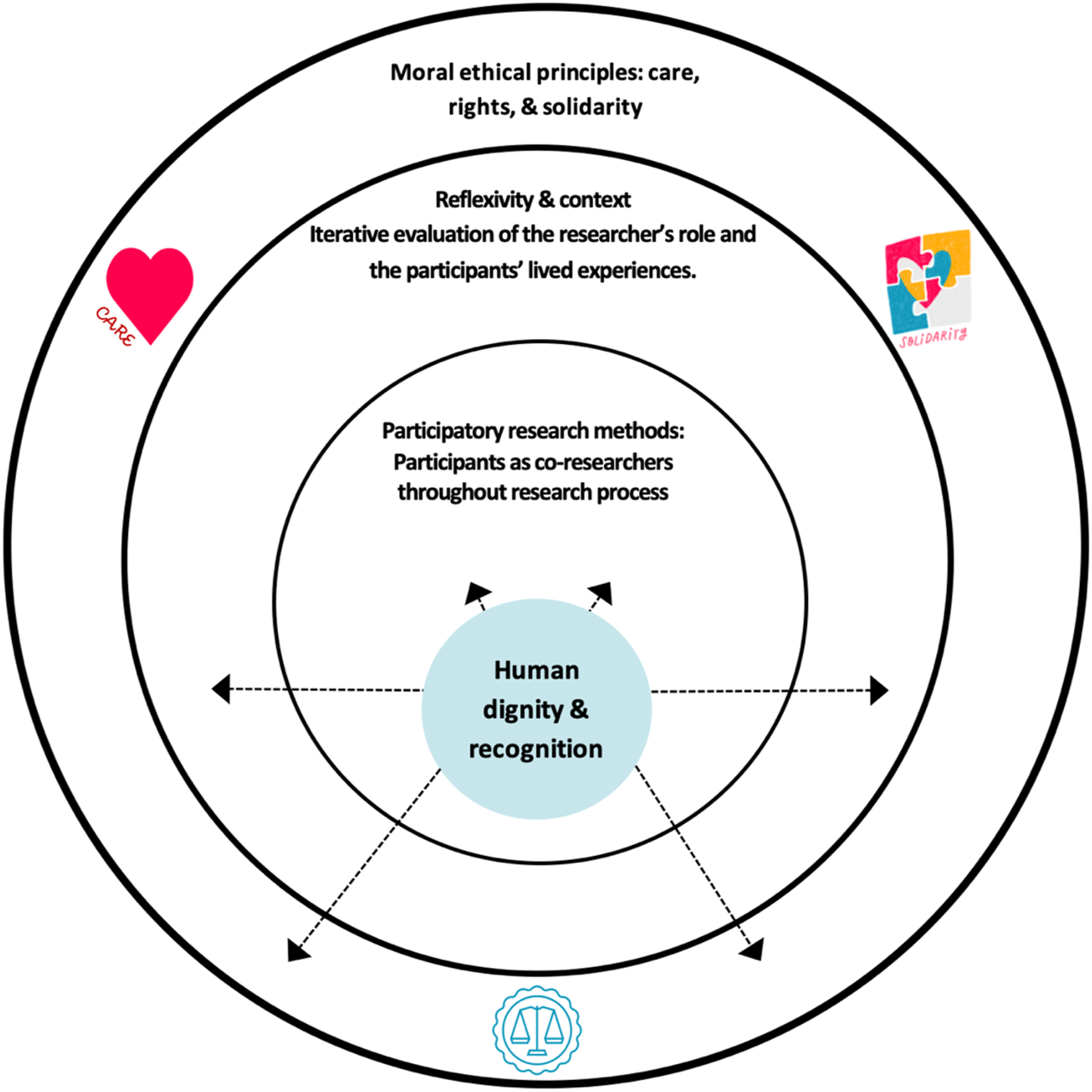
Navigating boundaries through recognition
The commitment to treating participants as ends in themselves (Kant) through active recognition (Honneth) profoundly shaped interactions and boundary negotiations. Spending six months deeply embedded within the partner NGO made maintaining a detached “outsider” stance impossible and ethically undesirable (Ryan, 2015: 2). This integration, involving daily interactions and stepping into roles beyond pure research (like teaching support), aligns directly with Honneth’s emphasis on mutual respect and relationship-building. Rather than viewing these shifting boundaries as a methodological contamination, the recognition framework positions them as opportunities to demonstrate care, affirm dignity (rights), and build connection (solidarity). For example, there were days I had to stand in for a teacher who had called in sick at the last minute, and other days I had to participate in extracurricular activities organised for the children. This helped me negotiate the dialectical understanding of being either an ‘outsider’ or ‘insider’; I understood myself to be a researcher with different identities while out in the field. This approach fostered the trust necessary for the undocumented migrant children, who were participants, to share their experiences authentically, directly reflecting the ethical thread connecting Kant’s moral philosophy with Honneth’s practical theory (Honneth, 1995; Honneth and Farrell, 1997; Kant, 1994).
Participatory methods: Enacting respect and enhancing research
A key outcome of applying this ethical framework (illustrated in Figure 1) was the deliberate adoption of alternative and participatory research methods not merely as techniques, but as relational practices which were aimed at enacting respect for children’s agency and expertise. In the place of solely relying on traditional interviews, the approach involved embedding myself within the participants’ (undocumented migrant children) context and adapting methods to foster trust and collaboration. These methods are detailed below:
Building trust relationally
For instance, before conducting Focus Group Discussions (FGDs) with the undocumented migrant children, I spent approximately six months volunteering daily at the NGO where the children attended school in the evening. The volunteer work involved observing classroom dynamics, assisting teachers, participating in activities (curricular and extra-curricular), and simply being present during lunchtimes. Such prolonged engagement moved beyond a researcher-subject dynamic, allowing relationships based on familiarity and trust to develop organically. This process enacted Honneth’s ‘care’ dimension, demonstrating a commitment that extended beyond data extraction and recognised the children as independent meaning-making individuals within their ‘school’ environment. The process also highlights Kant’s description of viewing individuals as ‘ends in themselves’ with inherent dignity. It was only after the fifth month, once a level of rapport was established, that I conducted FGDs, creating a safer, more open space for children to share their perspectives.
Adapting methods for agency
During the FGDs with children, I adopted methods to enhance their agency and comfort (see Thomas and O’Kane, 1998). Recognising potential language barriers or difficulties articulating complex feelings, pictures were used to prompt discussion about experiences related to schooling and belonging in South Africa (Blessed-Sayah et al., 2022). This visual method allowed children multiple ways to express themselves, valuing non-verbal cues and shared interpretations, thereby respecting their diverse communicative competencies. Following the FGDs, children completed worksheets involving drawing and writing about their school experiences. This was not primarily for data collection but served as a fun, expressive activity that acknowledged their participation and allowed the children a tangible way to reflect on the discussions, and reinforcing their role beyond just providing answers. Such activity also relates to Honneth’s explanation of recognising the agency of individuals and providing opportunities for upholding the moral duty to see children as ‘end in themselves’ capable of reasoning.
Contextualised engagement with parents
Another participatory method I employed was actively engaging the parents of the children. Data collection with parents involved home visits lasting two to three hours, allowing for observation within their daily lives and fostering a more relaxed, contextualised interview environment. This approach respected their space and expertise regarding their varying family situations. During these visits, parents often spontaneously, without my asking, shared important documents – such as problematic birth certificates or school application forms – which visually grounded their narratives and demonstrated their active engagement in navigating systemic barriers. In addition, I used an iterative consent technique during each of these home visits, re-explaining the study and checking comfort levels. This iterative process further enacted respect for the parents’ autonomy and addressed the power dynamics inherent in going into their private spaces (see Graham et al., 2013).
These examples illustrate that the value of participatory methods lies not just in the techniques themselves, but significantly in how they are applied relationally. By grounding these methods in the ethical principles of recognition – demonstrating care, upholding rights through processes like iterative consent, and building solidarity through shared activities and contextual understanding – researchers can more effectively treat participants as ‘ends in themselves’, respect their agency, and gather richer, more ethically sound insights (Kant, 1994; Thomas and O’Kane, 1998). This approach demonstrates that ethically sound practice, grounded in recognition, directly contributes to methodological rigor and research quality. Research thus moves from ‘extracting’ data (researching on) to conducting research with participants, especially those in vulnerable positions.
Shifting research from being conducted on vulnerable groups to being conducted with them introduces complexities around confidentiality and consent but is ethically essential (Bussu et al., 2021; Thomas and O’Kane, 1998). This participatory turn, advocated by researchers like Frediani (2015), and aligned with the principles outlined by Thomas and O'Kane (1998), is more than a methodological preference; it is an ethical imperative drawn directly from the principles of respect, recognition, and solidarity. A participatory alternative to conducting research transforms research into a collaborative endeavour that can challenge injustice, amplify marginalised voices, and contribute to a more equitable research landscape, ultimately resulting to more valid, meaningful, and impactful results.
Conclusion: Embracing ethical reasoning, reflexivity, and recognition
This paper has systematically argued for a fundamental shift in how researchers approach ethics when working with vulnerable populations, such as undocumented migrant children. Simply adhering to procedural requirements, while necessary, is significantly insufficient for navigating the complex moral landscape of such research. While guidelines like those developed by the ERIC project (Graham et al., 2013) offer valuable frameworks emphasising principles such as respect, benefit, and justice, and highlight common challenges, these guidelines also acknowledge that procedural compliance alone cannot guarantee ethical practice. The lived experience of children in vulnerable positions often reveals the limitations of such guidelines in addressing the nuanced, moment-to-moment ethical decisions researchers face. As the preceding sections have demonstrated, truly ethical practice demands in-depth reasoning, grounded in moral philosophy and enacted through critical self-reflection and contextual awareness. Researchers must move beyond checklists towards a conscious engagement with their ethical duties and the inherent dignity of their participants.
Achieving ethically sound practice requires researchers to be both theoretically informed and morally conscious, particularly regarding their positionality and the power dynamics inherent in studying vulnerable groups. As Guillemin and Gillam (2004) highlight, reflexivity is not just a methodological concept but an essential ethical tool. This essential tool compels researchers to continuously and consistently examine their assumptions, actions, and interactions. However, as Kiili et al. (2023) note, reflexivity remains under-reported and under-theorised in research with vulnerable children, often failing to critically engage with how researchers’ own social positions and histories shape the research relationship, and so, knowledge production. This reflexive practice, therefore, must be deeply rooted in context. A nuanced understanding of the specific socio-political, economic, and cultural realities shaping participants’ lives is significant for applying ethical principles like those derived from Kant and Honneth in a sensitive and meaningful way. Methodological empathy, guiding all research stages, becomes essential. Hence, an ethical research framework as illustrated in Figure 1 is necessary.
The ethical research framework presented as Figure 1 offers a conceptual tool to guide researchers in this endeavour. The figure visually pulls together the core arguments of this paper, integrating: • Moral ethical principles: Foundational values of care/empathy (Care), upholding legal/moral status (Rights), and fostering mutual support (Solidarity), derived from Honneth and aligned with Kant’s moral duty. • Reflexivity and context: This refers to the critical lens through which ethical principles are applied, requiring self-awareness and deep situational understanding. Thinking jointly about reflexivity and context means recognising that ethical awareness is not static but dynamically shaped by the specific research encounter. Context includes not only the participants’ immediate circumstances (for instance, precarious legal status, poverty, experiences of discrimination as in the South African context) but also the broader socio-political environment (for instance, xenophobia and securitisation), and the institutional setting of the research (such as pressures for rapid data collection). Reflexivity within this requires researchers to constantly interrogate how these contextual factors influence their own perceptions (shaped by their ‘habitus’ – dispositions and reflexes – and capital, as Kiili et al. [2023] suggest drawing on Bourdieu), their interactions with participants, and the interpretation of findings. Accordingly, reflexivity and context involve researchers asking: How does this specific context alter the power dynamics? How might my positionality within this setting influence trust or disclosure? How can ethical principles like ‘care’ or ‘solidarity’ be meaningfully enacted here, given these specific constraints and vulnerabilities? It moves reflexivity from a purely internal, individual process to a situated, relational practice, demanding ongoing evaluation of the interplay between the researcher, the participant, and the complex environment they inhabit. • Participatory research methods: The action-oriented approach ensuring participant agency and collaborative engagement as advocated by Thomas and O'Kane (1998) and illustrated in Section D, transforming children from data sources to active contributors who are ‘end in themselves’. • Human dignity and recognition: The central goal, shifting research from being on participants to being with them. This framework encourages researchers to see these elements as interconnected and essential for ethical practice.
Overall, the ethical imperative is clear. Researchers must actively resist simplistic, often dehumanising labels (such as equating undocumented status with criminality) and commit to recognising the full humanity and inherent dignity of all participants. This involves embracing the Kantian duty to treat individuals as ends in themselves, operationalised through the practical forms of Honneth’s theory of recognition – demonstrating care, respecting rights, and building solidarity. Adopting this philosophically grounded, reflexive, and participatory approach is not merely an ethical ‘add-on’; it is fundamental to conducting research that is just, respectful, and methodologically sound. This paper’s contribution lies in explicitly integrating moral philosophy (Kant and Honneth) into a practical framework for ethical decision-making. This framework addresses the gap where procedural ethics often falls short in guiding relational engagement and reflexive practice, especially concerning the power imbalances and potential for extractivism noted in research with children in vulnerable positions. By centring recognition and reflexivity within specific contexts, it offers a deontological way to operationalise the high-level principles found in guidelines like ERIC in the complex realities of fieldwork. It requires researchers to enhance their own understanding of ethics, viewing it not as a bureaucratic hurdle but as a continuous commitment. By doing so, researchers can move beyond potentially extractive practices towards the reciprocity and mutuality called for by Spyrou (2024) and contribute work that genuinely empowers undocumented migrant children participants, amplifies marginalised voices, and fosters a more equitable and ethical research landscape.
Footnotes
Acknowledgements
I thank Dominic Griffiths, Halima Namakula, Beatrice Akala, Limakatso Seeko, Tobi Dayo-Olupona, and Moleli Nthibeli for giving detailed feedback and comments on the initial and final drafts of this paper.

Funding
The authors received no financial support for the research, authorship, and/or publication of this article.
Declaration of conflicting interests
The authors declared no potential conflicts of interest with respect to the research, authorship, and/or publication of this article.