



Abstract
This ethnographic study investigates how a fad enters two Swedish school-age educare centers and how the children use it in negotiating social positions. The sports drink Prime is not mainly consumed for its content; instead, the bottles are valued as pop-cultural objects. By regarding the fad as discursive, the results show how children utilize their knowledge of the fad to influence their position in the institutions. The study contributes to knowledge on how fads enter and are translated into children’s social contexts, as well as the effects they have on children’s social lives in educational institutions.
Introduction
This study is part of a larger project on popular culture in Swedish school-age educare centers. Popular culture is a central aspect of children’s everyday media and consumer practices, both inside and outside of educational settings. The spaces and objects of play of contemporary childhood can be understood as medialized (Johansen, 2017; Ågren, 2015), as they assemble intertextual networks across digital and analog contexts, through toys, video games, and clothing (Aarsand, 2010; Jenkins et al., 2013; Wohlwend, 2017). Although these materials and media texts are produced within a global market, they gain meaning through children’s social uses (Buckingham, 2007), making consumption deeply embedded within everyday practices and inseparable from both media and childhood (Sparrman and Sandin, 2012; Ågren, 2015).
Within popular culture, fads are phenomena characterized by their novelty, quick rise to popularity, and subsequent disappearance (Aguirre et al., 1988). The colloquial use of the term is often connected to children’s use of popular culture, and with good reason, as it is a recurring theme throughout children’s leisure, with examples such as Cabbage Patch Kids, Tamagotchi, and, more recently, Labubu dolls (Buckingham and Sefton-Green, 2003; Mitchell and Reid-Walsh, 2002). These fads, or crazes, flourish in children’s everyday lives and peer cultures as they seep into children’s practices (Horton, 2010, 2012). As they assemble large heterogeneous followings, fads also work as possible social networking tools between individuals and peer groups, or as status symbols within one’s own group (Horton, 2012). In peer relations, materials and practices stemming from popular culture affect both the internal hierarchy and the composition of peer groups, depending on the interests, ownership, and knowledge of materials and themes from popular culture (Aarsand, 2010; Horton, 2012; Willett, 2011). As such, children’s social relations and popular culture are closely intertwined, and phenomena such as fads become central, albeit short-lived, in children’s leisure (cf. Horton, 2010).
Fads are nothing new in children’s cultures, but transmedia networks and social media put these in a different landscape (Jenkins et al., 2013; Wohlwend, 2017). Within globalized media systems, fads have been marketed utilizing cross-platform ‘micro-ontologies’ (Buckingham, 2007; Horton, 2010), where stories and practices in different media reach and capture the interest of larger groups of children. Contemporary fads spread rapidly through social media, where children’s participation through content creation is an active component in the marketing (Jenkins et al., 2013; Lee, 2025; Wayne, 2019).
With its central aim of providing pupils with meaningful leisure (Skolverket, 2022), the Swedish school-age educare institution (SAEC) is an important arena for children’s interests and social lives (Elvstrand and Lago, 2016). The majority of Swedish children between the ages of six and 12 attend SAEC after their school day has ended (Skolverket, 2024). The practice of SAEC is characterized largely by pupils’ freedom, combined with more formal, but often voluntary, teaching activities. With large groups of children of different ages, as well as the possibility to decide how to spend your time, this context comes with specific conditions for children’s relational work (Elvstrand and Lago, 2016). Popular culture plays a large role in children’s practices within SAEC (Dahl, 2011; Jansson and Wallner, 2023), yet we know little of how global fads influence children’s institutionalized leisure. The ability of popular cultural fads to engage different social groups makes them particularly interesting within an SAEC context, where social relations are a central facet both to how children structure their time within the centers and to the pedagogical philosophy.
With this in mind, the current article aims to explore the discursive power of a fad in the educational setting of Swedish school-age educare. The research questions attached to this aim are: (1) What values emerge through the Prime fad? (2) How are these values enacted in children’s social positioning in the SAEC practice?
Prime, YouTubers, and sports drinks – The lifecycle of a fad
In early 2022, YouTube celebrities and professional boxers Logan Paul and KSI released a brand of energy and sports drinks called Prime, which later that same year became a global phenomenon. As Summer drew close in 2023, Swedish news outlets described a “hysteria” that caused the beverage to go out of stock in stores, leading to surging prices (Häggström Lind, 2023; Harr, 2023). At its peak popularity, the sports drink, Prime Hydration, sold for up to 100 SEK (approx. $9–10), whereas other sports drinks cost around 15–25 SEK (Larsson, 2023).
“Functional beverages”, such as sports drinks or energy drinks, are often advertised as healthier alternatives to sodas, with connotations of athleticism and active lifestyles (Lopes Frias, 2021; Tomkinson and Elliott, 2020). Prime’s marketing has primarily pushed the caffeine-free 1 Hydration sports drink, and as a brand, has managed to reach children and adolescents worldwide. Moreover, advertising on social media from creators with a large fanbase among children and young people muddles the lines between advertisement and content (Jenkins et al., 2013; Lee, 2025; Thelandersson et al., 2025; Wayne, 2019). Prime’s official TikTok and YouTube channels have made use of this through the “stitching format” 2 of the platforms to use fans’ and, among them, children’s videos in their advertisements 3 .
Aguirre et al. (1988) note how fads often attract criticism from outsiders, who tend to view them as frivolous or even hedonistic. These sentiments are echoed in Swedish news articles from the height of the Prime fad, which focused on the product’s steep price, its connection to social media influencers, and that consumers were as young as 10 years old (cf. Harr, 2023). Moreover, media coverage of Prime was bolstered by societal discourses on children’s health regarding caffeinated beverage consumption (cf. Aftonbladet, 2023) and children’s vulnerability in marketing, consumption, and social media (cf. Cervenka, 2024).
The end of 2023 also saw the end of the Prime fad. To show just two examples, by April 2024, both Swedish and British news outlets describe the fall of Prime as the first quarter of the year showed a 50% fall in UK revenue (Rogelberg, 2024), while, in Swedish stores, the price of a bottle went down gradually, with some bottles selling for as low as 16 SEK a bottle (Ericson, 2024), a stark contrast to “20 SEK a sip” (Harr, 2023), which was reported on 6 months earlier.
Children’s interests in school-age educare centers
As children within Swedish lower (ages 6–9) and middle school (ages 10–12) finish for the day, they may spend their afternoons at school-age educare centers. The SAEC is an institution that, in comparison to similar facilities for extended education in other national contexts, has a fairly long tradition of facilitating care for children while their guardians are at work (Rohlin, 2012). As such, it is an integral part of the Swedish school system, with around 85% of children in Sweden between the ages of six and nine attending. The educational content of the SAEC is regulated through the national curriculum, emphasizing teaching based on pupils’ needs, interests, and experiences (Skolverket, 2022).
In educational institutions, popular culture tends to be disregarded in pedagogic activities, as it does not represent the (middle-class) culture of schooling (Henward, 2015; Sherbine, 2020). Popular culture can also sometimes be prohibited, in schools’ efforts to promote socio-economic equity (Fast, 2007). However, in SAEC, popular culture is used by teachers as a way of engaging children’s interests (Ljusberg, 2022). Still, there is sometimes a misalignment between the values represented in popular culture and the values and activities of SAEC, creating a possible dissonance between central tenets of the pedagogy and their application within the educational practice (Jansson and Wallner, 2023; Martínez and Olsson, 2021).
Popular culture, discourse, and power
To deepen our understanding of the role of popular culture, and particularly fads, on children’s social lives within school-age educare, we examine Prime as a specific micro-ontology (Buckingham, 2007; Horton, 2010) existing across different media and spaces. To this end, Foucault’s concept of discourse is used as a frame for understanding how knowledge of, and within, an individualized, historically specific phenomenon is constituted (Foucault, 2002b). This perspective on fads focuses on the inherently social and intertextual aspects of popular culture, media, and consumption (Fiske, 2011; Sparrman and Sandin, 2012). Fiske (2011) argues that popular culture becomes meaningful through people’s social practices, its relevance to everyday life, and its plasticity in how people use it (cf. Horton, 2010; Ågren, 2015). Moreover, intertextual elements in various forms of media, toys, clothes, videos, both within and between different cultural icons, are made meaningful through these social, everyday aspects (Fiske, 2011). Foucault, in turn, describes discourse as “practices that systematically form the objects of which they speak” (Foucault, 2002b: 54). Seeing popular cultural phenomena as discursive highlights the “rules” and knowledge that define the terms through which specific ways of using or engaging with a fad are constituted.
This text examines how children engage with a popular-cultural phenomenon by scrutinizing the rules that must be in play for certain ways of speaking and doing fads to be enabled and be meaningful, as well as the effects these rules have in social interactions. This approach foregrounds how the knowledge produced within fads functions as relations of power, shaping practices and determining the subject positions from where one can speak with authority, what can be said or done, and by whom (Ball, 2012; Foucault, 2002b). According to Foucault (1980), “[w]e are subjected to the production of truth through power, and the exercise of power except through the production of truth” (p. 93). Applied to fads, this oscillatory process means that knowledge(s), both internal and external to the discourse, shape discursive practices, which, in turn, construct how objects and actions are perceived. Therefore, knowledge and discourse are fundamentally tied to power, both as an effect, enabling or disabling a subject’s actions, and as an instrument, actively used within social interactions (Foucault, 2002a).
Foucault’s conception of power centers on how subjectivities are shaped through simultaneous processes of individualization and homogenization under regimes of truth and normality (Foucault, 1982). This includes how subjects are objectivized by others, how individuals internalize relations of power, and how they allow operations on their bodies, thoughts, and behaviors for personal achievement (Foucault, 1982, 1988). Taken together, this perspective on power emphasizes the multiple factors and the many tensions—institutional, social, or based on the pop-cultural discourse— that coexist and affect children’s agency when engaging with the Prime fad. It sheds light on how knowledge, subjectivity, and relations of power are produced through a short-lived popular-cultural phenomenon, and how these processes affect everyday practice in the SAEC setting.
Method
Setting and methodology
Ethnographic fieldwork was undertaken by the first author in two different school-age educare centers: at the rural Emerald School from September to November 2023, and the Ruby School, situated in the center of a large town, from November up until the Christmas holidays. The researcher spent around 3 h a day, two to 4 days a week, from the opening of the centers in the afternoon until closing. In total, 34 days were spent at the Emerald and 20 days at the Ruby school. Both schools had more than one department for SAEC, divided into age-based units. Research was carried out in the units for 8–12-year-olds at both schools, where all pupils and staff were asked to participate. In total, 43 children and 12 staff members participated in the study, and the data used in this article features 30 children and seven staff from both centers.
Children’s informed consent can be affected and complicated by aspects such as information being written for adults, which can be hard for children to comprehend (Gallagher et al., 2010). As such, per the recommendations of the Swedish Research Council (Vetenskapsrådet, 2024), information about the project has been formulated in separate ways with the target audience in mind to ensure that information is comprehensible for all parties, and all participating children, legal guardians, and staff members have provided written consent. During fieldwork, other factors, such as peer pressure or relations of power between researcher, child, and staff, have been considered (Gallagher et al., 2010; Horton et al., 2025). Thus, consent from staff—and especially the children—has been viewed as a reflexive, fluid practice, where a participant’s prior consent does not guarantee willing participation at any given time (cf. Wallner and Jansson, 2024). The study has been approved by the Swedish Ethical Review Authority (Reference no. 2023-00871-01) on May 6, 2023.
The fieldwork started with an inductive approach and the aim of exploring the role of popular culture within SAECs (Hammersley and Atkinson, 2019). The researcher took the role of a caring adult, a different adult than the staff, with curiosity about children’s knowledge and interests (Christensen, 2004; Horton et al., 2025). From the outset, the researcher adopted a passive stance, allowing children to initiate contact (Clark, 2011). This entailed being invited to participate in the children’s everyday activities, such as playing, drawing, or board games (Hammersley and Atkinson, 2019). This approach to participant observations was a fruitful way of building relationships with the children (Clark, 2011). Additionally, as SAEC settings are marked by large groups of children who can freely choose where to be and what activities to engage in, it functioned as an initial sampling strategy of choosing which children to follow and led to observations of and discussions on their pop-cultural interests. As relationships developed, observations became more focused, following different peer groups across ages and genders. Prime was seen in the children’s practices early on in the fieldwork, which was unexpected, as sports drinks were prohibited at the centers. This acted as a rich point (Agar, 2006), a departure from expectations, which stipulated further inquiry by choosing to observe children who brought bottles to the centers, as well as asking participants about the brand.
The fieldwork was mainly documented through jottings and photographs on site, which were elaborated on directly after the fieldwork (Emerson et al., 2011). Thus, the data used in this article consists of fieldnotes based on participant observations and informal conversations with staff and children, as well as photographs of the children’s art, toys, activities, and the premises. During writing up and later during the process of analysis, news reports, online stores, and social media content have been used as complementary references for putting the children’s stories into context.
Analysis
The analysis was initiated through open coding using the software MaxQDA. The initial codes were cross-referenced and categorized, aiming to elucidate shared cultural meanings and practices (Fiske, 2011; Gee, 2014; Hammersley and Atkinson, 2019). These categories were initially close to the data (e.g., Prime being expensive, talk about social media influencers, Prime bottles used as water bottles). This was then further analyzed into more abstract levels by utilizing the concepts of discourse and power (Foucault, 2002a; 2002b) to examine how these ideas form a specific knowledge base (e.g., what the price of Prime signifies, the intertextuality of Prime). This process has been recursive, going back and forth between specific excerpts, the Prime data corpus, and the dataset of the larger project in several steps, which aided in further understanding the effects of the discursive knowledge in social interactions (Foucault, 2002a), as well as to maintain consistency and validity in the analysis (Agar, 2006).
The results demonstrate how the Prime fad materializes in the everyday life of the SAEC. The first part of the results section features excerpts showing how the children and staff members express their knowledge of Prime. As such, the excerpts are representative of how the practices of children and staff systematically form Prime as an object. The latter section covers two examples where children make use of this knowledge of Prime in social interactions.
Results
The prime discourse
Colorful Prime bottles were often observed at the SAEC centers during the 4 months of fieldwork, and Prime was a common topic for conversation between children and the researcher during the autumn. Since the earliest news reports on the Prime “hysteria” in Sweden are from May and June (Häggström Lind, 2023; Harr, 2023; Larsson, 2023), this happened in the middle of the Prime fad. However, both of the participating SAEC centers were under school-wide sugar bans, a common practice in Swedish schools where pupils are not allowed to bring candy, sugary drinks, or similar snacks. This, in turn, meant that the material content of Prime—the liquid—was prohibited within the institution.
The following section aims to show how the fad moved into the educational institution and came to affect the daily practices of the children. Examining Prime as a discourse focuses on how the talk and practices with and about the bottles draw upon knowledge constituted within a specific intertextual network based on a shared history (Foucault, 2002b). First, the children’s practices surrounding the bottles are highlighted, followed by an examination of how the intertextual network on which Prime is based was expressed by the children.
A prized, pricey possession
The following excerpt is from the researcher’s first encounter with Prime during the fieldwork at the Emerald Center in September 2023. Pelle and Bertil are seated at a table, painting. On the table are paint brushes, acrylic colors, papers, and three brightly colored bottles. I ask the pupils what they are painting. ‘We’re painting Prime bottles’, Pelle says without looking up. ‘Prime, what is that?’, I ask. ‘It is a really expensive beverage. It costs 100 crowns’ (approx. $10). I’m surprised by the cost. ‘What, a hundred crowns?’ ‘Yes, but they only cost 39 at the grocery store’, Pelle answers. ‘There are also fake ones’. He points at the red bottle and continues: ‘They don’t have this white line around the letters’. (Excerpt 1, The Emerald Center, 7 September 2023)
Throughout the fieldwork, the most common talking point regarding the Prime beverage was the high cost. Children at both SAEC centers mentioned the high price tag and the existence of two versions: a cheaper one available in regular stores and an elusive, expensive version. The price ranges of these were stable amongst the children, where the former cost between 29 and 39 SEK and the latter 100 SEK. There were fluctuations in the reasoning behind this duality, however. As Pelle explained, the fake Prime could be identified by the visual attributes of the bottles. In contrast, other children equated fake with the cheaper versions and the ones sold in the supermarket. In other instances, low cost was juxtaposed with the exclusivity of the pricier variants, which were unavailable in regular grocery stores or had special flavors.
The recurring topic of the high price of Prime highlights two key points. First, the idea that Prime is expensive is central to the power of the brand- and fad identity. Pelle introduced the beverage through its price, even though what he had paid had dropped from 100 to 39 SEK. This sentiment was also propagated by news reporting, where high prices became a defining feature of the Prime craze (Häggström Lind, 2023; Harr, 2023; Larsson, 2023). Second, the allure of the colorful bottles lies not only in their high price but also in the hunt for the ‘real’ or best version, a theme also found in social media content 4 , where creators scour stores to find what they call ‘real’ Prime. Among the participating children, notions of authenticity and rarity were linked in various ways to the different price categories. Together, these narratives show how the price is used discursively, as both the high price and the value of authenticity and exclusivity function as rules that delineate possible ways of speaking about the price beyond the actual cost.
The following excerpt focuses on a third aspect of the Prime discourse, namely, the collecting. ‘Have you tasted Prime?’, I ask Adam. ‘Yeah’, he tells me, ‘I have 2 Tropical Punch, one Lemon Lime, two Raspberry, and one Ice Pop’. (Excerpt 2, The Ruby Center, 4 December 2023)
Several children boasted of the number of flavors they had bought or tasted. Although the flavors were a recurring theme in children’s and staff discussions on the subject, the children did not discuss the actual taste unless an adult—staff or researcher—asked about it. As Mia, a teacher at the Ruby Center, explained, some children who claimed to own Prime did not know what it tasted like. Instead, as Adam recounted the bottles he owns in the excerpt above, the flavor is secondary to the variety and size of one’s collection. Staff members at both locations described children collecting and displaying the bottles to other children as common practices during the fad.
Collecting is a well-known feature in children’s fads and can emerge within local practices in or between peer groups as well as from the design of the commodity (Buckingham and Sefton-Green, 2003; Horton, 2012). In the case of Prime, this requires understanding the bottles in particular ways. Even though Prime is not designed as a collectible, the ways price, exclusivity, and variation between bottles are constructed in the children’s narratives shape Prime as something more than an expensive drink, making collecting possible. Moreover, since sugary drinks were prohibited, the children brought Prime bottles filled with water, which requires them to value the bottles—independently of their contents—unlike most other consumable goods. In contrast to, for instance, an exclusive bottle of wine, Prime containers retain their value and exclusivity after consumption. This allowed the children to comply with institutional dietary regulations while still participating in the fad. These factors, internal and external to the discourse function both as the cause and the effect of the knowledge produced (Foucault, 1980) and illustrate how Prime is made to fit the everyday practices of the children in this context (Fiske, 2011).
Both SAEC centers had prohibitions on other collectibles, such as Pokémon and football cards, as the staff deemed them a cause of conflict (cf. Henward, 2015). Yet, despite acknowledging that Prime bottles were collected and displayed, the staff did not ban them. Bringing water-filled Prime bottles, neither a sugary beverage nor a collectible toy, thus functioned as resistance through evasion of the dominating forces of the institution (Foucault, 2002a; Mitchell and Reid-Walsh, 2002). At the same time, fads can be understood as operating as homogenizing forces, determining what one must own or discuss to be “with the times” (Aguirre et al., 1988; Foucault, 1982). The knowledge reproduced through Prime bottles also signifies an individualization and elevation of the self through attainment of the best collection (Foucault, 1982, 1988). The fad is thus situated within a network of relations of power, both constraining and enabling one another, affecting how the children’s practices are shaped, and how the bottle is understood (Foucault, 2002a).
Knowing prime – Intertextual practices
Even though the fad revolved around the bottles, the children discussed content from social media as closely connected to Prime. The following examples highlight how Prime is placed in an intertextual network that enables multiple subject positions for speaking within the discourse (Foucault, 2002b). Alva sits next to me during snack time. ‘Maybe you can help me with something’, I tell her. ‘At the other school I visited, there was a really popular thing called Prime.’ Alva shows me a wide grin and starts chanting in English. ‘We are Prime boys, we are Prime!’ ‘What chant is that?’, I wonder. ‘It’s not a chant! It’s a song!’ ‘Where is it from?’ ’TikTok.’ (Excerpt 3, The Ruby Center, 18 December 2023)
In this excerpt, Alva acknowledges that she knows what Prime is by singing. The song itself is a meme from TikTok and YouTube, first created and uploaded by a child and later stitched by the creators of Prime to be used as an advertisement 5 . By using this song, Alva positions herself as someone who engages with social media content closely connected to the product. In turn, Alva’s singing also highlights how consuming Prime as a popular cultural text is a transmedial practice that can be done in various ways and not just by buying bottles (Fiske, 2011; Jenkins et al., 2013; Wohlwend, 2017). Furthermore, it hints at the fundamental relationship between Prime and social media use.
The connection to social media, and the influencers behind the drink, is something brought up by several children, as is further seen in the next excerpt. Here, Pelle and Bertil are painting Prime bottles, which, with their strong visual language, were a recurring inspiration for drawings in the SAECs. As Pelle and Bertil painted their bottles, they took great care in replicating the shape of the bottle, the colors, and especially the black and white text. I look at Pelle’s bottles. ’I think I’ve seen these on TikTok’ I tell him. ‘Yeah, they’re really popular.’ He replies. ‘Is that where you’ve seen them?’ ’Yes, and on YouTube. “Kayesaih” drinks them.’ I tell him that I don’t recognize that YouTuber. ’It’s spelled K, S, I.’ Pelle continues. […] Bertil, another boy, says ’He is friends with a boxer’, (Excerpt 4, The Emerald Center, 7 September 2023)
In this excerpt, Pelle demonstrates his knowledge of the brand by declaring that he watches the YouTuber KSI, one of the creators of Prime. Bertil builds on this knowledge by stating that KSI is friends with a boxer, most probably talking about the other creator of Prime, Logan Paul. Although Bertil had not brought any bottles, his displayed knowledge could be viewed as a legitimate entrance strategy into the conversation. Referring to creators and online content becomes a way of participating in the fad, illustrating how cultural expertise can compensate for not owning the item (Pugh, 2009). Likewise, Pelle and Bertil’s drawings of Prime signal knowledge about the product, as they reproduce its visual design (cf. Jansson and Wallner, 2023; Willett, 2015).
In these excerpts, Alva, Pelle, and Bertil all position themselves within the discourse of Prime, even though only one of them displays a physical bottle. Their statements express the importance of social media as a space where the Prime fad finds its origin and application (Foucault, 2002b). The children draw on social media content as intertextual knowledge and as ways of legitimizing subject-positions, bringing creators and online formats into the analog setting through talk and song (cf. Wallner and Jansson, 2024).
In summary, values of attainment and cultural knowledge emerge through the Prime fad. Combined with the product’s cost and its prohibition at the SAEC centers, these practices can be seen as exterior institutional, social, and economic factors that aid in shaping discursive practices (Foucault, 2002b). Collecting reproduces and legitimizes the knowledge of Prime as contingent on price, exclusivity, and authenticity, and further cultural knowledge of the discourse is constructed through accessing and referencing social media. Both are ways of joining in the fad. The Prime discourse resembles earlier children’s fads yet depends on contemporary media technologies and surrounding practices, operating through an internal logic. The relations between these aspects and the bottle itself are necessary for speaking about Prime and constructing the bottle as a discursive object: a valuable container and cultural text rather than a beverage (Foucault, 2002b).
Prime in action
In the previous section, we argued that the Prime fad functioned as a discourse, structured by rules connecting several different elements, making up certain knowledge and practices. This section portrays how the children utilized these values embedded in the Prime discourse to position themselves within the social groups of the SAEC.
The power of prime
Discourses order what can be thought, said, and done, and, as such, operate in the relations of power in everyday social encounters (Foucault, 2002b). During the Prime fad, the children ordered their social encounters in relation to its values. In the first excerpt, Pelle enacts the monetary and symbolic value of Prime through an “exhibition” of his three bottles, arranged on a drawing table in the largest room of the Emerald Center and surrounded by plastic coins (see Figure 1). Pelle’s prime exhibition (The Emerald Center, 7 September 2023).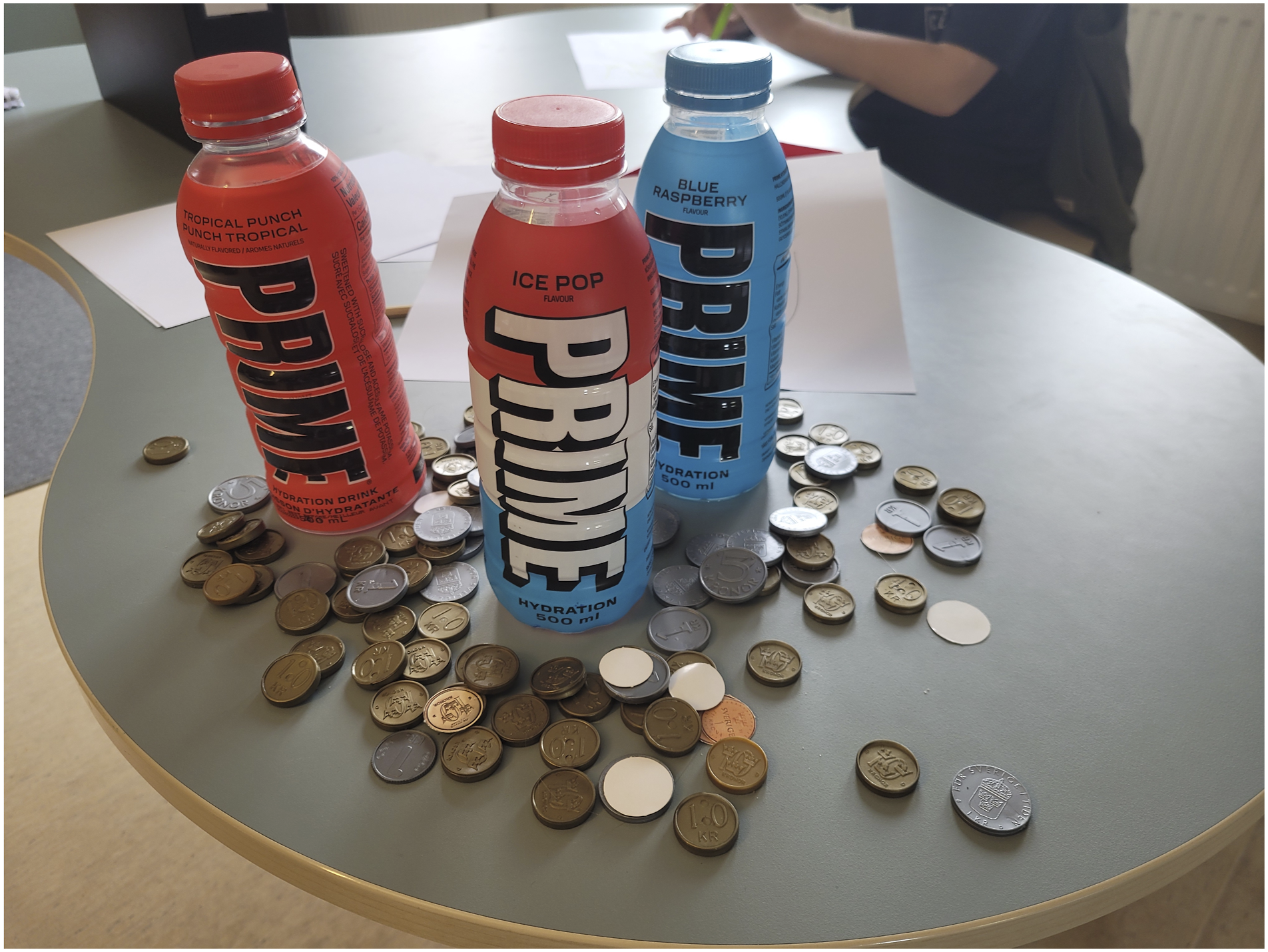
By creating his exhibition, Pelle frames the bottles as more than just residual packages. They are understood as prized (discursive) objects (Foucault, 2002b) and important popular cultural texts, which makes them worthy of being displayed in this fashion. The exhibition itself is a discursive statement, contingent on previous statements, conditions, and practices of the Prime discourse (Foucault, 2002b). The coins surrounding the bottles encapsulate aspects of Prime, such as money and buying power. Furthermore, Pelle appropriates commercial texts of the brand through the visual language of his exhibition. The logos face forward, the bottles form a triangular arrangement, and the coins are scattered in ways reminiscent of ice cubes and fruit in Prime’s social-media advertisements. These elements indicate Pelle’s familiarity with Prime’s online presence and his ability to mobilize its visual aesthetics, a literacy skill based on the Prime discourse. The exhibition emerges from relational elements such as attainment and status and is therefore an expression of the power of Prime (Foucault, 2002a).
The act of exhibiting is inherently social: it is meant to put possessions on display for others. In this regard, Prime as a cultural text becomes an instrument for positioning yourself within a social context (Foucault, 2002a). As the SAEC houses heterogeneous groups, age often acts as a rationality of power and status within the center (Hurst, 2017; Lago and Elvstrand, 2019). This is further reinforced as the older pupils of the Emerald finish school for the day and arrive at the SAEC center: When the older pupils come to check in for the day, a group of five pupils is drawn to Pelle and the table with the bottle exhibition. They ask whose bottles they are and start to talk to Pelle about the brand. He explains to the older students that the bottles are not fake and that Pelle bought them for a hundred crowns at the nearby grocery store. (Excerpt 5, The Emerald Center, 7 September 2023)
The Prime bottles act to draw the attention of the older children, which signals a shared value between these students and Pelle, as the producer of the exhibition. Earlier, as seen in the first excerpt, Pelle explained that he bought his bottle at the grocery store for the oft-repeated lower price of 39 SEK. When speaking to the older children, however, Pelle inflates the price of the beverages to that of the exclusive and “not fake” bottles. As was shown earlier, the price is a central theme in how Prime is talked about, functioning discursively to signify authenticity, rarity, and prestige. By adjusting the price depending on his audience, Pelle attempts to elevate the status of his collection to the older children. This demonstrates his understanding of how price is constructed within the discourse and what values are attached to it. In turn, he positions himself as knowledgeable about Prime, though in a different subject position than earlier interactions produced. Despite the shifting details, Pelle consistently reproduces the discourse’s core values of exclusivity and authenticity. Moreover, emphasizing the price and authenticity in this manner also positions the older pupils as knowing subjects of the Prime discourse for the statements to be relevant.
Pelle adapts the fad’s rationalities of power to stake his claims and position himself more favorably. Implicit in this example are other forms of power relations, such as age differences between the children, wealth, as well as institutional forces, including rules about collecting and sugary drinks. This example shows how knowledge of how the Prime is constructed becomes a variable in networks of power within the context of the SAEC (Foucault, 2002b). By exhibiting his bottles, and through his discourse-specific knowledge of Prime, Pelle is working to strengthen his position in the SAEC age hierarchy.
Status in peer groups
The composition of the pupil group at the center varies, depending on the working hours of the parents. This means some children go home earlier than others. In the example below, Stina’s (in Grade 3) regular friend group has gone home for the day, but she knows some of the girls in Grade 2 and joins them as they are working on coloring at the SAEC center’s lounge group. Stina does not usually accompany this peer group. As they draw, Stina initiates a hand-raising game about who has pierced their ears and at what age they got them. After a few minutes, Ronja introduces another topic: ‘Raise your hand if you have Prime!’ Ronja says, quickly throwing her arm up in the air. Stina’s, Vera’s, and Lina’s arms shoot up just as fast as Ronja’s. Ebba looks around and also raises her arm, but with a hesitant expression. ‘I’ve tried ALL the flavors!’ Stina says while coloring. ‘Even Lemonade?’, Vera wonders. ‘Yes!’. ‘Ice Pop? Blue raspberry?’ Ronja and Vera start questioning Stina about all the different flavors. After naming all the flavors, they switch to naming all the colors instead: ‘The blue one? The purple one?’ (Excerpt 6, The Emerald Center, 9 October 2023)
The hand-raising game is an effective way of positioning yourself and your peers in relation to a specific topic. When Stina begins by asking if and at what age the other girls got their ears pierced, she exposes relations of power that work in the group, rooted in discourses of age and gender. Subjectification is the dual process by which individuals are placed as subjects under rules through which they and everyone else must know them (Foucault, 1982). In this case, the game establishes a norm for when girls should get their ears pierced and simultaneously requires each participant to position herself as a subject in relation to this norm and the rest of the group.
Here, Prime becomes an object that acts similarly to age and gender in organizing subject positions according to what is considered normal. Engaging with a fad becomes a way of showing and seeing who is “in”, and as shown earlier, both ownership and knowledge serve as legitimate forms of participation. Although none of the girls has brought the colorful bottles to the center, Ronja positions herself as a competent participant within the Prime discourse and challenges the others in the group. Simultaneously, she utters an inclusionary criterion based on a possessive binary: either you claim to have it, or you do not. In doing so, Prime functions as a homogenizing force akin to age or femininity, setting the norm through which the group is ordered (cf. Foucault, 2002a).
Stina declares to the group that she has tried all the flavors, which is an impressive feat by the collectible logic of the Prime discourse. But the legitimacy of her statement is immediately scrutinized by Vera and Ronja, who test her knowledge of specific flavors. In questioning her, they simultaneously show their knowledge of Prime and position themselves as subjects speaking within the Prime discourse. As such, even though Ronja’s question set the bar higher than mere knowledge of Prime, the discourse can be performed as a means to improve positions based on relations of power active in the interaction.
To conclude, the children use the fad to change or affirm their social positions. Through its values, such as popularity and symbolic monetary value, the Prime fad becomes an effect and an instrument of power that operates both through norms and through individualizing practices. Younger children can attain a strengthened position among older children through Prime, while older children can demonstrate their involvement in the fad and thereby affirm their social positions. These examples demonstrate how the values of the fad combine with the local rationalities of power in the centers, such as age and group belonging.
Discussion
By examining Prime as a discourse, we have attempted to elucidate the relations between its elements, the rules governing them, the multiple meanings attached to the bottles, and the intertextual foundations on which these meanings rest. Although the fad is centered around a sports drink, to the children, this fad is about something else: Prime is a collectible, a social media item, a costly status symbol. As a discourse, Prime has an internal logic, a specific knowledge that is used in peer interactions, affecting existing rationalities of power in the SAEC center, and has concrete effects on the subject positions of children at the centers.
The discursive practices of the fad found online also appeared among children at both SAEC centers, illustrating how the local uses of the fad reflect a larger discourse spanning multiple settings. As Logan Paul and KSI promote their brand, they do so both as the producers of the commodity and as influencers marketing the product. The results display how these personas, as well as the content they produce and stitch, are important elements of the fad. This puts these influencers in a beneficial position and is a probable cause of the success of the product. This is perhaps a sign of the times, as they are far from the only influencers selling products aimed at children. Influencer marketing and brands are forms of advertising that not all children engage with critically, and this is complicated further by parasocial relationships between viewer and influencer if the product is created by the influencer in the form of merch (Martínez and Olsson, 2019; Thelandersson et al., 2025). Furthermore, the participatory culture of social media, as well as the nature of fads and peer culture, blurs the line between producers and consumers, making children part of the global marketing (Jenkins et al., 2013; Lee, 2025; Wayne, 2019; Wohlwend, 2017).
Prime can be seen in light of the affordances specific to school-age educare, as the results show how the SAEC context and the Prime discourse converge and enable different ways for pupils to engage in inclusionary or exclusory practices. The fad allowed the children to engage in displays of expensive, high-status collectibles for their peers. Other popular cultural objects in the participating centers, such as trading cards, were prohibited for similar reasons, as is a common practice within educational institutions (Fast, 2007; Horton, 2012; Seiter, 1993). While the Prime beverage itself was prohibited as a sugary drink, the containers persisted because their value was constructed not in their contents but as cultural texts embedded in discursive practice (Fiske, 2011; Sparrman and Sandin, 2012). As such, these anomalies found a place in the centers despite institutional constraints.
The demographic composition of the SAEC entails different social relations than in the school setting and thus different social negotiations (Lago and Elvstrand, 2019). Fads, such as Prime, work as a possible bridge between ages and peer constellations, contributing to new interactions (Horton, 2012). They influence the negotiations and relations of power in the SAEC centers through their presence, both as instruments and as effects of power (Foucault, 2002a), to stand out and fit in.
For teachers, the speed and intensity with which a fad spreads seem to make it hard to stay updated. At the end of the fieldwork and in the months following, Prime was relegated to the clearance shelves in most supermarkets. It was a fast and intense trend, as one teacher described it in a follow-up mail conversation. As such, it entered the last stage of a fad, namely the rapid descent into obscurity (Aguirre et al., 1988) and took its place beside other extinct crazes, such as the Tamagotchi (Buckingham and Sefton-Green, 2003). The characteristic short lifespan of a fad does not mean that its impact on the social lives of children is lessened, as the results show. The Prime discourse was contingent on logics outside of its domain, such as economic worth, and access to, and knowledge of, social media. In this sense, the values attached to Prime reflect contemporary concerns among these children, such as age, money, social media, and fame, and demonstrate how these topics are mobilized in the everyday leisure of the SAEC institution.
Footnotes

Ethical considerations
The Swedish Ethical Review Authority (DNR 2023-00871-01) approved the study on May 6, 2023.
Consent to participate
Written informed consent has been provided by all participating pupils and their legal guardians, and by all participating staff members prior to participating.
Author contributions
David Rapp is the corresponding author of the text, principal instigator of the design of the study, has collected data, and had the primary part in analyzing the data. Lars Wallner has collaborated in the design of the study, interpretation of data, and writing and critical revision of the text. Tünde Puskás has collaborated in the design of the study, interpretation of data, and writing and critical revision of the text.
Funding
The authors received no financial support for the research, authorship, and/or publication of this article.
Declaration of conflicting interests
The authors declared no potential conflicts of interest with respect to the research, authorship, and/or publication of this article.