




Abstract
This article examines what we can learn about kindergarten childhoods when using archived records about children’s free play with building blocks in the 1930s. Taking its starting point in previous research about how Froebelian building blocks have been part of kindergarten ideology and education, the article explores how visual and textual sources promote different versions of childhoods in and around a kindergarten institution. Moreover, the article argues for the importance of not only paying attention to children’s archived visual and verbal voices, but more noticeably, also to girls’ and boys’ non-verbal activities and engagement, i.e., non-verbal “voices”.
Keywords
Introduction
Building blocks were among the material objects developed by Friedrich Froebel (1752−1852) to be used in his education practice during the nineteenth century and onwards to improve children’s intellectual and practical skills. The use of building blocks became part of the global kindergarten movement as a “traveling idea” (Prochner, 2016), and additional designs of building blocks were used in different parts of the world (Bakker, 2016; May, 2016; Prochner and Kirova, 2016; Read, 2006). Different designs implied varying ideological statements in relation to kindergarten and early childhood education; for example, what was considered most advantageous for children to build with: small or large blocks, or both (Prochner, 2011; Prochner and Kirova, 2016). In addition, there were arguments concerning how aligned the activities should be in relation to Froebel’s ideas; advocates of “conservative” versus “evolutionary,” or even “revolutionary,” practices were part of the kindergarten discourse during the twentieth century. Conservatives promoted the importance of instructing children, who were expected to imitate an adult way of building, while revolutionists advocated for freer explorations by children, and showed how building blocks could be part of play (Prochner and Kirova, 2016). There was also the question of whether children became passive due to the teaching with blocks, or if they were self-activated and learning; with some arguing that “order” must be used to achieve the Froebelian ideals (Bakker, 2016). Moreover, in New Zealand, kindergartens were founded for poor children in disadvantaged areas, and here building blocks produced “Froebel’s child builders,” to be molded into industrious citizens of the new colony; thus, “Block building became an essential educational activity in the real life of kindergartens” (May, 2016: 170).
This kind of research, which examines the role of Froebelian building blocks in varying ways, demonstrates that building blocks have been productive in the writing of kindergarten history, and central to the role of material culture in the history of the institutionalization of early childhood. The research is mainly based on resources such as teachers’ records, educational instructions, syllabuses, autobiographies, and letters. In this article, we add to such research by using Sweden as a case to study the different ways in which building blocks were used in a Froebelian kindergarten during the 1930s. We primarily use archived first-hand written observation records of children’s play with building blocks, in which children’s activities, interactions, and verbal and non-verbal communication were documented in great detail. In addition, a movie, a photograph, and a lecture published in a kindergarten magazine, all from the same decade and kindergarten, are included in the analysis. We can show how building-block practices evolved in mixed groups of children aged 1–2 years and 3–4 years, and how adult notions of freedom were actualized through these activities. We also discuss how the varying source materials permit different interpretations of the children’s supposed freedom, and hence suggest varying gendered versions of kindergarten childhoods. This offers an addition to earlier historical research on Swedish kindergarten childhoods and the influence of Froebel (Fredricson, 2020; Hatje, 1999; Holmlund, 1999; Westberg, 2016), as well as a discussion on how the use of varying historical records become important in processes of interpretation. The question guiding the analysis is: What can we learn about gendered kindergarten childhoods when analyzing aspects of freedom and play from varying recordings of children’s building activities during play? To answer this question we examine relational work, free exploration, imitation, and resistance.
Contextualization: Sweden and building blocks in the 1930s
The archived observation records of children’s play with building blocks that we study in this article belonged to a kindergarten in Norrköping, at that time the city with the most female textile workers in Sweden. It was a time characterized by industrialization and urbanization. Hence, there was an acute need for childcare services, and the bourgeois sisters Ellen and Maria Moberg founded Froebelian kindergartens for both middle-class and working-class children to meet such needs (Hatje, 1999; Holmlund 1999). This was in line with the first international wave of preschool development, when working-class children became of interest (Brehony, 2004; Holmlund 1999; Read, 2006). In research, the sisters are presented as pioneers of the Swedish kindergarten movement (Hatje, 1999). It is also argued that they were aware of the critiques and controversies surrounding Froebelian pedagogy, which was part of the kindergarten movement in the USA around 1900 (Brehony, 2004; Fredricson, 2020). According to Fredricson, it is clear that the sisters consciously steered the interest in order not to make room for similar critiques in the Swedish/Nordic context. When the sisters started a Nordic journal about kindergartens, in the 1920s, the central idea was to spread Froebelian pedagogy and also give voice to alternatives, including child psychology, in order to open up space for varying inspirations about how to organize childcare (Fredricson, 2020).
One such alternative was Alva Myrdal’s idea to initiate “large nurseries” [Sw. storbarnkammare] in larger cities, instead of kindergartens. These nurseries, however, were not based on Froebelian pedagogy. Instead, it was intended that child psychology, now introduced in Sweden, should inform the pedagogy (Fredricson, 2020). However, that did not rule out building blocks in general, it was only Froebel’s blocks that were considered inappropriate, Myrdal maintained: “these Froebelian play materials might give the children passive pleasure, while their real purpose is to give the adults a sense of pride in the production” (Myrdal, 1935: 118). 1 When she listed appropriate toys for a “large nursery,” building blocks were mentioned for 2, 3, 4, and 5-year-olds, and were among the “most appreciated toys” among the children (Myrdal, 2012 [1936]). In total, Myrdal presented 554 building blocks of varying sizes and shapes, mainly larger than the Froebelian ones. In addition, she proposed small cubes in different colors, i.e., the same size as several of the Froebelian blocks but in additional bright colors of red, green, yellow, and blue, and not stacked in boxes (Myrdal, 1935: 125).
However, and even though the Moberg sisters and Myrdal shared a vision of increasing the role of children’s institutions in society, the issue of if, and if so how, Froebel should be an inspiration continued to be negotiated in the magazine (Fredricson, 2020). The sisters acknowledged that child psychology could be included, but argued that it could never be allowed to take over from the role of studying children in practice. They claimed that it was essential that student teachers trained themselves via their own observations, an idea also promulgated by Susan Isaacs in the UK (Giardiello, 2014: 115), and whom one of the sisters had visited (Hatje, 1999). Elsa Köhler, the Vienna-based child psychologist invited to Norrköping by the Moberg sisters, lent authority to such a view, because she trained students in an ordinary kindergarten and not in laboratory kindergartens or kindergartens at universities, as child psychologists usually did (Lindgren et al., 2023). In addition, Köhler also focused on the students, and not the teachers, as Dewey did (cf. Prochner and Kirova, 2016: 105).
Without mentioning Froebel, the sisters continued to covertly re-enact his ideas (Hatje, 1999), by addressing the topics of children’s freedom and children’s play in ways similar to previous and contemporary discussions in the UK, the USA, and the Netherlands (cf. Bakker, 2016; Giardiello, 2014; Prochner and Kirova, 2016). According to Moberg, kindergarten should “provide plenty of time and space for children’s free play both indoors and outdoors” (Moberg, 1937: 12, emphasis in original). Moreover, kindergarten children should access the “greatest possible freedom” (Moberg, 1937: 11, emphasis in original), which was in line with Froebel’s ideals about giving children opportunities for active discovery, moving, and experimenting with the body (Bakker, 2016).
Moberg’s text in the magazine was a written version of a lecture she had given to politicians interested in social child welfare in Stockholm, explaining what she meant by children’s freedom; namely, that they should not be immobilized on benches and chairs, and should not be “chained in long trails” by standing in line for long periods (Moberg, 1937: 11). Instead, the offering to children in kindergarten should be about both time and material; they should have time to play and materials to play with freely. Play, she contended, was a prerequisite for practicing freedom in the kindergarten (Moberg, 1937). This was also emphasized in a movie produced for the Norrköping kindergarten’s anniversary, in which such practices of freedom were visualized via children building with Froebelian building blocks (Figures 2(a)–(c) and 3(a) and (b)), as well as in an archived photograph of toddlers from the same decade (Figure 1) analyzed in this article. Photograph from the 1930s of the toddlers’ room with small children, and two students, i.e., observers. The furniture was adapted to the children’s size, and the adults look a bit cramped and oversized. There are ordered building blocks on the table in front of two boys (Photograph, K1:3 No. 438, NSA, courtesy of the city archive of Norrköping).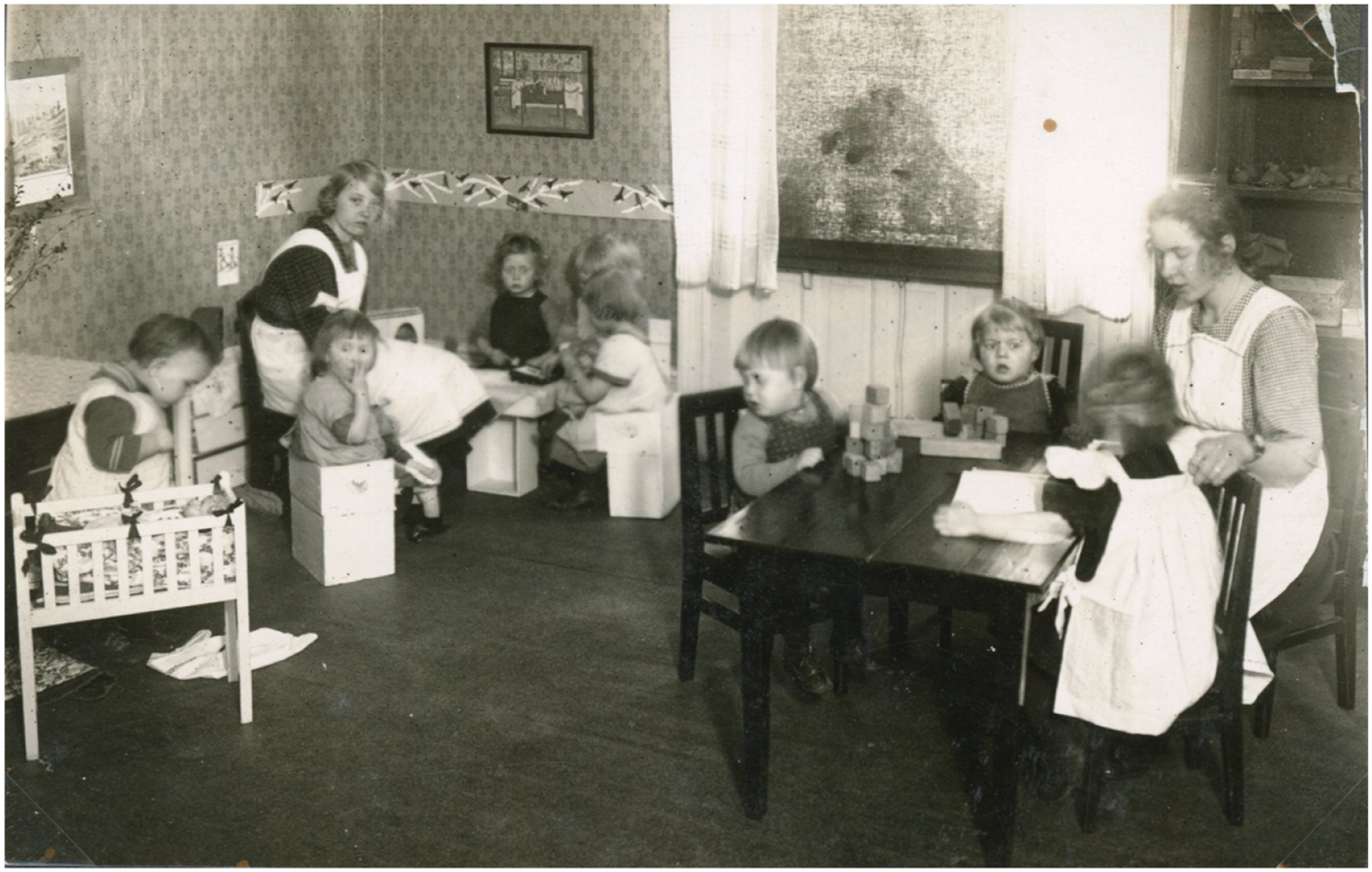
By making herself a proponent of freedom and free play, Moberg aligned herself with the “revolutionaries” in the USA (cf. Prochner and Kiranova, 2016: 101). At the same time, we know from previous research that children in the Norrköping kindergartens took part in lessons where they built under instruction from a teacher who led the activity (Lindgren et al., 2023). One observation record tells us that a boy child could lead such a lesson, and that his playmates followed his instructions, as part of the “free play” initiated by teacher Moberg. This demonstrates that the children were well aware of what was expected of them, and that they had mastered the (adult) lesson protocol, which included both being able to follow a script and having the capacity to handle individual choices. As this shows, a kindergarten building lesson could be part of free play, and free play could be a space where children actualized for both themselves and the adults what it was like to be in kindergarten, comprising handling both order and free play (Lindgren et al., 2023). In this article, we focus on free play and building blocks.
Materials and methods: the use of archival empirical sources
Inspired by previous research about kindergarten history and its interest in building blocks, we started to look for building blocks in the written observation records from the Norrköping kindergarten. The collection comprises approximately 370 observations from 1931 until the late 1940s. For this article, we have selected three observations from the earliest records, when Köhler visited Norrköping, between 1931 and 1933; one lasted 45 min, two are 30-min observations, in total 2 h and 5 min. Girls and boys aged from 12 months upwards handled varying types of Froebelian building blocks, using them in what was referred to as “free play.” The children had varying socio-economic backgrounds, they could have been working class or middle class, and we do not have information about the individual children’s backgrounds (cf. Lindgren et al., 2023).
The movie we have analyzed was produced for an anniversary and was first screened in 1937. It was presented as “a visit” to the kindergarten (Movie, 1937, K4:1, NSA). During the 1930s, a number of movies depicting different types of childcare and kindergartens were produced in Sweden (Grunditz, 2018). This particular movie promoted a successful kindergarten housed in a recently built facility. 2 Why the photograph was taken is unclear (Photograph, K1:3 No. 438, NSA). What we do know is that there are more than one thousand photos in the archive, some of which were used to promote the kindergarten and attract funding (Grunditz, 2018; Westberg, 2016). We singled out this particular photograph because it depicts the toddlers’ room where one of the written records that we have analyzed was made, as well as building blocks. Due to its “fine grain and evenness of detail,” realistic photography had “become a primary metaphor for objective truth,” as explained by Daston and Galison (2010). This gives strong “symbolic value” to photographic reality, which is supposedly describing a real, objective truth. Hence, we argue, realistic photography in the selected source material renders both real and symbolic value to the still and moving images, where building blocks were part of how such values were communicated. On the other hand, it is emphasized that photographic images are subjective and “have no single identity”; they “are given ethnographic meaning in relation to the discourses that people use to define them” (Pink, 2007: 28). In this article, we use these different ways of understanding photographic images to discuss the outcomes of the varying interpretations they actualize in terms of freedom in building-block practices and gendered versions of kindergarten childhoods.
In the selected written and visual records, children’s engagement with blocks was recorded in great detail, which indicates that the observers regarded these activities as important. This is similar to teachers’ records describing their teaching practices with blocks in the USA, where children’s way of handling the boxes, their “individuality,” reactions, and feelings were included (Prochner and Kirova, 2016). As we show below, the Swedish records are even more detailed and rich in describing the children’s exact movements and non-verbal communication. For us, being ethical means treating the sources and the people in those sources with care throughout the research process and in accordance with the legal, copyright, and ethical rules that apply to this kind of research. The sources we have utilized do not contain sensitive personal data as defined by the General Data Protection Regulation (GDPR). It is not known whether the children consented to being filmed and photographed, but there is no evidence in this photographic material to suggest that they objected.
The empirically driven process of analysis, with its interest in children’s building activities, was combined with an interest in children’s body movements, looking practices, and interactions with material objects and human actors (Lindgren and Grunditz, 2020). The process proceeded in four stages: 1) We skimmed through all the observation records from 1931–1933 to search for building blocks; 2) We re-read the chosen examples several times to identify potentially interesting themes, and in relation to previous research; 3) We related our themes to the movie, photograph, and publication by Moberg, to discover connections between the identified themes and these source materials; and 4) We strove to find a coherent way to write down and present the results in a comprehensive manner (Jordanova, 2012). That is, we sought to discuss how the written and visual records enable varying interpretations in relation to the ideals of freedom expressed in Moberg’s vision and the role of building blocks. We conclude that the written and visual records focusing on Froebelian building blocks offer a variety of gendered versions of kindergarten childhoods.
Results: varying outcomes of free play with building blocks
We use the archived written and visual records created in the same kindergarten where Moberg was a teacher, 3 which she had also founded, together with her sister, to follow how the new training in freedom was practiced. We focus on activities involving building blocks. More specifically, we single out aspects that have been identified in research about Froebelian pedagogy as important for training children to embrace freedom (cf. Giardiello, 2014; Lindgren and Grunditz, 2020; May, 2016; Prochner and Kirova, 2016): free exploration, looking around and staying (or not) with the task at hand, how relationships developed, and how resistance was practiced by the children. We also examine the role of touch, and the material experience of the building blocks (Giardiello, 2014: 116). The results are presented as four themes, where the first engages with the photograph and written records of toddlers, both girls and boys, aged 1–2 years. The following two themes involve girls aged 3–4 years. The fourth and final theme focuses on the movie, which presents boys as interested in block building practices in kindergarten, and proposes visual evidence countering the content of the written records. The general question guiding the analysis is: What can we learn about kindergarten childhoods from written and visual records of children’s building activities during free play?
The youngest children practice freedom and relational work via building blocks
We start with the 1–2-year-olds, the toddlers, and an archived photograph. Figure 1 is a photograph of the toddlers’ room where the written observation analyzed below took place. We do not know if the people in the photo are the same as the ones described in the written records. We can only be sure that it is the same room, the toddlers’ room.
This photograph provides visual evidence of what a kindergarten looked like in the past (cf. Jordanova, 2012). We can see how the room was decorated and furnished, with furniture adapted to the size of the children, to which the adults had to adjust their bodies. There were play materials available, and building blocks were neatly ordered on a table in front of two boys. We can see curtains, and pictures on the wall, creating a “home-like” environment, in line with Moberg’s ideas, as expressed in the magazine (Moberg, 1937). Of course, “home” was a transatlantic ideal for kindergartens at the time and reflected bourgeois norms of what a proper home should be like. The photograph also enables us to see how the children and adults were dressed and their hairstyles. When we compare it to the written observation records, we find that the aspects visualized in the photograph were generally not noticed (see below). 4
Turning to the written observation record, another understanding emerges of how free play in this kindergarten was organized. Our first example is about toddlers’ play with building blocks in the room presented in the photograph (Figure 1). The writing was undertaken jointly by three observers at one-minute intervals and lasted 45 min (Observation, 26/1, F2, NSA). This observation is unusual because it recorded six children and not one, as was most common. The observation is labelled: “free play in the toddlers’ room.” Girls and boys played in the same room; the youngest one was 12 months and the oldest was 24 months old. We know what the children’s names were: Bengt, Sonny, Marianne, Gerd, Stig, and Ann-Mari. One teacher was present alongside the three observers. In addition to three boxes containing small and large building blocks, which were given to the children by the teacher, the children had access to boxes containing toys that they could manage on their own. In the observation record, the following toys are recorded as part of the interaction: two Montessori trays, a wooden dachshund on wheels, two balls, a carrier, a cylinder, a skittle, a wooden rooster, a wheelbarrow, a wooden hen, and a cat made of cloth. We focused on interactions involving the blocks, and made a running shortlist in order to grasp some of the complexities of the observation, focusing on the children’s free use of the building block materials and their ability to move freely. The list from the record becomes lengthy: /…/ Sonny is sitting and builds a tower out of blocks. Bengt does not put back the box, as he has been told, but grabs a carrier instead. After a few seconds he grabs the dachshund from Stig. Ann-Mari has caught hold of a building box, which she tries to turn upside down. Gerd grabs a block, gives it to the Miss
5
and says: “Take.” Marianne continues to play among the blocks. /…/ Sonny is building with the blocks on the shelf, puts them in the box. /…/ Marianne gets help from Miss Maja to pick up the blocks. Ann-Mari moves forward with the box, tries to turn it over again. /…/ Marianne crawls for blocks. Miss Maja asks her where the lid is, she goes after it. Ann-Mari tries in vain to take the blocks out of the box. /…/ Ann-Mari turns over the building box, Gerd has gone to the table, playing with blocks. Sonny joins her and they play together. Sonny is going to put down the blocks and runs for each block around Gerd, and puts it down. Bengt and Marianne look on. /…/ Sonny drops a block, is told by Miss Maja to pick it up, picks it up. Throws it again. This effort is accompanied by “boh, boh.” /…/ Gerd throws a block on the floor, Miss Maja tells her to pick it up, she does so. Stig sees the cupboard, crawls there, takes blocks from there. /…/ Gerd throws blocks around, but Miss Maja shows her how to pick them up and put them in their place. Sonny throws a building box lid on the floor, is asked by Miss Maja to pick it up, grabs the lid with both hands, thereby unable to get up, Miss Maja helps: “jump, that’s it.” /…/ Gerd builds a tower from 5 blocks, says: “Look, good, yes, well, look.” Knocks over the tower, screams with delight. Stig wriggles on his stomach after a rolling ball, catches it, crawls to the tiled stove where the shiny brass beckons and hits the doors with the ball. Sonny moves to the blocks and builds with them, then puts them in the box. Ann-Mari sucks on a block, moves away with it across the floor. /…/ Gerd sucks on a block, but Miss Maja takes it away and says: “No, no, no.” /…/ Stig and Gerd play with their blocks, each in their own way. /…/ Marianne knocks out the blocks, after putting them in the box. Ann-Mari puts a block on the chair, moves on. /…/ Bengt gets large blocks to play with. /…/ Gerd and Miss Maja continue to look for blocks. As soon as Gerd sees a block, she points to it and says excitedly: “Look, look.” Stig crawls around, finds a block, puts it in his mouth. /…/ Marianne finds a block, puts it in a wheelbarrow and pushes it. She puts several blocks in it and pushes. /…/ Bengt runs wildly around, picks up a block from the floor. Then he wants to take Ann-Mari’s carriage, but cannot. /…/ Gerd takes blocks and puts them in the wheelbarrow, pushes it around. (Observation, 26/1, F2, NSA)
As this shortened version of the observation record shows, there were plenty of activities going on simultaneously among the toddlers (Observation, 26/1, F2, NSA). Individual children freely explored and used the blocks for varying purposes, they even put blocks in their mouths, and that seemed not to be appropriate. They were also encouraged to embrace their freedom by picking up blocks or putting them back in a box. The children could use the blocks to build or turn them into cargo when pushing a chair, carriage, or wheelbarrow. They could also choose to play with each other. Communication mainly consisted of non-verbal body-language. The adults used some verbal communication, and the children made utterances rather than using words to communicate. There were screams of delight, as well as other expressions of intensity in the room. Miss Maja seemed to have her hands full, she interacted with the children to guide and support them in their movable explorations of materials and play. When taking part in the written records, a sense of noisy disorder, disruption, and free exploration during which both girls and boys interacted, stands out as a fair description of what was going on.
When comparing the visual and written records, we see that the photograph constructs a sense of a reality in which the children were calm and sitting still in their chairs, they were in their designated positions and did not move, even though they were fairly young. In that sense, according to Moberg’s ideals for the kindergarten, as explained above, the photograph represents a situation in which the children would be described as immobile, or “chained” to the furniture. As the children were staged in the photo, it was not a situation where freedom could be easily trained via free access to play materials and moving around. The photograph gives the impression of immobile children, and the potentially good habits related to that; including sitting still (school readiness), not making a mess, or being quiet. The written records, on the other hand, we argue, are more aligned with Moberg’s ideas, that children should be able to move around and choose their own play activity.
However, putting the two records alongside each other provides a thicker description than relying on one source alone (Martin, 2018). The photograph brings a visual reality to the kindergarten environment, adding to the messy mobility and the mainly non-verbal interaction described in the written record, which is not discernible when looking at the photograph. When we combine the contextual knowledge from the written record with the photograph, space opens up for interpretations of the social interaction taking place in what at first sight seems like a frozen moment, depicting immobile bodies. When we look carefully, supported by the knowledge about children’s access to mobility and free play provided by the written records, the photograph can also reveal that social interactions were taking place. The children looked at each other, they exchanged gazes and made space with their gazes, both in the written and visual records, although the extent of such activities is more obvious in the written record. The children were also aware that they were being recorded—the children in the photograph are looking at the camera and the children in the written records addressed the observer in ways that make it clear they were aware of being observed (cf. Lindgren and Grunditz, 2020). Hence, when we combine the records, the vision of the photographer and the kindergarten observer merge into a thick visual experience of a historical practice. Importantly, in both kinds of record, the building blocks attracted symbolic value as part of children’s shared childhoods in this kindergarten.
One’s own free exploration, to look around or stay with the task
One girl, 3.5-year-old Britta-Maja, was observed twice while building with Froebel’s sixth gift.
6
On each occasion the activity continued for 30 min; the girl was constantly building and the observer wrote down all of her building activities (Observation 1&2, Britta-Maja, F2, NSA). The first observation started when the girl sat down on the floor with the box and tried to take off the lid (Observation 1, Britta-Maja, F2, NSA). She pulled it but it did not come off immediately, and she looked around, perhaps to get help or because she had not succeeded with the task at hand and wanted to see if anyone had noticed. She continued pulling at the lid and managed to take it off. She then tipped the box onto its side, poured out some blocks, and then turned the whole box upside down. The observer described it like this: She picked among the blocks and put one block beside another. She continued and it became a row of five blocks. She then took several blocks and put two more in the row and then she moved the whole row. Then she added one more and then two slim ones on top. Then she put nine slim ones in a row on top, then a large one, then a large one in the lowest row. One large on top of that one and one large on top at the other end of the row. Then she put a large block on top and one on the side. Then she demolished everything. Now she put two large blocks a bit apart and put one slim one on top, held on to it and pushed the two blocks together so it became a gateway. (Observation 1, Britta-Maja, F2, NSA)
As shown in this observation record, Britta-Maja built on her own and in the way that she wanted (Observation 1, Britta-Maja, F2, NSA). There was no pre-set agenda for her to follow and no one intervened during her exploration of what she could accomplish with the building blocks. In addition to building a portal, she made a tunnel and different corners. The building was a tactile experience, she could feel the blocks of different sizes in her hands when she picked them up, held them, and pushed them in varying directions. The girl demolished what she had built several times, and this seemed to make her content. She was also clearly interested in what was going on around her; she “looked around,” “looked around at the other children,” or “looked at the Misses” several times during her building activity. Hence, she was concentrating on her task while simultaneously being interested in what the other children and teachers were doing. Britta-Maja continued to build; she constructed angles, tried different strategies, formed “a new rectangle with large blocks, then a quadrilateral with 2 acute and 2 obtuse angles” (Observation 1, Britta-Maja, F2, NSA).
One of the teachers asked Britta-Maja what she had built. According to the observation record, she did not “want” to answer and instead started to put the blocks back into the box. This shows that the children did have the freedom to build what they wanted without intervention from the teachers, and they were not obliged to answer questions about what they had accomplished. The girl continued to put the blocks back into the box and, according to the observation record that described the process, this was not an easy task. Eventually, the observer put her pen and paper aside and joined the girl in her efforts to get it right: “Then we helped each other to put it back in the right way” (Observation 1, Britta-Maja, F2, NSA).
As this comment shows, there was a correct way to put the blocks into the box, and this was important when the time for building ended. As explained by Moberg, mentioned above, this was how “good habits” developed via free play, by putting materials back into place or waiting for materials. Good habits contained the potential threat posed by “limitless freedom,” and hence the combination explained why this kindergarten was successful, Moberg explained (Moberg, 1937: 13). The observation records show how such ideals were actually practiced in Sweden, in addition to other countries where the same instructions for how to put blocks back into the box were used (Giardiello, 2014; Prochner and Kirova, 2016). This is an example of how a “traveling idea” (Prochner, 2016) was implemented unchanged in everyday practices.
However, something more took place. The girl received assistance from the observer, who described this as a collective action shared by the two of them. The observer and observed, we argue, became close and intimate through this collaborative action, triggered by a building-block activity. Hence, this joint action involved more aspects than playing in order to practice good habits, it became a moment of relatedness in line with the process Moberg was arguing for in the journal. The observers, the students, were expected to be “really living with them, and to be their friend and comrade in both work and play” (Moberg, 1937: 18). Moberg’s clear message was that, to be a “modern” teacher, especially in relation to the youngest children, it was more important to tune in to the children than to be skilled in psychology. If students were too focused on making psychological observations, they ran the risk of creating a distance between themselves and the children. As the written records can reveal, such ideas were practiced via the use of building blocks.
Practicing imitation and resistance
Another girl of about the same age, 3.4-year-old Gunhild, was observed while playing with small and large building blocks (Observation, Gunhild, F2, NSA). This observer did not explain what the girl was building; instead, as in the example above, she described the building process. She added evaluating comments to the record. The girl’s style of building was “fumbling,” “independent,” she fit the blocks together “well,” not so “regularly,” and she made an “even” row. These kinds of comments signal that some ways of building may be more appropriate than others—even though it was supposed to be a free play activity. This observer also added descriptions of speed into the record-making. Twice the girl put the blocks down slowly, and she demolished what she had built in a slow way. This girl, like Britta-Maja above, looked around to see what the other children and teachers were doing. However, she became influenced by what she saw, and started to imitate another child’s style of building. She had just demolished what she had built and started a new build when she looked at another girl building beside her: Looks at her friend [Sw. kamraten], takes similar blocks to her, builds a fence-shape like her, looks. Differently from her friend, puts up the box and builds near it. Builds like her, saw that she had put in a different block than her friend, changed to the same, now builds more independently, happened to demolish it, builds it up again. (Observation, Gunhild, F2, NSA)
This observation record displays how this girl took inspiration from another girl building near her (Observation, Gunhild, F2, NSA). She started to imitate the other girl’s construction and corrected herself when she saw that she had used a different block, changing her choice to make it exactly the same. After that, she started to build more independently, according to the observer, who did not describe how or what the girl was building. We do not know why the girl started to imitate her friend’s construction; maybe she lacked her own ideas, or thought it was particularly nice to look at, as today’s children become inspired by each other’s play activities. It could also be that this girl liked to mimic a teacher-led building lesson, but in this example, she followed a peer’s building instead of a teacher’s (cf. Lindgren et al., 2023).
Gunhild was also persistent; when she accidentally demolished her construction, she built it up again. We cannot know for certain, but probably persistence was also considered something “good” for children to develop according to adult ideals—being in line with a positive work ethic. Gunhild, like Britta-Maja above, refused to say what she was building when asked about it. “It’s nothing,” she responded (Observation, Gunhild, F2, NSA). A teacher tried to make her verbalize her building activity by posing a follow-up question about whether someone lived inside what she had built (probably a house, we guess). The girl said: “No. Building blocks.” This could be interpreted as a bit cheeky, that the girl was talking back to the teacher by pointing out the obvious—that the building material consisted of blocks and therefore there were only blocks inside. The girl was referring to a real world, not conjuring up fantasies. It could also be interpreted as the girl turning down the teacher’s invitation to engage in joint fantasizing. Hence, she was actively resisting the teacher’s questions and turning down an invitation, and that was considered okay in this context of free play with blocks.
Block building on the screen: boys as active, competent builders
In the movie, the modern kindergarten was described in captions to still images commenting on the moving images. One caption re-enacted Moberg’s ideas from the magazine: “Initiative and independence develops via free choice of play and material. But the freedom implies responsibility” (Movie, 1937, K4, NSA). The moving images show boys and girls engaging in free play with varying materials and the adults supporting the children’s access to these materials when needed (they were also accessible on open shelves). Five sequences included boys using building blocks of varying shapes: small, middle-sized, and large blocks. Hence, the large blocks advocated by Myrdal (1935, 1936) were also used in a kindergarten run by the Moberg sisters, which could be interpreted as yet another way for the sisters to signal that they were modern and kept up with new ideas. Some boys were building while sitting on chairs at tables, and some were on the floor. They built individually and in groups. In one sequence (Figure 2(a)–(c)), the audience can follow how boys took turns to help build a large vehicle-shaped construction using three types of blocks, and, eventually, sat down in the vehicle they had constructed while moving freely on the floor and building with blocks of different sizes: (2 a–c) One sequence where boys built a vehicle using blocks of varying sizes on the floor (Movie, 1937, K4:1, NSA, courtesy of the city archive of Norrköping).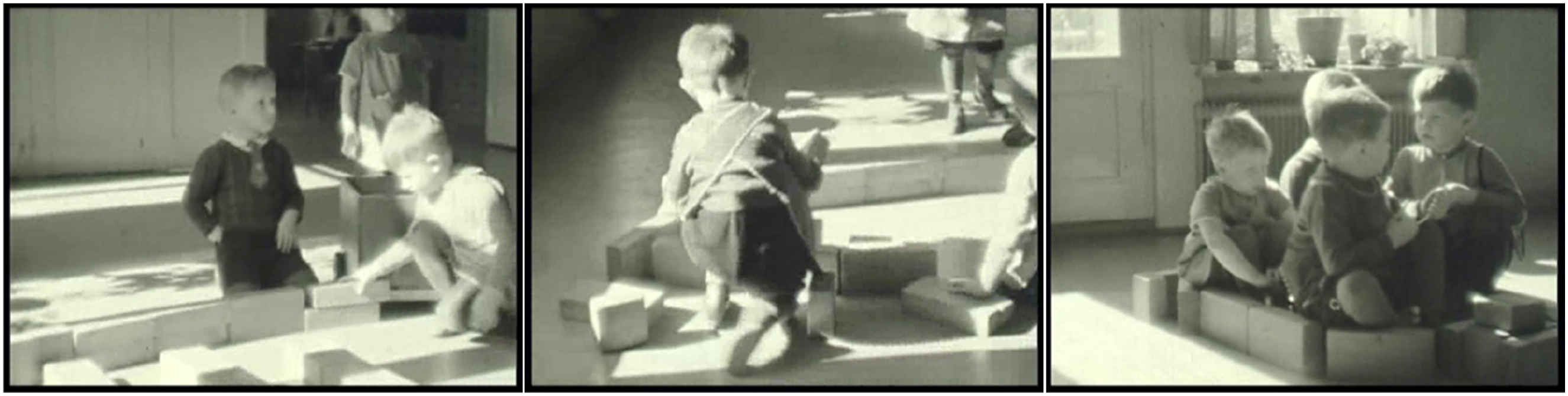
It is clear what the movie’s narrative was seeking to achieve; how building blocks and boys activated each other in a joint successful, freely moving construction practice. When looking carefully at the movie, it seems as though the boys were being directed to some extent, they seem to be looking for instructions outside the play activity (Figure 2(b)), and their body language in Figure 2(c) signals that they were not in a play situation; rather, they were being directed how to perform. In any case, for a public audience, that might not have stood out as important. One boy at the front is holding a ring of metal to imitate a steering wheel, and there were close-ups of the boys’ faces and lips to show that the boys in front were making humming sounds (Figure 2(c)). The audience was expected to understand that they had built a car, clearly a symbol of modernity at the time.
A second example from the movie displays one boy’s individual enterprise to create a rather complex construction of a house-like building using medium-sized blocks (Figure 3(a) and (b)). (3 a and b) Boy’s free building of a complex house construction (Movie, 1937, K4:1, NSA, courtesy of the city archive of Norrköping).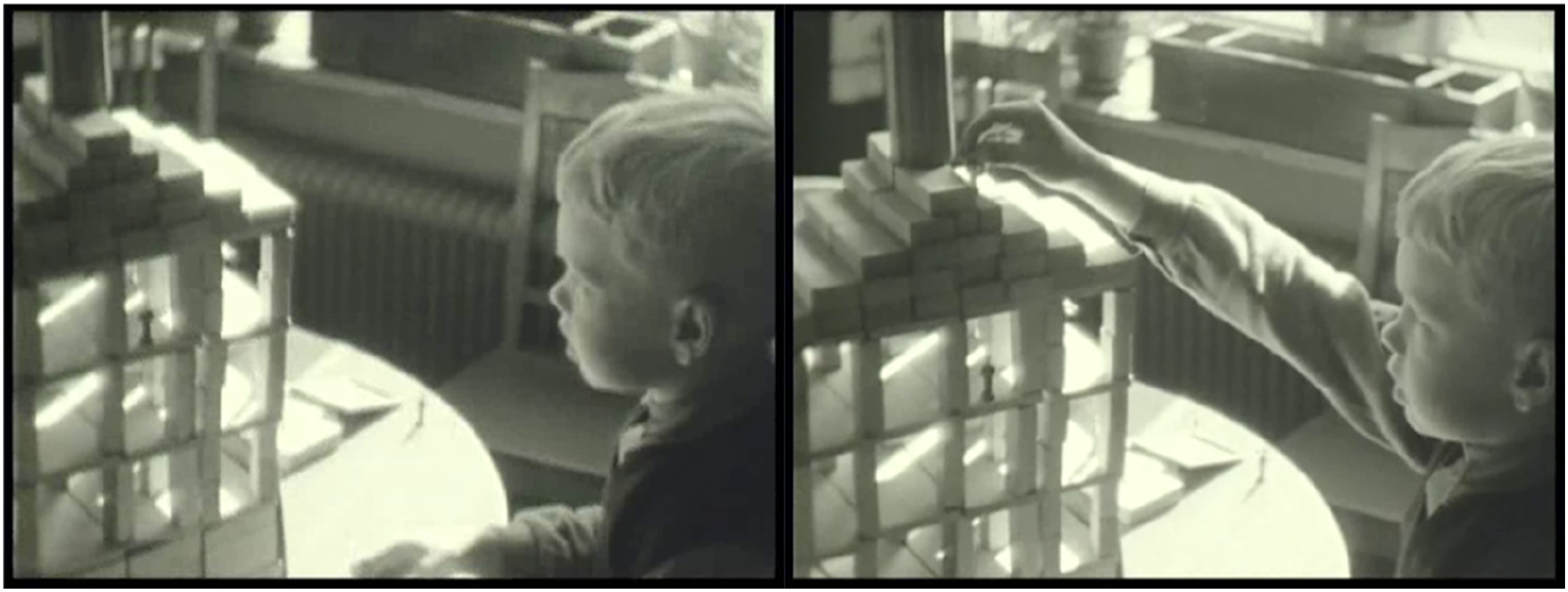
This boy was not building on the floor but, although he was “chained” to furniture, he managed to accomplish his free building task. He seemed simultaneously engaged, focused, and creative, similar to the description of the girl’s building practices in the written records above. In the movie, the sun from the large window enhanced the architectural nature of the building, making it look bright and modern. The boy’s building let the sunshine in, just as the sunshine streamed into the kindergarten and onto the building boy. The free play of sunlight added to the positive and modern ambiance of the movie. These examples demonstrate how notions of free play with building blocks, and how to handle freedom, were communicated as a male experience via the movie produced for a public audience. There were no girls engaging in advanced individual or joint building activities. In fact, only one girl was shown building in the movie, and only with very few blocks; putting two small blocks on top of each other. She was also looking into the camera, indicating that she was not as engaged in the creative process as the block-building boys were. Hence, in terms of gendered notions of building activities, the interpretation becomes different between the visual and written records. In the written observation records, girls were engaged and creative free builders, while in the movie and photograph, boys were portrayed as such. Hence, visual records aimed at a public audience established gendered notions of block-building practices, as being something mainly for boys.
What can we learn from children’s free play with building blocks using visual and written records in child history research?
Using a Swedish kindergarten as a case to study building blocks, our results add to previous research: that the shape, size, and use of the building blocks were charged with kindergarten ideology (Prochner, 2011; Prochner and Kirova, 2016). In Sweden, there was an interest in following Froebelian ideas, whereby children should follow a specific plan instructed by adults (Lindgren et al., 2023). In addition, and as explained in this present article, building blocks became key artefacts when implementing the new ideal to nurture children who were able to handle freedom. Building blocks were put on display in visual records, and written records paid detailed attention to children’s building activities. In relation to the ideal, that children should practice freedom in kindergarten via access to time to play, affordances of play materials, and space to be able to move, the differences between the visual and written documentation becomes important for the interpretation. If we only use visual records, we will not gather enough information to be able to grasp the complexities and freedoms provided for both girls and boys; we are unable to see or comprehend what was going on in these respects. The sense of richness accompanied by excess that appears in the written records becomes lost: the excessive mobility, sounds, access to play materials, non-verbal interactions, and so on.
On the other hand, if we use only the written sources, we miss out on the sense of reality that the photographs provide; what the environment looked like, how rooms were furnished, clothing, hairstyles, and other visual details. The visual records support the notion that building activities were a practice activating male engagement, while the written records focused on girls’ interest in building; how they were engaged and creative free builders. Hence, a stark contrast evolves regarding the 3–5-year-old girls and boys between the visual and written recordings, where the visual material produced for a public audience communicated the notion that boys were builders and girls were not, at a time when notions about the importance of building a new society including children as citizens were strong (Lindgren, 1999). Hence, in the visual records, boys were portrayed as the builders in society. The written records argued that girls also had such potential, but these remained in the archive. Hence, the different records present somewhat varying versions of gendered childhoods where the visual and more publicly available records single out boys as the sole potent supposedly “free” builders. This points to the importance of being aware of how archives and their “fragments” always are invested with political dimensions (Mills, 2013: 703).
Moreover, the written records reveal an interest in how the youngest girls and boys played together with blocks. The youngest children were not yet proper builders; they used the blocks mainly as props for investigating their environment and to play around. In any case, this interest in girls and boys playing together via blocks might be interpreted as yet another way to nurture children in accordance with feminist ideas about increased gender equality. In such an interpretation, playing and exploring together was a coming together in gender-equal practices, implying that both women and men were part of building society.
We find it particularly interesting that the written records steered interest to such a large extent towards the non-verbal; body movements and non-verbal interactions via looks and sharing (or not sharing) material objects. This demonstrates that such archived records can give voice not only to children’s verbal voices (Gleason et al., 2019), but, more importantly, also to the youngest children’s non-verbal activities and engagement, i.e., non-verbal “voices.” Childhoods must be both seen and heard, to paraphrase Ian Grosvenor’s (2007) call to use visual sources in child history research. In addition, both the archived visual and written records are important tools for taking practices of embodiment into account in relation to both events and objects (Mills, 2013). In this article, we have provided examples of why this is important when conducting child studies archival research concerning the youngest children. When using both visual and written records, it becomes clear that kindergarten childhoods vary; they reveal different versions of girls’ and boys’ childhoods in addition to how they have been intertwined in history.
Footnotes
Acknowledgements
The authors would like to thank the anonymous reviewers for their valuable comments.
Declaration of conflicting interests
The author(s) declared no potential conflicts of interest with respect to the research, authorship, and/or publication of this article.
Funding
The author(s) disclosed receipt of the following financial support for the research, authorship, and/or publication of this article: This work was supported by Faculty Funding, Stockholm University.
