



Abstract
The article reports on a study that explores children’s epistemologies of the environment. We drew on Nxumalo’s (2016) concept of ‘refiguring presences’ as a conceptual and methodological orientation. Such an orientation develops an expansive understanding of voice, encourages researchers to resist absences and erasures, and braids together activities of attending, remembering, disrupting, and imagining. Based on a study in a diverse multilingual primary school in the North West of England, we explore children’s relationships with the natural environment with a focus on treescapes. We use an anti-colonial lens and propose a mode of listening to voices in ways that recognise the emergence and entanglements of data, distributed stories, knowledge systems and concepts in ways that challenge neat theorisations about children’s relationship with the environment.
Introduction
What new intersections among research, invention, and political agency might emerge when voices have to be assembled rather than merely amplified, and when new methods of listening need to be invented? (Brigstocke and Noorani, 2016: 2)
This article constitutes an opening and noticing project following the anti-colonial orientation proposed by Nxumalo (2016) which she refers to as ‘refiguring presences’. We take refiguring as a way of rethinking voice in environmental research with children; an approach that relates differently to what is present, noticed, or potentially missed in research encounters. This form of presencing is enacted through a web of spatial, human and non-human affordances that have come together during the research assemblage we report on here. Such an emergent assemblage offers complex entanglements of children and their knowledges of the world, researchers’ subjectivities and their disciplinary backgrounds (namely childhood studies, applied linguistics and literacy studies), multi-modal data, classroom possibilities and constraints, place stories that go beyond the immediate research site, and different concepts that speak to this fluid orientation. Together, this methodological and conceptual interplay seeks to unsettle the notion of voice by embracing its distribution across what is said, what is written, what is visually represented and what is missed or deliberately silenced. As such, we work with the challenge in Brigstocke and Noorani’s (2016) quotation above in an attempt to put together ways of assembling voices, while working with different action verbs such as attending, noticing and listening.
This article is part of a large interdisciplinary project called ‘Voices of the Future’ that explores how children and young people talk about and engage with Treescapes (NE/V021370/1), funded by the Natural Environment Research Council (NERC). The project aimed to explore children’s relations to treescapes with a focus on belonging and hope, and it brought together a number of disciplines including the science of tree-measuring, childhood studies, and human geography. The project had a particular focus on exploring children’s knowledges, experiences of/with urban treescapes, and hopes for the future treescapes, and it is this focus that we are going to address here. ‘Treescapes’ as a term involves a broad and dynamic conceptualisation of trees. The ‘-scapes’ suffix indicates flows, networks, interactions, fusions, and hybridity, ranging from street trees to small stands of trees to woodlands to forests and beyond. The term also entails processes that cut across the local, national, and transnational (Appadurai, 1998; Urry, 2000). To attend to these fluid aspects of the term during the research with children, we here argue for the need to attend to the presencing associated with children’s spoken words, drawings, and interactions with one another, with the research team, and with non-human actants including trees, grass, spades, gloves, sand, roots, and worms as well as research tools such as recorders, colours, papers, etc. That said, it is important to shake our confidence so as not to miss the absences, leaving us with open theorisations and uncertain conceptualisations challenging the coloniality associated with masterful theories (Singh, 2018), neat descriptions and grand claims about children’s knowledges of the environment.
Our entry point is that children’s voices in environmental research are characterised by multiplicities of knowledges, experiences and worldviews and that such epistemic diversity is not expected to be expressed in a monolithic way. Rather, we view children’s voices as distributed across bodies, objects, drawings, sound waves, silences, and different topics. This stance draws on Nxumalo’s (2016) ‘refiguring presences’ as an orientation that attends to distributed stories (including silent, illustrated, written, or spoken ones), the relationality of story-telling, the positionality of story-tellers, and how stories are generated, enacted, narrated, or silenced in relation to networked worldviews that emerge from, yet transcend, the local. We understand the practice of ‘refiguring presences’ as an act of methodological and conceptual presencing, and we bring this together with a perspective that re-thinks children and childhood and looks at the non-human through Kraftl’s (2020) concept of looking beyond the child, so that the focus changes from the children alone to the children and the environment. In this article we use the term ‘attending’ to describe this process of recording and documenting and listening to children’s small stories and drawings.
In our work with the children, we sat with them and listened to their environmental/tree stories as they drew and narrated, on small tables in a Year three classroom. The stories we attend to in this research are not fully fledged, canonical, or traditional. Rather, they are fleeting snippets of experiences, memories, disruptions, and imaginings, projected sometimes in talk, writing, drawing, talk only, writing only, or drawing only. Exploring and describing the (mis)match between talking, writing and drawing constitutes the key premise in this paper, which brings together the multiplicities of voices associated with children’s experiences of the natural environment, stretched over time, place, materialities, memories, and imaginations in a school setting. Such multiplicities give rise to research configurations with generative potentialities which cannot be neatly, coherently, or compatibly held together, nor can they be clearly storied. This produces a messy ontological state of being for research with implications for ‘thinking-with data’ (Nxumalo, 2016: 642).
We focus on the plurality of ‘presences’ to resist erasures and absences (Simpson, 2011), and we do this in the context of erasures and absences associated with the coloniality of human language (often spoken or written), the coloniality of voice (often perceived as externally projected through a spoken modality), as well as the coloniality associated with mastery (Singh, 2018). Such coloniality reproduces established norms of normative superior forms of voice that need to be amplified, quoted, and analysed for research purposes. They also produce confident epistemic findings associated with what is being amplified and analysed. Through re-thinking voices, we confront the normative coloniality of human voice in conjunction with materialities, embodiments, alignments, and places where these voices are generated and produced as part of research. By doing so, we contribute to Nxumalo’s (2016) quest for generating anti-colonial interruptions that go beyond the gathering and reporting of neat data producing universal or singular conceptualisations around children’s knowledges of /about trees and their engagement with outdoor natural environments.
It is important to note that our consideration of voice includes seeing it as multiple, plural, and distributed through practices, thereby reconsidering how stories emerge, how they are told, and who narrates them. Re-thinking voice as a practice also highlights the need to join the dots between humans, non-humans, places, and objects in order to explore how children ‘do things with words’ (Austin, 1962), ‘do words with things’ (Canagarajah, 2020), and generate (in)coherent stories with and without words.
In what follows we start by discussing ontologies of the ‘child’ in social research, a position that we utilise to further re-think the notion of ‘voice’. After that, we present the methodological details of the study, followed by a presentation of data fragments. The article concludes with implications for re-thinking voices and refiguring presences in educational research with a focus on the environment.
From the ‘what’ to the ‘after’ in ‘childhood studies’ and ‘voice’
With the emergence of the New Sociology of Childhood (James and Prout, 2015), children have been conceptualised as competent individuals and active agents (Kellet, 2011) rather than passive recipients of information. This conceptualisation argues against the separation of children from the adult world and disrupts psychological discourses around childhood as a period of dependency upon others (Mayall, 2020). Instead, more recent discussions conceive of childhood as emerging from a mixture of materialities, flows, forces, and dynamic assemblages, opening up a relational view of ‘child-in-the-world’ (Kraftl, 2020). We draw on such posthuman conceptualisations of ‘children’ and ‘childhood’ as we attend to relational encounters with body and matter, and emerging subjectivities and positionalities entangling into becoming through/with intra-actions. This view of childhood constitutes a paradigm shift from considering childhood as a central (bounded and individual) category to an emergent one, moving the focus from what childhood is to how childhood is done (Spyrou, 2019: 318–319).
This onto-epistemological position of the ‘child’ is directly linked to how children’s voices can be re-conceptualised in ways that go beyond traditional understandings of what counts as voice, generating new possibilities that see voices as scattered across mud (Cole and Somerville, 2020) and entangled with trees, as well as sand and other non-human actors (Macrae, 2020). Our way of re-thinking voice is inspired by a set of concepts that decentre and push beyond/after the traditionally perceived central unit of analysis: the child. For example, we find Spyrou’s (2019) work of de-centring, Macrae’s (2020) on looking beyond the child, and Kraftl’s (2020) on looking ‘after the child’ invaluable in establishing research practice that attunes to things and beings, the here-and-there, the emergent, the relational, and the always-in-the-making. Studying children as part of assemblages helps us explore the dynamism and complexity of the social (Spyrou, 2019). Therefore, to attend to children’s voices in ways that are not pre-defined but networked and emergent requires a move away from the view of children’s agency as individual capacity (Gallacher and Gallagher, 2008) to explore the unravelling of doing, becoming, and coupling.
This section takes forward our thinking of the ‘beyond’ and ‘after’ the child to inform an expansive, dynamic, and networked conceptualisation of voice, but before we do this, we present a brief discussion about traditional theorisations of children’s voice. Children’s voices in schools can be categorised in hierarchical categories such as students’ voice or pupil’s voice (Murray, 2019), representing and reproducing power imbalances (Atkinson, 2019), and there is a danger of taking an instrumental view of children’s voice (Kraftl, 2013) through which children’s voice is listened to only if it serves a neoliberal, instrumental purpose. There is also the danger of treating children’s voice as representational (MacLure, 2013), which risks the production of imagined fixity, homogeneity, and categorical thinking (Deleuze, 1994) that can ultimately privilege certain types of highly individuated voice. To address these inherent challenges, we maintain the view that children go beyond oral language and apply material, sensory, bodily, and affective modes to express their perspectives (Badwan, 2021; Hackett, 2022). While thinking with/of these multiplicities, we are also attentive to an expansive view of voice by including stories of tree/child relations carrying weight (Nxumalo, 2016) but rarely being part of the scholarship on human/nature connections. We talk about stories that lay outside the world coming into the classroom and noticed in a set of entanglements that we were also part of. Children’s voices in these stories were clustered into groups, in an analytic process, of being drawn and narrated, drawn only but not narrated, and in some cases, only narrated but not drawn, in ways that did not necessarily create coherence, with voice also becoming haptic and embodied in bodily and sensory movements that occurred during the research activity.
In the next section, we outline the methodological details of what we call ‘an attending activity’, during which we attended to engagement narrating, storying, responding, corresponding, deviating, and drawing in relation to connections between children and their natural environments.
Designing the ‘attending activity’
The attending activity took place over a period of three consecutive days during which we (the project team, including the three authors) worked and thought with a group of 90 Year three children (aged 7–8 years) in a primary school with students belonging to diverse ethnic communities including Middle Eastern, African Caribbean, Indian, Pakistani, and Eastern European. Institutional ethical approval was sought and gained for this research by the ethics committee at Manchester Metropolitan University, and we asked the children to read and sign the consent forms with their parents, avoiding giving separate forms for parents and for children. Having sought all the required approvals, we adopted a view of ethics as a process (Neale and Hanna, 2012) and started the visit by explaining the different types of activities, and the concept of children as researchers as well as the concept of research. Following that, we offered the children the choice of whether they wanted to take part or not.
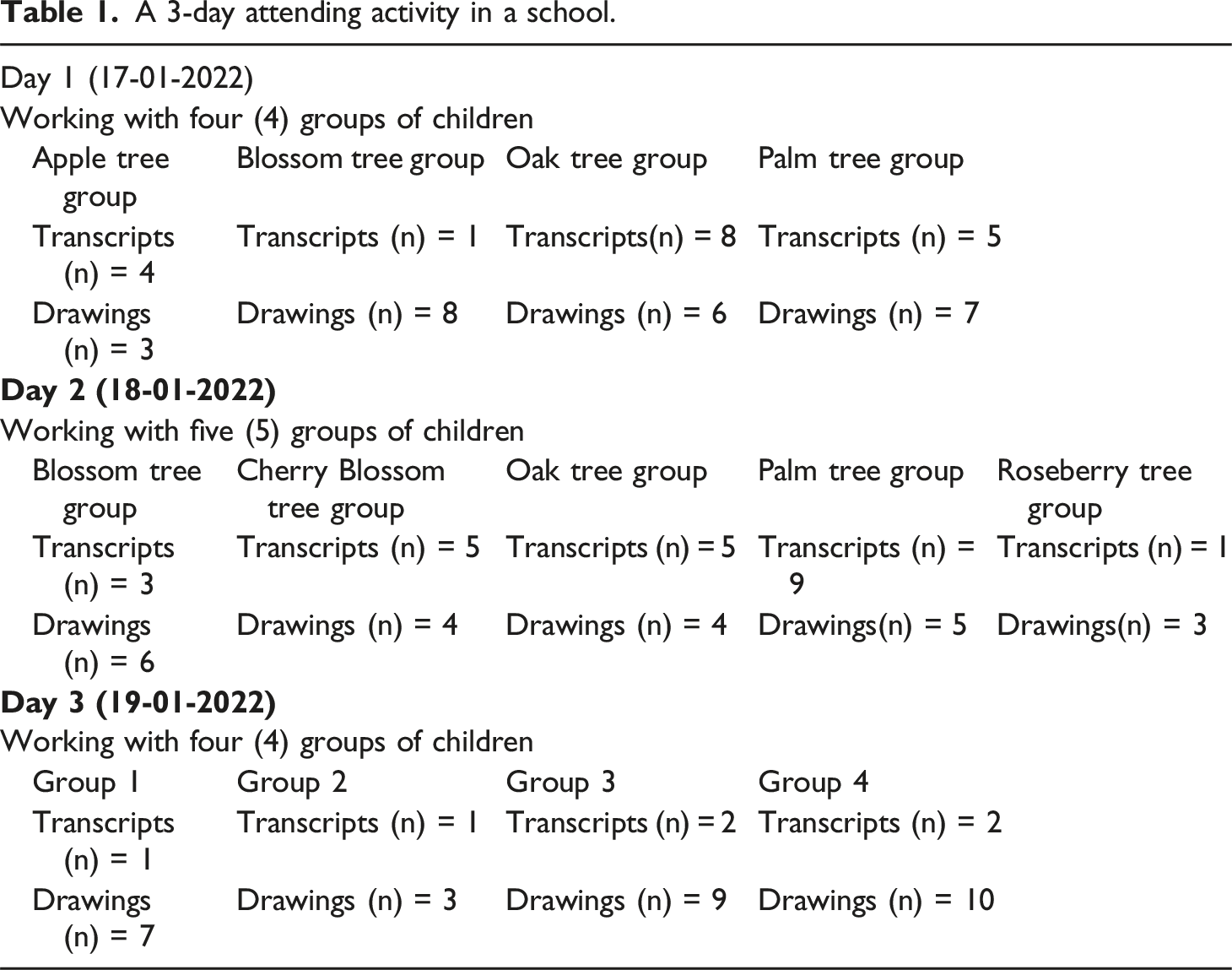
Our focus for this part of the project was to explore what children knew and to establish what they knew. After this, we embarked on a series of treescape-designing, tree-planting, and tree-care activities, working in partnership with a local organisation concerned with tree-planting. The aim of this session was to hear children’s voices and attend to their knowledge. We visited three classes of 30 children and attended to each class in turn. In each class, the children sat in groups of four or five and worked with an adult, and we were keen to ensure that the class teachers and the children were positioned as co-researchers. We placed a digital voice recorder on each table with colouring pens and sheets and provided thematic prompts that the children could use to keep themselves and other engaged in the activity. These included the following: (1) What do you know about the natural environment? (2) How do you know what you know about the natural environment? (3) What activities do you do in the natural environment or what do you like to do outdoors? (4) Do you think we will have more trees or fewer trees in Manchester in the future?
For the first part of the visit, the children interviewed and recorded one another. The second part, however, entailed many ways of thinking and responding through drawing, writing, or speaking to other children or to the researchers in the presence of voice recorders. This activity was particularly designed to create a generative space affording multiple not restricted (i.e. only language focus) means of communication and expression.
A 3-day attending activity in a school.
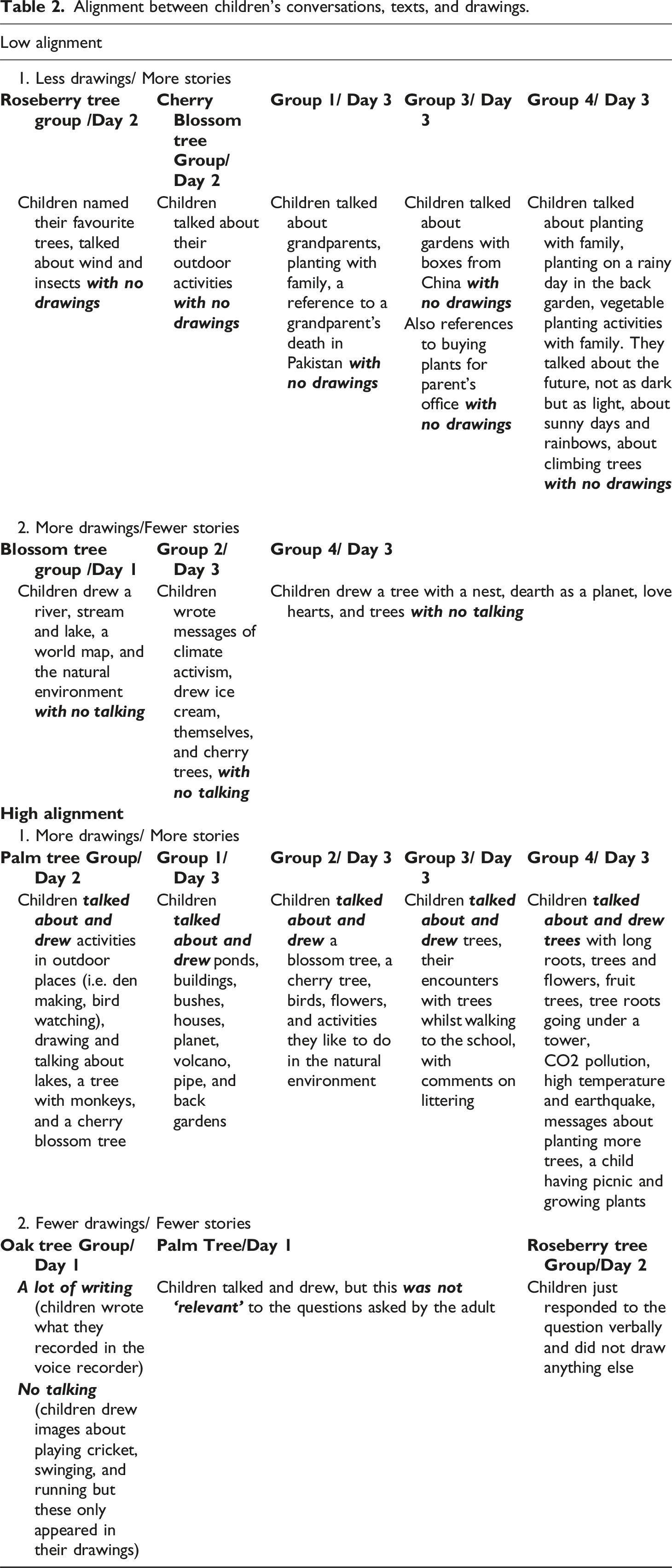
Alignment between children’s conversations, texts, and drawings.
Re-thinking children and their relations with the natural environments
When we looked through transcripts of the children’s conversations, juxtaposed them with the children’s drawings, and linked both to our recollections of the research events, we identified how ambiguous and different forms and modalities were generated/came into being during the activity. We explored how conversations, drawings, the research prompts, the researchers’ presence, and the dynamics around the tables related to and interacted with one another, and during the process of looking into drawings and transcripts, we became interested in the idea of alignment (i.e. the high and low levels of consistency) to notice the divergence in verbal and visual stories that were produced during the research activity. Letting go of control, we were not concerned with whether or not the children answered our adult-centred questions/prompts. We instead focused on ‘incoherences’, and moments when the children developed ideas outside our framings. As such, we were interested in chasing these incoherences across different modalities, not in favour of an idealised distribution between spoken words, texts and drawings but in genuine curiosity to see how children make meaning outside the coloniality of language and Euro-centric views of nature.
Both verbal and visual stories narrated/produced by the children carry dynamic (i.e. high/low) alignment between them. e.g., there were instances of verbal stories that were either not accompanied by any visuals including texts, lines, or objects or were accompanied by unrelated objects, lines, and texts. We refer to these as instances of ‘low alignment’. At other times, drawings were very detailed and were accompanied by relevant verbal stories, indicating higher levels of alignment between both (i.e. verbal and visual) modalities.
Both high and low alignment instances were equally valued in our rethinking of the convergence and divergence associated with children’s voices. We found the process of analysing alignment a productive process for us as it demonstrated the fluidity and unpredictability of this research assemblage. We present the key themes emerged in children’s conversations, texts, and drawings in the chart below showing high/low alignment between verbal and visual stories.
Children’s conversations, texts, and drawings appeared to be ordinary practices scheduled during their routinely timetabled classroom activities. These ordinary practices, however, as Dyson (1993) suggests, did not happen in isolation. Children rather moved in/out among different worlds and time and space structures including their social and relational imaginary worlds. However, challenging the notion of representational voice, we do not aim to present what these conversations, texts, objects, lines, and drawings mean but what they can do. We focus on the texts and pictures of objects and matter in the children’s drawings, enabling us to trace connections of children with human and more than human worlds (Kraftl, 2020). With a particular focus on the interruptions that the ‘attending exercise’ produced, we join Nxumalo (2016: 641) in asking, ‘what possibilities there might be to interrupt anthropocentric imaginaries of the forest as a separate site of exploration and learning for children?’ In particular, we attempted to highlight imaginaries of forests or the natural worlds which do not fit into a particular Western, Eurocentric conceptualisation. Considering voice in this sense, as scattered across space and modalities, we noticed how moments and situations within visual and verbal stories (i.e. data) enabled us to uncover unusual and unsettled stories of children about natural environments (Nxumalo, 2016). As such these analytical examples offer openings and interruptions, rather than fixed coding. They open a window on what was observed (present) in the classroom and what was noticed (potentially absent). The purpose of these examples is not to fix the data or offer a rigid or traditional representations and analytical categories. Rather, they help us complexify voice across different objects and modalities, while highlighting alignments and ruptures, in a constant attempt at challenging epistemic fixity and stasis in environmental research with children.
We could describe the drawing, talking, and writing (text) that the children did as entanglements (Mazzei and Jackson, 2017), and this enabled us to see children’s voices as (re)configured in the intra-actions between the material and discursive. Our discussion on data fragments starts with what we call ‘visual stories’ based on the drawings that children created during the attending activity with the words ‘visual stories’ suggesting more emphasis on drawing and less on talking. We then include ‘verbal stories’ that we attended to during the activity. As the name suggests, by ‘verbal’ we mean fragments of data in which more emphasis was placed on talks, conversations, and narration and less on drawings. We conclude our discussion with ‘visual and verbal stories’, focusing on fragments in which there was high alignment between children’s talking and their drawings. We do not suggest that any form of stories is better, but rather provide understanding of what children think about trees and their natural environments. We see all forms and kinds of stories as equally important in order to attend to children’s worlds.
Visual stories of, about, and with trees
We include five examples of children’s drawings (Figures 1–5) to show dispersed stories on tree/child engagements: Swinging outdoors (Oak Group, Day one of attending activity 17-01-2022). Playing cricket (Oak Group, Day one of attending activity 17-01-2022). Playing football (Oak Group, Day one of attending activity 17-01-2022). Insects and bugs as part of the natural environment (Palm Group, Day one of attending activity, 17-01-2022). Functions of trees and where knowledge about trees comes from (Oak Group, Day one of attending activity 17-01-2022).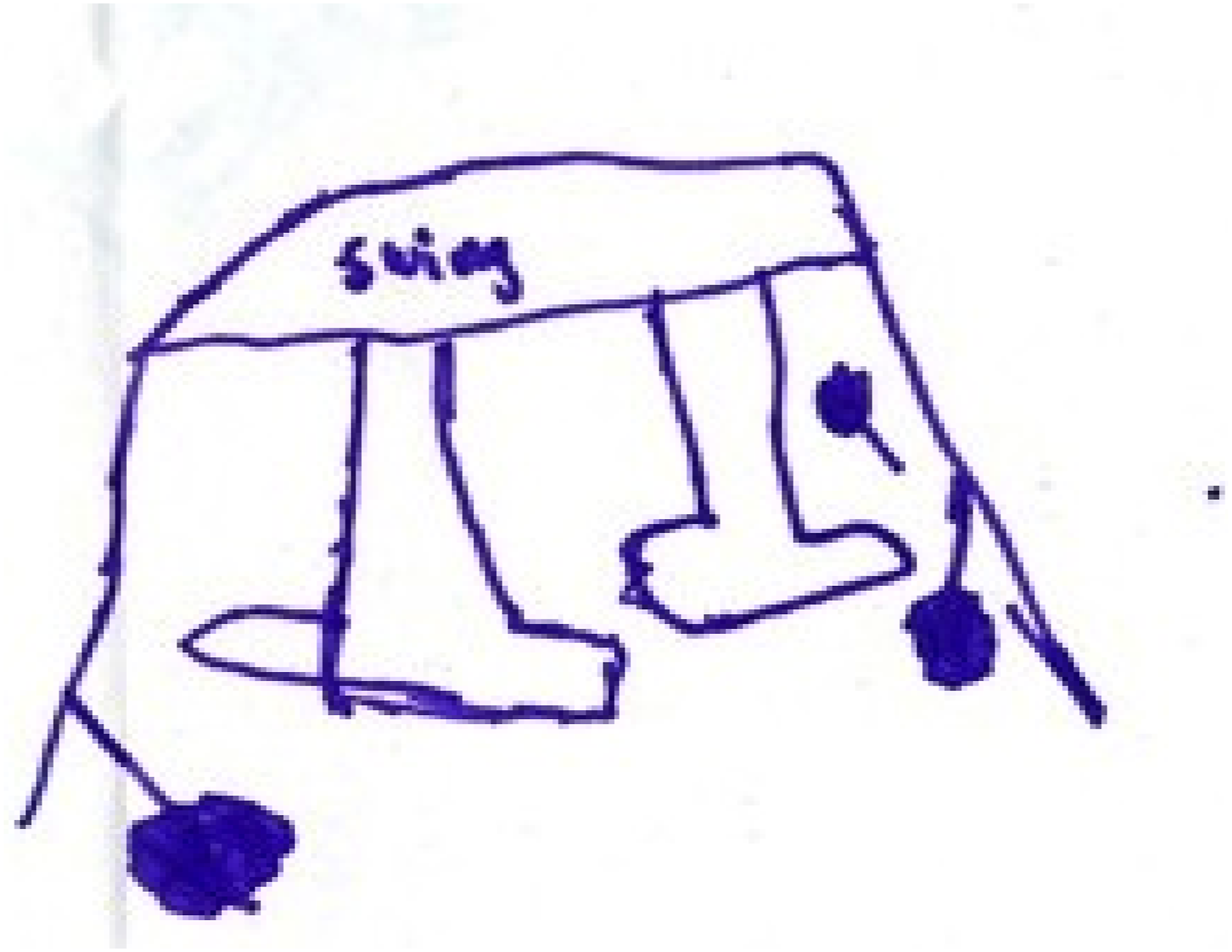
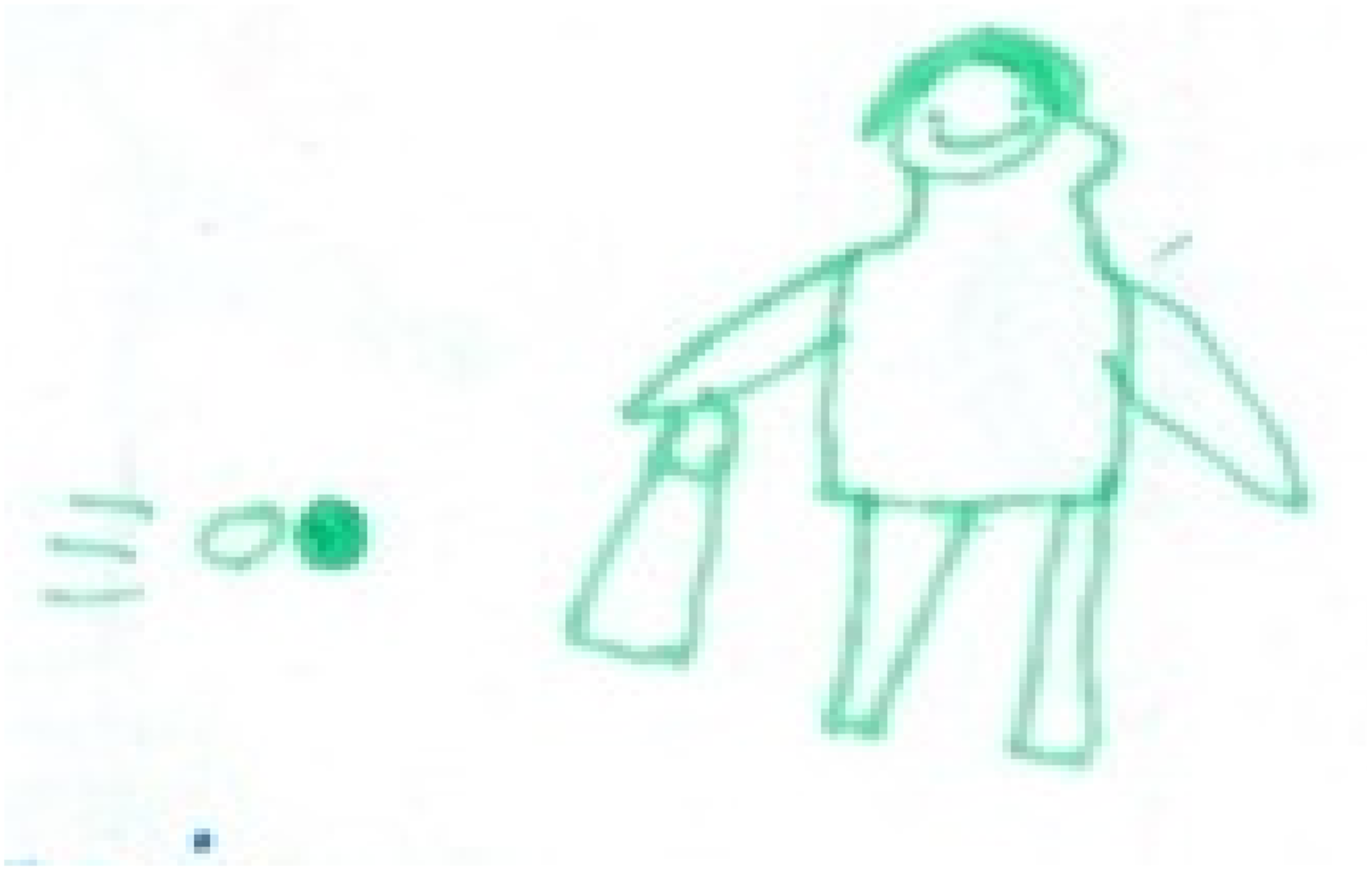
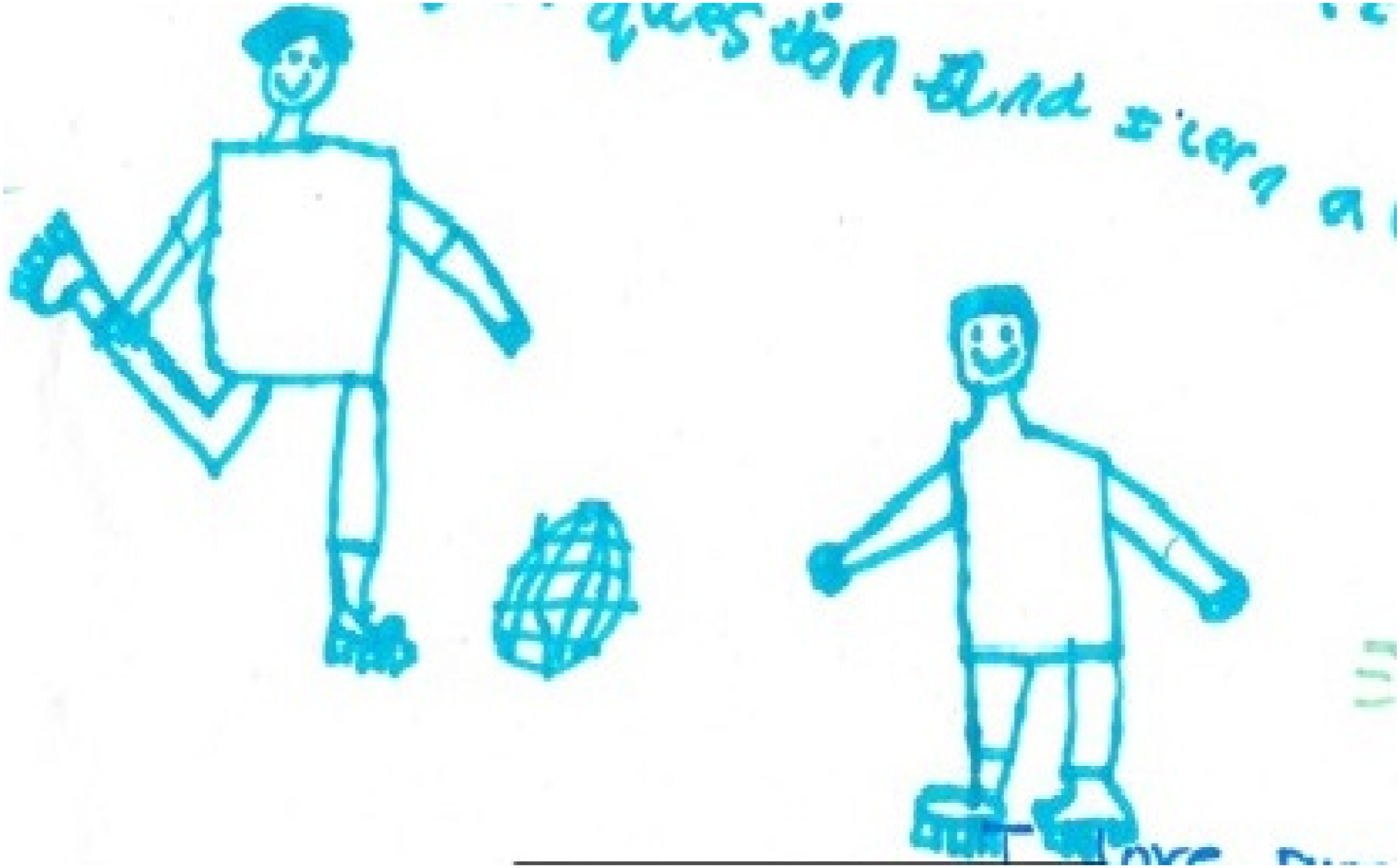
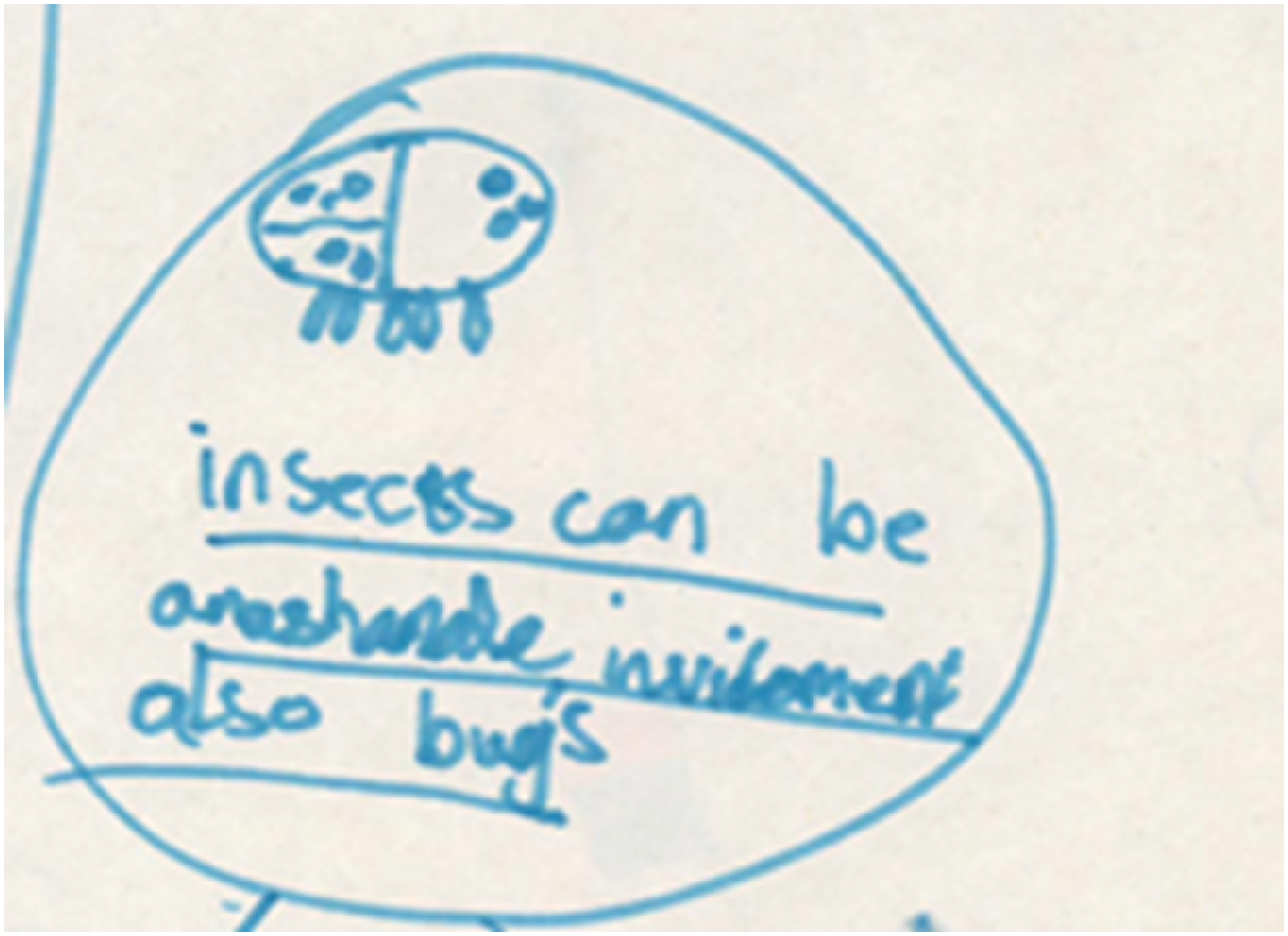
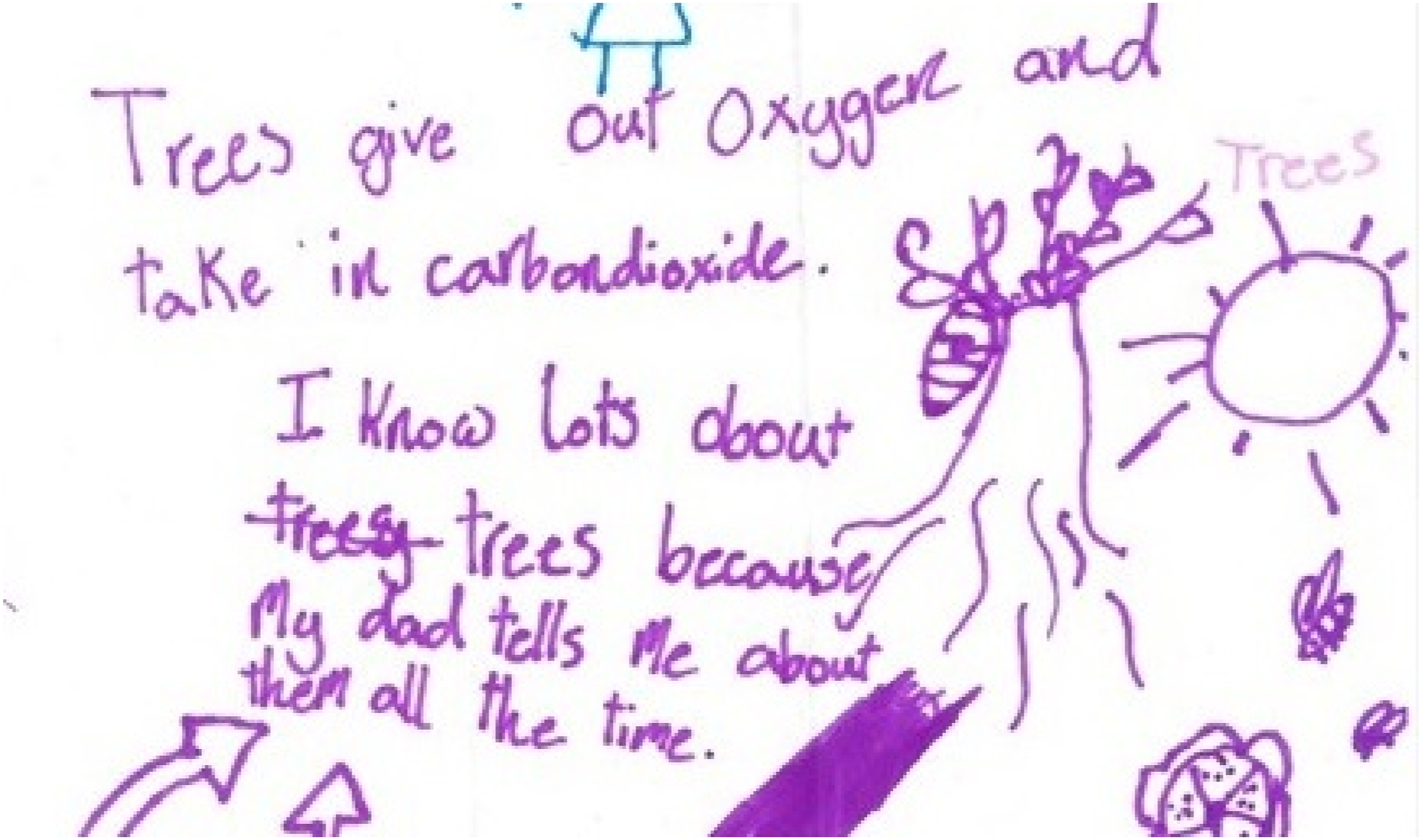
These included the pictures of objects with a very little text. For example, in Figure 1 we see a swing with no child/children, with a label ‘swing’. Figure 2 contains an image of a human (probably a child) with a bat in their hand. Figure 3 shows two human bodies, football shoes, and a football in between the human bodies. Both Figures 2 and 3 do not contain any text or labels. In Figure 4, we see an insect with dots, a big face and five legs, and we see a text. Some parts of the text are clear and can be read, ‘insects can be’ and ‘also bugs’, but the other two words are unclear. Figure 5 is heavily texted, describing the functions of the trees, and we see a big tree with something hanging from the tree branch, a sun, bees, flowers, and tree roots. At the bottom, there is another description in form of text which does not apparently resonate with the first lines. This story is a combination of text and drawings of objects and other living beings (bees). Figure 5 relatively appears different from the previous Figures 1–4 with more text, but we could not find any record of the children’s conversations about these drawings.
These images are taken from different children working in different groups portraying their thinking/understanding of the natural environment, but these stories remained hidden. In some stories, children became the centre of the stories, but in other stories objects such as the swing, insects, and trees are the centre with no depiction of any child/children, thus making it hard to develop neat and fixed theorisations around children’s relationship with nature. This constitutes openings, rather than grand narratives. Such openings are disruptive interruptions to static orientations in climate education.
Verbal stories of, about, and with trees
By ‘verbal’ we mean conversations that children recorded using audio recorders during the research activity, and we include three examples to explain the incoherence between visual and verbal stories that children shared in response to some questions.
In the following example, a group of children were responding differently, fleetingly, and in a playful manner in the presence of the audio recorder: Class teacher: ok, tell me what do you like to do outdoors? Child (1): ah.. I like to see apple trees. Yeah, bye Class teacher: what did you like to see Child (1): I like to see apple tree. Class teacher: do you like to check something? Child (2): I like to check the wind Child (2): what do you like doing outside? Child (3): I like climbing trees and sitting underneath them to have some shade Child (3): what do you like doing outside? Child (4): I like skipping and playing with hula hoops Child (4): next Child (5): me? Khawla: what do you like to do outside? Child (5): checking the wind Khawla: yes, anything else? Child (5): have a picnic. Child (1): I love picnics. (Children’s conversation in Roseberry Group, Day two of attending activity, 18-01-2022)
The class teacher began by exploring with the children which activities they would like to do in outdoor places. We noticed a variety in the children’s responses, and some of responses shared by the children do not align with adults’ expectations. These included examples such as checking the wind, skipping and playing with hula hoops, and having picnics. Many of these conversations did not confirm to the concept of ‘story’ but contained random snippets of different stories of worlding with the more-than-human (Taylor and Pacini Ketchabaw, 2018), including such stories of children, wind, hula hoops, and apple trees, in which the children’s engagement with trees became visible but also disappeared. When we looked at the drawings, we could not see any traces of these verbal stories in the visual portrayal of engagement of the children, trees, and the natural environments.
In another example of verbal stories generated during the attending activity, we noticed children’s conversations that did not correspond with their drawings or even appear relevant to the activity. However, these apparently ‘unrelated’ stories included snippets that speak to children’s lives entangled with the world outside the school. These stories centred around children, the adult researcher (Kate), the questions being raised and discussed, and feelings of sorrow, wonder, and excitement generated during the activity. In this group, children were working with (Kate) to explore and discuss their knowledges and experiences of being engaged with natural environments. Child (1): my grandma lives in Pakistan. Kate: great, and do you think there are trees in Pakistan? Child (1): my mum’s grandma passed away. Kate: oh, I am sorry. Child (1): of course, there are trees in Pakistan. Kate: so, Tell me about the trees in Pakistan. Trees are everywhere in the world. Child (2): I went to Jamaica and there are loads of trees. Kate: oh that’s amazing Child (2): you know Child (2): the water is very salty though Kate: really Child (2): sea water Child (3): I saw some people making more trees and some more people cut down to make some paper. Child (4): can someone pass me a dark blue? Child (3): yeah, you can. Child (2): anyways, Jamaica is on the hottest in the planet. Kate: it is an amazing place to go Child (2): it’s really hot Kate: is there where you saw the jungle? Child (2): yeah Kate: wow Kate: have you …[interrupted] Child (2): my grandma lives there Kate: wow Child (2): one of my grandmas. I got four grandmas Child (3): four? Child (2): yes, Jamaica is burning hot I got sweat in a second I got there. Child (1): do you know how my mum’s mum passed away? Kate: how? Child (1): my mum’s mum passed away in Pakistan Kate: yeah, that is sad Child (1): because she was ill, and she could not breathe, and her heart stopped working and then they buried her in the ground (Children’s conversation in Group 1, Day three of attending activity, 19-01-2022)
The conversations between children and the researcher appeared as non-linear, disrupting the flow of the activity. Some of the children shared transnational stories when talking about grandparents, and these stories were entangled with memories of family members across multiple contexts and points in time. The stories were also nurtured by the researcher and peers when interlocutors valued listening to one another. However, the narratives remained fragmented (Yoon and Templeton, 2019: 60). By paying attention to these fragments enacted in storied moments and time, we attended to the embodied presence of the children, the researcher, and the tree stories being generated within the research process (Nxumalo, 2016). We shifted our focus from only listening to tree stories to these smaller transnational fragments.
In another example, we noticed complexity and messiness in the content being generated in verbal (talking) and visual (drawing) stories, when children talked about the future of their city (Manchester). Children were re-imagining the future of their environment, involving talks, using metaphors such as dark, light, rainbow, rainy Sunday, greener, growing more trees, and proudness. However, none of these things (metaphors) were present in the drawings that children created during the activity. Child (1): do you think in Manchester, the future will be greener? Child (2): of course yeah… of course green… always it’s gonna be not dark… it’s gonna be light like a rainbow and rainy Sunday ... Child (1): do you think in future, Manchester will be greener? Child (3): yes . it will … if more people come here … (inaudible) and plant more trees. This will be real proudness in the growing up trees. So I think we will have green Manchester. Child (1): I am done with mine. Samyia: what do you guys think about the future of trees? Child (2): I think it will be light not dark like it used to be . Child (2): and I think it might happen in a few years, but I think if it happened, we might get greener if we don’t stopped planting. Child (2): interview (Usman) Child (3): In the future. It’s gonna be lighter … very light not dark as it used to be … it could … (inaudible) be and one day yeah … one day … two days yeah it’s gonna be lighter yeah cause (Sameer) yeah. They say it’s gonna be darker … (Ahmad’s cousin…. Sameer) and now it’s gonna be lighter yeah … interview over yeah … Child (4): I know it’s gonna be really light cause my cousins says it’s gonna be dark. My cousins yeah. They say it’s gonna be dark not light … and really light because couple of days it’s gonna be very lighter and couple of days it’s gonna be light and whoever says it’s gonna be dark. (Ahmad) says … saying it’s gonna be dark. Yeah yeah what you gonna say? Child (3): (Kamil) thinks it’s gonna be dark. Who else thinks it’s dark? It’s dark. (Children’s conversation in Group 4, Day three of attending activity, 19-01-2022)
When we analysed this talk we realised that the children were describing the future in ways that were complex and diverse, stretching from religious metaphors of dark and night to family references and imaginations. For example, in the above conversation, a child (2) used the metaphors of light, linking the greener future with light. Some children did associate the future with planting more trees. For example, child (3) talked about having more people in the city and more trees as well as having a green future, making an explicit connection between green future and having or planting more trees. Child (3) also mentioned being proud and feeling hopeful.
The children drew on wider understandings of light and talk from their own cultures. Child (2) responded to the interviewer’s question (A) by referring to dark and light futures. He also described temporal dimensions, referring to the past and the present. Child (3) referred to time related to a re-imagination of the future by talking about how it will be light for 1 day and dark for another day. Child (4) picked up on a familial connection (cousin) and thought of a future which will be dark and lighter for couple of days. Children (3) and (4) agreed and imagined their future as dark. The metaphors of dark and light were talked about but not portrayed in the drawing or in writing, and were not even further debated in conversations, leaving us wondering about their connections with trees, the children, and their imagination of the city in the future. The metaphors of light are often presented in the forms of traditional fairy tales and religious stories (Adams, 2019). In common conceptions of human/nature connections, children are often made to see or read about leading characters trapped in the dark and finding light at the end (Gadd, 2014). However, we noted how the presence of an adult (Samyia), who shares religious and cultural heritage with most of the children in this group, generated possibilities to resist taken-for granted ontologies (Nxumalo, 2016) as well as methodologies of doing research with children. When things were being wrapped up after the end of the research activity, (Samyia) overheard two children talking about the Day of Judgement and the whole world going dark first and then light. These conversations remained absent in the data set and were expressed as the researchers were ready to leave the classroom. We were ‘missed’ from the recordings and drawings associated with the research activity. However, through our attentiveness and subjective entanglements, these potentially absent and silent stories (Nxumalo, 2016) became important, refiguring different framings of children and their natural environments, as well as our own practices of being engaged in research with children.
Visual and verbal stories of/about trees
In this section, we show examples of children’s conversations and drawings which closely align with one another and describe what mattered to the children when they described their natural environment, as they not only centred around trees but visualised or verbalised other elements and materials (i.e. human and more than human) from their worlds.
In the example, child (1) drew Carbon Dioxide (CO2) and a picture of a tree which had fallen. In the digital voice recorder, the children recorded the following conversation: Child (1): I have written CO2 pollution is gone … because look trees fell down and I am going to draw earthquake. You know the temperature when it goes up (Children’s conversation in Group 4, Day three of attending activity, 19-01-2022)
Figure (6) shows trees falling as a result of ‘CO2 overload’, causing the temperature to rise: CO2 and falling tree (Group 4, Day three of attending activity, 19-01-2022).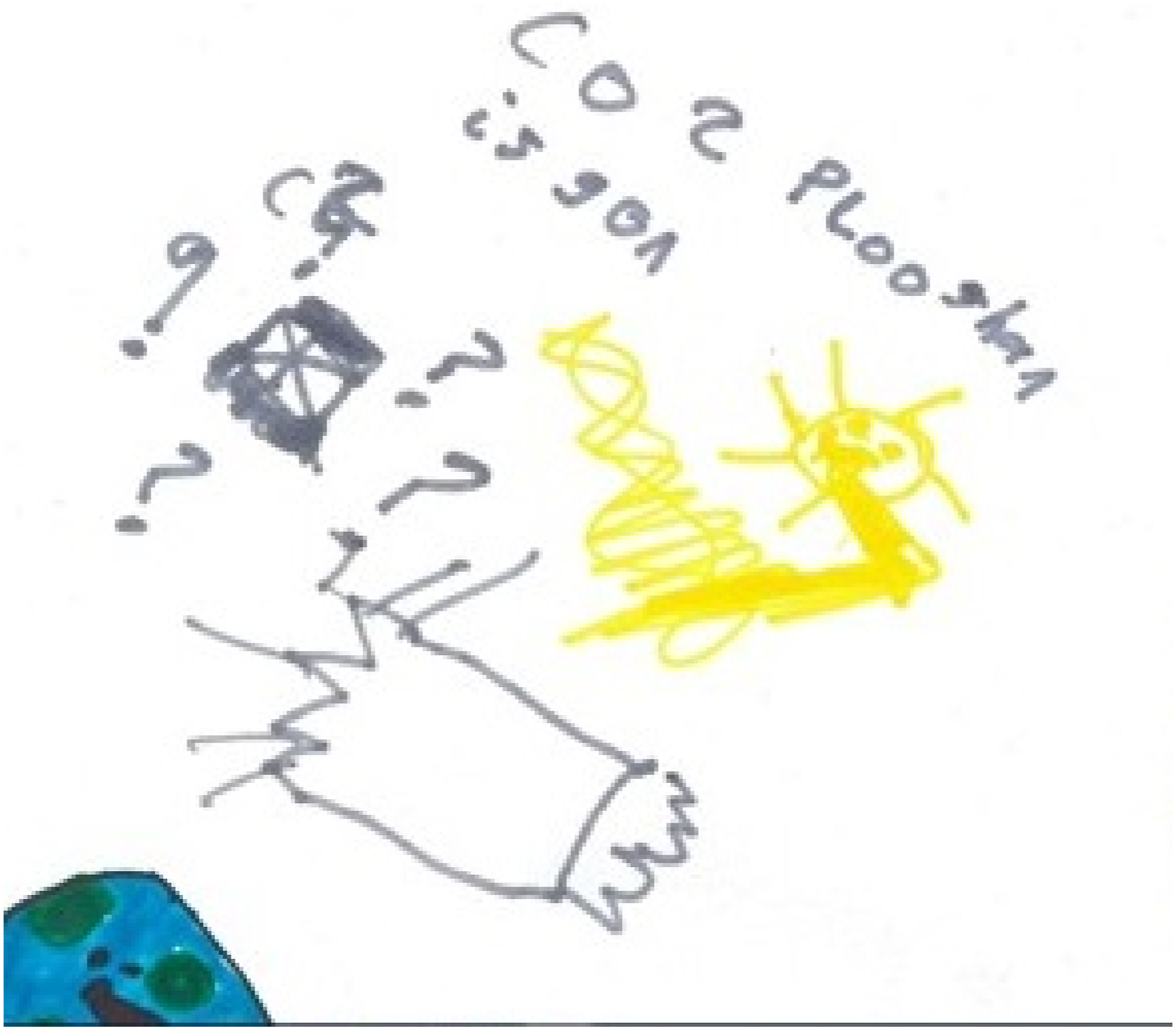
In another example, a child (2) drew himself, a picnic basket, a tall tree with birds, with a speech bubble (‘I love trees’). The child recorded the following conversation in the voice recorder: Child (2): I drew myself standing with a picnic basket and picnic mat near a tree and a river. (Children’s conversation in Group 4, Day three of attending activity, 19-01-2022)
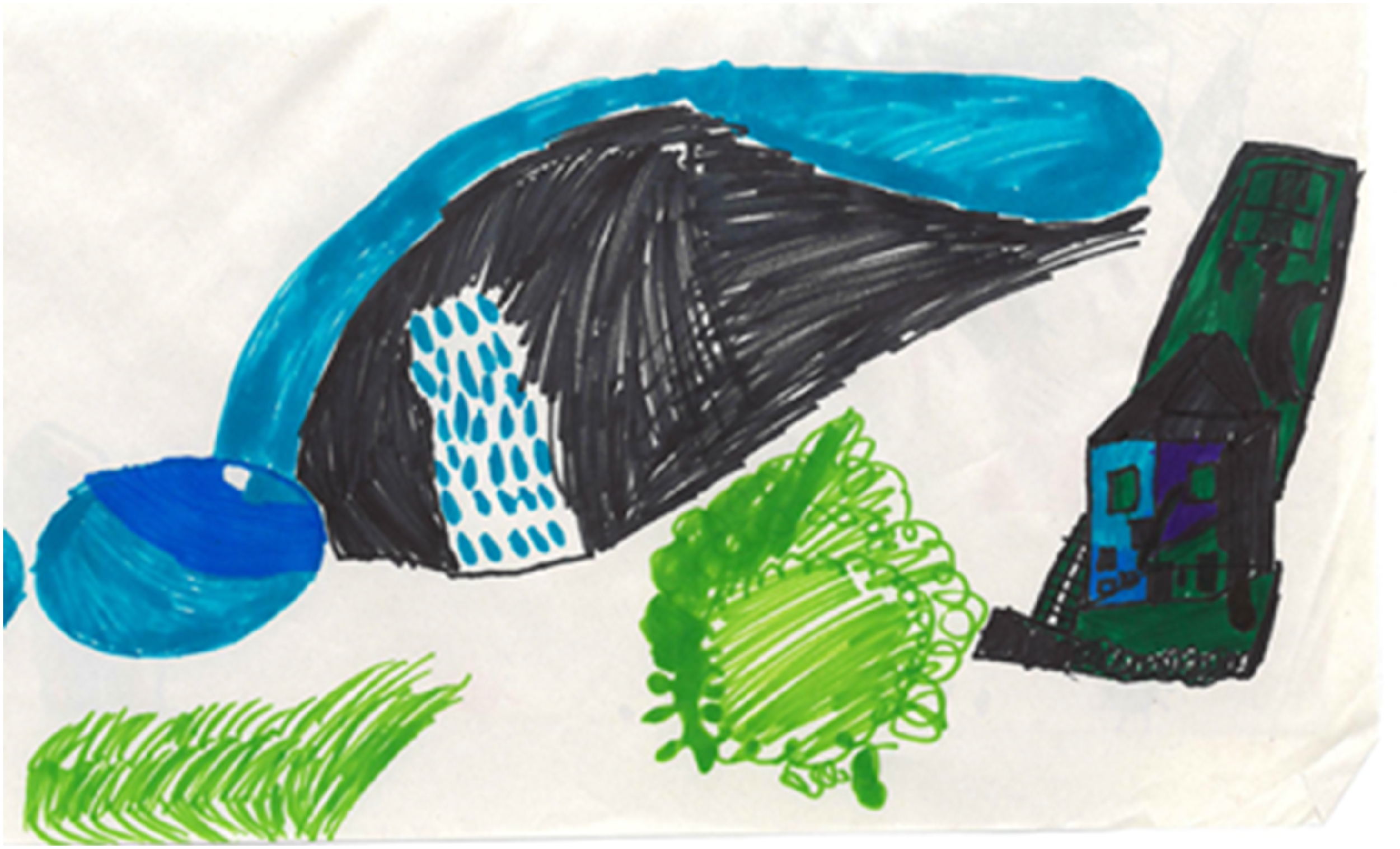
In another group, children drew a house (in a tree) and a pond with black and blue water and then recorded the following conversations in the provided voice recorder: Child (1): what is that? Child (2): the pond Child (1): oh yeah, a pond Child (2): there is a nice big pond over there. There is a big pond. Child (1): I know how to draw a house and colour Child (1): house in the natural environment. (Children’s conversation in Group 1, Day three of attending activity, 19-01-2022)
In the same group, the children also made pictures of lava, a pond, stream, and volcano and recorded following conversation: Child (1): who drawn this pond as we already draw a pond? (Talking about drawing) Child (2): this is my pond Child (1): that’s a stream, that’s a lava Child (3): volcano is part of the environment? Child (1): yes Child (3): I am gonna draw a volcano Child (3): I really need a black … Child (3): I am drawing a volcano (Children’s conversation in Group 1, Day three of attending activity, 19-01-2022)
Children made pictures of a pipe with a hole, and they drew pictures of trees, a building and machines. They then talked about this drawing: Child (1): that’s how big my back garden is Child (1): because there is construction going on that’s there Kate: so you think construction is stopping the trees. Child (1): I am drawing a little pipe Child (1): how you put a hole? … Child (1): how do you make the hole? Child (1): just made it, I just draw like a little pipe (Children’s conversation in Group 1, Day three of attending activity, 19-01-2022)
In these pictures/Figures (1–10), we noticed drawings of human bodies, matter, and materials including pipe, buildings, and machines. We also noticed trees, grass, flowers, sun, clouds, water, rain, gas, and lava, and these pictures of human as well as non-human elements depict different imaginations of the natural environments. A child having a picnic near the tree (Group 4, Day three of attending activity, 19-01-2022). Pond and a house in the natural environment (Group 1, Day three of attending activity, 19-01-2022). House, stream, and lava (Group 1, Day three of attending activity, 19-01-2022). Pond, construction site, and pipe (Group 1, Day three of attending activity, 19-01-2022).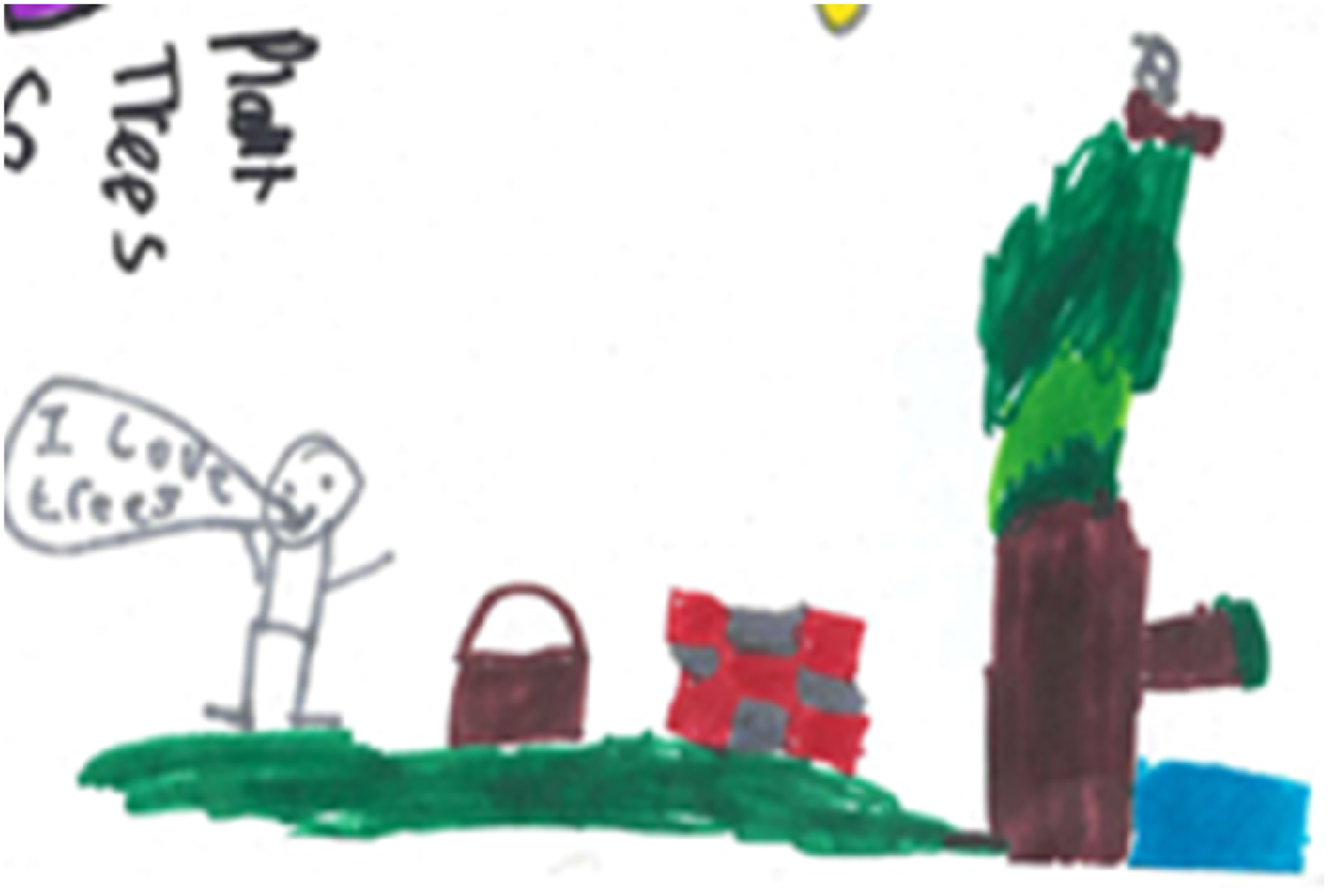
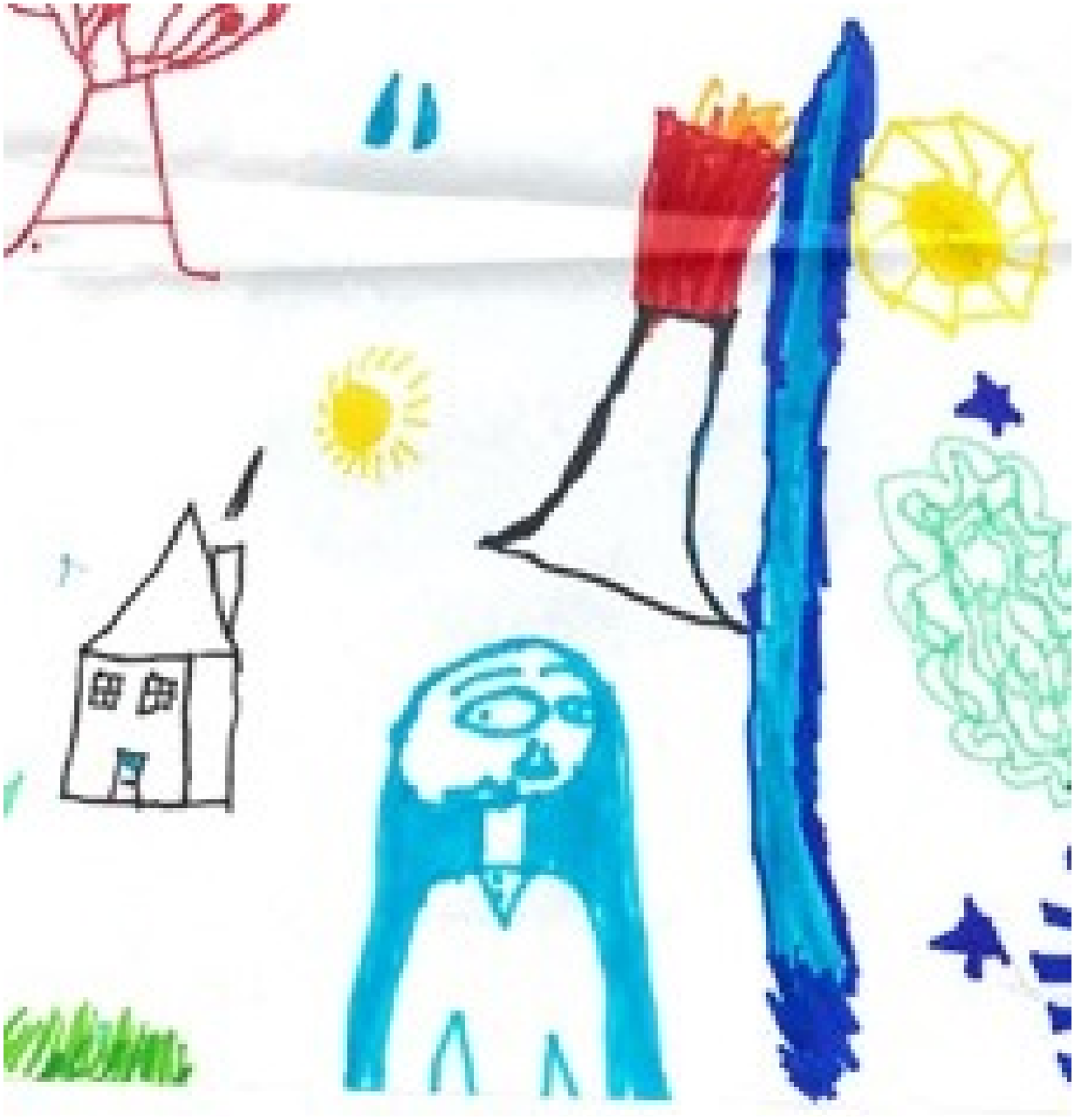
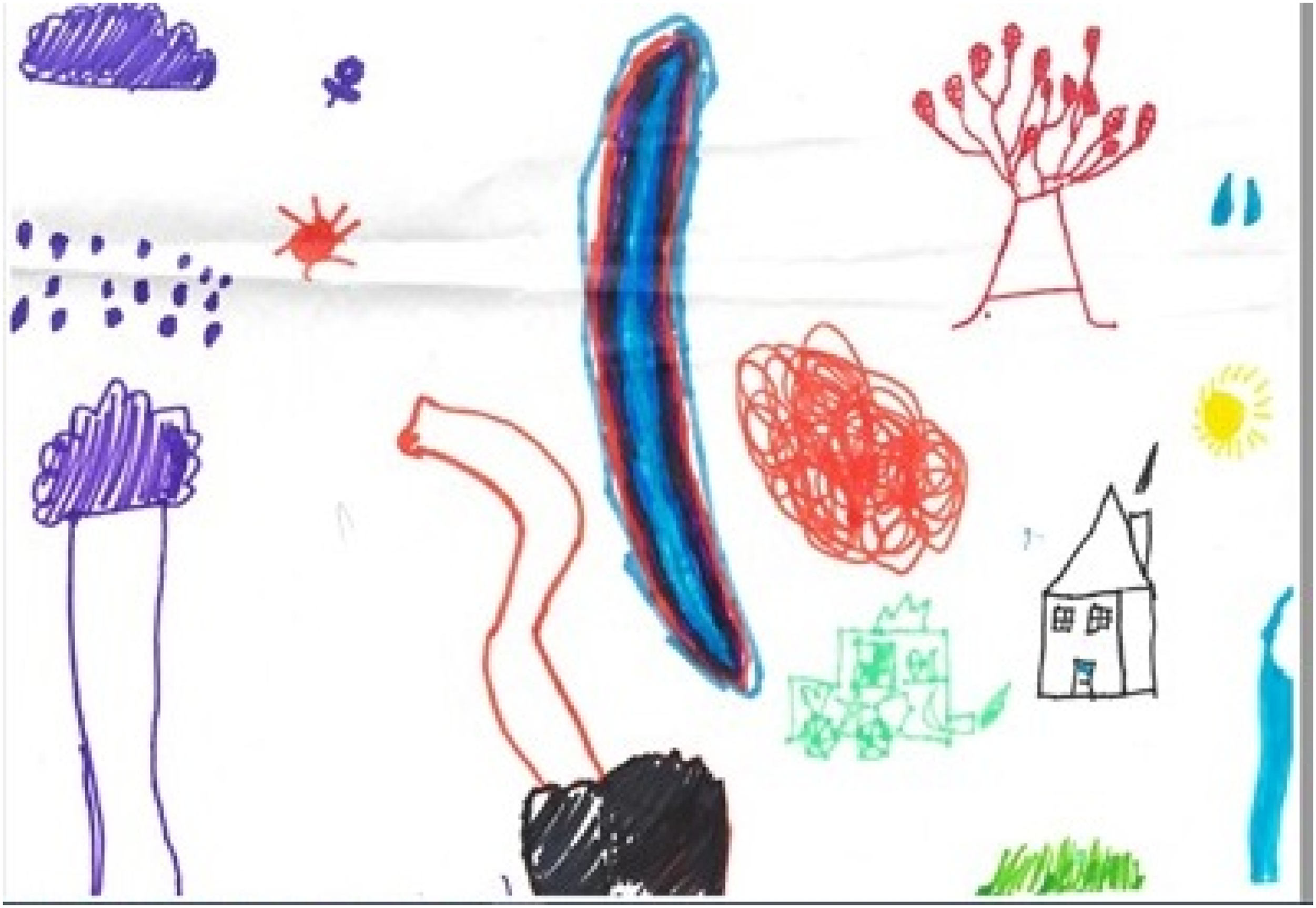
In response to prompts as part of the attending activity, a lot was shared, written, and drawn. These verbal, visual, and written narratives tell stories about the children themselves and conditions inside the school and outside in the neighbourhood in which they live, while some events describe transnational family contexts and connections that the children hold. These responses reported, written, and drawn by the children enabled descriptions of the natural environment in much broader and more complex ways. Children’s verbal, visual, and written stories can be seen as relational assemblages that matter ontologically (Rautio and Jokenin, 2015), enabling possibilities for children to share certain stories when talking about outdoor (natural) environments. The existence of the material, more-than-human world and transnational (global) familial connections with trees in children’s drawings and conversations shows children ‘becoming-with’ (Rautio and Jokenin, 2015: 6) during the research activity. Children shared fleeting, sometimes verbal, visual, or both visual and verbal stories of their experiences of/with trees and the natural environment. At the same time, children’s knowledges of trees and their connections with trees became more complexified, highlighting the presence of other objects, materials, and small stories mattering to children more than trees. This opens out an expansive view of children’s voice through which we noticed voice as entangled with transnational experiences, stories, and ways of knowing and being with trees and with the outdoor natural environments disrupting conceptual framings of children’s connections and experiences with the outdoors (Nxumalo, 2016).
Conclusion
Children’s visual and verbal, or sometimes only verbal or visual, stories of the natural environment appeared here as relative, relational, embodied, and entangled with research matter and children’s relational lives in and outside the school. Children’s oral, written, and visual depictions of their natural environment(s) very much depended on what mattered to them (Kraftl, 2020) or what became important in moments whilst doing the research activity. We sat with the children and observed the moments when we all were doing the attending activity, and we came to perceive children’s oral, written, and visual stories not as finished products with clear messages but as ongoing, unfinished, disruptive, and under construction, all of which came into existence as a result of the research assemblage that brings together the researchers, the class teacher, and spatial and material affordances in ways that allowed the creation of generative encounters (Mazzei and Jackson, 2017). We noticed that the children became entangled with the situations they were in whilst responding to the questions about the natural environments. They sometimes responded to the questions in a few words or in a sentence; at other times, they talked about family knowledge about trees, transnational families, and stories of tree planting. Sometimes, the activity itself became a moment of exploration when the children’s stories did not focus on trees or on the natural environments. Considering research as a relational and generative encounter allowed us to de-centre children’s agency (Spyrou, 2019) as well as our own ways of defining and describing children and their connections with the natural environments (Nxumalo, 2016).
We noticed that children’s verbal, written, and visual stories are entangled with their encounters with significant human and more-than-human others across multiple contexts. Their stories of buildings, pipes, machines, play equipment, the children themselves, their grandparents, as well as the trees, flowers, grass, sun, lava, and CO2 pollution all became part of the worlds (Taylor and Pacini Ketchabaw, 2018) that were created as part of the attending activity. Therefore, with this, we came to know stories of more than trees and more than a child/children as these stories were being described, drawn, written, and enfolded within us and with the children. These require ‘response-able’ (Haraway, 2016) considerations and a move away from representational analysis to interpret how children share their understanding of the world around them. With our embodied presence, we refigured our own entanglements within the research process by paying attention to the relations and affections generated among the research team and the children when expansive stories were created and shared (Nxumalo, 2016).
The stories we presented above are fleeting, quick, busy, interacting, relational, incoherent, and disruptive. We might not be able to fully capture the multiplicities of voices, because they are not singular, coherent, convergent, or unitary, but we explored the convergence and divergence between different modalities, topics, research assemblages, and experiences. This, however, enabled us to attend to children’s voice and research affordances in different ways. By focusing on Nxumalo’s refiguring presences (Nxumalo, 2016), we recognised certain voices, visual, verbal, and silent stories framing children and their natural environments in different ways. We looked beyond the individual child by attending to converging and diverging practices of talking, drawings, human bodies, things and materialities that became part of the research activity, enabling us to make sense of these research encounters through a critical stance.
Footnotes
Declaration of conflicting interests
The author(s) declared no potential conflicts of interest with respect to the research, authorship, and/or publication of this article.
Funding
The author(s) disclosed receipt of the following financial support for the research, authorship, and/or publication of this article: This work was supported by the Natural Environment Research Council (NERC) [NE/V021370/1].
