




Abstract
The field of child protection is closely interwoven with the national welfare state and its institutions. Nowadays, both the everyday lives of families and the professional work are shaped by transnational activities. This article presents the results of a study on child protection services in Germany working across national borders. Although regulated by international law, there are institutional and organisational gaps challenging professionals in this field. We can find processes of border setting and border crossing by professional social workers at the same time. Two ideal types of transnational situations are presented that reflect the variations of professional activities.
Keywords
Introduction
Certain professions deal with core issues within a society. When these issues are considered important enough, their handling is restricted to professional groups with specific and credentialed expertise (Hughes, 1963). The history of these professional domains (law, science, medicine etc.) shows that the specialists within them often have more than one official mandate, and that these are often in tension with one another. The social issue of child welfare, for example, accommodates questions of justice, but also distinct concerns for the physical, psychological, and social well-being of children, as well as an obligation to support parents. These tensions in responsibility are also reflected in the social work associated with child welfare. Social work has a societal mandate to protect children, but it also has a mandate from children and their parents (Köngeter, 2009). A third mandate relates to the work ethic of the profession, which has to honour general human rights and the rights of children (Staub-Bernasconi, 2016).
In the German-language literature, Schütze (2000) was the first to systematically identify these tensions in the social services, and elaborated a non-exhaustive list of the contrary mandates associated with professional social work. Schütze argues that dealing with these tensions is at the core of professional activity, including in the field of child and youth welfare. Key tensions in child welfare can be traced back to the structural problem of help and control, which is linked to the profession’s involvement in the welfare state, and the sometimes conflicting instructions from society on the one hand and service users on the other. In this regard, it has been found that professionals often legitimize their actions based on normative models of family and education that find support in social policy regulations (Sutterlüty, 2017). Another tension in working with families emerges when family members – children and parents – have contradictory needs and wants (Schütze, 2000). Significant tensions also arise between the contradictory logics of organizations and professional practice. Organizations are important and efficient for social service delivery, but they tend to standardize professional activity, which goes against the professional approach to dealing with social problems (Bode and Turba, 2014).
These tensions appear in and between institutional and organizational levels. Tensions arise in particular when mandate and license diverge (Nittel, 2000), which is typically the case in transnational situations. Analyses of professional tensions, however, have often neglected to consider the importance and impact of national and international institutions, which may restrict license, or the transnational activities of clients and social workers, which may redefine the mandate. Although social work is to a large extent institutionalised, organised and financed by the welfare state, social workers look for services beyond their nation state, and clients often live in more than one country, sometimes even trying to escape the control of the welfare state, who have the power to make interventions in their family life. Against the background of this neglected, transnational dimension of child and youth welfare, we focus on the following research question: How does professional work in the field of child and youth welfare change when its participants regularly cross-national borders and create transnational social spaces? To this end, we present the results of a qualitative study, in which we analyse professional action across national borders. We aim to identify tensions that arise when professional practice exceeds one’s own national context. Both the institutional and organisational integration of the profession play a role, as does the concrete interaction between professionals and clients.
Transnational child welfare – The institutional context
The German child and youth welfare system offers families a broad range of socio-educational support services for parents who are no longer able to ensure the well-being of their children. These services include parental counselling, and inpatient and outpatient care for young people and their families. Professional work in this area focuses, among other things, on the difficulties faced by families in raising and caring for children. However, these areas of concern are very frequently connected with additional social problems such as unemployment, illness or addiction, which fall within the remit of other social security systems. The German child and youth welfare system is closely regulated by law and relates specifically to the German national context (Diwersy, 2024). The child and youth welfare system is particularly responsible for the practical implementation of child protection. After an increase in child protection cases in the 2000s, this field of action has been restructured through legal amendments, which have further increased the welfare state’s power to interfere in family situations and protect children. Since then, professional practice has been increasingly shaped by discussions of child protection, eventually resulting in a focus on standardised processes of risk assessment and casework (Witte et al., 2019).
In practice, transnational issues such as UN children’s rights also play a role, and their terminology and practices are coupled closely with the national framework of child and youth welfare. The same applies to theories that are used to characterise specific problems in families and identify their best solutions. Since these interventions are connected to the catalogue of socio-educational support services, we can identify nationally specific ways of talking about social problems within the family. The strong focus on education, for example, is related to a more than 150-year-old tradition of talking about child welfare through the theoretical lens of social pedagogy. This enables a supposedly concise explanation for those familiar with national discourses, but raises the question how the problem of understanding is dealt with in a transnational context.
In border regions such as the Grand Region – which includes Luxembourg, parts of France, Germany, and Belgium – professionals regularly deal with families that are spread in some way across multiple countries. These families commute, move back and forth, or are separated by a border. Furthermore, organisations that offer socio-educational support services (such as residential therapy groups) take in children from other jurisdictions. For the most part, however, there is a lack of legal provisions and binding procedures in this sector (Henallux, 2021).
We analyse such cross-border phenomena through the theoretical lens of transnational studies (Glick Schiller and Levitt, 2006; Khagram and Levitt, 2008). This refers to those cross-border relationships and practices in social, cultural, economic and political contexts that are not created or regulated by the state, and unfold across national contexts (Levitt and Glick Schiller, 2004). Transnational studies have shown that transnational connections between individual and collective actors fulfil important functions of support and care. In this regard, transnational networks, especially transnational family networks and networks of (non-governmental) associations, play a central role (Chambon et al., 2011). The theoretical insights and empirical research on transnational phenomena have not only revealed that common notions of identity, culture, ethnicity (and so on) need rethinking, but also that transnational relationships can be understood as social processes of ‘boundary making’ (Basch et al., 1994) and the translation of knowledge across these boundaries (Trans|Wissen, 2020). Initial research projects dealing with transnationality and social support for families show that professionals operating abroad are typically not familiar with foreign law, or the assistance systems available to them in their country of work. They also record that awareness of contacts and contact procedures is poor, and that cultural stereotypes play a role in approaches to casework. Overall, crossing borders leads to uncertainty (Kelly et al., 2019; Sievers, 2013). It is therefore of interest to analyse how these transnational, practical relationships between families and professionals influence child protection work.
A border analytical perspective
In social sciences the term border marks a difference and refers to practices of inclusion and exclusion in various dimensions. Many of these debates focus on the effects of borders, but borders can also be understood as processes of settlement and maintenance. Spatially, the concept of borders refers to the structuring of discrete territories. In the social sciences, researchers are increasingly interested in symbolic borders, which can develop a social efficacy. Symbolic borders are created by classifying people. If this is accompanied by unequal access and an unequal distribution of opportunities and resources, symbolic borders become social borders (Lamont and Molnár, 2002). For a long time, territorial borders were associated with the idea that communities could be defined through a spatial framework in which nation, territory, society and culture mesh seamlessly together (Beck, 2000). However, the connection of territorial, symbolic, and social borders is not simply given, but rather emerged through a contingent historical process, culminating in a powerful sense of differentiation, one that goes largely unquestioned in everyday life and is reinforced with appeals to national and cultural identity. Criticisms of methodological nationalism have uncovered the neglect, in this idea, of the varied empirical realities of transnational practice (Wimmer and Glick Schiller, 2002). A number of studies have emerged out of this scepticism that deal with alternative constructions of spaces and identities, especially as they exist in border regions (Wille et al., 2015).
Modern territorial borders – most importantly those of nation states – are powerful dividing lines through which affiliations and rights can be secured or denied. In the field of child welfare, various welfare-state-regulated boundaries can be identified: socio-political discussion of the phenomena of ‘childhood’ and ‘family’ is based on the notion of permanent spatial presence; childhood is predominantly thought of as a period of growing up in a fixed physical place within a national territory; and the image of family and parenthood is based on the idea of the presence of all family members within one national context. Transnational developments are barely considered here. These socio-political demarcations owe to a conceptual emphasis on order: a central frame of reference for professional social work, which has substantial practical effects on the design of support services.
The concept of working on borders was taken up in relation to border zones of cooperation. Because of the breadth of social work’s areas of responsibility, social workers often have to collaborate with other professions. In these contact zones we find overlapping responsibilities, a mix of different approaches, professional affiliations, and work assignments. The pragmatist analytical framework, with its concepts of ‘boundary objects’ (Star and Griesemer, 1989) and ‘boundary stories’ (Diedrich et al., 2011), can help us understand how borders are interpreted, reconstructed and transformed within these contact zones. Boundary objects are material or immaterial objects that transport information. They are plastic, and interpreted differently across communities, but with sufficiently stable content as to maintain integrity. In contrast, boundary stories are less flexible – they bundle experimental knowledge together that relates to specific events in practice and best practices.
The analytical category ‘border’ is also increasingly taken up in discourses of social pedagogy and social work. With their metaphor of ‘border work’, Kessl and Maurer (2009) draw attention to the role of social work in reproducing power relations, a process that involves taking over the socio-political interpretations of problems and classifying people accordingly. At the same time, such a critical perspective can also reveal the potential for change in these social relations and structures. Our analysis is based on the concept of dynamic social boundaries in Lamont and Molnár (2002), and pays particular attention to the professional ‘boundary work’ of social work described by Kessl and Maurer (2009).
Researching transnational child welfare – Methodological considerations
The results presented here derive from a study in which we interviewed social work professionals working in child welfare services in Germany. We used the methodological framework of situation analysis, developed by Clarke (2005) on the basis of Ground Theory Methodology (GTM) (Strauss, 1987). Clarke’s situational analysis (2005) combines GTM with the central considerations of discourse analysis and actor-network theory. As a result, we focus not only on the practices of actors, but also how these practices take up discourses and non-human entities as a way to legitimize, critique or transform themselves. This significantly expands the focus of analysis from the micro level to the interaction between micro-, meso- and macro-social levels. Methodologically, Clarke suggests taking up theoretical concepts from pragmatism to analyse the relevant phenomena. Strauss’s theory of social worlds and arenas plays a special role here. According to Strauss (1978), members of social worlds relate to one another in their actions as members of a group, community or culture. The boundaries of social worlds can be determined through mutual reference to one another. Arenas form where social worlds overlap. These are places and occasions where members of different social worlds meet. Arenas are places of exchange, debate and hierarchization in which different systems of meaning, forms of belief and knowledge, and core activities and objectives come together.
The aim of situation analysis is to identify key elements of the situation from the perspective of the researched as well as of the researchers. This allows one to identify all elements in a given transnational situation. Discourses and discursive elements (which play an essential role in the translation of knowledge) receive special consideration. A central premise of situational analysis is an open approach, which aims to formulate empirically grounded theories.
For this, we take 19 problem-centred interviews (following Witzel (2000)) as our corpus of data. This type of interview is characterised by its narrative opening and particular focus on a problem or situation. In the interviews, the professionals each describe a transnational case constellation that they have dealt with themselves. These can be incoming or outgoing transnational cases. We exclusively interviewed professionals from German welfare institutions and services, both public and independent. This was in order to have a control against which to compare institutional frameworks. The data collection took place throughout Germany. The professionals have different functions within their organisation, but all of the interviewed professionals had direct contact with the families they worked with. Given the research interest of our project, we interviewed social work professionals as members of a social world who, in dealing with transnational cases, come into contact with foreign institutions and people from other social worlds. Our interviewees therefore have experience with transnational social arenas, in which a broad array of symbolic and social boundaries come into play, and are influenced by professional discourses and heterogenous welfare state norms.
Our selection of interviewees follows the guidelines of theoretical sampling and is designed to cover the entire spectrum of possible transnational situations. The interviews were transcribed and thus made accessible for reconstructive analysis.
In order to gain a better understanding of the concrete transnational work processes and dynamics under examination, we expanded on Clarke’s (2005, p. 151) toolbox, integrating the interactionist heuristic of the arc of work (Strauss, 1987). This is particularly suitable for analysing professional work because it can be used to track the various tensions that emerge in the different stages of professional work. The reference point for this is not the organisation, but the design of an individual work project, in which actors from different organisations can be involved. By combining coding and mapping techniques, and using Clarke’s extended toolbox, we could reconstruct the perspectives of the interviewees, as well as the elements central to their professional practice and relations to one another.
The cases considered here correspond to two of the four ideal-typical constellations described in the project. We understand a constellation to be a certain form of appearance and relation between certain elements within a situation; in this case of transnational, professional, child welfare work in Germany. The analysis of individual constellations is an intermediate step toward mapping the complexity of the situation systematically.
To do this, we first identified key categories of these constellations which highlight significant differences in professional actions. Following this, we constructed an ideal type. This ideal type is based on the characteristics of a real case narrative, but these characteristics were extrapolated to provide a comprehensive representation of all possible constellations and points of tension. This means that the constellations presented here do not occur in reality as described, because real transnational casework always includes elements from the other ideal constellations. The ideal type nonetheless has the great advantage of representing the conceivable possibilities of all transnational constellations. Overall, four typical constellations of transnational professional practice are treated in the analysis.
Transnational constellations as an interaction between welfare state institutions, associations and families – Insights from two constellations
In all the constellations examined, the institutionalization of child protection by the welfare state is of particular relevance. Although differently structured across jurisdictions, child protection authorities generally play a central role in ensuring the best interests of the child (Gilbert et al., 2011). The central dividing lines within these constellations are the following categories: (1) the degree of cross-border networking, (2) the outlook of the cooperation partners, (3) their professional attitude and (4) the modes of translation in use.
We present two constellations that are located in European border regions. One is the ‘Grande Région’ surrounding Luxembourg. This region includes French Lorraine, Belgian Wallonia (with its German-speaking community), Luxembourg, Saarland and Rhineland-Palatinate (Interreg V A GR, 2021). The other is the ‘Euregio Region’ in the border triangle of Germany, Belgium and the Netherlands, which includes the three Belgian regions of Liège, Limburg and East Belgium, the Dutch province of Limburg, and the region surrounding Aachen. A common characteristic of both border regions is that a variety of transnational practices take place there, including in child welfare. The key difference in the cross-border organisation of child welfare services is that, in the Euregio region, there is a cross-case network of actors in child and youth welfare, and permanently established cooperation structures. In the Grande Région around Luxembourg, this is not yet the case.
Transnational intervention
The ideal type of ‘transnational intervention’ is a constellation typical of cross-border movements in the Grande Région between Germany, and Luxembourg or France, and are usually not initiated by professionals, but by service users. In this region, there are no official child protection authorities across borders, but transnational activity in the child and youth welfare is nonetheless common. The way in which national social security systems are institutionalised, especially in child and youth welfare, differs significantly, one country to the next. In addition, German, Luxembourgish and French are all used, such that language translation is regularly necessary. For professionals working in the region, cross-border cases are not unusual. The analysis shows, however, that these professionals have only rudimentary knowledge of the help systems of their neighbouring countries, and see little sense in extensive transnational collaboration. These factors contribute to a phenomenon that our interviewees call ‘system flight’. This is the term professionals in the Grande Région use to describe the escape of families across national borders, and escape from state intervention.
In our interview with him, long-standing employee of the youth welfare office Mr Scherer described a typical constellation. He referred to a Luxembourg family – the Adams – as a ‘classic system evader’. This refers to highly stressed families who have exhausted the possibilities of the national support system, and whose children are about to be taken into care. These are often families with complex problems such as unemployment, debt, addiction, a lack of means to care properly for their children, and violence and conflict. To avert having their children taken away, the family move to neighbouring Germany. The professional thus projects onto them the image of system evader, already fixing an impression of their situation. On first personal contact with the family, he finds this impression confirmed. He reports that the family had distanced themselves. They were reluctant to accept outpatient help, but were then almost impossible to reach. Under conditions of pressure and insecurity Mr Scherer feels that the children’s well-being is at risk, but he does not contact the Luxembourg authorities to explore a joint approach. In the end, Mr Scherer takes the family’s children into care, while the mother, who has sole custody, ‘flees’ back to Luxembourg to avoid further intervention on the part, for instance, of the social welfare office. For reasons of residency law, the children now also have to return to Luxembourg, where there isn’t any suitable follow-up help for the family.
In our interviews, we found several such cases describing typical constellations of transnational intervention. The interviewed professionals describe these cases and its processes in similar ways. After ‘system flight’, families manage for a certain period of time to avoid contact with the local child protection authorities, due to insufficient cross-border collaboration. Sooner or later, however, they run into German authorities, where they once again become a case. The lifestyle of these families deviates significantly from the ideal image built into the child-protection policies of the welfare state, so that ‘fitting problems’ arise. At the same time, it is typical for these constellations of transnational intervention to have a network of contacts that support them across borders. As a result, the families are partly in Germany and partly abroad and are barely accessible to professionals. The analysis shows that the professionals feel pressured to act due to their mandate to protect children. At the same time, the cross-national context frustrates their attempts to ensure the well-being of the child, as they have too little insight into their current situation. This creates uncertainty.
Professional descriptions of cases make it clear that all of the families are not only assumed to have the same patterns of behaviour and mobility, but also that the perceived phenomenon of ‘system flight’ is linked to assumptions on the part of German social workers that decisively influence the professionals’ view of the case and their course of action – assumptions about lifestyle, family resources, and social problems.
These assumptions are bundled into the boundary story of ‘system flight’. Boundary stories represent a medium of translation ‘when little else is in place’ (Diedrich et al., 2011, p. 4). They transport experiential knowledge and create coherence when (as is typical in this constellation) there is no systematic exchange of information between the child and youth welfare authorities across borders. It is assumed that the families have multiple social problems and are highly stressed, so that working professionally with them is difficult and offers little chance of success. In addition, the professionals assume – based on assumptions about the foreign support system and foreign professionals – that these families have had bad experiences with the authorities. This produces an expectation that access to them is difficult, and that they will be unwilling to cooperate.
Although cross-border assistance processes in the Grande Région are no exception, the foreign structure of child protection, are not well known to German professionals, not to mention other elements of the social security system. Likewise, these support processes are not systematically considered in the organisation of facilities and services. Because of the lack of stable cross-border networking, responsible cooperation partners are often unknown. Professionals also report data protection obstacles and language barriers. In addition, when meeting families, hardly anything is known about their individual family history. Exchanges with foreign professionals are mostly unsystematic, sporadic or non-existent, since the official support systems are viewed as invasive and inefficient. Potential foreign partners are assumed to have insufficient understanding of the case and inefficient case work. If contact takes place in overlapping social worlds with foreign actors and families, a boundary story becomes dominant, and leads to an emphasis on symbolic and spatial boundaries.
In the context of welfare state regulations, the boundary story thus has the effect of creating differences and permanently maintaining borders in two respects. First, a comparison is made between the boundary story and institutionalised images of the ‘normal family’ which are implicit within the welfare state. A normative difference is opened up between these forms of life, which leads to a reproduction of the borders created by welfare state institutions in the course of professional interpretation. This has the effect that work with the families is seen as problematic and not very promising.
Second, processes of professional border demarcation also become effective because of perceived differences between the domestic and foreign child protection systems, with different views of social problems and ways of working. Professionals therefore do not see themselves primarily as members of a profession, but as part of a national child protection system, with hierarchical differences between the allegedly superior domestic child protection services and the allegedly inferior foreign system.
The problem in this constellation is that German professionals start with an already distorted perception of families, and see little benefit in exchange with the professionals belonging to the foreign child protection authorities. As in the case of the Adam family, negative stereotypes overlay the individual view of the family’s situation, and the uniquene dimensions of the case history are not grasped. In addition, boundary stories may also prevent exchanges of knowledge which are indispensable for understanding individual cases. In concrete casework, this is reflected in the tendency to fit cases into existing national services, and to process them with steps and procedures that are familiar only in the national context. In short time frames, individual professionals work together with family members on site, who inhabit their own spatial and content-related area of responsibility. There is, however, no long-term plan to develop this kind of help. Professional help instead consists of uncoordinated selective interventions. In the process, crucial transnational requirements are not taken into account.
As a consequence of the mountings social problems faced by these families, lots of authorities and official agencies from their own national context become involved in the course of the casework: the immigration authorities, the social services, and the health authorities – each of which is responsible for a different, wider range of problems in family life, and each of which works according to different standards than child welfare. So that one can assert oneself against other actors and maintain one’s own freedom to act, the focus is on one’s personal, state-regulated mandates: to act, and to ensure the best interests of the child (within the national framework). This additionally favours the neglect of the transnational quality of the case.
As Figure 1 shows, this leads to arcs of work (Strauss 1987) being cancelled as soon as they have been started. The support process in the country of origin can also not be continued in Germany. Nor can assistance in Germany be maintained across borders when families move back and forth. Due to the boundary-preserving effect of the Boundary Story, it seems more convenient for professionals to start their own project with the family. However, this does not do justice to the transnational realities of family life, so that the help offered clashes with the needs and expectations of the families. The abortive arcs of work point to tense conditions for action that professionals tend to try to resolve unilaterally. Arc of work of ‘transnational intervention’.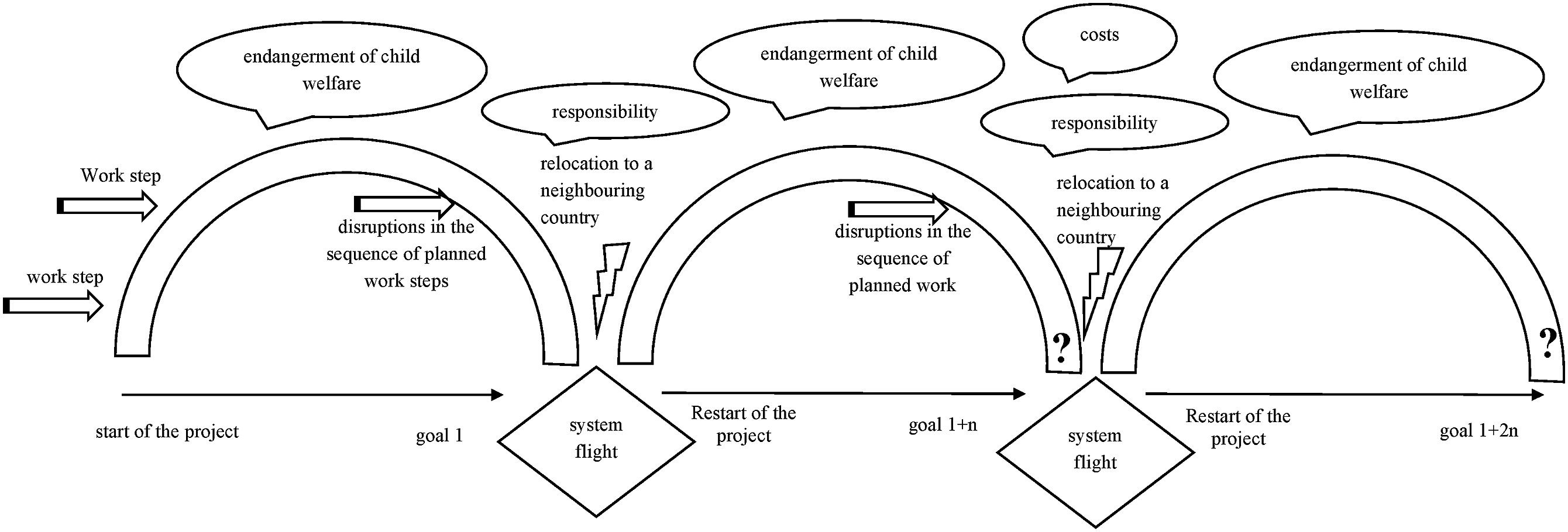
In this constellation, professionals are under pressure to act due to a lack of transnational networking and a poor awareness of the protocols of the foreign assistance system. Above all, however, it is simply not possible to establish a trusting working relationship with the families. This leads to phases of contingency in the course of assistance, during which problems are not dealt with immediately and build up into crises. In these escalating situations, professionals intervene directly in the family system and impose a solution on the family that they do not support.
Transnational care
The ideal type of ‘transnational care’ refers to cases found in the second border region studied: the Euregio region between Germany, East Belgium, and the Netherlands. The region is not only characterised by a common language and lifestyle, but also by many different cross-border networks, cooperations and organisations in different sectors, including child welfare. Cross-border assistance procedures in child welfare are a regular occurrence here. Professionals cite the quiet and rural setting of eastern Belgium as a reason for this, making the area attractive for children and young people. Conversely, children and adolescents from East Belgium are placed in Germany if they are looking for a specialised service that does not exist in East Belgium, or if they need to be at a distance from their parental home. The professionals we interviewed are well acquainted with the respective foreign support systems that owe to regular transnational cooperation. They are also aware of specific contacts and general procedures. Although the two child welfare systems in eastern Belgium and Germany are similar, they are not congruent, so that here too – despite the many similarities – translation practices are needed. This is done through two main boundary objects (Star and Griesemer, 1989). Like boundary stories, boundary objects also represent translation efforts. The central difference is that they only unfold their effect in personal exchange, in which different actors address their expectations of another and negotiate a common consensus. Boundary stories, by contrast, are institutionalised sets of interpretation frameworks.
This is exemplified by the transnational aid provided for the Thill family. They come from East Belgium. The family’s daughter, Jenny, needs follow-up help outside of her nuclear family after a stay in a psychiatric hospital. However, she no longer wants to return to her previous living arrangement in east Belgium. As a result, the case manager from east Belgium resolves to support the family in finding accommodation in the German part of the Euregio region. From a professional point of view, the facility run by Mr Zeiss is chosen as the best suited to Jenny’s wishes. He is responsible for Jenny for several years. In Mr Zeiss’ narrative, there are regular references to a common regional origin and affiliation to the Euregio region, as well as a focus on the child’s welfare in all of the decisions and plannings of the casework. For example, he points out that all those involved – both professionals and family – are residents of the border region and have the same cultural background. National borders are not thought to play a significant role in everyday life. Zeiss also transfers this feeling of togetherness to the transnational cooperation of the professionals and the family. In addition to physical proximity, he establishes personal proximity, which generates predictability and a basis for reliable cooperation. All of this is oriented toward the child’s well-being. For Mr Zeiss, it is important to aim for a common goal with the family and Jenny together, and to structure the support in such a way that Jenny can yield long-term benefits: attendance at school, for example.
This practice also becomes clear in the reconstruction of the other case constellations assigned to this type. The following illustrations summarise the key findings of the data interpretation below.
The cross-border movements in the Euregio region are not only professionally intended channels for help, they are also planned with a long-term perspective and the option to return. The decision to cross a national border is made in agreement with the family. The starting point is to design a course of assistance in the best interests of the child. If cross-border assistance is organised against this background, contact persons and support structures tend to be known. Some agencies are already organised transnationally in this way. There are also transnational agreements between health insurance companies, so that many uncertainties that in our other case histories do not even arise in the first place.
As with Mr Zeiss, two boundary objects play a specific role here: the ‘border area’, and the ‘child’s welfare’. In our interviews, it becomes clear that the professionals perceive themselves as living in a border area where national border crossing occurs regularly. This also applies to the families they work with. They live transnationally, crossing national borders every day. They assume a common cultural and regional affiliation, and a shared, transnational way of life. To pass through a national border thus has a different meaning for these professionals. They do not perceive borders as a barrier, either physically or symbolically. The effect is to produce no feeling of foreignness or otherness toward the child protection services of the other country. Instead, professionals see a mutual benefit from each other, since they can learn from each other, and services can be selected according to individual needs. This favours the alignment of casework with shared universal professional values. The two boundary objects promote translation processes that create hybrid knowledge and the possibility for flexible transnational case processing.
Professional practice is determined by mutual appreciation, recognition and trust. This opens up the view of the particular situation of a family, who also feel like residents of the border country. The sense of a common cultural affiliation means that the professionals’ view of the families is not pre-structured by nationally connoted categorisations. This favours reconstructive, emergent processes of case-making and casework. The border object ‘border region’, and the identifications associated with it, allow the reference to national borders to fade into the background in everyday practice. This means that professionals are less oriented toward national laws and regulated procedures, because transnationally compatible ideas (the best interests of the child, for instance) become guiding principles for action.
Professional action is also organised along the second boundary object: the ‘best interests of the child’. This is an indeterminate legal concept that must be interpreted on a case-by-case basis, requiring a negotiation between all parties on how the well-being of the family’s children can be ensured in the long term. This constellation thus involves all participants aiming at a common goal, agreeing on the steps to be taken, and cooperating closely on their execution. Transnational networks of families and associations are not understood here as deviating from and hindering the implementation of a national mandate for action; they are seen as a valuable resource that forms the basis for the content of the aid Figure 2. Arc of work of ‘transnational care’.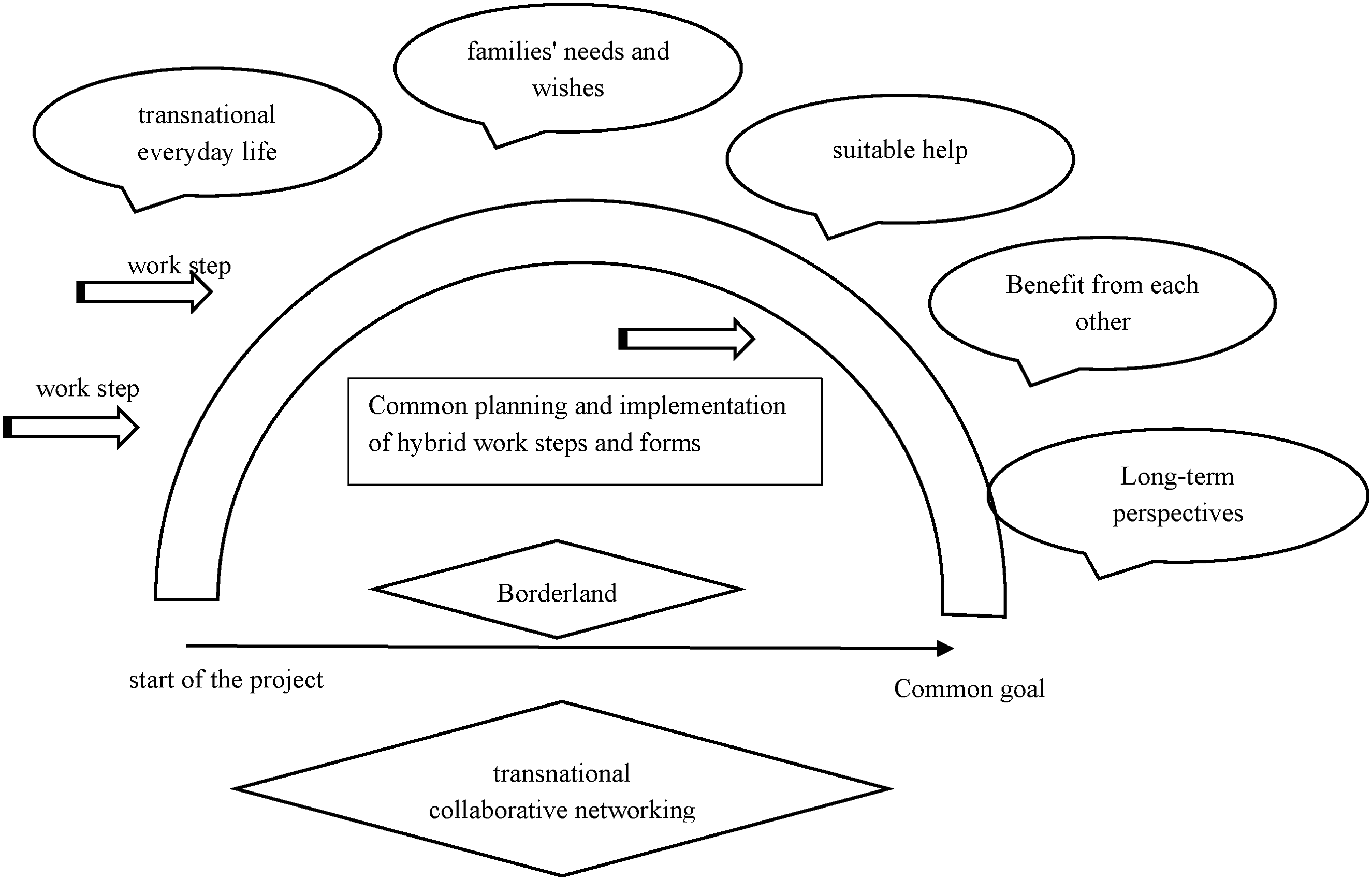
As illustrated in figure two, this constellation makes it possible to plan and implement a joint project with all those involved. This results in only one arc of work that can be maintained transnationally. The two powerful border objects contribute significantly to the success of the cross-border work. It appears to be easier for professionals to mediate and resolve tensions in their actions when against the background of the existing structural conditions of the region. When the professional and private actors involved meet in this border region, the space that emerges is not a conflictual negotiation about whose financial claims will be enforced. Rather, it is possible to anchor professional actions to supranational reference points that have universal validity for social workers. This encourages professionals to see themselves as members of a social world of social work, and to work cases together. In this respect, a border expansion is taking place in which regulated child welfare services are transformed so as to connect better with coping strategies and transnational ways of life.
Transnational professional child welfare – A look ahead
Transnational constellations lead to changes and new challenges in the already complex professional responsibilities of child protection and child welfare. Professional practice is characterised by the tensions already familiar in the national context, such as those of help and control. There are also further tensions that result from transcending the national frame of reference.
The two ideal-typical constellations are not intended to show how transnational casework succeeds or fails, but rather to highlight the crucial points of tension at which professional action is determined. In particular, our study shows that there is a significant difference between the power, responsibility and resources made available to child welfare in terms of social policy, and the expectations towards social work the professionals set themselves; namely: ensuring the well-being of the child, the amelioration of living conditions, and the improvement of parenting practices.
These tensions are related to the transnational extension of each case, and arise because the relations between the two constitutive features of professions - license and mandate - change when they are no longer nationally bounded. The license always refers to the national context, even in transnational cases, which means that the qualification and associated actions always require legitimization in contexts other than one’s own national context. In addition, one’s own state mandate ends at the national border, but not the mandate from the clients and the profession itself.
The typical constellations presented here are two of a total of four typical variants that can occur in transnational child protection and childcare (Diwersy, 2024). They are exemplary for those cross-border contexts in child protection that can occur in border regions where linguistic, social and cultural borders do not coincide with national borders, and where border crossings in different contexts are part of everyday life. The analysis makes it clear that even in cross-border contexts, national guidelines and the welfare institutions of child protection and childcare play a central role, and cannot simply be ignored. However, transnational practices that occur in situations of child protection are neglected by following national regulations.
In total, four typical fields of tension could be reconstructed that make up the possibilities space of transnational professionalism:
At the institutional level, the tension between formality and informality can be shown. Transnational case constellations are only very basically regulated in legal terms. As a result, professionals are confronted in transnational cases with institutional gaps, for example on the transfer of responsibilities. The lack of legal regulation in transnational educational support tends to favour an orientation toward national guidelines that are only known by residents.
The analysis also shows that transnational situations cannot simply be dealt with in a trouble-free manner with procedures that have been tried and tested in the national context. This will result in a tension between adaptation and reflexivity. The German system of child protection and socio-educational support features structures, processes, and responsibilities that differ significantly from other national systems. Transnational situations require a decision on whether and to what extent the transnational casework should be aligned with national systems, or whether a reflection should proceed on the differences between the systems, and new solutions found.
On an interactional level, there is a tension between limitation and delimitation. The transnational provision of support also places special demands on the organisation of working and cooperating. In many situations, greater spatial distances arise, and there may be linguistic and/or cultural boundaries. In addition, the transnational expansion of the case sometimes makes it more difficult to establish commitments and stable relationships with both the service users and the foreign co-operation partners. Because this can involve considerable effort, there is a tendency to dissolve and severely limit co-operation and relationship work.
Finally, there is the tension between transfer and transformation when it comes to the transmission of knowledge and skills. Transfer means simply applying one’s own ideas, methodological knowledge and skills to transnational constellations, without considering that problem-solving knowledge generated in a specific national context cannot be transferred seamlessly to other national or even transnational contexts. Transformation, on the other hand, describes the process by which new hybrid knowledge is created in a joint negotiation between different actors from different national contexts, and by which innovative transnational approaches are explored.
The results of the study show that, due to the general lack of legal regulations and insufficient organisational resources, professionals are left to their own devices in many questions of transnational casework, and have to sound out central procedures in individual cases, depending on previous experience and their own attitude. Since transnational casework is difficult to plan, many professionals faced with uncertainties will tend to orient themselves toward the state mandate in the form of legal orders and guidelines. However, this harbours the structural danger that the transnational context of the families’ lives and problems will be ignored. Discretionary powers are to be used by social workers to consider both the scope of what is legally possible and the needs of the transnational situation of families. If the normative standard for transnational professional action is taken to be the empowerment and participation of the clients (Negi/Furman 2010), then transnational professionalism cannot be achieved without the inclusion of the potentials and coping strategies of the clients.
For cross-border cooperation between professionals and families, it seems crucial to recognize and question border constructions, as well as the extent to which they need to be expanded and transformed in the best interest of the child. In concrete case work, one needs creative solutions for translation processes. This requires that organisations have the appropriate resources and knowledge management. In addition, the insights of the ‘transnational practitioners’ offer important points of departure from which to incorporate insights into the (inter)national social policy discourse (Gal and Weiss-Gal, 2013). This way, it could help broaden the political outlook on social problems beyond national borders, as well as contribute to the redefinition of those problems, so as to realign offers with transnational requirements.
Footnotes
Declaration of conflicting interests
The author(s) declared no potential conflicts of interest with respect to the research, authorship, and/or publication of this article.
Funding
The author(s) received no financial support for the research, authorship, and/or publication of this article.
