




Abstract
The inclusion of young people in conducting research leads to the creation of shared knowledge, honest communication, and increases the legitimacy of the research, allowing it to be an effective base for policy creation. This paper looks at the role of horizontal co-production with young people, as we reflect together on the process of collaboration in peace-building research.
Introduction
Research has shown that the inclusion of young people in research leadership can drive the broader use of knowledge and honest communication of values, increasing the legitimacy of the research, 1 allowing it to be substantive, reliable, and an effective base for policy creation (Oliver et al., 2019). These benefits, however, can only be realised if the desired approach to co-production is translated into an effective programme of action, which requires investment, meaningful process, time, and mutual respect. This paper examines the key issues associated with co-production by focusing on a participatory relational approach to co-research and monitoring, evaluation, and learning with an international Youth Advisory Board (YAB) consisting of young people across four countries involved in the Mobile Arts for Peace (MAP) project: Nepal, Indonesia, Kyrgyzstan, and Rwanda. The YAB was implemented to inform an international arts-based project that seeks to use arts-based practice in the pursuit of peacebuilding, and has the core purpose of providing a space for young people to influence the direction of the programme; contribute meaningfully to the Monitoring, Evaluation and Learning (MEL) of the programme, including peer researchers, co-developing tools, implementing tools and co-analysing data; and provide space for creative knowledge sharing and dissemination of findings from MEL activities.
Understanding the key issues associated with quality co-production and participation is important to develop a process that balances the practicalities of participation, acknowledge, and tackle tokenistic inclusion, and manage the tensions between vying stakeholders (Tisdall, 2015). This paper, co-written between youth and adult researchers, contributes to the growing literature on best practice in co-produced cross-cultural research with young people, specifically in engaging youth in international advisory boards that centralises arts-based methods. The ‘co-production cycle’ designed for this project and outlined in this paper has policy and practice implications for programmes seeking to create international YABs, specifically in acknowledging that YAB’s with the role of international YABs provide an opportunity to understand larger issues across contexts and enrich policy development at local levels. This paper starts with the context and a reflection from a YAB member, and co-author of this paper, on their journey to contextualise the experience of youth researchers embarking on this process. This reflection provides in-depth information on her reasons for joining YAB that are complemented by reflections from other young people in the group. The paper goes on to introduce the methodology, present findings, and conclude with overarching reflections and recommendations for research and monitoring, evaluation, and learning with young people. It culminates in the production of a co-production cycle for participation that identifies each stage in the YAB journey.
Context and literature
The arts-based project forming the basis for this paper is an ongoing international programme that uses arts-based practices with young people in the pursuit of peacebuilding in Indonesia, Kyrgyzstan, Nepal and Rwanda. It is funded by the Arts and Humanities Research Council (AHRC) and the UK’s Global Challenges Research Fund (GCRF) and involved the delivery of arts-based peacebuilding programmes in schools and youth clubs. Co-production and co-research are at the heart of the programme, with young people from member countries participating in a YAB that is founded on a co-developed Terms of Reference that documents the purpose, structure, values, and details of the YAB. The purpose of the YAB is to provide a space for young people to influence the direction of the programme; contribute meaningfully to the MEL of the programme, including peer research, co-developing tools, implementing tools and co-analysing data; and provide space for creative knowledge sharing and dissemination of findings from MEL activities (including co-writing this article). The shape and direction of the YAB is determined collaboratively by the young people, with the support of the adult allies (in-country support person). The YAB creates space for young people to engage with young people in other countries and to share ideas. It meets monthly online, with occasional extra meetings, to support mutual learning and to discuss new activities to support MEL through youth-led research and arts-based activities. The group also has a WhatsApp group where regular communication on MEL activities and other opportunities and reflections are shared. Members of the YAB are encouraged to use their experiences and knowledge to help each other, reflect together, and to decide on and lead new actions in each country as part of the ongoing project.
Reflection
This reflection was produced by a YAB member and co-author to reflect on their reasons for joining the YAB and their journey:
“I was born in Nepal in the southern part of the country. While growing up I have seen women always engaged in household chores and never allowed to have their public life. I have seen women working early morning to midnight in their houses and never having the power and authority to make decisions. Having grown up in such a context I always felt, it's more important for women to have the power within their own homes and interpersonal relationships than it is for them to have power in the larger economic framework as a whole. Being a girl in my country, a male-dominated society where women do not have the freedom to work outside, I have observed several cases in my village where individuals would prefer to send their sons to high school for higher study rather than their daughters due to the historical assumption that sons will stay with their parents until they are elderly and daughters will marry and not serve their parents. After several years of staying in my area, luckily, my father had a transfer to a new area and my family members all migrated.
I go back to the village during certain festivals and important days. During my trip, I usually hear and observe many of my friends’ difficult experiences with violence. I have first-hand witnessed the depression and anxiety of one of my friends who almost thought of giving up her life because she couldn’t share her worst experiences with anyone around. When I was a child, I also had some similar experiences which still give me goosebumps but I never made it my weakness. Rather living and hearing the stories from such a context has helped me to build a keen interest in the issues of girls and young people. For this, at an early age, I have always felt the need to take the initiative to do something for young people. So that I can help them to share the difficult journey they have lived up to this point. To begin with, I found [the project] an important platform. I currently serve as an YAB Member on the project, a participatory international action research project that engages youths in policy advocacy through arts-based practice.
I remember an incident while facilitating an art-based session in one of the schools in Nepal. One girl during a feedback session came to me. She said: “I felt we girls were missing from all the subjects being taught in schools because the lessons and courses in schools never talked about experiences faced by girls such as Menstruation, the dowry system, child marriage, and girls' rights”. She further said, “But now the session that you facilitated based on [the project] methodology made me feel really grateful for talking about our issues.” Another girl from the same school also added, “We never thought there would be an alternative to traditional teaching methods, to discover an art-based method as a teaching-learning process has been enlightening for us.” They said “We always had a guilt for not concentrating in classes and being frustrated with our teachers for teaching in such boring ways. The way you facilitated the art-based session made us realise that learning can also be fun and participatory rather than just a lecture and the learning sessions can happen on the topics which we young girls are facing.”
This made me to the realise that the situation in our society has not changed even in 2023. Still, we don’t talk about girls and women’s issues in the public domain including courses and curriculum. The classroom is just the extension of social realities, and it does not create a learning environment based on children’s engagement, and on the other hand, the courses do not take girls’ living experiences as a matter of subject. The project in Nepal sought to normalise discussing girls’ and women’s issues in the school curriculum and it tried to shift the learning environment from a “power dominance” to a “learning in partnership” model. All these have made me really feel that the arts-based method can be a powerful, convenient, and engaging tool for learning among girls in a society where gender-based discrimination is very high. Through the project, I had a chance to meet many young people and have heard their stories. All the impactful stories have made me realise I want to work for these young people and help them to speak up for themselves. I have many times seen a younger version of myself (a shy and fearful kid who was always afraid of other judgments) in many students which makes me empowered to contribute to society in a meaningful way by creating spaces for young girls to speak up about the issues they are facing.” (Nepalese Member)
This testimony provides rich insight into a young person’s journey to joining the YAB. It highlights the factors influencing the desire to join a YAB (i.e., desire to change the community for others), introducing alternative methods for learning and sharing knowledge (i.e., introducing arts-based methods to encourage learning), opportunities for supporting others to thrive, and creating safe spaces for meaningful dialogue.
Co-production: Advocacy and participation
Co-production provides opportunity to transform traditional power dynamics and create space for academia to engage in alternative forms of knowledge production and exchange (Bell and Pahl, 2018). Advocacy and participation, two distinct components of co-production, can be powerful when intertwined for the purpose of exploring and understanding social problems, strengthening meaningful engagement and decision-making, and community sustainability. Advocacy can be a central element of co-production that intends to challenge and change policies and positions of decision-makers through organised and systematic actions to ensure outcomes are equitable. The facilitation of participants by others through engagement and support not only creates opportunities for co-production, but it also creates space for young people to lead. Self-advocacy allows young people to realise and share their own identity within the co-production process by developing confidence, self-identity and acting as agents of change (Atkinson, 2002). A challenge in advocacy processes is the need to increase the efficacy of participants to ensure they are both comfortable with the process and that they possess the ability to recognise potential systems of oppression (Poteat et al., 2020). There is a tendency in co-production to prepare youth participants to create solutions that fit within pre-existing systems, whereas advocacy should be transformational (Ginwright and James, 2002).
Participation involves collaboration with others that allows for the wider exploration and understanding of social problems. This leads to the broader use of knowledge, honest communication of values, and increases the legitimacy of the research, allowing it to be substantive, reliable, and an effective base for policy creation (Oliver et al., 2019). Strategies for participation require careful consideration of the context in which participation occurs to ensure young people have an opportunity to share views, reflect on needs and exercise agency, though it is important to balance them with justice orientated perspectives to give definitional depth to participants’ hierarchical mobility. Lundy’s (2007) model of participation, drawn from the United Nations Convention on the Rights of the Child (UNCRC), for example, sought to respond to the general ambiguity of participatory approaches by offering a chronological approach to youth participation and a typography of four specific areas: ‘Space’ and ‘Voice’ (related to the right to express views in a safe supportive space) and ‘Audience’ and ‘Influence’ (related to the right for the views to be listened to and given due weight) (Kennan et al., 2019). These areas allow researchers to separate different areas of meaningful participation, evaluate them appropriately, and develop clear obligations toward youth participants.
Co-production: Arts-based approaches
Arts-based approaches are based within a narrative research paradigm drawing on personal experiences and life history with the art expressing lived experiences through means such as photography, theatre, or creative writing (Casey and Webb, 2019). Utilising these methods allows participants to offer powerful means of voicing their experiences and can be particularly effective for those who learn in alternative ways or may be less verbally articulate (Casey and Webb, 2019). Although the goal of their employment in participatory research is as a means of capturing the sensuous and emotional, considerations of legitimacy of ‘what counts as knowledge’ and ‘whose knowledge counts’ remains a point of contention amongst academics, therefore, deep consideration needs to be given to participant selection (Boydell et al., 2016). Additionally, Phillips et al. (2002) discussed the validation of co-produced outputs, one being emergent and related to participants’ shared expressions and the other artefacts that are applicable to the wider field of practice. Both emerge from the creative and collaborative approach; however, the latter is often considered more legitimate, acting as the traditional ‘result’ of research. Effective art-based research should seek to legitimise both.
Meaningful co-production with young people requires the development of programmes of co-production that are collaboratively designed and benefit young people directly (i.e., development of skills, confidence, relationships, training, and mentoring), as well as others in the community. Creating an environment founded on meaningful participation allows young people to develop self-worth and confidence through engaging in activities that promote leadership and advocacy. Meaningful participation does not just happen from a desire and/or idea, but rather a genuine understanding of cultural exchange, young people’s agency, and barriers to participation (Couch, 2007). Challenges in developing meaningful participation tend to be contextual, such as the time required to participate, which may compete with home responsibilities and personal obligations, resource-based, such as access to money or transport, or finally, relationship based, such as having poor relationships with the people running the programme and/or peers (Borden et al., 2006).
Co-production: Cross-cultural research
Cross-cultural research can be used to provide insights into both universal and specific factors of a phenomenon, contextualised through social and linguistic variation (Pena, 2007). Effective cross-cultural research should be grounded in the recognition of historical, sociological, political, and cultural forces that act upon the participants and seek to examine, compare, and contrast (Broesch et al., 2020). This means that in cross-cultural research researchers must be cognizant of their positionality, lived experience, and situated knowledges across contexts and how these may impact understanding and implementation of research. Intersubjectivity also needs to be encouraged to help participants garner a deeper insight into one another’s contexts when co-producing. In relation to co-production, where English is used as the lingua franca, constraints can be put on research participants if they are asked to present their work in English to meet research output requirements, rather than in their own language (Condon et al., 2023). Positionality refers to the wider political, economic, social, and historical context that impacts on interpersonal relationships – how people view themselves and how people view others (Temple and Edwards, 2002). Considering one’s positionality provides a foundation for tackling power differentials, promoting self-awareness, and creating trusting relationships. Reflexivity provides researchers with an opportunity to deconstruct and challenge positionality, creating an inclusive, transparent, and open environment (Temple and Edwards, 2002).
The central tenet of the paper is that co-production in cross-cultural arts-based projects, examined through advocacy and participation, have a key role in creating space for young people to work in partnership with adults in research, to be appreciated and care for one another, to acquire skills, and be confident to co-research and lead in their communities. It argues that youth researchers benefit from being offered opportunities to that allow them to contribute and exchange knowledge with their peers in a non-pressured environment, a process which is validated through relationships that are built throughout the process.
Methodology
This paper is co-written between young people and adult researchers and was developed from the experiences of the involved participants who were part of an international YAB. The YAB engaged both young people and researchers in the co-creation, and leading, of Monitoring, Evaluation and Learning (MEL) for a peacebuilding project in Nepal, Indonesia, Rwanda, and Kyrgyzstan. The YAB consists of 2–5 youth representatives from each country, with young people engaged in this reflective processed aged 18–24. YAB members were invited to contribute to the paper, with reflections on how YAB members wanted to contribute In this paper, Juhi Adhikari (YAB member) was a co-author on the paper, leading the young people’s contribution engaging with youth across the YAB, as well as offering contextual and relevant insights into the youth experiences from her own perspective as one of the participants, for example, with how the youth engaged with the River Journey. Other YAB members chose to provide valuable insights without co-writing. This was achieved through young people and researchers engaging in reflective sessions to discuss core concepts of co-production, which allowed for meaningful and insightful research, as well as offering their insights into the paper. The process sought to be as creative as possible in identifying the different opportunities available for youth engagement, including their own ideas, valuing “pockets of participation” and idea generation (Franks, 2011). Thus, the team created ways for YAB members to share their ideas on key questions through a variety of digital methods (online synchronous and asynchronous) without needing to co-write if they did not want to.
Ethics
The study adhered to ethical research guidelines and principles for safety, dignity, rights, and well-being of the participants (Morrow, 2009). Our ethical procedure and practice addressed critical elements of voluntary and informed ongoing consent, limited confidentiality, anonymity, do no harm protocol, power imbalances between researchers and participants, and use of data. Ethics was approved by the three participating Universities Ethics Committees. The ethics in this research thus adhered to procedural ethics and integrated an ‘ethics of care’ that respects and recognizes participants and co-authors as relational, further emphasising the value of participants being members of the team who are respected, treated with dignity, and listened to in the research (Bussu et al., 2020).
Methods
Two 60 to 90 min online reflective sessions were held over Zoom 2 in which project participants were invited to discuss ideas on the development of the article. One session was global, involving two females and two males, and one in Nepal, involving several female members. Alongside audio and video, during these sessions, a Jamboard 3 was used where ideas could be shared, with a Zoom text-based chatbox being used as a space for participants to respond to questions on participation and their experiences, in the manner that best suited them.
For the international session, the opportunity to participate was shared in the YAB WhatsApp group and across email with local partners. This approach was selected for the co-writing to aid participants in reflecting on their experiences as YAB members in written, verbal, and art-based formats. This method aligned with the previous meetings that had used similar activities, such as Jamboard, that the participants were familiar and comfortable with. The Nepal national meeting was coordinated by a Nepal International YAB member (co-author Juhi) who brought together Youth Advisory and Advocacy Researchers (YAAR), a local YAB, to reflect on the questions. Two adult researchers, supported by interpreters, helped the YAB lead facilitate the sessions. The Rwandan YAB worked with local youth advisors via WhatsApp to share their own input as well.
The reflective sessions explored the following questions around reasons for joining the YAB, the motivation for remaining in the YAB and the strength of YABs. These questions were asked in English with interpretation provided for local languages for the international and local YAB members. Participants were then welcomed to share ideas in verbal and/or written format in their preferred language. Detailed field notes of the discussions were taken of verbal responses to capture the quotes verbatim and ensure key ideas were shared. Additionally, documented notes and reflections from the monthly YAB board meetings were saved in a shared folder. These notes included details from the meetings, key notes, and reflections that emerged. These notes allowed for the capture of additional observations that enriched the gathered reflections. Further to this, as adult and youth co-writers engaged in reflexivity, the researchers remained mindful of the power dynamics inherent in intergenerational spaces, their owner positionality and lived (and living) experiences. This was reflected on, including the experiences with child and youth advisories and ‘participation’ more broadly in the work conducted. The influence that personal lives can have on understanding youth engagement, participation, and co-production, and the way the authors facilitate, engage in conversation, and analyse data, were also considered. Regular meetings were held where the authors could check-in with each other on their assumptions, being mindful of positionality and situational knowledge.
Data analysis
To analyse the data, a thematic analytic approach was adopted to systematically analyse the qualitative data (written on Jamboard, Zoom, and WhatsApp) drawing on Braun and Clarke (2021). The process included familiarisation with the data and then line-by-line coding before the co-construction of themes that explored patterns of meaning (Daly et al., 1997). One adult author compiled all the data into a shared document, before the involved parties met to discuss key words and codes. This created a shared approach between youth and adult researchers. After this, researchers worked independently to highlight and comment on a shared document. This process was iterative where each co-writer read and re-read the data, with one author creating a coding framework. The final stage of this part of the process involved a series of meetings that encouraged the youth and adult researchers to reflect on their codes, highlight core concepts, and co-develop the themes which best captured the experiences of the participants, validated through group reflexivity. Patterns were explored ‘within and across data in relation to participants lived experiences, views, and perspectives (Clarke and Braun, 2017, p. 297). After this process, the themes were taken back to the YAB to ensure that they resonated with the dialogues that had been had during the reflective sessions, and their perspectives on the YAB. After cross checking with the youth advisors, further quotes were integrated into the themes prior to the finalisation of the findings section.
Findings
The following section explores the perceptions of the YAB members presented under three themes: (1) Beginnings: Access, facilitation, and desired contribution; (2) Middle: Relationships, collaboration, and the power of arts-based MEL; and (3) Future: Continuation, reflections, and barriers. The findings are presented in a flow format to reflect on the journey of the YAB experience to date (and beyond). It identifies the iterative nature of each phase, which reinforces the horizontal collaborative processes.
Beginnings – Access, facilitation, and desired contribution
Initial engagement in the MAP project was associated with a desire to address the issues around them, and, to discuss local issues with an international group:
“What motivates me is from the start I was interested and comfortable with what the project is working on, specifically the title Mobile Arts for Peace…it’s an interesting thing to do to acknowledge and address the issues around me…I still can’t believe I'm in an international project with many things to learn and people to meet” (Indonesian Member)
Other young people echoed this view, with an interest in connecting with other people, including a young person in Nepal.
“It offers an opportunity to have a voice, make a difference, and contribute to decision-making processes that affect our lives and the lives of those we reach out to and/or connect with through this project.” (Nepalese Member)
Engaging in co-production requires the development of meaningful relationships with, and between, youth researchers which can only be effective if they feel valued and know that their opinions have weight (Lundy, 2007). Youth researchers noted the need for platforms to enable them to have their voices heard without pressure from adults to ensure their expectations of YAB membership are both met, and the time is enjoyable: “What motivates me is when I join the project, I feel comfortable and not pushed around. So, it's a fun thing to do” (Indonesian Member)
The ability to contribute to a space that encourages cross-cultural exchanges of information (Poteat et al., 2020) with participants who had similar experiences themselves and to support other young people through arts-based processes was a draw for youth researchers: “The reason why I joined a YAB committee is because I was interested in doing research and continue being part of it to support other young people with different problems through art-based methods and discovering new ideas.” (Rwandan Member)
Co-production has benefits that can only be realised if the desired approach is translated into an effective programme of action, which requires investment, meaningful process, time, and mutual respect. However, despite the positive inclination toward collaborating with colleagues in an international context, youth researchers noted feelings of anxiety and anticipation in contributing their ideas: “It can be scary when you are not confident but when you start coming and participating then it helps you develop yourself and helps me to be confident and share my ideas” (Nepalese Member)
Joining an international participatory group is a difficult decision for young people, with fear of the unknown a significant factor. This illustrates the requirement for the provision of detailed information on the purpose, missions, structure, and requirements of the group: “There are certain challenges to every project. I feel like one of the major challenges to participation in the YAB was the lack of awareness about [it]. I would love to see an individual social media site or section dedicated to YAB and what this project entails. It would be a great way to document the happenings of the project in a separate space.” (Nepalese Member)
A difficulty within this, for adult allies, is the creation of both space and processes that allow for the youth voices to emerge and for individuals to feel comfortable contributing and the balance against inadvertently creating a system, which encourages conversation across established, as opposed to transformational, topics (Ginwright and James, 2002). As noted, there are also considerations of what the role of adults should be within the YAB, with youth researchers not wanting to feel pressured during their involvement. Opportunities should also be created that provide youth researchers with the chance to develop their relationships with others on YABs: “It is running in other countries so it would be good to do some sort of event for all of us to communicate together – a time we can all get together as a large group to discuss what we are doing and improvements” (Nepalese Member)
Finding time to connect is not the only challenge in creating and maintaining connections, with other challenges associated with managing the sensitivities when other members are having difficult days. Youth researchers discussed this challenge, recommending that people need to acknowledge that others have good and bad days: “Acknowledge that people have good and bad days, so it is important to remember not to let the bad days impact you. You need to keep positive and learn to deal with the challenges. It would be good to have a day to reflect on personal problems so that you have support with the challenges and have emotional support. Create debrief sessions, emotional and wellbeing support.” (Nepalese Member)
Where space was created that allowed for youth voice to be prioritised, youth researchers were able to develop positive relationships with the wider community and leverage productive relationships with adults: “When we went to [a Nepalese district] we got the idea how to solve the community issue through art. We know the communities’ social issues and we can solve it by involving with our local government and leaders…by conducting an awareness program” (Nepalese Member)
This theme discusses three aspects of the early processes of co-production, with reflections from youth researchers on their experiences. The draw toward youth research was led by the opportunity to work with peers in an international context, away from adult influence, and co-design solutions to shared problems. Soft barriers exist, however, with youth researchers anxious about contributing and unsure of what was expected of them. To resolve this, it was noted by participants that there needed to be a clearer description of what was expected and opportunities to build relationships outside of the YAB. A risk to this, as noted in the literature (Borden et al., 2006), is the reliance on adult allies to develop these systems, which may inadvertently allow them to have influence over the conversations that develop.
Middle – Relationships, collaboration, and the power of arts-based MEL
As youth researchers continued with their role on the YAB, whilst sustaining the delivery of the wider project, various elements arose as critical to them for a meaningful and positive YAB experience. The first was in the quality of relationships across intergenerational boundaries, not only as an essential component of an effective YAB, but as a source for meaningful connections: “Youth and adults can hear each other’s opinions and give each other chances […] Being connected (remotely or in-person) and having an open and safe space to share ideas” (Indonesian Member)
Participants noted the importance this can have in fostering meaningful relationships that disrupt traditional generational hierarchies. It reinforces the literature on the importance of time to foster trust and build relationships in child and youth advisories and to respect emotional relations as an important process of research (Wright et al., 2021). During the validation sessions, the other YAB members highlighted the value of an ongoing opportunity to share with other people who have had similar experiences across various locations and cultures. “It’s running in other countries so it would be good to do some sort of event for all of us to communicate together – a time we can all get together as a large group to discuss what we are doing and improvements.” (Nepalese Member)
While often relationships were prioritised at the establishment of the YAB, they are not always prioritised throughout the whole journey. For example, one of the Nepalese members noted that the local YAB had used “The first four sessions to get to know each other [through energisers]” and create “the opportunity to bond”; however, once fieldwork began in earnest this was not prioritised as much, highlighting the importance of “reconnecting with each other”. They recommended the creation of space to allow for this moving forward, with the data highlighting the value of energisers at the start of a YAB in ensuring meaningful commitment to reconnecting and bonding. This reinforces the importance of fun and play in the process and aligns with Woodyer’s (2012) argument that play can provide moments of rupture to transform normative ways of being and doing. Teamwork was another area noted in the research: “Together as YAB members we work as a team in every circumstance to achieve the targeted goals, which is what makes a difference.” (Rwanda Member)
An essential element of this was communication: “A great collaboration is what makes a strong YAB, also communications on everything so everyone can understand each other.” (Indonesian Member)
Members pointed out that having the opportunity to communicate about their experiences as youth researchers doing MEL activities with the team across different settings was important, so that they could learn from each other and get advice. As a YAB Member from Indonesia shared: “Basically, we are learning together!” One YAB member shared the value added when the work is done together, even in challenging times: “Because everyone here helps each other and share ideas. Even with disputes in each of the countries, the diversity and differences can be a collaboration.” (Indonesian Member)
The experience in facilitating arts-based MEL tools through the YAB process also enhances self-confidence, connection, and the wellbeing of the YAB members, contributing to their sense of purpose and connection with the international YAB community. The experience of being a part of the YAB and engaging as a youth researcher in their community not only served to enhance cross-cultural learning and communication but grew the confidence of the youth. As one youth shared: “my confidence building and learned arts-based skills through the YAB river [journey] flows to the Island of Hope where I believe YAB can be established as a helping hand to society and contribute to the establishment of art-based curriculums that engage lots more youths in society.” (Nepalese Member)
Future – Continuation, reflections, and barriers
As youth researchers look towards the future, they were encouraged to engage in reflective practice. This approach was adopted to promote ownership within the co-production process, with youth researchers sharing experiences and knowledge: “Ownership is something I can associate with ideas and opinions that everyone has and can be shared in this project. Alongside getting support and being useful for better.” (Indonesia Member)
Indeed, youth researchers involved in the project reflected on the means in which they hoped to encourage project continuation and the promotion of other voices: “We can teach younger children how to help in society and what to do to promote change/influence youth. Easier to influence now as awareness is much higher in modern times – example of how the YAB is creating opportunities for other children.” (Nepalese Member)
The inclusion of young people as co-researchers in this project has enabled young people to use knowledge, communicate values, legitimise research, and lead change. Youth researchers reflected on the importance of equality and equity in co-production: “Everyone in YAB has equal rights. As in like rights to voice their opinions, to participate, and to speak.” (Indonesia Member).
Youth researchers can create their own identity as changemakers within peacebuilding by developing confidence, self-identity, and agency (Atkinson, 2002). Youth researchers discussed this point in a reflection session, giving examples of contributing to positive change: “[We] Went to schools and trained the students on learning through art. We gave students a task to find out the social issues in their area and usually find big issues like corruption, and gender issues but the answer was related to urban/rural … We can teach younger children how to help in society and what to do to promote change/influence youth...” (Nepalese Member)
Imbuing ownership through advocacy and participation can prove challenging, with youth researchers encouraged to share challenges in reflective sessions, meaning that reflective sessions, themselves, form a powerful part of the co-production process. A barrier to the development of these communities is language, with Condon et al. (2023) arguing that support is required in groups with multiple languages, especially to ensure that youth researchers can engage in their own language. This challenge was discussed in a reflective session with the youth researchers: “There is a challenge of language differences in the ways of communication that results in misunderstanding of an individual, education curriculum that hinders the YAB activities, tools used in communicating like laptop and telephones sometimes become challenges during zoom meetings, internet problems.” (Rwandan Member)
Language barriers can impact on creating and maintaining connections, creating a disconnect between youth researchers in other countries and lead researchers. Youth researchers reflected on the importance of bringing people to avoid this disconnection: “I see YAB as a team and a group so bringing people together can be challenging…People can get disconnected or lost which can be difficult…we want is an engaging activity that happens regularly so we can engage together and keep the team together…opportunity to come together and create something (promoting and energising each other).” (Nepalese Member)
When looking toward the future, youth researchers reflected on their own journey, and took into consideration their feelings of ownership. Regarding continuance, they believed it was important to recognise time pressures on youth researchers, whilst they encouraged developing a community and relationship building. A significant barrier youth researchers noted was language, with challenges in communicating through text-based applications, with translation issues slowing down communication.
Discussion
The process of forming an international YAB, which uses co-production as a founding principle requires the introduction of clearly defined principles and values. Both these aspects should actively inform those who are involved within a project how their contribution will be valued and what is hoped to be achieved through participation (Lundy, 2007). Decisions to join the international advisory groups were individually constructed by prospective members; however, an overarching theme was the desire to work with people outside of their immediate context to exchange knowledge and co-design solutions within the peacebuilding context. Despite the benefits to participating in the YAB, there did exist fears about joining the board. One fear was over expectations whilst another fear was associated with gaining opportunities to build personal relationships with others in the YAB. The resolution to this is the creation and promotion of the strong principles and values that would guide the process. Within this project these values were co-created, culminating in a Terms of Reference that provided a guide for members, based around the development of a space that promoted and prioritised youth voice and relationship building. This was important due to the shared belief that involvement in the YAB would free members from feeling coerced or having their voices overpowered by adult members.
The fears of feeling overpowered by adults mean there is a requirement to build participatory and meaningful relationships with youth members. To enable this, youth researchers noted the need for platforms to be developed that allowed them to have their voices heard without expectations from adults. Lundy (2007) reflected on this in prior research, noting that successful participation and/or co-production requires members to be valued and know that their opinions have weight. Meaningful relationships in this context are circular and reciprocal, with networks created between leader researchers in the United Kingdom and Canada, lead YAB members, other youth researchers, and young people and adults in the local communities. These relationships require time dedicated to creating and maintaining connections to ensure successful engagement, but for them also to be developed in a variety of contexts.
Once YAB activities had commenced, it was important to maintain a positive and strong space for co-production through the development of a cycle of reflection which includes three critical elements: supportive relationships and meaningful connections between youth participants, their peers, and adult allies; strengthening bonds and working relationships; and the power of arts to facilitate these connections. Meaningful relationships provide an opportunity to transform traditional power dynamics and create space for engaging in alternative forms of knowledge production and exchange (Bell and Pahl, 2018). Often during the establishment of a YAB, relationships between the stakeholder groups are prioritised, this does not necessarily follow throughout the whole journey as other aspects, such as project outputs, gain more focus. Failure to position relationships at the centre of the process can lead to the erosion of the foundations. The participant’s recommendation was to create space for this going forward, highlighting the value of ‘energisers’ (activities used in meetings to encourage socialisation and enhance cohesion) in encouraging bonding and reconnecting, reinforcing the importance of fun and play in the process of co-production (Woodyer, 2012).
Opportunities to communicate their experiences in completing research activities was viewed positively by youth members, as it allowed them to share learning and knowledge, part of the exchange that drew them toward participation. The experience of learning and facilitating arts-based MEL tools through the YAB was noted as enhancing self-confidence and the wellbeing of the YAB members, contributing to their sense of purpose and connection with the international YAB community. Although youth members valued teamwork and communication, there are challenges associated with multi-language international groups. Language barriers can create a disconnect for youth researchers. with Condon et al. (2023) noting that using English as the lingua franca can put constraints on research participants if they are asked to present their work in English to meet research output requirements, rather than their own language. Upon creating the YAB, lead researchers introduced flexibility with youth researchers offered the opportunity to engage in their native languages using translators to support dialogue. Considering the future of the project, youth participants reflected on the processes of encouraging ownership within the co-production process and how the group contributed. The use of technology was seen as beneficial in closing the gap between the communities and engaging in self-reflection and sharing ideas allowed for them to create their own identity within the project, developing their confidence, which encouraged self-advocacy. One of the key barriers they did consider was as to whether the stakeholders considered time restraints. Young people have a range of pressures, such as exams, extra-curricular activities, and family responsibilities, which need to be considered in the design of projects. Asking for significant contributions toward the project was not always practical for participants.
Taken as a longitudinal process the project can be split into three stages with youth members identifying each stages’ unique aspects. It starts with the ‘Hill of Life’, with participation guided by the development of meaningful relationships, inclusive practices, collaboration, and reciprocity. The members saw these as separate, but interlocked characteristics that developed into a mutually reinforcing cycle, termed ‘The River’, which focuses on the development of relationships which encourage collaboration and ownership. This leads to knowledge creation and exchange. The ability to reflect on these moments and learn about shared experiences encouraged member self-development and awareness of social problems (and solutions), strengthening relationships as they become more confident, leading to better outcomes. As the members begin to look toward the future, termed the ‘Island of Hope’ by members, there is a desire for the programme to remain sustainable, and encourage wider advocacy. Participants noted the need for wider ownership that was reflective of their lived experiences, and barriers that may impede this, language, and technology. The co-production cycle contributes to leadership and wellbeing of young people by promoting ownership in the process, the former encouraging the engagement with new youth members, and the latter ensuring the continuation of those involved. An illustration, developed through this research, of the co-production cycle arts-based participatory action is presented in Figure 1. Illustration of the co-production cycle arts-based participatory action process.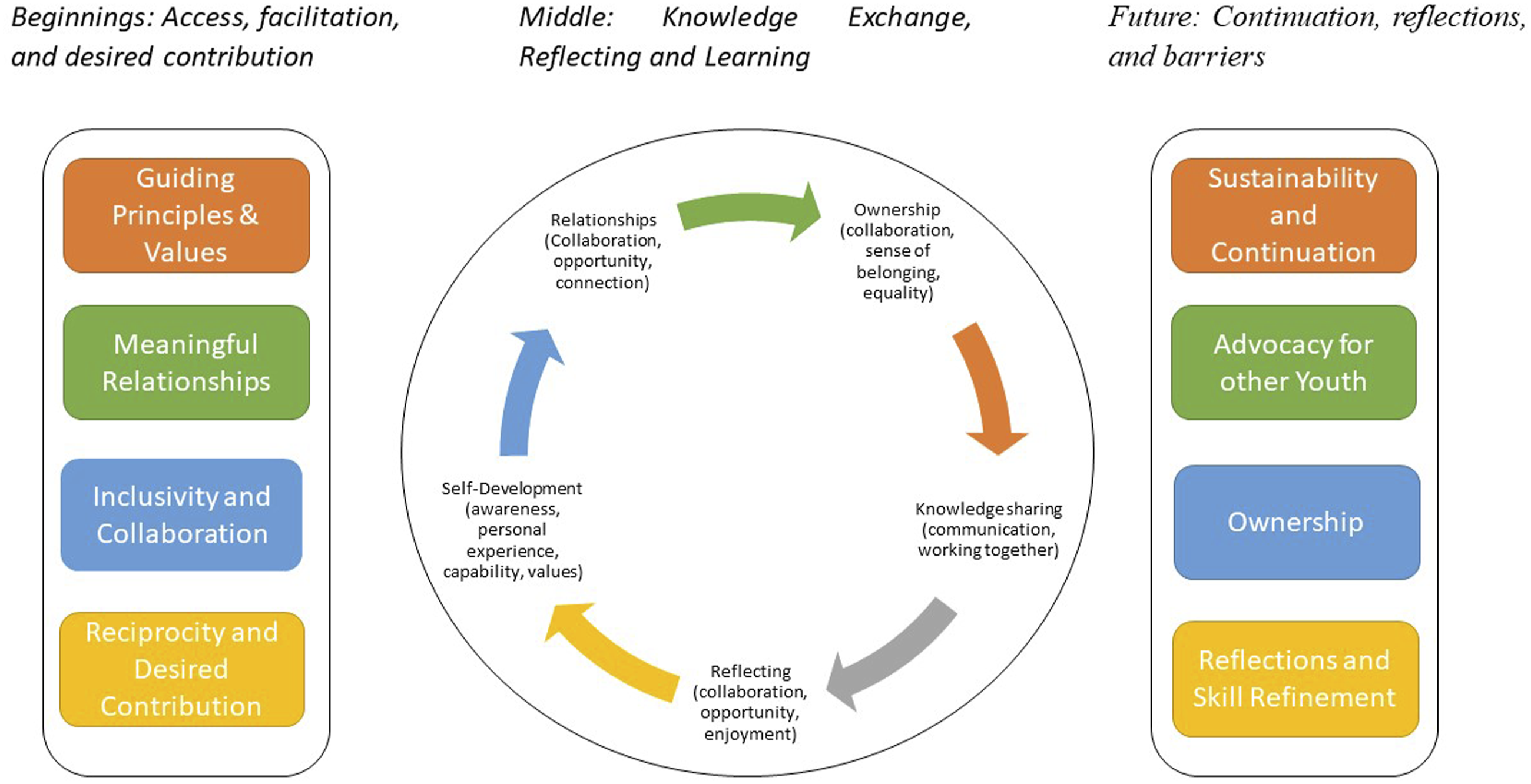
Conclusion
Embedding reflexivity in the co-production process allowed for youth members to identify the strengths, opportunities and challenges that emerged during their time with the project, both collectively and as an individual. This research contributes to our understanding of approaches to engaging youth in an international YAB that spans diverse countries. The key theme that emerged through the beginning, middle, and present of the project was that of community membership, relationships, and engagement, with each stage of the project being validated through these experiences. This research highlights the promising practices and strengths that encourage meaningful participation, the creation of ownership, the role of incentive, and the celebration of success. This paper illustrates that co-production in cross-cultural arts-based projects, examined through advocacy and participation, have a key role in creating space for young people and adults to work in partnership in research, to all mutually engage with one another, be appreciated, acquire skills, and be confident to co-research and lead in their communities. It creates a space that gives youth researchers opportunities, through items such as advocacy and international support, in conjunction with reflection and inter-stakeholder exchange. This is not just around the top-down/bottom-up exchange between global stakeholders and the young people in each country, but also between stakeholder groups in the community (family, friends, schools etc.) which illustrates a vertical and horizontal exchange. This approach has policy and practice implications for programmes seeking to create international YABs, specifically in acknowledging that YAB’s with the role of international YABs multi-faceted provide an opportunity to understand larger issues across contexts and enrich policy development at local levels. Thus, intergenerational dialogue in YABs should be prioritised through top-down and bottom-up approaches in conjunction with vertical and horizontal approaches. This paper provides key insights into the development and sustainability of international YABs but there are limitations in the findings. The reflections sought to engage all youth in the YABs however inputs were primarily from the young people who are most active in regular zoom meetings in the group. Additional reflection and dialogue is needed on how to best support all members engagement, recognising holidays, personal, family, school, and work commitments, and to reflect on diverse ways of participation throughout the YAB journey (in addition to our creative approaches shared above) to support meaningfully engagement that meets the needs and realities of participants. Further research to understand the reasons for different levels of engagement would be beneficial in understanding the co-production cycle during arts-based participatory action for young people who are less engaged in the process.
Accessible summary
Young people and adults working together creates a space for tackling social problems. Working together (or co-production) helps us to design research and/or activities that are based on creating shared knowledge, honest communication, and sustainability. But to do this, we need to offer an environment for young people and adults that balances practical issues with meaningful participation. This article shows us that working together can be good for evaluating international peacebuilding programmes, with arts-based activities at the heart. It shares insights from a programme where young people and adults work together to monitor and evaluate the Mobile Arts for Peace (MAP) 4 programme, leading to a new model of working together for international Youth Advisory groups. The paper shows how working together has the ability to make our work and wellbeing stronger, our practices meaningful and our research a source of celebration. It does this by giving us a model for working together than support ownership, co-creation and celebration of success. You can find an overview of the paper in the following short video - https://youtu.be/S4ubwqn6dhM.
Writing together
The paper is based on a project that sees young researchers and academics actively work with each other within an arts-based peace-building context across four countries. In this paper, Juhi Adhikari, YAB member, is acting as an author and leading the young people’s contribution engaging with youth across the YAB and at the national level, The writing process for this article sees both young people and researchers engage in reflective sessions to discuss core concepts of co-production, which will lead to meaningful and insightful research. The process allowed for different styles of participation and engagement to contribute ideas, recognising the physical act of academic writing did not suit everyone’s interests, time, or comfort. Training on academic writing and research skills have been embedded within the project to ensure that the young researchers have the knowledge and skills to directly contribute to all the projects outputs.
Footnotes
Acknowledgments
We would like to thank all the international Youth Advisory Board (YAB) members, national youth advisory board members (YAB) and youth advisory advocacy researchers (YAAR) for contributing reflections, insights, and critical ideas for this paper. In particular, we recognise the contributions of Muhammed Haikel Akmal Buchori and Indri Patrama Putri (Indonesia international YAB members); Isimbi Pauala, Umotoni Angie, Cyubahiro Daniel (Rwanda national YAB members); Muna, Ramila, Neharika, Anjana, Rachita, Upahar, Kanchan, Prasiddhi, Anuz, and Anjali (Nepal YAAR members) for engaging in online sessions and WhatsApp communication to share core reflections and quotes that shaped this paper. We are also grateful to the adult allies across the country teams who have supported participation and translation. In particular, we recognise Emmanuel and Harla’s active roles in reviewing and reflecting on the content and paper writing sessions. Additionally, we acknowledge the wider Mobile Arts for Peace (MAP) international teams for their role in the project, a few which who reviewed the paper (Richard Hazenberg, Ananda Breed, and Sarah Huxley) providing valuable insights.
Declaration of conflicting interests
The author(s) declared no potential conflicts of interest with respect to the research, authorship, and/or publication of this article.
Funding
The author(s) disclosed receipt of the following financial support for the research, authorship, and/or publication of this article: The Mobile Arts for Peace (MAP) project was supported by the Arts and Humanities Research Council (AHRC) Global Challenges Research Fund (AH/T008164/1).
