




Abstract
Researching with children and young people on topics that are considered to be ‘sensitive’, such as family violence, trauma and abuse, continues to be challenging. But there still is not enough evidence on children and young people’s own views and experiences of participating in ‘sensitive’ research. This article reflects on our experience, as a team of young lived experience advocates and a university researcher, of working together on a project to find out what children and young people in Victoria, Australia who have experienced family violence need to support them in their recovery. The project is about learning what is working well, what could be done better, and where the gaps are between what children and young people tell us they need from services, and what services are doing now. This article shares what we have learnt, including how we have set up a Youth Advisory Group and how we have developed an interactive online activity for children and young people to tell us about their experiences of family violence support services. We also discuss challenges we have faced, such as navigating power flows within the project team; embedding co-design into the project; and getting ethics approval to do this research. Finally, we share three guiding principles for collaborative research that puts children and young people’s voices, views and experiences at the centre. We hope that others can learn from our experience to promote the rights and participation of children and young people when working with them in research about family violence.
Introduction
Researching with children and young people on topics that are considered to be ‘sensitive’, such as family violence, trauma and abuse, continues to be challenging (Moore et al., 2021; Neelakantan et al., 2023; Noble-Carr et al., 2020; Powell et al., 2018, 2020). While learning from the experiences of children and young people who are victim-survivors of family violence is a ‘rapidly growing area of interest’ for research (Noble-Carr et al., 2021: 932), there still is not much evidence of children and young people’s own views and experiences of participating in such research. This article reflects on our experience, as a team of young lived experience advocates and a university researcher, of working together on a project to find out what children and young people in Victoria, Australia who have experienced family violence need to support them in their recovery. The project is about learning what is working well, what could be done better, and where the gaps are between what children and young people tell us they need from services, and what services are doing now.
We begin by explaining our approach to researching and writing this article, as a practical example of the importance of young people setting the context and crafting the narrative for collaborative research. We also give an overview of the project that has brought us together, including its aims, how we are doing the research, and why it is important.
We then turn to share our co-research story. We draw on published research about engaging with children and young people in the research process, to highlight our successes, challenges and systemic barriers, how we are learning from what has already been done, and what we are doing differently. The areas we focus on are research agenda-setting; navigating power flows between adults and young people in the project team; the role and influence of a youth advisory group; and consent for children and young people with lived experience of family violence to participate in the research.
We conclude with three guiding principles, to inform future collaborative research with children and young people who have experienced family violence. We hope that others can learn from our research journey, to promote the rights and participation of children and young people when working with them in family violence research.
Our approach to researching and writing this article
We have taken an emergent approach to researching and writing this article, creating space for the young lived experience advocates to lead the process. We held a brainstorming workshop to discuss how we wanted to thread our different forms of expertise together in an article format, while still making it accessible and engaging.
The workshop was organised and facilitated by the lived experience advocates. The room was filled with fidget toys, snacks, colouring in and creative art materials. We began with a check-in and ‘getting to know you’ questions that focused on building the relationships and trust. We used conversations, post-it notes and activities to explore what felt important for us to share and why. We had regular breaks and Uber Eats was a must for lunch!
Kirra, Tash and Liam brought to the workshop their practical expertise as young lived experience advocates who have worked across various settings, from academic research projects to government advisory boards. Georgina offered insights and examples from her academic research in the areas of children’s rights, family law and family violence, and knowledge of existing research on collaborating with children and young people as co-researchers. These complementary perspectives gave us the opportunity to learn from each other.
We brainstormed what was important for each of us to include in the article using these four questions, which formed the basis of our reflections: • What have we learnt so far from working together? • What challenges have we faced? • Zooming out, how has the broader system impacted our work and created barriers? • Where can we improve and what are our ideas for change in the future?
We recorded our ideas and answers to these questions using a combination of handwritten post-it notes (see Figure 1 below) and a virtual whiteboard. Notes from our brainstorming session.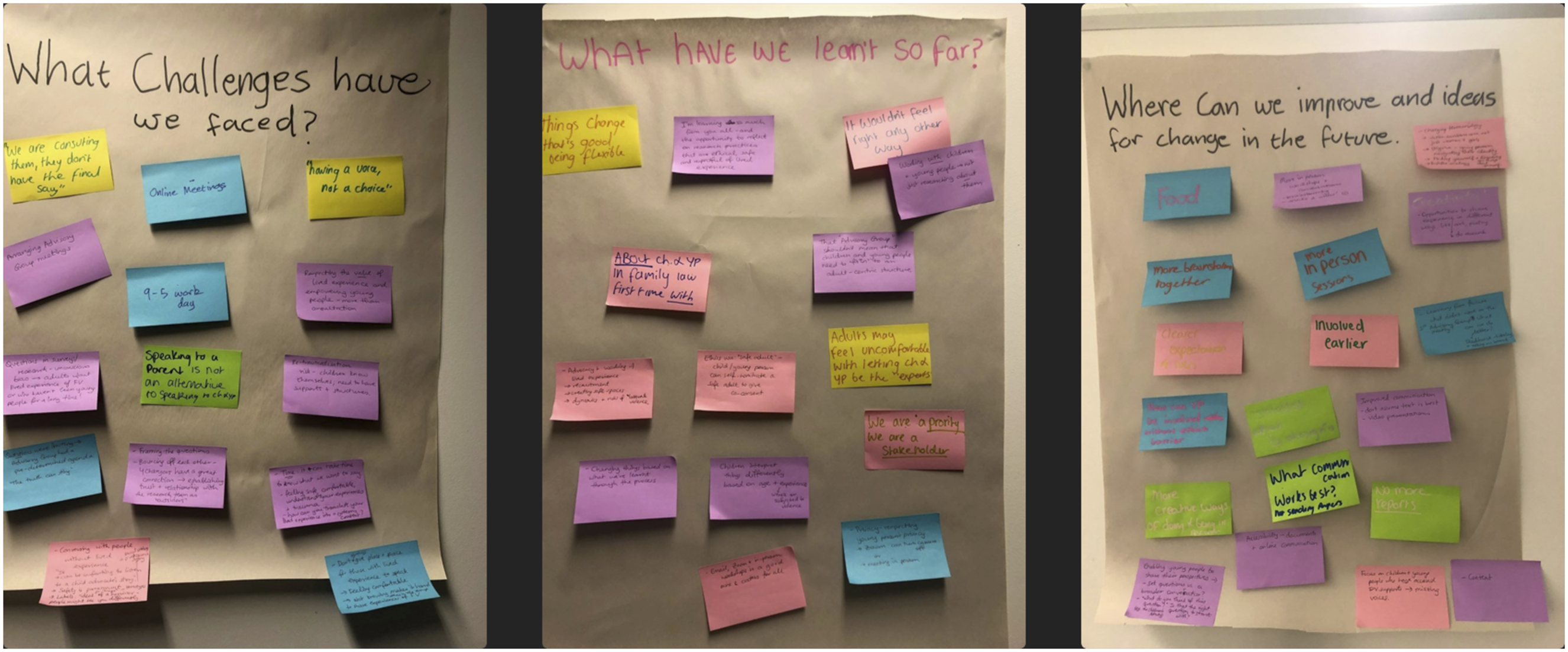
After compiling our workshop notes, Georgina created a shared first draft document that we could all work on simultaneously. In bringing our different areas of expertise together, it was important to all of us that the wisdom and authentic voices of the young advocates were not lost in the co-research process. Georgina put together some questions that the young advocates answered individually to help us reflect on our experiences in our own language (see Figure 2 below). We used the answers to these questions to help us structure and write this article. Georgina also prepared a literature review on the topic of collaborative research with children and young people, to help inform our co-research reflections and to give context to the project. Questions that helped us to write this article.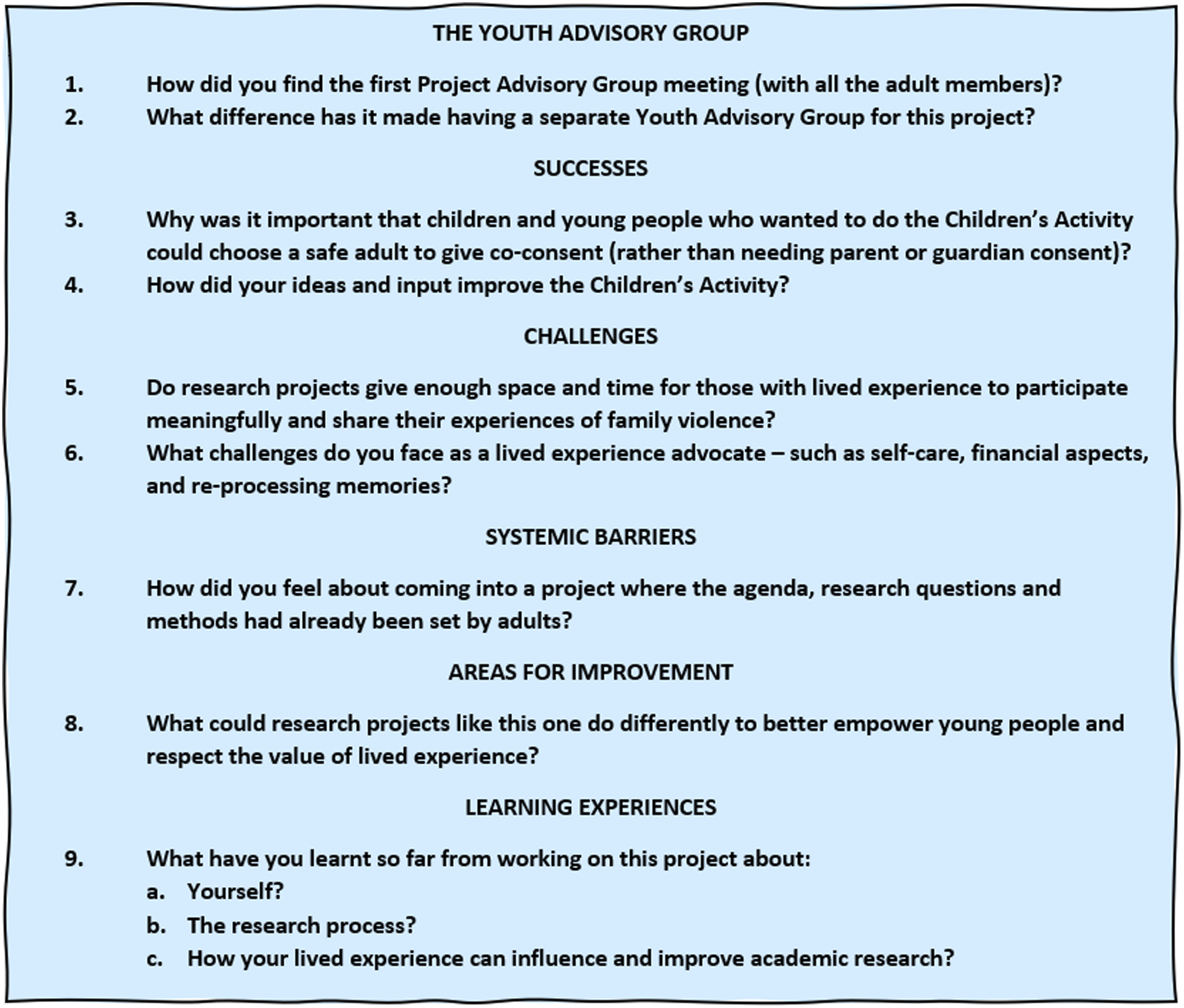
You will notice quotes throughout this article, which are reflections of the young advocates that we shared as part of the process of answering the questions. We have chosen to not attribute each quote, because we all co-authored this article and we wanted children and young people’s voices and lived experiences to be threaded throughout.
Research has shown that there are benefits for both children and young people and researchers when working together. For children and young people, the most commonly cited benefits include increases in confidence and well-being, promoting a sense of agency and achievement, collaboration and gaining new knowledge and skills (Bakhtiar et al., 2023). But these benefits have usually been summarised by adults, who incorporate or interpret select quotes from the young researchers when writing about co-research with children and young people (see, e.g., Cuevas-Parra 2020; Graham et al., 2017; Kiili et al., 2023). This means that adults filter our voices, views and experiences (but see Dan et al., 2019).
We think it is important to highlight other aspects of our role as co-researchers and experts by experience, which might not fit so neatly into the glowing narrative of ‘needed, useful and rewarding’ (Cuevas-Parra, 2020: 5). Georgina has incorporated the academic research throughout this article, but we wanted to ensure that our own, authentic voices and language were not lost in the writing process. This article is written from our perspective as young lived experience advocates.
The ‘Children’s Voices for Change’ project
Our project, titled ‘Children’s Voices for Change: A Rights-Based Approach to Understanding and Implementing Effective Supports for Children and Pre-Adolescents as Victim-Survivors of Family Violence’, is funded by the Victorian Government, Australia. The project is led by Southern Cross University, working with Berry Street’s Y-Change initiative, Safe and Equal, the Centre for Excellence in Child and Family Welfare, and Swinburne University of Technology.
This aim of this project is to better understand the needs of children and young people aged up to 13 years who have experienced family violence in Victoria, Australia. The project explores what is working well, what could be done better, and where the gaps are between what children and young people tell us they need from services and what services for children and young people are doing now. There are four main stages of the project: • Stage 1 involves researching Victoria’s family violence service system, analysing data about how children and young people access and use these services, and learning from research about meeting the needs of children and young people who have experienced family violence. • Stage 2 is a survey that asks people who provide services to children and young people who have experienced family violence about their work, including how they think children and young people could be better supported. • Stage 3 is an interactive, online activity for children and young people who have accessed family violence support services in Victoria to tell us about their experiences of those services, and what those services could do better to help them feel safe and well. We call this the ‘Children’s Activity’. • Stage 4 involves workshops to develop and test a Children’s Feedback Tool. Services will use this tool to better understand what children and young people who have experienced family violence need to help them feel safe and well.
Why this research project is important
(Commonwealth of Australia (Department of Social Services), 2023: 51)
This research project is important because children and young people who have experienced family violence are often invisible in the service landscape: they are the ‘forgotten’ and ‘silent’ victims (State of Victoria vol II, 2016: 129). In Victoria, Australia, where we are doing our research, there is a lack of targeted services that respond to the recovery needs of children and young people as victim-survivors of family violence in their own right (State of Victoria vol II, 2016). Australia’s National Children’s Commissioner has highlighted the need for more ‘child-specific services’ to support children and young people who have experienced family violence ‘to recover alongside their parent or carer’ (Australian Human Rights Commission, 2021: 23).
There is now a greater focus in Australian law and policy on prioritising the voices and lived experiences of children and young people in the design, delivery, monitoring and evaluation of family violence support services and systems. For example, the National Plan to End Violence against Women and Children 2022–2032 (‘National Plan’) identifies the need to ‘recognise children and young people as victim-survivors of violence in their own right, and establish appropriate supports and services that will meet their safety and recovery needs’ (Commonwealth of Australia (Department of Social Services), 2022: 21).
A focus on listening to and learning from the perspectives and lived experiences of children and young people as to their own well-being is also reflected in Safe and Supported: The National Framework for Protecting Australia’s Children 2021–2031 (Commonwealth of Australia (Department of Social Services), 2021); the Australian Research Alliance for Children Youth wellbeing framework for children and young people, The Nest (Goodhue et al., 2021); the National Principles for Child Safe Organisations (Australian Human Rights Commission, 2018); and the National Children’s Mental Health and Wellbeing Strategy (National Mental Health Commission, 2021). However, there are continuing gaps in research and practice.
Children and young people often want to share and discuss their experiences of family violence, safety and well-being (AHRC, 2021; Noble-Carr et al., 2020). Moore et al.’s (2021: 695) study found that children and young people may be motivated to participate in research on a seemingly ‘sensitive’ topic if it is something they have experienced, if it seems interesting, if they have a strong view about it, or if they believe their participation will help others. Some children and young people have also said that participating in sensitive research gives them the opportunity to get ‘things off their chest’ and have someone listen to them (Moore et al., 2021: 696).
But the perceived ethical, methodological and practical challenges of doing research with children and young people on the subject of family violence are many. These include concerns about emotional safety, informed consent, capacity, and the potential for causing further harm and trauma to victim-survivors (see, e.g., Beetham et al., 2019;Cossar et al., 2016; Lamb et al., 2021; Moore et al., 2021; Neelakantan et al., 2023; Noble-Carr et al., 2020; Powell et al., 2020; Powell et al., 2018). As a result, researchers have tended to rely on adults, such as parents or service professionals, to understand children and young people’s experiences (Kay 2019; Moore et al., 2021; Noble-Carr et al., 2020).
Our research project is needed because not many researchers have asked children and young people for their own accounts of family violence and their experiences of support services (see, eg, Houghton, 2015; Morrison, 2015; Cossar et al., 2019; Warrington, 2017), especially in Australia (see, eg, Fitz-Gibbon et al., 2023; Robinson et al., 2023). This project will help us to better understand the needs of children and young people who have experienced family violence and how to respond, by listening to and learning from children and young people themselves.
Setting the research agenda
Our project is working within the Victorian Family Violence Research Agenda 2021–2024, which sets out the Victorian Government’s research priorities to develop and add to the evidence base to support family violence reform. One of the research priorities for Phase 1 of the Family Violence Research Grants program, which has funded our project, is ‘Children and young people as victim-survivors in their own right’.
The specific research topic that our project is addressing is ‘Effectiveness of supports for children and pre-adolescents (10 to 13 years) accessing family violence services’. The various research topics have been developed ‘following extensive consultations with stakeholders, including Victorian Government departments and community sector organisations’ (Victorian Department of Families, Fairness and Housing, 2023). But we think it is always important to ask who is setting the agenda, and who are considered legitimate ‘stakeholders’, including whether the process is accessible for children and young people to participate in these consultations.
Research has shown that where a research project has been funded by an external agency, research questions and project design are usually fixed by adult researchers before children and young people are invited to be involved (Lundy et al., 2011: 723; Noble-Carr et al., 2020: 188). We had no say in developing the research topic for the Children’s Voices for Change project. The adults in the project team had already crafted the research questions and the four stages of the project set out above. As Franks (2011: 20) has explained, ‘[t]he very fact that the professional researcher is … able to make choices suggests that [they are] in a more powerful position than a child participant’, but ‘beyond the researcher there are also funding, time and contractual constraints’.
Coming into a project where the agenda, research questions and methods were already set gave us no space to share new ideas about how the project could improve family violence services for children and young people (Grace et al., 2019; Werner-Seidler and Shaw, 2019)
Navigating power: The first Project Advisory Group meeting
A common theme throughout the literature on co-research with children and young people is the need to address power imbalances between adults and children and young people in the research process (Bakhtiar et al., 2023; Bradbury-Jones and Taylor, 2015; Dubois et al., 2022; Franks, 2011; Lundy et al., 2011; Taylor et al., 2014). Power imbalances can be a barrier to children and young people’s involvement in research in various ways, including through parents or caregivers, who are typically required to give consent for their participation; and service professionals, who can act as ‘gatekeepers’ and screen out children they consider vulnerable, such as by ‘forgetting’ about research or ignoring it (Powell et al., 2020: 327). Researchers’ power can also be a barrier to involvement, because children and young people might be considered less ‘skilled’ and ‘knowledgeable’, so they might not be given the opportunity - or feel comfortable - to participate as ‘equals’ in developing the research agenda, questions, methods and outputs (Bell et al., 2021; Holt, 2004).
At the first Project Advisory Group meeting for this project, there was an immediate sense that we as young advocates did not have a lot of power. This meeting was held on Zoom and there were 16 participants, including four young lived experience advocates, members of the project team, and adult advisory group members from across research, policy and practice.
Before too long, a lot of the unknowns became clearer. This was just another advisory group, another space where we would be asked to share our perspective, our lived experience, our stories, and be vulnerable with a group of people we didn’t know.
All too often, young people with lived experience of disadvantage are asked to join a one-hour online meeting, where we get talked at in ways that don't make sense to us. We are asked to share what we think about systems that have harmed us: systems that professionals in these kinds of advisory groups often represent.
There is also a lot of holding that young people do in these spaces. Holding the weight of your experiences of trauma; the power imbalances; of knowing that you are trying to represent young victim-survivors who cannot be represented by one person, because ‘lived experience' of family violence is not a singular experience; and the heaviest weight at the bottom of the shelf: trying to prove that young people with lived experience are not only capable of being in these spaces, but must be heard and partnered with to create systemic change.
We were outnumbered at the first Project Advisory Group meeting: there were three times as many adults in professional positions than there were children and young people. We didn’t get to know everyone in the virtual room and some people didn’t have their cameras on. As survivors of family violence, we can be on high alert all the time. Not knowing who was in the room was intimidating. There is the gut-wrenching fear that the perpetrator is going to find out about the advocacy work, about where you live and go to school. Unfortunately, leaving a perpetrator and a violent relationship doesn’t always mean you are safe.
We had been emailed ‘child-friendly’ versions of the project overview and agenda to read ahead of the meeting. Reading a stack of background papers is not always accessible for young people. We felt like we were already behind before we started. During the meeting, we were trying to make sense of the language and acronyms being used. It didn’t seem that the professionals understood us or that they were representing the children and young people they work with.
We seemed to be there just to tick a box. It was a very difficult space to be in. We were not truly consulted with and it felt almost suffocating to try to voice our own opinions. A fight for the mic, but also that looming feeling of
The big shift: Forming a Youth Advisory Group
After the first Project Advisory Group meeting, all the young people, Y-Change’s Youth Engagement Coordinator and Georgina came together. We had an honest debrief about where we were at and the feedback we wanted to share. Collectively, we came to a decision to create a separate Youth Advisory Group.
Georgina accepted that we would need to essentially ‘reset’ and start from scratch if we were going to work together effectively. Other researchers have reported similar experiences. For example, Graham et al. (2017: 197) found that a child-led research program was a ‘significant learning experience’ for the adult researchers, with the Lead Facilitator noting that ‘[b]efore it started I developed the whole program … But by the first session, I’d thrown it out and I was so upset … Because it didn’t work’.
Sometimes it can be challenging for professionals to share the space with lived experience experts, to allow for a more equal exchange (Clayson et al., 2018; Lamb et al., 2020, 2023; Loeffler and Bovaird, 2016). But it felt comfortable having these difficult conversations with Georgina about what wasn’t working and being able to do something about it together. It is a real skill to be able to receive feedback, have your work critiqued and put aside your own assumptions and biases to just listen to what children and young people are saying they need. Sometimes we are asked: ‘What do you need to make this space more accessible?’ Yet when we suggest something, the response is: ‘That isn’t going to be possible.’
Research projects that have engaged children and young people as co-researchers have often formed a Children’s Research Advisory Group (‘CRAG’) to work alongside the adult researchers (Donegan et al., 2023; Lundy et al., 2011). The CRAG mechanism has helped to facilitate meaningful co-research, by engaging children and young people as a ‘key stakeholder group with particular expertise’, who have a ‘direct influence on the questions and focus of the research’ (Lundy, 2011: 719, 723-4). They can also provide ‘a space to build trust, assign responsibility as co-researchers and share reflections on the process’ (Donegan et al., 2023: 239-41).
Having a separate Youth Advisory Group for the Children’s Voices for Change project has meant we have been able to get to know everyone in the group and build relationships, which has fostered a positive environment. We have also had more time to work through things, so it feels like we are learning together. This is more energising, because we can bounce off each other. Although we may have all had different experiences of family violence, we can approach these in a way that feels safe. There is a collective understanding of our bad experiences.
This is similar to the experience of children and young people engaging in a child-led research project in Graham et al., (2017) study, who reported that they had developed their relational skills as they worked through difficulties together and supported one another. In other research projects, young people have reported value in working and connecting with their peers (Moore et al., 2021: 696; Neelakantan et al., 2023: 1419).
Our Youth Advisory Group is not limited to meeting during the standard 9.00am to 5.00pm work day, which makes it more accessible to attend. Practical issues such as scheduling meetings during (adult) business hours can be barriers to children and young people’s involvement, limiting their ability to engage fully in collaborative research with adults (Bakhtiar et al., 2023: 24; Graham et al., 2017: 192).
The financial burden
Lived experience work comes with a lot of job insecurity, once-off work, and needing multiple part-time, casual and volunteer roles. The Youth Advisory Group members for the Children’s Voices for Change project were paid twice as much as the professional Advisory Group members. But many children and young people are not paid for their advocacy and lived experience work. If a paid opportunity does come up, young people are often paid much less than researchers and other professionals, and typically with gift cards instead of money.
Organisations may also use honorarium payments as a way of paying for lived experience work, without any explanation of the processes and implications it may have for young people in terms of government welfare payments, student loans and tax. This can leave young people already experiencing disadvantage with debts. There are also many young people who have experienced family violence living independently and trying to pay the rent, food and other bills (just like adults!).
We believe that children and young people with lived experience should always receive financial payment for their contributions. We should also be given options for how we would like to be paid (Lamb et al., 2020, 2023).
Milk and honey: The wins
Although we have faced some challenges in our co-research experience so far, we have also had wins along the way! Here we share some examples of where our feedback and input directly impacted the way the research was conducted.
The Children’s Activity: More accessible, less tokenistic
The Children’s Activity was an interactive activity hosted on the online survey platform ‘Qualtrics’, intended for children and young people aged 10 to 25 years, who have experience accessing family violence support services in Victoria when they were aged up to 13 years. The Activity could be completed on a mobile phone, tablet, laptop or desktop computer. There were two options: Activity 1 was recommended for participants aged 10 to 15 years of age; Activity 2 was recommended for participants aged 16 to 25 years. Both versions of the Activity included a combination of checkbox and open-text questions, ‘dragging and sorting’ boxes to rank items, and selecting an ‘emoji’ face to represent feelings. Activity 1 featured more emojis, simpler language and the option to upload drawing responses. Both versions gave children and young people the opportunity to share what they need to feel safe and well, and their experiences of engaging with family violence support services. All questions were optional and could be skipped.
When we were asked to help develop the Children’s Activity, all the questions had already been created by adults in the project team. But at the Youth Advisory Group meetings with Georgina, we deep dived into the detail by working through each question together. There was space for everyone to share their reflections and perspectives on what could be different, including how questions could be improved, which questions we thought needed to be added, and to challenge some of the language being used.
We also deconstructed questions that felt like they were seeking a specific outcome. Researchers sometimes work backwards from what they want the project to achieve, asking questions that lead the person with lived experience to a certain ‘right’ answer (Kim, 2016: 238). By reflecting on how each question was framed, we asked the researchers to consider: Is this the right question to begin with? What might look like a simple question can be much more complex from a young person’s lived experience perspective (Franks, 2011).
A question in the Children’s Activity that we challenged was: 'When did you get help from support services?' We thought it was important to first ask, 'What did getting help for family violence look like for you?' A child or young person might not be aware that they are actually receiving support, such as by having a case worker visit their home, or speaking to a psychologist, or staying in a motel. With our feedback, a definition of ‘support services’ was added as a hover button (see Figure 3). The ‘hover button’ in the Children’s Activity to explain support services.
The question in the Children’s Activity that we found most problematic was:
Pretend you have a magic wand and can make anything you like. If you could make a new space for children and young people to go for help if something happened that made them feel scared or unsafe, what would it look like? What would you put in the space? Who would you want to be there?
The ‘magic wand’ question is often used in research with children and young people (see, eg, Coyne et al., 2021; Davey et al., 2010; Epstein, 2006; Skivenes and Strandbu, 2006). We often get asked, ‘What would you do if you had a magical wand?’ If we had a dollar for every time we are asked this question, we would be rich!
When we do use our ‘wand’ to contribute, adults tell us that our ideas for change aren’t realistic, so we are not taken seriously. The ‘magic wand’ question underestimates children and young people’s capacities (Freeman 2010), including our capacity to appreciate that we are working within a broken system and that change takes time. This question also feels tokenistic, particularly for children and young people who have been failed by systems.
We worked with Georgina to change this question, so that we were asking children and young people for feedback that could actually be used and implemented. The ‘magic wand’ question became an interactive activity that asked:
Think about what needs to change to make support services better for children and young people who have experienced family violence. Here are 5 blocks. Write one thing on each block that you think would make services better for children and young people. Please tell us how and why these things would make services better for children and young people.
The revised Children’s Activity was the result of what we as young people wanted, guided by the project team. By spending time working through each question, were able to make the research more accessible for children and young people who have experienced family violence, moving it away from a typical survey to something more interactive and engaging. This is because we could imagine answering the questions in the Activity without having to think too hard about what it would be like to be a child answering them. Our involvement ensured that ‘children’s “insider” perspectives’ were represented (Bakhitar et al., 2023: 10).
Our approach to co-consent for children and young people
Consent is an ongoing systemic barrier to children and young people’s participation in research. Where research involves ‘sensitive’ topics such as violence, trauma and/or and abuse, the approach to consent is often ‘highly scrutinised by a series of gatekeepers needing assurances’ that researchers are ‘working ethically and appropriately’ (Moore et al., 2018: 92).
In Australia, the National Statement on Ethical Conduct in Human Research (2023) (‘National Statement’) provides guidelines for researchers undertaking research with or about people. The National Statement helps researchers and research ethics committees to identify and consider ethical issues that arise in the design, conduct, review and distribution of human research. Chapter 4.2 of the National Statement is about children and young people. It explains that:
Research involving children and young people raises particular ethical concerns about: • Their capacity to understand what the research entails, and therefore whether their consent to participate is sufficient for their participation; • Their possible coercion by parents, peers, researchers or others to participate in research; and • Conflicting values and interests of parents and children.
The National Statement requires specific consent to a child or young person’s participation in a research project from the child or young person themselves (where they have the capacity to make the decision to participate); and either one or both parents, or the child’s legal guardian or other primary caregiver.
At the first Project Advisory Group meeting, discussed above, many of the professionals supported the approach of a parent or guardian giving consent for a child or young person to participate in the Children’s Activity. But it is known that the hierarchical relationship and power imbalances between children and their parents or guardians are magnified in circumstances of family violence (Fineman, 2014; Kim, 2006). There is still a prevailing assumption in family violence research, policy and practice that parents are the primary victim-survivors, and that children and young people will have a safe parent, but this isn’t always the case. Parents or guardians assumed to be ‘safe’ are not always experienced this way. A child might not have a safe parent or guardian. The need for a child or young person to get the consent of their parent or guardian concerned us.
We strongly advocated for children and young people to be able to choose their own trusted adult to give co-consent. The trusted adult would be over 18 years old and could be a parent, guardian, family member, sibling, teacher, close friend or caseworker.
Our own lived experiences of family violence helped to inform our reasons for advocating for a different consent process for the Children’s Activity. We supported co-consent from a trusted adult because: • A parent or guardian might simply • There are • A child or young person who has experienced family violence might • The need for a parent or guardian to give co-consent creates • Giving children and young people the opportunity to nominate a trusted adult to provide co-consent is consistent with the children’s rights-based approach of this research project (Dimopoulos, 2022). It recognises the children are victim-survivors of family violence
Based on our advice, the proposal that Georgina put to her university ethics committee was that participants aged 16 to 25 years could determine their own best interests and consent to participate in the Children’s Activity; while participants aged 10 to 15 years of age would need to provide the co-consent of a trusted adult of their choosing. All participants under the age of 18 were encouraged to include a trusted adult to help them decide about their involvement in the research.
A possible risk of this co-consent approach is that a child or young person may incorrectly choose a trusted adult, who turns out not to be ‘safe’ for them. But the university ethics committee accepted our proposed trusted adult co-consent approach as a risk mitigation strategy, and ultimately approved the application. This was a huge, unexpected win for us.
Our three guiding principles
Research projects seeking to better understand children and young people’s experiences of family violence must collaborate with lived expertise to ensure the research is safe, meaningful, and accurate. Here are our three guiding principles for working with youth advocates, to help overcome some of the ongoing, systemic barriers we have experienced:
Research projects are often rushed due to tight timelines and funding constraints. This makes it very difficult for children and young people with lived experience to be embedded in the project and to meaningfully share their expertise as participants, co-researchers and co-authors. Being asked to step into a project where the research agenda, questions and methods have already been set doesn’t give space for lived experience to influence the process.
Research projects about children and young people should have those with lived experience involved at all stages, from the initial idea and ethics processes, to interpreting and presenting the data, and everything in between. We understand the perspectives of children and young people going through family violence because we have experienced it ourselves. We are the only ones who can help researchers understand if a project is accessible to young people like us. It is important for researchers to use curiosity as a tool to learn from our experiences and perspectives.
Children and young people, especially those who have experienced or are currently experiencing family violence, have a lot of weight on their shoulders. We can be juggling school, work, advocacy, and navigating our experiences of trauma, which can feel very overwhelming. It can also be difficult revisiting old memories and reflecting on our experiences of abuse and violence. We may still be living the impacts of family violence.
This means we may need to have some time and space away from the research project. It may also mean that we don’t reply to some emails or text messages. But this doesn’t always mean that we don’t want to be involved. It is important when working with children and young people in research that you create and hold space and time for us to be involved in whatever capacity works best, and that you give us the flexibility to step in and out as we need. Prioritising our safety and wellbeing means research will take longer.
Most of the spaces we enter as young advocates are not accessible. Being in the space with other children and young people with lived experience means that we aren’t fighting on our own. We are doing it together. This makes us feel safer and more comfortable to share our knowledge and expertise. When we share stories of our lived experience, they resonate with other young advocates: we understand each other.
Ideally, there would be one space that is accessible for everyone, rather than having young people off to the side in a separate advisory group. We would be sharing the space, the power and the decision-making. But there needs to be the readiness among adults to make the space more accessible and youth-friendly. This includes not expecting young people to have the same background knowledge and context about the system; and ensuring that we can show up just as we are, and not have to change to try to fit into an adult-controlled space.
Conclusion
This article has presented our collective experiences of co-researching on the ‘Children’s Voices for Change’ project in Victoria, Australia. We have described how our ideas shaped the Children’s Activity, to enable children and young people who have accessed family violence support services to participate in the project more meaningfully and safely. We have also explained how we secured ethics approval for an innovative consent process for the Children’s Activity, so that children and young people could self-nominate a trusted adult to give co-consent to their participation.
We agree that collaborative research is an opportunity for children and young people to ‘make a change by raising the voices of the most vulnerable and excluded’ (Cuevas-Parra, 2020: 8). That is one of the aims of our research project: to ensure that children and young people are recognised as victim-survivors of family violence in their own right, respecting that they have unique and distinct needs and experiences. But the dominant, paternalistic view of children as vulnerable ‘objects of concern’ (Smart et al., 1999; Tobin, 2015) is still ingrained in family violence research. A focus on children and young people’s vulnerability to harm can be emphasised to such an extent that it prevents or limits their participation (Angell et al., 2010; Neelakantan et al., 2023). As Nowland et al. (2022: 2) have argued: Unless … barriers to collaborative research with children and young people are fully understood and strategies for overcoming the challenges are shared, research risks being perpetuated as yet another form of symbolic violence. That is, it will create conditions which perpetuate and normalise children and young people’s subordinate position in processes of knowledge creation.
Our research project has exposed ongoing power imbalances at various levels between adults and children and young people with lived experience of family violence. The strongest example is our experience of the first Project Advisory Group meeting. We have also considered how systemic barriers, including a pre-determined research agenda and funding timelines, have impacted the research.
We have shown that engaging children and young people with lived experience as co-researchers can benefit research by adding ‘a valuable dimension or unexpected perspectives through children’s insights’ (Bakhtiar et al., 2023: 22). Georgina has captured her experience working with us on the Children’s Voices for Change project in this way: My experience co-researching with Kirra, Tash and Liam has been both challenging and enlightening. I have discovered that it is one thing to research Kirra, Tash and Liam have – rightly – challenged my perception of my ‘proper’ role as an academic researcher. The first Project Advisory Group meeting in particular was a steep learning curve. I entered the meeting with nervous optimism and left feeling deflated that I had failed the children and young people in the group. Recognising that I have so much to learn from these young people has been instrumental to developing a strong co-research relationship with them. While I can offer the ‘textbook’ knowledge, Kirra, Tash and Liam bring a wealth of insight and expertise drawn from their personal experiences of family violence and advocacy. When we complement each other in this way, not only does the project benefit, but so do we as co-researchers. Working with the young lived experience advocates has given me the opportunity to ‘walk the talk’ of my children’s rights research and to concede that there is still a lot of work needed to bridge the gap between the theory and practice of co-researching with children and young people in the context of family violence.
The story of children and young people’s experiences of family violence is typically told by professionals. When professionals share power, platforms and space with lived experience, we can write our own narratives and change the course of the story for other children and young people. By stepping into the uncomfortable space of not being the expert, we can truly partner together and learn from each other. If our advocacy helps even one child or young person, it will all be worth it.
Footnotes
Acknowledgements
We would like to thank Holly Aitken, Harrison Cant and Eliza Hew for their help with the research and referencing for this article; and Bec Percy and Shakira Branch for their support as Berry Street’s Y-Change Youth Engagement Coordinators.
Declaration of conflicting interests
The author(s) declared no potential conflicts of interest with respect to the research, authorship, and/or publication of this article.
Funding
The author(s) disclosed receipt of the following financial support for the research, authorship, and/or publication of this article: The ‘Children’s Voices for Change’ project is funded by the Victorian Government, Australia through Family Safety Victoria’s Family Violence Research Grants Program (Phase 1).
