



Abstract
Against the backdrop of the rise in child migrants across the world, this study advances understanding of the transformative potential of centralizing children’s stories and experiences through multi-sensory materials, producing accessible and creative ways to disrupt, counter, and draw critical attention to the impact and legacy of displacement. Focusing on two controversial historic migration/refugee schemes, Kindertransport and Windrush, this study integrates haptics with vision and audition, presenting contemporary children as co-producers/researchers, experts and “experiencers”, with former children’s objects, stories, memories.
Keywords
Introduction
Against the backdrop of the rise in refugees and migrants across the world (half of them under the age of 18), this study advances understanding of the transformative potential of centralizing children’s stories and experiences through exploring material objects, producing accessible and creative ways to disrupt, counter, and draw critical attention to the impact and legacy of displacement (Unicef, 2021; Ziersch et al., 2020). It does so by presenting contemporary children, as co-producers/researchers, experts and “experiencers” in their embodied interactions, with former Kindertransport and Windrush children’s artefacts, objects, stories and memories. Locating such material interplay firmly within the realm of the haptic and sensory, and therefore as embodied cognitive experiences (Edwards, 2010; Wilson and Foglia, 2016). Here, as Frykman and Frykman (2016: 24) remind us, ‘tangibility is crucial for the transmission of affects’. The aim of this study is to relate children’s engagement with and use of the artefacts and objects (including letters, items of clothing, and a suitcase) to ways of thinking about other childhoods and former child migrants’ memories, stories and narratives upon arrival in their new country. Centralising multi-sensory methods, we show the generative power of the haptic and the life of objects in counteracting “prejudices”.
Focusing on two controversial historic migration/refugee schemes, namely Kindertransport and Windrush, taking place over 70 years ago, this study uses sensory learning, integrating haptics with other senses, such as vision and audition, to facilitate a process of embodied cognition, with the potential to develop meaning-making through disruption (Chatterjee and Hannan, 2015; Kushner and Knox, 2012; Rowe, 2002). The Kindertransport refers to the organised rescue effort to save (mostly) Jewish children from nazi-controlled territory prior to WWII between 1938 and 1940. Around 10,000 children arrived in the UK through the Kindertransport scheme (Sims-Schouten and Weindling, 2022; Keesing et al., 2019). The Windrush scheme, named after the HMT Empire Windrush, which brought one of the first large groups of post-war West Indian immigrants to the UK in 1948, carrying 1027 passengers and two stowaways on a voyage from Jamaica to England, has become symbolic of the generation of Commonwealth citizens who came to live in the UK between 1948 and 1970 (Arnott, 2019; Seybold, 1998). Despite the differences, what both schemes have in common is their status as pre or post second-world war migration/refugee schemes and the mixed reception and experiences of the children involved (and their families in the case of the Windrush scheme), marked by a complex intersection of marginalisation, discrimination, support and gratefulness (or the expectation to be grateful), the (emotional) legacy of which can still be seen today (Ala, 2018; Kushner, 2012; Lynch, 2015). In line with Alcoff’s work on cultural racism, we show that the actual language of racism today is largely about cultures, and sometimes about religions that act as proxies for cultural difference, rather than genetics or biology. Cultural racism primarily involves certain misperceptions of peoples, that is, ways of being and living (Alcoff, 2023).
Self-Other distinctions are central to social and temporal spaces and identities, and research shows that specific social groups, such as (child) refugees, are often presented as the “Other” (e.g. in relation to culture, religious practice and community values) (Alcoff, 2023; Joffe, 2003). Here, “Othering” is achieved through three distinct representational pathways: through representational absence, through representations of difference, and through representations of threat (Chauhan and Foster, 2014). There is evidence that children take cues from “self-other” constructions in society and attach meaning to subtle and not so subtle messages about the relative desirability of belonging to one social group over another (Hirschfeld, 2008; Katz, 2003). Thus, the biases that children exhibit are not random (Katz, 2003; Sullivan et al., 2020). Moreover, research shows that racial biases and stereotypes are difficult to change in adulthood (Stangor and Schaller, 2000), providing a strong rationale for understanding these attitudes in childhood, when change is more feasible.
We take the view that children are active agents and constructors of their own life and acknowledge the meaningfulness of inter-personal and intra-personal experiences and sense-making (Sims-Schouten, 2021; Stein, 2000). Drawing on Edith Stein’s (2000) radical intersubjective phenomenological concept of empathy and affect, namely “to feel within” what the other “I” is experiencing from a first-person perspective, we invited contemporary children to touch Windrush and Kindertransport children’s objects (and facsimiles of), as well as read and listen to their stories and memories of migration and make sense of their experiences relationally and personally. Grounded in the critical realist stance proposed by Bhaskar (1989) and developed in Sims-Schoutens’ previous research, we apply retroductive reasoning, testing proposed explanations for counter-narratives and making (non-linear) inferences about underlying structures/mechanisms that may account for the phenomena involved (Sims-Schouten, 2021; Sims-Schouten and Riley, 2019).
We thus view listening to children’s ideas and opinions on matters that affect them as central to ideas of participation, social justice, democratic practice and agency, and treat childhood as personal, fluid and relational, recognising the inherent interdependence of children’s worlds and centralising children’s meaning-making and validating children’s voice and agency (see also Styker et al., 2019). There is evidence that object and sensory type interactions have impact on children’s sensemaking and perceptions, for example research highlights that embodied cognition impacts behaviour change in a given situation as well as extending to “offline” cognition (Novak and Schwan, 2021; Walton et al., 2016). Yet at present there is no theoretical and practice-based framework for modelling these processes. This project explores the impact of multisensory encounters, narratively framed from the perspective of migration and displacement, where through sharing “things” (i.e. objects, artefacts, stories, books) associated with former Windrush and Kindertransport children, with children in schools, a potential way to provide a deeper and more meaningful understanding of displacement, as well as disrupting potential prejudice is exposed. We discuss this further below.
Multi-sensory approaches and materials as disruptive and facilitative
Centred on “things”, this study acknowledges objects, stories and artefacts as carriers of complex visual, material, cultural and social meanings generating multiple narratives and interpretations (Binnie et al., 2021; Sims-Schouten, 2025). It seeks to respond to Downes et al.’s call to consider emotions and materiality together (2018: 20), recognising the ‘affective potential of discovery and contact with objects’, since as they are ‘experienced in their materiality’, this experience necessarily ‘carries with it a particular emotional charge’ (2018: 17). Multi-sensory methods provide opportunities for enriched mental representation through manual exploration of objects, thereby facilitating the emergence of abstract ideas and concepts (Chatterjee and Hannan, 2015; Yates and Szenasi, 2021). Moreover, by integrating haptics with other senses, such as vision and audition, multisensory approaches and materials facilitate a process of embodied cognition, with the potential to counteract prejudices through disruption (Novak and Schwan, 2021; Wilton et al., 2024). This follows Piaget’s recognition (1952) that ‘sensorimotor’ experiences facilitate cognitive development and aligns with more recent work in the field of embodied cognition which has implications for education and learning processes and environments acknowledging the sense-richness of human experience of the world (Kiefer and Trumpp, 2012; O’Loughlin, 2006).
Applying forms of object-based multi-sensory methods, which centralise the ‘[e]motional valence of objects’ and recognise the ability of ‘the emotional object to evoke and stand in for an absent person or place’ (Downes, 2018: 14–16) may provide a rich seam of critical and disruptive psychological experiences related to sensemaking and perception and learning opportunities, in particular in relation to reflections on “difference”. Counteracting prejudices through moments of rupture also requires reflection on sensemaking and what the participant (or learner) brings to the (learning) situation, rather than solely focusing on the nature of the content itself (Edwards, 2010).
Using creative methods in making sense of child migration experiences is not new. For example, Apers and Richter (2021) used journey mapping visualising the experiences of migrant families from the beginning to the end, whilst Moskal (2019) used visual methods (like drawing, maps, photographs, and videos) to make sense of migrant and refugee children’s worlds. At the same time, in their article Stories too big for a case file, Aissatou et al. (2022) highlight the importance of creative forms of knowledge production and aesthetic modes of expression for communicating the affective complexities of research material; and, the importance of turning the representational gaze outwards towards systems and institutions to avoid situating social inequities as individual failings: to instead, invite viewers to ‘walk together’ in solidarity with research interlocutors.
Further research has highlighted the educational benefits of integrating objects into (children’s) learning environments as a way of developing subject knowledge and facilitating transferable skills, such as communication, team working, lateral thinking, and observational and drawing skills (e.g. Chatterjee and Hannan, 2015; Downes, 2018; Novak and Schwan, 2021; Parkin, 1999). At the same time, objects, artefacts, voices and stories of groups unevenly targeted by oppression have been used to collectively curate museum exhibitions and to expose, and counter, histories and legacies, e.g. of 20th-century “race betterment” (Kelly et al., 2021). Our current study is the first of its kind to invite contemporary children to make sense of former child migrants’ lived experiences and legacies of displacement, counteracting prejudices by embracing a form of knowledge beyond language where knowledge is embodied and expressed through sensory experience outside of the spoken word (Binnie et al., 2021). It acknowledges Downes et al.’s position that ‘feelings are embodied, experienced physically as a participant in the material world’, a locus where ‘[o]bjects become mediators in emotional transactions between humans’, wherein the affective states and emotions ‘they arouse and which become attached to them are often uncertain or shifting, part of a spectrum of experiences irreducible to words alone’ (Downes, 2018: 9-11).
Sensory learning and engagement can facilitate new ways of looking at things, through reflexive and object-laden encounters with “difference” leading to more meaningful and holistic understandings (Binnie et al., 2021). It can stimulate behaviour change, through reflexive encounters with “difference” within an interactive space, unsettle prejudice and provide a deeper and more meaningful understanding of (ethnic) identity that goes beyond current models or rote classroom learning (Sims-Schoutens and Weindling, 2022; Sullivan et al., 2020). This view of impacting behaviour change and learning coming about through moments of rupture also requires reflection on sensemaking, perception and learning in the context of objects, and what the participant or learner brings to the (learning) situation, rather than solely focusing on the nature of the content itself, that is, it emphasises the relational (Stein, 2000). This has relevance since the relational qualities of objects and artefacts provide for their potential for agency, the ability to do something and effect change and act upon people’s feelings (Downes, 2018; Parkin, 1999; Prown, 2000).
While multi-sensory learning and methods have been celebrated for minimising the power relationship between the adult researcher and young person (Elden, 2012; Farmer and Cepin, 2017), it should be added that this can only reduce power imbalance if the choice, voice and agency of the child and their capability and authenticity is considered (Dare et al., 2021). Children’s rights discourse, inspired by the United Nations Convention on the Rights of the Child to honour children’s right to express their opinions, assumes a strong agency and capability in children, inviting children into the research process and aiming to represent the child in wider social and scientific discourses (Graham et al., 2013). Yet, the danger here is the assumption that there are ‘children’s voices’ out there waiting to be ‘captured’ by the adult researcher (Elden, 2012; Sims-Schouten et al., 2023).
Drawing on Bhaskar’s critical realism (1989) and Stein’s empathic and affective phenomenology (2000), our starting point is that as well as the “disruption”, questioning and dialogue facilitated through material encounters, uncertainty and discomfort can also be elicited, demonstrating an iterative, rather than simple and effortless, continuous process. This involves a focus on knowledge coproduction, rather than ‘data gathering’, facilitating equal collaboration between children as ‘experts of childhood’ and researchers as ‘experts by qualification’, culminating in knowledge and freedom of expression, and revealing positions and positionality (Rikala, 2020; Simpson and Murphy, 2020). Emphasizing the affective relations between humans and artefacts (Frykman and Frykman, 2016), materiality and multi-sensory experiences are thus the subject matter of this research, in order to analyse how categorization is embodied within children’s perceptions of their own and other children’s identities. Here materiality not only represents children’s identity, but also the agency of the “non-human actors” (Garnier, 2021).
Critical realism (CR), put forward by Bhaskar (1989) and developed in our own work (Sims-Schouten, 2021, 2025) proposes that whilst there is an (objective) world that exists independently of people’s perceptions, language and imagination, there is also a need to acknowledge that part of that world consists of subjective interpretations, which influence the way in which the world is perceived. Moreover, as well as paying attention to the ‘objective world’ and subjective interpretations inherent in this, Bhaskar (1989) also refers to the need to acknowledge ‘absence’ (the fact that looking at what is missing in a social context or entity/institution/organization provides insight into how that situation is going to, or needs, to change) and ‘epistemological dialectic’ (inconsistencies in cognitive or practical situations suggesting that something has been left out of the theoretical or practical mix). Edith Stein (2000), a phenomenologist and philosopher, highlights how meaningful experiences can both transpire between people, and within persons. She describes the first as a ‘mental phenomenon’, referring to the ‘sameness of meaning’ requiring an inter-personal matrix, and the second as a ‘sentient phenomenon’, referring to sensations, sensibilities and emotions that require an intra-personal matrix (Stein, 2000: xiii). For example, ‘things’ may change or alter affective states, consciously and unconsciously, permanently or temporarily, literally (like drugs or pollution) or metaphorically (like a wedding ring), which promotes an understanding of ‘objects as actors which do not emote; which produce and transmit feeling, but do not, themselves, feel’ (Downes, 2018: 11), and provides for potentially transformative embodied cognition and learning experiences. Linking this to critical realist ontology means engaging with individual stories, experiences and realities at three different levels, namely the “real” (exploring causal mechanisms of events), the “experiential” (experienced events) and the “actual” (events and processes that occur) (Bhaskar, 1989; Sims-Schouten and Riley, 2019). Below we discuss how we put this into practice.
Methodology: Multi-sensory research in practice
This study follows the principles of material-culture and embodied research, presenting marginalised narratives of lived experiences as ‘material manifestations of emotion’ (Downes, 2018), and inviting participants to use a physical, tactile activity to explore and generate knowledge (Thanem and Knights, 2019; Vachelli, 2018). The benefit of using this kind of methodological tool is that participants are provided with the spaces and opportunity to reflect on the topic matter in-depth and in conversation with each other, whilst undertaking a relevant activity that could also act as an affective resonator to generate further discussion (Heras and Tàbara, 2014; Witcomb, 2013). In this respect and through the collaborative encounter of the objects, our project was both informative and transformative. A total of 56 children aged 10–16 years old (mixed gender and ethnicity) from four schools across the South of England participated in the research. Three of the schools were secondary, one was a primary: all were state schools, with one of the three secondaries for children with autism. It should be noted that none of the children who participated in the study were child migrants themselves. The project was ethically approved by the University ethics committee and informed consent was obtained from all the participants involved in the study; parental consent was also obtained.
The study builds upon previous work by the first author (Sims-Schouten, 2025; Sims-Schouten et al., 2023), using coproduction approaches and visual methods, doodles and discussions in research with children, foregrounding children’s meaning making and reflecting the resourcefulness and agency implicit in creativity through doodling or other activities the children want to engage in. Our previous work and pilot project highlight that using three approaches to data collection, i.e. drawing/doodles, written responses and discussions, provides children with choice and agency on how to engage with the materials. As such, we asked the children to lead the knowledge production and data collection phase, after presenting them with the objects, artefacts, stories and memories, and whilst some children preferred to talk about this in small groups, others wanted to doodle, write and draw. Moreover, putting children in charge also leaves choice for children to engage and disengage as they please, leading to a range of experiences, from children inviting adults (researchers/teachers) to get involved, to children acting out experiences, finishing early or asking for the activity to go on a bit longer (Elden, 2012; Farmer and Cepin, 2017).
Each session lasted for about an hour. Drawing on the principles of material-culture and embodied research and empathic/affective phenomenology, we involved the senses as a means of inquiry and not just an object of study (Downes, 2018; Stein, 2000). In practice this meant that we presented the children (in small groups of between 2 and 5 children) with objects, artefacts, stories and memories from former Windrush and Kindertransport children with the aim of co-constructing knowledge via ‘doodles’ (using felt pens and tablecloths to draw on), written responses and discussions (the latter were recorded, subject to informed consent from the children). The objects consisted of letters, books, photographs, toys, drawings, clothing, and a small suitcase collected through previous research (archival, as well as through interviews with former child migrants linked to the two migration schemes) by the first author. The objects were placed on a table at the front of the room, to start with, and children were then invited to pick them up, touch them, smell them, and share them with other children at different tables. In addition to this, we read out extracts from books and letters from former child migrants and asked children to read these out to each other and share their responses.
The project values and validates children’s voice and agency, including their ideas and contributions: in line with the principles of embodied research, we invited the children to touch the objects, listen to the stories, and look at the photographs in order to explore and generate knowledge (Willett et al., 2022). The benefit of using this kind of methodological tool was that the children were provided with the space and opportunity to reflect on the topic matter, in-depth at their own pace and in conversation with each other. At the same time, they were undertaking a relevant activity, namely touching, doodling, talking, listening, that could also act as an affective resonator to generate further discussion (Witcomb, 2013). In this respect and through the collaborative encounter of doodling and chatting, our research methods had the capacity to be both informative and transformative (Sims-Schouten et al., 2023).
As part of each session, the children and researchers (and in a number of cases with addition of the teachers), engaged in brainstorming, discussing the meaning of the objects and doodles, abstracting these into “themes” or conceptual categories, representing the perspectives of the young people as social agents (Braun and Clarke, 2019; Sims-Schouten et al., 2023). In line with critical realist ontology, layers of explanations of regarding the “real”, “actual” and “experiential” were revealed through an informed and interactive dialogue between participants, centred around the coproduction of knowledge (Bhaskar, 1989; Sims-Schouten and Riley, 2019). There were two goals here. First, was to provide spaces for conversation so we could understand more about what the children felt about the “things” (objects, stories, photographs) and the kind of sensemaking journeys of perception and learning that they were on. Here, the act of doing enabled conversation to flow and engagement in doodling and discussions enabled participants to reflect more deeply on the objects, stories and photographs. Second, the tasks in themselves were designed to centralise children’s voices in meaning making and how they made sense of objects and stories from, and about, other children their age. Here we viewed children as the experts on childhood, not the adults, and this was reflected in questions such as ‘what does this mean for children your age?’, ‘how do/would you feel?’. The latter enabled us, as researchers, to co-construct meaning and, together with the children, collate this into themes, which are discussed below.
Immersive childhoods: Core themes
Below are examples of themes extracted from our practical “on-the-ground” project, drawing on doodles, discussions and written material by the children in relation to the “things” (objects, artefacts, voices, memories, stories, photographs, books) that they were presented with. Following affective and empathic phenomenology and critical realist ontology (Bhaskar, 1989; Stein, 2000), we centralised sensations and sensibilities in meaning-making locating narratives within “real”, “experiential” and “actual” events and processes, resulting in four themes: “Just like us” “Being a Child” “From material object to personal experiences” “Being Legit”
Each of the themes are a result of the children’s immersive engagement with the materials they were presented with, from listening to stories and letters from former Kindertransport and Windrush children, through looking at and touching the objects of the former child migrants that we shared with them (a doll, sweater, toys, a suitcase) to writing their thoughts down on paper in their own handwriting. In line with the methodological approach discussed above, children had a number of means through which to express themselves: doodling, writing, talking – the results of which are presented below.
Theme 1: “Just like us”
The examples below provide insight into the fluidity of childhood and the inherent interdependence of children’s worlds, highlighting how, as active agents, children navigate self-other distinctions (Chauhan and Foster, 2014; Spyrou, 2019). None of the participants in the study were child migrants themselves, and as such presenting the objects, memories and artefacts as ‘coming from former child migrants’ initially resulted in discussions around who those children were, embracing a form of otherness with a number of the children saying that other than the Ukrainian child refugees in their schools, they had never met child migrants. Yet, listening to, viewing, touching and discussing the objects evoked an element of empathy and ‘sameness’ as can be seen from Figures 1 and 2 below. Group doodle. Individual reflection.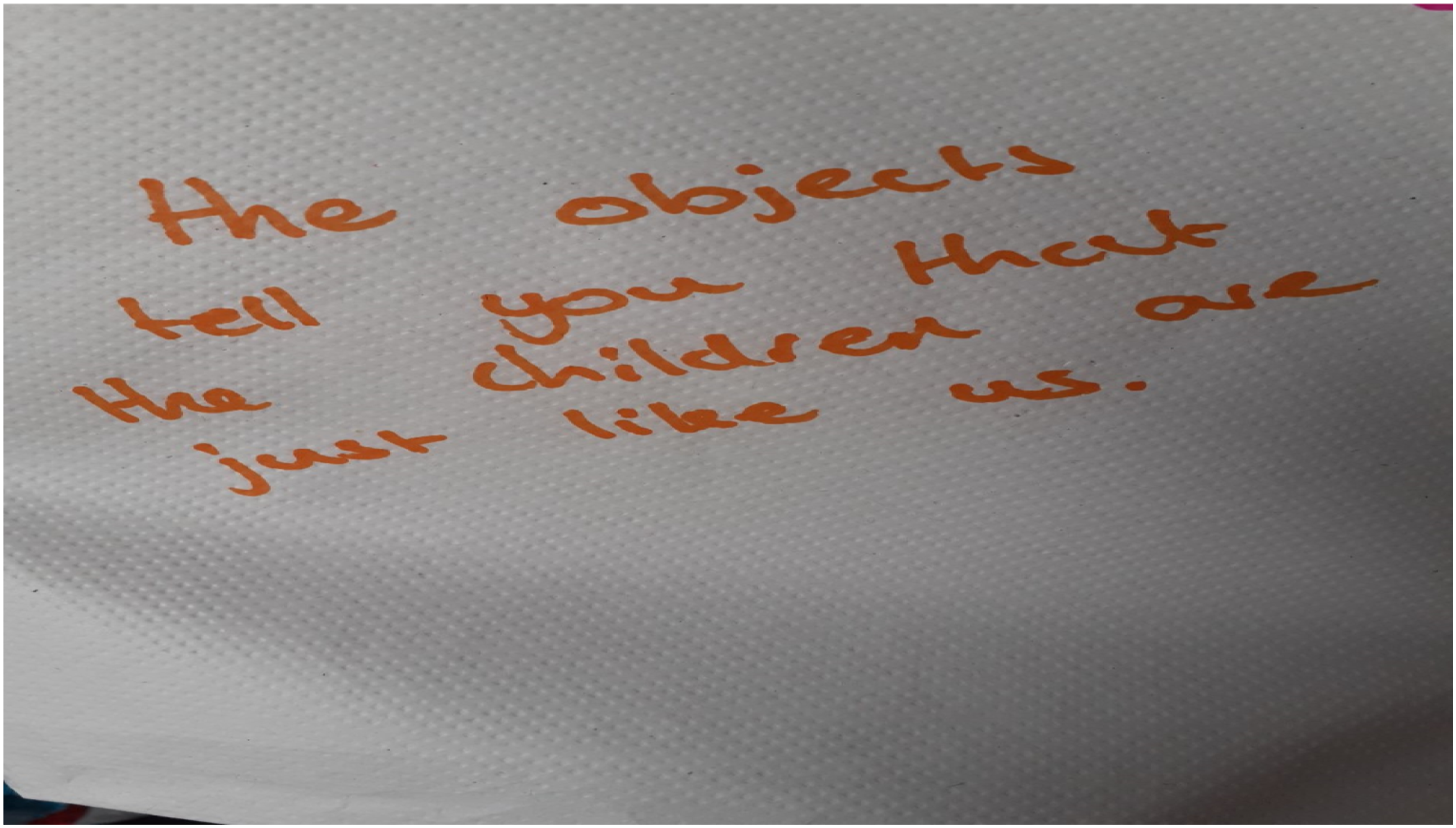
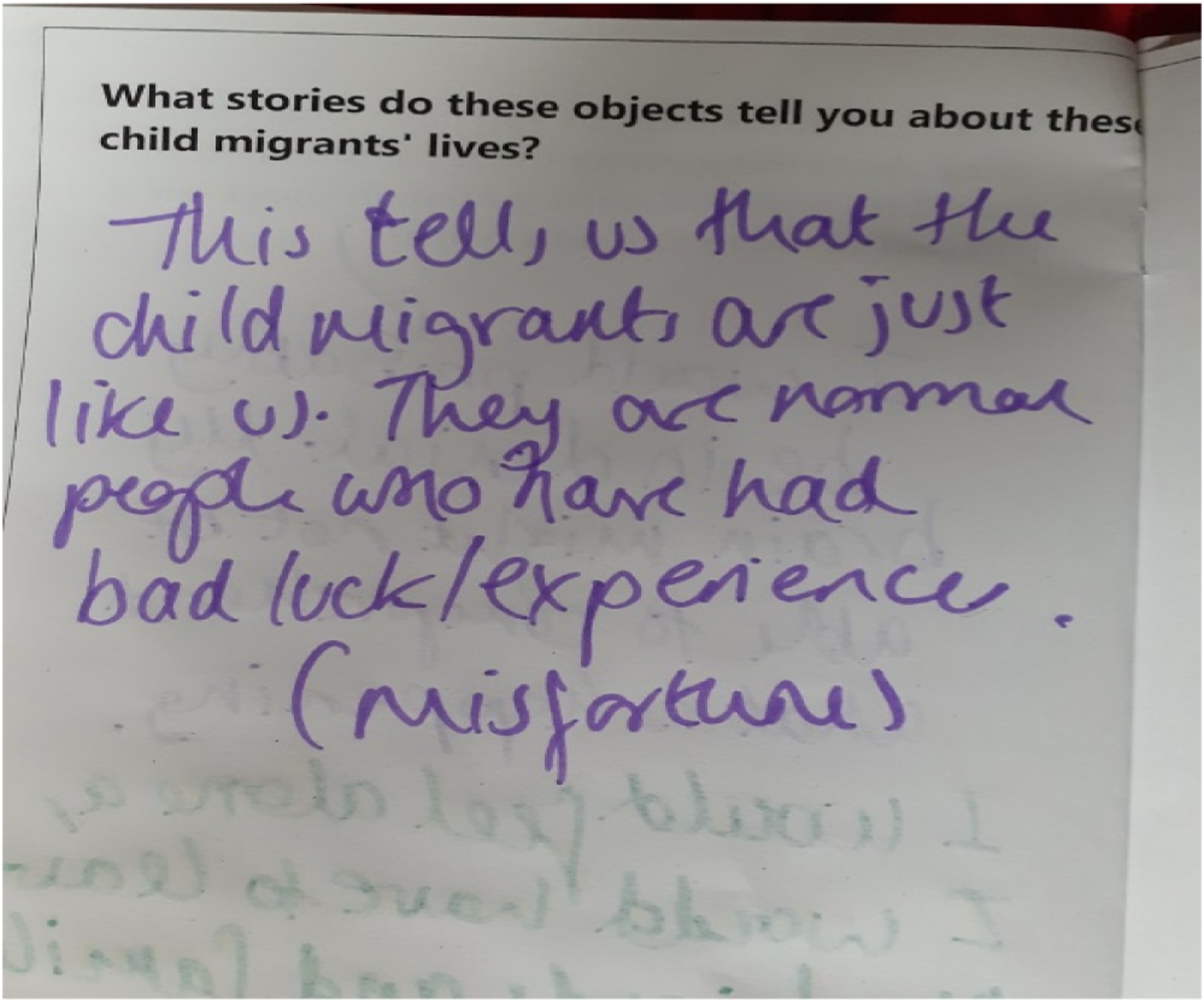
Figure 1 is part of a doodle activity between a group of four children, which took place after they had been presented with the stories, objects and memories of the former child migrants. As part of the doodling activity, they were asked to engage with, share and touch the various sources. Here they also had an opportunity to provide an individual reflection in relation to the objects, as can be seen in Figure 2:
The fact that engagement with the objects, artefacts, memories and stories of the child refugees/migrants resulted in them being described in terms of ‘just like us’ (see Figure 1) and ‘normal people who have had bad luck’ (Figure 2) highlights the power of sensory learning opportunities, providing enriched mental representation through manual exploration of objects, thereby facilitating the emergence of abstract ideas and concepts (Rowe, 2002; Yates and Szenasi, 2021). In this case, integrating haptics with other senses, such as vision and audition, the sensory learning facilitated a process of embodied cognition, thereby disrupting taken for granted perceptions about child migrants.
As mentioned in the Methodology section, as part of each session, the children and researchers (and in a number of the cases including teachers), engaged in brainstorming. This often started with questions, such as ‘What is it like to arrive in a new country as a child migrant? – ‘What do you think?’– ‘How would you feel?’. On some occasions these questions were met with silence. Yet, in light of the critical realist approach adopted in this paper, ‘absence’ (i.e. what is missing in a social context) is just as meaningful as what is said, and it was often not until the children were presented with the stories, objects and letters from former child migrants that they started engaging in doodling and discussion activities. On other occasions the questions resulted in children talking about fellow classmates who were ‘different’, e.g. because they could not communicate with them, like the Ukrainian children mentioned above.
Here, the ‘interpersonal dialogue’ facilitated through the objects, memories and stories from former children functioned as a form of affective resonator and facilitator of sensations, sensibilities and emotions (Stein, 2000; Willett et al., 2022), as can be seen in Figure 3: Group doodle.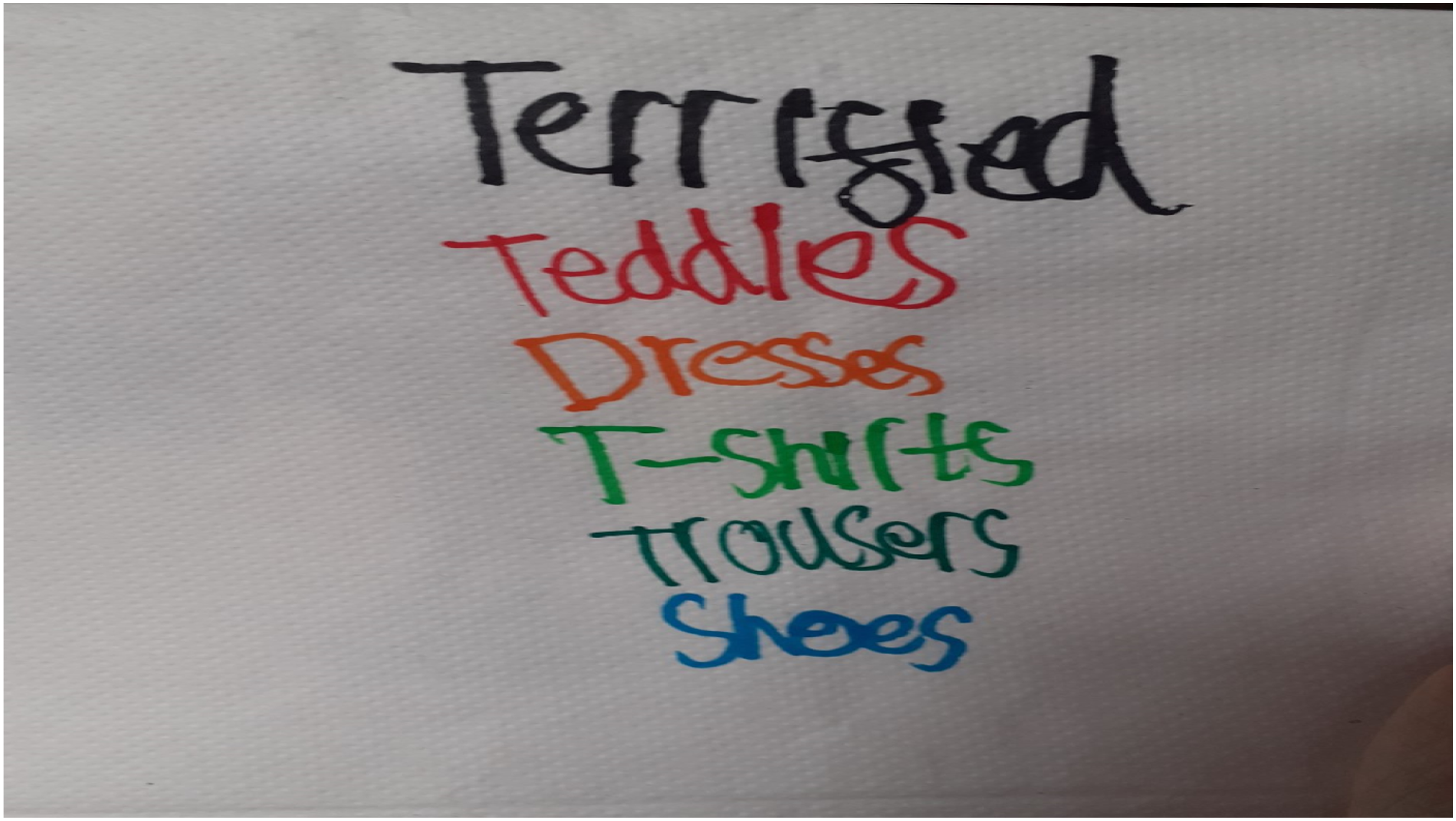
Figure 3 displays both the affective and cognitive responses of the children after being presented with the objects, moving from emotions (‘terrified’) to objects, such as the teddies and items of clothing (dresses, t-shirts, trousers, shoes), showing the transformative and disruptive impact on children’s perception and learning (Novak and Schwan, 2021; Walton et al., 2016). The view of sensemaking and learning coming about through moments of rupture also requires reflection on what the participant or learner brings to the (learning) situation, rather than solely focusing on the nature of the content itself, which is reflected in the next theme “being a child”.
Theme 2: “Being a child”
This theme highlights how the children started to engage with the concept of “being a child” (rather than an adult), as experts and experiencers, after being presented with the objects, artefacts, and memories, framed within narratives of migration and displacement. Their responses to the question ‘what comes to mind first’, after experiencing the stories and objects, demonstrates that “feelings” remained at the forefront of initial responses: Probably quite scared because you’ve never - you don’t have someone that you like always had around. I also said you’d feel like angry because you’re being like forced to change something when you’re already like changing physically. Puberty. Changing into a teenager. Feeling guilty for like people left behind. And other children that didn’t make it over. I feel like bad for them, because I can’t imagine having to go through like the same situation that they have. Like I don’t know how I would be able to, like emotionally especially. Especially when you’re a child and you haven’t got your parents with you, like no one to guide you and stuff.
Taking their own experiences as the starting point, the children highlight the challenges of growing up and puberty, whilst at the same time engaging with basic needs for protection and attachment. By doing so, they engage with what Stein (2000) refers to as an inter-personal matrix, reflecting sameness of meaning and mental phenomena. This was also evident from the group doodling that the children engaged in:
As with the theme “just like us”, Figure 4 shows glimmers of insight into both affective (‘overwhelmed’, ‘sorry for them’) and cognitive (‘wouldn’t understand’, ‘unprecedented’) responses of the children in relation to the objects, reflecting a sense of powerlessness in the face of displacement (Garnier, 2021; Witcomb, 2013). Thus, material objects, memories and stories allow the children to move from observer to experiencer, and ultimately engage with what it is like to be a child migrant, which can be seen in Figures 5 and 6 below (Binnie et al., 2021). Group doodle. Group doodle. Individual reflection.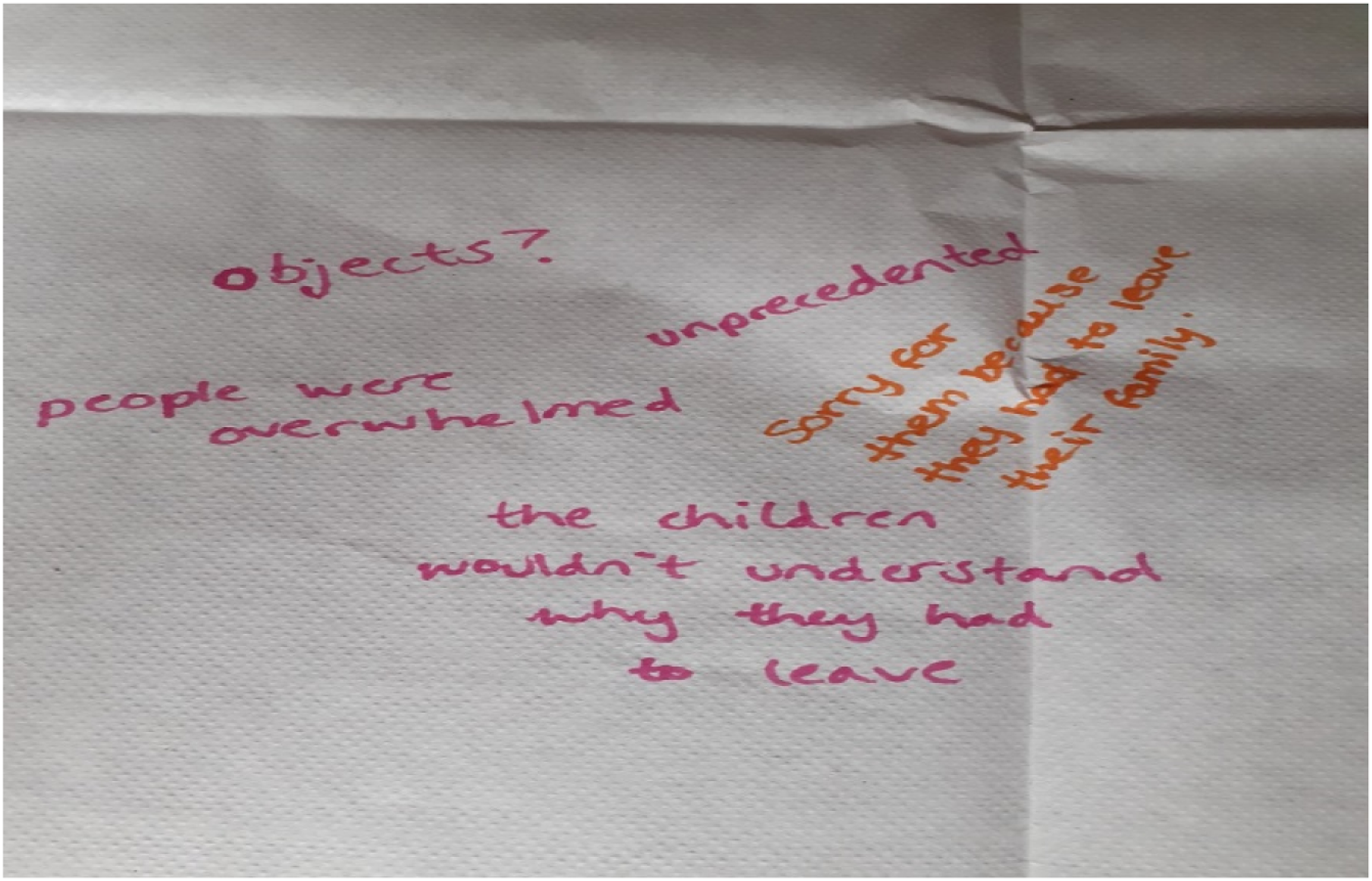
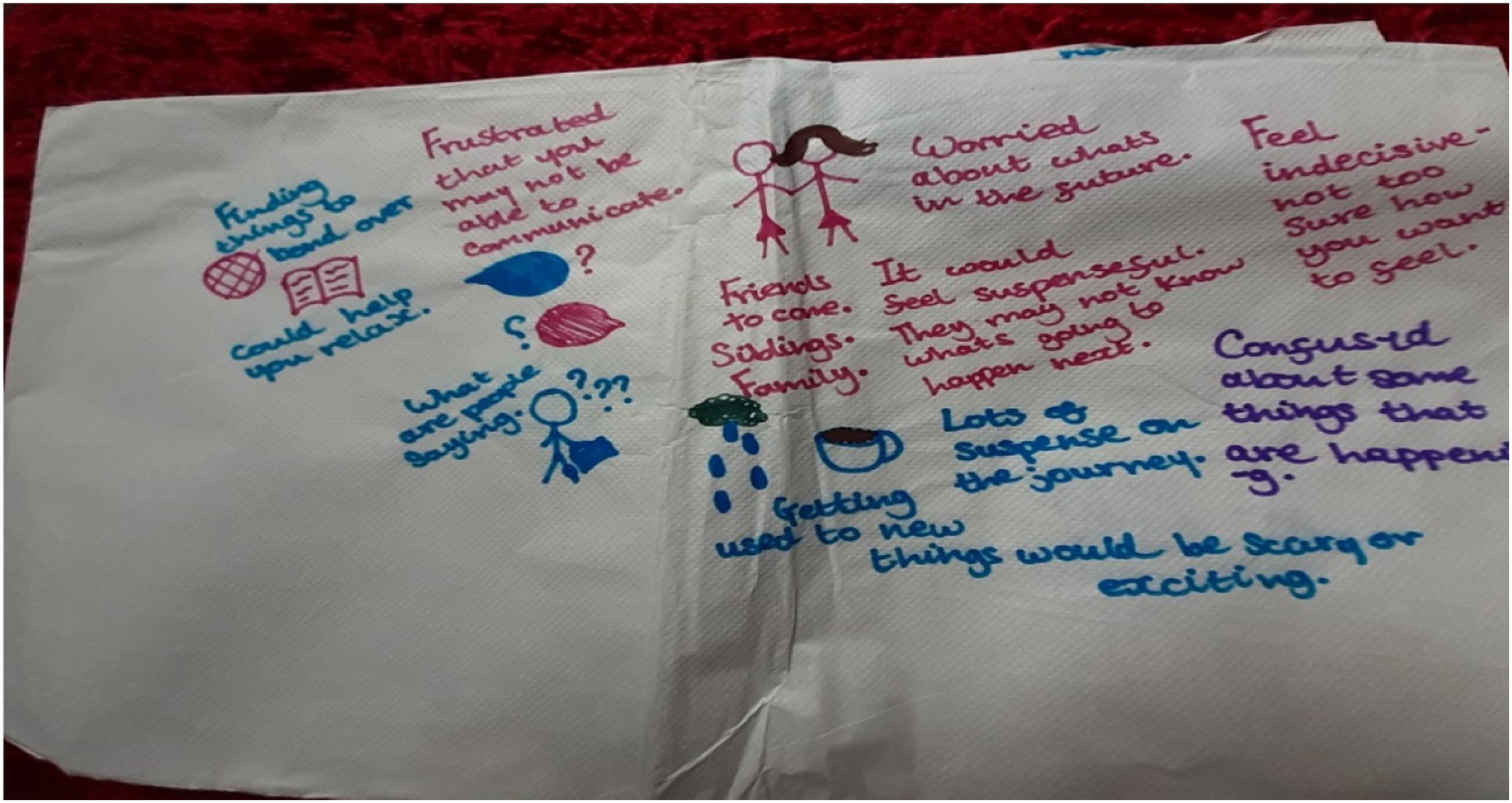
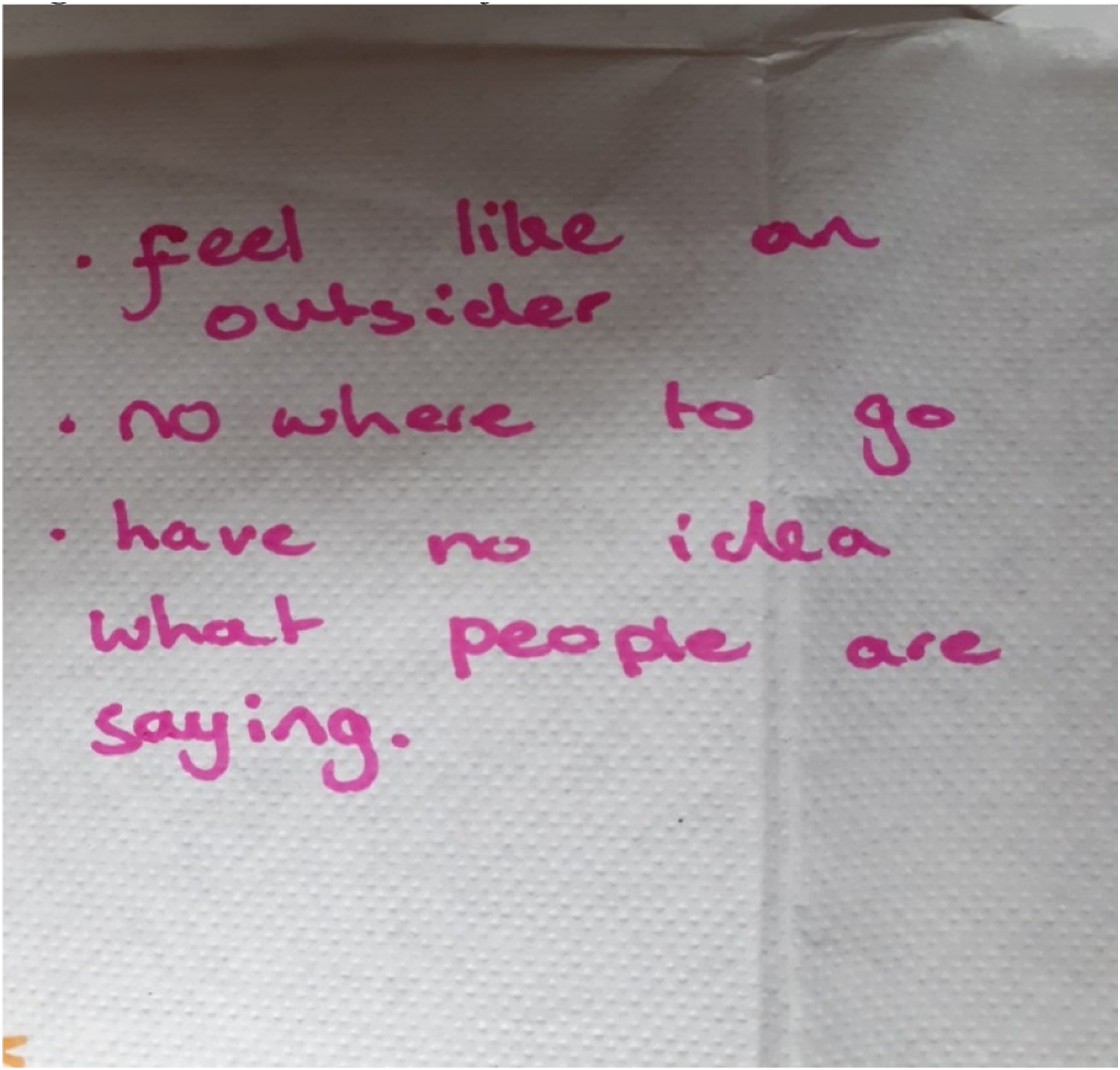
Both Figure 5 (group doodle and discussion) and six (individual reflection) show elements of “being othered” and not knowing ‘what people are saying’ (Figure 5) and ‘feeling like an outsider’ (Figure 6) highlighting how the child participants in this study navigated “self-other” distinctions by moving from the outsider to becoming the insider and experiencer (Chauhan and Foster, 2014).
The emergence of abstract ideas, cognitions and affective responses evidenced below shows the power of sensory learning in facilitating opportunities for enriched mental representation (Chatterjee and Hannan, 2015; Rowe, 2002). Moreover, in addition to expressing affective and cognitive responses, reflecting an element of “sameness”, it also stimulated some of the children to express their own personal experiences and feelings, which will be discussed in the next theme below.
Theme 3: “From material object to personal experiences and feelings”
Not only did the sensory objects stimulate the children to engage with what it might be like to be a child refugee, prompting them to say that these children are just like them, the disruption and interactive sensemaking and learning facilitated by the “things” (objects, memories, stories) also brought about an element of intra-personal reflection (Garnier, 2021; Stein, 2000). The latter was either expressed as personal experiences, at home with their own family, or by reflecting on their own feelings. The examples below show how the children moved from discussing the objects to reflecting on their own, sometimes traumatic, experiences. Participant 1: It’s a small suitcase. Participant 2: I don’t think I’ll be able to fit my mum in it and that’s all I’d want to take. Participant 3: Some people hate their family. Participant 4: I used to like my family; my parents used to fight
The children who participated in the discussion above were enrolled in a special school for pupils with a diagnosis of autism. As can be seen from the conversation between the children, the initial discussion, which revolved around the small suitcase linked to the Kindertransport scheme that they were presented with, quickly turned into a reflection on their own home situation and families. Here, children as active agents and constructors of their lives and experiences highlight that childhood is not always smooth sailing. Previously, we discussed how the image of the ‘vulnerable child refugee’ does not allow any room for a more nuanced understanding of the experiences of individual children, such as in relation to trauma and related behaviours and consequences (Kushner and Knox, 2012; Morgan, 2020). Yet, whilst engaging with the very objects of former child refugees/migrants the children in our study did just that – they showed that childhood experiences can be difficult and problematic at times and it should not be taken for granted that everybody loves their family. As well as reflecting on personal family experiences, the sensory sessions also resulted in practical reflections, such as the one below, which comes from a discussion among a group of children in a state secondary school: Participant 1: I’d ask my mum if I could take something from her— Participant 2: But like, Pandora, so I might take one of her charms or something. Participant 3: And then I’d take some of my brother because, well, he’s my brother. Researcher: Yes. What kind of thing do you think you’d take? Participant 3: From my brother? I don’t know, maybe a watch or something. He’s got a few watches. Participant 3: I forgot to put my watch on actually today. Well.
Not only did the children reflect on their own experiences at home, with their families, they also engaged with their own emotions (see Figure 7) using “I” to, quite literally, reflect on how they would feel if they were in the same position as the former child migrants. By drawing the objects, touching them and listening to the stories and looking at the photographs the sensory learning experience facilitated a form of embodied affection and cognition, where the children are both the experiencers and experts of childhood (Hougaard et al., 2022; Stryker et al., 2019). Group doodle.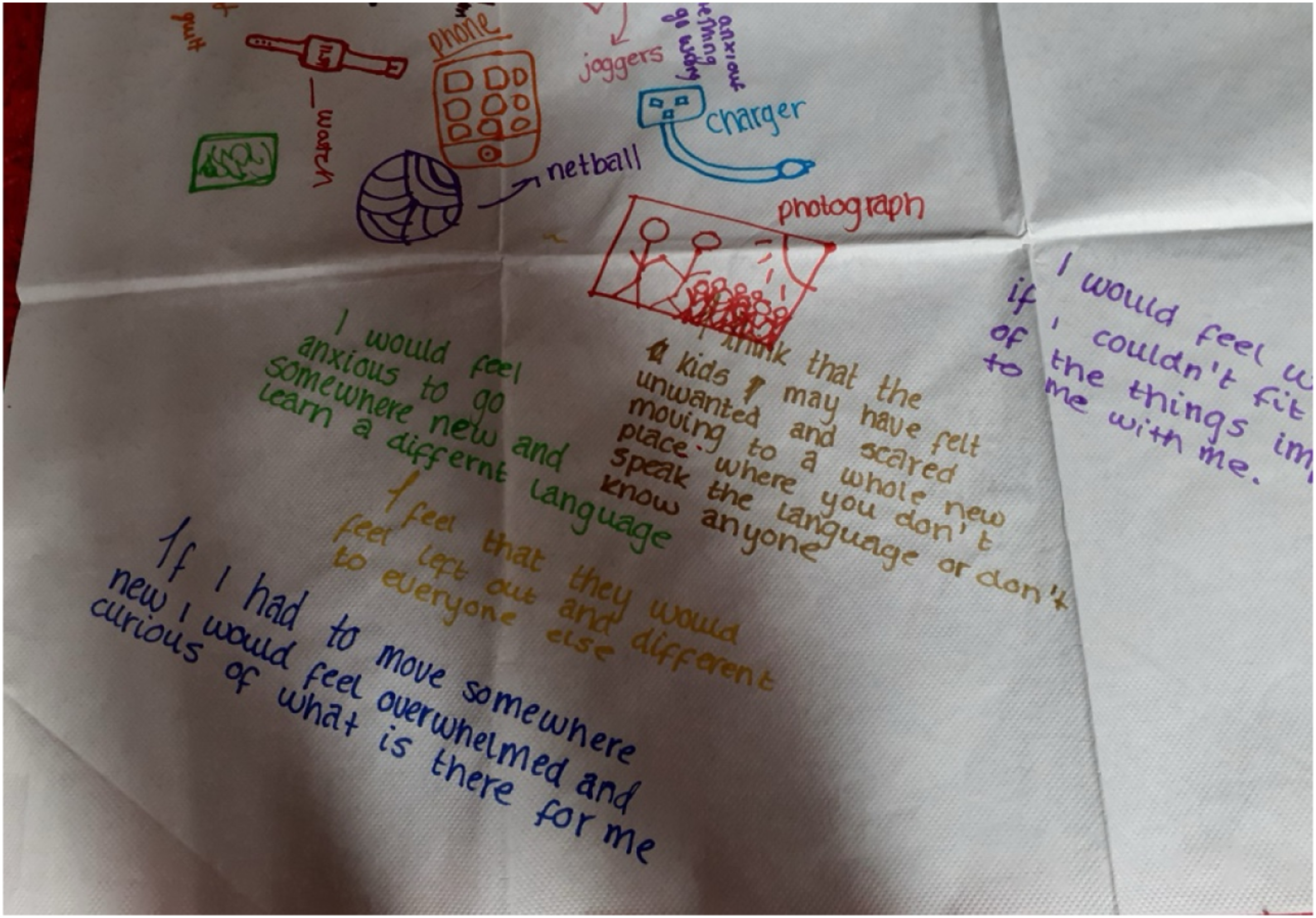
This form of self-communication provides glimmers of insight into the inner world, personal experiences and social identity of the child, centralising their feelings, emotions and cognitions (‘I would feel’, ‘I think’, ‘If I had to move’) as can be seen from Figure 7 above. Moreover, this also extended to their own being and legitimacy, which is discussed below.
Theme 4: “Being legit”
The discussion below is centred around some of the core artefacts associated with the Kindertransport and Windrush schemes that we shared with the children, namely a doll, a sweater and photographs, causing them to ruminate about childhood memories: Researcher: A memory, yes. What sort of childhood memories are important here? Participant 1: Your brain ones. Participant 2: Well not memories, but photos. Researcher: Photos? Participant 3: My passport. Because if you’ve got that then Participant 1: You see, you’re legit. [laughter] Researcher: What else would you take with you? Participant 4: My birth certificate. Researcher: That is a good point. Participant 5: Is it? Participant 1: Well actually yes, I mean. Participant 6: So that you can prove you’re a real person!
Children as active agents and constructors of their life also take cues from ‘self-other’ constructions in society and attach meaning to subtle and not so subtle messages about the relative desirability of belonging to one social group as opposed to another (Hirschfeld, 2008; Stryker et al., 2019). As such, children will hold a number of biases that are not random, but are facilitated by what they hear and see around them. For example, as with the Windrush and Kindertransport schemes at the time, current issues around migrants and refugees, and whether they are legal or not, are widely documented in the media (McLaughlin, 2018). Moreover, like the Kindertransport and Windrush schemes, there is an element of scrutiny and suspicion towards “unchildlike” children and criminalization of undocumented migrants (Morgan, 2020). The discussion above needs to be seen in such a light and explains why the talk moves from photographs and memories as ‘brain ones’ to showing actual evidence that you are ‘legit’, so that you ‘can prove you’re a real person!’.
In addition to discussing legitimacy in relation to their own being, the legitimacy and permanence of objects and artefacts was also discussed, thereby engaging with the long term affective and cognitive meaning of objects and the emotional value of the longevity: Because it kind of like, because I’ve always had them around, and it would bring me a sense of comfort. Because I know that even though I’m in a different place there is still something which has stayed the same, and that’s that specific type of jewellery.
Finally, children also expressed their disapproval (see Figure 8). We previously highlighted how in contemporary society the needs of the child supposedly take centre stage, whilst in reality children are rarely consulted and the very concept of childhood is often controversial and problematised (see also Stryker et al., 2019). The reflection (in Figure 8) on the fact that the children were poor and ‘had tiny luggages’, and that they ‘had to leave their home’ resulting in the unhappy face and ‘very disappointing’ engages with this to an extent. Individual reflection.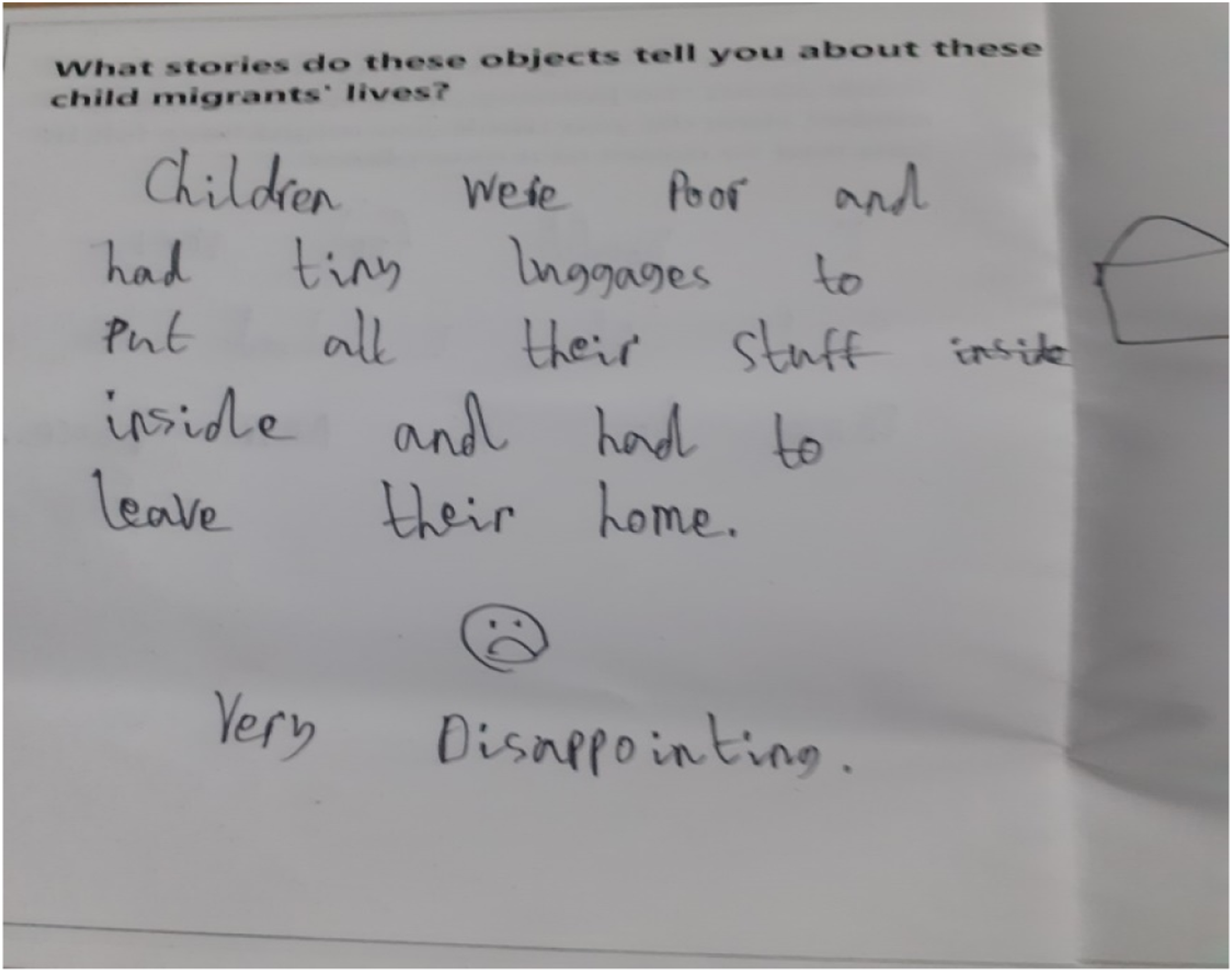
Discussion and conclusion
It is clear from our findings that the haptic and sensory experiences of the objects interested the children and provided them with an initial point of experiential rupture, the examining of an object through material interplay (small fingers grasping the suitcase handle, as if testing for its weight and “handedness”) expressing and engaging a proximity to not just the object itself but also its symbolic and other potential meanings (Downes, 2018; Parkin, 1999; Stein, 2000). That such objects hold the power, or “agency”, to provoke particular affective and emotional responses was demonstrated through a range of spoken, hand-written and hand-drawn responses by the child experiencers, which enabled children to respond in their own individual way and to engage their sensorimotor abilities, with many of the children producing reflective responses which focused on the object of the suitcase and its potential contents. Here the children’s responses in relation to how they would feel, what is important to them and which objects they would take if they had to leave their country speak to Parrott’s (2012) understanding that ‘artefacts are engaged in multiple processes of sensory and emotional identification, with controlled and uncontrolled effects’ (2012: 51), with ‘feelings roused by an object made and used ‘then’ in the ‘now’’ (Downes, 2018: 18) providing some form of affective bridge, generating personal fictions to arise out of the object and personal relations and relationships to be explored and reflected upon. That the ‘sensory frames, gives access to and heightens the affective’ (Edwards, 2010: 23) is suggested here by the children as experiencers’ responses, pointing to the use of objects as artistic fictions (Prown, 2000).
Facilitating the child experiencers’ object interactions in this way provokes imaginative, affective and emotional responses and an element of “sameness”, with many of the children’s responses directly stating the objects demonstrated their former child owners’ as ‘just like us’: in turn this process of reflection fostering a turn inwards to explorations of the self and its emotional and affective states (Chauhan and Foster, 2014; Sims-Schouten et al., 2023). ‘Overwhelmed’ was a common written and spoken response when child experiencers reflectively explored their haptic examinations and mental understandings of objects related to forced journeys and experiences of migration and displacement, highlighting how conjoining the material with the emotional thus allows for the possibilities of ‘the affective power of objects and the role of interpretation in enhancing it’ (Witcomb, 2013: 39), and speaks to phenomenologically-oriented understandings of forms of embodied learning (Stein, 2000; Stolz, 2015). This highlights how affect can act as a basis for gaining emotional insight into past experiences, where material objects may have “power” or “agency” in activating the expression of empathy in the present (Chatterjee and Hannan, 2015; Garnier, 2021).
Using a suitcase, and a range of personal items (letters, jumper, toys) to sensorily express and explore children’s responses to childhood narratives of forced migration and displacement thus creates special conditions for affective, empathic and cognitive confrontations between past, present and future as well as between objects with very different charges (Lofgren, 2016; Stein, 2000). First coined by Massey (2005), we position the “throwntogetherness” of these objects, ‘memories and intentions in the suitcase’ as facilitating the ‘special moods as well as quickly passing affects aris[ing] when the case is opened and items handled’ (Lofgren, 2016: 150). By doing so, this study suggests in addition that, in locating material objects within specific narrative frames (forced migration and displacement), such objects attain an emotional or affective charge or resonance, functioning in some way similarly to what Edwards (2010: 23) notes photographs achieve, calling them ‘‘history objects’’, that is, ‘they demarcate and reserve a sense of the past and collective memory’.
Such instances of specific object “fictions”, it should be understood, may provoke both individual and collective responses however, each in turn influenced by the other. Further, through particular association with migratory narratives, and specifically journeys made ‘in crisis’ (Edwards, 2010; Parkin, 1999), levels of affective resonance may become raised or attain a greater value, where sensorimotor interaction occurs with the object, its “thingness” in its material form – the suitcase’s dented edges, for example – promising in their rough touch to the participant’s fingertips a physical experience which performs the agency of physical witness. This also speaks to Burman’s understanding that ‘[t]he objects are themselves a kind of pictorial memory, a spatial representation that fixes time in the moment’ (Burman, 2023: 21), with childhood ‘therefore membered as well as remembered, maintained or even constructed as a material record even as the embodied child(-adult assemblage) has passed on’ (Burman, 2023: 22). In particular, by allowing the narrative (re)“membrance” to be controlled, taken over and led by the children appears to foster a space for reflection, with the potential to effect a cognitive shift away from notions of “Other” and oppressive responses to instead enact a re-gathering and communing which inculcates a reflective sense of similar selves, or indeed a “similarising”. This can perhaps also be seen as an experience which subverts Freud’s “uncanny” process (1919), akin to Burman’s understanding that ‘placing familiar objects in unfamiliar contexts (and vice versa) disturbs received meanings and interpretations (Burman, 2023: 24), to produce instead the familiar – a relational turns to same-ness, ‘just like us’, which centres the relational to extend a hand of greeting and welcoming into a kindred, family-led landscape of the child and childhood.
As such, integrating haptics with other senses, such as vision and audition, suggests multisensory approaches and materials facilitate a process of embodied cognition, with the potential to counteract prejudices through disruption (Novak and Schwan, 2021; Wilton et al., 2024). Our research thus highlights how engaging children, young people and participants across generations can provide unique opportunities and potential for critical and careful discussion about migration. Yet, in line with the critical realist approach adopted in this paper, it is also important to take account of ‘absence’ (i.e. what is missing in a social context or entity/institution/organization) and ‘epistemological dialectic’ (inconsistencies in cognitive or practical situations). The latter is specifically important in relation to what objects prompted emotions, critical debates, personal empathy or collective responses and what objects (if any) were met with limited responses, blankness or an inability to respond by some children. While this was not the purpose of the current paper, we aim to explore this in further work.
Conclusion
This study is the first of its kind to make sense of children’s lived experiences and legacies of displacement through multi-sensory methods, embracing a form of knowledge beyond language where knowledge is embodied and expressed through sensory experience outside of the spoken word (Garnier, 2021; Oakley, 1994). We posit that such methods can stimulate behaviour change in childhood, through reflexive encounters with “difference” within an interactive space, unsettling prejudice and providing a deeper and more meaningful understanding of (ethnic) identity (Sims-Schouten, 2025; Sullivan et al., 2020). This study specifically explores such impact of reflexive encounters with “difference” within an interactive space also as a form of disruptive learning and in order to provide a deeper and more meaningful understanding of (ethnic) identity that goes beyond rote classroom learning.
Viewed through a critical realist lens, centralising the concept of reflexive ethnicity and the meaningfulness of interpersonal and intrapersonal experiences, this project offered immersive multi-sensory materials and engagement with former Kindertransport and Windrush children’s objects, stories and artefacts as an opportunity for creating critical sensemaking, knowledge and learning. Critical realism promotes awareness as a key strategy for tackling oppression, proposing that whilst there is an (objective) world that exists independently of people’s perceptions, language and imagination, there is also a need to acknowledge that part of that world consists of subjective interpretations, which influence the way in which the world is perceived (Bhaskar, 1989). Linking this to multi-sensory materials and sense-making and Edith Stein’s (2000) affective and empathic phenomenology we provided insight into how meaningful experiences transpire both between people, and within persons.
Footnotes
Declaration of conflicting interests
The author(s) declared no potential conflicts of interest with respect to the research, authorship, and/or publication of this article.
Funding
The author(s) received no financial support for the research, authorship, and/or publication of this article.
