



Abstract
Children’s participation in mandatory family mediation is an aspect of parents’ separation process in Norway. In this article, we aim to explore what adolescents emphasise in their narratives about their participation. Eleven adolescents aged between 12 and 17 participated in qualitative semi-structured interviews. Drawing on Communication Privacy Management theory, the results show that, during participation in mandatory family mediation, adolescents are provided with opportunities to exercise agency by managing privacy boundaries. Family mediators have the potential to assist adolescents during and after disclosures of private information.
Introduction
In this article, we present narratives from adolescents about their experiences of participating in their parents’ mandatory family mediation process. We show how adolescents as agents can negotiate the management of private information with adults, such as parents, family mediators (henceforth ‘mediators’), and the interviewer in this study. Seeing adolescents as social agents, we see them as “negotiating with others with the effect that the interaction makes a difference – to a relationship or to a decision, to the workings of a set of social assumptions or constraints” (Mayall, 2002: 21). Further, these interactions and negotiations are seen in relation to how they can improve adolescents’ everyday lives during their parents’ separation processes (referring to divorce and break-ups between cohabiting parents). The focus on process can be useful when exploring children’s co-construction of their social world, especially during the time of parental separation (Berman, 2015).
More than 20 years ago, Smart (2003) pointed to the shift in focus from how parental separation can be harmful for children, to research that highlights the complexity of such processes. Smith and colleagues (2003), for instance, emphasised facilitation of children’s participation in family and legal decision-making regardless of their competence as one aspect of such complexities. Since then, the discussion is no longer if, but rather how (italic in original), children should participate (Birnbaum, 2009). Various modes of children’s participation in family law proceedings are generally available across jurisdictions (Mol, 2021), which also includes alternative dispute resolution processes, such as meditation. Depending on the country, alternative dispute resolution processes are offered or required, in which parents are encouraged to reach their own parenting agreements jointly (Mol, 2021). In Norway, mediation in relation to parental separation can be done in two ways; court-connected mediation and mandatory family mediation (henceforth ‘family mediation', see for instance Nylund, 2021). Judges and lawyers are not involved in the latter.
Norway implemented the UN Convention on the Rights of the Child in Norwegian legislation in 2003. The best interest of the child is now the underlying principle for family mediation (The Marriage Act, 1991: Section 24; The Children Act, 1981: Section 52). Additionally, parental separation is seen as a process that need preventive actions on behalf of the children involved (Official Norwegian Report (NOU) 2019:20, 2019). Therefore, all separating parents and parents who disagree about parental responsibility, residence, contact, or relocation with children under the age of 16 must attend at least one mediation session (The Marriage Act, 1991: Section 26; The Children Act, 1981: Section 51). Family mediation in Norway is carried out by certified mediators at the Family Counselling Office (FCO), at no cost to the family. Mediators have professional backgrounds such as lawyers, clinical psychologists, psychiatrists, priests, social workers, or child welfare officers (NOU 2019:20, 2019). FCOs carry out about 15 000 mediation cases annually (The Norwegian Directorate for Children, Youth and Family Affairs (Bufdir, 2023)). The purpose is to help parents create a written agreement about parental responsibility, residence, contact, and practical matters that ensures that the best interests of the child are protected (The Marriage Act, 1991: Section 26; Regulation on Family Mediation, 2007: Section 1; The Children Act, 1981: Sections 48 and 52). It is the parents who own the agreement, and they are responsible for ensuring children’s right to be heard. The mediator should encourage, accommodate, and support parents’ capacity to safeguard this right (Regulation on Family Mediation, 2007: Section 2).
While there are no formal regulations of children’s participation in mediation in Norway, which is generally the case for most alternative dispute resolution processes (Mol, 2021), the participation of children has, for the past decade, been given particular attention within the family mediation service (NOU 2019:20, 2019). Several researchers claim that the purpose of including children in family mediation is unclear (Eikrem and Andenæs, 2021; Strandbu and Thørnblad, 2015), and this ambiguity is apparent outside of Norway as well (Birnbaum, 2009). How mediators choose to carry out the family mediation depends on their exercise of discretion (Salamonsen et al., 2022). Even if the annual participation of children has been between 22 and 26 % the past 5 years (Bufdir, 2023), the percentage of children’s participation varies considerably between offices (Bufdir, 2021). It is therefore likely that the context of children’s participation can vary across FCOs and across mediators’ ways of meeting children in the family mediation process.
Children often emphasise to be listened to by parents and being able to have a say after parents’ separation (see for instance Berman, 2018; Holt, 2018). What is an ongoing task during the process of parental separation, and perhaps particularly when family members meet with other professionals as part of this process, is to manage information about one’s own and the other family members’ private lives (Petronio, 2008). Children appreciate openness from their parents and can be more likely to do so when they grow older (Sunde et al., 2021). However, the management of private information during parental separation can sometimes be challenging, for instance because of inappropriate disclosures from parents (Afifi et al., 2007), or make children, parents or stepparents feel caught between family members due to the communication strategies that are being applied (Afifi, 2003).
Contextual factors regulate opportunities or constraints that can influence children’s agency (see for instance Abebe, 2019). Adolescents’ strategies for sharing information with their parents can differ according to how they view the support from parents (Baudat et al., 2022), or within the context in which different expectations and permissions exist, such as in interactions with social workers in child protection cases (Morrison et al., 2019). Importantly, children can be strategic when evaluating the possible risks and the appropriateness of how to disclose (Callaghan et al., 2017).
WHO (2023) defines persons between 10 and 19 years old as adolescents. Considering the participants in this study, the term ‘adolescents’ is used to distinguish them from children in general terms, who are everyone between 0 and 18 years old (UN General Assembly resolution 44/25, 1989: Article 1). In Norway, this distinction is particularly relevant in relation to the right to be heard, which state that the opinions of adolescents from the age of 12 should carry significant weight in decisions concerning them (The Children Act, 1981: Section 31).
Adolescents may, in particular, experience tensions between privacy and disclosure. Privacy is defined as “the feeling that one has the right to own private information, either personally or collectively” (Petronio, 2002: 6). Some researchers emphasise that being introduced to new forms of participation is a central feature of child development (see for example Haavind, 1987; Rogoff, 2003), that, particularly for adolescents, can involve new ways of balancing autonomy and independence in their close relationships (Gulbrandsen, 2008). When adolescents meet a mediator during the parental separation process, they must decide what to say to the mediator and what to keep private about their personal lives, their parents, and family practices, and thereby balance the tensions in play. We aim to investigate adolescents’ experiences of participating in family mediation as one of several processes taking place during parents’ separation. We draw on the concepts of privacy boundaries and explore how adolescents’ agency is expressed in their narratives in which they describe management of personal and collective privacy boundaries during the parental separation process. Furthermore, we examine how adolescents use opportunities, such as meetings with the mediator, to affect and negotiate the rules that regulate privacy boundaries to influence aspects of their everyday lives. We follow the summary by Somers (1994: 613‒614) of narratives, “that social life is itself storied and that narrative is an ontological condition of social life”. Adolescents’ thus construct narratives to make sense of happenings in their lives (Somers, 1994).
Theoretical framework
We apply a sociocultural approach to explore how adolescents make meaning of their participation in family mediation processes. In line with Ulvik (2009) and Skivenes and Strandbu (2006), we see meaning as created through interactions and negotiations with others. Somers (1994: 618) argues that ontological narratives, the stories that social actors make to make sense of and act in their lives, are central in such interactions and negotiations. According to Somers (1994), narratives are constructed by bringing events together in a specific manner, by relationality, connectivity, and selective appropriation. The construction of narratives is basic to agency; agents adjust stories to fit their identities, and they tailor reality to fit their stories. Narratives are created in relation to others, in the specific time and context in which they live (Somers, 1994).
Viewing agency as relational, we acknowledge generational power issues between children and adults (Abebe, 2019; Alanen, 1998; Spyrou, 2018). In the context of this article, such adults can be parents, mediators, and researchers. One way to recognise relational agency is to include adults in the analysis (Wyness, 2012), for instance by identifying ways adults exercise generational power. As social agents, children develop and learn through participation in, contributions to and guidance by the values and practices of their cultural communities and social partners, which also change (Hundeide, 2002; Rogoff, 2003). Children’s participation in family mediation is one way of engaging in a practice where children interact with adults, and thereby make generational power issues relevant.
We also use concepts and ideas from the Communication Privacy Management (CPM) theory (Petronio, 2002, 2008). The CPM theory is dialectical, building on concepts originally developed by Bakhtin (Bakhtin, 1981, 1987). In her theory, Petronio further draws on dialectical aspects in personal relationships described by Baxter and Montgomery (1996). Dialectical aspects in personal relationships are not viewed as simple polar oppositions, but rather contradictions seen as complex and overlapping and sometimes in tensions with each other (Montgomery and Baxter, 1998). Connectedness, for instance, cannot only be seen as the opposite of autonomy, but rather in dynamic and opposing associations with several forces such as autonomy, privacy, self-assertion, and independence. Additionally, dialectical aspects are seen as ongoing and in indeterminant interplay. Openness and privacy, for instance, should be seen as an interactive unity (Montgomery and Baxter, 1998: 159). Context is one of several influencing factors in developing or changing rules that regulate such tensions (Petronio, 2002: 21‒22).
A central premise in the CPM theory is that disclosing private information can yield benefits and lead to consequences for oneself or others (Petronio, 2002). Boundaries mark ownership lines for individuals’ privacy on personal and group levels (personal and collective boundaries; Petronio, 2002). The dialectic between disclosing and concealing must be balanced in order to manage the publicness of the information and the possible vulnerability for someone in case the information is disclosed (Petronio, 2002, 2008). During parents’ separation for instance, adolescents manage their personal privacy boundary in addition to the collective ones that they share with siblings, parents, friends and others in different constellations.
Rules regulate the permeability of the privacy boundaries; that is how easily, how much, and what type of information can pass through the privacy boundaries. These rules are negotiated and adapted, and can be explicitly stated or implicitly suggested (Petronio, 2002). The rules typically change when relationships change, which is often the case during parental separation processes. According to Petronio (2002), those inside of a collective privacy boundary might struggle to coordinate rules during such processes.
Methods
We recruited strategically by including participants according to deliberately selected criteria (Flick, 2007): age between 12 and 17 and attendance in at least one conversation with the mediator during parents’ family mediation process. The preventative approach of family mediation in Norway means that a considerable number of cases are characterised as low or middle conflict cases (63 % in 2021; Bufdir, 2023: 30). In line with the intention of family mediation in Norway, we recruited participants regardless of conflict levels between parents.
Working towards ethical symmetry (Christensen and Prout, 2002), we aimed to reduce possible barriers for participation for underrepresented groups by providing translated information sheets, offering to use interpreters, and other adaptions if needed.
Initially, we aimed to recruit adolescents who had attended their first conversation with the mediator within the past 6 to 12 months. Because this criterion proved difficult to fulfil, we extended the time frame. An overview of the participants’ timelines can be found in Figure 1 below, which shows that several participants had reasons to attend sessions at the FCO either prior to attendance in the family mediation process or through several follow-up meetings. The timelines were made together with the adolescents during the interview. The participants’ timelines of the narratives, showing time ago since the parents’ separation, participation in the mediation process, and clinical and follow-up meetings.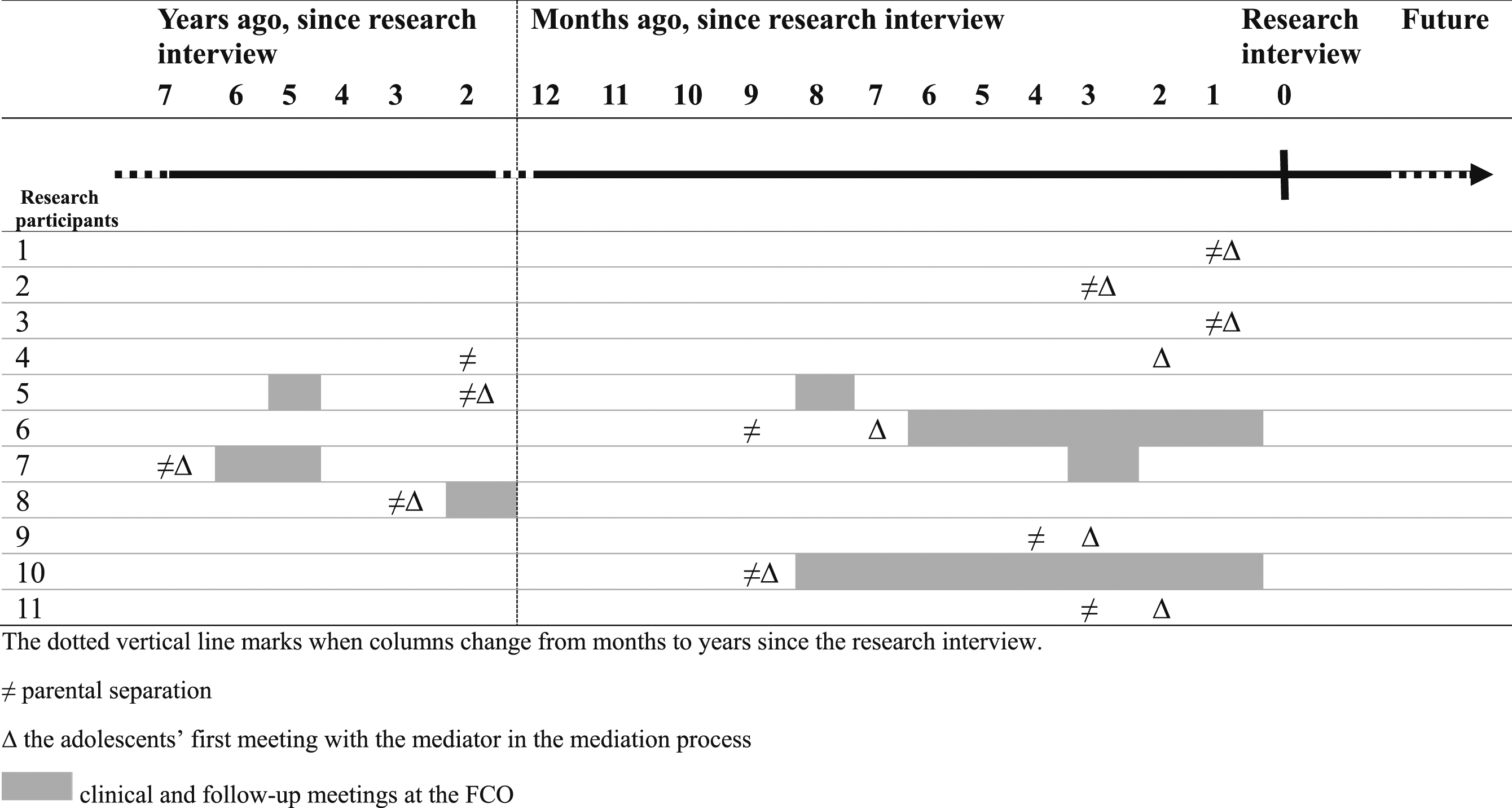
Personal consent was acquired from 16- and 17-year-olds. Personal and parental consent was acquired from those younger than 16. Participants were informed about their right to withdraw from the study, and provided the opportunity to read the manuscript before submission to scientific journals. The project was approved by the Norwegian Agency for Shared Services in Education and Research.
Eleven adolescents (two boys, nine girls) aged between 12 and 17 were recruited by mediators from five FCOs in all four regions in Norway. We apply pseudonyms and 3-year age ranges (12‒14 and 15‒17) in the results to protect anonymity. Two of the participating adolescents were born in an African country.
The interviews lasted between 45 and 90 min and were carried out between September and December 2020. The interview guide was inspired by the life mode interview developed by Haavind (1987). This form of interviewing is well suited to acquire knowledge about children’s everyday lives. According to Gulbrandsen (2018: 3), such knowledge is useful for developing professional practices that aim to contribute positively to children’s lives.
The interviews were carried out at a venue chosen by the adolescent (in their homes, a meeting room at the local FCO or at the interviewer’s workplace, or digitally by Zoom). The interviewer asked the participants to talk about the time from when they came to know about their parents’ separation, and until the day of the interview. For some of the participants, this was a long timeframe. Ideas from narrative methods (see for instance McAdams, 1993) were used to help structure the interview by asking about a highlight, a low point, and a turning point. The aim was to explore the family mediation experience within the larger narrative of the parental separation process. The participants were only asked directly about their participation in the family mediation process if this was not mentioned in their narrative. The timeline helped to pin down significant events in the narratives and had the advantage of creating a common understanding and coherence of the narratives. Thus, it seemed to be a ‘research-friendly’ technique (Punch, 2002).
In some interviews, tensions between the interviewer’s curiosity and recognition of the generational power differences were in play. For instance, follow-up questions could be seen as attempts to open collective privacy boundaries of adolescents and other adults, such as the mediator. Adolescents’ evasion or explicit concealment were therefore understood and acknowledged as them exercising agency by managing the collective privacy boundaries they were part of.
The interviews were transcribed verbatim. To secure internal validity, the authors went through the interview transcripts together and discussed the findings.
Grouping codes into core themes.
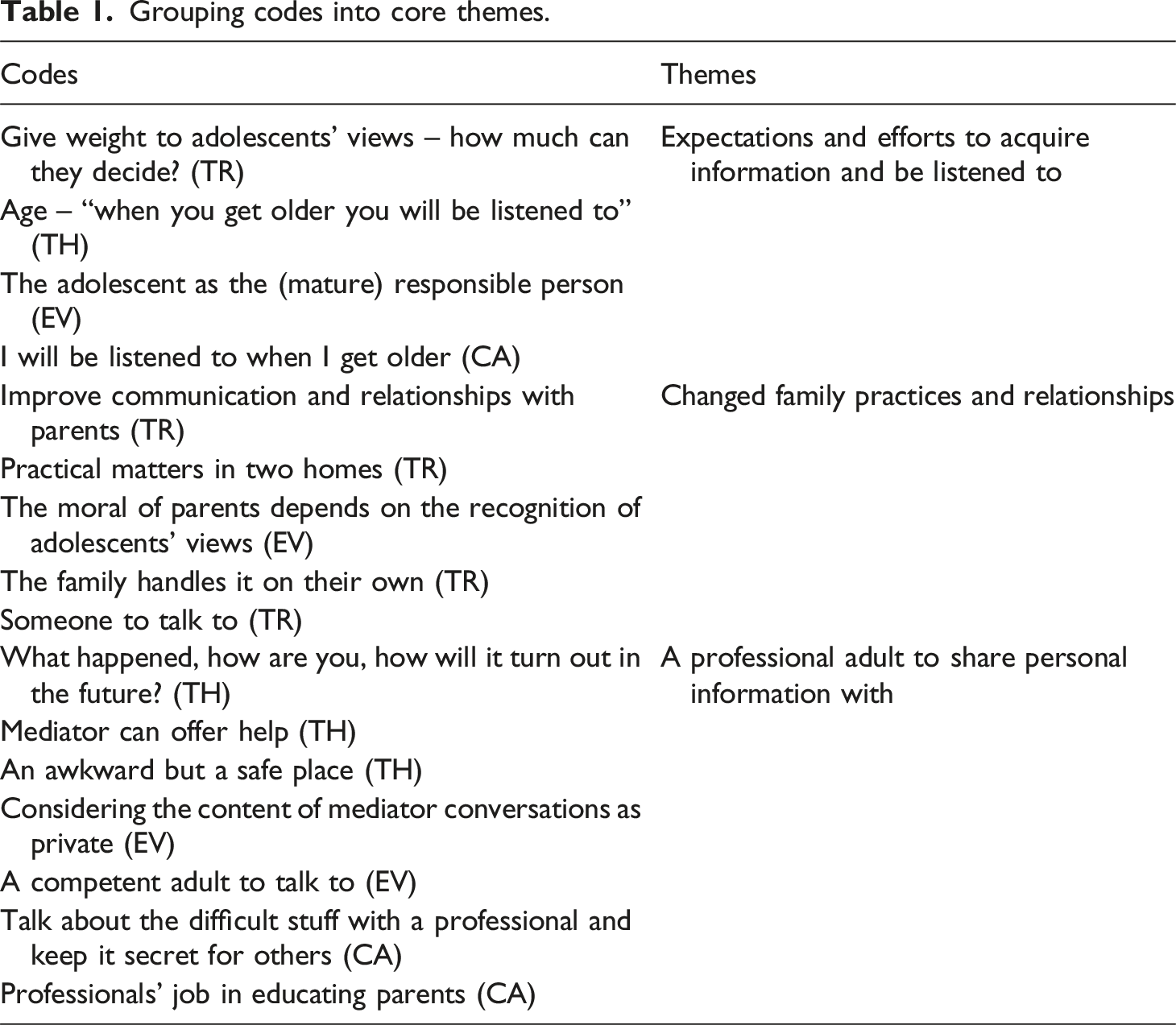
In the following, we present our empirical findings that are structured within the three core themes. They will be exemplified by three aspects of the narratives that we have named ‘Being kept and keeping oneself outside the privacy boundaries of parents’, ‘Family practices that change, create changes in privacy boundaries’, and ‘Mediators’ exclusive access to adolescents’ private lives.’
Being kept and keeping oneself outside the privacy boundary of parents
Ellinor’s (15‒17) family situation was initially characterised by strong privacy boundaries with little permeability of verbal information, and ‘apparently’ implicit rules that indicated respect for each other’s personal and collective privacy boundaries. The conversations with the mediator were central in Ellinor’s narrative and represented opportunities to negotiate and affect her and her mother’s privacy boundaries, and thereby improve their relationship.
Ellinor introduced her narrative by describing how she became certain that her parents would separate. Her parents had been quarrelling and did not spend time together. They seemed to keep the upcoming separation secret, but as Ellinor said, “it didn’t work, because I was there”. When her father bought a new bed, she finally became certain that they would separate: Ellinor: They quarrelled all the time, and sometimes one of them went out into the living room and slept there. And that was strange, because when I woke up and one of them was on the couch, I was just wondering, like, “why don’t you sleep in your bed?” And then he [the father] just bought the bed, and then it just seemed logical, since they didn’t sleep together anyway, they didn’t want to sleep next to each other. And it was visible, even if they didn’t say it. Interviewer: Hm. And then they bought the bed. What did they say then, when they had bought the bed? Ellinor: They didn’t say anything, and I didn’t ask, really. So, it was as if everyone knew, and then no-one was asking or talking about it. Interviewer: Okay. Why do you think it was like that? Ellinor: I don’t know, maybe they didn’t want to believe it was true, so they refrained from talking about it. (…) Interviewer: And you say that you didn’t ask about it either? Ellinor: No, I didn’t dare.
It was something very visible, but at the same time not spoken of. As we interpret her narrative, Ellinor viewed the bed as a symbol of the fact that her parents did not enjoy spending time together, and that, in the words of Ellinor, “it was probably just before they divorced”. She came to this conclusion through her own observations and indirect explanations from her parents. Ellinor’s personal privacy boundary and her parents’ collective privacy boundary seemed to be clearly marked. They did not welcome her, and she did not dare to ask about being invited inside of their collective privacy boundary. We assume that there were implicit rules that guided her and her parents’ privacy boundaries since her parents had not explicitly told her not to ask any questions. Thus, when she was invited to a session with the mediator, she got the chance to influence and negotiate these rules. The atmosphere that the mediator created in their first meeting seemed important in this regard. First, during the first conversation, I thought that I would probably not come back here, right? This is just a place for those who don’t know – like, who need help. I don’t need help. I needed help. I found that out later. So yes. (…) So, I said to dad [some months after the first conversation], because I knew I could tell him. I didn’t dear to tell mum. I was scared she would get upset. So, then I told dad, and then he fixed it for me. So, I started going here [the FCO], and then I told the mediator about how mum was, and then she [the mediator] said that she would talk to mum if I was okay with it, and I was. And then we [Ellinor and her mother] started going. (…) It was something new because I hadn’t done it before. And it was like really safe. So, I could just talk about how I was doing. And then I got help, and it was so strange. [laughter]. (…) Because she [the mediator] asked the right questions, and it was like – it was like safe, like really safe. This was what she was doing, and then it was like: she knows this.
This quotation shows how Ellinor at first did not identify herself as someone who needed help, but after meeting with the mediator and having some time to reflect on her situation and the possibilities of talking with the mediator, she felt safe enough to go back and ask for help. The mediator represented someone she could invite inside her personal privacy boundary, and who could help her give meaning to what was going on.
Ellinor said that the mediator wanted to talk with Ellinor’s mother, and Ellinor was okay with it. They had conversations separately with the mediator and later had sessions together that were facilitated by the mediator. We see the mediator as assisting Ellinor with integrating her personal privacy boundaries with that of her mother, and thereby initiating a process that was previously hindered by how Ellinor and her mother communicated. We understand this process as providing an opportunity for Ellinor, as an agent, to negotiate and initiate processes that created improvements in her relationship with her mother. According to Ellinor’s narrative, it made a difference. Ellinor and her mother were able to talk with each other, and they achieved a common understanding of each other’s situation and then, according to Ellinor, became “best friends”.
Family practices that change, creates changes in privacy boundaries
The narrative of Guri (12‒14) describes parents who quarrelled much of the time. What was especially difficult for her was how information from her parents’ discussions was not hidden from her. She was also frustrated by how they made the quarrelling visible to her friends, even though they had agreed to prevent that from happening. As a paradox, Guri said that when her parents told her and her sibling about the parental separation, she was told to keep it a secret. Guri did not seem to agree with this rule concerning how to manage the collective privacy boundary related to the parental separation process. The following is an excerpt from the narrative to show how Guri, as an agent, rejected the rule suggested by her parents and instead did what she thought was best for herself: I didn’t start to cry or anything; I just left (…) to visit [my friend], right, I told her. Mum said … they said that I was not allowed to tell anyone. I said: “Why?” (…) I felt I had to tell someone. I couldn’t keep it inside. I left … It wasn’t the first I said, but … then I just said it (…). I thought it was stupid that Mom said that … that I was not allowed to tell anyone. I understand it, because it was what would be best for them. But I think that they are not so good at thinking about how it would be for me (…) because I don’t have any other ways to like … than say it to someone (…) We [Guri and her friend] did not talk much about it, really. Her parents do not quarrel as much … but we did not talk much about it. [I] just said it.
Guri’s narrative demonstrates how some adolescents take an active part in challenging the ‘rewriting’ of rules that manage privacy boundaries. As the parental separation progressed and one of Guri’s parents moved into a new apartment, the relationships with her parents changed, and disagreements arose. Guri found it difficult to talk with them and said that the parents’ conflict was one of the reasons for this. Parental conflict during the parental separation process seems to generate situations in which new rules are about to be created. There are several examples of how participants manage collective privacy boundaries when family practices changed during the parental separation process. Frida’s (12‒14) narrative exemplifies how the conflict between her parents was defined as private while the parents still were married. When the parental separation was a reality however, Frida finally felt okay to talk to professionals about how things had been in the past, as if the rules that governed the collective privacy boundary had changed.
Guri did not mention her session with the mediator herself in her narrative and was therefore asked in the interview whether she had been at the FCO. She had participated in one session, but she had little to say about it. It did, however, offer her an opportunity to talk with someone other than her parents, who she felt uncomfortable talking with. (…) I thought it was uncomfortable to sit there with mum and dad, because I actually hate talking with them, and that they listen to what I talk about. I just think it is unpleasant. So … (…) After that, mum, dad, and (sibling) were outside while I was in the room. And then I got to say how I felt and such. Not like too much, just a little bit. I was allowed to say what I wanted, but it was like …
This excerpt seems to be characterised by ambiguity. Guri had the opportunity to talk about what she wanted, but at the same time, she felt restricted. Her struggles with her parents did not seem to be thematized in the session with the mediator, and thus the mediator was not presented as central in creating meaning or solutions to these challenges. We do not know whether Guri would need any more help from the mediator. Ellinor’s narrative, on the other hand, shows how the first conversation with the mediator can provide support in the future. The example of Guri might represent a missed opportunity to utilise the potential of the conversation. The same applies to Frida’s narrative. Frida talked about her troubles to the mediator but got the impression that the FCO only offered further help for children under 12, and she was too old. These examples provide insight into different ways in which mediators carry out sessions with adolescents, and thereby differ in how they provide or limit opportunities to exercise agency.
The way Guri challenged the formation of new rules is an example of being an agent with her own agenda, but also of how parents might have less control of collective privacy boundaries during parental separation processes. Guri challenged these rules in other contexts outside of the family mediation setting. Other participants in this study used the conversation with the mediator to open up about challenges that previously had been undisclosed. Jakob (12‒14), for instance, used the opportunity to tell the mediator about difficulties in his relationship with his father. At the same time, he asked the mediator to prevent his father’s negative reactions when the information was disclosed, something the mediator was not able to. Jakob had talked with his father and tried to make his father change by becoming more interested in Jakob’s and his siblings’ lives and stop being angry. His father had, Jakob explained, not expected that Jakob would tell the mediator about the negative aspects of his father’s behaviour. Jakob: And, like, he [Jakob’s father] said he didn’t expect it. Interviewer: Okay. He hadn’t expected that you would say that you would live mostly with mum? Jakob: Yes. Interviewer: Was there anything else he didn’t expect? Jakob: Yes, and he didn’t expect, like, in a way, that we would go and say very much negative [things] about him.
According to some participants, parents might be surprised that their children disclose information about the parents’ behaviour to the mediator or make choices that not necessarily correspond to the parents’ ideas. Additionally, when adolescents talk with the mediator, it might be an opportunity for them to make choices on their own behalf regarding whether to disclose or keep information about parents private.
Mediators’ exclusive access to adolescents’ private lives
Some participants described a friendly environment in the new family relationships that had been established, constructive cooperation in establishing new practices with the family members, and agreement about new rules that manage collective privacy boundaries between the adolescent and the parents. Iben’s (12‒14) narrative gave the impression that she and her parents managed the situation well despite complex relationships following the parental separation. However, even if the situation was presented as going smoothly, she had multiple sessions with the mediator over several years. One of the reasons she gave during the research interview was that she and her parents had agreed to schedule a meeting with the mediator when they needed to discuss living arrangements. But then I had to tell mum, because – I felt that I was old enough to at least let them know that I didn’t want to spend my time there every other week. That I wanted to stay more at mum’s. (…) I have told mum and dad – or (the mediator) have said to them that if they want to talk with me about it [the living arrangement], then they had to let (the mediator) know so that she could discuss it with me. Because I don’t want to talk about it with mum and dad.
However, at one point, her father asked Iben to spend more time at his place, and this represented a violation of the rules they had agreed on. Iben then had to remind him about their agreement about meeting with the mediator before making a decision. This example from Iben’s narrative shows how difficult it can be to discuss living arrangements with parents. The mediator represented a person who could assist Iben and her parents in a way that took Iben’s views into consideration.
Some mediators seemed to have created a safe atmosphere for disclosing private information. What the participants had disclosed to the mediator, and the specific impact it had on their everyday lives, was not always disclosed in the interview. This can be understood as a choice to protect some aspects of family lives, but also the collective privacy boundary between the participants and the mediator. The following example from Iben’s narrative shows how the mediator had a special position as a conversational partner for her: Those things I don’t talk with anyone about except the mediator; those things I didn’t, in a way, mention [in the interview], because I don’t want others to know about it, too. But I did say most things. But there are always some aspects that are a little bit more private, too. I don’t think my best friend knows it.
While Iben had got to know the mediator through several sessions over some years, the interviewer represented an unfamiliar person. Additionally, because this was part of a research project, strangers that she did not know of would probably read some parts of her narrative. Perhaps she did not want all aspects of her parental separation narrative to become public in this way.
It seems that the participants created narratives explaining some of the troubles they experienced in the parental separation process. For some, participation in the family mediation process represented an integrated part of this narrative and made the mediator central to the private issues they struggled with, for instance by helping them negotiate a common understanding with the parents. We interpret tensions between disclosing and keeping private as central features of their everyday lives and participation in the family mediation process. Additionally, management of the privacy boundaries was exemplified, providing insight into possible potentials of the family mediation service. The mediator can become someone they rely on and disclose private information to, and thereby be provided exclusive access to their private lives.
Discussion
This article provides insight into the role adolescents’ participation may play in the parental separation process when practices for managing privacy boundaries are negotiated. In their narratives, participation in the family mediation process was connected to an aspect of their everyday lives they struggled with and needed to change, or had been able to change in the past with the help from the mediator. Tensions between revealing and concealing private information illustrated possible power differences between adolescents and parents, and of how mediators can utilise the potential in the family mediation service during adolescents’ participation. We agree with Abebe (2019: 9) about children having personal agency which shapes their individual actions, but at the same time being dependent on and largely regulated by familial contexts, opportunities/constraints, and interpersonal relationships. As underlined by Petronio (2002, 2008), others are central to balancing the dialectic between disclosing and concealing. In line with the CPM theory (Petronio, 2002), adolescents are aware that disclosures can have consequences for themselves and their parents. Adults are thus central to how adolescents make such choices, and they affect how adolescents exercise agency. The narrative approach helped us gaining insight into the troubles experienced by the adolescents in this study both prior to the parental separation and while family practises were about to change. How they dealt with these troubles informed us about ways to exercise agency in meetings with adults who hold different forms of power, and with different kinds of risks and benefits for the adolescents; relational consequences between the adolescent and parents, decision-based consequences, and unknown and impersonal consequences.
Agency aiming for therapeutic consequences and rights-based opportunities
In a study carried out by Thørnblad and Strandbu (2018; see also Strandbu et al., 2020), children report that they are satisfied with talking with the mediator as representing a neutral and unfamiliar person. Since children can emphasise that the sessions with the mediator provide opportunities for them to ‘ease the burden’ (Thørnblad and Strandbu, 2018: 202) and talk about their emotional reactions related to the parental separation (Eikrem and Andenæs, 2021), one of the potentials of family mediation lies in reducing discrepancy between children’s and their parents’ reports about children’s well-being after parental separation. Such discrepancy can exist between children and their parents (Holt et al., 2021), and as our analysis has illustrated, these discrepancies may be sustained by the management of personal and collective privacy boundaries. Children’s participation in family mediation can be considered as helpful by parents because it can provide them with feedback about their parenting (Eikrem and Andenæs, 2021). However, mediators can negotiate with children about what information can be passed on to the parents when they consider what’s at stake (Strandbu et al., 2019). Also, because children’s participation in family mediation can increase mediators’ access ‘backstage’ into the private sphere of the families, some parents can ‘lose face’ as child-focused parents (Thørnblad et al., 2019). Children’s disclosure of private information to different adults show how they can exercise agency with an aim of feeling supported in their emotional reactions or relational needs, for instance by making the mediator a therapeutic ally, or by trying to improve parents’ capacity to care for them.
Mediators can benefit from getting to know the rules that manage collective privacy boundaries between adolescents and their parents, and also how adolescents have been engaged in creating and negotiating these rules. As we have showed, the mediator plays a vital role through the atmosphere they create to support adolescents’ agency. By making it possible to initiate processes for change, or by helping to sustain or negotiate the rules of privacy management, perhaps the mediator can create a context that reduces tensions between concealing and revealing. Adolescents’ personal agency may, during a family mediation process, be given more space and made more prominent.
Also, the relational aspect of agency is exemplified by how mediators facilitate adolescents’ agency. Their agency can become limited or restricted, depending on how adults exercise their generational power. Mediators who are less open to being part of future change processes, who perhaps focus on ‘containing’ adolescents’ agency (Morrison et al., 2019), or who focus on ‘the authentic voice’ of adolescents (Wyness, 2012), might not utilise their potential. Parents, on the other hand, can exercise generational power through how they credit or blame the unexpected disclosures from adolescents.
Abebe (2019: 12) asks what kind of agency is deemed ‘productive’ for children and how children’s relationships enable or restrict their agency. We suggest that adolescents’ participation in a family mediation process can be helpful and lead to change if mediators’ and parents’ management of collective privacy boundaries are acknowledged and put on the table. In that way, adolescents’ personal agency is not an expression of autonomy alone, but rather something seen in relation to their connectedness with adults.
The interviewer as an ‘outsider’ of collective privacy boundaries
Another interesting aspect of the interdependency in adolescents’ agency is the role of the interviewer. They would only meet the interviewer once, while the mediator had proved their competence and left the door ajar and provided an opportunity to safely disclose information with possibilities of having influence on their everyday lives. In the interview, the adolescents could reflect upon their experiences from the parental separation process and the participation in the family mediation, while at the same time conceal aspects that were reserved for the dialogue with the mediator. In other words, the adolescents’ management of collective privacy boundaries was adapted to the adults they interacted with and the contexts they participated in, and reflects how revealing and concealing are overlapping concepts. The contextual differences might explain why some mediators were invited inside privacy boundaries while the interviewer was not.
Even if interdependency also applies to siblings and other members of social networks (Abebe, 2019), this has not been the main focus of this article. However, we acknowledge that such relationships are important to adolescents’ exertion of agency, for instance through teaming up with siblings when they negotiate and manage collective privacy boundaries, or by turning to a sibling when needing someone to talk to. This study applied a broad time frame, and perhaps that is why the troubles in the communication with their parents and in their relationships seemed to be a common topic across the interviews. After all, the relationships to parents represented a continuity throughout the time frame given for their narrative. Also, because of the profession of the interviewer, the adolescents might have been more prone to emphasise relational aspects in their narratives.
Conclusion
Our study provides insight into some of the dynamics in play when adolescents participate in family mediation. Berman and Daneback (2022) suggest offering counselling to all parents going through a parental separation. Adolescents’ participation in family mediation in Norway exemplifies how this form of support can be put into practice, and how adults can attend to adolescents’ agency in the process. Some important potentials in the family mediation service are exactly these: to offer a site to share information and initiate dialogues when the parental separation process has started, and to be a haven that is easy to return to if rules of privacy boundaries are renegotiated and relationship turbulence appear.
Footnotes
Declaration of conflicting interests
The author(s) declared no potential conflicts of interest with respect to the research, authorship, and/or publication of this article.
Funding
The author(s) received no financial support for the research, authorship, and/or publication of this article.
