




Abstract
This study explores children’s appropriation of media rules in a group of boys (10 years) in Sweden. The analysis is based on focus-group interviews where rules regulating children’s use of mobile phones in school was discussed. Drawing on ethnomethodology and conversation analysis, the focus is on how rules are made sense of and appropriated, and how this contributes to establishing, negotiating, and sustaining a moral order for digital media use. The findings show that the children justify rules by discussing them in relation to their school context, through criticism of the enforcement of rules, and through navigating different rule systems.
Introduction
As participants in different social and cultural practices, children encounter norms and rules that they need to identify and appropriate. Appropriation is the “process by which individuals transform their understanding of and responsibility for activities through their own participation” (Rogoff, 2008: 65). The concept underlines how children learn through participation in joint activities within communities of practice (cf. Lave and Wenger, 1991). Consequently, the appropriation of rules can be seen as a process whereby children make sense of, adjust, and negotiate rules in locally relevant ways as they establish and sustain moral order (e.g., Aronsson and Cekaite, 2011; Cobb-More et al., 2009).
This study explores how children talk about norms and rules that regulate their digital practices. By digital practices we mean assemblages of actions that involve various tools, material as well as linguistic, associated with digital technologies (e.g., Jones et al., 2015). Children’s use of digital media is highly debated in the Western world (e.g. Dahlgren et al., 2021; Kucirkova et al., 2023; Livingstone, 2021). In research as well as in the public debate, the time children spend on digital technologies has been the cause of growing concern and is discussed in relation to a wide range of phenomena, such as psychological wellbeing, nutrition/obesity, sleep, physical activity, concentration and learning outcomes (e.g., Dahlgren et al., 2021; Thomas et al., 2020). Around the world various stakeholders recommend parents as well as schools that they restrict children’s screen time (e.g., Blum-Ross and Livingstone, 2016; Morris and Sarapin, 2020; Selwyn and Aagaard, 2021). In the Scandinavian countries, within a wider debate about the digitalization of school, children’s use of mobile phones in school has become a matter of public concern. With strong support from parent groups and politicians, mobile phones are often banned from classrooms and for younger children also from breaks and lunch time.
In discussions of digital media norms and rules, the absence of children’s perspectives is however striking. In this study, we hence examine how children themselves talk about the norms and rules governing their use of mobile phones in school. We focus on how the children make sense of the rules as they navigate local and public discourses about digital media use thereby (re)producing and negotiating a moral order for the use of digital technologies in and out of school (see Bergmann, 1998; Buttny, 1993). The analyses are based on focus-group interviews with Swedish children aged 10–11 years in 2016. At the time, screen time and mobile phones were already hot topics that had been discussed by parents and in schools for quite some time (e.g., Blum-Ross and Livingstone, 2016; Redmayne et al., 2011; Selwyn and Bulfin, 2016).
Moral order, rules, and accounting practices
Children’s use of mobile phone is guided by norms and rules relating to where and when this activity is appropriate (cf., O´Bannon and Thomas, 2015; Redmayne et al., 2011). Dealing with norms and rules means dealing with morality (e.g., Bergmann, 1998). Norms and rules regulating the use of mobile phones rest on situated moral orders and are often taken-for-granted as part of the everyday routine lives of people, but made explicit when transgressed by participants. Norms and rules about mobile phones may also be made explicit when a situation changes, such as when a movie starts, an airplane is about to take off, or when a lecture begins. They are explicit in the sense that the breaking of a rule results in some type of reaction from co-participants pointing to a particular rule. There are also implicit rules that rest on “shared local understandings, perhaps developed during prior engagements, or underlying wider moral codes” (Cobb-Moore et al., 2009: 1478). In breaking a norm or rule, the rulebreaker may be held accountable and expected to produce an explanation that can be assessed by the co-participants (Buttny, 1993). Accountability can be described as “the standing assumption that whatever a member does, he or she is liable for it at least in the neutral sense that a sensible descriptive account can or could be given of it” (Antaki et al., 2008: 12).
Adjusting to moral order demands interactive work by the participants. Such moral work draws attention to accounting practices where being accountable is not only seen as a way to constrain the individual but also to “enable the individual to circumvent such constraints” (Buttny, 1993: 8). Thus, accounting practices involve creating, sustaining, questioning, clarifying, and negotiating moral order. Justification, i.e., arguments and explanations for acting in certain ways, taking a stance, or claiming a particular position, can be seen as a particular form of accounting practices. Research has shown how, for example, preschool children use different types of justifications in managing social organization and establishing social order (Cobb-Moore et al., 2008). When children justify their actions, they use local rules as resources to make sense of the social situation at hand. This could be rules of ownership (Cobb-More et al., 2008), rules and guidelines created to guide (future) actions, and more loose references to a shared history (Theobald and Danby, 2014). Hence, rules are resources used in making actions accountable (cf. Wootton, 1986). In short, moral work and accountability are a common and intrinsic quality of children’s everyday social interactions (Goodwin 1990; Theobald and Danby, 2014).
Participation in accounting practices requires an awareness of what is expected in the situation at hand. Studies of children’s appropriation of rules have shown that children display their understanding of specific as well as general rules through collective and active participation (Martin and Evaldsson, 2012). Moreover, through making sense of rules, the children appropriate an understanding of what is dis/preferred in a particular setting, making it into their own (Evaldsson and Corsaro, 1998). Children’s meaning-making and appropriation of rules can be seen as a way of actively shaping society and creating local social order (Cobb-More et al., 2009; Evaldsson and Corsaro, 1998; Martin and Evaldsson, 2012). In this process, appropriating rules does not mean that children “take over” existing conventions. Instead, rules serve as resources for children to make sense of ongoing actions in which they adjust and develop the rules in relation to, for instance, objects over which they claim ownership (Cobb-More et al., 2009). Moreover, “rules provide an interpretative framework for coordinating activities and a resource for negotiations, enforcement, and discussions” (Martin and Evaldsson, 2012: 53).
In this study, the focus is on children’s meaning-making and (re)production of moral order in talk about rules that regulate their use of digital media. We explore how a group of boys, in the context of a focus-group interview, reflect upon rules about mobile phones in school. The children’s tellings about rules, their implementations and consequences, are seen as narrative accounts based on a collective understanding of how, where, and when to use digital mobile phones, i.e., a moral order. The tellings also include accounts justifying the children’s stances when talking about the use of mobile phones.
Focus-group discussions in peer groups
The focus-group data were recorded as part of a video ethnographic study exploring the media literacy practices that children (9–11 years) participate in as they use digital and mobile technologies in school and at home (project nr. MAW 2014.0057). The study focused on the communicative and multimodal competencies that children develop and how different places and everyday contexts become an integrated part of their literacy practices. The project also explored how children’s media literacy practices were oriented to and valued within different situations and settings, as well as how schools and families sanctioned or supported the children’s use of digital media and technologies.
As part of a 4-month fieldwork in one grade four class (with children 10-11 years old) in a Swedish elementary school, the second author conducted three focus-group interviews with 6-7 children in each group (n = 19). The children in this class were predominantly from ethnically homogenous middle-class family backgrounds. The different constellations of interviewed children were based on their extended peer groups: one group with boys, one with girls, and one mixed. The interviews were conducted during school hours in a room next to the children’s classroom, and each interview lasted approximately 1 hour. The group discussions took place towards the end of fieldwork. Observations that had been made both in school and at home were used to determine which questions to ask in the interviews and concerned various topics related to the children’s use of digital media, such as their access to technologies, what they did with/on the devices (at home and in school), what role digital media played in the peer group and family, and so on. In other words, the moderator and the children had previous knowledge of each other, the researcher having spent 2 days a week in school over a period of 4 months as well as four afternoons in one of the interviewed boys’ home and three afternoons in one of the interviewed girls’ homes.
The study has been approved by a regional ethics committee (Dnr 2015/113). The children’s parents were informed about the study and gave their written consent for their children’s participation before fieldwork started. The children were informed about the study and their right to decide whether they wanted to participate or not in the beginning of, but also continuously during the fieldwork. Participation in the focus-group interviews was optional. All children in class chose to participate.
Narrative accounts in talk-in-interaction
The data consist of narratives solicited in focus-group interviews. A strength of the focus-group format is the possibility for interaction and co-narration, as several interviewees share their points of view with each other as well as the moderator (Ayrton, 2019). The interview format has been found to encourage participants to engage in joint production of meaning, knowledge, and narratives, where both agreements and disagreements are displayed (Halkier, 2010).
Using ethnomethodology and conversation analysis (e.g., DeFina, 2009), we take an interactional approach to the analysis of interview talk. This means that we view the interview as a distinctive social event and focus on the narratives that emerge in this environment (cf. De Fina and Perroni, 2011; Karlsson and Evaldsson, 2011). Following De Fina (2009: 240), we define narrative accounts, including justifications, excuses, and explanations, “as recapitulations of past events constructed as responses to an explicit or implied ‘why’ or ‘how’ evaluative question by an interlocutor”. Importantly, this definition does not restrict accounts to justifications of untoward behavior or breaches of expectations of what is normal behavior. Instead, all accounts are seen to involve an explanatory component as they are produced as responses to an open or implied interlocutor’s evaluative inquiry (see De Fina, 2009: 239-240). From such a perspective, the original intention of the person who asks a question is not important, what is important is the way the narrator shapes the narrative and the way they perceive the interlocutor’s question (De Fina, 2009; see also Goodwin, 1996).
The analysis is based on video recordings of the focus-group discussions that we have transcribed to capture sequence organization and prosody (see Appendix for transcription conventions) and analyze the actions they perform in turns at talk (cf. Edwards and Potter, 2017). The participants are speaking Swedish and translations into English are included in the extracts. For this study, we have chosen to focus on an extended sequence of talk in which the group with only boys, here called Hugo, Hector, Erik, Adam, Alex, and Jonas, engages in explorative argumentation and collaborative reasoning around regulations concerning their use of mobile phones in school. In this group, everyone but Hugo had a mobile phone of their own. The sequence was selected for closer analysis as it represents an elaborate illustration of how the interviewed children made sense of and unpacked some of the rules regulating their media usage. In the analysis, we take into consideration the evolving organization of the narrative accounts as the boys, in interaction with the moderator, work to justify, explain, reflect upon, and challenge a particular rule that does not allow mobile phones in school, thereby also shedding light on the children’s accounting practices and their orientations to the norms and rules surrounding their use of digital media.
Rules, accounting practices, and moral order in situated talk about mobile phones
In the school where field work was conducted there was a rule stipulating that children were not allowed to use their mobile phones while in school. The children generally respected the rule, but would sometimes also violate it and use their phones. Interestingly, there were never any conflicts over phone use during fieldwork, nor, for example, did the teachers collect the phones in the morning, an otherwise common practice in Swedish schools. In our analysis we will show how the group of boys account for and discuss the rules that regulate when, where and for how long they could use their mobile phones. As the boys respond to a question about what they think about not being allowed to use their phones in school, they display how they have appropriated this rule. Although the focus-group format may raise concerns that the children are merely attempting to accommodate to an adult’s queries, the ways the boys respond show their orientations towards answering the question posed by the moderator, as well as their ability to justify and critically discuss the various rules that regulate their everyday lives.
The analysis is divided into four parts. We begin by exploring how the children account for the relevance of the rule (extract 1). Next, we show how one of the boys argues that the school’s application of the rule is problematic (extract 2). We proceed to demonstrate the boys’ hypothesizing about the reasons for the rule (extract 3), whereas the last part focuses on the children’s navigation between different rule systems regulating their use of digital media (extract 4).
Assessing and accounting for the rule
Five minutes into the interview, after having talked about whether the boys have mobile phones and what they do with them, the moderator asks what they think about not being allowed to use their phones in school (lines 1-2). The design of the question – “what do you th
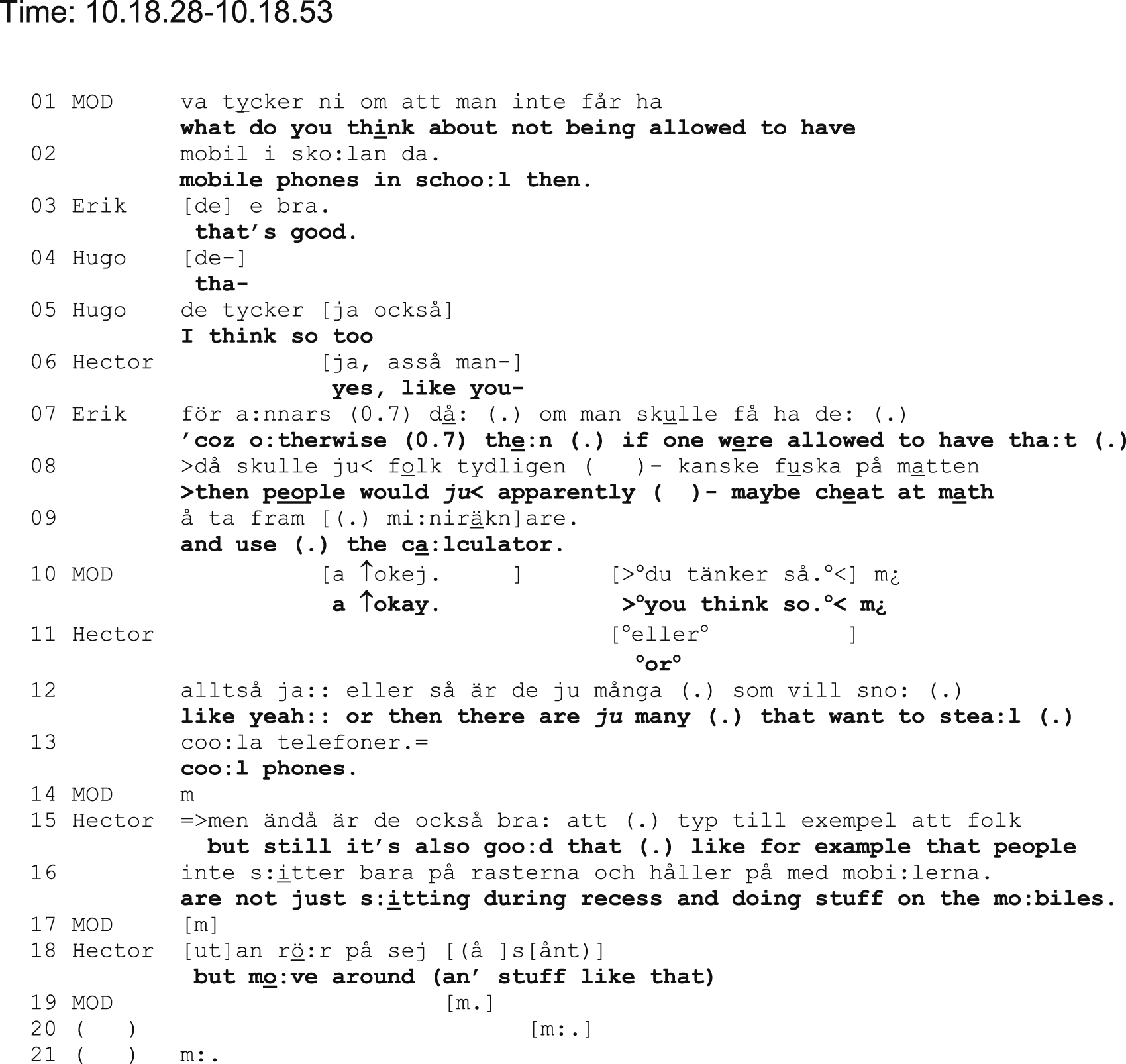
In the extract, three different accounts in support of the rule are produced, each drawing on a different reason. In lines 7-9, Erik raises the issue of cheating and that this is something “people would apparently” do. Although supportive of the rule, the use of the generalized category “people” as well as the adverbial “apparently” at the same time distances Erik as an individual – and the other boys that are present – from the morally problematic action of cheating (while doing math). It is presented as something that someone outside the category is claiming that people (in general) are doing (cf. Skärlund, 2016: 275). Erik thus manages to avoid accountability for the truthfulness or even probability of the cheating actually taking place. To this, the moderator responds with an acknowledgment “a ↑okay.” followed by a softly produced meta-comment literally translated as “you think so”, here confirming Erik’s point of view.
At this time, Hector, who already in line 6 initiated a turn, adds an account that is framed as an alternative using the conjunction “or” in lines 11 and 12. Introducing the morally accountable action of stealing, he claims that “there are ju many (.) that want to stea:l (.) coo:l phones” (lines 12-13). Again, the argument is presented as a general fact, and through the epistemic marker “ju” as shared knowledge, that is as something that all co-present participants know. The specification of not just any phones being stolen but “cool” phones, however, also anchors the argument in the children’s world where some phones are considered cool and hence more attractive than others.
The third account centers on an argument recognizable from the public discourse on children and digital technologies that alludes to how the use of digital devices may lead to physical immobility (e.g., Dahlgren et al., 2021). Hector continues talking, this time framing the account with the disjunctive “but still” explicitly underlining the positive assessment of the rule: “but still it’s also goo:d that”. He continues “like for example that people are not just s:
The children are defending and justifying the rule through these accounts. However, it is not an uncritical stance as they produce the accounts according to their own conditions and by not accepting the moral accountability invoked by the arguments as theirs. Through the use of categories and adverbials, the boys avoid moral accountability by creating an us-them dichotomy, thereby presenting themselves as a group acting differently from others. In fact, the rule is accounted for in ways that display that the boys do not consider it to be applicable to them. We can also notice how the mobile phone is oriented to in different ways: as a tool (a calculator), as an attractive asset (a cool phone), and as a source of (morally accountable) entertainment (doing “stuff” on the phone).
A negatively loaded narrative objecting to an interpretation of the rule
Immediately following upon the interaction in extract 1, a third boy, Hugo, initiates a narrative that problematizes and challenges the righteousness of an application of the rule. It concerns the definition of what “in school” means. This account has the form of a canonical story, with a recapitulation of past (recurrent) events, including reported speech, a temporal ordering of events, and an evaluation (Labov and Waletzky, 1967). Moreover, it is a complaint story, that is, a “negatively loaded narrative[s] about somebody who is not present in the current interaction” told to someone who was “not present in the situation” (Haakana, 2007: 154).
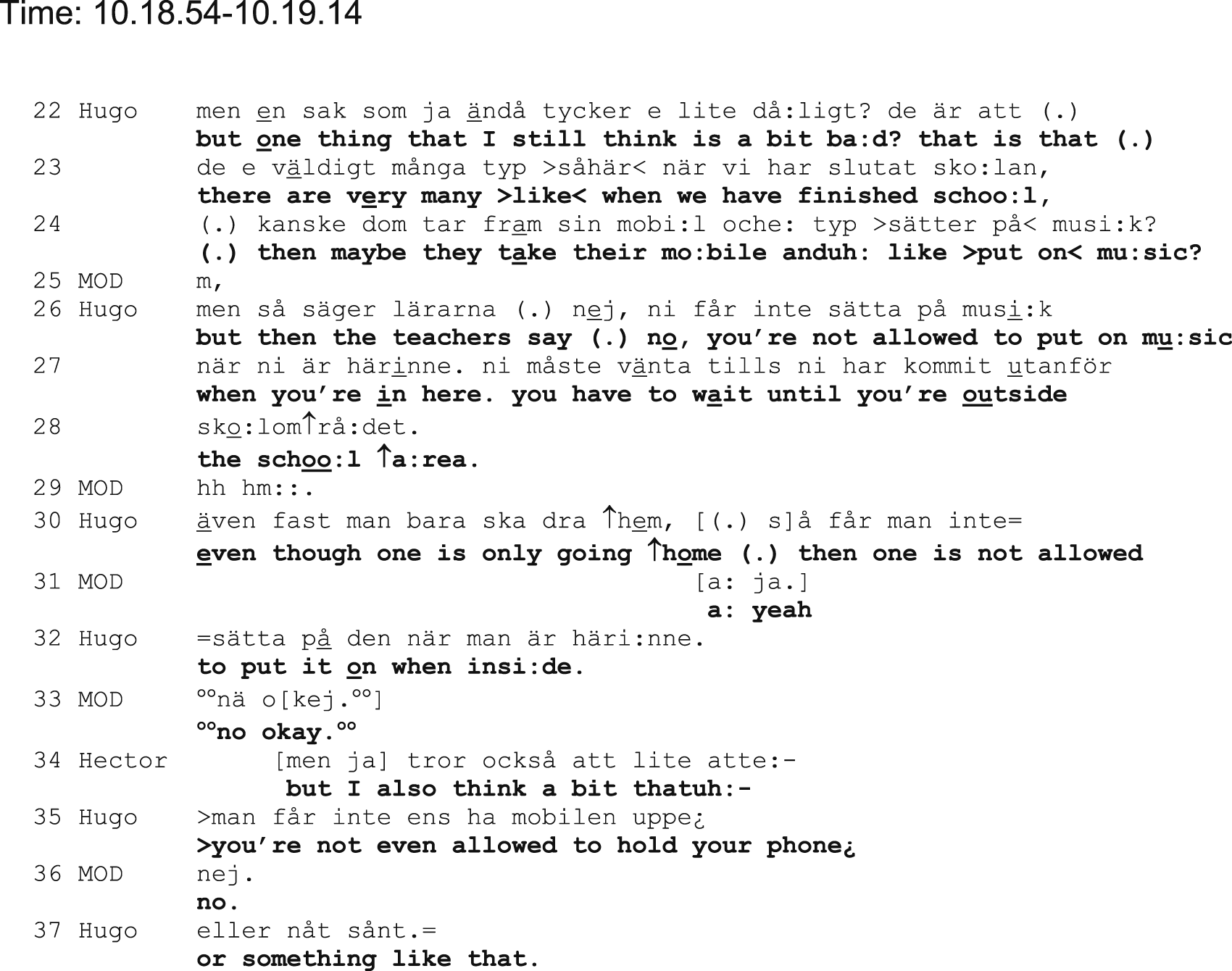
The narrative is framed as a personal opinion “something that I still think is a bi:t bad” (line 22), which works as a prospective indexical (Goodwin, 1996) providing the audience with a framework for interpretation, here that an objection to the rule, although mitigated, is coming up. The story is established by describing a typical and non-accountable action: children putting on music on their phones after school. Referring to the number of children with the maximum case “very many” underlines the action as something that concerns a large group. The specification of the time “when we have finished schoo:l” (line 23) is crucial. The formulation anchors the story in time (after school) and space (inside the school area).
Following the background description (lines 22-24), the category teachers is introduced into the story (line 26). The formulation “but then the teachers say” introduces action into the story by projecting the teachers’ intervention into the children’s activities. Using reported speech, Hugo enacts a teacher’s upholding of the rule with a distinct initial “n
In the story, two ways of defining “in school” are juxtaposed and contrasted as conflicting in the children’s interpretation of the rule versus the teachers’: one in terms of time (line 23, finished school) and the other place (lines 27 and 28, “in here” versus “outside the schoo:l ↑ a:rea”). The story problematizes the teachers’ interpretation of the rule “you’re not allowed to have your phone in school” by targeting what “in school” means. It depicts the children as doing ordinary, reasonable things after school, on their way home, whereas the teachers appear as rigid interpreters of “in school” in terms of geographical space.
Hypothesizing about a reason for the rule
Hugo’s narrative is not followed up by the other boys. Instead, upon story completion, Hector, who attempted to initiate a different opinion already during Hugo’s telling (line 34), minimally acknowledges the story with a “yes” (line 38) and proceeds to hypothesize about a reason for the rule. Here we will see that age, made relevant through the school grade, is introduced as a crucial category when accountability is discussed. Within child(hood) studies, age has been pointed out as a structuring dimension of the social life of children (e.g., Thorne, 2004).
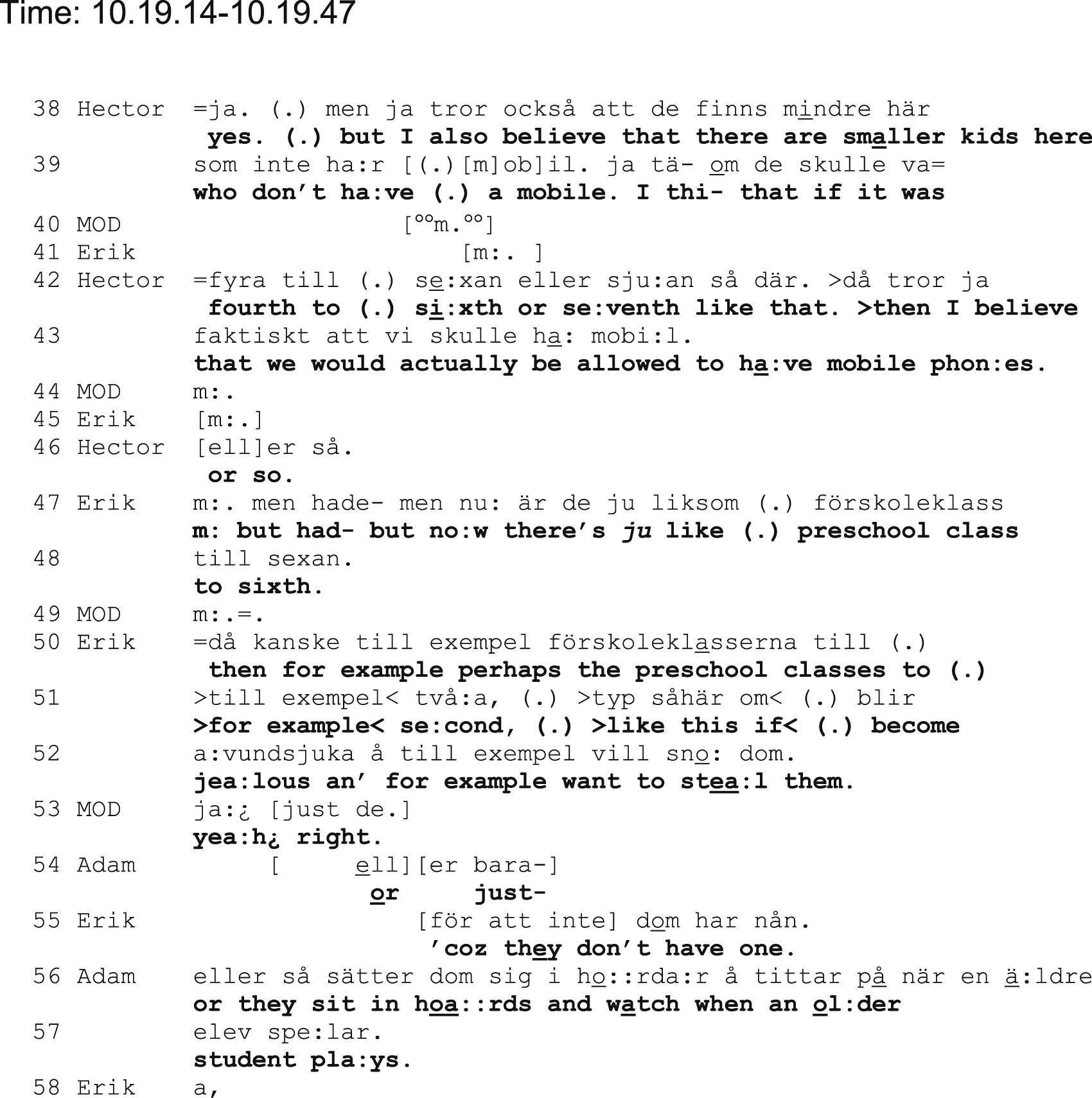
Hector frames his hypothesis with a description of the situation in school, where there are younger (“smaller kids”, line 38) children who do not have mobile phones. The original moderator question (extract 1, lines 1-2) is phrased in terms of what the children “think” about the rule, thereby requesting subject-side assessments (Edwards and Potter, 2017). In this extract, Hector formulates his thoughts in terms of something that he believes (“I also believe”, line 38), thereby positioning his utterance epistemically by referring to a factual circumstance rather than a personal opinion. He argues that if the school was for older children, in grades four to seven, “then I believe that we would actually be allowed to h
Adam adds a different account, that the younger children may “sit in h
In all, the younger children are portrayed as jealous and as not being able to control their actions. The accounts actualize a hierarchy between children in different grades, where younger children are depicted as extremely interested in what the older students are doing. Again, the boys in the peer group distance themselves from other, younger, students who would not be able to act responsibly in case mobile phones were allowed in school. Implicitly, the younger children are thus, through the older children’s accounting practices, blamed for the necessity of the rule (cf., Buttny, 1993).
Shifting accountabilities
The interaction in extract four occurs at the end of the sequence of talk about the rule. Extract 3, was followed by a report about a boy in class who had played on his phone in school the same morning (not included in the extract) when Adam continues reflecting on the rule. Throughout the analyzed sequence, the children orient to the moderator and to answering the interview question. In this last extract, however, as screen time becomes a topic of talk, the boys are also holding each other accountable for their digital habits.
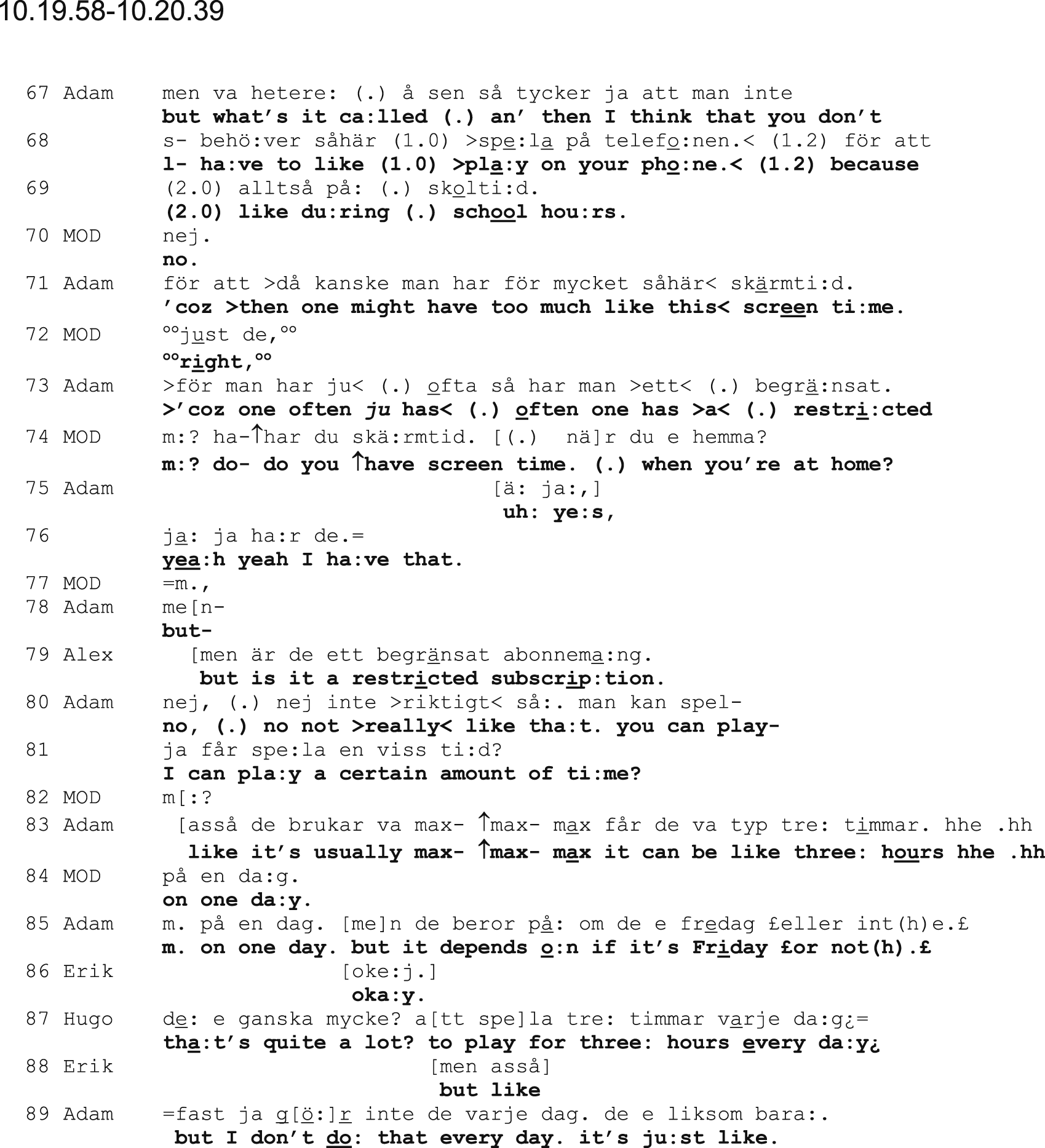
In lines 67-69, Adam expresses the opinion that “you don’t ha:ve to like (1.0) >pl
In response to Adam’s accounting, Alex requests more information about the restrictions: “but is it a restr
This account demonstrates the children’s navigation between different rule systems restricting their use of digital media. It also shows how they are actively sustaining the rules by developing their own norms of use. Adam justifies the rules in a way that is grounded in the children’s world and is part of their moral agency. His account shows how the children protect their interests by securing that the time they spend using digital media is quality time and that screen time is not wasted.
Discussion
Children are surrounded by norms and rules that regulate where, when, and in what ways to use mobile phones in their everyday lives (e.g., Blum-Ross and Livingstone, 2016; O’Bannon and Thomas, 2015). Previous studies have mainly explored screentime rules based on surveys (D’Angelo and Moreno, 2019; O´Bannon and Thomas, 2015; Redmayne et al., 2011). Drawing on an EMCA approach to norms and rules, we have scrutinized how a group of boys make sense of a local rule, demonstrating how they establish, negotiate, and sustain moral order in the focus group discussions (e.g., DeFina, 2009). The results provide a nuanced understanding of how children deal with rules that avoids seeing them as either followers or opponents, and that evidences that children can be part of the discussions of rules that concern them and their practices (cf. Martin and Evaldsson, 2012). The study moreover contributes with knowledge on how norms and rules are jointly negotiated and established and give access to the children’s reflections on the reasons for why rules are present and necessary in local practices.
The discussed rule of no mobile phones in school was introduced into the interview by the moderator based on observations and informal interviews during the ethnographic fieldwork. The analyses show how the assumed intentionality of the rule is of consequence to how the children make sense of, justify, and negotiate rules. As shown, the boys justified the rule by making it relevant for their everyday day lives at school: cheating was related to math, stealing was related to cool phones, and sitting still was contrasted to moving around. By relating the rule to concrete activities in their school, it is made sense of, legitimized as reasonable, and made into their own. Interestingly, the boys discuss the rule as intended for ‘people,’ a general category used to mark a distance between ‘them’ and ‘us,’ the peer group. In such a way, the teller takes the position of an outsider, and sees the rule as motivated in terms of a general directive addressed to the larger category of children at their school. The distinction between ‘them’ and ‘us’ is also used when the boys talk about younger children, which to them covers preschool class to grade three. When the boys unpack the category ‘younger children,’ they associate the category with children who do not have mobile phones of their own and/or might want to steal the cool ones. This in turn provides a reasonable explanation for the youngest children as the reason why mobile phones are banned and hence justifies of the rule. Due to their age, they are considered socially uncontrollable and cannot be held accountable for wanting to steal a mobile phone (cf. Buttny, 1993). Thus, to sustain moral order age is oriented to as a structuring principle (cf., Thorne, 2004) and a justified argument for why the older children are not allowed mobile phones in school either.
Appropriating rules involve identifying for whom, when, and where a rule is valid (Evaldsson and Corsaro, 1998). The study shows examples of how the boys problematize where and when mobile phone prohibition is enforced by the teachers. That students listening to music on their mobile phone after school are being told to not use their phones, is presented as questionable. By arguing their mobile phone use as an activity that happens after school, that very many children do on their way home, a clear impression of a rule that is enforced at the wrong time and place is mediated. The criticism directed at the teachers points to an activity where the children are held accountable but do not see themselves as such. It could be argued that the boys suggest a more nuanced view on how, when, and where the rule should be enforced. Moreover, the children display the validity of the rule as situated in time and space, and transgressing school time means that it loses its legitimacy. In short, this critique displays respect and support for the school’s rule (cf., Selwyn and Bulfin, 2016) but treats it as problematic in its particular implementation. More importantly, it evidences how children discuss and handle rules in a nuanced and reasoned way (cf., Martin and Evaldsson, 2012).
The accountability of rules is situated; what is expected at school usually differs from home. In contrast to previous EMCA studies of children’s appropriation of rules that have focused on what happens at one site (e.g., Cobb-More et al., 2009; Evaldsson and Corsaro, 1998; Martin and Evaldsson, 2012), the present study shows how children reason about rules across school and home. One example is screen time, which is often discussed in relation to the use of tablets, games, and computers in families (e.g., Blum-Ross and Livingstone, 2016; Livingstone, 2021; Squire and Steinkuehler, 2017). When the notion of screen time came up in the interview, one of the boys argued that by sticking to the rules at school he could have more screen time at home. The concept screen time was presented as unproblematic and as taken for granted in terms of time spent on phones, tablets, computers, and game consoles, whereas the idea of what was too much screen time became a topic of discussion. In contrast to the discussion over mobile phone use in school, the boys also held each other accountable. Although screen time was not a topic at school, for one of the boys, playing digital games at school might have consequences for the time that could be spent in front of screens at home. This shows how children navigate within and across practices such as school and home, and that the rules they are facing are negotiated and adjusted to fit their everyday lives.
The study of norms and rules in interaction is central to an understanding of the place that mobile phones occupy in children’s everyday life across settings. Analyzing children’s talk about norms and rules in detail shows how they are understood, justified, and adjusted by the children themselves. Norms and rules are made relevant in situations where children are accepting accountability for following rules, but they are also discussed, negotiated, and problematized. By drawing distinctions between what is allowed or not, and in the way they account for and justify the norms and rules, the children show that the rules are based on a common understanding of how, where, and when to use digital mobile technologies. As part of society, children react to discussions, ideas, and rules that they face when interacting with institutions, such as school and family (D’Angelo, and Moreno, 2019; Morris and Sarapin, 2020). As such, through the appropriation of norms and rules, children navigate, sustain, and create moral order within and across school and home. The use of mobile phones is a practice that is not limited to what occurs within the borders of the screen, which is a rather poor understanding of children’s media usage, but includes a range of social practices where children live their everyday life.
Footnotes
Declaration of conflicting interests
The author(s) declared no potential conflicts of interest with respect to the research, authorship, and/or publication of this article.
Funding
The author(s) disclosed receipt of the following financial support for the research, authorship, and/or publication of this article: This work was supported by Marcus and Amalia Wallenberg Foundation (2014.0057).

Appendix
Talk has been transcribed according to conventions developed by Gail Jefferson (2004).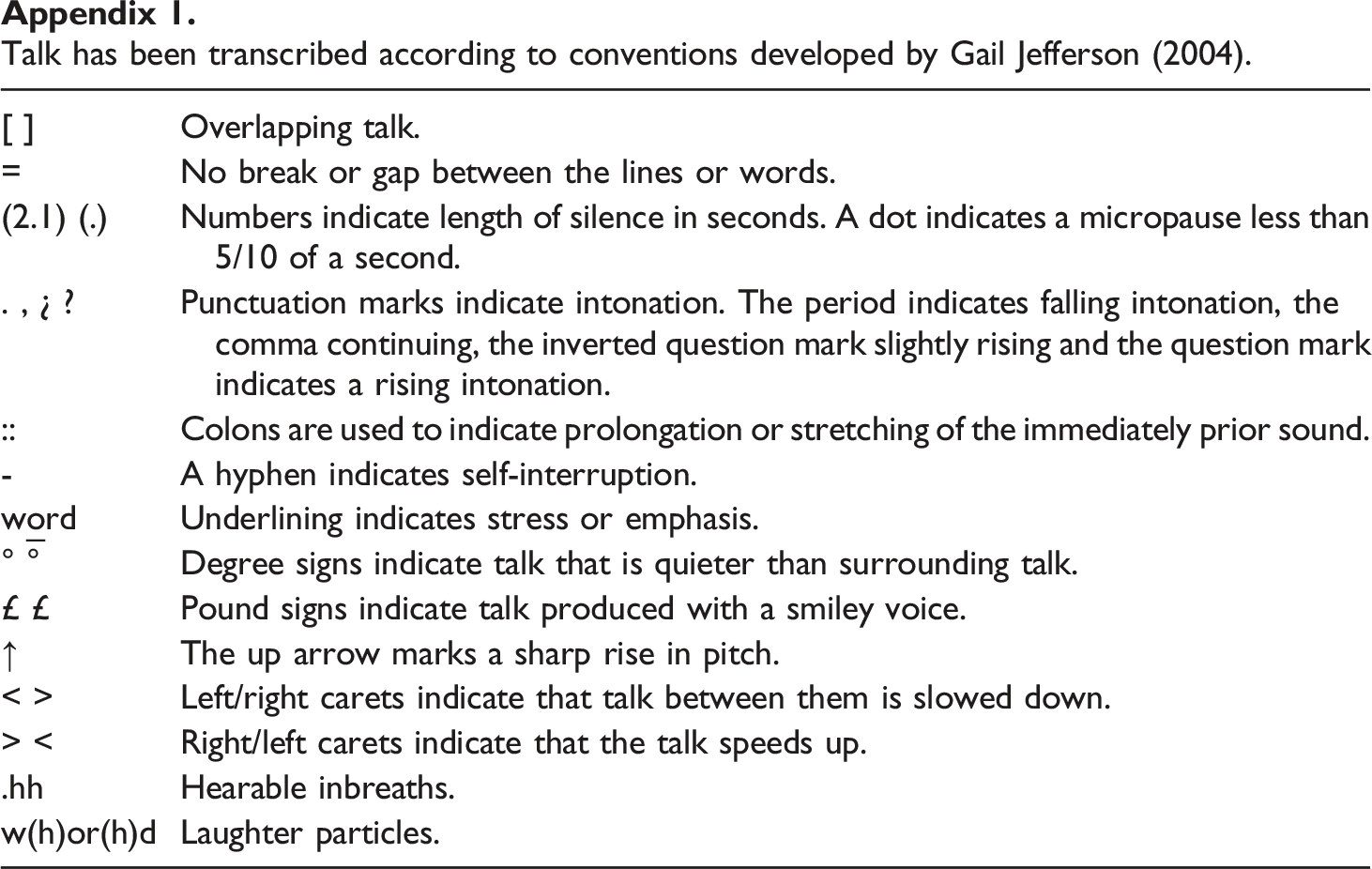
[ ]
Overlapping talk.
=
No break or gap between the lines or words.
(2.1) (.)
Numbers indicate length of silence in seconds. A dot indicates a micropause less than 5/10 of a second.
. , ¿ ?
Punctuation marks indicate intonation. The period indicates falling intonation, the comma continuing, the inverted question mark slightly rising and the question mark indicates a rising intonation.
::
Colons are used to indicate prolongation or stretching of the immediately prior sound.
-
A hyphen indicates self-interruption.
w
Underlining indicates stress or emphasis.
° °
Degree signs indicate talk that is quieter than surrounding talk.
£ £
Pound signs indicate talk produced with a smiley voice.
↑
The up arrow marks a sharp rise in pitch.
< >
Left/right carets indicate that talk between them is slowed down.
> <
Right/left carets indicate that the talk speeds up.
.hh
Hearable inbreaths.
w(h)or(h)d
Laughter particles.