



Abstract
This paper focuses on art productions by children participating in an art-based wellbeing intervention project in Kashmir. Drawing on feminist security studies, we conducted narrative analysis to explore how children represent in/security. The locations of in/security were the environment, the body, and the socio-political realm. Children articulated nuanced and complex representations of the natural and social world, influenced by local and global forces, and created their own meanings and practices of in/security.
Introduction
Long-term conflict has been the setting for several generations of children in Indian-administered Kashmir 1 . While the Indian settler-colonial project 2 and the resistance towards it can be traced to the early 20th Century (Mushtaq and Amin, 2021; Osuri and Zia, 2020; Zia, 2020), there has now been more than 30 years of state-organised suppression of the popular movement for self-determination. This crackdown has involved multiple strategies to oppress and control the population in the name of eradicating militant groups, such as killings, enforced disappearances, fake encounters, mass rapes and sexual violence, torture, and other forms of excessive force and surveillance (see for instance Bhan and Duschinski, 2020; Kaul, 2021). Growing up in a location marked by state violence and militancy has severely impacted all aspects of children’s lives (Imroz, 2016; Mehraj et al., 2018; Rashid, 2012). Exposure to excessive force and violence has resulted in decline in mental health (Khan, 2016; Mohammed Altaf and Khan, 2019), while the political context has further affected children through disruptions in education, loss of family income, and increased precarity and vulnerability (Rather, 2011). Yet, children are not only subjected to violence, but are also active in the resistance movement (Duschinski et al., 2018). Stone-throwing has become a central mode of protest and is considered a “signifier of the anti-India rebellion in post-2008 Kashmir” (Ganie, 2021: 116). In India, Kashmiri boys are consistently portrayed as militants, terrorists, or extremists (Ganie, 2021: 117). In contrast, inside Kashmir, members of militant groups as well as street protestors are often celebrated as heroes of the freedom struggle (Kazi, 2018).
While there is a growing body of literature on children choosing to protest the occupation, there is less scholarship on how children who do not engage in resistance movements view the world around them. This article contributes to this theme by exploring how Kashmiri children represent security and insecurity in artworks created during the arts-based therapy programme Art of healing in Kashmir, a collaboration between academic institutions in the United Kingdom, Anurupa Roy (Katkatha Puppet Arts Trust), Vikramjeet Sinha (Building on Art), and a school in southern Kashmir Valley. This programme took place in the tumultuous aftermath of India’s abrogation of the special status of Jammu and Kashmir in August 2019, 3 during which everyday life was brutally interrupted by severe restrictions on free movement, shutdown of Internet services and telecommunications, incarceration of politicians, journalists, and human rights defenders, as well as closure of schools and non-emergency services (Khan et al., 2021). As the political restrictions and communication blackout merged into the Covid-19 pandemic lockdown in spring 2020, schools remained closed, resulting in children unable to leave their homes for more than a year with only intermittent contact with the outside world. In this context, a school in southern Kashmir collaborated with our interdisciplinary team of academics and artists to deliver creative activities to children, exploring the potential for these activities to facilitate expression and improve wellbeing. In this project, the children produced a rich body of material which provided insights into how they see the world around them, specifically how they understand security and insecurity in their lives. This project concurs with a larger shift in the study of international conflict to bottom-up approaches (Mac Ginty and Firchow, 2016), as a feminist examination of security compels us to decentre the narratives of state actors and instead focus on marginalised sites of in/security. As we see in the children’s narratives, security and insecurity are deeply linked, as the Indian efforts to control and securitise Kashmir result in insecurity for Kashmiris. We therefore use the term in/security to demonstrate this symbiosis between security and insecurity.
Literature review and theoretical framework to understand children’s in/security narratives in times of conflict
There is a vast body of empirical work that explores the roles and experiences of children in times of conflict, including children as child soldiers (Dallaire, 2010; Reich and Gates, 2010), children as part of social and revolutionary movements (Saleh, 2013), children born out of wartime rape (Carpenter, 2010), and children forced migrants (Huynh, 2015a). Importantly, children do not only live in the midst of long-term conflict, but are also at the centre of security narratives (Beier, 2020). Children are often presented as vulnerable victims in need of protection, the “quintessential innocent civilians” (Beier, 2015: 9), while also often represented as aggressive threats to contain, treat, or care for. 4 Importantly, settler-colonial contexts create their own interpretations and meanings of security narratives of children that are used to legitimise state violence (Shalhoub-Kevorkian, 2019). We also see this in Kashmir, as narratives of children as either helpless victims or radicalised militants (Malik, 2020) reiterate the idea of an area in need of being securitised, controlled, and civilised by India. These narratives serve India’s military strategy and settler-colonial project, as they contend the necessity, on the one hand, to protect the children from militant violence or from oppressive traditional norms and practices and, on the other, to bring peace and security by penalising the protestors and stone-pelters. This paper challenges these security narratives by starting from the presupposition that the concept of childhood needs to be understood historically, avoiding Western-centric oversimplifications (Balagopalan, 2011). Overall, in international relations scholarship, much of the childhood literature is caught in the binary of children as victims or agents, as many international frameworks on children in conflict are guided by the idea of childhood as a time of innocence, notably articulated in the United Nations Convention on the Rights of the Child (UNCRC) 5 . Here, children are also constructed as apolitical: children should just not be free from political obligations, such as voting or participating in political protests, but are also deemed incapable of political agency. This confines them to the private sphere, separated from politics and the public (Huynh, 2015b: 37). Children whose experiences do not fit within the remits of normative childhood are portrayed as deviant and “their childhoods marked as abnormal or even immoral” (Lee-Koo, 2020: 21). Thus, liberal notions of childhood based on middle-class ideals (Golden and Erdreich, 2020) fail to productively theorise the lives of children from different cultural contexts, other than as victims. Hence, there is a need to historicize the concept of childhood considering postcolonial and decolonial frameworks that have challenged Western ideas of children as innocent and vulnerable (Balagopalan, 2020). Scholarship from South Asia has been particularly productive in conducting ethnographic work that records the everyday experiences of children living in different socio-economic and geographic locations. Problematising normative childhoods based on liberal and Western culture, the idea of cultures of childhood, emphasises “…the importance […] to situate the study of childhood and children’s lives broadly in South Asian political, cultural and economic contexts” (Behera, 2007b: 14), perceived as embedded in a system of social values, ethos, and cultural patterns. These are marked by colonising forces that attach presumed South Asian values to the “pre-modern” and traditional (Behera, 2007a). Importantly, colonial and postcolonial experiences continuously shape societal norms, driving discourses and practices that instrumentalise children’s bodies in the quest for “modernisation” (Balagopalan, 2010; Yunus, 2021). Within the larger literature on South Asian childhoods there is less work from Kashmir. Ahuja et al. (2016) have analysed young Kashmiri Muslims’ expressions of identity through artwork. They found that approximately the same percentage of the children from Kashmir as those from New Delhi drew pictures pertaining to national identity associated with India (Ahuja et al., 2016: 5) Meanwhile, in Aatina Nasir Malik’s (2020) ethnography of Kashmiri children’s play, the children demonstrate awareness of the conflict as they take on roles of the military and militants, particularly demonstrating a political identification with the militants as they desire to be on the militant “team” in the game. The different outcomes may be due to that Ahuja et al. (2016: 8) conducted their study in a school run by the army, whose environment shaped the children’s articulation of identity. Furthermore, the political contexts of the studies were different, as Ahuja et al. was conducted before 2016 while Malik did her ethnography afterwards.6 Yet, both these studies demonstrate that children are endowed with critical capacities to navigate politics in conflict-ridden territories. Indeed, the most recent literature in the field (see for instance Spyrou et al., 2019) has stressed that the by now widely accepted focus on children as centres of agency, far from denying their status of victims, help view this status in the larger context of social and economic phenomena that shape the communities that children are part of. Hence, in this study we explore how children make sense of the contextual and multifaceted experiences of growing up in an area of long-term conflict.
The analysis is situated in a theoretical framework of critical and feminist security studies. Traditionally the realist understanding of security as the survival of the state in a world order threatened by war and anarchy, has dominated international relations. During the last four decades, this narrow understanding has been challenged by critical and feminist scholars who have shifted the object of security from the state to individuals and communities, and from war/sovereignty issues to a broader set of factors. Feminist scholars have accentuated how gendered categorisations, behaviours, and ideologies impact experiences of in/security (Sjoberg, 2009). This presents important questions on “which violences are considered worthy of study and when these violences occur” (Shepherd, 2009: 209). As Wibben points out, we need to see security as “a continuum of violence between peace and wartime that also transgresses the boundaries of private/public and international/domestic realms” (Wibben, 2020: 117). Therefore, a feminist examination of security in Kashmir compels the scholar to decentre the geopolitical conflict and instead focus on marginalised sites of in/security, for instance children. Feminist narrative approaches focus on meaning-making and marginalised stories within IR (Wibben, 2011). Narrative approaches demonstrate that identities are formed and understood by narratives. In these perspectives, identity is constructed by the stories that people tell “themselves and others about who they are, and who they are not, as well as who and how they would like to/should be” (Yuval-Davis, 2010: 266). It is through the telling of one’s story that the self is produced, which constructs security (Wibben, 2011). Hence, narratives of security produce our identity. Conversely, an important condition of being able to claim security is to have a recognised identity (Hoogensen and Rottem, 2004: 165). “This implies that security is not only concerned with the values associated with a given subject but by naming those values as being in need of securing, and thus, by definition, existential to the subject being secured, security narratives (re)produce the subjects’ existence” (Wibben, 2011: 68). As we shall see, children’s own narratives in the arts productions become a medium in which their representations of security and insecurity are expressed and can be analysed.
Material and methodology
The 18-month research project Art of Healing in Kashmir took place in a school in a mid-sized town in southern Kashmir, with students from both urban and rural households, that had previously identified several wellbeing challenges affecting its students, particularly negative impacts of the ongoing conflict and lockdown associated with the abrogation of Article 370 in August 2019. These included cases of depression, self-harm, violence, anxiety and stress-induced ailments, lethargy, and loss of motivation and engagement in academics. The school and the project team designed an arts-based intervention that could provide the potential for expression and support the mental wellbeing of students. The school had already identified a group of students with wellbeing needs that was considered suitable for the school wellbeing programme. It was from that group of potential participants that children and parents were approached and invited to participate in the arts intervention. We recruited 30 student participants who ranged in age from 11 to 15 years old. The gender mix was 21 girls and 9 boys. The project was disrupted by a series of school shutdowns in response to both Covid-19 and political circumstances in the region. As a result, arts activities were delivered through a hybrid of online and face-to-face sessions in small groups twice a week. Methods were directly developed together with the partner school and arts team led by Anurupa Roy and Vikramjeet Sinha to ensure they were sensitive to the local context and practices. Regular meetings were held with school staff and arts team to reflect on the methods, the challenges, and children’s responses. These conversations were central to the bottom-up approach of the project. Information sessions were held to ascertain that parents and children were fully informed of the research and our objectives before agreeing to participate. Further, we prepared protocols to maintain the anonymity of participants and their artistic outputs. Ethical approval was obtained by the Ethics Committee at the University of the West of England, Bristol, prior to the recruitment and delivery of the art activities.
At the outset, sessions were organised around the metaphor of transformation by engaging with a “caterpillar-butterfly journey,” following its lifespan from the laying of the egg, the hatching of the egg and the arrival of the caterpillar, to its metamorphosis into a butterfly. Children were asked to think about the caterpillar’s experiences; its challenges, strengths, secrets, and desires – all of which were expressed through creative outputs including paintings, landscape sculptures, box houses, videos, puppets, hero stories, and poetry. Initially working individually, participants later merged their hero stories into group narratives which formed the basis of further creative activities. Each group developed their stories and arts outputs with support from the arts team. These included two theatre performances, a peep show/shadow puppet box display, and a mural. All creative work was presented to parents and the wider school community through a series of performances and exhibitions.
For social researchers, there is a growing use of creative approaches as methodological tools (Kara et al., 2021). These can contribute to reduce power imbalances associated with researching vulnerable groups and individuals (Green & Denov, 2019). Creative methodologies also provide opportunities for research in situations when verbal communication is not appropriate or sufficient, providing a means through which people can explore difficult emotions, themes, and issues that are considered unsayable (Ahuja et al., 2016; Knight, 2014). This has particular relevance when working with children who may have experienced trauma (Mitchell et al., 2019). Either as an alternative or as a complement to conventional research methods, creative approaches can reduce anxiety by making the experience fun and enjoyable (Mitchell, 2006). Such methods are also valued for their ability to shift the research event, enabling participants to explore and narrate their experiences in a way that corresponds to their own ways of connecting to the world (Johnson et al., 2012).
This paper uses narrative analysis (Stern, 2006) to explore how children understand and represent security and insecurity in their natural and social world. Epistemologically, narrative inquiry challenges positivist approaches to knowledge by using stories as data (Andrews et al., 2008; Riessman, 2008). We therefore see the knowledge produced in this project as co-constituted by the children, the arts team, and the researchers, where there are translations of interpretations taking place at every step. Hence, we do not claim that the research process is repeatable with the expectation of the same results, nor that the findings can be generalisable to all children in Kashmir. However, we strongly argue that the study provides an insight into children’s worlds. Indeed, centring children’s voices is highly significant, as the perceptions of children are an important insight into the broader collective, social, and political sufferings in which they are immersed (Shalhoub-Kevorkian, 2009). Narratives, whether presented in stories, paintings, or performances, are born out of experiences, in that they interpret and re/imagine our natural and social environments. Thus, we can use narrative methods to link personal stories with political discourse (Brännlund et al., 2013). Indeed, as has been stressed by Stephens (1994) and Williams (2016), focusing on children’s narratives does not involve a narrow immersion into a self-enclosed “‘children’s worlds’ or ‘children’s culture’” (Williams, 2016: 336), but opens up our analysis to the large set of local and global forces that shape children’s subjective experiences.
Data analysis was done in three steps: First we conducted an initial familiarisation of data which involved viewing all the videos and photographs, as well as reading fieldnotes from the artists. We took initial notes about generic themes and ideas that appeared while browsing the large library of material. Secondly, during a second reading, we took notes about each production and transcribed the handwritten stories. After this second review of the material, we outlined more detailed themes, such as environment, home, violence, family, girls/women, rape, and reorganised the data into these categories. Finally, as we noted that some data fitted into several categories, we merged these into three: in/securities of the environment, in/securities of the body, in/securities in the socio-political realm. We found that these three categories of in/securities capture the way the children, through their narratives, define their identity while growing up in Kashmir.
In/securities of the environment
The children demonstrate an awareness of the multidimensional continuum of violence impacting their environment as many of their productions concern themes such as landscapes, territories, natural resources, and the impact of human activities on them. These environmental in/securities often appear to be transfigured into mythological forms and permeated by conflicts among human, natural, and supernatural forces. Our use of the term environment is intended precisely to capture this kind of in/security narratives, which do not clearly differentiate between the natural and the social world. Overall, what emerges from the children’s arts productions, is neither romanticised representations of Kashmir as a paradise on earth nor any explicit references to political and violent conflict. However, in/security appears to be integral to the narratives of their own land, which they view as an insecure social/natural world. This is reflected in the many artefacts that directly address the dangers and vulnerabilities of a natural environment already torn apart by human and non-human wrongdoings, as if the experience of conflict in Kashmir had been transposed into the very fabric of the natural world and hence onto the identity of the children.
Some of the artworks evoke a pure and intact nature, but those representations remain abstract and decontextualised. The colours, particularly green and the land of the rainbow, prompted in the sessions by the arts therapists, ignite some idyllic representations of idealised environments of fulfilled dreams and escapism. However, while these colourful depictions of the imaginary peaceful idyllic worlds are positive, they are not settings of any narrative. In these lands nothing happens; they are merely static mesmerising sceneries. Most children, instead, depict their environment as mystically dangerous, already contaminated and embattled. In some cases, even with apocalyptic accents. And these depictions do become settings of narratives that are often about conflicts. They are, ultimately, in/security narratives. In several final performances, for instance, nature is the location of danger where the rules and order of everyday life are upended; there are wizards, witches, ghosts, and dragons who bring both security and insecurity. It is to the forest where the father in the “Two Sisters” story goes to sacrifice himself for his daughters’ happiness. Later, the daughters enter the same forest to retrieve him and reunite the family. So, while these final performances set the dangerous and mystical nature as the stage for the hero’s story, in the artefacts produced by the children individually, the environment itself becomes the subject of the story and the object of in/security.
For instance, Shafiya’s
7
short story, “The rainy season with a kind man,” recounts a man who observes the harmonious interconnected elements of nature around him and reflects on the damage caused by greedy people polluting wildlife and plants. In another story, Shafiya develops an eco-myth narrating the transition from an early world without greenery, in which humans were threatened by the lack of oxygen, to a green world full of life-giving plants. Yet, this lush realm is now threatened by human deforestation, and risks to revert to the oxygen-deficient early world.
8
Anjum’s hero story and drawings concern trees threatened by acid rain produced by a witch (Figure 1). In a re-mythologised rendition of the scientific explanation of acid rain, the witch hovers above the trees in the absurdist form of a black line that contaminates the rainwater filtering through. Observing the poisoning of the trees, the clouds gather into a storm that confronts the witch. Eventually, the storm triumphs, the fresh rain breaks through the filter, and the trees regain vitality. Aisha’s hero story and accompanying drawings about the snowman who wants to “rule the whole year [round],” by covering the world with perennial snow can be seen as a paradigmatic case of “conflict transposed into nature” (Figure 2). However, the villain of the story, the sun, tries to stop the snowman by threatening to melt him. This leads to a confrontation during which the snowman uses his powers to freeze everything around him. Ultimately, the sun itself turns into ice and surrenders, while the snowman becomes king. Acid rain, drawing by Anjum. The snowman and the sun, drawings by Aisha.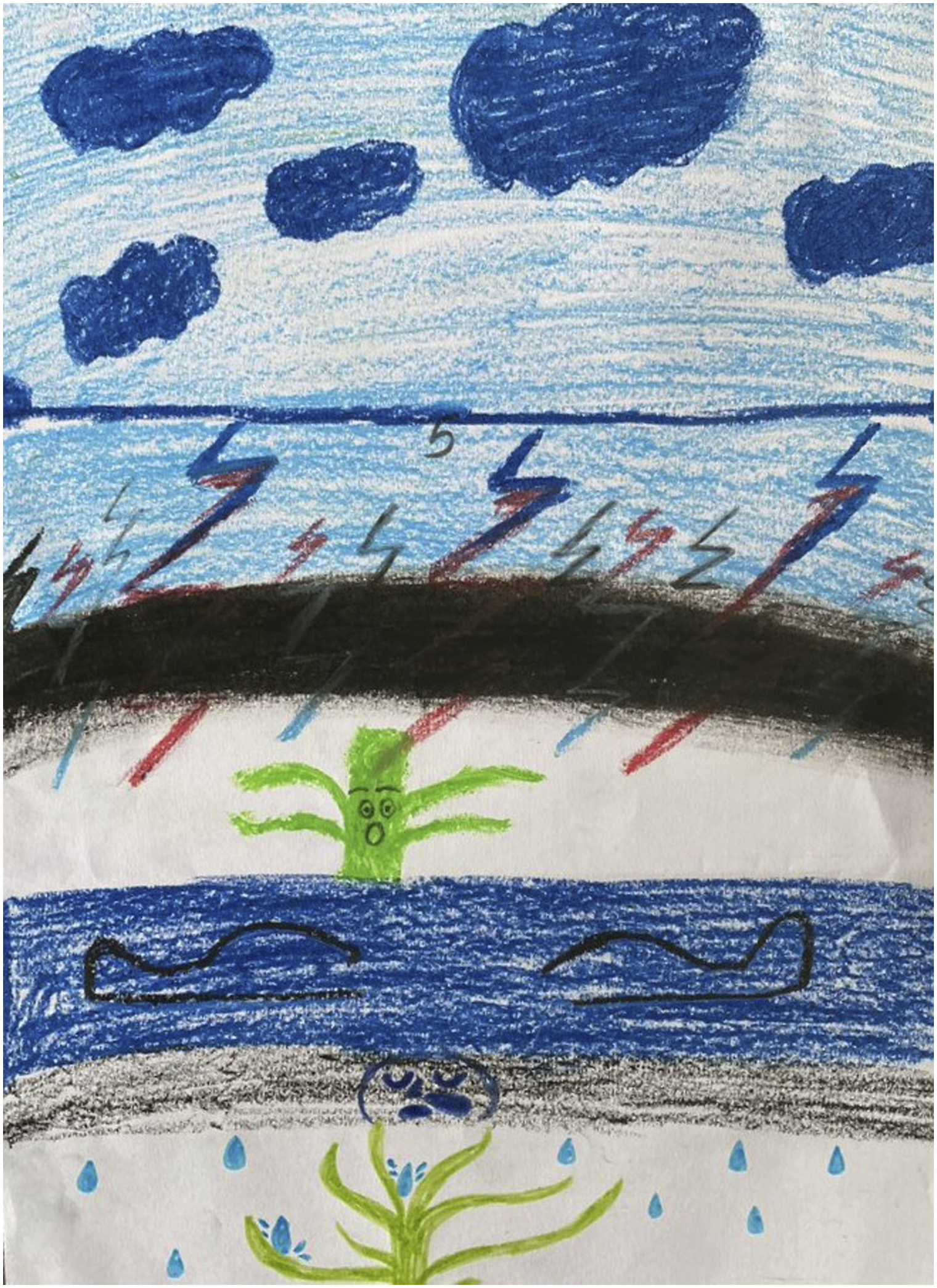
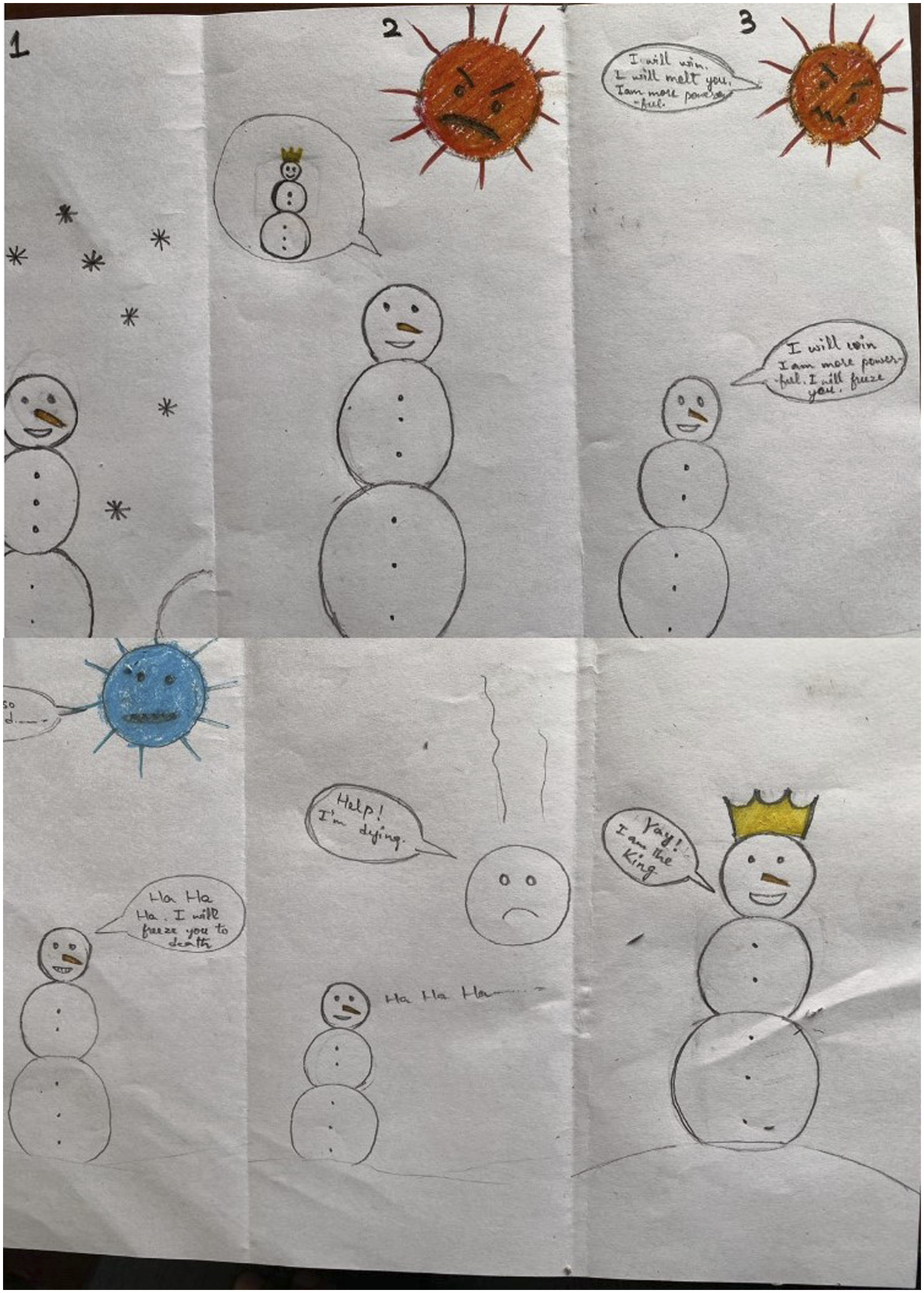
These last two stories describe battles between two forces, depicted in dichotomous elements such as snow/sun and rainwater/pollution. In Aisha’s story about the snowman, the fundamental elements of the world order are upended, with the unsettling scenario of the snowman conquering the sun. In these stories, land and nature are destroyed, not directly by humans as in Shafiya’s story above, but by mythical forces. On the one hand, human agents are depicted as responsible for endangering nature. On the other, many of these representations involve conflicts between natural forces against which the children cannot exert agency. These are insecurities of which children are witnesses rather than active participants. This emerging environmental awareness, however, is far from decontextualised. There are clear elements indicating that the compromised environment in question is the mountainous and snowy Kashmir. Thus, the effect of global warming is observed in the reduced snow levels, and a snowman can appear as a hero, whereas the sun is the villain. Likewise, the effect of the dragon’s fire results in the melting of the snow.
Our study confirms findings by Ahuja et al. (2016) who, in a comparative analysis of drawings by adolescents in Kashmir and New Delhi, observed that the former represented the environment more frequently than the latter. Yet, unlike the productions by the children in Ahuja et al. (2016: 6), which depicted Kashmir as a “paradise and showing scenes that are specific to Kashmir, such as coniferous trees, … snow clad mountains, and tulip gardens”, the material we studied represented the environment as a location of in/security. These productions go beyond simply praising the beauty of the environment by emphasising that it is under threat. Here, the children engage in the activity of naming the objects that are threatened, and therefore in need of securing (Wibben, 2011: 68) and thereby position themselves with respect to the challenges of their environment and the gendered global and local forces shaping it.
In/securities of the body
While the environment is narrated as a broader location of in/security in need of securitising, many of the girls who participated in the project created drawings and stories depicting specific forms of violence targeting the bodies of women and girls. There were two sets of narratives: insecure feminine bodies more generally, and rape and sexual violence more specifically.
An example of the narrative of insecure feminine bodies is offered by Deeba’s painting (Figure 3) in which a normatively drawn mermaid is sitting on a black stone in the sunset. Yet, she is sad, and blood is dripping from her wounded body into a red-stained ocean. In a painting by another student, Zainab, a lonely, crying girl protects herself from the anonymous onslaught of four gigantic hands converging towards her. Both the hair and the dress of the girl are red, and so are the hands. The frame around the picture seems to be dripping blood. Crying mermaid, drawing by Deeba.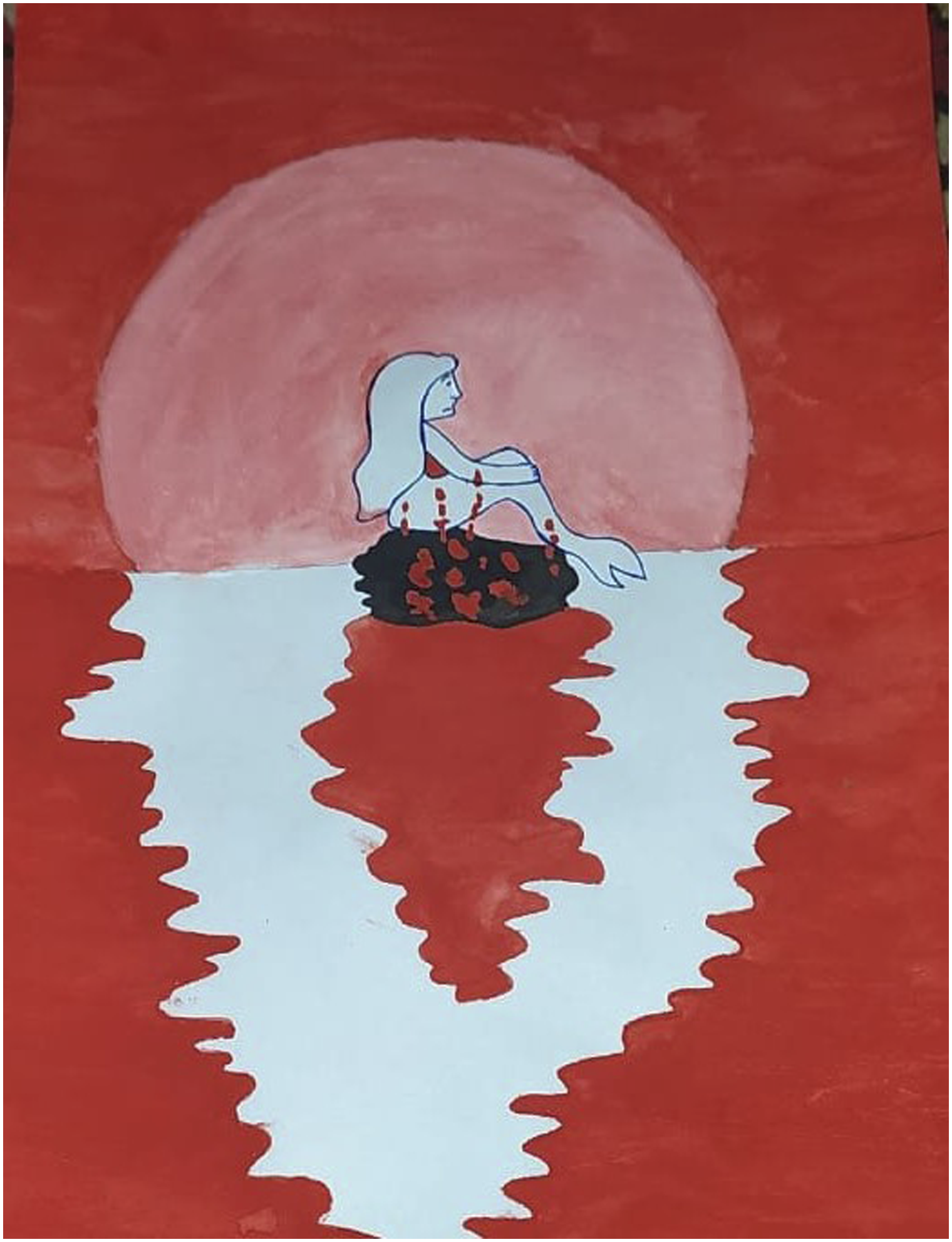
In other productions of insecure feminine bodies, instead of these unknown, anonymous threats to femininity, we find sharper focus on maternity. Zaira painted a woman dressed in red surrounded by arrows pointing towards her, which can be interpreted as a situation of violence and victimisation. Importantly, the story accompanying the drawing portrays a woman experiencing violence from her community. When she finds out that she is expecting a girlchild, the violence and social stigma intensify. Another participant, Zainab, also connected maternity with vulnerability in her painting of a heart inside of which there is a foetus attached to an umbilical cord (Figure 4). A pair of hands reaches to hold the heart, while another set of hands is seeking to grab it. The accompanying illustrations also tell a story about a mother subjected by violence from people around her. However, maternity is also seen as the family’s fundamental element. This is illustrated in the “Two Sisters” story, in which the death of a mother in childbirth sets off years of sadness, guilt, and sacrifice. Distressed by the way his children argue, fight, and blame each other for their mother’s death, the father gives his life in exchange for the happiness of his children. Foetus in heart, drawing by Zainab.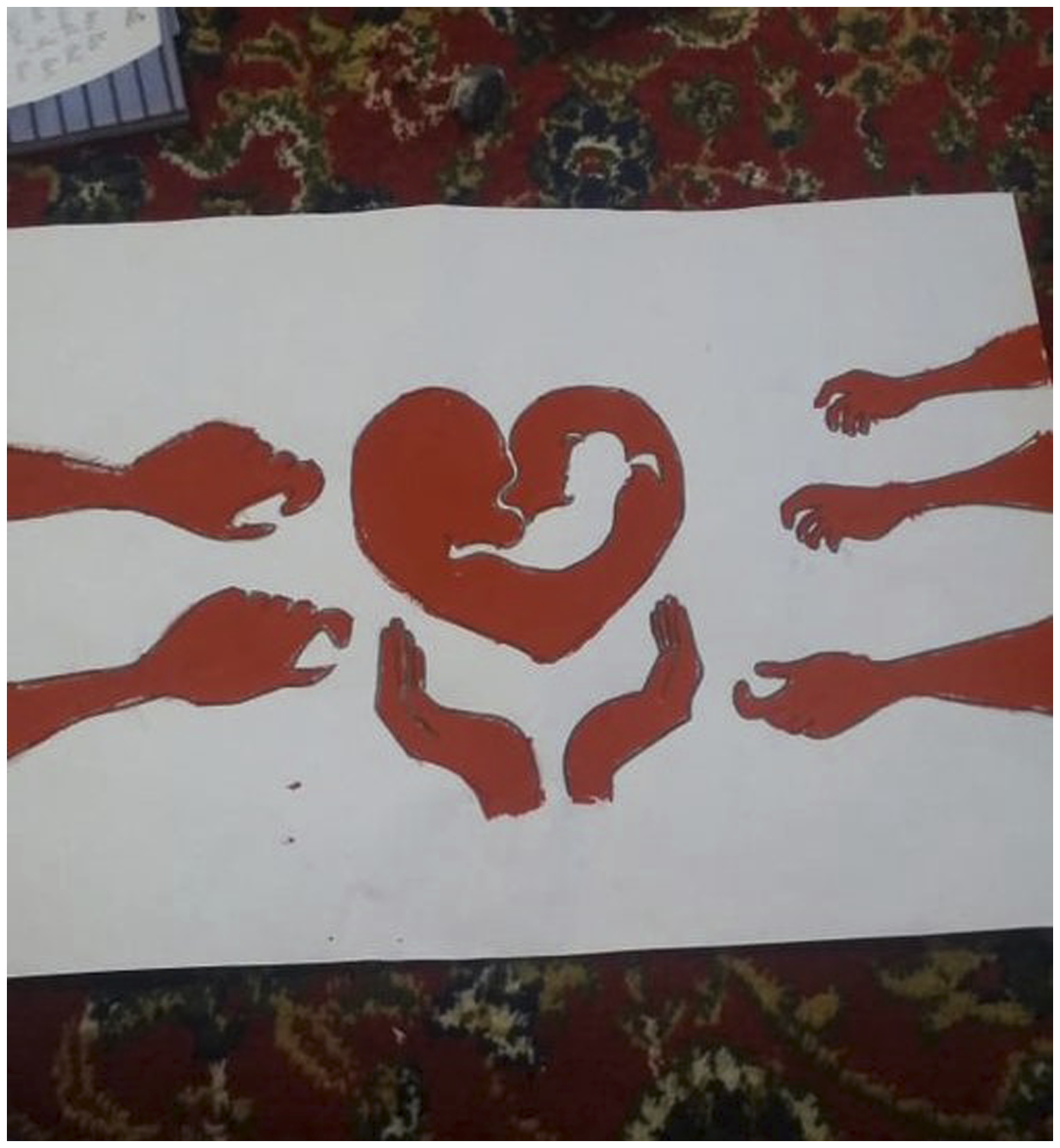
The second type of narrative – rape and sexual violence – appeared mainly in the productions of one of the participants, Zainab. Yet, she referred to the theme frequently, indicating its importance. As noted in the previous section, when the artists asked the children to use green or the spectrum of colours of the rainbow, they produced idyllic representations. However, when asked to use the colour red, the classical imagery of love and romance gives way to representations of violence against bodies. One of Zainab’s narratives is about the “red land,” the “land of love”, which paradoxically turns out to be the stage of multiple and repeated rapes. In this land, almost nobody offers aid, and the girls are doomed to accept their condition. The story ends inconclusively with hopeful but ineffective attempts by the hero butterfly to bring about the needed change. This story portrays a society that fails in its protective role and leaves girls alone to defend themselves. The butterfly symbolises the lonely hero resisting the violence, despite the widespread indifference surrounding her. Another drawing by Zainab consists of two sections: the first depicts a woman with a long tongue, which is being cut by a knife. The word “humanity” is written on the tongue and on the knife is written “human.” The cutting of the tongue may symbolise the silencing of women, removing their humanity. In the other section of the drawing, a man is molesting a girl by pulling her dupatta. 9 The man exclaims “Ha ha ha. Let’s see what you can do…!”, demonstrating power and abuse. There is ambiguity in this painting, because it could either mean a literal undressing (in preparation for sexual violence) or depriving her of her religious, social, or cultural protection. The written hero story accompanying this drawing states that the dupatta is a shield from abuse. This drawing is one of the few productions that concerns religious representations, particularly exploring the junction between gender violence and repression of religious freedoms. This acute awareness of the in/security of the body is accompanied by the explicit desire to take an active role in overcoming the insecurities. There are multiple articulations of attempts to secure the victims from violence. For instance, in Zaira’s story about the woman with a girl child discussed above, becoming a mother brings about a new sense of resolve. Zaira writes “[s]he was wearing the crown of ‘Women empowerment’, though not many people can see it.” The determination to challenge gender norms, while initially receiving further stigmatisation, ultimately brings “an army of women” to join her battle for “women empowerment.” Thus, Zaira paints a group of women in red, surrounded by feminist signs, and jointly radiating arrows that symbolise their collective strength. It also provides an optimistic counternarrative to the loneliness of the butterfly evoked in Zainab’s hero story, discussed above.
Feminist resistance is the central theme also of the mural project “Search for Equality” by the Change Makers group (Figure 5). In their presentation, group members took the audience around the mural telling the story of a king who, rather than handing power to his daughter, plans to pass the kingdom to his nephew. The audience follows the group of girls telling the story of the princess trying to recover her kingdom, embodying the story of the princess fighting for justice. The mural ends with the princess setting off on her quest to search for equality, and in front of parents, siblings, and teachers, the girls end their performance by shouting out “the future is feminist,” thus themselves embodying a feminist subjectivity in front of their community. Photograph of mural “Search for Equality” by Change Makers.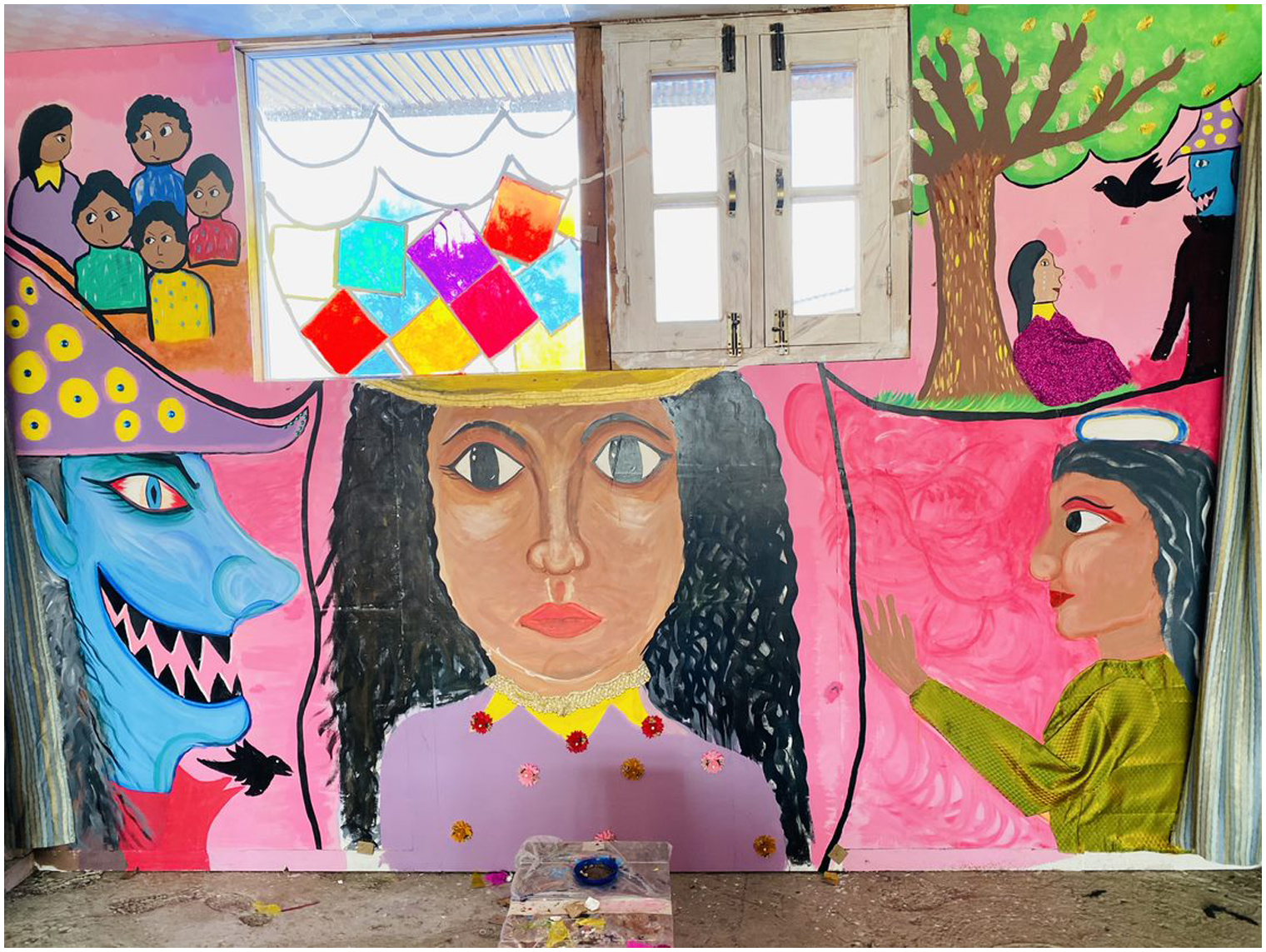
In the arts productions identifying in/securities of the body, Kashmiri girls, specifically, represent their social landscape as fraught with dangers of physical violence, sexual violence, and social stigma. Some perceive maternity itself as a potentially perilous condition. However, importantly, these narratives of insecurity also evoke the possibility of actions aimed at reclaiming security.
In/securities in the socio-political realm
In many of the productions, the children address more explicitly issues of in/security in the socio-political realm. Here, the socio-political realm refers to the set of contexts and relations in which political action is visible, including the role of laws, political actors, and the divisions within society. This is the location of in/security the children encounter when they cast their eye beyond their homes, which as most of the box houses produced present as a protective haven, or as a safe springboard to the world. 10 Overall, the children describe a socio-political world in disorder, permeated by violence, corruption, and dishonesty. Particularly three aspects of in/security are apparent: The first concerns the awareness that the present disorder is a result of past errors. The second aspect is the present impact of the troubled political order and the consequent adoptions of unjust laws. Finally, the third involves the conflict between opposing social groups. While the productions included here are far less in number, they provide insights into how the children view their active role in society.
The first aspect – understanding of the relation between past injustices and current problems – is portrayed in Aisha’s series of creations about a village situated beneath a volcano (Figure 6). Over time, the villagers throw the corpses of people they have killed into the volcano. One day, the volcano bursts and spews out blood destroying the entire village. The story can represent a society that is endangered by its past collective wrongdoings to the point of being on the verge of collapse. While this story is situated in an imaginary place, it demonstrates awareness of a link between historical violences and the contemporary socio-political situation. It highlights the possibility that everybody pays the price now, in the present, for errors by others in the past. This awareness represents a key ingredient in the formation of a political consciousness. Volcano, drawing by Aisha.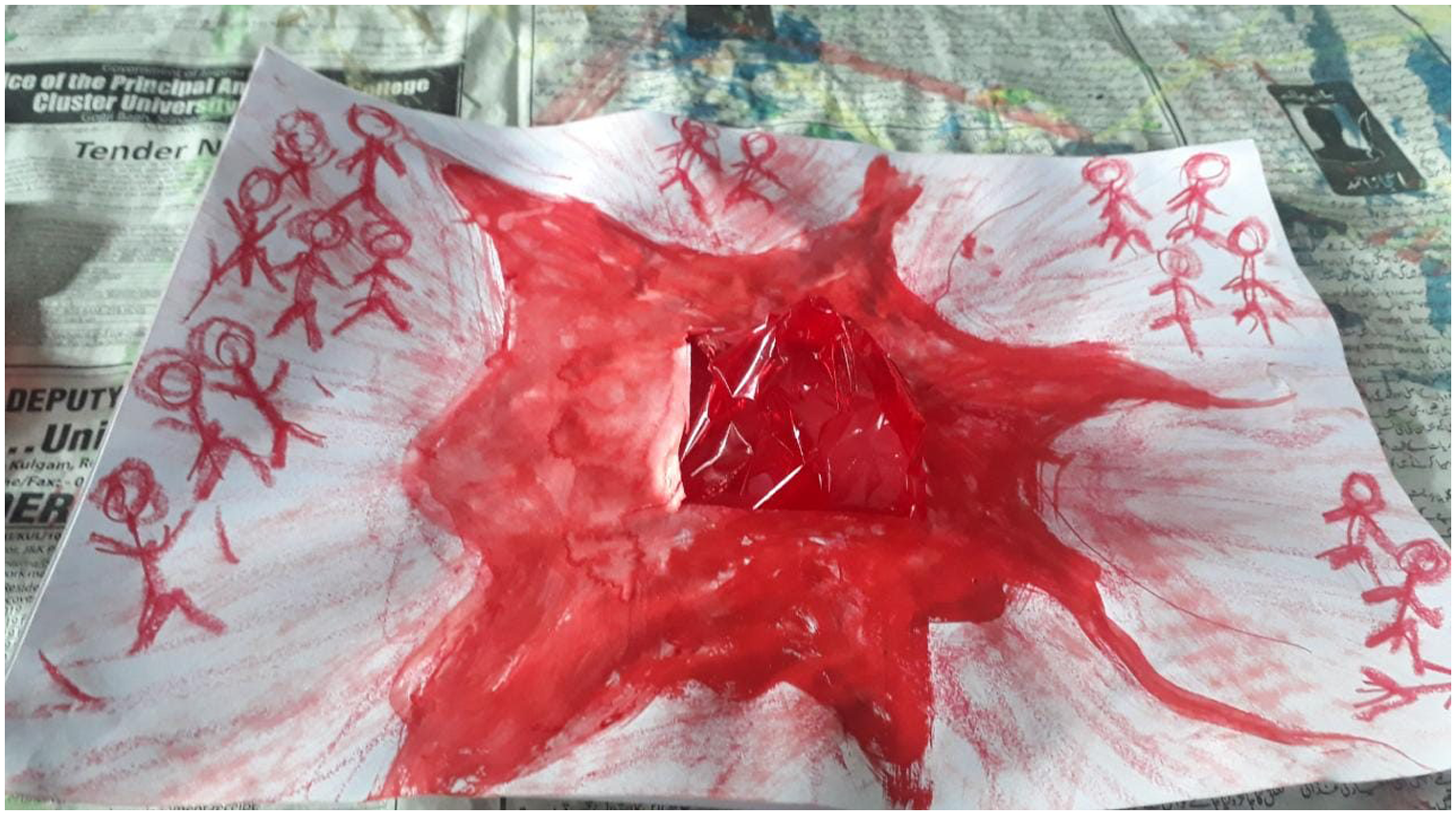
The second aspect is represented in the hero stories documenting the existence of a disrupted society. Here children portrayed the world as misgoverned by corrupt politicians and unjust laws that create division and conflict among different social groups. Yet, faced with what the children see as an unfair society, their reactions are neither passive, nor violent, nor irrational. On the contrary, they conceptualise their identity as a potential political agent able to perform non-violent actions: canvassing to ensure the right politicians are elected, “changing the mindset” of people, and promoting unifications through dialogue. For instance, in Shafiya’s story, the female hero challenges the draconian laws enforced by “fake politicians” making “fake promises.” The hero “hates all these things done by the government. She is irritated by all these things.” The frustration is turned into activism as the hero and her companion travel the villages to inform and educate their inhabitants about how to elect just political leaders. Also in the stories by Riya and Shaista, troubled socio-political orders become settings for the heroes’ quests and form the heroes’ identities: the experiences of in/security in the socio-political realm prompt the creation of stories about political action, imagining activist identities. This reminds us of the similar way in which the gendered in/security of bodies instigated a feminist identity amongst the research participants.
The third aspect – the conflict between opposing social groups – is represented in Masrat’s hero story, in which we read about the feud between two imaginary communities that are abstractedly characterised as “the positive” and “the negative” people. In this story, despite this polarised characterisation, the hero girl does not expel the negative collective, but convinces their leader to acknowledge and appreciate the qualities of the positive life, so that the two groups can reconcile and become united. Once more, the solution envisaged, far from being violent and divisive, expresses a point of view valuing inclusivity and dialogue among different social groups. In these narratives, we see how children describe the socio-political world surrounding them as an in/secure location, as they “nam[e] […] the threat and danger” (Stern, 2006: 182). We also see that they do so according to three specific aspects – past errors, a tainted political context, and social divisions. In this way, their creative productions provide clear examples of how they label practices that inform and recreate their own identities through in/security narratives. Furthermore, even more so than in the productions discussed throughout the previous two sections, the examples concerning socio-political in/securities reveal the formation of a real sense of agency. They indicate that the children take it upon their heroes to change the political situation for the better and in a non-violent manner.
Conclusion
By applying feminist security studies to children’s artwork, this article sheds important light on oft-hidden aspects of Kashmiri children’s personal and social life. In their artwork, the children identified the objects under threat, which were necessary to secure (Wibben, 2011: 68). It is in this narrative process that children were building their identity in relation to the world around them (Tamboukou, 2008; Yuval-Davis, 2010). In our analysis, we distilled three main locations of in/security: the environment, the body (specifically the feminine body), and the socio-political realm. Woven into the three locations, we discern textures of a troubled land in need of securitisation. In the representations of the environment, the children depict the dangers and vulnerabilities of a natural setting already torn apart by human and non-human transgressions. Children also characterise in/security of the body through gendered descriptions of violence against the feminine body, such as wounded maternity, rape, and sexual violence. In the socio-political realm, they evoke the idea of a land compromised by past and current socio-political forces, exemplified by past errors, a degraded political context, and social divisions. In the three locations, the children identify the world around them as in/secure, while also formulating actions and responses. For instance, in the story about the princess who fought for her right to the throne, the children articulated both the gendered inequalities that permeated their world and imagined what a resistance against it could look like. This resistance is ultimately securing the girls by temporarily creating a safe space. Thus, this paper contributes, first, to a growing literature on children in Kashmir by adding an exploration on how children represent their natural and social world. Second, it brings an innovative approach to qualitative methods, in that it analyses productions coming from arts-based activities using narrative techniques. Through our narrative approach, we found that as children observe and engage with the reality they live in, they develop complex and nuanced understandings of their social and natural world, creating their own meanings and practices of in/security
Footnotes
Acknowledgements
We thank our colleagues and friends who worked with us on the Art of Healing in Kashmir project: Mohammad Shameem of Katkatha Puppet Arts Trust, Lopa Shah, Aizah Islam, Suhail Parray, and Sara Penrhyn Jones at Bath Spa University.
Declaration of conflicting interests
The author(s) declared no potential conflicts of interest with respect to the research, authorship, and/or publication of this article.
Funding
The author(s) disclosed receipt of the following financial support for the research, authorship, and/or publication of this article: This work was supported by the Arts and Humanities Research Council (AH/V004263/1).
