




Abstract
Moving beyond the “canned” lens on literacies dominant in contemporary literacy studies in Malawi, this study connects theoretical perspectives on sensory and critical literacies to original empirical data on children’s lived “olfactory literacies”. We focus on situational and locally experienced odours in two classrooms in semi-urban Malawi. We present findings from interviews and drawings with 25 children who shared their olfactory preferences with the local researcher. Children’s views were supplemented with the researcher’s and teachers’ evaluations of the olfactory qualities of their classroom environments. Our study advances the field by being the first to unite theoretical provocations on sensory literacies in global child research with critical and empirical insights into children’s local olfactoscapes.
Introduction
The sense of smell is an important sense that is implicated in a number of life-saving and life-enhancing conditions, with a body of evidence showing the vital role smell plays in processing emotions and memories, starting already at infant age (Suss et al., 2012). As children grow up, they progressively develop their odour discrimination and odour perception skills (Oleszkiewicz et al., 2022a), in response to new environments and stimuli (Arshamian et al., 2020; Speed et al., 2021). There is a wealth of studies involving adults’ olfaction that reveal diverse findings, such as, for instance, cultural distinctions in odor preferences (Raj et al., 2021) and the interplay between multiple senses in learning, memory, and emotional processing (Spence, 2022). Nevertheless, the exploration of olfactory research in the context of childhood studies is still in its infancy—an area we addressed in this study by focusing on sensory literacies.
The recent turn in literacy studies towards sensory literacies has created the space to rethink the meaning of body and embodied relations in learning. Sensory literacies provide valuable thinking tools to challenge socio-historically biased and restrictive notions of children's literacy skills. We connect to this work with a postcolonial perspective on sensory literacies in Malawian classrooms. Our specific focus on the sense of smell in these literacy constellations is our way of integrating theoretical propositions of embodied and spatial literacies with a documentation of children’s lived experiences in a local environment. In particular, we consider the specific contributions that a scholarly study of olfactoscapes can generate for critical, indigenous and culturally sensitive studies of contemporary childhoods (see Pence, 2011).
In this study, we aimed to conduct a theoretically-driven study with an empirical inquiry into the olfactory profile of Malawian classrooms and children’s olfactory preferences. The empirical part was divided into four research questions: Which odours, in which intensities and of which origin, are Malawian children exposed to in their classrooms? Which odours do Malawian children describe as enjoyable? How do Malawian children represent odours in their story drawings? How can these insights be integrated into a coherent approach towards children’s olfactory literacies?
We begin our article by presenting a brief overview of the New Literacies theories and how they map onto the key concepts of olfactory literacies. We then present how our research connects to these studies and outline how the scholarship of place-based research informed the methodological approach we adopted.
The many kinds of children’s literacies
Traditional literacies (Reading and writing skills)
In Malawi, but also in official international documents, the literacies of children are frequently depicted using a deficit discourse: Malawi is described as a low-income, low-resource, country in Sub-Sahara Africa, with high innumeracy and illiteracy rates and teachers’ shortages (UNESCO Institute for Statistics, March 2016). Researchers have shown the importance of reading and writing readiness tests for preparing children for school (e.g. Pretorius and Naude, 2002), significant gender differences in the literacy levels of school leavers (Soler-Hampejsek et al., 2018), issues of absenteeism, drop outs and overcrowded classes. Given these shortages, researchers and policy-makers have advocated for balanced literacy programs that incorporate neuroscientific and cultural insights (Kamlongera, 2010; Iyengar, 2019) with suitable reading materials (Shin et al., 2020). We acknowledge the important role of this research in childhood studies. In our research, however, we take a different perspective on children’s literacies with a focus on olfactory literacies, that are part of New Literacies.
New literacies
Brian Street's influential research on social literacy (1984, 2003) demonstrates that multiple forms of literacies exist, with each type being influenced by power dynamics, contextual factors, and historical backgrounds. Literacy understood as a social practice is literacy acquired through interactions (Theobald, 2016), which are influenced by peer culture, media and cultural plays (Hadley and Nenga, 2004). Drawing upon this comprehension, the New Literacies framework has questioned the predominant emphasis on children's textual and verbal communication, advocating for the inclusion of corporal, embodied, and multimodal avenues of meaning-making. Researchers in the domain of New Literacies underscore the influence of both material and immaterial elements within texts and narratives in shaping children's literacy practices (Williams, 2022). Converging these facets, Kress' multimodal approach to literacies (2009; Kress and Van Leeuwen, 2001) has ushered in a fresh perspective within new literacy studies that deeply examines non-verbal modes of communication and the multimodal construction of meaning (Jewitt, 2008; Rowsell et al., 2018). We consider this body of work as guiding the subsequent theorisations of multimodal and sensory literacies – concepts central to our project in Malawi.
Multimodal literacy approaches are often adapted when studying children’s digital engagement (e.g. Petersen, 2015; Undheim and Jernes, 2020) but they are also increasingly part of studies concerned with the question of interplay of senses and the ways in which individual senses become foregrounded in specific contexts. For example, Jewitt and Leder Mackley (2019) highlighted the significance of touch in illuminating the intricate process of literacy learning when children interact with technologies. Integrative ethnographic approaches (e.g. Flewitt, 2011) as well as posthumanist “speculative” and baroque methods of inquiry (MacRae et al., 2018) spotlighted the multimodal and sensory ensemble in children’s classrooms. Our approach to olfactory literacies was rooted in these theoretical accounts, and it was framed by critical postcolonial critical literacy studies.
Postcolonial and critical literacy studies
Even if theoretically substantiated, scholarly discourses can reproduce educational inequities by promoting the social privilege of selected authors, and by legitimizing their narratives as the only valuable narratives, thus limiting access to stories that maintain a hierarchical society with a few in power. Recently, childhood scholars have gravitated towards the accounts of theoretical ethicists who bring to fore the issues around decoloniality of childhoods, sustainability research, climate justice and childism (e.g. Abebe et al., 2022; Biswas, 2020). These emerging critical perspectives offer a fruitful framework for conducting studies aimed at gaining fresh insights and pioneering new approaches, which align with the aspirations of our focus on Malawian children’s olfactory literacies.
Although olfaction is central to the theoretical propositions of sensory learning and embodied knowledge by many scholars (see Herz, 2009 for an overview), the literature is quiet on the diversity of children’s olfactory literacies across the globe. Olfaction has been undervalued, understudied, and under-applied in childhood studies more broadly (Kucirkova, 2022), and our choice of the empirical focus in the local context of Malawi is an attempt to deviate from New Literacies research that thus far, has been predominantly conducted in classrooms of the WEIRD (Western, Educated, Industrialized, Rich, and Democratic) societies. As such, we align with Vannini et al. (2013) assertion that social justice represents the ‘main staples of sensuous scholarship’ (p. 65) because senses and equitable literacies are vitally interlinked. As such, our emphasis on olfaction introduces a novel dimension to the field of new literacies studies and assumes a distinctive postcolonial perspective. This uniqueness emanates from our investigation in Malawi, a context hitherto primarily characterized by the examination of children's conventional literacy competencies.
The provocations, critiques and emancipations presented as part of the New and critical literacies work led us to a theoretically integrated framework: Olfactory literacies.
Olfactory literacies
Olfactory literacies integrate sensory and postcolonial literacies with a novel focus on children’s sense of smell in meaning-making with texts and stories. We understand olfaction - encompassing the reception and expression of the sense of smell - as an integral aspect of human sense-making and interpretation of the world. Furthermore, olfaction is part of spatial, material and sensory approaches to literacy (Mills, 2015) that pay attention to all six senses, including the lower senses of smell, taste and proprioception (Kucirkova, 2022).
Children globally and children in Malawi, are exposed to various foods, plants, body odours, air pollution levels, community practices involving food, religion or medicinal species, and these socio-geographical factors influence and mirror their olfactory literacies. Olfaction thus cuts through social, historical and cultural layers of children’s literacy studies in several ways. As an example, Kucirkova (2022) highlights the role smell plays in hedonic experiences that are embedded in local food and family gatherings. Empirical studies with adults show cross-cultural differences in olfaction perception (Majid, 2021) and variation in olfactory knowledge and affective responses to odours across cultural groups (Ferdenzi et al., 2013). Our aim was to begin to delve into children’s olfactory preferences in Malawi – an aspect previously not considered in childhood studies.
Thus far, olfaction, as a nascent area of research in social studies and humanities, has attracted nuanced scholarly interest dedicated to the investigation of smells that are being lost with the disappearance of historical artefacts (Miotto, 2016), natural and urban places (Bembibre and Strlič, 2021) and emerging olfactory virtual reality art (e.g. Niedenthal et al., 2019). Furthermore, investigations of cultural variations, and their historical roots and origins, are beginning to emerge in neurological, historical and psychological literature (Lisena et al., 2021). However, research on lived relationships that children have with odours, is lacking.
Previous sensory research has illuminated the haptic affordances of specific environments (especially digital environments, e.g. Price et al., 2015; Jewitt and Price, 2019) and the sound and movement within public spaces such as museums (e.g. Hackett, 2014) and early years settings (Gallagher et al., 2018), but not children’s experiences of odours. The production of smellmaps and engagement in guided smell tours (Allen, 2021), has been the exclusive focus of urban and adult geographical studies (Gao et al., 2022). As such, our documentation of children’s olfactoscapes complements the currently adult-oriented sensory research (see McLean, 2020) and expands the haptic focus of sensory early childhood studies.
Methodological approaches to olfactory literacies
We approached Malawian children’s olfactory literacies as a way to contest colonising tendencies that conceive of literacy as a visually-dominated set of reading and writing skills. We were particularly wary of the inadequacy of the visual sense in representing the fullness of children’s literacies. The dominance of the visual sense in early childhood classrooms has been spread with colonial viewpoints, whereby ‘in the West the dominant group has conventionally been associated with the supposedly “higher” senses of sight and hearing, while subordinate groups (women, workers, non-Westerners) have been associated with the so-called lower senses of smell, taste and touch’ (Howes, 2006: 164-165). We wanted to address the deficit discourse tendency of past research with an empirical study and connect to Abebe et al. (2022) emphasis on bottom-up approaches to knowledge and commitment for paying close attention to the unique local context.
In pursuing this goal, we drew on theories of embodiment, socio-spatiality and sensory studies to understand how they might generate new meanings but also where they are deficient in their conceptual applications. The latter connects to Biswas’ (2022) provocation that the philosophical nuances of the postcolonial critique are difficult to blend with the practical context of research and its pedagogical implications. Biswas’ (2022: 349) concept of “ontological simultaneity” was a useful “logic framework” (ibid) for positioning our empirical endeavour to explore the scope of olfactory focus in studying childhoods in Malawi.
Ontological simultaneity refers to the pluralist perspective of viewing phenomena as “being and becoming at the same time”. Biswas (2022) emphasises that ‘any judgement about reality can only be partially true and hold only for the specific aspect of the judged object (…) acknowledging the incapacity of any human observer to describe reality fully. Consequently, a third conditionally qualified proposition integrates the intellectual and cognitive limitations of any observer i.e., indescribability’ (p. 349). Biswas’ (2021) pertinent question “who needs sensory education?” and the author’s own clarification that it is adults who need to learn from children, not the other way round, inspired us to include both children’s and their teacher’s and researcher’s perspectives concerning local odours and the olfactory qualities of the classrooms.
Methods
Ethics
Our study was of an exploratory character and designed to highlight the significance of olfaction in sensory literacies in a specific local context. In an uncharted research area and our heightened sensitivity towards ethical aspects of empirical investigations by Western scholars, two concepts guided our work: researcher reflexivity and the ethical principles of place-based education.
Researcher reflexivity
One of the key quality indicators of qualitative inquiries is the extent to which the researcher engages in ongoing, transparent and iterative reflective processes (Taylor et al., 2015). Sensitive to the issues of narrowly defined, adult- and West-driven notions of literacy, we paid attention to what Hackett (2021) termed damaging hierarchical binary in early childhood research and to what Badwan (2021) refers to as identity mainstreaming in literacy studies. This position required ongoing and substantial researcher reflexivity.
Natalia is based in Norway, a country known for being one of the three (UK, USA and Norway) most active donors in Malawi (OECD, 2013). Neema is a native to Malawi and a community member of the local context where the data collection took place. During the study, she kept a reflective diary which she shared with Natalia and the two authors also communicated by email and WhatsApp calls during the project. The data analysis presented in this article is thus based on a joint judgment of a Western and local researcher, who both co-authored this paper as an attempt to broaden the theoretical understanding of sensory literacies and to illustrate children’s olfactory experiences in diverse contexts. Our motivations to depart from research that studies children’s literacies in a homogenising and colonial way, maps on the values exposed by place-based education.
Place-based education
In place-based education, places are interpreted as being characteristics of ‘our theories of knowing and being” (Gruenewald, 2008: 144). In interpreting our data, we drew on insights from ecological, experiential and leadership place-based studies, and their introduction to childhood research by Knapp (2005) and other place-based pedagogues. An inquiry into a specific place is a ‘look at how landscape, community infrastructure, watersheds, and cultural traditions all interact and shape each other’ (Sobel, 2004: 9). Places, such as classrooms, are products of socio-cultural-historico-political values. In other words, odours are part of the mutually constituting influences of place (classrooms in our case) and the people (study participants).
Study participants
Twenty-five children, nine boys and 16 girls took part in one-to-one interviews with the researcher in their classrooms. The children’s age varied, the youngest child was aged 6 years and the eldest child 8 years. The children attended two primary schools in Mzuzu, a semi-urban area of Malawi. All the children attended the same classes – grade 2 in school 1, and grade 3 in school 2 – and came from what would be locally considered low to middle income homes. Consent was granted by their parents and guardians for the children to participate in the study. Two female teachers, both with years of experience and special training in teaching lower grades of primary education (which consists of eight grades in total), participated in the adult interviews. Neema is native to Mzuzu and her reflections from the fieldwork were included in the data analysis.
Procedure
Although we originally wished to follow the messy and more-than-representational methods of critical literacy scholars and the proponents of the sensorial framework (Jewitt et al., 2021), the realities of a post-COVID19 empirical research meant that we needed to follow a flexible and responsive approach to data gathering. We adapted the traditional observational methods of place-based education to leverage Neema’s research expertise and to accommodate the possibilities of data collection in the local context. The interview and systematic methods of place-based education were thus a pragmatic choice to meet our study aims without compromising our epistemological and ethical stance and accommodate the specific study context.
We triangulated data from interviews with teachers and children, children’s drawings and researcher’s observations in the classroom. The researcher’s observation was a systematic documentation of the olfactory profile of the classroom. The researcher noted her observations in a Table, in which she coded the type of odour, its possible origin, subjective assessment of intensity and whether it was adult-or child initiated. The first three coding categories (the type, origin and intensity of odour) correspond to extant smell-mapping techniques used with adults (see McLean, 2020), while the distinction between adult/child-initiated odour is a proxy for establishing the extent to which children’s olfactory experiences represent passive or active enactments of their olfactory literacies.
The interviews followed a semi-structured interview protocol, constructed by both authors. The teachers were asked about what they perceived as important odours in children’s literacy and why, and how they perceived olfaction in relation to other senses. Children were inquired about their favourite odours. Neema recorded the interviews in audio format, transcribed them, and then translated them into English to facilitate joint analysis by both authors (English was the shared language of the authors).
Cognisant of the linguistic limitations of olfactory literacies, we elicited children’s olfactory preferences not only verbally through interviews but also through drawings. The researcher (Neema) asked children to draw their stories and any smells they liked, and she used the children’s drawings as a prompt for her interviews with the children. After the interviews, the researcher collected the paper-based crayon drawings from all children in the classrooms, scanned them and sent to Natalia, so that both authors could analyse the drawings for any presence of odours mentioned by the children to the researcher. This was not to check verbal with visual representation but rather to supplement children’s verbal accounts with non-verbal representation of odours.
Data analysis
Interviews with teachers and children were analysed with manifest content analysis, which considers the participants and context of data and sorts the interview transcripts into groups of related categories that demonstrate shared patterns and associations (p. 128, Kleinheksel et al., 2020). Unlike classic content analysis, manifest content analysis does not require special training of the researchers/coders as it reports the content directly recognised in a text, without trying to discern deeper meaning/intention of the participants (ibid). This analysis procedure fitted our aim to extract meanings at the surface level, without implying or inserting our own meanings into the teachers’ or children’s words.
To analyse children’s drawings, we aimed to see if children would draw some objects that are known to be universally fragrant qualities (for example soap or foods) and whether they would represent them in various colours. While people’s likes and dislikes of specific odours are highly subjective and idiosyncratic, there are also some objectively perceived bad and good smells that have unique physicochemical properties impacting olfactory perceptions (Khan et al., 2007). There are also some known colour-odour correspondences that have been identified in art, science and design (see Spence, 2020), for example muted colours tend to be used for fruity odours and earthy colours for woody odours. We therefore analysed children’s drawings with attention to the use of colours and depiction of fragrant objects.
Findings
Malawi and cultural references to smell
In the national language of Malawi, Chichewa, and in the two languages that are commonly used in the area where data collection took place – Chitumbuka and Chichewa – ‘smell’ is ‘sungo’ and ‘fungo’ respectively while the verb ‘to smell’ is ‘kununkha’ or ‘kununkhira’, depending on whether it is a bad odour or a good scent/smell. The distinction is often made by describing the context where smell is used, for example during cooking in the kitchen or when using soap and hand moisturisers. For instance, to describe the scent of a banana fruit, in Chichewa it is ‘fungo la nthochi’ or ‘kununkhira nthochi’ while in Chitumbuka it is ‘sungo la nthochi’ or ‘kununkhira nthochi’. The same applies to scents of various items including fruits. If something is producing a bad odour, in both Chichewa and Chitumbuka it is ‘chikununkha’- spelled the same but pronounced differently.
Olfactory profiles of the classrooms
Olfactory profile of school 1.
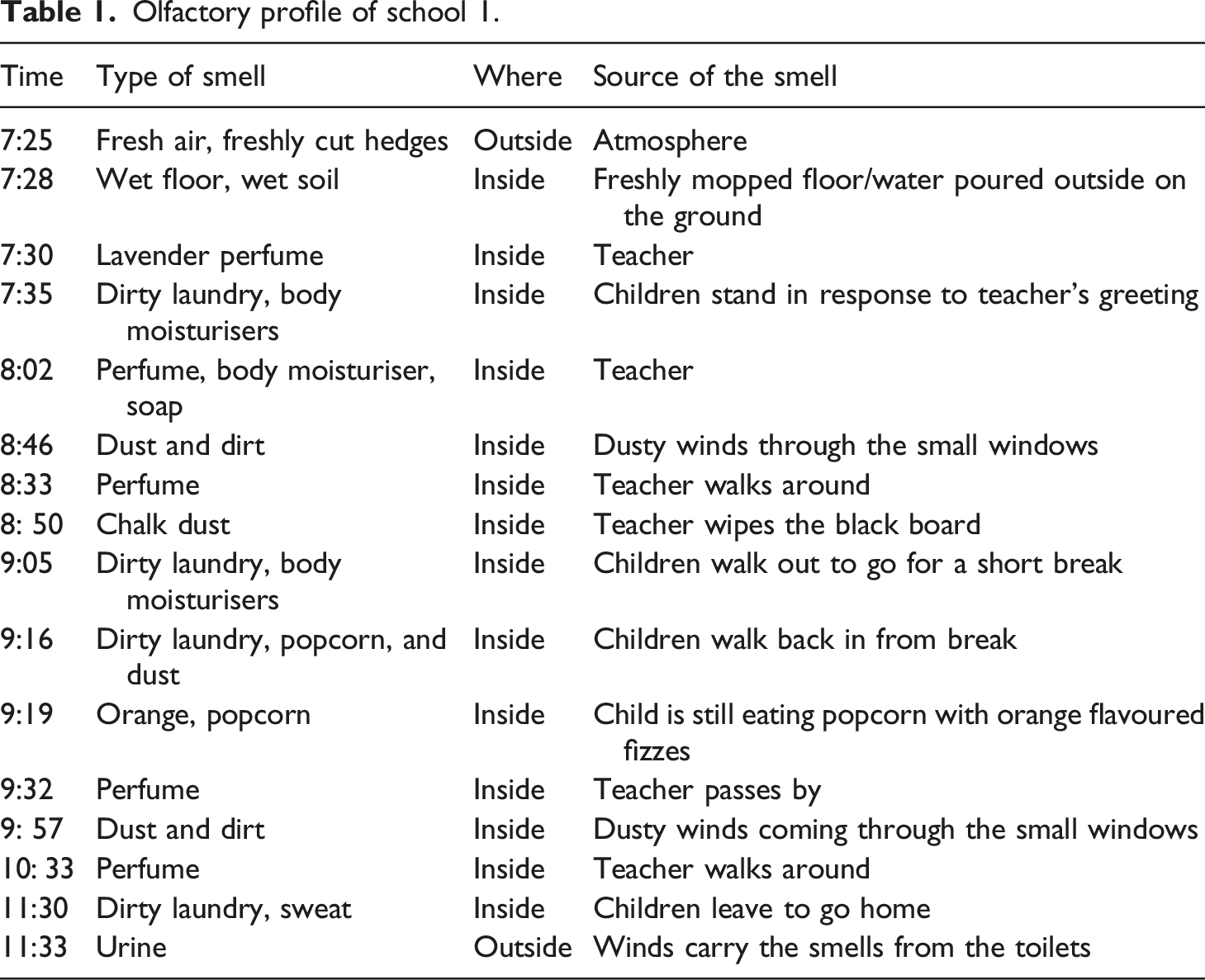
To supplement the olfactory log from the classrooms, we also created a SmellMap, i.e. a visual representation of the odours observed in the classroom. The SmellMap (Figure 1 for School 1 for illustration) contains the key odours identified during the olfactory audit, together with their intensities at an arbitrarily selected time point (11:40 a.m.). The intensity is represented with the size of the individual bubbles, with larger bubbles corresponding to a more intense smell. SmellMap for School 1.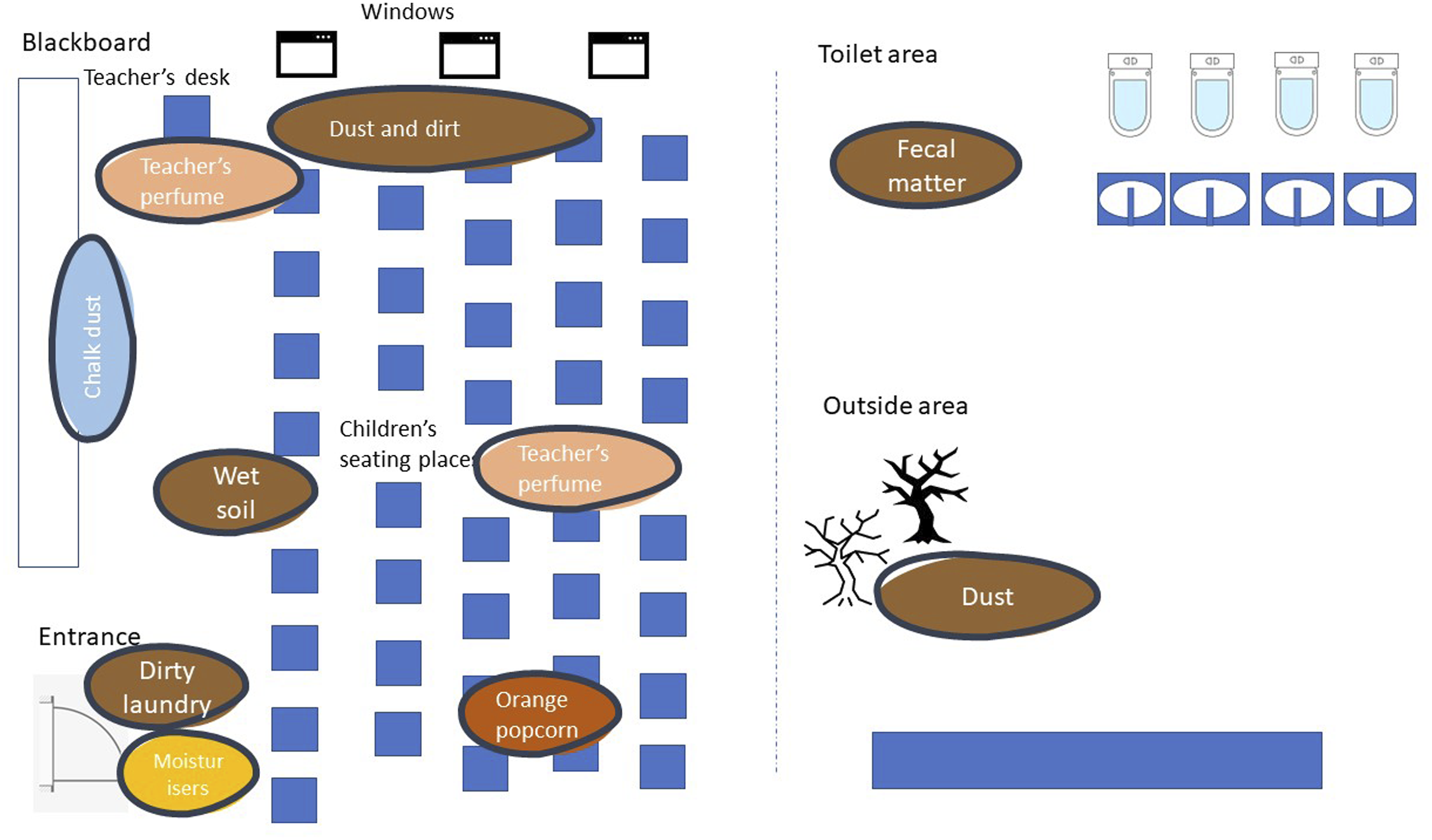
Children’s olfactory preferences: drawings
Our analysis of 49 drawings found minimal presence of fragranced artefacts or possible colour-odour correspondences. Even though all children had access to a set of colourful crayons during drawing activity, their final drawings were predominantly based on one or two colours per picture per child. Children’s pictures depicted various household items (e.g. pots), work utensils (e.g. cutters for grass), people and trees. The latter two were mentioned by some children as carrying their favourite smells. We could not identify other reliable olfactory references in children’s drawings.
The use of drawings as a visual method for representing children’s olfactory preferences thus proved to be a study limitation. Although the researcher asked the children about their favourite smells during reading or in stories, the children seemed to have interpreted the question as their favourite smell overall and their drawings focused on various story elements but not smell references. The drawings served as a prompt for conversation with the researcher but did not reveal additional insights into children’s olfactory preferences. This could be a methodological limitation specific to our study but also to olfactory children’s research more broadly, and remains to be further examined with alternative response-elicitation techniques.
Children’s olfactory preferences: interview data
Children’s answers about their favourite smells were mostly related to various types of food, with most children referring to fruits and meat. Examples included: black berries, mangoes, matani, oranges, bananas, apples, guava, spaghetti, meat, nsima, masuku, boiled eggs, fish and vegetables, bread, sugar, porridge, and cake, potato fries. Two children said they loved the scent of new clothes and two children related favourite smell to a particular person (“my mum’s perfume”). Four children referred to scented or perfumed objects as their favourite scents. Only one child out of 25 did not have a favourite smell.
For most children, food items had the most pleasant smell and out of these food items, fruits were the favourite ones. Some children preferred relatively strong odours (bananas), while others liked relatively faint odours (apples). Some children, when prompted by the researcher, described their taste preference along with their smell preference (see Interview Extract nr. 1). Researcher: Tell me what your favourite fruit is. Child nr.6: Mangoes Researcher: And what is your favourite smell? Child nr.6: The smell of bananas. Researcher: Why do you like the smell of bananas? Child nr.6: Because they taste good
Children’s food preferences reflected both healthy food choices (e.g. Child nr. 18 “mangoes and guava”) but also “sugar, porridge, and cake” (Child nr.31). The children’s direct reference to local foods provided an insight into local culinary culture. For example, the children mentioned they liked the smell of nsima (porridge made of maize flour and water) or masuku (indigenous tree with the scientific name Uapaca kirkiana that produces orange fruit). Interestingly, even if explicitly asked, the children did not recognise the smell of grass or trees as their favourite odours, or as having any smell at all (see Interview Extract nr.2) Researcher: Can you tell me anything that is green that has a smell that you like? Child nr.22: No. The things I mentioned do not have smell…the grass, the hedges, the trees…they do not have smell.
This child did not consider grass or trees to have a smell, which highlights the dimensions of odours that are inherent in the nature and are perceived differently by different cultural groups. Furthermore, the smell of new clothes is not typically reported in the olfactory literature, but was a clear preference of two children, who explicitly referred to newly bought clothes (Interview Extract nr.3) Child nr.6: I like the smell of clothes. Researcher: What kind of clothes? Child nr.6: The scent of new clothes…clothes that have just been bought.
The olfactory and gustatory senses are tightly bundled (Majid, 2021), and it is thus not surprising that children’s experiences of their favourite foods are associated with their smell preferences. With limited literature on children’s olfactory preferences, it is difficult to tell how typical these preferences were for children in this local area of Malawi or children more generally. What seems to be a cultural phenomenon is that two children referred to the smell of flowers (child nr. 14) and the smell of pine tree (child nr. 20), but did not refer to them as pleasant or non-pleasant but as carrying medicinal properties (extract nr.3). Researcher: What do these trees do? Child nr.20: If you are sick. You take the leaves of the trees, boil them and cover yourself with a heavy blanket so that you can inhale the steam. Researcher:: Ok? Which trees can be used for that? Child nr.20:: Blue gum trees Researcher: I see. What sickness requires one to do that? Child nr.20:: (laughs) I don’t know…I just know that when one is sick, they do that and they get better...the steam has to be breathed in. Researcher:: Interesting. Does the steam have smell? Child nr.20:: Yes. Researcher: Has someone ever boiled some for you so that you can do this? Child nr.20:: No (laughs) Researcher: Ok. What is your favourite smell? Child nr.20:: The smell of pine tree.
Teachers’ olfactory preferences: interview data
Interview responses from the two participating teachers revealed high awareness of the importance of a multisensory reading experience and the role of each individual sense in literacy. The teachers commented on how vital the visual sense is, and thereby good lighting in the room, matters for an enjoyable reading experience: “If the child is not able to see properly because the room is poorly lit, she cannot enjoy the reading.” (Teacher 1) and lamented that their classrooms were not always well-lit, nor did they provide the physical comfort required for pleasant reading. Teacher 1 “It is important that children should be comfortable during story reading but as you know that we have problems in primary schools in the country where we have too many children in one class and without furniture…children have to sit on the floor but we just make sure that they are as comfortable as possible considering the circumstances… ” “I am currently having 104 learners in my class…so it’s really tough to get them really comfortable but we try”, Teacher 2.
Interestingly, both sound and smell were commented in terms of their negative influence on reading: noise was perceived as being a disturbing and interrupting factor for reading and bad smell for the reading experience. “Noise disturbs their concentration so it’s important that the room is quiet when they are reading.” (Teacher 2) “It is not good that there should be bad smell in the room where we’re reading or doing our lessons so we make sure to get rid of everything that produces bad smell…like mops or brooms. Of course, sometimes it is difficult to get rid of bad smell especially if it’s coming from the children themselves…for example if they come to school without washing their bodies and their underwear, that produces bad smell but we cannot get rid of it.” (Teacher 1)
When asked about the sensory qualities of a good book for the children, and olfaction in particular, the teachers’ answers mirrored their views on ambient smells in terms of the need to avoid bad odours: Teacher 1: “If the book has a bad smell, it does not matter how it looks, children cannot like it.” For sounds, Teacher 2 seemed to think that some sounds were a good enhancement of a story and make children more involved in the reading experience: “If we are reading a story about drums, we can give a drum to one child and let her beat it in the background while the story is being read. The sound of the beating of the drum will help make the children more interested in the story and not disturb them in the least.”
This teacher made also a discerned comment about the type of smell with a given book: “I feel that when there is a pleasant smell that would be good for the children and if the book has a bad smell, they would not like it because it would make them feel uncomfortable and affect their reading and enjoyment.”
The visual aspect of the book in terms of appealing pictures were deemed important by both teachers and so was the texture of a book: “The images attract them to read the story…especially if there are brightly coloured images…children will enjoy the book more than if the book has no pictures or plain pictures. (…) Children enjoy books that are a bit hard…the soft ones tear easily so they do not enjoy them.” (Teacher 1)
Discussion and future directions for Olfactoscape research
In this study, we set out to document children’s preferences, representations and experiences of odours in their classrooms, as the first empirical attempt to tap into Malawian children’s olfactory literacies. The scholarly argument that selective engagement of senses represents the site of human agency (Rhys-Taylor, 2013) lies at the heart of social justice approaches to children’s literacies, which animated our focus on children’s olfactory literacies.
The interviews with children indicated children’s preferences for food-related smells, especially fruits. The finding aligns with the known associations between taste and smell (Breslin, 2013). Although sensory preferences, and chemosensory preferences in particular, are influenced very early on during pregnancy (Kölble et al., 2001), they are also heavily culture-specific. The environmental influences on children’s smell preferences were evident in their references to local foods (nsima) and indigenous plants (masuku, mangoes) as well as objects such as new clothes, reflecting the types of smells they valorise based on their daily experiences (which are unlikely to involve frequent access to new clothes, perfume or soap). It was interesting to note that children associated plant-related smells with medicinal properties. Prior research shows variation in children’s awareness of local and indigenous plants and their properties. For example, Jiménez-Balam et al. (2019) interviewed Yucatec Maya children (ages 7–12) about local plants and found that these children could identify the use of 16 medicinal plants and their healing properties for skin, respiratory, or digestive problems. In contrast, in a sample of Australian children, most children had minimal knowledge of the plants’ properties in their natural habitat (Beasley et al., 2021), although the knowledge rapidly increased after the children’s participation in the research project. Beasley et al. (2021) refer to such knowledge as “botanical literacies”, which together with olfactory literacies, hold significance for early childhood pedagogies.
Based on a large-scale comparative study in eight European countries involving the taste preferences of 1.839 6–9-year old children, Ahrens (2015) concluded that age and culture are the strongest predictors for children’s taste preferences but similar research on olfaction is missing. Variation in children’s odour preferences depend on various individual factors, including family influence (Nováková et al., 2018). In addition, there is a close relationship between familiar smells and smells people like and attribute hedonic qualities to (Distel et al., 1999). Odour identification ability plays a part too. Indeed, Nováková et al. (2014) demonstrated that the more the children (8–11-year olds from Czechia) can identify various odours, the higher they rate unpleasant odours as unpleasant. It is the combination of in-born traits, experience and environmental exposure that influence odour identification ability across cultures (Majid et al., 2017), and all three factors would have played a role in the children’s reports of their favourite smells in our study.
The participating teachers discussed olfaction with a focus on odours that they deemed unpleasant and that should be eliminated from the classroom environment. Their discourse also encompassed a deliberate consideration of the intricate interplay of sensory experiences within the classroom. Notably, their discussions predominantly centered around the dichotomy of noxious and pleasant smells, with limited elaboration on the identification or discussion of distinct olfactory stimuli present within the classroom. This finding connects to recent data that suggest that the perception of the hedonic quality of an odour, that is how pleasant one finds the odour, is relatively stable cross-culturally, as shown with data from children representing 18 countries (Canada, Chile, Czech Republic, Egypt, Finland, Germany, Greece, India, Israel, Italy, Japan, Mexico, Poland, Spain, Sweden, Switzerland, Turkey, USA, Oleszkiewicz et al., 2022b). Indeed, the perception of odour pleasantness is shared across cultures and the main factors influencing it have been attributed to personal preference and the physicochemical structure of the odorants, rather than any particular cultural environment (Arshamian et al., 2022).
Neither the children nor the adults who participated employed specialized or nuanced olfactory terminology. This outcome aligns with our expectations, as most languages, including those spoken in Malawi, lack dedicated lexicon for precise odour descriptors (see Arshamian et al., 2022). Consequently, children as well as adults, predominantly describe odours based on perceived pleasantness (Sulmont et al., 2002).
Study limitations and conclusions
The researcher followed the interview protocol but as revealed in the data extracts and as notable across the data, there were several inconsistencies in how questions were asked and prompts offered to children. The researcher made these adjustments to connect to the children and the local context, in alignment with our ethical stance. Thus, overall, children’s replies should be interpreted as the odour preferences that were revealed within this study context rather than objectively measured or detectable preferences.
Also, while we drew on original data, we did not carry out an evaluation that would quantify specific patterns or common olfactory profiles in this geographical location. The frame of “ontological simultaneity” further caveats against any claims of universality, and this caveat is particularly pertinent in studying olfactory dimensions (Majid, 2023). Our sampling strategy was based on convenience sampling, which, as Majid (2023) explains, leads to a homogeneous group of participants, and as such, cannot be generalised to the whole population or to establish psychological universals regarding odour preferences.
It follows that our empirical efforts to establish children’s olfactory preferences and to capture the olfactory kaleidoscope of Malawian classrooms are merely guideposts, which, while not dubitable, require replication and critical discourse in their evaluation and implementation. Our ethical stance was to challenge the colonial entanglements in our work and our principal interest remains to move away from homogenising and normalising approaches to Malawian early childhood education. Together with scholars who seriously attend to the questions of universalism in current childhood literacy studies, we recommend they also consider the provisionality of scientific knowledge of children’s olfactory literacies.
As we set these methodological limitations against the broader research question of a coherent approach towards children’s olfactory literacies, we see how critically important it is to re-couple ambitious theories from empiricalness. The theoretical orientation of new literacies helped us to think of smell as part of children’s sensing of the world, which is rich in colours, texts and odours (Classen, 1993). Malawian children’s olfactory preferences highlight the multi-layered connections between senses and children’s lived experiences in the classroom. The researcher’s and teacher’s insights into the olfactory landscape of classrooms added to our understanding of children’s possibilities to engage in olfactory literacies in their everyday environments.
Given the lack of empirical research reported from the Global South in English research literature, our study provides direct insights into lived experiences of children who are often excluded from the “truth claims of Western science” (p. 20, Breidlid, 2013). The study made us acutely aware of the need for childhood studies to move beyond linear, homogenizing and “WEIRD” representations of children’s literacies, and advance the goals of critical sensory literacies not only theoretically but also empirically. The diversity in Malawian children’s responses underlies the necessity for a serious engagement with the question of olfactory literacies to complement hegemonic and industrialized approaches to portrayals of children’s experiences. We conclude that the odours in the children’s classrooms, with their healing as well as adverse properties, and with the body odours of the children and teachers and the environmental aromas around them, created intimate human connections between self and other required for a socially just education. Our engagement with the rich olfactoscape of Malawian classrooms is therefore our invitation to childhood researchers to re-think children’s literacies as a place to enact social justice.
Footnotes
Declaration of conflicting interests
The author(s) declared no potential conflicts of interest with respect to the research, authorship, and/or publication of this article.
Funding
The author(s) disclosed receipt of the following financial support for the research, authorship, and/or publication of this article: This work was supported by the Jacobs Foundation and Norges Forskningsråd.
