



Abstract
Based on ethnographic fieldwork, we explore how boys use jocular play to perform romantic relationships in their peer culture and construction of masculinities. The analysis combines an ethnomethodological approach to doing gender with poststructuralist-influenced studies on masculinity and boyhood. We demonstrate how the boys – through game-playing, teasing, humorous narration, and ritual insults – do gender while they explore potentially embarrassing romantic experiences. The boys police and produce acceptable heterosexual masculinities while having fun and doing friendship, demonstrating the dynamic and entertaining potentials of performing romantic relationships in jocular peer play.
Keywords
Introduction
This study focuses on the role of jocular language practices in preteen boys’ performances of romantic relationships and on how boys’ romantic engagements are embedded in their peer culture. Romantic interests often emerge in early adolescence, when children begin to form intimate relationships that are different from other close relationships in their lives (Collins et al., 2009; Christopher et al., 2016). Children’s romantic engagements usually commence during middle school, as girls and boys begin spending more time together and socializing in cross-gender groups (Connolly et al., 2004; Eder et al., 1995). Despite the importance of preteens’ ventures into romantic relationships, notably few researchers have explored the social dynamics of boys’ emergent romantic cultures in everyday school life (but see Eder et al., 1995; Renold, 2013). Particularly, Renold, (2005; 2007) have addressed the importance of studying boys’ romantic relationships as they are performed in the pursuit of “acceptable” heterosexual masculinities. In exploring preteen children’s experiences of an active boyfriend-girlfriend culture, Renold (2005) found that while girls could publicly display their desire for and commitment to romantic relationships and futures with boys, “having a girlfriend” was a more fearful project for boys to take up and could easily give rise to teasing. The findings highlight how preteen boys engage with romantic relationships differently from girls, and how complex and contradictory gender performances are embedded in boys’ peer group cultures.
Here we approach the underresearched field of how preteen boys construct masculinities as they engage in and perform romantic relationships within their peer culture (cf. Adler and Adler, 1998; Renold, 2005; Simon et al., 1992). Data is drawn from ethnographic research combined with video recordings of children’s everyday peer group interaction in a multiethnic school setting in Sweden. Jocular language practices, including teasing, game-playing, insulting, and storytelling, were found to play a central role in the boys’ everyday interactions with peers. Based on a peer language socialization approach, we argue that it is important to explore the constitutive role of language in how boys do gender in everyday interactions among peers (cf. Goodwin and Kyratzis, 2014), rather than in interview contexts. From such a perspective, this study explores the role of jocular peer language practices in how boys interactionally accomplish gender within situated interaction (cf. Evaldsson, 2005; Morgan, 2002). For this purpose, we use an ethnomethodological approach to doing gender as an ongoing accomplishment and as emergent proprieties of interaction (West and Zimmerman, 2009). Here, the ethnomethodological framework is combined with poststructuralist-influenced studies on masculinity and boyhood (cf. Renold, 2005; Swain, 2006; Wetherell, 1998). The combined approach provides ways of exploring the situated nature of how boys do gender in jocular language practices that differ from representations of boys, as mainly engaged in dirty talk, aggressive teasing, and/or sexual harassment, usually outlined in studies of normative masculinities (cf. Adler and Adler, 1998; Kehily and Nayak, 1997; Renold, 2005).
Research on jocular language practices among boys
Prior research shows how children exploit the power of language in teasing, jocular play, ritual insults, disputes, gossip, and storytelling to organize social relationships and perform identities (Goodwin and Kyratzis, 2011, 2014, for overviews). In the midst of everyday peer group interactions, children make evaluative commentaries and playful renderings of one another for taking stances and negotiating local social orders, as well as for exploring subjectivities and discourses within their peer culture (cf. Eder et al., 1995; Evaldsson, 2005; Evaldsson and Svahn, 2017; Goodwin, 2011).
Several studies demonstrate how teasing and insulting are crucial in the cultures of boys and young males (cf. Labov, 1972; Morgan, 2002; Renold, 2005; Swain, 2004; Willis, 1977). Particularly Labov (1972) have demonstrated how boys in an Afro-American language community, use a particular form of ritual insults, including creative, obscene, and often sexually oriented mockery such as “mother insults” to learn the cultural categories that are relevant to their social group (cf. Goodwin, 1990; Morgan, 2002). Success relied upon skills in taking what one’s opponent had said and turning it against him, encouraging and even requiring the boys to behave in an expressive and assertive manner (Goodwin, 1990; Labov, 1972). Evaldsson (2005: 764) also found that young boys in multiethnic low-income peer group settings in Sweden displayed cultural skills in insult practices that contributed to the “production of, and innovation in, a local masculine order” promoting toughness, having fun, and competition. In Willis’s (1977) classical ethnography, “having a laugh” and “piss-takes” function to build within-group solidarity among working-class boys. Yet, Odenbring and Johansson’s (2021) interview study of boys’ perception of joking cultures sheds light on the dualities of jocular play. Even though gay labeling was used for having fun and was associated with being a “goof” among the boys, it contributed to the construction of gender hierarchies and a heteronormative order (cf. Pascoe, 2005; Swain, 2004).
Through teasing and insults, boys also socialize with one another to mark their own masculinity while strengthening within-group relationships (cf. Fine, 1987; Kehily and Nayak, 1997; Renold, 2005). Fine (1987) demonstrates how preteen boys in little league baseball (aged 9–12) build up their reputations as “cool” and sexually knowledgeable through (sexual) joke talk, insults, and evaluative commentaries on girls. As overinvolvement with girls could be troublesome, teasing served to communicate friendship as more important than romantic relationships with girls. In his ethnographic school study, Swain (2004) shows how teasing and labeling other boys as “gay” can police and produce “acceptable” heterosexual masculinities that create and maintain both gender and sexual peer group hierarchies. In Thorne’s (1993) study on gender play, the boys initiated cross-gender teasing to mark and police gender boundaries between boys and girls. For example, boys made fun of other boys for being romantic or in love, and for hanging out with girls. Thorne and Luria (1986: 186) also show that children (aged 9–11) who publicly stated that they had a crush on someone or had a girlfriend or boyfriend were less susceptible to romantic teasing. In contrast, Eder et al. (1995: 89–90) demonstrate how boys portrayed girls “as passive objects of male sexual desire and aggression” and that the aggressive stance taken by the boys disrupted any potential romantic relationships. Teasing also provides important resources for both boys and girls to address and perform romantic relationships in everyday school life. For example, Eder (1991) found that both adolescent boys and girls used teasing to perform romantic relationships and negotiate intimate matters. Teasing, humor, and collective laughter were also used by both boys and girls to deal with feelings of embarrassment tied to romantic relationships and to express romantic interests in a “safe way” (cf. Adler and Adler, 1998: 167).
As demonstrated, jocular language practices are important in boys’ constructions of masculine identities and social relationships with peers, not least in performances of romantic relationships. The aim of this study is to further explore how jocular play (teasing, laughter, narrative humor, ritual insulting, etc.) is used by young boys in everyday interaction to express their own masculinity while managing divergent social relationships, including both romantic and friendship relationships.
Analytical procedures
The study draws on ethnographic research combined with video recordings of children’s everyday peer group interactions (approx. 45 h of video) conducted by the first author in a Swedish multiethnic school setting. The peer language socialization approach that is taken focuses on peer group interactions as a central locus of study and on children as subjects, actors, and creators of peer cultures. Important to this process is language, which both encodes culture and is a tool for children’s active participation and hence agency in identity constructions in this culture (Goodwin and Kyratzis, 2011). Methodologically, the study is based on an ethnomethodological approach to members’ understanding of social categories (MCA) and the related methodology of conversation analysis (Sacks, 1992). Following an ethnomethodological approach from Garfinkel (1967) , the analytical point of departure is the “doing of gender” as a locally managed practical accomplishment (West and Zimmerman, 2009). We use an ethnomethodological approach to membership categorizations (Sacks, 1992) to explore the way gender identities are constructed and how identities are mobilized for different interactional purposes (Speer and Stokoe, 2011: 22). A crucial feature of membership categorizations is that they operate on multiple levels of interaction that are both constitutive of and reflect conventional expectations of normative behaviors within a specific group and culture (Evaldsson, 2021). Thus, for MCA, the analyst necessarily draws on extra-contextual resources in the form of cultural knowledge of wider discourses and social structures to explicate the sense-making orientations of the participants (Speer and Stokoe, 2011).
The ethnomethodological framework is combined here with poststructuralist-influenced studies on masculinity and boyhood (cf. Bhana, 2020; Renold, 2005; Swain, 2006). In this perspective, masculinity is a configuration of gender practice associated with the social positions of men and boys (Connell, 1995). This line of thinking underscores both the dynamic nature of masculinity and the social and cultural embeddedness of gender. Although gender is seen as fluid, cultures of schooling create different opportunities to perform different masculinities (Renold, 2005; Swain, 2006). In other words, as Swain (2006: 333) notes, there are “different alternatives, or possibilities, of ‘doing boy’ that are contingent on each setting, using the meanings and practices available”. In this study, we draw on Wetherell’s (1998) plea for a more integrated stance that takes into account “the highly occasioned and situated nature of subject positions and the importance of accountability rather than discourse per se in fueling the take up of positions in talk” (ibid, 1998: 394). In this perspective, a detailed analysis of interaction allows a different view of constituted identities that do not simply reify abstract societal discourses and norms concerning appropriate masculine and feminine behaviors (Speer and Stokoe, 2011: 7).
By analyzing membership categorizations in sequences of action, we explore “the constitutive role of talk for local social organization, and how issues associated with wider social structures and discourses can be located, observed and described within situated action” (Evaldsson, 2005: 764). In addition, we argue that an ethnographic understanding of children’s social world is central for studying how boys exercise their agency in the production of masculinities as gender patterns are accommodated and resisted.
The school setting and peer group arrangements
The ethnographic fieldwork (including participant observations, video recordings, and focus group interviews with friendship groups) was conducted among approximately 30 children from two different fifth-grade classes in a multiethnic school setting. The fieldwork offered possibilities to gain access to and document how girls and boys in different peer group constellations organized social relationships (friendship, cross-gender, boyfriend-girlfriend, etc.) through routinely performed language practices (i.e. teasing, gossiping, storytelling, etc.) in everyday interactions. Gender arrangements were characterized by the social choreography of “with” and “apart” described by Thorne (1993: 51), whereby boys and girls from the same school class usually socialized in the schoolyard in both same- and cross-gender groupings. In such peer group interactions, especially cross-gender arrangements, the children regularly performed a boyfriend-girlfriend culture in which they explored romantic relationships and created romantic matches between girls and boys. Jocular language practices were used particularly among the boys in their negotiations of intimate gendered relationships among peers, both separating themselves from girls and coming together and breaking gendered boundaries.
The boys’ peer group
The selected data in this study draws primarily on everyday interactions in a peer group constellation of three boys: Hamid, David, and Alex. These boys regularly participated in jocular play practices (teasing, ritual insulting, game-playing) during recess and lunch breaks. All three of them had a high status and were positioned as popular among the other children. For the boys, it was no fun to joke with someone who could not respond in a humorous way. In the focus group interviews they described joking as an important activity for “doing friendship”, in which it was safe to make fun of each other without the risk of offending the other party.
Jocular language practices in boys’ peer group interactions
For the analysis, we have selected instances that focus specifically on how the boys use jocular language practices to do gender while they perform romantic relationships and build friendships. Jocular play activities were often performed through playful and evaluative commentaries in passing. The particular data has been chosen in relation to its richness and “narrative power” (Derry et al., 2010). The analysis focuses on selected episodes in which the boys’ playful commentaries develop into longer sequences of playful verbal interactions in which the participants perform and negotiate romantic relationships while realigning the social order of the peer group.
The episodes are drawn from handicraft lessons where the children moved around rather freely, talking and sharing information while engaging in language practices, such as teasing and storytelling, to have fun. For ethical reasons, all the children who took part in the study have been given fictional names in order to secure their anonymity.
Game-playing and category work
The boys engaged in jocular play to collectively address the ambiguities surrounding their engagements in romantic relationships while cultivating their own friendship (Eder, 1991; Renold, 2005). In the first episode, the boys initiate a jocular game in which they first bring up a gendered position of “who’s a fag”. As will be shown, the non-hetero position of a “fag” is highly occasioned and needs to be seen in the context of the ongoing conversation. When we enter Excerpt 1a, the two boys David and Alex are socializing with each other (see Figure 1). As they talk, Alex is spinning a hammer on the table while he initiates a game by posing a rhetorical question in a smiling voice – “who’s a fag here” (line 1) – and then spinning the hammer and repeating the question in a playful manner (line 3). We will show how the humorous framing of the game enables the boys to address and experiment with gendered relationship categories in their doing of friendship:
Excerpt 1a
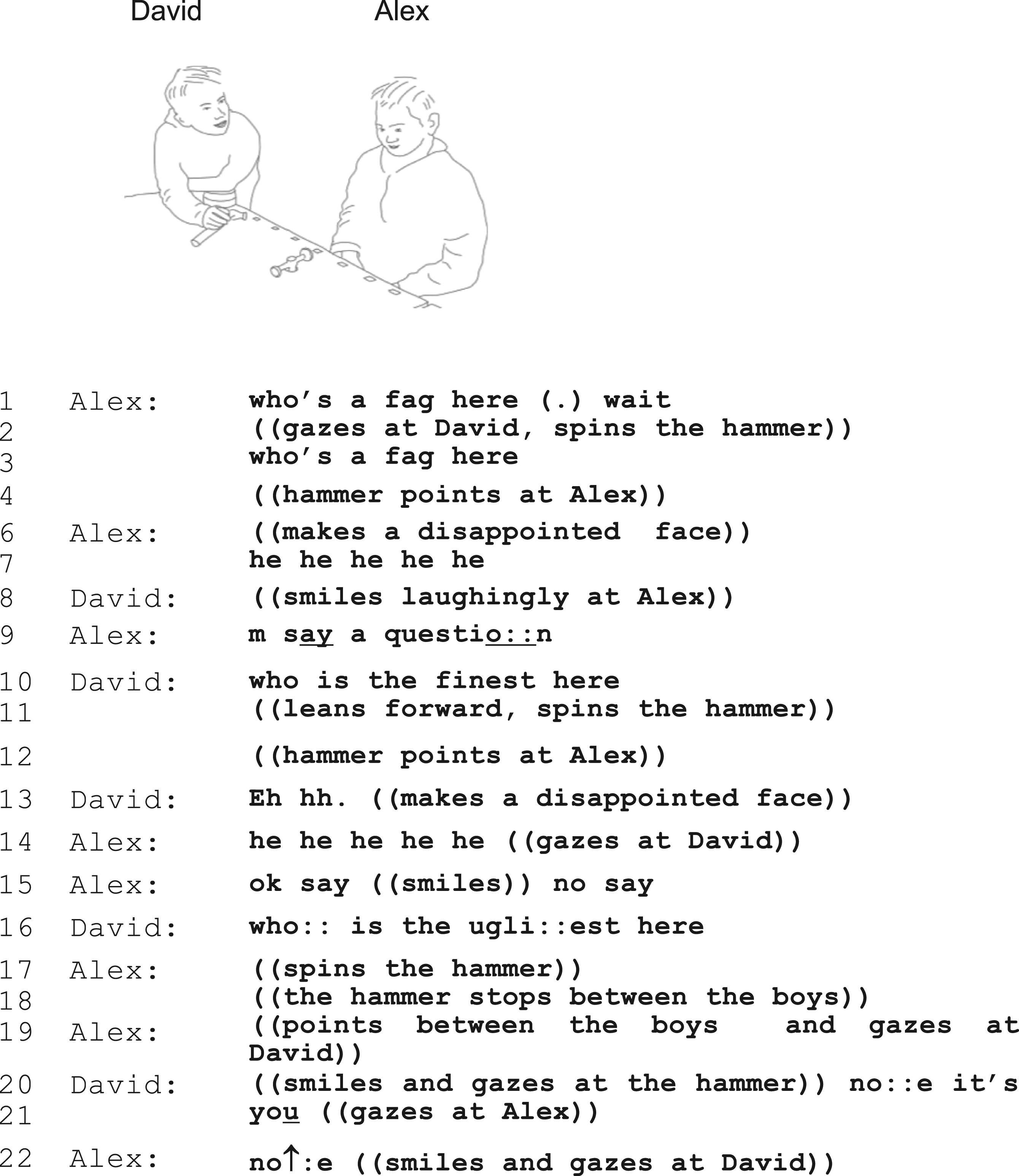
When the hammer ends up pointing at Alex, he first produces a quick disappointed grin, and then starts laughing as David responds with a smile (lines 4–8). The boys’ embodied responses in the form of facial expressions and laughter index the negative meaning of the gay labeling, “fag” (lines 6–8). Similar to Odenbring and Johansson’s (2021) analysis of schoolboys’ joking cultures, the label “fag” or “gay” is associated with being “funny”, “odd”, or a “goof” within this context (cf. Jonsson, 2007: 124). As the interaction develops, the humorous framing of the game opens up for elaborated negotiations about more or less desirable gender categorizations or category-bound actions, indexing masculine gender.
Alex now directs David to “say a question” (line 9). David aligns by suggesting a category-bound action that indexes appearance as a central attribute: “the finest”. He then spins the hammer (lines 10–11). This time it ends up pointing at Alex, and David responds with a laughing sigh of disappointment. David’s response makes Alex burst out laughing in a mocking way (line 14), casting David’s disappointment of not being positioned as “the finest” as humorous. When David challenges Alex with a contrasting category attribute (“the ugliest”) (line 16), Alex avoids being identified as such (lines 17–19). David treats Alex’s response as amusing and starts laughing, telling him with a smirk, “no it’s you” (i.e. you are the “ugliest”, lines 20–21). The use of the other reference, “you”, transforms the game into a playful insult directed at Alex for not being attractive enough. A contrastive reference to “the ugliest” thus makes inferentially available a more general reference to appearance as a central masculine gender attribute, which in turn intensifies the fun of the game (lines 20–22).
A few sequences later in Excerpt 1b, the game shifts into more explicit romantic relationship categories. Although it is not obvious why the boys shift between different relationship categories, the categorization process makes available a frame of reference within which different forms of categories of a person can be performed (Evaldsson, 2005). The prior category attribution of being ‘(un)attractive’ allows the boys to develop the game into extended negotiations of what counts as appropriate romantic relationships. Encouraged by Alex, David now poses a new rhetorical question, asking the hammer: “will Alex ever get married?” (line 26). Alex then spins the hammer, which ends up pointing between the two boys (lines 27–28). At this point David develops the game into fortune-telling, deciding not only the outcome of the game but also what will happen with Alex’s romantic relationships in the future (lines 29–31):
Excerpt 1b
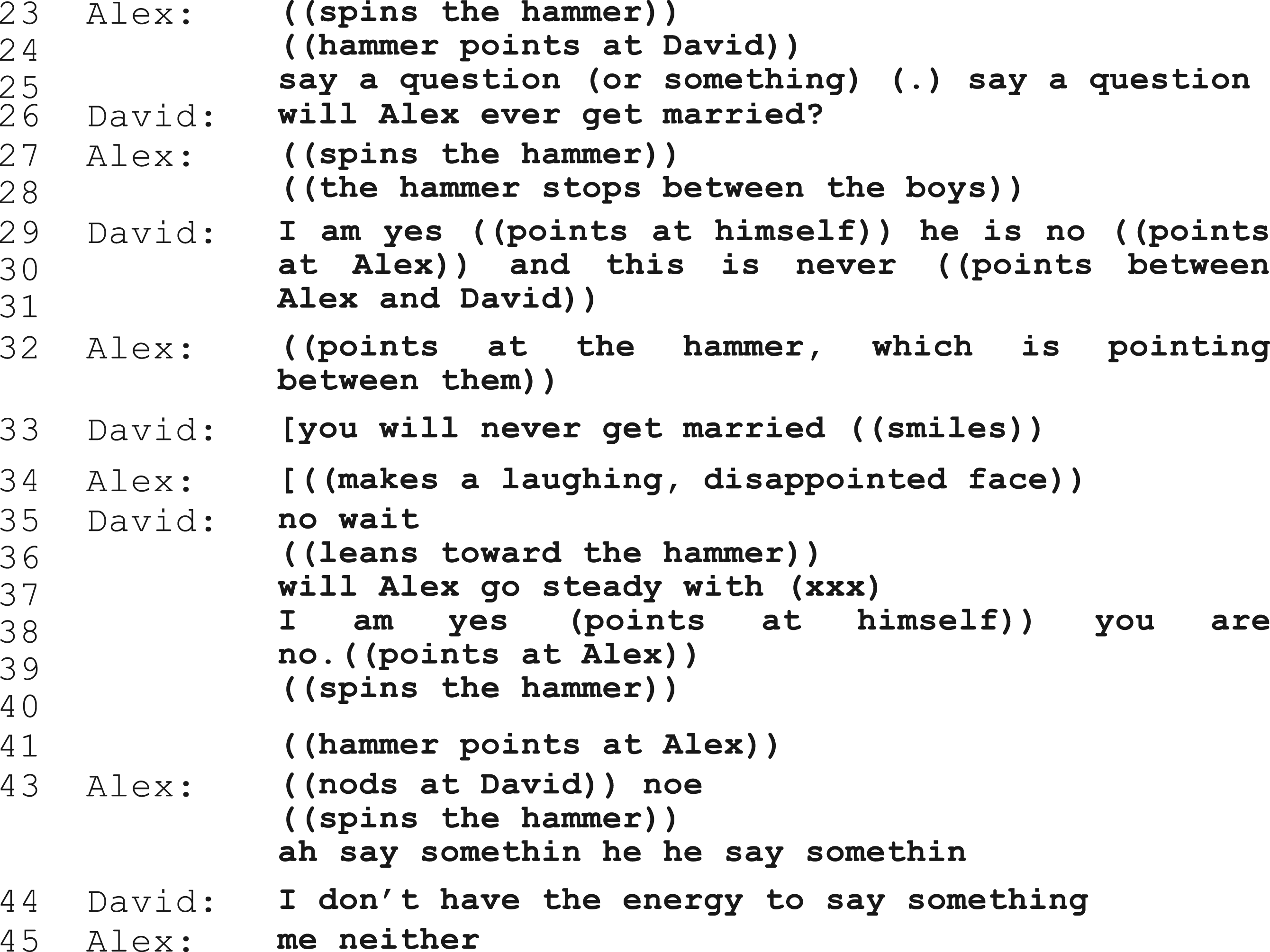
When the hammer ends up in between the boys, the positioning of Alex is clearly exaggerated and framed as a playful insult: “you will never get married” (line 33). The use of the extreme-case formulation (Pomerantz, 1986) “never” highlights how expectations of having a ‘girlfriend’, displaying an implicit orientation to a heteronormative order, are invoked in the game. The built-up tension leads to a climax in which the two boys end up smiling and laughing (lines 33–34). However, the play event takes a more serious direction when David asks the hammer “will Alex ever go steady with (xxx)” (line 37). The hammer is now put in movement to once again decide the future of Alex’s romantic experiences, real or imagined. In this way, in the midst of a game, a future romantic relationship becomes a public concern for the two boys. Thus, even if the boys are performing romantic relationships in a playful manner, there are limits to what kind of information is possible to disclose and/or make fun of.
The boys’ engagements in the jocular game-playing enable them to treat romantic relationships tied to “marriage” and “going steady” as exciting and desirable. The boys’ shared orientation toward heteronormative discourses of love is in contrast to Alex’s initial use of the gay label. Importantly, the humorous framing of the peer interaction demonstrates that the boys’ reference to “gay” as a troubled identity is more about gender than sex. Moreover, the use of the gay label makes it possible for them to address imaginary futures of marriage under the guise of play. Thus, the unfolding playful action sequences indicate that the gay labeling is not invoked primarily to display an orientation toward heteronormativity. However, as Eder et al. (1995: 126) demonstrate in their school ethnography, in the long run the use of gay labels with negative connotations contributes to consolidating a heteronormative order whereby only romantic feelings for the opposite sex are culturally appropriate.
Romantic storytelling and intimate friendship
We will now look further into how the boyfriend-girlfriend culture is performed, explored, and negotiated in jocular talk about romantic love. In Excerpt 2 one of the boys, Hamid, suggests in a playful and humorous mode that David, who is seated opposite him (Figure 2), and one of the girls in class, Elina, are a good romantic match (line 1). David first responds to the playful positioning of him as a potential ‘boyfriend’ first with surprise (line 2) before launching a romantic story (lines 4–5). This story invokes a rather delicate romantic girlfriend experience while cultivating intimate friendship among the boys:
Excerpt 2
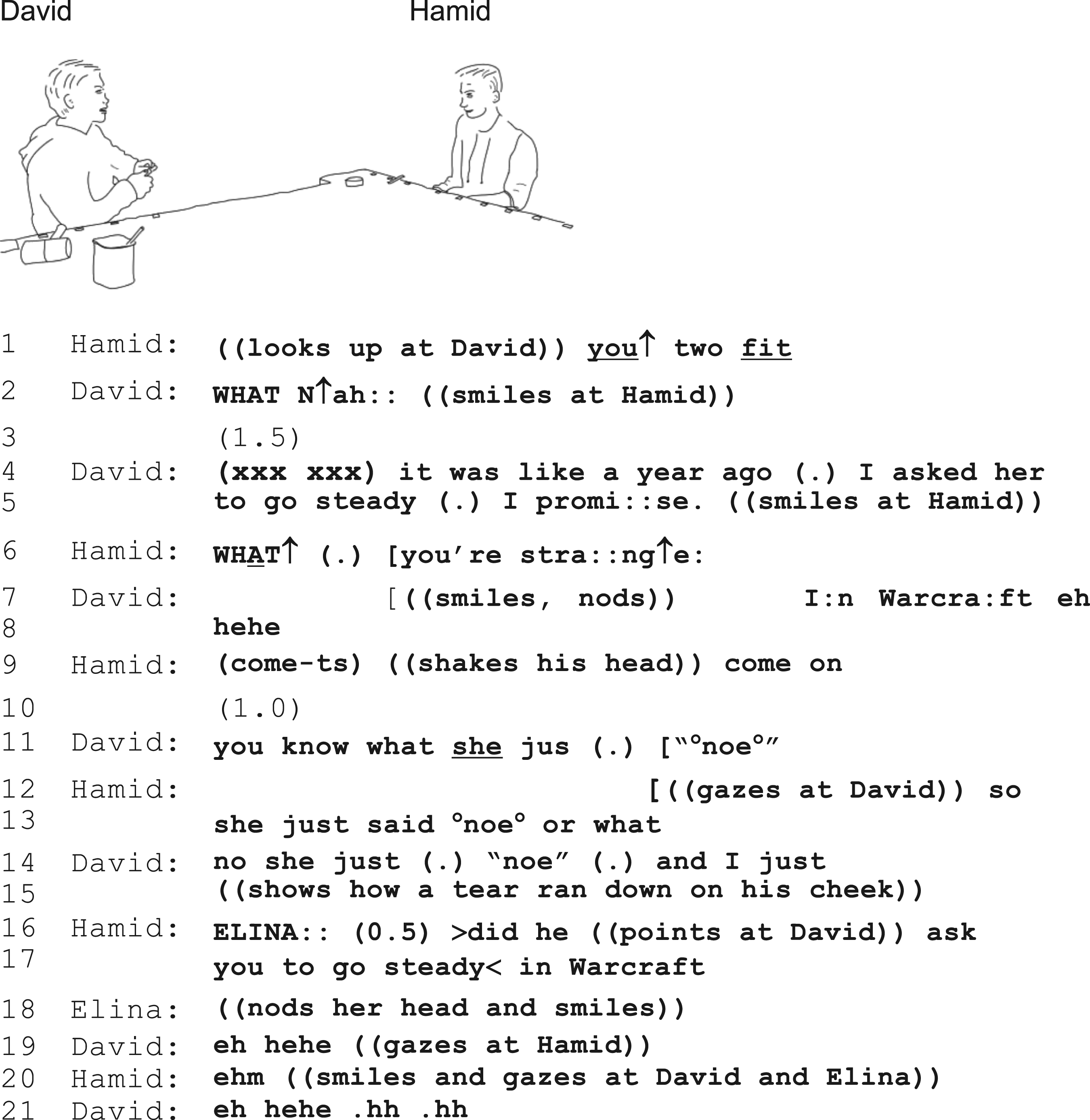
At first, David responds with an exaggerated denial “N↑ah::” (line 2). The denial is followed by a smile, signaling that the teasing is treated as playful (Tholander and Aronsson, 2002). Instead of fighting back, David launches a romantic story of how he asked Elina to “go steady” (lines 4–5). The words “I promise” frame the telling as serious, while the laughter displays its ambiguous playful and spectacular character (lines 4, 5, 7). In her school ethnography among middle school children, Eder (1998: 82f) found that collaborative narration enabled the boys to explore social concerns, gendered relationships, and cultural values (cf. Sandford and Eder, 1984). Here, we can see how Hamid supports David’s telling. Hamid’s outburst of surprise along with his negative assessment, “WH
Eder (1998: 89) also found that self-mocking within humorous narration can contribute to reliving the embarrassing aspects associated with the story being told. As we can see, David discloses some delicate information about how he failed to convince Elina to be his ‘girlfriend’ (line 11). The dramatization creates involvement and invites Hamid to display co-alignment “so she just said °noe° or what” (lines 12–13). Hamid now takes on a supportive and affectionate stance, demonstrating that he is concerned and intrigued by David’s telling (cf. Tholander and Aronsson, 2002). Through the use of reported speech “she just “noe”” and a bodily reenactment, “I just” (lines 14–15), the teller (David) now dramatizes his own gendered position as a rejected ‘boyfriend’, showing how a tear ran down his cheek when Elina rejected his romantic proposal. The embodied reenactments provide rhetorical devices for dramatizing the actions performed by the protagonist (here Elina) in the past as hurtful. At this point the recipient, Hamid, uses a highly affective stance to invite Elina, the protagonist and potential ‘girlfriend’, into the storytelling. When Elina, who is seated at another table, silently nods and confirms David’s telling (line 18), the narrated moment reaches its climax. David and Hamid look at each other and start laughing (lines 19–20), displaying their shared excitement while consolidating their intimate friendship. At the same time, the boys’ joint laughter and body language indicate that sharing a disappointing girlfriend experience is experienced as embarrassing within the boys’ peer culture (Eder, 1991; Sandford and Eder, 1984).
Romantic storytelling and embarrassing romantic performances
The humorous mode of the boys’ romantic storytelling derives from the transgression of multiple gender boundaries between romantic/friendship, male/female, and public/private (Kehily and Nayak, 1997: 79). Through their collaborative storytelling of a failed girlfriend experience, the boys intensify and play with these boundaries and the ambiguities of romantic performances in boys’ peer culture, while maintaining the boundaries of their own gendered group. We will now continue to focus on how the boys transform cross-gender relationships into playful public events through the use of humorous devices. The first episode shows how narrative humor is used both to publicly stage boyfriend-girlfriend relationships and to share the excitement and embarrassment of the romantic performances at work.
Before Excerpt 3a, Elina, who often socializes with the boys, has been helping Hamid with his sewing machine. In line 1, Elina tells Hamid to stop looking at her as she hits him in a playful way. David, seated nearby, overhears Elina’s directive and transforms it into a romantic male gaze by positioning Hamid as a potential ‘boyfriend’: “but you know Hamid is in love with you” (line 3).
Excerpt 3a
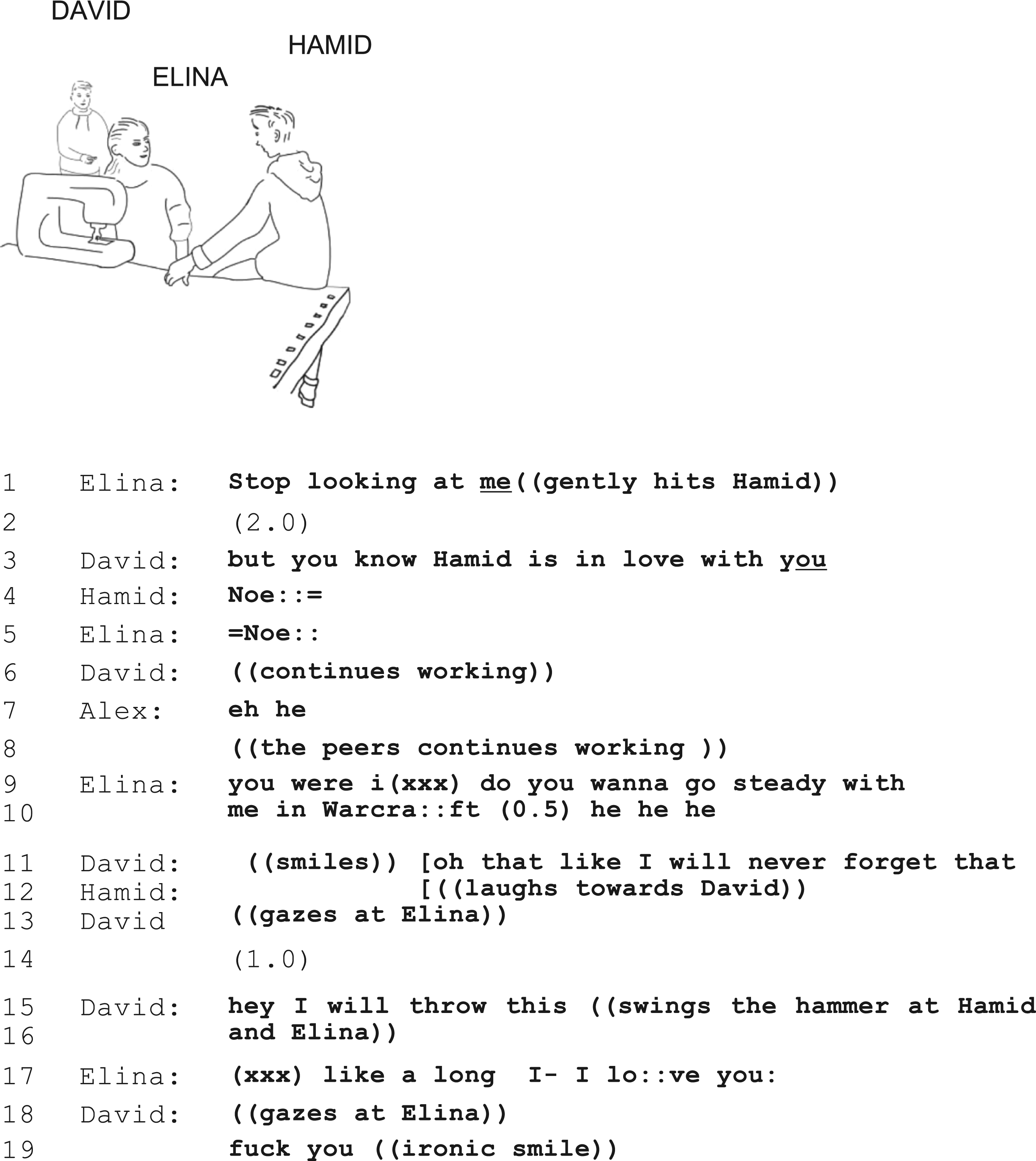
David’s humorous categorizations of Hamid’s innocent look into a public expression of love invoke a delicate subject, from which Hamid and Elina immediately distance themselves (lines 4–5). The fact that it takes some time before Hamid reacts indicates that the playful framing makes it difficult for him to strike back, as this would put him in a position of acting like someone who takes seriously what the others are being playful about (Evaldsson, 2005; Goodwin, 1990). Instead, Elina is the one who provides a counter-attack, telling the others that David asked her to “go steady” when they were playing Warcraft (lines 9–10). David responds to Elina’s public disclosure of his romantic experience with her by smiling and looking at her (lines 11, 13). In so doing, he uses a “face saving” strategy that makes him appear unperturbed by Elina’s disclosure (Tholander and Aronsson, 2002: 569, 577). In overlap Hamid reinforces the humorous framing by continuing to laugh (line 12). David now shifts footing and responds by swinging the hammer and laughingly stating “I will throw this” (lines 15–16). David’s upgraded physical threat highlights that disclosing personal details about others’ romantic experiences is constructed with a mixture of excitement and tension among the boys (Eder, 1991). In this case David’s escalated excitement invites Elina to reveal further details about his romantic experiences, including his affectionate display for her, “I love you”, while playing Warcraft (lines 17). After Elina’s second disclosure David responds with a serious insult, “fuck you”, combined with an ironic smile (line 19) (cf. Tholander and Aronsson, 2002). Thus, even if Elina is not acting in a malicious manner to deliberately embarrass David, he treats her disclosure of his romantic girlfriend experiences as a form of infraction.
The analysis demonstrates how disclosing information about other peers’ attempts at initiating a romantic relationship is structured around implicit storytelling conventions in which a disclosure has to involve experiences “on one’s own behalf” (Pomerantz, 1980). Thus, David is entitled to disclose his own personal girlfriend experiences with Elina to Hamid (Excerpt 2). Elina, on the other hand, is not allowed to use similar information about David to make fun of him in public. The two examples provide insight into how claims of entitlements, in terms of who has the right to disclose romantic experiences and how, are negotiated and contested through teasing and narrative humor both within the boys’ peer culture (Excerpt 2) and in their interaction with girls (Excerpt 3a).
Romantic comebacks and mock fighting
Sharing romantic girlfriend experiences with a close friend might be acceptable and appropriate for the boys (Simon et al., 1992), while making romantic experiences public to other peers easily gives rise to escalated teasing (Thorne and Luria, 1986). Even if David treats Elina’s disclosure as an infraction, he continues to use narrative humor to stage a romantic comeback that escalates into mock fighting.
Just before Excerpt 3b, David has observed Elina and Hamid working closely together. After a few seconds, he targets Elina by staging a romantic storytelling with a fairytale structure: “That was the day when Elina…” (line 1). The hypothetical storytelling provides a framework for transforming Elina and Hamid’s friendship into an emerging romantic boyfriend-girlfriend relationship – “…when Elina fell in love with Hamid” (lines 1–2):
Excerpt 3b
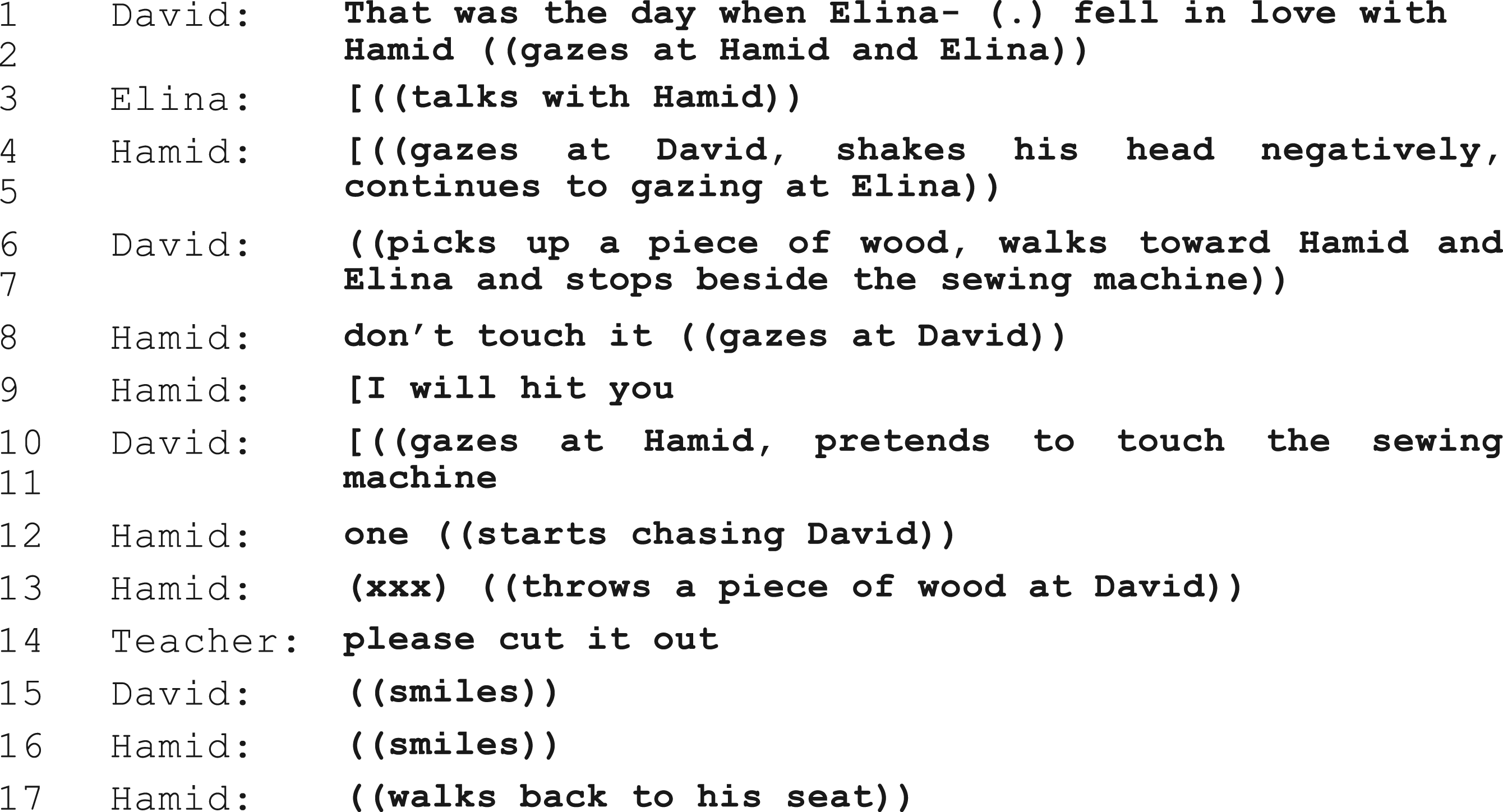
The emotional relationship category invoked in the romantic storytelling (“fell in love”) in line 1 is socially powerful as it transforms Hamid and Elina into a ‘romantic couple’ (compare to Excerpt 3a, line 3). In their ethnographic study on gender and heterosexual arrangements among schoolchildren, Thorne and Luria (1986: 186) also found that category attributes of “liking” or “having a girlfriend or boyfriend” (e.g. “Hamid is in love with you” or “Elina fell in love with Hamid”) are matters of public notice that are co-constructed from subtle bodily signs. In the example, Hamid sits close to and talks with Elina, and has chosen her as a working partner in handicraft. He responds to the teasing by shaking his head while Elina continues working (lines 4–5), demonstrating that they do not find the teasing amusing (Tholander and Aronsson, 2002). At this point, the teasing shifts into a mock fight (Kehily and Nayak, 1997: 75), taking the form of a competitive contest to partly undo a peer. David now picks up a piece of wood and walks toward Hamid and Elina (lines 6–7). In response, Hamid threatens to hit David if he touches the sewing machine (lines 8–9). When David then pretends to touch it (line 10–11) Hamid starts running after him, throwing a piece of wood at him (line 12–13).
Most research demonstrates how romantic teasing (in which the teaser transforms a cross-gender friendship into being romantic) contributes to policing and maintaining gender boundaries between boys and girls (Thorne, 1993; Thorne and Luria, 1986). In the two examples above (Excerpts 3a-b), the romantic teasing instead functions to strengthen cross-gender relationships (Eder, 1991, 1993). For example, the verbal and physical counter-responses performed by Hamid serve to reinforce his friendship with Elina. Simultaneously, the humorous narrative and romantic verbal teasing playfully invokes romantic relationships, real or imagined, between girls and boys.
Hamid’s counter-attack and recycling of narrative humor
In what follows, David constructs an imaginary image of Hamid’s and Elina’s romantic feelings as emerging in the moment. Hamid responds with a jocular counter-attack in which he recycles the hypothetical narrative format. The recycling of the humorous narrative provides interactional resources for Hamid to strike back and make fun of David’s friendship with Alex by playfully transforming it into an imagined romantic relationship (Excerpt 3c line 21, 23–24).
Excerpt 3c
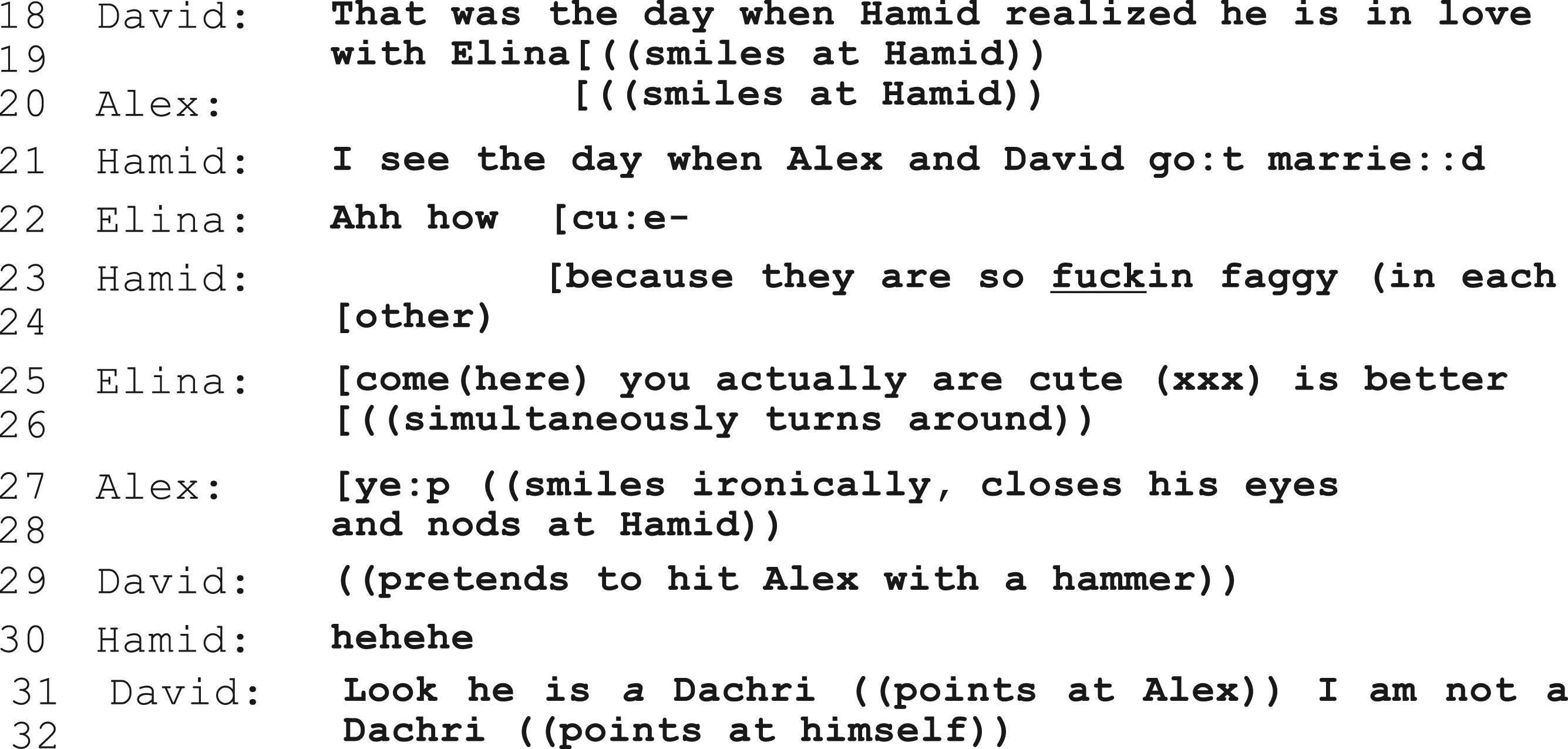
Hamid responds to the teasing with the same narrative structure, “I see the day when Alex and David got married” (line 21), used by David previously (lines 18–19). “Recycling” the format of prior talk functions to create a “boomerang” whereby the target transforms prior utterances to his/her own advantage (Goodwin, 1990: 178f). By introducing the relationship category “got married” in the recycled narrative, Hamid playfully transforms Alex and David’s close friendship into an imagined future of a non-hetero marriage. Elina supports Hamid’s humorous enactments with a positive assessment, “Ahh how [cu:e-” (meaning how cute) (line 22), thus indirectly aligning with Hamid’s projection of an imagined future marriage between the two boys. Yet, Hamid then upgrades the teasing into a more aggressive sexual insult, adding that Alex and David “are so
The use of a derogatory gay label (lines 23–24) demonstrates how the boys use anti-gay talk to police and produce acceptable masculinities (Eder et al., 1995; Renold, 2005). Elina distances herself from Hamid’s abusive language by recycling and upgrading her description of the two boys’ relationship as being “cute” (lines 25–26). In response, Alex closes his eyes and nods his head simultaneously as he silently says “ye:p” (lines 27–28), displaying the ambiguous character of the category claim. David takes on a contrastive stance, pretending to first hit Alex with the hammer several times (line 29), indirectly rejecting the categorization of himself and Alex as a cute and “faggy” couple, instead casting Alex as “a dachri” (Arabic for “cock”) (lines 31–32).
The two boys’ different reactions to the gay labeling illustrate how the derogatory gendered category of being “fags” is avoided, and function both to construct and deconstruct a heteronormative order among the boys. In this process, recyclings and narrative humor are used both to stage an insult and to disarm the initial teaser (Tholander and Aronsson, 2002). The ambiguous playful and aggressive character of the gay labeling and mock fighting demonstrates how the boys use jocular play to create friendship among themselves while avoiding being categorized as “fags” (Eder et al., 1995; Renold, 2005).
Discussion
The analysis demonstrates how a peer group of young boys use jocular play in the form of game-playing, teasing, laughter, ritual insults, and narrative humor to do gender as they negotiate and explore romantic relationships, including sharing boyfriend-girlfriend experiences and forming close friendship with other boys as central matters in the boys’ peer culture (Renold, 2005). As Sandford and Eder (1984) also note, jocular play is used in both boys’ and girls’ peer cultures to address the complex and often contradictory social and gendered meanings associated with romantic relationships among peers. Thus, even if the boys make fun of and cast other boys who form close friendship bonds as being odd or “faggy”, the use of jocular peer talk enables them to share potentially embarrassing romantic experiences with other boys.
In prior research, boys’ constructions of masculinities are often associated with aggressive forms of teasing, ridiculing, and insulting, creating power relations among boys, subordinating girls, and policing gender boundaries (cf. Eder et al., 1995; Renold, 2013; Swain, 2004). The boys in this study also use romantic teasing and abusive language to draw up and strengthen gender boundaries, making it risky for them to have close friendship with girls as well as with other boys (cf. Renold, 2005; Thorne, 1993). Simultaneously, the detailed analysis of the jocular practices reveals how the boys form alignments with other boys and display supportive stances that enable them to share romantic girlfriend experiences without becoming embarrassed and being ridiculed by others, in ways that strengthen rather than threaten the young boys’ masculinities and peer relationships.
The ambiguous playful and serious character of jocular language practices allows the boys to address intimate topics and imagined future romantic relationships in everyday interactions with other boys and girls (cf. Sandford and Eder, 1984). The ethnographic analysis demonstrates that the boys use narrative humor, laughter, and teasing to challenge each other by bringing up romantic experiences in public. Their engagements in public teasing create a common platform for boys and girls to participate in romantic performances while having fun and laughing together (Eder, 1991). The fact that the boys use jocular play to handle romantic experiences also implies a risk that the romantic teasing and public disclosures may backfire. The use of gay labels, mock fighting, and physical threats provide insight into how the boys police and produce acceptable heterosexual masculinities along with intimate friendship through ritualized jocular play activities in everyday school life (cf. Eder et al., 1995; Kehily and Nayak, 1997; Renold, 2005). Within this context the humorous staging of romantic experiences through playful teasing, insults, and mock fights is an important cultural skill involving having fun and doing friendship, providing for the dynamic and entertaining potentials of performing romantic relationships in peer play.
Overall, our study offers a more nuanced analysis of boys’ production of masculinities among peers, showing that the main goal of their engagement in humor, romantic teasing, and (sexual) insulting is not to create and maintain gender and sexual peer group hierarchies (cf. Renold, 2005; Swain, 2004, 2006). The boys in focus also interactionally perform, explore, and share romantic experiences in ways that create emotional and physical intimacy among themselves as they cultivate their emerging friendship in everyday school life.
Footnotes
Declaration of conflicting interests
The author(s) declared no potential conflicts of interest with respect to the research, authorship, and/or publication of this article.
Funding
The author(s) received no financial support for the research, authorship, and/or publication of this article.

Appendix
Transcription conventions adapted from conversation analysis (Jefferson, 2004)
The convention of single quotation marks the relationship categories (‘boyfriend’ vs ‘girlfriend’) and category-bound activities/attributes (‘liking’, ‘(un)attractive’, etc.).
The English translations are as close as possible to the Swedish verbatim records.