




Abstract
This article draws on child activists’ experiences in Bangladesh and Ghana, who mobilised to stop potential child marriages from their respective Child Forums and Children’s Parliaments. Case studies were undertaken with 75 child activists, 10 girls whose child marriages had been stopped, and 22 adult stakeholders. The children’s activism disrupted intergenerational relations – unsettling adults’ attitudes towards children – and depended on such relations – children were successful in stopping child marriages because they drew on critical social capital and mobilised key stakeholders. Children’s activism thus has lessons for children’s participation literature more generally, in the synergies between children’s mobilisation and intergenerational relations.
Introduction
Children 1 across the world are entitled to their participation rights, outlined in the United Nations Convention on the Rights of the Child (UNCRC). Ever since this human rights treaty entered into force, numerous UN agencies, civil society organisations, academia, and children themselves have sought to unpack, embrace and protect participation rights. This three-decade process has witnessed multiple challenges for children’s participation, including insufficient recognition of participation rights, consistent concerns about tokenism and a failure to effect decisions, and lack of sustainability (Lundy, 2018; McMellon and Tisdall, 2020). Nevertheless, a growing body of evidence shows that groups of children have made concerted efforts that have overcome these challenges, channelling their actions into achieving social change and influencing decision-making (Taft, 2011; Tisdall and Cuevas-Parra, 2020).
This article examines the activism of children’s groups, in Bangladesh and Ghana. The groups are supported by World Vision, an international nongovernmental organisation (NGO), which provides an enabling environment for children to operate freely and to choose the topics in which they want to engage, within an international development framework (World Vision International, 2015). In Bangladesh and Ghana, children decided to mobilise themselves to detect cases of child marriage, which is illegal in their countries but nonetheless still happens (Ahonsi et al., 2019; UNICEF, 2020a, 2020b). They then take actions to stop the marriage ceremonies. 2 We wanted to learn from such examples, to what led to such actions’ apparent success in achieving social change and influencing decision-making. Further, we wanted to explore how recognising such actions as activism, drawing on activism’s rich literature largely outwith childhood studies, might provide new and stimulating ways to understand and address participation and intergenerational relations.
With this overall agenda, the article begins by outlining key components of children’s participation rights, their connections with intergenerational relations, and the concept of activism. The article then outlines the research study’s methodology before discussing the findings. It concludes by considering the contribution child activism makes practically and conceptually to the children’s participation field particularly and children’s rights more generally.
Participation, intergenerational relationships and activism
The UNCRC brings a new status to children by recognising them as subjects of rights, who are entitled to be heard and participate in decision-making processes (UN Committee on the Rights of the Child, 2009). Article 12 (1) is a General Principle of the UNCRC, and requires that: States Parties shall assure to the child who is capable of forming his or her own views the right to express those views freely in all matters affecting the child, the views of the child being given due weight in accordance with the age and maturity of the child.
Article 12 intersects with other participation rights outlined in the UNCRC, such as the freedom of expression, freedom of association and access to information. In order to expand the understanding of children’s participation, the UN Committee on the Rights of the Child’s General Comment on Article 12 provides a definition: This term has evolved and is now widely used to describe ongoing processes, which include information-sharing and dialogue between children and adults based on mutual respect, and in which children can learn how their views and those of adults are taken into account and shape the outcome of such processes. (2009: 3)
Article 12, and the General Comment’s definition of participation, put relations between children and adults as central concerns. Children’s participation needs to be a process of constructive exchange, where both children and adults share information and engage in dialogue to influence decision-making. This implies that children’s participation rights are realised in the contexts of their relationships between themselves and adults.
Hence, the implementation of these rights are engrained with interdependent child-adult relations, which are built on the reciprocal roles of children and adults (Westwood et al., 2014). Children’s participation can be considered via an intergenerational lens, in order to explore the way adults engage as supporters, facilitators, collaborators and/or inhibiters, within participatory contexts (Wyness, 2013). Intergenerational collaboration and dialogue refer to the interactions within and between two social categories – children and adults – and how their social positions intersect in their communications and exchanges (see also Alanen, 2011; Mannion, 2012). Power differentials amongst generations are not easy to resolve as power is at the centre of human relationships and cannot be redistributed straightforwardly through integrational dialogue (Percy-Smith, 2011). Similarly, Wyness (2013) argues that respectful intergenerational relations may mitigate power issues but these are not reordered automatically by the use of intergenerational methodologies. Further, the intersection between individuals and their activism has been discussed by postcolonial theorists who argue that these connections need to take into account power relations, exploitation, subversion, and change (Balagopalan, 2019; Pande, 2015).
The potential for adult control of and over children’s participation is a pervasive concern in the human rights’ literature (e.g. see Caputo, 2017; Punch, 2016). Adult attitudes, systems and institutions are criticised for all too often circumscribing, limiting or blocking children’s participation, whether it be adults’ views that children lack capacity and the competency to participate, to institutional ways of working that privilege certain types of knowledge, at certain times and in certain spaces that exclude children (Tisdall, 2021). If children’s participation is facilitated, too often powerful adults constrain what children can address or side-line their views in decision-making (Spyrou, 2011). So, while intergenerational relations are embedded in Article 12 and the UNCRC more generally, adult power all too often undermines or blocks children’s participation rights.
Thus, the success of child activism has captured the interest of the children’s participation field (Bosco, 2010; Taft, 2011; Tisdall and Cuevas-Parra, 2020) and indeed the public more generally. High profile examples are Malala Yousafzai, on girls’ education, and child activists from the USA who have argued for greater gun control. Greta Thunberg’s lead on school strikes has galvanised the world to address climate change. Such activism upturns intergenerational relations: rather than children being offered the opportunities to participate, they make and take the opportunities; rather than adults defining the topics and parameters, children are deciding on their causes and their solutions. Activism has rich seams of literature outwith the children’s field, that associate it with action for a cause or social goal, willing to challenge social norms and decision-making’s status quo (e.g. Griffin, 2017; Martin, 2007; Yang, 2016). Does child activism provide new ways of understanding and addressing intergenerational relations and participation?
This article seeks to learn from the practices and concepts of activism, for children’s participation rights more generally. This is done in the context of child activism to stop child marriage, the latter which is the context rather than the focus for the underlying research study undertaken in Bangladesh and Ghana and this article. Child marriage is understood as a marriage or union taking place before a child reaches the age of 18 years (UNFPA, 2012). In Bangladesh, 51% of girls are married by the age of 18 and 18% by the age of 15, which means that 38 million married before the age of 18 years (UNICEF, 2020a). In Ghana, 19% of girls married as children, with 2,300,000 married before the age of 18 years and, of those, 600,000 were married before the age of 15 years (UNICEF, 2020b). In both countries, child marriage is associated with gender inequality, poverty, lack of access to educational opportunities and patriarchal beliefs that value girls in different ways to boys (UNFPA, 2012). This is underpinned by cultural values, norms and traditional beliefs that marginalise girls by considering them less important than boys and a burden for the families (Nahid, 2014). Thus, child marriage is justified by social norms (Ahonsi et al., 2019), even though in both countries such marriages are illegal. 3 In Bangladesh and Ghana, children have gathered together to stop child marriage, gathering media headlines and public attention (e.g. Daily Prothom Alo, 2018) and with apparently great success. The postcolonial histories of, and ongoing implications for, both Bangladesh and Ghana are relevant, with certain similarities due to British imperialism and its subsequent bureaucratic and educational codifications and structures (e.g. see Pande, 2015; Twum-Danso Imoh, 2016). These thread through the governance, administrative and school systems referred to below, as well as how child activism itself is positioned and developed. Postcolonialism requires attention to the multiple understandings of childhood, agency and power struggles within the existing local cultures and values (Liebel, 2020; Pande, 2015) and decentres presumptions based on Anglo-centric history and norms (Kurtis and Adams, 2017). These local examples of child activism to stop child marriage, then, are situated in particular contexts, with potential lessons for children’s activism and children’s participation.
Methodology
The research study aimed to explore the processes and outcomes of the work of child activists in Bangladesh and Ghana from the perspective of the child activists, (potential) child brides, and community members. To address this aim, we started with groups of child activists in Bangladesh and Ghana, which were supported by respective World Vision offices in these countries. The child activists were all involved in Child Parliaments/Forums, which are long-standing arrangements where children meet together locally to learn about and act on children’s human rights.
We selected two case studies that had similarities in their objectives, ways of working, and organisational settings, but were slightly contrasting in terms of legal, cultural, and social contexts, in order to provide rich and diverse views on a similar issue (Bennett and Elman, 2006). In Bangladesh, the selection included two sites – a rural and an urban location – although in analysis the geographical differences in Bangladesh did not prove notable. In Ghana, we conducted the study in the rural area of Tamale in the north of the country, in two communities. The study involved 75 child activists (44 who identified as girls and 31 who identified as boys) in total: in Bangladesh, 36 child activists (21 girls and 15 boys) between the ages of 12–17 and, in Ghana, 39 child activists (23 girls and 16 boys) between 10 and 17 years old. 10 girls (6 in Bangladesh and four in Ghana) whose child marriages had been stopped were interviewed. Further, 22 adults were interviewed (9 in Bangladesh and 13 in Ghana). These adults were identified by the child activists as important for their actions or the parents/family members of the potential child brides. Relevant documents and media reports were collected.
This study commenced with a self-report questionnaire of eight questions followed by in-depth focus group conversations with the child activists. The focus groups were conducted predominantly in mixed-gender groups, as that was how the children usually met together. A few girls asked to participate in focus groups with only other girls, which we respected. Interviews were held face-to-face and were semi-structured, aiming to learn sensitively from participants’ views and experiences (Holstein and Gubrium, 2011; Potter and Hepburn, 2012). A different method would be required to engage child brides and their families with the most negative experiences; nonetheless, the interviews did raise both negative and positive elements and illuminate findings reported elsewhere (Tisdall and Cuevas-Parra, 2020).
Fieldwork was predominantly undertaken in the participants’ respective languages. Most qualitative interactions involved one of the authors and a local translator, which were audio-recorded; the audio-recordings were then transcribed and translated into English. In both Bangladesh and Ghana, the research was facilitated by people with local knowledge and who were bilingual in the respective languages (see acknowledgements), which allowed the findings and conclusions to be checked in this regard. The quantitative data were analysed using descriptive statistics. This provided certain basic information about the child participants and the extent of their activism on child marriage. Qualitative data were examined using thematic analysis by recording themes or patterns associated with the research questions (Guest et al., 2012). A coding framework was created, based on individual coding of the same data by at least two research members. This was followed by discussion across the research team. Consideration was given in analysis of each country’s data, to such differences as geographical location, age and gender within country contexts. For this article, any differences relevant to the analysis are raised in the discussion.
The research study was a partnership between the University of Edinburgh and World Vision International, with both contributing financially and in-kind and subject to an agreement ensuring research integrity. The research focus was deliberately not evaluative of local World Vision offices’ programmes but appreciated the ‘gatekeeper’ access to potential research participants. The two authors led the research team for the study, developed the methodology and undertook the analysis. The study was given ethics approval from the Research Ethics Committee at the School of Social and Political Science, University of Edinburgh. A substantial range of ethical issues were considered, from seeking informed consent to how to ensure sensitive field work instruments, which are detailed in the ethical protocol. Of particular note for this project, the research team sought to ensure research participation was voluntary and contributors were informed of all the project details in their own language. Participants provided written consent, with the understanding that consent is an ongoing process that can be reviewed at any stage of the fieldwork. The research team shared with the participants that, while confidentiality and anonymity were crucial components of the project, confidentiality had its limits should someone be at risk of significant harm. All personal identifiers, such as family names and contact details, were removed from the transcribed data, to help protect participants’ anonymity.
Results and discussion
The investment of children
The activism was possible because of the investment of children. Their investment had three dimensions: practically, child activists were willing to use their time and energy to stop child marriage; emotionally, they were passionate about their cause, as something important for potential child brides, to improve their communities and to promote children’s rights more generally; and they were invested and rewarded personally, bolstered by pride and often parental and community affirmation.
A notable feature of the child activism in both Bangladesh and Ghana is that, literally, it was very active. The children invested a great deal of time in their Forum/Parliament work itself. When intervening to stop child marriages, they often had to take action within days if they were going to stop the marriage. Such actions are exemplified in Figures 1 and 2 below, where child activists mapped out how they would typically undertake a child action: Process of child actions to stop child marriage (Ghana): Example from one focus group. Process of child actions to stop child marriage (Bangladesh): Example from one focus group.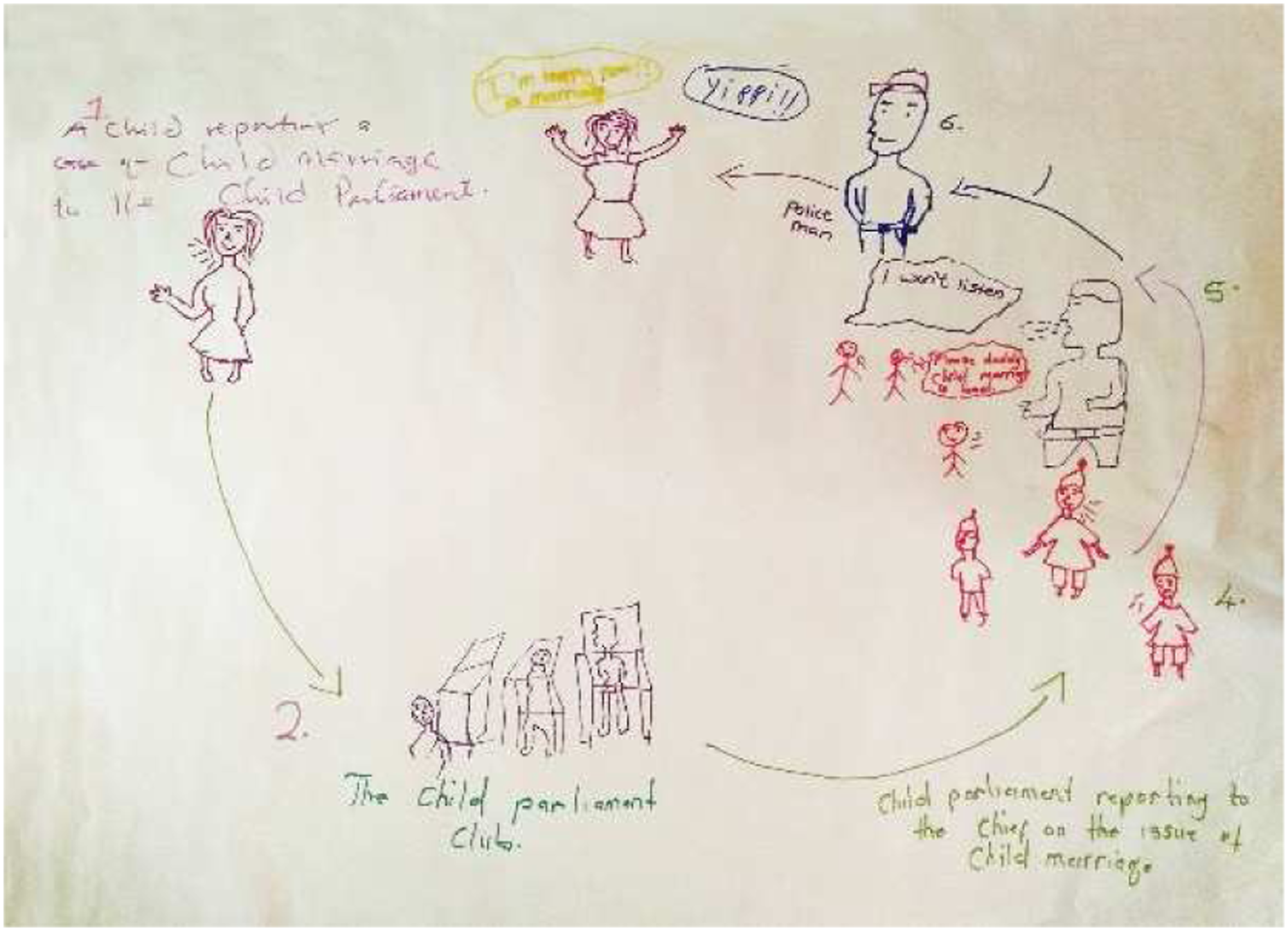
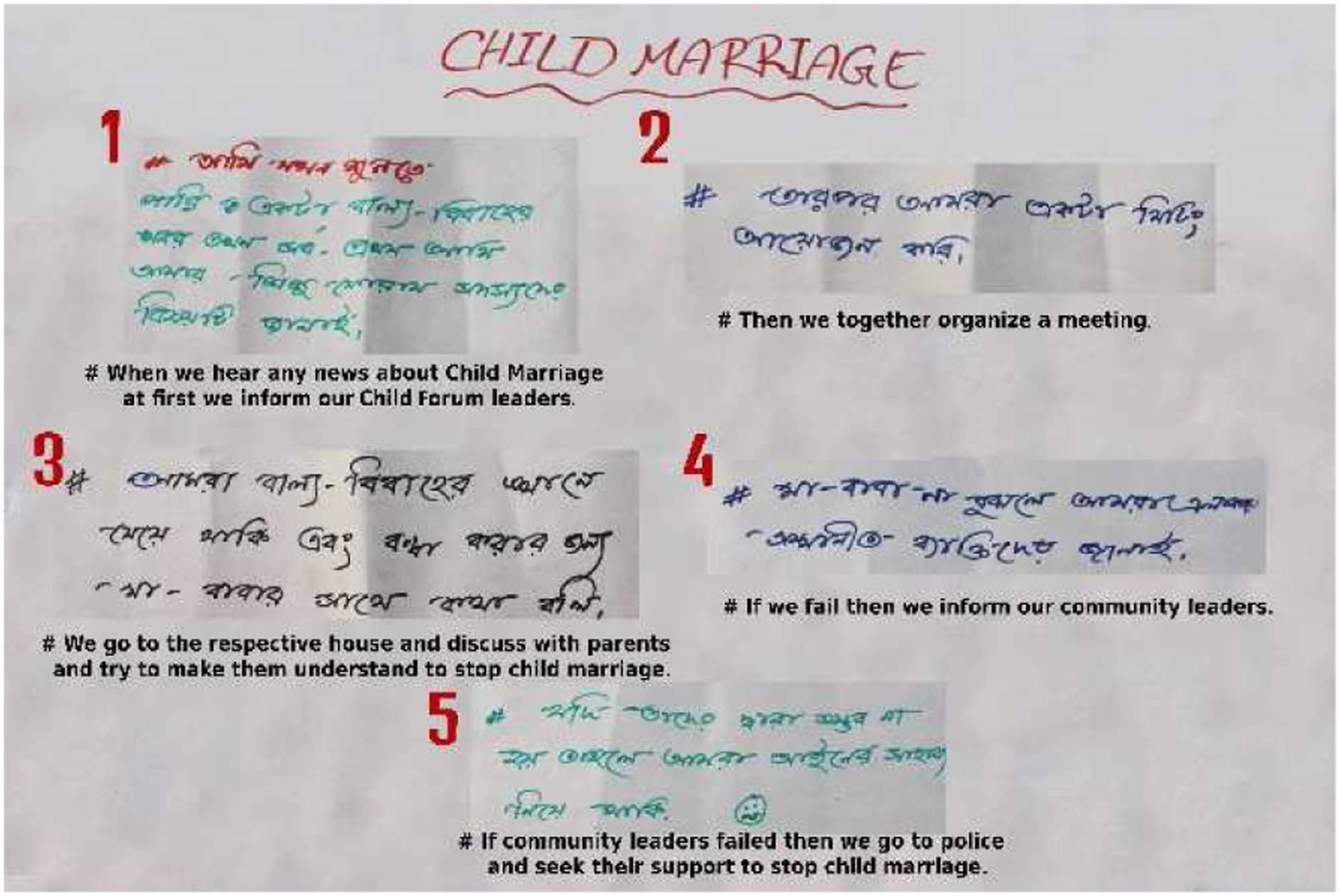
As can be seen in both figures, this often involved considerable physical mobility: children went to the key stakeholders in person, whether they be households of the potential child brides, teachers, Child Forum/Parliament facilitators, local officials or the police. In Bangladesh, this also involved considerable investigation, as the children became skilled at finding out the girl’s age through locating her birth certificate or when the girl was sitting exams, to be able to prove that the girl was under age. Thus children were investing considerable amounts of the time, often intensively, in their activism.
Such investment was frequently described by those interviewed, both adults and children, as necessary in order to mobilise the key stakeholders. This was most up front in Bangladesh, where local administrators felt overwhelmed by the scale of their geography and responsibility and increasingly relied on the children’s activity. An Upazila Nirbahi Officer (UN0)
4
, for example, shared his efforts to mobilise the community: We have some plans, but it is very tough to keep our commitments because I have more than 400 square kilometres under my jurisdiction. It is very tough to go to every side and take [care of] every responsibility. For this reason, we are encouraging community development and alertness and motivating the local people. We are trying to build up this kind of bridge with lots of people. (Local Law Enforcement Officer, Bangladesh, Interview 7)
A similarity between Ghana and Bangladesh was that children often had the information about a potential child marriage, through their peer networks, their own family situations and community connections, before other stakeholders did. Further, one professional in Ghana spoke of the power of children informing local Chiefs, because the children were seen as apolitical by the Chiefs and thus political affiliations would not dissuade local action. The children reported that in Ghana, once mobilised, police intervention was often very effective. Thus, children’s investment in going to stakeholders helped these stakeholders in turn enforce the law that they were responsible for.
This investment of time was intense for children and not always easy. This was particularly raised in Ghana, by several participants. Both the facilitator of a Child Parliament and several children spoke extensively of the time and associated efforts to undertake the Child Parliament more generally and to support the activism in particular. When asked about any negative aspects to their activism, several children in Ghana spoke of their parents feeling the children were spending too much time on the Child Parliaments. In Bangladesh, the children frequently noted the need to mobilise quickly and virtually always worked as a group, as it was not socially acceptable for girls to travel alone. But concerns were not raised in Bangladesh, by children nor adults, that the children’s activism detracted from their schooling or their time overall.
Children’s investment was invariably described by them as arising out of commitment, a passion and energy to change child marriage both for potential child brides and for their communities (see Martin, 2007, which links activism to passionate commitment, and Biswas and Mattheis, 2021 on children’s involvement in school climate strikes). In Ghana, child activists used a range of evocative words, including words associated with ‘saving’ and ‘rescuing’.
5
A typical example of this combination is: Some of us, we do it because it is an opportunity for us to help our colleagues to get saved. Even though we were not the ones going through, because one day, it might affect us, we have to start it at that moment for us to save other children in order save ourselves. (Member of Child Parliament, Ghana, Focus Group A)
This wording echoes other philanthropic activism by adults in the past, for example, where adult activism was referred to as the ‘child saving movement’ when concerns about child abuse and juvenile delinquency were being recognised more widely (Cunningham, 2005). Typically such movements are criticised as constructing those saved as purely victims and imposing power on socially deprived families and communities (e.g. see Wells, 2008). However, this wording by the child activists potentially counters such critiques because the children were of their communities and the activists were often ‘saving’ their peers and sometimes themselves from child marriage. In contrast to the words used in Ghana, the qualitative data from Bangladesh is more descriptive of their actions, which are often fast paced generating a sense of excitement. But the children and the facilitators from one Child Forum were eager to share with us documentary videos, of their actions to stop child marriages. 6 The depictions have a heroic quality, with similarities to action movies of superheroes: stirring music and the heroines striding purposively across expanses in order to stop the child marriages. Thus the children were invested in their activism because they saw it as a just cause, a heroic cause, a necessity to save themselves, their peers and to improve their communities.
The child activists very consistently expressed their personal investment in, and rewards from, their activism. Our research was with children who remained connected to their activism, so we are not able to comment on children who became disengaged from the activism. For those who persisted, they were proud in their growing confidence to act or speak publicly, their increasing knowledge about child marriage, their ‘joy’ and ‘happiness’ in saving someone from marriage (mentioned by several children in Ghana), and their public acclaim. A large minority of adults and children in Ghana, for example, spoke about child activists being recognised as ‘role models’. In Bangladesh, a Child Forum member wrote about her pride in her questionnaire: After preventing a child marriage, we take pride in ourselves. When others praise us for our work, we feel special. We feel that we have done something good for the society and that the society understands our worth. (Bangladesh)
In both contexts, the children consistently expressed the personal affirmation they felt and often received from their activities, as well as particular skills that they developed. Further, child activists mobilised, strategised, and influenced key stakeholders in order to secure children’s rights in their communities, thus challenging and transforming their societies.
Engaging and influencing adults
The research finds certain costs to children’s investment. In both Bangladesh and Ghana, some children reported feeling threatened or upset at the responses of certain parents of the potential child brides. A particularly negative response was described by a child activist: “They (the parents) yell at us … The parents sometimes threaten us that, if we go to their village, they will detain us there and rather arrange marriage for us, the Forum members” (Focus Group 1, Bangladesh). No children reported that such physical threats were carried out (and, in this case, the child went on to say they would appeal to the police) but the research did find strong memories of children feeling vulnerable because of their interventions. This was tied to adults’ views that children were acting out of place as children. Two Child Parliament members in Ghana (Focus Group B), in a typical example, discussed how the police did not always listen to them: Child Parliament Member A: Some of them, they actually insult us. They say don’t even talk to us. And some say they are grown-ups and we are not of the age to educate them. But some of them will listen to us. Child Parliament Member B: Some of them always look down on us: that we are children and we are of their children’s age and we cannot advise them.
Children could be perceived as inappropriately knowledgeable, vocal and intervening. Such concerns about children acting out of place were the most common negative responses throughout the research, whether from the parents of potential child brides, the children’s own parents, key stakeholders or other community members. However, these perceptions were reported as, overall, changing over time. Children spoke about altering views in their communities, where their activism was increasingly respected and applauded. Thus children’s activism was both threatened and curtailed by prevailing adult attitudes towards children and childhood but their activism also helped to modify these attitudes and recognise children’s contributions to change. Activism over time thus has transformative potential for all parties involved, moving (at least somewhat) from adult-led to child-led actions.
If the investment of children was vital for their success in stopping child marriage, so too was intergenerational relations. Other adults – key decision-makers, with authority and status to stop child marriages -- were influenced, educated and sensitised by the child activists. According to child activists, the reciprocal nature of these intergenerational collaborations was crucial to stopping child marriages. For example, child activists in Bangladesh engaged with UNOs over time, building up their access to such officials in instances of potential child marriages. One child activist in Bangladesh described an episode in detail: While we were trying to help a girl, many people were present in the UNO’s room. Maybe one MP or somebody important was also present there. Some more people were also wanting to meet the UNO. We went there at such a time. Everybody inside the room was busy. But when the UNO saw us, he invited us to talk with him. (Member of Child Forum, Bangladesh, Focus Group 1)
The activists in this episode were given the space and time to convey their information. Adults realised that child activists were resourceful partners: as reported above, in Bangladesh UNOs recognised that child activists were able to mobilise swiftly and provide supportive information to spot a potential child marriage, were able to provide accurate information about a child’s age and often researched the birth certificates. In Ghana, the child activists’ strategy was to make their work known to the local Chief and school principal to ensure that these key actors were aware of their activities and knew how to request the child activists’ support, when needed.
Supportive adults from the Child Parliament/Forums created the conditions required to strengthen the children’s activism on the basis of mutual respect and trust (see also McQuaid et al., 2017 for similar findings). Such intergenerational backing was perceived as welcome and essential by the child activists. This perspective resonates with Martin’s (2007) concept of ‘ecology of activism’, making parallels to how a flower or fruit is only able to grow with the support of nutrients, roots, water, distribution of pollen and sunlight. Equally, activism can only be successful if the activists are supported by people and resources that contribute the necessary skills, tools, communication means, and space – amongst other factors – to carry out their actions. This is further evidenced by interviews in Ghana, where children had not accessed such support. Interviews with potential child brides found several who knew about the Child Parliaments but were not part of them; they spoke eloquently about how they did want to help other girls not to be married, sought to take action by connecting with their friends, but felt unable to make any further difference. Without the ecology of activism provided by the peer and intergenerational support of the Child Parliaments, these girls were not linked into activism and did not feel they could influence change.
The intensity of this intergenerational collaboration varied between the two sites of Bangladesh and Ghana. In Bangladesh, child activists appeared to be more independent to make decisions and reacted quickly when a potential case of child marriage was reported. They often approached the brides’ family, on their own, without the assistance of adults. In contrast, in Ghana, most of the actions carried out by the child activists were conducted in collaboration with school staff and, if this did not work, they engaged with the local Chief or the police. One child activist mentioned a typical example: First of all, we have to go to the Chief, who is the highest among them. So if you go to tell [the Chief] anything, they will put action into it, and maybe call the parents or a meeting concerning child marriage. (Member of Child Parliament, Ghana, Focus Group A)
These findings show that the child activists’ actions included a two-way intergenerational collaboration, where children approached adults in power to gain their support while adults relied on children to identify cases and provide essential information to stop a child marriage. These adults entered into dialogue with the child activists, without the need for the adults to be activists themselves: for instance, by creating spaces for dialogue, listening to children when they reported cases and amplifying children’s credibility as advocates.
Conclusion
This research began with the interest in learning from dramatic cases of children coming together to stop child marriages. We wanted to learn if indeed their actions were successful in doing so and if so how they were successful. We found at least two ingredients as fundamental: the considerable investment of children in time, emotional energy and commitment and, somewhat to our surprise, the reciprocity of intergenerational relations built over time.
We labelled these actions as ‘child activism’, akin with examples of youth activism (e.g. O’Brien et al., 2018; Pitti, 2018) and the school climate strikes, as a provocation to the challenges of children’s participation so often found in the field. As Martin (2007) argues, activism is an action to support a cause that people believe in, for social change. Activism captures critical components of interest to this article and frequently found in the literature: the emphasis on action; the association of activism with a cause or social goal, often fuelled by passion, commitment and energy; and activism as a way of challenging social norms and the status quo in relation to decision-making (Naisargi, 2011). This research evidences that children were passionate and committed to their cause to protect girls from being married. Furthermore, children perceived a personal sense of reward as their activism contributed to promoting and protecting children’s rights more generally. Activism not only proved a learning space for children but a learning space for adults (Nance-Carroll, 2021).
We can learn from wider discussions of activism, that recognise the infrastructure for activism, the biographies of activists that detail how often they have mentors, inspirations and supporting networks (Buire and Staeheli, 2017; Keller, 2012) and the sharing of critical social capital (Ginwright, 2007). The research demonstrates how the Child Forums and Child Parliaments provided spaces for children to mobilise, to come together to strategise, to gain support from facilitating adults, and to have the information tools to influence their communities and key adult stakeholders. Staff and organisations linked the children to key community stakeholders and reframed how the children were perceived by these stakeholders, so that reciprocal relations grew stronger and more frequent over time and child activism became more successful (and more marriages were stopped). Further, the study has indicative evidence, from its interviews with some potential child brides in Ghana, that without such supported spaces, the children has the interest in and commitment to activism but not the channels to invest in it. Developing intergenerational relations that are constructively reciprocal and supportive should be embraced by the children’s rights field, rather than distrusted as not being ‘pure’ children’s participation. All activists require an ecology of support.
Children’s participation is often described as helping to change adults’ attitudes towards children and increase respect for children as social actors (see McMellon and Tisdall, 2020). Similarly, a robust research finding was how child activism constructively changed the views of activists’ parents, communities and stakeholders in relation to the value of children’s knowledge and interventions. This finding complements Bosco’s (2010) interest in children’s everyday activism and political work, which often goes unrecognised as activism and political work in their school and home contexts. But these examples of child activism go further, because they are more openly activist and are openly disruptive to child-adult and child-parent hierarchies. Both Bangladesh and Ghana are democracies and children were inserting themselves into their governance and within their communities. The research found that child activism may come with a cost in situations where children felt threatened by parents of the potential child brides or curtailed by traditional practices and attitudes towards children. However, on the whole, children perceived a general sense of acceptance and recognition of their contributions to change.
Part of the attraction of child activism is that it seems to upend generational ordering (Taft, 2011), so that adult control of children’s participation is undone and children themselves are claiming the spaces for action, deciding on their own priorities and their own solutions. This goes beyond the managed forms of children’s participation, which risk staying within the ‘status quo’ at best and tokenistic at its worst. It goes towards actual, practical change – in this case, the stopping of a child marriage – and social transformation – in attitudes and prevalence of child marriage, as well as the status of children and their rights. From the study’s findings, both practical and social changes were a result of child activism, with increasing success over time and with experience. Their activism worked across types identified in the youth activism literature (see O’Brien et al., 2018): the children worked within existing systems and power structures, for change; they contested social norms of childhood and child marriage and how laws should be enforced, thus disrupting the status quo; and the children mobilised around new norms and values, transforming outwith the status quo. Perhaps the child activism was particularly successful because it worked across all three activism types, to create change.
While generational ordering may have been upended or at least substantially reformed, child activism was still undertaken in a network of intergenerational relations. At its simplest, this is no surprise. Children are part of families, of communities and of societies; their actions are interfacing with institutional, cultural and legal contexts that involve adults as well as children; key actors within the actions involve both children and adults. But the observation is useful to recognise the relationality of children’s participation and their rights more generally (see Morrison et al., 2020; Mühlbacher and Sutterlüty, 2019). Interdependency and relationality is not a surprise to rights’ discussions and has been discussed elsewhere particularly in relation to women and disabled people (Arneil, 2002; Herring, 2018). Yet, partially because of the reaction against ‘traditional’ views of childhood that depict them as vulnerable, dependent and incapable, often the celebration of children’s agency, autonomy and competency has been privileged in promoting their rights (see Moran-Ellis and Tisdall, 2019 for discussion). Child activism encourages us to reconstruct social norms and scholarship on the basis of children’s experiences: from what we have learnt from child activists and their activism, we are encouraged to develop robust forms and understandings of human rights that can recognise their relationality yet not diminish children’s contributions nor status. Child activism can provide a fruitful space to do so.
Footnotes
Acknowledgements
We would like to acknowledge the contribution of children and young people to the research project, who were so well supported by local staff. We want to thank World Vision Bangladesh and World Vision Ghana for facilitating the research and Strala Rupa Mollick and Gregory Dery for providing research support. We appreciate the support of World Vision International for the partnership project. Many thanks to Patrick Brobbey who supported our fieldwork in Ghana. Kay Tisdall would like to thank others who have helped develop ideas on child activism, through the following projects: Economic and Social Research Council (ESRC)/UKRI (R451265206, RES-189-25-0174, RES-451-26-0685, GCRF ES/T001399/1, ES/S004351/1), the AHRC GCRF Changing the Story Large Project Grant, the European Union’s Rights, Equality and Citizenship Programme (2014–20), and the Social Sciences and Humanities Research Council of Canada.
Declaration of conflicting interests
The author(s) declared no potential conflicts of interest with respect to the research, authorship, and/or publication of this article.
Funding
The author(s) disclosed receipt of the following financial support for the research, authorship, and/or publication of this article: This work was supported by the World Vision International and University Of Edinburgh.
