



Abstract
This article examines employability discourse within school uniform policies as a way to justify uniform. The uniform policy of every publicly funded secondary school in Scotland (n = 357) was studied using content and discourse analysis. Employability discourse was grouped into three themes: School as preparation for work; school to replicate a work environment; and young people creating a good impression for employers. The rationale of the uniform is revealed as a technology through which the employer’s gaze is projected onto pupils.
Introduction
School uniform and employability may not appear connected. While the dominance of the employability agenda in higher education is well-documented (e.g. Arora, 2015; Courtois, 2019), the ways that employability is addressed in school are less prominent. In this paper we focus on employability, meaning the ability to gain employment or have the skills and abilities to be employed. In Scotland if school leavers go into education, training or employment that is called a positive destination (Scottish Government, 2012). We have found that employability or the requirement to be employable is reinforced in schools in a less obvious way, namely through school uniform policies. Employability reasoning within school uniform policies is an aspect of school uniform policies that has been noted (Raby, 2005) but not investigated before in a national dataset.
Pomerantz (2007) called for further analysis of dress codes, in particular to focus ‘on some of the more invisible practices of the school’ (p. 384). This paper sheds light on the most restrictive type of dress code, namely a compulsory school uniform. This can be regarded as a hidden practice of, on a micro level, neoliberalism and the concept (and logic) of employability being performed in secondary education. We use the term ‘neoliberalism’ to mean political beliefs that call for the state primarily to safeguard individual liberty, in particular commercial liberty, and to protect private property rights and ‘the good and virtuous person who is able to access the relevant markets and function as a competent actor in these markets’ (Thorsen and Lie, 2006: p. 15). Reay (2017) found that young people she interviewed whom she described as ‘good neoliberal subjects’ expressed individual responsibility for their education success, or lack of it (p. 96). Through a neoliberal lens, then, we can understand school pupils as being responsible for their own level (or lack) of success in the jobs market. We had in mind Foucault’s concept of governmentality when analysing the school policies and sought to answer the question: how do school uniform policies make links to future employment through employability? The significance of this study is in how it reveals school uniform as part of a toolkit that normalises pupils into becoming self-regulating workers as part of ‘the policy juggernaut of neoliberal economics’ (Doherty, 2007: p. 203).
Unlike much of Europe, in the UK including Scotland, school uniform is still the norm and schools without a uniform are unusual. Therefore, in this study in Scotland we examined how school uniform policies impart the notion of school for employability and employment rather than looking at looser ‘dress codes’. Critical discourse analysis of the school uniform policies of publicly funded secondary schools in Scotland (n = 357) uncovered a focus on employability embedded within the explicit reasoning for schools adopting and/or retaining a school uniform in 15% of the schools (n = 53). We found this employability agenda present in three distinct ways in uniform policies: School as preparation for work; school to replicate a work environment; and young people creating a good impression for employers.
In the literature review below we consider employment and employability discourse, the rationale for school uniform and provide our theoretical framework. After the literature review we provide details of our research study method and then share the findings of our research. The findings are then discussed, and we conclude the paper with possibilities for change with the proposed incorporation of the UN Convention on the Rights of the Child into Scots law.
Literature review
Employment and employability discourse
Seminal work in the 1970s on the relationship between school and employment, what we might now call employability, emphasised the role of cultural reproduction, namely the maintenance and perpetuation of cultural forms, such as social inequality and privilege, and cultures themselves, from generation to generation (see e.g. Bowles and Gintis, 2001; Willis, 1977). Part of this cultural reproduction can be seen in the ongoing tradition of school uniform in the UK. There are many ways in which schools can be understood as playing a part in producing a compliant workforce. Organisations such as the OECD (2015) have called for the involvement of employers in designing and providing education programmes, as did the Scottish Government’s Commission for Developing Scotland’s Young Workforce (2014).
The discourse of employability has, since its popularisation in the 1980s, replaced discourses of lack of jobs and unemployment or employment, shifting the focus to the employability of individuals (or lack thereof) (Fejes, 2014) in line with neoliberal policies. In the UK the move in emphasis to employability in schools has been accredited to New Labour (McQuaid and Lindsay, 2005). The employability turn can be seen more broadly in the European Union’s move to the investment state, similar to the policy advocated by the Ordo-liberals in post-WWII Germany, namely, that welfare policy should regulate the inequalities generated by liberal economic policies as well as investing in producing the workers required by the economy who are also expected to invest in the self, thus welfare is privatised.
The focus on employability changes a social problem (unemployment, job shortages) into an individual problem (lack of employability, i.e. ‘skills’). Individuals are, thus, urged to make themselves ‘competitive’ in a job market which is characterised by precariousness. It is understood and accepted that the labour market has become more flexible and global competition has increased (Tomlinson, 2012). A common analysis by policy makers of the issue of unemployment is that unemployment is due to the low skills and aspirations of the young unemployed and that it can be solved through ‘up-skilling’; thus, reflecting a focus on the supply-side (MacDonald, 2011). The suggested solutions for integrating young people into the labour market have, therefore, been centred on the individual, urging them to develop certain skills. Cuzzocrea (2015) describes the neoliberal assertion of individuals being able to shape their own destinies regardless of structural limits as the greatest weakness of the employability concept and argues that it has damaging consequences for young people who as a result likely blame themselves for lack of employment.
Work attire has moved in different directions in the twenty-first century with some companies moving to more formal workwear and then having specified days for casual dress while other employers, particularly in newer, technology-focused commerce, have adopted more informal dress codes (Peluchette and Karl, 2007). Just as there is little research on workplace wear and styles and employee preferences (ibid), there is sparse research on what children and young people would like to wear at school.
The rationale for school uniform
From the outset it is important to distinguish between school uniform policies and dress codes. Paliokas (2005, cited in Freeburg and Workman, 2016: p. 1) marked out six levels of restriction: none at all; a general dress code with broad principles; a detailed policy which focuses on what not to wear; a voluntary uniform; a compulsory uniform that can be opted out of; and, finally, a fully prescriptive uniform with no opt-out. In Scotland, where this research was carried out the vast majority (96%) of publicly funded secondary schools had the final category of uniform with a policy that both prescribed and proscribed items.
Various arguments are made for and against school uniforms in the countries where uniforms are mandated. Justifying compulsory school uniform on the basis that it will help make school students more employable is quite different to the egalitarian argument that school uniforms reduce social class indicators between children (Gereluk, 2008). The egalitarian argument has grown weaker as school uniform has become more expensive and is not easily affordable for families on low incomes even with financial support from their local authorities/municipalities (Child Poverty Action Group 2015; Children’s Society, 2020; Shanks, 2020). As well as egalitarianism, other reasons have been given for school uniforms and dress codes in the UK and elsewhere, such as reducing gang presence and violence, security, school ethos and identity, and achievement (Bodine, 2003a; Gentile and Imberman, 2012; Gereluk, 2008; Lopez, 2003; Wade and Stafford, 2003). The Scottish Government puts forward three advantages with school uniform: avoidance of potential competition between pupils over clothing brands which in turn helps to reduce bullying; creating a positive image of the school within the local community; and making it easy for staff to identify who belongs to the school (email communication, 17 February 2021). There is inconclusive evidence that school uniforms improve discipline and academic success (Reidy, 2021; Sanchez et al., 2012; Han, 2010; Yeung, 2009; Bodine, 2003a). Reidy’s (2021) review of evidence, conducted through a public health lens, found more negative impacts than positive benefits.
Analysis of school uniforms has previously recognised their importance as a means of securing conformity and ensuring affiliation by pupils (Synott and Symes, 1995). Bodine (2003a) highlights how the school uniform ‘sits at the intersection of debates on broad and contested issues surrounding childhood, including childhood as protected space, youth safety and violence, egalitarianism, social inclusion/exclusion, family stress, tension between individual and community rights, and a power struggle over shaping the environment of childhood’ (p. 43).
That the school uniform is shaped by such ‘socio-political rationales’ is further echoed in a recent review by Reidy (2021), who argued that ‘a country’s history, power structures, and socio-economic patterns’ are ‘played out through uniforms’ (p. 8). Framing school uniforms through a public health lens, Reidy’s (2021) review revealed that whilst appearing simple, school uniform impacts on health and education and has a negative effect on poorer pupils, girls, pupils from religious and ethnic minority backgrounds and gender-diverse pupils. Thus, rather than accepting school uniform or taking it for granted, in this research we investigated the justifications for it in relation to employability drawing on the work of Foucault.
Theoretical framework
We have used the Foucauldian notion of governmentality as a lens through which to frame the employment-related parts of the school uniform policies (Foucault, 1975/1995). In the Foucauldian sense, governmentality is both what the state does to the citizen and what the citizen does to themself (ibid). Thus, while the school uniform policies may set out what is allowed and what is banned in a school uniform, there is a reliance on the pupils to self-govern what is acceptable and allowed within their school (Meadmore and Symes, 1996). A governmentality analysis provides a framework to examine the school uniform policies. It highlights the regulation of the self and the active formation and reformation of the citizen (Doherty, 2007).
Foucault wrote that in the seventeenth and eighteenth centuries power had to be able to gain access to the bodies of individuals, to their acts, attitudes, and modes of everyday behaviour. Hence the significance of methods like school discipline, which succeeded in making children’s bodies the object of highly complex systems of manipulation and conditioning (1980, p. 125).
We can understand school uniform policies as accomplishing this by exerting power over school pupils’ bodies in relation to what and how they wear their clothes, what jewellery they wear or do not wear. Foucault holds that individuals are produced alongside other societal institutions through certain technologies acting on individuals’ bodies and souls’ ‘régimes of appearances’ (Dussel, 2004: p. 86). Foucault’s (1975/1995) notion of ‘docile’ bodies was used by Swain (2003) who noted that in schools, bodies are treated in two ways, collectively and individually, with the schooling system seeking to control both.
This paper seeks to contribute to the Foucault-inspired literature on school uniforms (e.g. Friedrich and Shanks, 2021; Happel, 2013; Dussel, 2004; Meadmore and Symes, 1996) to see what uniform policies tell us about the regulation of school pupils in Scotland. From Foucault’s work we can see how uniform policies are not only important in terms of what they state, what is allowed and what is not allowed, but also in terms of how the enforcement of the rules is carried out, not by teachers, but by the pupils themselves. Dress code policies may function as ‘a way to assist adolescents to thrive by providing boundaries and expectations for dress’ (Workman and Studak, 2008, p. 323). This highlights how such policies are often infused with assumptions and status quo-maintaining beliefs of what is considered morally correct, and that what pupils wear sets examples for appropriate conduct (Craik, 2003; Pomerantz, 2007). School uniform, thus, can be understood as a ‘a way to control, cloak, or restrict the extended body’ (Carlile, 2018: p.25). Furthermore, it has been argued that by associating the school uniform, which is traditionally masculine, with professionalism, masculinity is conflated with being professional (Edwards and Marshall, 2020). Several research studies have highlighted the entrenchment of gender differences in school dress codes and uniform policies (e.g. Edwards and Marshall, 2020; Happel, 2013) with extra attention on what girls are to wear (e.g. Pomerantz, 2007; Raby, 2010).
In her analysis of codes of conduct in Canadian schools, Raby (2005) argues that school rules are infused with attempts to shape young people’s agency ‘to a narrow, individualised and obedient self-discipline through a discourse of responsibility’ (Raby, 2005: p.77). Thus, it could be said that the individual pupil is made responsible for his or her own future. This fits with Foucault’s arguments regarding bio-power/politics and governmentality and the entrepreneurial self (Aghasaleh, 2018). In this way, individuals are blamed and become responsible for structural failure. Raby argues that student conduct is frequently linked to future employment: Most notably, dress codes are often justified by making references to preparing students for the ‘world of work’ (Raby, 2005: p.78). It is argued that this represents a hidden curriculum, in which students are shaped to be a certain ‘kind of worker’ (Raby, 2005: p.77). The types of dress and conduct encouraged – in particular, the formal style of uniforms and emphasis on respecting authority – suggests that students are being prepared for middle class or white-collar work, rather than for example other types of work or self-employment. While in the past schools could be seen as preparing young people to be part of ‘a disciplined workforce, installed with the habits of the factory regimen, those of diligence and an unquestioning servitude’ (Synott and Symes, 1995: p. 144), in other words for working class jobs (Willis, 1977), where a uniform would often have been needed for work, many of these jobs no longer exist, having been automated, and so the school uniform seems more linked to the aspiration of white-collar work.
In this study we sought to answer the question: how do school uniform policies make links to future employment through employability? We analysed the school uniform policies which explicitly stated how school prepares pupils for work through what they wear and contend that such an analysis provides insights into what is regarded as the underlying purpose of education and how it thus entrenches traditional social hierarchies rather than promoting social mobility or social justice.
Method
This project involved data collection from the websites of every one of the 357 publicly funded secondary schools in Scotland (Scottish Government, 2019). Almost all publicly funded secondary schools in Scotland have a website with information for parents/carers, pupils and prospective parents. The schools are legally obliged to produce a school handbook under the Education (School and Placing Information) (Scotland) Regulations 2012, review it annually and publish it on the official school website. The school websites usually contain the school handbook and other publicly accessible information on school uniform policy such as newsletters for parents.
While no sensitive information about schools or individual school pupils was collected ethical approval for the research project was gained from the second author’s institution. Students who helped to source and code the data (including the first author) signed consent forms agreeing to their research work being used by the second author. Information on each school was extracted from the secondary school dashboard (Scottish Government, 2020). The researchers located the school handbooks and uniform policies, downloaded them and then imported the files into the computer assisted qualitative data analysis software programme NVivo (Paulus et al., 2014). It was found that 343 of the schools (96%) had a compulsory school uniform which included items to wear and items not to wear to school. Of the 14 schools that did not have a compulsory school uniform, 3 had an optional or ‘unofficial’ uniform. For this paper we have focused our analysis on the 96% of schools that had a compulsory school uniform. There was no less formal uniform for older pupils, in fact in some schools the uniform became more formal with senior pupils being required to wear a blazer when younger pupils did not have to. Among the 357 schools there are 52 denominational schools (15%), all are Roman Catholic, and all have a compulsory school uniform.
Each school was treated as a separate case in NVivo, and attribute values were assigned to each case, for example its local authority (municipality), whether it was a denominational school, the level of deprivation according to the Scottish Index of Multiple Deprivation. Thus, differences between local authorities, between denominational and non-denominational schools and across deprivation levels, could be explored through coding queries (Bazeley and Jackson, 2019). Initial data analysis was similar to the content analysis undertaken of the student dress codes in 122 schools in North Carolina (Edwards and Marshall, 2020). As Cohen et al. (2018) state, content analysis ‘simply defines the process of summarising and reporting written data – the main contents of the data and their messages’ (p.674). This content analysis can also be described as first cycle coding (Saldaña, 2016). The coding began with the identification of the reasons given for having a school uniform. Later in the data analysis process, coding comparison was undertaken to ensure that there was reliability in the coding (Bazeley and Jackson, 2019). All the coding comparison queries, performed within NVivo, resulted in coding comparison similarity of over 90%.
While coding the reasons for school uniform, further codes were added inductively, and it was in this way that employability was identified by the first author as one of the justifications for having a compulsory school uniform. After identifying instances, or units of analysis, relating to employment and/or work through content analysis/first cycle coding, we then moved to a second cycle of coding (Saldaña, 2016). Critical discourse analysis was appropriate to use as we identified the recontextualisation of neoliberal discourse in the school policies (Fairclough, 1993). As Doherty (2007) notes, ‘the discourses embedded in policy texts operate to constitute, position, make productive, regulate, moralise and govern the citizen’ (p. 195) and this can take place at the micro level (p.201). While not typically performed together, Hardy et al. (2004) have pointed out that discourse analysis and content analysis can complement each other in the search for social reality
Coding of employability related reasons for school uniform.
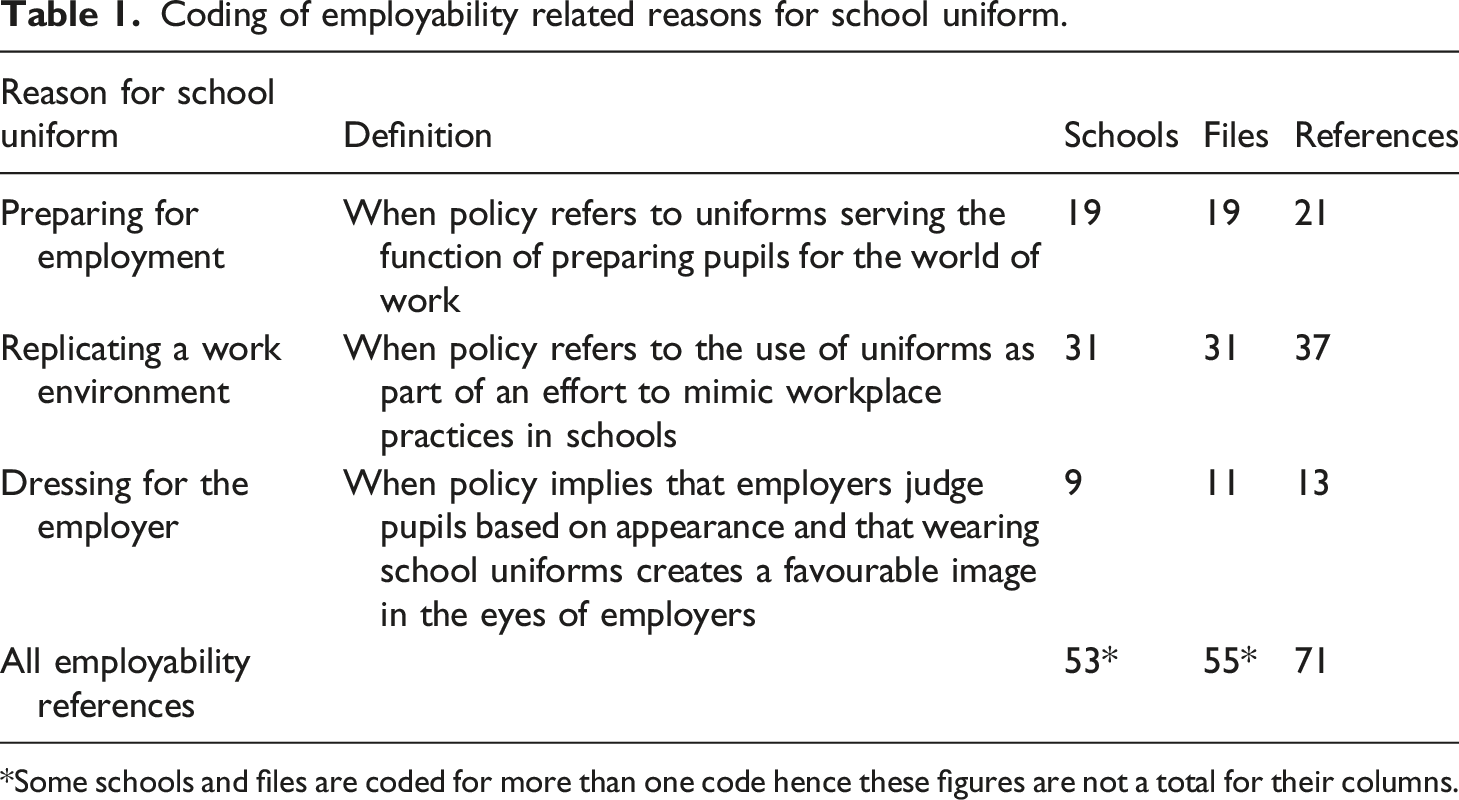
*Some schools and files are coded for more than one code hence these figures are not a total for their columns.
A comparison of the attribute values of the schools was undertaken to examine whether schools that referred to employment, work or employers were more or less likely to be denominational schools and/or have lower or higher levels of deprivation, but no common factors were found. No schools had files which were coded for all three codes. Only two schools (numbers 24, 41) had a file which contained coding for the employer’s gaze and another code (replicating a work environment). Just four schools had documents that were coding for both preparing for employment and replicating a work environment (schools 15, 33, 42, 43). The small amount of overlap in the coding of the three sub-themes shows that the definitions of the sub-themes were mutually exclusive and worked to highlight different themes in the school uniform policies, handbooks and communications with parents.
Numbers are given to denote the different schools that were coded under the employability codes and letters for other schools rather than provide the names of the schools. The results from the coding are analysed below.
Findings
The three employability themes will be examined in the remainder of the paper. The first encompasses explicit or implicit references to school as a preparation for the workplace, revealing the role of the uniform in producing ‘docile’ bodies ready for work. The second theme illustrates the usage of the uniform in the practice of replicating a work environment in school, and how this practice further disintegrates the distinction between education and industry as well as reveals an idealisation of professional work within schools. The third theme relates to the practice of using school uniforms to teach young people to dress for future employers, to project the employer’s gaze onto themselves and thus foster an internalised employer’s gaze in young people. In exploring these themes, we discuss how school uniforms exemplify a micro-level manifestation of market logic and employability discourse in secondary education, as well as what effect this might have on pupils and education as a whole.
School uniforms as preparation for work
The first theme identified in the policies concerns the use of uniforms to prepare pupils for the workplace. In the uniform policies, nineteen schools included justifications of uniforms as ‘preparing for the world of work’ or ‘the workplace’ (schools 2, 3, 4, 7, 10, 11, 13, 15, 18, 19, 25, 29, 33, 37, 39, 42, 43, 50, 53). Policies included statements like ‘smart or professional levels of dress are expected, and dress codes/uniforms are common’ (schools 29, 43). Eight schools used the specific phrase ‘world of work’ (schools 3, 4, 13, 18, 25, 29, 39, 50). The uniform itself suggests which world of work is being referred to, as the traditional white shirt, blazer and tie is associated with managerial and professional work. This world of work is characterised as a place of obedience and set standards: The workplace (…) where most of us will be expected to dress appropriately and follow the rules of the business (Uniform policy, School 42). Many employers nowadays require high standards of personal appearance from their staff. Encouragement to take a pride in their appearance at school will help to prepare pupils for the standards they will be expected to adopt when they eventually leave (Uniform policy, School 11).
By learning at an early age to adhere to such rules, pupils are being prepared for their future jobs. In other words, the school uniform is used as a tool for shaping pupils into self-disciplined workers who are aware of how they appear to authority and who will easily take to dress code policies that are enforced at work: Becoming familiar and comfortable at school with the concept of Professional Dress Code introduces young people at an early age to the concept of dressing for work. This is becoming increasingly important as a growing number of businesses/employers are now insisting on either a uniform or a Professional Dress Code which expressly forbids leisure-type wear or dress which is at the extremes of fashion (Handbook, School 43).
These passages emphasise the school’s role in preparing the pupil for the workplace and may reflect an increase in links between education and industry. In preparing pupils ‘for the world of work’, schools are anticipating the needs of employers and preparing children to meet these needs. It becomes the responsibility of individuals to adapt to the needs of employers, and employment is secured through improving employability (that is, the ability to meet employer demands or preferences) of each individual.
Replicating a work environment
Within the second theme, we outline how school uniforms are said to replicate a work environment at school. By simulating the workplace, a smooth transition from school to work is meant to be ensured. This intention to use uniforms to ‘replicate a work environment’ at school was either implicitly or explicitly referred to by 31 schools. In turn, it reveals a ‘not so hidden’ blurring of the distinctions between school and the workplace: Our Dress Code emphasises a smart and professional appearance – school is after all a workplace not a casual or leisure-based environment and we encourage all our youngsters dress to reflect this (School Handbook, School 43).
Terminology borrowed from the business world, such as ‘culture of success’ (1 school), ‘business-like’ (4 schools), ‘professional work ethic’ (9 schools) was also found in these passages with one school even introducing ‘casual Friday’ (cf. Guerra, 2019: p. 167). The professional workplace, as it is characterised by ‘smart’ clothing, efficiency, punctuality and ‘good manners’, becomes the role model for conduct and dress in the school. One school stated in its policy, the benefit of uniforms in achieving the aim of creating a productive working environment: Our school uniform (…) also puts pupils in a ‘work mode’, separating school from social time. There is a very obvious difference in the way young people approach their class work on occasions when we have a ‘non-uniform day’. They are more relaxed and in some cases, less focused on the work. (Handbook, School 17).
Some school policies also reveal an element of performativity in this endeavour, the schools appear to be mindful of their position in a competitive market: The public, including employers and people associated with further and higher education, generally look favourably on school [sic] where uniform is worn. It is in the interest of every member of the school that the school is viewed favourably in the community (Handbook, School 41).
This passage demonstrates how using uniforms to mimic workplace practices at school is not only for the sake of ‘promoting a professional work ethic’ in children, but also in order to ‘display a professional image’ to groups of high social standing (‘employers’, ‘people associated with higher education’) as well as the wider community. This performative element of the uniform reveals the cultural capital associated with office ‘professionalism’, as well as the school’s role in reinforcing this association in children and young adults.
In sum, this theme illustrates a tendency to view school as a mock version of the workplace. By simulating expectations and rules that exist in the workplace, school becomes a place where pupils are encouraged to play or pretend at being workers with some schools even implying that the pupils should regard themselves as workers (see extracts from schools 43 and 17 above).
Projecting the employer’s gaze
The last theme concerns the ways in which discourses linking school uniforms to the job market influence the subjectivities of pupils. The performative element of the uniform, and the emphasis on whom this performance is put on for (future employers), shapes the subjectivities of pupils in important ways. In the policy documents, school uniforms are commonly justified as creating a positive impression amongst the wider community, and, specifically, amongst ‘future’ or ‘potential’ employers. This implies that individual pupils should be mindful of how they appear to these employers. Ten schools refer specifically to the importance of the appearance of pupils in the eyes of the employer, for instance: Rightly or wrongly, members of the public and prospective employers often judge a school by the appearance (as well as the behaviour) of its pupils. It is therefore important that [School 21] pupils create a good impression of themselves and the school (Uniform Policy, School 21).
The emphasis on ‘appearance’ in the passage above is noteworthy, considering the specific type of appearance that is favoured in the traditional uniform - i.e. masculine, white, middle-class (Raby, 2005; Edwards and Marshall, 2020)- and also the type of garments that are forbidden in these policies - i.e. clothing that ‘reveals’ the female body or clothing associated with ethnic minority groups (Pomerantz, 2007; Edwards and Marshall, 2020). It reinforces the idea that there is a certain image that will be preferred by employers and as such is associated with success - an image that is in turn modelled after the appearance of members of specific social groups. Guerra (2019) writes of business attire in the City of London ‘the normalizing gaze is shifted from superiors to participants in the corporate field’ (p. 167, italics in original). In a similar way, school pupils might internalise a hypothetical employer’s gaze onto themselves when dressing for the school day.
An important distinction should be made between these kinds of statements and those relating to preparation for the workplace: whilst the latter emphasises the need to teach pupils how to dress for employers in the future for the employer’s gaze, the present rhetoric implies that they should be mindful of how they appear to these employers now, as if their secondary school existence has an important bearing on their success as adults: Our links with the community, local business and industry are very strong and if the uniform commands respect it can only enhance our students’ future prospects of employment. (Handbook, School 44)
The majority of these schools also align the reputation of the school with the success of the individual pupil, either implicitly or, as in the following passage, quite explicitly: There is no doubt that a community partly judges its school on the standard of dress of its pupils, and that the reputation of the school is liable to have some impact on their life after leaving (Handbook, School 6).
Both the emphasis on dress as well as school reputation implicitly acknowledges that future success will not be dependent only on skill and merit, but also on symbolic signifiers, like appearance, (a specific kind of) self-presentation, and which school one has attended. Effectively, pupils are reminded to think about, and cater their appearance towards, the employer’s gaze.
Discussion
Analysis of school uniform policies presented in this paper demonstrates how uniform in some schools is justified through an employability discourse. In the first theme (uniform as preparation for work), we see how school uniform is justified through preparing pupils for the so-called ‘world of work’ as found by Raby (2005). In the second theme (replicating a work environment), we see how uniforms are justified as a way of creating a ‘mock workplace’. Pupils are prepared for the conduct and self-presentation that employers will expect them to demonstrate in the future. However, the emphasis on uniforms lags behind many work environments. In the third theme (dressing for the employer: projecting the employer’s gaze), we see how this linkage of school and work is manifested at the level of the pupil. In this instance the uniform is used in an attempt to foster a specific self-consciousness, encouraging pupils to cater their self-presentation towards a certain image of professionalism that is believed to be favoured by employers. Three observations arise from our analysis in relation to the place of the market, the type of worker needed and the projection of the employer’s gaze and are discussed in turn below.
First, there seems to be a focus on educational institutions to subjugate young people to the market. In the uniform policies, we have pointed out the implicit or explicit ways that school is regarded as preparation for the world of work. The specific phrase ‘world of work’ echoes the employability discourse present in UK higher education, where the ‘world of work’ is strongly linked with ‘the real world’ (Fotiadou, 2020). This distinction made between the educational world and the ‘world of work’ implies that the theoretical and educational world is less ‘real’ and thus less important (ibid). In turn, this establishes a hierarchical relationship in which the educational sector derives most of its importance from its preparatory role of creating workers for the world of work, suggesting education possesses little value in itself. The justification of the use of school uniforms to help with the job market could be seen as a shift in the culture and authority of educational institutions. The use of business-related terminology and concepts within school (‘professional image’, ‘culture of success’, ‘casual Friday’, and so on) appear to imply that school must emulate workplaces in order to be relevant.
Our second observation concerns the effect of justifying and enforcing uniforms by linking them to employment. It seems to reveal a perspective on education not as an emancipating process through which individuals gain the intellectual tools to act upon the world, but rather as a top-down process of pupils being shaped to fit into a reality that they cannot change (Reay, 2017; Freire, 1996). Indeed, this is the sentiment found in the logic of employability discourse, where scarcity of jobs is a fact of life to which subjects must adapt. The question of the purpose of education hints at a larger, more philosophical debate, beyond the scope of this paper. For the moment, however, we can at least imagine what alternative purposes of education might be, for example, school as a place of emancipatory exploration, critical thinking and spontaneous self-realisation. Biesta (2009) argues that questions around the functions and purpose of education have been forgotten: ‘there is in general much discussion about educational processes and their improvement but very little about what such processes are supposed to bring about’ (p. 36). In an educational culture of measurement and performance indicators, it is clear to us that a serious re-engagement with the purpose of education beyond its role in ‘preparing for the world of work’ is necessary.
Through the discourse of using uniforms to ‘stand out’ as a good future employee (which is ironic, considering that uniforms bring conformity) and appeasing the preferences of employers, young people are taught the ‘taken for granted’ of subjugation to employers’ demands. Thus, this aims to create not just a docile worker, but an attentive one, ready to anticipate and adapt to employer preferences (cf. Friedrich and Shanks, 2021). From subservient bodies in school (Swain 2003) to obedient ones in the workplace. The emphasis on pupil conformity reveals what at first appears to be a tension between the disciplinary nature of enforcing mandatory uniforms and the neoliberal discourse of individual choice and responsibility, however both lead to individuals being made responsible for what happens to them. Furthermore, it entrenches what could be called a white male way of presenting oneself to the world (Aghasaleh 2018; Edwards and Marshall 2020; Graham et al. 2017; Happel; 2010; Raby 2005; Bodine 2003b).
Our third observation relates to the regulation of pupils’ bodies through the uniform policies. From reading the policies we cannot tell if the pupils comply with the requirements of what to wear and what not to wear as there may be internalised and non-internalised compliance as well as challenge and resistance (Raby and Domitrek, 2007). Most of the time it may not be the teachers and/or headteacher who police the uniform policy, it could be the young people themselves, when deciding whether to wear an item and/or how to wear it without breaching the uniform policy. However, from our analysis of school policies we cannot predict the level of compliance or how often disciplinary sanctions, mentioned in the policies, are used. Our analysis of the policies shows that those which refer to employability (n = 532) are trying to replicate a workplace environment and/or to prepare pupils for work, and in turn summon the presence of a fictional employer whose gaze is being projected onto pupils’ bodies.
In this work we have tried to answer Pomerantz’s (2007) call to focus analysis of dress codes on an invisible practice. The school uniform policies we have analysed in detail here, have gone beyond ensuring conformity, and have implied that to be employable young people must adhere to a strict uniform policy. As Craik (2003) and Carlile (2018) have stated, the implication is that young people’s inner selves are being controlled. To avoid the attention of teachers or because the policy discourse has been normalised, young people could be internalising the uniform rules (Meadmore and Symes 1996). Thus, when employability reasons are given for their uniform, the schools can be said to be projecting the employer’s gaze onto the pupils, but it is not known to what extent the pupils internalise it (Foucault, 1980).
Conclusion
While it was possible to analyse the school uniform policy of every publicly funded secondary school in Scotland that had one (n = 343), the study did not include an examination of how the policies are enacted and as mentioned earlier 15% of the policies were found to refer to employability (n = 53). This minority of schools explicitly embed employability discourse in their uniform policies, future work is needed to see if these schools are early adopters of practices that become more widespread, where else employability discourse is embedded in other school policies and practices, and how it is dealt with by pupils. As Doherty (2007) has noted, using a Foucauldian lens of governmentality, policy should be read with ‘an insatiable concern for the resistance, subversion, penetration, failures and conflicts of operationalised policy’ (p.201). Raby and Domitrek (2007) found compliance, investment and challenge when researching school codes of conduct. Therefore, further research is also required to uncover what forms or challenge, resistance these policies generate.
In school handbooks and uniform policies, the presence of an employability agenda represents a semi-hidden or opaque curriculum which implies that young people should be presentable and employment-ready, conforming to the market and the workplace, and their subordinate role within it. Our findings illustrate that in some schools, justifications for school uniforms are formulated through an employability discourse which emphasises individual success and responsibility. The ‘taken for granted-ness’ of emulating a workplace, in part through the uniform, reveals educational institutions’ view of their main role as being to prepare pupils for future employment. Furthermore, this linkage of school uniform to workwear is becoming more mismatched as there has been a general decline in the wearing of suits and ties (Godwin, 2019) to work and the Covid 19 pandemic and the rise in working from home is likely to have accelerated these trends.
The rationale of the uniform is revealed as a technology through which the employer’s gaze is projected onto pupils. This opaque or hidden curriculum (Raby, 2005) has implications for school leaders, the teaching profession, and for young people themselves. In particular, the incorporation of the UN Convention on the Rights of the Child into Scots law means that schools will have to ensure that children and young people are involved in decisions, such as school uniform, dress code and appearance policies, in order to comply with Article 12. Our analysis raises serious questions around what pupil voice means when children are responsibilised with furthering their own human capital. It is questionable what degree of choice can be present when one alternative is framed as a necessity for success and the other as having a detrimental impact on one’s future. As such, while we might presume that the young people themselves would not choose a school uniform that could be said to resemble the attire of a twentieth century white male middle class office worker, it is possible that because pupils have internalised the employer’s gaze, given a choice, they might choose the most formal school uniform because that is what they associate with success.
Footnotes
Acknowledgments
We wish to thank the students who were involved in the original sourcing and coding of school uniform policies, namely Lucas Adrian Brauns, Agata Kostrzewa, Marton Kottmayer, Kirsten Phelps, Daniel Phillips, Vilma Pullinen, Atyrah Hanim Razali, Cameron Roy, Maria Steiner Simonsen, and particularly Jasper Friedrich who provided feedback on this work. We also wish to thank Prof Pamela Abbott for her insightful comments on an early draft of the manuscript and the two reviewers who provided very useful feedback.
Declaration of conflicting interests
The author(s) declared no potential conflicts of interest with respect to the research, authorship, and/or publication of this article.
Funding
The author(s) received no financial support for the research, authorship, and/or publication of this article.
