




Abstract
This article uses a life-course approach to investigate how and why migrants’ feelings of belonging change between childhood and young adulthood. Drawing on 24 in-depth retrospective interviews with young Romanian migrants who moved to Italy as children, the paper shows how young migrants’ belonging is shaped by the nature of social relations and by the level of acceptance or exclusion expressed by others in the receiving and origin countries, under specific institutional and socioeconomic contexts. Overall, the study demonstrates how life-course methodologies are an essential tool to capture the dynamic, changing nature of belonging.
Introduction
The scale of international migration has increased in recent decades, with children being a significant part of this mobile population. According to the most recent global estimates, there are about 31 million migrant children and—in line with predictions on the impact of environmental and climate changes—these numbers are bound to go up (International Organization for Migration, 2019). For this reason, it is crucial to understand how children adjust to a new environment. As their life experiences “straddle two or more nations, cultures, and languages” (Roberge, 2002: 107), migrant children find themselves in a complex situation. On the one hand, as social actors, migrant children actively engage with and try to make sense of the new social and relational contexts of their host country. On the other, children maintain transnational connections which anchor them in two or more places. As a result, children’s identities and sense of belonging are challenged and transformed.
Belonging—the feeling of being accepted by others as members of a group or community—is an essential human need (Maslow, 1967). Not being able to satisfy this need can lead to feelings of loneliness, mental distress, and even depression (Baumeister and Leary, 1995). Given the challenges that geographical mobility entails to the lives of both families and children, understanding how belonging works is therefore essential. Drawing upon a qualitative study of Romanian migration in Italy, this article provides vital data on the reflections of young adult migrants about their experiences of moving to a new country as children and the impact of migration on their sense of belonging. Using a life-course approach on retrospective narratives, this article contributes to better understanding how the complicated interaction between individual and contextual factors helps construct and transform belonging.
A growing body of literature using belonging as a central concept has emerged since the 2000s (Yuval-Davis, 2006). Researchers have examined how migration creates multiple belongings (Colombo et al., 2009) and hyphenated identities which are constantly being negotiated (Cuervo and Wyn, 2014), focusing on the complex relationships between immigrant identity and place (Gilmartin and Migge, 2015) and the process of “making home” (Boccagni and Brighenti, 2017; McDonnell, 2021). The impact of migration on children’s lives has also been explored (Moskal and Tyrrell, 2016). Demonstrating that children engage in various cross-border transactions and maintain multiple attachments, these studies delve into children’s complex negotiations of identity and belonging, disrupting conventional understandings of belonging and family practices (Katartzi, 2018; Ní Laoire et al., 2011; Portes and Rivas, 2011; Tyrrell et al., 2019; Vildaitè, 2014). More recently, scholars have given great attention to the impact of Brexit on young people’s feelings of national identity and sense of belonging, as well as their future plans (Sime et al., 2020).
Building on this existing literature and on theoretical work on belonging and biographical perspectives (Rosenthal and Bogner, 2009), this paper contributes to the literature by looking at belonging as a temporal process, using a rich retrospective life-course approach. It does this by exploring how the question of migrants’ belonging arises and is continuously constructed and reconstructed over time from childhood to the transition to adulthood. By considering belonging as a result of the interaction between personal and family stories in specific socio-cultural contexts (Al-Rebholz, 2015; Rosenthal and Köttig, 2009), this article contributes to the literature by examining two key research questions: (i) How does belonging change throughout migrants’ life course from childhood to the transition to adulthood?; and (ii) What factors induce change in migrants’ sense of belonging from childhood to young adulthood?
The article contributes to the international literatures on childhood, migration, and belonging by analysing unique biographical semi-structured interviews with 24 Romanians who migrated to Italy as children, with their families, during the 2000s. By using this detailed retrospective data collected between 2015 and 2017, this study provides an exploration of participants’ recollections and reflections on their journeys from childhood to young adulthood and their construction of multiple layers of belonging in the destination country. In so doing, this paper demonstrates that belonging is not a fixed, but a continuous process, an ongoing negotiation of sometimes contradictory attachments which are transformed over time (Feliciano and Rumbault, 2019). The present study also illustrates how the life course approach is an ideal methodology to examine which factors influence the construction and transformation of belonging throughout migrants’ life trajectories.
Romanian migrant children in Italy
Romania has been, since the 1990s, one of the main source-countries for migrants to Western Europe, with the country registering the fastest growing number of emigrants from a state that did not face armed conflict (United Nations, 2016). 1 By 2019, the Romanian Diaspora had about 5.6 million members, almost 30% of the country’s total population, thus constituting an internationally unique migrant group (Melenciuc, 2019). Romania also occupies the first position when it comes to child migration: out of the 2.6 million inter EU migrant children recorded in 2018, almost 600,000 were Romanian, followed by Poland with 240,000 (Schumacher et al., 2019). Therefore, the study of participants’ recollections and reflections on childhood experiences of migration provides important empirical knowledge on a large and relevant migrant group at a global scale.
Romanian migrant children in Italy
Italy is the main destination country for Romanian migrants. With more than 1.2 million members (officially), Romanians represent the country’s largest minority and have the highest rates of settlement and integration (Colombo, 2012). Romanians also occupy the first place among the migrant population aged between 0 and 19, observing a slow but continuous growth in the last few years, to over 260,000 in 2018, followed a long way behind by Albanians and Moroccans (Schumacher et al., 2019: 60). This data confirms the significant presence of Romanian migrant children and youth in Italy. This high number of children and youth living abroad has sparked worry in Romania, in relation to the future of the nation in a context of mass migration, brain drain, and loss of active and future workforce. These migrants’ feelings of belonging and the likelihood of their return to the “motherland” have been extensively debated in the media and by politicians (Mihaltianu, 2020; Stancu, 2019). By determining how migrant children’s feelings towards their country of origin evolve throughout their lifetime, the present paper helps answer pressing questions.
Previously a migrant-sending country, Italy’s immigrant population has rapidly increased since the 1970s, reaching more than 5 million in 2018 (ISTAT, 2018). This phenomenon amplified fears of mass immigration and triggered an upsurge in negative feelings towards the influx of immigrants (Einaudi, 2007), an attitude which has had a significant impact on migrants’ experiences. When the Romanians became Italy’s largest migrant group in the 2000s, this led to the emergence of “Romanophobia,” a general alarm and xenophobia around the presence of Romanian citizens in Italian society. Children and youth have been under particularly close public scrutiny due to the rise of new “moral panics” and anxieties, especially regarding their integration, sometimes leading to a process of migrant stigmatization (Mai, 2010). This situation is repeated and even amplified at the local and regional levels, especially in the Northern regions of Italy, where the Lega Nord has been strong. Lega Nord is an extreme right political party promoting xenophobic and anti-immigration, especially anti-Islamic ideas (Cancellieri et al., 2014). This situation is in no way unique, but representative of the escalation in negative attitudes towards migration observed throughout the EU (Hellwig and Sinno, 2017). By exploring how feeling of belonging and identities are transformed by the migration process, this paper thus contributes to larger debates on the impact of migration on children’s lives in Italy and, more generally, in contemporary Europe.
Research on Romanian migrant families and children
After being almost absent until the fall of communism, Romanian migration studies have been thriving since the 1990s (Anghel et al., 2016; Cingolani, 2009; Scutaru, 2019). Initially, most research on Romanian child migration focused on unaccompanied minors (Apetroaie, 2008) and the international adoption of children from Romanian “orphanages” (Denéchère and Scutaru, 2010). More recently, echoing the rise of moral panics, scholars have focused on the “children left behind” in Romania by their migrating parents (Bezzi, 2013; Pascoal and Schwartz, 2018). Romania’s accession to the EU and the growing numbers of children joining their migrating parents abroad, has led to a recent increase in the number of studies on Romanian migrant children and family migration (Ducu, 2018; Miconi et al., 2018; Saint-Blancat and Zaltron, 2013; Valtolina, 2013).
The literature on Romanian migrants often concentrates on the parents’ perspective. Less studies examine children’s opinions and experiences. Romanian migrant children’s experiences are analysed especially in relation to family expectations (Colombo, 2012), focusing on the difficulties encountered or the discrimination they face (Bormioli, 2012). Not enough studies examine the combination of children’s relationships with Romania (Bratu, 2015) and the host country (Valtolina, 2013). Romanian children and youth are, however, part of studies focusing on belonging and identity building among clusters of migrants, mainly East Central Europeans or, more generally, migrant youth in specific regions or cities (Colombo et al., 2009; Lagomarsino and Erminio, 2019; Sime, 2018; Spanò, 2011). The present study contributes to this growing literature by focusing on the case of Romanian migrant children in Veneto, and particularly by integrating belonging as a dynamic, temporal process, an approach that contributes to the growing literature on Romanian young migrants.
Methodology
The data from this paper comes from 24 semi-structured interviews conducted with young Romanian adults who arrived in Italy as children in the early 2000s. The area of study is the North-Eastern Veneto region, the forth destination of choice for Romanian migrants in Italy (ISTAT, 2016). Since 2007, when Romania became an EU member, Romanians are the main national minority in the region. Also starting 2007, Veneto has the highest percentage of minors among the foreign residents in Italy, meaning there is a high number of foreign students in schools across the region (Cancellieri et al., 2014: 8–10). Veneto is also a “land of contrast” where, on the one hand, the region’s economic vitality is supported by the large number of migrants working in the numerous small and middle-sized businesses. On the other, it is also where Lega Nord finds “its most fertile soil” and where migrants must face the challenges of discrimination (Saint-Blancat and Zaltron, 2013). Perception of migration in Veneto is strongly influenced by the League, meaning the immigration rhetoric is, since the 2000s, largely based on the construction of fear for the foreigner who puts the integrity of local identity at risk (Cancellieri et al., 2014: 34–36).
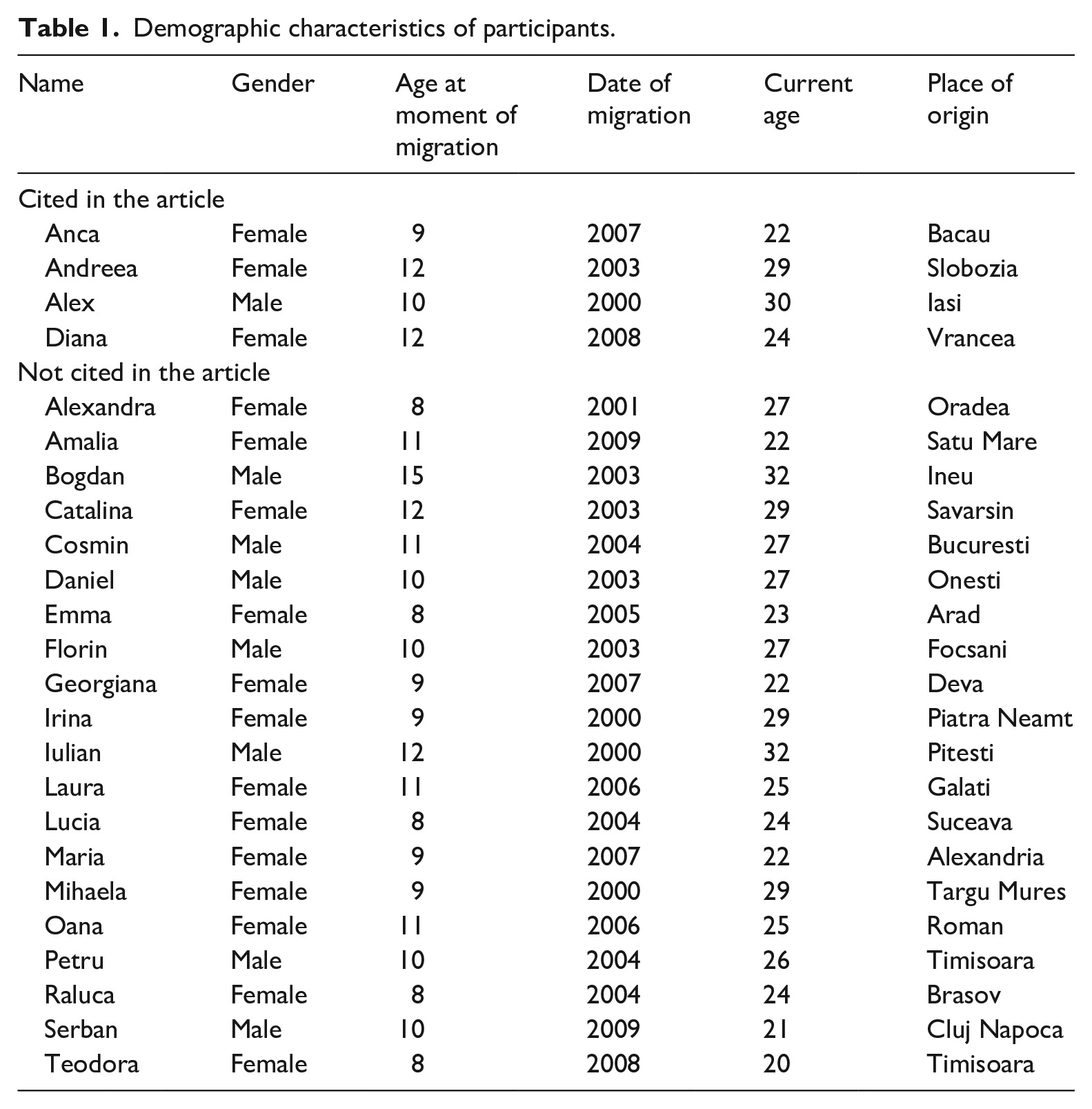
Participants were contacted through snowballing sampling techniques by using personal contacts, through Romanian migrants’ organizations and social media (i.e. Facebook groups), as reticence and mistrust have been often identified among minority youth, including Romanian migrants (Colombo, 2012). In the final sample, 21 of the informants had studied or were studying at the university in Padua and Venice, one finished high school and two attended vocational schools. All participants were born in Romania and all but one (who was 15) were between 8 and 12 years old when displacement happened (see Table 1 for a demographic description of the sample). All were in between their twenties and early thirties when the interviews were conducted. Most informants came from a working-class parental background; only two were from a middle-class parental origin (i.e. teacher, engineer). They came from all-over Romania, with no region being predominant. In Veneto, they were dispersed across the region, often in very small provincial towns, where their parents could find work (Saint-Blancat and Zaltron, 2013). After migration, most participants spent their summer holidays in Romania, at least until they graduated from high school, when they started developing more independent holiday plans. At home, most families spoke Romanian, but some participants refused to do so and spoke only Italian, both at home and in the larger society.
Demographic characteristics of participants.
The study used the life-course qualitative approach. Since “the life course of individuals is embedded in and shaped by their context” (Elder, 1998: 3), this approach examines individual life stories by focusing on the connections between individuals’ lives, family histories and the historical and socioeconomic context in which they lived. Narrative/biographic in-depth interviews were conducted to collect data on individual life-course trajectories. This method was chosen for two main reasons. First, narrative/biographic in-depth interviews are the most fitting to retrieve significant moments in the participants’ biographies through exploring “the meaning that the individuals give to them in interpreting the unfolding of their life” (Bolzman et al., 2017: 12). Second, life-story interviews, which are the result of the constructive collaboration between the interviewer and the interviewee, enable individuals to organise, interpret, and create meaning from their experiences (Atkinson, 2007; Clandinin et al., 2000). All but one participant acknowledged this was the first time they had reflected on their lives, choices, and feelings and noted this method of enquiry helped them gain a clearer understanding of their own experiences. As Downey and Clandinin (2010) argue, “stories are not only just about experiences but are experience itself” (p. 387).
The interview guide was organised around five central themes: (1) the migration journeys; (2) their experiences in the educational and work contexts; (3) the role of family and parental involvement; (4) their friend circles and social lives; (5) their aspirations and imagined futures. The interviews lasted between 1 and 3 hours and were conducted mostly in Italian. Seven were conducted in Romanian. All the interviews took place in a relaxed environment and had a semi-guided format. Pseudonyms were given to all participants to protect their anonymity and confidentiality. Interviews were audio-recorded, transcribed and analysed to reconstruct individual biographies. Individual life course trajectories were then compared, in order to “distinguish the effects that given socio-cultural opportunities and constraints have on the trajectories of migrants’ children from the effects of their individual characteristics and actions or the close social environment” (Bolzman et al., 2017: 7).
Empirical results: The journey of belonging
Participants’ memories of displacement presented numerous similarities. None of the respondents were included in the parents’ decisions to migrate, and all took part in step migration: one (or both) parent(s) emigrated first, and the participants joined a few years after. Most had never travelled outside Romania and had no idea what to expect upon arrival. Memories of their initial experiences refer to enthusiasm at being reunited with their parents, but also solitude and the difficulty of adjusting to a new environment. Rapidly, individual paths start to diverge, influenced by personal biographies, family histories, and the more general context. In order to illustrate how belonging changed throughout the life course across different participants and to identify the factors which play a role in this process, four individual biographies will be presented. This will enable us to both focus on the richness of each participant’s biographical uniqueness and to identify which factors played a role in the process of building belonging among different young migrants. All but Alex have parents from a working-class background.
Anca
Anca arrived in Veneto at the age of 9 in the summer of 2007, when Romania became a member of the EU and its citizens could travel and work more freely in Europe. The time spent with her grandmother, after her mother and then her father had emigrated, is remembered as a very sad period during which, besides missing her mother, she suffered “violence, humiliation, and abuse” from teachers in Romania and “used to cry all the time before going to school.” Joining her parents in an isolated house outside a small city of 10,000 inhabitants was thus perceived as “liberating.” After spending the summer holiday at home alone, watching TV, because her parents worked 8–9 hours a day, Anca joined primary school in September 2007. 2 Knowing “only three Italian words,” she recalls being afraid, expecting the same treatment as in Romania. To her surprise, the teachers were “patient and helpful,” but not her peers. Anca was, once again, bullied at school. She believes this happened because she could not speak back, defend herself. While this could be true, Anca also lived in the Treviso province where the Lega Nord was very successful (Cancellieri et al., 2014), making it highly probable that children’s actions reflected more general negative attitudes towards migration. The bullying lasted until the teachers taught her how to cuss in dialect, language used by Veneto speakers to create “intimate identities,” that reinforce boundaries between “insiders” and the “outsiders,” the immigrant “others” (Perrino, 2018). With support from “significant others,” that is, teachers (Saint-Blancat and Zaltron, 2013), Anca managed to break the language barrier that made her an outsider.
Middle school is remembered by Anca as “very difficult.” As in primary school, she did not have many friends and “none of them were very close.” Outside school, Anca spent most of her time at the library, avoiding going home where the situation had become quite tense, following a work accident her father had suffered. This is also around the time she remembers starting to “hate Romania: I never wanted to go back there. I did not speak Romanian anymore. I did not even want people to know I was Romanian. [. . .] For 3 years I did not want to hear anything about Romania.” In line with Colombo et al. (2009), “the negative value attached to being a foreigner, especially if one is included in stigmatised groups such as Albanians and Romanians, might lead to individuals distancing themselves from stereotypical representations” (p. 46).
At around 12, Anca also started practicing volleyball, which she argues helped her integrate through social interactions with Italian peers: “I lived in a small town. The fact that you do something with Italians, who know you, who know you come to practice, work well, it helps. I am trustworthy.” Sporting activities are indeed frequented mainly by Italians (Gargiulo and Dalla Zuanna, 2019), enabling Anca to socialise and earn the trust of her Italian peers. Towards the end of middle school Anca remembers “starting to change attitude towards Romania.” Especially during high school, she “started reading, wanted to know more about my roots.” Anca went to a secondary school (Liceo), where most students were Italian. Gargiulo and Dalla Zuanna (2019) argue all Italians can go to Liceo but only the highest achieving foreign students are accepted. Surrounded by mainly Italian peers, Anca started to slowly “open up and talk to people.” “The fact that I was respected was the most important” in her change in attitude, Anca argues. Anca was also recognised, by her Italian peers, as belonging to their group: “You are not like them [Romanians] but like us [Italians]” stated her colleagues one day when they were discussing Romanian migrants. Once she felt respected and accepted by her Italian peers, Anca began to overcome her trauma and renew with her origins. However, as well as an acceptance, this statement is also a reminder of Anca’s otherness, which might have prompted her to dig deeper into her culture of origin.
Her curiosity motivated her to study Romanian at the University in Padua and even travel to Romania, the country she had vowed never to return to. At the moment of the interview, Anca had just returned from a summer school in Romania. Exhibiting confidence and a certain serenity, she stated: “I was not afraid anymore. I could defend myself now.” When talking about Romania Anca also indicated: “I want to give back. To help Romania, a child. . . I want to return the chance I had.” She envisaged voluntary work in Romania or even adopting a Romanian child, “because for me coming to Italy was a positive, beautiful experience.” While stating she felt “a mix” in terms of belonging, finding a certain inner peace after having reconnected with her country of origin, Anca’s words illustrate the distance she felt towards Romania. Her connection to Italy, the country which enabled her to escape her childhood hardships and where she had her most formative experiences, was stronger.
Alex
Alex arrived in Padua, capital of the Veneto region, in 2000, when he was 10 years old. His father had been working in Italy for several years and the parents decided the whole family should migrate so the children would not grow up without a father. Initially opposed to the move, Alex states he eventually got carried away by the enthusiasm surrounding him. His first memories of arriving in Padua as a child focus on surprise and excitement with all the new discoveries: food, drinks, and especially the size of their new house, compared to what he had become accustomed in Romania. “School was difficult,” especially in the first year when he did not speak Italian:
“Children looked weirdly at me. . . I passed from many friends to zero friends, from being the best in my class to failing, all because I did not speak the language.”
There were no Romanians in Alex’s class, and the school did not have any “structures for foreigners,” like language classes, or activities in which he could partake with peers, in order to make friends. Contrary to most participants, Alex could count on his parents’ support, whom he argues regularly helped with homework. They had the skills and knowledge to provide support: both were university math graduates, and his mother was a high school teacher in Padua. Once he learned Italian, the situation got better, Alex proudly declared in the interview: he started making friends and he even finished middle school among the first in his class. Like Anca, Alex went to a Liceo, where he continued to be surrounded mainly by Italians, and recalls being among the first in his class, having “made some good friends and spent some beautiful years.” This echoes previous research, which has shown that migrant students with better results and parents of higher social status generally spend more time with Italians (Gargiulo and Dalla Zuana, 2019).
When Alex was 17 years old, his mother created a Romanian cultural organization in Padua. The contact with this organization and the activities it organised made him realise he “had driven away from Romania.” Here is what he recalls: “after 7 years in Italy, I was starting to move further away from Romanian culture. [. . .] I had started talking less and less Romanian. I used to speak at home but everywhere else Italian.” Unlike Anca, Alex’s recollection is not of a drastic cut in relation to Romania, but an imperceptible drifting away. The more time children of immigrants spend in Italy, the more similar they become to Italians (Gabrielli et al., 2013: 1420). Reconnecting with Romania is, however, remembered as an active decision on his part: because he “did not want to forget,” when he moved to the University in Venice, Alex became actively involved with his mother’s organization. He became the organization’s spokesperson, its public face, which illustrates the importance of the family’s capital and networks as social facilitators in maintaining connections with the country of origin (Saint-Blancat and Zaltron, 2013):
“I would speak at events and present them. I really liked it, although it was difficult to speak in front of thousands of people gathered for Romania’s national day. But it was an opportunity to meet folklore singers and dancers, writers, directors. . . who knew Romanian culture very well.”
In the final year of his BA, during his MA and after finishing the University, Alex lived abroad for several periods (Erasmus stay in Lyon, internship in Berlin, MA in Paris). In 2013, he returned to Padua but quickly realised he no longer belonged there: in Paris “I felt independent, with many things to do, many events, many places to see” while in Padua “I did not feel stimulated, and I felt I was wasting my time.” Using transnational friendship networks, Alex decided to move to Paris again. Wanting to “keep in touch with Romanian culture,” he started organizing events with Romanian cultural organizations that were similar to those he arranged in Italy (outings in nature, children’s activities, debate evenings. . .). When asked about where home is, Alex showed complex layers of belonging:
“Since I have not lived in Romania for more than 17 years, I no longer feel at home there. I feel more at home in Padua, because this is where my close family and my teenage friends are and I feel good here, but only as a holiday. I start to feel more and more at home in Paris because I have my world, my house, my habits. [. . .] But on vacation or during the holidays I return to Padua, eat Romanian food.”
Diana
In the 1990s, Diana’s parents lost their jobs as a result of the post-communist transition and decided permanent migration was the best solution for the family. They sold all possessions, and, after a few failed attempts, the father managed to cross into Italy and find a job. The mother joined after a few years, followed by the children, in 2008, after Romania had become an EU member. Diana was 12 when she arrived in Padua. As with Anca, parents worked long hours. Diana and her younger sister needed to discover and adjust to the new environment on their own. When talking about her first experiences in Italy, Diana remembers the excitement of being reunited with her parents, but also the difficulty of making friends. Being very shy and not speaking Italian, Diana was apprehensive at the idea of interacting with Italian children: “the fear was going there, and they say something you don’t understand, and you are ridiculed.” This also stopped her from getting involved in activities at the local church. Here is how she recalls one of her early experiences:
“We went to a catholic church near us where they organised different sports and activities. I loved dancing. I would have loved to go but I arrived late, and the groups were already formed. [. . .] I was afraid of this. After that I had my group of Romanian friends. I mean, in the beginning there was this thing of going to do something but later, when I had my friends, I did not have the same need anymore.”
Since these activities were mainly frequented by Italians, had Diana decided to attend the classes, she might have probably followed a similar path as Anca. Diana started making the friends mentioned above in (middle) school, especially during the special language classes organised for children of Romanian origin. Also, during the more than a decade spent living and working in Padua, her parents had developed a strong network of co-ethnics. While Diana remembers starting to get along well with most peers of Italian background after learning the language, she spent most of her non-schooling free time with Romanians until the end of high school. Like many migrants (Gargiulo and Dalla Zuanna, 2019), Diana followed a technical vocational education programme in high school, where she recalls making mostly fiends of Romanian origin. Once she felt safe, Diana continued cultivating strong connections with her ethnic group, in a wish to reduce the chances of being rejected. This attitude was also reinforced by interactions with her peers. Here is what she recalls about her high school colleagues, when she was about 15 years old:
“I believe they were racist. I mean, they were asking questions like ‘Do you, in Romania, have this or that?’ Wait a minute, where do you think I come from? [. . .] I would react badly, meaning I would fight with them [laughter] [. . .] I mean, what do you think. . . Oh, Romania! I came from God knows where. . .”
Although during the interview she contemplated that “maybe my peers were curious and did not know how to ask questions,” Diana still believed the interaction was “disturbing.” This reveals a feeling of superiority among her Italian peers, emphasising her lack of belonging to the majority. Diana’s fear of being excluded and her social interactions, coupled with the externally initiated process of ethnicization, led to the process of self-imposed disassociation from the national ethnic majority (Rosenthal and Stephan, 2009). In a search for support and aiming to lose the outsider status, Diana chose to belong to an already established group, that of the Romanian “others.” She turned inwards, seeking familiar habits and lack of judgement among the members of the same community by creating an ethnic enclave (Colombo et al., 2009: 44, 45). Upon finishing her technical institute, Diana decided to return to Romania, going against her parents’ wishes:
“I did not like the people, the fact that they were racist, the fact that you were seen differently. I mean, if you went at a job interview, they would say ‘Ah, you are Romanian’. . . I mean, you would see this. And I thought ‘No, I will go home to my own country’. For me this was terrible. And in this sense, I could not integrate.”
When asked where she experienced racism, Diana stated: “I saw this at school and, I don’t know, around me. . . I don’t know, you would see it and I did not like it and I could not and adapt to their way of being” because “we would always be perceived as different.” Ethnic boundaries are reinforced and illustrated by her use of the personal pronouns “you” and “I” when referring to general and individual experiences, respectively. Diana might have witnessed racist behavior, not only towards other Romanian migrant children in school, but also in her larger social network. As shown by Gherghina et al. (2020), perception of discrimination and lack of belonging to the majority are the strongest predictor of Romanian migrants’ intention of returning to their country of origin. Also, having maintained a quite close relationship with her Romanian childhood friends, Diana fell in love with one of them and decided “to go home” to Romania.
Upon arrival, with the help of her aunt, Diana found a well-paid job where she used the technical and language skills acquired in Italy. Despite her professionally satisfying situation, Diana found herself comparing Romanian and Italy and longing for the latter. Romania did not live up to the idealised image that Diana had created throughout the years in short enthusiastic visits. Diana also realised she had acquired some of the cultural traits and habits of her Italian peers and found it difficult to perfectly fit in only one place. Indeed, the more time migrant children spend in Italy, the more they become like their Italian peers (Gabrielli et al., 2013). Returning to Romania made Diana re-evaluate her connection to Italy and realise her time spent in Veneto had changed her, at the same time shifting her negative perception of Italy. She therefore decided to “stay for a while to get some experience” but move back to Italy in a few years: “I do not want to raise my children in this environment. The school system is much better in Italy. They can do so much more stuff than here.” Again, the multiple and complex layers of belonging expressed by Diana illustrate the continuously changing nature of belonging.
Andreea
In 2003, Andreea was 12 when she joined her parents in Padua, with her older sister moved to Padua. She did not want to move enjoying the freedom experienced in Romania. Contrasting other testimonies, Andreea remembers school was not too difficult in the beginning: she was ahead in mathematics and learned Italian very fast with a teacher provided by the school. While the teachers were remembered as “good as long as you studied” and peers “also good but had their own groups already,” Andreea emphasized her lack of freedom. When talking about the first years in Padua, Andreea also mentions her name was a constant reminder of otherness. Andreea is a girl’s name in Romania, while Andrea is used for boys in Italy. This created confusion and emphasised otherness: “everybody said it was weird, having a boy’s name. Once they knew my name, they looked at me differently.” For this reason, once she moved to high school, she asked everyone to call her Chiara, which is an Italian female name.
About a year after arrival, Andreea remembers start having “problems both at school and at home.” Her parents’ relationship started deteriorating and, when they separated, Andreea was prohibited from having any contact with her father or his family. This reinforced her feelings of isolation and lack of freedom. Her mother was also recalled as an important source of stress: “Mother stressed me a lot. She always said do this, do that, you don’t know how to do that, that is not good.” Andreea remembers feeling “lost” and “doing bad in school,” which further aggravated the conflict with her mother. Romanian parents’ high expectations towards children’s success in school are a source of great pressure (Colombo, 2012). The combination of family problems and pressure on school performance led to anxiety, panic attacks, and feelings of loneliness:
“I was very stressed and would cry all the time. [. . .] I went through many and ugly experiences but there was nobody I could talk to. I started writing in notebooks, on pieces of paper. I went to a psychologist in school, but he did not do much for me. He would just listen to me. He tried to tell mother to ease up, calm down, but it did not work.”
When she was about 14, “wanting to avoid the problems from home,” Andreea started spending “more and more time outside the house.” Initially, she joined a group of Romanians, some of whom she had met at school, but quickly started feeling awkward and inferior in their presence, feelings which might have been prompted by the attitudes of her family. Each time she visited Romania her family members living there made fun of how she spoke, emphasizing her difference, making her feel “ashamed” and “inferior.” Believing she had “lost her Romanian path,” Andreea found safety and acceptance with a group of international migrants living in Padua:
“I liked it a lot because one could see different ways of thinking, different ways of behaving with people. [. . .] I heard stories. It was something from our world.” The use of the adjective “our” highlights Andreea’s newfound feelings of belonging.
After finishing high school, Andreea started working, initially in a restaurant and later doing seasonal work in a hotel in the mountains, where she lived for a few months in a row. While this was a difficult job, it is also where she remembered she “started feeling better. I started to not have trouble breathing, to leave those moments aside and advance.” She also started to get involved in a theatre play the Department of Romanian Studies of the University of Padua organised with students and members of the Romanian diaspora. Andreea argues this experience allowed her to “find Romanians and find herself. Damn it, I am Romanian! I like it and I do not want to change any more.” Despite her fear of seeing the crisis return, of being judged by her family living in Romania, Andreea stated, at the end of the interview: “I now want to discover the Romanian in me, I want to learn better, to find my path in life. I wish to go to Romania and find myself, reunite with my culture.” Being away from the overwhelming presence of her mother, seemed to have allowed Andreea to reconnect with Romania, although the fear of being judged by others did not disappear.
Conclusion and discussion
Drawing on in-depth retrospective interviews with young adults who had migrated to Italy as children, this paper makes several important contributions to the literature on childhood, migration, and belonging. First, this article supports the thesis of a lifelong process of construction of ethnic belonging (Rosenthal and Köttig, 2009). In the interval covered by the paper, participants’ feelings of belonging changed on several occasions, leading to the development of multiple layers and expressions of belonging. This is consistent with studies which show that belonging changes often before mid-adulthood (Feliciano and Rumbault, 2019). Participants left Romania at a very young age, with little to no awareness of where they belonged in terms of ethnicity. When confronted with attributed or chosen forms of collective identity, they became aware of being “other” and “diverse.” The paper thus contributes to the existing scholarship by showing this process can start before adolescence and young adulthood (Phinney, 1993) and by illustrating how discrimination can be a central part in the lives of migrant children even at a young age.
Second, the study shows how social relations and the acceptance by others in the receiving and origin countries play a key role in shaping young migrants’ sense of belonging. The people with which migrants spent most of their time had the strongest impact on their belonging: the more time they spent with Italian peers, the more the participants felt they belonged to Italy. The opposite was true in cases of self-imposed disassociation. Closed bonding networks lead to a lower level of belonging and higher motivation to return to the country of origin, while bridging networks are associated to higher levels of belonging (Gherghina et al., 2020). Despite this, as illustrated by Diana’s testimonial, the more time children spend in Italy, the more similar to Italian peers they become (Gabrielli et al., 2013), even without realizing it. Additionally, the participants who felt accepted by the host society developed a higher sense of belonging to Italy, while the opposite was true for those who felt rejected, discriminated against. At the same time, as shown by Andreea’s recollections, when migrants experience a “dislocating experience as ‘others’ in both [receiving and home] societies,” they intensely feel a “sense of alienation and lack of belonging,” echoing experiences of young Albanian migrants in Greece (Katartzi, 2018: 458).
Third, the institutional context, including the nature of their schools, access to language classes, or sporting activities, also play a significant role in shaping participants’ social relations and belonging. School is the main context in which children get to interact with the culture of the host country, providing the basis for their wellbeing and the building of feelings of belonging (Chini, 2004). For example, going to a Liceo meant spending more time with Italian peers, as opposed to following a vocational path. Language classes for newly arrived migrant children enabled both socializing and a faster acquisition of Italian, which can help overcome the initial challenges of migration. However, the absence of activities during which children could interact with their peers, in, or outside of school, as well as experiencing discrimination can strengthen feelings of isolation and perceptions of “otherness,” as illustrated by the discourses elaborated by the Romanian migrants interviewed about their childhood experiences.
Fourth, this study suggests that social origin partly influences young migrants’ sense of belonging. Respondents’ family social background is relevant, but generally played a lesser role, corroborating results from other Italian regions (Lagomarsino and Erminio, 2019). Most respondents’ parents, including the cases of Andreea, Diana, and Anca, were from a working-class background, working long hours every week and having little time and knowledge to help their children at school or navigating the host society. Still, Alex’s case illustrates how more well-connected parents, with higher levels of education, can provide greater support for their children by palliating certain institutional shortcomings and enabling the acquisition of skills and social capital children can draw upon. In other cases, a challenging familiar background—single parent, overbearing mother, alcoholic father (Andreea), conflicts at home (Anca)—made adapting to a new environment more difficult. In order to mitigate these differences, schools, and public institutions have a strong potential of developing programmes and initiatives allowing equality of opportunities for all migrant children.
Fifth, the paper illustrates how the life course approach is the most suitable method to capture the dynamic, changing nature of belonging. The life course approach, applied to recollections of young adults of their childhood experiences, reveals how the interplay of various factors which combine individual experiences with the family’s socio-economic and educational background, as well as the larger socio-cultural contexts (Rosenthal and Bogner, 2009) play a role in shaping the respondents’ feelings of belonging across time. This life-course approach adds to recent studies that have examined Romanian migrants and their children (Bratu, 2015; Ducu, 2018; Saint-Blancat and Zaltron, 2013; Valtolina, 2013) by paying more specific attention to migrant children’s relationship with both the origin and host countries, and by integrating belonging as a dynamic, temporal process.
Overall, the results of this study reveal that, with time, young migrants develop multiple layers and intensities of belonging. The findings indicate this multiplicity of layers of belonging can enable migrants to achieve high levels of satisfaction and well-being. As Anca recalls, migrants can find a sense of balance when they manage to accept all the pieces or the puzzle which define who they are. This paper thus contributes to ongoing debates revolving around the existence of multiple belongings affecting the well-being of migrant children and youth (Berry and Hou, 2019). It does so by showing how social relations, the level of acceptance that young migrants experience during childhood in the host and destination countries and socioeconomic and institutional contexts can influence their trajectories of belonging from childhood to young adulthood.
Future studies should address two aspects that have not been addressed in this paper. First, our study was restricted to retrospective data. Despite the richness of the retrospective interviews, the analysis needed to rely on memory, which can be inaccurate and subject to biases. Future research can unpack the changing nature of belonging by looking at children today and following them, using a prospective life-course approach. Second, our sample is relatively small and limited to mainly young people who went to the university in Italy. Although educational success is one of the objectives of migration and hopes for the future of many Romanian parents, this sample is not fully representative of the Romanian migrant children population. Including a larger cohort and even comparing the experiences and/or memories of children having migrated to different countries, in Europe and beyond, will allow for the identification of the impact of national contexts on migrants’ lives.
Footnotes
Acknowledgements
The author would like to thank the editors, the two anonymous reviewers and Pablo Gracia for their valuable comments and suggestions on earlier versions of this article.
Declaration of conflicting interests
The author declared no potential conflicts of interest with respect to the research, authorship, and/or publication of this article.
Funding
The author disclosed receipt of the following financial support for the research, authorship, and/or publication of this article: The author received funding from the European Union’s Horizon 2020 research and innovation programme for the project “Risk and Migration. A Transnational History of Romanian Migration to Western Europe (2003–2014)” (Marie Skłodowska-Curie Grant agreement No 660281). This communication reflects only the author’s view and the REA is not responsible for any use that may be made of the information it contains.
