




Abstract
The present study examines sibling’ conflict trajectories with a specific focus on acts of sabotage – deliberate obstruction or destruction of activities with an object. Multimodal interaction analysis is used to understand how siblings’ conflicts are organised through multiple (verbal and embodied) practices. We further draw on childhood studies that focuses on children’s material practices and use the term enactment to better understand human-nonhuman relations. The study found that children put considerable time and energy into configuring deceptive bodies that both organised and disrupted their local moral orders.
Introduction
Conflicts constitute a recurrent part of children’s everyday lives and of their peer group cultures (Corsaro, 2003). Children’s conflicts are viewed as situations significant for children’s own (re-)organisation of social order and moral accountabilities within their peer groups and social relations (Danby and Theobald, 2012; Evaldsson and Svahn, 2017; Goodwin, 1990). Prior research on conflict interactions has demonstrated children’s complex verbal and social skills in claiming, escalating, and getting an upper hand in disputes (Ahn, 2010; Goodwin and Kyratzis, 2011 for an overview). We argue that attention to children’s embodied practices in the socio-material context of conflicts can contribute to and refine the understanding of ‘the micropolitics of social life’ (Goodwin, 2007: 373) and highlight the role of objects in children’s social relationships (Horton, 2010). In line with recent conceptualisations of children as embodied social actors (Evaldsson and Karlsson, 2020; Goodwin, 2007) that live their everyday lives in a socio-material world (Palludan and Wentzel Winther, 2017), we direct attention to a prolific, yet under-researched social situation, namely, conflicts related to young children’s possession and use of objects (but see Cobb-Moore, 2008).
In the present study, we examine young children’s (3- to 5-year old siblings’) embodied conflict trajectories with a particular focus on their covert and concealed (Goffman, 1971) conflict retaliation moves, here conceptualised as acts of sabotage towards objects. By adopting an interactional perspective on children’s peer cultures (Goodwin and Kyratzis, 2007, 2011) and taking inspiration from recent childhood studies that focuses on children’s material practices (e.g. Horton, 2010; Kraftl, 2015; Orrmalm, 2019; Rautio, 2016), this study, on the basis of video-recordings from families in Sweden, directs attention to how play with a desired object is sabotaged and destroyed through affective acts of retaliation.
Theoretical points of departure: Children, objects and embodiment
Our view on children’s everyday lives draws on studies of children’s peer cultures and social interaction as embodied (Goodwin and Kyratzis, 2011). Studies on children’s interaction exhibit a well-developed study of human interaction as bodily accomplished but have to a lesser degree engaged with materiality (but see Cobb-Moore, 2008; Cobb-Moore et al., 2009; Evaldsson and Karlsson, 2020; Karlsson et al., 2017). In line with recent calls to conceptualise objects and bodies together in studies on social interaction (Mondada, 2019) we argue that both human and nonhuman entities need to be taken into consideration when studying children’s conflicts. We elaborate on studies on children’s social interaction by drawing on terms from science and technology studies (STS), a field which has extensively studied human-nonhuman practices (Woolgar and Lezuan, 2013), and recent turns in childhood studies to take materiality into account when studying children (Kraftl and Horton, 2018; Prout, 2019; Spyrou, 2019). In particular, we make use of a concept central to STS, namely the idea of everyday practices as enacted, or brought into being, through the interaction of multiple (human and nonhuman) entities (Woolgar, 2012; Woolgar and Lezuan, 2013).
The combination of theoretical points of departure is held together by ethnography as the common method, and by a mutual focus on, and understanding of, everyday practices as produced, or done, in situ. Moreover, we argue that this combination of theoretical approaches makes possible an inclusive analysis of human-nonhuman (or child-object) interaction. In this way, we aim to understand how children’s everyday conflicts (which turn into sabotage) are enacted that is, are ‘emerging from the encounter between human and non-human entities’ (Spyrou, 2019: 316).
In addition, we suggest that a multimodal approach on embodiment and affect (Goodwin 2000, 2006) constitute an important conceptual framework for understanding social actions as they are organised through multiple modalities within (and with) the socio-material features of the situation. In doing so, the present study will contribute to the knowledge of how embodied action and objects are intertwined in children’s everyday conflicts and thus how they constitute a part of childhood.
Previous research
Verbal and embodied organisation of children’s conflicts
Studies of children’s conflicts have demonstrated a variety of linguistic and embodied practices that characterise arguments and disputes (Ahn, 2010; Burdelski, 2019; Danby and Theobald, 2012; Goodwin and Kyratzis, 2011). 1 Studies of children’s peer cultures show an intricate intertwinement of conflicts and morality, since it is in the conflict situation that interaction centres around moral transgressions. Children use talk to hold ‘one another accountable for moral action’ (Goodwin and Kyratzis, 2007: 286) and to negotiate (un)acceptable peer-group behaviour (Evaldsson, 2002), constituting and negotiating local moral order within the unfolding social situation. This way, children involve each other in the ‘collective negotiation of rules.’ (Niemi, 2016: 76). In addition to talk, children are also shown to ‘rely on a range of embodied practices [. . .] to hold one another accountable to their local understanding of social norms’ (Goodwin and Kyratzis, 2007: 286). Subtle embodied and spatial practices are shown to play a key role in children’s peer disputes (Goodwin, 2006; Goodwin and Kyratzis, 2011; Svahn and Evaldsson, 2011). Children’s gestures and postures within the socio-material space (in relation to each other and to objects), so called, ‘postural configurations’ (Goodwin, 2006: 359), indicate social closeness or distance. Spatial distance or proximity, approaching or distancing and looking away from the other, can calibrate effective conflictual exclusion or highlight friendship (non-conflictual and harmonious) relations (Evaldsson and Karlsson, 2020; Svahn and Evaldsson, 2011). Spatial orientation and embodied acts, such as gestures, emotional expressions, and body positionings present significant resources for displaying affectively aggravated conflictual stances and escalations of the conflict (Loyd, 2012).
As demonstrated in studies on children’s peer disputes, conflict trajectories can vary. Children can extend the conflict by repeating and escalating oppositional moves (Goodwin, 2006). Frequently, however, children’s conflicts simply fizzle out, but they can re-appear with new oppositional actions or retaliation. Within more extended conflict trajectories, acts of retaliation need to be carefully calibrated in order to appear as morally justifiable acts of retribution for the opponent’s wrongdoing (Evaldsson and Svahn, 2017). They also need to be carefully organised in order to be effective in affecting the opponent negatively. From a micro-sociological perspective, concealing an upcoming act of retaliation by calibrating it as sabotage can provide a suitable way to get the ‘upper hand’ in the conflict. According to Goffman (1971: 258) acts of sabotage involve intricate deliberate social and material acts of destruction (that cause damage). Therefore, the prospective saboteur needs to manage matters for alarm. In covert sabotage, ‘matters for alarm are concealed in a guise of some kind right under the eyes of the subjects’ (Goffman, 1971: 258). Notably, this requires skilful embodied organisation and accomplishment of sabotage, especially when sabotage is aimed at secretly targeting a desired object and whose doing causes damage to a peer’s (sibling’s) possession and play.
Children, conflicts and objects
Young children’s conflicts often revolve around possession or ownership of objects, especially ‘when two or more children desire an object which cannot be shared at the same time’ (Corsaro, 1985: 302). Thus far, however, there are few interactional studies on the subject, although object possession is continuously up for negotiation between children in play (see Cobb-Moore, 2008; Cobb-Moore et al., 2009; Danby et al., 2017). Several studies conducted in preschool settings show that young children’s temporary possession of play objects often meant gaining a desirable status as object-owner, and in turn, the right to decide the play rules (Cobb-Moore, 2008). In many cases, ownership rights are, as demonstrated in a study of Swedish preschool children’s peer group conflicts, strongly related to the initial possession of an object, although they can be contested and re-negotiated (Holm Kvist, 2018). Moreover, the ‘observed qualities’ of the objects are important to how children participate and design their actions and talk in play activities (Danby et al., 2017: 234). The material properties of objects can thus be used for different social purposes (Kraftl, 2015).
Research that has focused on families’ and preadolescent siblings’ material practices similarly found that object-possession has potential to create ‘intense conflict’ between children (Horton, 2010: 384). The conflicts can involve disputes over, for instance, the possession of pop culture merchandise (Horton, 2010) or the distribution of material entities such as rooms and computers (Palludan and Wentzel Winther, 2017). Moreover, the objects were shown to be possessions talked about with affect and love, thus mattering greatly to the children (Horton, 2010). The distribution of material entities, such as having one’s own room where one’s things could be placed, were ‘highly valued’ and contested between siblings (Palludan and Wentzel Winther, 2017: 38).
Research thus highlights how children’s and siblings’ everyday lives are intertwined with objects; it suggests that conflicts about objects can be seen as a significant locus for children’s constitution of social relations (Cobb-Moore, 2008; Horton, 2010). Accordingly, in the present study, we direct our attention to the social and interactional organisation of siblings’ conflicts where desired objects are the foci of dispute. We examine conflict trajectories of young children’s (aged 3–5) affective destruction of play objects, here called acts of sabotage. The analysis will focus on how sabotage is enacted in moment-to-moment interaction through embodied interactional and material features of children’s (siblings’) conflicts and how, in this process, activities and objects are skilfully monitored and destroyed in concealment.
Method
Data, participants and setting
The present study draws on 40 hours of video-recordings collected in 11 Swedish middle-class families with children. 2 The Regional Ethical Board has approved this project. All but two families included sibling pairs, in total 27 children, from zero to fourteen years of age, but with a large majority aged between 3 and 5. In order to lessen the researcher’s intrusiveness in the family homes, the parents were asked to record their everyday activities. The recordings included sibling play and conflicts, family meals, cooking, and book reading.
On the basis of repeated viewings of the video recordings of the siblings’ play, we found that siblings’ conflicts recurrently centred around object ownership. We identified that recurrent incidents of the siblings’ conflicts included retaliation moves that were designed in a concealed way (one sibling approaching and destroying the object and the play). The selected episodes were transcribed 3 in regard to the temporality of actions and quality of talk, embodied actions and relevant objects. In the present paper, we examine in detail such conflict trajectories in order to unpack the social organisation of object-play, sabotage and destruction. For this purpose, we have selected two conflict trajectories that involve acts of sabotage in two sibling-pairs of similar ages. They involve siblings Stella (5:1, girl) and Henrik (3:1, boy), and the second conflict situation involves Karolina (5:1, girl) and Gustav (3:7, boy).
Analytical approach
The analysis is informed by a multimodal interactional approach (Goodwin, 2000) in order to capture multiple modalities (as mediums of expression used by participants to build social action within their material surroundings) in interaction. They involve talk, voice, bodily posture and orientations, gaze, pointing, touch, movement, pace, and orientations to objects among other things (Goodwin, 2000; Mondada, 2016). Analytical attention is directed at how multiple modalities are intertwined and ‘mutually elaborate each other’ (Goodwin, 2000: 1490) within local situations. When directing our focus to embodiment, we use the term body configuration (see ‘postural configuration’ by Goodwin, 2006: 359) in order to capture the coordination of affective language, pace, movement, gaze and body positioning in achieving a socially meaningful ‘body gloss’ (Goffman, 1971: 128). In Goffman’s (1971) terms this refers to the ways in which individuals use their bodies to convey information about their situational engagement when they are in the presence of others.
This analytical approach builds on the Conversational Analytical approach to the sequential organisation of the unfolding of actions within temporal space and material surroundings as fundamental to the calibration of embodied actions (Goodwin, 2000; Mondada, 2016). The notion of sequentiality focuses on social actions as based on previous actions and as prospectively organised (retrospectively they respond to the previous action, and prospectively they outline possible next actions) (Sacks et al., 1974). We argue that a multimodal interactional approach allows us to examine how, in detail, sabotage is enacted by multiple human and nonhuman entities.
Findings
The analysis of the siblings’ embodied and socio-material play shows that conflicts frequently centred around possession of desirable objects. Such conflicts could get highly physical with objects being pulled and dragged which led to for example, tugs-of-war as well as other physical and verbal affective acts towards the sibling in order to gain possession of the central object. Such conflictual acts usually left one sibling in possession of the object, and thus also gaining the rights as conductor of the play (Cobb-Moore, 2008). It is in such cases that the ‘looser’ of the play object retaliated (although the conflict had seemingly fizzled out) through sabotage moves that targeted the children’s object of mutual desire. This required a skilful embodied performance and concealment of the upcoming destruction.
The children’s embodied acts of sabotage (Goffman, 1971) roughly unfolded in three phases: (1) a covert approach, (2) a destruction and (3) a post-destruction phase which involved redistributions of ownership of the desired objects, and justifications and arguments about moral accountability and righteousness. The children’s covert approach was organised through multiple embodied moves that configured, what we call, casual or playful but deceptive bodies. This meant exploiting the ‘orientation gloss’ that designated behaviours which signalled to others that they were engaged in normal and harmless everyday actions (Goffman, 1971: 128). In such ways, the sibling was able to unobtrusively monitor the other sibling and gain access to his/her play space. The embodied moves were deliberately deceptive through carefully calibrated body configurations and different, carefully modulated, affective expressions and by closely monitoring the opponent, material surroundings and the desired object.
Conflict escalation: The desired play object
Siblings’ retaliation through sabotage was usually preceded by an extended and escalated physical and verbal conflict where the children claimed and demanded possession of an object. They pulled, grabbed, or dragged the focal toy from each other, affectively making the toy, what we call, a desired object. Such stepwise cyclical patterns of object-centred conflicts could stretch across considerable time.
In Excerpt 1, siblings Stella (5:1) and Henrik (3:1) play with various tools in their family garden and argue about the possession of a hammer. They engage in repetitive physical takebacks of the object, which makes it unclear who had the hammer first. Through a loud and physical tug-of-war, they make affective claims to acquire possession of the same object.
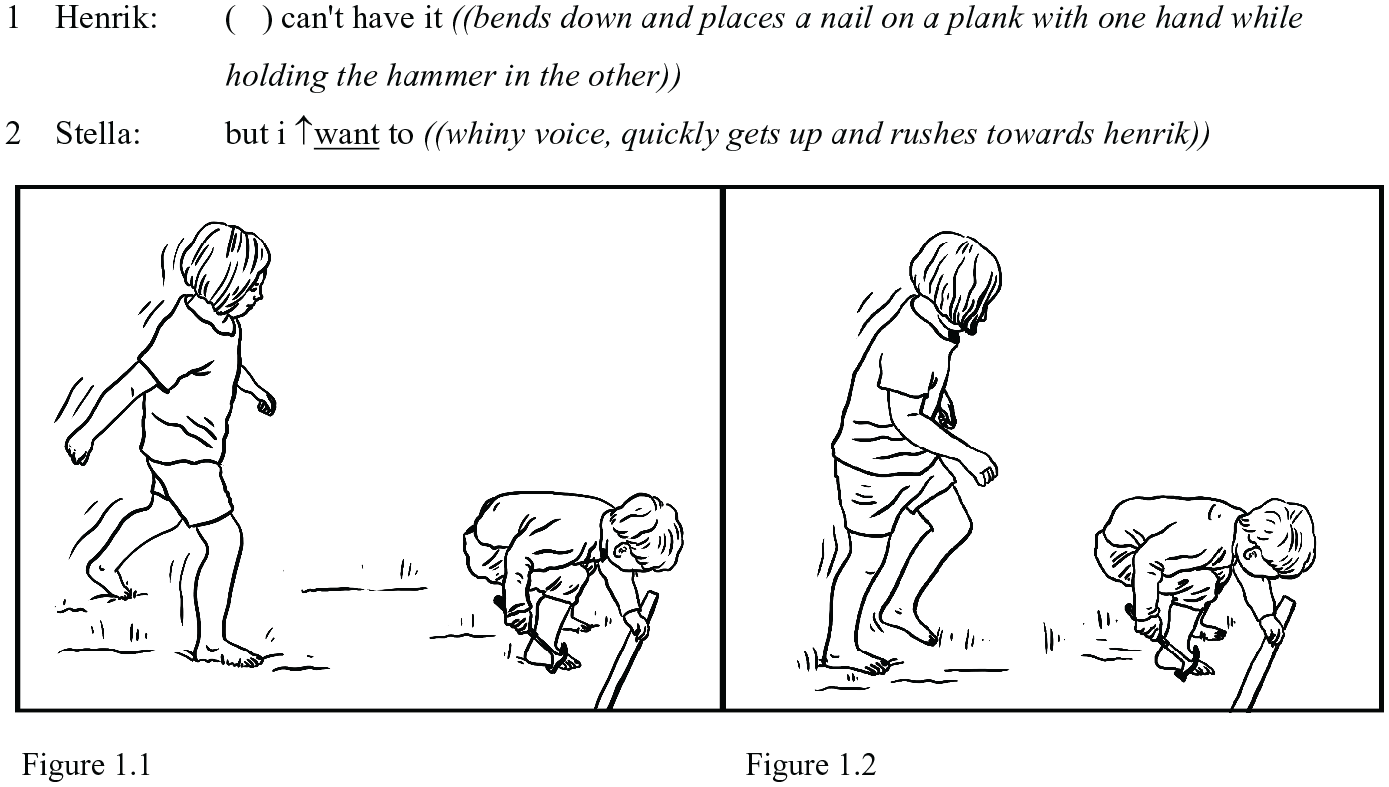
When Henrik forcefully takes the hammer back from Stella, his actions increase the value of the object because his sister ‘can’t have it’ (line 1). By claiming ownership, he both asserts his possession and rejects Stella’s right to the object. As a rightful object owner, Henrik immediately begins using the hammer, preparing to hammer a nail into a wooden plank (line 1, figure 1.1.-1.2). His serious engagement with the hammer and his bodily actions within and with the material surroundings, signal a valuable object. This way ‘ownership of particular stuff was a key imperative, and central to the ways in which ‘stuff’ came to matter’ (Horton, 2010: 384).
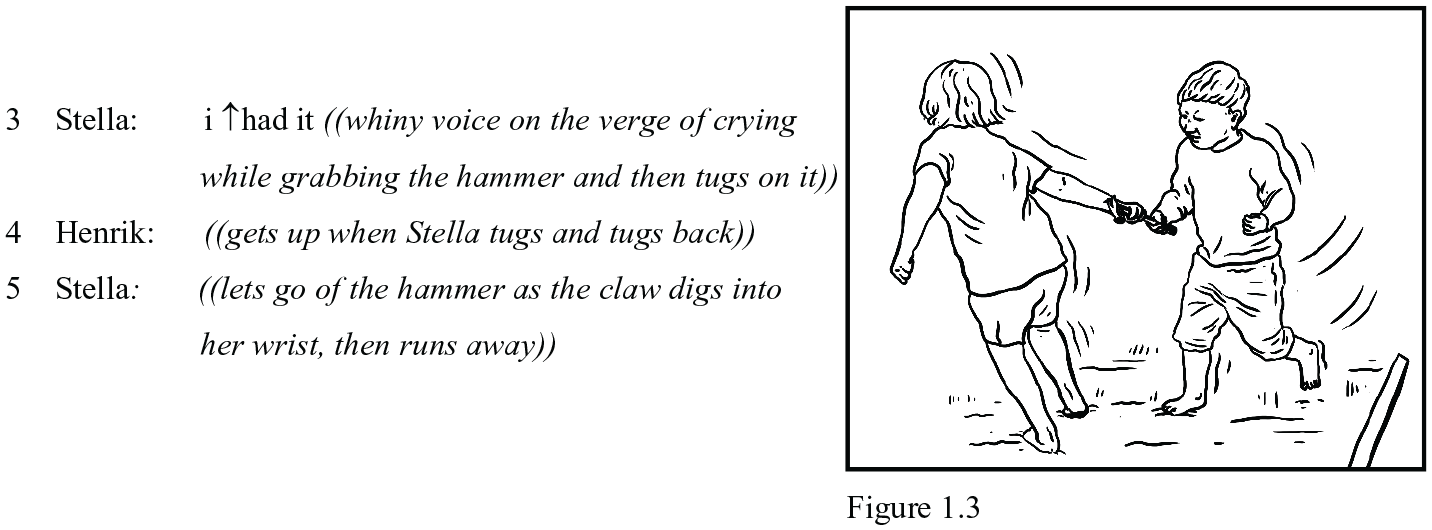
However, his possession does not last long. In a repetitive conflictual move, Stella claims her wishes for the object (line 2). She states her desires (‘but I want to’) in a whiny high-pitched voice on the verge of crying (Holm Kvist, 2018) and speedily rushes towards Henrik and the hammer (line 2, figures 1.1.-1.2). The multimodal configurations of talk, body, and speedy charging movement into Henrik’s play space, amplify Stella’s affective claims to the object. By quickly moving her body she occupies considerable space: she lunges forward with big steps, swings her arms widely and performs a routinised and publicly visible and physical take-back move, forcefully grabbing the hammer and (re-)claiming it (‘I had it’, line 3, figure 1.3). The hammer is brought into being (Woolgar and Lezuan, 2013) as an object of value and desire through strong emotional expressions, bodily actions and through the siblings’ mutual orientation towards the hammer, each other, and each other’s affective desires. However, at this point in the cyclical conflict trajectory, a physical take-back of the object is expected: Henrik quickly responds by getting up, maintaining his grip and tugs on the hammer (line 4, figure 1.3). The tug-of-war ends with his victory when Stella gives in: she releases the hammer as the sharp claws digs into her wrist and she moves away from her sibling and the hammer (line 5).
In all, several embodied and material conditions are of significance for how a hammer is enacted as a valuable object. The children’s affective responses and orientation towards each other made the object (and play activity) highly desirable, and such desire was expressed through loud verbal claiming and physical fighting. The siblings’ physical tug-of-war amplifies both children’s affective aspirations to get possession of the same play object.
Covertly preparing destruction by configuring a casual body
Conflicts about objects are dynamic and fluid. Although the conflict has seemingly fizzled out, the sibling who had lost possession of the object prepared for retaliation (that targeted the object of desire) in order to sabotage her sibling’s play. Notably, to be successful, the prospective saboteur needed to manage ‘matters for alarm’ and adopt a ‘guise of some kind’ (Goffman, 1971: 258). This required a skilful execution of sabotage, that is, the opponents/siblings carefully calibrated a covert embodied approach towards the desired object by adopting a body configuration that signalled normal and harmless everyday actions (Goffman, 1971: 128). The covert approach was organised through multiple embodied moves. Specifically, the deliberate configuration of, what we call, casual and deceptive bodies in order to gain unobtrusive access to the sibling’s play space and conceal the prospective act of retaliation.
In Excerpt 1b (continuation of Excerpt 1a), after her unsuccessful and affective take-back attempt, Stella retracts from an open conflict and withdraws from her sibling who now concentrates on hammering (excerpt 1b, line 6). When the conflict seems to have fizzled out, she starts to silently and slowly approach her opponent behind his back. Her casual body configuration strongly contrasts with her previous public and affective embodied attack on the object (Excerpt 1a).
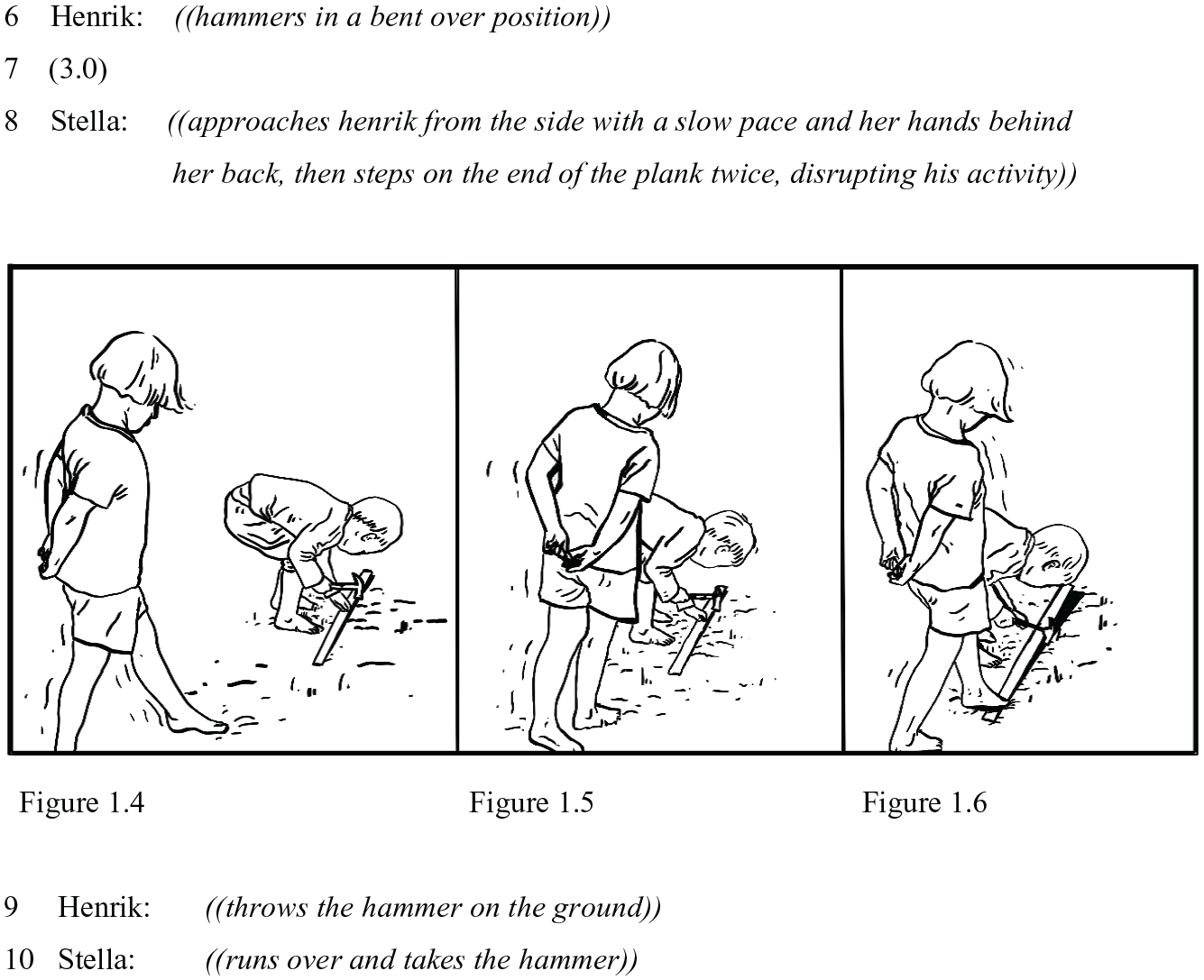
Stella moves silently, casually and slowly towards Henrik and the hammer (line 8). As Goffman (1971: 294) notes, blind spaces that ‘are hidden from everyone’s angle of vision’ . . . ‘can even be manufactured on the spur of the moment’ without the risk of easy discovery. Stella is slowly approaching Henrik and her body configuration is carefully organised outside the field Henrik’s vision. Her hands are now positioned behind her back (line 8, fig. 1.4-1.6) in a way that gives the impression that she is not targeting the desired object. This body configuration and silent, affectively downgraded approach within the socio-material space, contrasts strongly with her previous affective claims and speedy and forceful movement when rushing towards the object (Excerpt 1a). By adopting a casual body configuration Stella is this way able to maintain ‘normal appearances’ (Goffman, 1971: 258) thus displaying to Henrik that she is no longer pursuing the object.
The girl’s casual body configuration allows her to move into her sibling’s play territory and get closer to the hammer without being discovered. In this process Henrik is carefully monitored and taken into account (Evaldsson and Karlsson, 2020). Stella moves on to the destruction and quickly steps on the plank twice, making the plank swing (line 8, fig. 1.6). The rapid physical attack prevents Henrik from continuing to hammer. When access to the play space is achieved unobtrusively, in a concealed way through a casual – deceptive – body configuration, the saboteur is able to successfully obstruct the opponent’s play activity.
During the post-destruction phase Henrik gets up in surprise and throws the hammer on the ground (line 9). At this point Stella quickly picks up the desired object, becoming its new owner (line 10).
This is the craft of the covert embodied approach in sabotage: concealing one’s upcoming destruction through entering the play territory outside the target’s field of vision while configuring a deceptive body that deceives the target. We argue that an embodied covert approach, and the downplaying of the expression of desire towards the desired object, are significant in achieving successful sabotage of the object and play. The sibling, as a prospective saboteur, is this way able to inconspicuously and covertly, approach the target ‘right under the eyes of the subject’ (Goffman, 1971: 258) and get close to the desired object. Sabotage, in this case, granted Stella the opportunity to become the new owner of the desired object.
Covertly preparing destruction by configuring a playful body
As demonstrated in Excerpt 1b, the child’s embodied approach towards the desired object was organised in the immediate presence of the prospective target. Covert sabotage is subtly embodied within the material space of children’s activities; configuring a deceptive body requires skilful calibration, understanding and monitoring of the other’s activity and object use. As an ‘orientation gloss’, it transmits information towards co-present actors and designates behaviour that signals to others that the person is engaged in normal and harmless everyday actions (Goffman, 1971: 128). In order to not to alarm the other (the target of the sabotage), the child can, in addition to configuring a casual body, configure what we call a playful body in her approach. This body configuration also differs considerably in terms of affective expression and of publicly visible interest in the object compared to the body configuration during the tug-of-war in Excerpt 1a.
In Excerpt 2a, siblings Karolina, 5:1 and Gustav, 3:7 play with a plastic toy garage, a fragile construction. Their conflict is physical and repetitive: the siblings push each other away from the garage, loudly claiming their possession and right to play. Through their physical conflictual actions, the toy becomes a desired object. Before the beginning of the transcript the garage collapses and Karolina walks away from the play space. When Gustav mends the garage (line 1) and the conflict has seemingly fizzled out, Karolina comes back and covertly approaches Gustav by configuring a playful body (line 2).
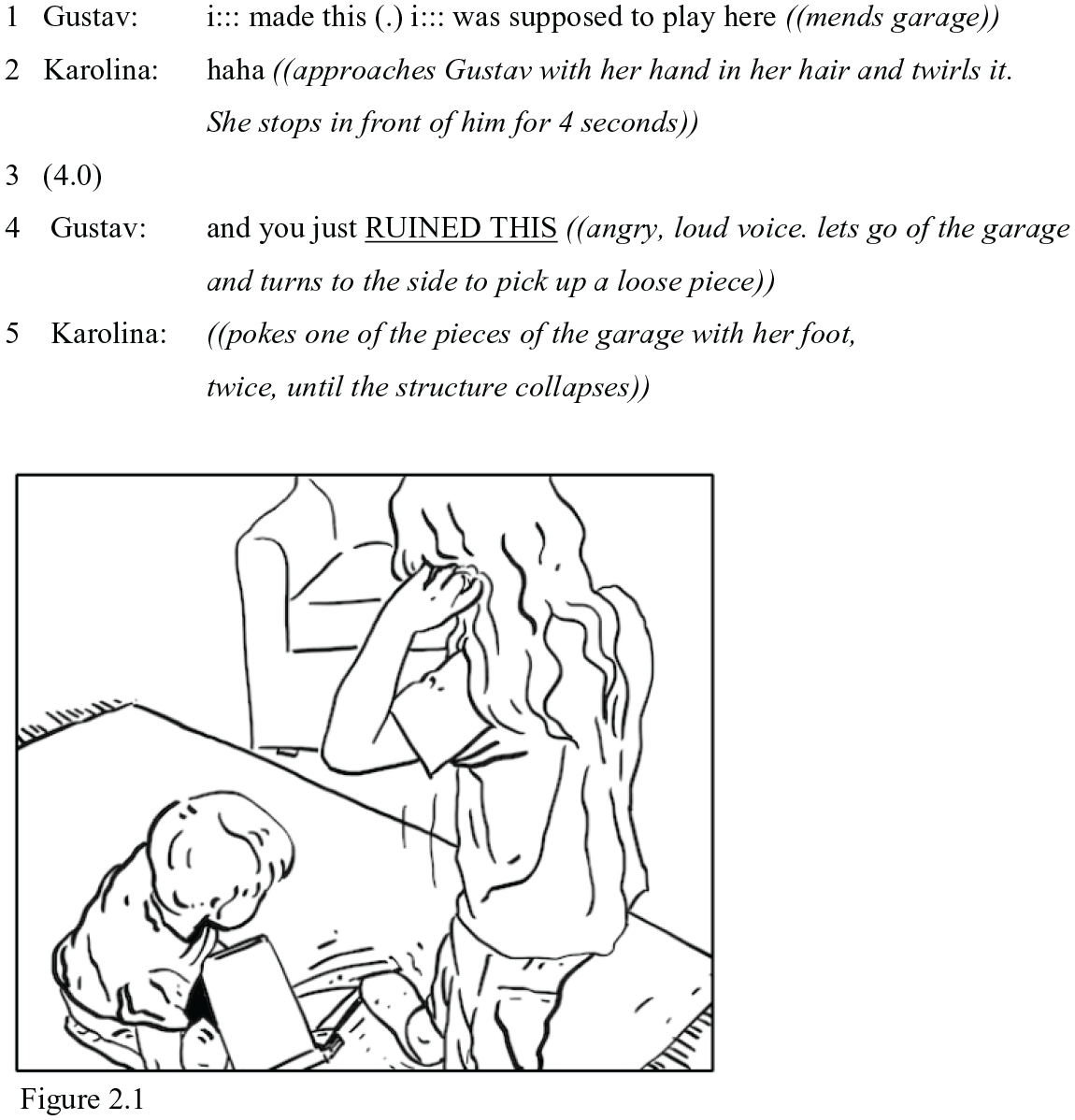
By using and mending the toy, Gustav merges the territorial boundaries of his play and the garage in a way that strengthens his role as an object-owner. Gustav, with affective talk, claims his possession, accuses Karolina, and makes territorial claims (‘I made this, I was supposed to play here’, line 1). This way, Gustav displays that the object ‘matters’ (Horton, 2010) to him. He also demonstrates that object ownership and proper use are linked to affective and moral accountability.
Similarly to Excerpt 1a-1b, the conflict seems to fizzle out when Karolina withdraws from the play space. Soon enough, however, she starts approaching her brother again: she moves slowly, laughs, and twirls her hair. This way she configures a playful, deceptive body towards her brother (line 2, figure 2.1, cf. Excerpt 1, figure 1.1-1.2). Gustav is clearly not alarmed by his sibling’s close territorial co-presence since she is able to stand close to him for 4 seconds (line 3). As he proceeds assembling the garage, Gustav again accuses his sister of inappropriately handling the desirable object with a loud and angry-sounding voice (‘and you just RUINED THIS’, line 4) thus positioning himself as the rightful object-owner. It is when he temporarily lets go of the object (line 4, figure 2.1), that Karolina destroys the toy by quickly poking the garage twice, until it collapses (line 5, figure 2.1). The act of destruction is, in line with Goffman’s (1971: 259) conceptualisations of sabotage, ‘exposed’ or ‘performed openly’ in front of its target. Karolina’s acts are clearly not incidental. Rather, it skilfully targets and intentionally sabotages her sibling’s activity through complete destruction. The configuration of casual or playful, but deceptive, bodies demonstrates the children’s orientations to the morally disputable character of the upcoming act of sabotage destruction since the retaliation was prepared in disguise and without causing alarm.
The post-destruction: justifying the destruction of desirable objects
During the post-destruction phase of the opponent’s activity, the children, in addition to becoming the new owner of the objects (as in ex 1b), articulated and made explicit moral accountabilities related to the sabotage. Affective accusations and justifications highlighted their orientations towards sabotage destruction as an intentional, and rightful, act of retaliation, or a frightful sabotage of the object. The children’s affective responses and embodied acts enacted the object as highly desirable. Such desire was tied to the possession, or denial of the other’s possession through destruction and sabotage.
In Excerpt 2b, when Karolina has successfully destroyed the play object (the garage), Gustav, with, an angry face, protests by screaming ‘NO AAH’ (line 6, figure 2.2).
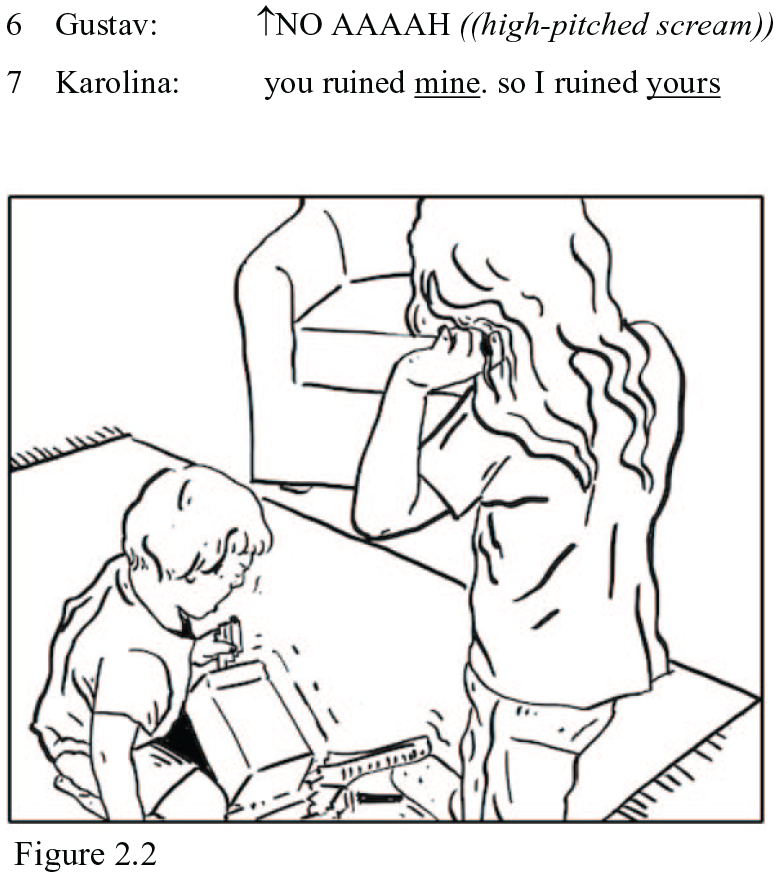
In response to her sibling’s affectively aggravated outcry (line 6, Figure 2.2), Karolina holds him morally accountable for destroying the object when it was in her possession: ‘you ruined mine, so I ruined yours’ (line 7). Her acts of retaliation and destruction are based on the moral rational of ‘an eye for an eye’ in that the offenses performed by the other party justifies her right to fight back (Evaldsson and Svahn, 2017). The material properties of the object have importance both for how the embodied conflict escalates, and for how the sabotage between the siblings is accomplished. The garage’s material construction is wobbly, and it can only be played with when intact. Since Karolina ultimately could not gain possession of the object during their lengthy conflict, she destroys the garage altogether. This way she creates (at least a temporary) impossibility for her sibling to sustain his play with the ‘highly valued’ (Palludan and Wentzel Winther, 2017: 38) object.
Concluding discussion
In the present study, we have examined embodied interactional and material features of siblings’ conflict-related acts of sabotage. The study has highlighted young children’s skills in calibrating and managing social relations and desirable objects in everyday play. The value of object possession was central in the siblings’ embodied conflicts and acts of retaliation. Retaliation through sabotage, consisting of a covert embodied approach, a public act of destruction and a post-destruction phase marked by affective accusations, shows young children’s intense concerns with situated and relational values of objects. Moreover, retaliation through sabotage highlights the children’s skills in both adopting, and orienting to, social features such as body movements and emotional expressions, and material features such as properties of objects (sharp or wobbly) in organising the social orders of play (Goodwin, 2006).
Object possession, or ownership, were common incentives and causes for children’s conflicts (cf., Cobb-Moore et al., 2009; Holm Kvist, 2018), where the siblings’ desires for the same objects created ‘intense conflict’ (Horton, 2010: 384). Conflicts therefore involved affective physical acts – grabbing, pulling – usually leaving one sibling the winner. It is in such cases that deliberate retaliation through sabotage and destruction of the play object was done by the saboteur. The children organised the covert approach through multiple embodied moves, designed to gain concealed, unobtrusive access to their siblings’ play space. Thereafter followed a destruction phase in which the sibling damaged the other’s activity with the desired object.
The embodied organisation and territorial dimensions of the conflict were clearly important to the manner in which the prospective saboteurs organised their covert approach and acts of destruction. The unexpected yet publicly visible act of retaliation, in front of the eyes of the opponent, was made possible by exploiting the structure of the escalated, fully embodied conflict concerning the ownership of a mutually desirable object. Notably, the embodied shape of prior conflict moves – physical dragging and pulling on the play object or each other while arguing loudly – helped to set the stage for the concealed approach and sabotage of the play object. The prospective saboteurs clearly downplayed the conflict and adopted what we have called casual and playful body configurations in order to be able to approach the opponent (the current owner of the desirable object) without ‘causing alarm’ (Goffman, 1971: 258).
Sabotage was thus enacted through the interaction of several human and nonhuman entities, specifically it ‘emerged through the encounter’ (Spyrou, 2019: 316) between the children’s deceptive body configurations, affect, desirable objects and through the objects’ material properties. The saboteurs configured their bodies in order to, successfully and deceptively, destroy their sibling’s activity with the focal object. They also affectively upgraded their expressions of desire towards the play objects (ownership claims, whining and pre-crying noises and accusations) or affectively downplayed the expression of desire thus performing a fizzling-out of the preceding conflict. The affective and embodied claims to the objects became a process through which the objects acquired their status (Woolgar, 2012) as desirable and valued. Moreover, the objects themselves played a central role in the enactment of sabotage. The sharp claw of the hammer, which made Stella let go of it, and the wobbly structure of the garage, which allowed Karolina to easily disrupt her brother’s activity with it, played a central part in how the interaction was organised. All these affective, embodied and material features were significant in the successful accomplishment of sabotage.
Objects in children’s conflicts
Considering ‘matter and its contributing role in the production of our worlds’ (Spyrou, 2019: 316), the analysis of siblings’ conflicts clearly shows how objects become central and emotionally valued to children, and are incorporated in a many different ways in their play. Conflicts about object ownership brings to light what is important to children in terms of their interest in objects, ownership and possession, and moral accountabilities. Object possession was intertwined with affective desires and was central to siblings’ conflicts and sabotage. The analysis of the children’s lengthy conflicts and their skilful body configurations for specific social purposes shows that they were emotionally and bodily invested in the objects. The way in which they objects were enacted as affectively valued and desirable indeed shows ‘how things can really matter’ (Horton and Kraftl, 2006: 73) in siblings’ relations. Close analytical attention to objects allowed us to make sense of children’s mundane, prolific, and yet, under-researched, everyday concerns. In this way, we found that objects are central to ‘the passing, ongoing, almost moment-by-moment constitution of these siblings’ relationships.’ (Horton, 2010: 384).
We have discussed children’s conflicts and sabotage in relation to objects in their everyday activities and in relation to their social concerns. Interestingly, a close analysis of siblings’ embodied actions towards desired objects, and more specifically, their deceptive body configurations, shows how children skilfully manage morally troubling actions. The detailed analysis of social interaction showed that embodied acts of sabotage were oriented to as morally disputable. Although, from the saboteur’s point of view, sabotage was justified as a way of getting the upper hand in the object possession conflict. The prospective saboteur adopted a ‘guise’ in order to, in a credible manner, be able to enter into and move around in the same socio-material space and play territory in which the other child was using the desirable object. Paradoxically, thus, being able to successfully sabotage the other’s activity involved knowing and exploiting collectively shared knowledge that sabotage and destruction of material objects were clearly acts of transgression.
How can we then interpret the children’s calibration of the intricate, complex, embodied acts of sabotage? The extended cyclic trajectory of the conflict, that centred around the object, and the indeterminacy and fluidity of the role as object owner can be tentatively suggested to serve as a basic ground for finalising the conflict through destruction/sabotage. We suggest that with the scant prospect of gaining permanent possession of the play object, retaliation by eradicating the play activity and disrupting the social order of play was affectively and materially efficient. In all, understanding childhood as ‘made up through a wide variety of shifting associations (and disassociations) between human and non-human entities’’ (Prout, 2005: 109) has helped us understand sibling’s acts of sabotage as ways to disrupt and re-organise the social order of play. Multimodal interactional analysis allowed us to show both the intertwining of verbal, embodied and material features of children’s mundane, highly affective everyday incidents, and the intricate ways in which ‘child-thing ensembles’ (Rautio, 2016: 45) are constitutive of children’s social lives and childhoods.
On the basis of the present study of sabotage between siblings, it can be tentatively suggested that the enactment of sabotage is partly made possible by the sibling relation itself. The relationship between siblings (because of its social continuity and relative symmetry) can potentially allow for transgressions and morally disputable acts in a different way than between peers (where social relations are more fragile) or between parent and child (where relationships are characterised by social asymmetry) (see e.g. Goodwin and Cekaite, 2018). Therefore, we call for a continued study of siblings’ everyday conflicts and of the sibling relationship, still largely an under-researched area (but see e.g. Gulløv, 2015; Palludan and Wentzel Winther, 2017; Wentzel-Winther et al., 2015).
Another way of gaining (more general) insights into how and when sabotage is enacted, including possible variations of the phenomenon, would be to engage in a study of (larger) datasets from a variety of sociocultural contexts, extending beyond what is currently analysed in the data collected in several Swedish middle-class families. Notably however, the focused analysis of two sibling pairs has facilitated a close-to-practice and detailed analysis of the siblings’ conflict trajectories. We have been able to demonstrate how, in detail, sabotage is enacted by many entities in the lived everyday lives of the children. Our contribution to the field of childhood studies and the study of materiality is an effort in the spirit of interdisciplinarity to combine fields of research in order to conduct a detailed and inclusive analysis of human-nonhuman interaction. We thus call for a further development of the study of children’s material practices, both in childhood studies and in studies on social interaction, this way promoting a study of childhood that is both social, and materialist (Prout, 2019).
Footnotes
Declaration of conflicting interests
The author(s) declared no potential conflicts of interest with respect to the research, authorship, and/or publication of this article.
Funding
The author(s) disclosed receipt of the following financial support for the research, authorship, and/or publication of this article: This work was supported by The Swedish Research Council [742-2013-7626].
