




Abstract
This article draws on data from a comparative ethnography of two UK primary schools to explore the complexities inherent in Mandell’s ‘least adult role’. In the interest of gaining insight into children’s informal productions of sexuality and gender, this role was used to gain access to peer group cultures and diffuse the imbalance of power between researcher and researched. However, while found to be productive in a number of ways, ‘least adulthood’ was revealed as a positionality suffused with practical, ethical and emotional complexities, and characterised by a fundamental misconstruction of the workings of ‘power’. In line with recent critiques that have recognised both ‘power’ and ‘agency’ as largely under-theorised in childhood research, I conclude this article by offering a tentative alternative to least adulthood, which attempts to respond to some of the key methodological and ethical challenges in contemporary childhood ethnography.
Introduction
I include these stories here to show how tricky it is as adult to participate in this subtle, shifting, complex world of childhood relations. (Davies, 1989: 39)
Between 2015 and 2016 I conducted a comparative ethnography of two primary schools in the North East of England, to explore how children’s understandings and ‘doings’ of gender and sexuality might differ according to their involvement in formal school ‘equalities work’. Having found during the pilot study for this research that children’s behaviours differed markedly across formal (classroom, assembly) and informal (playground, peer group) sites, this project sought in particular to gain insight into children’s more private, ‘counter-school’ gender/sexuality productions. It was for this reason that I chose to appropriate what Nancy Mandell (1988) has termed the ‘least adult role’: a researcher positionality that attempts to cast aside all adult signifiers except physical size to allow entry into children’s worlds as an ‘active, fully participating member’ (p. 433). As the substantive findings of this research project are discussed elsewhere, I focus in this article on the various practical, ethical and emotional challenges that characterised my ‘doing’ of the ‘least adult role’.
Method
The following data are drawn from a year-long comparative ethnography of two primary schools in the North East of England. Comprising participant observation, discussion groups and story groups with children, the project sought to gain a depth of qualitative insight into the relationship between formal school discourses and individual/collective understandings of gender and sexuality, with 84 days spent in total across years 1 (aged 5–6), 3 (aged 7–8) and 5 (aged 9–10) at each school. The nature of this participant observation is discussed in detail throughout my analysis.
Thirty eight discussion groups and 33 story groups were conducted with children in years 1, 3 and 5 at each school, and were made up of pre-existing friendship groups. Discussion groups (comprising 3–6 participants, and lasting 20–40 minutes) began with a reiteration of the project, an opportunity to ask questions and the recording of verbal consent, following which I would ask children to simply ‘tell me about being a girl/boy’ (see Chambers, 1994). Conversation would then generally flow freely, with its direction determined largely by participants rather than myself.
Story groups (comprising 3–6 participants and lasting 20–40 minutes) involved the reading and discussion of De Haan and Nijland’s (2002) King and King: a children’s story in which two princes fall in love. On my request, children were read King and King by their class teacher, with groups conducted over the following few days. Again, these began with a reiteration of consent, opportunity for questions and assurance of children’s freedom to leave at any point. Following a broad, open question – ‘what did people think of the story?’ – I allowed children’s conversation to develop relatively unaided, with open questions and prompts introduced where necessary. Throughout discussion and story groups I maintained, as far as possible, a ‘least adult’ positionality, which involved remaining neutral in response to children’s heterosexist, homophobic and otherwise inequitable interactions. The problems (and values) inherent in such an approach are the focus of this article.
Analysis
In deciding on least adulthood, I was informed in large part by the debates that have taken place within the ‘new sociology of childhood’ (Christensen and James, 2000; Hutchby and Moran-Ellis, 1998; James et al., 1998; Qvortrup et al., 1994), and their recognition of the ways in which unequal power relations that exist between ‘researcher’ and ‘researched’ are heightened in research with children (Tooke, 2000; Valentine, 1999). In light of this recognition, an increasing number of childhood researchers have sought to disrupt the imbalance of power between adult researchers and child participants through the development of new methodologies that work in part to ‘give power over’ to child participants (Gallagher, 2008). While some (Thomson, 2008; Van Blerk and Kesby, 2007) have advocated the development of novel, child-specific methods, I remain convinced along with Alderson (2008) and others (Harden et al., 2000) of children’s clear ability to participate in ‘traditional’ methods such as interviews, observation and discussion groups. My concern prior to entry into the field, then, was with considering how children’s voices might best be foregrounded through existing research techniques, as well as how my ‘situatedness’ as researcher might contribute to (and potentially disrupt) the imbalance of power between myself and my participants.
One positional approach that attempts to address precisely these issues is Mandell’s (1988) ‘least adult role’, which advocates that the researcher relinquish all adult signifiers except physical size in order to enter into children’s world’s as an ‘active, fully participating member’ (p. 433). 1 Having become acutely aware during my pilot study of the fundamentally situational nature of children’s gender/sexuality productions, the least adult role seemed an important means of accessing certain situated performances, in particular those that were not made visible to teachers or other ‘official’ adults in school (Abebe, 2009; Corsaro and Molinari, 2017). Indeed, when discussing the findings from my pilot study, I have often used the following extract (returned to more critically later) to demonstrate the significance of this role in enabling access to children’s private, ‘counter-school’ worlds:
(In response to my asking the group what they would think about a boy who played with dolls)
2 : I’d pretend to be his friend, and play a game with him, but then/
/when he walks away, we’ll just run away/
/or when he goes to the toilet just hide his dolls or something.
I’d hoy 3 it on the shelter on the/
/hoy them in the toilets!
You do realise that if this wasn’t Catherine you wouldn’t be saying this to a teacher would you. (Boys aged 7–8)
Doing least adult: Benefits
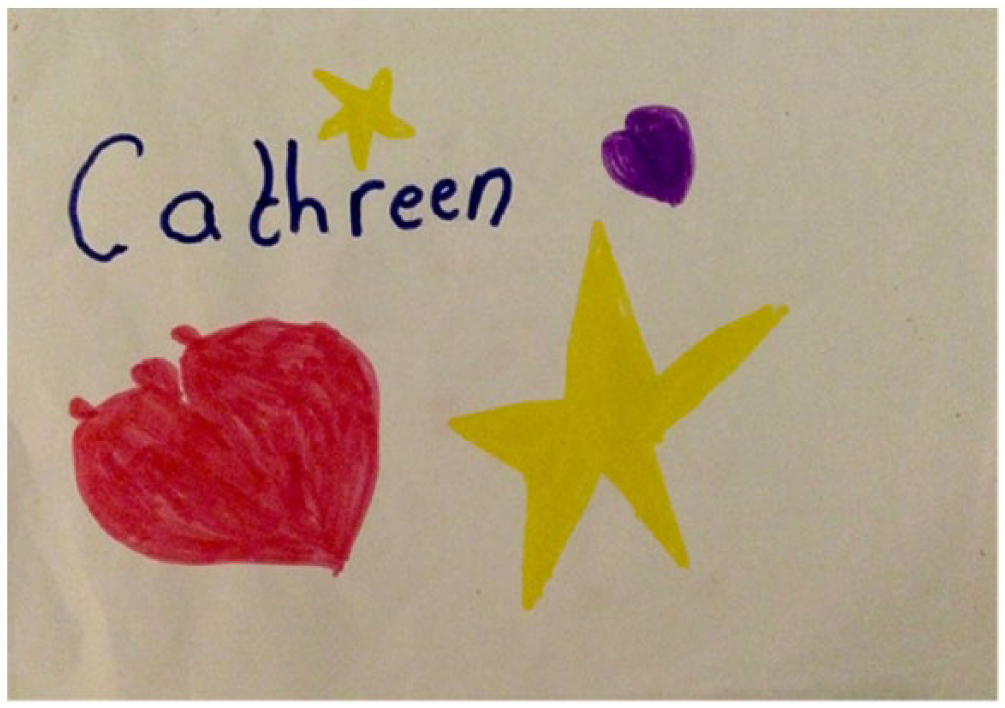
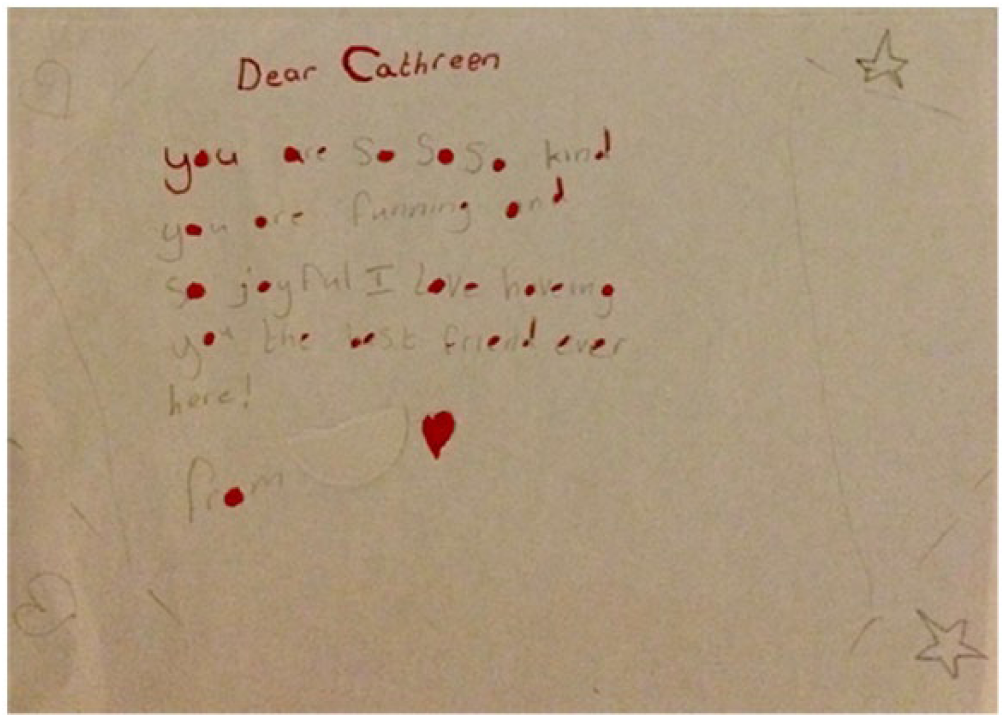
Throughout the majority of the fieldwork process, my commitment to enacting least adulthood was considerable. As well as being known by my first name, dressing informally and distancing myself from teachers and other ‘official’ adults in school, I also joined in lessons, sat on the carpet, ate dinner at children’s tables in the dining hall and participated fully in interactions on the playground and field. While during the very early stages of fieldwork these behaviours were met with amusement and suspicion from children, I felt as the research progressed that my position as least adult became accepted and embraced by many, if not most, participants. In the case of the card, below – given to me by an 8-year-old girl with whom I had established a particularly close friendship – the description of me as ‘the best friend ever here’ makes clear the friendly and equitable, as opposed to more normative, hierarchical relationship that we shared. Significantly, the card that this child gave to her class teacher on the same day described him as ‘the best teacher ever’ (my italics), signalling a clear differentiation in the way she viewed the two adults (friend/teacher) in her class (Figures 1 and 2). 4
Card from 8-year-old child.
Card from 8-year-old child.
I argue in light of such moments that there were a number of ways in which the least adult role was productive. Most notably, it enabled the development of relatively equitable, non-authoritative relationships with participants that helped in the creation of informal, peer group research spaces. Within these, children ‘open[ed] up to me in ways which do not usually happen with teachers’ (Epstein, 1998: 30) and discussed various subjects that were far less likely to be broached with ‘official’ adults in school. Indeed, the enthusiasm that children showed towards both the research and their relationships with me was not only gratifying, but also significant in terms of ensuring mutuality in the research process. Although fieldwork undoubtedly served my interests more than theirs, children’s clear enjoyment of the project (which I believe was aided significantly by my least adult position) went some way to ‘foster[ing] reciprocity and [overcoming] inequality’ (Barker and Weller, 2003: 41) during fieldwork.
Notwithstanding these benefits, occupying the role of ‘least adult’ was far from easy, and over the course of a year in the field I became not only exhausted by its multiple challenges, but also critical of what I came to see as its many inherent pitfalls. I focus throughout the remainder of this article on what I consider to be the key limits of least adulthood with regard to four broad themes – Mis/behaviour, Participation, Resistance and Vulnerability – and conclude by offering the ‘honorary child’ as an alternative positionality, which might better acknowledge the complex workings of ‘agency’ and ‘power’.
Doing least adult: Challenges
i. Mis/behaviour
Perhaps the most difficult aspect of being least adult was negotiating children’s ‘mis/behaviours’ 5 during discussion and story groups. Motivated by a desire to foreground children’s voices and minimise my own ‘heightened power’ as adult, I approached these groups with the conviction that they should be fundamentally non-authoritative, child-led spaces for discussion. Thus, following a recap of the nature and aims of the project, I began groups by restating my ‘non-teacherly’ role (reminding participants ‘I’m not here to tell you off’) and assuring children that ‘no topics were off limits’ (Renold, 2005: 13). While most discussion groups were productive in various ways, some – as a result of both this non-authoritative approach and, perhaps, an unnecessary overstating of my positionality – became so out of control that I found myself in states of total exasperation, and bafflement as to what to do. During these sessions, children ran and jumped around the room, talked and shouted over one another and swore excessively, while I agonised about how and whether to intervene. Having (naïvely) been unprepared for this particular challenge, I spent the early stages of the research process responding to such ‘misbehaviours’ in a largely makeshift and unsatisfactory manner. Sometimes I asked (or rather, begged) children to calm down, while at others I offered imperatives such as ‘the Headteacher is right there!’ or ‘we don’t want to get in trouble!’ in an attempt to quieten the group while maintaining a least adult position through the suggestion of shared culpability. During some of my most fraught moments, though, I regretfully found myself ‘snapping’ at children, or worse, telling them off. These moments were met with justified indignation from participants (‘you said you weren’t a teacher!’), and made me feel – both during, and for days afterwards – that I was failing at doing research (Horton, 2008).
As well as pushing me to think deeply about some of the limits of least adulthood (Is it possible to be least adult and conduct discussion groups? Is there any empirical use in half an hour spent trying, and failing to calm down a ‘hyperactive’ group of children? Was it even ethical to let children ‘misbehave’ to this extent?), these groups instigated a more profound reconsideration of the ways in which I had been conceiving of power up until this point. Indeed, like many others within the ‘new sociology of childhood’, I had been imagining power broadly as ‘a commodity possessed by dominant groups (adults) and not by their subordinates (children)’ (Gallagher, 2008: 137), with my employment of least adulthood representing an attempt to ‘hand over’ my disproportionate adult power to child participants. I had therefore been unprepared for the multiple ways in which children might ‘exploit, appropriate, redirect, contest or refuse’ (Gallagher, 2008: 137) my research techniques, with their ability to subvert and manipulate my ‘adult power’ made clear throughout groups in which I was rendered relatively powerless. Michael Gallagher (2008) provides a thorough critique of such ‘problematic oppositional model[s]’ (p. 137) of power in his discussion of participatory research with children, and draws on De Certeau’s (1988) distinction between ‘strategies’ and ‘tactics’ to elucidate the ways in which dominant ‘adult’ power might be subverted by children. Applying De Certeau’s formulation, adult power over children (particularly within the context of the school or classroom) can be understood as a ‘strategy’, or dominant mode of power that is able to produce and impose spaces in which to act, where ‘tactics’, conversely, can only manipulate or subvert strategic power from within (de Certeau, 1988; Gallagher, 2008). Within this framework, children’s discussion group ‘misbehaviours’ might be understood as enactments of tactical power, with my least adulthood representing an opportunity to rail against the strategic (adult, institutional) powers to which participants were normally subject. Through these resistances, children revealed themselves not as wholly powerless, but as able to tactically manipulate power from within, in complex and unpredictable ways.
Gallagher (2008) further emphasises the importance of avoiding a romantic conceptualisation of children’s resistant tactics, noting that these ‘may involve the oppressive colonisation of resources from weaker groups’ (p. 146) and the mobilisation of other available power strategies. Such colonisation was evidenced clearly during groups wherein inequitable power dynamics existed between children themselves, with more dominant (usually male) participants using these groups as sites for the enactment of oppressive behaviours. In the excerpt below, for example, Adam, Andy, Mike and Dan employ dominant power strategies to police the non-normative gendered behaviour of Laurel, a boy with long hair:
[To Laurel] I think you’re a girl (loud laughter)
I think you’re a crazy woman!
He hasn’t got long hair though! Like you!
(I try to calm Laurel down, who is trying to fight everyone)
Mrs.- Mrs. Johnson [Laurel’s surname]! (laughter) Mrs. Johnson/
…
Look he’s got eyeshadow on like a girl!
So, what’s it like- (overtalking, laughter)
I’m not a gi::rl!
Yeah y’are
Hello woman/
/(Fiercely) don’t act like one then (laughter)
E:r, what’s it like being a boy/
/fun. Beating up Adam, is fun
The thing about, being a boy is like, people don’t judge yu- how y’look unless y’look like Laurel (laughter)/
/oh come on, that’s harsh
(Laurel dives across the table to fight Dan)
Laurel! Careful, or we won’t be allowed to use this room. (Discussion group, boys aged 9–10)
The issue that arose during interactions such as these was that of whether, where and how to intervene. Was it more important to challenge emotional or physical discord between children (Keddie, 2000), and in what way should this be done? Should a least adult position be maintained while doing so? And if so, how?
Largely, in the case of verbal or emotional fallouts, I chose to side with the group’s ‘underdog’ in a manner that intimated my disapproval of unkind behaviour while maintaining a non-authoritative position. For example, my comment above (‘oh come on, that’s harsh’) attempts to make clear my support for the ‘victimised’ child while using shared language (‘harsh’ was a term often used by children during arguments) to maintain my affinity or ‘equal status’ with participants. Following these groups, though, I was pushed to consider the possibility that by refusing to exert more definitive adult power in these moments, I had enabled other dominant power strategies to be exercised. In Gallagher’s (2008) words, [H]ad I approached the project with a less romantic view of children’s agency as inherently benign, I might have decided that a stronger mobilisation of an adult power strategy … could have been justified here as a tactical resistance to the enactment of male domination. (pp. 146–147)
Indeed, the problematics of such ‘romantic’ theorisations have been increasingly highlighted within the childhood studies literature (Kraftl, 2013; Prout, 2005; Tisdall and Punch, 2012; Vanderbeck, 2008), with Holloway et al. (2018: 13) calling for ‘a move away from celebrations of young people’s agency, which are implicitly underpinned by both liberal conceptions of the subject and romantic ideas about the virtuosity of youth’. Through moments like the one above, children’s agentic capacity to ‘(re)produce privilege and oppression’ (Holloway et al., 2018: 4) was made profoundly clear.
Of further significance was the fact that I did feel compelled to abandon least adulthood in the case of physical violence, and when Laurel (above) responded to the others’ teasing with (tactical) punches and hair pulling, I definitively stopped him out of concern for the physical safety of the children ‘in my care’. Later, though, I found myself troubled by this. Indeed, how fair was it of me to regulate Laurel’s physical, but tactical, exercise of power more fiercely than the rest of the group’s emotional, but strategic and dominant, ones? And how, indeed, can I claim least adulthood when I had the power to regulate children’s behaviour according to what I deemed acceptable?
ii. Participation
Equally as challenging as this issue of participant ‘misbehaviour’ was negotiating the limits of my own behaviour as least adult participant–observer in school. As one of the tenets of ethnographic research is that ethnographers will immerse themselves in the world of their participants and share in local cultures and languages (O’Reilly, 2012), my time in school was spent participating fully in children’s day-to-day lives. While such ‘straightforward’ participation was fairly uncontentious (although still not without its challenges), significant issues arose when deciding where to draw the line with regard to ‘misbehaviours’ in school. Indeed, when cultural behaviours comprised rule stretching or breaking, participation became a significant practical and ethical challenge, and maintaining good relationships with teachers while simultaneously aligning myself with explicitly anti-teacher or anti-school sentiments proved a difficult tightrope to walk.
In addition to some minor ‘misbehaviours’, such as writing notes at the back of the classroom and playing in ‘out of bounds’ areas of the playground, there was one incident in particular that pushed me to consider at length the terms and limits of least adult participation. The details of this are laid out in the following extract from my fieldnotes, and reveal not only the risks inherent in participatory least-adulthood, but also the fluidity of adult–child power relations, which are ‘prone to slippage’ (Barker and Smith, 2001: 145) and subversion over the course of research (‘I’m telling on you!’): Following [Tyler et al.’s] discussion group [all aged 9-10], I returned to class and started packing up for the end of the day. Tyler, not for the first time this week, began trying to take my notebook from me, which I couldn’t let him read as it contains fieldnotes that reference other children by name. In the spirit of the discussion group we’d just had, where children had been swearing freely, I said – in an attempt to signify firmly that he couldn’t read my notes but without positioning myself as adult/authority figure – ‘C’mon Tyler, don’t be a dick’. Tyler looked shocked, and then said, in a tone of amusement/triumph, ‘you just called me a dick!’ He paused briefly and then clarified (upon realising that he had been using similar language in our discussion group, as well as regularly on the playground?) ‘ … in the class! I’m telling on you!’ In a state of panic, I got up and left the room as I heard Tyler go off to tell Lauren [the class teacher]. For about five minutes, I sat in a toilet cubicle, heart pounding, in a state of total indecision as to what to do. I decided I would return to the class and own up, explaining to Lauren that it was an attempt at least adulthood. When I returned, though, (by which time the children had left to go home) Lauren told me with a look of disbelief, ‘Tyler just said to me, “Catherine just called me a dickhead”’, in response to which, Alison [the other year five class teacher, who had joined Lauren for a chat in her classroom] laughed and said, ‘I’m going to go out on a limb and say that’s probably not true!’ Thrown by this reaction (and by the presence, and absolute disbelief, of both class teachers) I panicked, and despite having fully intended to own up, denied it. I then muddled my way through the rest of the conversation and left school full of regret, wondering: what if Tyler goes home and tells his parents? What if he gets in trouble for lying, which he didn’t? What if I am discovered later as having said what I said and denied it? … How should I have managed the ethical complexities of this researcher/participant relationship? Where do I draw the ‘least adult’ line? How do I successfully navigate this ‘inbetweener’, dual world positionality? (Fieldnotes, Newhaven: 20/03/15)
Following an agonising weekend spent debating how best to redeem this situation, I returned to school the following Monday morning and confessed my lie to Lauren, Alison and George (the school’s Headteacher). All three were admirably supportive, and understood that this incident – albeit misjudged – represented an aspect of the positionality I was attempting to maintain. It was agreed that if Tyler were to mention what happened, he would be told how sorry I was and that I had ‘got into trouble’ for my behaviour, satisfying in-school expectations of fairness and discipline while maintaining my least adult position.
This incident stands as a prime example of some of the practical and ethical challenges of being ‘least adult’, and exposes both the vulnerabilities inherent in this position, and the shifting relations of power between myself and my participants. Consistently unconvinced by my role and presence in his school, Tyler used this moment as an opportunity to employ tactical power ‘against me’ (‘I’m telling on you!’), and as somewhat threatening ‘leverage’ over the following months (e.g. signalling at me across the classroom or playground to indicate ‘I’m watching you’(!)). The relationship between myself and Tyler, then, ‘[cannot] be reduced to the powerful and less powerful along essentialised lines of difference’ (Holt, 2004: 15), but should be understood rather as shifting and multivalent, where generalised (strategic) systems of adult dominance ‘[do] not preclude multiple points of resistance and confrontation at which children are able to exercise power over adults’ (Gallagher, 2008: 143).
As well as complicating my previous conceptions of children as always relatively powerless, what was also significant about this incident was the questions it raised around the limits of least adulthood, as well as the social norms that remain intact even in norm-critical or queer childhood research. When speaking to other researchers in the weeks following, I found not only that some were deeply shocked that I had sworn with a child, but also that many (who spoke of having used least adulthood themselves) confessed to having never dealt with this issue as children had never sworn in their presence. Such revelations pushed me to question the extent to which these researchers can be said to have enacted least adulthood, as well as the limits of the role more generally. If children chose not to swear because it was made clear by the researcher that doing so would not be tolerated, then what was being enacted was not least adulthood. And yet also, if the researcher placed no (implicit or explicit) limits on swearing, but still no children swore in their presence, then perhaps something greater was being revealed about the ‘ever-adult’ nature of the adult researcher. Indeed, ‘one can resist these discourses but it is impossible … to step right outside of them’ (Epstein, 1998: 30).
iii. Resistance
This ‘inescapability’ of adulthood manifested itself in a variety of ways throughout my research, with the first of these relating to the manner in which I continued to enact adulthood unintentionally. For example, unlike children, who had to remain in the classroom for the duration of a lesson, I was allowed to leave whenever I chose, and walk around school unattended. At lunch (despite my continued requests to the contrary) I was always given a china as opposed to plastic plate, and a larger portion of food. And, significantly, I was allowed to take groups of children out of class unaccompanied for discussion and story groups. Children themselves noticed these inconsistencies and challenged them, and over time I became increasingly aware, and critical, of the contradictions inherent in my role.
Further to these fairly subtle contradictions, there were also a number of more obvious ways in which my adulthood revealed itself. While I often joined in physical education (PE), for example, it was clearly not possible for me to get changed into a PE kit in the classroom or, indeed, wear a PE kit (or school uniform) at all. I used the adults’ toilets as opposed to the children’s, which while inevitable, likely precluded interesting insight into school toilets as spaces for often regulatory peer group behaviour (see, for example, Ingrey, 2012; Rasmussen, 2009). While these enactments of adulthood might appear banal, they nonetheless represented further ways in which the role contradicted itself, and again children challenged these contradictions (‘why aren’t you getting changed?’) while trying to make sense of my somewhat confusing positionality.
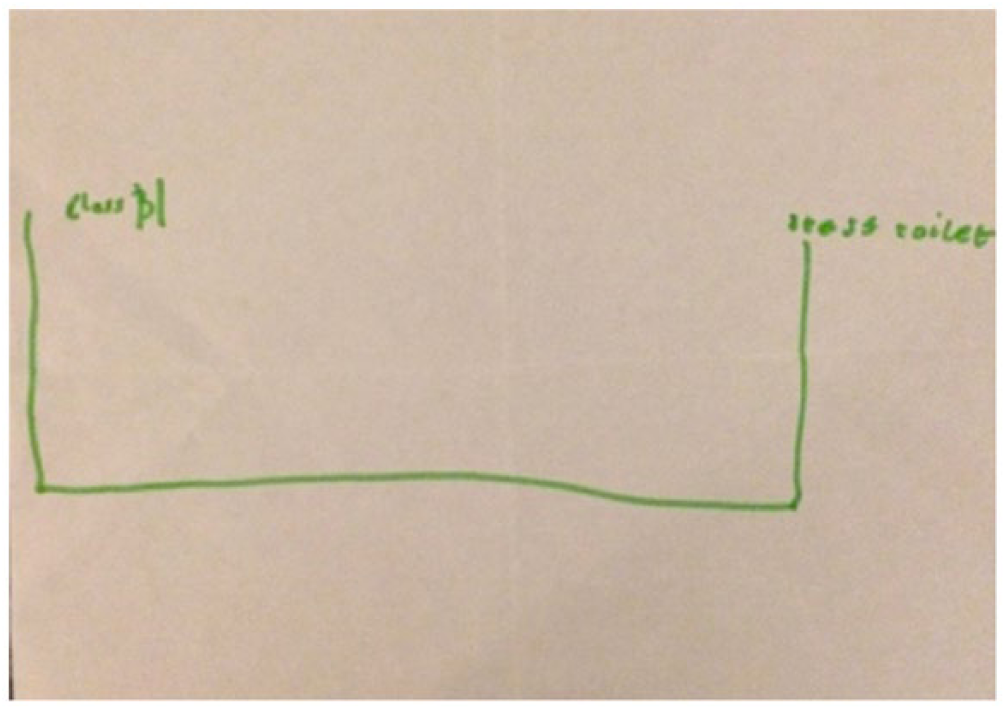
Of all the role’s difficulties, though, by far the most challenging were the moments during which children interpellated me as ‘teacher’ despite all of my efforts to the contrary. At intermittent moments throughout the year-long fieldwork process, children with whom I was convinced I had established a completely non-teacherly status would ask me to intervene in a fall out in the playground, or call me ‘Miss’. One lunchtime, amid a raucous discussion in the lunch hall about girlfriends, boyfriends, dating and dumping, one child told me enthusiastically, ‘you’re the best teacher ever!’ Another time, having told a child that I had got lost trying to find the toilets, I was drawn a map for next time, with ‘staff toilets’ clearly labelled (Figure 3).
Map.
More so than any of the role’s other challenges, it was being positioned as ‘adult/teacher’ despite all my efforts to the contrary that gave rise to the greatest feelings of personal failure. Each time a child called me ‘Miss’ my heart would sink, and I found myself responding to these interpellations by effectively resisting children’s resistances, and insisting that they accept me as ‘one of them’. However, over time this insistence began to feel uncomfortable: in asking to be accepted as least adult by children who challenged this positionality, wasn’t I enacting dominant power to project onto them an unwanted researcher–participant relationship? Was I, in Gallagher’s (2008) words, ‘unwittingly reproduc[ing] the regulation of children by insisting upon certain forms of participation, in the belief that these constitute “empowerment”?’ (p. 137)
Troubled by these resistances – and by my responses to them – I began to recognise some of the ethical problems inherent in attempting to occupy any singular research positionality, in particular one that is researcher- as opposed to participant-defined. Further, in being interpellated continually as adult despite all of my efforts to the contrary, I was pushed to think about the escapability of subject positions more generally, and the extent to which any researcher can resist the organisational structure of their research site in the manner that the least adult role attempts to. Indeed, notwithstanding ‘the multiple points of resistance and confrontation at which children are able to exercise power over adults’ (Gallagher, 2008: 143), the adult/child binary is one of the most rigid organisational structures in our society, and one that is perhaps most vehemently maintained within the space of the school (Barker and Smith, 2001; Holloway et al., 2018).
It was this realisation that pushed me to think again about the discussion group extract cited in this article’s opening, in which Jamie asserts, ‘you do realise that if this wasn’t Catherine you wouldn’t be saying this to a teacher would you’. It is clear from this statement that I am being recognised by Jamie as someone who is told things that other adults are not, and I am convinced that this ‘telling’ came as a result of the relationship I developed with this group of children over time. However, is Jamie saying that I am not a teacher? In fact, he says ‘if this wasn’t Catherine you wouldn’t be saying this to a teacher’, the implication being that ‘Catherine’ is still a teacher, but not the sort that puts limits on what is allowed to be said. In this instance, though, (and as I came to realise, many others like it) being read as ‘teacher’ clearly did not stand in the way of being allowed insight into peer group discussions. Thus, I wondered, do researchers perhaps occupy various positions on an inescapable adult-teacher spectrum? And is it our positioning on that spectrum – informed as much by commonality as by difference – that determines the level of access we are granted into children’s worlds?
iv. Vulnerability and a ‘sense of failure’
This is an article written from a number of overlapping senses of failure … First, most simply, the small sense of failure that arises in/from ostensibly small, banal moments of angst, awkwardness, embarrassment, uncertainty, hopelessness, and so on – like my awkward silence in the face of children’s racist, sexist, uneasy questions. Second, more broadly and persistently, the sense of failure and self-doubt which I find crowds my thoughts, dreams and reflections in the shadow of such moments (what was I thinking when I did X? Why didn’t I do Y? What could or should I have done differently? Really, how can I be so hopeless?!). (Horton, 2008: 364)
While by no means specific to the doing of least adulthood, the ‘senses of failure’ about which John Horton writes resonate strongly with my own experiences, and in particular, my attempts to navigate the many ethical challenges, and related personal and professional vulnerabilities, that marked my time in the field. As least adult, I regularly found myself in the position of having to make improvised decisions in response to children’s questions, and often felt, like Horton, incredible self-doubt about the decisions made. Horton (2008) opens his piece by citing a string of questions asked of him by a group of 10-year-old interviewees: ‘you know that football song about Pakis?’, ‘do you beat people up?’, ‘do you have fights outside the football?’, ‘have you ever done it?’, ‘do you think (that girl) is ugly?’, ‘do you think (insert name of latest pop music starlet) is fit?’ Really, what do you say? (What should one say? What would you say?). (p. 364)
Moments such as these represented one of the most significant challenges of the research process, not least because my intended role as least adult made it difficult to know how to respond to some children’s genuine requests for information. In the case of a group of 10-year-old boys asking me how two men have sex, for example, I felt simultaneously reluctant to occupy the role of ‘informant’ (after all, I was not in school as an educator, let alone a sex educator) and compelled to share the knowledge that I have as adult in order to provide information and counter the in-school ‘taboo’ of homosexuality. In this instance, I was so concerned to avoid giving weight to the notion of two men having sex as unspeakable that I ended up giving the group a (probably inadequate) overview of anal sex, along with a somewhat hurried qualification about how ‘people have sex in lots of different ways’. While the children appeared satisfied with this explanation, I still left school that day feeling both nervous about potential repercussions from teachers and parents, and ashamed at having provided the group with what felt like inadequate and perhaps essentialising information. More generally, I was profoundly concerned about how my least adult positionality should have been negotiated in this moment, and the many others like it. Should I, for example, refuse to tell a 5-year-old boy what breasts are (in response to him asking about my own), in order to not disrupt his understanding of me as least adult? Would doing so be ethical? And how do I justify some of the more essentialising aspects of my ‘on the spot’ answers to these questions (‘they’re something that women have’)?! Was it right of me to answer ‘yes’ to the question of whether I had a boyfriend, feeling as I did that a truthful response was only fair, given that I was expecting children to be honest with me? Or did doing so compromise my least adulthood, and serve to confirm the heterosexist expectations that those children likely had of me as ‘grown up female’? In dealing with these ethical dilemmas, I was, like Horton, plagued by a profound sense of uncertainty, in particular about what I should have done for the best in particular research situations … how I could ever know what to do for the best in such situations, and moreover … how to articulate all this, and myself. (Horton, 2008: 365)
No less difficult than negotiating these ethical challenges was managing the vulnerabilities that came with reverting to the social status of ‘child’ (Gallagher, 2008; Thorne, 1993). While adults in general occupy a more powerful social position than children, this relationship of power is not fixed, but ‘constantly negotiated and prone to slippage’ (Barker and Smith, 2001: 145), and it is still possible for the researcher to be ‘rendered powerless, vulnerable and open to exploitation’ (p. 145). In occupying the role of least adult, I experienced both positive and negative relationships with children, and opened myself up to interactions from which a more normatively positioned ‘grown up’ might have been exempt. While sitting on the carpet one day, I was asked by a 5-year-old boy, ‘do you ever brush your teeth?’ and when I replied yes ‘then why are they so yellow?’ Another time, an 8-year-old boy pointed at my legs, laughing, and said ‘look how fat you are!’ Though I was able to deal with some comments objectively (and consider their significance in terms of e.g. gender, age and power) I confess that the two described here caused me to cry in a toilet cubicle before returning to class. These experiences, while not reasons against the use of this role, draw attention to the significant emotional challenges of least adulthood, as well as to the often profoundly complex interplay of power between children and adults in the field.
Reconsidering the least adult role
Notwithstanding its shortcomings, being least adult did enable the development of valuable friendships with children, which in turn provided a depth of insight into peer group and counter-school cultures. Further, participating as least adult to the extent that I found myself in trouble for swearing enabled a more general questioning of some of the norms that remain intact even in norm-critical childhood research. I would argue in light of this for the necessity within – particularly queer – childhood studies for greater criticality with regard to swearing and ‘misbehaviour’, especially given their significant relationship to peer group culture (and thus participatory methodologies).
With the benefit of hindsight, though, I am able to recognise that one of the most significant weaknesses in my enactment of least adulthood was my over-investment in trying to almost ‘become’ or ‘pass as’ a child (Epstein, 1998: 33). Having found least adulthood productive during my pilot study, I entered into the field this time with an urge to apply the role in its purest form, to test just how far I might disrupt power relations and just how much insight might be made possible by a truly least adult positioning. The results of this, though, were having to negotiate extreme practical/ethical dilemmas and feeling unwarranted degrees of personal failure whenever my least adult status was questioned, not realising at the time that resisting adult/teacher-hood entirely was a near impossibility.
More than this, use of the least adult role pushed me to a more profound realisation: that I had been working until this point under the assumption that ‘power’ was something I had and children didn’t. While it is true that children are rarely in a position of strategic power in relation to adults (Gallagher, 2008; Holland et al., 2010), their ability to enact tactical power, as well as to exert other forms of dominant – for example masculinist – power over their peers and myself was revealed clearly throughout the research process (see also Walkerdine’s (1990) ‘Miss Baxter Paxter’). In its fixed positioning of ‘adult as powerful’ (Barker and Smith, 2001: 146), then, the least adult role not only simplifies the adult–child relationship, but also works under the assumption that power is almost wholly negative; a unitary force that needs to be expelled. Conversely, I have come to see power as ‘both a productive and repressive force’ (Holland et al., 2010: 362), operating at multiple levels between children, teachers and myself.
In this vein, I conclude by offering a tentative alternative to the least adult role – that of ‘honorary child’. This proposed position emerges out of my experiences of being both ‘granted’ and ‘denied’ access to children’s social worlds, and attempts to respond to some of the key methodological challenges in contemporary childhood ethnography: those relating to issues of positionality, agency and power.
Honorary Child
Regarding positionality, the role of ‘honorary child’ positions the child participant as the determiner of access to their own social worlds, with the researcher open to being denied such access at any time (and aware that this does not preclude the possibility of it being granted in other moments). Indeed, within this formulation the possibility and legitimacy of denial is key, and works to reject any positional approach that ‘insist[s] upon certain forms of participation, in the belief that these constitute “empowerment”’ (Gallagher, 2008: 137, my italics).
Second, ‘honorary childhood’ offers the possibility of avoiding any unitary theorisations of ‘the child’, by recognising ‘childhood’ as always necessarily multiple, shifting and contingent. Employing Butler’s (1993: 308) position on strategic lesbian identity, I suggest that what is meant by ‘childhood’ within this formulation should remain ‘permanently unclear’. Key to this is a related rejection of any necessarily positive or romantic conceptualisation of children’s agency, where recognising children (like adults) as heterogeneous subjects working within multiple contexts of power (Holland et al., 2010) necessitates an understanding of their agentic capacities as at once constrained and enabled by these contexts. Thus, this role theorises agency as fundamentally ‘situated within … wider social forces’ (Holloway et al., 2018: 7), and capable of both reproducing and challenging inequalities, privilege and oppression (p. 2). Within this, the adult–child relationship should be recognised as necessarily fluid and ‘prone to slippage’ (Barker and Smith, 2001: 145), as power’s fundamentally shifting nature precludes the possibility of any fixed (powerful/powerless) subject positions. A further extension of this is a recognition of researcher positionality as necessarily non-unitary: open to reconfiguration throughout the research process.
Finally, in foregrounding the contingent status of participation, the ‘honorary child’ role acknowledges both the inescapability of adulthood and the possibility – and crucially, value – of inclusion in children’s social worlds. Indeed, as is clear above, the problems inherent in least adulthood did not cancel out the rich insights enabled through the formation of non-authoritative friendships with participants. An ‘honorary child’ role thus maintains the importance of these friendships, while recognising these as always inevitably shaped by the researcher’s unavoidable adulthood.
Though a tentative proposition, I view the position of ‘honorary child’, as it is formulated above, as having the potential to contribute to current theorisations around childhood methodology, agency and power. In particular, this position rejects any fixed conceptualisation of the adult–child relationship, and recognises that when it comes to emancipatory ethics, ‘the question is not how to avoid using power, but how power can be used to resist domination’ (Gallagher, 2008: 147).
Footnotes
Acknowledgements
Many thanks are due to the children involved in this research, as well as to the two anonymous reviewers who provided constructive feedback on an earlier version of this article.
Declaration of Conflicting Interests
The author(s) declared no potential conflicts of interest with respect to the research, authorship, and/or publication of this article.
Funding
The author(s) disclosed receipt of the following financial support for the research, authorship, and/or publication of this article: This work was supported by the ESRC under Grant ES/J500215/1.
