



Abstract
This article examines how public funding shapes nonprofit advocacy under changing institutional conditions, using Norway as a case of a shift from corporatist representation toward pluralist and contract-based governance. Drawing on survey data from national-level voluntary organizations collected in 1983 and 2013, the analysis assesses how the amount and the share of public funding relate to advocacy engagement. The findings show that the amount of public funding has become increasingly linked to maintaining contact with public authorities, while the share of public funding plays a weaker and more stable role. Public funding is also associated with increased engagement in policymaking arenas among organizations with less institutionalized access to the policy process. There is little evidence that contract-based governance has redirected advocacy toward policy implementation. Overall, the results demonstrate that the effects of public funding are conditioned by institutional arrangements and organizational position.
Introduction
Voluntary, nonprofit-based organizations are often regarded as important complements to representative democracy. By articulating societal concerns and channeling interests through advocacy, they contribute to democratic legitimacy and broaden political participation. Governments may support this role through public funding to promote a more balanced representation of societal interests and enhance input legitimacy (Salgado et al., 2025). Public funding, however, also serves as a mechanism through which governments can seek to enhance output legitimacy by involving organizations in the implementation of public policy (Smith & Lipsky, 1993). This dual function of public funding creates a potential tension between enabling advocacy by supplying resources that can be transformed into organizational capacity and embedding organizations within governing arrangements that may discourage or redirect them away from advocacy.
Existing research is inconclusive as to which of these two dynamics prevails and suggests that both may operate simultaneously. While many U.S.-based studies find a positive effect of public funding on nonprofit advocacy (Kim et al., 2025; Lu, 2018; Neumayr et al., 2015), recent European evidence indicates that it can engender more stable political access but also encourage organizations to moderate their criticisms of public policy (Arvidson, Johansson, & Scaramuzzino, 2018; Bloodgood & Tremblay-Boire, 2017; Carré et al., 2025). This pattern may reflect cross-national variations in the institutional contexts shaping state–civil society relations, particularly the extent to which advocacy is organized through more open and competitive forms versus stable, institutionalized channels. Moreover, organizations’ position within the policy process, specifically whether they are established insiders with institutionalized access or outsiders lacking regular channels of engagement, may further condition whether public funding primarily enables or constrains advocacy.
This article investigates how the relationship between public funding and nonprofit advocacy is shaped by institutional context and organizational position, using Norway as a case. The question addressed is how public funding shapes nonprofit advocacy under changing institutional conditions, and whether its effects differ between organizations with institutionalized access to the policy process and those without such access. Norway offers a particularly suitable case for addressing this question within a single political context. Traditionally, it has been characterized by a corporatist model with stable, institutionalized channels of representation between the state and a limited set of encompassing organizations. Over time, however, this model has gradually given way to a more competitive and pluralist environment in which lobbying and pressure strategies play a larger role, a process often described as decorporatization (Rommetvedt et al., 2013). At the same time, public funding for voluntary and nonprofit organizations has expanded significantly and shifted from a predominantly trust-based paradigm toward more contract-based arrangements, in which funding is increasingly coupled with expectations that organizations engage in policy implementation and service delivery (Saglie & Sivesind, 2018; Trætteberg & Sivesind, 2025).
Empirically, the article draws on two surveys of national-level Norwegian voluntary, nonprofit-based organizations from 1983 and 2013 to assess how changes in the political institutional context have altered the relationship between public funding and advocacy. These surveys capture the transition from a context of strong corporatist arrangements and more limited public funding to one characterized by increased pluralist competition and contract-based governance. The analysis examines whether and how the association between public funding and advocacy engagement has changed across these periods, and whether this change differs between insiders and outsiders with more and less institutionalized access to decision-makers, defined representation in a state-initiated council, board or committee The article first outlines the theoretical framework and situates the Norwegian case, before presenting the empirical results and discussing their implications.
Conceptualizing the Relationship Between Public Funding and Nonprofit Advocacy
Nonprofit advocacy is understood in this study as voluntary organizations’ attempts to influence public policy (Pekkanen & Smith, 2014). The present study focuses on organizations’ political efforts within formal political arenas, understood as official, institutionalized venues of public authority where binding political decisions are made and implemented (Binderkrantz et al., 2015). Advocacy within these arenas can occur either in policymaking arenas, such as the legislature and government, where political priorities are set and policies are formulated, or in policy-implementing arenas, such as the public administration, where policies are executed and programs are managed. Organizations may seek to communicate their positions directly to policymakers through lobbying, participate in hearings or consultations, seek representation on boards, councils, or committees, or apply pressure from the outside through media outreach and activism (Binderkrantz & Pedersen, 2024).
The viability of different formal advocacy strategies depends on the institutional political context, which shapes how, when, and through what channels organizations can engage in the policy process. The United States is regarded as a classic example of interest-group pluralism (Lijphart, 2012), where organized interests compete for political influence and lobbying and other pressure strategies are more prevalent. By contrast, many European countries have traditionally been characterized by corporatism, where certain organizations enjoy privileged and institutionalized access as insiders to the policy process (Christiansen et al., 2010). In particular, Norway and the neighboring Scandinavian countries have been described as among the most corporatist countries in the world (Rommetvedt et al., 2013). However, pluralist features have become increasingly pronounced in many traditionally corporatist systems, with aspects of both coexisting within the same political system.
The resources needed for gaining political access and influence differ in corporatist and pluralist contexts. Under corporatism, influence typically depends on encompassing membership interests, as it involves an exchange of political influence for the organization’s support for policy decisions (Öberg et al., 2011). Under pluralism, by contrast, influence is shaped more contingently by organizations’ professional, financial, and informational resources, as political access is often linked to their ability to provide decision-makers with the knowledge and expertise they need (Dür & De Bièvre, 2007). One implication is that, as pluralist competition has intensified within traditional corporatist contexts, sustaining a privileged insider position has become less about mobilizing membership support and more about securing the financial and organizational capacity to engage effectively in advocacy. This may also mean that public funding has become more significant because it represents a relatively stable resource base.
From a theoretical standpoint, public funding can be viewed through two dominant perspectives, that offer contrasting expectations about its effects on nonprofit advocacy. The resource mobilization perspective emphasizes how public funding enhances organizations’ capacity for advocacy by providing stable financial resources, legitimacy, and access to policymakers (Crepaz et al., 2021). Acquiring public funding can itself be an important motive for voluntary organizations to engage in advocacy (Halpin, 2014; Lowery, 2007). For organizations with institutionalized access, it may help consolidate their privileged position by providing resources to sustain political activity (Crepaz & Hanegraaff, 2020). For those in less established positions, it may facilitate entry into policymaking arenas. Decision-makers also have incentives to support organizations’ advocacy activities, as they rely on the information and expertise these organizations provide (Binderkrantz et al., 2015).
The resource dependence perspective, in contrast, highlights the potential constraining effects of public funding. Governments can use financial support as a policy instrument to aid policy implementation (Salamon, 2002). In many countries, there has been a broader shift in governance linked to the rise of contract-based governance, involving more instrumental relations with voluntary organizations. By channeling resources through targeted grants or contract-like instruments, governments can secure organizational capacities for service delivery, extend their administrative reach, and ensure that programs are carried out in line with political priorities (Kelleher & Yackee, 2008). From a dependence perspective, this may disincentivize advocacy by linking organizational resources to narrowly defined outputs and discouraging engagement that might conflict with governmental priorities (Chaves et al., 2004). Through such arrangements, governments can exert normative and organizational pressures that encourage nonprofits to professionalize around service delivery and implementation roles rather than autonomous political engagement (Lu & Park, 2018). Organizations with diversified resources are potentially better positioned to resist such effects, whereas those heavily reliant on public funding are more vulnerable to being tied to implementation functions.
Empirical research provides mixed evidence for both perspectives, and findings vary across institutional settings. In studies from the United States, public funding is generally found to facilitate advocacy or have no discernible effect on it. Lu’s (2018) meta-analysis of over 40 studies reports a small but robust positive relationship between government funding and advocacy engagement, indicating that financial support strengthens organizational capacity for advocacy activities. Similarly, Kim et al. (2025) show that public grants enable nonprofits to sustain staff-based advocacy, and Suárez and Hwang (2008) observe that government funding is often associated with formalized advocacy structures, suggesting a legitimizing rather than constraining effect. Feeney and Rainey (2009) and Nicholson-Crotty (2007) show that general operating grants tend to promote advocacy, whereas narrowly specified service contracts may have neutral or dampening effects. Kelleher and Yackee (2008), however, find that contracting can also provide an avenue for lobbying public managers.
In European contexts, research points to similar variation in the effects of public funding within more institutionalized relationships between the state and civil society. Neumayr et al. (2015) find that Austrian nonprofits relying heavily on public funding are no less active in advocacy, indicating that financial dependence does not necessarily lead to co-optation. Arvidson, Johansson, Meeuwisse, et al. (2018) identify a “culture of advocacy” in Sweden, where public funding is understood to include a right to criticize government policy, although it may discourage more overt criticism. However, Carré et al. (2025) show that heavily publicly funded organizations in Flanders tend to concentrate their efforts in cooperative venues tied to service delivery rather than policy formulation.
Taking the resource mobilization and resource dependence perspectives into consideration, existing findings may be taken to suggest that the relationship between public funding and nonprofit advocacy is contingent on institutional context and organizational position: funding can strengthen advocacy when it supports voluntary organizations recognized as legitimate partners in governance, but under competitive conditions there is a risk that such funding draws less established organizations into implementation roles and redirects their efforts away from advocacy toward service delivery.
The Shifting Dynamics of Public Funding and Nonprofit Advocacy in Norway
Norway is a particularly relevant case for examining resource mobilization and resource dependence dynamics in the relationship between public funding and nonprofit advocacy. The Norwegian state has historically regarded voluntary and nonprofit organizations as legitimate partners in governance, granting them formal access to policymaking through corporatist structures. At the same time, most organizations have been relatively financially independent of the state, even though there has been close and frequent communication (Enjolras & Strømsnes, 2018). Over recent decades, however, two important developments have redefined how organizations gain political influence and how public authorities structure financial relations with the voluntary sector. First, the role of corporatism has weakened in favor of increased pluralist competition, and second, a contract-based logic has become more prevalent in public governance of the voluntary sector.
Norwegian corporatism, as it manifested at its peak in the late 1970s, centered on policy-preparing and policy-implementing committees within the central public administration (Nordby, 1994). These committees primarily included large, broad-based membership associations representing functional and economic interests. Public interest and advocacy organizations were often excluded, and although written ministerial consultations and lobbying provided alternative channels, they seldom carried decisive influence (Christensen & Egeberg, 1979). At this time, the Norwegian parliament remained relatively weak due to majority governments. From the late 1980s, however, corporatist institutions began to weaken, partly because of deliberate political reforms aimed at counteracting policy segmentation. At the same time, minority governments strengthened the parliament’s position, while fragmentation in civil society made voluntary organizations less able to represent encompassing interests. These changes contributed to a gradual decorporatization and pluralization of the policy process (Rommetvedt, 2023).
In the wake of growing decorporatization, lobbying and media strategies have increasingly supplemented traditional corporatist consultation (Rommetvedt et al., 2013). Although public committees remain important venues for influence, they are more expertise-oriented with fewer voluntary organizations represented. At the same time, organizations’ contacts with the public administration have declined, whereas interactions with the parliament and the government have increased (Sivesind & Enjolras, 2022). Advocacy in formal political arenas increasingly goes together with media outreach, as gaining influence requires organizations to frame constituent interests as public interests (Uhre & Rommetvedt, 2019). Yet, recent evidence suggests that organizations that historically have been privileged under corporatist arrangements still enjoy greater political access (Arnesen, 2023).
Public authorities have also increasingly come to regulate relations to the voluntary sector through policy frameworks that emphasize voluntary organizations’ roles in implementation and service delivery (Saglie & Sivesind, 2018). This has been described as a shift from trust-based to contract-based governance, in which public funding has become increasingly tied to specific goals, measurable outcomes, and reporting requirements consistent with management by objectives (Eikås & Selle, 2002). These changes are most visible in the financial governance of the voluntary sector. Between 1997 and 2013, total public funding to local- and national-level organizations nearly quadrupled, from approximately 2.9 to 11.1 billion NOK (Arnesen & Sivesind, 2017). By 2022, it had reached around 14 billion NOK (approximately 1.2 billion euros) (Stoltenberg & Sivesind, 2025). Among national-level organizations, the share of public funding in total revenues rose from an average of 7% to 22% between 1997 and 2013 and has since remained relatively stable (Arnesen & Sivesind, 2017).
Some scholars have viewed these developments and potentially weakening voluntary organizations’ advocacy functions. Eikås and Selle (2002), and later Selle et al. (2018), have warned that as voluntary organizations become tied to government-defined objectives and performance requirements, they risk losing the ideological and institutional autonomy that underpins their advocacy capacity. Toje (2013) has claimed along similar lines that dependence on government funding in the official development aid (ODA) sector has led to institutional capture that discourages criticism of public policy. Yet, little empirical evidence has been offered to substantiate such claims in the Norwegian context, highlighting a need for systematic analyses that examine how public funding relates to nonprofit advocacy under the changing institutional conditions of decorporatization and contract-based governance.
Theoretical Expectations and Hypotheses
The gradual shift from corporatist representation to more pluralized and contract-based governance has likely altered the ways in which Norwegian voluntary and nonprofit organizations mobilize and sustain political access. Financial and professional resources appear to have become increasingly important (Arnesen, 2023), while, at the same time, public funding has grown both as a source of capacity and as a mechanism of steering (Saglie & Sivesind, 2018; Trætteberg & Sivesind, 2025). These developments may suggest that public funding is not uniformly mobilizing or constraining.
As argued in the preceding parts, public funding may enhance organizations’ ability to maintain political contact by providing stable financial resources, staff capacity, and legitimacy (Kim et al., 2025; Lu, 2018). This suggests that, as the increase in pluralist competition has made advocacy more resource-dependent, public funding has become more important for Norwegian voluntary organizations in maintaining or expanding their advocacy activities. Based on this, the following hypothesis is formulated regarding the mobilizing effect of public funding on nonprofit advocacy:
The more traditional interpretation of the resource dependence perspective is that reliance on public funding ties organizations’ activities to governmental priorities, redirecting their efforts away from advocacy (Bloodgood & Tremblay-Boire, 2017; Chaves et al., 2004). If the growth in public funding to voluntary organizations in Norway has been associated with increased steering through project- and activity-based grants, one might expect such an effect. Therefore, an alternative hypothesis is:
Public funding may not only influence nonprofit advocacy in general, but also engagement in different arenas. For example, effective lobbying of decision-makers in policymaking arenas such as the parliament and government can be resource-intensive because it requires organizations to initiate and maintain contact over time. Research shows that well-funded organizations are more capable of sustaining such engagement (Kim et al., 2025). In this context, public funding may be important as a more stable resource that can enable organizations to professionalize and build the capacity needed to generate and deliver policy-relevant information. To capture this, the following hypothesis is formulated:
Alternatively, mirroring the resource dependence hypothesis, the growth of public funding in Norway implies that organizations’ activities are being more closely tied to targeted policy programs. Such funding may be more conducive to the expansion of organizations’ roles in policy implementation rather than policy formulation. When organizations rely on public funding, they may be more likely to orient their engagement toward policy implementation arenas within the public administration. Indeed, studies show how contract-based funding channels advocacy into cooperative venues of service delivery rather than policymaking (Carré et al., 2025). This forms the basis for the following hypothesis:
Finally, within a more pluralist environment, these dynamics between public funding and arena engagement may differ depending on the institutional position of organizations. Insider organizations are better positioned to leverage financial support for political access (Crepaz & Hanegraaff, 2020). Outsiders, by contrast, may rely on public funding as their main route to engagement but face stronger constraints due to their vulnerability to resource dependence effects. Applied to the Norwegian context, insiders who are represented in public committees may seek to draw advantage from their institutionalized position, even though corporatist representation has weakened over time. For example, it may provide them with access to public funding, which they can deploy to acquire further resources, legitimacy, and access. Outsiders in less institutionalized positions may be more accepting of public funding even if it involves engaging in policy implementation rather than policy formulation, because it provides a way into the policy process:
Data and Methods
The analysis is based on two cross-sectional surveys of nationwide voluntary, nonprofit organizations in Norway from 1983 and 2013, carried out at the University of Tromsø and the Centre for Research on Civil Society and Voluntary Sector (Gulbrandsen & Sivesind, 2013; Hallenstvedt, 1983). The surveys were designed as population surveys of all types of membership and/or volunteer-based organizations with a national scope. Pure nonprofit service providers (hospitals, nursing homes, schools, kindergartens, etc.) were excluded, as the surveys were designed with membership organizations and volunteer-based organizations in mind, although the population encompasses organizations that own and operate nonprofit institutions. However, such institutions are not represented in the data. Organizations were mapped using sources such as public registries, directories, and newspapers, in addition to online sources in the most recent survey, producing relatively exhaustive population lists. The questionnaire in 2013 replicated many of the questions from 1983 to allow for comparison, especially regarding contacts with public authorities and representation in administrative committees.
The 1983 survey received 1,120 responses with a response rate of 68.4%, while the 2013 survey received 933 responses with a response rate of 27.5%. While the lower response rate in 2013 can be ascribed to survey fatigue, it likely also reflects changes in the organizational landscape. Based on the mapping of organizations, the population is found to have increased significantly in size, from 1,880 in 1983 to 3,395 in 2013 (Sivesind et al., 2018). The internet and social media have made it easier to establish organizations with a national scope, and organizational formation has become more focused around specialized issues. One consequence is a greater number of relatively small organizations with varying levels of activity and resources, whose representatives are likely to have more limited time and interest in survey participation. Furthermore, the 2013 survey prioritized recruiting organizations that had participated in 1983 and in other previous surveys. As such, the surveys cover comparable active segments of the population, although the differing response rates warrant some caution. However, since the surveys are cross-sectional rather than longitudinal, the data cannot be used to infer causality but instead allow for substantive interpretation of differences between the 2 years.
Dependent Variables: Contacts in Formal Political Arenas
Voluntary organizations’ direct advocacy engagement is operationalized through questions on their contacts with central public authorities. In both the surveys, respondents were asked: “Do you have regular contact with central public authorities?”. If they answered yes, they received a follow-up question asking whether and how often (yearly, monthly, weekly, and daily) they were in contact with the following authorities: parliamentary committees, MPs and party groups, the cabinet, and the ministries. This operationalization mainly captures formal, unmediated contacts between individual organizations and different authorities. Coordination through networks has become more common and may yield higher advocacy success than working alone (Rommetvedt, 2023), and although umbrella organizations are included in the data, it should be noted that this measure does not account for advocacy through more informal coalitions or policy networks. In this sense, the variable represents a specific, potentially resource-intensive form of formal advocacy rather than capturing a full spectrum of political engagement by voluntary organizations.
There are three sets of dependent variables. First, to measure advocacy engagement, a binary variable is constructed reflecting whether the organizations had contacts with any of the authorities (1) or none (0). Second, variables are constructed to measure engagement in policymaking arenas and policy-implementing arenas among organizations that engaged in advocacy. The policymaking arena variable combines contacts with parliamentary committees, MPs and party groups, and the cabinet, reflecting engagement in arenas where policy priorities are formulated and decisions negotiated. The policy-implementing arena variable combines contacts with ministries, capturing engagement in arenas responsible for policy execution, regulation, and program management. Both indices range from 1 (yearly contact) to 4 (daily contact) and are treated as continuous variables in the analysis. While engagement in policymaking arenas can be reasonably assumed to relate to advocacy in a strict sense, engagement in policy-implementing arenas may revolve around technical issues related to funding and policy implementation, in addition to or instead of attempts to influence public policy.
Third and finally, an index is constructed to measure organizations’ relative engagement in policymaking versus policy-implementing arenas. The values for policy-implementing contacts were reversed (coded from –4 to –1 instead of 1 to 4), then added to the measure of policymaking contacts. On this index, positive values indicate more frequent contact in policymaking arenas, while negative values indicate more frequent contact in policy-implementing arenas. The variable theoretically ranges from –4 to 4.
Independent Variables: Amount and Share of Public Funding
To examine the relationship between public funding and advocacy engagement, two measures of public funding are used: the amount of public funding voluntary organizations received in the prior year and the amount of public funding as a percentage of total expenditures in that year. In both surveys, respondents were asked to provide information about the organizations’ total expenditures in Norwegian kroner and the share of revenues from different sources relative to total expenditures, including subsidies from the government. For organizations that provided information on public funding but not total expenditures, the data were supplemented by information from annual reports and public registries.
Public funding as a percentage of total expenditures is mainly measured as reported by the organizations, with the variable ranging from 0% to 100%. Although it must be assumed that respondents reported as precise information as possible, it likely depended on their overview of the organizations’ finances, and some may have provided rough estimates. Furthermore, some respondents provided the amount rather than the percentage, and in these cases, percentages were calculated relative to the reported total expenditures. The amount of public funding is calculated by multiplying the share of government subsidies by total expenditures. The data were adjusted for inflation from 1983 to 2013 to ensure comparability and converted from Norwegian kroner to euros, in millions, based on the exchange rate in 2013 to facilitate interpretation among an international readership.
Moderator Variable: Corporatist Insiders and Outsiders
The analysis also aims to assess how the relationship between public funding and advocacy is moderated by whether organizations are corporatist insiders with more institutionalized involvement in the policy process or outsiders who lack routinized access. Corporatist insiders and outsiders are distinguished based on a question asking whether the organizations were represented in a state-initiated council, board or committee, with the measure being a variable where 1 indicates representation and 0 non-representation. Because the role of corporatist representation has declined, fewer organizations report being represented in such bodies in 2013 compared to 1983, as shown in the descriptive statistics in Table 1. Considering that the organizational population has expanded over the same period, however, the drop is not necessarily as sharp in absolute terms, that is, in terms of the number of organizations represented.
Key Variables in the Analysis.

Control Variables: Type, Structure and Resources
Several control variables are included in the analysis. Different organizational types tend to vary in their advocacy engagement depending on their resources and institutional positions (Binderkrantz et al., 2015). To control for type, a three-category typology is used based on the International Classification of Non-profit Organization. A distinction is drawn between three main types of organizations: leisure (culture, sports, recreation, and faith-based), citizen (education, health, social services, environmental and animal protection, civic, advocacy and law, voluntarism, and international activities) and economic (business, professional, and labor unions). Organizational age is measured as years since founding, with the survey year as the starting point. Controlling for organizational age helps account for differences in advocacy engagement related to organizational maturity and institutional embeddedness. Organizational form indicates whether an organization is a hierarchical organization with local and/or regional chapters, a centralized organization that operates at the national level only and does not have geographical subunits, or an umbrella organization whose members exclusively comprise other nationwide organizations. An organization’s form can influence its advocacy engagement by affecting its capacity for resource mobilization (Halpin, 2014).
Besides these characteristics, the control variables also include measures of membership, professional, and financial resources. Three different variables measure membership resources: the number of individual members, the number of corporate members (e.g., firms and municipalities) and the number of organizational members (other nationwide organizations). Professional resources are measured by the number of paid staff. Finally, total expenditures are included as a measure of financial resources. Expenditures are adjusted for inflation based on 2013 prices and converted from Norwegian kroner to Euros in millions. All these measures are based on figures reported by the organizations themselves. The variables are included because they measure resources that matter for voluntary organizations’ advocacy capacity, as well as for how public funding may influence their advocacy engagement. For instance, organizations with a large membership base and large expenditures may have a more diversified revenue structure (Neumayr et al., 2015).
Analytical Strategy
To provide an overview of the empirical context, this section describes how Norwegian voluntary organizations’ engagement with central public authorities has changed between 1983 and 2013. Regression analysis is used to explore the relationship between public funding and advocacy engagement and proceeds in two stages. In the first stage, logistic regression is used to examine the relationship between public funding and voluntary organizations’ contacts with central public authorities. In the second stage, linear regression is used to examine the relationship between public funding and the frequency of contacts in the policymaking and policy-implementing arenas among organizations that engaged in advocacy. To examine changes in the relationship over time, the survey data from 1983 and 2013 are pooled, and an interaction term between year and public funding is included in the regression models. Significant interactions can be interpreted as indicating a change in the effect between the 2 years. The advantage of this approach is that it facilitates direct comparison of coefficients. Especially in the first stage, this is beneficial because logistic regression coefficients are not directly comparable between models (Mood, 2009). In addition, pooling the data enhances statistical power, which is important for robust analyses in the second stage.
One problem is that public funding for voluntary organizations is not random, and other characteristics can influence both the likelihood of receiving public funding and advocacy engagement. Importantly, organizations that receive public funding may have more frequent contacts reasons other than the funding itself. This can introduce selection bias in the second stage of the analysis, resulting in biased estimates and erroneous conclusions. The solution applied is inverse probability weighting, where predicted values from the first-stage logistic regression models are used to reduce bias in the second-stage models. The weights are calculated as the inverse of the probability of organizations engaging in advocacy, given the amount and dependence on public funding and other organizational characteristics. This technique creates a weighted pseudo-population where the distribution of public funding is similar across organizations. This allows for a more balanced comparison of the frequency of contacts between publicly funded and non-funded organizations in the parliament, government, and administration.
Descriptive Analysis
Figure 1 shows the percent of national-level voluntary organizations that reported having contacts with central public authorities in 1983 and 2013.

Percent of Norwegian national-level voluntary organizations in contact with central public authorities in 1983 and 2013.
The results indicate a decline in overall advocacy engagement: 54.2% of organizations had such contact in 1983, compared to 42.6% in 2013. Although this suggests that direct interaction within formal political arenas has become less widespread, it should be noted that the total population of national organizations expanded substantially over the same period. Consequently, the overall reduction may reflect compositional change in the organizational population rather than a decline in advocacy engagement among organizations overall.
Figure 2 shows how the frequency of contact with the parliament, government, and ministries changed between 1983 and 2013. The results indicate a general shift in advocacy activity from administrative to political arenas.

Percent of Norwegian voluntary organizations with yearly, monthly, weekly and daily contact with the parliament, government and ministries in 1983 and 2013.
Both parliamentary and governmental contacts have become more common and more frequent. For parliament, the share of organizations reporting yearly contact increased from 16% to 22.1%, and the share reporting monthly contact rose from 11.5% to 18%. The share with weekly contact also grew modestly, from 3.3% to 5.5%. For the government, the share of organizations with monthly contact nearly doubled, from 6.7% to 11.6%, while yearly contact rose slightly from 12.6% to 13.9%. By contrast, contact with ministries declined. The share of organizations with daily contact fell sharply from 7.1% to less than 1%, the share with weekly contact dropped from 17.8% to 8.6%, and the share with monthly contact dropped from 34.9% to 28.9%. Meanwhile, yearly contact increased from 23.7% to 33.6%, indicating that interactions with the bureaucracy have become less regular. However, despite this reduction in frequency, the overall share of organizations maintaining some level of ministerial contact has remained relatively stable.
Figure 3 displays a frequency polygon showing the distribution of organizations’ engagement across policymaking and policy-implementing arenas. The figure illustrates how organizations are distributed along this continuum, where positive values indicate more frequent contact in policymaking arenas and negative values indicate more frequent contact in policy-implementing arenas.
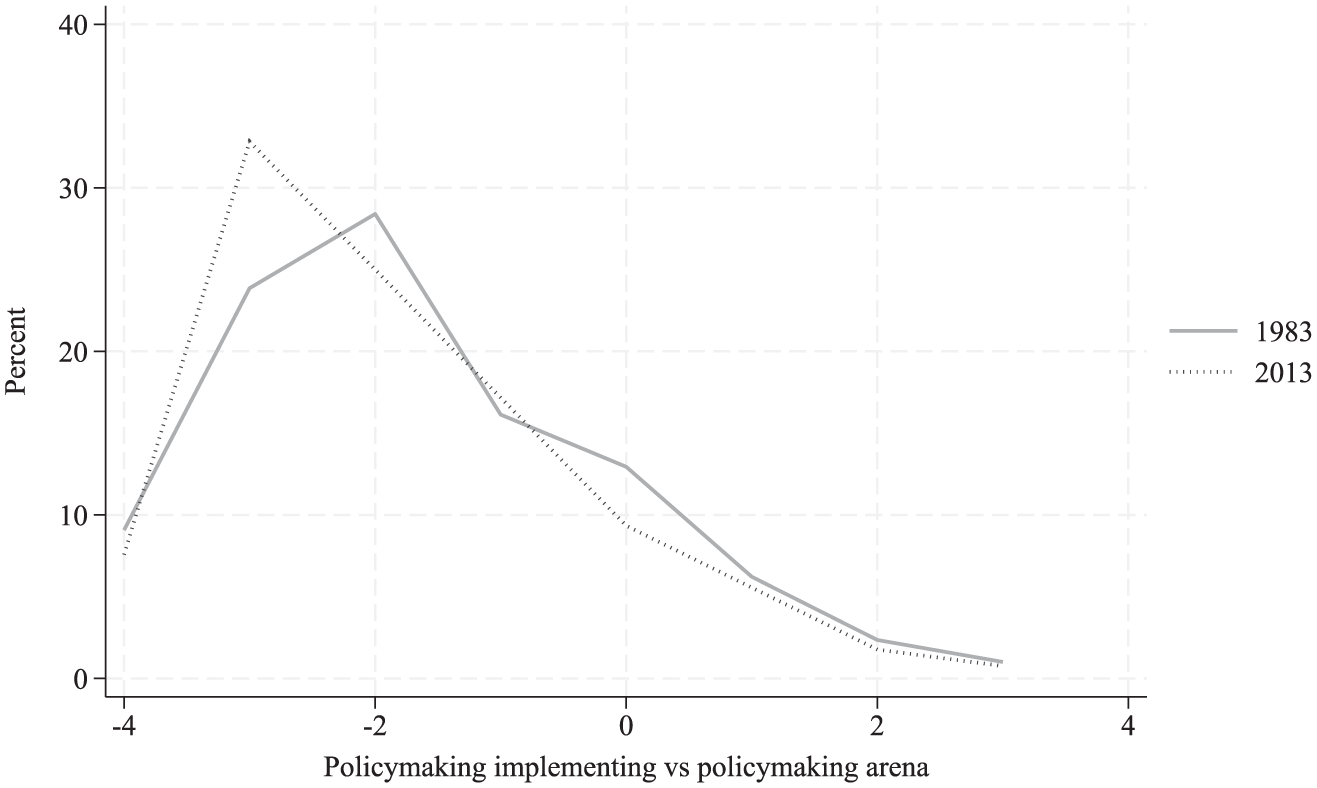
Frequency polygon (histogram) of organizations’ engagement in policymaking versus policy-implementing arenas in 1983 and 2013.
The distribution in 1983 is centered slightly below zero, indicating a modest predominance of policy-implementing engagement. By 2013, the distribution shifted marginally leftward, suggesting that organizations, on average, tended somewhat more toward administrative contacts when the two are juxtaposed. The mean value of the index was –1.715 in 1983 and –1.903 in 2013, and the difference (0.188) is statistically significant at the 5% level (t (989) = 2.00, p = .045). However, the shift is modest in magnitude, indicating that the overall balance of engagement changed little in substantive terms.
Overall, these results suggest that while the overall share of organizations engaged in advocacy has declined, those that remain active appear to operate across a broader range of arenas. The trends point toward a more differentiated advocacy landscape, in which political access has become more varied both in form and intensity. This raises the question of the role of public funding in shaping these changes in nonprofit advocacy engagement.
Regression Analysis
Public Funding and the Likelihood of Advocacy Engagement
To examine the relationship between public funding and advocacy engagement, a series of regression models was estimated. Table 2 presents the results of the logistic regression models examining the relationship between public funding and organizations’ likelihood of having contact with public authorities.
Logistic Regression Analysis With Contact With Central Public Authorities as Dependent Variables.

Note. Odds ratios, z-scores in parentheses.
Reference group: Economic. bReference group: Hierarchical.
p < .1. *p < .05. **p < .01. ***p < .001.
The results of the first model demonstrate a positive association between the amount of public funding and organizations’ likelihood of contact with public authorities and show that this association strengthened between the 2 years. In 1983, the higher the amount of public funding an organization received, the more likely it was to have contact with public authorities. While the negative year effect shows that such contacts were overall less common in 2013, the positive interaction term indicates that the effect of public funding on advocacy engagement increased over time. These results provide support for H1, which predicted that higher funding amounts would be associated with greater advocacy engagement and that this relationship would strengthen over time.
The second model shows a positive association between the share of public funding and the likelihood of contact with public authorities and indicates that this association remained stable between the 2 years. The positive main effect indicates that organizations with a higher share of public funding were more likely to have contact in both 1983 and 2013, while the non-significant interaction term suggests that the strength of the relationship did not change over time. The result contradicts H2, which held that the higher the share of public funding, the less likely organizations were to engage in advocacy.
Figure 4 illustrates the results by showing predicted probabilities of contact with public authorities by amount and the share of public funding. The left figure substantiates the results of the first model by showing that organizations with limited or no public funding were less likely to have contact with public authorities in 2013 compared to 1983, whereas those with higher amounts of public funding were more likely to have such contacts. The right figure shows that organizations with a higher share of public funding were more likely to have contact with public authorities in both 1983 and 2013. While it appears that organizations with a low share of public funding were less likely to have contact with public authorities in 2013 than in 1983, this reflects the general year effect rather than a change in the effect of public funding.

Predicted probabilities of contact with central public authorities in 1983 and 2013, depending on the amount of public funding and public funding as share of income, 95% confidence intervals.
Public Funding and Engagement Across Policymaking and Policy-Implementing Arenas Building on these findings, the next step is to examine whether public funding is related to how frequently organizations engage in different formal political arenas. Table 3 presents the results of a linear regression analysis where the dependent variables measure the frequency of contact in policymaking and policy-implementing arenas.
Linear Regression Analysis With Engagement in Policymaking Arenas and Policy-Implementing Arenas as Dependent Variables.

Note. Standard errors in parentheses.
Reference group: Economic. bReference group: Hierarchical.
p < .1. *p < .05. **p < .01. ***p < .001.
The results show weak or no association between public funding and engagement frequency, and this relationship remained largely unchanged between 1983 and 2013. In the first set of models, using the amount of public funding, no significant relationship is found for either policymaking or policy-implementing arenas. For policymaking arenas, the very small and non-significant main effect indicates that the amount of public funding was unrelated to how frequently organizations engaged in such activities. For policy-implementing arenas, the main effect is weak and only marginally significant, suggesting at most a slight tendency for organizations with higher amounts of public funding to engage more frequently in implementation activities. The interaction terms are non-significant in both models, indicating no change in the effect of public funding between the 2 years.
A similar pattern appears in the models using the share of public funding. For policymaking arenas, the main effect is small and non-significant, indicating that the share of public funding was unrelated to how frequently organizations engaged in policymaking activities. For policy-implementing arenas, the effect of the share of public funding is positive but weak, indicating that organizations with a higher share of public funding may have engaged somewhat more often in implementation activities in both years. The interaction terms are non-significant in both models, showing that the difference is small and stable over time. These results do not provide support for H3 or H4, which expected that higher amounts and shares of public funding would be associated with more frequent engagement in policymaking and policy-implementing arenas, respectively.
Insider–Outsider Differences in the Effects of Public Funding on Arena Engagement
The final part of the analysis examines whether public funding is related to the balance of engagement across policymaking and policy-implementing arenas, and whether this differs between corporatist insiders and outsiders. Table 4 presents a linear regression model where engagement in policymaking versus policy-implementing index is the dependent variable.
Linear Regression Analysis With Engagement in Policymaking Arenas Versus Policy-Implementing Arenas as Dependent Variable.

Note: Standard errors in parentheses.
p < .1. *p < .05. **p < . 01. ***p < .001.
In the first model, using the amount of public funding as the explanatory variable, the main effect of public funding is negative and non-significant, indicating no overall relationship between funding and the balance of engagement across arenas. However, the significant positive interaction between public funding and year shows that in 2013, higher amounts of public funding were associated with more frequent engagement in policymaking relative to policy-implementing arenas. This effect was not present in 1983. The positive main effect of insider status indicates that corporatist insiders generally engaged more in policymaking arenas in 1983, while the negative three-way interaction between year, insider status, and public funding suggests that by 2013, insiders with higher funding tended slightly more toward policy-implementing arenas. Conversely, outsiders tended more toward policymaking arenas in 2013.
Figure 5 illustrates these results by showing average marginal effects for corporatist insiders and outsiders. Consistent with the regression results, the plots indicate that outsiders with higher amounts of public funding were more likely to engage in policymaking arenas in 2013, while the corresponding pattern for insiders is flatter but tends toward policy-implementing arenas. This visual pattern reinforces the conclusion that the association between public funding and engagement across arenas is most evident among outsiders. Overall, this points to a modest shift: public funding appears to have a mobilizing effect on outsiders’ engagement in policymaking arenas, while for insiders it became somewhat more associated with engagement in policy-implementing arenas. Interestingly, this is the opposite of what was expected in hypothesis H5.

Average marginal effects of amount of public funding on engagement in policy-implementing versus policymaking arenas for corporatist insiders and outsiders, 95% confidence intervals.
In the second model, which uses the share of public funding as the explanatory variable, neither the main effects nor the interaction terms are statistically significant. This suggests that the share of public funding was not systematically related to whether organizations engaged primarily in policymaking or policy-implementing arenas. The weakly positive coefficient for the public funding share indicates, at most, a small tendency for more dependent organizations to engage slightly more often in policymaking arenas, but this difference is not statistically insignificant.
In summary, the results show that the higher the amount and the share of public funding, the more likely organizations were to have contact with central public authorities. The effect of amount of public funding increased from 1983 to 2013, while the effect of the share of public funding remained unchanged between the years. Public funding is not found to have any direct association with the frequency of contacts in policymaking or policy-implementing arenas. However, when these arenas are juxtaposed, the results suggest that higher amounts of public funding were associated with more frequent engagement in policymaking arenas relative to policy-implementing arenas in 2013 but not in 1983. Furthermore, this association was observed for corporatist outsiders, but not for insiders.
Discussion
The main findings show that the relationship between public funding and nonprofit advocacy is strongly shaped by institutional context and organizational position. In the contemporary Norwegian setting, public funding primarily functions as an enabling resource for advocacy, particularly under conditions of increased pluralist competition. The results show that the amount of public funding an organization receives is positively associated with its likelihood of having contact with public authorities, and that this relationship has strengthened over time. By contrast, the share of public funding, reflecting dependence on financial support, has a weaker and more stable association. Moreover, the results suggest that public funding is associated with somewhat increased engagement in policymaking arenas among corporatist outsiders, but not insiders. This supports the argument advanced in the introduction that organizations’ positions within the policy process condition whether public funding reinforces existing patterns of access or enables advocacy among actors lacking routine, institutionalized channels.
Furthermore, the findings illustrate how the impact of public funding on nonprofit advocacy has changed as systems of interest representation have shifted from corporatist to more pluralist forms. From 1983 to 2013, Norwegian voluntary organizations’ representation in corporatist committees declined, while engagement toward parliament and government expanded. Consequently, lobbying has increasingly supplemented corporatist representation (Rommetvedt et al., 2013). As pluralist competition has intensified, political access has become more contingent on organizations’ financial and professional resources. Public funding has, as a result, become a more decisive foundation for sustaining advocacy engagement. At the same time, there is little evidence that contract-based governance and the instrumentalization of public funding have drawn voluntary organizations toward policy implementation at the expense of advocacy, contrary to concerns raised by some Norwegian scholars (Eikås & Selle, 2002; Toje, 2013).
The present study suggests that decorporatization and contract-based governance are not associated with a simple weakening of organizational autonomy or political access. Rather, it may be more apt to see these developments as part of a wider reconfiguration of the organizational channels of influence. The erosion of corporatist structures has reduced the institutionalized venues for representation, but increased pluralism has opened new access points in parliament and government (Arnesen, 2023; Rommetvedt, 2023). Public funding provides financial resources that voluntary organizations can use to build advocacy capacity to engage in these more open arenas (Stoltenberg & Sivesind, 2025). In this sense, the growth in public funding may be seen as helping to compensate for the decline of corporatist representation by enabling organizations to maintain an active political presence through alternative channels. This transformation also entails a shift in the basis of influence, from membership representation to professionalized expertise, of which the longer-term consequences are unclear. However, the findings presented here suggest that public funding can both sustain established patterns of influence and open new spaces for participation. Although the analysis centers on the Norwegian case, the findings are likely to have relevance in a Scandinavian and broader Northern European context. Countries such as Denmark, Sweden, and Finland share long-standing traditions of corporatist exchange between the state and organized civil society, alongside extensive public funding regimes for voluntary and nonprofit organizations. At the same time, these countries have experienced similar, albeit uneven, shifts toward more pluralist forms of interest representation, increased professionalization of advocacy, and a growing reliance on contract-based governance arrangements (Arvidson, Johansson, & Scaramuzzino, 2018; Binderkrantz et al., 2015). In this respect, the Norwegian case may be understood not as exceptional, but as illustrative of a wider transformation in state–civil society relations, in which public funding increasingly functions as a key resource for sustaining advocacy under intensified competition.
Theoretically, the results contribute to nuancing the understanding of what the relationship between public funding and nonprofit advocacy may entail. Much of the literature treats resource mobilization and resource dependence as competing perspectives (see e.g., Chaves et al., 2004; Crepaz et al., 2021). Although the findings are in line with existing research from the United States and Europe that finds a positive or neutral association (Lu, 2018; Neumayr et al., 2015), the Norwegian case suggests that they describe complementary aspects of the same relationship. Public funding contributes to organizations’ advocacy capacity while also embedding organizations within the structures of the policy process. However, given long-standing traditions of corporatist exchange, dependence does not automatically mean co-optation. Rather, governmental support may be interpreted by organizations as a sign of legitimacy and inclusion, consistent with findings from other studies (Arvidson, Johansson, Meeuwisse, et al., 2018; Neumayr et al., 2015). At the same time, the shift toward contract-based and more instrumental funding represents a mode of control that operates through procedural and administrative expectations. As such, it can constrain nonprofit advocacy engagement in more subtle ways, although evidence from neighboring Sweden indicates that relatively few organizations are prone to holding back criticism to avoid risking their funding (Arvidson, Johansson, & Scaramuzzino, 2018).
While this study offers new insights into how public funding relates to nonprofit advocacy in changing governance contexts, some limitations should be noted. First, as it draws on two cross-sectional surveys, the analysis cannot establish causal relationships but rather identifies associations across two institutional settings within the same national context. Second, the measures of advocacy and funding focus on formal political arenas and rely on self-reported data, which may not fully capture informal, media-based, or grassroots advocacy activities. Third, while the study’s comparative-historical design captures dynamics likely to be relevant for Scandinavian and other Northern European countries characterized by corporatist traditions and extensive public funding regimes, variations in institutional structures and funding instruments may condition how these relationships unfold in other national contexts.
Conclusion
In conclusion, evidence from the Norwegian case indicates that public funding mainly has strengthened nonprofit advocacy under the conditions of decorporatization and increased pluralist competition. The study indicates that public funding supports advocacy engagement among voluntary, nonprofit organizations by providing financial resources that enhance their advocacy capacity, even when they depend highly on such funding. Importantly, public funding is found to bolster the ability of organizations with less institutionalized access to the policy process to engage in policymaking arenas. These findings underscore that the effects of public funding cannot be reduced to either mobilization or dependence and need to be viewed in relation to funding arrangements, organizational position, and institutional context. At the same time, the findings point to important longer-term tensions. As advocacy becomes more resource-intensive and professionalized, there is a risk that political influence concentrates among well-funded, professionally managed organizations, potentially narrowing the breadth of the advocacy field and weakening its contribution to democratic legitimation and political participation. The challenge for policymakers, therefore, lies in maintaining funding systems that sustain diversity in organizational voices while preserving autonomy for critical engagement under evolving governance arrangements.
Footnotes
Acknowledgements
The author thanks the three anonymous reviewers for their helpful feedback and suggestions.

Funding
The author received no financial support for the research, authorship, and/or publication of this article.
Declaration of Conflicting Interests
The author declared no potential conflicts of interest with respect to the research, authorship, and/or publication of this article.
Data Availability Statement
The data that support the findings of this study are available from the corresponding author upon reasonable request.