




Abstract
This article contributes to the existing donation literature by addressing the knowledge gap in the impact of the symbolic capital of charity endorsers on the intention to donate. It explores the interplay between the symbolic capital of the endorser, donor intentions, and social media self-disclosure in the context of charitable giving via crowdfunding platforms. Drawing on Bourdieu’s theory of capital conversion and social exchange theory, the study examines how the symbolic capital of the endorsers of charitable organizations influences donation behavior. A PLS-SEM analysis of the data obtained via a representative survey of 976 respondents suggests that donors exchange financial capital for symbolic capital of charity endorser to enhance their social recognition (i.e., symbolic capital), a process facilitated by self-disclosure on social media. This study confirms the presence of a generalized social exchange mechanism and highlights the critical roles of symbolic capital and social media in shaping charitable intentions.
Keywords
Introduction
According to the World Giving Index (2024) report, 35% of adults worldwide donated money in 2024. The amount of money donated in the United States alone is estimated to exceed US$300 billion (Giving USA, 2023). However, a significant number of organizations are competing for these charitable contributions. Data from the Urban Institute (2022) show that there are approximately 1.8 million charitable organizations in the United States, receiving both institutional and private donations. It is estimated that the number of nongovernmental organizations (NGOs) globally may be as high as 10 million (Global NGO Online Technology Report, n.d.). Even under the assumption that a significant portion may be inactive, this still represents a very large number. Therefore, while the total amount donated and the number of donors are indeed substantial, the competition to secure these contributions is also intense. Consequently, understanding the factors that influence donors’ decisions to support one initiative over another is of great importance.
In recent years, the crowdfunding model has been increasingly utilized in the competition for charitable funds. Compared with traditional fundraising methods, it allows for an expanded geographic reach, reduces costs, and facilitates more effective communication (Zhao & Shneor, 2020), making it a generally more efficient fundraising approach. Accordingly, crowdfunding is rapidly becoming a popular way to raise charitable funds (Gil-Gomez et al., 2023). This trend has drawn growing attention from researchers. Salido-Andres et al. (2021) identify three main areas of focus: fundraising organizations or platforms (to understand how their characteristics affect success), donors (to explore their motivations), and processes (such as platform functionality and communication strategies) that influence outcomes.
This article investigates the factors influencing donors’ intentions to contribute financially to charitable causes. Extensive research has been conducted on this topic, with numerous studies examining donations made both traditionally and through crowdfunding platforms (Bekkers & Wiepking, 2011; Kumar & Chakrabarti, 2023; Salido-Andres et al., 2021). Donor motivations are often analyzed through the lens of the self-determination theory (SDT), which distinguishes between intrinsic and extrinsic motivations (Kumar & Chakrabarti, 2023; Pitchay et al., 2022; Sargeant, 1999). Research has shown that intrinsic motivations, such as the perceived benefits of donating (Faulkner & Romaniuk, 2019; Graça & Zwick, 2021), cause involvement (Hajjat, 2003; Tao et al., 2021), religiosity (Baber, 2021), feelings of guilt and other emotions (Sargeant, 1999; Urbonavicius et al., 2019), and pure altruism (Baber & Fanea-Ivanovici, 2025; Gleasure & Feller, 2016), significantly influence the intention to donate. In addition, extrinsic factors, such as a sense of belonging to a community (Choy & Schlagwein, 2016; Ordanini et al., 2011) and the desire for social recognition (Graça & Zwick, 2021), also play a significant role in shaping donation intentions.
Many authors have studied how the social capital of donation recipients affects the amount of funds raised (Cai et al., 2021). The underlying mechanism is relatively straightforward; the number of internal and external connections directly influences the fundraising capacity of an organization (Ba et al., 2022; Lehner, 2014). Moreover, the potential accumulation of social capital can also motivate donors to engage in charitable activities (Eyigunlu, 2023). However, few studies have examined the influence of symbolic capital on donation behavior. The reputation of a charitable organization, often used as a proxy for symbolic capital, has been shown to positively influence donors’ intentions to contribute (Beldad et al., 2014; Bocquet et al., 2020). Frimpong et al. (2024) also analyzed how reputation building enhances the credibility of charity campaigns. In addition, several studies highlight the impact of the characteristics of a charitable organization’s endorsers on donation intention. Their attractiveness (Al-Wugayan, 2023), perceived relevance to the charity, public image, expertise, and reliability (del Mar Garcia de los Salmones et al., 2013; Wymer & Drollinger, 2015), and the reputation of the initiator of a crowdfunding campaign (Aw et al., 2024) all positively influence donors’ willingness to contribute. In other words, a strong positive reputation of a charity’s endorser constitutes a key success factor.
On the contrary, the reputation a donor acquires through the act of giving is recognized as one of the mechanisms encouraging donations (Bekkers & Wiepking, 2011). Research has also revealed that public acts of giving can encourage others to donate, as they signal both concern for the cause and personal wealth (Frank et al., 1996). Furthermore, the high social status of both the recipient and the donor has been identified as a factor positively associated with donation behavior (Vriens et al., 1998). Thus, the reputational benefits associated with donating are well-documented. Donors’ intentions are also influenced by the endorser’s symbolic capital, which enhances the organization’s visibility, credibility, and perceived importance of the cause.
Nevertheless, a key question remains: Can the endorser’s symbolic capital exert an indirect influence on donation intention—not merely by reinforcing trust in the act of giving but through a more complex mechanism of capital exchange? Specifically, can the endorser’s symbolic capital be converted into financial capital in the form of donations? This article aims to address this knowledge gap by drawing on theoretical perspectives from capital conversion and social exchange theories.
This article argues that the high symbolic capital of endorsers of charitable organizations or campaigns is exchanged for the financial capital contributed by donors, who, in return, seek to enhance their social recognition. An essential part of this exchange is the donor’s disclosure of personal information on social media, which allows them to use the symbolic capital gained through giving to reinforce their social standing. This study aims to examine the validity of this mechanism by analyzing empirical survey data.
Literature Review
Donation-Based Crowdfunding
Crowdfunding is a relatively new phenomenon that has experienced rapid growth over the past decade. Essentially, it is a method of financing activities by collecting relatively small contributions from a large number of donors using online technologies and platforms (Mollick, 2014). Shneor (2020) identifies four main types of crowdfunding: peer-to-peer lending, equity crowdfunding, reward crowdfunding, and donation-based crowdfunding. The first three types involve some form of benefit for the financier, such as interest on a loan, appreciation in the value of shares or other securities, the free or partially free receipt of new products or services, or other material benefits. According to the author, while direct material benefit may not always be the sole or dominant motivation for participation, it remains a key factor in these forms of funding. In contrast, donation-based crowdfunding involves contributions to individuals, projects, or organizations without the expectation of material rewards, with donors driven by other motivations. This type of crowdfunding can also support creators on subscription-based content platforms. It further includes civic crowdfunding, which finances community or public-interest projects lacking adequate state or municipal support (Davies, 2015).
While donation crowdfunding can also be used to finance scientific research or even business ventures, it is most commonly regarded as an online version of traditional charitable giving (Zhao & Shneor, 2020) aimed at supporting a wide range of good causes. Charitable giving is often motivated by either image-conscious or moral identity-driven concerns. Image-conscious donors seek social approval or status, aligning with external or introjected regulation (Cialdini & Schroeder, 1976; Reyniers & Bhalla, 2013), where giving is driven by the desire for recognition or to avoid guilt. In contrast, moral identity-driven donors are motivated by a self-concept rooted in ethical values, corresponding to identified or integrated regulation, where giving reflects internalized beliefs and a sense of moral duty (Reed et al., 2007). These dual donor motivations align with SDT (Bagheri et al., 2019; Chen et al., 2021; Pitchay et al., 2022), which explains human motivation through three basic needs: autonomy (a sense of volition), competence (feeling capable), and relatedness (feeling connected) (Deci & Ryan, 1985; Ryan & Deci, 2000).
Within this framework, motivation is further differentiated along a continuum from intrinsic motivation—engaging in behavior for its inherent satisfaction—to extrinsic motivation—performing behavior to achieve separable outcomes. In this study, we focus specifically on intrinsic and extrinsic motivational orientations as they pertain to social recognition and reputational incentives in charitable giving. This narrower focus is justified because intrinsic motivation captures donors’ internalized values and personal satisfaction from giving, while extrinsic motivation reflects the influence of external social rewards and pressures, such as enhancing reputation and symbolic capital (Choy & Schlagwein, 2016). Although competence and relatedness are important within SDT, our model focuses on motivational orientations most relevant to social exchange and symbolic capital. For example, a social intrinsic motive may reflect a desire to identify with a group by supporting its causes, while a social extrinsic motive may involve signaling affiliation through visible donations. The latter is closely linked to the pursuit of social recognition, which prior research has identified as a significant motivator in donation-based crowdfunding (Graça & Zwick, 2021). Such social recognition, gained through charitable giving, is important for securing social status and prestige, which, in turn, serves as a critical driver of donor behavior (Kataria & Regner, 2015).
Social and Symbolic Capital in Donation Crowdfunding
Evidence suggests that social motives exert a strong influence on charitable behavior, a phenomenon that can be better understood through Bourdieu’s (1986) theory of forms of capital. This theory identifies four distinct forms of capital: economic, social, cultural, and symbolic. Economic capital refers to material resources and wealth. In the context of crowdfunding, it enables individuals to make financial contributions or invest in campaigns. However, beyond its direct utility, economic capital can also be transformed into other forms of capital, such as gaining symbolic recognition through visible philanthropic acts. Social capital is constituted by an individual’s relationships and networks—both existing and potential. Within crowdfunding environments, social capital plays a critical role in mobilizing support. Cultural capital encompasses embodied dispositions (e.g., habits and communication styles), objectified forms (e.g., books and art), and institutionalized credentials (e.g., education and qualifications). In donation behavior, cultural capital may manifest in the alignment of values, tastes, or causes that resonate with potential donors. Symbolic capital (Bourdieu, 1993) refers to the prestige, recognition, or honor attached to individuals or actions. In the context of charity donation, symbolic capital is important as it can be accrued when donations are made publicly or are associated with socially esteemed causes. Donors may gain reputational benefits or status, and campaign organizers may enhance their legitimacy and visibility through endorsements, media attention, or association with respected figures.
Pierre Bourdieu developed the concept of symbolic capital to describe the intangible resources of honor, prestige, recognition, and legitimacy that individuals or groups acquire within a social context. Bourdieu (1986) argued that symbolic capital is derived from the recognition and legitimization of other forms of capital—such as economic, social, or cultural—by society. For example, a university degree (cultural capital) becomes symbolic capital to the extent that it is honored and respected by others, providing the degree holder with authority or status. Thus, symbolic capital is a social construct dependent on recognition within a specific field, which legitimizes and reinforces social structures.
Although symbolic capital encompasses a broad range of phenomena, like legitimacy, honor, and prestige, reputation is a very strongly related concept. The relationship between symbolic capital and reputation often overlaps, particularly within Bourdieu’s framework (Bourdieu & Wacquant, 2013; Ihlen, 2018). Symbolic capital is an individual or group resource granted through recognition by others. Reputation is both a significant component and a primary manifestation of symbolic capital. In Bourdieu’s analysis, reputation often functions as a tangible expression of symbolic capital, marking a person or institution as respected or influential within a community. For example, a scientist’s reputation among peers directly translates to symbolic capital, which can then be leveraged for further resources or influence. Thus, symbolic capital and reputation are often effectively synonymous in practice, although symbolic capital may encompass broader forms of recognizability or legitimacy beyond reputation alone.
Symbolic capital is inherently linked to the concept of social recognition. It derives its power from collective recognition and legitimation. Thus, a “good reputation” has symbolic capital because it is broadly recognized and legitimized within a group (Bourdieu & Wacquant, 2013). Social recognition refers to the acknowledgment and validation of an individual’s identity, status, or behavior by others within a social context. It involves how individuals are acknowledged or rewarded within a group, shaping their motivation and behavior (Deci & Ryan, 2000). Symbolic capital is socially constructed through recognition: Recognition—being acknowledged and valued by others—transforms other forms of capital into symbolic capital. Thus, recognition is the enabling mechanism that gives symbolic capital its power and meaning.
These forms of capital can be accumulated within specific fields, such as professional, artistic, or athletic domains. Symbolic capital is especially contingent upon recognition by agents in the specific field and depends on the field’s habitus—its shared norms, tastes, and behaviors (Bourdieu, 1990). They are also transferable across fields and convertible from one form to another (Bourdieu & Wacquant, 2013). For example, financial capital can be converted into connections (social capital), education (cultural capital), and public recognition or social status (symbolic capital). Similarly, a broad social network can be used to generate financial or symbolic capital, and symbolic capital can be exchanged for monetary resources or used to expand one’s network of connections (Pret et al., 2016). Such transfers often occur within Bourdieu’s “field of power”—the arena where dominant actors from various fields compete to define and convert different forms of capital (Bourdieu, 1996). Access to the field of power, however, is frequently mediated by the journalistic/media field, which plays a pivotal role in translating specialized forms of capital—such as academic prestige or artistic achievement—into symbolic capital that is legible and influential in the broader public sphere (Benson, 2006; Bourdieu, 1996). Thus, symbolic capital gained in one field can be transferred to others—especially the public sphere—to achieve specific goals.
In the context of crowdfunding, the impact of the recipient’s social capital on donors’ intentions to contribute has been extensively studied (Cai et al., 2021). The greater the number of connections that link the charity recipient to potential donors, the higher the levels of support they are likely to receive. The positive effect of social capital on donation intentions has been consistently demonstrated in prior research (Lehner, 2014; Polzin et al., 2018; Simon et al., 2019). The impact of symbolic capital has primarily been examined in terms of its direct effect on the intention to donate. A good reputation instills trust in the supported organization or project, increases the perceived value of the donation, and reinforces the belief in the project’s likelihood to succeed (Ba et al., 2022; Grant & Potoski, 2015; L. Liu et al., 2018). The influence of symbolic capital on the financial success of nonprofit organizations has also been demonstrated by Bocquet et al. (2020).
Social Exchange as a Transformation of Forms of Capital
Social exchange theory provides a useful framework for understanding how individuals are motivated to donate to charitable causes through the transformation and exchange of different forms of capital. This theory posits that many interpersonal relationships can be explained through the social exchange of valuable resources (Blau, 1964; Homans, 1958). These exchanges can occur between two individuals or between individuals and organizations and may be either direct or indirect (also known as generalized social exchange; Cook et al., 2013). In the case of direct exchange, resources are transferred directly between two entities; for example, an individual may provide personal data in exchange for a discount offered by a merchant (Degutis et al., 2023). In contrast, generalized exchange involves more than two entities and is not a direct exchange only between two participants. One form of generalized exchange occurs when a group of individuals contributes resources to a common pool and later draws from it. Another occurs when the exchange takes place within a network; one entity provides resources to another but receives benefits from other participants in the exchange (Ekeh, 1974).
Foa and Foa (1974) identified six types of resources: love, status, information, money, goods, and services. They function as socially valued currencies (capital) that individuals exchange to meet relational or identity-related needs. They facilitate their role in enabling reciprocal interaction, building social bonds, and acquiring recognition or influence. Bourdieu (2018) recognizes that various forms of capital can be the subject of social exchange. Both direct and generalized exchanges serve as mechanisms through which capital is transformed from one form into another. In this context, the resources are strategic assets used to negotiate position, legitimacy, and value within a given field. For example, businesses transform their financial capital (money) into symbolic capital (recognition or status) and vice versa (Bocquet et al., 2020; Pret et al., 2016), local entrepreneurs convert social capital (services) into financial capital (Svendsen et al., 2010), and intellectuals convert cultural capital (information) into financial capital (Böröcz & Southworth, 1996). Financial capital facilitates the development of social connections and networks, granting individuals access to influential groups. For example, wealthy individuals may join exclusive clubs, donate to political campaigns, or sponsor charitable events, fostering relationships with elite actors. These networks can, in turn, generate new opportunities for career advancement or business partnerships. Financial wealth can also be used to acquire cultural capital through education, art, and cultural experiences that shape one’s tastes, knowledge, and cultural fluency (Bourdieu, 1986). Private schooling, attendance at elite universities, and access to cultural institutions (e.g., museums and concerts) enhance cultural capital, facilitating social mobility and reinforcing social status. Symbolic capital involves the acquisition of prestige and legitimacy, often derived from accumulated social or cultural capital (Bourdieu, 1989). Wealthy individuals may enhance their social standing and influence through strategic philanthropy or visible, public contributions.
The public sphere plays a key role in the accumulation of symbolic capital, and today, social media represents its most effective form (Desrochers et al., 2018). Self-disclosure on social networks is one way to increase both symbolic and social capital. In essence, an individual’s actions and connections, which represent potential forms of capital, are only realized when made visible in the public sphere, particularly on social media. Otherwise, they remain latent and unrecognized. Individuals are motivated to disclose personal information due to their desire for social support (Luo & Hancock, 2020), the pursuit of social recognition (Bazarova & Choi, 2014), and efforts to build their reputation (Krasnova et al., 2010), all of which are proxies for symbolic capital (Lebaron, 2021; Shymko et al., 2023). Thus, those who are more inclined to disclose personal information on social media are also more likely to seek social recognition from others; in other words, they expect to gain status, legitimacy, prestige, honor, or, in summary, symbolic capital through their online behavior. This expectation motivates individuals to exchange their financial capital for potential symbolic capital.
Vroom (1964) proposed the expectancy theory, which states that behavior is driven by the expectation of specific outcomes resulting from one’s actions. When individuals anticipate a particular outcome and perceive it positively, they are more likely to be motivated to act accordingly. Expectancy theory has been widely applied across various disciplines to explain people’s intentions and behavior. Deal and Lloyd (2024) argue that it is among the most influential motivation theories in the management field. For example, Talwar et al. (2021) used expectancy theory to explore consumer attitudes toward natural food, Fan et al. (2022) applied it to travelers’ lodging decisions, and Al Rousan et al. (2024) used it to examine tourists’ intentions to visit national parks. Expectations, whether altruistic or egoistic, can influence the intention to donate to charitable causes (C. J. Liu, 2019). In the case of altruism, donors may expect their contributions to benefit others or society at large, while egoistic motivations involve expectations of personal benefits.
The motivating effect of expectations can be explained through the reciprocity mechanism at the core of social exchange theory (Khadjavi, 2016). Participants in an exchange anticipate reciprocity from others, meaning that after donating their financial resources, donors expect some form of reward in return. In the context of charitable giving, however, this reciprocity may be indirect—that is, donors may not expect a direct reward from the recipient, but rather indirect benefits from other members of society (C. J. Liu, 2019).
In the case of generalized exchange, individuals donate with the expectation of greater social recognition within society or a specific community. They may also be motivated by previous experiences of receiving charity or the expectation that they might receive charitable support in the future. This suggests that the greater the symbolic capital of a charitable organization or its endorsers, the higher the expected return, thus strengthening the motivation to donate.
Hypothesis Development
Evidence suggests that a charitable organization’s reputation has a direct positive influence on the intention to donate (Meijer, 2009; Snipes & Oswald, 2010). This indicates that the reputation of a charity’s endorser should have a similar effect, which has been confirmed by previous research (Park, 2017; Tantawi & Sadek, 2019). Fundraisers’ reputations are positively associated with their trustworthiness, which increases donation intention (Beldad et al., 2014; L. Liu et al., 2018). Endorsers’ good reputations work by drawing greater attention to the charity and its cause (Budabin & Richey, 2018; Ilicic & Baxter, 2014; Ratnasari et al., 2023), as well as enhancing positive attitudes toward the fundraiser (Erdogan, 1999; Harris & Ruth, 2015). Driessens (2013) argues that an endorser’s reputational capital can strengthen the credibility, perceived responsibility, and transparency of the fundraising organization, thereby increasing the intention to donate. Thus, to test this relationship based on our data, we propose the following hypothesis:
A theory of charitable giving has been developed based on the work of Eyigunlu (2023) and other sociologists, highlighting the pursuit of social and symbolic capital (i.e., social recognition), along with reciprocity-based exchanges, as key factors influencing donation behavior. Castillo et al. (2014) argued that donation behavior is shaped by social expectations and the pursuit of social status. The need for social approval is also recognized as an important factor in charitable giving (Bekkers & Wiepking, 2011). Therefore, the pursuit of social recognition, or symbolic capital, is a major motivational factor driving charitable behavior, encouraging greater donations. Based on this, we formulate the following hypothesis:
Bourdieu (1986) predicted and described the possibilities for the conversion of different capital forms into each other. Pret et al. (2016) further examined the ability of financial capital to transform easily into other forms, including symbolic capital. Bocquet et al. (2020) highlighted the importance of high symbolic capital for nongovernmental organizations in fundraising, providing empirical evidence of capital conversion processes. These studies provide a basis for asserting that a high level of symbolic capital held by a charity’s endorser is a sufficient cause for donors to attempt to exchange it for financial capital through indirect social exchanges by making a donation to the charity. Therefore, we formulate the following hypothesis:
Andreoni and Petrie (2004) argued that donors, when given a choice, prefer their donation to be publicly known. Bennett and Gabriel (2003) found that charities with higher public visibility and positive reputations received more donations, highlighting the impact of public perception on donor behavior. A. X. Yang and Hsee (2022) demonstrated that when publicity is obligatory, individuals are more likely to donate. Public self-disclosure via social media can positively influence the intention to donate, as it is often motivated by the pursuit of public recognition. By disclosing personal information, donors can expect a more effective impact (i.e., recognition by their social network) of the symbolic capital they receive as a reward for their financial contribution. Thus, the following hypothesis is formulated:
All these hypotheses can be combined into a single mechanism through which the symbolic capital or reputation of a charitable organization’s endorser is exchanged for the financial capital of donors, who, in return, expect to realize the symbolic capital through social media recognition. These interconnected elements operate as components of a single model. The research model shown in Figure 1 summarizes these hypotheses.
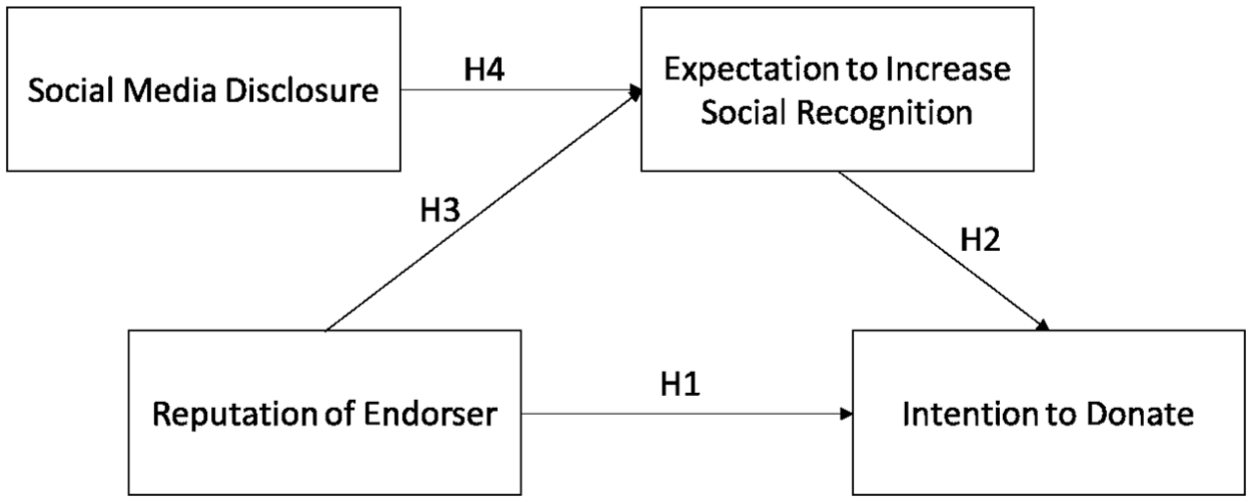
Research Model.
The research model is based on the theoretical assumptions of capital conversion and social exchange. The intention of charity donors to give is influenced by their expectation of converting financial capital into symbolic capital, facilitated by the reputation of the charity’s endorser. In this model, social media acts as a channel through which the symbolic capital gained from donating is acknowledged and made visible.
Method
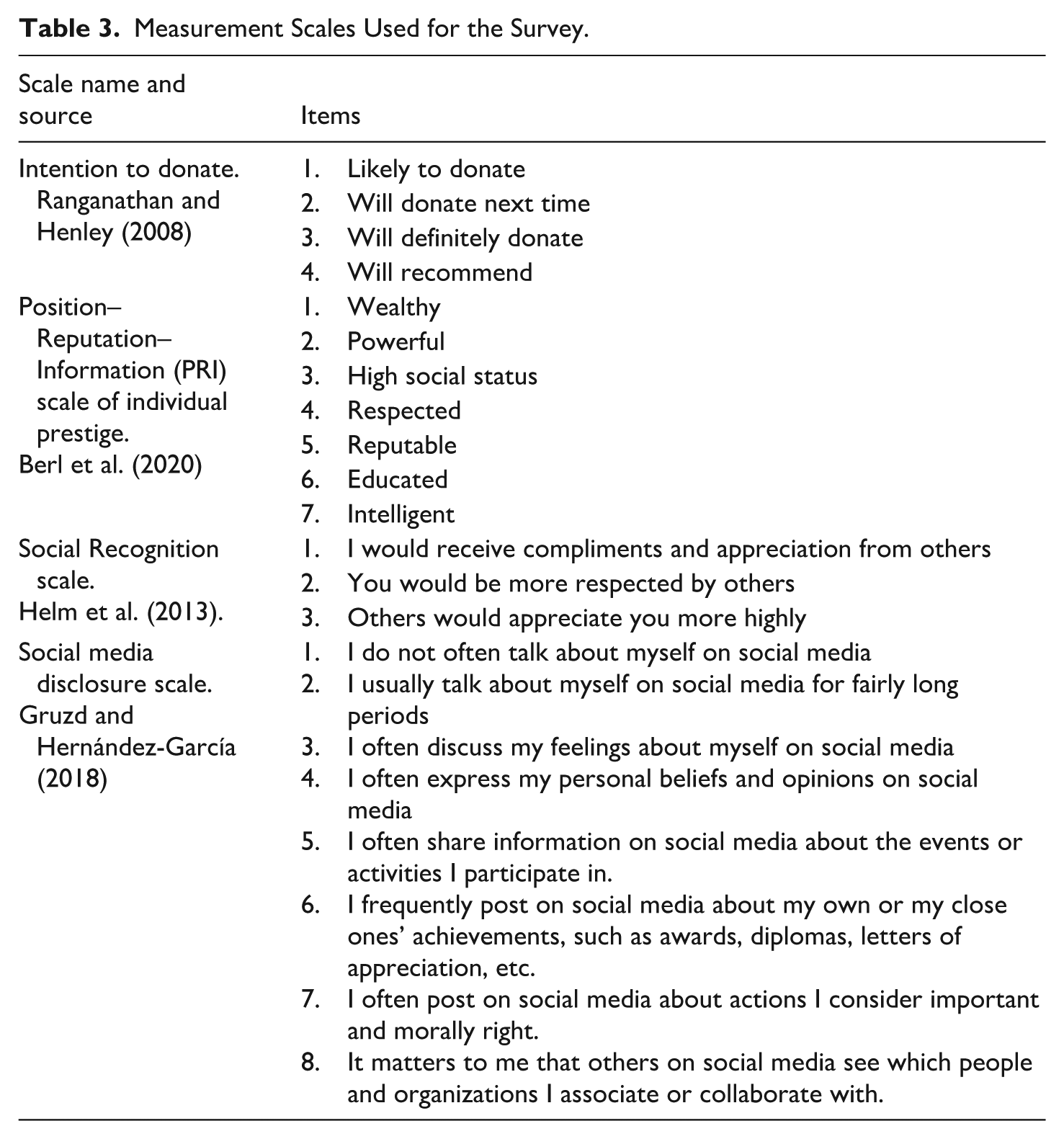
Data for this research were collected in Lithuania through an online representative survey conducted in the spring of 2024. The study primarily employed measurement scales with a well-established track record of successful application in prior research (see Table 3 in the Appendix). Social media disclosure was measured using an eight-item scale developed by Gruzd and Hernández-García (2018), which assesses both the amount and depth of self-disclosure. As no specific scale exists for the measurement of symbolic capital, prior research has used reputation, status, and other similar measures as proxies (Kim & Bae, 2023; Shymko et al., 2023). In this study, reputation, as a proxy for symbolic capital, was measured using the seven-item Position–Reputation–Information (PRI) scale developed by Berl et al. (2020). The three-item social recognition scale proposed by Helm et al. (2013) was adapted to assess expectations of increased social recognition. Intention to donate was measured with the four-item scale developed by Ranganathan and Henley (2008), which has been widely used in research on financial donations. The survey presented a scenario in which an existing and well-known charity organization raised funds for a social cause, which was identified as one of the most important national issues in public opinion surveys, via a crowdfunding platform, endorsed by a well-known public figure who has already supported fundraising efforts for the same cause. Thus, although the scenario was fictional, it closely resembled real fundraising campaigns that had actually taken place.
Data Analysis and Results
A total of 976 questionnaires were included in the data analysis. Only respondents with previous donation and social media usage experience within the last 2 years were included in the sample. The sample consisted of 37.9% male and 62.1% female respondents. Of these, 30.2% were aged 18–39 years, 30.1% were aged 40–54 years, and the remainder were 55 years of age or older. In terms of geographic distribution, 32.4% of respondents resided in the capital city, 29.9% in other major cities, and 35.7% in smaller cities and rural areas. The data were analyzed using SmartPLS4 software, applying the consistent partial least squares (PLS) algorithm (Ringle et al., 2024).
The analysis was performed after the removal of two items, one from the reputation scale and one from the social media disclosure scale, due to low outer loadings of 0.273 and 0.424, respectively. The model demonstrated a satisfactory fit to the data, with a standardized root mean square residual (SRMR) of 0.048, which is well within the acceptable threshold (≤0.1; Kock, 2020). Common method bias (CMB) was evaluated using variance inflation factors (VIFs) in the inner proposed model (≤3.3; Kock, 2015), with the highest observed VIF being 1.030. The indices that were used to assess the scales’ reliability (all ≥0.7) and convergent validity exceeded their respective thresholds (VIF ≤ 5; AVE ≥ 0.5; Ringle et al., 2024), as shown in Table 1.
Assessment of Reliability and Validity.
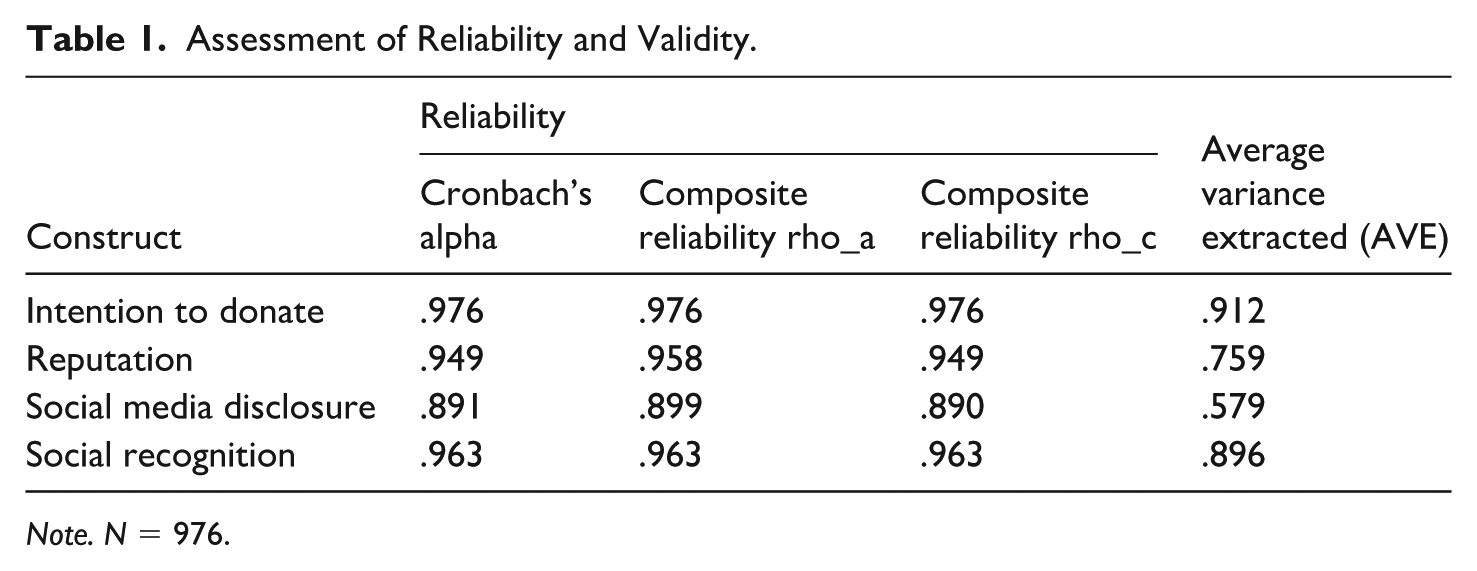
Note. N = 976.
The discriminant validity of the scales was confirmed using the HTMT ratio, with the highest coefficient being 0.580, remaining well below the recommended threshold of 0.9 (Ringle et al., 2024).
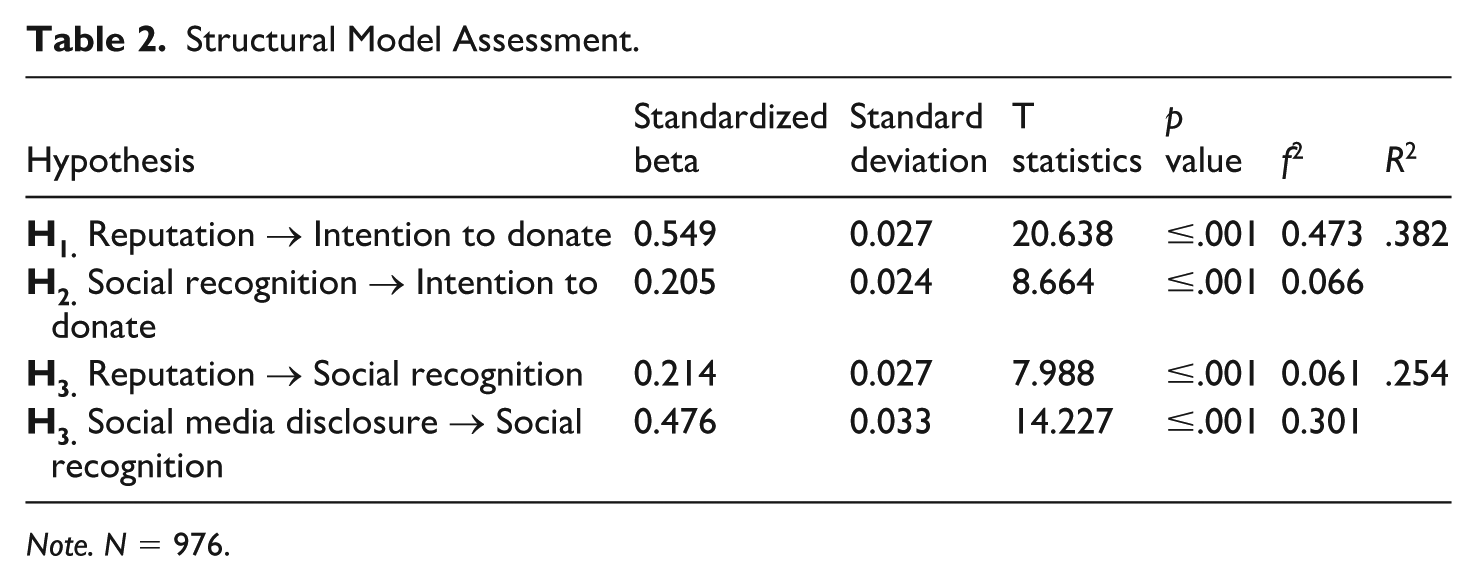
The values of R2 and f2 were satisfactory (see Table 2), which supported the evaluation of the structural model and the testing of the proposed hypotheses (Hair et al., 2022).
Structural Model Assessment.
Note. N = 976.
As anticipated in the research hypotheses, the findings revealed a strong positive relationship between the reputation of the fundraiser’s endorser and the intention to donate, supporting H1 (β = 0.549; p ≤ .001). H2, which proposed that the expectation of gaining social recognition through the act of donation increases the intention to donate, was also supported (β = 0.205; p ≤ .001). H3, which predicted a positive relationship between the endorser’s reputation and the donor’s expectation of increased social recognition through the act of giving, was confirmed by the analysis (β = 0.214; p ≤ .001). Finally, H4, which predicted a positive relationship between social media disclosure by a potential donor and their expectation of increased social recognition through the act of giving, was supported. A strong relationship was identified between these variables (β = 0.476; p ≤ .001).
Discussion and Contribution
This study makes several significant contributions to the literature. First, it expands the understanding of donation behavior by establishing an indirect mechanism through which the endorser’s symbolic capital influences donation intentions. Potential donors are motivated to donate by the expectation of enhancing their social recognition (i.e., reputation and symbolic capital). They anticipate exchanging their financial capital for the endorser’s symbolic capital, meaning that the higher the endorser’s symbolic capital or reputation, the greater its perceived exchange value for donors, who can convert it into their own social recognition. Therefore, this study’s results validate the application of capital conversion theory (Bourdieu, 2018) to deepen the scientific understanding of what drives charitable giving, by illustrating how reputation indirectly shapes donation behavior.
Second, donors are motivated by the desire to share information about themselves on social media, where acquired symbolic capital is realized through status reinforcement. This finding can also be interpreted through a signaling theory perspective (Connelly et al., 2024), where donors send costly, observable signals of generosity and social responsibility to their networks. By publicly disclosing their charitable actions, donors signal desirable personal qualities—such as benevolence, trustworthiness, and alignment with prosocial norms which are otherwise difficult to verify. They also signal alignment with the values, norms, and social standing of the charity endorser.
While prior research demonstrates that publicity influences donation intentions (Bekkers & Wiepking, 2011), earlier studies treated publicity primarily as a source of social pressure rather than as a medium for realizing symbolic capital (Alpizar et al., 2007). This study extends signaling theory by demonstrating that publicity is not only a mechanism for enforcing social conformity through the threat of reputational loss but also a powerful channel for strategic signaling—enabling individuals to accrue symbolic capital and enhance their status.
Bourdieu (1989) emphasized that symbolic capital cannot exist without its perception: For an individual to acquire symbolic capital, their merits must be known and recognized by others. In other words, individuals seeking to increase their symbolic capital need a public space where their qualities, actions, and achievements can be showcased. The more actively potential donors engage in public self-disclosure on social networks, the more effectively they can broadcast favorable signals and accumulate symbolic capital.
This finding not only aligns with, but also expands, signaling theory by illustrating how high-status endorsers and digital environments amplify opportunities to signal social value through philanthropy, mediating the conversion of material resources into symbolic capital (Granados et al., 2025). In this way, the study demonstrates an applied example of signaling theory within contemporary charitable giving, confirming core theoretical statements and suggesting new avenues for understanding strategic self-disclosure and status-seeking behavior in the digital age.
At the same time, the risks of social media usage should be openly recognized. While social media facilitates the accumulation and visibility of symbolic capital, it also exposes users to risks such as reputational harm, social coercion, peer judgment, and the commodification of altruistic behavior (Annaki et al., 2025; Huan et al., 2024). These dynamics highlight the ambivalent nature of publicity in digital spaces, where increased visibility can both enhance symbolic capital and undermine the authenticity of charitable action.
Third, the findings reaffirm the established influence of social recognition expectations on donation intentions. Bekkers and Wiepking (2011) identified social recognition as one of the key mechanisms underlying donation motivation. This study reinforces the link between a donor’s aspiration for social recognition within their social environment and their willingness to donate to charitable causes.
This process can also be understood through an integrated lens combining social identity theory and reputation management theory, both of which illuminate how symbolic capital shapes donor behavior. Within this framework, donors’ pursuit of social recognition reflects not only a desire to enhance reputation externally but also to internalize symbolic rewards that affirm valued aspects of their social identity (Chapman et al., 2025; Winterich et al., 2009). Social recognition functions as symbolic capital that circulates between donors and their social networks: Externally, it operates as a reputational signal of trustworthiness and moral virtue; internally, it reinforces belonging to esteemed social groups and enhances self-concept. In digital giving contexts—where donations and endorsements are often publicly visible—this dual process becomes especially salient. The act of donating or supporting a cause online enables donors to manage both their self-presentation and group affiliations in real time.
Building on this, the reputation of a charity’s endorser can be seen as a key mechanism through which symbolic capital is operationalized. The study demonstrates that a reputed endorser positively shapes donation intentions, likely through multiple channels: emphasizing the importance of the cause, fostering trust in the effectiveness of the donation, the credibility of the recipient and the administering organization, and the transparency of fund usage. Persuasive arguments in favor of donating become more impactful when backed by an endorser with substantial symbolic capital. As reputation management theory suggests, a reputed endorser acts as a strategic reputation asset that lends credibility and moral authority to the organization (Hillman & Keim, 2001). In digital environments, the endorser’s symbolic capital—manifested through visibility, authenticity, and perceived integrity—reduces information asymmetry and uncertainty for potential donors (Leclercq et al., 2024). Simultaneously, donors who support an endorsed cause partake in this exchange of symbolic capital, signaling alignment with trusted figures and socially admired identities (Reinstein & Riener, 2012). Hence, social identity theory and reputation management theory jointly explain how reputation is both constructed and internalized: Endorsers and organizations manage symbolic capital strategically, while donors absorb and reflect it to sustain their positive social identities.
All of this constitutes an example of generalized social exchange, where resources are exchanged not in direct, one-to-one interactions but through a complex web of resource interchanges among multiple actors (C. J. Liu, 2019). These exchanges are both direct and indirect: Donations are exchanged directly for the symbolic capital of the charity’s endorser, but building that symbolic capital requires the involvement of broader social networks through the public visibility of donations. Thus, the donor gives to the charity, draws symbolic value from the endorser’s reputation, and seeks recognition through public visibility. In the future, the donor may even leverage their accumulated symbolic capital to gain further resources from others. The generalized social exchange perspective helps explain these complex exchange relationships involved in the process of charitable giving.
Finally, an indirect contribution of this study is its attempt to quantify Bourdieu’s capital theory. Bourdieu is primarily known for his qualitative research within the fields of sociology and anthropology, but this view is limited and overly narrow (Grenfell & Lebaron, 2014). Bourdieu also used quantitative analysis and statistical methods in his research. Researchers who have followed his theoretical approach have applied quantitative methodologies across various social science fields (Grenfell & Lebaron, 2014), thus expanding the use of quantitative research methods and data applications within his theoretical framework (Rossier, 2019). Efforts to quantify and empirically measure Bourdieu’s concepts at the individual level have led to attempts to develop measurement scales for social capital (K. Yang, 2007) and symbolic capital (Nalaskowski & Dejna, 2015), with scholars emphasizing the need for further empirical research, including surveys, to refine symbolic capital measurement (Lebaron, 2021). Therefore, this article contributes to the quantitative extension of Bourdieu’s research program, this time within the marketing domain, by demonstrating the explanatory power of his theoretical insights in understanding consumer behavior and donation decisions.
The findings of this study carry several important implications for the strategic design of charitable campaigns, particularly those involving high-profile endorsers. Drawing on Bourdieu’s notion of symbolic capital and its role within processes of social exchange, this section outlines how nonprofit organizations and crowdfunding platforms can leverage reputation as a strategic resource by aligning campaign design with the social dynamics of recognition, field-specific legitimacy, and group normativity.
The symbolic capital of a charity endorser must not be treated as a universally transferable asset. According to Bourdieu’s field theory, symbolic capital derives its efficacy from the recognition it receives within a specific social or cultural context. Reputation is thus context-dependent and gains value from how it is perceived by specific target audiences. For practitioners, this implies that endorsers should be chosen strategically to fit the symbolic frameworks and habitus of the intended donor segments. Instead of focusing solely on visibility or celebrity status, organizations should assess how potential endorsers are perceived within relevant donor communities. For example, a public intellectual or social entrepreneur may hold more symbolic capital among socially engaged, educated donors than a mainstream entertainer. Conversely, entertainers with demonstrated philanthropic engagement may effectively mobilize symbolic capital among broader publics, provided their involvement appears authentic.
This study further demonstrates that reputation does not merely influence donor perceptions directly; it also functions as a key resource in social exchange. To translate this insight into practice, campaigns should make reputational links visible and accessible to the public. Communication strategies might highlight the endorser’s active involvement, allowing donors to associate themselves publicly with that figure’s symbolic standing. Digital platforms can further support this by offering shareable assets (e.g., badges, donor cards, or personalized endorsements) that connect the cause and the endorser’s identity, allowing donors to display their generosity meaningfully.
Social media plays a key role in facilitating the symbolic exchange of reputation and recognition. The visibility of a donation act often enhances its perceived social value. Accordingly, donation platforms should integrate seamlessly with social media, allowing donors to share their participation with minimal friction. Features like one-click sharing, prefilled posts, or story templates can enhance donor engagement and social reach. Moreover, platforms can amplify the symbolic return of donating by adding recognition mechanisms, such as featuring donors on campaign pages, public thank-you posts, badges for early donors, or milestone-sharing options. These elements create a reciprocal dynamic of symbolic recognition, rewarding donors with visibility and alignment with valued figures or causes.
Building on the importance of field recognition, organizations should identify social groups where giving to a particular cause is already seen as legitimate or valued. Campaigns can then be tailored to these groups through specific language, imagery, and communication channels. For example, professional associations may respond best to formal campaigns on LinkedIn featuring respected industry figures; youth-driven environmental causes may resonate on visual platforms like Instagram or TikTok, where micro-influencers hold symbolic capital; and community crowdfunding efforts may benefit from respected local figures (e.g., teachers, clergy, and organizers) whose reputations are rooted in local contexts. By designing campaigns for distinct fields of recognition and tailoring messages to align with the values and expectations of those fields, organizations can more effectively convert symbolic capital into motivation to donate.
Limitations and Future Research
The intention to donate is influenced by various factors that lie outside the scope of this study (Bekkers & Wiepking, 2011). However, the study aims to develop a core model of financial capital/social capital conversion, highlighting the key relationships and opening up numerous avenues for future research. Therefore, the inclusion of additional factors is a task for future research.
Since measuring forms of capital at the individual level using survey methodologies is a relatively new direction in social sciences (Prieur & Savage, 2013), no specific scales dedicated to measuring symbolic capital currently exist. Consequently, in this study, we had to rely on measurement scales that most closely align with—though not necessarily fully encompass—the theoretical understanding of symbolic capital as articulated by Bourdieu and other researchers (Bourdieu, 1986; Grenfell, 2014). This gap in measurement also presents an opportunity for future research. The development of scales to measure various forms of capital would facilitate the application of quantitative research in this theoretical field (Coulangeon & Duval, 2015).
Several potential directions for further research in this area can be identified. Based on signaling theory, one avenue involves investigating whether increasing opportunities to signal the act of donating enhances the likelihood of donations (Shang & Croson, 2009). Different levels or forms of signaling may have varying effects on charitable donation intentions, making this an important research question that remains unanswered. It would probably also be necessary in this case to apply experimental methods that would allow for an unambiguous determination of the causal relationship between signals and the intention to donate (Andreoni & Petrie, 2004).
Another avenue could involve exploring the personal characteristics that make individuals more or less susceptible to the mechanisms identified in this study. Undoubtedly, the expectation of social recognition is influenced by individual traits (Konrath & Handy, 2018); identifying these traits would allow for more precise targeting of communication and marketing strategies.
Building on Bourdieu’s research, it would also be interesting to examine whether the size of an individual’s social capital influences their potential to realize symbolic capital. This proposal is grounded in the theoretical premise that the more extensive an individual’s social network, the greater the potential value of the symbolic capital they acquire (Bourdieu, 1986; Lin, 2001). However, this potential relationship warrants further scholarly attention.
Conclusion
This study deepens the understanding of charitable donation behavior by showing how an endorser’s reputation, or symbolic capital, indirectly influences donors’ intentions to give. Drawing on Bourdieu’s capital conversion theory, it reveals that donors are motivated by the desire for social recognition, effectively exchanging financial resources for symbolic capital that enhances their reputation. Through signaling theory, the study also highlights how social media enables donors to publicly display generosity and moral values, turning philanthropy into a visible signal of social responsibility and belonging rather than a purely altruistic act.
Moreover, the findings reconceptualize publicity as a strategic tool for reputation building rather than merely a source of social pressure. High-status endorsers and digital platforms amplify opportunities for signaling social value, trust, and credibility, shaping how donors engage in charitable acts. By introducing a quantitative approach to Bourdieu’s framework, the study bridges sociological theory with marketing research, illustrating how symbolic capital and social recognition function as key drivers of donation behavior in today’s digitally connected world.
Footnotes
Appendix
Measurement Scales Used for the Survey.
| Scale name and source | Items |
|---|---|
| Intention to donate. Ranganathan and Henley (2008) | 1. Likely to donate |
| 2. Will donate next time | |
| 3. Will definitely donate | |
| 4. Will recommend | |
| Position–Reputation–Information (PRI) scale of individual prestige. Berl et al. (2020) |
1. Wealthy |
| 2. Powerful | |
| 3. High social status | |
| 4. Respected | |
| 5. Reputable | |
| 6. Educated | |
| 7. Intelligent | |
| Social Recognition scale. Helm et al. (2013). |
1. I would receive compliments and appreciation from others |
| 2. You would be more respected by others | |
| 3. Others would appreciate you more highly | |
| Social media disclosure scale. Gruzd and Hernández-García (2018) |
1. I do not often talk about myself on social media 2. I usually talk about myself on social media for fairly long periods 3. I often discuss my feelings about myself on social media 4. I often express my personal beliefs and opinions on social media 5. I often share information on social media about the events or activities I participate in. 6. I frequently post on social media about my own or my close ones’ achievements, such as awards, diplomas, letters of appreciation, etc. 7. I often post on social media about actions I consider important and morally right. 8. It matters to me that others on social media see which people and organizations I associate or collaborate with. |

Funding
The authors disclosed receipt of the following financial support for the research, authorship, and/or publication of this article: This work was supported by the Research Council of Lithuania (grant number LMT, S-MIP-23-38).
Declaration of Conflicting Interests
The authors declared no potential conflicts of interest with respect to the research, authorship, and/or publication of this article.
Data Availability Statement
Survey data are available upon request.