




Abstract
Informal communication can be a powerful persuasion strategy on social media, as it fosters a sense of personal closeness and connection with the audience. However, prior research suggests that in the context of nonprofit communication and charitable appeals, this approach may not yield the intended effects. Using a multimodal approach, the present study examines the persuasiveness of verbal and visual (in-)formality cues in Facebook donation appeals from a mental health advocacy organization. Findings from an experiment with 589 participants reveal that formal (vs. informal) language is more persuasive because it is perceived as more appropriate. This judgment, in turn, enhances the trustworthiness of the message sender and reduces perceptions of manipulative intent. Contrary to expectations, visual formality cues did not influence persuasion. Younger people generally had more favorable perceptions of donation appeals. Overall, the study underscores the importance of communication style in influencing message judgments and donation behavior.
Nonprofit organizations operate in highly competitive environments, where they vie with hundreds or even thousands of other charities for public attention and donations (Guo & Saxton, 2018; Min & Kim, 2012; Seshadri & Carstenson, 2007). To attract donors, nonprofit organizations often engage in extensive communication efforts through letters, emails, and, increasingly, social media (Elvira-Lorilla et al., 2023; Lovejoy & Saxton, 2012). Due to its ability to reach a potentially large audience at low cost, fundraising via social media has emerged as a convenient, fast, and efficient way to collect donations (Bhati & McDonnell, 2024; Elvira-Lorilla et al., 2023).
However, for donation appeals to be effective on social media, they must resonate with the audience and strike a positive chord (Xiao et al., 2022). This is influenced not only by the content of the appeal—what it conveys—but also by its style—how it is conveyed (Shen & Bigsby, 2014). Content-wise, nonprofits tend to raise more money during online fundraising events when they post more diverse solicitation messages (Bhati & McDonnell, 2024). In terms of style, one of the most fundamental choices concerns whether a donation appeal is phrased in a formal or informal manner (Pfeiffer et al., 2023; Schanke et al., 2024).
A common perspective in communication research is that informal language can be a powerful strategy for persuasion, as it fosters a sense of personal closeness and connection with the audience (Rennekamp & Witz, 2021; Schwabe et al., 2025). Consistent with this view, informal language has been shown to be more persuasive than formal language, for example, by inducing more favorable brand attitudes (Liebrecht et al., 2021) and enhancing user engagement on social media (Schanke et al., 2024). Informal communication appears to be particularly effective when used by warm (vs. competent) brands (Leung et al., 2022), when consumers are already familiar with a brand (Gretry et al., 2017), and when promoting utilitarian (vs. hedonic) products (Han et al., 2015). While these studies provide important insights into the effects of informal communication in commercial marketing, much less is known about its role in nonprofit advocacy. Surprisingly, emerging evidence points to reduced persuasiveness of informal communication in this context. Pfeiffer et al. (2023) found that people were more likely to support a charity when donation appeals used formal rather than informal language. One possible explanation for the reduced persuasiveness of informal communication in nonprofit advocacy is that it may be perceived as less appropriate than formal communication (Gretry et al., 2017). Specifically, informal communication might be seen as undermining the seriousness and sense of social responsibility expected of nonprofit organizations (Pfeiffer et al., 2023).
The present research seeks to shed light on this issue by experimentally investigating the influence of (in)formal communication on the perceived appropriateness of charitable appeals on social media as well as its downstream effects on persuasion. The study adopts a social semiotic lens, which suggests that (in)formality in communication can be conveyed not only verbally but also visually—namely, through the spatial distance between the camera and the depicted individuals (Kress & van Leeuwen, 2020; Macken-Horarik, 2004).
Conceptual Background
Verbal Formality Cues
Social semiotics provides a useful framework for theorizing how formality can be communicated in donation appeals. The theory is concerned with meaning-making—that is, the construction and organization of meaning through signs (Höllerer et al., 2018; Kress & van Leeuwen, 2020). One of its main tenets is that words and images can convey similar meanings, although each does so in a distinct way (Bateman, 2014; Kress & van Leeuwen, 2020). (In)formality may thus be expressed through language as well as visual imagery (Kress & van Leeuwen, 2020; Macken-Horarik, 2004).
A formal language style is associated with official contexts and is typically used for task-oriented interactions (Morand, 1995). It involves the use of deliberate, impersonal, and standardized language intended to establish a tone of distance and professionalism, convey seriousness, and communicate respect (Gretry et al., 2017; Leung et al., 2022; Nord & Naudé, 2008; Pfeiffer et al., 2023; Zhang et al., 2021). Formal words tend to be longer and often have Latin or Greek origins (Pfeiffer et al., 2023). Examples include expressions such as “eloquent,” “resilient,” “procrastinate,” “ubiquitous,” or “phenomenon.”
In contrast, informal language is associated with casual settings and is commonly used in everyday interactions between family, friends, and colleagues (Morand, 1995). It involves more spontaneous, personal, and colloquial language aimed at fostering social closeness, bonding, and a sense of belonging and group identity (Gretry et al., 2017; Pfeiffer et al., 2023; Zhang et al., 2021). Colloquial words tend to be shorter and can include slang, curse words, proverbs, and idioms (Pfeiffer et al., 2023). Moreover, colloquial language is characterized by specific grammatical choices (Halliday, 1989), including non-traditional capitalization spelling, punctuation, and structure (Pfeiffer et al., 2023). Nontraditional capitalization encompasses the use of capital letters in unconventional ways, such as within sentences and for words other than proper nouns (e.g., “Visit Our Website For More Information”). It also includes instances where capitalization is used for entire words (e.g., “This is YOUR chance to make a change”) or omitted when it would typically be required (e.g., “new york city is waiting for you”). Nontraditional spelling refers to words that are intentionally misspelled for emphasis (e.g., “amaaaaaziiing!”). Nontraditional punctuation refers to contractions (e.g., can’t vs. cannot) or the presence of multiple exclamation marks (e.g., “Thank you for sharing this post!!!”). Nontraditional structure includes elements such as sentence fragments (e.g., “Strong. Independent. Fierce.”) and interjections (e.g., “Oh no! We need to hurry up.”). 1
Visual Formality Cues
According to social semiotics, the spatial distance between the camera and a depicted person is the visual correlate of linguistic (in)formality (Kress & van Leeuwen, 2020; Macken-Horarik, 2004). Spatial distance and linguistic formality share their implicature of suggested social distance. Being physically distant from someone corresponds to public or professional contexts, where people interact at arm’s length. Conversely, being close to someone means that one can touch or hold the other person, which is something that people commonly do when they have an intimate relationship with others (Jancsary et al., 2018; Kress & van Leeuwen, 2020; Macken-Horarik, 2004). Although spatial distance is a continuum expressed in feet or meters, Kress and van Leeuwen (2020) conceptualize it as an ordered set of categories, each defined by specific breakpoints and associated relational meanings. A long shot image portrays the full body of the depicted person and conveys a highly formal relationship, typical of interactions between strangers. A medium shot cuts off the model between the waist and knees and suggests a formal, business-like relationship. A close-up shot shows the model’s head and shoulders and implies a more casual, informal relationship (Bünzli & Alizadeh-Afrouzi, 2025; Kress and van Leeuwen, 2020). 2
The Mediating Role of Perceived Appropriateness
Expectancy violations theory (EVT) offers valuable insights into how recipients react to (in)formal communication in charitable appeals. Developed by Burgoon (1978), EVT has been applied to a variety of communication contexts, including interpersonal interactions (Burgoon & Hale, 1988; Miller-Ott & Kelly, 2015; Sprecher & Hampton, 2017; Zhao & Kun Yan, 2022) and mass-mediated communication (Campo et al., 2004; Evans & Bang, 2019; Wilson et al., 2023).
The theory explains how our expectations shape the way we perceive and respond to communication in social interactions (Burgoon et al., 2016). Expectations are understood as enduring patterns of anticipated verbal or nonverbal behavior (Burgoon & Walther, 1990). According to this theory, people’s compliance with expectations regarding what is typical or how one should behave in a given situation facilitates persuasion (Babin et al., 2004; Bresnahan et al., 2002; Dragojevic et al., 2015; Eriksson et al., 2023; Frey & Lane, 2021; Julius et al., 2024). However, not every deviation from expectations necessarily leads to adverse effects. When behavior exceeds people’s initial expectations, it is perceived as better than anticipated, which is likely to boost persuasion. Conversely, when behavior falls short of expectations, it is perceived as worse than expected and is therefore prone to have a negative effect on persuasion (Browning et al., 2019; Burgoon, 1978; Burgoon et al., 2016; Burgoon & Walther, 1990).
Nonprofit organizations are generally expected to act in a socially responsible manner and to reflect the seriousness of their cause in their communication with stakeholders (Berger & Iyengar, 2013; Hornsey et al., 2021; Lin-Hi et al., 2015; Pfeiffer et al., 2023). These expectations apply not only to the content of their communicative acts (e.g., the amount of donations requested) but also to their stylistic delivery. When it comes to the latter, formal communication is presumed to align with expectations of nonprofit organizations by conveying professionalism and seriousness (Pfeiffer et al., 2023). In contrast, informal communication likely represents a negative deviation from these expectations, suggesting that the nonprofit may not take its social responsibility and mission as seriously as expected (Pfeiffer et al., 2023). Such a deviation may reduce the persuasiveness of donation appeals, defined here as the extent to which an appeal motivates individuals to donate. This consideration leads to the following hypothesis: 3
H1: Charitable appeals are more effective in increasing donation intentions when they use formal (vs. informal) language (H1a) and when they feature images depicting greater (vs. lower) spatial distance between the model and the camera (H1b).
According to EVT, negative deviations from expectations diminish persuasion through negative social judgments (Afifi & Burgoon, 2000; Burgoon et al., 2016). Specifically, unexpected and undesired deviations from expectations likely reduce perceptions of appropriateness, which refers to the extent to which a behavior is considered fitting or suitable for a given context (Babin et al., 2004; Bresnahan et al., 2002; Dragojevic et al., 2015; Eriksson et al., 2023; Frey & Lane, 2021; Julius et al., 2024). Perceived appropriateness thus helps audiences determine whether a message fits the social and situational conventions of a particular setting. Given the serious nature of their mission and their perceived social responsibility, nonprofit donation appeals may be viewed as less appropriate when they rely on informal communication (Pfeiffer et al., 2023). This leads to the following hypothesis:
H2: Charitable appeals are perceived as more appropriate when they use formal (vs. informal) language (H2a) and when they feature images depicting a greater (vs. lower) spatial distance between the model and the camera (H2b).
Reduced perceptions of appropriateness, in turn, are likely to prompt recipients to scrutinize the sender more critically (Burgoon et al., 2016; Julius et al., 2024). For one, they may be inclined to perceive the actor as less truthful, honest, and sincere (Burgoon et al., 2016; DelGreco & Denes, 2020; Lin-Hi et al., 2015). This effect may be especially pronounced in the nonprofit context, as nonprofit organizations often rely on donations and are therefore held to higher standards of appropriate and socially responsible behavior (Greitemeyer & Sagioglou, 2018; Hornsey et al., 2021). For example, irresponsible behavior has been shown to have a greater impact on trust in nonprofit organizations than in for-profit organizations (Lin-Hi et al., 2015). Perceived trustworthiness, in turn, serves as an important precursor to persuasion by influencing attitudes and individuals’ willingness to support a cause (Appel & Mara, 2013; Priester & Petty, 2003; Wallace et al., 2021).
Second, negative deviations from expectations may prompt people to question their interaction partner’s motives. In advocacy contexts, perceiving a behavior as inappropriate may lead recipients to scrutinize the sender’s intentions and become more aware of the underlying persuasive intent (Campbell, 1995; Lee et al., 2016; Wentzel et al., 2010). In such situations, recipients may infer that the sender is attempting to manipulate them or steer them toward certain choices (Campbell, 1995). Due to the high moral standards expected of nonprofit organizations, recipients tend to be especially averse to perceived manipulative intent from these organizations (Greitemeyer & Sagioglou, 2018). Perceptions of manipulative intent, in turn, are associated with negative effects on the persuasiveness of an appeal (Campbell, 1995; Chen et al., 2021; Cotte et al., 2005; Lee et al., 2016).
Taken together, the present study argues that informal communication in donation appeals constitutes a negative deviation from expectations and, as such, reduces the persuasiveness of these appeals. This effect is presumed to occur through diminished perceptions of appropriateness, which in turn lead to unfavorable judgments about the sender’s trustworthiness and perceived manipulative intent.
H3: The effect of visual and verbal formality cues on donation intention is mediated by perceived appropriateness, which, in turn, influences perceptions of the message sender’s trustworthiness and manipulative intent.
Multimodal Interaction Between Verbal and Visual Formality Cues
Textual and visual elements in multimodal messages are typically perceived as components of a unified whole (Bateman, 2014; Kress & van Leeuwen, 2020). This interrelation—known as intersemiosis—underscores the importance of considering how verbal and visual elements work together and may jointly influence audience responses. Previous research on multimodal semiosis and persuasion suggests that alignment between text and imagery can amplify message effects (Seo & Dillard, 2019; van Rompay et al., 2010). Adapted to the context of this study, one would therefore expect the persuasive effects of formal language to be reinforced when paired with a matching visual formality cue—that is, when a model is shown at a greater distance.
H4: There is an interaction effect between verbal formality and spatial distance, such that the positive impact of formal (vs. informal) language on donation intention (H4a) and perceived appropriateness (H4b) is amplified when paired with an image depicting a model at a greater (vs. lower) spatial distance.
Advocacy Context
The present research examines how verbal and visual formality cues affect the persuasiveness of donation appeals on social media. Specifically, the study focuses on appeals related to mental health in Switzerland. This decision is motivated by two main reasons. First, Switzerland’s advocacy landscape is highly competitive, making effective and resonant communication strategies essential for advocacy organizations. Notably, Swiss households allocate half of their donation budget to a single charity (Swissfundraising & Stiftung ZEWO, 2021). This “winner-takes-almost-all” dynamic places considerable pressure on charities to align their messaging closely with donor expectations (Suh, 2020). The strategic use of formality cues may therefore be particularly critical in this context. Second, mental health issues have become a rapidly growing concern among the Swiss population, calling for effective advocacy communication and sufficient funding for nonprofit organizations to carry out their work. As evidenced by a recent report from the Federal Statistical Office (2022), hospital admissions for mental health issues have risen dramatically over the last years. In 2021, mental health issues have become the leading cause of hospitalizations among teens and young adults in Switzerland, surpassing injuries for the first time (Swissinfo.ch, 2022).
Method
Design
The study utilized a 2 (verbal formality: colloquial vs. formal) × 3 (visual formality: long vs. medium vs. close camera distance) between-subjects design. To enhance generalizability and minimize the influence of idiosyncratic characteristics of any single stimulus, multiple stimuli were created for each condition—an approach known as stimulus sampling (Kim & Cappella, 2019; O’Keefe, 2015). Specifically, three different versions of verbal donation appeals were created and manipulated for formality (formal vs. colloquial). Likewise, photos depicting three different models were selected and cropped to create the three levels of spatial distance (close vs. medium vs. long). The total set of stimuli accordingly consisted of 54 donation appeals. Supplemental Appendix A.4 provides an overview of the experimental design.
Message exposure was randomized at four levels. Participants were first randomly assigned to one of two verbal formality categories, then to one of three text versions, subsequently to one of three spatial distance levels, and finally to one of three photo models. Each participant thus rated one out of 54 donation appeals.
Experimental Stimuli
The stimuli were presented in the form of a Facebook advertisement of a fictitious mental health charity called “MentalWell” (see Supplemental Appendix A.5). All ads consisted of the brand name and logo, a verbal text paragraph, and an accompanying image. Manipulation occurred in the verbal text paragraph as well as in the image.
The verbal message portion was inspired by posts from mental health advocacy organizations such as Mental Health America (MHA), Active Minds, the Jed Foundation (JED), and the Trevor Project, as well as health advocacy organizations like the American Heart Association. These organizations frequently publish posts that introduce individuals (e.g., “Meet Sarah . . .”) and connect their personal stories to the organization’s mission or a donation appeal.
Thus, the text paragraph in the present study introduced a person struggling with depression symptoms who found support by reaching out to the mental health hotline offered by the charity. The text concluded with a call to action, urging readers to donate to support the ongoing operation of the hotline. The name of the portrayed individual was gender-neutral to ensure that the text could be combined with images depicting female and male photo models.
The formality of the verbal text varied in terms of language choice and grammatical choice, with the informal version being characterized by the absence of formal words (language choice) and by nontraditional capitalization, spelling, punctuation, and structure (grammatical choice) (Pfeiffer et al., 2023) (see Supplemental Appendix A.6).
The visual images featured three distinct models—two women and one man—sourced from a commercial photo database. Spatial distance was manipulated based on Kress and van Leeuwen’s (2020) body framing classification. A close-up shot (head and shoulders) conveys informality; a medium shot (waist or knees) suggests a more formal, business-like relationship; and a full-body shot represents a distant, highly formal interaction typical of encounters between strangers (the visual stimuli are included in Supplemental Appendix A.7).
A pretest was conducted to validate the effectiveness of the manipulations. Participants rated the formality of each text version on a 7-point scale (1 = colloquial and 7 = formal) and assessed the spatial distance depicted in each photo using a seven-point scale ranging from 1 (near) to 7 (far). Findings indicate the manipulations worked as intended (see Supplemental Appendix A.8).
Participants
Swiss residents who were members of a market research panel (GFK) were invited to participate in the study if they were at least 18 years old. The initial sample included 628 participants. After screening for data quality issues (e.g., straightlining, respondent speeding) and non-random missing data, the final N was 589. Participants ranged in age from 18 to 88 years (M = 33.42, SD = 17.06), and 302 were female (51.3%). Supplemental Appendix A.9 provides a more detailed overview of the sample and a comparison with the Swiss population.
Procedure
The experiment was conducted in November 2023. Panelists were first informed about the study conditions and asked for their consent to participate in the experiment. They were then directed to a survey consisting of four parts. In the first part, participants were asked about their age, gender, nationality, and education. In the second part, they answered questions about their direct and then indirect experiences with mental health issues. In the third part, participants were randomly assigned to view one of 54 stimuli. Finally, in the fourth part, they responded to questions regarding the perceived appropriateness of the message, the perceived manipulative intent, the perceived trustworthiness of the message source, and their intention to donate to the featured charity.
Measures
Perceived Appropriateness
Participants were asked to indicate the perceived appropriateness of the Facebook post on a scale ranging from 1 (inappropriate) to 7 (appropriate) (M = 3.71, SD = 1.64). The item was taken from Van’t Riet et al. (2018). 4
Perceived Manipulative Intent
Consistent with previous studies (e.g., Lunardo et al., 2016; Warren et al., 2021), the present study employed a shortened version of Campbell’s (1995) manipulative intent scale. All items were phrased in a parallel manner by using only negatively worded statements. Manipulative intent was assessed with four items rated on a seven-point Likert-type scale (1 = Strongly Disagree, 7 = Strongly Agree): “The way this Facebook post tries to persuade people seems unacceptable to me,” “The Facebook post tried to manipulate the audience in ways that I don’t like,” “I was annoyed by this Facebook post because it seemed to be trying to inappropriately manage or control the consumer audience,” and “This Facebook post was unfair in what was said and shown” (M = 4.10, SD = 1.70, α = .937).
Perceived Trustworthiness
Perceived trustworthiness was assessed with two 7-point semantic differential scales (1 = untrustworthy/dishonest, 7 = trustworthy/honest). This index represents a shortened version of the original trustworthiness scale developed by Ohanian (1990) and has been used in previous research (Dores Cruz et al., 2021; Nicolas et al., 2022) (M = 3.77, SD = 1.60, α = .934).
Donation Intention
Individuals’ intention to donate to the charity was assessed based on a 7-point scale item ranging from 1 (definitely no) to 7 (definitely yes) (M = 2.22, SD = 1.58).
Controls
Four variables were obtained as controls in the present study: gender, age, direct experiences with mental health issues (“Have you ever experienced mental health issues,” 1 = yes [40.4%], 2 = no [57.4%], and 3 = do not want to disclose [2.2%]), and indirect experiences with mental health issues (“Are you aware of anyone in your personal network who has or has had mental health issues,” 1 = yes [86.2%], 2 = no [11.7%], and 3 = do not want to disclose [2%]).
Confirmatory Factor Analysis
A confirmatory factor analysis (CFA) was conducted using AMOS 29 to assess the validity of the measured constructs. The analysis included items measuring perceived appropriateness, perceived manipulative intent, perceived trustworthiness, and donation intention. Perceived appropriateness and donation intention were included as single-indicator latent variables. The error variances of these variables were estimated by multiplying one minus their alpha reliability by their respective variance (i.e., [1 − α] × σ2; Bollen, 1989). Initial model fit indices indicated acceptable fit. However, modification indices suggested substantial cross-loading of one item from the perceived manipulation scale (“This Facebook post was unfair in what was said and shown”) onto other latent factors. As the phrasing of this item may overlap conceptually with appropriateness and trustworthiness, it was removed to improve model fit (e.g., RMSEAInitialModel = .088; RMSEAFinalModel = .040; ΔRMSEA = .048). The final measurement model, depicted in Supplemental Appendix A.10, was used in all subsequent analyses. The model fit was evaluated using the root mean square error of approximation (RMSEA), comparative fit index (CFI), goodness of fit index (GFI), and Tucker–Lewis index (TLI). While RMSEA values should be below .08, values above .90 for CFI and TLI indicate good model fit (Hu & Bentler, 1999). The final model yielded a good fit: χ2(10, N = 589) = 19.247, p < .037; RMSEA = .04 (90% confidence interval [CI] = .009–.066); CFI = .997; and TLI = .994.
Results
Hypothesis 1 proposed that charitable appeals would be more persuasive when using formal (vs. informal) language (H1a) and when the accompanying image depicted a greater (vs. lower) spatial distance between the model and the camera (H1b). An analysis of covariance (ANCOVA) was conducted to examine the anticipated effects of verbal formality and spatial distance on donation intention, controlling for gender and age, as well as direct and indirect experiences with mental health issues. The results are reported in Table 1. Descriptive statistics (means and standard deviations) by language and spatial distance are presented in Supplemental Appendix A.11. Moreover, Supplemental Appendix A.16 provides additional analyses, including multilevel modeling, to support the robustness of the findings reported here and their generalizability across the different message versions within each condition.
ANCOVA Results for Perceived Appropriateness and Donation Intention (N = 589).
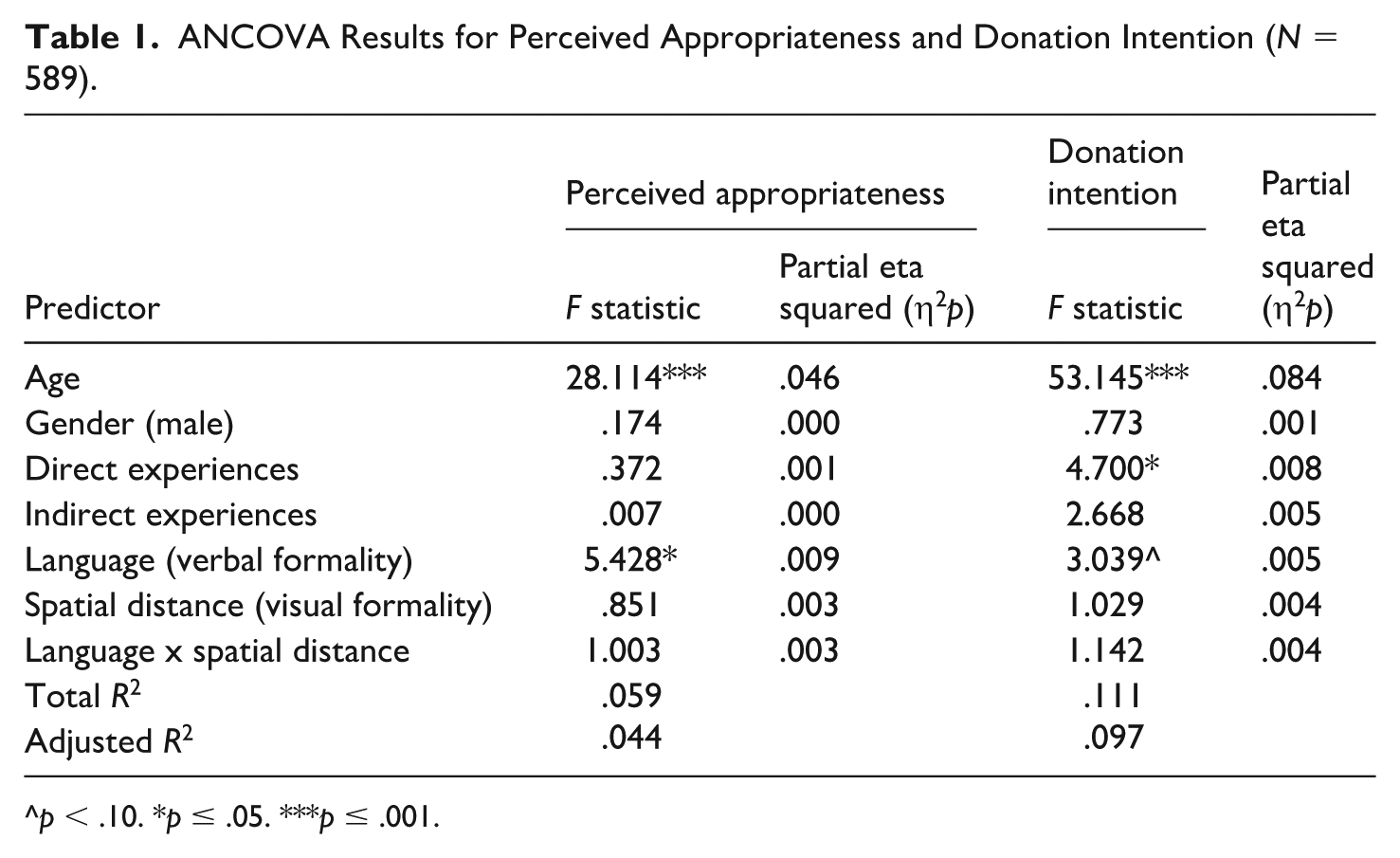
^p < .10. *p ≤ .05. ***p ≤ .001.
In line with expectations, formal language yielded a marginally significant positive impact on donation intention, such that the use of formal language (MFormal = 2.31, SD = 1.63) compared to informal language (MColloquial = 2.13, SD = 1.53) tended to increase people’s intention to donate money to the charity, F(1, 579) = 3.039, p = .082, partial η2 = .005. Figure 1 provides a visual representation of the effect.
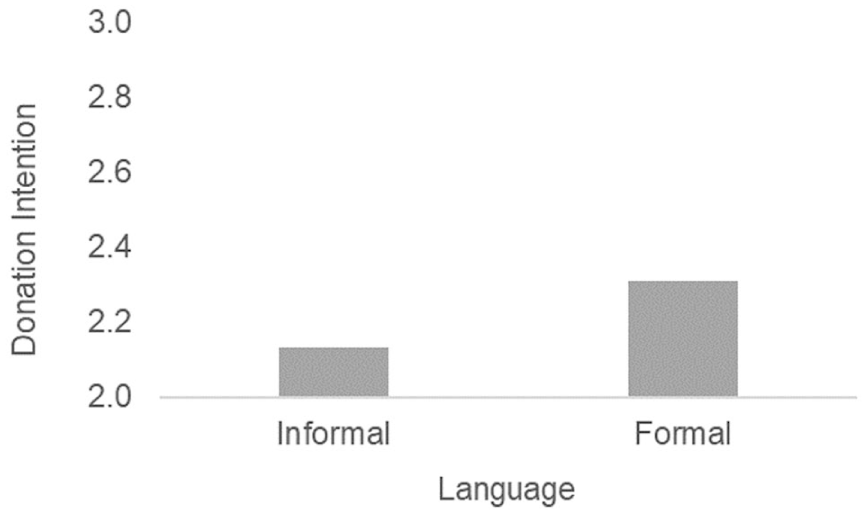
Donation Intention Across Verbal Formality Conditions.
Conversely, no significant effect of spatial distance on donation intention was found, although the effect was in the expected direction, MLong = 2.32, SD = 1.56, MMedium = 2.27, SD = 1.64, MClose = 2.07, SD = 1.53, F(2, 579) = 1.029, p = .358, partial η2 = .004. Thus, while the data yielded support for H1a, they warrant the rejection of H1b.
An interesting finding pertains to the influence of age, with elder people being significantly less receptive of the donation appeals than younger people. Specifically, older individuals were less willing to donate for the mental health charity, F(1, 579) = 53.145, p < .001, partial η2 = .084, b = −.027.
H2 predicted that charitable appeals would be perceived as more appropriate when using formal language (H2a) and when featuring images with greater spatial distance (H2b). An ANCOVA was conducted to test this hypothesis (see Table 1). As expected, formal language (MFormal = 3.85, SD = 1.58) was perceived as significantly more appropriate than informal language, MColloquial = 3.58, SD = 1.70, F(1, 579) = 5.428, p = .020, partial η2 = .009. Figure 2 illustrates the difference between formal and informal language in perceived appropriateness. Spatial distance did not affect perceived appropriateness, MLong = 3.84, SD = 1.66, MMedium = 3.70, SD = 1.62, MClose = 3.59, SD = 1.65, F(2, 579) = .851, p = .427, partial η2 = .003. Thus, the findings lend support to H2a but not to H2b.
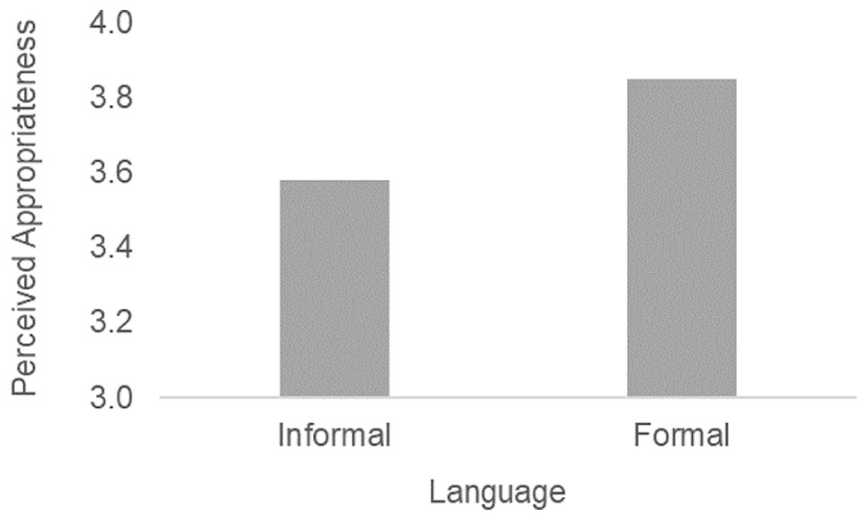
Perceived Appropriateness Across Verbal Formality Conditions.
Hypothesis 4 focused on potential interaction effects between text and imagery, testing whether the effects would be amplified when formal language was combined with an image depicting a model at a greater spatial distance. The data do not provide evidence for the presence of such an interaction effect, either for donation intention, F(2, 579) = 1.142, p = .320, partial η2 = .004, or for appropriateness, F(2, 579) = 1.003, p = .367, partial η2 = .003. Based on these results, H4 is rejected.
Hypothesis 3 proposed that the effect of visual and verbal formality cues on persuasion would be mediated by perceived appropriateness, which, in turn, would influence the perceived trustworthiness and manipulative intent of the message sender. Structural equation modeling (SEM) was used to test this hypothesis. Verbal formality was dummy-coded, using the informal language condition as the reference group. Spatial distance was collapsed into a dummy-coded variable, with the “close” category being the reference group. The control variables of gender, age, direct experiences with mental health issues, and indirect experiences with mental health issues were also included in the model. Verbal formality, spatial distance, and the controls served as exogenous variables, while perceived appropriateness, trustworthiness, manipulative intent, and donation intention were used as endogenous variables. The exogenous variables were permitted to correlate with one another, but associations were not allowed among the endogenous variables or their error terms. The structural model showed good fit: χ2(36, N = 589) = 71.392, p = .000; RMSEA = .041 (90% CI = .027–.055); CFI = .990; and TLI = .979. Figure 3 shows the structural model.
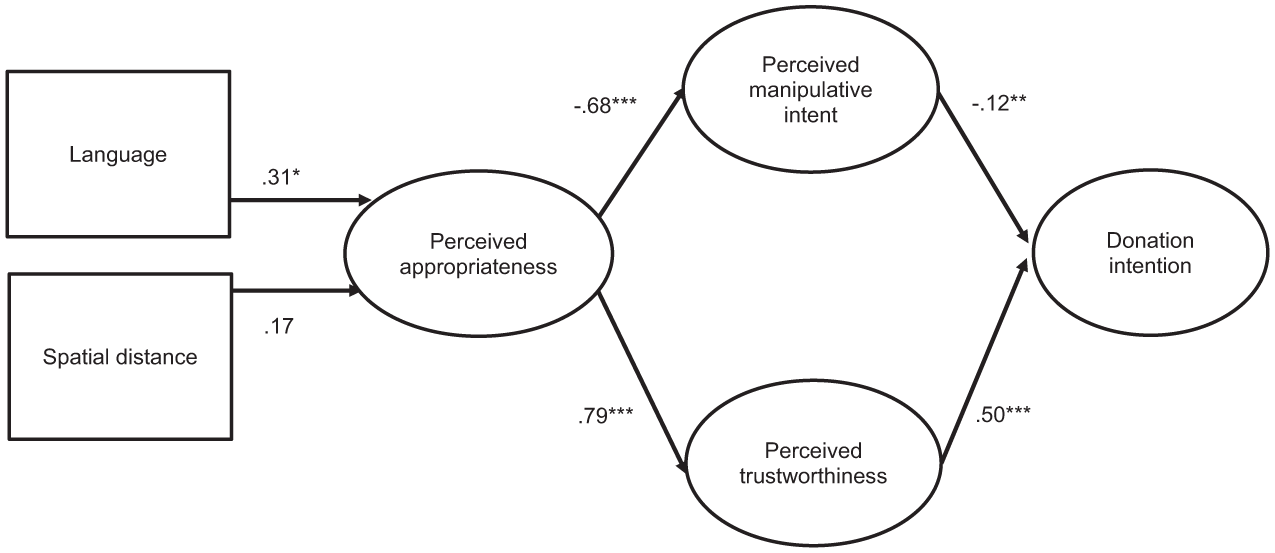
Coefficients for the Structural Equation Model.
As indicated by previous analyses, the influence of spatial distance on perceived appropriateness did not meet the traditional .05 significance threshold (b = .17, SE = .14, p = .239). However, formal language was perceived as more appropriate than informal language (b = .31, SE = .13, p = .020). Perceived appropriateness, in turn, increased the perceived trustworthiness of the message sender (b = .79, SE = .03, p < .001), which then positively influenced donation intention (b = .50, SE = .05, p < .001). Simultaneously, perceived appropriateness reduced perceptions of manipulative intent (b = −.68, SE = .04, p < .001), which was negatively associated with donation intention (b = −.12, SE = .04, p = .007).
To further examine the mediation effects of verbal formality on donation intention, indirect effects were computed using bias-corrected bootstrapping with 5,000 samples and 95% CIs. The indirect effects for “verbal formality → appropriateness → trustworthiness → donation intention” (b = .12, SE = .06, p = .018, 95% CI = [.018, .226]) and “verbal formality → appropriateness → manipulative intent → donation intention” (b = .02, SE = .02, p = .021, 95% CI = [.002, .068]) were both statistically significant. Supplemental Appendix A.12 provides a detailed overview of these results.
Overall, the findings confirm the mediating roles of perceived appropriateness, trustworthiness, and manipulative intent. The results clarify why formal language is more persuasive: it is perceived as more appropriate, which, in turn, increases the trustworthiness of the message sender and decreases perceptions of manipulative intent. Altogether, this supports H3.
Discussion
Even slight variations in the way donation appeals are presented can influence audience responses—especially on social media, where nonprofit organizations compete with thousands of others for attention and support. Given the growing importance of mental health advocacy in Switzerland, this study examined how verbal and visual formality cues influence the persuasiveness of Facebook donation appeals.
Findings from an experiment with 589 participants demonstrate that Facebook donation appeals are more persuasive when they use formal language rather than informal language (H1). The study also uncovered key mechanisms underlying this effect: People respond more positively to formal language because they perceive it as more appropriate, which enhances the perceived trustworthiness of the message sender while simultaneously reducing perceptions of manipulative intent (H3). Overall, the findings align with the main tenets of EVT, emphasizing the role that audience expectations play in the persuasion process. Specifically, the data support the idea that recipients expect charitable organizations to convey the seriousness of their mission through the wording of their appeals (Pfeiffer et al., 2023). When this expectation is violated, recipients form negative social judgments, which cascade into decreased persuasion. This research is novel in identifying the specific social judgments elicited by formal communication and in illuminating how these judgments are interrelated.
It is worth noting that the effect size of verbal formality on the measured outcomes was relatively small. One possible explanation is that, in single-exposure contexts, people may focus more on the content of the message than on stylistic aspects. However, research suggests that even subtle variations in a message can have substantial effects when repeated (Keating & Totzkay, 2025; Koch & Zerback, 2013; Miller, 1976). In other words, differences in audience responses to formal versus informal language may become more pronounced over time through repeated exposure. Future research is needed to validate this assumption. An alternative explanation may stem from the age composition of the sample, which had a lower average age than the general Swiss population. 5 Younger individuals may have weaker expectations regarding the use of formal language in donation appeals, as they are likely more accustomed to informal communication—particularly in social media contexts.
Counter to expectations, the visual counterpart of verbal formality—the spatial distance between the camera and a depicted person—did not influence persuasion (H1). This result is surprising, considering that the distance between the camera and model creates “a visual correlate of physical proximity in everyday interactions,” which seems likely to influence people’s responses to an appeal (Macken-Horarik, 2004, p. 14). Consistent with this idea, previous research has shown that spatial distance affects user engagement on social media (Dhanesh et al., 2022). For example, Facebook posts by U.S. health charities received fewer likes, shares, and comments when they featured close-up portraits (Bünzli & Alizadeh-Afrouzi, 2025).
The absence of significant effects of spatial distance in the present research is puzzling given that statistical power analyses indicated that the study was sufficiently powered to detect small-to-moderate effects, if they existed (see Supplemental Appendix A.13). One possible explanation for the non-significant result is that the spatial distance manipulation was too subtle for participants to detect. However, a pretest confirmed that participants were clearly able to distinguish between close-up, medium, and long shots, indicating that the manipulation of spatial distance was perceptible. Nevertheless, it should be noted that participants were not explicitly asked whether they interpreted these visual distances as indicators of formality. This omission was based on a key assumption in social semiotics: that representations of physical distance inherently convey meaning related to social distance and formality (Kress & van Leeuwen, 2020; Macken-Horarik, 2004). From this perspective, camera distance is not a neutral visual feature but a semiotic resource that communicates relational cues. In line with this assumption, prior research has shown that people often associate greater physical or visual distance with more formal communication, suggesting that spatial distance/proximity does function as a meaningful visual cue for formality/informality (Burgoon et al., 2002; Cristiani et al., 2012). However, it is possible that formality conveyed through visual cues is less salient than when expressed through verbal language. This may be due to the distinct semiotic properties of the visual mode. Unlike language, which relies on structured syntax and grammar to convey meaning with high precision, the visual mode operates through spatial arrangements and compositional principles, which tend to be more ambiguous and open to interpretation (Bateman, 2014; Geise & Baden, 2015; Kress & van Leeuwen, 2020; Meyer et al., 2018). As a result, visual cues such as spatial distance may not communicate formality as clearly or directly as verbal expressions—potentially making them less effective in influencing persuasive outcomes.
Importantly, social semiotics conceptualizes spatial distance as a universal cue for formality, with greater physical distance associated with more formal interactions. However, I acknowledge that there are also culturally specific visual cues of formality—such as clothing, facial expression, and color (Pennewell, 2024; for a discussion of facial expression and color, see Supplemental Appendix A.15). For example, societies differ in what is considered formal attire: In Western contexts, suits often signal formality, whereas in Middle Eastern cultures, garments such as the thobe or abaya may serve a similar function. From a Western perspective, the individuals depicted in the experimental stimuli were dressed in a way that could be classified as somewhere between formal and casual—attire suitable for professional settings with more relaxed dress codes as well as for private occasions. Although this choice was intended to enhance ecological validity by reflecting what younger people might realistically wear in everyday life, it cannot be entirely ruled out that clothing may have confounded the persuasive effects of the spatial distance cue.
Finally, another explanation for the non-significant effects of spatial distance is that participants’ cognitive processing of the charitable appeal was primarily text-driven, with the visual image serving more as an illustrative or decorative element. Supporting evidence from advertising research suggests that consumers often spend more time attending to textual content than to accompanying visuals (Belch & Belch, 2007; Decrop, 2007; Lee & Choi, 2019; Rayner et al., 2001). This tendency may be amplified in the case of “text-heavy” donation appeals, such as those used in the present study. Exposure to such appeals may prompt people to focus even more on the verbal text and, as a result, become less sensitive to variations in the visual image.
This interpretation is supported by dual-process theories such as the elaboration likelihood model (ELM) (Petty & Cacioppo, 1986). According to the ELM, persuasion can occur via two routes: a central route, which involves systematic and effortful processing of message arguments, and a peripheral route, which relies on heuristic cues. The relatively long and text-heavy appeals used in this study likely required greater cognitive effort and thus may have encouraged central-route processing. In such cases, recipients tend to focus on argument strength and relevance, while peripheral features—such as spatial distance—may exert less influence (Lazard et al., 2018). This prevalence of central processing may also help explain why pairing formal language with a visually matching spatial cue had little effect on the persuasiveness of the donation appeals (Hypothesis 4). To test the assumption that text-heavy messages prompt central processing and thus diminish the impact of visual cues, future research could systematically vary the amount of verbal content in charitable appeals. It is expected that spatial distance—as a visual cue—will exert a stronger persuasive effect when the accompanying text is minimal.
Theoretical and Practical Implications
The present research makes two important theoretical contributions. First, it advances communication research by elucidating the role of visual and verbal formality cues in donation appeals. Contrary to the widespread belief in social marketing that signaling personal closeness enhances persuasion, the present findings suggest that informal language reduces the persuasiveness of donation appeals. Furthermore, the study highlights the underlying mechanism by identifying perceived appropriateness as a key mediating variable that influences perceptions of the message sender’s trustworthiness and manipulative intent, both of which ultimately affect persuasion. This provides a deeper understanding of why formal language tends to have a persuasive advantage over informal language in donation appeals.
Second, the study offers an innovative methodological approach to analyzing multimodal communication in donation appeals. While previous research has extensively examined the role of verbal language in commercial marketing, relatively few studies have theorized the interplay between visual and verbal imagery (Geise & Baden, 2015). The present study addresses this gap by employing a social semiotic lens, which posits that the visual and verbal modes can convey similar meanings, even though they operate according to distinct logics (time vs. space) (Bateman, 2014; Kress & van Leeuwen, 2001). Its contribution lies in delineating how each mode conveys formality and how combinations of visual and verbal formality cues may influence persuasion. Although the study did not find support for the anticipated interaction effect between image and text, it nevertheless offers a valuable conceptual foundation for future investigations of visual and verbal cues.
In terms of practical implications, the study offers helpful guidance on how charitable organizations can enhance the effectiveness of their donation appeals on social media. The findings suggest that using formal communication increases donations. Moreover, the data indicate that—among the many factors charitable organizations must consider when crafting donation appeals—the distance between the camera and the model is not a primary concern, at least not in text-heavy appeals. This implies that they can allocate their resources to other visual aspects of donation appeals that have a greater impact on persuasion—such as emotions conveyed through facial expressions (Kang et al., 2022) or dynamic depictions of people and animals (Bünzli et al., 2025).
Limitations
One of the main limitations of this study is its exclusive focus on mental health–related donation appeals. While the findings largely align with the theoretical rationale provided, further research is needed to validate them in other nonprofit contexts, such as humanitarian aid, education, or climate activism. A second limitation concerns the generalizability of the findings, as the study included only Swiss residents. This raises the question of whether the results extend beyond the Swiss context. The issue of how to communicate mental health advocacy more effectively is both timely and globally relevant—particularly as many countries, including the United States and Canada, have experienced a sharp and troubling rise in mental health issues in recent years (The Canadian Mental Health Association, 2024; The Pew Charitable Trusts, 2023). Although Switzerland differs from these countries in various respects, including size and language, the findings may still be applicable due to important cultural similarities. Specifically, Switzerland, the U.S., and Canada are commonly classified as highly individualistic cultures (Minkov & Kaasa, 2022)—a factor known to shape how individuals interpret and respond to relational cues such as formality (Han et al., 2015). In fact, substantial differences in the function and interpretation of formality cues are commonly observed between individualist and collectivist cultures (Han et al., 2015; Zhu & Hildebrandt, 2013). Moreover, findings from a previous U.S.-based study on verbal formality in donation appeals corroborate the present study’s insights (Pfeiffer et al., 2023). Taken together, this suggests that the persuasive effects of formality are likely to operate similarly across individualistic cultural contexts. Nonetheless, given the importance of formality in strategic advocacy communication, further research and cross-cultural replications are needed to substantiate this claim with stronger empirical evidence. Finally, this study is subject to the typical limitations associated with using donation intention as a proxy for actual donation behaviors.
Conclusion
This research investigated the persuasive effects of visual and verbal formality cues. Findings from an experiment with 589 participants demonstrate that informal language (vs. formal language) is less persuasive in Facebook donation appeals, as it elicits a range of unfavorable social judgments about both the message and its sender. Counter to expectations, visual formality cues—expressed through the spatial distance between the camera and a depicted person—did not exert a significant influence on persuasion. Interestingly, younger people generally had more favorable perceptions of Facebook donation appeals. Overall, this study advances research on nonprofit advocacy by showing that even subtle relational cues can influence people’s responses to donation appeals and by identifying the underlying psychological mechanisms governing these effects.
Supplemental Material
sj-docx-1-nvs-10.1177_08997640251401570 – Supplemental material for The Influence of Verbal and Visual Formality Cues on the Persuasiveness of Charitable Appeals
Supplemental material, sj-docx-1-nvs-10.1177_08997640251401570 for The Influence of Verbal and Visual Formality Cues on the Persuasiveness of Charitable Appeals by Fabienne Bünzli in Nonprofit and Voluntary Sector Quarterly
Footnotes
Acknowledgements
This research received financial support from the Business Communication Research Foundation, an affiliate of the Association for Business Communication.

Ethical Considerations
This research was determined to be exempt from formal review and approval by the Ethics Committee of the University of St. Gallen. The research was conducted in compliance with local legislation, institutional requirements, and the APA Ethical Principles regarding research with human participants.
Consent to Participate
Participants gave their informed consent prior to taking part in each survey and were informed about the purpose of the data collection, as well as their rights concerning their data and participation. All data were collected anonymously. Participants had the option to contact the researchers at any time to request additional information or withdraw their consent.
Funding
The author disclosed receipt of the following financial support for the research, authorship, and/or publication of this article: This research received financial support from the Business Communication Research Foundation, an affiliate of the Association for Business Communication (ABC).
Declaration of Conflicting Interests
The author declared no potential conflicts of interest with respect to the research, authorship, and/or publication of this article.
Data Availability Statement
The data that support the findings of this study are available from the author upon request.
Supplemental Material
Supplemental material for this article is available online.
Notes
Author Biography
References
Supplementary Material
Please find the following supplemental material available below.
For Open Access articles published under a Creative Commons License, all supplemental material carries the same license as the article it is associated with.
For non-Open Access articles published, all supplemental material carries a non-exclusive license, and permission requests for re-use of supplemental material or any part of supplemental material shall be sent directly to the copyright owner as specified in the copyright notice associated with the article.
