




Abstract
Volunteers are vital for nonprofit organizations, yet recruiting them remains a challenge. This study evaluates two common strategies – Gift-Exchange and the Foot-in-the-Door (FITD) technique – in recruiting episodic volunteers. In a field experiment with over 500 participants, we tested whether framing incentives as gifts or requests influences engagement. Contrary to expectations, neither strategy outperformed the control group, with engagement rates remaining consistently high (16–18%). The results underscore the strength of a compelling mission, suggesting that costly incentives add little value. For NPOs, mission appeal may be more effective than elaborate framing strategies.
Introduction
Volunteers are the lifeblood of nonprofit organizations (NPOs), driving their operations while generating significant social and economic benefits (Berenguer et al., 2024; Dallmeyer et al., 2024; Ortega & Park, 2022; Simsa et al., 2019; United Nations Volunteers, 2021). Despite their critical role, many organizations face ongoing challenges in recruiting volunteers and maintaining engagement (Conrads et al., 2016; Jeworrek et al., 2021; Mertins & Walter, 2021; Studer, 2016). Behavioral economics offers promising approaches to address these issues by identifying strategies encouraging prosocial behavior. Two notable techniques in this context are the Gift-Exchange approach and the Foot-in-the-Door (FITD) technique, which are already widely applied in practice.
The Gift-Exchange approach involves providing small, unsolicited items—such as keychains, coffee mugs, or vouchers—to potential volunteers to foster goodwill and encourage engagement (Carpenter & Myers, 2010; Ferreira et al., 2024; Lacetera & Macis, 2010; Savary et al., 2020). In contrast, the Foot-in-the-Door technique, rooted in social psychology, initially involves making a small request that subsequently increases compliance with a larger, more significant request (Arnold & Kaiser, 2018; Dolan et al., 2012; Freedman & Fraser, 1966). Although both strategies share the common goal of fostering sustained engagement through simple, targeted interventions, they differ fundamentally in their framing: the Gift-Exchange approach relies on reciprocity triggered by an unsolicited gift, whereas FITD leverages consistency through an initial act of compliance.
Despite their widespread practical use, rigorous empirical comparisons of these two methods remain absent from the literature. This gap is both theoretically and practically significant, as understanding the comparative effectiveness of different behavioral strategies could substantially enhance volunteer recruitment practices. Given that NPOs often operate under severe resource constraints, knowing whether common framing strategies like Gift-Exchange or FITD meaningfully increase volunteer engagement may help organizations allocate limited time, effort, and financial resources more effectively. This paper addresses this research gap by empirically comparing the Gift-Exchange approach and FITD directly through a natural field experiment (Harrison & List, 2004; Levitt & List, 2009; List, 2011). Specifically, we examine how differences in framing, giving something to potential supporters versus asking something of them, affect individuals' motivations and their subsequent volunteering behavior. Our findings contribute to a deeper understanding of how specific framing interventions influence volunteering behavior, providing both theoretical advancements in behavioral economics and practical guidance for nonprofit management.
Related Literature and Hypotheses
Recruiting and retaining volunteers is a fundamental challenge for NPOs (Mertins & Walter, 2021). In contrast to employees, volunteers act without binding contractual obligations, making their engagement particularly sensitive to how initial interactions are framed (Studer, 2016). Behavioral economics and social psychology offer theoretical frameworks that can help influence volunteering behavior (Mason, 2012; Wilson, 2000). Empirical research demonstrates that non-binding interventions, such as the Gift-Exchange and Foot-in-the-Door (FITD) techniques, are effective strategies for encouraging prosocial behavior. By understanding the relative effectiveness of these strategies in motivating support, NPOs can optimize their approaches to attract volunteers while maximizing the impact of their limited resources.
The Gift-Exchange principle, rooted in the concept of reciprocity (Falk & Fischbacher, 2006; Gouldner, 1960), shows that even small, symbolic gifts can significantly increase cooperation and effort in experimental settings (Charness et al., 2012; Chaudhuri et al., 2016; Fehr et al., 1993; Hopp & Süß, 2024; Kujansuu & Schram, 2021). Akerlof’s (1982) gift-exchange model proposes that receiving a gift fosters goodwill, creating a perceived obligation to reciprocate that often manifests as increased willingness to contribute time or effort (Alpizar et al., 2008; Falk, 2007; Garbarino et al., 2013). Crucially, this mechanism is driven by positive reciprocity—the inclination to respond favorably to a kind gesture (Falk & Fischbacher, 2006; Rabin, 1993). Unlike traditional incentive systems based on enforceable contracts and extrinsic rewards (Holmström, 1979), the Gift-Exchange mechanism operates precisely in contexts where formal control is either ineffective or counterproductive. These gestures are perceived as social investments, enhancing social cohesion within organizations and invoking intrinsic motivation as individuals align their behavior with a sense of gratitude. From a social identity perspective (Ashforth & Mael, 1989), gifts can act as signals of group membership, reinforcing individuals’ identification with the collective and fostering commitment to shared goals. In addition, self-determination theory (Ryan & Deci, 2000) suggests that such gestures may satisfy basic psychological needs—autonomy, competence, and relatedness—thereby strengthening intrinsic motivation through the perception of being valued.
Similarly, the FITD technique enhances commitment and cooperation through incremental requests, leveraging psychological mechanisms (Arnold & Kaiser, 2018; Burger & Guadagno, 2003; Dolan et al., 2012). FITD is primarily grounded in self-perception theory (Bem, 1972) and the consistency principle (Cialdini & Goldstein, 2004). Complying with an initial small request may lead a person to view themselves as cooperative or prosocial, reinforcing subsequent compliance to maintain consistency with this revised self-image. Similarly, the consistency principle posits that people strive for behavioral alignment over time, and rejecting a second request after having accepted the first may produce psychological discomfort or cognitive dissonance (Festinger, 1957). Taken together, the approach suggests that people are inclined to align their subsequent behavior with their initial actions to maintain a coherent self-concept and minimize cognitive dissonance resulting from inconsistent behavior. Therefore, individuals who comply with a small initial request are expected to be more likely to agree to subsequent larger requests (Freedman & Fraser, 1966). FITD has shown particular promise in social contexts, where even minor initial commitments can result in substantial long-term engagement (Arnold & Kaiser, 2018; Dillard et al., 1984; Dolan et al., 2012; Pascual & Guéguen, 2005). Public commitment and social norms can enhance its effectiveness further (Burger & Guadagno, 2003). In the context of NPOs, initial low-effort requests may include actions such as signing a petition or following the organization on social media. These low-effort, low-commitment actions effectively create a psychological connection to the cause, laying the foundation for deeper involvement over time.
Gift-Exchange and FITD emphasize the role of reciprocity and public commitment as pivotal drivers of prosocial behavior. Despite these promising results, the broader applicability of these approaches in field contexts remains insufficiently explored. Challenges such as potential crowding-out effects in the Gift-Exchange approach—where material incentives may undermine intrinsic motivation—could limit its effectiveness (Ariely et al., 2009; Gneezy et al., 2011; Müller & Rau, 2020). Similarly, the effectiveness of the FITD technique appears to be highly dependent on the framing and design of the initial request, further complicating its generalizability (DellaVigna et al., 2022; Gneezy & List, 2006; Guadagno et al., 2001; Hennig-Schmidt et al., 2010; Kube et al., 2012; Yeomans & Al-Ubaydli, 2018).
These limitations highlight the need for systematic investigations to better understand the mechanisms and applicability of these strategies across different contexts. Both approaches emphasize the critical role of framing in promoting prosocial behavior: Gift-Exchange fosters goodwill through material gestures, while FITD promotes cooperation via incremental requests. Despite their distinct implementations, both rely on shared psychological mechanisms such as reciprocity and self-perception. This underscores the importance of systematically comparing these strategies under identical conditions to understand their relative effect. The present study addresses this gap by providing a structured comparison of the two approaches, both in relation to one another and in comparison to a baseline condition without such interventions. This design enables an evaluation of the distinct and shared effects of Gift-Exchange and FITD, as well as their relative efficacy in fostering engagement. By isolating the impact of framing, the findings aim to offer practical recommendations for resource-constrained nonprofit organizations (NPOs) to design cost-effective volunteer recruitment strategies. Based on these interventions, we hypothesize the following:
In the subsequent experiment, participants received a voucher under two different framings: either as an unconditional gift (Gift-Exchange) or accompanied by an explicit request to donate it as a small favor (Foot-in-the-Door) (see “Experimental design” section for details). In both treatments, the monetary value and available options were identical: participants could either retain the voucher for personal use or donate it. The decision to retain or donate the voucher can be conceptualized as a framed version of a dictator game, a widely used tool to assess participants’ altruism (Capraro & Vanzo, 2019; Dreber et al., 2013). Altruistic individuals are expected to donate the voucher, while a purely self-interest-maximizing individual would keep it. Despite the theoretical implications, empirical evidence on the relationship between altruism (as measured by dictator games) and real-world engagement remains inconclusive. For instance, Carpenter and Myers (2010) found no significant correlation between altruism, assessed through dictator games, and firefighters’ response rates to emergency calls. Similarly, Gurven and Winking (2008) observed that dictator game outcomes did not predict participation in community well-construction projects among Tsimane forager-horticulturalist villagers. In another study, Galizzi and Navarro-Martinez (2019) reported non-significant correlations between dictator game decisions and helping behaviors in a field experiment. Their systematic review and meta-analysis further highlighted the mixed and inconsistent predictive validity of dictator games for prosocial actions in real-world settings.
Altruistic individuals may also exhibit two competing behavioral tendencies in this context. On one hand, they might view their time spent on the project as complementary to their voucher decision, leading to higher engagement. On the other hand, they might perceive their time commitment as a substitute for donating the voucher, potentially reducing their engagement (Bowles & Polania-Reyes, 2012; Brown et al., 2019). Given this inconclusive evidence, we aim to explore whether the decision to keep or donate the voucher influences participants’ engagement levels in our study. By comparing participants across both voucher-related conditions and treatments (GIFT and REQUEST), this study seeks to clarify whether such decisions are indicative of broader prosocial tendencies or if they operate independently of engagement outcomes.
Experimental Design
To identify the causal effects of framing strategies on the engagement of new episodic volunteers, we conducted a natural field experiment embedded in a real-world setting. This required (1) a collaboration with an organization that could offer low-barrier, episodic volunteering opportunities, and (2) a participant pool with no prior exposure to the organization to eliminate confounds from familiarity or selection bias.
To meet these conditions, we collaborated with a nonprofit offering suitable volunteer tasks. The organization, a German NPO, Generationen Digital Verbinden e.V. (Connecting Generations Digitally), active in the field of elderly care, pursues the goal of fostering communication and social participation among older adults, particularly those living in retirement homes or facing loneliness. This goal is primarily realized through the implementation of mainly digital projects. Volunteers are based across Germany and typically include individuals who are unable or unwilling to engage in traditional, on-site volunteering, making the NPO’s remote and flexible approach particularly inclusive. In the project associated with this study, the NPO engages volunteers in designing and moderating interactive quiz sessions for seniors in over 40 elderly care facilities—activities that require no prior experience, can be completed remotely, and demand minimal time commitment. This form of digital voluntary work was particularly well-suited to our target population, as it enabled anonymous participation, required no long-term commitment, and allowed for straightforward performance evaluation.
The target population for recruitment consisted of individuals enrolled in an existing health behavior panel study, all of whom had consented to all the following behavioral interventions. 1 The panel study started in March 2022, whereas the present study began in late 2022. Participants were diverse in age (18–77), education, income, and employment status, and had no prior knowledge of or connection to the nonprofit. They did not know or communicate with one another, ensuring experimental independence and minimizing peer effects. Their demonstrated digital literacy, evident through regular use of a health-tracking app, further confirmed their suitability for a remote volunteer task. They would later be contacted on behalf of the organization as part of its volunteer recruitment effort.
As a first step, we introduced the thematic context for the later volunteering request without disclosing the involvement of the NPO. 2 Participants of the health behavior study were informed that their step data from the following week would be used in a quiz for seniors in elderly care facilities, where the seniors would guess the total number of steps taken by all participants. This framing aligned naturally with the health study’s focus on physical activity and mirrored prior communications in tone and structure. The focus consistently remained on physical activity, minimizing self-selection biases (Cemalcilar, 2009), and ensuring reliable and authentic data collection.
One week later, participants received an online survey. Before receiving the survey, participants were randomly assigned to one of three treatment groups, ensuring that any observed differences could be attributed to the experimental treatments rather than pre-existing biases. The survey began by reporting the total number of steps taken across the sample and then introduced the NPO. This was followed by explaining the NPO’s mission and activities on a landing page, after which participants were asked to rate the organization on a Kunin smiley scale ranging from 1 (negative) to 5 (positive). Following this shared section, participants were randomly assigned to one of three treatments. For the control group, the survey ended at this point. In the two treatment groups, however, the survey continued with an additional page presenting a €10 voucher, framed differently depending on the treatment:
In both cases, participants could choose to keep the voucher or donate it to an elderly care facility in the NPO’s network, where it would be used to buy equipment such as microphones or speakers.
Seven days after completing the survey, all participants received a call-for-volunteers from the NPO inviting them to contribute to a 17-day quiz advent calendar. Each day featured a new theme and a corresponding call-to-action, encouraging participants to submit self-created content such as photos or written quiz questions. These contributions were used to design quiz rounds for seniors in elderly care facilities. Topics like nature or hobbies were intentionally kept simple to ensure broad accessibility and participation (Appendix A.1). Participants could contribute on as many days as they wished (0–17 times), with only original submissions counted as valid; copied content was excluded. 3 Figure 1 summarizes the experimental treatments and procedures. The experiment received ethical approval from the German Association for Experimental Economic Research e.V. [vjEG9k1q] and was pre-registered using the American Economic Association’s RCT form [AEARCTR-0010466].
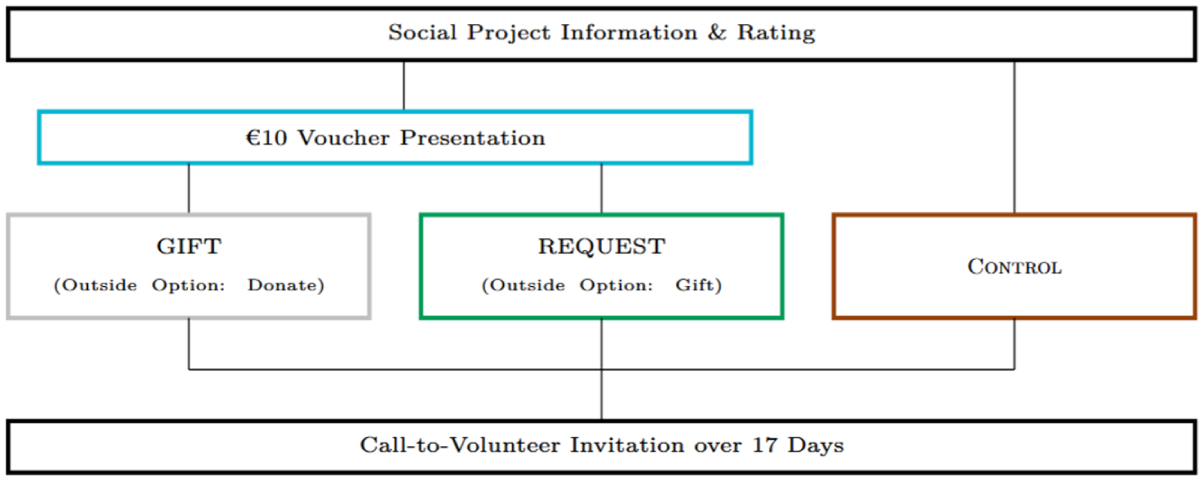
Experimental Treatments and Procedures.
Power Calculation
While the decision to keep or donate the voucher may not significantly influence engagement, understanding broader contextual and individual factors is crucial to addressing the persistent challenges faced by nonprofit organizations in recruiting volunteers. Studies indicate that response rates to volunteering requests are generally low, highlighting the difficulty of engaging individuals in prosocial activities. For example, Jeworrek et al. (2021) reported response rates as low as 0.5% to 1% for promotional flyers distributed to mailboxes to recruit participants for a neighborhood platform. This aligns with typically low response rates observed in cold outreach efforts, where individuals are contacted directly for the first time without any prior relationship or expressed interest in the initiative. Slightly higher response rates of 2.5% to 2.9% were observed by Conrads et al. (2016), who recruited volunteer conference assistants through an email distribution list targeting students. In this case, the students were also contacted directly without having previously expressed interest in volunteering. However, it is plausible to assume some prior connection, as the conference was organized by professors and faculty members at the students’ own university.
While we did not have personal relationships with the participants of the study, they had been contacted anonymously several times over the preceding months as part of a fitness study. This can therefore also be classified as “cold outreach,” in the sense that we sought to recruit new volunteers for a cause among individuals who had no prior connection to the organizing NPO and had never expressed interest in volunteering. However, a certain level of prior relationship existed due to the recurring contact during the fitness study. Thus, it is reasonable to assume a significantly higher willingness to engage in volunteering compared to true cold calling. Furthermore, the task requested by the organization was easy to fulfill, required minimal time investment, could be completed flexibly in terms of location and timing, and was likely enjoyable for many participants. Consequently, we expected a comparatively high participation rate of 10% in the control group.
Based on Hypotheses 1a–c and 2, we did not expect differences in treatment effects across the subgroups (GIFT/Donated, GIFT/Kept, REQUEST/Donated, REQUEST/Kept). However, we anticipated significantly higher engagement rates in all treatment groups compared to the control group due to the substantial monetary incentive of €10, estimating a doubled volunteer rate of 20% in each subgroup. A chi-square power analysis was conducted to determine the required sample size. Using a significance level of 0.05 and a desired power of 0.8, the analysis indicated a minimum sample size of 269 participants. To account for uncertainty regarding the donation decision, we chose to oversample to ensure robustness.
Results
A total of 242 participants were randomly assigned to the GIFT treatment, 232 to the REQUEST treatment, and 107 to the CONTROL group. 4 The treatment groups were intentionally oversampled to ensure comparable subgroup sizes, as participants in these groups had the option to either keep or donate their vouchers. This approach enabled us to examine treatment effects at the aggregate level and within subgroups based on voucher usage.
Participants had an average age of 46.9 years (range: 20–77), with 75.2% identifying as female and 27.8% reporting prior volunteering experience. At the start of the experiment, all groups gave similarly positive ratings for the project, with mean scores of 4.4 in GIFT, 4.3 in REQUEST, and 4.2 in
Our data analysis was conducted in two steps. First, we used non-parametric tests to compare engagement levels across treatments. Second, we applied regression analyses to assess the influence of individual-level covariates and test the robustness of treatment effects under multivariate adjustment. This approach enhances statistical validity and supports clear inference in the context of behavioral heterogeneity.
As intended, the framing of the voucher influenced participants’ decisions significantly, despite the relatively subtle nature of the treatments and the consistent decision-making options provided. In GIFT, 45.04% of participants opted to keep the voucher for personal use, whereas in REQUEST, only 21.12% made the same choice. This statistically significant difference (χ² test, 6 p < .001) underscores that even minimal changes in framing can effectively shape decision-making outcomes in the expected direction.
Notably, in both treatments, most participants chose to donate the voucher rather than keep it for personal use. Even in the GIFT treatment, where the voucher was explicitly framed as a personal benefit, the prevailing decision was to donate. This outcome highlights the robust influence of prosocial tendencies, even in situations where the framing promotes self-interest. These findings demonstrate that, while incentive framing significantly guides individual choices, prosocial behavior persists when supported by the broader context, indicating that self-focused incentives do not necessarily undermine generosity but can coexist with altruistic actions.
The proportion of participants who contributed at least once (measuring volunteering incidence) did not differ significantly between groups: 18.2% in GIFT, 18.1% in REQUEST, and 15.9% in CONTROL (Figure 2A). Chi-square tests confirmed that these differences were not statistically significant overall (p = .859) or on a daily basis. While these rates may initially appear modest, they reflect meaningful levels of engagement, as even participation rates as low as 5% are considered strong within this type of context. Notably, the participation rates of the treatment groups closely align with the expectations derived from our power calculations, albeit being approximately 2 percentage points lower than predicted. Conversely, the unexpectedly high participation rate in CONTROL (6 percentage points above expectations) reduced the observable treatment effects. The potential factors influencing this outcome and the diminished differentiation between groups are explored in the following analysis.
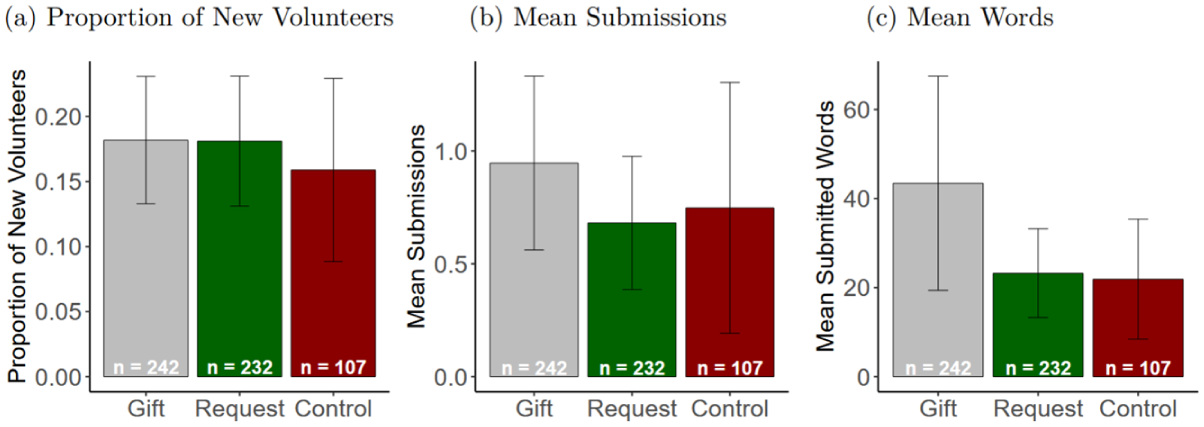
Treatment Effects.
When examining the total number of contributions by treatment (our measure for volunteer engagement), participants contributed an average of 0.95 submissions in GIFT, 0.68 in REQUEST, and 0.75 in CONTROL (Figure 2B). Kruskal–Wallis tests revealed no statistically significant differences between the treatment groups and the control group on average (p = .818) or when analyzed per day. Similarly, the analysis of word counts (measuring the quantity of volunteer engagement) shows a notable but not statistically significant disparity between treatments (Figure 2C). On average, participants in GIFT submitted 43.43 words—nearly double the contributions in REQUEST (23.25 words) and CONTROL (21.9 words). However, Kruskal–Wallis tests indicate no statistically significant differences in word count across treatments, whether aggregated over the full duration of the study (p = .863) or examined on a day-by-day basis.
A critical factor underlying these results is the substantial variability in participant engagement, as evidenced by the large confidence intervals in all outcome measures. This variability stems from the behavior of a few highly active participants who contributed extensively, while the majority of participants did not engage at all. This extreme distribution reduced the statistical power to detect significant differences between treatments and underscores the challenges of measuring engagement in episodic volunteering contexts. These dynamics and their implications for interpreting treatment effects are further addressed in the discussion. Bonferroni-adjusted p-values for the three outcome comparisons under Hypotheses 1 are reported in Appendix A.2 (Agresti, 2013; List et al., 2019).
Since neither the proportion of new volunteers, the word counts, nor the average number of submitted words varied significantly across treatment groups, we reject Hypotheses 1a–1c. This suggests that the framing of incentives did not substantially influence either the likelihood or depth of engagement, indicating that other factors may drive participation in episodic volunteering.
Subgroup analysis based on voucher use revealed no significant differences between the two treatment groups across all three dependent variables. Among voucher donors, 21.1% in GIFT and 18.0% in REQUEST volunteered at least once, compared to 14.7% in GIFT and 18.4% in REQUEST among participants who kept their voucher (Figure 3A; χ² test, p = .740). The mean number of submissions was 1.25 in GIFT and 0.73 in REQUEST for donors, and 0.58 in GIFT and 0.51 in REQUEST for participants who retained their voucher (Figure 3B; Kruskal–Wallis test, p = .647). Similarly, in terms of word counts, donors contributed an average of 55.2 words in GIFT and 25.7 words in REQUEST, compared to 29.1 words in GIFT and 13.9 words in REQUEST for those who kept their voucher (Figure 3C; Kruskal–Wallis test, p = .689). Bonferroni-adjusted p-values for the three outcome comparisons under Hypothesis 2 are reported in Appendix A.2. Because previous altruistic behavior, as indicated by voucher donation, did not significantly impact subsequent engagement levels across any of the measured variables, we reject Hypothesis 2.
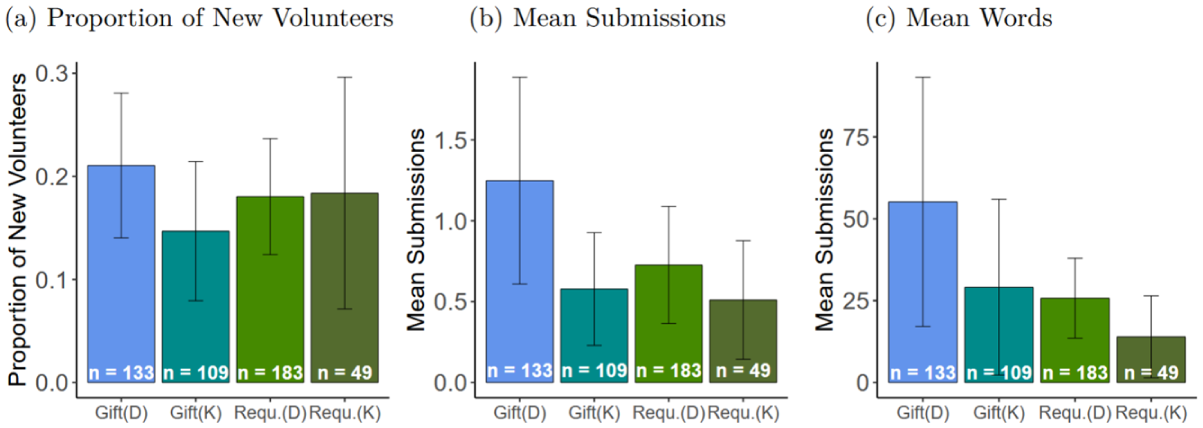
Treatment Effects by Voucher Use.
Prior research indicates that standard socioeconomic variables can significantly influence volunteering behavior. For instance, women and older adults show higher engagement levels (Henninger et al., 2024; Mertins & Walter, 2021; Simonson et al., 2021), and individuals already involved in prosocial activities are more likely to volunteer elsewhere (Dury et al., 2015). Beyond demographics, value alignment with the organization is a key determinant of volunteer commitment (Einolf & Yung, 2018; Ridder & McCandless, 2010). A recent meta-analysis confirms that personal values, as measured by the Volunteer Functions Inventory (Clary et al., 1998), are the strongest predictor of volunteering behavior (Zhou & Muscente, 2023), underscoring the importance of perceived social value in driving engagement. Accordingly, age, gender, project rating, and prior volunteering experience were included as control variables in the subsequent analysis.
Logistic regression analyses for binary outcomes (≥1 submission) 7 and ordinary least squares (OLS) 8 for continuous outcomes (submissions, words) provide additional insights into these factors influencing participants’ behavior (Table 1). We report robust standard errors in all regression models to account for potential heteroskedasticity, thereby ensuring valid inference even if the assumption of homoscedastic residuals is violated (MacKinnon & White, 1985; White, 1980). Detailed model specifications are depicted in Appendices A.3 and A.4. While age showed a weakly significant effect on the number of submitted words, it did not significantly influence the other two dependent variables: the likelihood of volunteering or the total number of submissions. Gender emerged as a strong predictor, with women significantly outperforming men across all outcome measures. As expected, participants’ ratings of the social project were a robust predictor of all engagement metrics, indicating the importance of perceived project value in motivating volunteering behavior. Surprisingly, prior volunteer experience in other contexts did not significantly influence engagement in this experiment, suggesting that episodic volunteering contexts may operate differently from more sustained forms of engagement.
Regressions on Multiple Outcomes.
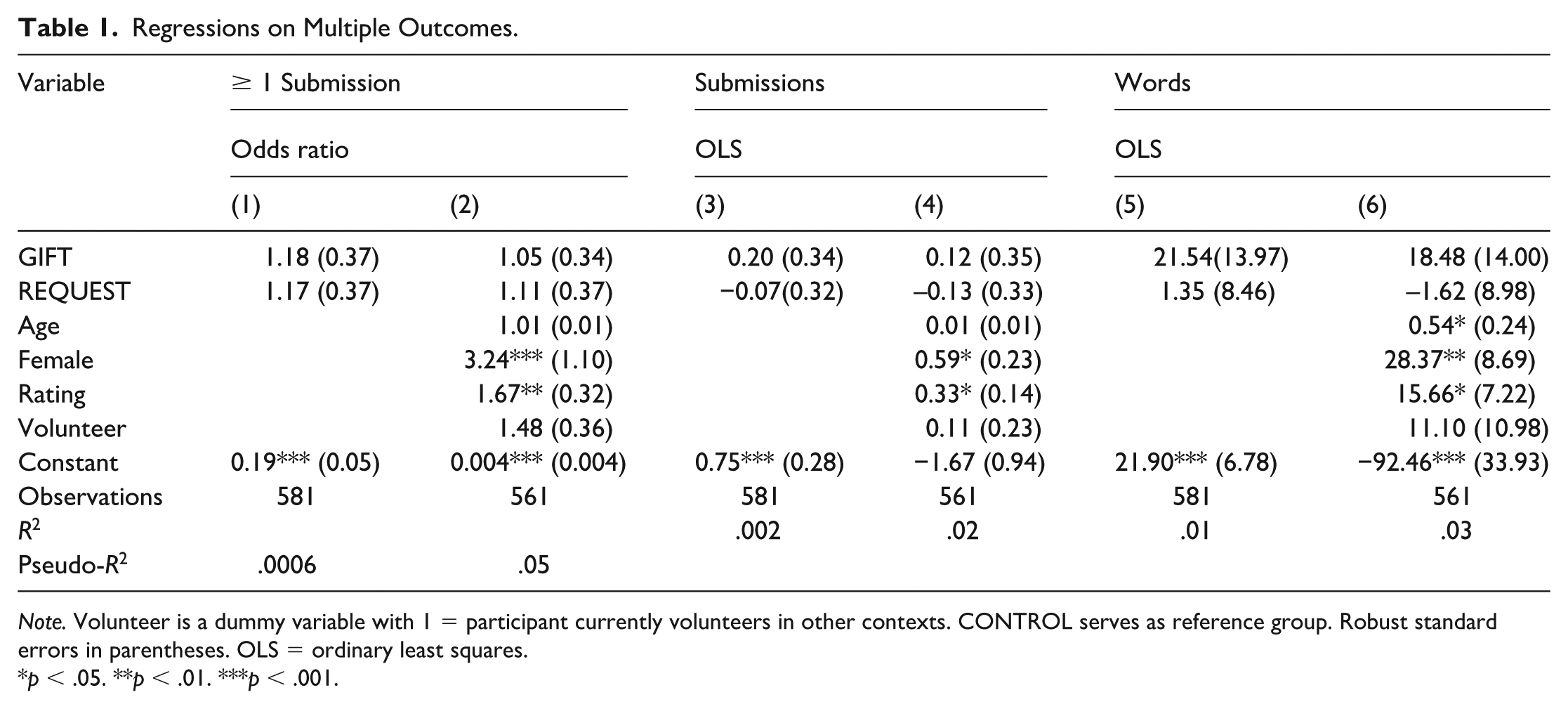
Note. Volunteer is a dummy variable with 1 = participant currently volunteers in other contexts. CONTROL serves as reference group. Robust standard errors in parentheses. OLS = ordinary least squares.
p < .05. **p < .01. ***p < .001.
Discussion
Our analyses revealed that neither framing incentives as gifts or requests nor the act of keeping or donating the voucher had a significant impact on follow-up engagement, challenging the assumption that monetary incentives can function as either substitutes or complements for time-based contributions. This finding resonates with earlier research demonstrating that the effectiveness of extrinsic incentives may diminish when individuals are already internally motivated to act (Gneezy et al., 2011; Müller & Rau, 2020). Although recent work has shown that carefully designed monetary incentives can promote engagement without undermining intrinsic motivation (Dallmeyer et al., 2024), our data indicate that such effects may be context-dependent. In the present study, the strength of the cause appeared sufficient to elicit high participation regardless of framing or incentive. The study also underscores the value of leveraging even modest pre-existing relationships. All participants had previously been contacted in the context of an unrelated fitness study, which, despite being anonymous, may have fostered familiarity and reduced psychological barriers to participation. Although this prior communication cannot be interpreted as a causal factor, these repeated but low-touch interactions could have increased trust and perceived credibility, thereby facilitating subsequent engagement. Unlike pure cold outreach, which typically lacks any prior contact, our findings suggest that even minimal exposure to an organization or affiliated context may serve as a meaningful foundation for future recruitment efforts. This supports prior arguments highlighting the role of trust and familiarity in shaping prosocial responses.
The null effect observed for the FITD treatment aligns with prior mixed evidence regarding its effectiveness in the context of volunteering (Guadagno et al., 2001; Yeomans & Al-Ubaydli, 2018). Although the technique has proven effective in other domains, its reliance on incremental engagement may be less impactful when individuals are already inclined to support the cause. In such cases, the initial low-effort request may fail to provide additional motivational leverage. The ineffectiveness of the Gift-Exchange framing similarly suggests that reciprocity-based appeals lose potency when participants already perceive the cause as valuable and the request as legitimate. One plausible explanation for the overall lack of treatment effects is the presence of a ceiling effect. Engagement rates were consistently high across all groups, including the control group, with 16–18% of participants actively contributing. This suggests that the project’s intrinsic appeal, combined with low barriers to participation, may have created a situation in which framing interventions had little room to exert additional influence. Such ceiling effects have been observed in prior work, particularly in studies where the perceived social benefit of the action is high and individual autonomy remains intact (Mertins & Walter, 2021; Savary et al., 2020).
The limited salience of the voucher incentive may offer another explanation. While valued at €10, the voucher may have lacked sufficient motivational weight in this context, particularly in comparison to the perceived importance of the social cause. As Bénabou and Tirole (2006) argue, the effectiveness of monetary incentives depends not only on their nominal value but also on their signaling function and contextual, as well as personal relevance. In this case, participants may have regarded time contributions as more authentic or socially meaningful than material tokens, diminishing the persuasive power of the incentive regardless of the framing. While both experimental treatments were grounded in well-established behavioral theories, the framing manipulations may have been too subtle to produce distinct effects on behavior. Although voucher usage patterns varied significantly across treatments, these differences did not extend to actual engagement. This suggests that participants may have interpreted both interventions similarly in terms of social expectations or moral obligations.
Taken together, the findings have important implications for nonprofit practice. Targeting individuals who have had prior, even minimal, exposure to the organization, through earlier interactions, information campaigns, or affiliated activities, may be more effective than contacting entirely unfamiliar audiences. Trust and familiarity, even if built passively, appear to facilitate engagement in ways that one-off material incentives do not. Moreover, the findings reinforce the effectiveness of mission-driven recruitment strategies by indicating that alignment with inherently meaningful causes significantly enhances engagement outcomes. When a social project is already perceived as important, engagement can be high regardless of whether it is paired with a gift or a structured request. In this sense, the data affirm the proposition that “a good cause can stand on its own.”
Rather than relying on external motivators, NPOs may achieve greater success by fostering personal identification with the cause. Practices that help individuals internalize the value of their contribution, such as articulating the societal relevance of the activity, showing the concrete impact of each task, and offering flexible, low-barrier participation, can support psychological needs for autonomy, competence, and social connection. These strategies are not only more sustainable but also more accessible for organizations facing resource constraints. Despite the strengths of the experimental design, several limitations must be acknowledged. While the sample included variation in age, gender, and prior volunteering experience, it was drawn from a single research panel consisting of digitally literate individuals. This limits the generalizability of our findings, particularly to populations with different cultural backgrounds, digital access, or baseline engagement levels. Replication in more heterogeneous or cross-national settings is necessary to assess the robustness and transferability of the observed null effects. The relatively high baseline engagement in all treatments suggests a potential ceiling effect, making it less likely that stronger effects would emerge in more engaged populations.
Therefore, future research should replicate the design across different cultural, institutional, and motivational settings to assess the boundary conditions of our findings. In addition, framing and incentives should be evaluated when the underlying cause is less salient, more contested, or where ceiling effects can be ruled out, as the relative effectiveness of behavioral interventions may shift in such contexts. Finally, the present study focused on a single episode of engagement. Longitudinal research is needed to assess whether initial framing strategies influence sustained involvement, particularly in settings where repeated interactions are possible. This includes tracking whether framing strategies create a gateway to deeper engagement and commitment over time, or whether their effects are limited to the immediate decision. Understanding these temporal effects is especially relevant for NPOs aiming to foster durable volunteer relationships beyond one-off participation. Future studies should examine mission-framing strategies in contexts where identification with, or familiarity with, the cause can be systematically measured and varied, as our assumption that intrinsic motivation, trust, or prior familiarity increased engagement remains speculative due to the absence of direct measurement. Furthermore, more salient or personally tailored framings should be explored to better isolate their effects in high-motivation settings. Exploring cumulative or delayed effects of these strategies, especially when combined with repeated messaging or increasing task complexity, remains a promising direction for understanding volunteer dynamics in the nonprofit sector.
Conclusion
This study examined the effectiveness of two widely applied recruitment strategies, Gift-Exchange and the Foot-in-the-Door technique, compared to a control group in fostering episodic volunteering for a German NPO focused on digital elderly care initiatives. Contrary to expectations, neither intervention significantly outperformed the control group. Within the scope of this study, framing incentives as either a personal gift or a cooperative request did not meaningfully influence subsequent volunteering behavior. Furthermore, neither keeping nor donating the incentive significantly influenced follow-up engagement, challenging the idea that monetary incentives act as substitutes or complements to time-based contributions. Instead, participants’ evaluations of the social project emerged as the strongest predictor of engagement, suggesting that intrinsic motivation could have played a central role in driving participation across all groups.
Footnotes
Appendix

Ethical Considerations
The study was approved by the German Association for Experimental Economic Research e.V. (Ethical Clearance Reference Number: vjEG9k1q) on November 11, 2022. All participants provided written informed consent prior to participating.
Funding
The authors disclosed receipt of the following financial support for the research, authorship, and/or publication of this article: This project was partly funded by VolkswagenStiftung Germany, Research Cooperation Lower-Saxony—Israel (grant number: A124745) and the German Federal Ministry of Education and Research (grant number: 16GDI107A).
Declaration of Conflicting Interests
The authors declared no potential conflicts of interest with respect to the research, authorship, and/or publication of this article