




Abstract
Drawing on data from a 2.5-year field case study, this research examines how an International Non-Government Organization (DevCo) uses ambidexterity to manage the tensions between upward and downward accountability. Using the theoretical lens of organizational ambidexterity, particularly the explore-exploit paradox, and utilizing Miles and Snow’s adaptive cycle, we analyze how DevCo optimized existing systems to strengthen donor reporting and upward accountability. At the same time, we unearth how DevCo fostered downward accountability by building new relationships with local non-governmental organizations and recipient communities. Using the explore-exploit paradox, we highlight how DevCo’s ambidextrous capabilities were seen to be mutually supportive as opposed to being mutually exclusive. This case study also shows how ambidexterity enabled DevCo to effectively manage the diverse array of stakeholders to whom they are accountable. These findings are discussed from both a practical and theoretical perspective.
Introduction
Upward and downward accountability are concepts that address the flow of responsibility and transparency within an organization. Both forms of accountability are essential for fostering trust and ensuring that the interests of all stakeholders are met. However, the key challenge for organizations, particularly international non-governmental organizations (INGOs), is balancing the requirements of all stakeholders due to conflicting demands, which can at times lead to INGOs prioritizing the needs of influential stakeholders (Ebrahim, 2016). While the challenge of managing competing demands of stakeholders has received considerable attention in the literature, Ebrahim (2003) argues that a large portion of the accountability discussion does not include a comprehensive analysis of “how” INGOs handle these demands. In line with this, Kuruppu and Lodhia (2020) state that it is crucial to describe “how” stakeholder relationships are handled by INGOs and in turn provide a more nuanced understanding of “how” accountability demands are managed within the sector. One concept that has been introduced within the literature to help manage the tensions between upward and downward accountability is organizational ambidexterity (Duncan, 1976). Organizational ambidexterity allows organizations to support a balance between innovative and efficient processes, fostering a culture of accountability across all levels of the organization. Central to the concept of organizational ambidexterity is the ability to manage exploration and exploitation processes (Duncan, 1976), which influences how an organization manages their resources and information both internally and externally.
Running parallel to this, INGOs play a knowledge brokering role between donors and local actors (Choi & Kim, 2010; Corbin et al., 2011; Vasconcellos & Sobrinho, 2015; Walsh & Lannon, 2023) employing global and local knowledge (Leach et al., 2008), disseminating knowledge, (Hushie, 2016) while simultaneously learning from local contexts (Barker & Beckford, 2006). An organization’s competitive advantage (Nonaka, 1994), positioning (Grant, 1996), and competitive performance (Venkitachalam & Willmott, 2017) depends on how it strategically uses the knowledge it possesses (Nonaka, 1994; Venkitachalam & Bosua, 2014). This requires organizations to evolve their strategies to ensure they make the best use of their knowledge (Scheepers et al., 2004) as environmental contexts evolve (Venkitachalam & Willmott, 2013) to align organizational and environmental conditions (Zyngier & Ventkitachalam, 2011). INGOs need to simultaneously react to emerging changes by exploring new knowledge, while also exploiting existing knowledge (Lannon & Walsh, 2020). Seeking to both develop new knowledge while improving existing processes gives rise to tensions due to a knowledge exploration-exploitation paradox whereby organizations seek to simultaneously meet these opposing demands (Knight & Harvey, 2015; Lannon & Walsh, 2020; March, 1991).
In this paper, to gain a deeper understanding of “how” an INGO supports upward and downward accountability in the redesign of its knowledge management (KM) strategy, we take data gathered during the completion of a 2.5-year case study conducted with an INGO, DevCo (pseudo name). In doing so we illustrate how DevCo implemented ambidexterity to support and manage the tensions between upward and downward accountability. DevCo is an international development aid organization, operating in 23 countries, employing 400 staff, supporting approximately 2.7 million people. DevCo is funded through approximately €40m in institutional (mostly governmental) funding and €20m from members of the public. Using a partnership model with local INGOs, it provides aid to recipient communities. Data for this case study were collected from multiple stakeholder groups across numerous sites in Zimbabwe, Uganda, and Kenya. To organize our findings, we use Miles and Snow’s (1978) adaptive cycle framework, allowing us to determine how DevCo balanced the exploration and exploitation of resources, while simultaneously managing environmental changes and managing upward and downward accountability. Put simply, this paper seeks to gain insights and answer the following research question “How do INGOs implement ambidexterity to support upward and downward accountability?.” The remainder of the paper is structured as follows, first we consider the conflicting demands of stakeholders on INGOs, before moving to discuss the tensions between upward and downward accountability within the sector. We then present the theoretical lens of organizational ambidexterity and introduce the Miles and Snow framework which is used to organize the findings from our case study. The subsequent section presents details of the methods used in this paper before moving to present our empirical findings. The final section of our paper discusses the practical and theoretical implications of our findings before drawing final conclusions and outlining recommendations for future research.
Stakeholders in INGOs
Freeman (1984, p. 46) defines stakeholders as “any group or individual who can affect or is affected by the achievement of the organization’s objectives.” For INGOs stakeholder groups can be both internal, such as employees, management, and board members, and external stakeholders, including donors, governments, local non-governmental organizations (NGOs), beneficiaries, local communities, volunteers, and the media. Due to the reciprocal nature of the stakeholder relationship, INGOs need to balance what is expected of the various stakeholder groups from the INGO, as well as managing what stakeholders demand from the INGO in return. This creates an enormous challenge for INGOs due to the conflicting demands from stakeholder groups, all of whom demand different returns from INGOs such as outcomes, services, quality, and sustainability (Moshtari et al., 2024). As a result, INGOs often find themselves juggling the needs and demands of multiple stakeholders, creating a key challenge for INGO managers. These challenges are heightened by the complexities of limited resources, and as a result management are often faced with the dilemma of sometimes prioritizing stakeholders demands to capitalize on securing resources (Ebrahim, 2016). This is particularly true in the case of external stakeholders, who play a crucial role in the survival of INGOs (Crittenden, 2000). When given the opportunity, external stakeholders can exert substantial influence over INGO operations and contribute to their legitimization (Moore, 2000). Assad and Goddard (2010) highlight that INGOs are likely to prioritize stakeholders who could impose sanctions or withhold resources. Similarly, Pallas et al. (2015) indicate that INGOs often fail to represent stakeholders’ interests because they are constrained by the need to survive, and therefore will often choose to serve the needs of stakeholder groups that can best serve their need for resources. Consequently, they may focus on meeting the needs of groups that are most beneficial for resource acquisition, placing INGOs in a precarious position where they become beholden to powerful stakeholders—such as donors—and risk becoming instruments of their interests (Pallas et al., 2015).
Included in the demands of various stakeholder groups is the demand for accountability. Again, because INGOs operate in a multiple stakeholder context, they have to fulfill the accountability demands of multiple stakeholder groups simultaneously (Hengevoss, 2023). Similar to the conflicting expectations and demands of stakeholder groups, accountability demands from stakeholder groups are often opposing and conflicting (Coule, 2015). Therefore, as Herman and Renz (2004) rightly point out, the key challenge for INGOs is managing differing stakeholder perspectives and expectations. This necessitates assessing performance relative to stakeholder interests and implementing multiple reporting mechanisms to address their diverse concerns. To this end several management systems have been identified within the literature to help INGOs navigate the complexities of stakeholder demands, while advancing their mission. For example, stakeholder engagement frameworks help INGOs identify stakeholders and assess their needs (Pallas et al., 2015), program management systems ensure alignment between INGO programs and stakeholder priorities (Abdel-Kader & Wadongo, 2011), and monitoring and evaluation (M&E) systems track financial management and facilitate budgetary reporting (Marshall & Suárez, 2014). The next section explores accountability in the INGO sector in greater detail.
Accountability and INGOs
Ebrahim (2003) defines accountability as the means through which individuals and organizations are held externally to account for their actions and as the means by which they take internal responsibility for continuously shaping and scrutinizing an organization’s mission, goals, and performance. Unlike private businesses, who are primarily accountable to shareholders, INGOs are accountable to their donors, governments/funding bodies, boards of directors, recipients of aid, and field partners, meaning they are held accountable to multiple stakeholders simultaneously. Literature to date has largely established that the essential elements of accountability are centered on “to whom,” “for what,” and “how” (Pilon & Brouard, 2023). However, as Pilon and Brouard (2023) caution, accountability within the sector is fraught with challenges. They outline two conceptions of accountability that aid our understanding of competing interests which create multiple accountability challenges for INGOs.
First, they present a narrow conception of accountability, emphasizing agency theories, public interest, and resource reliance, which can be understood as a functional process (“how”) to satisfy enforced demands (“for what”) of upward principals (“to whom”). On the contrary, a broader definition of accountability, focused on stewardship, democratic, and stakeholder theories, can be understood as a strategic process (“how”) to provide information that is based on felt responsibility (“for what”) to downward stakeholders (“to whom”). These conceptions of accountability utilize the upward and downward accountability dichotomy, the most used dichotomy in the INGO literature to help explain directional pushes and pulls (Kaba, 2021; Pilon & Brouard, 2023). Essentially, INGOs are upwardly accountable to the donors who fund their activities, or downwardly accountable to the target communities they plan to serve (Banks et al., 2015).
In explaining the difference between the two AbouAssi and Trent (2016, p. 284) define upward accountability as a “relationship with donors or governments, as a consequence of control over financial or regulatory resources,” and downward accountability as a “relationship with beneficiaries or those indirectly impacted by its activities.” Upward accountability involves interactions between INGOs and donors (“to whom”) (Kaba, 2021; Williams & Taylor, 2013) and involves control to ensure donor resources are used as expected (“for what”) (vanZyl et al., 2019), using results-based management (“how”) (Lomofsky & Grout-Smith, 2020). Downward accountability, however, refers to INGO relations with the needs of clients/beneficiaries (“to whom”) (Kaba, 2021; Williams & Taylor, 2013) and the mechanisms to identify those needs and see they are met (“for what”) (vanZyl et al., 2019), and served through community participation (“how”) (Kingston et al., 2023).
Research to date indicates that INGOs rely heavily on government approval and funding, which limits their ability to understand and carry out accountability despite the variety of stakeholders they must take into account (Pilon & Brouard, 2023). Furthermore, AbouAssi and Trent (2016) point out that because INGOs depend on donors for financial resources, and donors need to safeguard their interests, INGOs are compelled to focus on upward accountability to donors (Ebrahim, 2003; Newcomer et al., 2013). However, Pilon and Brouard (2023) warn that this emphasis on donor interests may distance INGOs from the communities they serve. This may be because, at the center of non-profit organizations is its social mission (Akingbola, 2006), creating an inherent tension where organizations must respond to both their social mission while acquiring funding to ensure their stability (Ogliastri et al., 2016).
Although a considerable body of research examining accountability in the sector has been established (see, for example, Benjamin, 2013; Ebrahim, 2003; Gugerty & Prakash, 2010) (Ebrahim 2003) argues that much of the accountability debate lacks an integrated examination of “how” INGOs manage conflicting and sometimes overlapping demands. This has led Kuruppu and Lodhia (2020) to reiterate the importance of explaining “how” changing stakeholder relationships are managed and their importance in understanding organizational practices and processes. Managing this paradox is the core of organizational ambidexterity (Duncan, 1976).
Ambidexterity and INGOs
Ambidexterity helps organizations deal with turbulent external environments (Asiaei et al., 2023; Pellegrinelli et al., 2015) and rapid changes (Guisado-González et al., 2017), thereby improving organizations’ responsiveness to opportunities while enabling risk-taking. It does so by considering an organization’s engagement in both exploitation and exploration activities (Sollosy et al., 2019). In this context, exploration involves pursuing new possibilities through innovation, experimentation, and discovery (March, 1991), to cope with latent trends (Lubatkin et al., 2006), resulting in knowledge generation (Gupta et al., 2006). It can involve seeking novel technologies to create innovative products and services (Benner & Tushman, 2003), entering new technology fields (He & Wong, 2004; Vrontis et al., 2017), and introducing new generations of products (He & Wong, 2004; Vrontis et al., 2017), or extending existing product ranges (Vrontis et al., 2017). Exploration involves departing from existing skills (Benner & Tushman, 2003), for instance by shifting toward customization—which requires a better understanding of customers’ needs—or by forging new relationships and linkages with external organizations to incorporate novel technologies (Filippini et al., 2012).
Exploitation, however, is associated with stability (Farjoun, 2010). Old certainties are exploited (March, 1991). It focuses on improving existing products (He & Wong, 2004; Vrontis et al., 2017) and enhancing service reliability (Benner & Tushman, 2003). This can be achieved through increased automation (Benner & Tushman, 2003), reducing production costs, (Vrontis et al., 2017) and improving yields or reducing material consumption (He & Wong, 2004). Exploitation may focus on enhancing existing markets (Vrontis et al., 2017) by deepening the existing customer base, fine-tuning offerings to maintain customer satisfaction (Benner & Tushman, 2003), drawing on past knowledge (Gupta et al., 2006) and engaging in organizational activities “in the neighborhood of existing capabilities” (Benner & Tushman, 2003).
A key question for organizations is how to simultaneously manage exploration and exploitation (O’Reilly & Tushman, 2011). Given both sets of activities vie for the same scarce organizational resources, trade-offs may be required (March, 1991). Gupta et al. (2006) argue that March’s (1991) theorization assumes exploration and exploitation are fundamentally incompatible, existing at opposite ends of a continuum. However, this does not mean that both activities cannot be pursued (Stadler et al., 2014), rather it simply means maintaining a balance (March, 1991). Alternatively, instead of viewing exploration and exploitation as mutually exclusive (Filippini et al., 2012), they can be considered mutually reinforcing (Zhan & Chen, 2013). Similarly, Farjoun (2010) posits that exploration and exploitation should be seen as a duality rather than a dualism, rendering them interdependent and enabling rather than separate, mutually exclusive, or incompatible. One way of managing the inconsistencies of the exploration and exploitation processes in a single organization is by adopting an ambidextrous structure that allows “internally inconsistent architectures” (Benner & Tushman, 2003). Employing ambidexterity can help organizations streamline their responsiveness to changing customer requirements (Sherif et al., 2013). This can be achieved through either structural ambidexterity or contextual ambidexterity (Filippini et al., 2012).
Structural ambidexterity (Filippini et al., 2012) involves dual structures (Benner & Tushman, 2003; Fang et al., 2010) where separate units undertake each activity (Tushman & O’Reilly, 1996). Some groups engage in learning that enables diverse ideas to be explored and developed (Fang et al., 2010). These innovative ideas are disseminated to other groups so wider learning can occur (exploitation). While there are consistencies within groups, inconsistencies exist between loosely-coupled sub-groups (Benner & Tushman, 2003). These inconsistencies are strategically integrated by top managers who provide this pivotal integrating (Lubatkin et al., 2006) and alignment (Smith & Tushman, 2005) while dealing with subsequent tensions (Stadler et al., 2014). Stadler et al. (2014) argues that more research is needed that considers the coordination of exploration and exploitation beyond the role played by top managers.
Alternatively, contextual ambidexterity is defined as “the behavioral capacity to simultaneously demonstrate alignment and adaptability across an entire business unit” (Gibson & Birkinshaw, 2004, p. 209). This approach enables employees to allocate their time flexibly between exploration and exploitation activities (Filippini et al., 2012) by developing facilitating processes, with top management support (Gibson & Birkinshaw, 2004). Contextual ambiguity allows both exploration and exploitation to coexist simultaneously within business units, with employees choosing the degree to which each is required (Stadler et al., 2014). Guisado-González et al. (2017) argues that exploration and exploitation can be seen as complementary, occurring simultaneously. Similarly, Pellegrinelli et al. (2015) found contextual and structural ambidexterity to be direct alternatives but that each could “enable and underpin” the other. When developing one capability organizations should ensure the other is also improved, to achieve a relative balance (Wang et al., 2023). Conversely, Zimmermann et al. (2020) found the drivers of ambidexterity may act at cross purposes to each other, rather than act in complementary ways, arguing that organizations need to choose between structural and contextual approaches rather than use both.
While their environmental context may be broadly the same, INGOs follow multiple paths to achieve ambidexterity with no “one solution” (Cannaerts et al., 2020), though a shared vision needs to be articulated (Avby, 2022). Ambidexterity requires an inclusive corporate culture (Zhang & Sun, 2023), with relationships with external stakeholders forming a critical element of ambidexterity (Asiaei et al., 2023; Xing et al., 2024), as they facilitate organizations in exploring and exploiting their networks (Wang et al., 2023). This creates the need to maintain relationships with different types of clients (Bednarek et al., 2016) and build trust with partners (Wang et al., 2023). Clear communication channels across the organization are also critical to resolve any tensions, with informal communication preferred over formal channels (Kassotaki et al., 2019). Furthermore, mechanisms for horizontal and vertical communication throughout the organization are also needed to support ambidexterity, even if staff are in different geographic locations (Kassotaki et al., 2019). For INGO subsidiaries, ambidexterity is important as exploitation of headquarters knowledge may not be sufficient for local conditions, and so exploration is needed to adapt to local conditions, however, this local exploration adaptation may result in little alignment to the corporate strategy and difficulty in integration back to headquarters (Borini et al., 2022). It is therefore critical that formal organizational structures simultaneously support exploration and exploitation (Zimmermann et al., 2020) in the form of the structural capital of the organization, namely, management processes, structure, reward mechanisms, and collaboration processes, all of which are positively associated with ambidexterity (Asiaei et al., 2023).
Further examples of ambidexterity in the INGO literature can be seen through Balboa’s Paradox of Scale (Balboa, 2018). Within this paradox, NGOs that succeed locally (local scale) can face challenges while engaging with international donors, while, on the contrary, INGOs can find it difficult to connect with local communities (global scale). What drives success at the local level, such as relationships, skills and organizational structures, can hinder global coordination, and vice versa. When INGOs try to be ambidextrous, they must nurture innovative practices at the local level, while also maintaining standardized processes that align with their global vision. In this context, local units develop relationships that boost community engagement, whereas at a global level there is a greater need for the application of best practices, which often comes at the expense of local initiatives (Balboa, 2018). This paradox pushes INGO leaders to develop internal capacities, such as intercultural understanding, dedicated coordination roles, and internal flexibility.
Leadership capabilities, including the ability to resolve tensions, thus providing coherence, is a key driver of ambidexterity (Pellegrinelli et al., 2015; Zimmermann et al., 2020) with ambidextrous leadership (Bell & Hofmeyr, 2021; Malik et al., 2024) positively affecting exploration and exploitation (Jia et al., 2022). Organizational ambidexterity is significantly influenced by the behavioral integration, involving collaboration and joint decision-making among the top management team, with collaboration ensuring members can balance explore and exploit as they know what others are doing and can plan the resource requirements (Venugopal et al., 2020). There is also a need for “temporal leadership” given the tensions between long term focus, exploration, and short-term focus, exploitation with top management teams (TMTs) needing to synchronize resource allocation and prioritize certain innovative projects (Chen & Liu, 2020). Leaders need to act as facilitators, supporting exploration and exploitation activities through social awareness, coordination and relationship building (Avby, 2022; Katou et al., 2021; Wang et al., 2023). In particular, for contextual ambidexterity, managers should empower and encourage employees to make their own judgments as to how to resolve the conflicting demands place on them (Pellegrinelli et al., 2015), as well as engaging in fair and constructive judgment of employees’ ideas (Caniëls et al., 2017), and provide support for a “freedom to make mistakes” (Bell & Hofmeyr, 2021) by fostering a foster a culture of experimentation (Bell & Hofmeyr, 2021). Where leaders show a concern for exploration so too will their employees (Katou et al., 2021). Furthermore, a supportive environment encourages employees to act proactively, particularly if employees know that managers will be supportive if there is failure (Caniëls et al., 2017), creating an “open attitude to errors” among employees (Caniëls et al., 2017).
While research has examined the effects of ambidexterity on organization performance (see Table 1 of Solís-Molina et al., 2018), it has largely overlooked the processes and practices that enable ambidexterity, the “how” of ambidexterity, which has led Bednarek et al. (2016) to argue that there is much still to learn in this area. Recently, studies have combined the theoretical lens of ambidexterity (Håkonsson et al., 2012; Sollosy et al., 2019) with Miles and Snow’s (1978) adaptive cycle, to explore how exploration and exploitation processes are managed. Miles and Snow’s (1978) framework posits that organizations respond to shifting environmental conditions by addressing three problem domains—entrepreneurial, engineering, and administrative. Although these challenges occur simultaneously in mature organizations, they are discussed sequentially here for clarity.
Miles and Snow’s Adaptive Cycle.
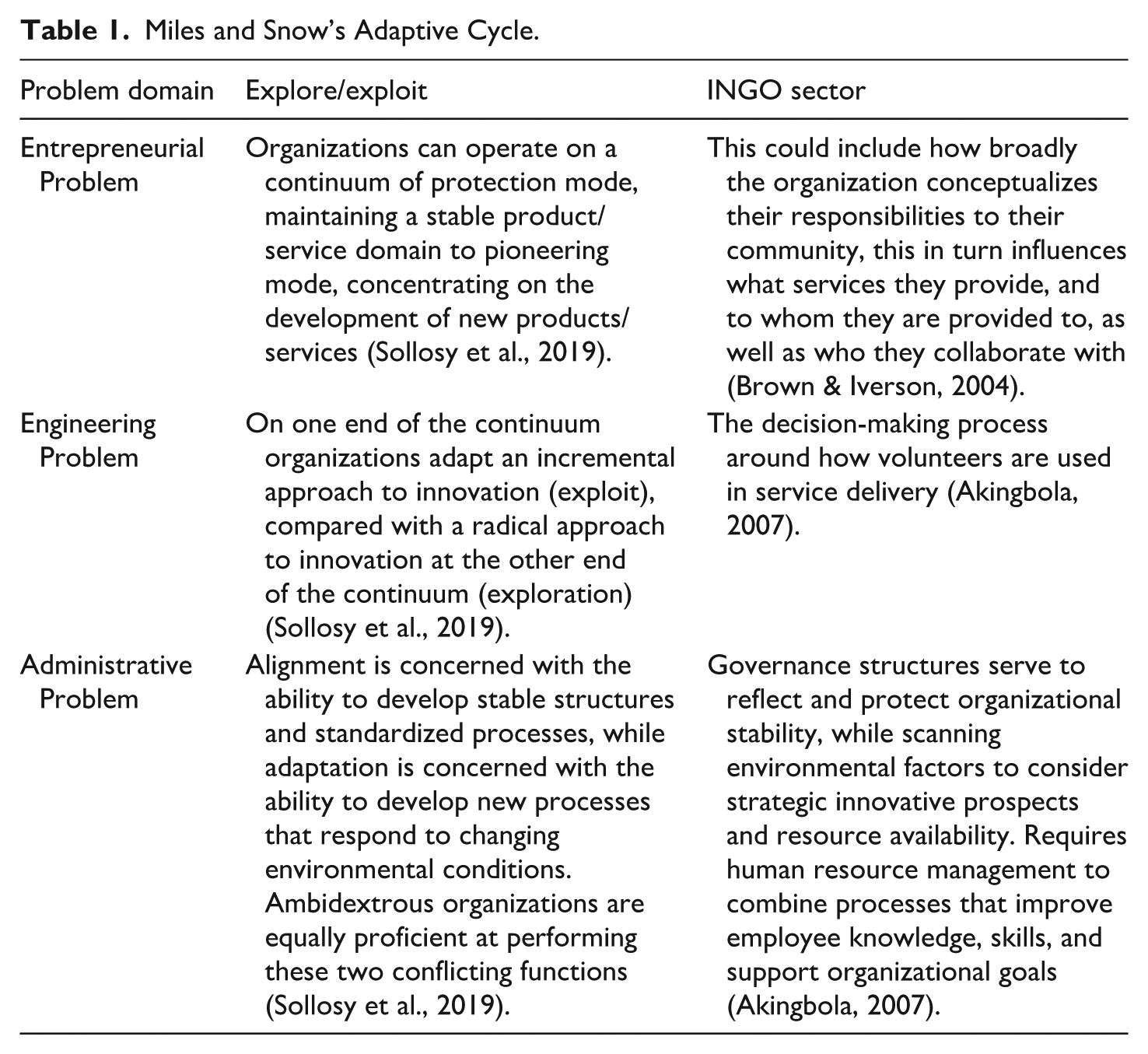
The entrepreneurial problem addresses how the organization defines its “product or service and target market” (Miles & Snow, 1978, p. 21), representing the need for service and resource opportunities, focusing on the extent to which existing products/markets are exploited versus the exploration of new products and markets (Sollosy et al., 2019). The engineering problem considers how operational solutions are developed to deliver the services of the organization, including the selection of a service delivery method, for example, technology and alignment of information and communication linkages necessary for effective operation (Miles & Snow, 1978), focusing on the delivery of products or services through an incremental approach to innovation (exploitation), or a more radical approach to innovation (exploration) (Sollosy et al., 2019). The administrative problem considers structures and processes to direct and monitor operations (Miles et al., 1978), where organizations need to balance alignment with adaptability (Sollosy et al., 2019). Table 1 combines the elements of the adaptive cycle with the explore-exploit paradox, considering their application to the INGO sector.
This Study
Drawing on Miles and Snows’ adaptive cycle as the synthesizing framework we illustrate how DevCo manages accountability tensions. In this context, organizations can draw on ambidextrous capabilities to effectively handle both upward and downward accountabilities, while managing a complex array of stakeholders. To help practitioners and academic audiences understand how INGOs balance ambidextrous capabilities we examine exploration and exploitation activities undertaken by DevCo during the redesign of DevCo’s KM strategy. The overall objective of this study is to help gain a greater understanding of “how” DevCo simultaneously engages in both activities while navigating multiple accountabilities and addressing the needs of various stakeholders. In doing so we can answer the following research question “How do INGOs implement ambidexterity to support upward and downward accountability?”
Method
This study is based on a 2.5-year case study of DevCo conducted between 2015 and 2017 during the redesign of its knowledge management (KM) strategy. This design enabled us to examine phenomena and their dynamics within their natural context. Given the central role INGOs play in connecting donors and communities (Choi & Kim, 2010; Corbin et al., 2011; Vasconcellos & Sobrinho, 2015; Walsh & Lannon, 2023) we identified DevCo as an interesting case due to its engagement with both global and local knowledge. The project’s initial terms of reference document outlined comprehensive data collection and reporting procedures, including the following statement, “having more narrative and reflection coming from a partner level would be really, really valuable because there’s more applied context with it, not just the data,” as well as an expressed desire for “deep roots in the grassroots.” DevCo was also selected for case analysis because our research question emphasizes accountability. In addition to highlighting accountability in its organizational strategy, DevCo maintained an accountability framework document that clearly articulated its current position.
DevCo’s strategy addresses accountability in terms of both upward and downward dimensions. It is driven by the need to maximize value from limited resources through enhanced management information systems and acknowledges that international trends necessitate explicit downward accountability—achieved by involving partners more directly in decision-making. DevCo’s accountability framework explicitly lists a broad range of stakeholders, including program participants and their communities, partner organizations, DevCo staff and volunteers, supporters, the public, donors, regulators, governments, and the media. The strategy document referenced the need to consider the priorities of local partners and communities through better mutual understanding and collaboration between stakeholders using active participation and consultation, all while ensuring optimal use of limited resources. These factors indicated DevCo was suitable for the proposed research question: “How do INGOs implement ambidexterity to support upward and downward accountability?”
Prior to the commencement of data collection, DevCo had undergone an organizational restructuring that resulted in a matrix organizational structure. This change affected how knowledge was generated, codified, and shared, leading DevCo to identify KM as a global priority. In addition to better understanding local perspectives, DevCo was transitioning from a project-based approach to integrated programming. This shift required a change in mindset with staff considering not only the needs of specific funded projects but also broader issues spanning multiple projects. DevCo was also committed to developing its partnership model of working with local NGOs. It employed a principle of “subsidiarity” whereby decisions were to be made at the lowest level of the organization by people who best understood the local context, albeit with reporting to and visits from the M&E section of DevCo. There was a need to balance local autonomy with ensuring donor funded project objectives were met.
Data for this case study were collected from multiple stakeholder groups across multiple sites, in Ireland, Zimbabwe, Uganda, and Kenya. Two of the researchers were involved in supporting the initial discussions, developing terms of reference for the project, facilitating workshops, and were involved in the monthly project meetings (see Appendix).
Data Collection and Analysis
We use several qualitative methods utilizing multiple sources. Similar to studies examining strategic developments (Scheepers et al., 2004) and exploration/exploitation research (Filippini et al., 2012; Knight & Harvey, 2015) we used recorded and transcribed semi-structured interviews. In line with previous studies, respondents at various levels were interviewed (Knight & Harvey, 2015; Sherif et al., 2013) with interviews taking between 45 min and 1 hr. In addition, similar to Kreiner et al. (2015) we drew on field notes and onsite observations while attending workshops and meetings. Researchers were provided with access to internal reports and access to the organizational document repository system. Data were analyzed using NVivo 10 software.
In this study the KM redesign took place in two phases (see Appendix) with staff at multiple levels. Initial discussions in the planning phase were held at headquarters and in Zimbabwe with four directors and five managers (two from the Strategic Impact Unit (SIU) and three from development programs) as well as staff that included five SIU members and two from the information systems department. In addition, there was a meeting in the Zimbabwe field office with the country director, four program officers, and an information technology (IT) staff member. In these meetings, organizational needs and project objectives were identified.
During the implementation phase initial workshops and interviews took place in all three countries with staff at different levels, including country directors, M&E officers, finance officers, and project managers. Discussions focused on what knowledge was used to accomplish work, how knowledge was currently managed in the organization, and potential ways to develop knowledge in the future. Implementing the project involved centralized work that took place at headquarters, mainly in the IT department, and decentralized work by a project team involving staff in three African countries, Zimbabwe, Uganda, and Kenya. At this implementation phase it became clear that the nature of discussions and proposed activities were different, between the IT section and the field offices, with the top management team seeing value in both. There was a difference in emphasis between activities that took place by the IT team and the team coordinating inter-country activities in Africa. Workshops were carried out over 2 days in each of the three countries. They began by outlining how the case organization currently perceived KM and the terms of reference of the project. Staff then engaged in two exercises to help them consider opportunities and gaps that existed in how they currently manage knowledge.
To understand “how” INGOs operate (Lewis, 2014) and to derive practical insights (Lindenberg, 2001), we organized the collected data using Miles and Snow’s adaptive cycle framework. Data were coded against each of the three adaptive cycle problems: entrepreneurial, engineering, and administrative. This indicated that entrepreneurial issues occurred earlier in the project followed later by both the engineering and the administrative. Data were then coded based on whether they related to knowledge exploration or exploitation. Similar to Cunha et al. (2016) we moved between data sources and emerging interpretations of the data until a stabilized interpretation was achieved. Examining the data indicated that exploration activities focused on downward accountability, while exploration concerned upward accountability. Three themes emerged from the data within exploration and exploitation respectively.
Empirical Analysis
We agree with Gupta et al. (2006) that learning and innovation are present in both exploration and exploitation activities, but possess different qualities. We categorized the IT teams plans as exploitation given they focused on existing needs (Lubatkin et al., 2006; Vrontis et al., 2017) relating to upward donor accountability (Berghmans et al., 2017), with the planned activities seeking to improve efficiency by refining existing activities (March, 1991), specifically refining knowledge (Gupta et al., 2006) gathered for donor and internal reporting, that enabled well-defined solutions (Filippini et al., 2012) to be executed. Alternatively, development programming team activities were defined as explorative for several reasons. They involved learning and innovation that was distinct from the exploitative activities (Gupta et al., 2006; He & Wong, 2004). They sought to develop new possibilities (March, 1991) and opportunities (Filippini et al., 2012) at a country level. While the actions did not involve searching for new products/markets or technologies (Benner & Tushman, 2003; Filippini et al., 2012), they were, nonetheless, explorative in that they sought to extend DevCo’s current range of services (He & Wong, 2004; Vrontis et al., 2017), and focused on finding new and creative ways of developing services to satisfy customer needs in more customized ways (Benner & Tushman, 2003). These changes required new knowledge and skills (Benner & Tushman, 2003; Knight & Harvey, 2015) around stakeholder engagement and reputation building that developed and deepened a latent trend (Lubatkin et al., 2006), in this case, downward accountability (Berghmans et al., 2017; Kaba, 2021). This indicated DevCo was engaging in structural ambidexterity (Filippini et al., 2012).
Knowledge Exploration Trajectory
The planning stage involved considering entrepreneurial problems. Discussions about KM were held among staff at headquarters, in country offices in Uganda, Zimbabwe, and Kenya, as well as with local INGOs and recipient communities, to examine how KM could exploit existing work practices and explore new opportunities. Exploration centered round three sets of activities.
Reflection and Learning Spaces
During the implementation stage, developing learning was overseen, by the M&E team, who coordinated activities through monthly video conferences, and local field office staff and partner organizations, as a way of preventing mistakes reoccurring, improving future work, and learning “beyond” the reported numbers. “[knowledge is] not just numbers . . . like going to a community or looking at a program that you managed for a few years and saying this is what I think went really well . . .” (SIU member).
Partner INGOs were able to compare the extent to which learning was included in various donors’ reports: “a huge amount of work goes in there [to reports] . . . a lot of valuable information, but that doesn’t get harnessed. . . . We see them as reporting obligations rather than learning opportunities”. (Director, Local INGO Partner)
There was an iterative cycle between learning and implementing what was learnt. Developing learning helped increase adaptability and provided staff with opportunities to connect and develop relationships. Although enthusiasm existed for interpersonal knowledge sharing, time was seen as a constraint: “It’s time related to prioritization of workload and time related to urgency of certain imminent things, like whether it’s crisis in a country . . . you reflect, and I think that’s one of the hardest things. There’s a huge willingness and openness for it”. (DevCo Manager)
An additional partner constraint related to how projects were financed. While beneficial in the long-run learning activities were not directly funded. “Increasingly, donors are not funding overheads . . . that has been one of our challenges” (Partner INGO).
Deepening Partnership Connections
There was a sectoral trend toward development organizations working in confederations. Some senior managers, possessing field experience, saw DevCo’s role as being a catalyst for learning among partners, between partners and at the organizational, and between countries, as aid programs were implemented. DevCo facilitated partners learning about how to improve their M&E practices, which increases partners’ attractiveness to donors. While deepening connections was viewed as positive and necessary, it raised issues related to DevCo’s partnership model: “There is a sensitivity around getting to the community, without going through the partner, so . . . it’s like “do you not trust me?” . . . why would you need to investigate my tools . . . and we would say that (DevCo) is not just another donor, we’re a partner, if you’re a partner then there’s trust and we’re working on this together.” (Strategic Impact Group member)
When discussing how they worked with DevCo, partners referred to the organization’s openness to “revise its approach,” achieved through multiple conversations with their partners. Such openness facilitated connections being developed.
Increase Reputation and Become a Thought Leader
There had been a strategic move from individual projects to integrated programming. These changes were made to develop DevCo’s reputation in identified thematic areas, clarifying its core capabilities: “We should become the go-to people in those humanitarian [themes] not just in development circles in [DevCo] but outside. . . . Our KM, has to have a goal, and for me that’s where we want to be”. (Senior Manager)
Headquarters staff acted globally, working with donors to develop programs that field offices implemented locally through building coalitions and influencing stakeholders who could help or hinder projects: “It’s about pulling together people with a common interest. That’s why we need to now develop themes and identify organizations that are likely to fit into certain themes and bring those together. . .”. (Partner INGO)
In addition to making connections, influence could be achieved through developing artifacts targeted at different stakeholder groups. Knowledge created and held locally, developed during development work, tended not to be codified, remaining in tacit form. There was value in codifying such knowledge, held in field offices, to showcase and disseminate staff expertise and thought leadership. Before knowledge could be exploited by codifying and sharing it to other locations in DevCo it was important that context was considered to ensure re-use was appropriate: “You write a package with a narrative that brings out the issues, summaries the political realities . . . you then realize that the media is your primary target group . . . and then we would then be pushing for policy change”. (Partner INGO)
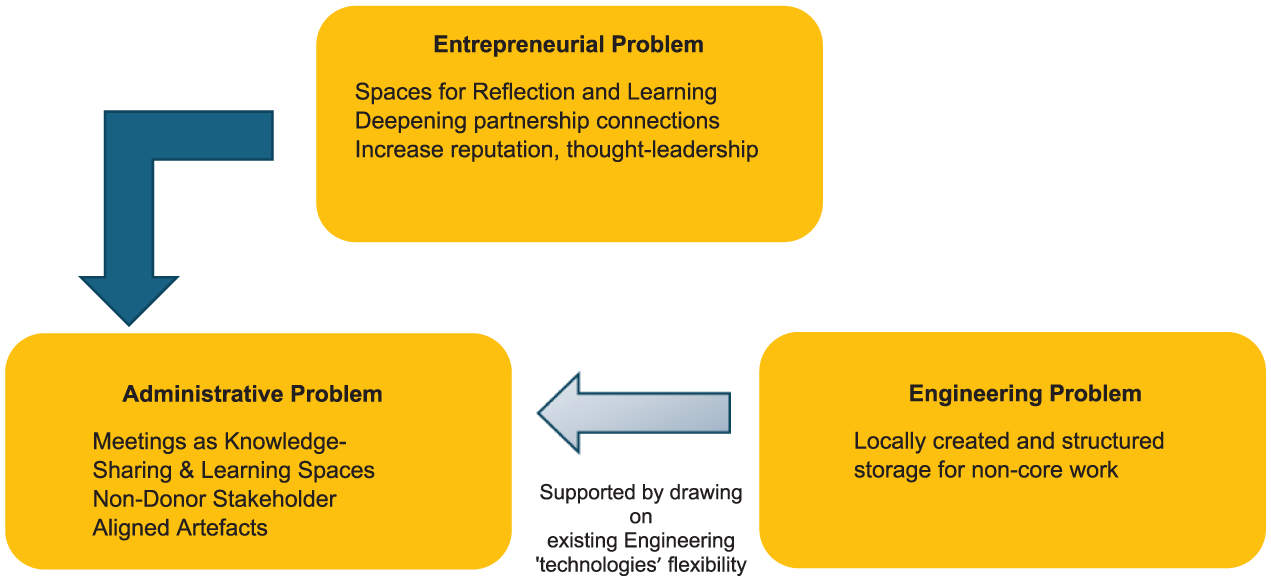
While strategic planning involved engaging with entrepreneurial problems, the opportunities identified were implemented by engaging with the administration and engineering problems. Given the importance of contextual knowledge, exploration-oriented activities were undertaken locally, giving rise to administrative problems. Distinctions were drawn between core and non-core work. Core work was activities directly related to development programs. Non-core work involved building and maintaining wider relationships, increasing DevCo’s visibility, reputation, and influence among stakeholders to facilitate core work. This raised the question: how should locally generated knowledge be captured and used to influence stakeholders? Current systems were designed for the donor stakeholder group, but local staff were also interested in capturing and storing knowledge to influence multiple non-donor audiences and support non-core work.
Although local knowledge sharing was important, meetings were dominated by core day-to-day activities. Meetings were restructured to explicitly include knowledge sharing on specific topics, with the inclusion of relevant external stakeholders. Discussions about learning and stakeholders led to discussions on knowledge codification. In addition to capturing what was learnt during work for internal use, knowledge was made externally available by developing alternative versions, targeting different stakeholder groups, to increase DevCo’s visibility, reputation, and influence. The focus was on repurposing knowledge to produce stakeholder-aligned artifacts. The document repository held core work–related documents but also allowed staff to create virtual spaces using their own classifications to store contextualized, locally created non-core material. In the case of exploration, the trajectory (Figure 1) moved from the entrepreneurial to answering locally focused administrative problems while drawing on information systems related to the engineering phase.
The Explore Trajectory.
Knowledge Exploitation Trajectory
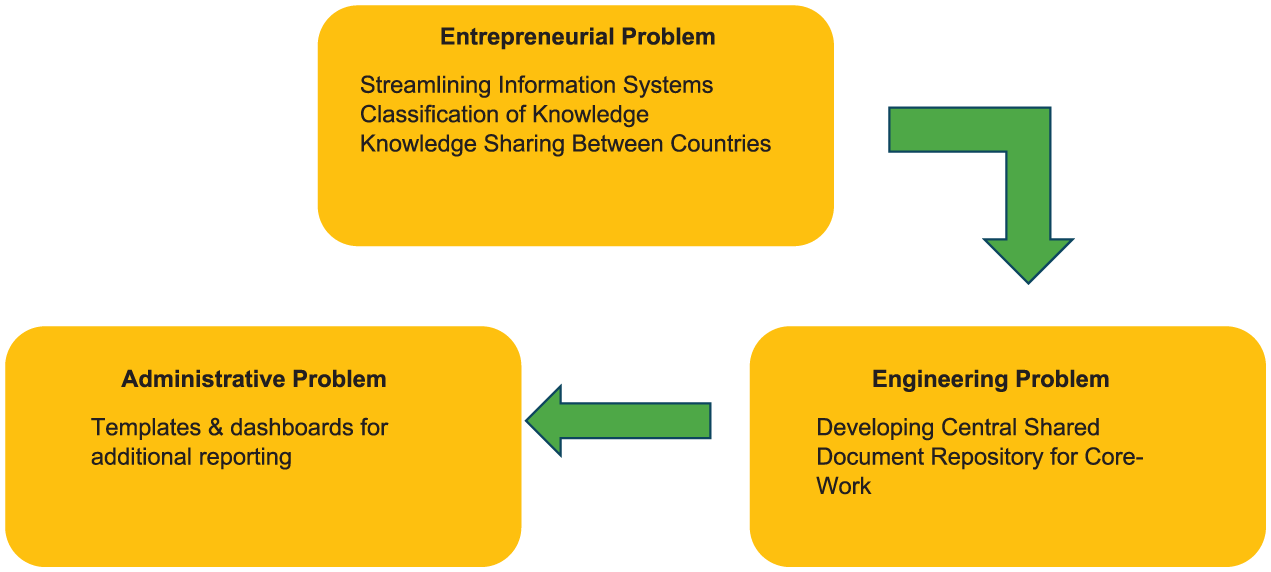
DevCo identified three ways to exploit their existing knowledge, streamlining information systems, the classification of existing knowledge and knowledge sharing between countries. The first two involved improving upward reporting and accountability to donors while the latter was concerned not only getting increased value from resources but also exploited its knowledge brokering role.
Streamlining Information Systems
DevCo used a centralized financial information system and a document repository. While the former managed donor grants, the latter held relevant documents such as grant contracts, partner agreements, and project reports. The need for more structure in the document repository was identified: “It becomes very challenging to get people to contribute to any kind of knowledge repositories . . . we need to provide people with a workflow that’s very explicit . . . A lot of information is held on the laptops and servers in the field offices”. (Manager, IT department)
While field staff used information systems to manage the data required for donor reports, there was a lack of consistency in whether additional codified program knowledge was collected at all, and if so, how it was then centrally stored. This created a need to streamline how the underlying processes occurred.
Classification of Knowledge
The IT department wanted to develop better ways of classifying knowledge to encourage its reuse by staff. One way was to move from more free-form documents to classifying knowledge using taxonomies: “We also change in that will be less on files and information input more in fields so it will allow reporting of key KPIs . . . move away from the concept that we are talking about documents . . . break down those documents into the fields . . . users will have finer granularity than just a document, they’ll be able to search and retrieve”. (Member, Information Systems Department)
This change would support data integration so that reports could be more easily generated using data from multiple development programs. It would also make it easier to codify knowledge within sections of when writing reports and subsequently search for such knowledge across files.
Knowledge Sharing Between Countries
DevCo held a central position between donors and local INGOs. Operating in multiple countries on defined themes provided potential for Inter-Country knowledge sharing. DevCo used its existing partnership-model to identify and work with local INGOs, who in turn delivered aid to recipient communities, making inter-organizational knowledge sharing possible. SIU had an overview of actions across multiple countries and had built up relationships through field visits and so on.
“Our [SIU] team engage in a lot of cross organizational kind of, projects . . . We would tend to know people across lots of different areas” (SIU Member).
Knowledge sharing helped defend current markets and support the current organizational strategy, improve future funding applications, and improve the efficient delivery of aid.
These themes, developed in the planning phase as entrepreneurial problems, were examined, and implemented by modifying information systems which required engineering problems be answered first, with the focus then moving to administrative issues. The IT department located at DevCo headquarters was central to implementing related activities: “It’s also an awful lot of knowledge sitting in different places . . . and I don’t think [staff] get value out of it”. (Senior Manager)
Re-aligning information systems responded to several identified challenges: some files were held on individual computers limiting availability; integrated programming required using multiple documents relating to individual projects, multiple documents were used to generate reports for DevCo and donors. Holding information centrally facilitated accessing data when writing reports. Improving the document repository provided a standard template for each country while allowing staff to create additional local spaces.
Moving to integrated programming increased the need to classify documents in multiple ways as there were multiple funding streams within programs with some documents relevant to multiple projects: “We have very effective knowledge capturing systems . . . we will be at a place very soon where you can search in a single place and get access to all of our knowledge that we’ve stored”. (Manager, Information Systems Department)
Traditionally, technical thematic knowledge and knowledge relating to program management was shared downward from headquarters to countries. Downward knowledge sharing could continue to local INGOs, increasing their capabilities. While such vertical knowledge sharing was in place there existed the potential to increase horizontal knowledge sharing between countries. However, during the timescale investigated the focus was on implementing systems changes outlined above leaving no time to do this. Local staff were trained in the classification and storage of documents and additional repository functionality. They created locally streamlined systems, developing dashboards that drew on existing data and developed their own locally relevant repository templates (see Figure 2).
The Exploit Trajectory.
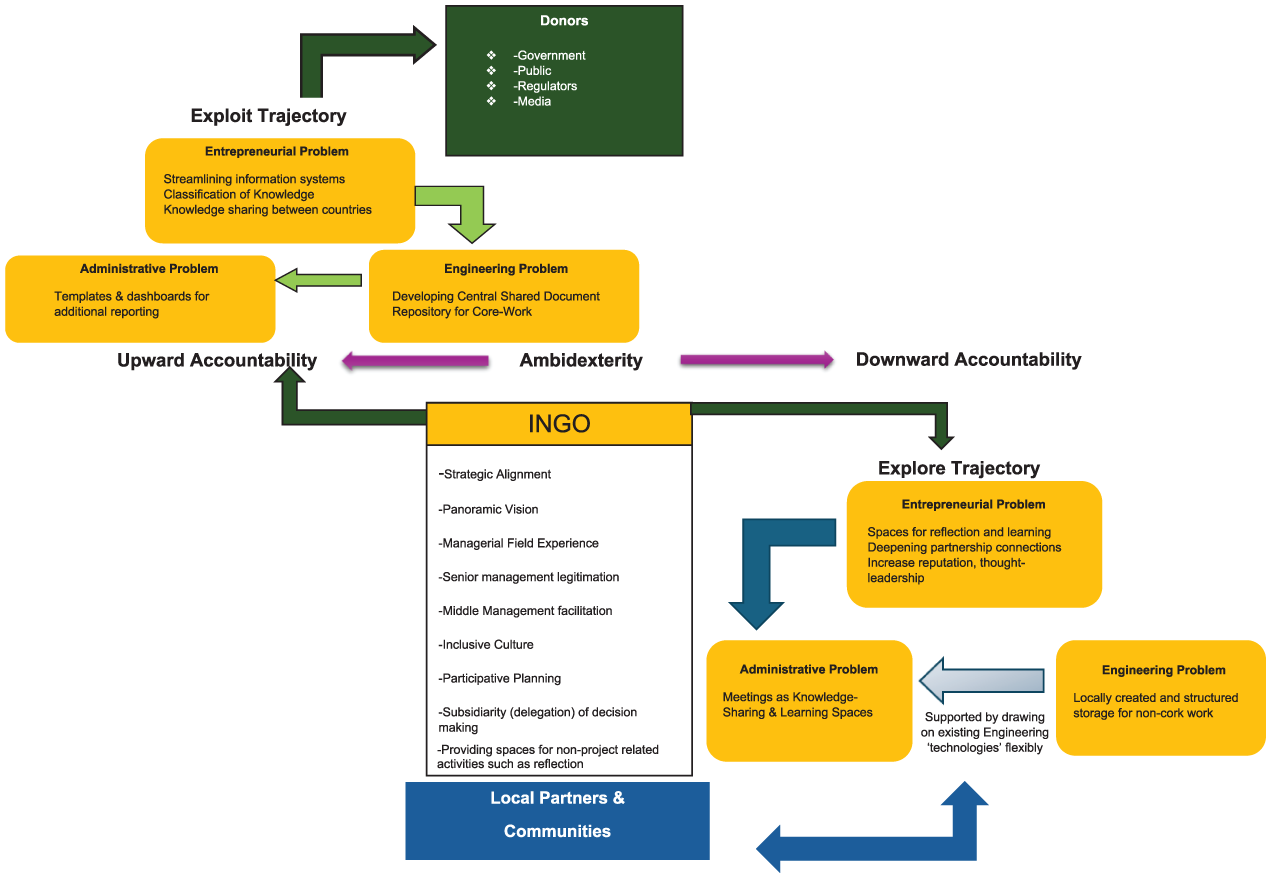
Using Miles and Snow’s (1978) adaptive cycle and examining our findings through the lens of organizational ambidexterity, we uncovered the challenges and activities that emerged as DevCo concurrently pursued efficiency and innovation. These findings are summarized in Figure 3.
Summary of Accountability Flows and Explore/Exploit Trajectories.
Discussion
When considering current debates regarding upward and downward accountability in non-profit organizations (Kaba, 2021; Pilon & Brouard, 2023), it is useful to view these concepts through the lens of ambidexterity, particularly in terms of exploration and exploitation. While the literature on ambidexterity considers what is needed to manage such tensions, suggesting “how” ambidexterity should take place, however a deep knowledge on “how” ambidexterity is operationalized in the non-profit literature is an acknowledged gap (Ebrahim, 2003; Kuruppu & Lodhia, 2020). In this paper, to gain a deeper understanding of “how” an INGO implements ambidexterity to support and manage the tensions between upward and downward accountability, we sought to answer the following research question “How do INGOs implement ambidexterity to support upward and downward accountability?” Overall, our case study shows that ambidexterity enabled DevCo to manage a diverse array of stakeholders. by exploiting existing systems to enhance donor reporting and upward accountability, while simultaneously exploring new approaches for downward accountability through partnerships with local NGOs and communities. Our case study, like Cegarra-Navarro et al. (2017), demonstrates how ambidexterity can help improve an organizations responsiveness to opportunities, to deepen understanding at local levels, facilitating greater levels of downward accountability. Moreover, similar to Campbell (2002); Ebrahim (2016) and Kaba (2021), we found that exploitation allowed DevCo to improve centralized features that focused on donor accountability. The need for DevCo to be accountable to all stakeholders, as outlined by Kingston et al. (2023), rather than maintain the status quo, as suggested by Kaba (2021), was facilitated through exploration. Finally, organizations can choose between two forms of ambidexterity: structural and contextual ambidexterity (Zimmermann et al., 2020). Our analysis indicates that DevCo employed contextual ambidexterity, which allowed staff the flexibility to engage in both exploration and exploitation. These findings are expanded upon in the discussion that follows.
Miles and Snow’s adaptive cycle was useful for structuring our analysis of how the project was planned and implemented. Although mainstream strategy literature views the entrepreneurial, engineering, and administrative problems as occurring simultaneously (Sollosy et al., 2019), DevCo addressed these problems sequentially, with distinct sequences for knowledge exploitation and exploration. In this study the entrepreneurial problem was considered first, with engineering and administrative problems considered in support of the entrepreneurial problem. The entrepreneurial problem, relating to service and resource opportunities (Miles & Snow, 1978, p. 21), raises questions relevant to not-for-profits about aligning strategic activities (Borini et al., 2022; Kassotaki et al., 2019) by top management teams as they develop an “overarching vision” (Bell & Hofmeyr, 2021) or a “panoramic view” that goes beyond existing silos (Xing et al., 2024). Staff considered broad questions about what was needed and what the project was to achieve. Senior managers provided the necessary legitimacy, while it was middle managers that led the planning process. DevCo was used to managing international development projects and it is interesting that it decided to present this initiative as a project. This allowed staff to use their existing project management capabilities. Once DevCo had addressed the entrepreneurial problem, it moved onto the engineering problem.
The engineering problem focuses on developing operational solutions to deliver services and products (Miles & Snow, 1978; Sollosy et al., 2019). Ghoshal (2003) notes how the engineering problem is tasked with creating a system that operationalizes management’s solutions to the entrepreneurial problem. From an exploration perspective, this centered around the IT storage systems for DevCo. In terms of exploitation, this took the form of developing repository capabilities to support the delivery of modifications to service delivery in the form of upward accountability to donors. Knowledge was shared downward with local NGOs, increasing their knowledge capabilities, while horizontal knowledge sharing took place between countries.
Finally, the administrative problem considers structures and processes to direct and monitor operations (Miles et al., 1978). Put simply, the administration problem deals with the logistics of how the organization should structure itself to manage and implement engineering and entrepreneurial problems. It is therefore concerned with “establishing roles, relationships, and organizational processes” (Akingbola, 2007). The need for coordination and synchronization (Chang et al., 2022) as well as good communication with informality preferred to formality (Kassotaki et al., 2019) was achieved in the implementation phase by monthly meetings, supported by middle managers.
With regards ambidexterity, the project drew on the need for ambidexterity to have an inclusive corporate culture (Zhang & Sun, 2023). For DevCo the project involved initial participative planning involving senior managers, middle managers, staff managing programs, and information systems, as well as engagement with field staff. This brought alternative perspectives to bear on “what to do.” Senior managers need to consider potential for the future while also ensuring execution and process (Lawrence et al., 2022). The role of top managers in our analysis was important as their perspective ensured activities were aligned to organizational priorities present in the current strategy and accountability framework documents. Experience in the field was also present at the planning stage, not only from field staff and middle managers who conducted M&E visits, but also because of several senior executives having spent years in the field offices of various countries. For this project many of the senior managers had experience of working in field offices earlier in their careers and so understood the inherent tensions present and, as posited by (Borini et al., 2022), valued local knowledge. While there is a recognized need for senior managers to engage with exploration (Cegarra-Navarro et al., 2017; Lawrence et al., 2022), in this study they played an initial facilitating role. This was manifested as they collaborated and planned resourcing needs, as suggested by (Venugopal et al., 2020), through the prioritization of projects.
It is also suggested that senior managers involve themselves in resolving tensions (Pellegrinelli et al., 2015; Zimmermann et al., 2020). While they did not themselves actively resolve or raise tensions they did facilitate ambidexterity, partly through raising awareness, relationship building and coordination, all of which are advocated by Katou et al. (2021) and Wang et al. (2023). Senior managers did seek to empower employees; they were involved in developing an initial narrative that provided a justification for any potential contradictions that might arise, supporting Kassotaki et al. (2019) who advocate that authority should be delegated downward to increase participation. While middle managers were not mentioned much specifically (not “called out”) in the literature on ambidexterity, they were central to this project. While Kassotaki et al. (2019) found middle managers exhibited significant levels of ambidexterity, in this project they were more facilitators. It was, as indicated by Solís-Molina et al. (2018), the middle managers who helped build a climate of trust and supported freedom to try new things. Kassotaki et al. (2019) found limited ambidexterity among employees as they were focused on exploitation. This was facilitated by a supportive environment with a culture of empowerment, providing employees with the space to explore. Delegation and participation were intertwined in the project as there were initial workshops that encouraged participation, as well as providing delegated authority to act locally on agreed priorities. After the project was completed, progress was reported back to top management as well as the opportunity to discuss learning between the various groups. Again, existing structures were drawn upon such as the annual meeting at headquarters.
The tensions and trade-offs in non-profits when seeking to facilitate upward and downward accountability (Berghmans et al., 2017; Ogliastri et al., 2016; Williams & Taylor, 2013) are an established issue in the ambidexterity literature. At the start of the implementation phase, broad entrepreneurial questions enabled DevCo to identify different opportunities: exploiting resources at headquarters and exploring innovations in the three participating countries. There was a difference in focus between field and central staff with the former engaging in exploration while the latter exploited. While the project had initial terms of reference, each country had a 2-day participative workshop that helped align the different groups involved to overall goals. Employing a distinct project helped ameliorate the issue, identified by Wang et al. (2023), that the balance between exploring and exploitation was maintained, as well as reducing the risk that there was a preference for exploitation as a safe focus of action (Guisado-González et al., 2017) that was inherently supported by organizational routines (Cegarra-Navarro et al., 2017; Lee et al., 2017). Indeed, our research found that, when given the opportunity, staff were willing to reflect on and explore how to better engage with local stakeholders. However, the time needed for reflection was brought about during a specific project. As not-for-profits have less developed mechanisms for downward accountability (Ogliastri et al., 2016), then, like DevCo, they need time for exploration to develop downward accountability. Given the objectified nature of some non-profits, dependent on multiple funding streams, it is difficult to allocate time for exploration activities that were not mandated by funders.
Furthermore, exploration in DevCo focused not on “emerging customers” and creative new ways to provide services to them (Benner & Tushman, 2003) but relatedly on exploration through developing a better understanding of recipients’ needs and developing new relationships similar to Filippini et al. (2012). This exploration focus helped counter the risk of ignoring the need for social accountability, identified by Chu and Luke (2023). The ability to explore allowed DevCo to move away from a narrower conceptualization of accountability Pilon and Brouard (2023). The “to whom” of exploration was downward (Kaba, 2021; Williams & Taylor, 2013), focusing as it did on the needs of beneficiaries. Alternatively, exploitation, involving efficiency and execution (March, 1991) to meet current needs (Lubatkin et al., 2006) through standardized processes (Knight & Harvey, 2015) using existing knowledge (Vrontis et al., 2017) was found, for DevCo, to relate to upward accountability, improving donor reporting mechanisms and sharing existing knowledge. It was as Benner and Tushman (2003) suggest, about fine-tuning activities.
Finally, within the context of the existing literature, there are striking similarities between findings of this case and Balboa’s (2018) paradox of scales. These similarities have been illustrated in our case study as we demonstrate how ambidexterity enabled DevCo to leverage established systems for enhanced donor reporting and upward accountability, while pioneering new partnerships with local NGOs and communities for downward accountability, mirroring the local versus global scales of Balboa’s paradox of scales. Similarly, as we consider three problem domains in our analysis, entrepreneurial, engineering, and administrative, Balboa’s typology distinguishes between three key types of capacities—political, technical, and administrative, using these capacities to determine success at the local and global scale, illustrating how the requirements for each of the three capacities shift for the local and global scale. Both studies highlight the importance of ambidexterity in INGO settings, as they try to strike a balance between exploration (innovation, adaptability) and exploitation (efficiency, operational excellence), while understanding the requirements of local and global contexts, and simultaneously managing a complex array of stakeholders.
Conclusion
Historically, the not-for-profit sector has focused on results-based accountability (Campbell, 2002), a narrower approach (Pilon & Brouard, 2023) aimed upwardly at principals (Kaba, 2021; Pilon & Brouard, 2023). It is therefore not surprising that donor reporting capabilities were already well developed in DevCo. With a shift toward a broader view of accountability, there was a need to explore downward accountability. To manage this, and as seen in DevCo, upward accountability was managed by incrementally exploiting existing capabilities, while downward accountability was developed by exploring new methods to deepen relationships and understanding of recipient communities’ needs and perspectives. DevCo began to develop this capability through ambidexterity. This is not surprising given the typical structure of non-profits. While a for-profit business may use structural ambidexterity through having a new product development department, this may not suit a not-for profit organization that is geographically dispersed and seeking to explore how services can be developed in local contexts. Coordination was managed by middle managers within the agreed terms of reference. Exploitation took place at headquarters, while exploration occurred in the field. While focusing on different things, an important question is whether the two activities should be seen as mutually exclusive or as mutually reinforcing. Similar to Filippini et al. (2012) exploration and exploitation, for DevCo, took place separately. However, there was potential for future interaction so that they are mutually reinforcing as posited by Farjoun (2010), Pellegrinelli et al. (2015) and Wang et al. (2023). For example, exploration of downward accountability, by deepening local insights, can enrich upward accountability reporting for donors, offering a more comprehensive picture of the activities they fund and the overall work of DevCo.
This paper contributes to the call for research on the contested nature of accountability in NGOs (Kennedy, 2019; vanZyl et al., 2019), as well as responding to the call by Kuruppu and Lodhia (2020) to explain “how” stakeholder relationships are changed and, the need for a thorough examination of “how” conflicting stakeholder demands within the INGO sector are managed (Ebrahim, 2003). A limitation of this study is its reliance on a single case, making it necessary for future research to explore whether these findings can be generalized across all non-profit contexts. Furthermore, while our findings highlight the organization had ambidextrous capabilities, which could be seen to potentially support each other, future research should examine organizations where downward accountability is better developed, to gain a greater understanding of the degree to which upward and downward accountability can mutually support each other.
Footnotes
Appendix
Timeline of Events.
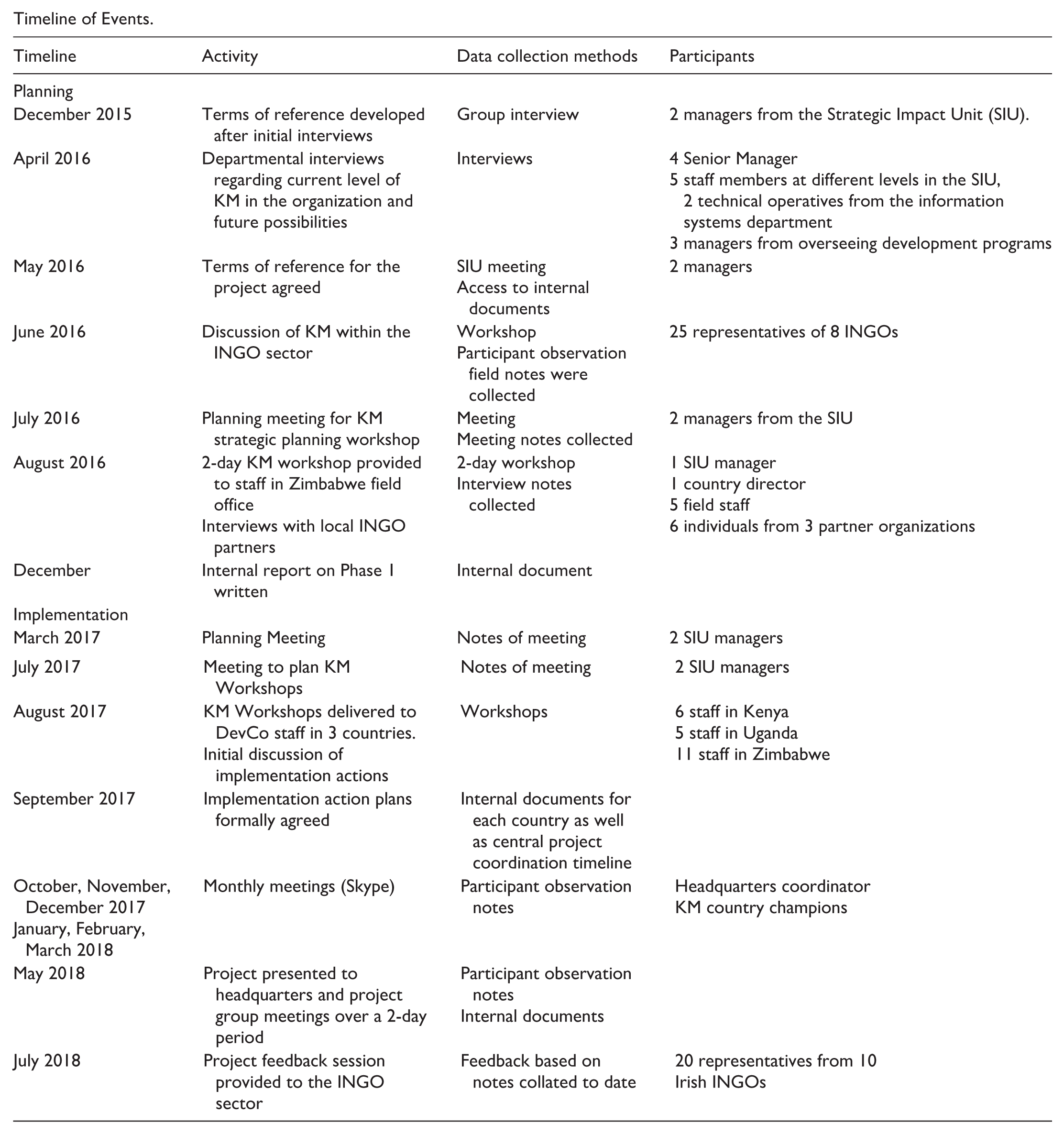
| Timeline | Activity | Data collection methods | Participants |
|---|---|---|---|
| Planning | |||
| December 2015 | Terms of reference developed after initial interviews | Group interview | 2 managers from the Strategic Impact Unit (SIU). |
| April 2016 | Departmental interviews regarding current level of KM in the organization and future possibilities | Interviews | 4 Senior Manager 5 staff members at different levels in the SIU, 2 technical operatives from the information systems department 3 managers from overseeing development programs |
| May 2016 | Terms of reference for the project agreed | SIU meeting Access to internal documents |
2 managers |
| June 2016 | Discussion of KM within the INGO sector | Workshop Participant observation field notes were collected |
25 representatives of 8 INGOs |
| July 2016 | Planning meeting for KM strategic planning workshop | Meeting Meeting notes collected |
2 managers from the SIU |
| August 2016 | 2-day KM workshop provided to staff in Zimbabwe field office Interviews with local INGO partners |
2-day workshop Interview notes collected |
1 SIU manager 1 country director 5 field staff 6 individuals from 3 partner organizations |
| December | Internal report on Phase 1 written | Internal document | |
| Implementation | |||
| March 2017 | Planning Meeting | Notes of meeting | 2 SIU managers |
| July 2017 | Meeting to plan KM Workshops | Notes of meeting | 2 SIU managers |
| August 2017 | KM Workshops delivered to DevCo staff in 3 countries. |
Workshops | 6 staff in Kenya |
| September 2017 | Implementation action plans formally agreed | Internal documents for each country as well as central project coordination timeline | |
| October, November, December 2017 |
Monthly meetings (Skype) | Participant observation notes | Headquarters coordinator |
| May 2018 | Project presented to headquarters and project group meetings over a 2-day period | Participant observation notes |
|
| July 2018 | Project feedback session provided to the INGO sector | Feedback based on notes collated to date | 20 representatives from 10 |

Funding
The authors disclosed receipt of the following financial support for the research, authorship, and/or publication of this article: This research study was supported by the Irish Research Council’s New Foundations scheme in 2016 and 2017.
Declaration of Conflicting Interests
The authors declared no potential conflicts of interest with respect to the research, authorship, and/or publication of this article.
Data Availability Statement
The data supporting the findings of this study are not publicly available due to confidentiality agreements.