




Abstract
The relationship between organizational identity and organizational identification has received limited scholarly attention. For many nonprofits, however, especially social mission-based organizations, the relationship is of critical importance. To develop new insights into this relationship, we rely on survey data from four social mission-based (“diaconal”) nonprofits. Such organizations typically employ highly dedicated people who identify with the nonprofit and its mission. We test four hypotheses regarding the relationship between perceived organizational identity and organizational identification and find that identification is enhanced by perceptions of a normative organizational identity, identity category, and institutional identity. These findings point to the need to consider the specific aspects of organizational identity that shape organizational identification in general and in social mission-based nonprofits in particular. They also highlight the need to bridge organizational identity and organizational identification literatures.
Keywords
Introduction
Nonprofits “rally, engage, and enroll workers, volunteers and donors” (Minkoff & Powell, 2006, p. 591). This is especially the case when nonprofits’ missions are based in a clearly articulated organizational identity that aligns with the members’ own beliefs and values (Cloutier & Ravasi, 2020; Dutton et al., 1994; Kouamé et al., 2022). Typical missions of nonprofits include feeding the poor, fighting for social justice, protecting our planet, helping homeless people, and providing health care. These social missions appeal to individuals who seek meaningful, prosocial work, some of whom even experience a calling (Elangovan et al., 2010; Sirris & Byrkjeflot, 2019).
The knowledge that nonprofits have this ability to attract and retain motivated individuals who develop identification with their organization has evolved over several decades but gained more focused attention in the early 2000s (Brown & Yoshioka, 2003; Leete, 2000; Light, 2002). Yet, despite an increase in the last decades in the number of published scholarly papers on organizational identity (Gioia et al., 2013; Pratt et al., 2016) and identification (Edwards, 2005; E.-S. Lee et al., 2015; Miscenko & Day, 2016; Riketta, 2005; Weisman et al., 2023), existing models are still incomplete with respect to providing an understanding of how organizational identity at the collective level influences identification at the individual level in general and in social mission-based nonprofits in particular. Studies suggest that members tend to develop identification based on both organization-level (De Roeck & Delobbe, 2012; Mael & Ashforth, 1992; Reade, 2001; Smidts et al., 2001; Yue et al., 2021) and individual-level variables (Epitropaki, 2013; Salvatore et al., 2018). Previous literatures have also highlighted the interplay between organizational identity, construed image, and organizational identification (Dutton & Dukerich, 1991) and between organizational distinctiveness and organizational identification (Mael & Ashforth, 1992), suggesting that the perceived identity of an organization holds significant potential to shape the cognitive or emotional relationship that members have with it (Albert et al., 2000). However, we do not know much about which aspects of their identities, or which central, enduring, and relatively unique features of organizations (Albert & Whetten, 1985) enable member identification, especially not in the case of social mission-based nonprofits. Even if members agree that their organization has a strong identity in a certain respect (e.g., as a government agency or nonprofit), this does not tell us much about whether they identify with it on a cognitive and emotional level. This limitation may result in inadequate theoretical frameworks but also missed opportunities for improving leadership and governance strategies in practice.
This study examines the relationship between organizational identity and identification in the context of social mission-based nonprofits. The empirical data are collected from four diaconal nonprofits, which represent a particular category of social mission-based organizations (Askeland et al., 2019). Whereas the latter can be defined as organizations that are driven by a core mission to create positive social change in society, such as reducing poverty, improving education, advancing human rights, promoting sustainability, or supporting public health, diaconal nonprofits are social mission-based organizations that differentiate from other social mission-based organizations through their faith-based platform. Specifically, they are nonprofits “whose identity and mission are self-consciously derived from [Christian] religious traditions and which operate on a voluntary, nonprofit, and independent basis to promote articulated ideas about a common good” (Askeland et al., 2019, p. 30).
Diaconal organizations represent a context where the relationship between organizational identity and organizational identification is likely to be particularly salient. Diaconal organizations typically attract employees and managers that identify with the social and diaconal aspects of the work (Askeland, 2014, 2017; Sirris, 2023; Sirris & Byrkjeflot, 2019). The social mission embedded in diaconal work is a powerful reference point for members, serving not only as an identity marker but also as an identification driver. Indeed, members’ identification with their organization could be a requirement for succeeding and surviving as a social mission-based organization, thereby representing a strategic resource in an increasingly competitive environment.
To examine the relationship between organizational identity and identification, we tested a set of hypotheses based on a sample of 456 respondents from four different diaconal social mission-based nonprofits. The findings offer the following contributions: First, the study sheds light on key aspects of organizational identity that enhance organizational identification by revealing the significance of identity category, normative identity, and institutional identity. These insights underscore the multifaceted nature of organizational identity and its impact on organizational identification, highlighting the critical roles of normative, categorical, and institutional aspects of organizational identity in fostering member identification in social mission-based nonprofits in general and diaconal organizations in particular.
Second, in contrast to much of the literature on nonprofits, we bridge theories of organizational identity and organizational identification. Our conceptualization of organizational identity follows the definition proposed by Albert and Whetten (1985) as those features of an organization that are perceived by the organization’s members as central, distinctive, and relatively enduring, whereas organizational identification is “The perception of oneness with, or belongingness to the organization” (Ashforth & Mael, 1989, p. 22). The literatures on the two constructs have largely developed in isolation from each other (Kreiner, Hollensbe, & Sheep, 2006), despite the seemingly obvious conceptual links that exist between them. By bridging the two notions, we hope to contribute to more cross-fertilization as well as new opportunities for multilevel analysis in the case of nonprofit organizations that combines organizational approaches to organizational identity with individual-level insights concerning organizational identification.
In the following, we present the theoretical background of our study and the hypotheses we seek to test. After a description of the methods used for this study, we present the findings, followed by a discussion of their theoretical and practical implications.
Theory and Hypotheses
March and Simon (1958) were some of the first to discuss the concept of organizational identification. However, with some exceptions (e.g., Hall et al., 1970; S. M. Lee, 1971; Patchen, 1970), the concept was mostly dormant until the 1980s when it began to gain prominence within the fields of organizational behavior, social psychology, and communication (Ashforth & Mael, 1989; Cheney, 1983). Since then, scholars have continued to examine many important aspects of organizational identification. With inspiration from social identity theory (Tajfel, 1982), studies have suggested that the identification experienced by members with their organization encompasses affective and cognitive aspects (Haslam, 2004; Van Dick et al., 2004). Organizational identification implies “that the organizational member has linked his or her organizational membership to his or her self-concept, either cognitively (e.g., feeling a part of the organization; internalizing organizational values), emotionally (pride in membership), or both” (Riketta, 2005, p. 361). The cognitive dimension involves a perception of oneness with an organization, meaning the sharing of successes and failures of the focal organization (Ashforth & Mael, 1989), whereas the emotional dimension implies that members who identify strongly with their organization experience an affective connection with the organization and its mission.
In accordance with these studies, we conceptualize organizational identification as an emotional and cognitive bond between individuals and their organization. Existing research often models individuals’ identification with their organization as an independent variable (Cole & Bruch, 2006; Y. Liu et al., 2011; Oktug, 2013), as confirmed by a large meta-review by Greco et al. (2022), or as a mediator (Bartel, 2001; Dukerich et al., 2002; B. Liu & Perry, 2016) or moderator (Abbasi et al., 2021; De Cremer, 2005; Riketta, 2005). Our study, however, follows a large body of research that models organizational identification as the dependent variable (Weisman et al., 2023). Our review of this literature suggests that while empirical studies have examined the effects of a number of independent variables on organizational identification such as emotional culture (Yue et al., 2021), reputation and prestige (De Roeck & Delobbe, 2012; Dutton et al., 1994; Mael & Ashforth, 1992; Reade, 2001; Smidts et al., 2001), psychological contracts (Epitropaki, 2013), social and economic work freedom (Salvatore et al., 2018), and organizational culture (Schrodt, 2002), organizational identity is rarely included as an independent variable. Exceptions include a study by Kreiner and Ashforth (2004), who found no influence of organizational identity strength on organizational identification, and Foreman and Whetten (2002), who found that perceived alignment between current and ideal organizational identities positively influenced members’ relationships with their organization (defined as organizational commitment). Conceptual papers also exist: Dutton et al. (1994) presented organizational identity as a possible antecedent of organizational identification, and Albert et al. (2000) suggested a dynamic relationship between organizational identity and identification.
In the case of nonprofits, examined antecedents of organizational identification include employees’ pride and respect for leadership (Boezeman & Ellemers, 2014), material and non-material benefits (Camarero & Garrido, 2011), peer identification and identity synergy (Fombelle et al., 2012), perceived organizational support (Meyer, 2021), and behavioral and cognitive job crafting (Walk & Peterson, 2022), among others. However, the literature on employees’ identification with a nonprofit is limited [a few exceptions include Godfroid and Labie (2023) and Rho et al. (2015)]. This is despite the calls for more research on the antecedents of organizational identification in general (Albert et al., 2000; He & Brown, 2013; Weisman et al., 2023) and within the nonprofit sector context in particular (Boezeman & Ellemers, 2014; Kreutzer & Jäger, 2011; Stam et al., 2014).
Our assumption is that the degree of identification depends on the type of identity that a nonprofit has (as seen by its members), specifically, whether its features can be classified as belonging to a utilitarian or normative identity (Albert & Whetten, 1985). A utilitarian organizational identity can be defined as member beliefs that emphasize characteristics and values such as efficiency, quality, profit maximization, and performance in their conceptualization of themselves as a collective (Brickson, 2005). The typical example of an organization having a utilitarian organizational identity is the for-profit organization. By contrast, a normative organizational identity emphasizes characteristics such as shared ideology, shared values, the organization’s history and mission, and high employee commitment (Albert & Whetten, 1985). Churches, hospitals, orchestras, universities, and nonprofits typically have strong normative organizational identities (Albert & Whetten, 1985; Foreman & Whetten, 2002; Glynn, 2000; Golden-Biddle & Rao, 1997).
There is some evidence from previous research to suggest that a normative organizational identity differentially influences organizational identification among members. A study by Dukerich et al. (2002) on physician’s cooperative behaviors, for example, found that physicians identified more strongly with their organization when they perceived their health care system as having a more values-centered organizational identity rather than economic efficiency. Similarly, a study by Lipponen et al. (2008) found that value congruence with a perceived normative organizational identity was more strongly associated with identification compared to utilitarian identities. A study by Foreman and Whetten (2002) on a related construct, organizational commitment, found that commitment is influenced by the perceived congruence between an organization’s current and desired identity. The larger the gap between members’ perceptions of their organization’s current identity and what they think their organization’s identity should be, the less likely they are to feel committed to that organization. Studies have also suggested that a cognitive gap between perceived existing identity and ideal identity stimulates dis-identification (Elsbach, 1999). Thus, because our respondents are members of nonprofits, we expect them to identify more with their organization the more they perceive it to have a normative identity:
Competitive pressures have resulted in mission drift for many nonprofits (Ebrahim et al., 2014; Jones, 2007). Mission drift can be defined as the process whereby a nonprofit “los(es) sight of their social missions in their efforts to generate revenue” (Ebrahim et al., 2014, p. 82). Competitive tendering, long-term contracts, and marketization imposed on mission-based nonprofits by public authorities have promoted a stronger emphasis on utilitarian aspects at the expense of the nonprofits’ social, moral, and religious origins (Bassi & Vincenti, 2015; Maier et al., 2016; Sirris, 2020). Nonprofits have also experienced a gradual weakening of many of their defining features as a result of standardization requirements specified by public authorities (Trætteberg, 2015). Thus, the identity of the modern nonprofit has arguably shifted to a more utilitarian orientation in addition to and perhaps even at the expense of its original normative organizational identity (Jäger & Schröer, 2014). Mission drift could potentially weaken both organizational identity and organizational identification. Thus, the expected effect on organizational identification is negative because the congruence between the current organizational identity and the expected identity is far too low for any substantial emotional or cognitive bond to develop. This is to say, the more a social mission-based organization is characterized by a utilitarian organizational identity, the less its members will identify with it:
We also expect the degree of organizational identification to be influenced by identity category. An identity category can be defined as an organization’s classification within a recognized, higher-order group (e.g., nonprofit, government agency, or business) or a lower-order group within these categories (e.g., diaconal organization within the nonprofit category), which provides predictability and a shared understanding of organizational identity among both internal members and external audiences (Hsu & Elsbach, 2013; King & Whetten, 2008). According to the social actor theory of organizational identity (Whetten & Mackey, 2002), organizations are “identifiable as an organization of type x” (Glynn & Marquis, 2007, p. 26). This is in contrast to the social constructionist perspective, which holds that organizational identity is an evolving, negotiated construct that emerges through collective sensemaking processes (Gioia et al., 2013; Golden-Biddle & Rao, 1997). From the social actor perspective, however, the type of organization could be expected to make a difference with respect to organizational identification, although it is not sufficient to simply belong or claim to belong in a specific category of organizations to foster high degrees of identification among members. The category itself might actually reduce identification, as could be the case with categories associated with stigma, highly bureaucratic categories, ethically controversial categories, or high-pressure or burnout-prone categories (e.g., the tobacco industry, the adult entertainment industry, the gambling industry, investment banking). Indeed, studies have shown that employees in stigmatized industries often experience identity conflicts and may engage in various coping mechanisms including psychological distancing from their employer (Kreiner, Ashforth, & Sluss, 2006; Kvåle & Murdoch, 2022; Lai et al., 2013).
Still, certain organizational categories arguably have the potential to increase identification among members. Social mission-driven organizations such as nonprofits, charities, social enterprises, and diaconal organizations could create such cognitive and emotional attachments because their missions align with their members’ personal convictions and values (Foreman & Whetten, 2002). Given our sample of diaconal organizations, we expect this category to be able to produce strong identification with the organization among members. Thus, members who strongly categorize their organization as diaconal typically exhibit heightened organizational identification:
Finally, we want to test a hypothesis concerning the institutional identity of organizations. According to institutional theory, an institutional identity is an identity that has evolved over time and become associated with distinct features as a result of adaptation to external and internal demands (Scott & Davis, 2006; Selznick, 1957). During this process, organizational members become defenders of the organization’s mission and existence. They regard their organization as having value in its own right beyond its function and goals. This identity can be an important source of both emotional and cognitive identification for employees, as it fosters a sense of meaning and belonging and, not least, a will to secure the organization’s survival (Dutton et al., 1994). The latter could make members more willing to accept extra responsibilities and support the organization in difficult times. It is also crucial for an organization’s ability to garner commitment and loyalty from its members (Ashforth & Mael, 1989; Dutton & Dukerich, 1991; Selznick, 1957). Moreover, organizational identification is especially likely if members see their organization’s identity as unique and distinct (Cole & Bruch, 2006). Thus, organizational identification strengthens when members share these perceptions of their organization.
Method
Research Context
Our survey data are collected from four social mission-based nonprofits that define themselves as “diaconal.” In Northern Europe, a particular branch of Christian faith-based organizations belongs in this category. The concept of diaconal is deduced from the Greek Biblical concept of serving, diakonein. The Evangelical-Lutheran Church of Norway defines diaconia as “the caring practice of the church. It is the gospel in action, expressed through compassion, inclusive communities, safeguarding creation, and fighting for justice” (National Church Council, 2020, p. 1). Promoting Christian social work, diaconal organizations have been operating for about 150 years at the intersection of the church and the evolving public welfare system in Nordic welfare states. The four diaconal organizations represented in our study run hospitals, nursing homes, rehabilitation services, psychiatric wards, and child services, all of which are funded almost exclusively by public authorities.
Data and Questionnaire
We developed an online questionnaire that we sent to all four organizations in the spring of 2023. The HR departments in the four organizations administered the questionnaires on their end and forwarded them by email to their employees, respectively. The total number of questionnaires sent is unknown to us but could be as high as 8000. In total, 472 respondents submitted their answers, giving a theoretical response rate (in the worst case) of about 6%. Excluding incomplete and non-usable responses, our final sample was 456 responses. A total of 36% of the respondents were men and 64% were women. About 37% of the respondents work with child services, 36% with drug addicts and alcoholics, and 23% as nurses or hospital/nursing home staff, although there are some overlaps between the categories because the different institutions offer somewhat similar services. All respondents were informed at the beginning of the questionnaire that the survey had been approved by Sikt—Norwegian Agency for Shared Services in Education and Research. All respondents consented to having their anonymous responses collected, saved on a web server, and analyzed.
All survey items were scored on Likert-type scales of 1 (strongly disagree) to 7 (strongly agree). For composite scales, we relied on a combination of previously validated measures published in peer-reviewed papers and measures developed specifically for this study. We translated scales that originally were written in English into Norwegian.
Measures
The questionnaire and its measures were developed and validated in several steps. First, we conducted literature reviews to identify previously validated measures that we could use for the purpose of our study. On the basis of this review, specifically contributions by Albert and Whetten (1985) and Foreman and Whetten (2002), we developed four organizational identity scales: normative, utilitarian, category, and institutional. For our dependent variable, we adopted the measure of organizational identification developed by Mael and Ashforth (1992).
Second, we conducted exploratory factor analyses to check the construct validity of the organizational identity scales. Factorability was assessed using Bartlett’s Test of Sphericity and the Kaiser–Meyer–Olkin (KMO) measure of sampling adequacy. Bartlett’s test (p < .001) confirmed the suitability of the dataset for factor analysis for all scales. KMO values were above 0.7 for all scales with the exception of institutional identity, whose overall MSA (measure of sampling adequacy) value was 0.59 (Table 1). Because we saw no reason to expect the items of the scales to be uncorrelated, we used the oblimin oblique rotation (Costello & Osborne, 2005) for each analysis. We used principal axis factoring as the extraction method, as recommended for exploratory factor analysis (ibid.). We expected the items of each scale to load on the same factor, given that all scales were designed to be unidimensional. Single factors emerged in all cases. Factor loadings were higher than .40, and eigenvalues were above 1.0. Cronbach’s alpha scores were above the conventional reliability expectations of 0.70 (J. Cohen, 2013) for all scales with the exception of institutional identity (Table 1).
Reliability and Construct Validity Analyses (N = 456).
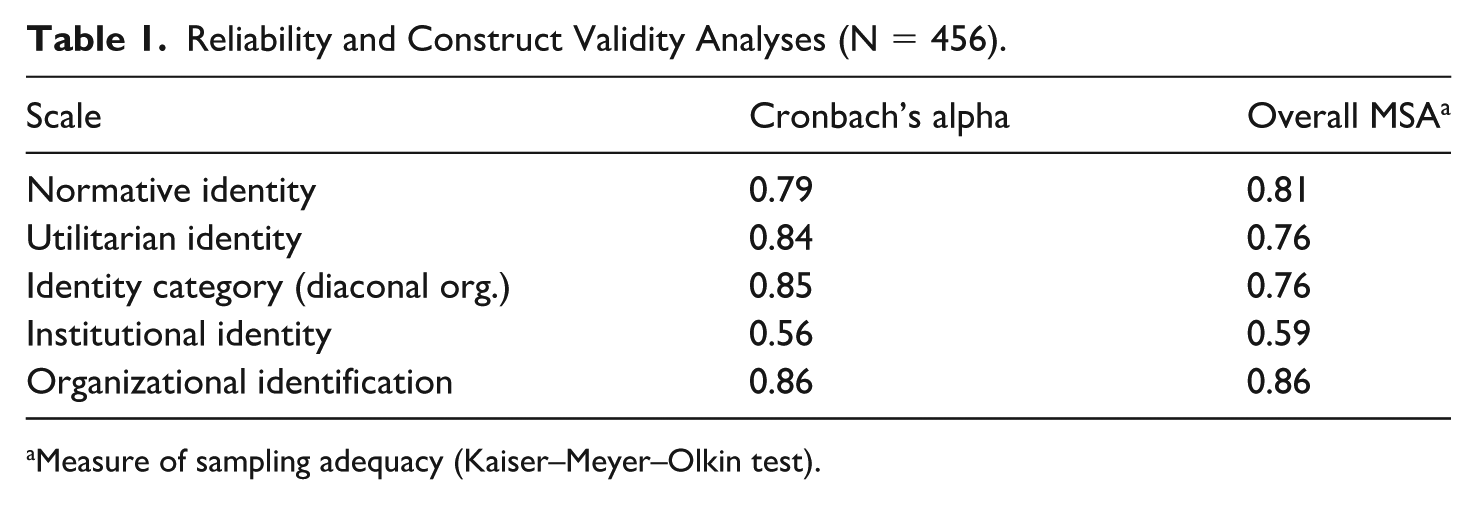
Measure of sampling adequacy (Kaiser–Meyer–Olkin test).
The details on the development of measures are as follows (see Appendix for a complete overview of measures).
Normative Organizational Identity
This measure was developed from a composite Likert-type scale used by Foreman and Whetten (2002) as an operationalization of the theoretical definition used by Albert and Whetten (1985). Because Foreman and Whetten developed their measure specifically for co-ops, we adapted the items of the measure to fit the context of social mission-based nonprofits. Examples of items measuring normative organizational identity are “our organization is primarily a mission-driven organization” and “our organization emphasizes social relations between employees.”
Utilitarian Organizational Identity
This scale is also based on the measure developed by Foreman and Whetten (2002), adapted to better fit the social mission-based context. Examples of items intended to measure utilitarian organizational identity are “our organization emphasizes budget control” and “our organization emphasizes user orientation.”
Identity Category
Given that all our respondents work for diaconal organizations, which is a distinct category in itself, we chose to rely on the operationalization of diaconal organization used by the Church of Norway (2020, p. 4) as a proxy for identity category. We translated the definition into five statements about organizational identity. Examples of items included in the scale are “Compassion is an important value for our organization” and “social inclusion is an important value for our organization.”
Institutional Identity
We developed a new four-item scale for this study specifically. The scale is intended to capture the extent to which members see their organization as something worth preserving and protecting (Selznick, 1957). Examples of items measuring the degree of institutional identity are “it would be a great loss if my organization changed its name” and “my organization should merge with other organizations” (reverse-coded).
Organizational Identification
Our dependent variable, organizational identification, is a six-item scale developed by Mael and Ashforth (1992). Examples of items are “when someone criticizes my organization it feels like a personal insult” and “I am very interested in what others think about our organization.”
Control Variables
We included the variables gender, length of tenure, and age as control variables, as these may influence the attachment between an individual and their organization (A. Cohen, 1993; Dadaboyev et al., 2023; Oktug, 2013). Gender was dummy-coded (female = 1, male = 0). Age is a linear variable, and length of tenure was an ordinal categorical variable, coded as the midpoint value for each bin.
Analysis
Hierarchical linear regression analysis based on the ordinary least square (OLS) method was used to test the hypotheses. We developed three different models to examine changes in explained variance in the dependent variable. Hierarchical linear regression analysis offers the benefit of adding different types of independent variables in succession into the model so that their effects on the dependent variable can be assessed in a step-wise process (Pedzahur, 1997). Doing so enables the possibility of comparing the predictive power of different models. Multicollinearity tests (the variance inflation factor) indicate that multicollinearity is not a concern in our models, with all factors being well below five. The Durbin–Watson tests indicate no significant autocorrelation in any of the models. To test for common method bias, we ran Harman’s single-factor test (0.347), indicating the absence of common method bias. Plots of residuals against fitted values verify homoscedasticity and the absence of patterns that could violate the Gauss–Markov assumption. Table 2 reports the means, standard deviations, and correlations among all variables.
Means, Standard Deviations, and Correlations (Pearson’s r) of All Variables (N = 456).
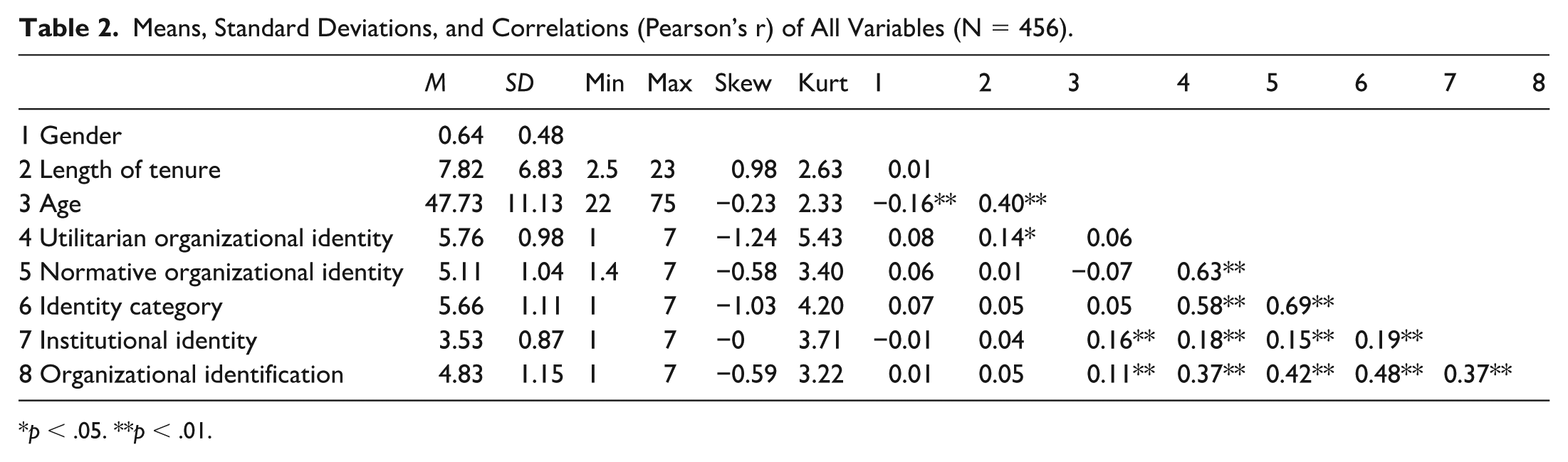
p < .05. **p < .01.
Findings
Table 3 reports the results from the hierarchical linear regression analysis. In the first step of the analysis, the two forms of organizational identity proposed by Albert and Whetten (1985), utilitarian and normative, are added to the model. In this model, which explains about 20% of the variance in organizational identification, both variables have a positive, statistically significant effect on organizational identification (p < .01). As for the control variables, age has a statistically significant effect on organizational identification (p < .01) whereas gender and length of tenure do not.
Results From Hierarchical Regression Analysis (N = 456).
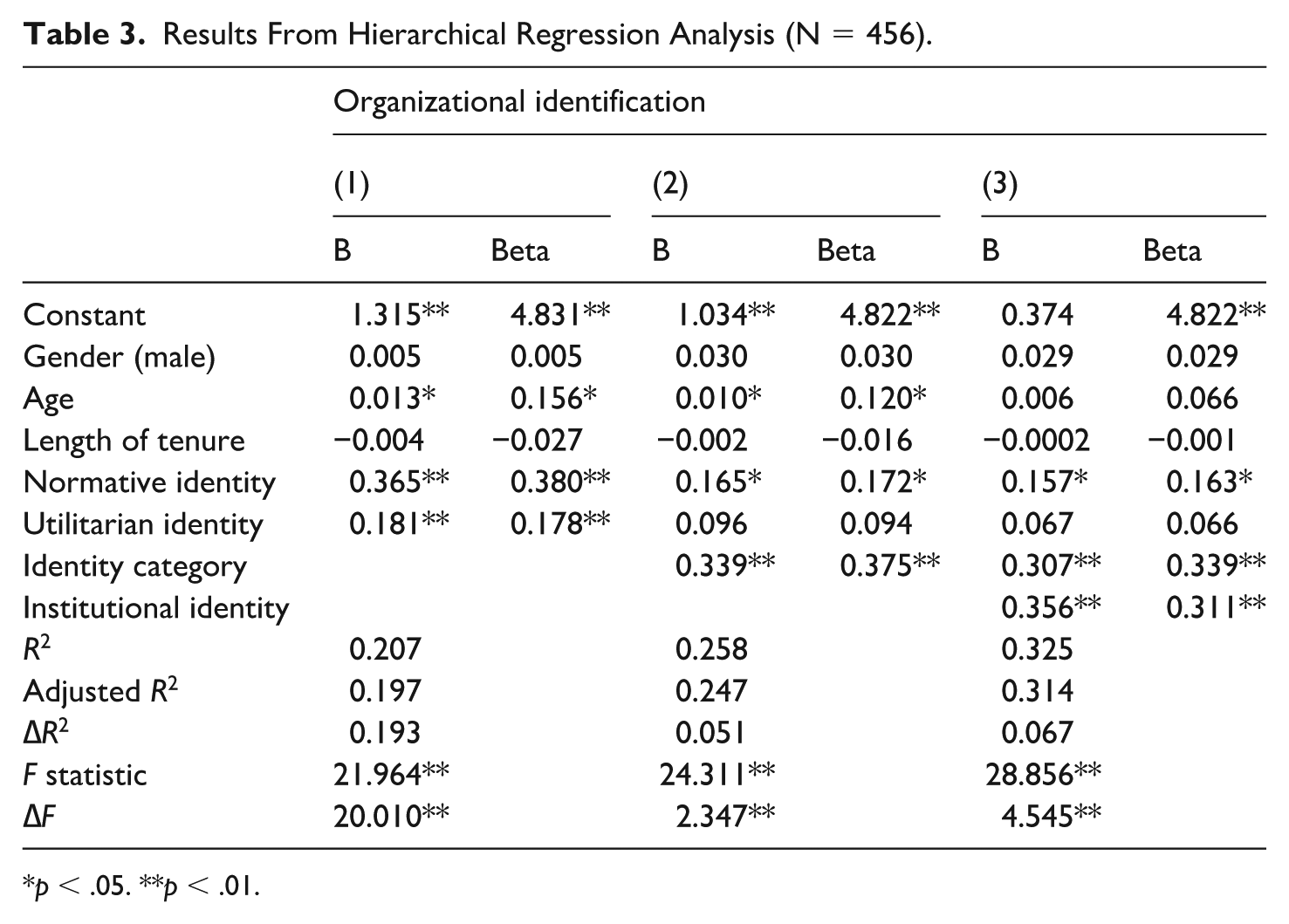
p < .05. **p < .01.
The addition of the identity category in Step 2 leads to a statistically significant increase in explained variance (p < .01), indicating that about 25% of the variance in organizational identification is accounted for by the model. Identity category significantly predicts organizational identification (p < .01), whereas utilitarian organizational identity no longer does. Normative organizational identity continues to significantly predict organizational identification (p < .05), albeit with a lower effect than in the previous model. Age also continues to have a statistically significant positive effect on organizational identification (p < .05).
In Step 3, institutional identity is added. Doing so significantly increases the explained variance in organizational identification (p < .01) to about 32%, giving us a final model that fits the data best. Having the second strongest standardized effect (0.311), institutional identity has a positive, statistically significant effect on organizational identification (p < .01), although this effect should be interpreted as tentative and preliminary due to the low Cronbach’s alpha value of the scale. Normative organizational identity and organizational identity category continue to significantly predict organizational identification (p < .05 and p < .01, respectively), with identity category having the strongest standardized effect of the independent variables on organizational identification (0.339). This is an important finding, as it suggests that mission drift through adaptation to competitive pressures could reduce organizational identification among members. Utilitarian organizational identity does not, as in Model 2, predict organizational identification. We also note that none of the control variables significantly predict identification.
Overall, all models confirm H1, H3, and H4, although it is important to note that H3 receives only weak support. H2 is supported in Model 1 but not in Models 2 and 3 when the other independent variables are included in the analysis. Thus, the hierarchical regression analysis offers support for three of the four hypotheses. Figure 1 shows the final effects of each independent variable on organizational identification, controlling for gender, age, and length of tenure.
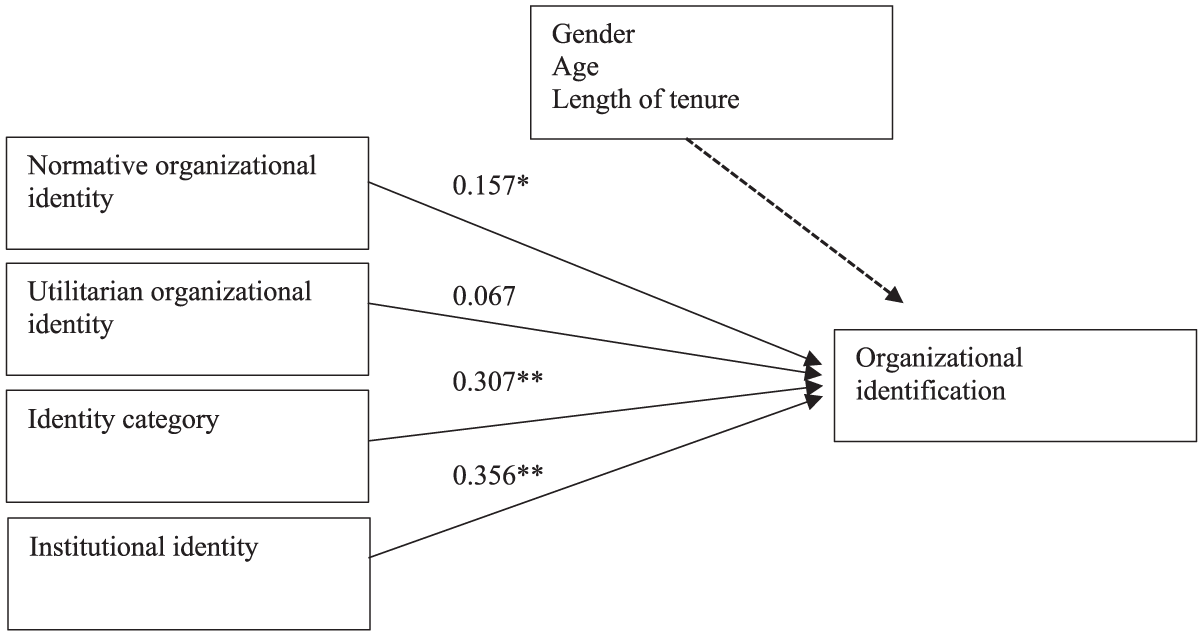
Final Regression Model.
Discussion
Theoretical Contributions
The objective of this study was to contribute to a better understanding of a relationship of the utmost importance for social mission-based organizations: How organizational identity influences organizational identification. These constructs have attracted considerable scholarly attention in the literature. Yet, the question of how they are connected empirically has been inadequately addressed. To rectify this limitation, we tested four hypotheses developed from current insights into this relationship. Using data from four social mission-based nonprofits, we found support for three hypothesized effects. Specifically, we found that organizational identification is predicted by normative organizational identity, identity category, and institutional identity but not utilitarian organizational identity.
The theoretical contributions of our study are several. First, our study adds to a better understanding of organizational identification in the context of social mission-based nonprofits, particularly diaconal ones. Although some studies (Boezeman & Ellemers, 2014; Kreutzer & Jäger, 2011; Y.-j. Lee, 2012) point to the possibility of organizational identity having a positive, independent effect on organizational identification within the nonprofit context, we have limited insights into the question of how a nonprofit’s organizational identity makes current and prospective employees identify with it. A better understanding of this question is needed in the case of social mission-based nonprofits, which arguably rely on their identity to attract committed and motivated employees. Our study provides insights into how multiple forms of organizational identity bind nonprofit employees with their organization through (a) the importance of the nonprofit’s mission and traditional ideals—its normative organizational identity, (b) the nonprofit’s membership in a distinct social group or “family” of organizations—its identity category, and (c) the embodiment of an enduring and valuable entity worth preserving—its institutional identity. Together, these findings highlight the multidimensional nature of organizational identity in nonprofits and its effect on organizational identification, pointing to normative, categorical, and institutional aspects of organizational identity that each could contribute to member identification.
Whereas the institutional identity is the most uncertain of these three, the identity category is the strongest. In fact, a key contribution of our study is the detection of identity category as a salient predictor of organizational identification. In accordance with social identity and categorization theory (Tajfel, 1982), this finding suggests that categorization plays a key role in organizational identification—and perhaps especially in social mission-driven nonprofits. Previous studies in organizational identity literatures have paid limited attention to category membership. This is perhaps due to the tendency for scholars to rely on social construction perspectives (Gioia et al., 2013; Golden-Biddle & Rao, 1997) rather than the social actor perspective (Whetten et al., 2014; Whetten & Mackey, 2002) when examining organizational identity. In our study, however, we found that categorization can provide important insights with respect to explaining organizational identification. Members who are less certain about the diaconal identity of their organization also tend to identify less with their organization. Conversely, members who tend to place their organization in the category of diaconal organization tend to identify with it more strongly. Thus, generalizing from this finding, our study suggests that the perception of working for an organization that belongs in an appropriate identity category makes a cognitive and emotional difference to members with respect to their attachment to their organization. This influence of identity category on identification highlights the possibility of a spill-over effect from the category to the organization in the sense that the organization inherits attractive key identity features from the category that enable recognition and identification. 1 However, it also suggests that mission drift—a key concern for many social mission-based nonprofits (Ebrahim et al., 2014; Jones, 2007)—could be detrimental to organizational identification because it arguably reduces this spillover effect and potentially introduces cognitive dissonance for employees who joined the organization based on what kind of organization they perceived it to be.
Second, we foster interdisciplinary scholarly dialogue and theory integration by bridging organizational identity and organizational identification literatures in the context of social mission-based organizations. Previous studies tend to unite around either organizational identity or organizational identification with limited cross-fertilization between the two literatures. Our study, in contrast, extends a small group of studies that in various ways have pointed to the need for a more nuanced integration of both constructs (Albert et al., 2000; Cole & Bruch, 2006; Dutton et al., 1994; He & Brown, 2013). If we are to take seriously the claim that organizational identity matters for important organizational phenomena such as, for instance, strategic decision-making (Fumasoli et al., 2015), relations with stakeholders (Brickson, 2005), organizational commitment (Foreman & Whetten, 2002), and member behavior (Haslam et al., 2003)—all of which are crucial for social mission-based nonprofits—then further insights into the breadth of organizational identity and how it impacts organizational identification should be welcomed. By showing that “who are we” as a collective shapes members’ relationship with that collective, our findings enable a better understanding of the cognitive and emotional relationships between employees and their organization.
In short, if we want to better understand the antecedents of organizational identification, particularly in the case of social mission-based nonprofits, we should not mainly look at variables that emphasize perceptions of external attractiveness, prestige, and image (Dutton et al., 1994; Smidts et al., 2001) or variables relating to internal organizational and workplace aspects (Epitropaki, 2013; Salvatore et al., 2018; Schrodt, 2002). We should also consider the aspects of organizational identity that create such perceptions, some of which—as confirmed by this study—concern the significance of normative versus utilitarian identity, identity category, and institutional identity. Thus, we need nuanced theorizing from both organizational identity and organizational identification literatures about which identity dimensions matter for organizational identification.
Limitations
As with all survey research, this article comes with important limitations that should be taken into consideration when interpreting the results. The response rate is one such limitation, as it cannot be estimated with accuracy. Although the number of respondents is sufficiently high to run statistical analyses, it is difficult to specify any potential non-response bias and assess how representative the sample is of the total population.
In addition, the low Cronbach’s alpha and KMO values for institutional identity reduce our ability to draw conclusions about the effect of this variable on organizational identification. Lower reliability for this measure means that it may not consistently capture the phenomenon of interest. The observed effect of this particular variable should be viewed as more tentative and preliminary than the others and in need of further validation.
Finally, as our sample consists of diaconal organizations, which are a subset of social mission-based organizations, no comparisons are made with other types of organizations. It is not evident that the findings can be generalized from our sample to the larger population of social mission-based organizations. Diaconal organizations have unique features with respect to their faith-based platforms and Christian religious traditions that may not fully extend to secular social mission-based organizations.
Practical Implications
For nonprofit practitioners and policymakers, the results underscore the importance of developing and nurturing a clear identity category in accordance with the expectations of the employees. Doing so implies ensuring that official identity claims converge with members’ claims about where they belong in a social space of organizations. Whether the nonprofit is social mission-based, faith-based, advocacy-oriented, or some other type of nonprofit, its programs, services, activities, and public image should align with the features typically associated with the claimed identity category. In this way, a positive spillover effect from the category to the nonprofit could help employees identify more strongly with their organization.
Cultivating a coherent normative organizational identity rooted in values, ideals, and social missions also emerges as a particularly important focus area. A clear articulation of a mission, a set of ideals, and a social purpose could be vital to creating and maintaining deep emotional and cognitive bonds between the employees and the organization. A coherent organizational identity could also be a decisive factor in recruiting motivated individuals who identify with the mission. Interestingly, and somewhat surprisingly given the non-utilitarian aspects of social mission-based organizations, our findings do not give reason to recommend nonprofits to avoid mission drift toward a utilitarian organizational identity. Employees who perceive their organization to have a utilitarian identity do not tend to identify less with their organization than employees who do not perceive their organization to have a utilitarian identity. Nevertheless, based on our findings, we would argue that nonprofits should be careful not to lose sight of their normative identity as they adapt to external efficiency and standardization pressures.
Fostering an institutional identity as a distinct and enduring presence could also further strengthen members’ organizational identification. In an era of significant isomorphic pressures for nonprofits (Bromley & Meyer, 2017) and increasing competitive and standardization requirements leading to mission drift (Ebrahim et al., 2014; Jones, 2007), a clear institutional identity could arguably be a crucial differentiator for nonprofits. To cultivate such an identity, nonprofits could emphasize their own history, past achievements, values, crucial events, and milestones. Doing so could increase employees’ pride in representing important traditions, which in turn could have a positive effect on organizational identification.
Conclusion and Suggestions for Future Research
Organizational identification is a phenomenon of key importance for any organization, but perhaps especially for social mission-based nonprofits whose effectiveness depends on members’ personal interest in a shared purpose. Using survey data from four diaconal organizations in Norway, this study clarifies how “who are we” as an organization emotionally and cognitively affects members’ relations with that organization. Specifically, we find that members’ identification strengthens when they perceive (a) a normative organizational identity anchored in mission, values, and ideals; (b) clear membership in a meaningful identity category (here, diaconal); and (c) an institutional identity that signals an enduring entity worth preserving. In contrast, a utilitarian identity does not consistently predict identification once other identity dimensions are considered.
These findings encourage more debate and research into the important question of how to understand the relationship between organizational identity and organizational identification in the case of social mission-based organizations. Given that our sample is limited to diaconal nonprofits, future studies should seek to improve generalizability by broadening the empirical scope. Comparative, multisector designs that include secular social mission-based nonprofits, public agencies, and for-profit social enterprises could potentially offer increased insight and nuances not only into the strength of the relationship between organizational identity and organizational identity in different contexts but also the specific significance of the identity category with respect to organizational identification.
We also encourage studies that develop alternative measurement scales for the independent variables used here. For example, researchers could unpack identity category more granularly by developing category-specific instruments across different nonprofit “families” (e.g., advocacy, service provision, arts, environmental). They could also distinguish between different versions of identity category by creating category-agnostic and category-specific versions. To capture general aspects of a nonprofit organizational identity category, a core scale applicable across nonprofits could serve as a platform, supplemented by optional scales for diaconal, advocacy, health care, arts, and so on, depending on the empirical context.
In the same vein, future research could improve the measure for institutional identity tested here by developing items that incorporate other behavioral proxies than the ones we included and seek to validate these refined instruments in empirical studies. The low Cronbach’s alpha for institutional identity is counterintuitive to theoretical assumptions anchored in classic institutional theory whereby members come to see their organization as an end in itself (Selznick, 1957). With better and validated scales, the effect of institutional identity on organizational identification could be assessed in a more reliable manner.
Footnotes
Appendix

Funding
The authors disclosed receipt of the following financial support for the research, authorship, and/or publication of this article: The authors received funding from five Norwegian diaconal foundations/organizations for this research: Diakonova Haraldsplass, Diakonhjemmet, Crux, Virke, and the Norwegian Blue Cross.
Declaration of Conflicting Interests
The authors declared no potential conflicts of interest with respect to the research, authorship, and/or publication of this article.