




Abstract
This field study explores how career considerations intersect with other motives to inform the decision by skilled professionals to accept long-term international development volunteer positions. Analyzing pre-assignment interviews with 50 volunteers, we find strong interdependencies between volunteers’ careers and their altruistic objectives, with large numbers across different career stages seeking to use their volunteer experiences to curate careers that, variously, establish, recalibrate, advance, refresh, or extend their prosocial contributions beyond their volunteer assignment. We identify six volunteer profiles—that we label Launchers, Enhancers, Career Breakers, Transitioners, Imposed Transitioners, and Veterans—which are broadly aligned to career stage, and which present a nuanced perspective of the individual-altruism nexus in international volunteering. We advance modern career theories by showing how international volunteering experiences serve as pathways to bring greater career meaning while simultaneously introducing precarity and liminality that increase the already high opportunity costs of international development volunteering.
Keywords
Introduction
International development volunteering (IDV) is a form of demand-driven voluntary service involving professionals with valued expertise undertaking long-term, structured voluntary work placements with pre-defined development objectives (Chen, 2018).
Research into the motivations of volunteering and IDV is abundant (Hudson & Inkson, 2006; Meneghini, 2016; Okabe et al., 2019). However, studies are yet to consider IDV through the lens of career theory, with a specific focus on how volunteers’ career interests intersect with other motives. Understanding this nexus is needed for several reasons. It is especially germane for individuals, because long-term volunteering has substantial impacts on skilled volunteers’ career trajectory, with opportunity costs (personal, financial, and professional) far exceeding those of domestic volunteering or short-term/unskilled international volunteering (Lough et al., 2016). For volunteer agencies and local communities wanting to increase volunteers’ participation, retention, and efficacy, it matters because volunteers whose personal needs are fulfilled are more satisfied and productive, and so volunteer longer and are more effective in achieving their assignment’s development goals (Allan, 2017; Mannino et al., 2011; Zhou & Kodama Muscente, 2023). More broadly, recognizing the career implications of activities like IDV sheds important light on the mobilization of professional expertise toward global development objectives in a time when major donors’ funding is retreating (Dyer, 2025).
Analyzing pre-assignment interviews with 50 highly skilled Australian volunteers, we find that career concerns are prominent across demographic and professional categories, and that these intersect with volunteers’ prosocial and other motivations. Our contributions are threefold. First, we derive six profiles of IDV that delineate the different ways volunteers interweave their commitments to volunteering with pragmatic career concerns, and thus how organizations overseeing and supporting IDV assignments might better recruit, manage and support volunteers to achieve their pre-assignment objectives. Second, we extend models of motivations of international volunteers by revealing strong interdependencies between altruism and self-interests, identifying the different ways that volunteers seek to capitalize professionally on their IDV experience by weaving self-interest and other interests into future (more) prosocial career. In other words, rather than volunteering assignments being just a “meaningful (career) break” (Meneghini, 2016) or providing a setting for altruistic and career-related motivations to co-exist (Okabe et al., 2019), we reveal how professionals from diverse backgrounds and career stages view their IDV experiences as part of a longer-term commitment to a career imbued with prosocial contributions and meaning. Third, we extend the application of modern career theory to a context and population that is unique in its structure, and through this draw attention to ways that IDV operates as a conduit through which skilled professionals fuse prosocial and personal (career) goals. In doing this, we respond to calls to better understand how employees “weave career episodes together to craft a larger sense of meaningfulness over the entire sweep of a career” (Fetzer et al., 2023, p. 1919), while highlighting challenges inherent in the way volunteers do this; notably, high levels of career precarity and liminality.
Four sections follow. First, we review relevant research into IDV motivations and careers. This is followed by an overview of our study’s research design and procedures. We next detail our main findings, before considering the theoretical and practical implications of our work.
Literature Review
International Development Volunteering
While different forms of IDV exist, we focus on a common model whereby skilled volunteers are assigned to long-term international positions in locally managed host organizations, typically non-government organizations (NGOs), or government departments. These volunteers support, mentor, and otherwise work alongside host-country colleagues to achieve development-focused outcomes. Assignments are often facilitated by international volunteer cooperation organizations (IVCOs) based in volunteers’ home countries, which work with host organizations to develop position descriptions, recruit and screen applicants, and prepare and support volunteers before and during their assignments (Schech et al., 2018).
Importantly, volunteers’ professional expertise—critical to the aims and structure of IDV—imbues their decision to volunteer with substantial opportunity costs that go beyond financial (loss of income) 1 to include their removal from structures in their home country that benefit them professionally (e.g., networks, knowledge and job opportunities) and/or personally (e.g., family and social networks). These costs include volunteers needing to make multiple transitions with different levels of novelty and adjustment (Louis, 1980), like traversing countries, contexts, roles, employers, cultures, professional sectors, and/or professional levels. The considerations that these volunteers weigh up in seeking and accepting IDV assignments, therefore, differ markedly from those of unskilled, short-term, or domestic volunteers.
Motivations for IDV
Understanding why people volunteer has long been a topic of academic interest. The most widely used model to explain this is Clary et al.’s (1998) “volunteer functions inventory” (VFI) which identifies personal and social psychological functions that motivate volunteering. Recognizing volunteering can meet different needs or “functional motives” for different people (Mannino et al., 2011), the VFI identifies six functions that volunteering can serve: gaining career-related benefits (career), developing psychologically (enhancement), developing or strengthening relationships (social), acting on or expressing one’s altruistic interest in helping others (values), learning and/or applying skills in different ways (understanding), and displacing negative feelings of guilt or escaping problems (protective). Studies have shown that all six functions can predict favorable outcomes like volunteer commitment, satisfaction, frequency and retention (Zhou & Kodama Muscente, 2023) and that different functions can influence how salient outcomes are evaluated; for instance, possessing multiple motivations may strengthen the drive to volunteer yet lower satisfaction levels (Kiviniemi et al., 2002). Different studies have revealed some needs as being relatively more important among certain cohorts (Zhou & Kodama Muscente, 2023), and while some motivations are reported more regularly than others, these can differ across age groups (Almog-Bar et al., 2022; Omoto et al., 2000) and with experience (Clary et al., 1998). Numerous studies show that the act of volunteering can fulfill multiple needs simultaneously (Clary et al., 1998; Mannino et al., 2011). This is consistent with evidence that volunteering has become more flexible and arranged to suit volunteers’ interests and availability (Hustinx & Lammertyn, 2003), including as a mechanism to both deploy and develop professional expertise (Burbano et al., 2018).
Studies examining motivations for IDV report similar patterns (Meneghini, 2016; Okabe et al., 2019; Schech et al., 2018; Unstead-Joss, 2008), with volunteers holding a complex array of goals that are personal (e.g., adventure and personal growth), altruistic and/or professional (e.g., developing skills). By way of example, two studies using different IDV cohorts but both drawing heavily on the VFI have differentiated groups of volunteers with personal and professional motivations. Examining former Italian volunteers across a range of age categories, Meneghini (2016) distinguished those whose motivations were primarily (a) “outward focused,” seeking adventure or variety, cultural learning, expressing humanitarian values, embracing learning, and using new skills and (b) “inward focused,” including a desire to escape an aspect of their life, develop skills for future use in their career, to enhance their self-esteem or self-image, among other motives. In the case of Unstead-Joss’s (2008) qualitative study of 12 early- and mid-career former volunteers, different groups of volunteers were motivated by, for instance, escaping their life or circumstances, developing personally, or changing career. Studies showing the co-existence of individual and altruistic motivations are evident in results reported in other studies addressing a wide array of IDV experiences, not solely volunteers’ motivations (Hudson & Inkson, 2006; Schech et al., 2018).
In considering the career consequences of IDV, two features are notable in studies of volunteers’ motivations. First, on the whole interest in volunteers with professional/career motivations tend to center on volunteers’ desire to acquire marketable skills, networks, or knowledge during their assignment (Fee & Gray, 2011) with little consideration for how these sit within volunteers’ overarching careers—for instance, different volunteers’ assumptions or expectations about the acquisition, value, or transferability (or not) of these capabilities, or how these capabilities might be used after volunteers complete their assignments. For example, despite developing career skills being one objective of (some) inward-focused volunteers, Meneghini (2016) represented IDV as a “meaningful break” in (an otherwise) “flat” career for the volunteers in her study, rather than, for example, a pivotal career transition point. Schech et al.’s (2018, p. 152) study of skilled young volunteers identified “experiential learning” and “gaining invaluable work experiences” as important motivations, with no indication of the reasons for these or how the respondents planned to use these experiences.
Second, these goals are proffered as alternatives to or co-existing with other motivations, often proposing these dual motives involve a trade-off between competing interests (Fetzer et al., 2023), with limited acknowledgment of the way that these motivations may be interdependent or remain entwined. Okabe et al.’s (2019) survey of over 1,500 former Japanese volunteers, for example, differentiates volunteers motivated by helping others (“altruists”) from those who are “business-minded” (seeking career advancement) from those aiming to change themselves (“change-oriented”). Hudson and Inkson’s (2006, p. 304) longitudinal investigation of the arc of volunteers’ experiences before, during and after their assignment highlighted volunteers’ multiple pre-assignment motivations and post-assignment “personal transformations,” although addressed neither the relationships between individuals’ suite of motivations nor their pre/post volunteering experiences or goals. Even Unstead-Joss’s (2008) study, which alludes to some volunteers hoping for a career change, offered no indication of whether and how these objectives related to other underlying goals like helping others or expressing important values.
It is this interdependence between volunteers’ career-related and other motives, largely absent in volunteering literature that our study seeks to explore. We next canvass parallel developments in career literature and consider the rise of meaningful (Fetzer et al., 2023) or prosocial (Bolino & Grant, 2016) careers as potentially valuable lenses through which the motivations of highly-skilled IDV volunteers might be integrated within their career aspirations.
A Career Perspective of IDV
A “career” includes all the relevant experiences—work-related and other—that individuals accrue within and outside the workplace (Sullivan & Baruch, 2009). While models linking individuals’ career attitudes and motivations with age and career stages retain some legitimacy (Super, 1980), our study is anchored within modern career theory (Arthur et al., 1989; Becker, 1994) which emphasizes individuals’ agency to construct and manage careers that exist outside the confines of a single employer, sector, location, or age cohort (Sullivan & Baruch, 2009). Within this paradigm, career goals change in response to individuals’ evolving values, interests, and personal demands (Mainiero & Sullivan, 2006), and are punctuated by unpredictable interruptions (Pryor & Bright, 2011) and transitions across positions, employers, and sectors (Chudzikowski, 2012). In this, scholars are increasingly interested in the opportunities that workers have to instill flexibility, meaning, agency and periodic renewal into their career (De Vos et al., 2020), built on a variety of experiences and pathways that can include international work or IDV (Dickmann & Cerdin, 2018; Fee & Gray, 2011).
While career theorists have focused on “intelligent” careers and the importance of workers accruing skills and networks (Arthur et al., 2017), others look at the way that workers seek to entwine into their work and career a sense of meaningfulness (Rosso et al., 2010) or prosociality (Bolino & Grant, 2016). A “prosocial” career entails work that helps other people and/or produces positive prosocial impacts (Duffy & Raque-Bogdan, 2010). Such values-driven careers can incur financial and emotional hardship (Simpson & Willer, 2015) but have been described as the pinnacle of subjective career success (Dobrow & Tosti-Kharas, 2011). Studies show that professionals are willing to sacrifice traditional career benefits to realize altruistic goals (Dickmann & Cerdin, 2018), and that a desire to fulfill these goals can instigate career pathways and transitions at different times (Ahn et al., 2017). In this professional landscape, workers can knit together prosocial “career episodes” (Fetzer et al., 2023) to derive meaning from their contributions to prosocial outcomes (Bailey et al., 2024; Lysova et al., 2023). Yet while studies show that people with prosocial motives are attracted to—and are willing to sacrifice other benefits for—work that allows them to make a contribution, studies of the motives for prosocial careers tend to focus on those already ensconced in certain organizations and roles (Grant, 2007) or careers (e.g., Zhang, 2024), on workers commencing careers (Duffy & Raque-Bogdan, 2010), or on the spiritual underpinnings of such transitions (Ahn et al., 2017). Zikic’s (2022) theorizing about “career sacrifices,” for instance, in which employees forego an element of their professional lives to fulfill other obligations, calls for more research into employees’ decision to change careers to align their professional futures more closely with their values.
The limited attention to prosocial career transitions overlooks contemporary career paths that, to be sustainable, increasingly place emphasis on individuals to curate and connect disparate professional experiences spanning various roles, employers, sectors, locations, and time periods into a satisfying, enduring and meaningful career (De Vos et al., 2020). A feature of these sustainable careers, therefore, is periodic role transitions or renewing one’s orientations toward an existing role (Louis, 1980) at all stages of professional life (Chudzikowski, 2012) involving, for example, moves across roles (entry/re-entry/exit), organizational units (intra-organization), employers (inter-organization), profession (inter-profession) sector (inter-sector) and/or context (e.g., inter-city/country). In this landscape, professional experiences of all kinds—including those made available through IDV—allow workers to integrate temporary opportunities for advancement, meaning or growth into “sustainable” career paths (De Vos et al., 2020), and through this align prosocial and professional interests in ways that take these beyond competing altruism-career dichotomies.
Beyond this, career issues have added importance to IDV for two contrasting reasons. On one hand, relocating abroad intrudes on all aspects of volunteers’ life, and the role’s fixed duration and voluntary nature suggest that the assignment itself provides limited career pathways. Consequently, decisions about IDV involve professional sacrifices that other forms of prosocial and professional activity lack.
On the other hand, IDV volunteers often report reaping professional benefits that may be unavailable via other means (Fee & Gray, 2011, 2013). These benefits have been raised in the context of the growing professional demand for certain experiences and skills that IDV can foster (Clark & Lewis, 2017) and also against a background critical of some forms of IDV for “privileging the professional development of workers from the (Global) North” (Howard & Burns, 2015, p. 9) and of the encroachment of neoliberal interests and practices on development and IDV spaces (Baillie Smith & Laurie, 2011). Similar critiques have been directed at contemporary career literature for promoting unrealistic images of professional life (and of “sustainability”) and for prioritizing individual human capital over other consequences of career decisions, like societal, ecological, or relational capital (Bal et al., 2021). Within this milieu, IDV can be seen as an increasingly important plank in the trajectory of a sustainable career. What is currently absent, however, is research identifying how volunteers’ pre-assignment motivations are embedded within a larger career trajectory, including how volunteers seek to build on prosocial elements of the IDV in their professional futures.
Building on this, the aim of the study is to explore how volunteers integrate their career experiences and interests with other motivations when deciding to undertake an IDV assignment.
Research Methodology
The research design, aligned with the study’s exploratory objectives and pre-approved by a university ethics committee, centered on semi-structured interviews with 50 Australian volunteers.
Sample
Respondents were recruited at pre-assignment briefings overseen by the Australian Volunteers Program. The Australian Volunteers Program is a government-funded IVCO that works with host organizations in Africa, Asia, and the Pacific with the aim to “achieve locally led change and the realization of the Sustainable Development Goals.” It does this by recruiting and placing Australian volunteers to international assignments, typically ranging from 3 to 24 months. Since 2018, the program has overseen the recruitment, preparation, and in-country support of more than 3,000 volunteer assignments in over 1,000 host organizations, jointly working with these organizations to devise position descriptions, monitor and support volunteers, and manage these volunteers’ performance.
To recruit participants, information sheets and a project website link were emailed to prospective participants in advance, and posters, flyers, and a short presentation were made available at briefings. Comprehensive consent forms were signed before data collection.
As shown in Table 1, 50 diverse respondents were recruited. Professional backgrounds and prior work experience (range: 0–41 years, M: 13.24 years) varied greatly, the latter strongly correlated with age (α = .74).
Characteristics of Respondents.
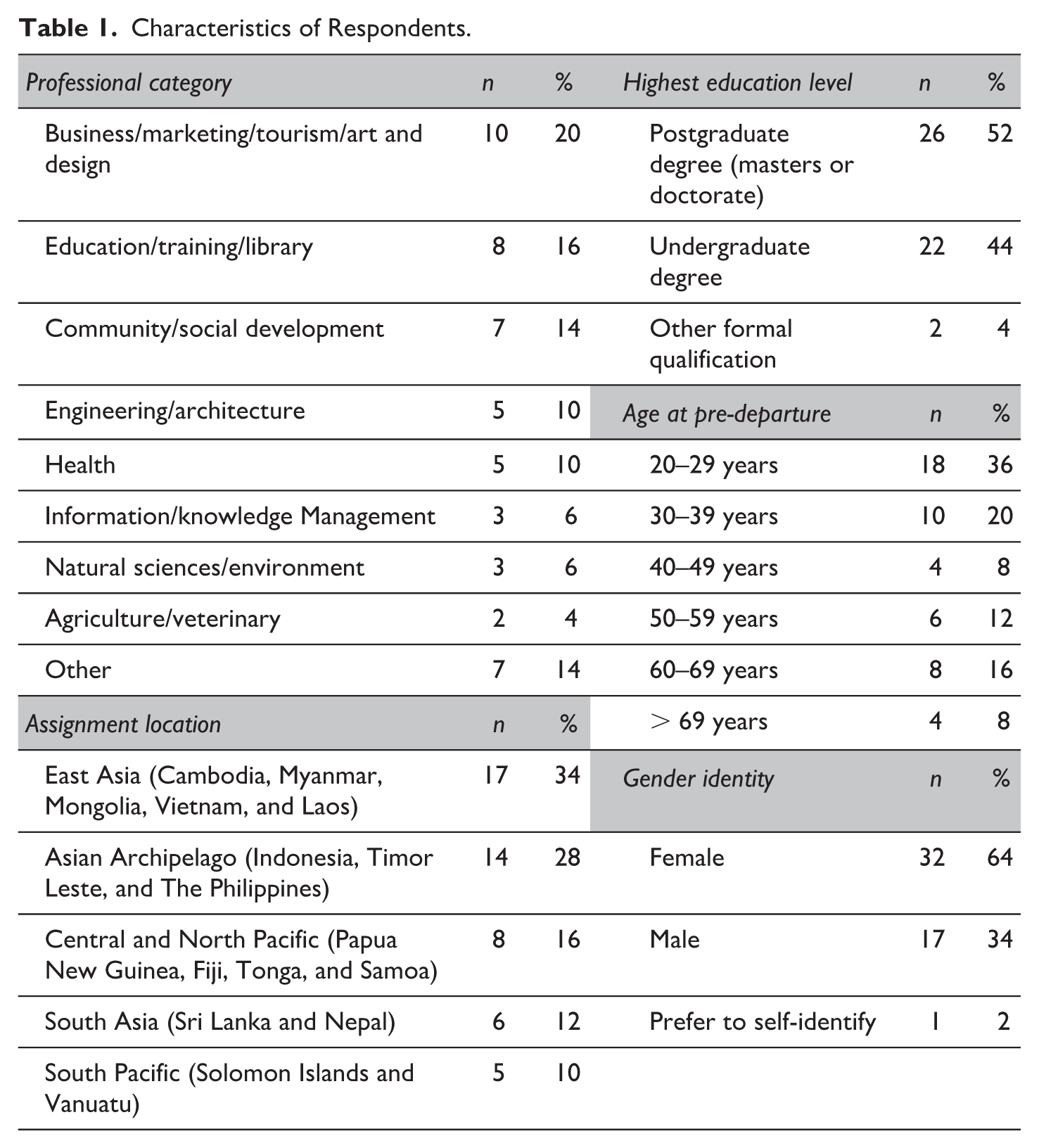
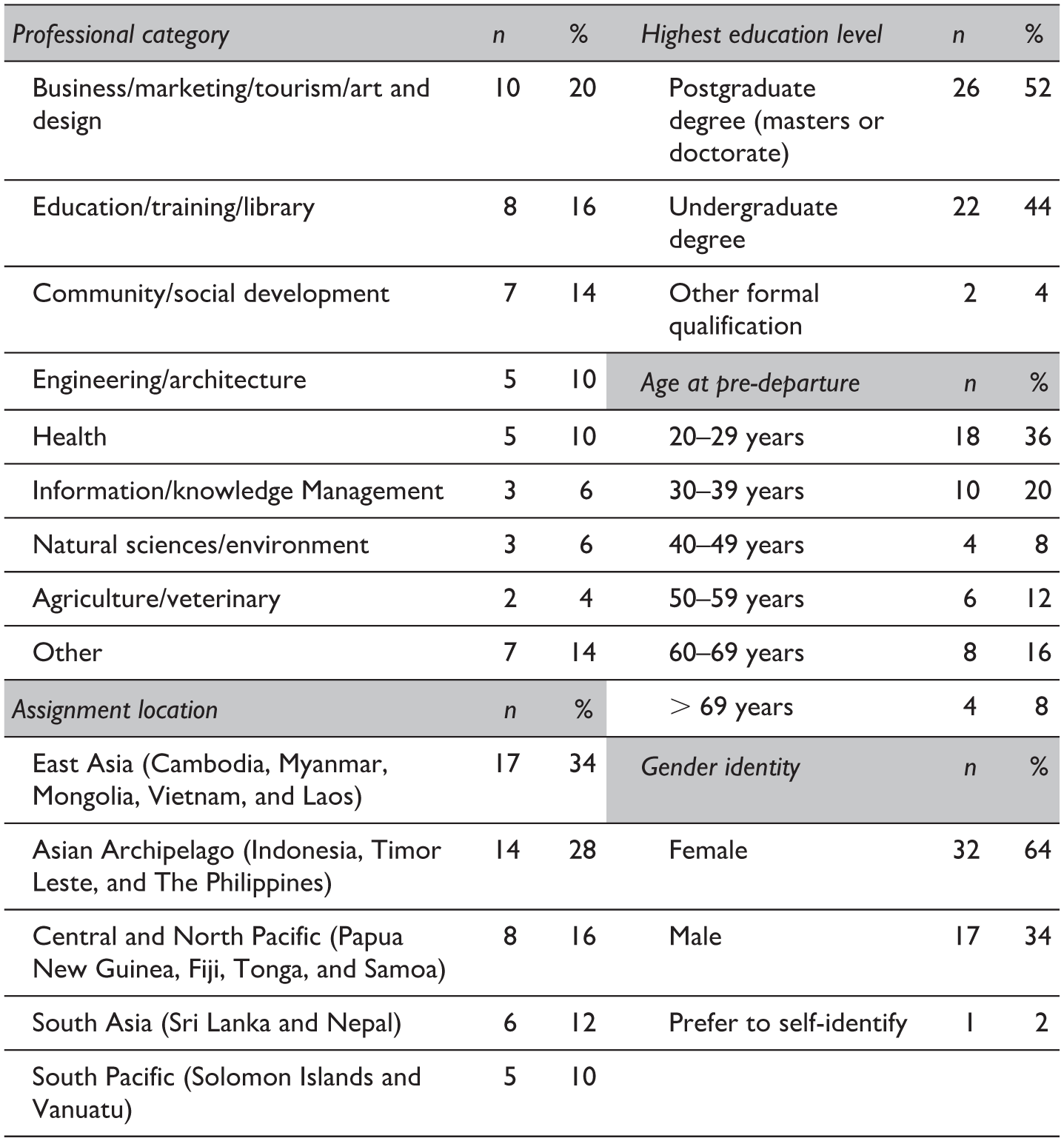
Thirty-nine (78%) respondents expected to continue working full-time following their assignments; seven were in retirement, and four others were open to future work/career but uncertain at the time of the interview. A range of identities (by ancestry) were reported, including Scottish, Chinese, French, Australian Aboriginal, Maori, Indian, Irish, Malaysian, German, Italian, Welsh, and English. Twenty-six (52%) were multi-lingual and six (12%) came from homes in which a language other than English was spoken. Three (6%) reported having a disability.
Data Collection and Analysis
Semi-structured interviews were preceded by a brief online survey that collected demographic, professional and educational information. One-to-one interviews (mean duration: 58 minutes) focused on respondents’: (a) background and reasons for volunteering, (b) career circumstances and their impact on the volunteering decision and role, (c) assignment expectations, and (d) future plans.
Interview transcriptions, proofed for accuracy, and coded using pseudonyms formed the basis of qualitative data analysis (mean length: 8,135 words). Analysis broadly followed Nowell et al.’s (2017) six-stage process of thematic analysis and summarized in Figure 1.
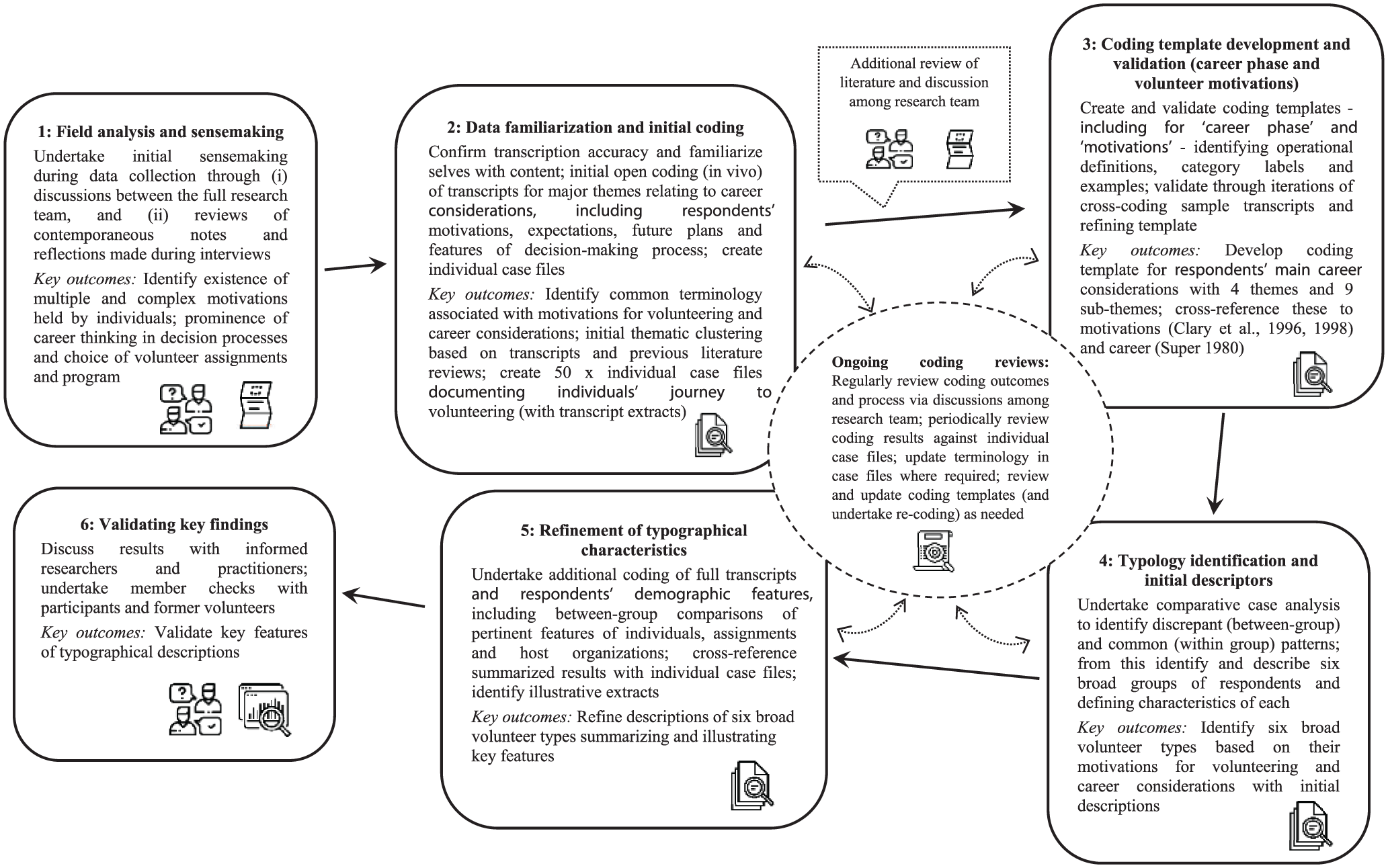
Overview of Main Stages of Data Analysis.
As shown in Figure 1, analysis commenced during data collection (step 1) and involved four rounds of coding (steps 2–5) progressing from generally inductive coding of interview extracts (step 2), to the creation and validation of a detailed data coding template (steps 3 and 4) that was used to classify all responses on two parameters: (a) motivation/s to volunteer, adapted from Clary et al.’s (1998) framework as applied by Meneghini (2016) and (b) career concern/s, coded more abductively through reviewing existing literature (e.g., Super, 1980) while remaining faithful to respondents’ descriptions. These classifications combined analysis of respondents’ decision to volunteer, including the factors influencing the decision, the benefits (if any) sought from the assignment, and respondents’ future plans and pathway to IDV (e.g., choice of role and program, and current work).
In cases where multiple career concerns and/or motivations were reported, responses were prioritized based on three criteria: (a) responses to specific interview questions like “Of the things we’ve discussed, which do you consider to be most important?,” (b) the order or frequency with which a theme was raised, with those identified first or multiple times indicating relatively greater importance, and (c) other indicators of respondents’ subjective weighting like qualifiers or superlatives (e.g., “The
Several steps were taken to ensure the coding template was “trustworthy” (Nowell et al., 2017). Initially, tentative category labels, definitions, and examples were devised and used by three researchers to independently code 13 transcripts, with attention to multiple categories being reported and the prioritization of these. Results of this coding were cross-checked and the template modified to address ambiguities. The revised template was then validated via a second round of independent coding by two researchers, cross-checked for reliability. The full data set was then coded using the final agreed coding template (Supplemental material Attachment 1).
The coding process was punctuated by regular discussions and periodic reviews (dashed circle at right of Figure 1). As the final volunteer profiles emerged, within- and between-group similarities were examined to identify patterns (e.g., respondents’ secondary motivations, decision-making processes, and demographic features). Where the data allowed, group-level statistical comparisons (Kruskal & Wallis, 1952) of features like respondents’ age, years of professional experience, and planned assignment duration were undertaken.
Efforts to ensure the findings’ reliability and validity included regular discussions of emerging results among the research team, the creation of individual case files for all respondents to ensure the totality of each respondents’ data set could be compared against data fragments, and member checks on a summary of the study’s key outcomes (Lincoln & Guba, 1985).
Results
We address the results in two parts. First, we review the main outcomes of the coding of respondents’ career-motivation nexus. We then describe six “profiles” based on how volunteers’ career concerns intersected with their motives to volunteers.
Integrating IDV Assignments with Professional Careers
Three response patterns were common to all six volunteer groups. First, respondents were acutely aware of the career implications of their volunteer assignment, an awareness informing many aspects of their decision to volunteer. While most identified multiple motivations for volunteering (M: 2.7) and multiple career concerns (M: 1.52 per respondent), all articulated relationships between their decision to volunteer and their career, including retirees. Thirty-three respondents (66% of the sample and 72% of those who anticipated working post-assignment) identified “career” issues as a strong motivation. For 14 (28%), it was the primary or sole motive.
Second, an overwhelming number of respondents were at a self-described career “transition” when they applied to volunteer. Just four (8%) expressed firm professional plans following their assignments (six others reported personal plans like travel or weddings that would limit their post-assignment activities in some way). In contrast, 20 had resigned from employment to accept their IDV roles. An additional nine (18%) had been recently made redundant and were “between jobs”; three had returned from extended travel and/or other full-time commitments. Eighteen others were entering or ending professional careers: advancing from studies to their first full-time professional job (7, 14%) or transitioning from full-time work to retirement (11, 22%).
Third, while all six VFI motives were identified,
2
the two most commonly identified primary motivations were “career” benefits (14, 28%) and altruistic “values” (19, 38%). Moreover, these were frequently reported in tandem. Nine of the 14 (64%) respondents expressing primarily “career” motivations identified “values” as a subsidiary motivation. Nine of 11 (82%) respondents motivated primarily by “values” who had plans to continue working after their assignment also identified “career” motivations. More consequentially, however, respondents’ descriptions of these motives made it clear that, for most, these goals were entwined and often expressed in relation to seeking prosocial careers beyond the volunteer assignment’s duration. Nineteen participants (38% of the sample, 49% of those with plans to continue working beyond the assignment) were unambiguous about both: (a) being motivated to volunteer by potential career benefits that their assignment would offer and (b) having a desire to use their assignment to transition in some way to a career that had a stronger prosocial orientation. In these cases, respondents sought roles, employers, and/or sectors which, they believed, would provide greater professional meaning. Terms like “meaningful,” “contributing,” “passion,” and “fulfilling” were used to describe these future careers: . . . being able to contribute to something meaningful (Vivienne) My goal is to find something that I’m really passionate about and that’s really fulfilling (Barbara) I do hope to be able to use my work in more meaningful ways (Cherie)
An additional nine respondents had career motivations and expressed broad interest in future work being more prosocial, although had less clearly defined pathways to transition and so were using the assignment to explore the viability of a possible shift (“I’m feeling like I’m at a stage in my career where I can give something back without it being ego driven . . . but at the moment I’m on a very open-ended track,” Christine). Jointly, these 28 respondents comprise a cross-cutting group of “prosocial career seekers” that represent 58% of the sample, 90% (28/31) of respondents identifying any career-related motivations, and 72% of all respondents anticipating working after their assignment.
In short, the bulk of respondents entered their IDV assignment conscious of its career implications, aware of potential opportunities that might emerge, and open to pursuing these, while also lacking the safety-net of a job or employer to which to return. The existence of these career junctures, therefore, adds to the many other transitions inherent in respondents’ IDV experiences. Moreover, the bulk of respondents harbored future career objectives through their IDV assignments with inherently prosocial features. Their IDV assignment was thus not just a career interlude but also a filter path through which they might explore or sculpt a more prosocial professional contribution beyond the assignment’s lifespan. It is this intersection of career and prosocial motivations—and the variety of ways this relationship was expressed by respondents—that distinguishes the six volunteer types we discuss next.
The Nexus of Career and Meaning: Six Volunteer Profiles
Six volunteer profiles were developed based on the ways volunteers sought to integrate IDV with their careers. Table 2 shows that the six profiles reflect distinctive combinations of motivations, perception about how volunteering relates to their career, the main career benefits attracting them to volunteering (“pull” factors), the main reasons they left their past career (“push” factors), and the career transition distinctive to each profile. Key features of each group are explained below.
Six International Development Volunteer Profiles (Intersection of Career and Motives).
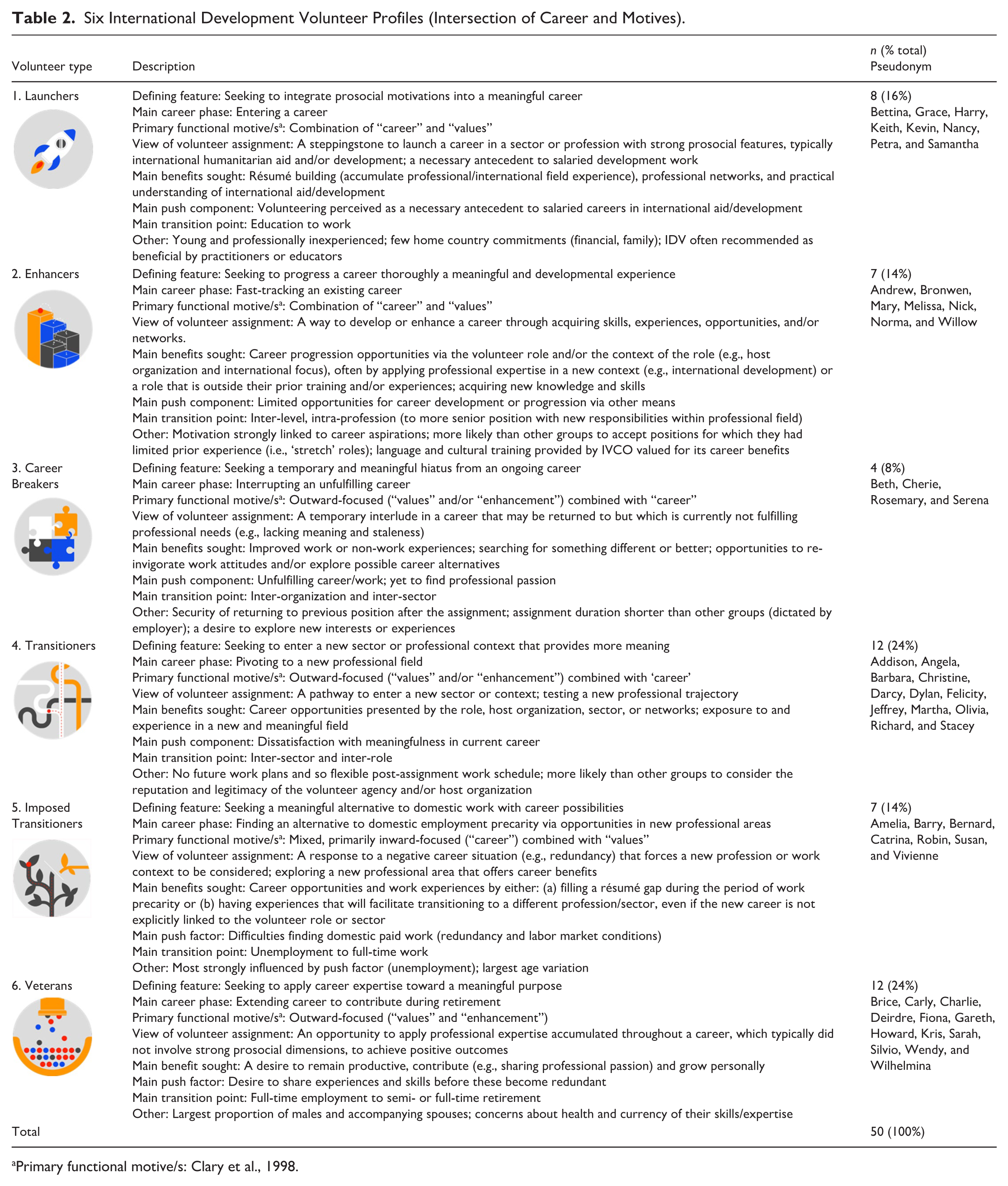
Primary functional motive/s: Clary et al., 1998.
“Launchers”—Integrating Values into a Meaningful Career
Launchers are defined by their desire to use IDV as a stepping-stone to launch a career after completing formal education in an area like development studies, human rights, sustainability, or humanitarian aid. This group perceived IDV as an entry-level pathway to careers in sectors like humanitarian aid and/or international development.
Launchers’ desire to integrate their values into a (future) long-term prosocial career preceded the volunteer assignment, yet the decision to volunteer was viewed as a “really good way of making that step between university and field work in developing nations” (Grace), anticipating that “this will open up professional opportunities for me afterwards, but also it directly aligned with personal growth and all my goals” (Nancy). Consistent with this, among the career benefits that Launchers hoped to derive from their assignments were to “gain [international] experience” (Bettina) that “I can put in my CV” (Keith), and “networking, meeting new people” (Kevin).
A narrative common to Launchers was that recent graduates “have to do [IDV] . . . to get an entry-level job” or a “foot in the door,” “to make professional contacts [and] get the opportunity to learn” (Harry). Thus, while Launchers expressed strong agency about their assignment choice, an innate push motive came from expectations that voluntary work was a necessary prelude to employment in the sector, and that their volunteer assignment would expose them to the institutional knowledge, networks, and practices to enter the sector as professionals. Consistent with this, Launchers saw the opportunity for field experience and networks, rather than the role itself, as most attractive when deciding to volunteer. For similar reasons, the reputation of the host organization and IVCO were also important considerations.
“Enhancers”—Progressing a Career Through Meaningful and Developmental Experiences
The defining feature of Enhancers is their use of the IDV to consciously enhance a career by acquiring beneficial skills (Mary), experiences (Bronwen), opportunities (Andrew), and/or contacts with people or organizations (Nick). Enhancers’ primary motivation for volunteering was “career progression” through a role that “aligns with my career ambitions” (Norma). Rather than entering or changing a profession/career, Enhancers had a body of relevant professional experiences prior to their volunteer assignments (M = 5.71 years); the career benefits came largely from opportunities to extend these experiences into more senior positions or new and meaningful contexts unavailable elsewhere. For example, Willow was “pushed by my mentor and supervisor” to seek work abroad and expected her volunteer role to be a “real crash course in altruism . . . let’s see if this is a possible [career] path.”
Unlike Launchers, the position itself—including, for some, its international context—was critical to the career benefits Enhancers sought. These included specific roles, responsibilities, and/or contexts that volunteers expected to stretch their expertise and experiences, and so “contribute both to my career progression and to whatever cause I’m working on” (Norma). For Melissa, who had vast policy and program experience, “marrying . . . [an understanding of] how gender issues really affect people on the ground with [experience in] South-East Asia . . . will be really good for me career wise.” Andrew held aspirations to work with a prominent international NGO and was hoping to “really stretch myself” by adding “developing nation” expertise to his “many years of experience working in urban water sanitation.” As these responses suggest, learning—not just field experiences—was a chief goal (“to get some skills and build on my work experience,” Mary). Consistent with this, support provided by the IVCO (e.g., training and networking events) was perceived as beneficial to careers not just to assignment success.
It was thus the prosocial nature and context of the career opportunities that the assignment would open rather than the prosocial nature of the role itself that formed Enhancers’ ethical ballast. This can be contrasted with Launchers, for whom the voluntary aspect of the role served a clear purpose (the opportunity to accumulate time in the field that would otherwise be unavailable).
“Career Breakers”—Temporary and Meaningful Hiatus from an Unfulfilling Career
All Career Breakers were seeking a temporary interlude from a career which they expected to return after the volunteer assignment but which they found unfulfilling—for example, “getting a bit jaded . . . not really getting the job satisfaction that I wanted at the moment” (Serena), or “reach(ing) a point where [my career] just plateaued” (Rosemary).
Despite having the security of jobs to which they could return, all four Career Breakers were cognizant of possible career benefits and opportunities of the volunteer assignment, although this interest was exploratory and lacked the clarity or commitment of other groups (“I think it will end up being quite a positive impact on my career, but I’m not sure how that will pan out,” Beth). Thus, although three Career Breakers reported being open to learning, networking, and/or developing professional experiences (“I’m hoping that I am going to gain some confidence,” Serena), these goals were subordinate to a desire for improved professional fulfillment or meaning. As the following extracts illustrate, a sense of searching for different or better career possibilities is apparent in their decision to volunteer: I just wasn’t getting the satisfaction [in my current career] . . . I do want to give something, serving communities or just giving my skillset back [to others] (Rosemary). [In the future] I do hope to be able to use my work in more meaningful ways (Cherie).
Career Breakers, all four of whom were women, is the only group with respondents reporting plans to return to an employer/role after the assignment. The IDV, therefore, presents an opportunity for a meaningful experience in a new work environment, sector, or culture, but with the security of returning to a previous role/career, if not professional satisfaction, after the assignment. In this, their volunteering embodies a meaningful professional sabbatical that most closely aligns with Meneghini’s (2016) “meaningful break.” The assignment duration (shorter than other groups) and the security and reputation of the IVCO and volunteer program were prominent considerations.
“Transitioners”—Testing or Entering a New Sector or Context that Provides More Meaning
All 12 Transitioners were explicit about wanting to use their volunteer experiences to pivot to a different (new) career that they believed would provide more meaning, although in subtly different ways. For some it was to enter a new professional area; for example, from law to education, or from science or government to international development. For others, it was a broader global career that they hoped the assignment would facilitate (“I’m keen to try and get [paid] work overseas at the end of this twelve months,” Stacey).
For all Transitioners, the foundation for their decision to volunteer came from their belief in the learning and career opportunities inherent in the role to be performed, the host organization to be worked with, the networks to be formed, or the context in which these took place (“I’m anticipating that I’ll meet a lot of people over the next years who have experienced things, so I can learn a lot from them,” Olivia). In other words, each Transitioner saw the IDV position and its context as offering a platform to change careers.
Like Launchers, an important consideration for most Transitioners was a role, sector or host organization that offered a pathway for a career that better matched their values (“[My last career] wasn’t filling a particular need for me,” Jeffrey). However, unlike Launchers, Transitioners bring substantial professional acumen (M = 9.17 years) and a desire to apply this in a new career direction (“. . . something I’m passionate about, something that’s really fulfilling,” Barbara). Because of this, Transitioners were, overall, facing the most uncertainty in their volunteering decision. All had chosen to leave an established career. None had firm post-assignment work plans. Consequently, the success (or failure) of the assignment in facilitating the foothold to a new career (via experiences, networks, opportunities, and skills) was critical to achieving this objective. Consistent with this, a paid role in a new prosocial position or sector was the most common alternative to volunteering for Transitioners.
Unlike Career Breakers, who were open to exploring career possibilities but with the safety of a back-up career, Transitioners planned to use their IDV experience to test quite specific career trajectories they envisaged, rather than to explore possible career options. Thus, despite uncertainty about the outcomes of volunteering, most Transitioners expressed clarity about the careers that they hoped to realize. These included work at specific locations (Felicity), with particular employers such as government agencies (Jeffrey) or intergovernmental agencies (Martha) or others (“I’m hoping to work with one of the project partners and then work with [a research organization], that would be a long-term goal,” Richard), in specific roles (e.g., “the strategy side of designing international development programs,” Olivia) or a combination of these (“to work in the [logistics] space for an international organization . . . I hope some opportunities may pop up in the World Trade Organization,” Dylan).
“Imposed Transitioners”—A Meaningful Alternative to Domestic Work with Career Possibilities
Imposed Transitioners’ decision to volunteer was instigated by an extraneous career event—a redundancy and/or difficulty finding local salaried work—and so typically not their preferred career choice. All six were unemployed and conscious of the need to transition away from a former career. Barry’s future was “all up in the air . . . I lost my previous job after 29 years.” Catrina was “made redundant at [her] previous job in the corporate world,” while Bernard spent 2 years as a “house husband” after being unable to find full-time paid work. For Imposed Transitioners, therefore, volunteering was a “plan B” (Bernard), after having sought paid positions domestically and/or internationally (“I did have a look at a couple of positions (domestically) and I just thought this is going to go nowhere,” Robin). Thus, the volunteer assignment served the purpose of: (a) filling a gap in their résumé or career during the period of employment precarity and/or (b) opening opportunities to transition to a different sector and/or profession by providing relevant experiences, even if the new career was not explicitly linked to the volunteer role or sector (“I expect that it will help me get confidence that I can still transfer all my skills into a completely different world that’s not a corporate world and still be happy,” Catrina).
Imposed Transitioners was the group with greatest age variability (range: 26–60 years) and the one whose motivations were most strongly affected by extraneous circumstances (labor market conditions). They saw their enforced career interruption as a chance to combine doing something positive with the professional opportunities that they believed the IDV could offer. Although they were uncertain about their professional futures, most Imposed Transitioners recognized the assignment as a means to explore new experiences (Susan), operating contexts (Bernard and Catrina), or host organizations (Barry), and/or to develop new knowledge or skills (“learning about another disease because I’ve been working in cancer research for 30 years so now to move on to malaria, a communicable disease, will really complement my career,” Robin).
While not the sole focus of their assignment, the chance to find work in prosocial sectors or contexts was a salient feature of Imposed Transitioners’ goals. For instance, Amelia hoped the assignment would help her to “get my foot into a job . . . move into an area that, to be honest, makes me feel good about myself.” Catrina, who “was handed a redundancy at the end of last year . . . after 20 years working predominately in marketing with consumer goods companies,” was hoping the assignment would help her shift to “applying my skills and experiences to areas that aren’t just big multinational organizations selling food to people.”
“Veterans”—Applying Career Expertise Toward a Meaningful Purpose
The defining characteristic of Veterans was an expressed desire to use professional experiences and expertise (M: 26.6 years)—accumulated across long careers and through various professional pathways—toward a meaningful purpose. All Veterans were retired or semi-retired and all articulated strong outward-focused motivations to express positive values that may have not been central to their careers previously. Illustrative of this, Charlie explained: I’d gained a lot of knowledge in my working life and I started to think, well if I don’t do anything that just all dies with me. So I thought, it’s not mine to hang onto . . . it would be good to pass something on . . . passing on knowledge
Veterans was the only group with a majority of members not identifying career objectives. Instead, “values” and “enhancement” motivations dominated. Nonetheless, a range of subsidiary motivations underpinned their assignments, including professional passion and a desire to remain productive. Brice discussed needing to “keep my brain ticking over.” Sarah spoke about being “committed to the idea of [her professional expertise] helping to implement effective change.” Deirdre described her assignment as “a combination of all the things that [I am] passionate about.” Yet in doing this, Veterans were extending careers that for most had not been strongly prosocial while fulfilling the goal of making a meaningful contribution. For Howard, it was “to support people, to share my skills. It’s my passion for social justice, and I feel I need to give back to society, I want to give back.” Nine Veterans (75%) had applied to volunteer within 12 months of finishing a professional career. For these, IDV was, in effect, a “reverse transition” from work to retirement made attractive by: (a) the enjoyment to be gleaned from a role involving mentoring and supporting others, rather than managing or leading (“I really like mentoring . . . that’s something that gives me a lot of pleasure”) and (b) the desire to use professional expertise while relatively current in a positive way. For couple Kris and Sarah: . . . both of us are really committed to [our profession]. It’s not just about making a profit, it’s helping people to be more effective . . . in the best possible way, in a humane way. I suppose when I finished working for money I had this sense of still having something to contribute. I would really just like to share my skills. (Sarah)
Veterans were the group most likely to seek a role that enabled them to apply existing skills rather than a role that presented challenges or novelty that would contribute new experiences and skills, more common among Launchers, Enhancers, and Transitioners. Nonetheless, although not a prominent motivation, some Veterans were aware of future opportunities to continue using their professional acumen in ways aligned to their values in paid or unpaid positions. Carly “did wonder whether the role I’m doing . . . could lead to some further involvement in [the host country].” Wilhelmina could “really see my [. . .] work . . . perhaps getting my foot in the door with [a major intergovernmental agency].” Brice indicated an interest to “develop a network” within the international development sector (“. . . you’re not in it for the money, you’re in it for the interest and the contribution . . . that could be a really attractive option”). Thus, while volunteering served the chief goal of extending Veterans’ professional contributions in meaningful ways, some also saw chances to broaden this into an “encore” career more firmly embedded with prosocial values.
Discussion
This field study has identified the different ways that volunteers use IDV assignments to integrate prosocial and career interests. It identifies six volunteer profiles, summarized in Table 2, showing that volunteers seek to use IDV to establish (Launchers), advance (Enhancers), recalibrate (Transitioners), refresh (Career Breakers, Imposed Transitioners), or extend (Veterans) a sense of meaning in their career.
The study’s first contribution is to reveal stronger connections between volunteers’ career and prosocial motivations than other studies have reported. Indeed, while volunteers in each of the six profiles approached their assignment with different expectations and sought different benefits, for most the decision was infused with the overarching goal to entwine more meaningful contributions into a career trajectory that would draw directly, in different ways, on their volunteer experiences. At one level, although our findings contradict studies showing tensions between volunteers’ inward and outward motives (Fetzer et al., 2023), our results support prior studies that highlight the multifarious motivations associated with volunteering (Clary et al., 1998) and with IDV in particular (Meneghini, 2016; Okabe et al., 2019). However, what our findings also reveal are hitherto unreported interdependencies between volunteers’ career and prosocial goals. That is, rather than simply fulfilling multiple motivations during a career break (Meneghini, 2016), our results show how IDV assignments can play important roles in helping volunteers at different career stages to embed (a stronger) prosocial impact into a meaningful career.
On this issue, while some individuals and groups were more career-oriented in approaching their assignment than others, even the most altruistic (i.e., value-oriented) respondents were conscious of the assignment’s potential impact on their professional/career standing, while some of the most career-driven respondents viewed the assignment primarily as a mechanism to embed strong values within their professional life, and through this to configure a distinctively “ethical” career. By revealing this, we highlight the folly of too readily distinguishing between volunteers with career or altruistic interests (Meneghini, 2016; Okabe et al., 2019; Unstead-Joss, 2008), and too readily suggesting a trade-off between benefiting oneself or others (Fetzer et al., 2023). This is important because critiques of neoliberal ideologies influencing IDV tend to view concerns for volunteers’ personal/career interests as risks to the genuine prosocial goals of IDV (Schech, 2017). While this criticism has veracity, our findings present a more complex account. Not only can professional and prosocial goals exist in parallel; volunteers with the most overt career objectives may, in fact, exhibit stronger prosocial commitment (via an ongoing career) than others whose prosocial motives are confined to the temporary duration of the assignment itself.
Our analysis also sheds light on the interactions of a volunteer’s different motivations that have implications beyond IDV. Motivations for volunteering have, to date, been viewed largely as independent although not exclusive. That is, studies anchored by Clary et al.’s (1998) VFI recognize that volunteers can possess multiple motivations simultaneously but have failed to describe or explain how these needs might interact. Our exploration reveals that different underlying motivations can be connected in meaningful and multifarious ways within individuals—as evident in the way that volunteers “values” and “career” motivations combined to manifest via discrete forms of prosocial career-building. From this, we postulate that interdependencies between volunteers’ different motivations can have tangibly different implications for IDV research and practice. This finding is consistent with studies showing that multiple motivations can interact in ways that influence other prosocial behaviors like discretionary help at work (Takeuchi et al., 2015) or charitable giving (Feiler et al., 2012). Importantly, it was the richness of the qualitative data set that enabled these relationships to be explored and the distinctiveness of the profiles to be drawn. While our study unearthed the varied presentations of “career” and “values” motivations among IDV, it seems feasible that other combinations (e.g., “protective” and “understanding” or “values” and “enhancement”) might similarly result in motivational cocktails that are theoretically and practically distinctive for IDV or other forms of volunteering.
Our focus on volunteers’ career considerations also contributes insight to the vast liminality inherent in the IDV encounter. Previous studies have noted how the conditions of volunteers’ IDV assignment place them in multiple states of transition, crossing nations, employers and roles, and operating at the nexus of their IVCO and host organization (Fee & Gray, 2022). Our results establish that many IDV volunteers also enter liminal career spaces by transitioning professionally between sectors (Transitioners and some Imposed Transitioners) and employment status (Launchers, Imposed Transitioners, and Veterans), most without employment security. When viewed from a career perspective, the substantial professional—and for some, financial—insecurity of this liminal space reflects the relative privilege of the volunteers involved in IDV, their strong commitment to the assignment, and the strength of their expectations about the career benefits the assignment will provide. To the extent that greater liminality is associated with heightened uncertainty and adjustment stress (Sullivan & Al Ariss, 2021), our results highlight risks of IVCOs, host organizations, funding bodies, and volunteers themselves overlooking important psychological dynamics that can affect volunteers’ adjustment, wellbeing, and assignment success.
Our findings also highlight the very career-oriented ways that volunteers view their involvement with IDV, supporting contemporary theories of career that emphasize both their boundarylessness and responsiveness to evolving values and interests (Mainiero & Sullivan, 2006), and highlighting the different ways that IDV forms an important part of this. The pattern of our responses also supports the ongoing relevance that workers attribute to particular international experiences (Welch & Welch, 2015)—in this case, IDV—mainly via the role, international context, and/or networking opportunities. For this sample, these are perceived by volunteers as furnishing pathways to enter a sector (Launchers), to progress (Enhancers) or change a career (Transitions), or to explore career possibilities (Career Breakers and Imposed Transitioners). Notably, these perceived career benefits very often stem from volunteers’ desire to sustain strong prosocial contributions throughout their career, not just the fixed tenure of their assignment. This therefore offers a counterpoint to critiques about volunteers’ career interests necessarily harming IVCOs’ development objectives. While volunteers’ motivations can influence their experiences during their assignments (Meneghini, 2016), a fuller picture of their contributions to development outcomes should take into account their experiences both during and after their volunteer assignments.
On this, we note a tentative relationship between volunteers’ career stage (age and years of professional experience) and their decision to volunteer. For instance, statistically significant differences in mean age and years of professional experience existed between some of the groups we profile. 3 Although significant age differences were not apparent between all groups, this emergent finding is consistent with studies indicating changes in workers’ attitudes across one’s career (Sullivan et al., 2009). While studies have linked the intensity of domestic volunteers’ motivational goals to demographic markers (Clary et al., 1996) and shown how motivations may change with age (Meneghini, 2016), our results suggest that volunteers at different points in their careers can balance these motivations with pragmatic professional considerations in the context of high-commitment IDV.
Finally, of particular interest to career theorists may be the large proportion of women who enter volunteer assignments with career objectives. Barriers can prevent women accessing career progression and development opportunities (Tutchell & Edmonds, 2015), including international work opportunities (Bader et al., 2024). Expectation of more career discontinuities (Sullivan & Carraher, 2018) can also make it difficult for women to develop career capital (Hynd & Broadbridge, 2018). Partly because of the multiple roles that women assume in their lives, Zikic (2022) proposes that women may be more likely to make career transitions. While our findings on this point are tentative, 22 of the 26 women who intended to work following their volunteer assignment reported career-related objectives (85%). This includes Launchers (8/12, 67%), Transitioners (7/12, 58%), and Enhancers (5/7, 71%), the three groups articulating the strongest link between their motivations and career aspirations and the groups whose motivations were most strongly associated with human capital theories (King et al., 2005). It is feasible that some of the features making IDV an attractive career decision for women (Table 2) may be important contributors to the relatively strong participation by some groups of women in IDV compared with other international work assignment, a pattern worthy of more focused research.
Research Limitations and Future Studies
The study’s two main limitations stem from the sample composition and the timing and nature of the data collection process.
On the former, while not seeking statistical generalization, an important consideration in exploratory research like ours is the extent to which the results are theoretically transferable to other populations and settings. Our sample comprised 35% of all volunteers attending the briefings at which recruitment activities occurred (n = 144) and 26% of all volunteers deployed by the program that year (n = 190). De-identified data made available by the Australian Volunteers Program revealed no significant differences between our sample and other volunteers on indicators such as gender, age, or assignment. Comparisons with other studies show similarities with participants in Australia (Fee & Gray, 2022) and elsewhere (Clark & Lewis, 2017; Okabe et al., 2019). Collectively, these point to a broadly typical sample.
Notwithstanding this, and while our study benefits from several features of respondents’ diversity (e.g., age, profession, gender, and cultural identity) the sample comprised well-educated, Australian professionals with high levels of prior international work experience—all features likely to have shaped respondents’ attitudes toward the assignment and/or their career. This, and the relatively small number of volunteers in our study—and in some of the groups that our analysis unearthed—mean that studies of more and different volunteer cohorts are needed to verify and/or develop further the profiles we identify, and to examine in more detail some of the insights induced from our analysis.
A second limitation is our study’s use of self-report, cross-sectional data, collected prior to respondents’ departure but after an elaborate recruitment and preparation program. Efforts were made to reduce response biases (e.g., social desirability) through procedures like assured anonymity, rapport building, and follow-up probes to confirm details. Nonetheless, reliance on pre-departure data, while timed to provide the most direct insight to our study’s objective, prevents us from identifying changes that volunteers may undergo during their assignments that affect their career goals, and the subsequent impacts on their careers that our findings foreshadow.
Practical Implications
Our findings add nuance to understandings about the features volunteers seek from their IDV experiences, and how volunteers (hope to) use these following their assignments.
First, while it is valid to question the extent to which IVCOs’ programs should, in fact, consider volunteers’ career concerns—rather than solely supporting the capacity of host organizations (Fee et al., 2024)—our implications assume that volunteers whose career and other interests are being supported are likely to be more effective during their assignment and better positioned to contribute in meaningful ways after their assignment. Ample evidence demonstrates better performance when individual and organizational goals align (Joshi et al., 2003) and when workers can see how their roles contribute to meaningful outcomes (Allan, 2017). Thus, IVCOs and host organizations that can balance volunteers’ legitimate career interests with those of the role and host organization are likely to benefit from volunteers’ commitment, longevity, and performance (Nencini et al., 2016). In doing this, it also offers potential strategic benefits by aligning interests of different stakeholder groups—both “upstream” donors, who are increasingly drawn to domestic benefits of development assistance, and the “downstream” development interests of IVCOs and host communities (Fee et al., 2024)—and by altering power dynamics that have commonly undermined long-term ownership of international development work (Lough & Oppenheim, 2017).
As such, our results are likely most valuable to IVCOs seeking to more effectively recruit, screen, prepare and/or support particular types of volunteers. The results allow IVCOs to provide more attention,
Similar configurations could support other types of volunteers. Domestic partnerships with corporate and/or government employers might be equally fruitful for recruiting Enhancers—emphasizing assignments’ career development potential—and Career Breakers, who may find their career rejuvenated by short-term IDV assignments. In both cases, mechanisms to support volunteers to maintain home-country professional links during their assignments are likely to assist their post-volunteering career objectives (e.g., by encouraging sustained contact with and support from professional associations throughout the assignment). Where volunteers with vast professional experience are required, features attractive to Veterans can be built into their assignment support (e.g., specialized insurance/health allowances). Used in these ways, the volunteer profiles provide a tentative template to guide volunteer recruitment, design program support, attract a wider range of suitable candidates and, importantly, to match volunteer candidates to host-organization requirements and assignments in which they are likely to thrive.
Our findings also offer insights for the broader IDV system by drawing attention to not just the vast benefits that volunteers contribute to host organizations and communities during their time in-country, but also opportunities to enmesh and nurture tangible benefits for volunteers’ careers. Consequently, our results allude to a potentially larger (and largely unreported) contribution that IDV can make to global development objectives, such as the sustainable development goals; namely, by providing experiences through which volunteers manifest careers that sustain their prosocial contributions after their volunteer experiences.
Beyond this, an important contribution of our study is unearthing data on the extent to which (prospective) volunteers make consequential career decisions based on untested perceptions about the value of IDV experiences and transferability of experiences, skills, or networks. Awareness of these perceptions enables IVCOs to (more) accurately represent the potential career impacts—benefits and also risks—of their programs, and to consider whether their programs provide realistic previews of careers into which (some) volunteers seek to move, and how they might meter expectations where appropriate. From a career capital perspective, the very high opportunity costs associated with demand-driven IDV, evident in the overwhelming majority of respondents whose subsequent careers hinged on them achieving certain career outcomes, may make this a valuable addition to IVCOs’ activities to prepare and support volunteers before, during and after their assignment. This might include discussions surrounding the full range of potential career outcomes that volunteers can encounter (including barriers and setbacks that they confront upon repatriation), the reasons for these, and the support available.
Finally, IVCOs and host organizations should take heed of the extent of personal, professional, and career transitions many volunteers face. Multiple simultaneous and/or extreme transitions create heightened sensemaking needs (Louis, 1980) and add to assignment stresses (Sullivan & Al Ariss, 2021). While contemporary careers necessitate frequent shifts (Chudzikowski, 2012), the breadth and extent of those experienced by volunteers are extreme. Our findings show that the major career transitions experienced by volunteers add further to this burden. IVCOs, host organizations and volunteers alike, therefore, should take steps to mitigate their negative impacts, through realistic job previews (Wanous, 1992), opportunities for pre-assignment contact with host-organization staff, and both in-country and post-assignment support that helps mitigate volunteers’ career—not just their cultural—adjustments (Haski-Leventhal & Bargal, 2008).
Supplemental Material
sj-docx-1-nvs-10.1177_08997640251386775 – Supplemental material for Integrating International Development Volunteering With a Meaningful Career: Australian Development Volunteers in the Asia-Pacific
Supplemental material, sj-docx-1-nvs-10.1177_08997640251386775 for Integrating International Development Volunteering With a Meaningful Career: Australian Development Volunteers in the Asia-Pacific by Anthony Fee, Peter Devereux, Cliff Allum and Phoebe Everingham in Nonprofit and Voluntary Sector Quarterly
Footnotes

Funding
The authors disclosed receipt of the following financial support for the research, authorship, and/or publication of this article: This work was supported by the Australian Department of Foreign Affairs and Trade (DFAT).
Declaration of Conflicting Interests
The authors declared no potential conflicts of interest with respect to the research, authorship, and/or publication of this article.
Supplemental Material
Supplemental material for this article is available online.
Notes
Author Biographies
References
Supplementary Material
Please find the following supplemental material available below.
For Open Access articles published under a Creative Commons License, all supplemental material carries the same license as the article it is associated with.
For non-Open Access articles published, all supplemental material carries a non-exclusive license, and permission requests for re-use of supplemental material or any part of supplemental material shall be sent directly to the copyright owner as specified in the copyright notice associated with the article.
