




Abstract
Although nonprofit fundraisers face considerable critique about the ethics of their work, research has not typically examined the perspectives of fundraisers themselves. Applying Charitable Triad Theory, we propose that fundraising is inherently fraught with ethical tensions because it involves consideration of three key stakeholders: donors, beneficiaries, and fundraisers. We surveyed 69 professional fundraisers working in diverse nonprofits and asked them how they perceived the ethical landscape of their work. Thematic analyses revealed that fundraisers perceive ethical challenges relating to donors (e.g., soliciting from vulnerable donors), beneficiaries (e.g., how beneficiaries are depicted), and the fundraising organization itself (e.g., how funds are used). A quarter of respondents talked explicitly about the balancing act required to manage competing ethical demands. The triadic lens nuances theorizing on fundraising ethics by highlighting inherent ethical tensions. Findings can inform the development of codes of conduct that engage with the unique, triadic nature of fundraising ethics.
Nonprofits help address some of society’s most pressing problems, from homelessness and disaster relief to climate change and animal welfare. Most nonprofits rely on donations to fund their important work, and successful fundraising requires them to maintain high levels of public trust (Chapman et al., 2021; Gaskin, 1999). It is therefore imperative that nonprofits navigate their unique ethical landscapes to avoid ethical transgressions and possible resulting scandals that could damage their social license to operate (Chapman et al., 2023).
The ethics of fundraising have generally been discussed by scholars, ethicists, and the media (e.g., Burt, 2023; de Bruin Cardoso et al., 2024; MacQuillin & Sargeant, 2019). However, the views of professional fundraisers themselves have rarely been represented in the literature. The current study therefore examines fundraisers’ own perspectives on the ethical dimensions of their work. Grounded in qualitative data from professional fundraisers, we consider the unique ethical landscape of nonprofit fundraising and the extent to which practicing fundraisers have internalized some of the key theoretical and practical criticisms of their profession. Analyzing responses through the lens of Charitable Triad Theory (Chapman et al., 2022), we find a profession fraught with inherent tensions emerging from the need to serve three key stakeholder groups: donors, beneficiaries, and the fundraising organizations they work for. In doing so, we generate practitioner-led insight about the reality of fundraising ethics, which can inform discussions of what should be considered right and wrong in fundraising.
Ethical Critiques of Fundraising
Several critiques have been leveled at the practices of fundraising, from both within and outside the profession. In this section we briefly summarize three example critiques out of a vast array that have been studied, focusing on those that have received most academic attention and also represent the three stakeholder groups that are the focus of this paper: representation of beneficiaries (“poverty porn”), the behavior of fundraisers (the challenges of transparency), and engagement with donors (concerns about pressure tactics).
“Poverty Porn”
Critics call campaigns that focus on need and hardship “poverty porn” (Clough et al., 2023; Duncan et al., 2024), implying that those depicted are being exploited for the enjoyment of the viewer. The principal concern is that campaigns emphasizing need, distress, and hardship, even if accurate, may also downplay the agency and resilience of the people depicted. Imbalanced portrayals can be damaging, especially when they reinforce existing negative stereotypes (see A. Baker, 2015; Bleiker & Kay, 2007). Fundraising is not the only medium to be criticized for “poverty porn.” To illustrate, both the Australian reality TV show “Struggle Street” and the American reality TV show “The Briefcase” received widespread criticism for being “poverty porn” (Alcorn, 2015; Chung, 2016). While these examples refer to problematic representations of people living within domestic borders, “poverty porn” has more commonly been studied in relation to international development and humanitarian disaster appeals.
In part through the use of “poverty porn,” fundraising campaigns for international charities have been criticized for evoking neocolonial or postcolonial archetypes (Bhati, 2021; Irfan, 2023). When Western audiences see need-based depictions of people of color in distant lands it may reinforce historical colonial stereotypes about foreign communities being “dark, primitive, and powerless” (Hutchison, 2014, p. 2) and “white saviors” who rush in to save the day (Benton, 2016; Dooley, 2019). For example, Hutchison (2014) analyzed five front-page photographs published by the New York Times newspaper to document the 2004 Asian Tsunami—a disaster that generated US$14 billion in donations. She argues that those images disempowered the communities depicted by generating emotion through a focus on victim trauma and helplessness and setting that in contrast to the active presence of “white saviors” in the form of aid workers.
Transparency
Another critique of fundraising, and one that applies to all types of nonprofits, relates to lack of transparency about how donations are used. The most common topic of scholarship on transparency is about charity efficiency: the portion of donations that are used to fund the advertised work of the charity versus the portion used to cover administrative costs, overheads, and fundraising (e.g., Hyndman & McConville, 2016; Ryazanov & Christenfeld, 2018). Public outcry, however, is often about whether or not funds have been spent in a timely fashion, especially after a disaster that generated many donations (e.g., Henderson, 2020). Other critiques of fundraising transparency are that sometimes the proposed outcomes are never achieved (Knox, 2015) or money may be redistributed from the advertised cause to some other project without the donors’ permission (de Bruin Cardoso et al., 2024; Gillespie et al., 2024).
Pressure Tactics
A third critique relates to the approaches that fundraisers use to raise money, especially the application of pressure. Charities have been criticized for using high-pressure tactics in their mass market fundraising (Chapman et al., 2024; Oh & Ki, 2019). Examples of high-pressure tactics that have been criticized include face-to-face methods of fundraising (where potential donors are approached in public places such as malls or city streets, or even in their own homes), the use of guilt appeals, and high-frequency appeals, where people are asked for donations too often to feel comfortable saying no (e.g., Hibbert et al., 2007; Sargeant et al., 2012; Waldner et al., 2020).
Fundraising Ethics: An Overview
The fundraising profession is aware of these various critiques. In response, a range of industry resources have been developed, including international guidelines and standards (Certified Fund Raising Executive, 2018; Watt, 2013) and an array of organization-specific codes of practice (e.g., MSF, 2007). It remains unclear, however, to what extent these codes and guidelines are informed by either theory or empirics.
There is a small but burgeoning academic literature engaging with questions around the ethics of fundraising. Conceptual articles dominate the field, many of which discuss normative theories of ethics (i.e., ideas about how fundraising should be practiced ethically; MacQuillin, 2022). Approaches to ethics are often categorized as either consequentialist or deontological (MacQuillin, 2022; Willey & Owen, 2023). Consequentialist approaches prioritize the outcomes of decisions and consider that whatever leads to the best outcomes is ethical. Deontological approaches are more concerned by the inherent rightness (or wrongness) of an action. Both of these approaches are present in theorizing on fundraising ethics (see overview in MacQuillin, 2022).
In his review of normative theories of fundraising ethics, MacQuillin (2022) summarizes 14 different theoretical lenses into four broad ethical theories: trustism (i.e., building public trust is ethical), donorcentrism (i.e., prioritizing donors’ needs is ethical), service to philanthropy (i.e., serving philanthropy is ethical), and rights-balancing (i.e., balancing duties to both donors and beneficiaries is ethical). These broad categories have also been adopted in other conceptual articles, such as Routley and Koshy’s (2023) theoretical analysis of common ethical dilemmas and MacQuillin and colleagues’ (2023) proposition to engage beneficiaries in the co-creation of fundraising campaigns. Willey and Owen (2023) instead propose an Ethics of Care approach to fundraising ethics, centered on the relationships between key stakeholders and the prioritization of interpersonal wellbeing. Other conceptual approaches have also been applied to the question of fundraising ethics, including Moral Foundations Theory (Burgess et al., 2023), neocolonialism (Irfan, 2023), and community-engaged fundraising (Keegan, 2021).
Augmenting this conceptual work are a few empirical studies, all but one of which employ qualitative approaches to data collection and analysis, generally through semistructured interviews or focus groups among professional fundraisers (c.f., Rahwan & Leuker, 2023 which reports quantitative survey data). However, these studies generally look at only specific ethical topics, such as “poverty porn” (Mahmoud & Nang, 2024) or tainted donations (Rahwan & Leuker, 2023), or focus on a specific subtype of nonprofit, such as international development (Ademolu, 2023) or Christian international charities (Ninaber & Mittelman, 2021). They typically do not include fundraisers working in a broad array of nonprofit subtypes and ask them to freely report the ethical dimensions of their work across a broad range of issues, as we do here.
Theorizing Ethical Tension in Fundraising
Fundraising involves soliciting voluntary financial contributions from potential donors to fund the nonprofit’s mission. Charitable Triad Theory (Chapman et al., 2022) articulates how nonprofit fundraising is essentially a social process that involves navigating dynamics related to three key stakeholders: donor, beneficiary, and fundraiser. The donor is the individual or entity who voluntarily contributes financial support. The beneficiary is the individual, group, or entity who may eventually receive some benefit because of the donation being made. As examples, the beneficiaries of a preschool are the children who attend it, and the beneficiaries of a disaster relief organization are the community members affected by the disaster who receives assistance as they rebuild. We recognize that some people have critiqued the term “beneficiaries” as implying recipients are passive and that all interventions are beneficial; preferring perhaps terms like participants, affected communities, or partners (e.g., Loffeld, 2022; Robbins, 2017; Vowles, 2018). We have elected to retain the language of Charitable Triad Theory in the spirit it was intended: as a practical recognition of the reality that some group or entity is the end-user for whose benefit the donation is ostensibly made. Finally, the fundraiser is the individual or organization who solicits donations from potential donors on behalf of potential beneficiaries. Nonprofits themselves are not beneficiaries but fundraisers: they serve as intermediaries who raise money to support beneficiaries through the delivery of the organizational mission. In this paper, we consider the views of individual fundraisers who work within their fundraising organizations. We note that Charitable Triad Theory does not nuance between individual fundraisers and the organizations they work for. Although individuals and organizations are separable, conflating the two helps maintain the elegance of the conceptual framework, as well as being a concession to the fact that the two are often fused in the minds of donors.
We propose that the triadic nature of giving, as articulated by Charitable Triad Theory, suggests the potential for inherent ethical tensions in fundraising (see also Burgess et al., 2023). Individual fundraisers must serve the needs of three masters: the potential donors they approach, the beneficiaries they serve, as well as the fundraising organizations they are embedded within. We propose that ethical tensions arise for nonprofit fundraisers because of their need to consider diverse stakeholders: donors, beneficiaries, and fundraising organizations.
Ethical dilemmas may emerge if focusing on the needs of one actor could be detrimental to the needs of another. For example, if fundraisers believe that the ethical action is to raise as much money as they can to support the needs of beneficiaries, those fundraisers may overlook potentially unethical practices in relation to donors such as asking them for donations too frequently (see also MacQuillin & Sargeant, 2019). Alternatively, if fundraisers believe making the organization’s donors feel valued is ethical, they could overlook potentially unethical practices in relation to beneficiaries such as depicting them as dependent on the support of donors. Or if fundraisers believe that the fundraising organization having the biggest impact on the cause is ethical, they may overlook potentially unethical practices in relation to donors such as redistributing funds away from donors’ original intentions (see also de Bruin Cardoso et al., 2024; Gillespie et al., 2024). In short, fundraisers’ emphasizing ethical behavior with relation to different stakeholders could generate ethical tensions.
The Current Study
We asked 69 professional fundraisers, working in a range of nonprofit contexts, about both the general ethical considerations of their work and the specific considerations with reference to beneficiaries. Fundraisers are a traditionally hard to research sample and the studies that engage with them often focus on major donor fundraisers (those developing one-to-one relationships with high net wealth individual donors; e.g., Shaker & Nelson, 2021) rather than the primarily mass market fundraisers we have represented in our sample (though see Hansen, 2020; Shaker et al., 2019). Studies engaging fundraisers, especially about fundraising ethics, have generally restricted their focus to particular charity subsectors (Ademolu, 2023; Herrero & Kraemer, 2020; Ninaber & Mittelman, 2021; Waters, 2007), or particular ethical topics (Mahmoud & Nang, 2024; Rahwan & Leuker, 2023). To our knowledge, no previous study has engaged with the views of professional fundraisers working in a wide array of charity types on the entire ethical landscape of their work. We explicitly demonstrate how fundraising has a unique ethical landscape, where ethical considerations relating to three different stakeholders—donors, beneficiaries, and fundraisers—must be balanced. We advance understanding of Charitable Triad Theory by applying its triadic lens to the novel context of fundraising ethics and integrating it with other theories from the organization studies literature to better understand the ethical landscape of the fundraising profession. Findings can also contribute to developing conversations around both practical and idealized ethics for the fundraising profession.
Method
Procedure
Australian fundraisers were invited to take part in an online survey via an email from the Fundraising Institute of Australia (FIA), the nation’s peak body for fundraising. All active members received the email. Participation was strictly voluntary. Anyone who completed the survey was entered into a prize draw to win a pair of noise-canceling headphones (provided by the FIA) as a form of compensation.
During a 15-minute survey, participants answered questions about the nonprofit organization they worked for, their fundraising practices, and their perspectives on ethical considerations in the profession. The full questionnaire is available on the Open Science Framework (OSF; https://osf.io/vy6jg/). For the current project, we focus on participants’ open-ended responses to two questions. First, we asked about their reflections on general ethical considerations within the fundraising profession: “Do any ethical challenges arise in your day-to-day experience as a fundraiser? If so, what are they?” We then asked them to reflect specifically on ethical considerations when depicting beneficiaries within their fundraising materials: “What are your thoughts on the way beneficiaries are and/or should be depicted in fundraising appeals?”
Participants
In total, 69 professional fundraisers completed the survey. Two-thirds (72%) of respondents were women, which is broadly reflective of gender representation in the profession as a whole (see Dale & Breeze, 2022). Participants ranged in age from 25 to 71 years (Mage=43.60, SD=11.48) and had an average of 11.24 years of professional fundraising experience (SD=8.35; range=0-50 years). Participating fundraisers worked for a range of nonprofits (see Figure 1A) that served diverse beneficiaries (Figure 1B), and in moderate-sized fundraising teams (M=12.15 team members, SD=10.10; median=5; range=1-100). Noting that it was possible to select multiple categories, the three most common types of nonprofit subtypes represented were health (36%), social services (36%), and research (22%). Regarding beneficiaries, the three most common types served by participants’ nonprofits were children (43%), sick people (36%) and families (30%).
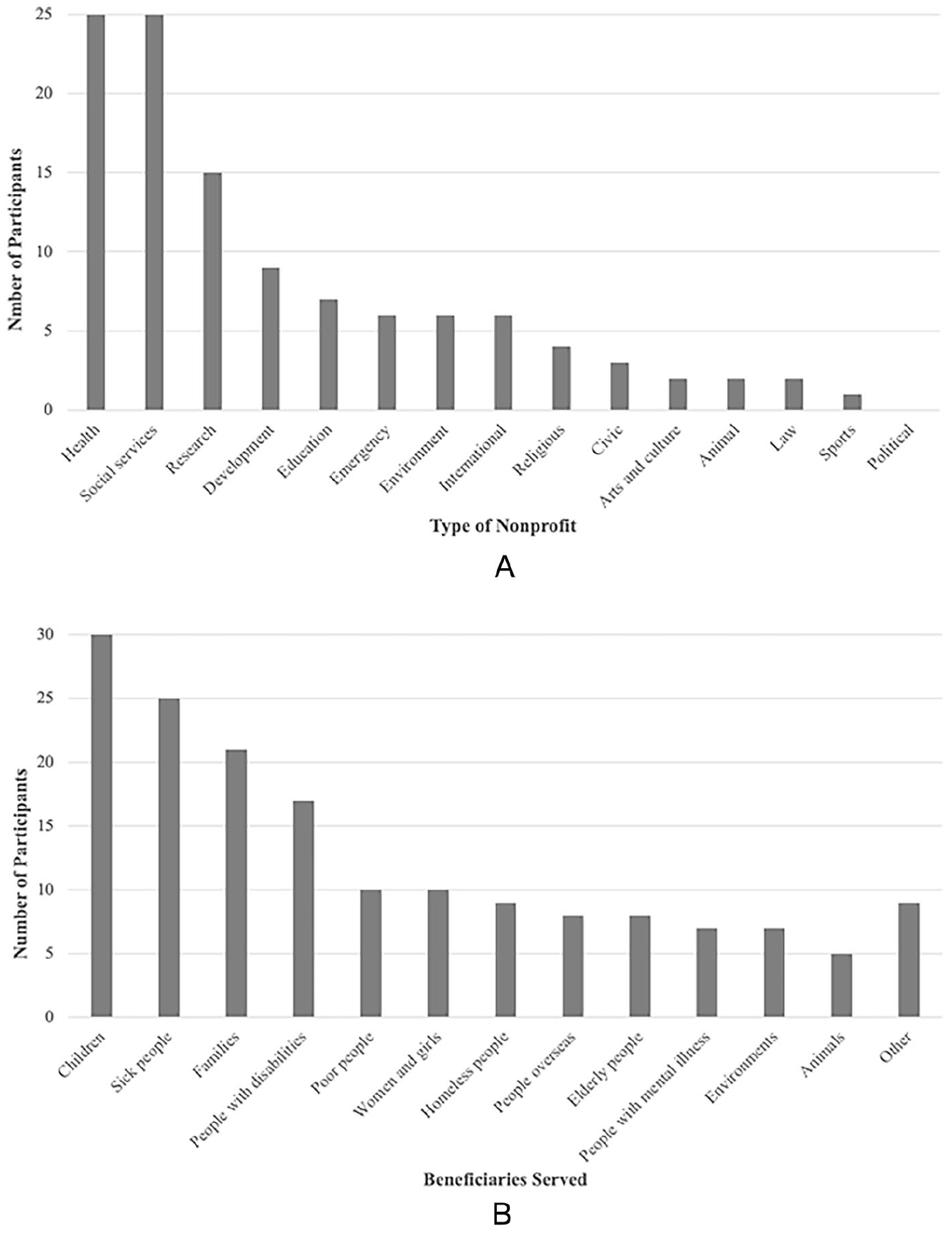
Summary of the (A) Types of Nonprofit That the Participating Fundraisers Work at, and (B) the Beneficiaries Their Organizations’ Serve.
Thematic Analysis
Survey data were imported into NVivo and thematic analyses were conducted on responses to the two questions outlined above. To understand the ethical considerations that the fundraisers perceived in their work, we conducted thematic analyses. Although the three overarching thematic categories were identified theoretically, based on the three broad categories of stakeholders outlined in Charitable Triad Theory (i.e., donors, beneficiaries, fundraisers; Chapman et al., 2022), all themes were identified inductively. In other words, for both questions, themes were generated bottom-up from the data, with no initial assumptions about the specific ethical considerations that would be identified by fundraisers.
Braun and Clarke’s (2006) guidelines for thematic analysis were followed, which involve six steps. First, the first author became familiar with the data by reading all responses and noting initial ideas. Second, they systematically coded all interesting features in the data, resulting in 65 initial codes across the two questions. Third, the first author collated the codes into potential themes. The codes and preliminary themes identified in steps 2 and 3 are available on the OSF. Fourth, the first author reviewed all potential themes to ensure both construct clarity (i.e., that the codes within each theme held together) and that the thematic structure represented the full dataset well. Fifth, themes were named and defined. At this point, all co-authors also reviewed the themes and offered feedback. Sixth, relevant extracts were identified to evidence each theme as part of producing this report.
To confirm the reliability of the themes generated, second coding was also conducted by an independent coder who was not affiliated with the project. The second coder used the thematic definitions generated by the analysis to allocate each participant response to any and all relevant themes. Interrater agreement was 92% of across the dataset (κ=.71), indicating substantial agreement (Gisev et al., 2013). The two independent coders then met and discussed each point of disagreement to reach consensus for the results presented in this article.
Results
We consider first the general ethical considerations identified by fundraisers, before engaging in a more detailed analysis of how fundraisers think beneficiaries are and should be depicted in fundraising campaigns. In both sections we include direct quotes from participants, which are included as they were submitted (i.e., grammatical issues and typos are retained). Respondents are identified only by gender, tenure as a professional fundraiser (number of years, full-time equivalent), and the type of nonprofit they currently work for.
General Ethical Considerations
Analyses identified eight themes in response to what fundraisers perceived to be the general ethical considerations that arise in their work (see Table 1). A substantial minority of fundraisers either explicitly stated there were not any ethical considerations in their work (n=13) or elected not to answer the question (n=9), implying they had no pressing ethical considerations to mention. Thus, a third of respondents (32%) did not seem to have strong views about ethical considerations in their work as fundraisers.
Summary of Themes Identified in Relation to the General Ethical Considerations Involved in the Practice of Fundraising.
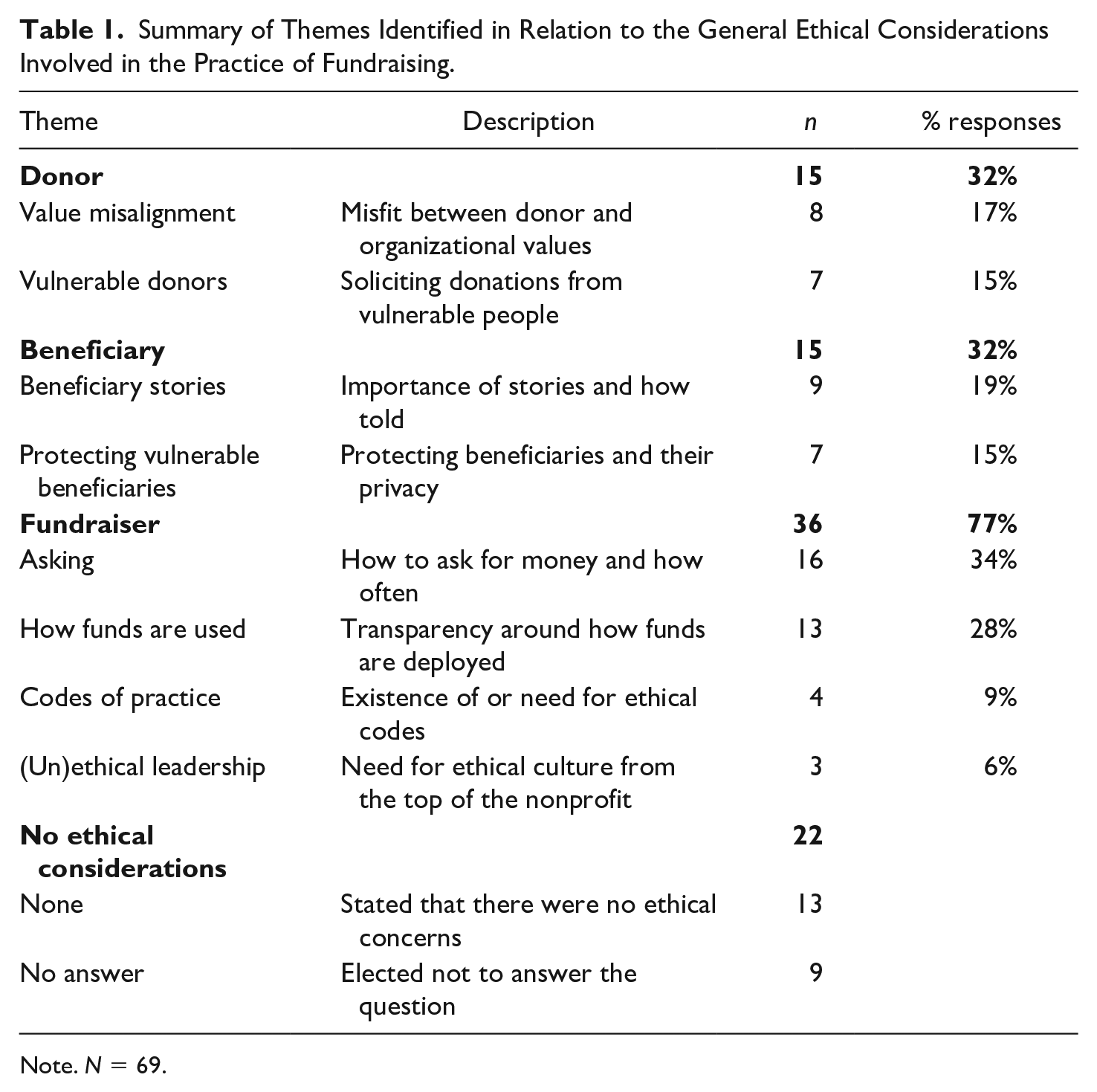
Note. N = 69.
At first glance, it may appear alarming that such a large subset of fundraisers was not aware of the ethical dimensions to their work. However, 22 of the 23 fundraisers who did not note any general ethical concerns did outline ethical considerations around the way that beneficiaries are depicted in campaigns. This suggests that the initial lack of elaboration was likely a failure of recall, as they quickly recognized the important ethical considerations around beneficiaries when prompted to do so. Indeed, people are much better at recognizing factors than recalling them unaided. Two-thirds of respondents, however, did have views about common ethical considerations in fundraising. We present the themes grouped under the Charitable Triad categories of donor, beneficiary, and fundraiser.
Donor
A third (32%) of fundraisers who raised ethical considerations noted issues relating to the donor. Two themes were identified in relation to donors: value misalignment and vulnerable donors.
Value Misalignment
The most common ethical concern relating to donors was a perceived misfit between donor and organizational values. Many fundraisers specifically discussed their concerns about taking money from what the literature calls “tainted donors” (e.g., Dunn, 2010). For example, one fundraiser notes the “Main ethical challenge was accepting major gifts from individuals / companies whose wealth is derived from mining for fossil fuels, weapon manufacturing, gambling, big pharma, or community destruction due to property development” [woman, 9 years, social services].
Some fundraisers suggested that corporate donors may cynically give to charities to enhance their public images through corporate social responsibility programs (see also Wu et al., 2021):
“How many steps does it take to green-wash money? (eg if the money isn’t considered acceptable if received direct from the fossil fuel mining company, is that same money acceptable if received via an intermediary vehicle such as [foundation anonymized]? If we don’t accept the mining company’s direct donation, will we accept a workplace giving donation from a mine employee either matched or unmatched?” [woman, 11 years, health & education].
Though so-called “tainted” donors were a major component of value misalignment, sometimes fundraisers were not concerned that the donor was a bad actor, but rather noted that the donors and the fundraising organization simply did not share the same values. For example, “Navigating the organisation’s LGBTQIA+ inclusivity with a primarily Christian donor base” [woman, 10 years, social services].
Vulnerable Donors
Some fundraisers were concerned about ethical considerations related to soliciting donations from vulnerable people, intentionally or otherwise. One noted simply: “We have to take measures to ensure we don’t take funds from vulnerable people” [woman, 6 years, health]. Another noted that some of their donors were vulnerable, but they may still want to give: “Soliciting (inadvertantly) donations from vulnerable people, while still allowing vulnerable people to have agency over their funds” [woman, 13 years, health].
It was not always clear what made donors vulnerable, though older age was sometimes mentioned. Fundraisers seemed cognizant that—through mass marketing approaches—they may be asking people with reduced cognitive capacities (perhaps due to age or disability) who may not feel able to decline. For example,
“Older donors feeling like they have to help or give – although try to constantly clean data if get signs donors may not be able to understand it is an ask not a demand or show signs they shouldn’t be approached. However when I have worked in larger organizations it is very difficult to always see the warning signs” [woman, 5 years, health].
Beneficiary
Another third (32%) of participants mentioned ethical concerns regarding beneficiaries. We further elaborate these themes in the next section of the results, when we asked people specifically to consider ethical challenges in the depiction of beneficiaries. For now, we briefly discuss the two beneficiary-relevant themes highlighted as general ethical considerations, which relate to beneficiary stories and protecting vulnerable beneficiaries.
Beneficiary Stories
The way beneficiary stories were shared was discussed, especially balancing the “need to demonstrate need while maintaining dignity of clients” [woman, 17 years, social services]. Another raises the same tension: “Showing beneficiaries in a way that is dignified but still shows the reality of the situation” [woman, 25 years, international]. Responses show a clear awareness of an inherent challenge for fundraisers: the moral duty to raise the funds needed (by demonstrating need) with the moral duty of respecting and protecting the beneficiaries of those funds. “We think a lot about how we represent our beneficiaries – it’s a delicate balance of showing need while being respectful and preserving the dignity of the people we help. We are all human and that’s the key.” [man, 5 years, emergency].
Protecting Vulnerable Beneficiaries
Fundraisers also highlighted the fact that many beneficiaries were vulnerable in some way (e.g., children, survivors of sexual violence) and discussed the need to be vigilant in protecting the “Privacy of the beneficiaries” [man, 8 years, social services] as well as “consideration for informed consent (especially with elderly people and people with a disability)” [man, 3 years, environment].
Fundraisers seem aware of the processes and systems that must be put in place to protect vulnerable beneficiaries. For example, some use hybrid stories: “Being respectful to survivors of child sexual abuse when sharing stories. While we are given permission to share their story, we enhance de-identification by building hybrid stories so the survivors can’t identify their experiences.” [woman, 5 years, social services].
Fundraiser
Three-quarters (77%) of participants raised ethical considerations around the practices of fundraising and internal dynamics in the fundraising organization. Given the generalized prompt around ethical considerations in fundraising, it makes sense that many participants focused on the practical dimensions of their jobs. Four key themes came up: the ethics of asking, how funds are used, codes of practice, and (un)ethical leadership.
Asking
A common theme was around asking for money: who asks, how they ask, and how often it is appropriate to ask. Some fundraisers experienced challenges formulating appeals around sensitive or confronting topics: “Trying to attract philanthropy donors for a topic which is confronting i.e. end of life care and not softening the message just to appease their sense of comfort” [woman, <1 year, health] and “Bequest strategies also feel morally challenging” [woman, 2 years, research]. Others discussed the challenges of not being able to personalize campaigns and communication preferences to the needs of donors: “Being able to show respect and responsiveness to an individual donors needs when you are working on mass appeals and campaigns” [woman, 15 years, animal]. These examples highlight a tension between the fundraisers’ raison d’être (i.e., to raise money for the cause) and a moral obligation to consider how donors feel about being asked.
In particular, donors may prefer to be asked to donate less frequently, while fundraisers may feel it is their job to keep asking: “I think we’re always trying to respect donors wishes whilst still encouraging them to give more” [man, 13 years, international]. This can surface a dilemma for fundraisers around “Over asking” [woman, 5 years, medical research], especially during times of collective financial hardship: “With grey areas around people’s solicitation preferences. Frequency of asking given rising cost of living” [woman, 2 years, research]. The conclusion may be that fundraisers should balance appeals with communications showing impact and appreciation: “Not all correspondence should be about money/donations” [man, 14 years, social services].
How Funds Are Used
Another common theme emerged around how the money raised is used. This included whether the monies were used for the exact purposes donors intended, covering organizational expenses (i.e., overheads), and transparent reporting: “the need to xplain where the money goes” [woman, 7 years, medical research] and “Transparently showing how donations are utilised and explaining administration costs” [woman, 18 years, health]. Sometimes there was a need to coach donors about where funds were needed: “Managing organisation needs with donors expectations of how their support should be utilised (such as overheads or projects that are not exciting)” [woman, 18 years, social services].
Codes of Practice
Some fundraisers highlighted the existence of or need for codes of ethical conduct, either within the specific nonprofit or in the wider sector. Examples include “ACFID compliance” [woman, 25 years, international] and the “FIA Code is always a framework to guide fundraising practice to ensure donors have a positive experience that reflects laws, codes, privacy etc.” [man, 15 years, research]. One fundraiser had invented their own ethical framework: “I adhere to what I invented and call the TEACH Principles: Transparent, Ethical, Accountable, Community Focussed, Humanity Benefitting” [man, 50 years, health], while another noted a “lack of fundraising policies” [woman, 7 years, diverse].
(Un)ethical Leadership
Several people talked about the need for an ethical culture to come from the top of the organization and the problems that arose when it did not. Some noted that leaders pressured them to act unethically. For example, “Senior managers “push” to include costs against acquittals, that are not directly related to the grant being acquitted” [woman, 11 years, health & education]. Another noted: “Board members wanting the staff to do things that are not ethical – like telling donors what we are fundraising for (which appeals to donors) and spending the money in other” [woman, 20 years, health].
Ethical Considerations When Depicting Beneficiaries
Our second question prompted fundraisers to consider specifically the ways beneficiaries are—or should be—depicted in appeals. Analyses identified eight themes, which are summarized in Table 2 and elaborated below. As will become apparent, many of these themes are intertwined and speak to the existence of ethical tensions.
Summary of Themes Identified in Relation to How Beneficiaries Are or Should Be Depicted in Fundraising Campaigns.
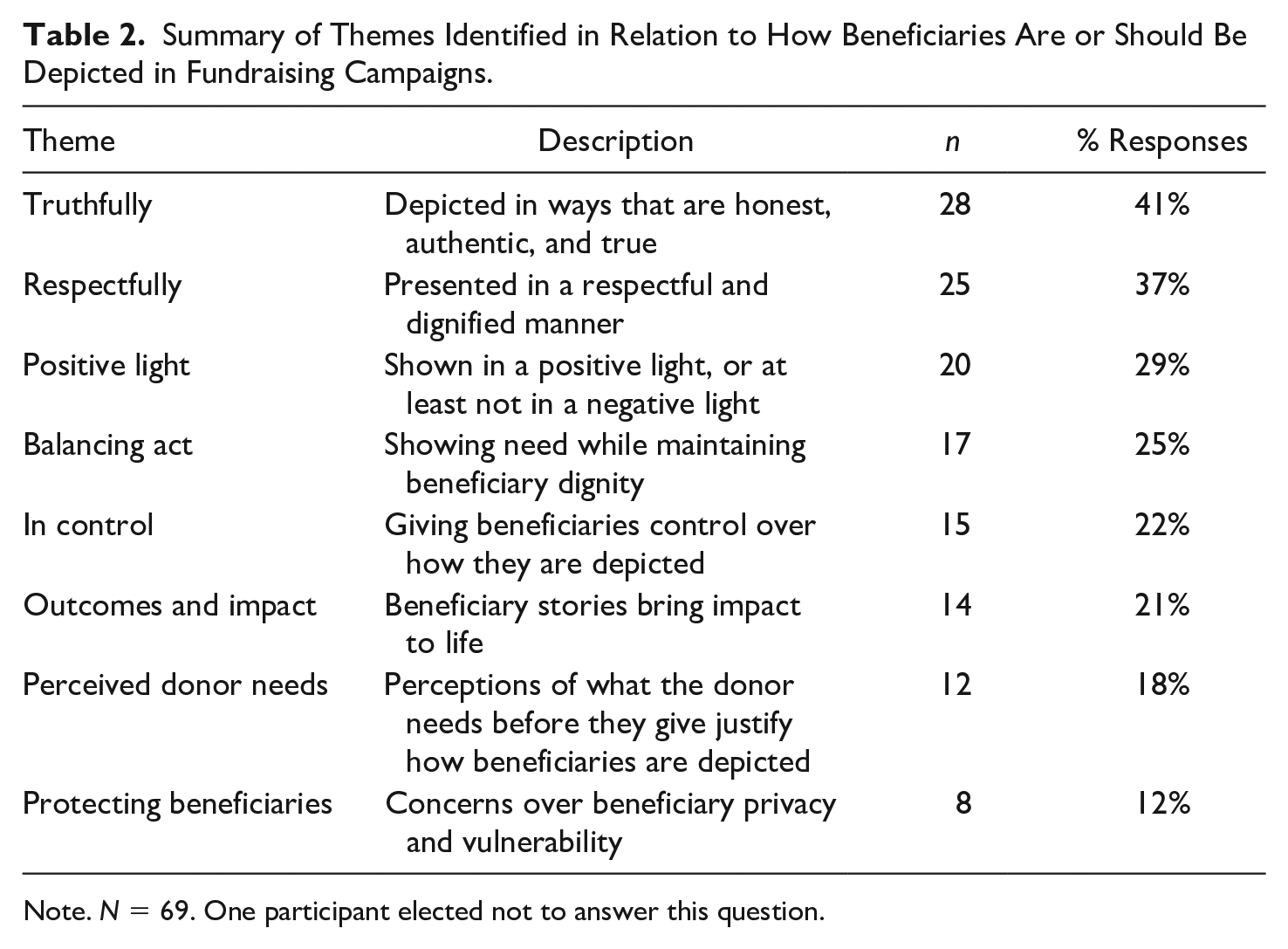
Note. N = 69. One participant elected not to answer this question.
Truthfully
Fundraisers highlighted the importance of beneficiaries being depicted in ways that are honest, authentic, and true to their lived experience: “The story needs to be true and accurate” [woman, 2 years, research] and presented “Realistically and with genuine quotes, stories, photos and videos” [man, 24 years, research], “With honesty and transparency” [woman, 3 years, social services]. The beneficiary’s story should be an “Authentic, first person account of their story” [woman, 10 years, health] and “They should be shown as they really are, not made to look any better or worse off” [woman, 25 years, international]. Truthfulness also means not adding drama or hyperbole:
“Without type-casting. Not all our beneficiaries are poor, unemployed, trauma-impacted, from lower socio-economic or complex backgrounds or minority groups. Many are simply people who live too far away from the support services their children need, and they are happy to contribute to the cost of their child’s care.” [woman, 11 years, education and health].
Respectfully
Fundraisers also stressed that beneficiaries should be presented in a respectful and dignified manner. Often just the word “respect” was included in the response, as if it was always a consideration, even if not the focus of the response, for example: “With respect” [woman, 5 years, sports and recreation], or “Respectfully” [woman, 11 years, education and health]. Some noted beneficiaries’ humanity—“They are humans, like everyone else. IT could happen to anyone” [woman, 8 years, development and housing]—and the need to avoid disempowering them through harmful representations: “Beneficiaries must be represented in a respectful manner that does not diminish, disempower or misrepresent them” [woman, 1 year, research and social services].
Positive Light
A quarter of responses noted that beneficiaries should be shown in a positive light (e.g., happy, agentic) or at least not in a negative light (e.g., pitiable). For example, “Beneficiaries should not be depicted negatively or to be pitied” [woman, health].
Some of these approaches seemed to be around presenting beneficiaries as agentic: “They should be depicted as active participants in change but without sugar coating the difficulty of their circumstances” [man, 13 years, international]. Another example:
“Beneficiaries should be depicted with dignity, in need of solidarity rather than paternalistic charity, as co-creators of their experience with the charity, as having their own value (skills, knowledge and experience) to bring to the relationship, and with the ability to be as independent as possible” [man, 3 years, environment].
For others, the driver to portray beneficiaries in a positive light was more about the impact that would have on donor psychology. For example, “Beneficiaries are always depicted as being happy/appreciative of the support they received from donors” [Man, 12 years, Research]. Another noted, “It’s essential to paint a positive picture of the future and the beneficiaries’ impact thanks to others’ generosity” [woman, 8 years, education].
Balancing Act
As in the general ethical considerations, when it came to how beneficiaries are depicted in campaigns many fundraisers talked about the tightrope they walk: “We need to be respectful of our beneficiaries, and we also need to demonstrate the need” [woman, 15 years, health and social services]. Another notes, “It’s a fine line – we need to show some vulnerability, whilst maintaining the dignity of our clients” [woman, 17 years, social services]. Fundraisers must handle beneficiary stories “Respectfully and without judgement but not shying away from highlighting the key struggles of their journey, as these elements make for emotive storytelling” [woman, 10 years, social services]. This highlights how fundraisers balance the twin moral imperatives: raising money for beneficiaries while also maintaining their dignity. To do so, they must show them “With needs. But with dignity” [woman, 5 years social services and emergency]. Another grapples explicitly with this dilemma: “Need is important to share to evoke a reason to give however this can lead to beneficiaries feeling like they are portrayed as weak. Without their stories donors would feel less compelled to give” [woman, 18 years, health]. It is apparent that the tension is discussed frequently in their work, with other teams having opinions on where the balance should fall:
“I would love to depict beneficiaries in the same way our program staff do – as strong, determined people who need a hand. We try and incorporate as much strengths based narrative as we can in our fundraising copy, but it is difficult to convey urgent need and strong emotion and highlight the beneficiary strengths” [woman, 10 years, social services].
In Control
This theme spoke to the need to give beneficiaries control over how they are depicted, including informed consent, active participation in the creative process, and the chance to review materials before they are sent out. For fundraisers “It is important beneficiaries are reviewing what is being said and how they are being portrayed” [woman, 5 years, medical research] so that they are portrayed “Respectfully, authentically and with their consent” [woman, 15 years, environment]. One fundraiser notes that “beneficiaries should have final say over whatever is published” [woman, 2 years, research].
Fundraisers also note that giving beneficiaries control means that one must let go of assumptions about what are the right or wrong ways to share beneficiary stories: “Where possible they should be canvassed and their wishes respected. This includes, but does not *automatically* mean “strength-based” portrayal” [man, 8 years, development and housing]. In other words, beneficiaries may have a stronger stomach for showing their true hardships than some may assume:
“I have spoken to our beneficieries about this as there has been so much talk about this. Every beneficery has told me the same, if I am telly the story they told me and using the pictures they know have been taken that they want their story to be told so that others don’t have to suffer in the same way. I think their thoughts are what matters most” [woman, 12 years, international]. “Beneficiaries should be depicted in fundraising stories in a way that THEY are happy to share with their family/friends, even though it may be difficult, painful, emotional, raw. Because of this, they should have the right to approve/edit how they are portrayed at any step in the process and they should know this and believe it right from the start of the process. . . . I’ve worked directly with at least 50 different beneficiaries, and they have all been happy to share their story in this way, because it is their way. I believe that its really important to most beneficiaries to be really ‘seen’ and ‘heard’ and to not sugar-coat the challenges they face and the impact it has on their life ‚it’s actually very empowering and satisfying for beneficiaries to share their stories in this way” [woman, 22 years, social services].
Outcomes and Impacts
Fundraisers talked also about how they feel beneficiary stories should be used to bring the outcomes and impacts of their organization’s work to life. Thus, the story is “Important [for] showing the real world benefit of donating” [woman 5 years, medical research], so “the story should be about an outcome not an output” [woman 10 years, education]. Beneficiaries should therefore be depicted as “Experiencing positive change as a result of the services provided by the organisation” [man, 5 years, social services]. This theme was less overtly ethical but the fact that fundraisers noted this when prompted to consider ethical considerations around the depiction of beneficiaries suggests they feel an ethical duty to reflect the outcomes of their organization’s work in a positive light.
Perceived Donor Needs
Even though the question was about beneficiaries, some fundraisers highlighted their ideas around what donors would need before they would give as a way of justifying how beneficiaries are depicted. For example, “Without their stories donors would feel less compelled to give” [woman, 18 years, health]. Perceived donor needs can inform how stories are presented as well as the kinds of stories that are shared:
“Donors appreciate relatable stories of impact – how their giving makes a difference, rather than stats (i.e. # of people in poverty), so beneficiary quotes, anecdotes go down well. Donors also appreciate that transformation or impact is rarely linear so stories that are authentic, down-to-earth and succinct are better than macro impact statements” [man, 15 years, research].
This emphasis on donors when asked about beneficiaries is likely a symptom of the tensions we have discussed throughout. It may be hard for fundraisers to untangle their ethical commitments to different parties—donor, beneficiary, and fundraiser—because their job requires them to balance considerations of all three.
Protecting Beneficiaries
Finally, echoing general ethical considerations raised, some fundraisers highlighted concerns around privacy and the vulnerability of certain kinds of beneficiaries. This included the need to protect the “Privacy of the families depicted and.how much/specific information is shared” [male, 8 years, social services], including the need to “De-identify” stories [woman, 10 years, education]. Some kinds of beneficiaries were also highlighted as particularly vulnerable. For example, “Underage, sick & vulnerable people should be included only with extreme care and consideration” [woman, 5 years, medical research].
Discussion
Thematic analyses of the views of fundraisers working across diverse nonprofit contexts suggest that contemporary fundraisers may have a relatively nuanced understanding of the ethical considerations of their work. Most of the fundraisers who participated in our research had actively moved away from problematic historical approaches like “poverty porn” and appeared to have a genuine commitment to beneficiaries as active stakeholders and a wish to depict them in a dignified light. That said, respondents highlighted, whether implicitly or explicitly, a range of ethical tensions inherent in their roles.
Fundraisers’ need to serve multiple masters—donors, beneficiaries, and the fundraising organization—can generate a host of ethical dilemmas, especially when the needs of different stakeholders are in conflict. Numerous examples of this tension were observed in the data, such as (1) the need to be truthful and depict the genuine hardship beneficiaries face while protecting the feelings of potential donors and sheltering them from possible feelings of guilt; (2) the wish for beneficiaries to be shown as strong and happy, even when that conflicted with their real experience of deprivation; (3) the need to achieve organizational performance goals while maintaining the reputation of the organization, the dignity of the beneficiaries, and not putting donors under undue pressure; and (4) the imperative to maximize good while following donors’ wishes about exactly how their donations should be spent, even if donor priorities do less good overall. With a broad host of ethical considerations—and indeed what is ethical itself being contextualized and unique in nonprofit contexts—fundraisers must be attuned to these pressures and do their best to navigate them gracefully.
The key finding, that fundraisers serve multiple masters, leading to a range of ethical tensions, is a novel application of Charitable Triad Theory (Chapman et al., 2022). The theory was originally elaborated as a theoretical framework to understand donor behavior: who is most likely to offer charitable support and when and why they are likely to do so. Here we expand our collective understanding of Charitable Triad Theory by demonstrating its utility in understanding the actions and thinking of not only donors, but also fundraisers and their professional practice. In this way, we demonstrate for the first time an expanded domain of relevance for the theory, which may be a useful lens for understanding decision-making and organizational behavior in nonprofits more broadly.
The rights-balancing theory of fundraising ethics (MacQuillin & Sargeant, 2019) has argued for the need to balance the rights of both donors and beneficiaries when deciding what is an ethical action. By applying Charitable Triad Theory, we expand theorizing on fundraising ethics from a dyadic to a triadic perspective, by acknowledging that fundraisers must also consider the needs of and consequences for the fundraising organization itself. Our data show that serving these three masters is an inherent part of being a fundraiser but also generates a host of ethical tensions that must be acknowledged and navigated by the fundraiser.
In addition to Charitable Triad Theory, Paradox Theory also provides a useful lens to consider the ethical tightrope that fundraisers must walk (Lewis, 2000; Smith & Lewis, 2011), by acknowledging the inherent and persistent tensions that some organizations face. Paradox Theory argues that organizations which have multiple stakeholders face inherent and persistent tensions (Lewis, 2000; Smith & Lewis, 2011). This relates also to Stakeholder Theory’s argument that organizations should pay attention to the values and needs of their diverse stakeholders (e.g., Freeman et al., 2004; Hansen, 2023), and also accepts that paradoxical tensions may be inevitable and should not necessarily be resolved. Previously, Paradox Theory has been applied to examine the difficulties socially minded organizations face in trying to deliver on a triple bottom line of economic, social, and environmental sustainability (e.g., Carmine & De Marchi, 2023; Palakshappa et al., 2024). In such cases, maximizing income might be best achieved through, for example, exploitative labor practices or externalization of environmental costs. This could create a tension between the social, environmental, and financial agendas of the organization. Our data suggest that such paradoxes are also inherent in the fundraising function of many nonprofits, created especially by the need to consider diverse stakeholders: donors, beneficiaries, and fundraising organizations.
Paradox Theory proposes that such ethical tensions are not necessarily problems that need solving but rather a reality that requires awareness and effective ongoing management (Lewis, 2000). Effective management requires moving away from either/or approaches and instead embracing both/and approaches to competing demands (Lewis, 2000). In other words, fundraisers will be best equipped to navigate their ethical environment when they are conscious of the tensions that emerge from the divergent interests of donors, beneficiaries, and the fundraising organizations they work for. Embracing the reality of diverse, competing ethical demands should generate the greatest long-term sustainability (Smith & Lewis, 2011) and fundraisers should be less likely to find themselves influenced simply by the needs of the stakeholder with the greatest power. Power discrepancies between stakeholders nevertheless remain a reality that should be explicitly acknowledged and counterbalanced. Applying a Charitable Triad Theory lens, and informed by Paradox Theory, we recommend that nonprofits familiarize themselves with the reality of ethical tension and develop rules of engagement that effectively balance competing interests to maximize the overall good.
Fundraisers raised concerns about value misalignment with some donors, which implies they understand the risk of having their reputations damaged through affiliation with bad actors. Both donors themselves and the money they donate can become tainted or, in other words, be considered socially unacceptable (Dunn, 2010). The right thing to do in such situations—whether to accept or keep the donation vs reject or return it—is often subjective and contextual (Moody & Pratt, 2023), and fundraising organizations must balance considerations of ethics (what feels “right”), pragmatics (what will do the most good), and public image (how others will feel about the decision). D. Morris (2008) has even argued that nonprofits have a moral duty to receive all donations regardless of origin (a consequentialist perspective). However, others feel that nonprofits must maintain a sense of moral purity and not accept donations from questionable sources (a deontological perspective). Fundraising professionals themselves are slightly more sensitive to the prospect of charities accepting donations from morally ambiguous donors (e.g., companies who had poor environmental practices) than are members of the general public, but all agree that donations earned through criminal activity should not be accepted (Rahwan & Leuker, 2023). In our data, ethical considerations related to the misalignment of values between donors and the fundraising organization. However, it is also possible that the misalignment could exist between donors and individual fundraisers.
Fundraisers also discussed ethical considerations relating to their fundraising practice. The ways fundraisers ask for money, the frequency with which they do so, and transparency around how donations are used have all been sources of criticism (e.g., Chapman et al., 2024; Hyndman & McConville, 2016; S. Morris, 2016). Fundraisers in this study explicitly discussed tensions around how to ask, such as the need to authentically reflect the difficulty of people’s situation while not falling into guilt-inducing territory, and how often to ask, knowing their primarily role is to ask for donations but needing to maintain positive relations with donors and make them feel appreciated. The professional fundraisers in our study also appeared attuned to broad concerns around how funding is used, where donations are allocated, and how transparent the organization is. The primary tension here seemed to be balancing organizational impact and donor preferences.
A host of specific ethical concerns were raised in relation to the way beneficiaries are depicted. Fundraisers felt that beneficiaries should be depicted truthfully, respectfully, and in a positive light. These perspectives align with the five principles of the TARES test for ethical persuasion: Truthfulness, Authenticity, Respect, Equity, and Social responsibility (S. Baker & Martinson, 2001). Recent research has shown that truthfulness is a key consideration for people when evaluating the ethics of depictions of poverty. Across a series of studies, Duncan and colleagues (2024) found that people are less concerned about the use of emotion to elicit donations or depictions of extreme hardship than they are about deceptive tactics like using actors or staging photographs.
An interesting tension embodied in the theme of protecting beneficiaries is the effectiveness of what is known as the ‘identifiable victim effect’: that individual beneficiaries with identifying information such as name and age generate more donations than groups or more anonymous beneficiaries (e.g., Small & Loewenstein, 2003; Small et al., 2007). Thus, the less anonymity the better in terms of the fundraising outcomes (or if prioritizing commitments to the fundraising organization) but this is balanced with the very real need to protect the anonymity of beneficiaries. This represents another ethical challenge that fundraisers must navigate.
Lack of beneficiary input into fundraising appeals has previously been identified as a problem that the nonprofit sector needs to address (MacQuillin et al., 2023; Ninaber & Mittelman, 2021). Our results show that some fundraisers are actively co-creating campaigns with the beneficiaries represented in those campaigns. Critiques of beneficiary representation are often elaborated by people in comparatively high-status positions such as academics, nonprofit leaders, and journalists. Assuming that beneficiaries are not comfortable with depictions could arguably be considered another kind of paternalism.
A small wave of research is giving voice to beneficiaries themselves. Research from the UK discussed depictions of homelessness in focus groups with 38 young people engaging homeless services and found the beneficiaries were “visually literate and familiar with how marketing works” (Breeze & Dean, 2012, p. 141). Those beneficiaries championed dynamic storytelling that developed empathy (rather than simply provoking sympathy) and communicated a pragmatic understanding of fundraisers’ need to balance accurate depictions of complex social problems with the need to effectively raise money. Bhati and Eikenberry (2016) conducted focus groups with 24 children living in poverty in India to understand their perspectives on the kinds of images used by NGOs to raise money to support children like them. Those children preferred images that portrayed them as, for example, clean, happy, and brave, and also supported images that would raise awareness of the difficult realities of their lives. The children even seemed aware of the inherent tension in the ethics of fundraising images: “The participating children . . . conveyed a tension between being portrayed as happy and in a good light versus being portrayed correctly” (Bhati and Eikenberry, 2016, p. 38).
A common implied theme across responses has been that of a balancing act driven by ethical tensions. Some participants even made that tension explicit. Fundraisers, beneficiaries, and photographers are all aware of the delicate balancing act between showing real need and preserving both the dignity of the beneficiaries and the feelings of the donors (see also Bhati & Eikenberry, 2016; MacQuillin & Sargeant, 2019). Fundraisers in our sample were aware of the pitfalls of “poverty porn,” discussed earlier, and were wary of crossing that line; yet they felt a moral imperative to raise money for the communities they serve and were cognizant that awareness of need is one of the essential prerequisites of giving (Bekkers & Wiepking, 2011).
Nevertheless, there were some examples of views that were more paternalistic or problematic. Some fundraisers in our sample seemed more sensitized to the needs of donors than of beneficiaries, mirroring a historical focus on donors in both academic literature and ethical codes of conduct (Chapman et al., 2022; MacQuillin & Sargeant, 2019; Ostrander, 2007) and highlighting that imbalances of power may exist between the three stakeholder groups. Other fundraisers were focused mostly on performance demands within their own fundraising organizations. Integrating Charitable Triad Theory with Paradox Theory, for the first time, we propose that ethical fundraising can be maximized by explicitly considering the ethical dimensions of engagement with all three parties involved in giving exchanges (i.e., donors, beneficiaries, and fundraisers) and we encourage scholars and practitioners to engage a triadic lens.
Strengths, Limitations, and Future Directions
By surveying a hard-to-access community of professional fundraisers working across a range of nonprofit contexts and fundraising roles, we conducted a “pulse check” on contemporary fundraising ethics. A strength of the study is that we included both recall and recognition prompts to inquire into fundraising ethics. One result of using a recall approach is that a significant minority of participants did not initially report any ethical considerations. This may be because they did not perceive ethical considerations in their work. Alternatively, it may be that they simply did not feel comfortable mentioning the ethical issues that do arise, perhaps out of duty to their organization, the wider profession, or even because of a kind of moral superiority whereby nonprofit staff may perceive that their organization knows best and therefore that their actions must be inherently moral (de Bruin Cardoso et al., 2024). Whatever the reason, we saw improved engagement when prompting fundraisers to talk specifically about ethical considerations relating to beneficiaries.
There is always a possibility of selection bias in surveys because people with certain characteristics may be more likely to respond. It is therefore possible that we have an oversampling of fundraisers who care about ethics completing the survey, perhaps skewing the findings. To minimize that risk, we advertised the study as being about “Effective Fundraising” and did not mention the topic of fundraising ethics in the project description.
We considered only one national context. Ethics are subjective and contextual and therefore likely differ across cultural contexts. Future research may wish to broaden the sample to include fundraisers in different cultures, especially those in emerging and understudied fundraising contexts. Now that we have identified qualitatively some of the key ethical dimensions of fundraising with reference to donors, beneficiaries, and fundraising organizations, future research may wish to apply quantitative techniques to a broader sample and across national contexts. This would allow consideration of direct trade-offs and how fundraisers rank different ethical considerations in terms of both what is right and what is done. It would also be interesting to learn whether fundraisers typically take a more consequentialist or deontological approach to ethics. Quantitative methods—whether survey or experimental—would also allow analysis of how those trade-offs and rankings may be affected by the fundraising context (e.g., serving humans vs the environment, or mass appeals vs major donor fundraising).
Managerial Implications
Fundraisers face the challenging daily task of navigating competing ethical pressures in reference to their donors, their beneficiaries, and the fundraising organizations they work for. To navigate those competing pressures effectively they would benefit from structural guidance on what is and is not acceptable, and what is and is not to be prioritized under different conditions. Many nonprofits have concrete guidelines for how beneficiaries can and cannot be depicted; for example, not using a camera angle that “looks down” on participants, avoiding “white savior” tropes, and with informed consent (e.g., Australian Red Cross, 2022; MSF, 2007). Given the diversity in nonprofit practice, and therefore the risk that different nonprofits will implement different ethical standards, the nonprofit sector would benefit from overarching codes of ethical conduct at both the national and international level. Our data suggest that new ethical codes should grapple explicitly with the inherent tensions discussed here and consider the needs of not only the donors and beneficiaries, but also the fundraising organization and wider profession, when deciding what is ethical.
Footnotes
Acknowledgements
Special thanks are given to the Fundraising Institute of Australia for their support in distributing the survey to their members and offering a prize for participation. The authors also thank Aakash Kurian Thottam for his work as second coder.
Declaration of Conflicting Interests
The author(s) declared no potential conflicts of interest with respect to the research, authorship, and/or publication of this article.
Funding
The author(s) disclosed receipt of the following financial support for the research, authorship, and/or publication of this article: The current research was funded by a Linkage grant from the Australian Research Council (grant no. LP200200046).
