




Abstract
Despite advancements in LGBTQ+ rights, transgender people remain as one of the most socially stigmatized and marginalized members of society. Many continue to face state-sanctioned discrimination. Kerala stands out in supporting and advancing transgender people. We interviewed 15 government officials and 28 transgender women to explore how the Kerala government uplifted and improved the lives of its transgender people. Using a grounded theory approach, we analyze Kerala’s (one of the most progressive states in India) efforts to support transgender people. We found that access to common good—linked with citizenship, active participation, and collective action in society—is key to connect policies with outcomes for socially marginalized groups. Our study emphasizes how representative bureaucracy can empower society’s most vulnerable individuals and help them establish nonprofit organizations for their own support. This discovery allowed us to enhance and develop a process-based theory of representative bureaucracy. Our study extends the theory by establishing the mechanisms by which representative bureaucracy delivers the common good to society’s marginalized members.
Introduction
Despite advancements in equality rights in the West, transgender people continue to experience harassment and violence. The Trans Murder Monitoring research project reports that 321 transgender and gender-diverse people globally were murdered between October 2022 and September 2023, and a majority of the victims were transgender women/feminine people (Transrespect.org, 2023). As a highly stigmatized group, transgender women are poorly organized (as a collective) and have unequal access to resources that enable them to participate in society. One way to improve the outcomes of transgender people is through representative bureaucracy. However, the theory of representative bureaucracy does not specify how government representation can be mobilized into greater collective action, involving nonprofits and community organizations, to effect social change for socially stigmatized groups. This leaves us with a theoretical black box and little guidance on how representation in government can improve lives for marginalized groups. In this respect, the State of Kerala in India stands out in enacting policies to protect the rights of transgender people. We analyze the efforts of both the transgender community and the government of Kerala to support transgender people and interviewed government officials and transgender women to identify the mechanisms by which government, nonprofits, and community organizations were mobilized to improve their lives. The insights were used to develop a process-based theory of representative bureaucracy, useful to guide policy-makers, nonprofits, and community organizations to enact practices to support vulnerable and oppressed groups. A process-based theory is helpful to align representative bureaucracy theorizing with building solidarity, collective action, and ultimately enabling social justice for socially marginalized groups.
Despite our efforts to cast attention on transgender people, the public administration literature has been silent on representation measures, unhelpful for supporting socially marginalized groups (Bishu & Kennedy, 2020; Meyer et al., 2022). Transgender identity refers to a gender identity and/or expression that differs from the sex assigned at birth (Doyle, 2022). The preponderance of transgender people remains largely destitute, lacking basic literacy and skills to even enter the labor market. Transgender people are more likely to be targets of predatory policing and exploitation by authorities (Gaynor & Blessett, 2022; Nisar, 2018), leaving those in need unwilling to seek support. For instance, transgender women avoid seeking public welfare on account of hostile and discriminatory experiences (Butz & Gaynor, 2022). In this respect, a lack of representation in government may push those who need help away (Nisar, 2018). To promote a more equitable society, we need to locate practical solutions that can aid the transgender community develop capacities for active participation in society. For example, policies for transitioning in public workplaces and legalizing identities for the third or diverse genders are avenues to legitimize and support transgender people, effectively offering transgender people sexual citizenship (Elias, 2022; Elias & Colvin, 2020; Elias et al., 2018; Nisar, 2022).
Existing theories—such as Marshall’s theory of social rights and liberal models of citizenship—have not adequately addressed the shortcomings of public policies in tackling inequalities in the distribution of the common good as a citizenship entitlement. While representative bureaucracy shows promise, it does not clarify how to transition from mere numerical representation to enacting real change (Bishu & Kennedy, 2020; Kennedy, 2014). We therefore propose a process-based theory to capture the how of representation processes that have been missing in the literature. Along with developing a process-based theory of representative bureaucracy, this study enhances our understanding of how bureaucratic systems can promote sexual citizenship and provide societal benefits to transgender women. Representation in government acts as a crucial foundation fueling nonprofits and community organizations to effectively deliver service to those in need. In this respect, we adopted a grounded theory approach to investigate how the Kerala government employs representative bureaucracy to improve the lives of a socially marginalized group. In so doing, we also strengthen the link between representative bureaucracy and nonprofit and civil service organizations. This knowledge is critical to support the development of transgender people and the wider LGBTQ+ community.
Conceptual Background
The State of Kerala is notable for enacting policies that support marginalized groups, including transgender individuals, by granting them legal recognition, employment opportunities, and access to shared resources, known as the “common good” (Albareda & Sison, 2020; Melé, 2009). The common good includes public benefits such as health care, education, and social services, which help individuals achieve their life goals and benefit the entire community (Argandoña, 1998). Access to these resources is generally facilitated through citizenship, collective action, and civic participation (Albareda & Sison, 2020). However, transgender individuals often face exclusion due to lack of recognition. We argue that representative bureaucracy can help marginalized groups gain citizenship and access the common good necessary for active societal participation. Our study lays the groundwork for a process-based theory of representative bureaucracy. The paper is organized as follows: we start with a brief overview of representative bureaucracy to establish our framework, followed by an explanation of our research methodology, presentation of findings based on emerging themes, and conclude with a discussion and recommendations for future research on representation theory.
Representative Bureaucracy
Government bureaucracies create policies and implement programs impacting the development of others (Dolan & Rosenbloom, 2015). A central concern is whether government bureaucracies fairly represent all segments of the general population. Kingsley (1944) introduced “representative bureaucracy” to articulate a need for bureaucracies to meet the needs of the diverse people they serve. Representative bureaucracy is therefore critical to ensure a fair and equitable distribution of resources so that society’s disadvantaged can access and benefit from these resources (Lam & Ng, 2020).
Mosher (1968) distinguishes between passive and active representation in representative bureaucracy. Passive representation occurs when public organizations mirror the people they represent. Although largely symbolic, passive representation increases legitimacy and confidence among citizens. For example, hiring African American police officers can help the police department gain legitimacy with the Black community (Riccucci et al., 2018). Although passive representation is tokenistic, it could lead to strengthening participation and citizenship engagement (Gaventa & Barrett, 2012).
Active representation occurs when civil servants from minority groups influence policy outcomes and program implementations (Lam & Ng, 2020). One form of active representation is the participation of street-level bureaucrats in connecting policies with citizens; these bureaucrats have direct contact with the public and make decisions on the provision of resources such as safety, education, and health care (Riccucci et al., 2018). When government employs people of minority backgrounds to build relations with similar others, it creates isonomy, which in turn fosters a sense of belonging and trust with members of that community. We draw from representative bureaucracy theory to guide our research into exploring the mechanisms on how the government serves transgender people in Kerala.
The transgender community in conservative societies faces tremendous social stigma and reports difficulty in accessing sexual health care services (Do et al., 2018). A case was filed by the National Legal Services Authority of India (NALSA) to protect the fundamental rights of the transgender community. The landmark “NALSA judgment” recognized that individuals who fall outside of the gender binary could be recognized as the third gender (Supreme Court of India, 2014).
The Kerala government, in responding to the legislation (the NALSA judgment), moved to recognize, involve, and support the transgender community, initially through the representative bureaucracy. The NALSA won a landmark case (the “NALSA judgment”) where transgender people are legally recognized as the third gender which accorded them fundamental human rights. We also know that legal protection alone is insufficient to bring about the necessary changes in attitudes to support socially stigmatized groups (Narendran et al., 2021). Nevertheless, following the NALSA judgment in 2014, the Kerala government put in place comprehensive measures to support the transgender community.
We are motivated to understand how the Kerala government has worked to improve the lives of transgender people and, in so doing, has led to the creation of nonprofit organizations and businesses started by the transgender community. This paper therefore advances the theory of representative bureaucracy by outlining government mechanisms for employing, legitimizing, and improving the lives of transgender individuals. This knowledge can serve as a foundational framework for other jurisdictions aiming to assist socially stigmatized and marginalized groups. To accomplish our purpose, we interviewed government officials and transgender women to offer insights into transforming the transgender community through government efforts.
Methodology
Following previous studies (Ahl & Marlow, 2012), we adopt an interpretive technique for the present study. This technique assumes that social reality is not singular, but instead is shaped by participants’ social contexts (Putnam & Banghart, 2017). We explore the social realities and lived experiences of transgender people under the communist government and people working for the government, including transgender employees, and follow Mason’s (2017) argument that we cannot assume any one research subject possesses unequivocal epistemological privilege. Thus, we draw from two groups who have epistemological advantage: members of the transgender community and government representatives. The term government representative is used here because some study participants worked for the government or community organizations such as nonprofits, distributing government assistance (e.g., training and funding), while others volunteer with the Department of Social Justice to support the welfare of the transgender community. Our study included 15 interviews with government officials and 28 interviews with transgender women 1 who run businesses and volunteer with the Department of Social Justice. A total of 43 participants were interviewed for the study. Ethics approval for this study was obtained from the Human Research Ethics Committee at the first and third author’s affiliated institution. Participants were given an information sheet and consent forms, and only those who signed the consent forms were included in the interviews. We adhered to all relevant protocols, ensuring participant privacy, informed consent, and data protection.
We believe that treating transgender men and transgender women as a single group overlooks the unique experiences and challenges each faces within a patriarchal context. In India, reports of violence against women are particularly alarming (Pandey, 2022). Within this context, where women face pronounced vulnerabilities, some men who identify as women may become more vulnerable to violence. Given this heightened vulnerability, our study focuses specifically on transgender women. In recruiting for government officials, we specifically selected those who were providing support services to the transgender community in Kerala. Some of the interviewed officials identified as transgender, but we did not exclude any participants based on their gender identity. The key criterion for inclusion was that their job role centered on delivering services to the Kerala transgender community.
Access and Interviews
Since the authors are not members of the transgender community, one challenging task was gaining access to research participants. Similar to Tlaiss and Kauser’s (2019) study on Lebanese women entrepreneurs, there is no database for transgender people in India. The initial strategy to gain access was through a letter of support from the Department of Social Justice to conduct the study in Kerala. The official who provided the letter of support also urged the researchers to avoid using the Malayalam (language in Kerala) synonyms for transgender people, as they were considered offensive by the community. In Kerala, the term transgender is widely used in the interviews, and it is driven in part by the fusion of English in local language. The term transgender is an adjective, but in Kerala, it is used as a noun (Krishna, 2023).
An initial face-to-face interview was scheduled with a government official at the Transgender Cell 2 (the official name given by the government of Kerala) of the Department of Social Justice with the letter of support. A government representative (a transgender woman government employee) provided a list of transgender women and phone numbers for interviews. The official further advised the authors to conduct the interviews using Malayalam, as many transgender people would not know English.
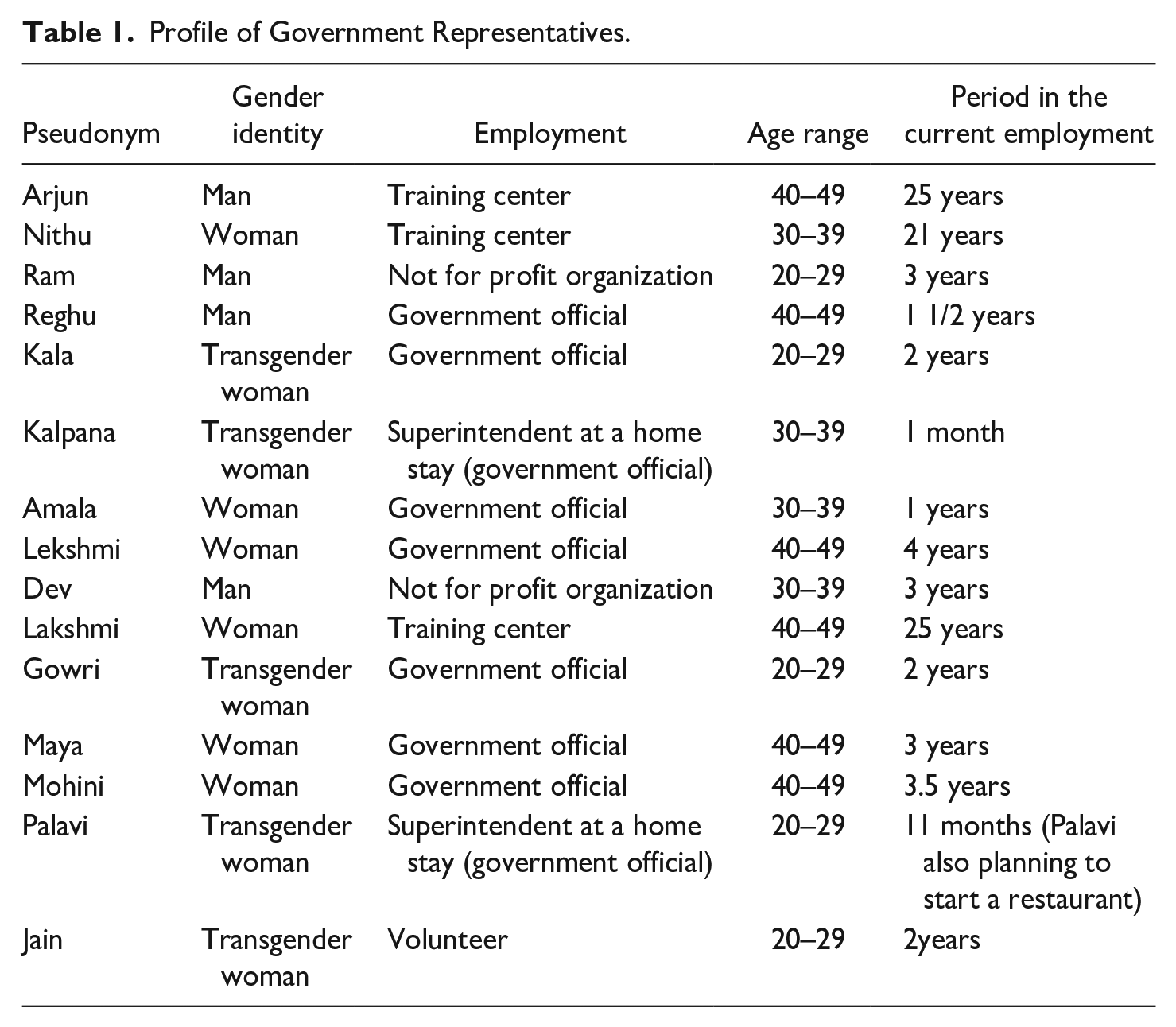
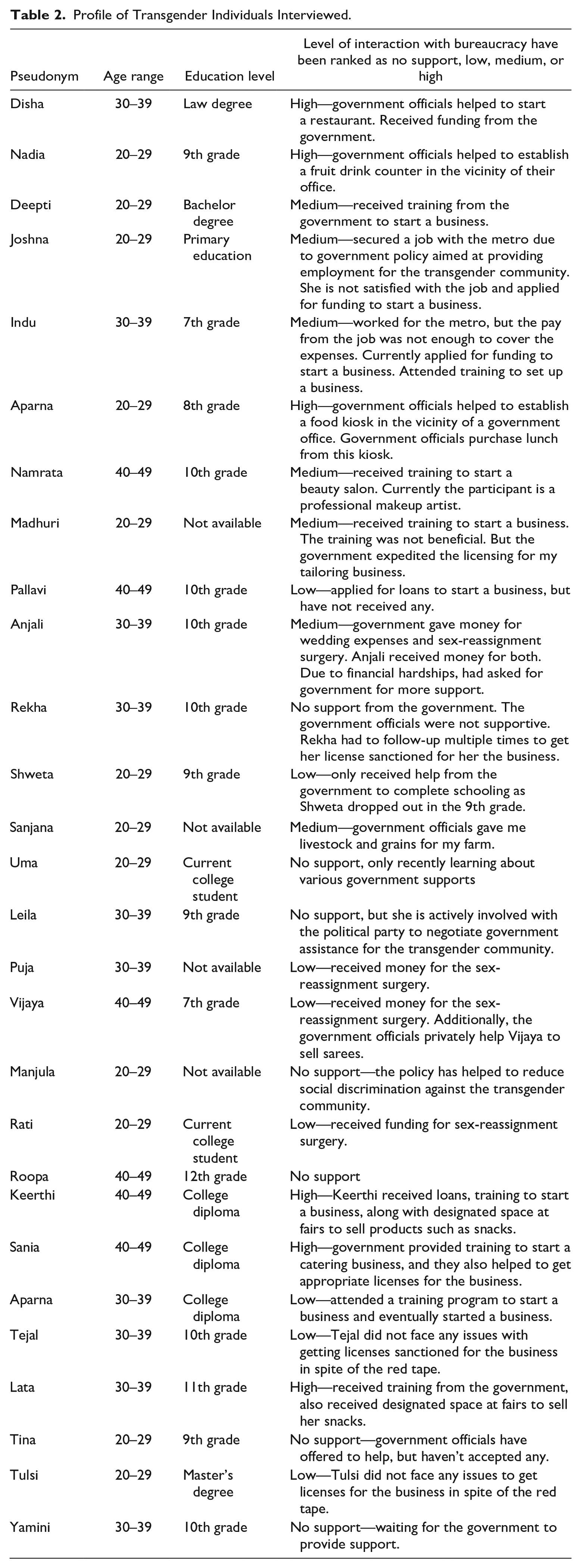
Data were collected in two phases. The first phase (interviews with 28 transgender people) occurred between December 2018 and January 2019. The second phase (interviews with 15 government representatives, including a few officials from the Department of Social Justice) occurred between December 2019 and January 2020. Depending on the participants’ willingness to share their experiences, the interviews varied from 20 minutes to 1 hour. See Tables 1 and 2 for participant profiles.
Profile of Government Representatives.
Profile of Transgender Individuals Interviewed
A Malayalam-English translator (not involved in the study) was used to transcribe the interviews. The first author/interviewer, who is originally from Kerala, reviewed the transcripts to check for validity and to ensure that the translation accurately represents the interview discussions. The author also cross-validated the content to ensure authenticity and accuracy of the content before data analysis.
The interview questions were structured to allow participants to narrate their personal perspectives. Guide questions included a general question that asked participants to describe themselves and their organization; factors that enabled them; the people who had positively or negatively impacted and influenced their success; the level of support received from government officials, associations, and nonprofits including civil service organizations; difficulties they faced; support or resources they received to start and continue their operations; future prospects; and their recommendations for change (e.g., policies, practices, laws, or conditions) that need to be in place to support transgender people. Guide questions for government representatives included a general question to describe themselves, their job and role, experiences with the transgender community, the social and political conditions that impact the transgender community, and their views regarding proposed solutions to enable the transgender community self-support and sustain themselves.
The course of the dialogue was guided by the participants (Leitch et al., 2010). All the interviews were conducted in Malayalam. The interviewer had information sheets in both Malayalam and English, but the participants preferred Malayalam. All the interviews were tape-recorded; participants did not show any reluctance to be recorded. Studies have shown that interviewers can influence the responses of participants through follow-up questions by using terms generated by participants to frame questions (Corley & Gioia, 2004). While recognized as a fundamental aspect of rigor in qualitative research, there is a lack of clear guidance on how to achieve this. According to Hennink and Kaiser’s (2022) systematic literature review, saturation can typically be reached with 9–17 interviews. However, given the hard-to-reach nature of transgender women, we focused on theoretical saturation, as many participants shared similar complex family and social dynamics. Once we observed no emergence of new codes, we determined that saturation was achieved with 28 participants.
Data saturation was not an issue with government officials; through snowball sampling, we interviewed all officials associated with supporting the transgender community. All but one official agreed to participate—this official did not respond to our attempts to reach them. Nevertheless, another official from the same department provided insights, ensuring that the department’s perspective was still included in our findings.
The sample is comprised of two groups: government representatives and transgender women. Government representatives included employees, founders of nonprofit organizations, individuals responsible for organizing training for transgender community members, and volunteers collaborating with the government to assist the transgender community. Participants in the study were between the ages of 20 and 49 years, with employment experience varying from a few months to over 20 years. We only recruited individuals who had worked directly with the transgender community. Among the government representatives, five identified as transgender women.
The transgender women who participated in our study were aged between 20 and 49 years. Their educational backgrounds ranged from primary school completion to obtaining a master’s degree, which is noteworthy given that Kerala has the lowest school dropout rates and a high enrolment rate in colleges and universities compared to other states in India (The New Indian Express, 2021). Our data revealed that social discrimination, bullying in schools, and family evictions led many to leave school. They formed a supportive community with other transgender women, and most participants come from lower socio-economic backgrounds, leading them to start businesses out of necessity. Their interactions with the government varied significantly. Some received substantial assistance, such as funding for business ventures and/or sex-reassignment surgery, while others who applied for support encountered delays due to bureaucratic obstacles (Table 2). Overall, our data revealed a range of experiences regarding government support.
Data Analysis
The analysis undertaken follows the following process: One author first read and re-read interview transcriptions and field notes to understand thematic connectivity (Williams & Moser, 2019), guided by the “5Ws” (who, what, where, when, and how) to explore data and develop codes and categories (Flick, 2009). Although the initial codes were more descriptive, it enabled us to organize similar data thematically and refine our codes. A second author independently followed the same process to enhance reliability and consistency (Coleman, 2022; Ryan & Bernard, 2003). Any disagreements were discussed until a common understanding was agreed upon. We then organized and categorized the data by assessing the causes, contexts, consequences, and conditions (LaRossa, 2005). We located relevant literature to make sense of the interview quotes, subcategories, and themes. This enabled us to move to a higher level of inference and begin connecting statements from the research participants, which helped make explicit connections to develop theory (Lester et al., 2020). This ensured credibility, neutrality, consistency, and replicability of findings (Lincoln & Guba, 1985). After undergoing multiple iterations of the codes, the following codes were developed: representative bureaucracy, the common good, citizenship, and sustainable development. The first- and second-order codes are presented in the Appendix.
To avoid research bias, the author who conducted the interviews utilized memos to record reflections and experiences with each participant, particularly on the challenges in conducting the interview, perceptions of the conversation, and where the interview was conducted (Clarke, 2005). This helped us capture emergent emotions related to the research questions and reflect on the potential biases that may have influenced the way the interviews were conducted and how the initial coding was conducted (Lester et al., 2020).
Findings
In our analysis, we draw attention to the changes in transgender people’s lives, as distal outcomes, after the government enacted positive measures. Data were coded based on our interest in learning more about how the government legitimizes and improves the lives of transgender people. We find evidence that active representation in government and recognition of transgender people result in citizenship (which we will define later) and access to common good. This enables them active participation in society and sustainable development. Figure 1 outlines the process by which active representation in government can effect change, which we term process-based representative bureaucracy.
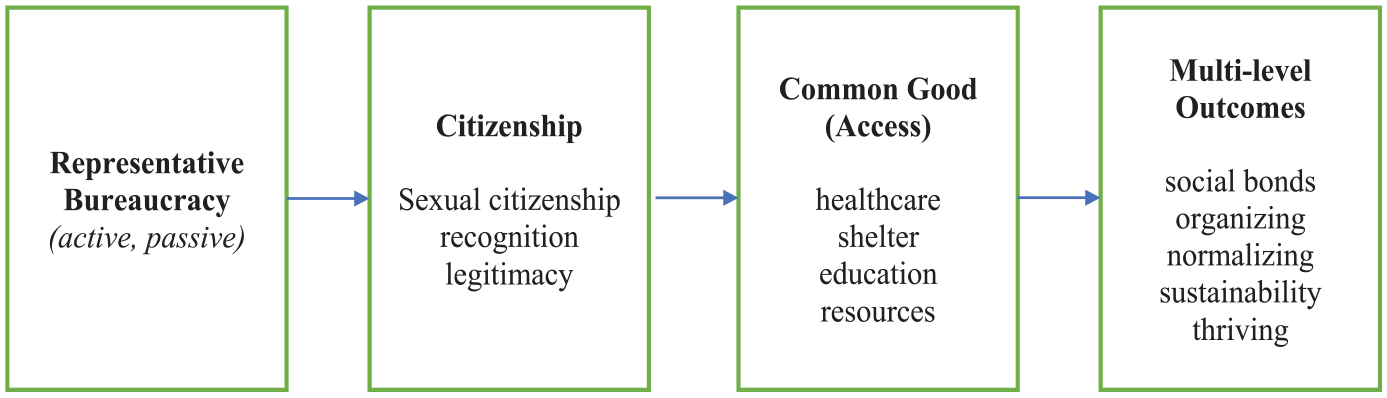
Process-Based Theory of Representative Bureaucracy.
We organize our findings from the themes that emerged. While we identified specific themes, like other studies involving processes, there are overlaps between the themes. This is important because it signals the interconnectivity between themes (helps establish causality in qualitative studies) that the participants used to describe their experiences and connection to multiple levels of outcomes.
Representative Bureaucracy
Representative bureaucracy emphasizes hiring under-represented groups into government to serve the diverse and broad interests of society. Our analysis identifies three ways in which representative bureaucracy occurred: (a) employment in government (street-level bureaucracy), (b) volunteer roles in nonprofits and community organizations (expanding on the role of representative bureaucracy), and (c) membership in the party (indirect influence through political activities).
Employment in Government
The Kerala government is noted for establishing the first transgender cell in India, with the appointment of the first transgender person (Syama S Prabha) as a state project officer (Deccan Chronicle, 2018b). The government employs transgender people to deliver programs, including distributing the identification (ID) card, financial support for sex-reassignment surgery, and funding for self-employment. Like Syama, many other transgender people are now working for the government in various roles. One of the transgender employees explained their responsibilities: I work as an assistant in the Transgender Cell of Social Justice Department. We plan and execute programs for the welfare of the transgender community. There are many transgender communities here. We design programs—transgender welfare programs. Our system is that the programs we implement should reach the beneficiaries. This is part of a state-wide project. (
Kalpana, who is a transgender woman, at the time of the interview, she was working as a superintendent at a homestay for transgender women. Kalpana also worked as a field officer in the AIDS Control Society and also narrates the struggle she had to endure to provide progressive.
I am working as a field officer in the AIDS Control Society. The purpose, as a field officer, was prevention of HIV and to advise the people on HIV prevention, preventive methods and if detected to give treatment to those affected by HIV. I had people working for me. It was after this that we got an opportunity to organize a festival. Thus, we identified 300 to 350 transgender people in northern part of Kerala. This was the time when there were no identity cards. So, a cultural society arranged a fairly big meeting of the transgender community and government officials. Senior officials and seventy odd transgender people took part in the first get together. We were able to present the issues facing the transgender community. It was after this meeting that we issued an identification card for the transgender community in one of the rural areas in the northern part of Kerala. (
We analyze these roles through our interviews with the research participants.
Volunteering in Government, Nonprofits, and Community Organizations
Transgender people further assist other disadvantaged members of their community through volunteer roles in addition to government employment. Vijaya, a sex worker who previously experienced harassment by the police, now holds an important volunteer position with the government. As a volunteer member of the district court, Vijaya has the opportunity to contribute to decisions concerning transgender people through the legal system. This narrative demonstrates the government representative bureaucracy outside formal employment systems.
I am also a member of the district court. The commissioner and the minister are also members of the district court. The four of us in the district court are Leela, Mary, Jane,
3
and I. We are also the secretary, president, and vice president of the community-based organisation. Maya is on the state-level committee, along with Diya,
3
Meera, and Bessy. (
In addition to the above, there is a post within the government called the Justice Board Members. Two of the members of the Justice Board were interviewed, and they mentioned that their role is voluntary: This work does not give us any income. This is a service that we do, a service that we do for our community. When the people in our community contact us for any issues, whatever be the time, we help them. In each of the 14 districts, four to five of us are included in the justice board. We provide a helpline for them. When transgender [transgender people] face any crisis, either in the community, their homes, or other places, we offer our help. We go to their houses and educate the people there. We also communicate to transgender [transgender people] all the programs relating to them. (
Justice Board members are from the transgender community; they help community members cope with discrimination, abuse, or eviction from their family. The members educate the family members of transgender people and provide counseling services and legal assistance.
Membership in Political Party
Some members of the community also become politically active. The political party in power established a youth wing called the Democratic Youth Federation of India (DYFI) to attract young transgender activists. As the communist party is in power, many saw this as an opportunity to become active politically, gain power and status, and influence government policies that can benefit their community.
Leila, a transgender woman who teaches traditional Indian folk dance, felt that the current government has created awareness about transgender people, adding that this could be further improved by increasing the representation of transgender people in political parties. To gain further prominence and influence, Leila has joined DYFI. The opportunity to be a part of a political party boosted her status in society. Similarly, Gowri, a young transgender woman who is an active member of the welfare board, praised the efforts of the communist government; she believed in the efforts of the party and joined the youth wing of the party. Being part of a political party accords a higher status, which the participants take advantage of: Many are members of organisations like DYFI. Many of us work at different levels of the CPM. We get good support from our senior leaders. Under the left-wing government, several support programs are available for us. I am a member of the DYFI of the Changanassery block, which is the youth wing of the communist party. Many of us are members of the state committee, the district committee, and persons who take part in party conventions. So, the support of the political leaders is always with us. We get good support from the political parties. (
By welcoming transgender people into political parties, the Kerala government was able to extend its support to the transgender community beyond government agencies. The transgender women we interviewed became active not only as street-level bureaucrats but also as volunteers in nonprofit organizations and became politically active.
Legitimizing the Transgender Community
One of the first steps in protecting transgender people is to recognize them as full members of society. Two participants narrated how society mistreated them prior to government intervention; one of the participants mentioned that she contemplated suicide due to mistreatment from others. Another participant recalled how “the policemen tell us to get lost and beat us up saying that we have no right to live in this world.” With such societal mistreatment including from government authorities, the Kerala government took steps to assist transgender people gain legitimacy in society. They included measures such as issuing identity cards, creating census categories, and recognizing civil marriages for transgender people. While these measures provide transgender people with legal recognition and access to government resources, they also have symbolic value in the form of validation and a sense of belonging.
ID Cards
Dev explains how the NALSA judgment is the catalyst for implementing ID cards. Although the NALSA judgment was pronounced in 2014, it took a few years and for the government to return to power to implement ID cards for the transgender community. Even though there is a law, many Indian states (not a central government function) have not taken the initiative to implement the ID card (previously issued to men and women only to procure government services). According to the judgment, people can declare their identity without intrusive measures or physical examination.
There is an issue regarding the identity of transgenders [transgender people]. The district committees will screen applications for an ID. Those who apply for the ID are verified to confirm that they are a transgender person. No physical examination or examination of sex organs is done. According to the 2014 NALSA judgment of the supreme court, gender is self—declared. An interview with the district committee ascertains the gender. (
Aparna was proud to share that she voted using her transgender ID card in her constituency. The ID card is a symbol of acknowledgment by the legal system of an identity that stands on equal footing with other mainstream gender identities (male and female). In this respect, ID cards allow transgender people to make their authentic identity official; it also enables them to seek assistance from the social welfare board. Lekshmi, a government representative, mentioned that the first measure implemented by the government was to provide transgender people with ID cards, which could be used to access various government programs.
The first thing we did was to establish identification cards. It is mandatory to have an ID card to access any government assistance, transgender [transgender people] should have an ID card. Around 1,000 applications have submitted applications for an identification card, we have started issuing them. (
Establishing a Census Category
Kala, a transgender woman working for the government, mentioned that transgender people could get an ID card as a man, woman, or third gender, that is, if a transgender person identifies themselves as a woman, they can request an ID card as a “woman.” Sex-reassignment surgery is thus unnecessary to be recognized as a woman or a man. This is evident in Keerthi’s response, where she refuses to undergo sex-reassignment surgery. Even though Keerthi identifies as a woman, she prefers to dress like a man due to the social misconception that transgender people undertake sex work, wear women’s clothing, and wear heavy makeup.
Keerthi elaborates on social issues where people exploit young transgender women after the sex-reassignment surgery and are lured into sex work. Thus, to avoid these unwanted advances and harassment, Keerthi wears menswear in public and has an ID identifying Keerthi as a transgender person: I have also changed my voter’s ID card [based on the transgender ID]. I also want to change the Aadhaar card.
4
I can’t change the Aadhaar card because of the house loan. After the loan has been repaid, I will change the Aadhaar card. (
Recognition of Civil Marriage
In addition, the government has acknowledged the union of transgender couples. In 2018, two transgender people, Surya and Ishaan, got married; their union was witnessed by the mayor, minister, and among many others (Deccan Chronicle, 2018a). The government encourages transgender unions and provides financial assistance to support them: Many transgenders [transgender people] have an ID. Based on this, a transgender man and a transgender woman can get married. For this marriage, only one person needs to be a transgender person; they will still get an amount of ₹30,000 as financial support. (
Both Surya and Ishaan are transgender people.
A few of the participants disclosed that they are married. Aparna did not disclose any funds received from the government but mentioned that she is in a relationship. Her partner was a homeless man who helps manage the small business she is running, I receive support from my mother and my husband, I got him from the streets. He stays in the shop at night. It is a living together relationship. He is the greatest support for me . . . he and my mum. (
Similarly, Anya also received support from her husband: “that, my husband Sam helps me financially and mentally when I felt low. When I share my thoughts with him, he also gives me ideas to use in my business. They are my two main supporters from my family.” These accounts show how the government embraced the union. The interview participants had no issue disclosing their relationship to the public; it also shows transformation from being labeled as the “criminal tribe” under British rule (Biswas, 2022) to government embracing transgender identities and their civil unions.
Taken together, government initiatives on ID cards, census categories, and recognition of civil marriages serve to legitimize the transgender community. The transgender women were able to gain access to critical resources as a result of being legal and lawful citizens.
Common Good for Transgender People
Common good are resources that are shared and benefit everyone equally; however, it is frequently attained through citizenship, collective action, and active participation. In line with this, the Kerala government took steps to affirm transgender people standing and active participation in societal life through active representation in government. In the following sections, we document some critical life domains (e.g., health care, housing, education) in which transgender people have been excluded and how government efforts through representative bureaucracy enabled their human development and improved transgender lives.
Access to Health care (Sex-Reassignment Surgery)
One immediate benefit of a transgender ID card is the ability to access sex-reassignment surgery. A few of the participants had just undergone the surgery at the time of the interview. We learned that the government not only provides the surgery but also offers financial assistance for post-surgery recovery. In addition, the government established shelters for the transgender community during the recovery period. Through these measures, the government not only facilitates the transition but also extends support with their integration into the larger community.
The government also assists those who undergo surgery. They get roughly ₹30,000 at a rate of ₹3,000 per month. The expenses for the surgery, amounting to ₹200,000, are also paid by the government. Thus, we get very good support from the government, this has changed the life of transgender [transgender people] for the better. (
In addition to medical costs, the government also ensures adequate care post-surgery and continues to financially support transgender people. Lekshmi, a government official, elaborates: Each transgender person can get assistance for up to two lakhs rupees for Sex Reassignment Surgery. This amount of two lakhs is not a fixed amount. It depends on the medical bill they submit. Last year ₹30 lakhs was sanctioned for the surgery; this year, it is 50 lakhs. After surgery, they get an amount of ₹3000 per month for nutritious food and to continue the medical treatment. (
Access to Housing (Shelter) and Financial Support to Rebuild Lives
The government provides temporary accommodation for transgender people who need shelter. Kalpana, a transgender woman, manages the accommodation in Northern Kerala. Apart from the accommodation, transgender people also receive funding through Kudumbasree (a neighborhood group), to give them access to opportunities to rebuild their lives.
This home where I stay forms a shelter for transgenders [transgender people] who are thrown out of their homes, for those who just had their surgery, and for those who are going through a crisis. This forms a temporary shelter for them for a period of a maximum of three months. The health minister, Smt Shylaja Teacher, inaugurated this foster home. This initiative is for the betterment of the transgender community. We provide facilities like Kudumbasree, provide opportunities to study, and help them to get employment for 300 to 350 transgenders [transgender people] in the community. A cell for transgender [transgender people] has been formed under the Social Justice Department. The Department has a program called Rainbow to give them the opportunities they want and the facilities they require. (
The government further provides funds to assist transgender people for self-employment, skill development, and post-surgery-related grants. Lekshmi, a government official, listed more provisions provided to transgender people: Last year ₹50,000 per head was provided to promote self-employment among transgender [transgender people]. Financial assistance was given to the sixty-two transgender [transgender people] who applied for assistance. After they have started the work and the district officer gives a certificate stating that the self-employment venture has been initiated, then the second instalment will be released. (
Access to Education
Many transgender people were not able to complete their education. Maya, a female government official, mentioned that transgender people experienced bullying at school, and many lost interest and dropped out. However, the government provides opportunities for transgender people to complete their education even years after they have dropped out. Gowri, a transgender woman government official, mentioned that counseling is provided to encourage transgender people to continue their studies. The support from the government is evident in Lata’s response: I am currently studying plus two.
5
Three people who have been with us have passed SSLC,
6
Literacy mission course. My exam is on 21st December 2019. Like this, we are completing our education. (
Lata was not able to complete their high school education, so under the government’s literacy mission, Lata completed her lower secondary education. Another transgender person, Jain, who works for the Justice Board, is proud to say that she was the first transgender person to complete secondary education under the literacy mission program. Jain was proud to point out that her story appeared in the newspaper.
Those without secondary education, the government helped them to complete their education. Last year it came out the newspapers. You might have heard the news about a transgender person completing plus two. It was me. That was the first time a transgender person had completed plus two in our state. (
It is evident that access to health care, shelter, education, and important resources (common good) aided in these transgender people develop and build their lives. In addition to the above, the transgender cell is working to implement pension for transgender people: Usually, people retire at the age of 60. But the transgender community have endured surgical procedures and have been exposed to medications and their life span is usually shorter compared to normal males and females. They are also exposed to hormones. Their bones will be brittle. The plan is to designate a lower retirement age as their lifespan is short. The age limit for retirement has not been fixed yet. The discussions are going on. (
To equip the transgender community with employment, the transgender community is provided with the opportunity to receive free driving lessons so that they can become either an autorickshaw driver or a taxi driver. Due to the hardships the transgender community faces, the cell is working toward getting approval from the government for the transgender community to have access to ration cards (eligibility to purchase subsidized food grain).
Sustainable Development for Transgender People
A noteworthy outcome of the government’s efforts is the diffusion of representative bureaucracy effects in the transgender community and beyond. In this respect, we heard of repeated instances where transgender people who received support go on to support other transgender people.
Transgender People Provide Housing and Safety to the Community
Roopa is a serial entrepreneur who has started multiple businesses and traveled many places. She started to help fellow transgender people and eventually became the president of a nonprofit organization. Roopa offered transgender people who have been evicted from their homes a place to stay as well as free meals: I never knew how the organisation works. I did not hope to become its president. When I became its president, I wanted to give at least a meal a day, and a place to sleep for the members of our community and our establishment became almost like a house. When these goals were achieved, members of our community used to come here to eat and sleep. They soon began to regard me as their mother. This grew like a chain. (
Likewise, Keerthi, who works for the Justice Board, fights against harassment of transgender people. Keerthi works with fellow transgender people who are harassed by others and/or family members. Transgender people evicted from their homes owing to personal or financial reasons are also provided with accommodation. Moreover, people who have undergone sex-reassignment surgery also received accommodation until they recover.
In Trissur district, we interfere if there is harassment, a public issue, or a family issue. We provide them with counselling. We provide them with all legal help, even how to approach the police. We arrange lawyers for free. We provide them the services of a public prosecutor . . . We give them all relevant information. (
Transgender People Creating Employment for Others in the Community
Once transgender women become more secure and self-sufficient, they, in turn, volunteer with nonprofits and community organizations to help other transgender people. Rekha, an established makeup artist, received no financial assistance from her family and the government. After becoming a well-sought-out makeup artist in the capital city, her focus is on helping other transgender individuals. Rekha has employed transgender individuals evicted from their homes. She shared: This lady was thrown out of her family home. She didn’t have a place to sleep. She worked as a helper with different households in the city before joining me a couple of days ago. There are a lot of transgender [people] out there who deserve any help and support they can get. She has a family, but they don’t want her or support her. (
Namrata, a popular makeup artist, created an academy for transgender people. She also owns a nonprofit organization, where the focus is to help fellow transgender people. Namrata decided to start an academy where transgender people will be trained as beauty therapists to help them find jobs or start a business.
Yes, we are giving training to transgender [transgender people] through the “Beauty Salon.” I feel that this is the first time in the world that there is a “Beauty Salon” for transgenders [transgender people]. Our aim is to train about one hundred transgenders [transgender people], so that they can join existing salons or we will help them to start their own business. (
Transgender People Educating the Public
Leila, an established dance teacher in her town, is a DYFI member who has started to work for the welfare of the transgender community. Leila realized how transgender people are hesitant to take an HIV test because their names are published in a database that anyone can access, and testing for HIV evokes a social stigma and the risk of being labeled as sex workers. Leila has been working toward implementing confidential HIV testing and maintaining confidentiality with a positive test: I know a few transgender [transgender people] who were HIV-positive. Their names are still published. That is wrong. It stops others from coming over and testing. They fear that if they check and turn out to be positive, it would be difficult for them to face the public. So, we came up with the idea to form an association. We don’t expect to gain anything out of it personally. We don’t take a salary as well. (
Disha, an actress, used to be harassed and beaten by the police; they used explicit language and forced her to dance in the streets. Now, she is invited to conduct training classes for medical students to increase their awareness about harassment against the transgender community.
Recently, I was talking to a group of students at the Alappuzha Medical College. They do not know the number of sexes in the community. They are the people who will work as doctors in our community in the future. I failed in the 10th standard,
7
but I teach classes for doctors, police trainees, and others. Until recently, doctors did not know the details of the surgery that is done for transgenders [transgender people]. This includes the doctors who have treated me for my mental health issues. The main purpose of being a transgender resource person is to emphasize that trans-personalities are a part of society and that they are human beings. (
Transgender People Organizing, Bonding, and Normalizing Transgenderism in Society
Two transgender women who have become financially secure currently manage nonprofits to provide safety to transgender people. Namrata, a prominent transgender makeup artist, mentioned that many individuals in the transgender community are not allowed to participate in the arts, especially among male-to-female transgender people. Namrata gave the members opportunities to express their artistic talents through competitions and shows and said: This society is meant to bring to light the artistic talents of transgender [transgender people]. They were not allowed to sing along with the songs that they hear and to dance along with others. Their talent was thus curbed from early childhood. This is almost like blowing out a candle as soon as it is lit. They had to hide their talent, and this was simmering inside them for long. I identified such children with latent talent and brought them into the limelight. Now, they sing and dance, and they take part in modelling and fashion shows and many such activities. (
Dev mentioned a drama conducted by a group of transgender people called the Untold Forgotten Stories.
The theatre group of Dhwayah is called Rainbow Echoes. It is a transgender [transgender people’s] theatre group. Their play is called the Untold Forgotten Stories. Sreejith Sundaram is the director of this play. He is based in Chennai and belongs to our community. He is also an activist. He has created a women theatre group called Kattiyakkkari. (
In the play, transgender people narrate their own stories, and the drama is used to educate others. One of the performer’s parents accepted the gender identity after hearing these stories (The News Minute, 2018).
In ways such as these, transgender women were able to form social bonds, organize, normalize transgenderism, and thrive. Many women became self-sufficient, empowered, and were able to give back to their communities in multiple ways.
Discussion
In what ways can governments support and improve the lives of underrepresented and marginalized groups? Our study suggests that government representation can be mobilized into greater collective action, involving nonprofits and community organizations, to effect social change for socially stigmatized groups. The practical relevance of our research is the cornerstone of representative bureaucracy with implications for creating more equitable societies. The Kerala government first recognized the limited capacity for transgender people to benefit from common good, essential for their human development and survival. This prompted the mobilization of transgender individuals within the government, which subsequently expanded into broader representation in society through volunteers, nonprofits, and community organizations. We also found that access to common good is linked with citizenship, active participation, and collective action in society. This discovery allowed us to enhance and propose a process-based theory of representative bureaucracy. Our process-based theory (Figure 1) outlines the steps necessary to achieve the objectives of representative bureaucracy. By ensuring that government and societal institutions reflect the diversity of the populations they serve, broad representation enhances legitimacy and fosters the inclusion of marginalized and underrepresented groups. This, in turn, promotes equity, social justice, and increased trust within the community. In the following section, we outline the three components of our process-based model, derived from the findings of our research.
From Government Representation to Societal Representation
Initially, hiring of transgender people into government may appear tokenistic (depicting a form of passive representation). However, the government ensured the active engagement of transgender people in the government’s decision-making process though the establishment of transgender cells. In this way, the government activated street-level bureaucrats to channel resources to those who are in need. This symbolic yet important step opens the doors for transgender people development and participation in society, through active volunteers and broader representation in society. In line with Lotta and Marques (2020), we find evidence of how members of the transgender cells were able to build relationships with members of their community. This in turn facilitated the implementation of policies that meet the needs of the transgender community. Access to bureaucrats also gave transgender people an avenue to effectively tackle discrimination, harassment, abuse, and bullying by families and society.
Citizenship (Legitimacy)
The government took a critical first step to recognize and legitimize transgender people, affording them standing in society. Marshall (1950) advances that citizenship encompasses civil, political, legal, cultural, and social rights. In this respect, conferring status on transgender people enables them to secure participation in society. McKearney (2021) adds that granting “sexual” citizenship (on the basis of sexualities) can serve to de-stigmatize sexual minorities and promote an image of desirable citizens. Although sexual citizenship is a social rather than a legal or political concept, it nonetheless offers standing, security, and protection to a socially stigmatized and ostracized group. Our study thus underscores the development of citizenship rights for transgender people through representation in government.
It is notable that a political party in Kerala openly welcomes and accepts transgender individuals into its ranks. We found instances of younger transgender people joining the party’s youth wing. Consequently, in addition to representation in government, we observed members of the transgender community becoming politically active. Their membership in a political party provided them with power and influence over governmental and political decisions, resulting in greater representation within society.
Access to Common Good
The connection between representative bureaucracy and the common good remains largely unexplored in public administration scholarship. Dahl and Soss (2014) caution the risk that market-based reforms in public administration could undermine the provision of common good, potentially disadvantaging vulnerable populations and widening existing inequalities. Echoing this concern, Pečarič (2016) argues that effective public administration must be both responsive to individual needs and committed to the common good, advocating for collaboration, shared values, and active citizenship. In this respect, proactive measures of the communist government in Kerala to support transgender individuals—addressing a failure to provide the common good of adequate care and support to all citizens—illustrates the transformative power of representative bureaucracy and inclusive governance.
Multilevel Outcomes (Sustainability and Thriving)
Deneulin and Townsend (2007) advocate for the “common good” as the good of the community, to ensure the wellbeing of all individuals. However, there has been limited literature in this regard. Government efforts to ensure equitable distribution of the common good to vulnerable and marginalized groups have a self-sustaining and cumulative effect, including social bonding, empowerment, and thriving. As we saw, many transgender people gave back to the community when they became self-sufficient. Notably, government efforts to support vulnerable groups (through government employment) have led to the establishment of nonprofits and businesses run by individuals who benefited from this support. We heard accounts of successful transgender people help others in the community by reducing the stigma of HIV tests, educating police trainees and doctors, and hiring other transgender people in their business. Members within the community become self-sustaining and build community.
Conclusion and Agenda for Research
We were interested in how representative bureaucracy can be an effective means to improve the lives of transgender women, a highly stigmatized group. Previous studies (see the article by Bishu & Kennedy, 2020 for a review) that explored the representation of minority groups in government did not explain how representative bureaucracy brings change to socially marginalized groups. Research on representative bureaucracy has also been criticized for lacking intersectional identities, limited in geography and context, and an absence of qualitative inquiry, which restricts our understanding of effective representation. Moreover, selective law enforcement, heightened surveillance, and moral policing by frontline workers can undermine the citizenship of marginalized social groups (Nisar, 2018). In countries like the United States, varying and often contentious policies regarding transgender individuals are implemented across different states, resulting in ongoing legal and social challenges (Mezey, 2020). This study addresses many of these shortcomings. Lessons from Kerala’s representative bureaucracy can foster inclusivity and social justice. Williamson (2023), in a study of 173 nations, notes that the rights of transgender individuals are often overshadowed by a broader focus on sexual orientation. In contrast, Kerala places transgender individuals at the forefront, with some government officials identified as transgender women themselves.
Using a grounded theory approach, we analyze Kerala’s efforts to uncover the mechanisms by which government, nonprofits, and community organizations were mobilized to improve the lives for transgender people. The insights were used to propose a process-based theory of representative bureaucracy. We explored and examined the mechanisms by which representative bureaucracy delivers the common good to society’s marginalized members, adding depth to existing scholarship on representation theory. Intentional government hiring can lead to the enactment of policies (by providing standing in society and sexual citizenship) that benefit marginalized groups. In this fashion, we demonstrate that effective representation could trigger, deliver, and diffuse common good, which are resources necessary to participate in society and life. Our study also underscores the importance of providing common good to drive change and improve the lives of socially marginalized groups.
The insights generated in this study also have theoretical and practical implications. Although representation in government is important to improve the lives of marginalized groups, our findings highlight the need to first legitimize socially stigmatized groups. This step is essential for marginalized groups to gain standing in society to enable their access to the common good—resources that should be made available to all members of society and benefit everyone. Our study also highlights an important link between representative bureaucracy with nonprofits and community organizations to achieve equitable outcomes. Although our study focuses on transgender women, our line of inquiry should be extended to other deeply stigmatized groups such as sex workers, drug addicts, and ex-offenders. Thus, we call for more research on linking representation theory for stigmatized groups with collective agency and more equitable outcomes.
In the future, researchers can explore the power dynamics within bureaucratic structures and how these dynamics affect the effective implementation of policies and programs for transgender individuals. Future work could uncover hidden biases, structural inequalities, and systemic barriers that may hinder the successful implementation of these programs across different states and regions. In addition, future research could critically assess whether bureaucratic initiatives foster equality or if they instead reinforce tokenism, paternalism, or surveillance over the longer term.
A few limitations should be noted to put our study into perspective. First, our sample only included transgender women given the focal aim of the study. The experiences of transgender men might be different from those of transgender women. We also acknowledge that other identities may play an intersectional role in our study. This, however, does not distract from our aim to develop a process theory on how representative bureaucracy can play a role in supporting marginalized groups. Second, our study is focused on Kerala, a small but progressive state in India. This may potentially limit the external generalizability of our findings to other political and social settings, including other states in India. Attitudes toward LGBTQ+ and transgender people may manifest differently across different political, cultural, and religious contexts. Therefore, the boundaries of representation theories have not been sufficiently established, including in highly progressive societies. In practical terms, are right leaning political parties ready to embrace socially stigmatized groups? Would the public agree to a distribution of the common good to those they deem to be deviant or unworthy of receiving support? These questions, and others, do invite further research that can aid in developing society’s most marginalized and vulnerable groups.
Footnotes
Appendix
First- and Second-Order Codes.

| First-order concepts and illustrative data | Second-order themes | Aggregate theory dimensions |
|---|---|---|
| Transgender women involved in implementing the welfare programs for transgender people | ||
| I work as an assistant in the Social Justice Department. We plan and execute programs for the welfare of transgender [transgender people]. We design transgender welfare programs. Our system is that the programs we implement should reach the beneficiaries. This is part of a state-wide project. Four employees are posted here. | Employment in government | Representative bureaucracy |
| Transgender superintendent managing temporary homestay for transgender persons | ||
| It is meant for them to recuperate after the surgery. They can stay here for 6 months, but we allow them to stay if they cannot find a residence after three months. This is a project directly under the government. At present, this place can accommodate 25 persons. Stay and accommodation are free. We also give them training to develop self-employment skills. We will try to find a placement for them if they want to get employment through us. If they want to continue education, we also try to provide them with that. All expenses during the stay, including medical expenses, are borne by the government. | Access to training and development | The common good |
| Transgender persons engaged with the district court to help the decisions related to the community | ||
| I am also a member of the district court. The commissioner and the minister are also members of the district court. The four of us in the district court are Leela, Mary, Jane, and I. We are also the secretary, president, and vice president of the community-based organization. Maya is on the state-level committee, along with Diya, Meera, and Bessy. | Volunteering | Representative bureaucracy |
| Justice Board members address the social and family issues encountered by transgender persons | ||
| This work does not give us any income. This is a service that we do, a service that we do for our community. When the people in our community contact us for any issues, whatever be the time, we help them. In each of the 14 districts, four to five of us are included in the Justice Board. We provide a helpline for them. When transgender [transgender people] face any crisis, either in the community, their homes, or other places, we offer our help. We go to their houses and educate the people there. We also communicate to transgender [transgender people] all the programs relating to them. | Volunteering, influence in policy setting | Representative bureaucracy |
| Enhance the support to transgender persons through being the member of the political party | ||
| Many are members of organizations like DYFI. Many of us work at different levels of the [political party]. We get good support from our senior leaders. Under the youth-wing government, several support programs are available for us. I am a member of the DYFI of the Changanassery block, which is the youth wing of the [political] party. Many of us are members of the state committee, the district committee, and persons who take part in party conventions. So, the support of the political leaders is always with us. We get good support from the political parties. | Influence in policy setting | Representative bureaucracy |
| Transgender identification cards linked to welfare benefits | ||
| The first thing we did was to establish identification cards. It is mandatory to have an ID card to access any government assistance, transgender [transgender people] should have an ID card. Around 1,000 applications have submitted applications for an identification card, and we have started issuing them. | Legitimacy—ID cards | Citizenship |
| Transgender people go through a screening process to get the identification card | ||
| There is an issue regarding the identity of transgenders [transgender people]. The district committees will screen applications for an ID. Those who apply for the ID are verified to confirm that they are a transgender person. No physical examination or examination of sex organs is done. According to the 2014 NALSA judgment of the supreme court, gender is self-declared. An interview with the district committee ascertains the gender. | ||
| ID for transgender people can be linked to all government IDs | ||
| I have also changed my voter’s ID card [based on the transgender ID]. I also want to change the Aadhaar card. I can’t change the Aadhaar card because of the house loan. After the loan has been repaid, I will change the Aadhaar card. | Legitimacy—census category | Citizenship |
|
|
||
| Many transgenders [transgender people] have an ID. Based on this, a transgender man and a transgender woman can get married. For this marriage, only one person needs to be a transgender person; they will still get an amount of ₹30,000 as financial support. | Legitimacy—recognition of civil marriage | Citizenship |
| Society accepts transgender partnership | ||
| I receive support from my mother and my husband; I got him from the streets. He stays in the shop at night. It is a living together relationship. He is the greatest support for me . . . he and my mum. | Legitimacy—societal acceptance | Citizenship |
| Funding for transgender people for the surgery and recovering from surgery | ||
| The government also assists those who undergo surgery. They get roughly ₹30,000 at a rate of ₹3,000 per month. The expenses for the surgery, amounting to ₹200,000, are also paid by the government. Thus, we get very good support from the government; this has changed the life of transgender [transgender people] for the better. | Access to healthcare | The common good |
| Government covers the medical expenses related to the surgery | ||
| Each transgender person can get assistance for up to two lakh rupees for sex reassignment surgery. This amount of two lakhs is not a fixed amount. It depends on the medical bill they submit. Last year, ₹30lakhs was sanctioned for the surgery; this year, it is 50 lakhs. After surgery, they get an amount of ₹3000 per month for nutritious food and continue the medical treatment. | Access to healthcare | The common good |
| Facilities for transgender people who were evicted from their family house | ||
| This home where I stay forms a shelter for transgenders [transgender people] who are thrown out of their homes, for those who just had their surgery, and for those who are going through a crisis. This forms a temporary shelter for them for a period of a maximum of three months. The health minister, Smt Shylaja Teacher, inaugurated this foster home. This initiative is for the betterment of the transgender community. We provide facilities like Kudumbasree, provide opportunities to study, and help them to get employment for 300 to 350 transgenders [transgender people] in the community. A cell for transgender [transgender people] has been formed under the Social Justice Department. The Department has a program called Rainbow to give them the opportunities they want and the facilities they require. | Access to financial support | The common good |
| Funding to start a business | ||
| Last year, ₹50,000 per head was provided to promote self-employment among transgender [transgender people]. Financial assistance was given to the 62 transgender [transgender people] who applied for assistance. After they have started the work and the district officer gives a certificate stating that the self-employment venture has been initiated, then the second installment will be released. |
Access to employment | The common good |
| Education for transgender people who were unable to complete primary and secondary education | ||
| I am currently studying plus two. Three people who have been with us have passed SSLC, Literacy mission course. My exam is on 21st December 2019. Like this, we are completing our education. | Access to education | The common good |
| Media recognition for transgender people who complete their secondary education | ||
| Those without secondary education, the government helped them to complete their education. Last year, it came in the newspapers. You might have heard the news about a transgender person completing plus two. It was me. That was the first time a transgender person had completed plus two in our state. | Access to education | The common good |
| Shelter and meals for homeless transgender people | ||
| I never knew how the organization works. I did not hope to become its president. When I became its president, I wanted to give at least a meal a day, and a place to sleep for the members of our community, and our establishment became almost like a house. When these goals were achieved, members of our community used to come here to eat and sleep. So, it became easy for me to conduct meetings and to tell them about any government circulars. They soon began to regard me as their mother. This grew like a chain. I never used to charge for the food. I used to provide for them using the money I get from the sponsors. I did not anticipate any profit. | Providing housing | Sustainable development |
|
|
||
| In Trissur district, we interfere if there is harassment, a public issue, or a family issue. We provide them with counseling. We provide them with all legal help, even how to approach the police. We arrange lawyers for free. We provide them the services of a public prosecutor. We give them all relevant information. | Providing safety | Sustainable development |
| Employment for transgender people evicted from their family home | ||
| This lady was thrown out of her family home. She didn’t have a place to sleep. She worked as a helper with different households in the city before joining me a couple of days ago. There are a lot of transgender [transgender people] out there who deserve any help and support they can get. She has a family, but they don’t want her or support her. | Creating employment | Sustainable development |
| Vocational education for transgender people | ||
| Yes, we are giving training to transgender [transgender people] through the ‘Beauty Salon.’ I feel that this is the first time in the world that there is a ‘Beauty Salon’ for transgenders [transgender people]. Our aim is to train about 100 transgenders [transgender people], so that they can join existing salons, or we will help them to start their own business. | Providing education | Sustainable development |
| Privacy for transgender people getting HIV tests | ||
| I know a few transgender [transgender people] from Pathanamthitta who were HIV-positive. Their names are still published. That is wrong. It stops others from coming over and testing. They fear that if they check and turn out to be positive, it would be difficult for them to face the public. So, we came up with the idea to form an association. We don’t expect to gain anything out of it personally. We don’t take a salary as well. | Providing public education | Sustainable development |
| Training government officials to educate the different gender identities | ||
| Recently, I was talking to a group of students at the Alappuzha Medical College. They do not know the number of sexes in the community. They are the people who will work as doctors in our community in the future. I failed in the 10th standard, but now I take classes for doctors, police trainees, and others. Till recently, doctors did not know the details of the surgery that is done for transgenders [transgender people]. This includes the doctors who have treated me for my mental health issues. The main purpose of being a transgender resource person is to emphasize that trans-personalities are a part of society and that they are human beings. Scientific studies may have proved a lot of things, but when one is chasing the truth, I just show them what is right and what is wrong. | Providing public education | Sustainable development |
| Platform to exhibit their artistic talents | ||
| This society is meant to bring to light the artistic talents of transgenders [transgender people]. Transgender [transgender people] have the talent and ability to sing, dance, and draw. But they have had no opportunity to exhibit their talent. They were not allowed to sing along with the songs that they hear and to dance along with others. Their talent was thus curbed from early childhood. This is almost like blowing out a candle as soon as it is lit. They had to hide their talent, and this was simmering inside them for long. I identified such children with latent talent and brought them into the limelight. Now, they sing and dance, and they take part in modeling and fashion shows and many such activities. They have the full freedom to expose their talent. | Normalizing transgenderism | Sustainable development |
|
|
||
| The theater group of Dhwayah is called Rainbow Echoes. It is a transgender [transgender people’s] theater group. Their play is called the Untold forgotten stories. Sreejith Sundaram is the director of this play. He is based in Chennai and belongs to our community. He is also an activist. He has created a women theater group called Kattiyakkkari. They play their own stories. One such play is the “Untold forgotten stories.” They have exhibited it many times, and every time, they bring in some novelty. It is a beautiful play. This play shows the life of our community. | Normalizing transgenderism | Sustainable development |
Data Availability Statement
The data collected for this study are not publicly available due to the sensitive nature of the data that could compromise the privacy of the participants.
Declaration of Conflicting Interests
The author(s) declared no potential conflicts of interest with respect to the research, authorship, and/or publication of this article.
Funding
The author(s) disclosed receipt of the following financial support for the research, authorship, and/or publication of this article: The research was conducted with the Faculty of Business Grant provided by the University of Wollongong.
