




Abstract
This article provides an analysis of narratives about day-to-day cooperation between volunteers. It shows what challenges there are to cooperation, even when those involved share the same objectives and want to cooperate. Our analysis of the narrative interviews revealed two contrasting ideas volunteers have about cooperation: The first idea likens cooperation to a jigsaw puzzle, with volunteers emphasizing their mutual dependence. The second idea draws a comparison with pieces in a board game, with volunteers asserting their autonomy and acting strategically in dealing with others. The two ideas are shown to be incompatible, leading to volunteers taking rather critical views of each other. This shows the importance of a more nuanced analysis of different ideas of cooperation in volunteer work and of not taking successful cooperation as a given. Our practical conclusion is that the manner of cooperation in volunteer work needs to be negotiated more thoroughly.
The results presented here are part of two comprehensive multi-annual studies of people stopping volunteering in various areas of volunteer work. 1 In the narratives we collected, many of the volunteers interviewed addressed difficulties with cooperating. 2 We compared these narratives to better understand in what ways cooperation in volunteering can come under pressure—in particular when those involved in fact agree on their objectives. Our literature review showed that, so far, there has been little research into why cooperation can fail despite shared objectives. It often seems to be assumed that successful cooperation comes about as a matter of course where those cooperating share the same values and objectives (e.g., Englert et al., 2020, p. 346) and want to cooperate. In interviews with former volunteers, we found ample evidence suggesting that cooperating with other volunteers was difficult despite there being fundamental agreement on the values and objectives (e.g., promoting a particular sport) within the organizations concerned. In this article, we, therefore, address the question of why cooperation between volunteers can fail despite the best intentions and shared objectives. Our answer to this question is that it is the manner of cooperation that needs to be negotiated between volunteers and that can place obstacles in the path toward attaining shared objectives.
The volunteers in our study tell of their own ideas on ways of cooperating, contrasting these with other modes and ideas of cooperation they encountered in volunteering. These narratives show that volunteers also observe each other when cooperating and critically reflect on others’ ways of working. We argue that research would do well to pay more attention to the relationships and processes of cooperation between volunteers. This article reconstructs two ideal-typical conceptions of cooperation in volunteer work. It thereby seeks to improve the understanding of the specifics of the volunteering process and of the conditions that lead to its success or failure.
Our analyses are also addressed to volunteers: If they are aware from the start that the cooperations they will enter into will be under tension, and if they know the source of those tensions, they will not only be better prepared but also less disappointed and less likely to stop volunteering. If they are familiar with different ideas about volunteering, they will better understand the other with whom they will be working. Volunteering managers will also benefit from this knowledge when advising volunteers. A large part of volunteering, however, particularly in sports, in small political initiatives, or in local churches (probably not only) in Germany, where our study was conducted, is not overseen by professional volunteering managers. This article will provide volunteers with knowledge that will allow them to understand that the conflicts they experience as personal conflicts between individual personalities are typical conflicts that are part of volunteering.
Literature Review
Developing a better understanding of how volunteer work operates is the subject of both theoretical articles seeking to open the “black box” of volunteer service (Hustinx & Denk, 2009; Shachar et al., 2019) and empirical studies tracing the processes of volunteer work in organizations using a qualitative approach (Haski-Leventhal & Bargal, 2008; McAllum, 2014; Traeger et al., 2022). Hustinx et al. (2022, p. 8) put it like this: “There is a critical need for insight into social relations and interpersonal hierarchies among multiple actors” (p. 8). The following article pleads for a closer study of cooperation between volunteers to improve our understanding of volunteer work. We will then survey the state of research into cooperation, putting a particular focus on the third sector. Looking at the state of research in the third sector shows that the phenomenon of cooperation between volunteers has, to date, received less attention than might be expected. 3
Developments of the Idea of Cooperation From Game Theory
In addressing cooperation, we cannot avoid considering game theory (Diekmann & Lindenberg, 2015). Investigating cooperation from the perspective of game theory involves asking, in particular, under what conditions actors facing a dilemma will decide in favor of cooperation and against defection. These are situations in which actors are unsure whether their interaction partners are pursuing the same objective as they do. Game theory does not apply specifically to the third sector but is interested in the basic principles of coordinating collective action (Ostrom, 2010), such as in international relations (Axelrod & Keohane, 1985). The principal distinction made in game theory between cooperation and defection here represents a kind of master frame. Studies in game theory provide the crucial insight that mutual trust between interaction partners makes cooperation more likely, and that such trust is built by interaction partners communicating when facing a dilemma or by their being aware of the other person’s previous actions.
Insights stemming from game theory shaped one of the most influential theories within third-sector research: Putnam’s theory of social capital. In his study of civic traditions in modern Italy (Putnam et al., 1994), which marks the starting point of his theory of social capital, Putnam develops his theory by affirming considerations from game theory, that is, by analogy to the so-called prisoner’s dilemma (pp. 163–167). He follows the insight from game theory that people are more likely to choose to cooperate whether they know that their interaction partners have cooperated in the past. His conclusion is this: “Trust lubricates cooperation. The greater the level of trust within a community, the greater the likelihood of cooperation. And cooperation itself breeds trust” (p. 171). He further argues, also in his later studies (Putnam, 2000), that cooperation enables social cohesion and other collective (economic) benefits, but that the loss of civic networks (and thus of cooperation) puts modern societies at risk.
Social capital research has been a strong inspiration for third-sector research (van Deth et al., 2016), although its understanding of cooperation and trust has been criticized as lacking nuance. It assumed that any civic contact was always positive (Eliasoph & Lichterman, 2003, p. 759). Defenders of social capital theory have conceded this point of criticism, admitting that harmful cooperation and unsocial capital do exist, such as in racist movements (e.g., Uslaner, 2001, p. 114). But the criticism points to an underlying weakness stemming from the initial distinction drawn in game theory between cooperation and defection that also informs Putnam’s theory of social capital. From this perspective, the only alternatives are either good, cooperative action or bad, uncooperative action.
In contrast, Lichterman’s ethnographic studies highlight different “kinds of togetherness” engendered by volunteers (Lichterman, 2005, 2006; also see Lichterman & Eliasoph, 2014). They stress that different actions regarded as “civic” may bring about different ideas and kinds of cooperation. Thus, Lichterman and Eliasoph (2014) defined civic action as an “ongoing action that people must coordinate together. A nuanced concept of the civic can help explain why some measures of participation do not yield correlations that a neo-Tocquevillian approach would expect” (p. 838). This also provides an explanation why civic action may fail despite the best intentions.
Lichterman argues that research in the voluntary sector should focus more on different group styles and communication within groups. In his opinion, the analysis should focus on feelings of belonging. Regarding group formation, Lichterman points to actions he considers unpredictable: Who exactly reaches out to whom? It is precisely at this point, he suggests, that collective action might fail. In this way, he resists strong rationalization in accordance with game theory. In contrast to Lichterman, we observe that in voluntary work, people (are required to) cooperate without having freely chosen their group, as when they have been elected to a committee alongside others or must refer to others as part of their duties.
Cooperation in Different Configurations of Actors in the Third Sector
Another finding of our literature review is that, while there is research into cooperation in the third sector in relation to different configurations of actors, this rarely concerns direct cooperation among volunteers only. A common subject of research is cooperation between hired staff and volunteers. Here, a crucial assumption is that such cooperation is prone to conflicts, perhaps because there is a lack of clarity about the roles of hired staff and volunteers or even competition between them (Einarsdóttir & Osia, 2020). The usual outcome is a call for targeted management to resolve such conflicts (Studer & von Schnurbein, 2013). However, using the example of firefighters, Einarsdóttir and Osia (2020) also argue that in their case, it is not only the volunteers who need to be managed, but also cooperation between volunteers and professionals (p. 886).
Studies on the work of boards of associations shine a light on individual aspects of cooperation, such as the selection criteria for boards, the management styles of specific boards (Nesbit et al., 2016) or team dynamics and their impact on an organization (Schoenberg et al., 2016). In this context, it is also noted, however, that there has not been much research into different forms and dynamics of interaction within management teams (Baggetta et al., 2013). More research is done into conflicts on boards than on successful cooperation (Kerwin et al., 2011). This research shows that tasks, processes, and relationships may all be objects of conflict.
Further objects of research into cooperation in the third sector include different kinds of cooperatives (Curl, 2012; Pestoff et al., 2016; Saitgalina et al., 2016; Vieta et al., 2016). These forms of nonprofit economic activity are regarded as particularly attractive. They are seen as part of the solution of current societal problems (e.g., energy cooperatives). However, research into cooperatives is of limited usefulness to the question of cooperation between volunteers, as such research is, for the most part, concerned with the analysis of processes governed by contractual arrangements. Similarly, Ostrom’s studies on the use of the commons are ultimately about forms of legalization (Mwangi & Ostrom, 2009; Ostrom, 2008). Furthermore, in their analysis, studies on cooperatives tend to be based on the master frame of game theory, that is, the alternative between cooperation and defection.
This brief review of the state of research cannot provide a complete assessment of the variety of third-sector research. But it shows that cooperation can be understood and analyzed in different ways: from the question posed by game theory of whether people work together in pursuing a common goal to the nexus of cooperation and trust in social capital theory to the execution of contractually governed relationships in cooperatives. However, it seems to us that the subjective perspective of those cooperating has been neglected thus far. Their different ideas of the ways of cooperating have seldom been investigated. To understand why cooperation may fail, we need, in our view, an approach that makes us reflect on different forms of cooperation. This point of view is the basis for the research perspectives presented in what follows: We will investigate the different forms and ideas of cooperation that (implicitly) determine the narratives of (former) volunteers.
Method
In the scope of our exploratory and qualitative research project, 4 we investigated the implicit knowledge that volunteers have concerning the processual nature of their volunteering histories. To gain access to this processual knowledge, we decided on an open method: We conducted narrative interviews to find out more of what was relevant to volunteers, such as particularly pleasant or important experiences and difficulties. We interviewed volunteers who had ended a period of volunteering and were thus able to tell volunteering narratives with a beginning and an end. We collected narratives from different fields of action with varied tasks involved in them and differing levels of dependence on others (e.g., in training, in executive work, and in practical help). Access to interview partners was granted by relevant organizations in the respective fields and further expanded by snowball sampling. For this article, 65 narrative interviews on completed volunteer work were conducted. Narrative interviews give the former volunteers space to relate their experiences and stories, attributing importance as they see fit (Nohl, 2010). The interview begins with a general prompt to relate the history of their work as volunteers, 5 after which the interviewer asks a series of immanent, then exmanent follow-up questions resulting from the impromptu narration. Interviews ranged in duration between 30 min and 3 hr and were fully transcribed. All data were collected in two successive research projects from fall 2014 to spring 2022. 6 In addition to cooperation, other topics were also addressed in the interviews, such as biographical approaches to the topic of volunteer work or experiences with the organization. However, these are not the subject of this article.
For the following reconstructions, we choose those examples which portray the phenomenon of cooperation in a particularly vivid way. By systematically comparing interviews, we generated types and then selected those showing the minimum and maximum contrast between cases for this article. These typical narrative styles are from former volunteers from churches 7 and sports clubs, but are also found in a similar manner in interviews from other areas of volunteering. Given the difference and variance in our overall sample, we assume that generalized conclusions can be drawn about from our results, even though our sample is not representative per se.
The research team jointly evaluated the interviews to formulate and discuss different interpretations. The data were interpreted using the hermeneutic approach of the documentary method developed from the cultural sociology of Mannheim and Bourdieu (Philipps & Mrowczynski, 2021). This allowed us to analyze different narrative elements by which the volunteers structured their stories: These are often referred to as framings, relevancies, and vanishing points. Furthermore, we analyzed what comparative cases the interviewees use to make their point when arguing about their rationality in volunteering. The objective of this case-comparative analysis was to reconstruct and typify the habitual “frames of orientation” (Bohnsack, 2010, p. 104) that similarly structure the different narratives of volunteer work. By reconstructing homologous orientations—that is, those that exhibit similar structures—our basic methodological assumptions allowed us to draw conclusions about similar ways in which different volunteers have acquired knowledge and experiences of volunteer work. The scope of the following analysis is to typify the different narratives and ideas of cooperation. This does not mean, however, to hold the narrating volunteers to one specific style of cooperation.
Findings
Considering that no mention is made of cooperative relationships when the volunteers are prompted to tell their stories, it is remarkable that the narratives thematize these relationships so often. The volunteers in our sample commonly depict cooperative relationships as a challenge. This is evident in the similar (i.e., homologous) ways that interpersonal relationships 8 structure the volunteering narratives. Using six different examples, we will reconstruct two conflicting frames of orientation in which volunteers ascribe styles of cooperation to themselves and to others: Some (Claire, Sabrina, Steven) talk about the cooperation in their volunteer work in analogy to a jigsaw puzzle, while others (Susanne, Cameron, Stan) are more reminiscent of game pieces on a shared board. The two kinds of narrative differ according to how they address the issues of relationships with others, goal achievement, understanding of competence, and self-image as an agent. These issues play a crucial part in the narratives about cooperation, but they all remain implicit and so were reconstructed by us from the material. Against this background, we will then turn to a discussion of the processes of entering into and shaping such cooperative relationships as an inherent challenge faced by volunteers.
Puzzle Pieces
The first (ideal) type of narrative-structuring frame of orientation for the topic of cooperation can be described as “puzzle-solving.” This term was taken from the narrative of a former volunteer named Claire and adopted for the purposes of this article. 9 Cooperation, which is likened to solving a puzzle, is characterized by joint decision-making and a horizontal relationship of those trying to solve the puzzle. They talked about volunteering as if the result of the cooperation is ultimately greater than the mere contribution of all participants—something greater than the sum of its parts.
The narrative of Claire’s time as a volunteer is basically structured by two complementary ideas about cooperation. In her account, she recounts conflicts, disputes, “misunderstandings” (48-K, Line 491), and “personal [. . .] sensitivities” (48-K, Line 843) that she experienced in her many years of varied forms of volunteering in a church. A central role in her narrative is occupied by examples of conflicts, such as those experienced in the management of church properties and finances (48-K, Lines 533–560) or in the coordination of volunteer groups and services (48-K, Lines 1,148–1,188). Claire uses such background anecdotes as examples that explicitly demonstrate the problematic status of interpersonal relations within the parish. It is apparent even at this point that the mode of cooperation plays a major role in structuring her narrative. The negative perspective on the unreliable style of cooperation that other people adopt guides large sections of the stories, descriptions, and evaluations included in Claire’s account.
In contrast to this negative perception, Claire develops the (wishful) idea of (more) harmonious cooperation within the active church congregation. In particular, the way Claire refers to her own style of cooperation underscores the normative basis of the narrative. It is against this backdrop that her sweeping criticism of others assumes its true meaning. Moreover, Claire’s narrative takes up Christian values such as “charity, forgiveness, and peace” (48-K, Lines 841–842), as well as horizontally conceived (cooperative) relationships as motifs used to portray her own style of cooperation as opposed to others active in the congregation. These motifs act as vanishing points that anchor her idea of cooperation in the parish within her narrative. Claire uses the puzzle-solving metaphor in an attempt to sum up what she views as a desirable form of interaction: “[I]t would be better for me to see myself as a puzzle piece used to put together a completed work of art” (48-K, Lines 473–475).
In our understanding, this intuitive metaphor acts as a symbol of the specific way in which Claire refers to relevant others she interacted with during her time as a volunteer. First, the image of the “puzzle” expresses a consistently horizontal relationship of the persons addressed: As “puzzle pieces,” the volunteers and salaried staff appear to share the same level of importance and are necessarily dependent on each other. Apart from this constitutive equality of the individual puzzle pieces, the metaphor second implies the emergence of a complete “work of art” when the puzzle is solved. Only when the puzzle pieces, each small and inconspicuous in itself, interlock harmoniously (and hold each other in place) does a complete overall picture reveal itself that is greater than the mere sum of its parts.
This interpretation of the puzzle metaphor can be applied to many other passages in Claire’s narrative. She portrays herself as a committed person who, despite her academic qualifications and successful career, had no interest in prestigious honorary positions and leadership functions. For this reason, in her time as a volunteer, she mainly took on supportive tasks that tended to go unnoticed, such as the “flower service” (48-K, Line 203). The narrative motif of an emergent larger whole makes a further (implicit) appearance at a later point in Claire’s narrative. She refers several times to the “purpose of the association” (48-K, Line 999) of her church (congregation), which in her view consists primarily of “bringing heterogeneous people together within a community” (48-K, Lines 1,001–1,002). However small, the relatively unassuming activities of volunteers make an important contribution to the greater whole of a parish.
Although the frame of orientation of the “puzzle piece” finds its most clear expression in Claire’s narrative, a homologous habitus in terms of the (horizontal) reference to others can also be reconstructed in other volunteering narratives. Sabrina’s narrative offers an example of this: Sabrina is an artistic gymnast and has been involved in 1-week “gymnastics camps” for children and young people for several years. Her narrative is also structured by two (similarly) conflicting ideas of participation. She refers to a change in organization that ultimately changed the way the gymnastics camps were carried out. Early on in her narrative, Sabrina vividly describes the special atmosphere of the earlier gymnastics camps and thus (implicitly) maps the positive idea which guides the rest of her account: “Back then there were more than seventy children, more than twelve coaches and camp leaders, and it was an exhilarating feeling. It was a lot of fun, and [. . .] the great thing about the gymnastics camps was that the beginners were included” (21-S, Lines 82–92).
Sabrina’s account emphasizes the different people involved: The mentioning of many children, gymnastics coaches, and camp leaders evokes the impression of a lively hustle and bustle in the gymnasium. Sabrina’s emphasis is not on athletic success or disciplined training. Rather, she focuses on the special atmosphere (“exhilarating feeling,” 21-S, Line 87) and the communitizing aspect of “having fun together” (21-S, Line 90) and “warming up together” (21-S, Lines 90–91). The special atmosphere of the gymnastics camps is described as a co-production on the part of everyone involved: both the professional athletes and the lay camp leaders, and both advanced and beginners’ level gymnasts among the children. Considering the horizontal relationship shared by the participants and the emergent character of the “feeling” of the gymnastics camps, one can see how a homologous frame of orientation of collective “puzzle-solving” of different people is intimated here:
And part of it was that the big kids acted as mentors for the little kids, the seven-year-olds among them being homesick. And that worked wonderfully. It was a wonderful time. I wouldn’t have missed it for the world, and I’m very grateful for it. But doing this one week a year, I just didn’t have the enthusiasm I had before. I wasn’t up to date with the current methods of training anymore. Oh (sighing) yes, then we didn’t have any more beginners, then the coaching team didn’t fit somehow, making me think ‘oh well, it’s all in the mix.’ [. . .] And the [first organizer, author’s note] always considered: what personal strengths does everyone have? And I’m not an A-trainer, I’m not a qualified competitive athlete, I have other skills. And that included, for example, site management. (21-S, Lines 299–318)
This passage addresses the change in evaluation standards with respect to the coaches and the participating children ushered in by the change in organizer. The negative perspective on the performance orientation that came to dominate, guiding the selection of both the coaches and the children, guides the account of Sabrina. This is especially evident in her comparison: While she qualifies earlier gymnastics camps using strongly affirmative descriptors (“wonderful,” “great time,” “lots of fun”) and emphasizes the old organizer’s differentiated way of looking at things, she describes the later and, for her, obviously alienating gymnastics camps with a sigh—later referring to them as “squad training” (21-S, Line 645). What is also remarkable is how Sabrina positions herself in relation to the other persons involved: While she acknowledges the higher degree of competence of the professional “A-trainers” and their formal qualification, she in turn claims to possess a special organizational talent. This horizontal relationship also becomes clear in the value she places on the heterogeneity of the gymnastics camp team: It is precisely the “mix” that appears to constitute the special atmosphere of the (earlier) gymnastics camps. The conviction that each team member could make a specific contribution functions as the vanishing point of Sabrina’s presentation and her comparison of the gymnastics camps.
The narrative structure and the ideas about cooperation are very similar in Sabrina’s and Claire’s narratives. Both interviewees employ a homologous way of portraying themselves as smaller parts of a larger whole, be it the gymnastics camps or the church, where each person makes a specific contribution to this larger whole with the volunteer work they perform. At the same time, their contributions are constitutively dependent on those of other parties involved.
The narrative related by Steven, who designed the layout for the newsletter of a sports club for a number of years, offers yet another point of comparison and contrast for this frame of reference of “puzzle-solving,” in which the actions of an individual essentially depend on those of others. Steven’s story is interesting because the volunteer work he describes is more individualized than Claire’s or Sabrina’s. Steven is not a member of the club (see 58-S, Line 76), but rather sees himself as an “active father” (58-S, Line 22) of his sons, who train at the club. He also says that despite his many years of volunteering, he only very rarely entered the club building (e.g., on the occasion of the Christmas party) (58-S, Lines 749–756) during this time, as he could actually “do everything from home” (58-S, Line 407). His self-positioning as an external service provider stands in contrast to the other narratives discussed here. In Steven’s case, there is, for example, no comparable sense of identification with a higher “purpose of the association” as with Claire, and no attempt to reconstruct a special sense of community as in Sabrina’s account. On the contrary, large parts of Steven’s narrative seem to be structured by an (individual) enthusiasm for the (individual) task of graphic design. For this very reason, it is remarkable how Steven, who positions himself as an outsider, nevertheless continuously portrays himself in his relationship to others.
Steven’s narrative revolves around the production of a high-quality “product” (58-S, Line 1,224): A printed (club) newsletter that is intended to represent the club internally and inform the members about the various club activities. With regard to the production process, it becomes evident in Steven’s account that he is responsible for some part of the publication. Usually, the texts and photographs included in the club’s newsletter originate from the club members themselves. Steven’s job was to revise the articles and to create the graphic design:
And then I had proofreading staff who did the preliminary work for me. So I [. . .] just chose people who viewed it as their responsibility to take part, partly due to their function as office staff or because they were just volunteers or good souls from the club, who would then say, as it were: “Oh come on, I’ll just go ahead and do a quick revision.” Because I really noticed that I’m not a club type, so I don’t know about the club’s affairs. And someone always has to look through the newsletter with an insider’s perspective, because, um, I can/ A lot of the layout and stuff are things I can do. But um, as far as what this insider’s perspective is all about and what falls under copyright in there, there’s got to be someone who can smooth it all over in the spirit of the club, right? (58-S, Lines 318–335)
Steven sets himself in relation to a heterogeneous “proofreading staff” composed of club volunteers and full-time personnel who can bring the required insider knowledge of club life to the project. It is precisely the way he distances himself from the content of the “club affairs” in his narrative that provides evidence of his dependence on others in designing the newsletter. Because he himself was not a “club type,” he was dependent on others to account for and duly reflect the “club spirit.”
We argue that Steven’s narrative shares a homologous frame of orientation with those of Claire and Sabrina (as well as other narratives). First of all, they all describe the purpose of their volunteer work in terms of the emergence of a greater whole—be it a lively church congregation (Claire), a special atmosphere at sporting events (Sabrina), or a high-quality club newsletter (Steven). Second, they each frame their volunteering as a (small but specific) contribution relative to (many) other contributions from other people. In our estimation, this mode of representing horizontally interrelated contributors seems characteristic of the frame of orientation of the “puzzle pieces,” which structures the references to others in the volunteering narratives in a homologous way.
Game Pieces
The second (ideal) type of frame of orientation for the subject of cooperation that we observed in the volunteering narratives is the metaphor of game pieces. In this case, volunteers portray themselves as strategically acting individuals with specific competences. The narratives are much more strongly oriented toward the pursuit of the narrator’s own plans and by a certain autonomy, even if they always share a common goal with others in their mind. Accordingly, these narratives are homologous in their vertical relationship with which they contextualize the other actors and the narrated sequence of actions: First comes the narrator’s own concept, then the others’ response to it.
For example, Susanne, a former board member of a sports club who was responsible for public relations, clearly states in her interview her own ideas for the best way to organize voluntary work within the club: As a board member, she pushed for clear communication within the club, reflected, for example, in the way the club presented itself on its homepage, and specifically in its “wording” (36-S, Line 185) and “corporate identity” (36-S, Line 186). In addition to the club’s external appearance, she also attached importance to working methods and internal communication. She talks about the association’s premises and their upkeep, something unfortunately often only considered when the need was apparent. Susanne claims that there was no fixed allocation of tasks and responsibilities for the volunteers working in the club, leading to poor organization and uncertainties regarding who, for example, is responsible for making small repairs to the club’s facilities, a situation she sought to rectify. She was concerned about the prestige of the club, which not only plays in the German Bundesliga [national league], but whose public image is also instrumental in acquiring the favor of potential members, who may otherwise choose to train in a commercial gym.
As a specific example of her responsibility, Susanne talks about the club’s internal volunteer management in her narrative. She found it necessary to develop clear task “profiles” (36-S, Line 350) and a “culture of gratitude” (36-S, Line 301) for the volunteers. Furthermore, in view of the high turnover of volunteers, she stressed the importance of documenting the “processes” (36-S, Line 1,058). But how does she portray management as a cooperation with other association board members?
Susanne describes her work with the board as being undermined by a kind of generational conflict. What was in dispute was not so much the goal of promoting functional volunteer work in the club, but rather the question of its implementation: An entrenched attitude of “come on, then, I’ll get it done” (36-S, Line 554) prevailed as another strategy in the board, which Susanne nevertheless criticizes as not being very sustainable. There were “tenacious forces” (36-S, Line 1,342) who were concerned about their cherished “traditions” (36-S, Line 1,352). At the same time, Susanne describes a “clash of cultures” (36-S, Line 515) between those who are “deeply rooted in the club through family ties” (36-S, Line 1,357) and those considered to be newcomers.
In her interview, she refers to the difficult nature of the cooperation as a result of these clashing positions. Susanne describes herself as the one who tried to “tie the threads together” (36-S, Line 1,167) when it came to the coordination of volunteers. Summing up, she concludes that her project “got stuck” (36-S, Line 371). In the end, the other board members did not realize the enormous importance of having a good concept for the management of volunteers in the club, which is why she lacked “backing” (36-S, Line 377) for the implementation of her project. As evidence of this lack of support, she cites the fact that her concerns were not really a “priority” (36-S, Line 390) when new board positions were filled. While Susanne’s criticism recalls the descriptions falling under the puzzle-solving paradigm to the extent that those involved are only able to act whether they are supported by others, her dependence on other club members departs considerably from the narratives of horizontal cooperation. Instead of a collective growing together as a club, Susanne seems to be concerned with persuading the other members of the association to agree with her vision. Again and again, she emphasizes her superior knowledge as well as the importance and correctness of her ideas, which she has developed on her own or together with a trusted associate and which the others have failed to understand.
Autonomy with respect to one’s own actions and independence from the environment of an organization are also characteristics of Cameron’s narrative, which provides an account of his work in various Catholic church committees. Starting at the parish level in the pastoral council, he subsequently went through different restructuring processes, becoming a member of the lay council at both the deanery and the diocesan level upon his professional retirement. During this time, he worked with others on campaigns and ideas that addressed, for example, the declining membership of his church. Cameron describes himself as cooperating with others with a view to maintaining the church community and searching for a contemporary way to communicate the message of Christianity. The following example clearly elucidates his frame of reference: After a church tower fire, the congregation discussed what should be done with the church building. At the time, “many” (30-K, Line 298) demanded that the church tower be preserved, but Cameron criticized this:
And I just suggested at some point: What would be a possible solution with no church tower? And they didn’t want to discuss that. But I said: “We have to talk through this option at least once: What are the costs?” [. . .] I said: “It would be unreasonable not to include this option in our calculations.” That was rejected. They said I wanted to tear down the church. I said: “Maybe it would even be a much better idea to tear down the church entirely and build a completely new one. We still have land behind it, and so on. It would be better to build one with a proper community center, the community center here is just a provisional solution.” So then I got an extremely hostile reaction to this too. (30-K, Lines 310–327)
Cameron’s references to “talking through” (30-K, Line 314) and calculating the costs of different options (30-K, Line 320) could be understood as establishing horizontal relationships. Homologous to the “game pieces” frame of orientation, however, Cameron relates that he proposed possible options on his own initiative, such as that of a new building with a smaller tower or without bells. In his narrative, Cameron portrays himself as someone who conscientiously weighs up different options for action, taking a clear position in favor of rational—that is, economic—solutions and striving for the best for his community by providing sound arguments. The criterion for evaluating what constitutes a “reasonable community center” seems to lie less in how much it costs than in the possibilities of use it affords.
In his narrative, Cameron describes himself as a volunteer who is capable of distancing himself from his congregation and whose detachment from emotions and traditions allows him to adopt an outside view of things. He goes on to relate how an employee of the diocese calculated the costs for the different options—which were similarly expensive—and how they both reasoned that the “ideal solution” (30-K, Line 341) of building a new building would never gain acceptance among the parish majority. 10
The third narrative to be discussed in this section is told by Stan and differs from the previous two narratives in two respects: First, he does not describe doing administrative activities as a board member, like the other two volunteers. Rather he tells us about his time volunteering as a coach. Second, Stan does not put any emphasis on the question of economic rationality when making decisions. Nevertheless, his narrative is also comparable to the extent that he similarly stylizes himself as an independent person with his own plan for his volunteer work, placing particular emphasis on nurturing young athletes. His plan is focused on the effectiveness of training: Sport is ultimately about success in competition, which requires preparation in the form of a sensible training regimen. Similarly to the two volunteers presented above, Stan, therefore, ascribes a goal-oriented rationality to both himself and the training program he devised.
Stan talks about his time training young people in an athletics club and about wanting “somebody” (24-S, Line 211) from the club to assist him in his training efforts. The formulation of this wish reveals that he was evidently not interested in finding a person on an equal footing with whom he could jointly develop a sensible training plan for working with the youths. Rather, it was about finding a functional and interchangeable worker. This is also clear in his justification: He says that he had less and less time available for the training due to occupational commitments and occasionally came to practice “exhausted” (24-S, Line 199). Stan subsequently positions himself as the person leading training, and the additional person is portrayed as being dependent on him and being essentially responsible for leading the warm-up (24-S, Line 234).
In the interview, he emphasizes his own training ethics (“When I train, for me it’s/Monday, Wednesday, Friday starting at 6 p.m./that’s training time. Nothing else matters at all. I just go to practice and do sports,” 24-S, Lines 260–263) as a benchmark for his group. The children tended to come to practice irregularly. Moreover, the parents apparently saw the training more as a kind of afternoon child care service. Instead of trying to communicate with the children and adults—in the spirit of “we’re all in the same boat”—Stan expressed his displeasure by quitting. If we compare this narrative to other accounts of youth work in our sampling, in particular athletic training for children and adolescents (see Sabrina’s narrative in the previous section), it is striking how little Stan considers the young people themselves as possible cooperation partners: Instead of playing a part in creating a pleasant working atmosphere, their only role in Stan’s account is to carry out a plan, however reluctantly.
The common denominator of the three narratives is the implicit self-positioning of the narrators as rational and autonomous, creative, and capable protagonists. They portray themselves as largely uninfluenced by emotions and not beholden to any cliques or traditions. Just as a game piece can stand on a board alone without others to support it, these volunteers portray themselves as (more) independent when it comes to cooperation. Their actions are presented as more tactical. Although the volunteering activities considered in these examples are not based on hierarchical (working) relations per se, the volunteers naturally create narratives in which they situate themselves in a vertical relationship to others. In their articulation of well-considered proposals and plans for the joint solution of collective challenges (e.g., the preservation of a sports club or church or the nurturing of young athletes), the volunteers here simultaneously depict themselves as individuals who are able and allowed to be the ones to map out the solutions. In Table 1, we summarize both frames of orientation.
Ideal-Typical Frames of Orientation for Negotiating Cooperation in Volunteering Contexts in Our Material.
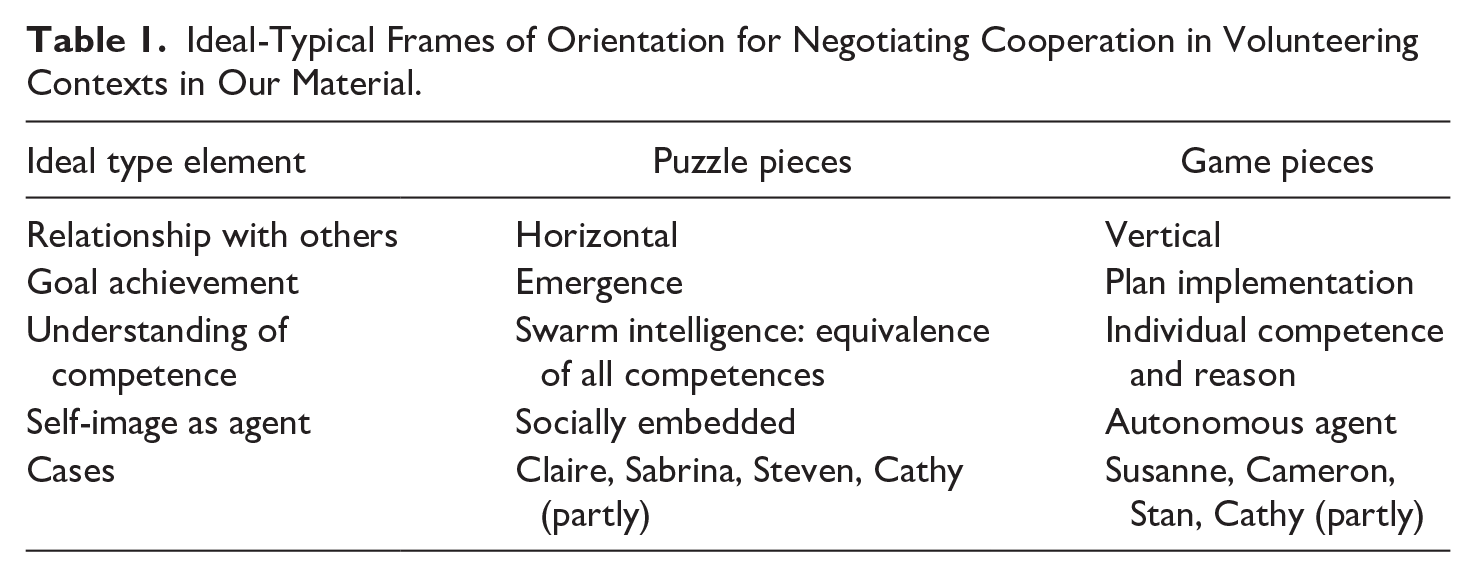
Relations and Scope of Puzzle Pieces and Game Pieces
The purpose of differentiating between the two frames of orientation, namely “puzzle pieces” and “game pieces,” is to typify the narrative modes employed by the volunteers—not to categorize the volunteers themselves. It is not the intention here to pin down the interviewees to a given “style of cooperation,” especially since hybrid orientations regularly emerge among individual empirical cases. This applies to Claire’s narrative, for example, from which we borrowed the term “puzzle pieces.” Her descriptions also show a certain autonomy that she attributes to both herself and her work. It is precisely in criticizing the supposedly irrational “sensitivities” (see above) of others in her parish that she sets herself apart as a person who knows better. In this respect, her narrative is reminiscent of the “game pieces” orientation. Conversely, horizontal relations can occasionally be observed in the narratives reconstructed as “game pieces”: One example is when Cameron talks about church dignitaries such as the bishop or vicar general, with whom he exchanged views on the future of the church at eye level: “With [. . .] arguments, you could talk to him [the bishop, author’s note] in a completely different way” (30-K, Lines 545–546).
The fact that the different modes of representation are not indicative of the narrating volunteers’ integral character traits is also apparent in Cathy’s narrative, which we will, therefore, briefly outline here as our final example. Her narrative is about two Catholic women’s community groups in two different cities. In her account of the first women’s group, Cathy’s narrative is structured in a way that is typical of the “puzzle pieces” frame of orientation: She describes a regular parents’ meeting, which gave rise (in an emergent way) to an increasing number of integration and diversity workshops. These were so successful that their Initiators were invited to collaborate on the city’s concept of “cultural mediators” by the local administration (38-K, Line 209). Cathy describes the creation of the workshops as a collective process of further education, which not only allowed each group member to suggest new experts, but also offered them a space to openly articulate their own lack of knowledge about migration and diversity. Nevertheless, the mode of representation changes with the change in group that is occasioned by her move to a different city: Cathy relates how she shared her experiences with the new women’s group and wanted to initiate similar projects there. However, she was told that the issues she brought up were not relevant in the new group. It is at this point in her account that Cathy reproduces typical characteristics of the “game pieces” narrative structure; not only was she prevented from introducing new ideas, but she also situates herself in a vertical relationship with the other women. The latter, as Cathy describes, wanted to just “be among themselves” (38-K, Lines 817–818) and (from Cathy’s point of view) discuss trivial matters.
Cathy’s example clearly illustrates that the frames of orientation typified above do not (necessarily) represent definitive attitudes or styles of cooperation of the narrating volunteers per se. Her account of the first women’s group is, therefore, initially shaped by the emergence of the unexpectedly successful diversity workshops, while the subsequent account of the second group is largely guided by a strategic plan with which Cathy wishes to inspire her fellow volunteers (however unsuccessfully).
A comparison of the examples discussed in this article demonstrates that successful cooperation is by no means always represented using the emergent “puzzle-solving” structure. Conversely, narratives of strategic “playing” are not necessarily only about conflicts. Instead, we analyze how the specific conflictual relationship between the two ideals of “puzzle pieces” and “game pieces” guides the experience, representation, and evaluation of cooperative relationships in volunteer work. As a result, cooperation can be experienced as successful or difficult in both types of framing—if in different ways.
Discussion
To what extent do the results presented add to the state of research into cooperation in volunteering and into volunteering in general? In our opinion, research into volunteering frequently shares the assumption that volunteer work is important to society (Overgaard, 2019) and that it benefits volunteers (Alfes et al., 2016; Wilson, 2012). This justified assumption is usually followed by a research practice that prioritizes how volunteer work can be better managed (Alfes et al., 2016; Studer, 2016), how volunteers can be more closely connected (emotionally) to their organizations (Farny et al., 2019; Walk & Peterson, 2023), and why social inequality is perpetuated in volunteering (Dean, 2016; Visser et al., 2023). In this respect, we find that there has so far been little room for research focusing both completely on self-organized volunteers and on conflicts between them.
But even where research into volunteering does focus on interpersonal relationships, there seems to us to be a narrowed perspective making it difficult to see why cooperations fail despite the best intentions. Either (a) there is too much focus on the volunteering individual or (b) too much is made of their embeddedness in a collective or milieu.
Regarding point (a) above, we already referred to the criticism that research into volunteering places too much focus on the volunteer and their individual resources (Hustinx et al., 2022, p. 7)—without considering their interactions with other volunteers or analyzing how their ideas are reflected in joint action. Our results here show the consequences different expectations may have on cooperation between volunteers. We noticed that current discourse tends to focus on the relations between salaried staff and volunteers (Einarsdóttir & Osia, 2020; Nagel et al., 2020)—yet many areas of the third sector function without a salaried staff structure. Alternatively, the research is about the relationship between volunteers and service users (Alfes et al., 2015; McAllum, 2018; Rush et al., 2024) which, in our view, also fails to provide a suitable basis of comparison for our question concerning cooperation between volunteers, given the specific power imbalance often inherent in such a relationship. Thus, our research is an attempt to increase the basis of knowledge of the important volunteers-only sector.
With the research suggested here on conflicting ideas of cooperation among volunteers, we are making the case for research on volunteer work to be more relational (Frederiksen, 2022). We emphasize, alongside McAllum (2014), that volunteers define tasks with and among one another. Their agency is, therefore, often connected precisely to their relationships with other volunteers.
To avoid misunderstandings, we also wish to stress that our article is not meant to advocate for the other extreme summarized in point (b) above, viewing volunteering as an expression of close social relationships (O’Toole & Grey, 2015), social belonging (Eckstein, 2001), and value congruence among volunteers (Ihm & Baek, 2021). In our view, this would overstate the significance of interpersonal similarity in relationships and cooperations. Furthermore, the studies cited, with all due respect for their other insights, do not address the conflicts in cooperations and thus contribute little to understanding them.
Compared with the aforementioned studies, we would like to situate our article between individualism and collectivism, as an argument for the usefulness of a perspective focusing more on the interactions and the process of volunteering. We also call upon research into volunteering to regard this phenomenon not only through the lens of its desired objectives but also to understand its challenges (for empirical examples, also see Carlsen et al., 2022; Willems et al., 2012).
Our empirical analysis further suggests that the collective (!) process of coordination, discussion, decision-making, and action can fail even with the best individual intentions of cooperation. Accordingly, volunteering is in no way guaranteed to generate the (social) capital that some impute to it (Mutz et al., 2022). In the volunteering narratives we recorded, entering into and shaping cooperative relationships with others turns out to be a notorious problem. Cooperation here appears not only as a horizontal relationship, as Putnam et al. (1994) argue, but may instead have a vertical orientation. The typology of the frames of orientation is, therefore, based on the attempts of the (former) volunteers to cope with cooperative relationships as documented in the narratives: Cooperation appears less as an individual decision for or against cooperation, as portrayed in our literature review but rather as the collective process of negotiating and shaping its modality.
In sum, this analysis gives rise to three perspectives that should receive greater attention in future research into volunteering. First, we need to know more about cooperation between volunteers, especially those working without supervision by volunteering management; second, we need more research looking at volunteers in their relations (not only in terms of their individual characteristics); and third, we need research into challenges and failures of cooperation.
Practical Insights
All this leaves the question of whether and how the results presented here can (and should) be used to improve volunteer work. It has become clear that one of the challenges of volunteering is that volunteers must agree on the manner of their cooperation. However, the narratives of former volunteers also suggest that negotiating specific modes of cooperation in volunteering is apparently rarely done explicitly or reflected on.
Against this backdrop, our article is, first of all, an invitation to volunteers to reflect on cooperative relationships and processes, which may evidently fail despite the best intentions and shared objectives. In our opinion, this applies even where it might be assumed that these cooperative processes are prepared, directed, and moderated by salaried staff (e.g., Cameron). Indeed, it is our impression that the challenge of differing and conflicting modes of cooperation is not so much an issue in volunteering management that might be resolved by clear organizational instructions. Rather, in our view, shaping the specific cooperation between volunteers forms a genuine part of the experience of volunteering. Therefore, it could well be useful to create spaces/opportunities in volunteering for jointly reflecting on and consciously negotiating issues in practical cooperation. Using the types of “jigsaw puzzle pieces” and “game pieces,” we here provide initial terms and perspectives for starting off the discourse and communication about different ideas of cooperation. Existing research into cooperation also shows that cooperation is likely to be more successful if it is talked about.
In our interviews with former volunteers, we frequently found that the typical challenges of cooperation analyzed here are experienced and narrated as personal conflicts or individual failure in each case. Understanding them as challenges of the field typically faced by volunteers would, in our opinion, provide significant relief and might help reduce the number of people who stop volunteering.
Conclusion
The analysis of the conflicting ideas of cooperation presented in this article stands in clear contrast to an image of volunteering in which cooperation unfolds naturally and free of conflict. In our interviews, cooperation appears to be highly controversial and contingent on many factors. The differences are not only content-related (e.g., finding the best option for rebuilding a church). Our analysis of the narratives makes it clear that fundamental issues related to the mode of cooperation in volunteering are subject to implicit negotiation. Each of the narratives can also be interpreted as a plea for a specific type of cooperative relationship. The narratives shaped by the “puzzle pieces” frame of orientation make a case for acknowledging the equal importance of different competences and portray the sense of community valued by the volunteers as threatened by conflict and competitiveness. In contrast, the narratives that exhibit the “game pieces” frame of orientation argue for the recognition of (the narrator’s own) individual competences as a superior starting point for pursuing rationally justified goals. They oppose the undermining of goal-oriented action by traditions that tend to have a more emotional than rational basis. Our analysis thus shows a conflict between different ideas of cooperation, each of which assigns a different meaning to individual competences, rational decisions, and inclusive togetherness. Cooperation is framed in such a way in the narratives that the volunteers can both realize their own ideas and visions and can—and must—negotiate the mode of cooperation with others (e.g., favoring either inclusiveness or hierarchical relations). But these negotiations seem to happen largely implicitly. While other volunteers’ wrong ideas of cooperation are reported with great relish in our interviews, no mention at all is made of volunteers having a discussion about their way of cooperating. Thus, the challenge for the practical support of volunteers seems to be not only their conflicting ideas of cooperation but also the fact that these appear not to be perceived as something to communicate about.
Future research should investigate the social context of the different modes of cooperation. As we have noticed, the cooperative relationships described in the interviews are frequently negotiated within the context of structural and/or normative conditions for action, for example, budgetary constraints in church congregations, a performance focus in sports clubs, or responsibilities and long-term goals in management boards. It is also conceivable that these two modes of orientation can be related to structures of society (as a whole). In this respect, it is apparent that the volunteering narratives are implicitly geared toward ideas of solidarity and competition. In view of this observation, it can be asked, for example, whether and to what extent the context of a competitive and achievement-oriented society, on one hand, or the social status of the volunteers, on the other, constitutes a relevant experience for their narratives of cooperation.
Footnotes
Data Availability
The data are not publicly available due to ethical, legal, or other concerns.
Declaration of Conflicting Interests
The author(s) declared no potential conflicts of interest with respect to the research, authorship, and/or publication of this article.
Funding
The author(s) disclosed receipt of the following financial support for the research, authorship, and/or publication of this article: This research was funded by the Deutsche Forschungsgemeinschaft (DFG, German Research Foundation)- 419367942 and 236860160.
