




Abstract
The ongoing debate about the distinctiveness of the nonprofit and for-profit sectors has intensified, particularly in light of recent research suggesting increasingly blurred boundaries due to the marketization of the nonprofit sector. In this study, we are the first to analyze mission statements (n = 611,077) from both sectors to examine their distinctiveness and potential overlap. Our findings reveal that while the two sectors remain largely distinct, there is also significant overlap. This similarity is driven by marketization, with nonprofit organizations showing greater alignment with the for-profit sector than the reverse. Our results underscore concerns about the marketization of the nonprofit sector, as we find a negative correlation between marketization (similarity to the for-profit sector) and the expressive functions of nonprofit organizations. Although nonprofit organizations exhibit both strong expressive and instrumental functions, these two dimensions are negatively correlated within the sector, highlighting an inherent trade-off.
Introduction
Although research on the third sector has spanned decades (Salamon & Anheier, 1992), the debate on whether, how, and to what extent it differs from the for-profit sector is far from settled (Salamon & Sokolowski, 2016). While the third sector has been mapped and characterized in many countries (Salamon & Sokolowski, 2018), recent evidence shows signs of eroding sector boundaries (Child et al., 2016; Dees & Anderson, 2017). This sector blurring occurs because organizations that belong to one sector are adopting practices that are typically associated with another sector. In the third sector, this blurring is partly driven by the fact that the rhetoric, organization, and goals of nonprofit organizations (NPOs) are becoming business-like (Maier et al., 2016). In the for-profit sector, blurring is driven by companies increasingly caring about their societal impact by, for example, adopting a triple bottom line and/or corporate social responsibility practices (Albrecht et al., 2018; Latapí Agudelo et al., 2019; Tate & Bals, 2018). Because of this, “it becomes harder and harder to determine an organization’s form (business, government, or charity) based on functional activity alone” (Bromley & Meyer, 2017, p. 957). Although the literature agrees that the two sectors have become more similar, there is no research that quantifies the similarities and differences between the two sectors. The goal of this study is to change this by asking: (a) How similar/distinct is the mission language of nonprofit and for-profit organizations (FPOs)? (b) How does hybridity (i.e., similarity to the for-profit sector) relate to the expressive and instrumental functions of NPOs? and (c) What linguistic attributes make the two sectors more/less similar?
To answer these research questions, we analyzed mission statements from over 600,000 Swiss NPOs and FPOs. Mission statements lend themselves very well to studying sector differences because they can be seen as the centerpiece of an organization’s identity (Kirk & Beth Nolan, 2010; Pandey et al., 2017). We applied both unsupervised and supervised machine learning to test how distinct the mission language of NPOs and FPOs is and used interpretable machine learning to identify the linguistic attributes that make the two sectors more or less similar. We also analyzed how the similarity of NPOs to FPOs relates to the expressive and instrumental functions of these organizations. This was done to ground the analysis in theory, as the “instrumental-expressive distinction offers a parsimonious conception that is fundamental to the nature of non-profit activities” (Lu Knutsen & Brower, 2010, p. 590).
Our results revealed that the third sector emerges as a distinct cluster when clustering the mission statements. The distinctiveness of the third sector is replicated in the supervised machine learning results, which revealed that mission statements can be classified as belonging to the third or for-profit sector with very high accuracy. Predicting the sector membership based on how expressive and instrumental a mission statement is also resulted in high accuracy, confirming the importance of these two functions in distinguishing the third sector from FPOs. While the expressive function of NPOs is substantially more pronounced than that of FPOs, the mean difference in the instrumental functions only results in a small effect. Thus, NPOs are on average substantially more expressive, but only marginally less instrumental than FPOs. However, within NPOs, these two functions seem to be (at least to some extent) a trade-off, as they correlate negatively with each other. Regarding marketization, we found a negative correlation between similarity to the for-profit sector (i.e., marketization) and the expressive function and a positive correlation with the instrumental function.
Our results have implications for both theory and practice. Regarding theory, our results confirm the importance of the instrumental and especially the expressive functions in distinguishing the third sector from FPOs. Our results also reveal that concerns about the effects of the marketization of the third sector are justified, as the similarity to the for-profit sector correlates negatively with the expressive function of NPOs. Marketization seems to be the main driver of the similarity to the for-profit sector, as the similarity of the third sector to the for-profit sector is driven by words that relate to marketization. Regarding practice, our results revealed that the expressive and instrumental functions of NPOs varied more across fields of activities (International Classification of Nonprofit Organization [ICNPO] category) than across legal forms. Thus, when deciding on a legal form (Child et al., 2015), practitioners should worry more about the legal aspects (e.g., member-based or not) than about the potential to carry out expressive/instrumental functions. However, practitioners should be aware that a focus on instrumental functions tends to be associated with a decrease in the expressive functions of an organization.
Mission Statements of NPOs and FPOs
A mission statement defines an organization’s reason for existence (Macedo et al., 2016) and can be seen as the centerpiece of an organization’s identity (Kirk & Beth Nolan, 2010; Pandey et al., 2017). Mission statements communicate the organization’s purpose to both internal (Phills, 2005) and external (Drucker, 2012) stakeholders and also affect the performance of an organization (Berbegal-Mirabent et al., 2021; Kirk & Beth Nolan, 2010; Pandey et al., 2017). Mission statements are particularly important for NPOs because these organizations are guided by a unique set of fundamental values, norms, and motivations that emphasize their strong societal focus (Moore, 2000). As part of their societal focus, nonprofits perform both expressive and instrumental functions (Frumkin, 2009). The instrumental function “focuses on organizations as tools for completing tasks with concrete outcomes, usually with social purposes” (Hager, 2010, p. 1096). This encompasses service delivery and advocacy activities that are intended to drive societal change, often yielding outputs or tangible benefits to stakeholders (Hamidullah et al., 2022). The expressive function of NPOs is to provide a platform for individuals and groups to express their values, beliefs, and interests through various activities and services (Frumkin, 2009; Hamidullah et al., 2022).
The instrumental and expressive functions are not mutually exclusive, and it is often argued and has been shown that NPOs, in contrast to FPOs, possess a more balanced presence of these two functions (Frumkin, 2009; Lu Knutsen & Brower, 2010). According to Frumkin (2009), the expressive and instrumental functions of NPOs are one of the most fundamental reasons why the nonprofit sector exists (Hamidullah et al., 2022). Beyond being useful for understanding the nonprofit sector, these functions have also been shown to be relevant to the operational aspects of NPOs. For example, Hamidullah et al. (2022) found that the public is often more aware of instrumental nonprofit brands. Thus, using the expressive and instrumental functions of nonprofits to understand the sector is relevant for both theory and practice.
In contrast to the societal orientation of nonprofits, the main goal of for-profits is to generate/maximize profits (Tu, 2016). Accordingly, the expressive function of for-profits is seen as less important and less pronounced than that of nonprofits (Clegg et al., 2021). However, for-profits can also enact expressive functions, for example by adopting a triple bottom line and/or corporate social responsibility practices (Albrecht et al., 2018; Latapí Agudelo et al., 2019; Tate & Bals, 2018). Corporate social responsibility can help for-profits attain a more expressive identity (Guimarães-Costa & e Cunha, 2008) and also attract stakeholders with expressive motives who use their transactions with such firms as a means of expressing their values and identity (Chatterji et al., 2009; Statman, 2008; Williams, 2007). Because of this, for-profits are increasingly seen as also being expressive, and not only instrumental, units (Clegg et al., 2021).
Sector Blurring
For-profits becoming more socially responsible is part of a bigger theme, namely that the two sectors are becoming increasingly similar to each other (James, 2017). Just as for-profits are increasingly focusing on their societal impact (Ventura, 2022), nonprofits are increasingly adopting business-like practices (i.e., managerialization, Hwang & Powell, 2009). As shown by Maier et al. (2016), the rhetoric, organization, and goals of NPOs are becoming business-like. A marketization trend has also been observed, with NPOs increasingly relying on commercial income (Eikenberry & Kluver, 2004). By making NPOs focus on services that are financially sustainable, becoming more business-like can negatively affect NPOs’ contributions to society (Eikenberry & Kluver, 2004; Maier et al., 2016). Becoming business-like can also threaten the expressive functions of NPOs, as managerialist methods and increasing competition leave little space for democratic participation (Eikenberry, 2009). Similarly, the positive side effects (e.g., in terms of community building) tend to be minimal for commercial activities (Backman & Smith, 2000).
This phenomenon of organizations adopting practices that are typically associated with another sector can lead to sector blurring. According to the blurring hypothesis (Child et al., 2016; Dees & Anderson, 2017), the boundaries between the nonprofit and for-profit sectors are eroding because the organizations in the two sectors are increasingly becoming alike. Organizations that combine characteristics from both sectors are often referred to as hybrid organizations (Billis, 2010). Hybrid organizations operate on the border between the third and the for-profit sectors and combine organizational features from the ideal-typical FPO and NPO (Suykens et al., 2019). Social enterprises, by combining business practices with a social purpose, are a typical example of hybrid organizations (Doherty et al., 2014).
The degree to which this sector blurring leads to the erosion of the two sectors is still contested (Child et al., 2016). On the one hand, Bromley and Meyer (2017) note that “it becomes harder and harder to determine an organization’s form (business, government, or charity) based on functional activity alone” (p. 957). On the other hand, sector affiliation has been shown to affect purchase decisions when consumers can choose between services/goods from nonprofits and for-profits (Ben-Ner et al., 2018), with consumers generally preferring services/goods from nonprofits to those offered by for-profits (Silvia et al., 2023; Xu, 2020). Similarly, sector boundaries have been shown to be an important guiding feature for practitioners (Child et al., 2016). Thus, while much has been written about sector blurring, the extent to which the sectors are indeed blurred or remain separate is still debated.
Research Questions
The current research aims to analyze the extent to which the sectors are blurred or remain separate. It does so by analyzing the extent to which mission statements from NPOs and FPOs are similar or distinct. As laid out above, mission statements can be seen as the centerpiece of an organization’s identity. Therefore, similarities/differences in mission statements between sectors should reflect meaningful similarities/differences in the sector’s identities.
As laid out above, the literature worries that becoming business-like can threaten the expressive functions of NPOs. To see whether this worry is justified, we will assess the association between the similarity of NPOs to FPOs and their expressive and instrumental functions. This also grounds the comparison of NPOs’ and FPOs’ mission statements in theory, as the “instrumental-expressive distinction offers a parsimonious conception that is fundamental to the nature of non-profit activities” (Lu Knutsen & Brower, 2010, p. 590).
By investigating the linguistic attributes that make the two sectors similar/distinct, the last research question aims to generate insights into how the mission statements of NPOs are similar to those of FPOs and vice versa. This allows us to see whether the sectors are identified by their core activities and whether similarities are driven by words that are related to marketization.
Method
Data
To obtain the mission statements of NPOs and FPOs, we downloaded all entries in the Swiss Central Business Name Index (616,401 at the time of downloading). This index lists all organizations that are registered in the Swiss trade register. By Swiss law, all organizations registered in the Swiss trade register must submit a mission statement. A main strength of these mission statements is that they must reflect the field of activity of an entity in a legally binding way (Schweizerische Eidgenossenschaft, 2007). A total of 17 different legal forms are listed in the Swiss Central Business Registry. We only kept data for the seven most common legal forms, leaving 99.1% of the original data. The legal forms, along with the count and percentage in the final dataset, are shown in Table 1. The legal form was used as a proxy for whether an organization belongs to the third or the for-profit sector. Following previous studies on the Swiss nonprofit sector (Helmig et al., 2017; von Schnurbein & Perez, 2018), organizations that are either a foundation, an association, or a cooperative were treated as belonging to the third sector. Under Swiss law, in addition to commercial entities, all foundations and cooperatives must be registered in the commercial register, whereas associations are generally not required to register (only if they pursue a commercial activity or are obliged by some donors). Even though associations can pursue a commercial activity, their business purpose must not be for profit (according to the Swiss Civil Code). Estimations mention approximately 80,000 associations in Switzerland (Helmig et al., 2017), of which 10,145 are registered. Since Switzerland has several official languages, the mission statements were all translated into English. 1 Before translation, 66% of the mission statements were written in German, 26% in French, and 7% in Italian. Neural machine translation (with the easynmt python package and the M2 M-100 model developed by Fan et al. [2021]) was used to translate the mission statements into English.
Legal Form Frequency Table.

Computational Methods
Natural Language Processing
To analyze text with computational methods, we need to translate the text into numbers. We used the state-of-the-art text-embedding-ada-002 embedding model by OpenAI to do that. This model transforms text into vectors in such a way that texts that are similar to each other end up with similar numerical representations (a vector of, in this case, 1,536 numbers called an “embedding”). To measure how similar the mission statements of the third sector are to those of the for-profit sector (RQ1), we used cosine similarity. Cosine similarity measures the angle between two vectors (embeddings) and is the default measure for textual similarity (Kotu & Deshpande, 2019):

To measure how similar NPOs are to FPOs, we computed the average cosine similarity of a given NPO to all other FPOs. The higher this average cosine similarity, the more similar an organization’s mission statement is to the mission statements of other FPOs. The organizations with the highest cosine similarity operate at the border of the sectors, as these organizations’ mission statements are most similar to those of FPOs. We used the same approach to identify prototypical NPOs by computing the average cosine similarity between a given NPO and all other NPOs.
To identify the effect of hybridity (i.e., similarity to the for-profit sector) on the expressive and instrumental functions of NPOs (RQ2), we adopted a two-stage approach. First, we used structural topic modeling (STM; Roberts et al., 2019) to identify fields of activities (i.e., topics) that are most and least similar to those of FPOs. STM allows us to identify common themes (i.e., topics) in documents and to relate the prevalence of these themes to covariates. We used the cosine similarity as a covariate to check whether certain topics are more prevalent in NPOs that are highly similar to FPOs as measured by the cosine similarity. Second, we analyzed how pronounced the expressive and instrumental functions of the identified topics (i.e., fields of activity) are. This was done by labeling these functions on a scale from 1 to 10 for the 10 documents that are most representative of a given topic. GPT-4 was used to do this labeling (see Supplemental Appendix for the prompt used). GPT-4 has been shown to be highly accurate for such labeling tasks (Savelka & Ashley, 2023). GPT-4 was also used to increase the interpretability of the identified topics. Instead of using the words that are most likely to occur in a given topic to characterize the topic, we used the method by Grootendorst (2022), which uses GPT-4 to provide a short topic label based on the most representative words and documents of a topic (see Supplemental Appendix). The advantage of using a topic model as an intermediary step is that it gives us a way to assess the face validity of the expressive/instrumental labeling by assessing whether fields of activity that we would expect to be more expressive (e.g., religion) or instrumental (e.g., providing affordable housing) are indeed labeled that way.
To additionally assess the strength of the relationship between hybridity and expressive/instrumental functions in a quantitative way, we sampled 100 mission statements for each third sector legal form and ICNPO category and again labeled the expressive/instrumental functions of each mission statement with GPT-4o (n = 2,978). This allowed us to directly answer RQ2 by computing the correlation between the cosine similarity to the for-profit sector (i.e., hybridity) and the expressive/instrumental function score of the mission statements. We also labeled the expressive/instrumental functions for a sample of 400 FPOs to compare the two sectors with regard to their expressive and instrumental functions. To further examine the validity of the expressive/instrumental labeling, we applied the interpretable machine learning techniques described in the methods section to the expressive and instrumental scores to check the validity of the labels. This revealed that words associated with a high expressive and instrumental function score are highly characteristic of these functions (see Supplemental Appendix for details). Finally, we used GPT-3.5 Turbo to assign each NPO mission statement to an ICNPO category. This allowed us to see how similarity to the for-profit sector and expression of expressive/instrumental functions varies across ICNPO categories. All prompts used for the labeling are shown in the Supplemental Appendix.
Unsupervised Machine Learning
If mission statements from NPOs and FPOs differ meaningfully (RQ1), unsupervised machine learning algorithms should be able to infer the sectors from the mission statements. This is because unsupervised learning algorithms, such as clustering, group data based on inherent similarities without having access to any pre-labeled categories. Thus, if the language or themes of the mission statements meaningfully differ by sector, these algorithms should automatically group them into distinct groups corresponding to each sector. To see whether unsupervised machine learning is able to identify the two sectors, we projected the 1,536-dimensional vectors down to two dimensions and then visually inspected the clusters to check whether the two sectors emerged as separate clusters. By reducing the information contained in the embeddings from 1,536 to two numbers, the algorithm is forced to retain only variation that is substantial and meaningful. To perform the dimensionality reduction, we used the UMAP algorithm, which is one of the most widely used and best-performing dimensionality reduction algorithms (Becht et al., 2019). We then clustered the 2D embeddings with the state-of-the-art HDBSCAN clustering algorithm (McInnes et al., 2017) to check to what extent the identified clusters align with the sector membership.
Supervised Machine Learning
The unsupervised machine learning approach to test for sector differences can be seen as a very conservative approach to test for sector differences in the mission statements, as these methods do not have access to the true sector labels. We therefore also used supervised machine learning algorithms to test how distinct the mission statements of the two sectors are (RQ1) and to identify linguistic attributes that make the two sectors more/less similar (RQ3). In contrast to unsupervised machine learning, supervised machine learning algorithms have access to the true sector labels as the algorithm is trained to optimally separate (i.e., classify) the labels based on the input features (i.e., embeddings). If the mission statements of the two sectors differ meaningfully, these algorithms should be able to classify the mission statements as belonging to the third or for-profit sector with high accuracy. We trained an XGBoost classifier to test whether the algorithm can successfully discriminate between third sector and for-profit sector organizations based on the mission statement embeddings. We used XGBoost because this algorithm performs very well in various classification tasks (Shwartz-Ziv & Armon, 2022). To avoid overfitting, we used five-fold cross-validation to train and evaluate the model. Since the classes are highly imbalanced, we also trained a model on a balanced dataset (i.e., the same number of observations for each legal form, see Supplemental Appendix). To test the robustness of the classification, we also trained a classifier on a reduced set of features (i.e., words) by removing frequent words (e.g., removing words that occur in more than 20% of the mission statements per legal form, see Supplemental Appendix). This was done to test whether the differences in mission statements are indeed meaningful or are just driven by some frequent (legal form-specific) keywords.
By examining how often cooperatives, associations, and foundations are wrongly classified as belonging to the for-profit sector, we get another idea of how (dis)similar these organizations are to FPOs. That is because, all else being equal, classification is harder for classes that have similar attributes (i.e., mission statements) than for classes that have dissimilar attributes. NPOs that are more similar to FPOs should therefore be misclassified more often than NPOs that are less similar to for-profits. The percentage of misclassified NPOs provides another estimate of how much overlap exists between the two sectors.
To understand how these classifiers arrive at their decisions, we use interpretable machine learning techniques to examine which words are most informative for classification. The commonly used SHAP values (Lundberg, 2017) allow us to see how important a given feature (i.e., word) is over all observations and in what direction (and to what extent) the feature affects the classification for each observation. These values were calculated on an XGBoost model that used the words and not the embeddings as input features, as the embeddings are not inherently meaningful. To remove irrelevant words, words that are directly related to the legal form of an organization (e.g., “association”) and words that occur in less than 0.1% of the mission statements were removed. 2
Results
Descriptive Results
Figure 1 shows the similarity of NPOs to FPOs (A) and to other NPOs (B) by ICNPO category and legal form. On average, the mission statements of organizations labeled with the ICNPO categories “Religion” and “Health” are the least similar to those of FPOs, while those with the ICNPO category “Development and housing” and “Business and professional associations, unions” are the most similar. For most ICNPO categories, the mission statements of cooperatives are significantly more similar to those of FPOs than the mission statements of associations or foundations. The size of this difference is substantial: the difference in the average similarity to the for-profit mission statements amounts to a Cohen’s d of 0.81 when comparing cooperatives with foundations and a Cohen’s d of 0.62 when comparing cooperatives with associations. The difference in average similarity to the for-profit mission statements between associations and foundations only yields a small effect of d = 0.14 (all
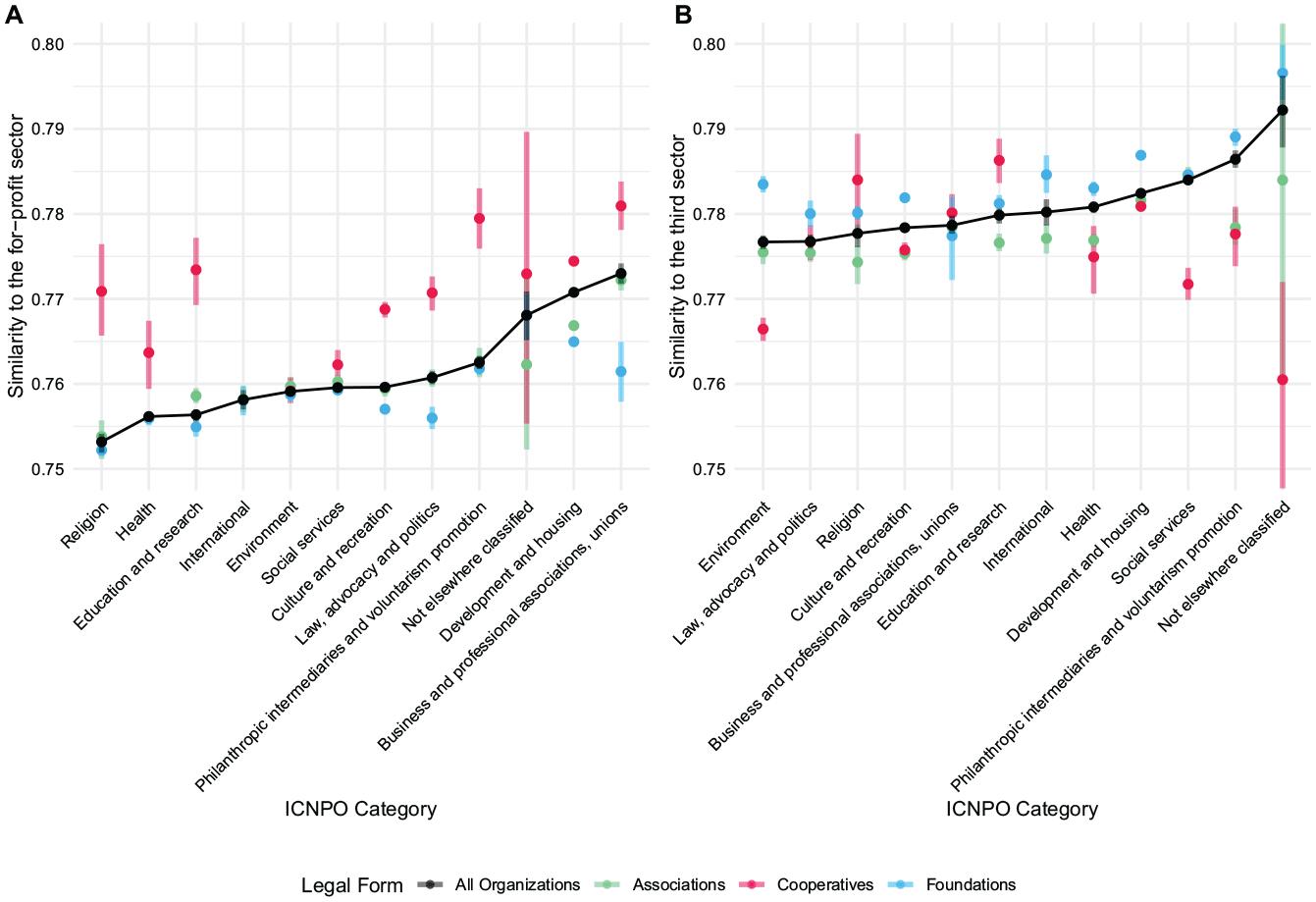
Similarity to the For-Profit (A) and Third (B) Sector by ICNPO Category and Legal Form. Error Bars Represent 95% Confidence Intervals.
Looking at how similar NPOs’ mission statements are to each other (Figure 1B), we see that on average, mission statements labeled with the ICNPO categories “Environment” and “Law, advocacy and politics” are least similar to other NPOs. In contrast, mission statements labeled with the ICNPO categories “Philanthropic intermediaries and voluntarism promotion” and “Not elsewhere classified” are most similar to other NPOs. The differences in similarity across the ICNPO categories are again substantial. For example, the difference between the ICNPO category that on average is least similar to those that are on average most similar to the other NPOs amounts to a large d = 0.96. To test whether the legal forms or ICNPO categories can better explain the variation in the cosine similarity, we again performed an ANOVA with the cosine similarity to the third sector as the dependent variable and the legal form and ICNPO category as independent variables. These two variables were able to explain 4.1% of the variance in the cosine similarities. Partial
Comparing Figure 1A and 1B reveals that, on average, NPOs are more similar to other NPOs than they are to FPOs. However, 9% of all NPOs are more similar to FPOs than they are to other NPOs (25.9% of cooperatives, 7.3% of associations, and 2.0% of foundations are more similar to the for-profit sector than to the third sector). Looking at for-profits, only 1.1% of all mission statements are more similar to NPOs than to other FPOs. This reveals that the similarity to the other sector (i.e., hybridity) is more pronounced in the third than in the for-profit sector. This is also our first evidence of, at least partially, blurred boundaries between the two sectors.
Figure 2 plots the mean expressive and instrumental functions by field of activity (A) and legal form (B) of the 3,378 mission statements where the expressive and instrumental functions were rated by GPT-4o. FPOs are on average drastically lower in their expressive function than NPOs, but only slightly higher in their instrumental function. The mean difference in the expressive function score between NPOs (M = 4.7) and FPOs (M = 1.9) amounts to a large Cohen’s d = 1.39, while the difference in the instrumental function score amounts to a small Cohen’s d = 0.22 (
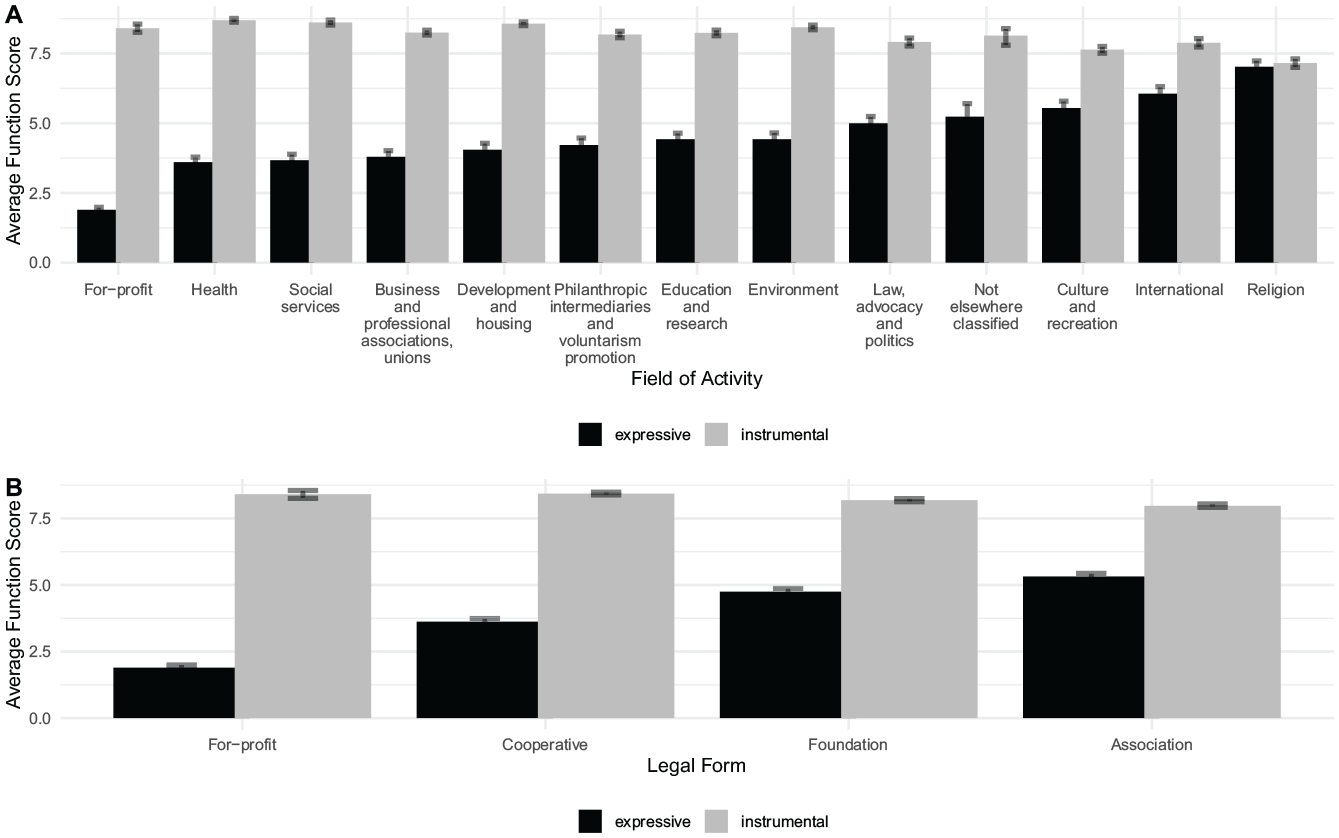
Expressive and Instrumental Function Scores by ICNPO Category (A) and Legal Form (B). Error Bars Represent 95% Confidence Intervals.
Figure 3 shows how the expressive and instrumental function scores relate to the similarity to the for-profit sector (A) and the similarity to the third sector (B). The correlation between the cosine similarity to the for-profit sector and the expressive function score is negative for associations (
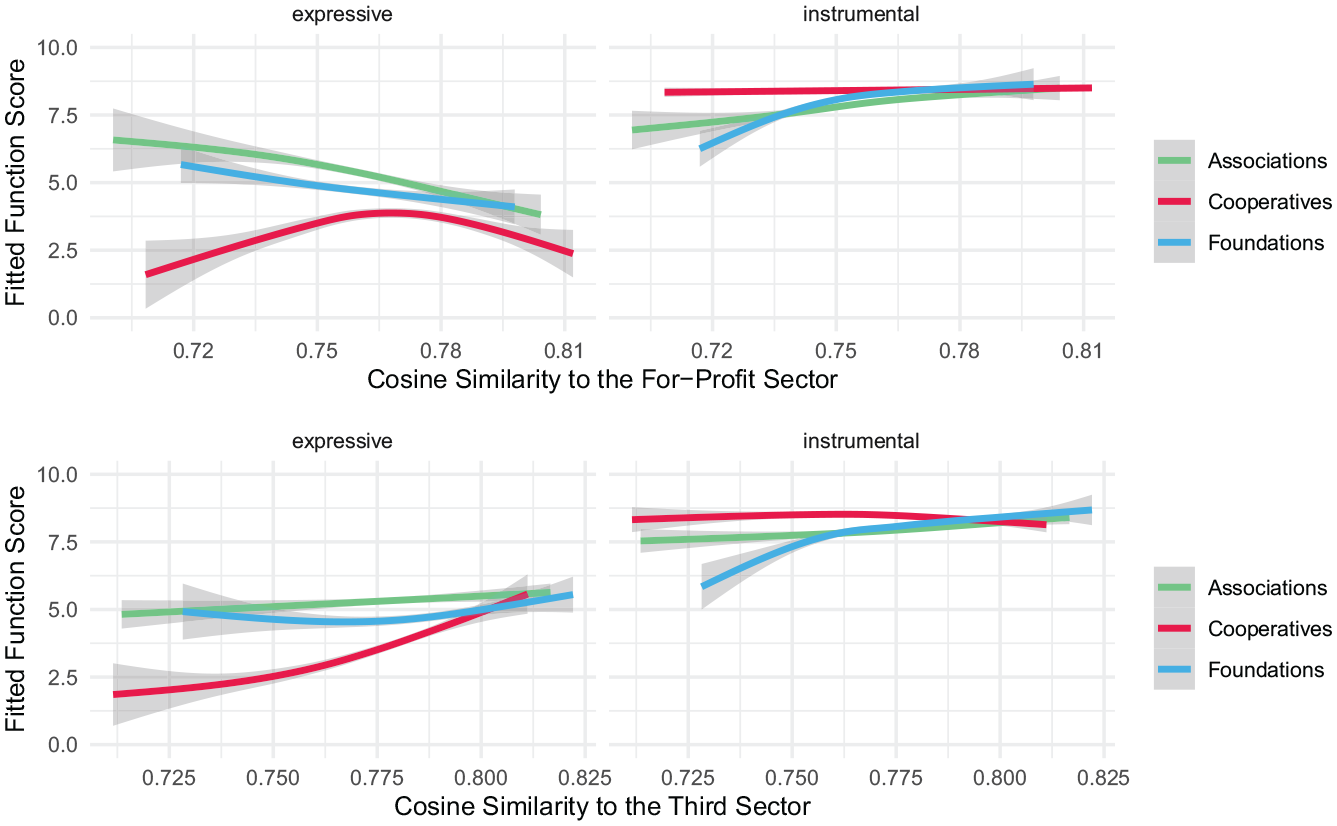
Association Between Expressive and Instrumental Functions and the Similarity to the For-Profit (Top) and Third (Bottom) Sectors by Legal Form.
Unsupervised Machine Learning
Figure 4 shows the result of reducing the dimensionality of the mission statement embeddings from 1,536 down to two dimensions. The plot shows the mission statements colored by legal form (A) and by the clusters that were identified by the HDBSCAN clustering algorithm (B). Figure 4A shows that NPOs form a separate cluster in the lower left that is quite well separated from the for-profit sector. This cluster was also identified as a separate cluster by the HDBSCAN clustering algorithm (Figure 4B, red cluster). To evaluate how well the clustering separated the NPOs from the FPOs, we calculated the homogeneity score. Homogeneity ranges from 0 to 1 and measures the extent to which clusters are made up of data points that are members of a single class. If third sector and for-profit mission statements are not mixed in the identified clusters, the homogeneity score would be 1. Using the sector labels as class labels, we found a homogeneity score of 0.76. This indicates that the clustering did well, but not perfectly, in separating third sector and for-profit mission statements.
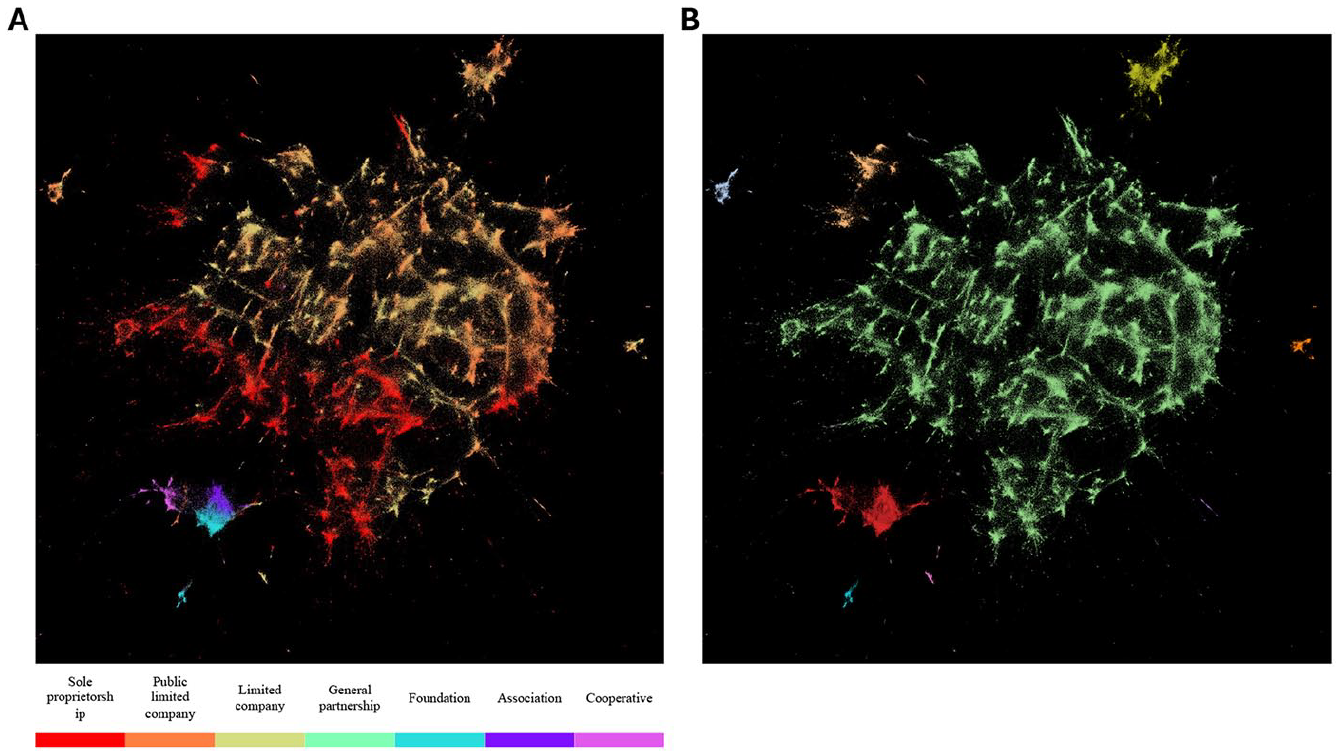
The Two-Dimensional Mission Statement Embeddings Colored by Legal Form (A) and Cluster Labels (B).
We next present the results of the structural topic model to see how the similarity to the for-profit sector relates to the missions (i.e., topics) that NPOs pursue. Figure 5 shows the topics identified by the topic model and whether these topics are more (positive estimate) or less (negative estimate) prevalent in mission statements that are more similar to the for-profit sector (as measured with the cosine similarity). The topics are colored by how expressive and instrumental they are as determined by the 10 mission statements that are most representative of a given topic. 3 This provides another measure of how the expressive and instrumental functions differ across similarities to the for-profit sector and field of activities (i.e., topics). The results regarding the expressive and instrumental functions broadly replicate the analysis shown in Figure 3, namely that mission statements tend to get more instrumental as they become more similar to the for-profit sector and vice versa for the expressive function (RQ2). The results also provide face validity for the labeling of the expressive/instrumental functions, as the expressive-instrumental colors of the topics match well with what one would expect based on the topic description. The topic model also clearly shows that economic activities become more prevalent as the similarity to the for-profit sector increases (e.g., “Cooperative Banking Business Operations,” “Economic Cooperation in Agriculture Cooperative,” and “Economic Promotion of Dairy Industry”). On the other hand, as the similarity to the for-profit sector decreases, the prevalence of topics that are typical for NPOs increases (e.g., “Human Rights and Dignity Advocacy,” “Humanitarian Aid Projects in Developing Countries,” and “Global Initiatives for Sustainable Future”).
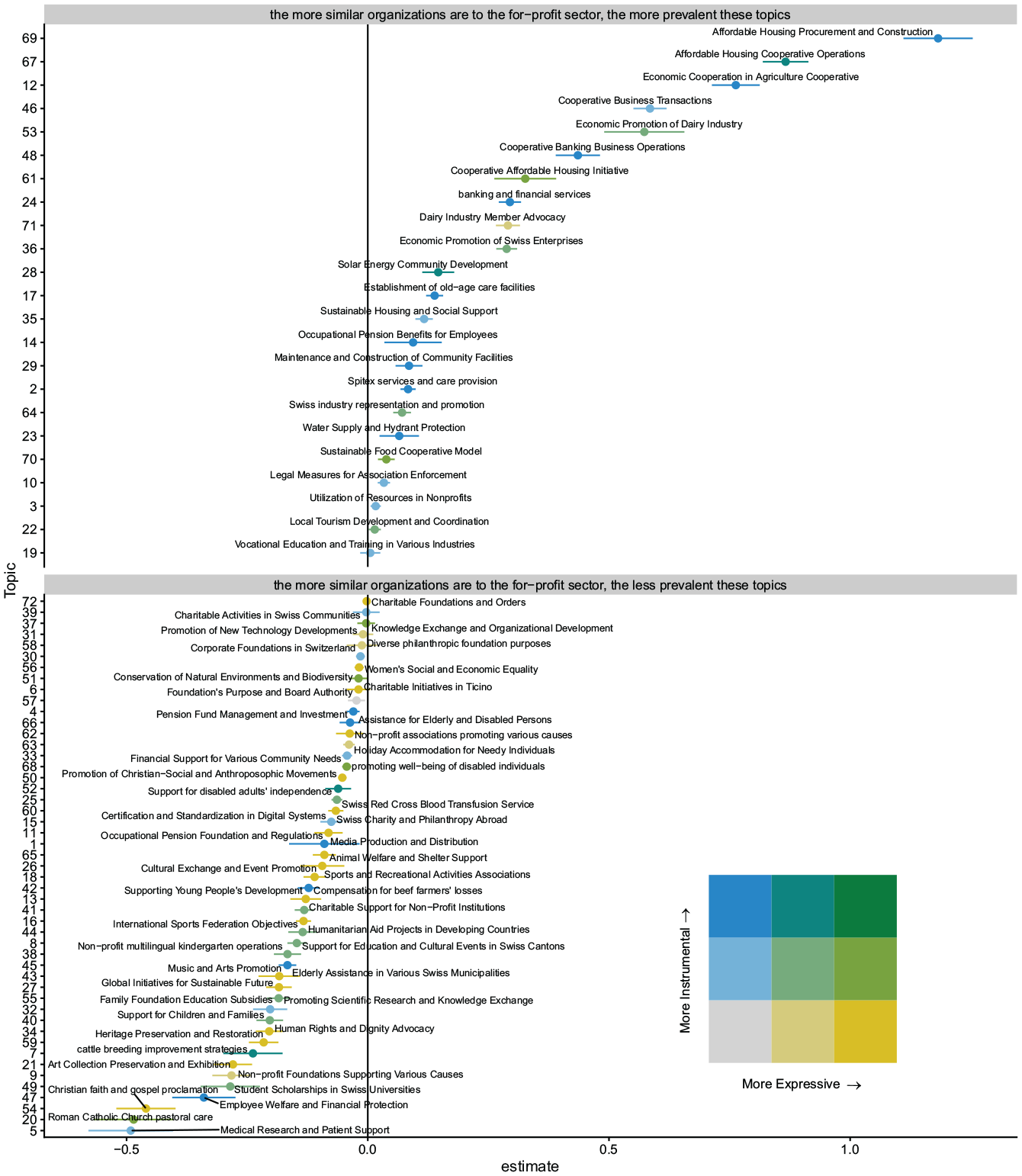
Results of the STM Model With the Similarity to the For-Profit Sector as a Covariate. The Larger the Estimate, the More Likely Is a Topic to Occur in a Mission Statement That Is More Similar to the For-Profit Sector and Vice Versa. Error Bars Represent 95% Confidence Intervals.
This set of analyses demonstrated that the mission statements of NPOs and FPOs differ meaningfully (RQ1), and that this difference relates to how expressive and instrumental their missions are (RQ2). However, this approach was limited by the fact that these (unsupervised) algorithms did not have access to the true sector labels. The results presented in the next section alleviate this limitation by being based on supervised machine learning algorithms.
Supervised Machine Learning
As described in the Method section, we trained XGBoost classifiers to test whether the algorithm can successfully discriminate between NPOs and FPOs. Figure 6 plots the confusion matrix, which shows how well the legal form that was predicted (rows) aligns with the actual distribution of the classes (columns). Looking at the results from the classifier trained on the full dataset, we see that it is not uncommon for NPOs to be misclassified as FPOs (in 11.36% of cases for cooperatives, 13.36% for associations, and 5.46% for foundations). However, as mentioned in the Method section, the high prevalence of for-profit mission statements could bias the classifier and result in over-prediction of this class. Looking at the confusion matrix from the balanced dataset, we see that this is indeed the case. The share of NPOs that were wrongly classified as FPOs drops substantially to 1.57% for cooperatives, 0.9% for associations, and 0.39% for foundations. These results show that cooperatives seem to be most similar to FPOs because they were most often misclassified as such, followed by associations and foundations. Interestingly, for-profit mission statements were misclassified as belonging to the third sector to almost the same degree as third sector mission statements were misclassified as belonging to the for-profit sector (1.99% vs. 2.86%). This reveals that, in addition to third sector mission statements that are very similar to for-profit ones, there are also for-profit mission statements that are very similar to those of the third sector.
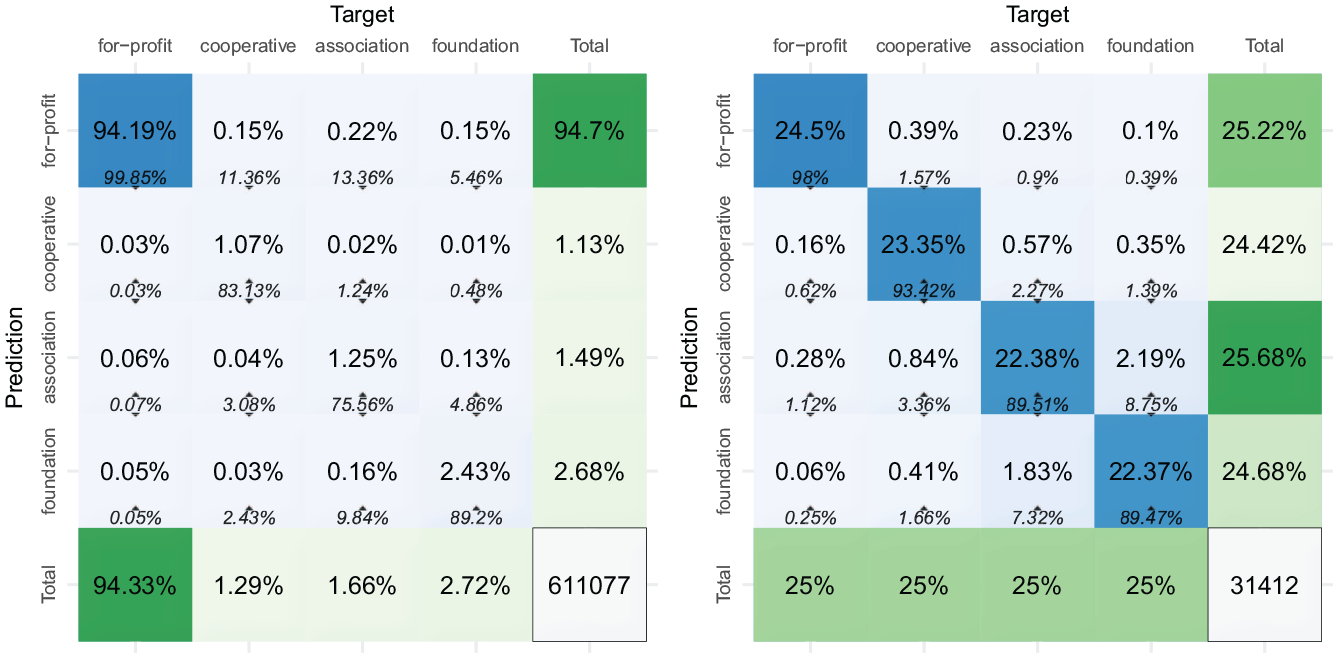
Confusion Matrix Based on an XGBoost Multiclass Classifier. The Values Beneath the Cell Percentages Show the Column Percentages. Left: Classification Results Based on All Data. Right: Classification Results Based on a Down Sampled Balanced Sample to Address the Class Imbalances.
The fact that mission statements can be classified with such high accuracy (the balanced accuracy, which is the mean of sensitivity and specificity, is 0.92 for the imbalanced data and 0.95 for the balanced data) confirms the results of the unsupervised machine learning, namely that the mission statements differ substantially by sector (RQ1). This high accuracy is especially impressive given that the classifier faced a multiclass classification problem. That is, it had to classify a mission statement as coming from an association, foundation, cooperative, or from an FPO. If we simplify the classification problem by only making the classifier predict whether the mission statement belongs to the third sector or not (i.e., having two instead of four classes), the balanced accuracy increases to 0.97 for the imbalanced and 0.99 for the balanced data. The performance of the classifier is quite robust to removing frequent words per legal form, as the balanced accuracy of the model that is trained on the embeddings where frequent words were removed is still very high (0.96 for the balanced data). This suggests that the classification is driven by meaningful differences in the mission statements and not just by frequent legal-form-specific keywords (e.g., “company”).
To see how well the expressive and instrumental function scores can be used to discriminate NPOs from FPOs, we trained the same model but now with these scores instead of the mission statement embeddings as input features. This classifier still achieves a respectable balanced accuracy of 0.64 in the two-class (for-profit vs. third sector) case and 0.61 when using four classes as the prediction target (for-profit, association, foundation, and cooperative).
Interpretable Machine Learning
Which features (i.e., words) does the classifier use to distinguish between third sector and for-profit mission statements (RQ3)? To answer this question, this section presents results from interpretable machine learning techniques to identify which features (i.e., words) are most predictive of a mission statement belonging to either the for-profit or third sector. Figure 7 plots the words that, on average, have the highest absolute effect on
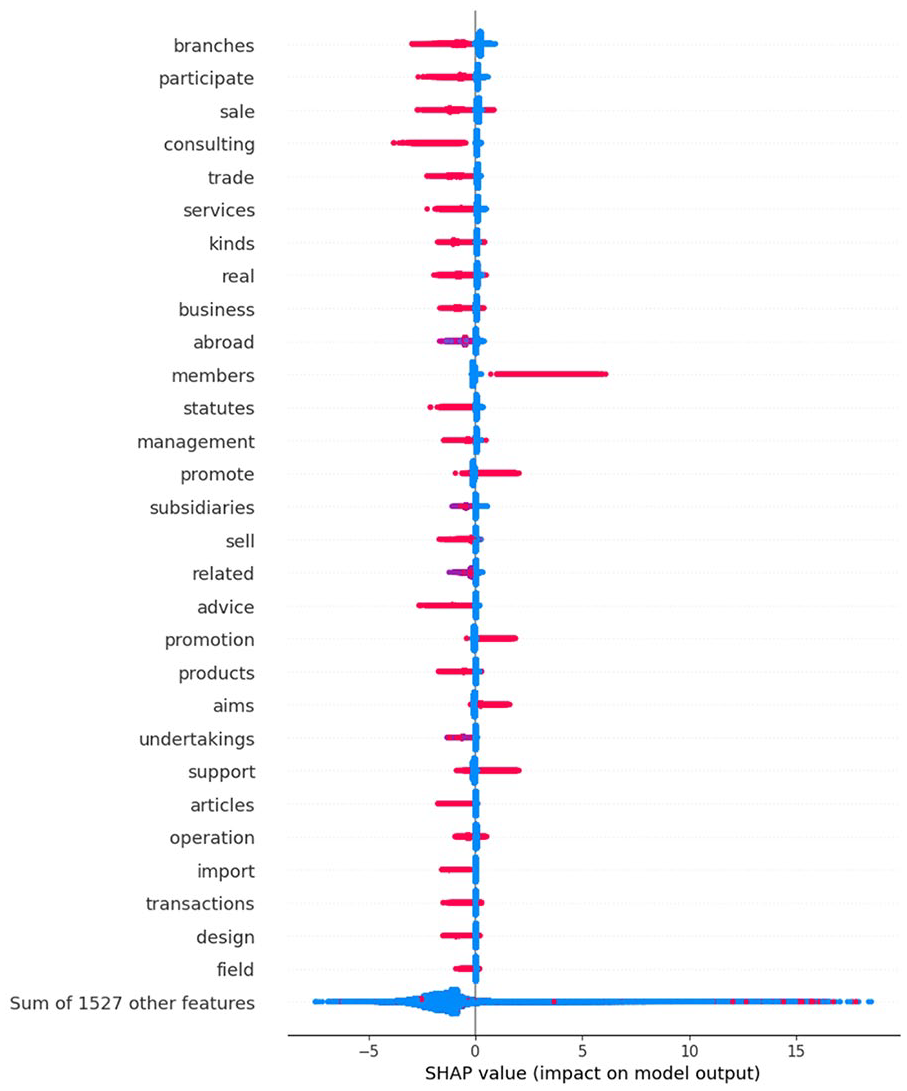
The 30 Words That, on Average, Have the Highest Absolute Effect on
To see whether words that are indicative of a mission statement belonging to a given legal form differ across legal forms, Figure 8 plots the words with the largest positive mean effect on
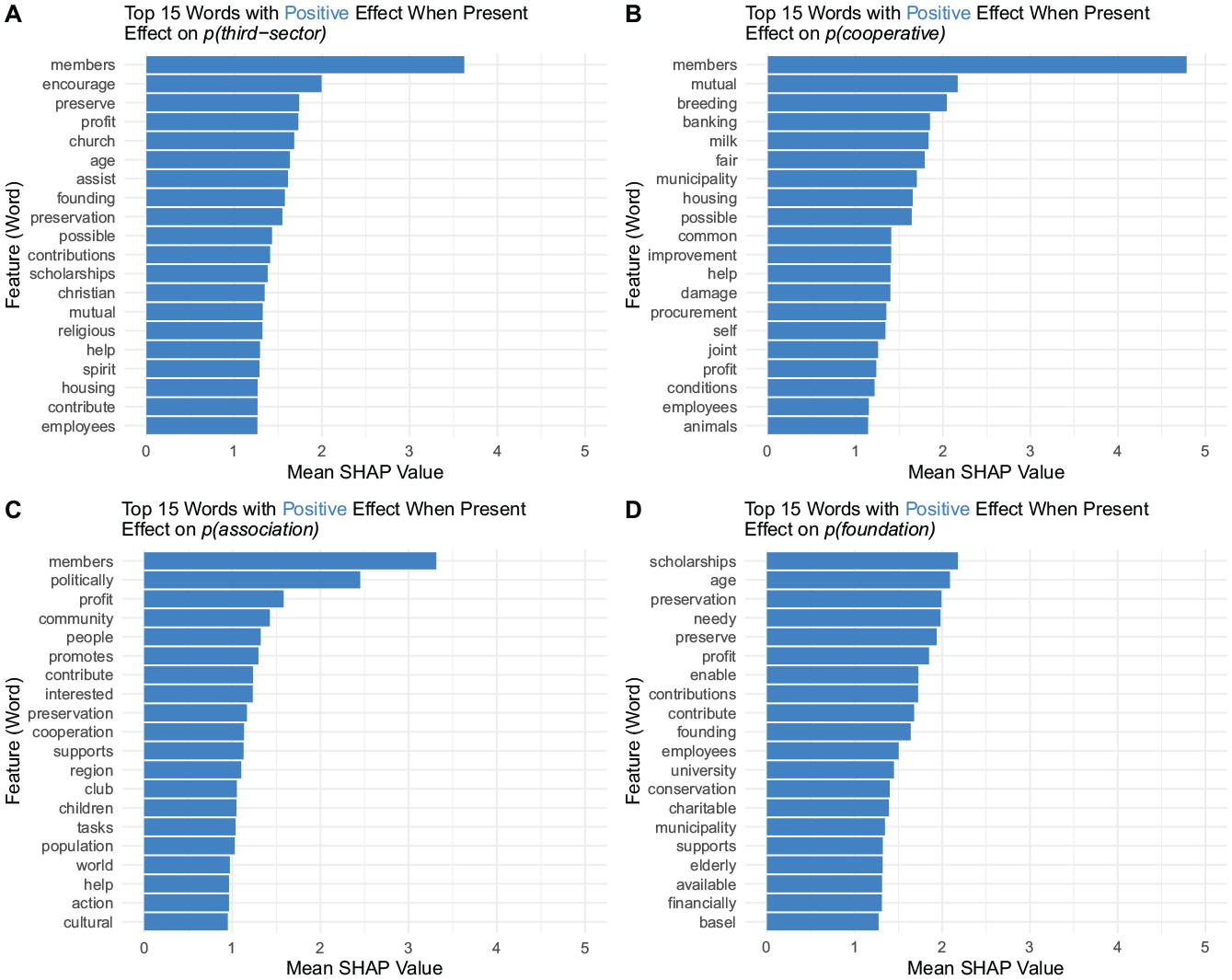
Words With the Largest Effect on
To give a more complete picture, Figure A3 in the Supplemental Appendix plots the 150 words whose presence has the largest positive effect on
The interpretable machine learning analysis revealed that the supervised machine learning algorithms use highly sector-specific and meaningful features (i.e., words) to predict sector membership. While the unsupervised machine learning analysis revealed that the similarity between the third sector and for-profit mission statements is in part driven by words that are indicative of market-related activities, the supervised machine learning classifier clearly uses the presence of such words as a signal that the mission statement does not belong to the third sector. This can be explained by the fact that these words overwhelmingly occur in FPOs’ mission statements and are therefore a highly informative signal, which the classifier picks up. But since these words are so prevalent in FPOs’ mission statements, they also boost the similarity of third sector mission statements to for-profit mission statements and lead to misclassifications to the extent that these words are present in third sector mission statements. Plotting the words with the largest negative effect on
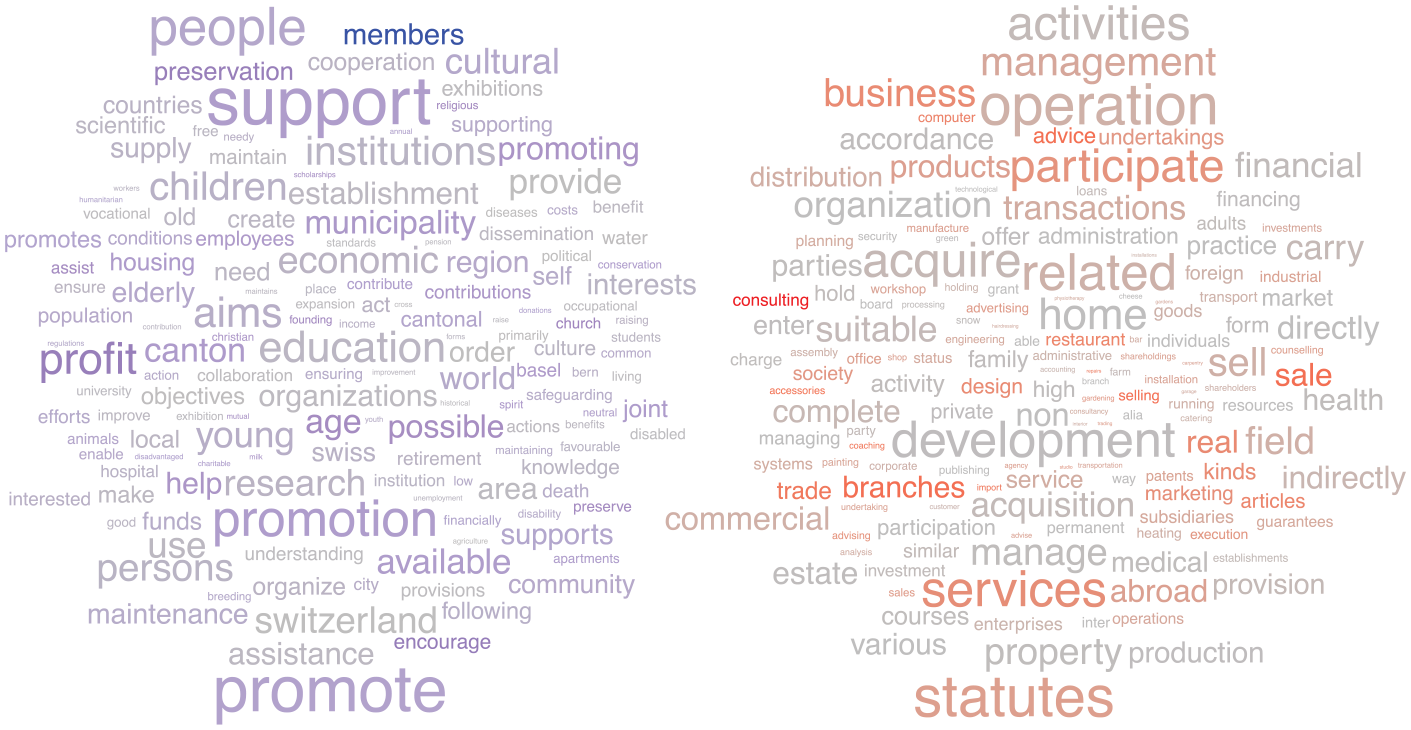
Left: 150 Words With the Highest Positive Impact (SHAP Value) Among the Words That Positively Affect
Discussion
The distinctiveness of the third sector has been studied and debated for decades (Salamon & Anheier, 1992; Salamon & Sokolowski, 2016). More recently, the phenomenon of sector blurring has received a lot of attention (Child et al., 2016; Dees & Anderson, 2017), in part due to evidence of the marketization of the third sector (Maier et al., 2016). We contribute to this literature by being the first to use mission statements from both the NPOs and FPOs to quantify how distinct the two sectors are. The results from both the unsupervised and supervised machine learning showed that the third sector is distinct from the for-profit sector (RQ1). However, in line with the literature on the blurring of the two sectors (Child et al., 2016; Dees & Anderson, 2017; Plummer et al., 2020), there is also some overlap. For example, 1.99% of the for-profit mission statements were wrongly classified as belonging to the third sector, and 2.86% of the third sector mission statements were wrongly classified as belonging to the for-profit sector. This is evidence of blurring boundaries, as the machine learning algorithm was literally not able to implement a decision boundary that would correctly classify these organizations.
To ground this rather technical analysis in theory, we analyzed how expressive and instrumental functions relate to the similarity to the for-profit sector. Our results confirmed that these two functions are fundamental in distinguishing the two sectors (Frumkin, 2009), as mission statements could still be classified with high accuracy based only on how pronounced these two functions are. These results also revealed that NPOs’ mission statements are substantially more expressive than FPOs’ mission statements, but only slightly less instrumental. Similarly, within the third sector, the expressive function showed greater variance than the instrumental function. This suggests that future research should focus on the expressive function when studying the differences between the third sector and FPOs. As the third sector differs from the for-profit sector, especially in its expressive function, the distinctiveness of the third sector is particularly threatened by the trend of FPOs becoming more expressive (Clegg et al., 2021).
The result that third sector organizations are substantially more expressive but only slightly less instrumental than FPOs is also relevant for practitioners, as it confirms that third sector organizations can be highly expressive without sacrificing too much of their instrumental function (as compared to for-profits; Frumkin, 2009). Thus, when choosing a (third sector) legal form (Child et al., 2015), founders should focus on legal form-specific restrictions (e.g., whether they are allowed to have members) instead of worrying about the potential to be expressive/instrumental. When choosing between founding a third sector organization or a FPO (Child et al., 2015), practitioners should keep in mind that, on average, FPOs tend to be substantially less expressive. However, this does not mean that FPOs cannot be expressive, as there is no law (in Switzerland) that restricts for-profits in this domain. Thus again, practitioners should focus on the legal implications of choosing a given legal form. For example, it is generally easier to raise capital for FPOs (Lyons et al., 2007).
Although our results showed that third sector organizations are high in both expressive and instrumental functions (as compared to for-profits), the negative correlation between the expressive and instrumental functions within third sector organizations indicates that third sector organizations face a trade-off between these two functions. In other words, third sector organizations that score high in their instrumental functions tend to score lower in their expressive functions. Thus, the worries about the effects of the marketization of NPOs (Eikenberry, 2009; Eikenberry & Kluver, 2004; James, 2017) seem to be, at least to some extent, justified. This is corroborated by the negative correlation between the similarity to the for-profit sector (e.g., marketization) and the expressive function of third sector mission statements (RQ2). However, it is important to point out that this is correlational and cross-sectional evidence. Thus, future research should use panel data to test whether marketization leads to a decrease in expressive functions within organizations. Our results also showed that marketization is the main driver in the similarity of NPOs to FPOs (RQ3), as words related to marketization are prevalent in third sector mission statements that were misclassified as belonging to the for-profit sector. This reveals the promise of using organizational language to study marketization as another contribution of this study.
While being the first study to use mission statements from both NPOs and FPOs to examine sector similarities, our study is not without limitations. First, we cannot assess the extent to which the mission statements are a true reflection of the activities of the organizations. However, there is a legal basis to the mission statements stating that the purpose of an organization must become clear from the mission statement. Thus, we can at least expect a reasonable congruence between the mission statements and the activities of organizations. Second, our analysis is based on cross-sectional data. Future research could replicate our analysis with longitudinal data to study how sector blurring has evolved over time. This would also allow more robust claims to be made about the effect of marketization on third sector organizations. Third, while mission statements and the expressive/instrumental functions have been shown to affect the performance of an organization (Hamidullah et al., 2022), our study does not provide any measure of how the similarity to the for-profit sector affects the (financial) performance of the organizations. Future studies could use our methods to measure similarity to the for-profit sector and augment the data with financial data to assess the impact of an increase in similarity to the for-profit sector on financial performance. Fourth and finally, our analysis provides a sector-level analysis. While this is a strength of this study as this has not been done before, future research could take a more micro-level approach by focusing on specific subsectors (e.g., health).
While we approached the study of the similarity of NPO’s to FPO’s mission statements through the lenses of hybridity and marketization, other perspectives could also be adopted in future research. A promising approach that comes to mind is to study sector differences through the lens of the Sustainable Development Goals (SDGs). An advantage of using the SDGs is that they could be used as a sector-spanning taxonomy to classify fields of activities. Existing taxonomies are sector-specific (e.g., ICNPO codes) and do not allow for easily classifying activities across both sectors. Using this approach, one could compare the missions of NPOs and FPOs that are active in the same SDG. This would also allow us to assess the similarity of NPOs and FPOs within the same service area (i.e., SDG). In our study, we only controlled for the area of activity in the third, but not the for-profit, sector. Due to recent advances in detecting SDGs in texts (Meier et al., 2021; Wulff et al., 2023), such an analysis should be feasible and would also answer calls for more research on the third sector and the SDGs (Meier, 2023).
Conclusion
To conclude, our study revealed that the third sector forms a distinct cluster from the for-profit sector but that there is also some overlap between the sectors. Although there seems to be some overlap between sectors, the statement that “it becomes harder and harder to determine an organization’s form (business, government, or charity) based on functional activity alone” (Bromley & Meyer, 2017, p. 957) seems to be an exaggeration, at least in the Swiss context. However, the distinctiveness of the third sector might be threatened by FPOs becoming more expressive (Clegg et al., 2021; Statman, 2008).
Supplemental Material
sj-pdf-1-nvs-10.1177_08997640241300509 – Supplemental material for From Mission to Market: Assessing Sector Overlap Between Nonprofits and For-Profits
Supplemental material, sj-pdf-1-nvs-10.1177_08997640241300509 for From Mission to Market: Assessing Sector Overlap Between Nonprofits and For-Profits by Dominik S. Meier and Georg von Schnurbein in Nonprofit and Voluntary Sector Quarterly
Footnotes
Declaration of Conflicting Interests
The author(s) declared no potential conflicts of interest with respect to the research, authorship, and/or publication of this article.
Funding
The author(s) disclosed receipt of the following financial support for the research, authorship, and/or publication of this article: Dominik S. Meier acknowledges support from the Google Cloud Research Credits program (award GCP203305752) and funding provided by the Gradel Institute of Charity, New College, University of Oxford.

Supplemental Material
Supplemental material for this article is available online.