




Abstract
Despite a regional Dutch foundation’s inclusive mission to respond to the growing ethnic diversity in the Netherlands, its funding for immigrant grassroots organizations has fallen behind its funding for other grassroots organizations. Since 2011, the disparity in funding has been growing without any prior change in the foundation’s mission and goals. This study investigates why immigrant grassroots associations (IGAs) are more likely to be excluded from funding than other grassroots associations (GAs). It examines possible underlying causes from the perspective of grant-making foundation staff by comparing the written language they use when rejecting applications from IGAs with those of other GAs. We offer a sense-making perspective on grant-making to demonstrate a tendency toward groupism among grant-makers, particularly in ambiguous decision-making situations. Although the ethnic particularity of IGAs’ grant applications does not appear to be a dominant reason for rejection, foundation staff’s interpretation of their quality leads to a higher rejection rate of IGAs. This study helps the understanding of the role of sense-making in exclusionary assessment practices in endowed foundations and its implications for foundations’ pursuit of inclusive grant-making.
Introduction
Ideally, endowed foundations fulfill their missions and goals by funding organizations whose projects contribute to them. Grant-making practice, however, is tricky because it consists, at its core, of interpreting the ways grant proposals may serve the mission and goals of the foundation, especially when they translate into ambiguous policies. To allocate grants that lead to the best possible outcomes, grant-makers must determine what information they need about applicants and proposed projects and be able to interpret that information effectively. In addition, grant-makers must balance the needs of grant-seekers against the mission of the foundation in an environment of unclear and changing societal challenges, confusing information, and conflicting interpretations (Leat et al., 2018). Our study reflects a sense-making perspective, which views grant-making as an ongoing process of perception and imagination based on past experiences and hopes for the future (Leat, 2007). Exclusion from funding following negative assessments of project proposals allows grant-makers to safeguard the foundation’s mission, which is part of their professional role. This can lead to unintended consequences for both grant-seekers and the fulfillment of the foundation’s mission, particularly in ambiguous decision-making situations where grant-makers rely on their own sense-making.
The motivation for this study is to better understand how sense-making influences their decisions to recommend rejection of applications. Sense-making theory emphasizes the retrospective nature of decision-making, in which decisions are based on past actions rather than future goals. It explains how improvisation, plausibility of narratives, and bounded rationality contribute to decision-making (Weick et al., 2005). The theory is not widely known in foundation literature on philanthropic decision-making, possibly due to lacking accessibility provided by foundations to data on their giving patterns and practices (Bekkers, 2022). When grant-making practices result in funding decisions that diverge from the philanthropic mission, an interpretive analysis of the stated grant-making policy and its implementation by grant-makers can help explain this divergence.
This article addresses grant-making practices in a Dutch regional endowed foundation, particularly with regard to the assessment of grant applications from two categories of grant-seekers: immigrant grassroots associations (IGAs) and other (non-immigrant) grassroots associations (GAs) in a period marked by profound societal and demographic changes. It builds on the rapidly changing ethnic composition of the Dutch population due to immigration during the research period (2002–2016) when the foundation increasingly excluded IGAs from funding. We explore differences in grant-rejection rates between IGAs and other GAs from the perspective of grant-makers (i.e., foundation staff charged with assessing grant applications). We examine factors in the assessment process that drive grant-makers to recommend rejection of grant applications by analyzing documents written by grant-making staff members, given the pivotal role of language use in the construction of meaning and sense-making (Whittle et al., 2023). We identify private and shared values underlying a consensus established over time, whether formalized in policy or unwritten, which informs the assessment of grant applications and its potential implications, particularly for IGAs. To identify GAs in the database of the researched foundation, we will use the following definition:
locally based, significantly autonomous, volunteer-run, formal nonprofit (i.e., voluntary) groups that manifest substantial voluntary altruism as groups and use the associational form of organization and, thus, have official memberships of volunteers who perform most, and often all, of the work/activity done in and by these nonprofits (Smith, 2000, p. 7).
To help compare IGAs to other GAs, we adapt Smith’s definition of GAs to reflect the unique characteristics of IGAs as follows: IGAs are local nonprofit voluntary organizations composed of individuals within immigrant and diaspora communities, informally pursuing a common interest based on their ethnic affiliation, and with volunteers performing at least 50% of the activities, supervised by up to 1 FTE (1,700 hours per year) of professional staff.
The term “official membership” (Smith, 2000, p. 7) is not always applicable within the Dutch context, where grassroots organizations operate under the legal category of both association and foundation. According to Smith (2000), the non-formal members of a GA are the analytic members, whom he describes as “people who regularly provide services aimed at the operative goals of a group” (p. 13). GAs are characterized by their limited scope, covering no more than one city or two neighboring regions; their paid staff, limited to no more than 1 FTE (approximately 1,700 hours on an annual basis) primarily for maintenance and administrative tasks; and their independence from national associations (Smith, 2000).
The term “grassroots association” (GA) refers to self-organization from the bottom up (Eliasoph, 2009). Examples in this study include residents’ associations, animal welfare organizations, local volunteer-run museums, homeland associations, LGBTQIA+ interest groups, volunteer groups for the preservation of historical mills, singles’ clubs, immigrant women’s associations, rescue teams, volunteer-run children’s playgrounds, and organizations serving the elderly. They are either identity-based or instrumental, with identity-based organizations being inwardly focused on mutual support and social gatherings, while instrumental organizations are externally directed toward advocacy (Rijkschroeff & Duyvendak, 2004). As a subset of all GAs, IGAs are distinguished by their organization according to a shared sense of ethnic belonging. All GAs rely on basic subsidies from local governments to cover structural costs. While public ethno-specific provisions have been phased out at the national level since 2000, IGAs have maintained solid financial relationships with municipalities (Duyvendak & Scholten, 2012; Vasta, 2007). Nevertheless, like all GAs, IGAs also depend partly on private foundations for their livelihood, although the share of contributions from such foundations in their total funding remains undisclosed.
Given their “web of social ties” in communities and neighborhoods, IGAs and other GAs represent interesting destinations for foundation funding (Smith et al., 2006, p. 102). With the objective of reaching target populations in local communities, the foundation in this study is committed to inclusion (i.e., equal access to funding for all grant-seekers). The foundation nevertheless excludes grant-seekers on grounds that cannot be traced to its inclusive mission.
Our analysis contributes to the foundation literature by offering a sense-making perspective on grant-making in three ways. First, by substantiating previous research on inconsistencies between espoused social values and those conveyed by resource allocations in philanthropic foundations (Whitman, 2009). In answering the question of the influence of sense-making concerning the policies of their own foundation on decisions to recommend rejecting applications, we find that private values of foundation staff members underlying these negative recommendations are not necessarily supported by organizational values, although they are shared by co-assessors and final decision-makers. Second, by providing empirical support for the limited potential of professionalism for rational and strategic grant-making as described in the foundation literature (Carpenter, 2017; Leat, 2007; Leat et al., 2018; Stewart & Faulk, 2014). In answering the question of the influence of sense-making of the applications on their decisions to recommend rejecting applications, we find that foundation staff members rely on their interpretative competence in the absence of unambiguous information on highly diverse grant proposals from widely differing volunteer groups. Although professionalization may improve their grant-making practice, the professional role of grant-makers is not well-defined, which may lead to different interpretations of the role of staff as professionals in assessing applications and shaping this professional role through joint agreement. Third, by directing attention to the ethnic affiliations of grant-seekers as a potential instigator of exclusion from funding through philanthropic particularism and paternalism (Salamon, 1987). In response to the main objective of this study, that is, to explain why IGAs are more likely to be excluded from funding than other GAs, we find that foundation staff members do cite ethnic affiliations of IGAs as the underlying reason for rejecting IGA applications. However, this does not appear to be a critical factor in explaining the disparity in funding between IGAs and other GAs, allowing this study to contribute to further inquiry and opportunities for future research.
In the remainder of this article, we explore the historical and institutional context of the foundation and the resulting research questions, followed by a review of the sense-making literature and its application in foundation literature, tapping sociological sources to provide a sense-making perspective on ethnic diversity, particularly relating to grant-making. We then outline our research method, data, and analysis, followed by a summary of the main findings. After relating points for discussion to the explanations and contributions presented, we acknowledge the study’s major limitation. The article closes by stating the main conclusions of the study and its implications for theorizing and practicing grant-making in foundations.
Research Context: An Endowed Foundation in a Diversified Society
The history of independent grant-making foundations in the Netherlands is documented primarily in gray literature (De Neve, 2008; Van Gendt, 2022; Willems & Looijesteijn, 2018). Such foundations are rooted in the medieval notion of caritas, or “love for each other stemming from the love of God” (Dumolyn, 2017, p. 412), as pursued by churches, monasteries, and guilds in solidarity with the poor. Although such solidarity was primarily concerned with the specific denominations or memberships of these entities, another portion of the poor benefited from general provisions, like almshouses or mutual aid boxes (in Dutch, bussen).
The Republic of the Seven United Netherlands (1588–1795) favored the Dutch Reformed Church over the Catholic Church, largely leaving the task of providing relief for the poor to the diaconate until the period of French rule (De Neve, 2008; Van Leeuwen et al., 2023). In the 17th century (the “Golden Age”), the deplorable living conditions of many poor people, mainly in the cities, contrasted sharply with the realities of an extremely wealthy elite. Although relief for the poor expanded during this period, it was not through the efforts of the super-rich, but through widespread philanthropy from all layers of the population, and particularly burghers (middle-class city dwellers), as shown in recent research (Van Leeuwen et al., 2023). The first known endowed foundations that were independent of voluntary contributions from the public obtained revenue from leasing land and renting out property owned by the upper strata (Van Voss & Van Leeuwen, 2012). This process could be lengthy, as evidenced by the House of Giving in ’s-Hertogenbosch, which was initially established in the 13th century with private donations and gradually shifted to investments in farms, estates, and public bonds beginning in the 18th century (Van Nederveen Meerkerk & Teeuwen, 2014). Meanwhile, the guilds (professional associations) continued to care for members who were no longer able to practice the occupation or, in case of their death, for their widows and children (Willems & Looijesteijn, 2018).
Civil poor-relief boards emerged in the 19th century and were gradually replaced by municipal services in the 20th century (De Neve, 2008). The economic recovery following World War II enabled the expansion of public services, including social security for the needy. The Netherlands became a welfare state with one of the world’s largest nonprofit sectors sustained by public funding (Burger et al., 1999; Schuyt et al., 2018). The existing political opportunity structure of pillars (in Dutch, zuilen)—societal segments along ideological and religious lines—granted all pillars equal rights to public funding (Habraken et al., 2013). Dutch government tried to incorporate a diversity of migrants into this pillarized political system by subsidizing migrant organizations on the assumption that they represented delineated groups, similar to Catholics or Social Democrats (Hoogenboom et al., 2008). The increasing secularization of Dutch society led to the gradual dissolution of the pillars (Dekker, 2019; Habraken et al., 2013). Government grants to the pillarized civil society declined significantly as a consequence of the economic recession of the 1980s. The worldwide monetary crisis of 2008 caused further declines in government expenditures on welfare and the nonprofit sector. Political support for the subsequent redesign of the welfare state arose from the expressed need for “self-responsibility” (Dekker, 2019, p. 76). The “participatory society” (in Dutch, participatiesamenleving) proclaimed by the Rutte administration (2010–2023) materialized in the de-professionalization of public services by having volunteers do the work (see also Habraken et al., 2013). Project-based funding replaced structural funding for nonprofit organizations.
As noted by Schuyt and colleagues (2018), these economic and political developments have increased the importance of philanthropy for nonprofit organizations since the 1990s. The proportion of private funding to public funding has nevertheless remained small. Foundations (endowed, family, and corporate) that donate from returns on assets account for only 7% of all donations to charities in the Netherlands. A long-term research program indicates which charities and target groups are favored, but not which types of organizations. The latest figures from 2020 are incomplete, due to the absence of a central register of foundations (Gouwenberg et al., 2022). Although most foundations record their expenditures in some type of system and provide financial data in mandatory annual accounts, no national data compilation is available. Research on philanthropic foundations in the Netherlands is therefore complicated and scarce.
The setting for this study is a single regional endowed foundation (hereinafter: the foundation) with the mission to improve society by supporting nonprofit projects relating to education, health, arts, culture, nature, environment, sports, recreation, and civic participation within a densely populated region of the Netherlands. The foundation is rooted in the Dutch Society for the Common Good, a social movement founded in 1784 that sought to uplift the common people, especially the disadvantaged, according to Christian and democratic values. Today, the foundation defines itself as inclusive, active, social, and eco-friendly. Annual expenditures range from €11 million to €14 million in returns on the foundation’s assets, acquired through the sale of a communal savings bank rooted in the Society to a for-profit bank 30 years ago. The foundation gradually shifted from a small, community-oriented organization to a professional grant-making institution while implicitly adopting a managerial approach to grant-making in the past decade. Executives (the executive director and staff members in charge of grant-making) exert considerable influence on the assessment and grant-allocation process, while a board of selected expert volunteers is entrusted with general policy guidelines. Although staff members regularly make on-site visits to organizations, there are no formal arrangements for community input. The foundation occasionally initiates its own programs, but its primary focus is on grant-making.
During the research period, covering the years 2002 through 2016, the foundation had a total of 20 board members, 16 grant-making staff members, and 3 executive directors, all varying in tenure. The professional education of the grant-making team prior to joining the foundation was primarily social and legal. The foundation does not offer training programs for new or long-serving staff. New hires are under the supervision of senior staff for an indefinite period of time until they are fully proficient. The board was more diverse in terms of professional education and work experience. On average, people of color or immigrant background comprised only a small share of staff (12%) and board members (5%). The gender composition of the board has been balanced since 2007, with staff following since 2012.
The ethnic diversity of the population in the foundation’s service area is increasing rapidly. From 2000 to 2022, the percentage of residents of migrant background grew by 7.7%, reaching 25.2% nationwide. This share is currently twice as high in the foundation’s service area, which covers the most densely populated province and city in the Netherlands (Centraal Bureau voor de Statistiek, 2022). In response to growing ethnic diversity, the foundation undertook several activities, such as symposia and research, to encourage IGAs to participate in applying for grants. For projects specifically targeting their own immigrant constituencies, opportunities were created for IGAs to access small donations (without specifying the maximum size). The terms were described as follows: The Foundation supports projects/activities of self-organizations that seek to emancipate themselves from their specificity and integrate into our society. A prerequisite is an open organization with sufficient reach. Self-organizations that are very closed, inward looking and turned away from our society do not qualify for support from our foundation. Small self-organizations can be supported with modest donations for their equipment and activities. (Foundation, internal draft document, 2003, p. 3)
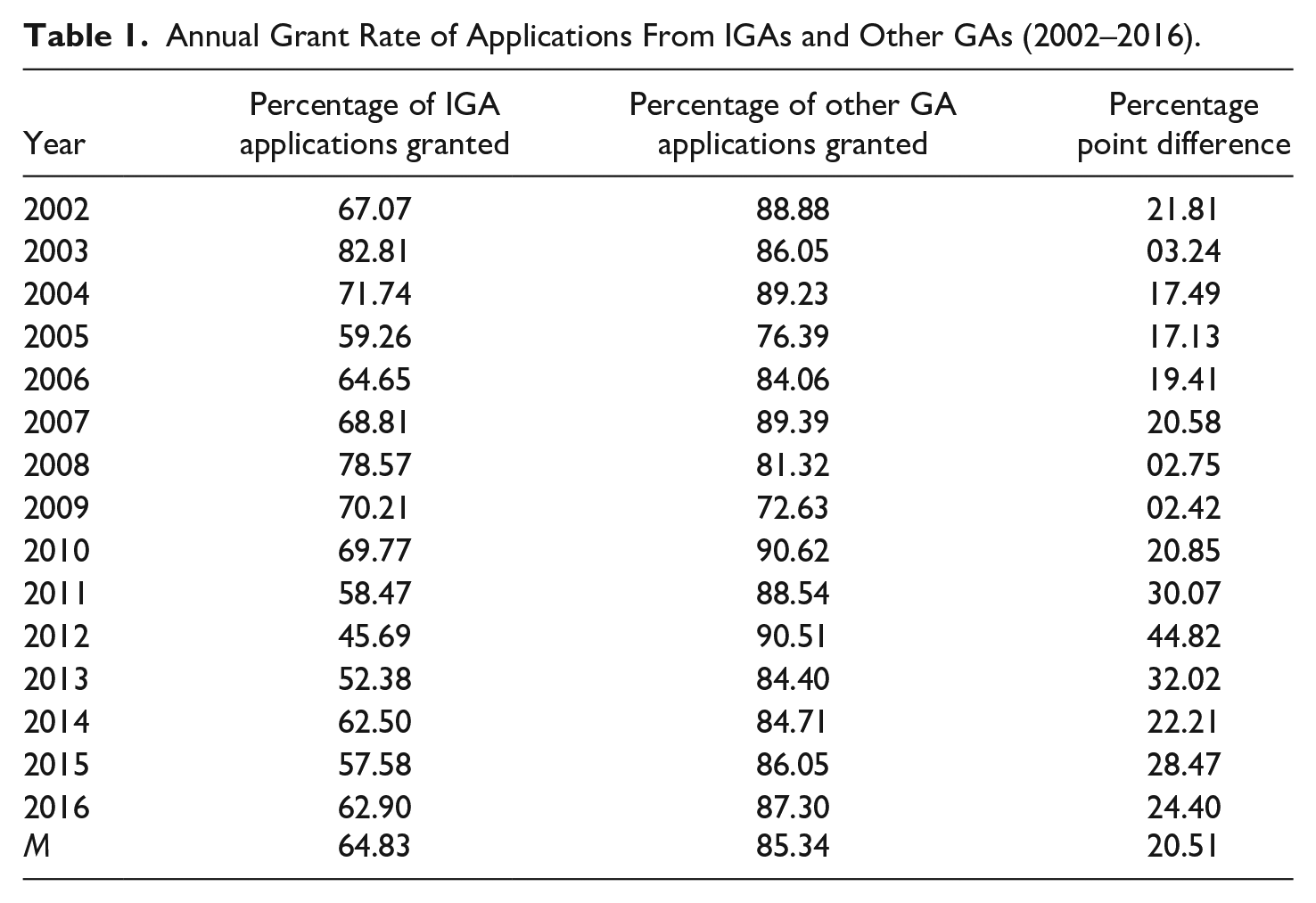
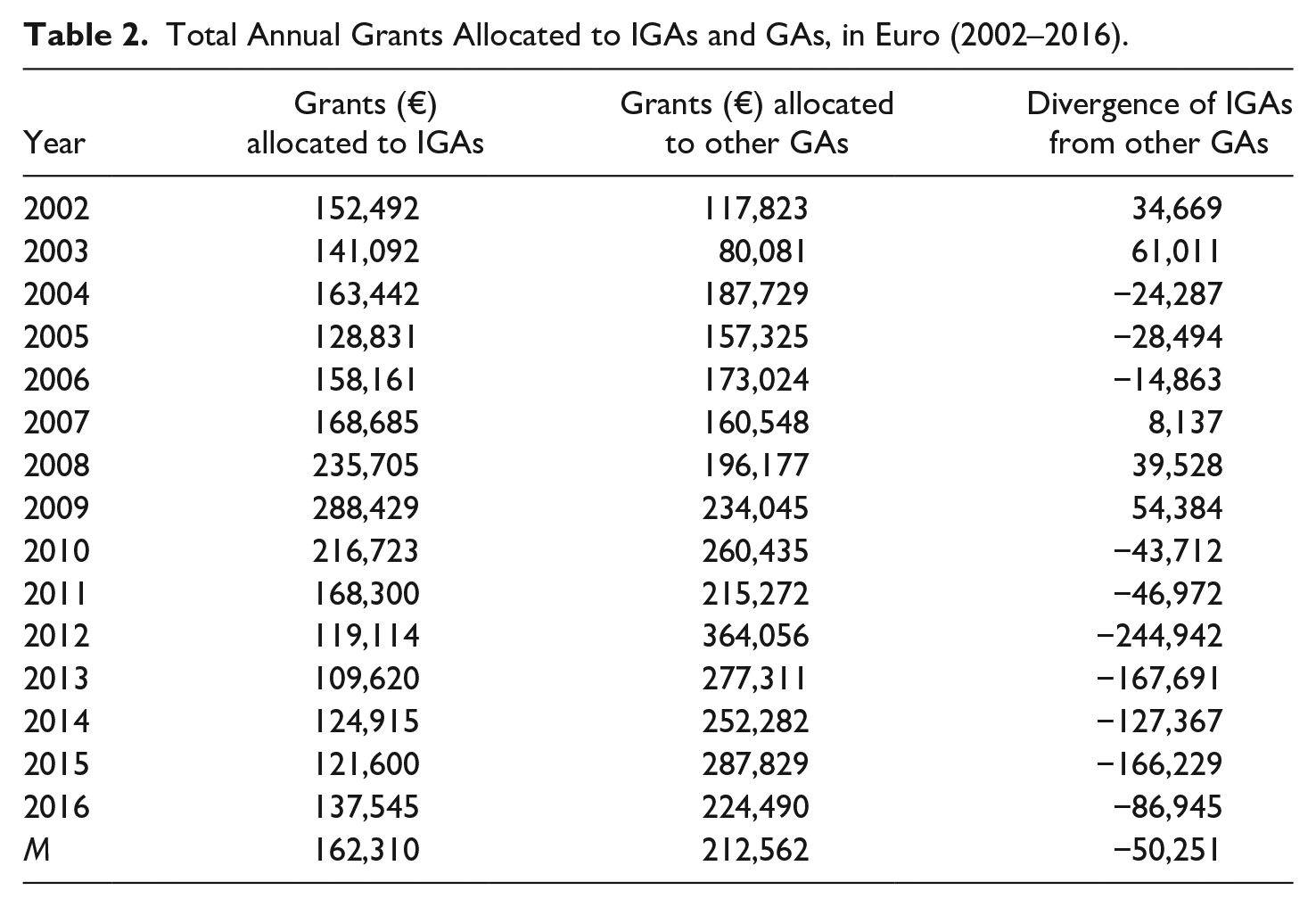
This policy was abandoned in 2012 because the foundation no longer wanted to differentiate between native Dutch people and those from immigrant descent. The new approach may have been influenced by the government’s policy decision to discontinue subsidizing civil society pillars, including migrant organizations. Although the foundation no longer wanted to differentiate between grant-seekers on the basis of origin and ethnicity, the grant rate for applications from IGAs was on average 20% lower than for applications from other GAs throughout the study period, with a minimum difference of 2.42% in 2009 to a maximum difference of 44.82% in 2012 at the detriment of IGAs. Grant rates for IGAs and other GAs began to diverge strikingly as of 2011 (see Table 1). The gap in the size of grants (in €) has also widened. Whereas IGAs received more money than other GAs for 5 years of the 15-year study period, they received less euros for the other 10 years. From 2010, IGAs have lost ground. In 2012, the gap between the monetary contributions received by IGAs and those received by other GAs was at its widest at the expense of IGAs (see Table 2).
Annual Grant Rate of Applications From IGAs and Other GAs (2002–2016).
Total Annual Grants Allocated to IGAs and GAs, in Euro (2002–2016).
This divergence in funding is surprising because all applications, including those for IGA and other GAs, are assessed on the basis of the same set of 90 different content policy notes. The IGAs-specific policy note was in use from 2003 to 2012. Moreover, different policy notes may apply to the same application, depending on the judgment of the assessor. Foundation staff also have discretion to make reasonable exceptions to the policy. Our goal is to explain the funding gap between IGAs and other GAs from a sense-making perspective by answering the following questions:
(1) How does sense-making by foundation staff members concerning the policies of their own foundation influence their decisions to recommend rejecting applications?
(2) How does sense-making by foundation staff members concerning applications from IGAs and other GAs influence their decisions to recommend rejecting applications?
A Sense-Making Perspective on Grant-Making
Foundations manage inclusion and exclusion through philanthropic particularism (i.e., favoring certain groups over others) and philanthropic paternalism, in which the wealthy determine the societal needs to be met (Salamon, 1987). Management-oriented foundations attribute their impact to making good grants to good organizations (Leat et al., 2018). In addition to good grant-making, however, the proper practice of social relationships is required (Fairfield & Wing, 2008; Ostrander, 2007). Prior research on potential hurdles in the relationship between foundations and grant-seekers has revealed social class differences between foundation officials and grassroots organizations (Bothwell, 2002); power differences and tensions between personal and institutional interests with both parties (Fairfield & Wing, 2008); and foundation staff reliance on an “an instinctive feel for the projects proposed and the character of the applicants proposing them” (Huang & Hooper, 2011, p. 425). The perception of organizational identities defines philanthropic relationships between givers and recipients, implying that they interpret signals—or make sense of one another—through “language, talk, and communication” (Weick et al., 2005, p. 409). Sense-making is retrospective, as future actions are guided by sense-making of past actions. Applied to grant-making, this means that decision-makers build on past experiences and hopes for the future, rather than on realistic prospects based on adequate information (Leat, 2007). The process is continuous, as people both act while thinking and think while acting (Weick et al., 2005). It is social, as people try to influence the interpretation of issues by others (Maitlis, 2005), and it is guided by power relations, as some people have more influence than others (Mills et al., 2010).
Sense-making occurs at three levels within organizations. The intra-subjective level involves the production of discursive accounts (e.g., on professional roles; for an overview of functions, see Cornelissen, 2012). These accounts are embedded within frames of references, which refer to “(a) A knowledge structure that directs and guides information processing” or “(b) A baseline expectation or reference point that provides a basis for social judgments and decision- making” (Cornelissen & Werner, 2014, p. 184). The organizational level involves the process in which “organization emerges through sensemaking” and people organizing “to make sense of equivocal inputs and enact this sense back into the world to make that world more orderly” (Weick et al., 2005, p. 410). They “search for meaning, settle for plausibility, and move on” (Weick et al., 2005, p. 419). The core idea of organizational sense-making is that people shape their environments through sense-giving and action-taking. Collective sense-making “occurs as individuals exchange provisional understandings and try to agree on consensual interpretations and a course of action” (Stigliani & Ravasi, 2012, p. 1232). It involves the social and institutional context of organizations (Sandberg & Tsoukas, 2015; Weber & Glynn, 2006), and power relations shaped by people in powerful positions through dominant narratives about society. Conversely, individual, or joint “disempowered actors” (Schildt et al., 2020, p. 256), who question and resist systemic power, may influence collective sense-making as well.
Central to sense-making theory is the construction of plausible narratives in which accounts need not be accurate or true, provided they serve a sense of coherence (Schildt et al., 2020). Plausible narratives spur groupthink, an emergent consensus in thinking, or accounts that enable action (Abolafia, 2010; Maitlis, 2005). A sense-making perspective on decision-making depicts decisions as resulting from retrospective plausible accounts that are neither “forward-looking” nor “future-oriented” (Boland, 2008, p. 58).
Although most sense-making literature departs from the organizational perspective, individual frames of reference and collective consensus on a course of action that shapes organizations are partially generated by collective sense-making within communities and societies. Our study addresses the emergent exclusion of IGAs from foundation funding during a period marked by progressive ethnic diversification in Dutch society. According to sense-making theory, collective sense-making serves to mitigate turbulence and maintain social cohesion as previously homogeneous communities and nations become increasingly diverse (Maitlis, 2005). When increasing diversity becomes ethnically defined by political practice exerted by “ethnopolitical entrepreneurs,” social relationships come to be framed in terms of ethnicity, thereby resulting in “politicized ethnicity” (Brubaker, 2002, p. 166). This implies that, while people categorize themselves by ethnicity, race, or nationality, ethnic groups are often constructed for political reasons by those who stand to benefit. In this view, ethnicity is not created by individual sense-making of differences between people, but at the level of collective sense-making, which trickles down to the institutional level. Once the practice has become institutionalized, individuals start to perform institutionally defined roles and scripts at the intra-subjective level (Weber & Glynn, 2006). Ethnically defined diversity may thus be interpreted as “the social organization of difference” (Vertovec, 2018, p. 112). Power inequality occurs when majority groups construe minority groups as “ethnic communities” in a “non-ethnic society” (Winter, 2007, p. 490). Scholars of sense-making confirm that stories about collective identities are highly contextual (Schildt et al., 2020) and prompted by cultural assumptions (Sandberg & Tsoukas, 2015). Power structures tend to reproduce themselves, despite diversity policies, as long as minority voices remain unheard (Mikkelsen & Wåhlin, 2020).
Examining grant-making through a sense-making lens requires considering the narratives of grant-makers about the profound demographic changes that have taken place in the Netherlands in recent decades. They might engage in groupism, that is, “the tendency to treat ethnic groups, nations and races as substantial entities to which interests and agency can be attributed” (Brubaker, 2002, p. 164). Narratives that define people as members of ethnic groups suggest that they are “unitary collective actors with common purposes” (Brubaker, 2002, p. 164) who legitimize claims for rights and resources based on constructed collective identities. Within a broader social context, Dutch institutions use official language in order to avoid defining people as members of ethnic groups. Terminology adjustments alone are unlikely to end the political practice of ethnically framing social inequality. The political environment remains crucial to granting or withholding opportunities for ethnically based organizations (Castañeda, 2020). Despite the breakdown of the Dutch political opportunity structure of pillars that granted all pillars equal rights to public funding, private funders may still view IGAs as representatives of ethnic interests. This may cause groupism to creep into grant-making practices in two ways: (a) in-group bias (i.e., the tendency to favor members of one’s own category) and (b) the tendency to exaggerate differences with out-groups (Brubaker et al., 2004). Assuming the legitimacy of these practices may obscure the unequal treatment of grant-seekers while jeopardizing the implementation of an inclusive grant-making strategy. Language use complicates the investigation of these processes (Whitman, 2009).
Method
The study was designed to uncover the impact of sense-making on grant-making practice and the associated risks of groupism and (unintentional) exclusion from funding. To this end, we reviewed the management literature to identify a perspective on decision-making that could clarify the frames of reference that grant-makers use to make funding decisions. Sense-making theory emerged as a well-suited conceptual framework for advancing the current state of knowledge about foundation giving. We used negative recommendations on grant applications from IGAs and other GAs to perform a comparative analysis of factors in the assessments leading to rejection of grant applications. We excluded positive recommendations from the study, as they provide no information about factors in the assessment process that lead to exclusion from funding. On the contrary, positive recommendations provide insight only into factors leading to inclusion, which is not our focus.
Next, we decided on an appropriate method to analyze the written language used by foundation staff members in light of the still sparsely advanced sense-making theory concerning decision-making in foundations. Its lack of guidance on applicable concepts, possible relationships between concepts, or validation of the relevance of the concepts and their relationship to the population or context being studied prompted the need for a grounded theory approach to data analysis (Vollstedt & Rezat, 2019). Given the many possible methods for coding textual data, each with advantages and disadvantages beyond the scope of this article, we will limit ourselves to the reasons why we excluded thematic analysis and discourse analysis from our preferred methodology. Our data are not well suited for thematic analysis due to the aforementioned lack of theoretically grounded definitions of categories and theoretically grounded formulation of coding rules (Mezmir, 2020). The same applies to discourse analysis, which in addition deals with multiple text types within multiple social events (spoken and written) and how they are interrelated (Bondarouk & Ruel, 2004). In our inductive, grounded theory approach for using documents as data, we prioritize the expressions of the grant-making practitioners as reflected in the texts they wrote (Charmaz, 2014). Following the Coding Manual for Qualitative Researchers (Saldana, 2016) we chose concept coding and focused coding as the methods that best served our purpose. We organized, analyzed, and presented the data in accordance with what is known as the Gioia methodology. Although the methodology is primarily used for the analysis of transcribed interviews in international business and entrepreneurship research, it is also applied to the analysis of written language (Magnani & Gioia, 2023). Despite recent criticism of the Gioia methodology for its supposed reduction of qualitative research to the application of what critics have denounced as “templates,” we concur with the proposition that “it should be employed as a systematic approach to trustworthy and rigorous qualitative data analysis that allows for creative theoretical development and helps to communicate with reviewers and editors” (Magnani & Gioia, 2023, p. 2). The data structure we created using the Gioia methodology is not meant to be a mere “clustering” of data, but rather a possible way to systematically collect and analyze qualitative data (Gioia et al., 2022). We do not claim to provide a definitive interpretation of our data, but instead offer our own sense-making of the research findings based on our experience and knowledge (Bondarouk & Ruel, 2004).
Foundation staff are not assigned to any particular type of grant-seeking organization. They all write recommendations on grant applications from IGAs, other GAs, and other categories of applicants according to their specific areas of expertise (e.g., arts, education, health, sports). The size of the database, 594 negative opinions, combined with the limited number of staff members (16) employed by the foundation in varying composition and tenure during the research period, led to the decision not to focus on changes in assessments over time (e.g., per year, per staff member, or both). Likewise, we did not categorize grant applications according to theme, target group, or intended goal, as the number of variables would become unmanageable, thus making it impossible to discern patterns in sense-making.
The first author is employed by the foundation and received permission to use its database for research purposes. However, the foundation explicitly did not grant permission to make the documents, that is, the written recommendations from which the data were retrieved, publicly available. Therefore, they must be kept confidential within the process of data collection, analysis, and presentation of findings. The risks of non-disclosure of recommendations are that the veracity and subjectivity of the research may be difficult to assess. To minimize the risk of subjectivity associated with the insider position, no protocol of terms was drawn up in advance. In addition, we organized internal feedback from two senior staff members concerning the coding process. The study was not affected by researcher presence, as the unit of observation consists of previously recorded documents that are not subject to unauthorized modification or manipulation.
Because a digital registration system has been available since 2002, we started the research period in that year. We collected negative recommendations on grant applications from IGAs and other GAs over 15 years (2002–2016), which yielded sufficient data for our comparative analysis. During this period, the foundation awarded an average of 64% of the approximately 30,000 grant applications, including those from IGAs and other GAs. We used IGA and GA samples from a previous study conducted by us.
Database Description
Our database consists of 594 negative recommendations on 2,749 applications from our sample of 215 IGAs and 215 other (non-immigrant) GAs during the period 2002 to 2016. A negative recommendation includes comments on the applicant organization’s track record, the project’s target population and region, and reasons for advising rejection. The length of relevant excerpts varies from several short paragraphs to two pages of text. Of 1,245 applications submitted by IGAs, 460 (37%) were rejected, as compared with 134 (9%) of 1,504 applications submitted by other GAs. Negative recommendations were extracted from the foundation’s registration system, which records the processing of applications from receipt to decision and the payment of donations (if applicable). Although mandatory parts of the registration system include the statutes, Chamber of Commerce registration certificates, annual reports, and accounts of applicant organizations, the foundation neither collects nor stores information on organizational features (e.g., board, volunteers, members, regular activities, and projects) of applicant GAs. These data are therefore missing and not addressed in the current analysis.
From the negative recommendations, we selected words, phrases, and sentences relating to judgments. Text fragments repeating or summarizing the project proposal were not included, nor were budgets or coverage plans, which provide no information on the sense-making processes of staff members.
Data Analysis
We analyzed the written language used by foundation staff in negative recommendations according to the steps of data analysis proposed by Gioia and colleagues (2013).
In the initial data coding, we maintained the integrity of first-order (informant-centric) terms. We then developed a comprehensive compendium of first-order terms. In the next step, we organized first-order codes into second-order (theory-centric) themes, which we subsequently distilled into overarching theoretical dimensions. Finally, we assembled terms, themes, and dimensions into a “data structure.”
We identified more than 2,000 quotations, which yielded 33 codes capturing the essence of informant-centric terms upon reaching saturation when no new codes could be extracted from the data. We used the QDA software program ATLAS.ti. to develop a compendium of these first-order terms and codes. Assisted by two senior foundation staff members, the number of codes was narrowed to 22, mainly by grouping codes referring to feelings (e.g., sympathy, disappointment, disapproval, frustration, annoyance, distrust, doubt, and uncertainty). We then organized the 22 codes into 6 theory-centric themes pertaining to the staff members’ perceptions of IGAs, other GAs, and the foundation. To ensure that the themes were recognizable to staff members, we requested another round of feedback from the same two senior foundation staff members concerning our inventory of first-order codes and designation of second-order themes. The feedback led to consensus that the overarching themes were indeed independent elements that help determine the outcome of recommendations. We subsequently referred to them as “factors” explaining rejection and provided them with short, unambiguous labels.
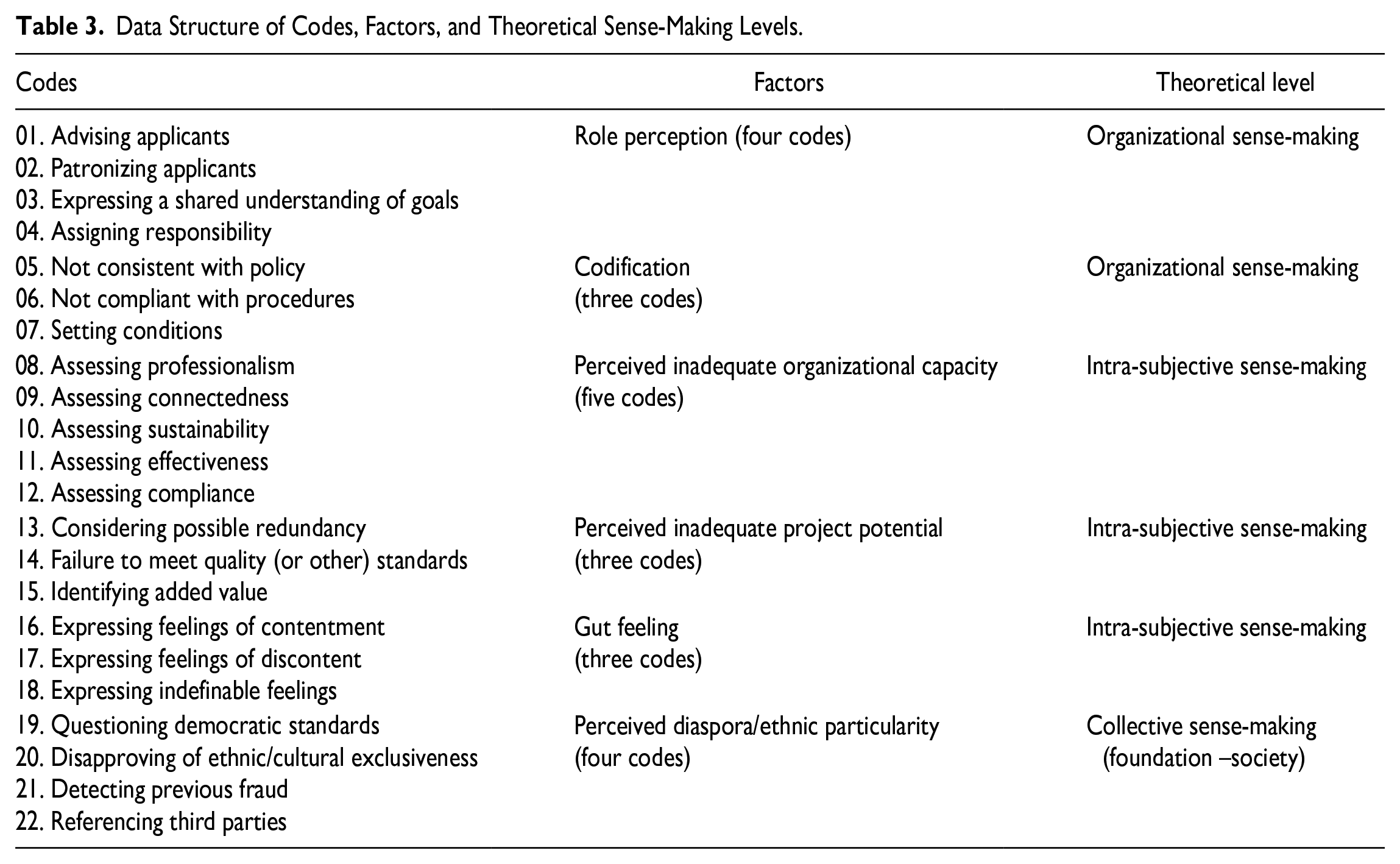
Finally, we assigned these factors to three theoretical levels of sense-making derived from the literature (and comparable to Gioia’s “dimensions”): intra-subjective, organizational, and collective. This generated the data structure presented in Table 3, which reveals that only one of the six factors uniquely explains the rejection of IGAs. We also compiled an inventory of the relative frequency with which each code occurs in the total number of identified quotations (2,008). Results for IGAs and other GAs are presented in Table 4. The findings are substantiated with exemplary quotations from the two document groups, as translated into English from the written language (Dutch) by qualified translators (See Table 5 in the Appendix).
Data Structure of Codes, Factors, and Theoretical Sense-Making Levels.
Relative Code Frequency in IGA and GA Quotations.
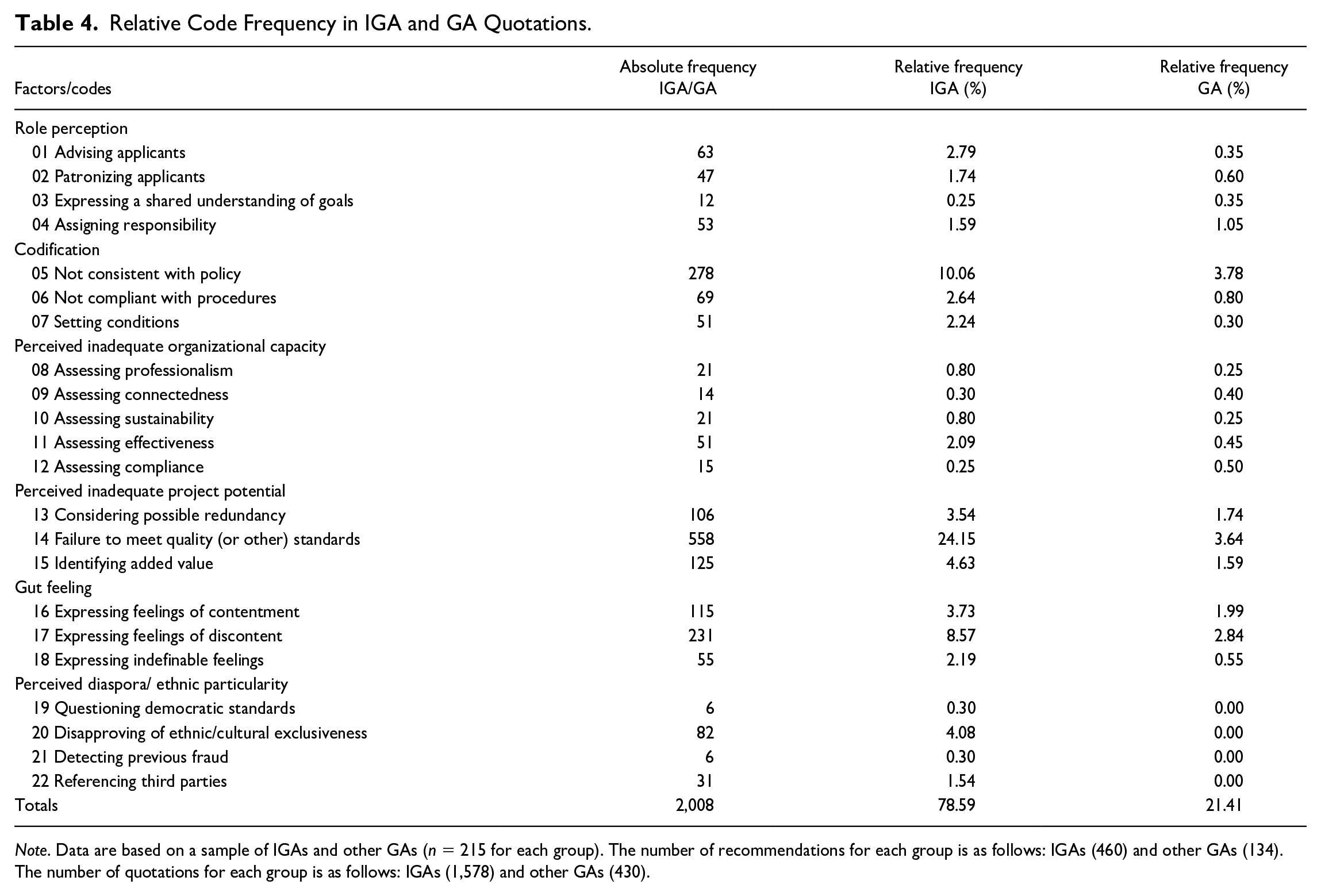
Note. Data are based on a sample of IGAs and other GAs (n = 215 for each group). The number of recommendations for each group is as follows: IGAs (460) and other GAs (134). The number of quotations for each group is as follows: IGAs (1,578) and other GAs (430).
Findings
The analysis reveals that five of the six factors explaining negative recommendations on applications from both IGAs, and other GAs were based on the sense-making of foundation staff members concerning their own roles as grant-makers, as well as on their sense-making regarding grassroots grant-seekers. All but one of the factors (codification, i.e., the standardization of donation requirements) were based on ambiguous policy. “Codification,,” together with “perceived inadequate project potential” and “gut feeling,,” make up the core three factors in which the divergence between the funding of IGAs and other GAs is most pronounced. These three factors are examined in more detail below.
Codification
Codification refers to whether the applicant and the grant application meet the foundation’s general criteria, procedures, and topic-specific conditions. These include the general policy and procedures against which all applications are reviewed, such as the mandatory nonprofit status of applicant organizations and the requirement for applicants to provide insight into the organization’s board composition and finances. For topic-specific policy notes, the codification factor applies to the unambiguity of terms which cannot be interpreted differently by foundation staff, and on which they cannot come to an agreement over time by making sense of it. Consider the following example of the policy on the purchase of wheelchair buses for the elderly, disabled, and mentally ill: The maintenance of the (wheelchair) bus must be financed from own resources; the drivers of the bus must also be insured from own resources or with the use of volunteer drivers; in principle, the (wheelchair) bus is being depreciated; use at least ten half days (morning/afternoon/evening) per week.
To clarify the non-ambiguous nature of terms in topic-specific policy criteria, we provide the following example of the policy note on youth and pop festivals that require individual or joint sense-making from grant-makers: The festival contributes to the quality of life in a neighborhood or district; highlights a new or underexposed form of music or art that is of interest to a young audience; focuses on a disadvantaged target group; makes a clear contribution to the cultural (youth) climate in our region.
These rather vague terms can lead to ambiguous decision-making situations in which sense-making by foundation staff members concerning the policies of their own foundation influences their decision to recommend rejecting applications. Conversely, codified (i.e., fixed) terms lead to unambiguous decision-making situations in which the influence of sense-making by foundation staff members concerning the policies of their own foundation on their decision to recommend the rejection of applications is virtually nil (Research Question 1).
Not all topic-specific policy notes have fixed criteria. The general policies and procedures are available for all to read on the foundation’s website. However, topic-specific policy notes are not accessible to grant-seekers or the general public, nor to peer philanthropic institutions. Our results show that IGAs fail more often than other GAs to satisfy the general conditions that are assumed to be known to all (see Table 4), but our study does not explain why this is the case. This requires further investigation in both IGAs and other GAs.
Perceived Inadequate Project Potential
Results show that perceived inadequate project potential is clearly more prominent in negative recommendations on applications from IGAs than those from other GAs. Nearly seven times more negative IGA recommendations received the code “failure to meet quality (or other) standards” as compared with GAs (see Table 4). However, negative recommendations for both groups fail to describe explicit reasons why quality was deemed inadequate. Although the justifications that staff members provided for the substandard quality assessment of project proposals were largely similar, the recommendations did reflect some differences between IGAs and other GAs. For both groups, proposals were seen as unclear, incomplete, poorly substantiated, and barely elaborated, regardless of the topic or target audience. Budgets did not add up or were considered grossly exaggerated and, in the case of IGAs, even grossly out of proportion and nonsensical. Negative recommendations on applications from IGAs were particularly likely to mention lack of expertise on project content, lack of familiarity with existing facilities, lack of collaboration with other organizations and experts, and poor communication with the foundation despite requests from staff members for meetings with applicants concerning their proposals. Deficient command of Dutch writing skills in grant applications was not used to substantiate negative recommendations. This may reflect the wide variation in Dutch proficiency within the IGAs and/or the staff’s professional capability to deal effectively with applications written in poor Dutch. The influence of sense-making by foundation staff concerning applications from IGAs and other GAs on their decisions to recommend rejection was not, according to our data, predominantly related to the perceived diaspora/ethnic particularity of IGAs applications. As a result, our study does not conclusively answer Research Question 2 on the influence of sense-making concerning applications from IGAs and other GAs on the decisions of foundation staff to recommend rejection of applications in a way that might explain why the quality of applications from IGAs is rated as inadequate more often than that of applications from GAs.
Gut Feeling
The factor “gut feeling” influenced negative recommendations for both IGAs and other GAs, although applications from IGAs appeared to evoke feelings of content as well as feelings of discontent more often than applications from other GAs did. Staff members also expressed uncertainty toward IGA applications more often. Expressions of pleasant, affirmative feelings toward organizations (e.g., “nice organization doing important work” and “committed people”) were typically followed by rebuttals introducing negative recommendations, usually based on the perceived inadequate project potential. Despite this ambivalence, co-readers and decision-makers endorsed negative recommendations instead of arguing in favor of a recommendation to award the application with a grant. The articulation of gut feelings thus led to a collectively accepted plausible narrative enabling action, in this case, to recommend rejecting applications.
In addition, foundation staff apparently shared an understanding of narrative of undefinable feelings, like, for example: “It’s still a guess,” and “I cannot quite put my finger on it.” We might infer that foundation staff members rely on their gut feeling in ambiguous decision-making situations. However, although this type of sense-making concerning applications from IGAs and other GAs clearly influenced foundation staff members’ decisions to recommend rejecting application (Research Question 2), our study does not explain why negative and undefined gut feelings were cited up to four times more often in recommendations to reject applications from IGAs compared with those from GAs (see Table 4).
Although the ethnic particularity of IGA grant applications does not appear to be a dominant reason for rejection, we found a tendency toward groupism among foundation staff, particularly in the absence of clear policies for assessing applications from IGAs that were aimed exclusively at their own immigrant constituencies. As noted above, the policy note was riddled with vague terms, leading to ambiguous decision-making situations regarding applications from the relatively new category of grant-seekers (i.e., IGAs), which fueled the sense-making process with grant-makers. Terms like “emancipation” and “integration” were not defined, and neither was the condition of being an “open organization with sufficient reach” to be eligible for funding. The written language of foundation staff revealed their resistance to funding projects aimed at specific ethnic groups rather than a broad audience, uncovered in their written recommendations. However, they did not explain the reasons which prompted their decision to recommend rejecting IGA applications in particular. A possible explanation might be that staff members follow the prevailing public view that ethno-specific interests should not be financed with public money (see also Vasta, 2007). We also found no evidence to explain the staff members’ frequent consultation of external parties concerning grant applications from IGAs. The traditionally close ties between the public and nonprofit sectors in the Netherlands might have led staff members to engage in networks of private and public institutions that collectively make sense of increased ethnic diversity and guide courses of action.
Discussion
The objective of this study was to explain why IGAs are more likely to be excluded from funding than other GAs, viewed from the perspective of grant-makers. The main finding is that ambiguous policy led grant-makers to rely on sense-making for five of the six factors, which consequently led to the exclusion of IGA grant applicants compared with GA grant applicants. Contrary to expectations, we found that the factor “perceived diaspora/ethnic particularity” of grant applications from IGAs was not decisive for decisions to recommend rejecting them. The legitimacy of such applications did not appear to have been assessed against criteria for the general accessibility of projects. Moreover, we found no indication of the existence of such criteria in the written language of foundation staff. The implicit lack of such policy criteria is also reflected in the finding that the GA applications were not assessed on this aspect, despite the large number of GA project proposals targeting homogeneous populations (e.g., particular neighborhoods or delineated groups of people with a shared interest in specific traditional art forms). For IGAs in particular, the foundation’s inclusive mission to serve a broad range of communities did not always lead to equal funding opportunities. This finding substantiates previous research on inconsistencies between espoused social values and those conveyed by the foundation (Whitman, 2009).
Instead, the factor “perceived inadequate project potential,” more specifically, the failure to meet quality standards, proved crucial to negative recommendations for IGAs applications. However, the data provide no evidence concerning whether the foundation used established quality criteria and, if so, which ones. Given the lack of dissent from co-readers and decision-makers in the recommendations, staff members apparently made sense of the concept of quality through collaboration and interaction. As illustrated in Table 4, most of the advisory and patronizing comments were found in recommendations on proposals from IGAs. We nevertheless found no specific advice on quality improvement, nor any intention to convey such advice in communications with IGAs. The nature of substandard quality (e.g., lack of an activity plan) was reported solely for the convenience of the decision-maker. On one hand, this deprives applicants, and particularly IGA grant-seekers, of the opportunity to make improvements in subsequent applications. On the other hand, it may reinforce the understanding of staff members (particularly newer staff) concerning what poor quality looks like. The professional role of grant-makers in foundations is as much about sense-making as it is about rational, strategic competencies including grant management, organizational development, analytical skills, and knowledge of nonprofits and project management (Carpenter, 2017). We contend that interpretive skills can be a valuable asset to the professional role of grant-makers (Huang & Hooper, 2011).
A final point for discussion concerns our finding in a few negative recommendations linking perceived undemocratic and deceptive behaviors with IGAs. For example, failure to meet democratic standards in IGAs was substantiated by presumed ties to extremist groups in the IGA’s home country or the absence of women or youth on its board. None of the negative recommendations for GAs reflected such suspicions, although they too may be affiliated with radical groups within the Netherlands. GAs may obstruct equal representation of women on their boards as well. Mention of these issues in recommendations is not accompanied by expressed intentions to investigate them further. This suggests that foundation staff do not discuss these issues directly with grant applicants. As a result, “accused” IGAs have fewer opportunities to present themselves in a way that increases their chances of receiving funding. This tendency to groupism toward ethnic groups as “substantial entities to which interests and agency can be attributed” (Brubaker, 2002, p. 164) can be detrimental to inclusive foundation grant-making.
Our main finding of ambiguous policies leading grant-makers to rely on sense-making with the associated risks of groupism and (unintentional) exclusion from funding of particularly IGAs must be approached with caution, given the non-replicability of the study. In addition, the study is difficult to generalize because of its limited focus on the specific context of the case under study, which is an overarching drawback of interpretive research.
Avenues for Future Research
This study proceeds from the ethnic affiliation of grassroots grant-seekers to investigate exclusionary assessment behavior on the part of grant-makers. We pursued an initial understanding of the relationship between levels of sense-making in foundations and its impact on exclusionary grant-making practices to spark academic interest in the sense-making approach to philanthropic exclusion. Our research questions might also be directed to rejective grant-making behavior toward organizations that are not based on ethnic identity, but on other identities (e.g., gender, age, or location). This pathway could allow philanthropy scholars to advance knowledge concerning philanthropic particularism and paternalism (Salamon, 1987).
Future research could explore long-term shifts in the judgments of grant-makers through sense-making (e.g., with respect to the changing content of grant proposals in terms of issues, goals, and communities served) and the influence of their personal and professional characteristics on their grant-making practices to advance the implementation of sense-making theory in foundation research.
The ways in which grant-makers perceive their professional roles and organizational identity as factors influencing grant allocation provide clues for comparative research between multiple foundations within different geographic and political contexts. The relationship between governance styles, communication management, and staff management of foundations and the promotion of core foundation values is also relevant. These topics address the complex connections between intra-subjective, organizational, and collective sense-making and processes of cueing and framing that might help to explain why certain categories of grant-seekers are excluded from funding. Building on our finding that quality requirements of applications prevail over their contributions to the foundation’s inclusive mission, further research could focus on the possible ranking of core foundation values and its effect on different groups of grant-seekers.
One intriguing avenue for research could be the institutional context of trends in grant-making for identity-based organizations, such as the IGAs examined in this study, as well as women’s organizations, queer-advocacy organizations, disabled people’s associations, or singles’ associations. This type of research could expose the operating mechanisms of institutional racism, sexism, and power inequity in foundations, as well as conditions allowing foundations to serve innovation, social movements, and democratic processes.
Finally, our research is relevant to both grant-making and grant-seeking praxis, given the demonstrated importance of sense-making in the philanthropic relationship. Greater awareness of this could contribute to effective, sustainable relationships (i.e., relationships that enable all parties to achieve their long-term goals).
Conclusion
The recent increase in ethnic diversity in Dutch society has affected social relations, including those between foundations and their beneficiaries. Despite its inclusive mission, the relationship between the studied foundation and IGAs has become weaker rather than stronger. This study shows that the disparity in funding between IGAs and other GAs can be explained by ambiguous decision-making situations in which grant-making is driven by sense-making. These ambiguous decision-making situations arise when the foundation’s inclusive mission, as can be inferred from the negative recommendations according to our findings, is not adequately reflected in the criteria of individual policy notes, leaving grant-makers susceptible to groupthink about IGAs in particular.
Two main conclusions emerge from the study. The first conclusion pertains to the self-interpreted professional role of foundation staff in fulfilling the foundation’s mission as a result of the loose definition of the mission as “contributing to an inclusive, active, social and eco-friendly society” (foundation document, undisclosed). If staff members interpreted their professional role as safeguarding the foundation’s inclusive mission, aimed at social participation by all populations regardless of background or identity, they should prioritize outreach among target audiences over the quality of applications. Our analysis further suggests that the feelings of staff members toward grant-seekers may play a vital role in their professional conduct. Negative feelings for IGAs might intersect with staff disapproval of ethnic particularity in the proposals of IGAs, shaped by the institutional context within which the foundation operates, as proposed by the sense-making theory that individuals start to perform institutionally defined roles and scripts at the intra-subjective level once a practice (i.e., framing social inequalities in terms of ethnicity) becomes institutionalized (Weber & Glynn, 2006). The second conclusion concerns the assessments of project proposals becoming more interpretative and based on frames of reference with higher levels of ambiguity in grant policy. Conversely, unambiguous policies (e.g., with regard to application deadlines, regional scope of projects, and financial assets of applicants), made staff members follow the rules without allowing personal or collective values to influence their assessment of applications. This implies that clarity of policy is needed to avoid groupthink among grant-makers that results in unequal treatment of different categories of grant-seekers.
Finally, it is important to note that this study highlights the perspective of the grant-maker and their power to reject or grant application. However, grant-seekers hold power positions as well because foundations depend on their projects to achieve their goals. For this reason, we believe that the focus of research on foundation giving behavior should be primarily on relationship management. It is our hope that our study will contribute to the understanding of the role of sense-making in exclusionary assessment practices in endowed foundations and its implications for foundations’ pursuit of inclusive grant-making.
Footnotes
Appendix
Exemplary Quotations From Negative Assessments of IGAs and GAs, by Factor and Code.
| Factor/code | Exemplary quotations from negative assessments (IGAs) | Exemplary quotations from negative assessments (other GAs) |
|---|---|---|
| Role perception | ||
| 1. Advising applicants | I pointed out the possibilities of the Youth Vacation Fund to him. | I pointed the association toward several agencies that regularly support publications. |
| 2. Patronizing applicants | Society comprises many more cultures, and some integration and cooperation with other organizations would not be amiss. | Although this may be pleasant, it is superfluous and I do not think it fits in with their aim to be of service, following the example of Jesus Christ. |
| 3. Expressing a shared understanding of goals | In my opinion, it is time for the association to join existing facilities. For this project, the association could use the possibilities offered by our choir program, thus preventing further dependence on our Foundation. | Such a radical approach to the refugee issue is not consistent with the apolitical objectives of the Foundation. |
| 4. Assigning responsibility | This is a matter for the Public Health Service. | Informing the residents is obviously the task of local authorities and housing corporations. |
| Codification | ||
| 5. Not consistent with policy | The promotion of organ donation does not fit our objectives. | No financial support for the interior if the exploitation is not definite. |
| 6. Not compliant with procedures | Absence of financial transparency, although it is clear that this will ultimately have consequences for all future applications. | The social evening has already taken place. |
| 7. Setting conditions | This kind of project must be consolidated by several parties. | Festivals are supported only in case of talent development. |
| Perceived inadequate organizational capacity | ||
| 8. Assessing professionalism | Moreover, I do not see enough guarantees for the quality of the mentors. Although they do receive a course and several return meetings with unnamed experts, the association is not familiar with the coaching profession, as far as I know. | Despite support from various people, including me, they are not able to submit a substantiated application for further organizational development. A substantiated budget is lacking; it is purely guessing. |
| 9. Assessing connectedness | For this festival, I wonder if there is really cooperation between the organizations in the neighborhood. | The municipality recently decided to encourage the association to merge into Organization X, as it is much better structured and adheres much more to the original objective: patrolling the streets to maintain safety, in collaboration with other parties. |
| 10. Assessing sustainability | The investment would be acceptable if there were any prospect for continuation after the project year. | Unnecessarily expensive and not sustainable. |
| 11. Assessing effectiveness | Moreover, from the application, it cannot be deduced how the discussions groups will encourage greater participation by the elderly. | No connection between the proposed reorganization and a sustainable volunteer organization. |
| 12. Assessing compliance | Paradoxically, the board and the volunteers of this organization consist of men only. Women should be appointed in the organization before submitting this type of application. | X is and remains a self-willed organization. |
| Perceived inadequate project potential | ||
| 13. Considering possible redundancy | In my opinion, there is no real need for a new sports initiative for women in the neighborhood. | The members have been organizing this action for years without support from our Foundation. With the help of the business community, to which they are all connected, it should be possible to cover the costs through sponsorship. |
| 14. Failure to meet quality (or other) standards | There is no activity plan. | The historical content is not further elaborated. |
| 15. Identifying added value | In this case, nothing relevant happens on this day. | Who is interested in interviews between younger and older people? |
| Gut feeling | ||
| 16. Expressing feelings of contentment | Although our Foundation is well disposed toward the Papuans and regularly supports activities of the association, there is no justification for granting the application. | It undoubtedly concerns a historically interesting publication about a little castle in O. (which is currently having great difficulties). |
| 17. Expressing feelings of discontent | The applicant’s stubborn refusal to do something about the composition of the board annoys me even more. | It was not easy to start a conversation. She did not seem to realize that she had previously applied to our Foundation. Moreover, any interest in starting a chat, let alone a relationship with the Foundation, seemed to be lacking. |
| 18. Expressing indefinable feelings | I have the feeling the organization is merely looking for projects. | I get the feeling that the coordinator has been harassed out of the job. |
| Perceived diaspora/ethnic particularity | ||
| 19. Questioning democratic standards | This club highly likely has connections with extremist nationalistic movements from Turkey. | None |
| 20. Disapproving of ethnic/cultural exclusiveness | It is not good to organize this party only for a specific cultural group. | None |
| 21. Detecting previous fraud | Applicant is blocked. Application is rejected without obligation (to substantiate). There is proof of past cheating on the financial completion of projects. | None |
| 22. Referencing third parties | Colleague A. and I had a conversation with the municipal policy officer about this application. Radio Station has a commercial broadcasting authorization and does not broadcast via the city’s local station. The applicant has already received €15,000 from the municipality under pressure from the council member, against official advice (commercial channel, equality principle). Note: The city already has 5 Hindustani radio stations. | None |
Data Availability Statement
The data are not publicly available due to ethical, legal, or other concerns.
Declaration of Conflicting Interests
The author(s) declared no potential conflicts of interest with respect to the research, authorship, and/or publication of this article.
Funding
The author(s) received no financial support for the research, authorship, and/or publication of this article.
