




Abstract
Reciprocity in informal helping, or informal volunteering, is often seen as a way to ensure that people who are not altruistically motivated exchange help. Yet, it could be problematic for those who are unable to help, as they would be excluded from this exchange. We study to what extent people’s reciprocity expectations affect informal helping intentions and whether necessity of helping and perceived helpfulness (indirect reciprocity) compensate and moderate this relationship. Expectations are tested with a factorial survey conducted among the Longitudinal Internet studies for the Social Sciences panel (N vignettes = 3,299). Multilevel regression analyses show that people have stronger intentions to help those who are likely to reciprocate but that a strong need for help and having helped others in the past are more important reasons to help. Furthermore, the effect of likelihood of reciprocity on informal helping intentions is stronger for neighbors who never helped others. Policy implications of these results are discussed.
Introduction
In our current day and age with the retreat of the welfare state (Ferragina, 2022) and the decline of participation in formal volunteering organizations (Meijeren et al., 2023), it becomes more and more important to be able to rely on informal forms of helping. Providing informal help, that is helping people that do not live in the same household without coordination of formal organizations (Einolf et al., 2016), is often thought of as a prosocial or altruistic act (Dean, 2022; Helms & McKenzie, 2013). However, more self-serving considerations, such as reciprocity, likely play a role as well. Reciprocity refers to the phenomenon that people are more likely to help those who have helped them (e.g., Amato, 1990; Einolf et al., 2016; Manatschal & Freitag, 2014). Reciprocity may particularly play a role in helping among neighbors compared with friends and family because they are less likely to help each other out of altruistic reasons (Curry et al., 2013; Phan et al., 2009). Hence, reciprocity norms may drive them to help, even when they would not have done so out of altruism.
Because reciprocity norms stimulate informal helping among those who are not altruistically motivated, it is generally seen as a positive influence on the provision of informal help (Manatschal & Freitag, 2014). For example, people may help a neighbor with their gardening because they assume that this neighbor will return their help by watching their kids for an afternoon. However, the importance of reciprocity may also have unintended, negative consequences. Particularly, a very strict norm of reciprocity in informal helping would entail that those who do not reciprocate will not receive help from neighbors. Although this may be an active choice for some, not helping may also stem from inability. This is problematic because the group that cannot help, for example due to health impairments (Erlinghagen, 2010; Hank & Stuck, 2008), is likely a group of people that would benefit most from receiving informal help.
To our knowledge, no prior research has examined to what extent people provide less help to those from whom they do not expect reciprocity. Previous studies have examined whether reciprocity norms motivate people to help (Manatschal, 2015; Manatschal & Freitag, 2014) and whether receiving help from others fosters informal helping (Amato, 1990; Phan et al., 2009). Yet, prior research has scarcely considered help-seeker characteristics. Hence, we are not aware of any study that has investigated whether people are less likely to help when they do not expect reciprocity in informal helping.
Moreover, these prior studies have not considered other help-seeker characteristics that influence people’s motivations to help them. This is problematic as it may confound any results found regarding reciprocity in informal helping. The best example of this is a help seeker’s need for help. As argued above, people who do not help may do so because they are unable to (Erlinghagen, 2010; Hank & Stuck, 2008). Hence, when they ask others for help, they likely truly need it. Awareness of need for help can motivate individuals to act altruistically (Bekkers & Wiepking, 2011), for example out of empathy (Batson et al., 2015), religious values (van Tienen et al., 2011) or the principle of care (Bekkers & Wilhelm, 2016; Wilhelm & Bekkers, 2010). Not controlling for necessity of helping someone may, thus, confound the relationship between reciprocity and informal helping.
Prior research (Amato, 1990; Manatschal, 2015; Manatschal & Freitag, 2014) has generally also not examined circumstances in which being unable to reciprocate help could be less relevant (for an exception, see Phan et al., 2009). Thereby, these studies neglect that being unable to reciprocate help is not static and that those who cannot help directly now, may have helped others (in the past). If they have done so, other neighbors may still see them as helpful people who deserve to be rewarded for their helping behavior, according to indirect reciprocity research (Alexander, 1987; Kolm, 2008; Nowak & Sigmund, 2005). This can in turn motivate these neighbors to help past helpers, irrespective of their currently ability to reciprocate. In other words, having helped others may moderate the effect of (direct) reciprocity.
Yet, not only moderations should be considered but it is also possible that people deem other help-seeker characteristics more important than expected reciprocity. These other factors could then compensate for a person’s inability to reciprocate. In this study, we, therefore, explore how important people find the aforementioned need for help and past helping behavior in comparison to likelihood of reciprocity, or whether these factors can compensate for the inability to reciprocate help.
By examining likelihood of reciprocity, necessity of helping and perceived helpfulness simultaneously in this study, we present a sounder estimation of the impact of reciprocity in informal helping than earlier research. Furthermore, we gain new insights in the circumstances in which reciprocity norms are less relevant by examining the compensating and moderating effects of perceived helpfulness.
Hence, we propose the following research question:
Research Question (RQ1): To what extent are people more willing to help neighbors who are likely to reciprocate their help in the future, are in higher need of help than other neighbors, or are being considered helpful?
We examine the impact of reciprocity, perceived helpfulness and perceived necessity of helping with a factorial survey. This entails that respondents are presented with a hypothetical situation—in our case about a neighbor asking for help—and are asked how they would respond (Auspurg & Hinz, 2015). Factorial surveys are a highly suitable method for studying reciprocity in helping. First, they have high reliability and relatively high internal and external validity (Auspurg & Hinz, 2015). Second, factorial surveys are known to reduce the impact of social desirability. Respondents are not asked directly how factors such as potential reciprocity or helpfulness would affect their behavior. Instead, this is assessed through presenting them hypothetical situations that vary on these factors. Finally, factorial surveys can confront people with situations they do not face in real life and evaluate how they would respond. This is particularly important in reciprocity research because regular surveys are unable to account for varying reciprocity opportunities. By only asking whether person A has helped the respondent and whether the respondent has helped person A (as done in Curry et al. (2013) and Stewart-Williams (2007)), a lack of opportunity cannot be taken into account, resulting in an underestimation of reciprocity. This is especially problematic because it can be assumed that opportunities for reciprocating are less prevalent among certain groups, such as young able-bodied persons. Despite these advantages, prior research scarcely used factorial surveys (for an exception see Belmi and Pfeffer (2015)). By employing a factorial survey, we aim to examine the impact of reciprocity in helping in a new and promising way.
In addition to this methodological contribution to the reciprocity literature, the present study makes various other contributions. First, it contributes to the informal helping literature by examining the impact of the help seeker. Prior research has largely neglected the idea that informal helping is an interaction between the potential helper and the help seeker and that help seekers thus may be relevant for the decision to help. Accordingly, the characteristics of the help seekers have hardly been studied (for exceptions see Amato (1990), Manatschal and Freitag (2014), and Manatschal (2015)]. Thus, our study improves on prior research by providing insight about the impact of help-seeker characteristics.
Furthermore, the results of this study may inform governments and volunteering organizations in two ways. First, it may provide new insights in who is excluded from neighbors’ help. These people either need to rely on help from friends and relatives or on help from formal organizations. Second, it may show how informal helping among neighbors may be facilitated. Because of their proximity, neighbors can be an important source of informal help. Yet, the informal help exchange among neighbors in currently relatively low, compared with help exchanges among friends and relatives (Amato, 1990; Ramaekers et al., 2023; Seifert & König, 2019). Knowing what could facilitate this help exchange may aid governments in stimulating this exchange among neighbors.
Theoretical Framework
The concept of informal helping has been studied in various strands of literature, including philanthropy and volunteering research. In this strand of research, informal helping is often seen as a form of prosocial behavior (Helms & McKenzie, 2013) or as a form of volunteering time to help others (Einolf et al., 2016; Wilson & Musick, 1997). In the latter context, informal helping, or informal volunteering, is seen as the informal counterpart of volunteering for an organization, also known as formal volunteering (e.g., Lee & Brudney, 2012; Wilson & Musick, 1997). The key difference between the two is that informal helping is not coordinated by organizations (Einolf et al., 2016).
Furthermore, different forms of informal helping can be distinguished. Distinctions are made based on how the help is provided, in groups or as individuals (Petriwskyj & Warburton, 2007), who benefits from help, individuals or informal organizations or collectives (Cnaan & Amrofell, 1994), and the content of informal helping behavior, care vs. house- and gardenwork (Wang et al., 2017) or practical help vs. emotional support (Ramaekers et al., 2022). In addition, measures of informal helping can focus on the person who receives help (person-oriented) or on the task that is performed (task-oriented) (Finkelstein & Brannick, 2007). As a result of these various distinctions, some studies have conceptualized informal helping as cooperation with others to improve one’s community (e.g., Piatak et al., 2019; Piatak & Mikkelsen, 2021; Shandra, 2017), whereas others have defined informal helping as individual help that people provide directly to others (e.g., Lee & Brudney, 2012; van Tienen et al., 2011; Wilson & Musick, 1997).
We follow the latter approach and conceptualize informal help as practical help that is provided by individuals to other individuals. Moreover, because our study examines the impact of help-seeker characteristics, it employs a person-oriented approach to informal helping. That is, it focuses on why people help a specific person rather than why people engage in a specific informal helping task. Examples of our conceptualization of informal helping are watching a friend’s children, mowing a neighbor’s lawn or helping a relative with the maintenance of their car.
Potential benefactors of informal helping that are generally considered are relatives, friends, and neighbors (Amato, 1990; Wilson & Musick, 1997). As discussed above, we will only focus on neighbors in this article. Prior research has indicated that reciprocity plays a larger role among neighbors than among friends and family (Curry et al., 2013; Phan et al., 2009). Informal helping for family and friends is likely motivated to a larger extent by kinship norms and emotional closeness than informal helping for neighbors. Motivations that rely on (future) self-interest, such as reciprocity, are argued to play a larger role in the informal help exchange among neighbors. Hence, our article focuses on neighbors and thus, informal helping refers to helping activities for neighbors that are not coordinated by organizations.
Reciprocity
It can be assumed that people are always willing to informally help neighbors to some extent, simply to maintain good social relations with their neighbors. However, prior research has suggested that norms about helping affect the extent to which people help informally (Einolf et al., 2016). A norm that is often proposed to influence informal helping is reciprocity (e.g., Gundelach et al., 2010; Manatschal & Freitag, 2014; Wilson & Musick, 1997). As we have discussed in the introduction, the norm of reciprocity entails that people are expected to react to others in a way that corresponds with how others treat them (Falk & Fischbacher, 2006; Fehr & Gächter, 2000; Gouldner, 1960).
Various expressions of this norm can be distinguished. Studies often distinguish between direct (between two people) and indirect (between multiple people) reciprocity (e.g., Ito et al., 2019; Molm, 2010; Roberts, 2008). These categories can be divided even further. Regarding direct reciprocity, people may be motivated to help because they have received help and now feel obligated to return this help (Falk & Fischbacher, 2006; Fehr & Gächter, 2000; Gouldner, 1960). This would constitute reactional direct reciprocity. Furthermore, people may be more motivated to help because they anticipate reciprocity from the receiver at a later moment (Axelrod, 1984; Simpson & Willer, 2015). This can be referred to as anticipation of direct reciprocity or “the shadow of the future” (Axelrod, 1984).
The distinctions in indirect reciprocity depend on who reacts to whom (e.g., Ito et al., 2019; Melamed et al., 2020; Simpson et al., 2018). First, generalized reciprocity refers to receivers of help providing help to others (e.g., Baker & Bulkley, 2014; Boyd & Richerson, 1989). If this occurs within a group, this may result in help eventually coming back to the original helper. Second, rewarding reputation concerns people being motivated to reward others (known) for helping (Alexander, 1987; Baker & Bulkley, 2014; Melamed et al., 2020; Nowak & Sigmund, 1999). They do so out of a belief in a just world (Lerner, 1980) or to promote cooperation (Kolm, 2008). The third expression of indirect reciprocity is based on reputational giving. That is, people are motivated to help others because it improves their status, which makes it easier to ask them for favors (e.g., Melamed et al., 2020; Nowak & Sigmund, 2005).
The current study focuses on two forms of reciprocity, namely, anticipation of direct reciprocity and rewarding reputations. With respect to anticipation of direct reciprocity, prior studies have suggested that this may play a role in informal helping (e.g., Gundelach et al., 2010; Manatschal & Freitag, 2014; Wilson & Musick, 1997). However, most studies on direct reciprocity have focused on the mutual exchange of help instead of seeing it as a motivation to start helping (Amato, 1990; Burger et al., 2009; Phan et al., 2009; Whatley et al., 1999). Yet, following a study by Manatschal (2015), we expect that people are willing to provide informal help to neighbors because they expect others to help them back. Moreover, we assume that people do not expect reciprocity from everyone equally but will estimate how likely it is that people will reciprocate their informal help, and act in accordance with that. Hence, it is expected that
Hypothesis 1 (H1): People are more willing to provide informal help to neighbors who are likely to reciprocate their help than neighbors who are unlikely to reciprocate.
With respect to rewarding reputation, a study by van Apeldoorn and Schram (2016) indicates that people determine who to help based on prior helping behavior. Hence, we expect that the more a neighbor helped others, the more they are considered deserving of a reward and the more likely they are to receive help. To summarize, we expect that
Hypothesis 2 (H2): Compared with neighbors whose past helping behavior toward others is unknown, people are more willing to provide informal help to neighbors who are known to help others and less willing to provide informal help to neighbors who are known to never help others.
Furthermore, we expect that these expressions of reciprocity interact with each other. Until now, we have presented neighbors’ (potential) helping behavior as static; either someone is likely to reciprocate help or not and someone has either helped in the past or not. This seemingly creates a division between helpers and non-helpers. Obviously, the phenomenon of reciprocity is more dynamic than that. People who are unlikely to directly reciprocate help now may have helped others in the past and vice versa. Furthermore, the desire to help those who are likely to reciprocate help (anticipation of direct reciprocity) and the desire to help those who helped in the past (rewarding reputation) likely stem from different motivations. Using the anticipation of direct reciprocity as a motivation to help is likely motivated by self-interest (Manatschal, 2015). Contrarily, rewarding reputations is argued to stem from a moral judgment, namely, that (past) good behavior should be rewarded (Alexander, 1987; Kolm, 2008).
These two types of motivations, the self-interested motivation and the “moral” motivation, may lead to diminishing results. That is when people have one reason to help a neighbor, that is, it is the right thing to help a neighbor who has helped others in the past, other motivations may matter less. Here, we argue that especially the desire to reward helpers is strong, as it motivates people to help, even when they have no obligations and will not receive anything in return. As a result, we suggest that the desire to reward helping others is so influential that it substantially reduces the impact that anticipation of direct reciprocity has. In other words, we expect that perceived helpfulness moderates the impact of anticipated reciprocity; people rely less on anticipated reciprocity when deciding to help when they know their neighbor has helped others in the past. Accordingly, we expect people to rely more on anticipated reciprocity when they know that their neighbor has never helped others. Summarizing, we expect that
Hypothesis 3 (H3): The impact of the likelihood of reciprocating on informal helping intentions is smaller when neighbors are known for being helpful and larger when they are known for being unhelpful.
Necessity of Help
Helping other neighbors may not be the only thing that makes people deserving of help in the eyes of others. The necessity of helping may play a role in this as well. Awareness of need for help is suggested to be a first prerequisite for engaging in prosocial behaviors, such as informal helping (Bekkers & Wiepking, 2011). That is, people need to know that help is required before they can assist others. Furthermore, the more people are aware of the need for help, the more they are willing to help (Levitt & Kornhaber, 1977; Schwarz, 1974; Staub & Baer, 1974).
Being aware of the necessity of help may translate into prosocial behavior for various reasons. For example, it has been proposed that need for help triggers empathic concern and in turn, altruistic motivation (Batson et al., 2015). Empathic concern refers to feeling (bad) for another person. This feeling is triggered by perceived need for help because people perceive a discrepancy between another person’s current well-being and the well-being they believe this person should have. In turn, empathic concern can result in altruistic motivation (Batson, 1987), and consequently altruistic behavior. Dispositional empathic concern has previously been linked to informal helping (Einolf, 2008; Wilhelm & Bekkers, 2010).
In addition, being aware of the need for help may make people act on their values. For example, it may motivate people to act on their religious belief to support those who require help (van Tienen et al., 2011). Alternatively, awareness of need may encourage people to act on the principle of care. This principle prescribes that—regardless of religious belief—people should help those who are less fortunate (Bekkers & Wilhelm, 2016; Wilhelm & Bekkers, 2010). Prior research has indeed indicated that being aware of the need for help is related to a large variety of prosocial behaviors, including as blood donation (Huis in ‘t Veld et al., 2019), informal care (Broese van Groenou & de Boer, 2016) and knowledge sharing (Pee, 2018). We propose that the impact of awareness of need extends to informal helping (intentions). Hence, it is expected that
Hypothesis 4 (H4): People are more willing to provide informal help to neighbors whom they believe to be in high need of help than neighbors whom they believe to be in lower need of help.
Compensation
In addition to reciprocity having a smaller impact on informal helping for neighbors who helped in the past (moderation), it is also possible that likelihood of reciprocity is not the decisive factor for informal help. This would entail that people rely more on other factors to decide to provide informal help than on expected reciprocity. For example, when a neighbor who cannot reciprocate help but has helped in the past, people may consider the low likelihood of reciprocation as a reason not to help but may simultaneously see their helpfulness toward others as a more important reason to provide help. Combining these considerations should then result in a final decision to help, as the reason to help is stronger than the reason not to help.
So far, there is hardly any research examining the possibility that necessity of helping and perceived helpfulness can compensate the impact of reciprocity. Hence, we refrain from deriving hypotheses about potential compensation. Instead, we will explore the relative effect sizes of these three factors in the “Results” section. An overview of the hypotheses that we did derive is visually represented in Figure 1.
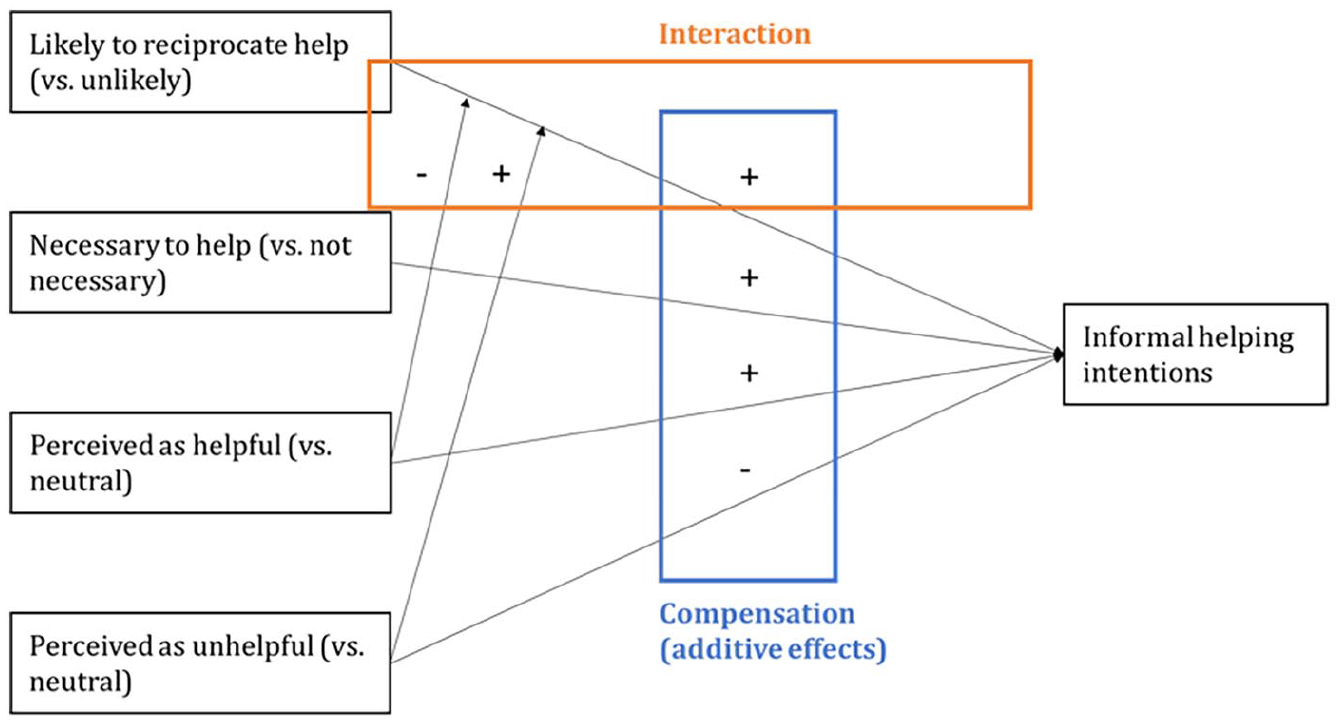
Conceptual Model.
Methodology and Data
To test our hypotheses, we conducted a vignette experiment based on a factorial survey design. This design entails that respondents are presented with short descriptions of hypothetical situations (vignettes) and are asked how they would respond to them. Major advantages of this design are relatively high internal and external validity (Auspurg & Hinz, 2015). This means that on one hand, the presented situations only differ on a few, predetermined aspects, excluding the influence of potential confounding factors. On the other hand, the design refers to concrete situations that may also occur in real life, making inferences toward a real-life situation sounder. A final advantage of the factorial survey design is the option to present respondents with situations that do not (yet) exist, thereby circumventing selection in being asked for help (Auspurg & Hinz, 2015).
Participants and Procedure
The vignette experiment was conducted among 1,104 members of the Longitudinal Internet studies for the Social Sciences (LISS) panel. The LISS panel consists of a representative sample of the Dutch population. 1 The panel is invited to complete online questionnaires every month. Of all members of the panel, 1,400 people that were representative for the Dutch population were asked to participate in the vignette experiment and of them, 1,104 (78.9%) people did.
The experiment consisted of three hypothetical situations (vignettes). After each vignette, people were asked how they would respond. Before a new vignette, respondents were reminded to think of the next vignette as an entirely new situation. The experiment was conducted in February 2022. Because every respondent reviewed three vignettes, our original data contained 3,312 observations of 1,104 respondents. After the experiment, one observation was removed due to an invalid answer on the dependent variable. Furthermore, three people were completely removed from the sample due to missing scores on control variables. Hence, our final sample consists of 3,299 observations of 1,100 respondents. The data can be found at https://doi.org/10.17026/dans-zpc-742n.
Design
In each of the three vignettes of our experiment, respondents are asked to imagine that they have just moved to a neighborhood and that one of their new neighbors asks for help with sweeping leaves from their front yard. Then a profile of this neighbor is presented, and respondents are asked how likely it is that they would help this neighbor. A (translated) example of a vignette is presented in Figure 2.
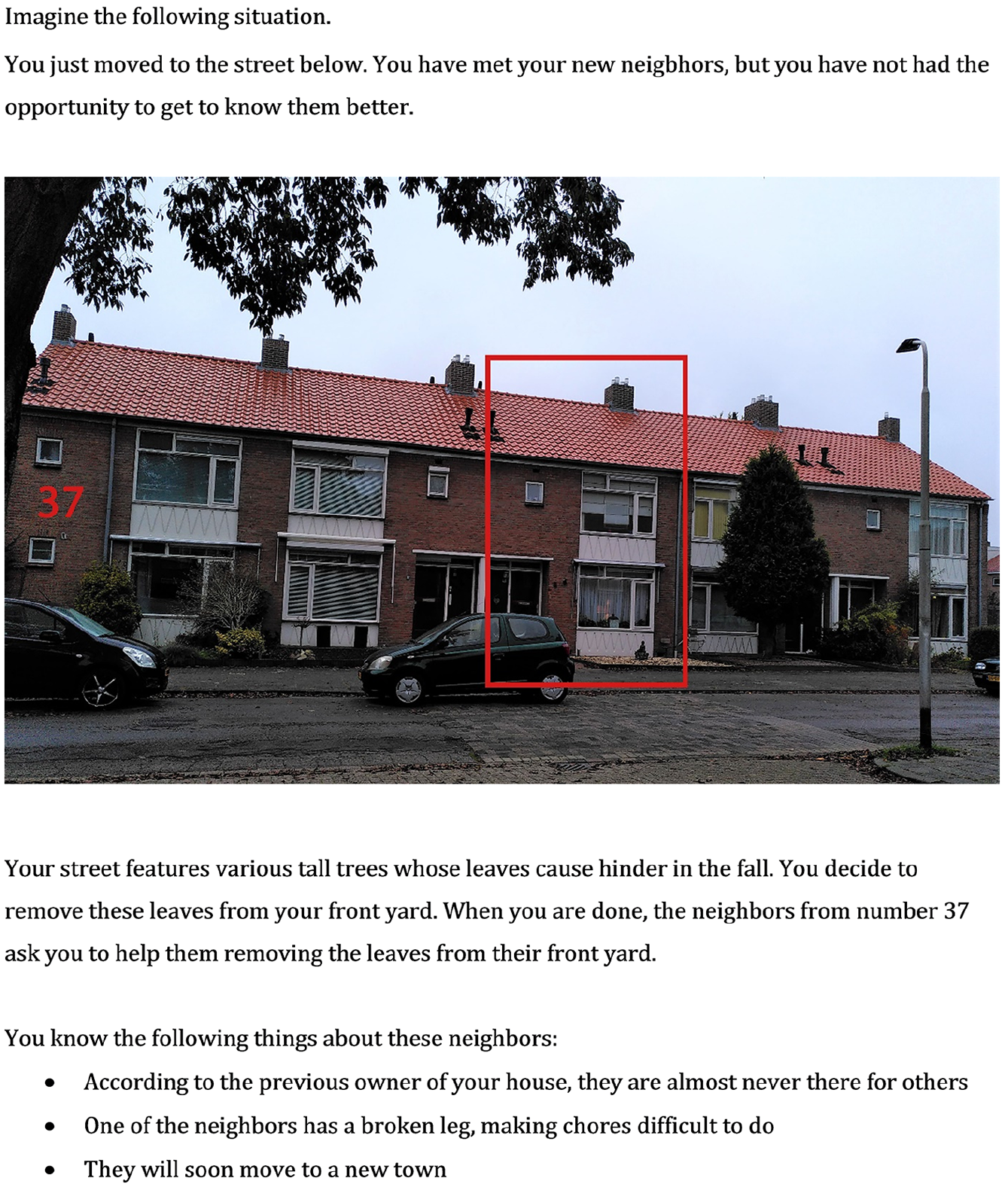
Example of a Vignette (Translated From Dutch).
The profile of the neighbor differed between vignettes on three dimensions, which had either three or two levels. The vignettes were checked for illogical combinations. 2 It was determined there were none. Hence, the vignette experiment had a 2 × 2 × 3 design. This results in 12 different vignettes, which were divided over four groups of three vignettes (see Appendix A for all possible combinations). Within each group, the order of the vignettes was varied, resulting in six versions of each deck. Hence, there were 24 different conditions to which respondents were randomly assigned.
Manipulations
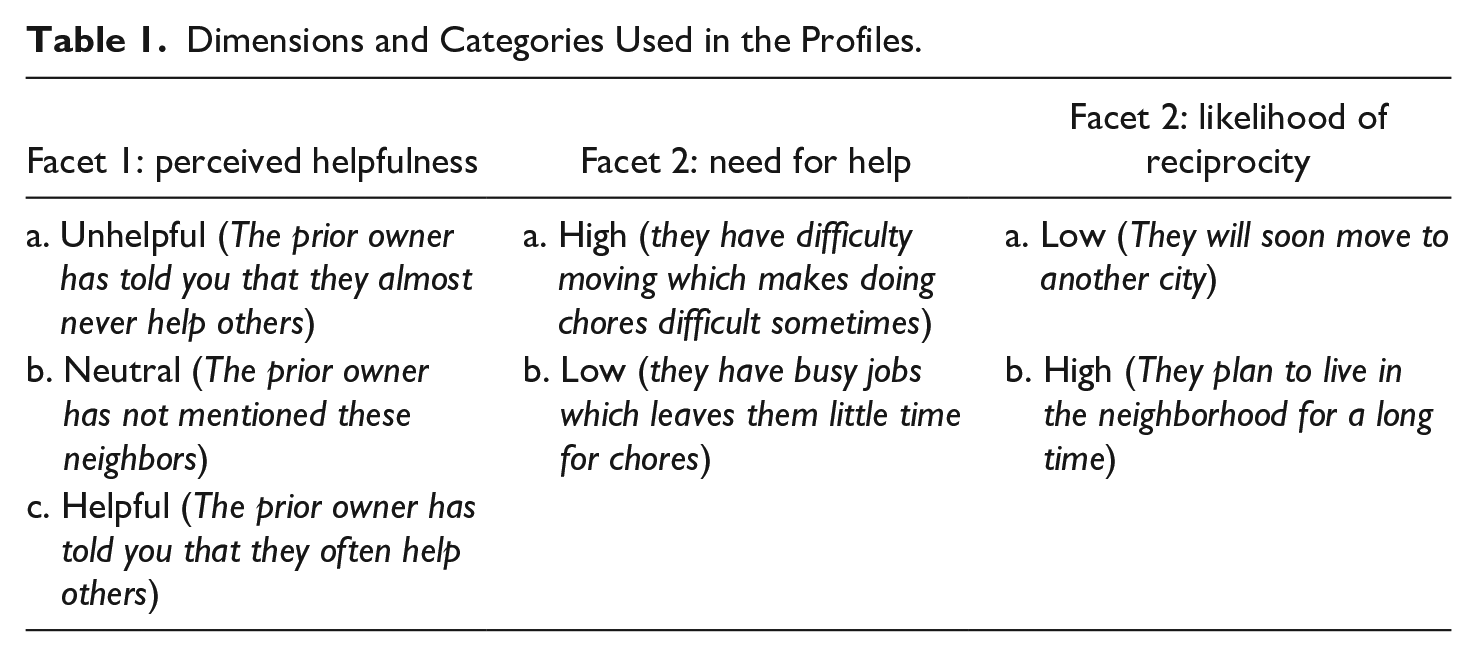
The three dimensions on which the vignettes differed from each other were (a) perceived helpfulness, (b) necessity of help, and (c) likelihood of reciprocity. Perceived helpfulness had three levels: unhelpful (0), neutral (1), and helpful (2). In the unhelpful vignettes, respondents were told that the old inhabitant of their house has said that the neighbor never helps other neighbors, whereas in the helpful vignettes, the old inhabitant is said to have mentioned that the neighbor is always happy to help others. In the neutral vignettes, respondents were told that they received no information about the neighbor. Both necessity of help and likelihood of reciprocity had two levels: low (0) and high (1). In the low necessity condition, respondents were told the neighbor needs help because they are busy and in the high necessity condition, the neighbor requires help because of a broken leg. Moreover, in the low likelihood of reciprocity condition, neighbor was said to move out of the neighborhood soon, whereas this neighbor was said to stay in the neighborhood for the foreseeable future in the high likelihood of reciprocity condition. A manipulation check was performed, showing that people thought neighbors were less likely to return the help when the neighbors were said to move soon than when they were said to stay (see Appendix B for details). Table 1 presents an overview of the dimensions and their corresponding levels.
Dimensions and Categories Used in the Profiles.
Measures
The dependent variable in the vignette design was the intention to provide help. Respondents were asked how likely it was that they would provide help to each profile’s neighbor, to which they could respond on a scale from 0 (very unlikely) to 10 (very likely). The independent variables were the three dimensions of the vignettes. For each dimension, dummy variables were created to differentiate between the levels. Concerning perceived helpfulness, the neutral condition was used as the reference category.
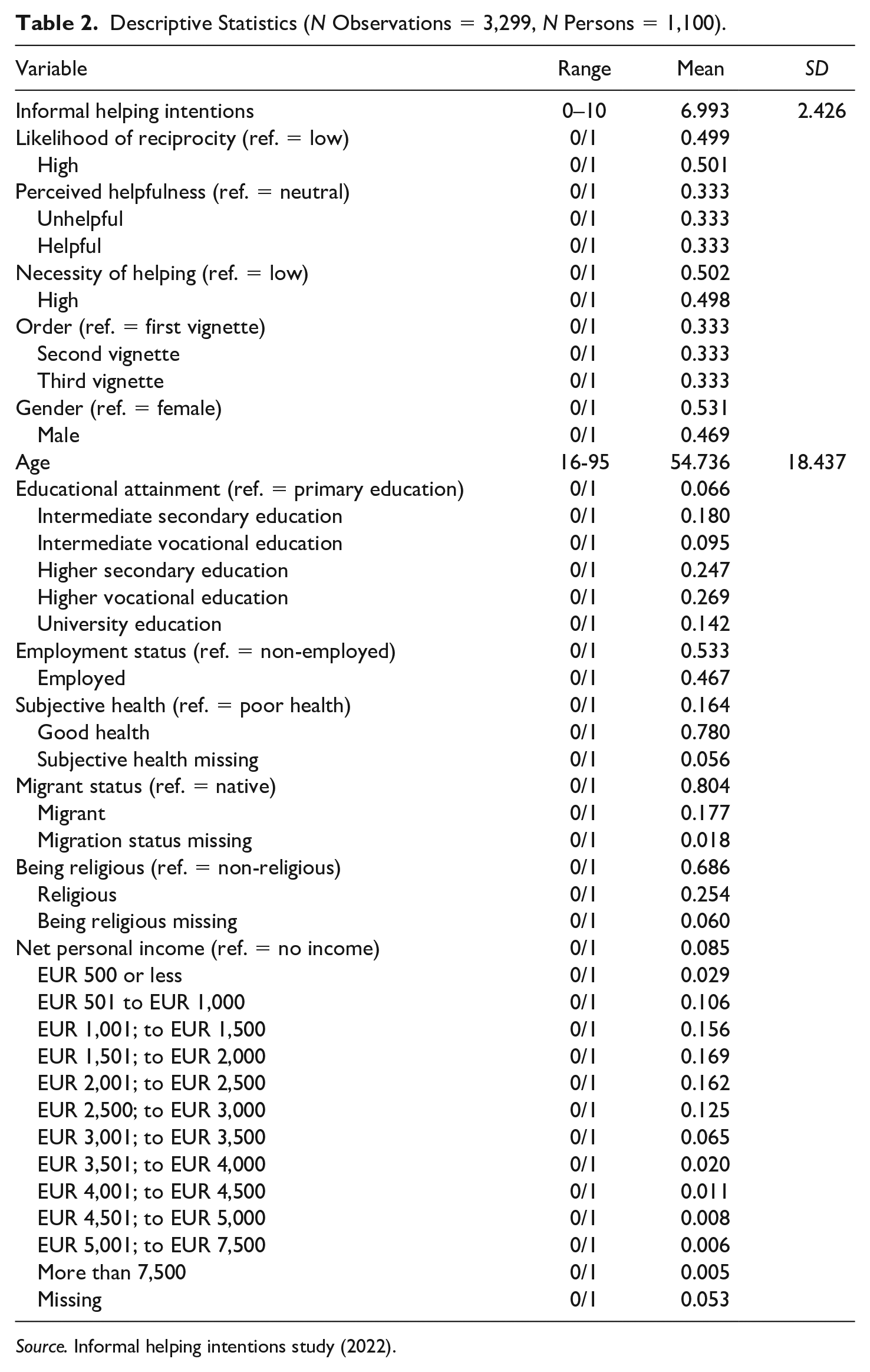
We controlled for the order in which the vignettes were presented, as this may have influenced people’s stated intentions. Moreover, we included various background variables in our models. 3 These give insight in how informal helping intentions relate to socioeconomic factors and can be compared with informal helping behavior. We control for gender (female/male), age, educational attainment (based on Statistics Netherlands categories), employment status (employed/non-employed), subjective health (good/poor), migrant status (native/migrant) and monthly income (categories ranging from no income to more than €7500 per month). 4 An overview of descriptive statistics of the dependent, independent, and control variables is presented in Table 2. 5
Descriptive Statistics (N Observations = 3,299, N Persons = 1,100).
Source. Informal helping intentions study (2022).
Method of Analysis
To analyze these data, we performed multilevel regression models. These are recommended for analyzing factorial survey data (Auspurg & Hinz, 2015) to account for the nested structure of the data (Hox, 1995). The fact that vignettes are nested in persons is particularly important in our data because the intraclass correlation is high (47.8%). This indicates that half of the variation in informal helping intentions is due to differences between persons (instead of vignettes).
We specified a multilevel model with the respondent at the higher level and the vignettes at the lower level. All effects included in our models are fixed, meaning that they do not vary over respondents. We chose these specifications because we do not expect that the factorial survey dimensions differ in their impact depending on respondent characteristics. Model 1 includes the three independent variables (likelihood of reciprocity, perceived helpfulness, and perceived necessity of helping) and the control variables as predictors. Model 2 includes all variables from Model 1 and interaction terms for reciprocity and the helpfulness dummy variables.
Results
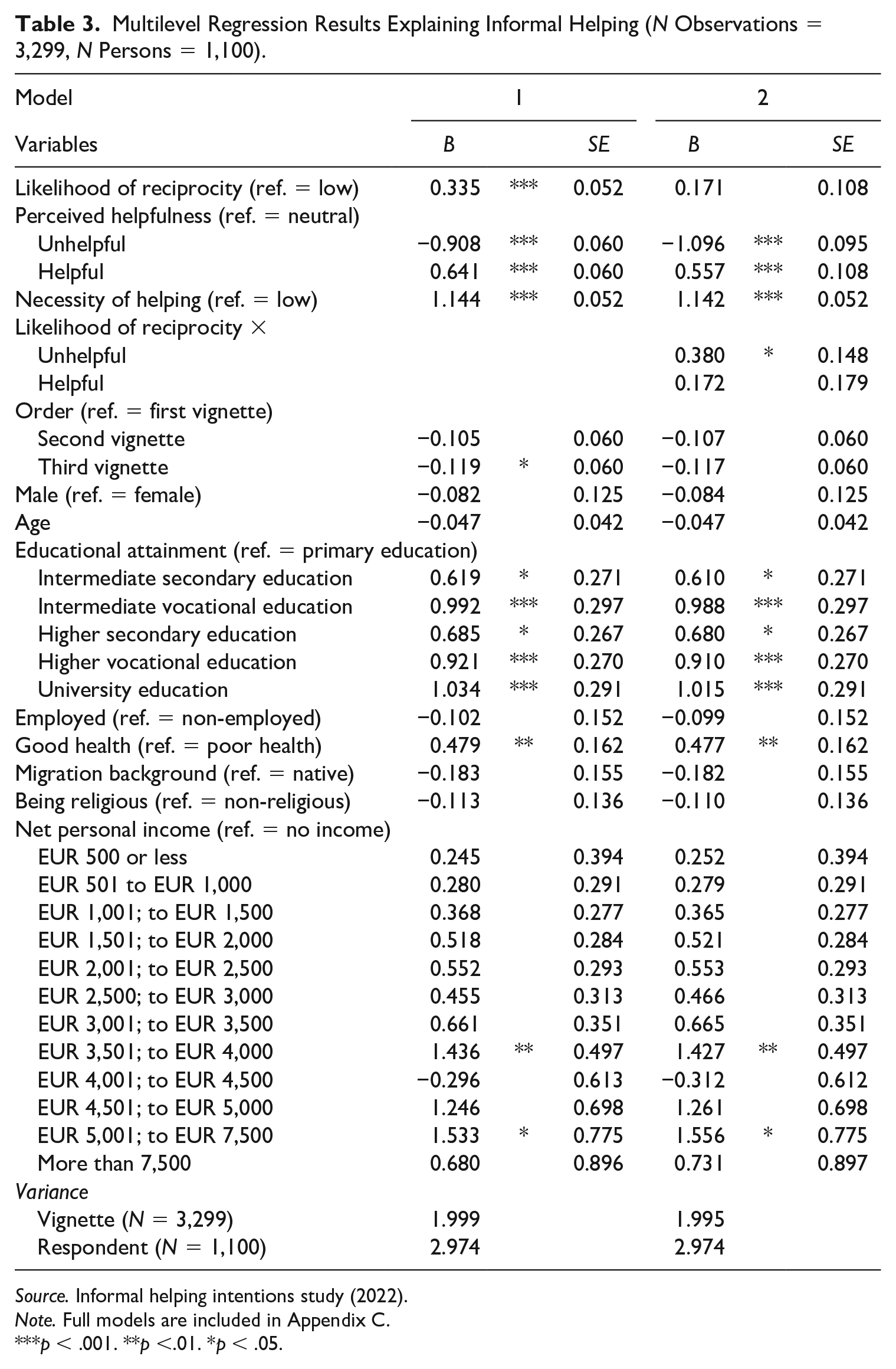
Table 3 reports the results of the multilevel analyses. Model 1 shows that people intend more strongly to help their fictional neighbor when this neighbor seems to be likely to reciprocate their help. More specifically, respondents score 0.335 higher on informal helping intentions when they are presented with neighbors who are likely to return their help compared with neighbors who are not. This effect is relatively small (3.0%), as informal helping intentions were measured on a 0 to 10 scale, but it is significant. This finding is in line with H1.
Multilevel Regression Results Explaining Informal Helping (N Observations = 3,299, N Persons = 1,100).
Source. Informal helping intentions study (2022).
Note. Full models are included in Appendix C.
p < .001. **p <.01. *p < .05.
Furthermore, Model 1 shows that people are more willing to help neighbors when the necessity of helping is presented as high. This finding is in line with H3. In addition, people are more likely to help neighbors who are presented as helpful, but less likely to help neighbors presented as unhelpful, compared with neighbors presented as neutral. These findings are in line with H4. These effects are larger than the effect of anticipated reciprocity in help, which we will discuss further when we describe whether compensation occurs. We will also not extensively discuss the results regarding the control variables here due to space constraints, but we do want to note the effects of order. We found that respondents intended to help less often in the third vignette than in the first. 6
Model 2 reports on the results of the multilevel analysis including the interaction terms between reciprocity and helpfulness. A visual representation of this model can be found in Figure 3. This figure shows the difference in informal helping intentions concerning a neighbor who was presented as likely to reciprocate help (yellow bar) and a neighbor who was presented as unlikely to reciprocate help (black bar) for various levels of perceived helpfulness. For vignettes in which the neighbor was also presented neutral, this difference is 0.171, as reported in model 2 of Table 3. To calculate the difference between low and high likelihood of reciprocity when comparing vignettes in which the neighbor was presented as unhelpful, we add this coefficient (0.171) to the interaction effect (0.380), which results in a 0.551 difference in total. This difference is significantly larger than among neutrally presented neighbors, which is in line with H4. However, the opposite does not apply. The difference between low and high likelihood of reciprocity did not significantly differ between vignettes in which the neighbor was presented as helpful and neutral vignettes. This means that the impact of likelihood of reciprocity was not smaller when a neighbor was presented as helpful, which opposes H4.
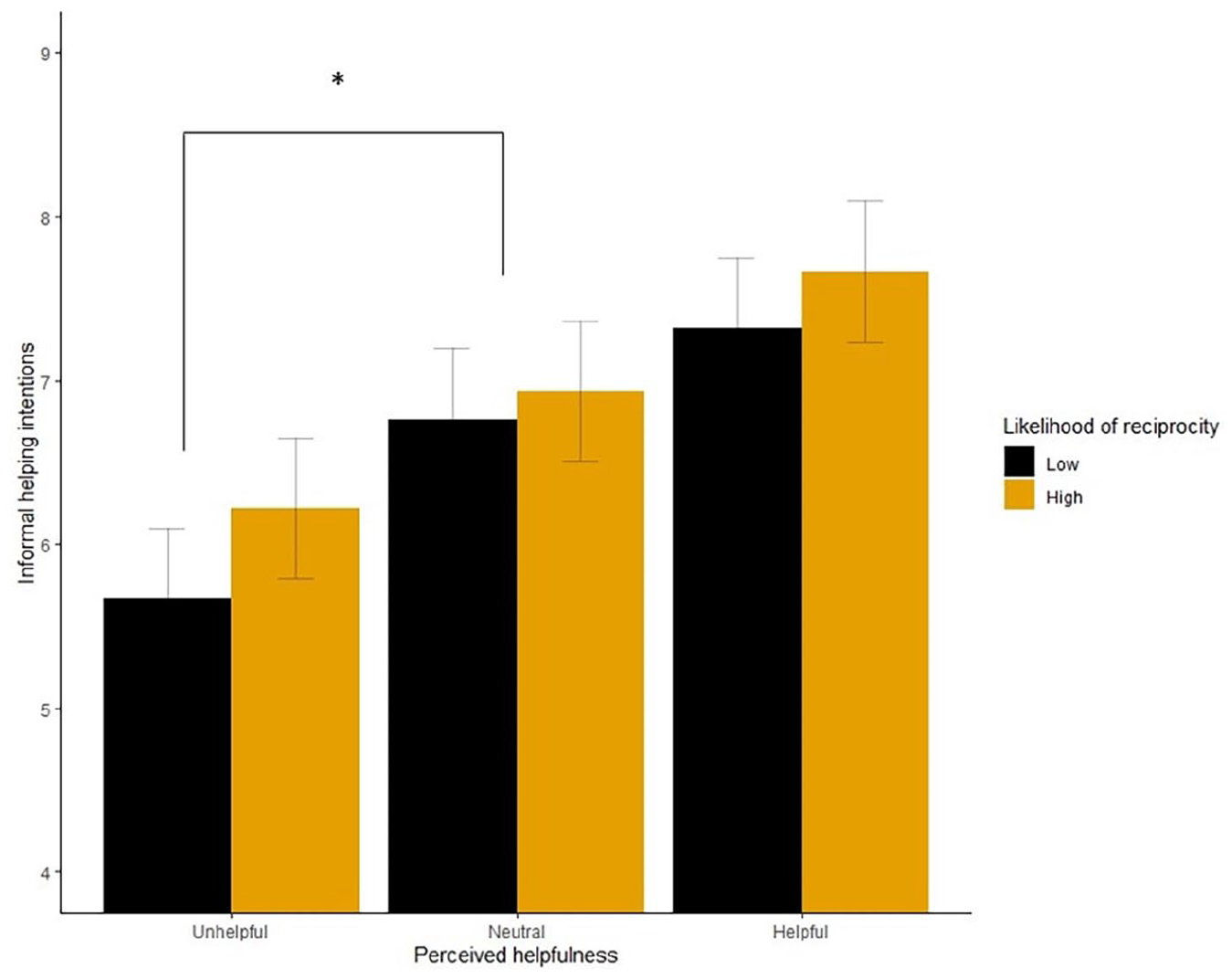
Informal Helping Intentions by Perceived Helpfulness and Likelihood of Reciprocity, Based on Multilevel Regression Models (N Observations = 3,299, N Persons = 1,100).
Although we did not hypothesize about this, it is not unthinkable that our interaction hypothesis only applied to people who were not in need of help, as necessity of help may have triumphed all other motivations for help. Hence, we explored a three-way interaction between our three manipulations in additional analyses. The results of this analysis, which can be found in Online Appendix 2, report no significant three-way interaction. Surprisingly, we do find an interaction between perceived helpfulness and necessity of helping; when neighbors are presented as in high need of help, being presented as unhelpful is more relevant than when neighbors are presented as in low need of help. In addition, being perceived as helpful is also more relevant for individuals’ informal helping intentions when people are perceived to be in high need of help instead of in low need of help. The results of the three-way interaction model and additional analyses that only include the two-way interaction (also included in Online Appendix 2) indicate that an interaction between likelihood of reciprocity and necessity of helping does not exist.
In addition to interactions between likelihood of reciprocity and perceived necessity and perceived helpfulness, the effect of likelihood of reciprocity may be compensated by the effects of perceived necessity and helpfulness. That is, the effect sizes of perceived necessity and helpfulness may be larger than that of likelihood of reciprocity, resulting in a net increase when adding them up. The results from Model 1 indicate indeed a compensation. Being unable to reciprocate help results in a drop of 0.335 in neighbors’ informal helping intentions. However, if one is considered helpful by others, Model 1 predicts an increase of 0.641 (5.8%) in informal helping intentions, resulting in a net increase of 0.306 (2.7%) in informal helping intentions. The same applies to perceived necessity. If helping a person is presented as necessary, Model 1 predicts a 1.144 increase (10,4%) in informal helping intentions. This also compensates for the 0.335 drop in informal helping that one faces if one is unable to return help. It eventually results in a 0.809 net increase (on an eleven-point scale; 7.4%) in helping intentions when a person is helpful but unlikely to reciprocate.
Discussion
The goal of this article was to examine the impact of reciprocity on informal helping intentions, and whether this impact can be compensated or dampened by helping behavior toward others and perceived necessity of helping. Based on a factorial survey conducted among the LISS panel in February 2022, we conclude that people have stronger intentions to help neighbors who are likely to reciprocate their help, need help or are seen as helpful. People have weaker intentions to help neighbors who are considered unhelpful. Concretely, this means that people want to help their neighbors more when they believe that this neighbor will help them as well at some point. They also are more willing to help when they notice the neighbor cannot do the task without them or when they know the neighbor helped a lot of other neighbors in the past. We found these results independent of the effects of socioeconomic factors, such as educational attainment, health, and employment status.
The results regarding the likelihood of reciprocity are in line with direct reciprocity research, showing that people are more willing to initiate help when the neighbor is likely to reciprocate (Falk & Fischbacher, 2006; Fehr & Gächter, 2000; Gouldner, 1960). Furthermore, our manipulation shows that the reason for the impact of reciprocity is indeed that people expect more help from neighbors in the “likely reciprocity” condition. This is line with the theoretical underpinnings of direct reciprocity (Fehr & Gächter, 2000; Gouldner, 1960). It also indicates that people do not automatically think that help is returned when they provide it, meaning that despite (direct) reciprocity being a norm, people anticipate that not everyone will (be able to) reciprocate equally.
It must be noted that likelihood of reciprocity seemingly has a rather small impact on people’s intentions to help. However, our design may slightly underestimate the impact of reciprocity due to prosocial bias. As we explain in Endnote 1, people who participate in (panel) surveys generally display more prosocial behavior and may thus find reciprocity less important than others. Yet, the LISS panel is highly validated and we believe the impact of prosocial bias to be limited in our study. Furthermore, neighbors only help each other 2.5 times per month in the Netherlands, compared with family members who help each other almost 10 times a month (Ramaekers et al., 2023). Hence, reciprocity may be the deciding factor in people’s ultimate decision to provide help. Future research needs to corroborate this claim in studies examining helping behavior.
Concretely, these results indicate that giving help is not an isolated prosocial action, but that people have expectations regarding what neighbors do for each other and which neighbors will live up to these expectations. Accordingly, their willingness to help neighbors depends on these expectations of neighbors. On the societal level, these reciprocity norms among neighbors make it less likely that people who cannot meet reciprocity expectations receive neighborhood support. Neighbors may still want to help because of other reasons, such as the necessity of helping or the receiver’s support given to others, but society needs to be aware of these circumstances when considering help neighbors might give to each other. It might imply that help seekers need to turn to family members and friends, among whom reciprocity norms are less strong (Curry et al., 2013; Phan et al., 2009).
Although the results of this study are in line with earlier studies about reciprocity in informal helping (Amato, 1990; Manatschal, 2015; Manatschal & Freitag, 2014; Phan et al., 2009), they also produced three new insights. First, Manatschal (2015) assumes in her study that immigrants help others to establish a reciprocal relationship with others. Our study empirically supports this assumption because whether another person will reciprocate indeed plays a role in whether someone intends to help that person. Second, our study is the first to show the importance of help-seeker characteristics, such as perceived helpfulness or likelihood of reciprocity, in someone’s decision to help. Prior studies have relied on assumptions about help seekers characteristics (Manatschal, 2015; Manatschal & Freitag, 2014) or have examined differences between the type of recipients (Phan et al., 2009; Ramaekers et al., 2023). Yet, no study has empirically examined whether specific characteristics foster receiving help. Because our study stresses their importance, future research should devote more attention to these characteristics.
Furthermore, our study shows that factorial surveys are a suitable method for examining the impact of reciprocity in helping. Our results and manipulation check show that reciprocity expectations can be accurately measured through factorial surveys and that these can detect reciprocity in informal helping. Being able to study reciprocity through factorial surveys is a positive development, because this method has high reliability, relatively high internal and external validity and can account for situations that have not (yet) occurred. Hence, our study has shown how reciprocity in helping would work, even for people who have never encountered such a situation.
Our findings also provide new insights in indirect reciprocity (Alexander, 1987; Nowak & Sigmund, 2005). The finding that people have stronger intentions to help those who are perceived as helpful supports both this theory. In addition, the interaction between likelihood of reciprocity and perceived helpfulness indicates support for a negative judgment bias (Rankin & Eggimann, 2009). This bias entails that people’s decisions rely more strongly on information about negative or uncooperative behavior than on positive or cooperative behavior. Together, these findings confirm, on one hand, that helping is not done in isolation. Instead, helping builds relationships with neighbors and fosters a feeling among them that the helper deserves help in return, even among those neighbors who have not experienced that help firsthand. On the other hand, these findings imply that people do not only help because they may reap benefits from it in the future. Instead, believing that someone deserves help, either because they helped in the past or cannot do without help, also seems to motivate people to help their neighbors. Furthermore, these findings imply that unhelpful neighbors have a relatively large impact on the informal help exchange in a neighborhood. A person who decides against helping their neighbors does not only reduce the informal help exchange directly by not providing help. Instead, the exchange of informal help also decreases indirectly because their neighbors are less likely to help an unhelpful person.
Yet, our study is not without limitations. First, this study examines informal helping intentions, not actual behavior. Although people may have thought about real-life considerations such as physical health or time constraints, we cannot be certain that the impact we found for intentions also translates to actual behavior. Yet, focusing on intentions may also have been beneficial in some regard. It is generally understood that social networks and having opportunities for helping play a major part in informal helping (Lee & Brudney, 2012; Wang et al., 2017). Examining intentions shows the potential in helpers when they are asked for help.
Second, we must note that this study only focuses on neighbors, Studies imply that reciprocity norms may be more important for them than for people that are closer to a person, such as friends and relatives (Curry et al., 2013; Phan et al., 2009). For example, an entire subsection of reciprocity in help literature suggests that reciprocity hardly matters for relatives because they are helped out of kin altruism instead of reciprocity altruism (Stewart-Williams, 2007; Stürmer & Snyder, 2010). Still, we did not study neighbors without reason. Neighbors are a largely unused group of potential helpers (Ramaekers et al., 2023). Understanding what motivates their helping can inform policy that promotes helping about neighbors. Future research should thus aim to validate the findings of the current study by comparing intentions and behavior and by comparing various recipients of help, such as relatives, neighbors, friends and acquaintances. Relatedly, our study only focuses on one type of informal help, namely gardenwork. Prior research has indicated that helping motivations differ based on the cost of helping (Stewart-Williams, 2007). Hence, it is possible that the helping motivations under study could play out differently when the cost of helping a neighbor is much lower or much higher than the example that we used. Future research could examine the role of reciprocity, past helping behavior and necessity of helping in both low- and high-cost helping situations.
Finally, the current study focuses on a single interaction. Yet, prior research has shown that reciprocity norms are reinforced by repeated interactions, which are likely to be common among neighbors (Gächter & Falk, 2002). Furthermore, reciprocity is to some extent situational; what is considered a fair exchange and who can provide that depends on characteristics of the asker, helper, their relationship, and the wider context they are a part of (Hansen, 2004; Nelson, 2000). Future research should, thus, investigate the impact of reciprocity over a longer period of time in which multiple interactions occur and with consideration of the social context in which exchange takes place. As argued by Hansen (2004), particularly qualitative approaches may be suitable to understand reciprocity from this more holistic perspective. Another approach to deal with the situational nature of reciprocity may include studies of reciprocity among neighbors in non-Western countries. Although reciprocity has been observed universally (Gouldner, 1960), it may play out differently depending on differences in norms on helping (e.g., Levine et al., 2001). Hence, studies in non-Western countries may provide new insights how the context affects reciprocity in informal helping.
Still, our study shows that reciprocity affects informal helping intentions among neighbors and that people who cannot give help are less likely to receive help from neighbors. This may indicate that this group has to rely more on other groups (friends and family) or formal organizations (e.g., municipalities or neighborhood organizations). Yet, there may be possible interventions that can help include the people who are unable to reciprocate in the informal help exchange. For example, neighborhood organizations can signal a person’s need for help through bulletin boards, emails or posters. Moreover, when a person has often helped neighbors, neighborhood organizations can make this visible as well. After all, our research suggests that knowledge on needing help or helping behavior toward others can compensate for a lack of reciprocity of ability. Researchers and practitioners should work together in developing interventions based on this research further and putting them to the test in real-life neighborhoods.
Supplemental Material
sj-docx-1-nvs-10.1177_08997640241241323 – Supplemental material for Why Neighbors Would Help: A Vignette Experiment on Reciprocity in Informal Helping
Supplemental material, sj-docx-1-nvs-10.1177_08997640241241323 for Why Neighbors Would Help: A Vignette Experiment on Reciprocity in Informal Helping by Marlou J. M. Ramaekers, Tanja van der Lippe and Belle Derks in Nonprofit and Voluntary Sector Quarterly
Footnotes
Appendix A:
Dimensions and Levels of the Factorial Survey
Appendix B:
Manipulating Reciprocity
In this section, we report on the validity of the main manipulation, namely, whether the help requester was likely or unlikely to reciprocate respondents’ help. In this way, we establish the extent to which our results are a sound empirical test of our hypotheses and theoretical framework. To manipulate this, the neighbors in the vignettes were either described as moving soon to a new town (indicating unlikely reciprocity) or as planning to stay in the neighborhood for the foreseeable future (indicating likely reciprocity; see Table 1 for an overview of the dimensions and categories). We assumed that respondents would expect the neighbor in the “moving soon” condition to be less likely to return their help than the neighbor in the “staying” condition. To check whether respondents indeed interpreted the manipulation this way, we asked respondents to estimate the likelihood that the fictional neighbor would return their help (0 [very unlikely] to 10 (very likely)).
First, we examined to what extent respondents answered this question differently based on the descriptions they received (see online appendix 1 for tables). A multilevel analysis with the same predictor variables as our main analyses shows that respondents estimated that the neighbors were less likely to return their help when the neighbors were presented as unlikely to reciprocate help than when the neighbors were presented as likely to reciprocate help. Likelihood of reciprocity is also the strongest predictor of expected return of help, although it only amounts to an effect of 0.9 on an 11-point scale.
Second, we examined to what extent respondents’ estimation of the fictional neighbor’s likelihood of returning their help explains any impact that reciprocity would have on informal helping intentions. We compared the results from Model 1 to the results of a similar analysis that also includes respondents’ estimations of the return of help (see Online Appendix 1). This comparison indicates that the effect of reciprocity is explained by the estimated return of help. This suggests that people react differently to the high and low likelihood conditions because they evaluate the chances of receiving help from these neighbors differently. All in all, we conclude that our main manipulation largely captures what we intended it to do.
Appendix C:
Full Models
Authors’ Note
The study is part of the research program Sustainable Cooperation—Roadmaps to Resilient Societies (SCOOP).
Data Statement
The data that produce the findings reported in this article are available for non-commercial purposes at https://doi.org/10.17026/dans-zpc-742n. The codes that produce the findings reported in this article are available through the Open Science Framework at  .
.
Declaration of Conflicting Interests
The author(s) declared no potential conflicts of interest with respect to the research, authorship, and/or publication of this article.
Funding
The author(s) disclosed receipt of the following financial support for the research, authorship, and/or publication of this article: The authors are grateful to the Netherlands Organization for Scientific Research (NWO) and the Dutch Ministry of Education, Culture and Science (OCW) for generously funding this research in the context of its 2017 Gravitation program (grant number 024.003.025).
Ethical Approval
This research was approved by the Ethics Committee of the Faculty of Social Sciences, Radboud University Nijmegen (ECSW-LT-2022-1-18-68918).
Supplemental Material
Supplemental material for this article is available online.
Notes
Author Biographies
References
Supplementary Material
Please find the following supplemental material available below.
For Open Access articles published under a Creative Commons License, all supplemental material carries the same license as the article it is associated with.
For non-Open Access articles published, all supplemental material carries a non-exclusive license, and permission requests for re-use of supplemental material or any part of supplemental material shall be sent directly to the copyright owner as specified in the copyright notice associated with the article.
