




Abstract
Community businesses contribute to the economic and social well-being of the communities in which they operate. As a subset of hybrid organizations, community businesses have unique challenges and opportunities related to their community embeddedness. Our study adopts an institutional logic perspective to understand the evolutionary boundaries of community business, which we argue, are shaped by the interplay of tensions between the social, market, and community logics. While existing literature discusses institutional logics from a dichotomous angle, focusing mainly on the social and market logics, we argue that the introduction of a third logic (i.e., community logics) has ramifications for the evolution of hybrid organizations. The different trajectories may have implications for the social, community, and economic impact that organizations can have. We draw on 39 qualitative interviews to provide useful insights for policy and practice on supporting community businesses.
Introduction
Community business is an umbrella term used to describe a diverse range of enterprises that exist to fill a local need (or set of needs) that is not being served by existing markets. They can be conceptualized as a type of social enterprise—a subset of third sector organizations which explicitly balance their social aims with a need to generate income (Billis, 2010)—and contribute to the well-being and development of their communities. In providing services to their local community, community businesses contribute to the vibrancy and resilience of their communities. It is also likely that, because they evolve with community needs as central to their business models, these entities are better placed than profit-driven traditional market entities at meeting those needs. Therefore, to the extent that they generate community benefits, encouraging the establishment and success of community businesses may be a powerful policy tool to address socioeconomic and spatial inequalities.
Despite the consensus on the need to encourage community business growth (in terms of turnover and size of organization), developing a knowledge base to enable community business continuity has been challenging. This is partly because community businesses do not have one legal entity or sector in which they operate and have different objectives and offerings, which makes them difficult to identify. While the field of social enterprise is frequently studied, there is relatively little recent empirical evidence on community businesses and their life cycles (Buratti, Sillig, & Albanese (2022) state that most influential articles are conceptual), including changes that might challenge their status as a community business. In addition, as these entities are neither purely commercial nor nonprofit, it is difficult to draw insights from either stream of literature. There is increased scholarly interest in the realm of social enterprise, which acknowledges the hybrid nature of socially oriented business entities, community business remains a developing subfield (Bailey, 2012; Stott et al., 2019). We argue that because of the local focus of their offering, community businesses face additional life cycle challenges that warrant their treatment as a distinct type of social enterprise.
This article explores the evolutionary boundaries of community businesses, which we suggest are shaped by the interplay of tensions between the social, market, and community logic. In for-profit enterprises, metrics for success tend to focus on growth and scaling; however, success for community business is a more nuanced concept. Similar to concepts of wider social enterprise growth (see Austin et al., 2012; Lyon & Fernandez, 2012; Weber et al., 2012), while remaining distinct, the replication of successful community business models and their emulation in other communities is also perceived as a marker of success. However, prioritizing these paths has the potential to transform the community business into a different type of business entity. We describe this as an evolution that alters business activity to the degree that they cross boundaries between organizational types. While this is not necessarily a bad outcome, it is important to understand these evolutionary mechanisms. Community business boundaries (as shaped by tensions and logics) are less well understood in the academic literature and policy space, creating barriers to supporting and growing the sector; a recent review does not identify articles related to this theme (Buratti, Albanese, & Sillig, 2022).
In response to recent calls for further exploration of community logic, we build on existing literature (Georgiou & Arenas, 2023) by addressing the following broad question:
What are the competing tensions faced by community businesses and how do these interact to affect their evolution?
In doing so, we aim to understand the tensions inherent in community businesses’ hybridity and outline evolutionary trajectories. We also seek to understand how community business leaders perceive the advantages and disadvantages of these evolutionary options. To address our research question, we draw on hybrid organization literature that acknowledges that such entities face and must balance competing priorities. Much of this literature uses an institutional logics lens to explore these tensions (Pache & Santos, 2013) but typically focuses on the social and market logics. However, we argue that to better comprehend the challenges faced in community business growth, there is need to consider the community logic. This qualitative study draws on institutional logics to outline the types of tensions faced by community businesses and is based on 39 semi-structured interviews with community businesses in England.
This article contributes to institutional logics and hybridity literature by elaborating and applying community logics. We build on Smith et al.’s (2013) framework of institutional tensions to understand this phenomenon. We provide a greater understanding of how these tensions shape the spectrum of evolutionary options for community businesses and demonstrate how the push or pull of these factors might provoke business model changes that transmute them into different kinds of enterprises. In doing so, we argue that community businesses are often driven by their imperative to survive rather than out of a devotion to a specific strategic direction born out of a single dominant logic. Consequently, their evolution can be erratic and nonlinear, and the interplay of tensions can create evolutionary scenarios in which business models are transformed into something that is no longer effectively a community business. While in this contribution we are agnostic about the normative implications of these kinds of transformations, exploring these boundaries and the tensions that shape them, generates valuable understanding about the conditions in which community businesses operate, and introduces important nuance in characterizing what “success” is for this class of enterprise. This has practical implications when it comes to supporting the growth of the community business sector and ensuring their continued provision of social, economic, and community impact.
Community Business, Hybrid Organizations, and Institutional Logics
While some have debated whether adopting a rigid definition of community business is productive (Buckley et al., 2017), outlining the dimensions of how we understand community business adds conceptual clarity. Buratti, Albanese, and Sillig (2022) describe community businesses as organizations which engage in commercial activity, involve the local community in their governance and service delivery, and that work toward the development of the local area by providing economic, social, and environmental impact using local resources and social capital. Although community businesses’ primary mission is social, it is supported by selling goods and services using mixed income streams (usually commercial fee-for-service model supplemented with grant funding; Evers, 1995; Harries & Miller, 2018) and can appear outwardly no different from for-profit businesses. In other contexts, these businesses could be profit driven, in these cases social objective(s) dominate and are inextricably intertwined with the target communities. Community businesses can be difficult to identify and, as such, there are gaps in our understanding about how they function and can best be supported. Recent research estimates that there are more than 9,000 community businesses operating in England (Higton et al., 2019) making them a small but important and diverse part of the English economy.
The term “hybrid” is used to describe organizations that blend traditionally for-profit practices with traditionally non-profit practices (Doherty et al., 2014; Haigh et al., 2015). These organizations leverage market mechanisms to achieve their social objectives. By relying on markets as one of their primary sources of revenue, these organizations deliver on their social missions without relying (as much) on donations or grants to sustain themselves (Ebrahim et al., 2014). Social enterprise and community business are both examples of hybrid organizations. While a more robust literature has developed around the challenges and opportunities of the organizational hybridity of the former, many of the principles are transferable to the community business context which can be described as a distinct subset of social enterprise (Pearce, 2003).
Most notably, the literature on the hybridity of social enterprise focuses on tensions inherent in this organizational form as hybrid entities are challenged to sustain both commercial viability and social impact simultaneously (Battilana et al., 2015; Mongelli et al., 2019). Pache and Santos (2013) reflect that hybrid organizations are, by their nature, arenas of contradiction. Scholarship frequently frames this in terms of a struggle between competing tensions, which can exist in different aspects of the business. Smith et al. (2013) identify social-business tensions in business performance, organization, belonging, and learning. We change Smith et al.’s (2013) framework to address the plurality of logics present in community business as well as changing the learning category to temporality as we interpret the parameters to be a consideration of change over time, rather than embedding new understandings.
Establishing performance priorities and goals can be difficult and conflicting for community businesses due to difficulties in defining success. Organizationally, businesses and charities require different structures (e.g., legal forms, financial infrastructure, hiring and training practices) that can also work at cross-purposes (Battilana & Dorado, 2010; Bromberger, 2011; Smith & Lewis, 2011). Organizational hybridity also breeds belonging tensions, as businesses need to convince potential market partners of their commercial viability, and hence act and communicate in the language of market-oriented business, while often still appealing to donors and foundations that align with their social missions and effectively communicating their need for support. Community businesses will often have to adopt and project different identities and rhetoric depending on the audience they face, and their hybridity entails a higher risk of being less appealing to both (Dey & Teasdale, 2016; Park & Bae, 2020). Finally, Smith et al. (2013, p. 410) describe learning tensions as the “tensions of growth, scale, and change that emerge from divergent time horizons.” They highlight that social mission success requires long planning horizons, while business successes can come from short-term gains. Often taking on short-term costs is necessary to expand the longer-term social mission and businesses must manage the demands of these different timelines.
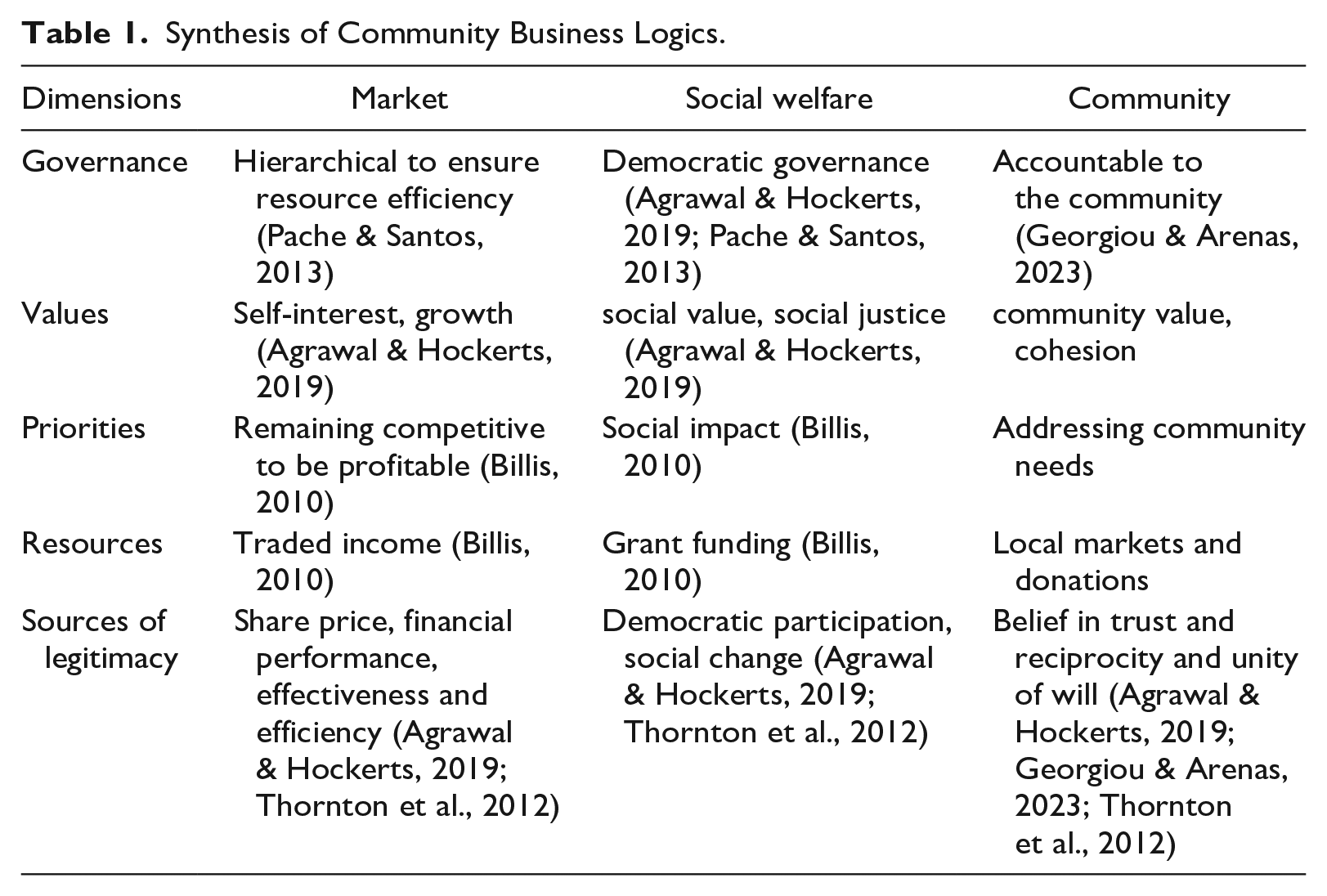
These tensions often juxtapose social and market priorities or institutional logics. The institutional logics framework argues that individuals’ and organizations’ interests, identities, values, and assumptions—the factors that motivate their structures, aims, and decisions—stem from embeddedness within prevailing institutional orders (Thornton et al., 2012). Identifying logics present in hybrid organizations involves looking at the ownership, governance, values, priorities, resources, and sources of legitimacy (see Table 1: Synthesis of Community Business Logics where we summarized these logics drawing from existing literature). We set out descriptions of three overarching logics, identified throughout the literature, as influencing community business (i.e., market, social and community logics). While community and social logics are strongly connected may be justified, recent literature has made a strong case that they are distinct logics in their own right (Georgiou & Arenas, 2023).
Synthesis of Community Business Logics.
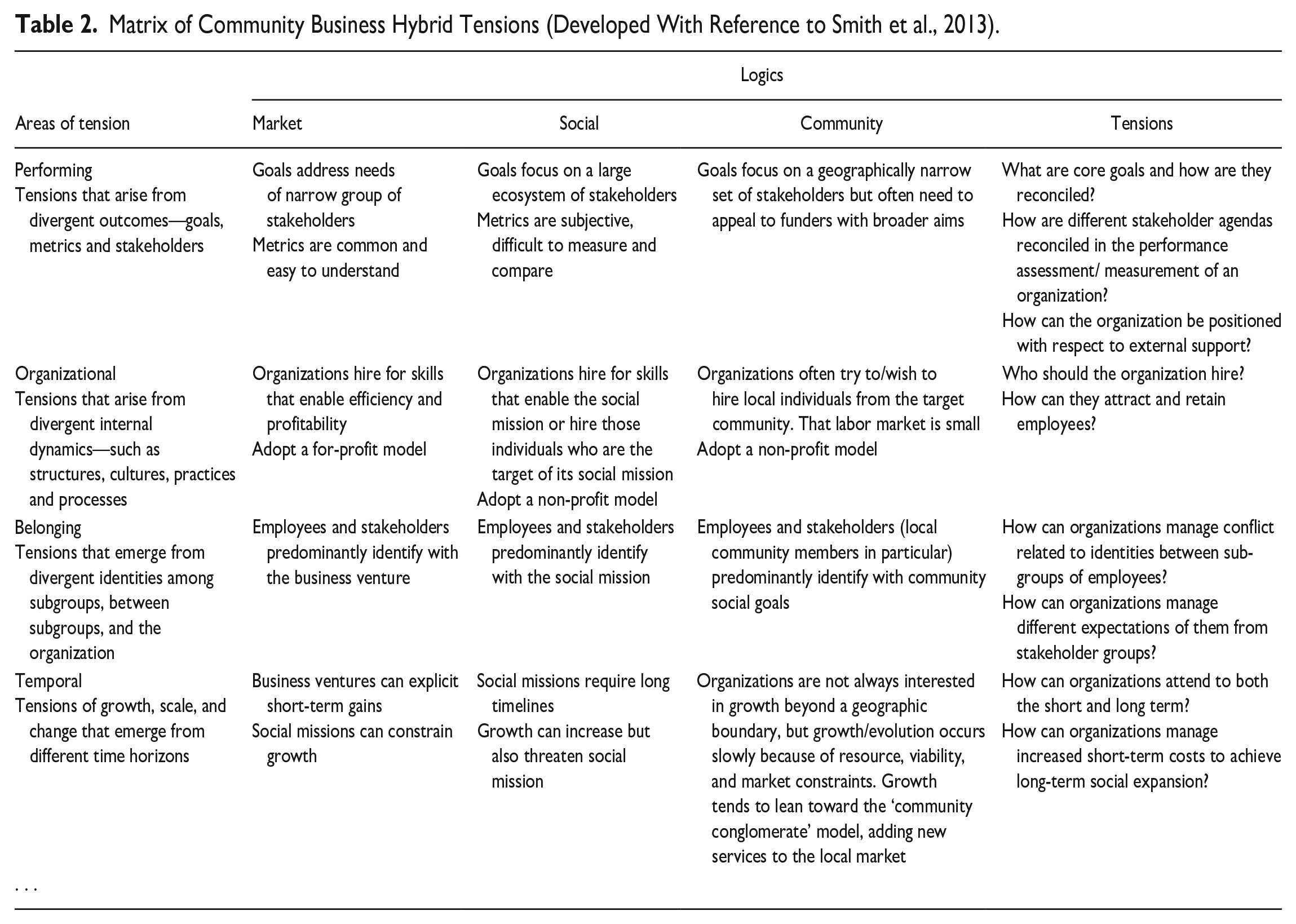
Identifying the logics within different organizations is a complex task (Reay & Jones, 2016) however, rather than focusing on the identification of logics, we seek to explore tensions between those logics. This is because no organization fits neatly within the ideal types presented in the literature, and tensions are present for all organizations. Table 2: Matrix of Community Business Hybrid Tensions visualizes the relationship between institutional logics and the areas of tension described by Smith et al. (2013), namely, performing, organizational, belonging, and temporal. Performing relates to outcomes, goals, and metrics; organizational aspects include internal conflicts that arise from different groups; belonging is connected to organizations seeking legitimacy from stakeholder groups and temporal to the future of the organization. Breaking down the points of conflict in the tensions allows us to begin to understand the ways in which the logics interact. In hybrid organizations, in each of the areas of tension depicted (and others not discussed here, denoted by ellipses), multiple logics coexist and must be balanced. We build on the Smith et al.’s (2013) model by applying it to community businesses, which include a third logic of community; this in turn adds complexity to the tensions they uncovered. In any organization, these parallel logics can blend, conflict, or dominate in different areas and at different times. How that happens within organizations, which logics (and aspects thereof) dominate, in what areas of the business, and how that shapes or challenges organizational evolutionary paths, is of central interest. While existing literature has explored narratives in the development of social enterprise (Seanor et al., 2013), and McMullen (2018) uses evolutionary metaphors to describe the potential for social enterprise to invade entrepreneurial ecosystems, there has been a dearth of understanding of the evolution of community business. This is a topic frequently discussed in terms of dual institutional logics; however, multiple institutional logics can be present in any organizational type (see Drencheva & Au, 2023 on social enterprises) and three logics are foundational to community businesses, namely, market, social, and community logics.
Matrix of Community Business Hybrid Tensions (Developed With Reference to Smith et al., 2013).
In brief, market logics prioritize hierarchy and centralization of decision-making to ensure resource efficiency and are organized around values of self-interest and growth. Dominant goals revolve around competitiveness and profitability, typically measured in terms of trade income, share price, and other metrics of financial performance. Social logic is primarily concerned with addressing a social need and the attempt to address a social mission or create positive change influences actions (Pache & Santos, 2013). It is associated with democratic control over the organization aligned with values of social justice (Agrawal & Hockerts, 2019). The social logic is associated with public sector resources in hybrid organizations usually such as public sector funding. 1 While social enterprise tends to be explored in terms of market and social logics, Pache and Santos (2013) note that organizations of all sorts exist within pluralistic institutional environments such as medical schools (health care and academics), public–private partnerships (state, market, and civil society), and biotechnology companies (science and market). Furthermore, hybrid organizations can be shaped by more than two logics, which opens up the possibility of even greater complexity and contestation (Drencheva & Au, 2023).
Therefore, we argue that because of its rootedness in localized milieu, community business experiences a third logic that is not consistently acknowledged among studies of social enterprise. A community logic stems from community businesses’ explicit mission to serve the needs of a geographically defined, and constrained, population. This logic prioritizes community needs and aims to promote community values, cohesion, resilience, and development. Where social logics engage with democratic governance and firms rely on hierarchies, the community logic is rooted in accountability to the group it serves and inclusiveness.
Figure 1, Community Business Hybridity Triangle, demonstrates how significant the geographic rootedness, which is foundational to the community of place logic, can be in situating the opportunity for community business. Two vertices of the triangle juxtapose the goals of independent economic viability and social impact. For each entity type on the right side, the diagram posits a stylized relationship between viability and impact, with private, for-profit businesses (left) characterized by high economic independence, but low social impact and, at the other side of the triangle, not for profits (including charities) characterized by low independence, but high social impact.
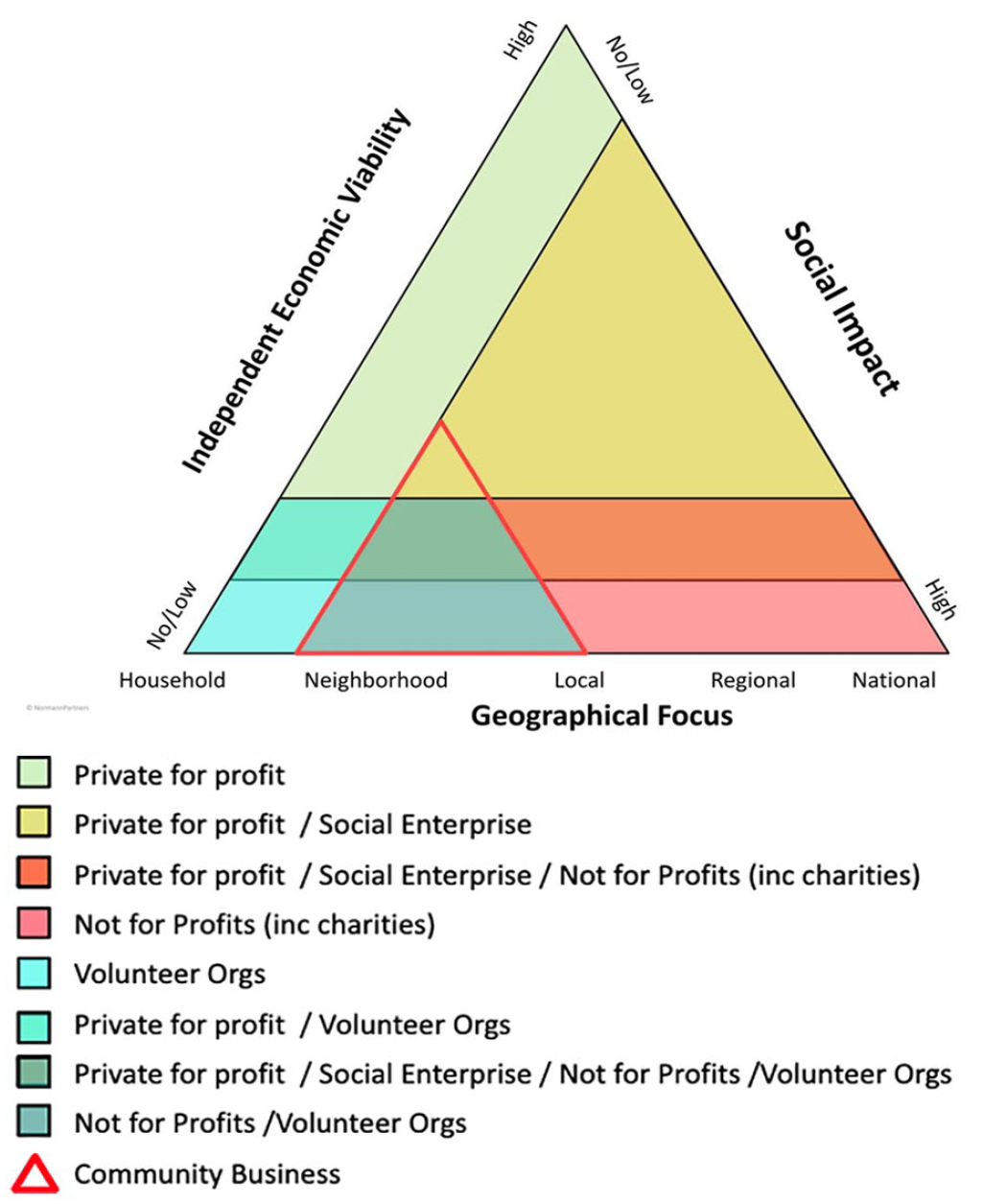
Community Business Hybridity Triangle.
Adding a geographical dimension adds further context, as organizations can be focused at different scales, which can add further layers of constraint on both commercial viability and impact. When the geographical focus of hybrid organizations is narrowed, the potential markets are smaller, and the social impact is more localized. The red triangle situates the notional limits of community business relative to other less geographically constrained entities.
Adding this third logic has the advantage of enabling researchers to consider how the unique geographical rootedness of community businesses influences decision-making and evolutionary trajectories. This adds further credibility to our contention that community businesses should be treated as a distinctive subset of social enterprise. However, multiplying logics also implies that community business growth opportunities may be more bounded. In the discussion, we envision five potential evolutionary scenarios, four of which see the firm adopt strategies that enable them to shift within the boundaries of the hybridity triangle and one that contemplates business model change such that it evolves into a different type of entity.
While logics are often discussed using the language of conflict, tension, and trade-off, recent research suggests that hybridity may not always result in zero-sum struggles between logics. This view holds that focusing on tensions overlooks the opportunities that may be available precisely because of organizational hybridity (Jay, 2013). Mongelli et al. (2019, p. 302) see potential in the “recombination of apparently contradictory but actually interrelated elements” and that the performance benefits that emerge from commercial focus combined with the passion elicited from pursuing social missions may offer new solutions to existing challenges (Smith et al., 2013). This argument does not imply that tensions do not exist only that they may not always involve negative trade-offs. Under these assumptions, the question then is whether, and how, organizations can find ways to balance these opportunities and trade-offs to maximize their potential to achieve strategic goals.
Method
We judged that a qualitative, exploratory approach to data collection was most appropriate to capture the rich and complex nature of the tensions and trajectories of community business. We draw from in-depth interviews with 39 trustees or senior management staff members of the community businesses (see Appendix for roles and service areas of community businesses); this was particularly appropriate to understand the institutional logics of community business and provided rich data from the perspective of community business leaders. Data collection was completed shortly before the COVID-19 pandemic (between 2018-2019). Interviews were conducted with community businesses identified and approached in conjunction with an intermediary organization which supports community businesses and commissions a large-scale “state of the sector” survey. Not all community businesses approached were in receipt of support from the intermediary organization, but all identified themselves as a community business. The United Kingdom has a long history of community business (Murray, 2019), and recent political interest in the connection between health and well-being and community businesses shown by the U.K. Government (2022), made England an interesting site to explore these issues. However, our contributions reach beyond the English context. Our sample reflects different geographies in England, with urban, rural, and semi-rural areas represented (see Appendix). However, per person, there are more rural community businesses than urban community businesses (Higton et al., 2019), suggesting that community businesses in rural areas are more vital in these areas. We therefore looked to ensure rural community businesses were strongly represented in the sample.
Community businesses interviewed as part of the study were not representative of the wider community business population, but rather the sampling approach looked to provide a stratified sample of businesses reflecting the variety of sectors, size, and geographies as identified in the “state of the sector” survey. Interviews lasted between 30 min to 1 hr. Our research adhered to our university ethics procedure. Interviews were conducted over the phone and followed a semi-structured interview schedule which included questions about the context of the community business, how they have evolved and adapted over the last 12 months, and their expectations for the future of their business. The interview guide was designed to elicit data on the growth and sustainability factors of community businesses. To facilitate the data analysis, interviews were audio-recorded and transcribed verbatim. Participants were also assured of confidentiality and anonymity to encourage sincere responses. Transcripts were assigned a numbered code to ensure confidentiality. The data were thematically analyzed according to the framework depicted in Table 2: Matrix of Community Business Hybrid Tensions. We first identified the broad logics as themes (market, social and geographic), before returning to the data exploring the tensions present in the community businesses under the categories suggested by Smith et al. (2013) (i.e., performing, organizational, belonging and temporal). The coding process was carried out by two of the authors to ensure greater reliability of coding. Where coding was inconsistent, the different codes were discussed, and the best fit agreed on. Quotes from the data are provided throughout the findings section as a means of illustrating the themes present, but also to include participants’ voices in the study (Jack & Anderson, 2002).
Findings
In this section, we document the tensions (and opportunities) that arise from the different logics that community businesses must grapple with and balance. We use Smith et al.’s (2013) framework to explore these tensions across different aspects of the business, focusing on performing, goals, and resources; organizing and staffing; belonging, and temporality.
Performing tensions arise from the need to manage divergent demands and goals across a variety of stakeholders, which means that what different interests define as “success” often clashes and conflicts.
Business and social logics collide where, for instance, it can be difficult to demonstrate success to funders, who seek social outcomes that are often difficult to quantify. Metrics can be a sticking point and often meeting targets can constrain business growth. One community center and cafe (Interviewee 13) noted that their funders required them to serve a certain number of members of the community, and that focusing on fulfilling that requirement meant that they did not have the resources to either seek additional funding or develop the commercial side of the business. Grantors expect all money to be spent on delivering a program, but often provide little support for innovation or for basic overhead costs, which increases reliance on commercial revenue streams. A community recycling organization (Interviewee 8) described similar, albeit fiduciary, constraints related to their reliance on loans stating “the problem is generating large amounts of income, so that you can afford to pay back a loan [. . .] it’s just not on.” While a community hub (Interviewee 28) also noted that grants were often not enough to keep the lights on:
You’ve got to do the hard work, you’ve got to make it profitable enough that it, not just breaks even, but makes a small profit to feed back into the core project, to pay for its heat, light, power, its contribution to core costs, such as insurance.
However, these same revenue streams can reduce the attractiveness for external funding (charitable and loans, inclusive). The recycling organization highlighted this stating that
it depends on the type of funders. You know, if we get some that would say, ‘You’re financially sustainable, you don’t need our money.’ You know, you get others saying, ‘You’re not big enough, therefore we’re not going to support you’ (Interviewee 8).
While social and commercial conflicts have been well documented across the literature, community and business logics also cause tensions. This is primarily because of the importance of community embeddedness in the business model, which means that the market for revenue generating aspects of the business is typically very geographically limited, and places constraints on revenue growth. Community businesses recognize that growth often means expansion beyond their localities, but can also be resistant to this model: “I suppose what it is, let’s say ‘you’re not big enough’ we’re perhaps not displaying a big enough ambition, you know, we don’t want to rule the world, we don’t want to have branches here, there and everywhere” (Interviewee 8). A community sports and leisure organization (Interviewee 15) observed that expansion beyond their local boundaries is possible but definitely “presents logistical challenges of running sites which are quite remote from each other.” This would require a different business model where different branches would have to be established and run “almost as separate businesses that are under one group head, rather than a satellite of the mothership.”
Social and community logics can also interact with each other, in fund-raising and revenue-generating activities. For example, a community focus can be too narrow or small for social funding streams. Similarly, the communities that require social support often struggle to advocate effectively for themselves at a local scale. As a community arts center (Interviewee 11) observed: “the people who most need it here, i.e., older people, people with disabilities, are not the group who can go fundraising.” A community focus limits the size of firms and can affect their ability to compete for opportunities open to social enterprise such as local contracts. A landscape service firm (Interviewee 12) that trains and employ local unemployed youth seeking to bid for a contract to maintain landscapes along public roads describes one version of this problem:
I obviously registered interest for that, requested the information for that, and on the first page it said, “To be considered, you have to have a minimum turnover of £2,500,000 annually.” Well, [my organisation] has an annual turnover of about £350,000 annually, so there’s never, ever going to be an opportunity [to compete for] work locally. The whole point, at the moment, for [. . .] national organizations, is to look at their social value, to look at supporting the communities that they’re within. I find it absolutely astounding that a district authority is automatically cutting out every local agency because, for that amount of turnover, you’ve got to be a national.
Firms are also limited in their ambition in interesting ways by their community focus. For instance, funding may be contingent on fulfilling certain local functions and prevent expansion into other areas. In considering alternative income streams the recycling firm (Interviewee 8) was thinking about leveraging their building space in novel ways but noted that:
We do have a local aim, [. . .] I mean if we were just maximising the money from the building, we probably might go for, say, antique fayres. We’re not supposed to be doing that. We’re supposed to be having the Brownies or the luncheon club. These aren’t groups that can pay you big money. So, I think there is a conflict here.
The limitation on the size of community businesses as a result of the community logic, and their ability to fund expansion is also reflected in the staffing and organizational structure of community businesses.
Organizing and staffing community businesses is also subject to various types of tensions. Smith et al. (2013) reflect that social businesses and commercial ventures often have different and inconsistent cultures and HR practices, wherein businesses must consider not only the skillsets of potential employees, but also the broader social benefits that they will get from employment.
However, business and social logics conflict, as staff require a variety of skills, from business management to grant writing and maintenance skills, that are difficult to get expertise for low(er)/no wage. This problem is particularly acute when organizations can only employ a limited number of staff. A housing association noted that:
because there is a limited number of people that we can afford to employ at this point, and there’s also a limited number of people with the right skills and experience to be able to do the work that there is (Interviewee 34).
Relying on volunteers also adds difficulties in finding and maintaining sufficient staffing levels to deliver on commercial aspirations. A renewable energy company (Interviewee 29) noted that “finding somebody who’s going to do it in their spare time for nothing is more of a challenge than employing people.” While an organization’s social logic may influence its reliance on volunteers, this can also sap the time of leaders who should be devoted to running the business:
My previous experience with volunteers [. . .] is you show them how to do something, you then have to check how they’ve done it, and then you will either wind up correcting it, or completing it (Interviewee 24).
Staffing is also a challenge because labor pools are often hyper-localized—an area in which business and community tensions come into conflict. The case of a community sports and recreation organization (Interviewee 15) highlights this challenge:
We continually advertise for qualified coaches and tend to be only able to pick up qualified coaches either because of migration, where people move into the area, or occasionally, the coaches look to move from the club that they are currently working in.
Social and community logics sometimes work at cross-purposes on staffing as well. Here, a key challenge relates to retaining talented staff for whom career advancement and additional career development opportunities can be limited by the size, location, and constrained geographical impact of the community business. Qualified staff naturally want to leverage their skills in environments that will offer them greater compensation, or with social organizations that have more prestige. The same sports and recreation organization (Interviewee 15) reflected that they rely on younger coaches that seek experience locally but do not intend to stay long term. While community businesses may be fertile training grounds for staff to feed into a more prominent and better-resourced social sector, the businesses we interviewed reported that the flow is seldom reversed. This transitory drain has challenges when it comes to building belonging, as well as retention of knowledge and expertise.
Building belonging relates to seeking internal cohesion between groups within the organization and legitimacy from stakeholders of the organization. Tensions in the sense of belonging of a hybrid organization often appear as they attempt to seek resources from particular stakeholders, causing disagreements about approach internally, and meaning organizations use a process of tactical mimicry externally (Dey & Teasdale, 2016). In terms of internal conflict or tension, this is often between the organization’s governance system (their board) and the operational side (the CEO/Managing Director/Founder).
Typical within the sense of belonging tensions, conflicts which arise from the business and social logics internal conflict can look like issues with where to seek resources. For example, one community business that had a community space, nursery, and catering business, noted that although they needed additional financial resources to grow the business, the board would not allow any more social finance (typically loans) and wanted all new finance to be grant based (Interviewee 6).
External tensions in this context can stem from an organization’s need to create a sense of belonging to the public sector and foundational funders, by showing their “entrepreneurial” and “business like” side (Dart, 2004; Maier et al., 2016). Foundations and public funders are increasingly seeing funding as a means to encourage community businesses (and other non-profit organizations) to build a financially sustainable project that is not grant dependent. This leads to tensions as operations seek legitimacy through organizational behaviors that are purely stemmed from seeking resources from those stakeholders. For example, one organization felt that funding was given only on the basis of the collation of evidence to convince public sector contractors to pay for the service (Interviewee 5). Another saw the creation of business planning and strategy as directly related to fundraising “because they need to know what you’re going to be doing with the money if they give it to you.” (Interviewee 4).
Seeking legitimacy from private sector partners can cause tension between the business and community logics for community businesses. Community businesses suggest that large private organizations often overlook or do not consider them as partners. One community renewable energy company suggested that community businesses “involve other attributes they don’t normally value or consider in day-to-day business” (Interviewee 32). This organization says to combat this oversight, “Corporate Social Responsibility is one of the main cards that we have to play when we’re talking to a standard commercial organization” but that this is an oversimplification of what they do, and “there’s far more to it than that” in particular there “isn’t [. . .] enough value placed on community building and what that entails.”
In seeking relationships with the local authorities and public bodies, the social and community logics often come into conflict. Community businesses see themselves as representing community interests better than public bodies can. For community businesses, local authorities are “focused on the wrong things” (Interviewee 23). According to the community businesses, public sector incentives are not always aligned with community needs, where for example:
County Council’s mindset, very much looks upon its building assets in the city as value that they can gain from selling to a housing developer or somebody like that, who says, yes, we’ll build you another block of flats to address your housing issue, but the land sits derelict for twenty years, because they know full well that it’s money in the bank. (Interviewee 32)
This is compared with how community businesses discuss the issues they wish to address or actions they would like to take to address challenges in their areas. For example, one organization says the important issues are “community spirit, community services” (Interviewee 23) and Interviewee 32 said that if they went to the local authority to take on an empty building and said:
We’d like to requisition this for the benefit of the community, and house community organizations that are doing something to support society and the environment, they’d probably laugh us out of their office.
This suggests that broader social aims can come into conflict with community needs and the ways in which community businesses interpret the problems around them.
Similarly, community businesses discussed, having noticed, much like the withdrawal of private business when the market is not big enough; public organizations starting to withdraw from sparsely populated areas saying, “the [public sector] organizations who should be helping support them are increasingly centralising to larger towns” (Interviewee 37). Geographical tensions also show in the boundaries of what is considered a “community,” the scale at which different stakeholders think community businesses should operate, and the boundaries of where funding is allocated (Interviewee 11). An illustration of how this is interpreted by community businesses is given by an arts organization who discussed a funder having a different idea of what level community businesses should operate at. They noted that the funders said they “weren’t locally-rooted” but that they had “been here for 30 years” and the interviewee did not know “how many local roots we need.” They perceived that the funder’s “definition of locality might be three streets either side of where the project is” yet this community business saw themselves as “local to- [. . .] every single ward of the town” (Interviewee 15). This misalignment of what community is, makes it challenging to seek legitimacy with public sector stakeholders, and causes a problem in the sense of belonging to the community, when community is not agreed upon.
Temporality can involve the constraint of growth because of social mission in the context of social/market hybrids (Smith et al., 2013). The growth of community businesses (in traditional terms of the organization increasing in size by number of employees and turnover), causes tensions again between the triple logics in which they operate. Often growth for community businesses is about better serving their community over the creation of profits.
When it comes to the business and social logics, tensions tend to focus around differences in ideas about what the growth of their organization means to them. The language of increasing profits does not always sit comfortably with the ways in which community businesses discuss their trajectory for the future. Often the motto is “we’re not in operation to make huge profits, we’re in operation to ensure we are not grant dependent” (Interviewee 8). The focus rather than being on “huge profits” (Interviewee 8) is on “stay[ing] alive” or “stay[ing] within our limits and we grow[ing] them according to our abilities” (Interviewee 32). In this way, community businesses are often prioritizing survival and resilience rather than more traditional ideals of private sector successes.
The impatience of capital that flows into community business causes another tension; outcomes which typically from the social logic are long term, are seen as required more quickly than is feasible by the market investors than can be delivered. Interviewee 34 noted that:
that’s quite a challenge, and when you do get investment or finance [. . .] people really need to be aware that it’s going to be years until they see any fruit for the input that they’ve given.
Thus, suggesting that the misalignment of timescales between community businesses and the suppliers of finance can cause problems in service delivery and achieving social goals.
Similarly, when it comes to business and community tensions the issue of stakeholders’ support for achieving objectives or goals becomes an issue. Public sector organizations position community business and private business in competition for growth opportunities when it comes to resources. One child care organization hoped to expand their current operations to a new unit, and to do so, needed the planning department to approve a change of use, but the planning department wanted to maintain the industrial use of the building rather than the nursery use. They noted that the planning department “obviously got to the point where they felt that they couldn’t keep changing the use of industrial units for, as far as they’re concerned, non-industrial use” (Interviewee 15). In this way, private organizations are prioritized and placed in conflict with community organizations for scarce resources. The same organization looked to buy in some market research on a new geographical area of operation, but was unable to understand or navigate the different options available to them. They note that their networks have not had that experience and therefore cannot help. This may suggest that the focus of community businesses on networks with community knowledge, or social understanding, may limit their traditional economic growth. However, it could also signal that this organization, in stepping outside of the community it operates in, undermines its knowledge of the community of the new locale, as traditionally community business would not need to commission market research, being very familiar with the market in their area.
Conflicts between the social and community often occur when there is need in the community that outstrips the resources available to deliver. This occurs in terms of space available within the geographical boundaries to expand a service (as in the case of the child care organization, who then looked to properties outside the community area), or when community businesses apply for contracts or funding from the public sector and either the missions do not match, or the timeframes do not match (as in the case of Interviewee 30).
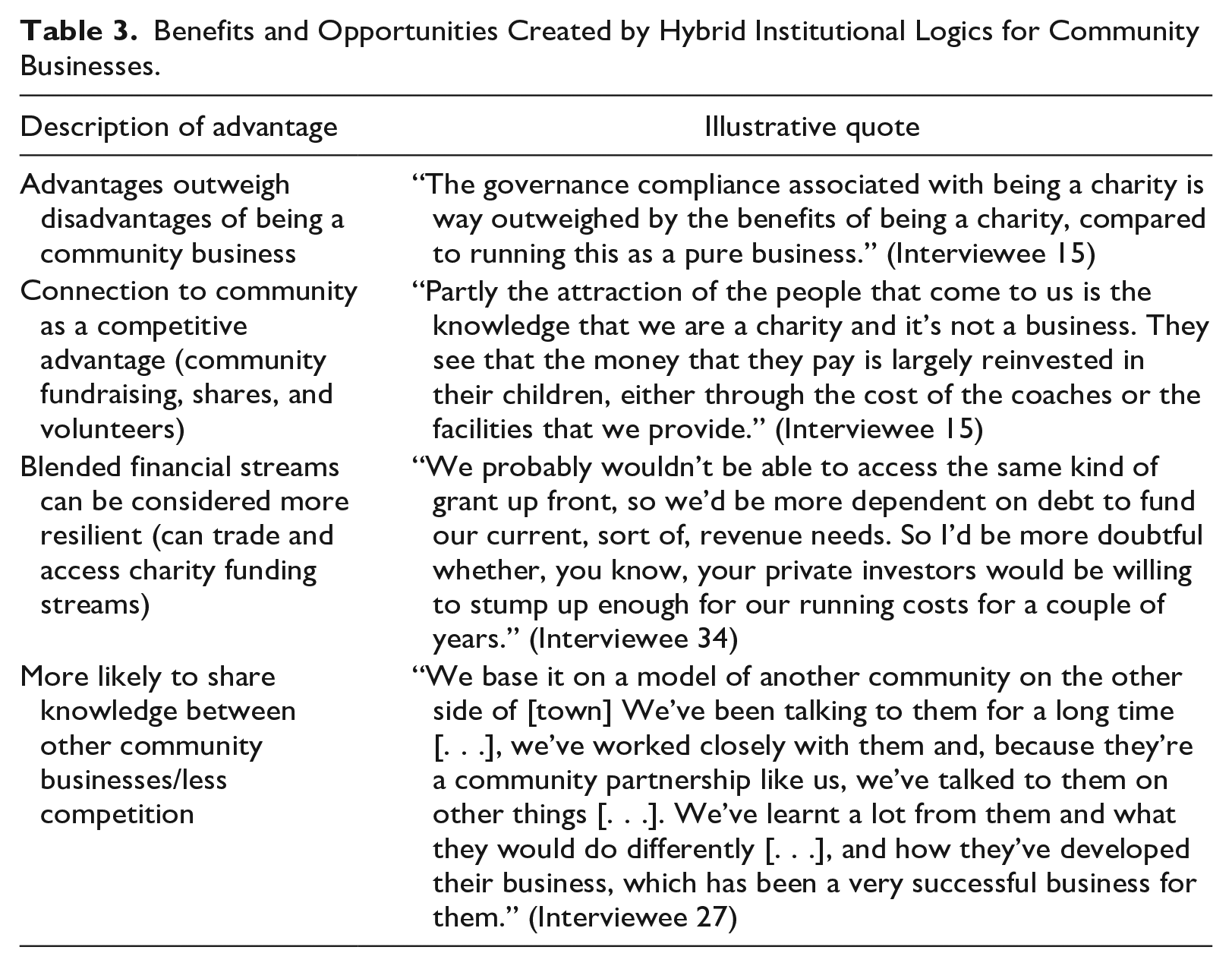
While there are tensions associated with the triple hybrid institutional logics that community businesses operate within, there are also significant benefits that can come from their organizational hybridity. As one interviewee described it, the “compliance associated with being a charity is way outweighed by the benefits of being a charity, compared to running this as a pure business” (Interviewee 15). Benefits from the hybrid logics come in similar forms to the tensions. For example, there is a benefit of the strong sense of belonging between the community and the organization that means they are more commercially viable. This is true through community resources such as community shares, crowdfunding, but also from a market perspective as the USP of the organization is the connection to the community.
One community shop said that they compete with supermarkets purely on the basis that local people enjoy the local connection. There is also the “good will” of people willing to contribute time to a community business because they are seen to do good for the community and are acting as a non-profit organization. In this way, the hybrid financial streams they have access to can be seen as beneficial, as it allows them to get access to grants that typical businesses cannot. Finally, community organizations are able to work together more, and share knowledge with each other, as other community businesses with similar models are not necessarily seen as a threat. There is competition for grant funding, and community businesses compete with other types of organizations for their market, but they perceive competition between community businesses as less prevalent. Table 3 outlines the benefits of hybridity according to the interviewees.
Benefits and Opportunities Created by Hybrid Institutional Logics for Community Businesses.
Discussion
While the specific context of each community business is clearly different, some common themes emerge from our findings. The tensions described above demonstrate many of the challenges that community businesses have to navigate because of their organizational hybridity. These tensions constrain, but do not necessarily stifle, the evolution of community businesses. Rather, they define the boundaries of the community business “playing field” within which various strategies can be adopted to evolve as a community business and set thresholds over which those entities transcend their community business origins to become something else. One of our main objectives in this paper is to use learning from the tensions inherent in their hybridity to model and compare potential evolutionary trajectories and understand how they perceive the advantages and disadvantages of these options. Tensions in the logics around performing, organization, belonging, and temporality (Smith et al., 2013) have implications for the evolutionary trajectories of community businesses.
We identify four trajectories that enable evolution within the model of community business and a fifth option that sees the organization change beyond the agreed definition of a community business. Each of these options comes with implications for where the business sits relative to the three dominant models: commercial enterprise, social enterprise, or community business. As we elaborated earlier, community businesses can (a) broaden their geographic focus which would take them closer to a social enterprise model. This often involves replicating the community business model in other locations and governing the separate businesses as a federation. In this case, each individual locally anchored business would be considered a community business, but the governing entity would function as a social enterprise. In this way, tensions between social and community and market and community may decrease while their ability to access specific resources may increase (in terms of staffing and financing). But a sense of belonging to the local community might be undermined. If the community business (b) increases their social impact that may influence their ability to generate traded income suggesting a move more toward a traditional non-profit mode. In this case, revenue generation is still important but deprioritized relative to the community mission. They can also do the opposite and (c) increase their financial independence, moving more toward a market logic, but this can impinge on social impact (which would move them closer to a commercial business). Both options (b) and (c) can increase a sense of belonging to a particular set of actors within a logic, thus resolving one tension, but also mean that avenues of resources could be undermined. They could also (d) add more services to their provision, either to increase their social or financial bottom line. There is a risk that by merging logics and creating community conglomerates a “civic monoculture” will occur, and it has been suggested this can reduce community resilience (McQuarrie, 2013).
The trajectories can be grouped into three overarching approaches and are visualized in Figure 2: Evolutionary Strategies of Community Businesses, namely:
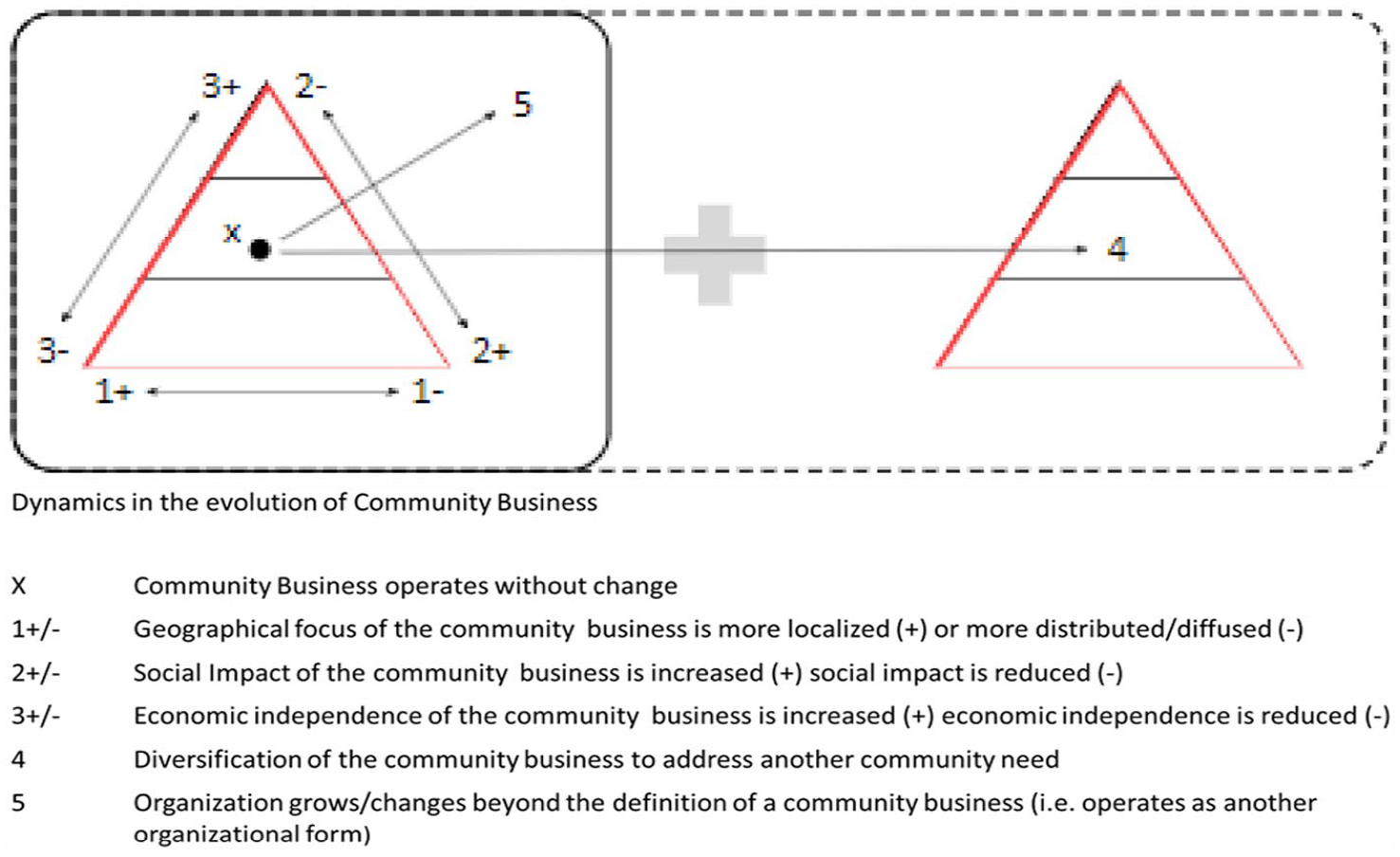
Evolutionary Strategies of Community Businesses.
a. Continuation (trajectories 1-3): The organization innovates by adapting and changing (or appears to change) the level of adherence to one logic as it fits best with their organizational identity but ultimately continues to operate as a community business, in the same sector.
b. Diversification (trajectory 4) - The organization responds to logics by changing sectors but maintaining their community business identity.
c. Transformation (trajectory 5) - The organization ceases to be a community business but becomes another organizational form, which involves not only a change in definition but an internal change in organizational identity. In other words, they move from balancing all three logics, to predominantly focusing on one, which is likely to be chosen according to the organization’s favored identity.
Some have suggested that these responses to constraints present because conflicting institutional logics are determined by dominant organizational identity: Whether the organizational identity is “more business-like” (Dart, 2004) or “non-profit-like” determines which trajectory the organization takes. However, adding the community logic enables us to consider the nuances around organizational decision-making. Complex institutional environments create operational dynamism in hybrid organizations. During the life of a community business, different logics can influence the direction of growth and survival of the organization. This builds on findings from Seanor et al. (2013) who suggest that a simple dichotomy between social and economic logics in social enterprises does not capture the complexity nor the vacillating nature of hybrid organizations between logics. We show how the addition of a third logic (community) can have additional challenges and opportunities.
Community businesses in our sample were primarily engaged in innovation to ensure the longer-term viability of their businesses. The strategies discussed seldom relied on growing the business, in the traditional sense, but many sought diversification (typically of income streams or sources of supportive resources). A small number of community businesses were contemplating opportunities to add new income streams by building on existing capacity (trajectory 5). For example, a community cafe that also runs a training kitchen to provide hospitality skills to unemployed youth reported exploring options to lease the kitchen during off hours to support catering or cooking classes to generate additional revenue. A community hub based in a heritage building evolved from using fees from its co-working space to support community programming to providing creative spaces for rent for music recording and rehearsals as well as a community kitchen. A village hall that rents office space to local businesses to provide day center services to the elderly community was investigating the potential to host weddings and other events. In all cases, these “growth” ambitions were seen as vehicles to improve their offering, provide community services better, and find “breathing room” in razor-thin margins.
In most other cases, firms were relying on efficiencies they felt might be possible by doing what they currently do better, and sometimes, reducing the scope of activities to more sustainable levels; both forms of continuation. Whether these activities reflected the precedence of social (trajectory 2) or market (trajectory 3) logics depended on the particular obstacles the firms were encountering in their evolutions. Some that had hoped to move toward more market orientations and reduce reliance on grants found themselves caught in a sort of “valley of death” where market activities were not (yet) profitable enough to reduce dependence on external funding and maintain community missions. Others that were more grant-dependent sometimes struggled to maintain grant funding and so were forced to be creative in expanding their existing commercial offerings. As noted earlier, two had considered and rejected geographical expansion (trajectory 1) on the basis that it was either beyond their capabilities or not desirable from a business model perspective.
The overall point here is that, in this sample, firms being buffeted by the tensions inherent in their hybridity had largely adjusted their strategies within the boundaries of the hybridity triangle, with their track determined more by a necessity-driven perception of the dearth or lack of options in alternate directions than the dominance of one particular logic. These organizations are conditioned to adapt or fail, and while they may maintain preferences about identities were open to doing what was necessary to survive.
Conclusion
Pressures from intergovernmental organizations and from public perception are increasing trends in organizational hybridity, as firms, social enterprises, public bodies, and non-profits “play the rules” of different “games” to survive and thrive. Literature on hybrid institutional logics has focused heavily on the social and market logics, neglecting the impact of multiple logics on the stability and evolution of hybrid organizations (Drencheva & Au, 2023). We argue that adding a third logic further complicates the tensions created by hybrid institutional logics and can have a significant impact on decision-making processes. Multiple institutional logics adds complexity and creates more challenges for seeing a clear pathway to the future of the organization. Understanding the increased opacity of evolutionary trajectories for leaders of hybrid organizations is important to understand how we support these organizations to have social, community, and economic impact.
Community businesses exhibited a tendency to be reactive to opportunities rather than strategic about their direction as they struggle to survive in the competitive environment (for both funding and markets). This reactiveness could cause elements of mission drift (Bennett & Savani, 2011) and in particular cause them to stray away from their local accountability—negatively affecting their central purpose. Understanding the boundaries of the fields of the game within which these hybrid organizations operate is useful as it allows us to see possible evolutions, and to understand what those ramifications are for the impact the organization may have.
Typically, for community businesses (and other hybrid organizations) evolution is not linear. Different push and pull factors in different logics will influence the direction of evolution, and thus, growth in these organizations is not straightforward toward one goal, rather it moves around the hybridity triangle. While this multiplicity may cause complications and an erosion of commitment to community accountability, as Mongelli et al. (2019) suggest, there are opportunities and advantages to embracing hybridity. Hybrid organizations can draw on resources (through tactical mimicry; Dey & Teasdale, 2016) that organizations that only operate in one logic cannot; meaning that they can be more resilient. Thus, the multiplication of complexity works both ways: It increases the challenges but also increases the advantages in some ways.
In summary, we make three core contributions to the literature on institutional hybridity and logics. First, we provide a more nuanced and complex understanding of the tensions (caused by underlying logics) influencing hybrid organizations’ decision-making processes. Second, we highlight how balancing these different tensions, often in a bid to survive, can result in a reactionary approach rather than long-term vision; this short termism ultimately influences the organization’s trajectory and ability to continue as a community business, which in turn has effects on their ability to serve their community. Finally, the evolutionary trajectories outlined in our article emphasize the dynamic nature of hybrid organizations and how their identities change over time because of existing tensions. This could be an additional aspect to consider in the decision-making processes of hybrid organizations.
Our conclusions lead to some areas that are ripe for further research. Exploration of the proportionality of the tensions and opportunities—are they equal or is one more likely to occur than the other? Furthermore, a deeper understanding of how the dynamic relationship between the logics and their tensions play out when they are active simultaneously would also be beneficial to understand the impact of hybrid organizations. Finally, while we have seen that institutional forces and a drive to survive heavily influence the evolutionary trajectory that community businesses face, further research is required to understand the link between non-profit leaders and their preferences, and organizational decisions around evolution due to triple institutional pressures. Particularly since it has been suggested that non-profit leaders do not necessarily idolize growth in the same way as a commercial business (Andersson, 2020).
Footnotes
Appendix
Overview of Interviews.

| Interviewee number | Primary activity | Geographic area |
|---|---|---|
| 1 | Café | Greater London |
| 2 | Community hub/facility | South West England |
| 3 | Arts Center/facility | South East England |
| 4 | Arts Center/Facility | North East England |
| 5 | Health and Social Care | Yorkshire & the Humber |
| 6 | Childcare | South West England |
| 7 | Community hub/facility | Greater London |
| 8 | Environmental/conservation | South West England |
| 9 | Village Hall | Greater London |
| 10 | Community hub/facility | Yorkshire & the Humber |
| 11 | Arts Center/facility | Yorkshire & the Humber |
| 12 | Ground maintenance/repairs | North West England |
| 13 | Community hub/facility | North East England |
| 14 | Finance | South West England |
| 15 | Sport and Leisure | Greater London |
| 16 | Community hub/facility | North East England |
| 17 | Housing | North West England |
| 18 | Energy | North West England |
| 19 | Education & Training | Greater London |
| 20 | Pub | South East England |
| 21 | Sport and Leisure | East Midlands |
| 22 | Health and Social Care | South West England |
| 23 | Community hub/facility | South West England |
| 24 | Transport | Greater London |
| 25 | Community hub/facility | South East England |
| 26 | Food catering and production/farming | South West England |
| 27 | Education | Yorkshire & the Humber |
| 28 | Community hub/facility | South West England |
| 29 | Energy | Yorkshire & the Humber |
| 30 | Community conglomerate | Greater London |
| 31 | Café | Greater London |
| 32 | Energy | East of England |
| 33 | Café | Yorkshire & the Humber |
| 34 | Housing | Yorkshire & the Humber |
| 35 | Community hub/facility | South West England |
| 36 | Shop | South West England |
| 37 | Social club | Yorkshire & the Humber |
| 38 | Shop | West Midlands |
| 39 | Housing | East Midlands |
Authors’ Note
Beldina Owalla is now affiliated to Oxford Brookes University, UK.
Data Availability Statement
The data are not publicly available due to ethical, legal, or other concerns.
Declaration of Conflicting Interests
The author(s) declared no potential conflicts of interest with respect to the research, authorship, and/or publication of this article.
Funding
The author(s) received no financial support for the research, authorship, and/or publication of this article.
