




Abstract
The community sector performs an important function in providing emergency food relief, yet food insecurity is often a chronic issue due to poverty and social exclusion. Progressive food provision models present opportunities to improve voluntary food relief services that are dominant in many countries. Informed by research with clients indicating a preference for blended service models that go beyond food provision, two government agencies partnered with a social enterprise and academics to pilot a social supermarket model. This research article (a) briefly summarizes international evidence on social supermarkets’ characteristics and offerings, (b) describes a process used to collaboratively develop a social supermarket incorporating universal access and social supports, and (c) presents a rubric defining elements of a social supermarket. Applicable to other community sector settings, the rubric emphasizes dignified access and service, plus opportunities for social support and connection, which are important elements in pathways out of food insecurity.
Introduction
In Australia and other high-income countries, the dominant response to household food insecurity is direct food provision (Lindberg et al., 2015; M. J. Williams & Tait, 2023), mostly delivered by charitable or voluntary agencies, which may receive funding from government, fundraising, or philanthropy, and often rely on surplus food donations. Despite growth in this sector, food insecurity in Australia has not yet decreased (Kent et al., 2020; Kleve et al., 2021). Food relief generally does not address the causes or reduce long-term food insecurity, unless accompanied by other financial and social supports (Rizvi et al., 2021; Sanderson et al., 2020). Food insecurity is often a persistent issue in people’s lives (Enns et al., 2020; Shinwell & Defeyter, 2021), with many relying on food relief for multiple years (Pollard et al., 2019), a situation exacerbated by food supply that is often nutritionally suboptimal (Simmet et al., 2017). Accessing food relief is often an undignified and disempowering experience (Hill & Guittar, 2023; McNaughton et al., 2021; Middleton et al., 2018; Van Der Horst et al., 2014), suggesting a need to transform charitable assistance models to address the systemic, structural causes of poverty (Gallegos et al., 2023; Tarasuk et al., 2022). Scope exists to improve service delivery to foster solidarity and reciprocity (Kleve & Gallegos, 2023; Parsell et al., 2022); uphold principles of dignity, choice, and nutrition (Kleve & Gallegos, 2023; Kleve et al., 2023); and improve social impact (Sustain, 2020).
Most government-supported food relief provided by community organisations is generally focused on crisis services (food, material aid) rather than social outcomes (end food insecurity/financial precarity, improve pathways). However, more progressive food relief provision and affordable community retail models are emerging (Kleve & Gallegos, 2023; Saxena & Tornaghi, 2018; Sustain, 2020; M. J. Williams & Tait, 2023), and colocation of “wrap-around” social support, service referrals, and social connection opportunities exist (Davis, 2019; Lambie-Mumford, 2019; Lawson & Kearns, 2018). Social enterprise models for affordable food access have grown internationally, which use food as an “opportunity” for engagement to social supports and connections. Social enterprise derives income from trade or exchange of goods and services, and reinvests revenue to fulfill the organisation’s social mission (Barraket et al., 2010; Kerlin, 2013). An example includes what is known as “social supermarkets” (or “solidarity stores”). Operating in Europe for decades (Holweg et al., 2010; Schneider et al., 2015) and more recently proliferating in the United Kingdom (Paget, 2015; Saxena & Tornaghi, 2018), social supermarkets have not yet appeared systematically in Australia (Lindberg et al., 2019; Wills, 2017). Many social supermarkets operate as social enterprises, by redistributing surplus food at very low cost (“symbolic” prices) for people experiencing food insecurity/financial precarity, and most provide social supports/services to users/members (Schneider et al., 2015). While this model is well established internationally, there is limited knowledge from research or evaluation to guide practice and assess social impacts. Furthermore, many social supermarkets attempt to address both environmental and social goals by using donated or intercepted food surplus to reduce waste, which often results in insufficient, inconsistent, or “secondhand” supply and nutritional quality (Edwards, 2021; Poppendieck, 1999; Riches & Tarasuk, 2014; Schneider, 2013; Simmet et al., 2017). Social supermarkets purport to offer more dignified service through increased choice, retail layouts, and the act of paying. However, the controlled/restricted access model (eligibility assessments, conditional duration of use) may erode dignity (De Renobales et al., 2015), reduce agency (Saxena & Tornaghi, 2018; Stettin et al., 2022), and conflict with people’s needs and desires (Booth et al., 2018; Lambie-Mumford, 2015). Controlled access can dampen clients’/recipients’ self-esteem (Middleton et al., 2018; Riches & Silvasti, 2014; Van Der Horst et al., 2014), which may undermine social supermarkets’ attempts toward dignified service (Hill & Guittar, 2023; Saxena & Tornaghi, 2018). In contrast, a universal access model (no eligibility assessment required, anyone welcomed) may be presented as a community “hub,” with retail-like layouts and informal spaces for social connection and commensality (social eating) opportunities. This format appears to be preferred by clients/recipients (Booth et al., 2018), is more dignified (De Renobales et al., 2015; Stettin et al., 2022), and may enable more “in-common” spaces for encounters among staff, volunteers, and clients (Cloke et al., 2017). These are important factors in building social capital, which may promote more successful pathways out of poverty and social exclusion.
Since 2015, the South Australian state government has been guided by their Health in All Policies (HiAP) experience (Government of South Australia, 2010) and have worked collaboratively across sectors and with community organisations and academia to address individual and household food insecurity (Government of South Australia, 2018). This collaboration supported local research with food relief clients, which expressed a preference for social supermarket models (Booth et al., 2018; Pollard et al., 2017), blending affordable nutritious food with opportunities for social connections and client-centered supports (Booth et al., 2018). While many social supermarket examples existed internationally to learn from (Holweg et al., 2010; Holweg & Lienbacher, 2016; Paget, 2015; Saxena & Tornaghi, 2018; Schneider et al., 2015), no tools or frameworks were available to guide planning and implementation.
This article describes the development of one of the first social supermarkets in Australia, a social enterprise model that incorporates affordable nutritious food with colocated social services, supports, and opportunities for social connection. This article (a) briefly summarizes international evidence on social supermarkets’ characteristics and offerings. It then describes (b) a process used to collaboratively develop a social supermarket rubric tool and pilot project in South Australia; this process involved, first, assessing an existing community food social enterprise, and, second, using the rubric tool to plan how to enhance the existing model to become a social supermarket. Finally, the article (c) describes the elements of a rubric tool for defining social supermarkets.
Method
To develop a social supermarket pilot project, two South Australian state government agencies (Wellbeing SA and Department of Human Services SA), drew on HiAP experience of gathering evidence, identifying solutions, and generating policy recommendations collaboratively (Government of South Australia, 2010; C. Williams & Broderick, 2010). While codesign methods were not explicitly used, principles of codesign, co-creation, and coproduction were adopted, such as equal partnership, openness, respect, empathy, direct interactions between stakeholders, continual dialogue, and relationship building (Vargas et al., 2022).
Step 1: Responding to Policy Recommendations and Client Preferences
Responding to a recommendation from local research with clients, the government agencies proposed to pilot a “blended service model” of “universal access to affordable nutritious food and access to opportunities for social connection, volunteering, participation, and services which could contribute to and support people in sustained pathways out of food insecurity (such as work experience, skills development)” (Booth et al., 2018, 2019; Pollard et al., 2017). The policy recommendation was to pilot a model featuring “co-located social services, social enterprise components, and employment pathways” (Government of South Australia, 2018).
Step 2: Evidence-Gathering on Social Supermarkets
Next, the government agencies commissioned a literature review to identify research evidence specifically describing social supermarkets, particularly to understand the “wrap-around” social services, supports, and opportunities that address underlying causes of food insecurity. A public health researcher delivered a rapid scoping review to determine the extent (size), range, and nature (characteristics) of the peer-reviewed and gray literature on social supermarkets (Arksey & O’Malley, 2005; Haby et al., 2016; Levac et al., 2010; Tricco et al., 2018). Structured searches were performed in databases, including Web of Science, Healthevidence.org, and Google scholar. Search terms were structured around key terms appearing in title, abstract, or topic, including “social supermarket,” “charity supermarket,” “solidarity store,” “social grocery” or “not for profit grocery,” and “community supermarket,” and incorporated concepts including “social enterprise” (any year, all languages).
Step 3: Pilot Project Establishment
The two government agencies identified resources to co-fund a short-term project, to “pilot” a social supermarket model. Policy actors identified a community supermarket social enterprise in northern metropolitan Adelaide, The Food Centre (TFC; https://thefoodcentre.com.au/) as a promising foundation to build upon, having a history of providing low-cost groceries and café, volunteering, cooking demonstrations, as well as a small selection of occasional services such as financial counseling. A government grant to TFC enabled them to engage a health promotion consultant to plan and coordinate the social supermarket pilot. Concurrently, academic researchers, with expertise in social impact (and who had led former qualitative research with food relief recipients), were invited to collaborate in developing the social supermarket model and evaluation. The policy actors, practitioners, and researchers all formed a working group to design the pilot collaboratively.
Step 4: Pilot Project Planning
The policy actors hosted an initial workshop to bring together the working group, review existing evidence and knowledge of TFC practitioners, and develop a logic model for the pilot. In addition, TFC elected to engage the perspectives of customers and volunteers through informal discussions and interviews held at TFC to ensure respectful and comprehensive engagement (described in the following).
Step 5: Elements of a Social Supermarket
A range of possible service elements were extracted from multiple sources to plan the social supermarket elements, including clients’ lived experience and preferences (Booth et al., 2018; Pollard et al., 2017), best practice recommendations for food relief (Booth et al., 2019), guiding principles for food relief providers (Government of South Australia, 2019c), Nutrition Guidelines (Government, of, South, & Australia, 2019a, 2019b), and international literature from the social supermarkets scoping review (unpublished). Concurrently, the social supermarket coordinator conducted a strengths, weaknesses, opportunities, and threats (SWOT) analysis and internal review of TFC (unpublished), and a student researcher performed interviews with TFC customers and volunteers to understand their wants and needs (unpublished). The policy actors collated and distributed a list of draft elements to the working group for collective review, deliberation, and revision (see the Appendix).
Results
Development of the Social Supermarket Model
The social supermarket model for the SA pilot was intended to complement and build upon TFC’s existing offerings (low-cost supermarket and café, occasional social services, secondhand goods shop/thrift shop, and volunteering program).
Client Lived Experience
Findings from the client research emphasized the need for services to be client-centered, empowering, and to provide opportunities for involvement, social connection, and broader support. The working group agreed that the social supermarket would focus on universal access to affordable nutritious food, socialization, access to opportunities for volunteering, participation, and linked services related to pathways out of food insecurity (Pollard et al., 2017). Details of each element derived from client research is described in the Appendix.
International Evidence
The scoping review of international social supermarkets included 44 publications from Europe, the United Kingdom, Canada, New Zealand, and Australia, and estimated that more than 1,000 social supermarkets operated globally. The review confirmed that social supermarkets are distinct from other food relief models because they provide (a) choice of food and groceries, (b) access to affordable food in a retail-like environment, and (c) social support or “wrap-around” services for users/members (De Renobales et al., 2015; Holweg et al., 2010; Paget, 2015; Saxena & Tornaghi, 2018). Often defined as “redistributors of surplus food for a social purpose” (Schneider et al., 2015) for people “living in or at risk of poverty” (Holweg et al., 2010), social supermarkets operated either as social enterprises, charitable organisations, cooperatives, or limited companies (Holweg & Lienbacher, 2016). Most relied on volunteer workforces and external core funding to operate. Social supermarkets were common in their aim to increase individuals’ agency through (a) product choice and (b) the act of paying (within economic means/symbolic prices), but there was more heterogeneity on (c) what social supports and services are deemed important. Most had controlled access or a membership model to reach specific groups (e.g., people on low incomes or pensions) and, unlike TFC, very few had open access to the public (universal access). Many social supermarkets offered structured or formal “wrap-around” social supports, services, or referrals (Department for Communities, 2022; Saxena & Tornaghi, 2018) rather than informal socialization or reciprocity opportunities. Some had informal offerings similar to TFC, such as a social café or skill development programs (Saxena & Tornaghi, 2018). Limited evidence was available to decide what elements were considered essential for social supermarkets’ implementation, and no experimental evaluations reporting client outcomes were found.
Rubric Tool to Guide Social Supermarket Implementation
During planning, it became apparent that a more definitive list of elements was needed to expand the existing model (TFC) into an implementable social supermarket. Using the full range of evidence available (practitioner knowledge, client lived experience, and international evidence), the working group developed a list of elements. After discussion and deliberation, a total of 14 elements were documented, as shown in Table 1 (primary research and original sources of knowledge are described in detail in the Appendix). Many of the elements represented points of departure from existing food relief and social supermarket models, being consistent with known client preferences for a more dignified, inclusive service model. Detailed explanatory statements were written for each element to clarify how they would “look” in practice when implemented, which was drafted as a rubric. A rubric comprises two axes: the elements to be evaluated (“the things that matter”) and the description of varying levels of performance in each of these elements (King et al., 2013)—these were set as “commencing,” “on-track,” or, as “best practice” (optimal practice). The rubric tool provided TFC with a working definition of all possible elements to guide implementation, and it accommodated the likely variation of elements when adopted in practice. The social supermarket coordinator consulted TFC volunteers and staff on the rubric tool draft version, suggested revisions, and the working group reached consensus through online meetings and emails. The social supermarket coordinator then used the draft rubric as a “self-assessment” with TFC staff and volunteers, which identified some service gaps and development opportunities, including food supply (nutrition, cost); sustainability/viability of funding sources; partnerships, volunteer management, and development; and social connection opportunities and support services (in response to community need). The final 14-element rubric focused on social supermarkets’ organisational model and social services/supports and social connection opportunities. These features are described below (see Supplemental Appendix for full rubric tool).
Defining Service Elements of a Social Supermarket Model for South Australia.
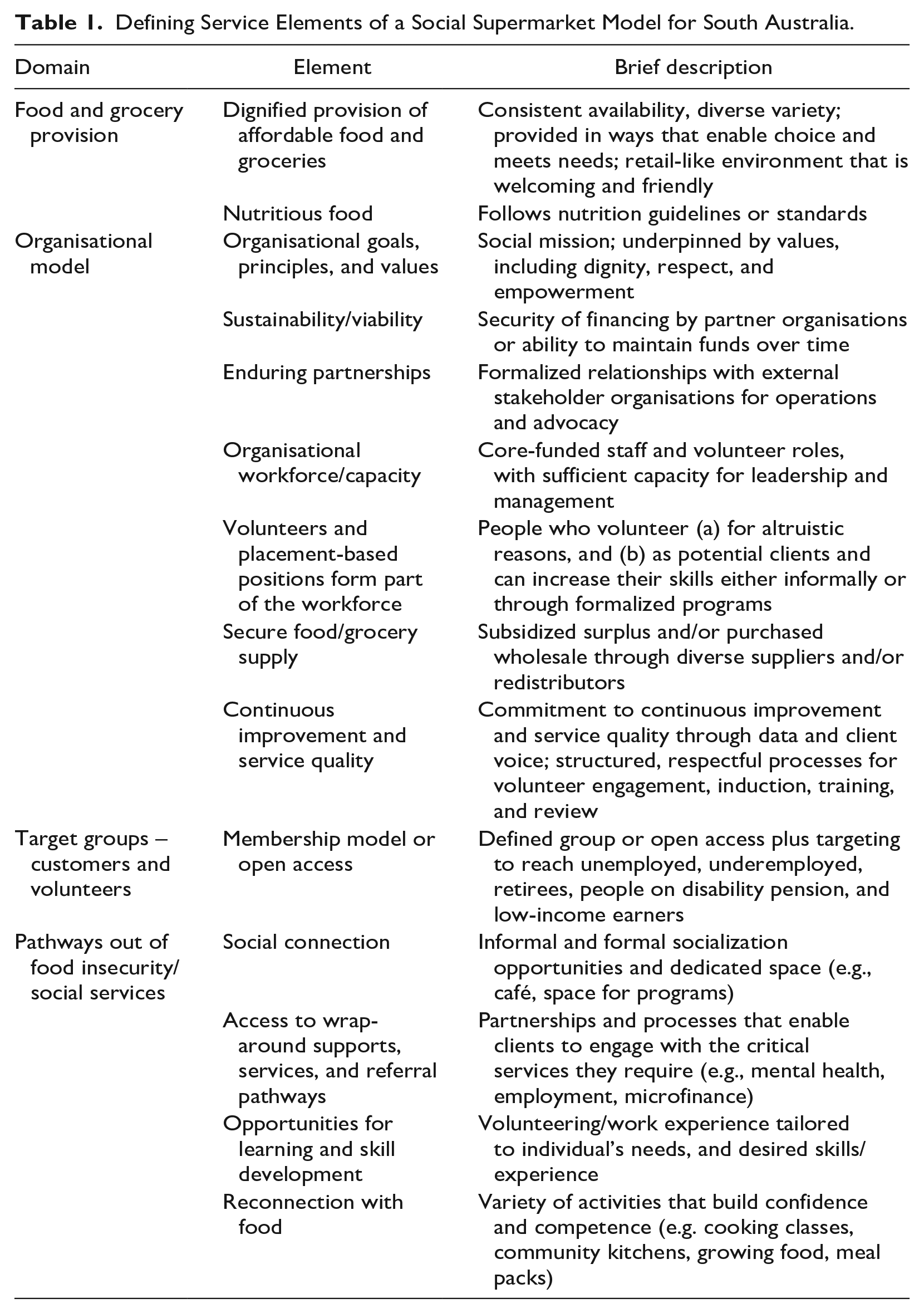
Organisational Model
Prior to the pilot, TFC was run as a social enterprise open to the public (universal access) with a café and secondhand/thrift shop at the entrance, and the supermarket interiors having a similar “look and feel” to a typical retail environment. Open access, dignified service, and “customer culture” were considered important to counter the potential stigma experienced in eligibility assessment and accessing food relief (Andriessen et al., 2022).
Service Elements—Social Services/Supports and Social Connection Opportunities
Prior to the pilot, the quality and range of food (and groceries) was considered paramount. TFC purchased wholesale and surplus-to-manufacture grocery items instead of donated surplus to ensure a consistent supply that met consumer needs and preferences. Nutrition guidelines were recently made available for the food relief sector (Government of South Australia) but had not yet been adopted at TFC, so during the pilot, the guidelines would inform their auditing and nutrition quality improvement.
Responding to gaps identified by the rubric, a broader range of social offerings was needed to provide more opportunities for social connection, reciprocity, referrals, community engagement, work-skill development, and employment pathways. Actions proposed included increasing access to wrap-around supports, services, and “warm referrals” to services, through new partnerships with local place-based social services or on-site “pop-up” services (such as financial counseling and microfinance), and processes to enhance employability following volunteering placements (such as in retail, hospitality, warehousing, and food processing). Informal opportunities for social connection, commensality, and reciprocity were identified as important dimensions of social support. Finally, reconnection with food was considered a promising opportunity for engaging the community in healthy food literacy, confidence, and skills, which was achievable through the on-site community kitchen.
Planning Social Supermarket Implementation
The coordinator used the rubric “self-assessment” findings to create an implementation plan (action plan) for the social supermarket pilot, in consultation with TFC staff and volunteers.
Use of the Social Supermarket Rubric Tool
The coordinator reflected that the rubric was useful in validating what staff and volunteers already knew, and therefore provided a safe environment for ongoing continuous improvement and service/strategic planning. Staff and volunteers reported the tool to be useful for planning, and that self-assessment allowed for a diversity of views to be expressed.
Evaluation of the Social Supermarket and Rubric Tool
Formal evaluations of the social supermarket model are ongoing (document analysis, stakeholder interviews, and surveys; results not available at the time of writing). Government reporting determined that TFC was operating as a social supermarket according to the rubric by the conclusion of the pilot project, and had increased their “performance” level for 11 of the 14 elements. The rubric has subsequently been briefly piloted in three additional food relief services and was found to be useful for self-assessment of practice, with some minor amendments proposed by practitioners. Future revision would require consensus from all collaborators, and would aim to increase the clarity and reliability of the rubric tool.
Discussion
Social supermarkets are increasingly proposed as a “stepping stone” between emergency food relief and mainstream food retail. In the short term, this may support people on low incomes or those experiencing chronic food insecurity (Holweg et al., 2010; Paget, 2015; Saxena & Tornaghi, 2018), In the long term, this model could provide engagement opportunities through universal access, social connections, and reciprocity. This article summarizes literature and presents a comprehensive rubric of elements to guide social supermarket design. The model and rubric are applicable to food relief providers and food hubs/community centres using food as an opportunity for engagement. The rubric can be used as a self-assessment tool to support services to go beyond provision of food and offer social support, services, and connections.
Responding to research with people experiencing chronic food insecurity, the premise of the SA social supermarket model was to explore a more dignified, client-centered service model, compared with direct food relief (Booth et al., 2018; Pollard et al., 2017). The SA model privileges certain values and organisational enablers, elevating the importance of universal access, dignified service, and nutrition, and informal opportunities for social connection, alongside social services. A community development and place-based approach informed the pilot implementation, aiming to respond to local needs. Therefore, practitioners and researchers adopting this rubric should consider what adaptations are necessary to respond to their local context.
Key insights from this project relate to the universal (open access) model, organisational values, and service elements. Although the literature is generally consistent about how social supermarkets are defined, there is insufficient attention given to the potential role of a universal access model and limited detail on service elements that may contribute to client outcomes. We emphasize these as important aspects to consider, given that most social supermarkets try to support people who are experiencing disadvantages, or who are socially/financially excluded from commercial food supply and services (Andriessen et al., 2022). There are consistent calls for greater dignity, choice, and “customer culture” in the sector (Andriessen et al., 2022; Lambie-Mumford, 2019; Middleton et al., 2018; Stettin et al., 2022), and a need to evolve voluntary service models to improve experiences, meet community needs (Fyall & Levine Daniel, 2018; Kleve & Gallegos, 2023), and enable sharing, trust, and reciprocity (Cloke et al., 2017; May et al., 2020). Values are threaded throughout the SA model to ensure that it is people-centered (Booth et al., 2019) and focused on improving outcomes, which is consistent with community development principles (Stettin et al., 2022).
Universal access may be a more dignified way to access affordable food and food relief vouchers while recovering costs through public trade. In the SA model, this is achieved through an open-access social enterprise community hub, which is different from services with controlled access and eligibility assessment. Greater inclusion and community engagement opportunities may occur through the café, programs, and activities because anyone is welcome to be involved. Universal access may also support “soft-entry” into services and supports, through welcoming, non-stigmatizing engagement (Allan & Campbell, 2011; Allen-Keeling, 2021), and “warm referrals” facilitated by staff and trained volunteers.
Service elements are detailed comprehensively in the SA rubric (Supplemental Appendix), which expands on the dominant “discount grocer and wrap-around” social supermarket model. While the international literature offers examples of wrap-around models, community context and preferences are paramount when proposing social and community services. Alongside commitment to community engagement and client voice, the SA model encourages a variety of informal and formal offerings beyond food, and has a focus on food product consistency, range, and nutrition quality. This may help to overcome the questionable quality of surplus food that dominates the food relief sector (Caraher & Furey, 2017; Riches, 2018) and better meet personal/cultural needs and preferences (Riches & Silvasti, 2014). Use of nutrition standards may help to minimize disproportionate amounts of ultra-processed foods, which can be health-limiting (Government of South Australia, 2019b).
Social supports are common in international examples (Saxena et al., 2022; Saxena & Tornaghi, 2018; Stettin et al., 2022), embraced in the SA model in four ways: (a) social connections, (b) access to supports/services to address underlying causes of food insecurity, (c) capacity building/skill development, and (d) reconnection with food. While designed to provide pathways out of food insecurity, they were proposed in response to preferences expressed by people experiencing chronic food insecurity (Booth et al., 2018; Pollard et al., 2017) and financial stress (Booth et al., 2019), which is consistent with recent calls to evolve charitable/voluntary service models (Allan & Campbell, 2011; Ambrey et al., 2019; Kleve & Gallegos, 2023; May et al., 2020; Stettin et al., 2022). The expanded range of elements that “go beyond food” extends opportunities for social connections, agency, commensality, skill development, and opportunities to “give back”/reciprocity (Booth et al., 2018; Kleve & Gallegos, 2023). Activities could be either colocated services on-site, off-site through local “pop ups” (Lindberg et al., 2019; Polzella et al., 2022) or made through “warm” referrals to other services in the local community. In future, these social supports and opportunities could be achieved through increasing place-based partnerships and alliances (Smith & Thompson, 2023), community engagement, and empowerment (Parsell et al., 2021; Stettin et al., 2022).
The social supermarket rubric is immediately useful to other organisations, such as food relief providers, community centres, social enterprises, or community-owned supermarkets. Organisations that wish to transition toward a social enterprise model of affordable nutritious food and long-term pathways out of food insecurity would find this rubric beneficial. Using the rubric, a provider can identify areas that could be developed to enhance existing practice, building in supports and services to address underlying determinants to contribute to client/customer outcomes. The model and rubric also provide a template for future funders and researchers to guide social supermarket design and evaluation. Robust evaluation of progressive models like this is needed, especially given ongoing effects of inequities, including insufficient welfare payments and wage growth, costs of living, and insecure work, which are entrenching chronic needs for food relief (Lansley & Mack, 2015; Temple et al., 2019).
Strengths and Limitations of the Process
A strength of the SA social supermarket model development process was collaboration between policy actors in two government agencies, namely, community-based practitioners and academics. This collaboration resulted in a practice-relevant tool with immediate applicability to service design and implementation. Another strength is the breadth of evidence used to develop the model and rubric, including international research and practice, preferences and knowledge of clients and practitioners, and values-based principles (Pettman et al., 2022). Collaboration was considered important for future collective impact, and this enabled a participatory, context-sensitive process that integrated a range of knowledge, competencies, and resources to solve a shared problem or opportunity (Whelan et al., 2021). The SA social supermarket model was flexible to build in a range of programs, opportunities, and services, allowing room for innovation and response to community needs and wants, within the available place-based resources and assets.
The methods used to develop the social supermarket model were pragmatic and chosen to fit within the policy and practice environments where the pilot was conducted. The pilot funding was for a defined period only (1 year) and process evaluation and client outcome evaluation findings were unavailable at the time of writing. Further piloting of the rubric and more robust evaluation is required to understand its utility in practice in other settings.
Although the social supermarket model may augment food relief services, and the rubric may be useful for practice, the authors do not suggest that the social supermarket model alone is sufficient to address individual and household food insecurity, and acknowledge a need to address underlying causes (Furey & Bell, 2022; Kleve & Gallegos, 2023), such as addressing low incomes and social exclusion through appropriate policy responses.
Conclusion
Social supermarkets provide a promising model to “go beyond food” and offer opportunities for engagement, social support, and connections, which may create pathways out of food insecurity. The SA model and rubric provide a description of service elements to guide future planning and implementation of social supermarkets, and privileges universal access, dignified service, and informal opportunities for social connections, commensality, and reciprocity, alongside other wrap-around social supports and skill development. Rigorous long-term evaluation is needed to determine social supermarkets’ contribution to client and community outcomes, to understand experiences of people using them, and related health and social impacts.
Supplemental Material
sj-pdf-1-nvs-10.1177_08997640231210463 – Supplemental material for Part Discount Grocer, Part Social Connection: Defining Elements of Social Supermarkets
Supplemental material, sj-pdf-1-nvs-10.1177_08997640231210463 for Part Discount Grocer, Part Social Connection: Defining Elements of Social Supermarkets by Tahna Lee Pettman, Katherine Pontifex, Carmel P. Williams, Deborah Wildgoose, Carolyn Dent, Gavin Fairbrother, James Chapman, Rory Spreckley, Ian Goodwin-Smith and Svetlana Bogomolova in Nonprofit and Voluntary Sector Quarterly
Footnotes
Appendix
Inputs to the Social Supermarket Model and Rubric for South Australia.
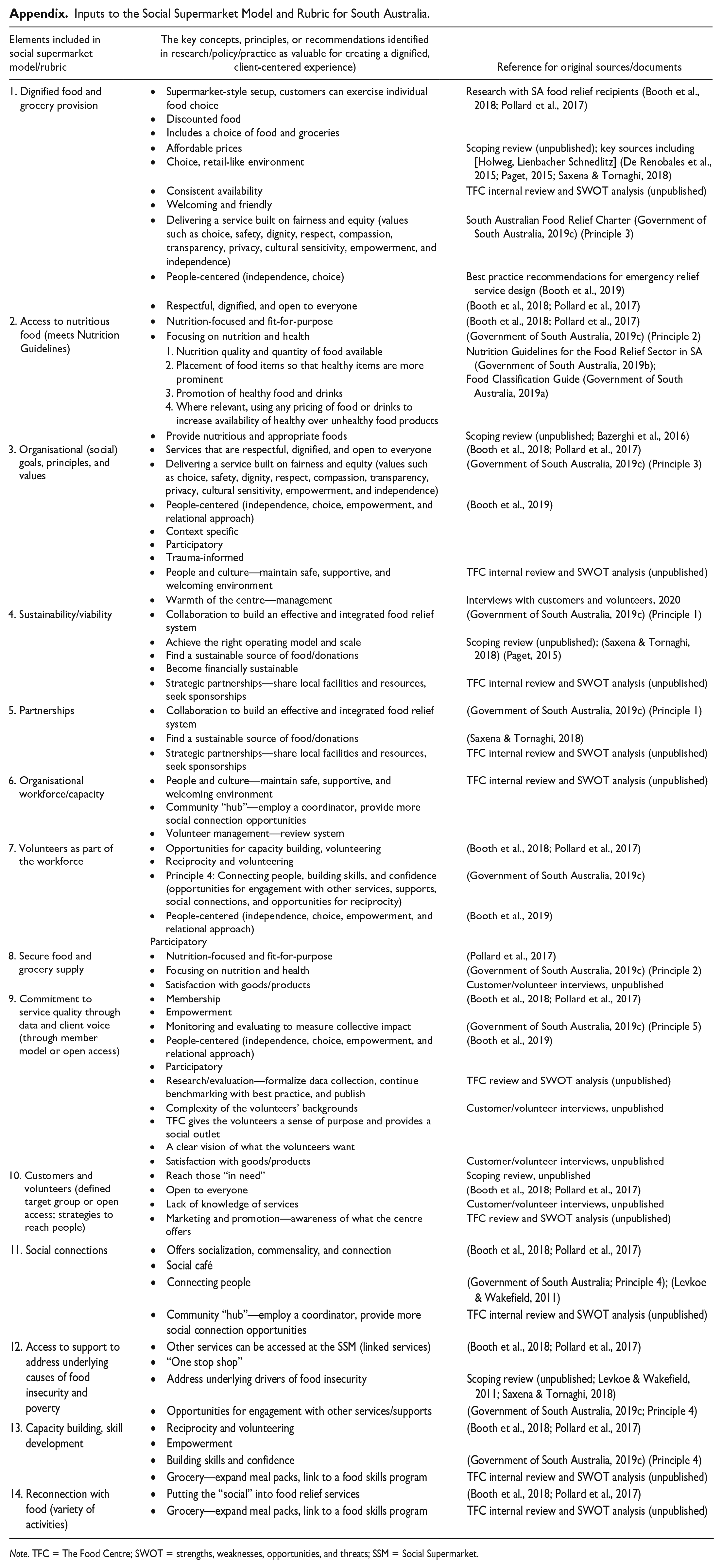
| Elements included in social supermarket model/rubric | The key concepts, principles, or recommendations identified in research/policy/practice as valuable for creating a dignified, client-centered experience) | Reference for original sources/documents |
|---|---|---|
| 1. Dignified food and grocery provision | • Supermarket-style setup, customers can exercise individual food choice • Discounted food • Includes a choice of food and groceries |
Research with SA food relief recipients (Booth et al., 2018; Pollard et al., 2017) |
| • Affordable prices • Choice, retail-like environment |
Scoping review (unpublished); key sources including [Holweg, Lienbacher Schnedlitz] (De Renobales et al., 2015; Paget, 2015; Saxena & Tornaghi, 2018) | |
| • Consistent availability • Welcoming and friendly |
TFC internal review and SWOT analysis (unpublished) | |
| • Delivering a service built on fairness and equity (values such as choice, safety, dignity, respect, compassion, transparency, privacy, cultural sensitivity, empowerment, and independence) | South Australian Food Relief Charter (Government of South Australia, 2019c) (Principle 3) | |
| • People-centered (independence, choice) | Best practice recommendations for emergency relief service design (Booth et al., 2019) | |
| • Respectful, dignified, and open to everyone | (Booth et al., 2018; Pollard et al., 2017) | |
| 2. Access to nutritious food (meets Nutrition Guidelines) | • Nutrition-focused and fit-for-purpose | (Booth et al., 2018; Pollard et al., 2017) |
| • Focusing on nutrition and health | (Government of South Australia, 2019c) (Principle 2) | |
| 1. Nutrition quality and quantity of food available 2. Placement of food items so that healthy items are more prominent 3. Promotion of healthy food and drinks 4. Where relevant, using any pricing of food or drinks to increase availability of healthy over unhealthy food products |
Nutrition Guidelines for the Food Relief Sector in SA (Government of South Australia, 2019b); Food Classification Guide (Government of South Australia, 2019a) |
|
| • Provide nutritious and appropriate foods | Scoping review (unpublished; Bazerghi et al., 2016) | |
| 3. Organisational (social) goals, principles, and values | • Services that are respectful, dignified, and open to everyone | (Booth et al., 2018; Pollard et al., 2017) |
| • Delivering a service built on fairness and equity (values such as choice, safety, dignity, respect, compassion, transparency, privacy, cultural sensitivity, empowerment, and independence) | (Government of South Australia, 2019c) (Principle 3) | |
| • People-centered (independence, choice, empowerment, and relational approach) • Context specific • Participatory • Trauma-informed |
(Booth et al., 2019) | |
| • People and culture—maintain safe, supportive, and welcoming environment | TFC internal review and SWOT analysis (unpublished) | |
| • Warmth of the centre—management | Interviews with customers and volunteers, 2020 | |
| 4. Sustainability/viability | • Collaboration to build an effective and integrated food relief system | (Government of South Australia, 2019c) (Principle 1) |
| • Achieve the right operating model and scale • Find a sustainable source of food/donations • Become financially sustainable |
Scoping review (unpublished); (Saxena & Tornaghi, 2018) (Paget, 2015) | |
| • Strategic partnerships—share local facilities and resources, seek sponsorships | TFC internal review and SWOT analysis (unpublished) | |
| 5. Partnerships | • Collaboration to build an effective and integrated food relief system | (Government of South Australia, 2019c) (Principle 1) |
| • Find a sustainable source of food/donations | (Saxena & Tornaghi, 2018) | |
| • Strategic partnerships—share local facilities and resources, seek sponsorships | TFC internal review and SWOT analysis (unpublished) | |
| 6. Organisational workforce/capacity | • People and culture—maintain safe, supportive, and welcoming environment • Community “hub”—employ a coordinator, provide more social connection opportunities • Volunteer management—review system |
TFC internal review and SWOT analysis (unpublished) |
| 7. Volunteers as part of the workforce | • Opportunities for capacity building, volunteering • Reciprocity and volunteering |
(Booth et al., 2018; Pollard et al., 2017) |
| • Principle 4: Connecting people, building skills, and confidence (opportunities for engagement with other services, supports, social connections, and opportunities for reciprocity) | (Government of South Australia, 2019c) | |
| • People-centered (independence, choice, empowerment, and relational approach) Participatory |
(Booth et al., 2019) | |
| 8. Secure food and grocery supply | • Nutrition-focused and fit-for-purpose | (Pollard et al., 2017) |
| • Focusing on nutrition and health | (Government of South Australia, 2019c) (Principle 2) | |
| • Satisfaction with goods/products | Customer/volunteer interviews, unpublished | |
| 9. Commitment to service quality through data and client voice (through member model or open access) | • Membership • Empowerment |
(Booth et al., 2018; Pollard et al., 2017) |
| • Monitoring and evaluating to measure collective impact | (Government of South Australia, 2019c) (Principle 5) | |
| • People-centered (independence, choice, empowerment, and relational approach) • Participatory |
(Booth et al., 2019) | |
| • Research/evaluation—formalize data collection, continue benchmarking with best practice, and publish | TFC review and SWOT analysis (unpublished) | |
| • Complexity of the volunteers’ backgrounds • TFC gives the volunteers a sense of purpose and provides a social outlet • A clear vision of what the volunteers want |
Customer/volunteer interviews, unpublished | |
| • Satisfaction with goods/products | Customer/volunteer interviews, unpublished | |
| 10. Customers and volunteers (defined target group or open access; strategies to reach people) | • Reach those “in need” | Scoping review, unpublished |
| • Open to everyone | (Booth et al., 2018; Pollard et al., 2017) | |
| • Lack of knowledge of services | Customer/volunteer interviews, unpublished | |
| • Marketing and promotion—awareness of what the centre offers | TFC review and SWOT analysis (unpublished) | |
| 11. Social connections | • Offers socialization, commensality, and connection • Social café |
(Booth et al., 2018; Pollard et al., 2017) |
| • Connecting people | (Government of South Australia; Principle 4); (Levkoe & Wakefield, 2011) | |
| • Community “hub”—employ a coordinator, provide more social connection opportunities | TFC internal review and SWOT analysis (unpublished) | |
| 12. Access to support to address underlying causes of food insecurity and poverty | • Other services can be accessed at the SSM (linked services) • “One stop shop” |
(Booth et al., 2018; Pollard et al., 2017) |
| • Address underlying drivers of food insecurity | Scoping review (unpublished; Levkoe & Wakefield, 2011; Saxena & Tornaghi, 2018) | |
| • Opportunities for engagement with other services/supports | (Government of South Australia, 2019c; Principle 4) | |
| 13. Capacity building, skill development | • Reciprocity and volunteering • Empowerment |
(Booth et al., 2018; Pollard et al., 2017) |
| • Building skills and confidence | (Government of South Australia, 2019c) (Principle 4) | |
| • Grocery—expand meal packs, link to a food skills program | TFC internal review and SWOT analysis (unpublished) | |
| 14. Reconnection with food (variety of activities) | • Putting the “social” into food relief services | (Booth et al., 2018; Pollard et al., 2017) |
| • Grocery—expand meal packs, link to a food skills program | TFC internal review and SWOT analysis (unpublished) |
Note. TFC = The Food Centre; SWOT = strengths, weaknesses, opportunities, and threats; SSM = Social Supermarket.
Authors’ Note
Gavin Fairbrother is also affiliated with The Food Centre, Adelaide, South Australia, Australia.
Author Contributions
T.L.P. and K.P. co-conceived and designed the rubric with C.P.W., D.W., and C.D., with collaborative contributions from G.F., J.C., R.S., I.G.-S., and S.B. T.L.P. and S.B. co-conceptualized the research manuscript with contribution from K.P. T.L.P. drafted the manuscript with significant input and critical revision from K.P., S.B., C.P.W., C.D., G.F., J.C., D.W., R.S., and I.G.-S. All authors reviewed and approved the final manuscript.
Declaration of Conflicting Interests
The author(s) declared no potential conflicts of interest with respect to the research, authorship, and/or publication of this article.
Funding
The author(s) disclosed receipt of the following financial support for the research, authorship, and/or publication of this article: The social supermarket pilot project was funded by a grant from the Government of South Australia to The Food Centre Incorporated, and a portion of funding was allocated to the Centre for Social Impact Flinders research team for evaluation activities. The development of this article was enabled by funding obtained from the Australian Research Council, Australian Government, ARC Linkage Grant LP200200681.

Supplemental Material
Supplemental material for this article is available online.
Author Biographies
References
Supplementary Material
Please find the following supplemental material available below.
For Open Access articles published under a Creative Commons License, all supplemental material carries the same license as the article it is associated with.
For non-Open Access articles published, all supplemental material carries a non-exclusive license, and permission requests for re-use of supplemental material or any part of supplemental material shall be sent directly to the copyright owner as specified in the copyright notice associated with the article.
