




Abstract
This paper proposes a distinctive strategic model (Strategic Confrontational and Collaborative Interaction Model [SCCIM]) for nonprofit organizations acting within the business ecosystem. The SCCIM maps both confrontational and collaborative strategies and tactics, thus accommodating the extensive range of nonprofit interaction alternatives toward business. Whereas confrontational and collaborative methods are well researched in the nonprofit-political realm, a comprehensive overview of these nonprofit strategies in the economic sphere is currently lacking. This research builds on both the business management and social movement literature, extending existing approaches via case analysis with a nonprofit-centric perspective, leveraging stakeholder theory. The resulting encompassing model provides a theoretical framework that may generate alternative insights for further academic research in nonprofit–business interaction. In addition, the SCCIM may be leveraged as a tool for practitioners: first, to enhance nonprofits’ strategies and tactics toward business, and second, to optimize the impact of the chosen interactions.
Introduction
Interactions between nonprofit organizations (NPO) and the economic sector have gained increased interest from scholars in various disciplines as well as from the public media, adding NPO relations with markets to the field of NPO interaction with the state (King & Pearce, 2010; Yaziji & Doh, 2009, p. 71). Whereas NPO relations with the government are categorized in cooperative or confrontational approaches, this dichotomy is rarely addressed in the literature dealing with NPO interactions in the economic sphere.
The business management literature describes NPO–business interactions primarily within the realm of corporate social responsibility (CSR) (Austin, 2000; Carroll et al., 2018; Kotler & Lee, 2005). Its focus lies on collaborative interactions, analyzed with a business-centric focus, often portraying the NPO as a strategic utility for businesses to reach CSR-related goals. Conversely, contentious relations with business are emphasized in the social movement literature, relating the anti-corporate action of social movements and NPOs to their effect in changing the institutional environment (den Hond & de Bakker, 2007; King & Pearce, 2010; Soule, 2009). Reflecting these two academic streams, NPOs are assumed to hold an inherent attitude or ideology that drives their strategic behavior toward corporations. NPOs are thus characterized as polarizing or integrating (Elkington & Fennell, 1998), adversarial or advisory (Rodgers, 2000), confrontational or cooperative (Simsa, 2001), radical or reformist (de Bakker et al., 2013; den Hond & de Bakker, 2007), and disruptive or persuasive (Briscoe & Gupta, 2016).
Increasingly though, academics acknowledge that a single NPO may resort to confrontational as well as collaborative approaches (Arenas et al., 2009; Yaziji & Doh, 2009) and that confrontational actions may be complemented by (Bereni & Dubuisson-Quellier, 2021) or evolve into (Phillips, 2019) a more cooperative approach. Nevertheless, a systemized overview of confrontational and collaborative NPO strategies and tactics toward business, that adopts an NPO-centric perspective, is currently lacking. This article aims to fill this gap, proposing a descriptive advocacy NPO interaction model toward business.
Defining Advocacy Nonprofit Organizations
In the nonprofit literature, the definition of advocacy is mostly related to the political activity of NPOs (Jenkins, 2006; Post et al., 2023). To broaden the scope, this paper defines advocacy NPOs as follows.
Advocacy NPOs typically protect (Boris & Mosher-Williams, 1998), promote or support interests of a cause or group (Birmingham, 2001, p. 9; Hopkins et al., 2022), while actively taking a stand and recommending new practices. This is enacted by advocating for the protection or restoration of collective goods such as the climate, ecosystems, biodiversity (Carroll et al., 2018; Jenkins, 2006), and additionally or alternatively, by representing or assisting vulnerable, minority, or marginalized social groups lacking the means to articulate or promote their issues. The NPO objectives vary according to the field they operate in.
As advocacy NPOs operate in the governmental realm, they aim to secure or defend the interests of these causes and groups. Advocacy NPOs then may try to influence policies (Jenkins, 2006), conceptualizing regulation or legislation (Neumayr et al., 2009), or act to ensure compliance with these policies, regulations, and laws.
When operating in the business ecosystem, advocacy NPOs aim to contrive a greater compatibility of business governance and strategies with the above-mentioned interests of causes and groups (Carroll et al., 2018, pp. 9, 75f; Schepers, 2006).
Finally, advocacy NPOs operating in civil society support the said interests of causes and groups, by targeting widespread media coverage, attracting attention (Guo & Saxton, 2020) to inform and mobilize the public (Boris & Mosher-Williams, 1998) and key opinion leaders. Their goal is then to put pressure on the political or economical spheres to change the status quo or future plans.
Research Scope
This article addresses the extensive interaction scope of advocacy NPOs against or with business: from confrontation to collaboration. The consistent findings emerging from the analysis of interaction cases underpin a subjectivist inductive (Varpio et al., 2020), empirically grounded, Strategic Confrontational and Collaborative Interaction Model (SCCIM). The SCCIM is descriptive and NPO-centric. It systematizes confrontational and collaborative NPO strategies toward business, relating these to their leverage of, and interaction with, business stakeholders.
Systematizing the full range of NPO interactions toward business from an NPO-centric perspective is both practically and theoretically relevant. From the practical side, it offers NPOs a birds-eye view of overarching strategies and corresponding tactics, which serves to optimize campaigns against, and collaborations with, businesses. From a theoretical viewpoint, the NPO-focused interaction model complements existing scholarly models; foremost, the SCCIM builds upon and adds a novel aspect to the paradigm of stakeholder relevance for NPOs’ interactions with corporations.
Data and Methods
Interaction cases between advocacy NPOs and business formed the research base. Case sources comprised academically published work, newspapers, magazines, websites, complemented by social media, print materials, and finally observation. The multiple cases represent an expansive range of NPO confrontations against, and cooperations with, business. A case database was created from the collected primary material, by selecting contentious, neutral, and collaborative advocacy NPO—business interactions linked to the UN Sustainable Development Goals, from the 1990s until the 2020s. The case contexts are heterogeneous: The interactions took place in different arenas, pursued different goals, applied different strategies and tactics, involved different stakeholders, and had different outcomes. As such, these cases formed an appropriate base to elaborate a generalized theoretical model (Eisenhardt & Graebner, 2007; Yin, 2003, 2009) of the broad and varied phenomenon of advocacy NPO-business interactions.
The multiple case material was analyzed from a nonprofit perspective. This perspective involved a secondary analysis, since the academic sources from the business management literature maintain a business focus, and the social movement literature often adopts an institutional view. As the literature on NPO–business interaction studies is fragmented, an inductive multiple-case comparison and content analysis (George & Bennett, 2005) was the method chosen to combine the empirical data. The analytic strategy to categorize the delineated nonprofit–business interaction relied on cross-case pattern search (Eisenhardt, 1989). The definition of interaction typologies followed from comparing and grouping individual cases (Yin, 2009, p. 269).
With the stakeholder concept as cognitive frame, the business stakeholders involved in the NPO–business interaction became the main embedded unit of analysis (Yin, 2003, 2009)
As the multiple case analysis corroborated with stakeholder theory (Freeman, 2010; Mitchell et al., 1997; Savage et al., 1991) and complemented the interaction classification of the academic literature, the forthcoming results present a consistent picture.
Results: Introducing the SCCIM
NPOs may operationalize their confrontational and collaborative interactions toward business in a direct or in an indirect way. The interaction alternatives depend on the influence NPOs exert on business stakeholders and the role these stakeholders play. In direct interactions, the NPO is a main protagonist, initiator, or partner, supported by business stakeholders. Indirect interaction happens via the NPO leverage, mobilization, or activation of specific company stakeholders, who take the lead.
The interactions between advocacy NPOs and business may, thus, be accommodated in four categories: direct confrontation, indirect confrontation, direct collaboration, and indirect collaboration, depicted as four quadrants in Figure 1.
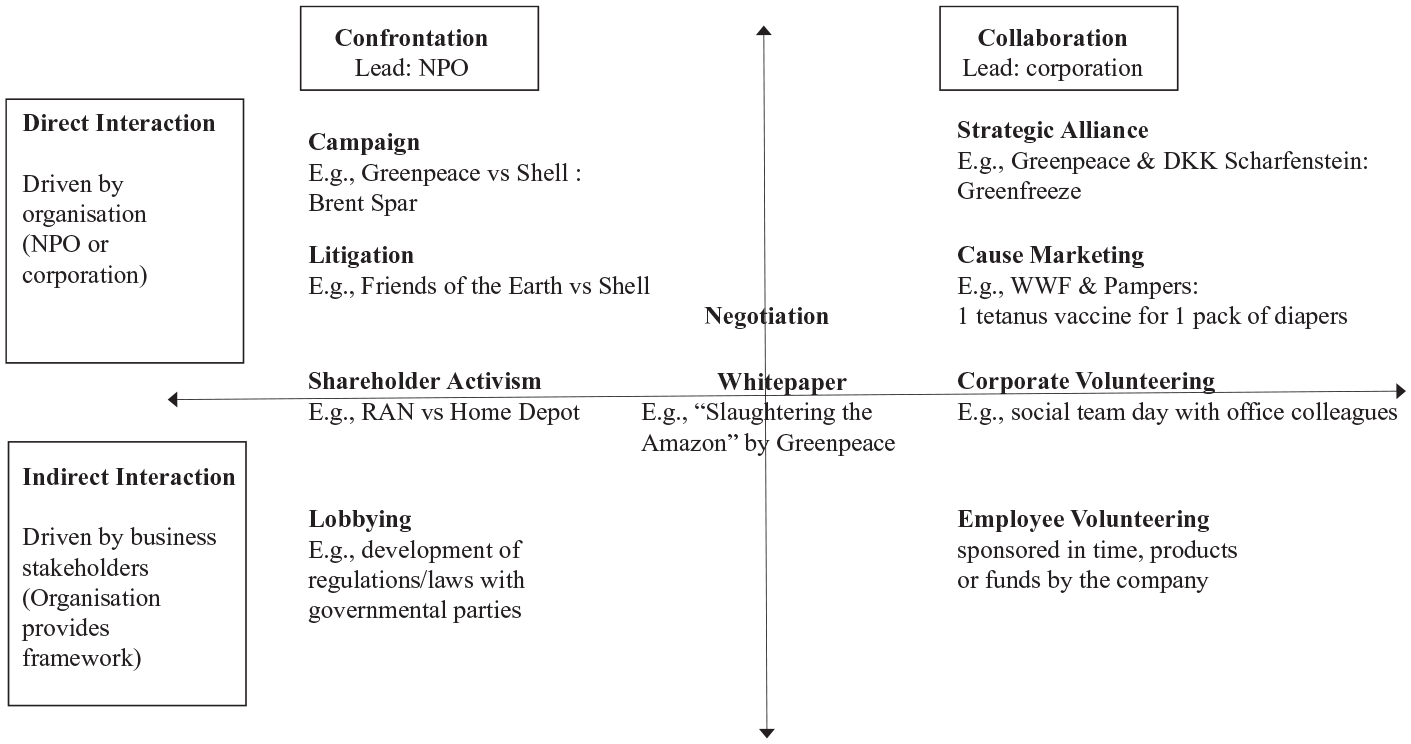
SCCIM: Strategic Confrontation and Collaboration Interaction Model.
Within the SCCIM, the horizontal strategic axis reflects the dichotomy between confrontation and collaboration as a conscious strategic choice for the NPO. In the confrontation quadrant, the NPO leads the initiatives, whereas in collaboration modes, business drives the interaction.
The vertical axis distinguishes between direct and indirect interaction modes. Direct interaction envisages the organization at the forefront of the initiative. Thus, for direct confrontation, the NPO defines the project, whereas for direct collaboration, business leads the initiative.
Indirect interaction, whether confrontational or collaborative, is a strategic interaction mode that relies on salient business stakeholders to implement the initiative. In the indirect interaction mode, business stakeholders push for cause implementation while the organization, NPO or business, remains in the background. The organization operates as enabler for these stakeholders by providing them with information, tools, or a framework to act on their behalf.
The axes confrontation versus collaboration as well as direct and indirect interaction represent a continuum. Direct confrontational campaigns may evolve toward direct collaboration, if NPO and corporation decide to negotiate directly to resolve or alleviate an issue. 1 Furthermore, indirect collaboration may evolve into direct collaboration, as evidenced by Austin’s (2000) Collaboration Continuum.
Empirical case illustrations of the four approaches as defined by the SCCIM are highlighted in the next paragraphs.
Direct Confrontation
Direct confrontation is an NPO strategy designed to pressure companies in reassessing their governance, modi operandi or strategic decisions. The success of a confrontational strategy is linked to the NPO’s ability to achieve a formal or informal coalition with further company stakeholders.
Campaigns and activist actions (e.g., vigils, shaming campaigns, calls for boycott, petitions) are designed to attract broad media coverage. The media coverage serves to strengthen the NPO’s image and communicate its mission, thus reinforcing its identity in the public eye (Rowley & Moldoveanu, 2003). A further campaigning objective is the rallying of civil society and key opinion leaders to support the NPO’s cause (Guo & Saxton, 2014).
An example of impactful direct confrontational NPO influence on a company decision is the 1995 Greenpeace Brent Spar occupation campaign, challenging Shell’s intention to dispose of the oil platform by sinking it in the North Sea. Greenpeace activism and communication fueled extensive media coverage, a public outcry that led to a Shell boycott, and international political pressure. In addition, increasing employee disengagement concerned Shell’s management (Yaziji & Doh, 2009, p. 61). With multiple stakeholders, including salient ones, supporting Greenpeace’s cause, Shell was put under increasing pressure. Instead of sinking the Brent Spar in the Atlantic, Shell was compelled to dismantle the construction. Following the Greenpeace campaign, legislation was passed, prohibiting oil platforms to be sunk. Furthermore, Shell’s internal governance was adapted to include consultation with NPOs on forthcoming projects (Yaziji, 2004). The Brent Spar case demonstrates that an NPO may reach their goals by gaining salience for the company. The NPO gains power, legitimacy, and urgency (Mitchell et al., 1997) by rallying a formal or informal coalition of various business stakeholder groups supporting the NPO cause.
Judicial activism, for example, litigation, is another direct confrontational strategy. In May 2021, an NPO coalition led by Friends of the Earth Netherlands won a court case against Shell, obliging the company cut down its CO2 emissions. The decisive business stakeholder here is the court of justice. It is a strongly influencing “dominant” stakeholder that wields power and legitimacy (Mitchell et al., 1997).
A third form of direct confrontation is shareholder activism (Phillips, 2019) when the NPO itself possesses enough shares to act on its own. This is the strategy pursued by the Dutch NPO Follow This, that buys shares of fossil fuel firms to “change oil companies from within” (Follow This, 2023). Also a formal coalition with a large business investor where the NPO is a visible and leading partner, as in the case of the NPO Oxfam Intermon and investor Boston Common Assets against oil company Repsol (Arenas et al., 2009), is a further example of direct confrontation.
Indirect Confrontation
NPOs can also pursue their goals indirectly by mobilizing and leveraging salient, powerful, or legitimate stakeholders (Yaziji & Doh, 2009).
Shareholder activism, described as direct interaction above, may be enacted as indirect interaction when the NPO, “invisible” to the firm, mobilizes and acts through third-party investors to achieve its goal. For example, the Rainforest Action Network (RAN) successfully acted indirectly, targeting and activating Home Depot stakeholder groups among which shareholders, employees and consumers, forcing the company to phase out old grown wood in favor of sustainably sourced wood, certified by the Forest Stewardship Council (FSC) (Carroll et al., 2018). One element of the RAN campaign consisted of a mailing to shareholders before the annual shareholder meeting, motivating them to submit a stockholder motion that led to a vote to stop the sale of old grown wood at Home Depot (Dziedziech, 2013).
Furthermore, NPOs’ lobbying toward the government, which has received extensive academic attention in nonprofit studies (Schepers, 2006) amounts to an indirect confrontational strategy. These NPO activities may consist of involvement in regulation and legislation (Neumayr et al., 2009) or influencing legislators (Boris & Mosher-Williams, 1998). An example is “Initiative Lieferkettengesetz,” a coalition of NPOs that lobbied and campaigned for the supply chain law, passed 2021 in Germany. National or supranational legislators or regulators are dominant stakeholders with power and legitimacy. An NPO can pursue its goal by cooperating with governmental entities in developing guidelines, regulations, or laws and influencing policy, thus increasing the institutional pressure on business.
In addition, advocacy NPOs may act as watchdogs, 2 for example, via the publication of white papers. For example, when Greenpeace published Slaughtering the Amazon, Nike announced to change its governance and procurement guidelines and discontinue sourcing leather from Brazil’s Amazon rainforest. Soon thereafter, Adidas followed Nike’s lead (Helmig et al., 2016).
NPO white papers may induce various business stakeholders to act: journalists, investors, or policymakers. Companies may hence feel compelled to take preemptive or reactive measures. The effect of a white paper may be confrontational if the research results are presented in a polarizing manner; conversely, such a report may be considered cooperative if it provides a balanced assessment of a trade branch performance. The information provided by NPO watchdogs is, therefore, placed between indirect confrontation and indirect collaboration.
Direct Collaboration
Direct collaboration may be operationalized via NPO’s advisory functions toward business (Rondinelli & London, 2003) or the tactical CSR instruments of corporate philanthropy, corporate volunteering, cause marketing, and community involvement (Carroll et al., 2018; Kotler & Lee, 2005). Over time these collaborations may develop in intensity and impact from philanthropic exchanges to transformational alliances (Austin, 2000; Austin & Seitanidi, 2012).
Transformational strategic alliances may be formed between NPOs and business to develop and implement sustainable changes, thus protecting or improving the circumstances for vulnerable people, communities, or the environment. An illustration thereof is the strategic alliance of Greenpeace and fridge producer DKK Scharfenstein (Stafford et al., 2003) to develop and launch the transformative innovation Greenfreeze in 1992: the first fridge without chlorofluorocarbons (CFCs) and a low CO2 impact. CFCs were the main cause of the hole in the ozone layer. Greenpeace’s mobilization of media and green-minded consumers in Germany catalyzed the change in the local market. The German government awarded the blue angel ecolabel to the product and leading German competitors were compelled to switch to Greenfreeze technology. Greenpeace proceeded with the global Greenfreeze rollout via a multistakeholder collaboration with governmental entities (Gschrey et al., 2018) and through the global initiative “Refrigerants, Naturally!” with multinational companies (Polman & Winston, 2021).
Cause marketing initiatives may help NPOs in pursuing their goals by improving the conditions of their beneficiaries while the business partner primarily directs the initiative at consumers and the public to generate sales, or enhance their image. An example of cause-related marketing (Kotler & Lee, 2005) is the collaborative promotion between Procter & Gamble and UNICEF dubbed “one life-saving vaccine for one pack of Pampers.”
Corporate Volunteering, meanwhile, is directed at employee stakeholders (Carroll et al., 2018). Direct collaboration occurs when the company selects the NPO cause for a team building event, for example, DHL’s Global Volunteer Day, which may encompass various activities such as planting trees together with colleagues. Also, skill-based support, for example, KPMG consultants helping disadvantaged communities with tax declarations (Carroll et al., 2018), is organized by the company for its employees.
Indirect Collaboration
Some companies sponsor their employees with time, products, or funding for individual volunteering activities. Volunteering is then organized, initiated, or pursued by individual employees, supported by a company program, for example, Daimler’s ProCent initiative, which is funded through payroll giving (Mercedes-Benz Group, 2023). Such NPO interaction with the company is indirect because the company is no longer at the forefront of the initiative; instead, its stakeholder—the employee—chooses to engage in a specific project.
Discussion
The tactics presented within the SCCIM may shift from one quadrant to another, depending on the interaction set-up or the perspective on the interaction.
For instance, based on the extensive nonprofit literature about NPO lobbying to regulate business activities, “lobbying” is categorized in the indirect confrontation quadrant in this paper. Lobbying may however also occur in the direct collaboration quadrant, as in some instances, NPOs and businesses collaborate to change legislation and regulation. An example thereof is the Animal-Free Safety Assessment (AFSA) collaboration against animal testing. Conversely, litigation may not only be enacted as direct confrontation, but may also be operationalized as an indirect confrontation; an example thereof is the court case against energy provider RWE by a Peruvian farmer, who is supported by the NPO Germanwatch.
Concurrently, the Greenfreeze case is presented within SCCIM as a direct collaborative strategic alliance, based on the interaction analysis at an organizational level. Assessed from an industry branch or market perspective however, this collaboration would be considered an indirect confrontation. By leveraging (among other stakeholders) a minor competitor, Greenpeace achieved its goal to roll out a sustainable transformative innovation in the fridge industry, coercing market leaders with established brands to adopt the new technology.
Therefore, the categorization of the tactics illustrating the four quadrants within the model is flexible: Category shifts are possible, depending on the perspective, the project type, interaction phase, or stakeholder role within NPO–business relations.
The broader, stronger, and salient the business stakeholder support for an NPO cause, the better this NPO is positioned to set the agenda and influence company initiatives and their implementation (Yaziji & Doh, 2009). Conversely, without salient stakeholder interest and involvement, NPO– business interaction is likely to fail (Stafford et al., 2000, referring to Westley & Vredenburg’s 1991 case between Pollutions Probe and Loblaws). By virtue of further business stakeholder support, an NPO may evolve from a secondary to a primary, important, company stakeholder. The more salient the cause-supporting stakeholders are, and the more acute the issue gets for the company, the more propitious the chances become for advocacy NPOs to reach their goals.
Implications for Theory
Literature on NPO–business relations mostly focuses on either confrontation or collaboration, thereby not reflecting the full range of interaction alternatives that NPOs may apply toward business. The proposed SCCIM is a novel conceptualization as it encompasses the extensive interaction spectrum of advocacy NPOs toward business, from antagonistic campaigns to transformative strategic alliances. This conceptualization of varied NPO roles in the economic domain thus complements the research that highlights the political roles of NPOs.
The SCCIM, therefore, supplements academic models, for example, the Collaboration Continuum, Cooperative Value Creation Stages (Austin, 2000; Austin & Seitanidi, 2012), or Collaboration Types (Rondinelli & London, 2003), and thereby propounds an extension of the literature.
The presented analysis conveys that stakeholder theory is not only relevant for firms but also for NPOs interacting with business. The SCCIM builds upon the paradigm of stakeholder importance and considers that NPO—business interactions do not occur in a two-party vacuum, but within the business ecosystem. Business stakeholders are an important causal mechanism for the NPO to achieve a positive impact. The SCCIM, thus, may form a theoretical base for future case study analysis, adding the business stakeholder factor to further variables, instruments, processes, output, and outcome descriptions.
Some scholars posit that interactions between advocacy NPOs and firms reflect an intention to promote institutional change (den Hond & de Bakker, 2007; Yaziji & Doh, 2009). Although this hypothesis may not apply to all interaction alternatives, several cases described in this article confirm that NPOs have been able to effect institutional changes. Institutional NPO–business interaction outcomes include: sustainability-improved business governance, sustainability-driven regulation and legislation, the foundation of sustainability-oriented organizations, up to disruptive sustainable technological innovation with global impact.
The highlighted Greenpeace cases indicate that a NPO may consciously choose a specific strategy toward a business depending on the context. This finding contradicts academic NPO classification as either being antagonistic or cooperative (de Bakker et al., 2013; den Hond & de Bakker, 2007; Elkington & Fennell, 1998; Rodgers, 2000; Simsa, 2001). Case analyses reveal, however, that NPOs master-specific tactical know-how, that they consequently and predominantly deploy. NPOs may therefore not be ideologically confrontational or collaborative per se but may be experts in tactical tools related to one, or the other, overarching strategy.
Implications for Practice
This research also has implications for practice. The SCCIM segments strategies into different tactics and interaction options, making it a practical NPO resource to develop and evaluate interactions with business counterparts. The model assists NPOs in thinking strategically and systematically within the interaction configuration they aim to pursue. This may contribute to NPO effectiveness in achieving its goals by influencing the business ecosystem.
The SCCIM also provides an alternative understanding of the mechanisms that may promote, enhance, or reduce the impact of an interaction. Depending on the chosen strategies and tactics, different business stakeholder groups become relevant for NPOs.
Case analysis suggests that a concurrent multifaceted stakeholder activation strategy could be more effective than a campaign that activates single stakeholder groups over a longer period. This concerted activation can be orchestrated by a single NPO or be implemented via a coalition of NPOs and/or business stakeholders, cumulating their complementary expertise to reach a common goal.
Limitations
The cases illustrating various NPO tactics in this research note were not chosen arbitrarily. The selected interaction cases were either inspiring as they resulted in systemic change, or were extensively documented in academic work, or finally, represented widespread practices. The highlighted Greenpeace cases, relating to the first two criteria, were specifically chosen to evidence that a single NPO may pursue different strategies depending on its relation to the business counterpart. Still, the presented strategies and tactics within the SCCIM could have been exemplified by alternative cases.
A further limitation of the SCCIM is that it focuses exclusively on business stakeholders as factor for interaction impact. Rival explanations that may also lead to successful outcomes for the NPO cause have not yet been thoroughly assessed.
Finally, NPO–business interaction cases may evolve from confrontation to collaboration. This dynamic cannot be reflected in the SCCIM, which is a static interaction map.
Future Research
The proposed SCCIM stimulates further research in several areas. The literature indicates that, over time, a confrontational approach may suffer from a wear-out effect (Simsa, 2001), whereas the dynamic of collaborative strategies may be intensified (Austin, 2000). The dynamism and development of initial strategies and tactics is an area to explore via in-case process tracing. What are the factors leading to a change in the interaction: How may confrontations evolve into collaborations (see also Bereni & Dubuisson-Quellier, 2021) or vice versa?
In addition, this research note features a broad selection, though not the full repertoire, of confrontational and collaborative NPO–business interactions. The methodology of inductive multiple case comparisons may result in the development of a mid-range typological theory (George & Bennett, 2005). Each interaction type represents one piece of the full SCCIM puzzle and as a “building block” (George & Bennett, 2005) it can individually contribute to the overall typological model. The proposed SCCIM may, therefore, be confirmed, enhanced, redefined, or challenged based on additional theoretical frameworks and interaction cases. Analysis of further tactics may uncover more variables, conditions, mechanisms, or causal paths.
Additional case analysis is needed to confirm the preliminary finding that simultaneous multiple stakeholder activation may lead to a faster and stronger impact for the NPO than subsequent activation of separate stakeholder groups.
The SCCIM may also form a base to quantitatively track the prevalence and the impact of specific tactics. The statistical correlation of specific business stakeholder involvement to these individual tactics would further enhance insight into the NPO–business interaction phenomenon.
Conclusion
Advocacy NPOs promote or support the interests of a cause or group and adapt their objectives to suit the governmental, economical, or civil society arena in which they aim to operate.
As global issues such as climate change become more pressing, all societal actors are expected to engage in making practices more sustainable: the governmental and economic sectors as well as civil society. The nonprofit literature has focused extensively on NPO–governmental relationships. Governmental institutions may, however, be slow in developing and implementing—sometimes diluted—policies, aiming to promote sustainability and social justice.
Advocacy NPOs may therefore additionally seek to affect progress in the economic sphere. Some progressive companies, 3 influenced by their stakeholders, 4 define new operating guidelines swiftly in their aim to be frontrunners in implementing sustainable change. Collaborative NPO interaction with these sensible business organizations represents an opportunity to develop best practice cases. This blueprint can be extended to other companies (collaboratively or coercively) and be used for improved governmental policies.
This research note lays out a distinctive conceptual and descriptive model that bridges the broad range of NPO approaches toward business. The SCCIM offers a conceptual anchor for further academic research. Last and foremost, the SCCIM can assist NPOs in leveraging the business ecosystem to catalyze social and environmental change.
Research Data
sj-xlsx-1-nvs-10.1177_08997640231203629 – Supplemental material for How Advocacy Nonprofits Interact With and Impact Business: Introducing a Strategic Confrontation and Collaboration Interaction Model (SCCIM)
Supplemental material, sj-xlsx-1-nvs-10.1177_08997640231203629 for How Advocacy Nonprofits Interact With and Impact Business: Introducing a Strategic Confrontation and Collaboration Interaction Model (SCCIM) by Maike A. Diepeveen in Nonprofit and Voluntary Sector Quarterly
Footnotes
Acknowledgements
The author would like to acknowledge the constructive, challenging, and inspiring input of an anonymous referee, the valuable comments of the editors Susan Phillips and Joanne Carman, the feedback and support of Michael Vilain and Arto O. Salonen that all helped to substantially improve this contribution.
Declaration of Conflicting Interests
The author(s) declared no potential conflicts of interest with respect to the research, authorship, and/or publication of this article.
Funding
The author(s) disclosed receipt of the following financial support for the research, authorship, and/or publication of this article: The author receives financial support via an EDUFI Fellowship.

Notes
Author Biography
References
Supplementary Material
Please find the following supplemental material available below.
For Open Access articles published under a Creative Commons License, all supplemental material carries the same license as the article it is associated with.
For non-Open Access articles published, all supplemental material carries a non-exclusive license, and permission requests for re-use of supplemental material or any part of supplemental material shall be sent directly to the copyright owner as specified in the copyright notice associated with the article.
