




Abstract
Despite growing research interest in the social impact of social enterprises (SEs), limited attention has been paid to the antecedents of social impact. To address this gap, we conducted a systematic review of 52 extant studies that examine the antecedents of SEs’ social impact. The paper synthesizes the antecedents identified from prior work and categorizes them into individual- and organizational-level factors. Based on the findings, we develop a future research agenda to advance our knowledge of the antecedents of SEs’ social impact. A key research opportunity is to explore the social impact antecedents related to the institutional and external environment of SEs, an area that has been overlooked in the literature. In terms of practical implications, the study can be used to consider which factors policy makers and practitioners should focus on to develop strategies for improving the social impact of existing and future SEs.
Introduction
Social enterprises (SEs) are viewed as a response to the inefficient allocation of societal resources of the conventional sectors of the economy—the government, traditional business, and nonprofit voluntary institutions (D. Young et al., 2016). Previous studies have highlighted the increasing importance of SEs because of their innovative approach to addressing complex social and environmental problems (Dart, 2004; Dees, 1998; Herranz et al., 2011; Liang et al., 2015). In its simplest form, an SE is described as an organization that trades goods or services for a social purpose (Bagnoli & Megali, 2011; Borzaga & Defourny, 2001; Kerlin, 2006; Nyssens, 2006) or leverages entrepreneurial activity to fulfill a social mission, thereby contributing to social change (Grieco, 2018).
SEs are accountable to multiple stakeholders such as beneficiaries, employees, customers, the local community, and funders (Abramson & Billings, 2019; Costa & Pesci, 2016; Grieco et al., 2015). They are subject to legitimacy judgments given their multiple accountabilities and the potential institutional logic incompatibility or conflict between their social and economic goals (Costanzo et al., 2014; G. Liu et al., 2014; McInerney, 2012). Commitment to social impact is a requisite to building organizational reputation and trust, gaining legitimacy, and accessing capital and impact investment (Abramson & Billings, 2019; Costa & Pesci, 2016; McInerney, 2012; Molecke & Pinkse, 2020) in SEs. Specifically, social impact often serves as evidence of the achievement of social objectives and creation of social value or the benefits of SEs to people, community, and the environment (Bacq et al., 2011; Grieco et al., 2015; Khare & Joshi, 2018; Ramani et al., 2017).
Recognizing the key relevance of social impact to SEs, research on SEs’ social impact has grown steadily over the last decade (Grieco et al., 2015; Kah & Akenroye, 2020). Prior work has typically focused on exploring the social impact concept in the SE context and measuring social impact and comparing different approaches to assessing social impact, including social value and social performance of SEs (Grieco et al., 2015; Molecke & Pinkse, 2017; Rawhouser et al., 2019). Despite growing scholarly interest in SEs’ social impact, it is surprising that there has been limited focus in the extant literature on the antecedents of SEs’ social impact. The antecedents that facilitate or constrain SEs to deliver social impact and support SEs to scale their impact remain both unclear and underinvestigated.
We believe that the aforementioned research gap has contributed to long-standing debates regarding whether a business-oriented approach or the commercialisation of nonprofits can support or subvert the fulfillment of their social mission (Dees, 1998; Foster & Bradach, 2005; Guo, 2006; Herranz et al., 2011), and whether balancing the commercial and social aspects is a prerequisite to achieve SE goals (Dacin et al., 2011; G. Liu et al., 2014). Although a growing proportion of SEs have successfully supported their social mission through commercial approaches (Herranz et al., 2011), there are also SEs such as nonprofits running businesses that have experienced failure because the introduction of business-based revenue streams clashes with their social goals (Fitzgerald & Shepherd, 2018; Kirkman, 2012; Kleiman & Rosenbaum, 2007; G. Liu et al., 2014).
This paper responds to the gaps in the SE literature by conducting a systematic review of the fragmented findings on the small but growing body of prior work on the antecedents of SEs’ social impact. The paper makes a significant contribution to the literature by synthesizing the social impact antecedents previously identified, to provide a nuanced understanding of what fosters SEs’ social impact. Having this more detailed knowledge enables development of a future research agenda that advances the SE social impact field and, at the same time, provides practical implications for the development of SEs and other organizations such as traditional nonprofit organizations (NPOs), which also require strategic approaches to scale their social impact and leverage fulfillment of their social mission.
Systematic Review Search Strategy
A systematic review is a well-established approach for advancing knowledge and building a foundation for theoretical development on a topic (Snyder, 2019). It is a process of identifying, analyzing, and synthesizing evidence from previous studies, specifically the theories, contexts, constructs, and methods used in prior research (Hulland & Houston, 2020; Mandler et al., 2021). This review is focused on prior studies that examined the antecedents of SEs’ social impact. A comprehensive search of articles from the high-quality databases of Web of Science (WOS) and EBSCO and the reference lists of systematic reviews related to SEs was undertaken to identify relevant studies for the review.
Contextual Definition of SE
A wide range of SE definitions can be found in the literature. Several studies (e.g., Borzaga & Defourny, 2001; Defourny et al., 2021; McMurtry & Brouard, 2015; Spear et al., 2009; D. Young et al., 2016; D. Young & Lecy, 2014) were already undertaken to offer some clarity on the complex concepts and models of SEs, but researchers have not yet reached a shared understanding or unified definition of an SE (Defourny et al., 2021; Defourny & Nyssens, 2017). While it is beyond the scope of this paper to provide a comprehensive discussion of the existing SE concepts, it is important to outline the conceptual definition of an SE used in this specific study, to appropriately set the search and inclusion criteria for the systematic review.
D. Young et al. (2016) explain that it is complex to draw boundary lines to distinguish SEs from conventional organizational forms such as nonprofits, for-profit corporations, small businesses, and cooperatives because SEs differ in how they combine their social and market goals. We recognize that SEs operate across a continuum of organizational forms, with traditional nonprofits and for-profit businesses at opposite ends of the spectrum. SEs move between purely philanthropic or mission-driven organizations that primarily seek to achieve social value and purely commercial or market-driven businesses that are mainly concerned with economic value and profit maximization (Dees, 1998).
For Chan et al. (2017) and the Asian Development Bank (2017), an SE can be a business-oriented NPO, a mission-oriented for-profit organization, or a hybrid organization (e.g., cooperative and community interest company) that actively pursue both revenue-generating and socially beneficial goals, which are different from traditional for-profit businesses that “use the market to promote social and environmental concerns” (Child, 2016, p. 1). From a nonprofit lens, SE is a term used for NPO that runs a business as a strategy to fulfill its social and environmental mission (Child, 2016; Cooney & Shanks, 2010; Herranz et al., 2011). It is also viewed as a “commercial arm” that emerges from within NPOs (Weisbrod, 1998; D. Young & Brewer, 2016), which is often driven by the desire to blend social logic with commercial logic in pursuit of a social mission (Besharov & Smith, 2014; Fitzgerald & Shepherd, 2018; Graddy-Reed, 2018). For example, D. Young and Longhofer (2016) identified that both commercial NPOs that depend on earned income at some level and public sector SEs, which are private nonprofits or businesses funded and controlled by government, should be included in the various organizational forms that can be considered as SEs.
Inclusion and Exclusion Criteria
An initial search of the combined key phrases “social enterprise” and “social impact” in the title and abstract fields led to the identification of 117 articles. These were manually screened to exclude studies that did not meet the following criteria: (a) The subject(s) of the study must involve SE, and (b) the paper must be a quantitative or qualitative study that has examined an antecedent of SE’s social impact. With only five articles meeting both criteria, an iteration of the search to include common alternative terms for SEs based on our contextual definition, and as found in our literature review, was undertaken to identify other potentially relevant papers. Terms closely related to social impact, namely social performance and social value, were included to add other potentially relevant papers. Specifically, the following search string (with wildcards, # or *, to capture plural forms, compound words, and spelling variations) was used in the EBSCO database and subsequently adapted in the WOS database search: “(‘social enterprise#’ OR ‘social business#’ OR ‘social venture#’ OR ‘non#profit business’ OR ‘non#profit organi#ation#’ OR ‘not#for#profit business#’ OR ‘not#for#profit organi#ation#’ OR ‘hybrid business#’ OR ‘hybrid organi#ation#’ OR ‘co#operative#’) AND (‘social impact’ OR ‘social performance’ OR ‘social value’).” While “nonprofits” were included in the inclusion criteria, further screening of the nonprofit papers through content analysis was undertaken to ensure that only NPOs that were explicitly described as having entrepreneurial activities and/or earned income were considered, while those that were purely charitable and/or had no mention of any trading or business activity in the paper were excluded.
To ensure the quality and relevance of studies included in the review, the search was restricted to articles published in English in peer-reviewed journals from 2000 to 2022. Books, book chapters, and other scholarly work were excluded as there is no way of confirming whether they had undergone a robust peer review. However, we encourage future systematic reviews on this topic to expand our search by adding more databases and publication types to include potentially missed empirical works to the SE literature.
Search Results
After the expanded search and the inclusion of the extracted papers from the reference lists of existing SE-related systematic reviews, 990 unique papers were found. Of these, 52 met the inclusion criteria. From these articles, 11 explicitly used social impact as their key construct or (one of the) explained variable(s), 11 used social value, and 30 used social performance (Figure 1).
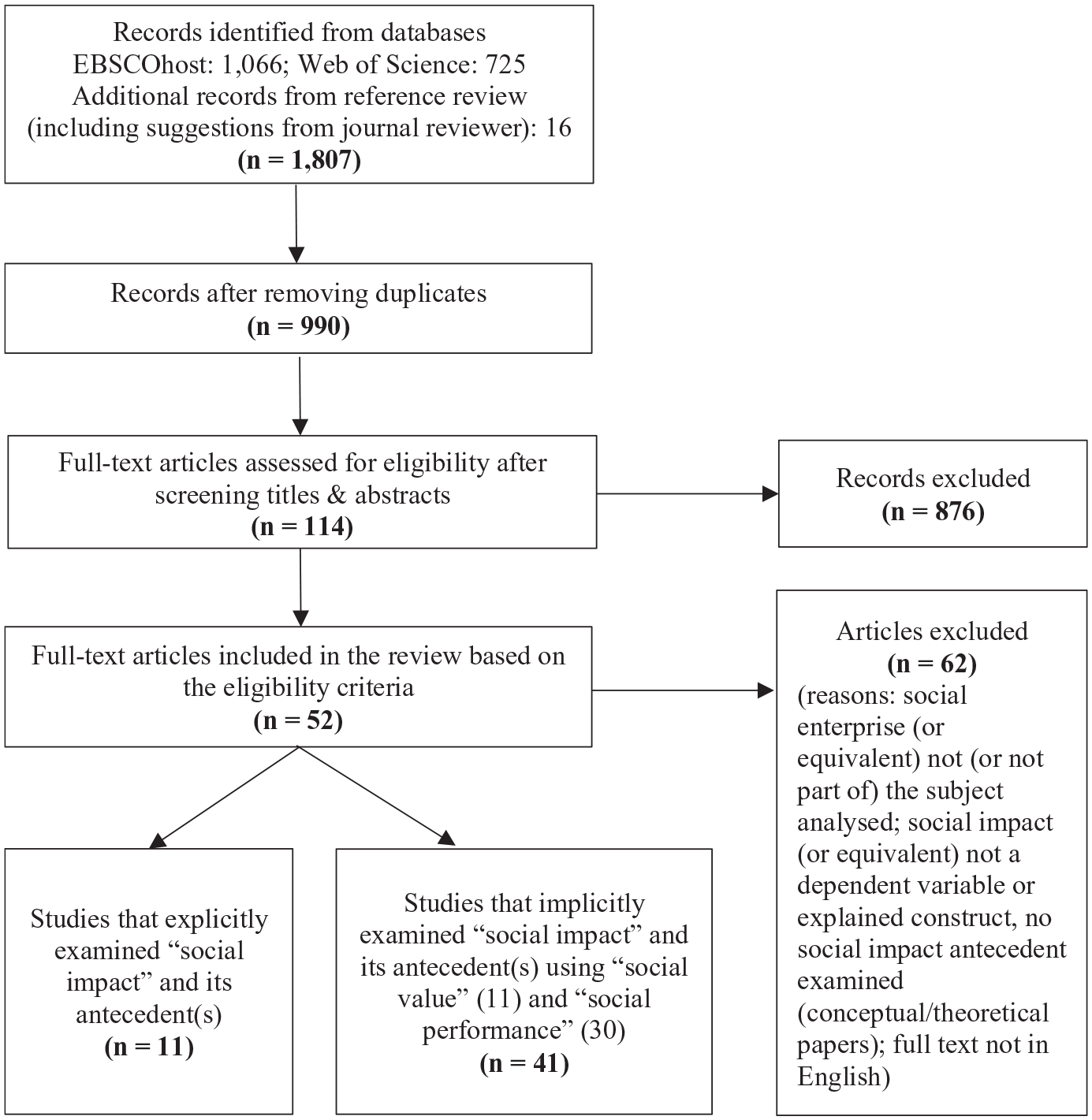
Results of the Study Selection Process.
The limited number of papers on the antecedents of SEs’ social impact, particularly in high-ranking journals, is not surprising given the infancy of research on SEs. The review also demonstrates the highly fragmented nature of publications, with the 52 articles published in 40 different journals (see Supplemental Material provided). While we set our search start year to 2000, the earliest study was published in 2010. However, recent growth in the number of studies is noteworthy, with 63% of the articles published between 2018 and 2022 (Figure 2). Most of the papers (77%) were quantitative studies while the remainder drew on either qualitative (15%) or mixed-method approaches (8%).
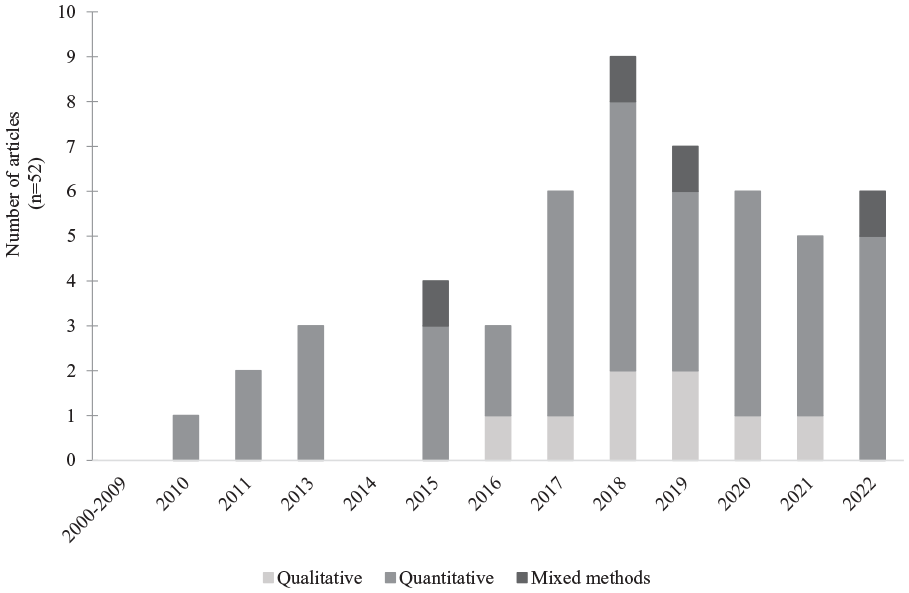
Number of Reviewed Studies Per Year, by Type of Research.
Social Impact as Conceptualized in Prior Work
Akin to SEs, social impact has various definitions in the literature (Hadad & Găucă, 2014; Kah & Akenroye, 2020; Rawhouser et al., 2019). Thus, it is important to examine how social impact has been conceptualized in previous studies. This study brings clarity around how social impact is defined in the SE context by identifying distinct conceptual themes that could guide future research in further establishing the concept of SEs’ social impact. In this section, we synthesized the definitions of the three social impact constructs—social impact, social value, and social performance—and identified two key orientations of how the constructs have been conceptualized: (a) societal needs-oriented definition and (2) organizational goal-oriented definition.
Societal Needs-Oriented Definition
The societal needs-oriented definition includes studies that defined their social impact construct as having the general motive of improving and/or benefiting society. Under this orientation, we have further identified three distinct subgroups. The first subgroup includes those studies that explicitly defined their construct as having the motive to improve society by responding to or offering a solution to society’s problems and needs. For instance, Bloom and Smith (2010) and Bacq et al. (2011) both equated social impact to addressing a social need or problem. According to Lee and Chandra (2020), social impact could be through engagement in social activities that address social issues and find new opportunities valuable to the society. It could relate to “product responsibility, community, human rights, diversity, training and development, health, safety, and employment quality” (Manolopoulos et al., 2022, p. 15). For Cannatelli (2016), social impact scaling was “a solution-oriented pattern promoting higher efficiency in the social sector” (p. 1), whereas for Rey-Martí et al. (2021), social impact was a form of social sustainability characterized by social cohesion and equity of access to key services of people facing social problems. Correspondingly, social value was defined in relation to resolving different social issues and problems through innovation (Son et al., 2017) and as “a concept designed to address real societal needs from a competitive advantage perspective” (Li et al., 2018, p. 2). In Khan et al. (2022) and Maine et al. (2022), social performance meant fulfilling the needs of the citizens or society and solving social and environmental problems.
The second subgroup defines the social impact construct through the lens of benefiting society via social value creation (SVC). Exemplar studies include that of Khare and Joshi (2018) who broadly defined social impact as the value created for beneficiaries, society, and the world, and the study of Bhattarai et al. (2019) who described social performance as an organization’s performance in creating social value for its customers. Oduro et al. (2022), Shin (2018), Shin and Park (2019), and Qing and Jin (2022) likewise explained SE social performance as the extent to which it creates value, for instance, through community contribution, social service, and job creation. Along the same lines, Osten and Toaldo (2022) viewed social performance as creating value in terms of concern for, or actions toward, the community, whereas Sabella and Eid (2016) conceptualized social value in terms of how an SE captures value from and communicates it back to communities to promote community development.
The third subgroup of societal needs-oriented studies involves those that conceptualized their construct in relation to social change or transformation and/or improving social welfare, especially for the poor. For example, Maseno and Wanyoike (2019) described social impact as a kind of impact that leads to poverty reduction and societal transformation. Ramani et al. (2017) likewise defined social impact as a positive social welfare that enhances transformative changes in the context of poverty. Two other studies, Sharma et al. (2020) and Lam et al. (2020), described social impact as achieving a better social status for the poor and social performance as doing good by reaching out to the poor. Similarly, Arrassen et al. (2017) and D’Espallier et al. (2017) described social performance in microfinance institutions (MFIs) as being reflected by the outreach and delivery of microfinance/financial services to poor people.
Among the studies reviewed, there are three papers that cut across the aforementioned three subcategories of societal needs-oriented definition. In the study by Liang et al. (2015), SE social performance was defined as the contributions in “improving local and global environmental conditions and creating positive social changes by addressing particular societal needs, promoting public awareness and social movements, and creating innovative and sustainable products, services, and institutions” (p. 100). Felício et al. (2013) conceptualized social value as “the necessary goods and services provided by organizations with social purposes such as promoting community development, advocating for more inclusive and fairer policies, or dealing with a variety of other social problems” (p. 2140). Furthermore, they described SVC as seeking a better society by removing constraints to social inclusion and assisting those in need. For Nascimento et al. (2021), social value devolution was about sharing value to society through creating jobs, improving education, minimizing environmental problems, and reducing poverty.
Organizational Goal-Oriented Definition
The next set of definitions is categorized as the organizational goal–oriented definition of the social impact constructs, which includes studies that defined their construct in relation to the SE’s social mission or goals. While a typical social goal of SEs is expected to be the motives and desired outcomes discussed in the societal needs-oriented definitions in the previous section, the organizational goal–oriented definition group is distinct in the sense that the definitions offered in the studies do not explicitly define the motive or outcome of the social impact but rather broadly explain that social impact is about achieving an organization’s social goal(s), emphasizing the act of execution of SEs’ social goal(s). These definitional statements do not necessarily specify what these goals are but rather offer a general social impact construct definition that is flexible enough to fit any SE type and sector.
Exemplar studies include those of Giones et al. (2020) who described social impact as the tangible social and environmental goals that the venture seeks to produce; Cavazos-Arroyo and Puente-Diaz (2019) who associated SVC with the execution of the SEs’ social mission; and Coombes et al. (2011) and W. Liu et al. (2021) who explained that social performance is about accomplishing the social mission and SVC of the organization. Also included in this group are the studies of Battilana et al. (2015), Bellostas et al. (2016), Cheah et al. (2018), Cho and Kim (2017), Gupta and Mirchandani (2019), G. Liu et al. (2015), Pinheiro et al. (2021), and Sanchis-Palacio et al. (2013), which all described SE’s social performance in terms of achieving an organization’s own social goals. In addition, Choi et al. (2021) conceptualized social performance in relation to having social goals and corporate social responsibility (CSR) with a performance management system and performing activities well.
Overall, the review demonstrates the close overlap and interrelationships in the definitions of the three constructs—social impact, social performance, and social value in the SE context. The constructs are also consistently viewed as a positive concept in all studies. In terms of scope, it is evident that they are generally loosely defined in the literature. Most articles offer a rather broad and generic concept description, which we suspect is likely intentional to conveniently fit any SE context or sector. It is also noteworthy that five studies (i.e., Choi & Chang, 2020; Jin, 2020; Lortie et al., 2017; Miles et al., 2013; Perrileux & Szafarz, 2015; Zheng et al., 2020) vaguely defined their social impact construct, failing to explicitly offer a definition in their paper, and rather defined their measurement indicators or implied meaning in relation to the SE’s purpose as an organization. Such poor conceptualization could be one of the reasons why the SE social impact field remains underdeveloped and the literature being scarce and fragmented.
Antecedents of the Social Impact of SEs
The review has identified two broad levels under which the antecedents of social impact can be categorized—the level of the individual/entrepreneur and the organizational level. Figure 3 summarizes the antecedents, including the different factors that mediate their effect on SEs’ social impact. The review highlights that regardless of the orientation used in defining social impact in the studies, authors have focused on both individual- and organizational-level antecedents, with the latter being a more common focus.
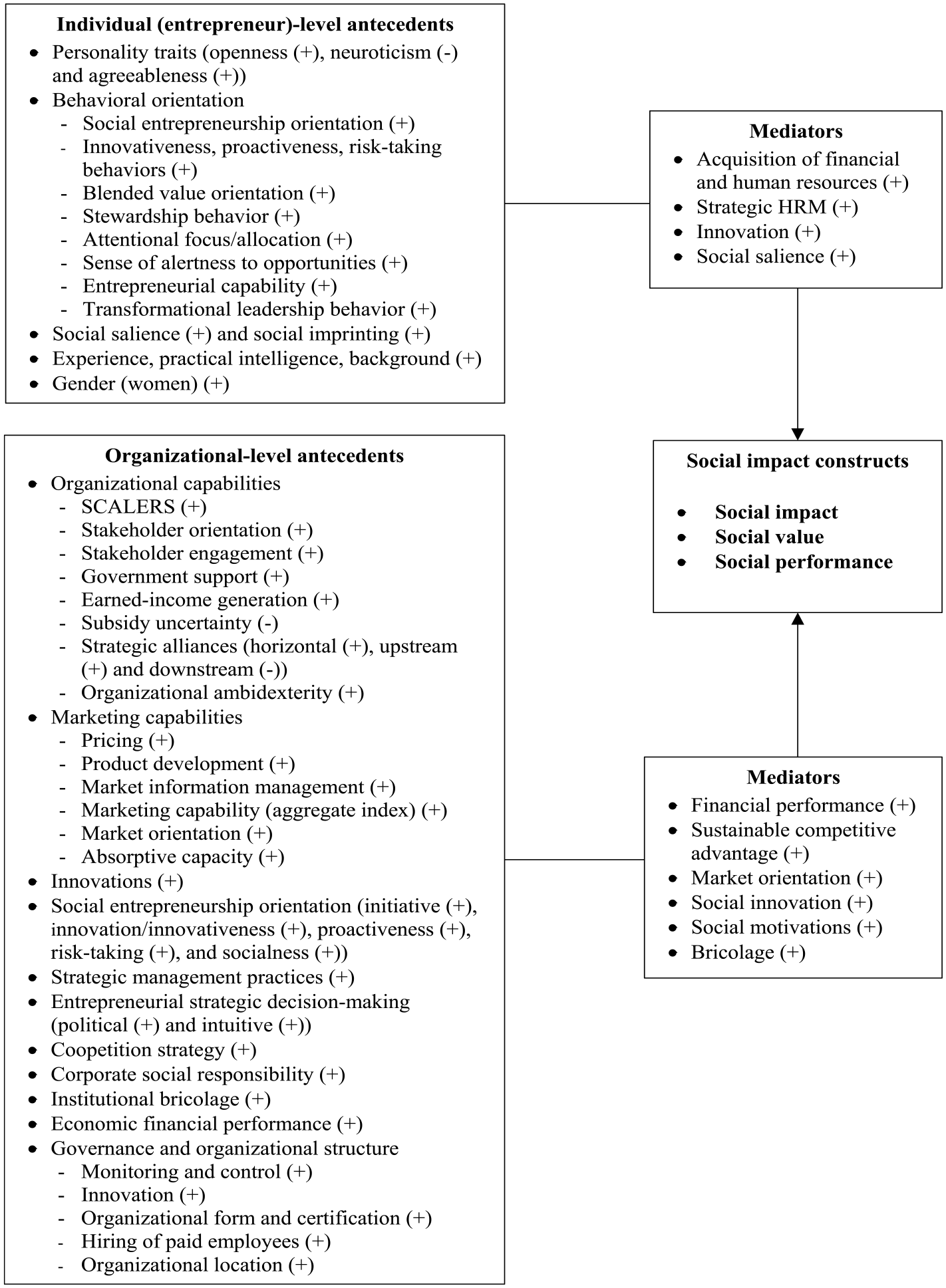
Significant Antecedents and Mediators of SEs’ Social Impact (n = 52 studies).
Individual (Entrepreneur)-Level Antecedents
The individual-level antecedents include factors relating to SE leaders/managers or social entrepreneurs. As a founder or chief executive of an organization, a social entrepreneur plays a key role in decision-making and strategic planning to address social problems and simultaneously create social and economic value (Coombes et al., 2011; Liang et al., 2015; Shin, 2018). Therefore, their characteristics and behaviors are expected to have some influence on SEs’ social impact.
Personality Traits of the Social Entrepreneur
Two studies (i.e., Liang et al., 2015; Shin, 2018) investigated the link between the personality traits of SE managers and the social performance of SEs. Drawing on the Big-Five personality trait framework (Goldberg, 1992), Liang et al. (2015) examined the effects of extraversion, neuroticism, conscientiousness, agreeableness, and openness on SEs’ social performance. Among these traits, neuroticism and agreeableness had a negative and positive influence on social performance, respectively. Shin (2018) on the other hand investigated the effect of managers’ openness on their SE’s social performance and, unlike Liang et al. (2015), found a significant relationship between the openness trait and social performance, but the effect was indirect and facilitated by a manager’s innovativeness.
Behavioral Orientation of Social Entrepreneur
Entrepreneurial behaviors or social entrepreneurship orientation (SEO) are also identified as having positive links with social impact constructs. Zheng et al. (2020) for instance, examined social entrepreneurs’ behavior, specifically their attentional focus, through the lens of attention-based theory (Ren & Guo, 2011) and paradox theory (S. L. Young et al., 2018). They revealed that SEs managed by entrepreneurs with a higher level of attentional focus toward stakeholders, operations, and their SE environment also demonstrated a higher social performance level. Shin and Park (2018) also investigated SE managers’ entrepreneurship behavioral orientation using organizational behavior theory (Robbins & Judge, 2014) and found that innovativeness, proactiveness, and risk-taking behaviors in managers and their blended value orientation positively influenced SEs’ social performance. The same entrepreneurial orientation factors, including the entrepreneurial capability in searching for new opportunities, showed a positive relationship with the social impact of work-integrated SEs (WISEs) in the study by Rey-Martí et al. (2021) study. Two other related behavioral characteristics—a sense of alertness to opportunities and the transformational leadership characteristics of SE founders—have been found to be positively related to the social value and sustainability of SEs (Sabella & Eid, 2016). However, an earlier study by Felício et al. (2013) found no significant correlation between transformational leadership behavior and SVC and explained that such a result can be attributed to the social organizations’ usual compulsion to adjust leadership to existing resources to ensure stability and success.
Social Salience
Another entrepreneur-level driver of SEs’ social impact is social salience. Drawing on goal-setting theory (Bandura, 1997) and the theory of planned behavior (Ajzen, 1991), social salience is described as the “importance entrepreneurs place on the social outcomes of their organization” (Lortie et al., 2017, p. 157). Lortie et al. (2017) and Cheah et al. (2018) both reported a direct positive link between an entrepreneur’s social salience and the SE’s social performance. A related concept is social imprinting, which is an early emphasis by SE founders on accomplishing their organization’s social mission (Battilana et al., 2015). Battilana et al. (2015) found a positive relationship between social imprinting and SEs’ social performance. The strong link between the goal-oriented behavior of social entrepreneurs and social performance is not surprising, given that the aforementioned studies (except Lortie et al., 2017, which did not provide a construct definition) consistently defined social performance using an organizational goal orientation. However, with only two studies demonstrating a positive relationship so far, more empirical evidence is needed to further establish the generalizability of such findings.
Background, Experience, and Practical Intelligence
Research on the antecedents of SEs’ social impact also includes the human capital attributes of social entrepreneurs, particularly those relating to individual abilities and experiences. The attributes investigated in prior research include the entrepreneur’s educational and functional background, their age (Choi & Chang, 2020), their practical intelligence or experiential knowledge, and/or their “ability to apply accumulated skills, disposition and tacit knowledge to solve everyday problems” (Jin, 2020, p. 3).
Choi and Chang (2020) found that SEs ran by entrepreneurs who are relatively younger, have higher educational levels, have graduated from prestigious universities, and who possess greater management experience or a functional background tend to have higher levels of social performance than their counterparts. These findings support the study hypothesis, based on human capital theory (Dimov & Shepherd, 2005), that the presence of human capital factors improves a firm’s performance. Jin (2020) likewise confirmed a positive relationship between the practical intelligence of social entrepreneurs and SVC of SEs. Work and business experience is also related to social performance and social impact. Using the concept of knowledge absorptive capacity (Cohen & Levinthal, 1990), Choi et al. (2021) confirmed the positive relationship between social entrepreneurs’ prior work experience in organizations with a social aim and SEs’ social performance, while Rey-Martí et al. (2021) established that having relevant training, business experience, and family business background and being engaged in active entrepreneurial behavior (e.g., forming a start-up team, creating a business plan and starting a business) improve the social impact of WISEs.
Gender
Drawing on role identity-related theories, Lortie et al. (2017) and Perrileux and Szafarz (2015) examined the link between entrepreneur’s gender and SEs’ social impact. The former used social identity theory (Tajfel & Turner, 1986) and the concept of gender self-schemas (Markus, 1977) while the latter used the role-congruity theory of leadership (Eagly & Karau, 2002). Lortie et al. (2017) concluded that women are generally more motivated to begin an SE and pursue the organization’s goals, thereby producing better social performance outcomes than men. Perrileux and Szafarz (2015) established that having a female-dominated board of directors (BOD) or a combination of a female-dominated BOD and a female top manager in cooperatives significantly improves the organization’s social performance.
Organizational-Level Antecedents
A comparatively larger number of studies have examined the organizational-level antecedents of SEs’ social impact. Prior work has mostly focused on analyzing the relationship of SEs’ social impact through organizational and marketing capabilities, along with the SEO and innovation of SEs. Other papers investigate the antecedents of social value and social performance, including economic performance, governance structure, strategic management practices, and the institutional bricolage of SEs.
Organizational Capabilities
There is burgeoning evidence linking organizational capabilities to the scaling of SEs’ social impact. The SCALERS model, which identifies seven organizational capabilities—staffing (S), communicating (C), alliance building (A), lobbying (L), earnings generation (E), replicating (R), and stimulating market forces (S)—is the predominant model used by researchers. The resource-based view (RBV) emerges as the most common theoretical framework to examine the effect of organizational capabilities on SE’s social impact. From the RBV perspective, SEs are viewed as having a bundle of capabilities and resources, which are developed, combined, and applied to scale social impact (Bacq & Eddleston, 2018). In the study by Bloom and Smith (2010), all the elements of SCALERS significantly predicted the scaling of social impact. Cannatelli (2016) replicated Bloom and Smith’s (2010) SCALERS study in the context of Italian social cooperatives but used contingency theory (Donaldson, 1995) as an organizing framework and examined contingency factors as moderators in the model. Unlike in the study by Bloom and Smith (2010), only staffing, communicating, earnings generation, replicating, and stimulating market forces were significant in the study by Cannatelli (2016), which may have been due to geographical and cultural differences.
Subsequent studies focus on analyzing the link between more specific organizational capabilities and social impact. In relation to the communicating and alliance-building dimensions of SCALERS, Sabella and Eid (2016) highlighted a strong relationship between stakeholder orientation and SVC and the sustainability of SEs. Following this research, Bacq and Eddleston (2018) investigated the relationship between three organizational capabilities, that is, stakeholder engagement, government support, and earned-income generation, and the scale of SEs’ social impact. In line with the RBV and consistent with previous studies, all three capabilities exhibited a positive link with the growth of social impact. Furthermore, the study revealed that such a positive relationship is contingent upon the stewardship culture within the organization (Bacq & Eddleston, 2018). Using input-process-output-oriented RBV and resource dependence theory (RDT), the direct and indirect relationships (via bricolage) between strategic alliances and SEs’ social impact were also confirmed in the study by W. Liu et al. (2021).
Another study (Oduro et al., 2022) drew on the dynamic capability theory (DCT), which also originated from RBV, to investigate the link between organizational ambidexterity (OA), a dynamic capability (i.e., explorative and exploitative ambidexterity) that helps organizations adjust to changing business trends and enhance their performance, and SEs’ social performance. It confirmed that SEs with a higher level of ambidexterity exhibit better social performance. The same relationship between OA and social performance was established in the study by Maine et al. (2022) from the perspective of the paradox theory and in the context of hybrid organizations. Tate and Bals (2018) also extended the RBV to the SE context by developing a framework called the “social resource-based view” to explore the relationship between SEs’ social capabilities and SVC. The social capabilities identified to drive SVC include a mission-driven approach, a sense of accountability or awareness of internal governance, social innovation, and collaboration.
Finally, although not directly discussed in the context of organizational capabilities or RBV, we find the study by D’Espallier et al. (2017) relevant to organizational capability factors. The authors examined the influence of subsidy uncertainty on the social performance of MFIs and, more generally, on fulfilling their social mission of providing affordable financial services to poor people. Findings confirmed that higher subsidy uncertainty leads to lower social performance in MFIs.
Marketing Capabilities
Another element of organizational capability that has received scholarly attention is the marketing capabilities of SEs. Drawing again from RBV, G. Liu et al. (2015, p. 271) define marketing capabilities as “the integrative process of applying the collective organizational knowledge, skills, and resources to market-related needs.” In their study, eight marketing capabilities—pricing, product development, market information management, channel management, marketing communication, selling, marketing planning, and marketing implementation—were examined in the context of SEs in the United Kingdom and Japan. Only the first three capabilities mentioned were positively related to the social performance of SEs in the United Kingdom, whereas no factors were significant in Japanese SEs. One potential reason for this finding is that SEs in Japan may not be as market-driven as SEs in the United Kingdom since they are already producing adequate market-based resources even before enhancing their marketing capabilities (G. Liu et al., 2015). The study’s inconsistent findings suggest that other contextual factors (e.g., geographic location) may affect the relationship between marketing capabilities and SEs’ social impact.
Cavazos-Arroyo and Puente-Diaz (2019) also investigated marketing capabilities from the RBV perspective, but unlike G. Liu et al. (2015), they examined the effect of different marketing capabilities in aggregate. Their analysis revealed a significant relationship between aggregate marketing capabilities and SVC in SEs. Other forms of market capabilities were explored in previous research drawing from RBV and DCT. These include market orientation (Bhattarai et al., 2019; Pinheiro et al., 2021) and absorptive capacity (Lee & Chandra, 2020), which both had a positive link to SEs’ social performance.
Innovation
A growing number of studies have examined the role of innovation in fostering SEs’ social impact. For instance, the SE case studies of Maseno and Wanyoike (2019), Ramani et al. (2017), and Sharma et al. (2020) and empirical study of Son et al. (2017) consistently confirmed a positive relationship between innovation and social impact in SEs. Li et al. (2018) and Cavazos-Arroyo and Puente-Diaz (2019) also established social innovation as a significant driver of SEs’ SVC. Social innovation is the “development and successful implementation of products, services, processes, and models to meet social needs, and implies a novel, more effective, efficient, and sustainable solution to alleviate a social problem” (Cavazos-Arroyo & Puente-Diaz, 2019, p. 3).
Market disruptiveness, an innovation-related factor, has also been examined in the study of Bhattarai et al. (2019). However, unlike other forms of innovation, market disruptiveness demonstrated no significant influence on SEs’ social performance. The authors explained that its nonsignificance could be a result of misaligned investment in radical innovations of SEs, meaning the innovation might not be meant to specifically serve the beneficiaries or address a social issue.
Social Entrepreneurship Orientation
SEO, which is often associated with innovation, is identified as another key antecedent of SEs’ social impact. Because not all SEs are entrepreneurial in nature and such an orientation is not always an inherent characteristic of an SE, researchers recognize the need to investigate SEO within SEs. Most studies reviewed (Felício et al., 2013; Khan et al., 2022; Li et al., 2018; Miles et al., 2013; Pinheiro et al., 2021; Ramani et al., 2017) found strong evidence linking SE’s entrepreneurial orientation to social impact. For instance, Felício et al. (2013) established that social entrepreneurship, as captured by higher initiative and innovation, improves SVC. Likewise, in line with the social value orientation framework (Bowes, 1998; Shane & Venkataraman, 2000), Miles et al. (2013) confirmed a positive relationship between a value-driven entrepreneurial orientation of SEs and their social performance. In the studies by Pinheiro et al. (2021) and Khan et al. (2022), both significant direct and indirect relationships between SEO (i.e., innovativeness, proactiveness, risk-taking, and socialness) and SE’s social performance were confirmed, with the latter relationship mediated by market orientation and sustainable competitive advantage, respectively. Cho and Kim (2017) also found a significant indirect relationship between entrepreneurship and SE’s social performance but without any direct link. Their findings suggest that entrepreneurial orientation may only improve SEs’ social performance if they support community networking activities that develop active communication with various relevant stakeholders and maintain quality relationships. In contrast, Cheah et al. (2018) found that entrepreneurial orientation does not predict SEs’ social performance. They argued that these findings result from the fact that the organizational entrepreneurial orientation of their sampled SEs is more likely to be focused on enhancing financial performance, whereas advocating for social value was secondary.
Economic/Financial Performance
Given the hybrid nature of SEs, economic or financial performance has always been postulated as directly associated with social impact constructs. Building on the concepts of sustainability and shared value, Cho and Kim (2017), Kim (2018), Li et al. (2018) and Shafie et al. (2018) examined the relationship between SEs’ economic performance and their social performance or social value. The findings are consistent in demonstrating that social performance and social value increase with economic performance. Shafie et al. (2018) argued that more income surplus allows SEs to fund more value-creating activities. However, at the sectoral level, Arrassen (2017) and Bellostas et al. (2016), who studied MFIs and sheltered workshops, respectively, found no significant relationship between the organizations’ financial and social performance. Conversely, Lam et al. (2020), who also investigated MFIs, generated slightly different results after using an intertemporal analytical approach. They found that the financial performance of nonprofit MFIs in one period positively influences their social performance in the subsequent period.
In the study by Giones et al. (2020), a different perspective was used to examine the relationship between the financial and social impact of early-stage hybrid organizations by including a third dimension in the analysis: environmental impact. Drawing on RDT (Drees & Heugens, 2013), Giones et al. (2020) demonstrated how economic, social, and environmental values interact and posited that in aiming for social impact, environmental impact or both, entrepreneurs are willing to sacrifice financial targets or financial value of their organization. Results revealed that social impact is achieved at the cost of financial impact. However, when aiming for environmental impact alone, or combined social and environmental impact, the need to sacrifice financial value was not evident.
Governance and Organizational Structure
Governance, which is often captured by organizational structure in the prior literature, has also gained interest from SE scholars. Using agency theory (Jensen & Meckling, 1976), Kyazze et al. (2017) examined the effect of organizational structure on cooperative social performance, specifically the influence of monitoring rights, ratification of management decisions, innovation, and policy compliance. They found that monitoring rights and innovation significantly increased the social performance of cooperatives, while the other two factors added no value to social performance. Consistent with the study by Kyazze et al. (2017), Shafie et al. (2018) found that a more effective organizational structure, proxied by BOD effectiveness in monitoring and controlling processes, can drive SVC and performance in SEs because it enables organizations to mitigate the opportunistic behavior of management and employees.
Gupta and Mirchandani (2019) also examined governance structure in the context of cooperatives and MFIs using the variables, MFI ownership structure (socially vs. commercially oriented), and BOD size. Socially oriented MFIs were found to have a higher social performance level than commercially oriented MFIs. Furthermore, having a higher number of BOD members and more independent directors was associated with higher social performance in socially oriented MFIs. Finally, a related study by Kim (2018) tested a broad set of organizational characteristics, which include organizational form and type of certification of SE, sourcing of external grants, hiring of paid employees, and regional location. Except for external grants, all the factors were positively linked to SEs’ social performance.
Strategic Management Practices
Different strategic management practices also predict SEs’ social performance. For example, Sanchis-Palacio et al. (2013) established a positive link between the use of strategic management (i.e., use of budgeting and developing a management or strategic plan) and the social effectiveness (performance) of SEs. In the study by Cheah et al. (2018), a positive relationship was likewise confirmed between SEs’ business planning and social performance. Maseno and Wanyoike’s (2019) case research also explored how investing in organization and management systems and implementing strategic operations and leadership approaches lead to social impact in SEs. More recently, Manolopoulos et al. (2022) examined the effect of different strategic decision-making (SDM) models, that is, rational, political, and intuitive SDM processes on SEs’ social performance, confirming the positive influence of political and intuitive SDM but not the rational approach.
There has also been an increased interest in factors related to strategic marketing. For instance, Qing and Jin (2022) examined CSR as a management strategy for achieving competitive advantage and found evidence of its positive relationship with SEs’ social performance. Another source of competitive advantage is the stakeholder orientation, which generates strategic resources and increases stakeholder salience to management to foster social performance. In line with the concept of strategic marketing and stakeholder theory (Freeman, 1984), Osten and Toaldo (2022) confirmed the positive influence of strategic orientation on the social performance of cooperatives. A related case study (Nascimento et al., 2021) also explored how the business strategy of coopetition, which combines competition and cooperation strategies to provide competitive advantage, leads to improved social value devaluation in SEs.
Institutional Bricolage
Institutional bricolage, or the actions taken by an organization or entrepreneur to address institutional voids, has also been identified as an antecedent of social value in one of the reviewed studies (i.e., Mzembe et al., 2019). While we consider institutional bricolage as an organization-level antecedent, we also recognize it as an institutional/environmental factor. Following the institutional pillar and bricolage categorization of Scott (1995) and Desa (2012), Mzembe et al. (2019) explored how the application of three institutional bricolage processes, normative/political (development aid), regulative (working around the bureaucratic procedures and taxation regimes), and cultural-cognitive (cultural values and traditions) bricolage, influenced SEs’ SVC in Malawi. The case research suggests that all these bricolage processes constrain the SVC of SEs. For example, the existence of strong traditional and cultural values constrains SVC because such an institution can be used by powerful actors to impede change brought about by external actors. Similarly, using development aid to address institutional problems may result in improper functioning of the market due to the risk of resource misallocation. Mzembe et al. (2019) further suggest that there could be greater challenges in promoting social value if aid inflows are grounded in local cultural values and traditions. Finally, punitive tax regimes and burdensome bureaucratic procedures, which increase the use of institutional bricolage to find alternative means (e.g., by creating a separate nonprofit entity) to mobilize resources for SVC, can negatively impact SEs’ operations (Mzembe et al., 2019).
Mediating Factors of the SEs’ Social Impact
Some of the antecedents of SEs’ social impact are mediated by contextual factors (Figure 3). While the mediation findings from the reviewed studies are highly fragmented and diverse, they are still worth synthesizing for future research. At the individual level, the acquisition of financial and human resources and strategic human resource management (HRM) showed positive mediating effects on the relationship between social entrepreneurs’ attentional focus and the SEs’ social performance (Zheng et al., 2020). Innovation was a significant mediator of the relationship between the openness of the social entrepreneur and SEs’ social performance (Shin, 2018), whereas social salience mediated the link between the entrepreneur’s gender (women founders) and social performance.
At the organizational level, social motivation mediated the effect of stakeholder orientation on cooperative social performance (Osten & Toaldo, 2022) while bricolage was a significant mediator in SEs’ strategic alliances-social impact relationship (W. Liu et al., 2021). Market orientation (Pinheiro et al., 2021) and sustainable competitive advantage (Khan et al., 2022) both positively mediated the SEO-social performance relationship in SEs, whereas social innovation was a significant mediator between SEs’ organizational structure and SVC (Cavazos-Arroyo & Puente-Diaz, 2019). Financial performance also showed a positive mediating effect on the relationship of marketing capability with social value in SEs (Shafie et al., 2018). Two studies (Bacq et al., 2011; Lee & Chandra, 2020) also tested the mediating effect of marketing and dynamic capabilities on SEs’ social impact but did not find any significant relationship.
Agenda for Future Research
This study has revealed a small but growing literature on the antecedents of social impact of SEs. Increased interest in the topic over the last decade has established social impact as a critical component in the development, management, and success not just of SEs but also of other organizations that similarly strive to fulfill a social mission. The 52 articles reviewed have contributed significant knowledge and theoretically advanced the SE research agenda. However, the highly fragmented and small number of reviewed papers suggests that more studies are needed to both understand and confirm the antecedents of SEs’ social impact. There are also significant gaps and conflicting findings in the literature which warrant further investigation.
We have identified several research areas that are worth investigating vis-à-vis the gaps in the literature. The study has established that SEs’ social impact can be conceptualized using different orientations or with a different scope. However, no significant distinction has been observed in the focus of inquiry of the sampled studies (i.e., whether the authors analyzed an individual- or organizational-level antecedent) vis-à-vis how the social impact construct has been conceptualized. Hence, our research agenda can be adapted regardless of the nature of social impact under investigation.
Research Agenda: Individual Level
While prior research on the influence of social entrepreneurs’ characteristics and behaviors on SEs’ social impact has made a significant contribution to the literature, it has been limited to offering a single-stakeholder perspective of the antecedents. It has focused only on how a social entrepreneur’s personality traits or characteristics play a direct role in achieving social impact, neglecting their possible indirect influence as they interact with other stakeholders (e.g., employees and customers) in their SE. As an SE leader, a social entrepreneur’s role involves various stakeholder interactions or relationships that are likely to shape or influence both his or her own behaviors and the behaviors and attitudes of his or her staff or followers toward achieving a common goal or making a social impact.
We therefore call on researchers to extend the analysis of social entrepreneurs’ traits and behaviors by examining their broader relational influence on SEs’ social impact. A possible approach to capture the relational perspective of their effects is to examine a social entrepreneur’s behavior through the lens of leadership theories. Leadership is both a trait and a behavior that involves a process of influencing people to achieve a common or desired outcome (De Jong & Den Hartog, 2007; Northouse, 2019). In this review, only two studies (i.e., Felício et al., 2013; Sabella & Eid, 2016) investigated behavioral characteristics of social entrepreneurs in terms of leadership. There is an untapped opportunity to explore leadership behaviors or styles in the SE social impact context to provide a relational perspective of the process and mechanisms by which a social entrepreneur’s traits or behavior influences social SEs’ impact. For instance, servant leadership, a leadership style that focuses on serving others (Greenleaf, 1977) and aligns with the goals of SEs (Newman et al., 2018), can be investigated. The prior literature confirms the positive influence of servant leader behavior on subordinates’ prosocial behavior and work attitudes and performance outcomes at different levels (Eva et al., 2019). However, such a relationship has yet to be validated in the SE context.
Research Agenda: Organizational Level
At the organizational level, previous studies have essentially focused on understanding what the SEs have (e.g., resources and capabilities) and what they do (e.g., organizational behavior and practices) to fulfill their missions and make an impact. It is surprising that none of the sampled studies specifically has investigated the influence of human capital on social impact despite human capital being a crucial strategic asset for SEs whose financial resources are often limited. In the HRM context, Roumpi et al. (2019) stress how vital it is for SEs to effectively manage human capital to help achieve its dual mission and become sustainably competitive. Our systematic review shows that HRM is only examined as one of the SCALERS indicators by a few studies; of which one investigates it as a mediator only.
Moreover, as with the individual-level analysis, organization-level analysis may also explore team- or group-level factors that might affect SEs’ social impact—an area that has also been neglected in prior research. Future research could extend examination of the influence of a leader and management team on social impact by examining how different leadership approaches, or the HRM system, foster social impact through the development of supportive organizational climates (OCs). The effects of OC on organizational performance and employee outcomes have already been explored in extant organizational studies (e.g., Al Damoe et al., 2017; Hunter et al., 2013; Schneider et al., 2013). However, limited research has examined the important role of OCs in the SE context.
Research Agenda: Environmental (Macro) Level
Another key observation is that extant research has predominantly focused on examining social impact antecedents that are internal to an organization, both at the individual and organizational level, almost neglecting the potential influence of institutional, stakeholder (relationship), and other environmental factors. Among the papers reviewed, only the study by Mzembe et al. (2019) tackled institutional factors (i.e., SEs’ institutional bricolage) in relation to social value. Our review findings concur with the SCALERS study of Cannatelli (2016), which also highlighted the predominantly internally focused approach to social impact scaling within the social entrepreneurship literature, overlooking the interaction of social ventures with the external environment in the pursuit of scaling social impact. Moreover, exploring potential antecedents at the environmental level is all the more important given that the majority of the sampled studies defined their social impact constructs at a broad level, with the society in mind, whereas only a few conceptualized their constructs from an organizational perspective.
Organizations and individual stakeholders are normally embedded in institutional environments that affect their processes, strategic choices, and decision-making (Thornton & Ocasio, 1999). Drawing from institutional theory (Scott, 1995), one can argue that different institutional pressures and external conditions may lead to different levels of social impact. Little is known about whether and how institutional factors, such as legal and regulatory policies, national and local cultures, and other external environmental factors can influence SEs’ social impact. Thus, this specific domain of enquiry might be explored. Although not presented in this review, some papers did consider factors related to the external environment in their analyses, that is, legal structure or organizational form (Cho & Kim, 2017; D’Espallier et al., 2017; Khare & Joshi, 2018; G. Liu et al., 2015; Sharma et al., 2020), legitimacy (Mzembe et al., 2019), stewardship culture (Bacq & Eddleston, 2018; Khare & Joshi, 2018), partnership with other firms (Choi et al., 2021), and socioeconomic context (Kim, 2018). However, these were only examined as either a control variable or a moderator. As such, further investigation of the direct and mediating effects of these variables on SEs’ social impact is worth investigating.
In summary, future research should investigate social entrepreneurs’ characteristics in relation to other stakeholders, as well as team- and institutional-level antecedents. We also argue that future researchers should build on prior research, which has largely focused on internal and micro-level antecedents only, by exploring factors that are external to the SE.
Conclusion
This paper systematically reviewed the antecedents of SEs’ social impact analyzed in prior SE research. The paper synthesized the social impact antecedents in the literature and organized them according to individual- and organizational-level antecedents. Among the key themes that have emerged from this study are the importance of entrepreneurial behavior or orientation and innovation in fostering SEs’ social impact, the significant link between organizational and marketing capabilities and social impact (consistent with RBV), and the critical role of economic performance in SEs’ social performance and value creation. Based on the findings, we argue that for SEs to improve their social impact, it is critical to develop the social EO of both the organizations and managers and to support their market-related capabilities and economic performance, while pursuing their social mission. This orientation is especially important for SEs emerging from traditional nonprofits and third-sector organizations because introducing a commercial focus into socially focused and values-based organizations is risky, can be disruptive, and potentially entails logic and cultural incompatibility, if not strategically managed. Through this review, we identified future research directions focused on those antecedents we deem important for developing strategies to improve the social impact of existing and future SEs.
Supplemental Material
sj-docx-1-nvs-10.1177_08997640231191794 – Supplemental material for Antecedents of the Social Impact of Social Enterprises: A Systematic Review and Agenda for Future Research
Supplemental material, sj-docx-1-nvs-10.1177_08997640231191794 for Antecedents of the Social Impact of Social Enterprises: A Systematic Review and Agenda for Future Research by Karen Quilloy, Alexander Newman and Amanda Pyman in Nonprofit and Voluntary Sector Quarterly
Footnotes
Declaration of Conflicting Interests
The author(s) declared no potential conflicts of interest with respect to the research, authorship, and/or publication of this article.
Funding
The author(s) disclosed receipt of the following financial support for the research, authorship, and/or publication of this article: The authors received financial support from Deakin University for the research of this article.
Ethical Approval
This article does not contain studies with human participants or animals performed by any of the authors.

Supplemental Material
Supplemental material for this article is available online.
Author Biographies
References
Supplementary Material
Please find the following supplemental material available below.
For Open Access articles published under a Creative Commons License, all supplemental material carries the same license as the article it is associated with.
For non-Open Access articles published, all supplemental material carries a non-exclusive license, and permission requests for re-use of supplemental material or any part of supplemental material shall be sent directly to the copyright owner as specified in the copyright notice associated with the article.
