




Abstract
Volunteer work among early adolescents has been largely neglected as a research topic. This study examines the influence parents have on their children’s volunteer activities when they are between 10 and 15, with a special focus on the difference made by parental styles. Data are drawn from a subsample of respondents in the U.K. Household Longitudinal Study. Controlling for parent’s volunteering, social class, and religiosity, sons are encouraged to volunteer by authoritative fathers and discouraged from volunteering by authoritarian fathers. Mothers’ parenting styles have no influence on their children’s volunteering, and permissive parenting by either parent has no influence on volunteering of either boys or girls.
Keywords
It is now widely accepted that the likelihood of volunteering changes over the life course as people’s dispositions, interests, responsibilities, and capabilities change (Lancee & Radl, 2014; Musick & Wilson, 2008). Furthermore, although resources, such as free time, good health, education achievement or occupational status, can help explain variations in volunteering among adults (Wilson, 2012), the import of these determinants varies depending on one’s stage in life. For example, parental status, with its child caring responsibilities, is a common determinant of some types of volunteer work (Einolf & Chambre, 2011) but its import is less among retirees, for whom health concerns or contact with friends are more important (Dury et al., 2020; Komp et al., 2012). Thus, the theory that is used to explain why some volunteer and others do not has to be adjusted to suit the life stage of the people involved.
For early adolescents, just entering their teenage years, the primary determinant of how they spend their leisure time is their family and, in particular, their parents. Therefore, to explore their volunteer activities, it is important to consider family process theories in addition to resource theories. This does not mean that resources are discounted. For example, adolescents who are doing well in school are more likely to volunteer, probably because they have more social skills (Einolf & Chambre, 2011). However, attention should be directed toward other sociological factors, such as social relationships with and interactions between family members. Specifically, it is within families that early adolescents learn how to interact with members of the wider community (Nesbit, 2013).
Much of the writing on parents and their children’s civic involvement adopts a human development perspective emphasizing processes such as socialization and role modeling. Another, not contradictory, perspective focuses on variations across families in the relationship between parent and child as a determinant of civic involvement. The parent–child relation constitutes a resource often referred to as “family capital,” or family-based social capital. Social capital is, after all, embedded in relations between actors. From this perspective, the family is a source of the social capital, a factor known to make a difference to civic involvement. Children are at an advantage if they can draw on this capital: “the greater the social capital to which the child has access, the more benefits provided to the child” (Furstenberg & Kaplan, 2004, p. 225). Through their relations with their parents, children gain knowledge, values, and skills which help the child navigate their life outside the family. But family social capital theory is not sufficient to explain how children might benefit from family relations because it does not interrogate the quality of those relations. This is where the study of parenting styles makes a major contribution.
There is abundant evidence that volunteer work among adolescents is largely family determined (Musick & Wilson, 2008; Nesbit, 2013). Adolescents are more likely to volunteer if their parents volunteer (Bekkers, 2007; Eberly Lewis & Franz, 2019, p. 3; Sundeen & Raskoff, 1994). An adolescent in a family in which at least one parent volunteers is almost twice as likely to volunteer and nearly three times as likely to volunteer on a regular basis than other adolescents (Grimm et al., 2005). Many studies have replicated this finding (Henney & Hackett, 2019, p. 67; Nolin et al., 1997; Ottoni-Wilhelm et al., 2014; Van Goethem et al., 2014).
Adolescents are more likely to volunteer whether their parents are highly educated and have larger incomes (Musick & Wilson, 2008; Nesbit, 2013; Sundeen & Raskoff, 1994). Lower status children have limited access to transportation, both parents are likely to be working, or the household has only one parent (Davies, 2017, p. 42). They have limited awareness of volunteer opportunities (Nolin et al., 1997). A study of youth in the United Kingdom found that, for children from poorer areas, volunteering “is just not the sort of thing they do” and that poorer youth lacked confidence about doing volunteer work, which was not overcome but rather exacerbated by recruiting that favored more middle-class youth (Dean, 2016, p. 105S). In addition, a child’s volunteer choices will be partially determined by parental class-inflected decisions “about residential location, school and educational opportunities, religious involvement, social clubs and extracurricular activities” (Eberly Lewis & Franz, 2019, p. 3).
Not surprisingly, adolescents are also more likely to volunteer whether their parents explicitly teach them how to volunteer and encourage them to do so. Having a conversation about why it is morally important to devote time to helping others is considered an essential component of the intergenerational transmission process (Eberly Lewis & Franz, 2019, p. 4). Socialization and role modeling typically go together.
Role modeling, status transmission, and socialization are not the only ways parents influence their children’s behavior. Parents encourage prosocial activities by creating an emotional climate in the household. In their upbringing, children are potentially exposed to different “styles” of parenting. Parents who are very responsive to their children but also demanding of them instill moral values, sympathy, and moral reasoning skills, all of which equip them for acting prosocially, whereas parents who are very demanding but unresponsive encourage their children to focus on themselves rather than others, for whom they have low levels of concern (Carlo et al., 2018; Eisenberg, 2015).
As the topic of parenting styles has been somewhat neglected by volunteering scholars, it is the purpose of this study to determine their independent effect on volunteering among early adolescents—children aged between 10 and 15. Controlling for role modeling, status transmission, and socialization, do parenting styles of either mother or father have any effect on the likelihood of their children engaging in volunteer work so early in their life? Furthermore, does the gender of the child moderate this effect in any way and what role, if any, does the gender of the parent play?
Volunteering in Early Adolescence
Early adolescents are usually overlooked as potential volunteers because they lack the autonomy and independence deemed necessary to perform the role. For example, members of the boys’ and girls’ clubs in Canada need signed permission slips from their parents before they can join in some volunteer activities (Shannon, 2009). Many nonprofits discourage volunteer contributions from early adolescents, setting a minimum age of 16 or even 18 (Henney & Hackett, 2019, p. 68). Several types of volunteering, such as mentoring, tutoring, or coaching, are considered inappropriate for early adolescents or demand skills they lack (Birdwell et al., 2013).
In addition, yet, surveys suggest that even early adolescents engage in volunteer work. A 2010 survey of U.K. secondary school pupils showed that children aged 11 to 14 were more interested in volunteering than older pupils, teaching sports to younger children being the favorite activity, particularly among boys, while girls favored looking after youngsters in other ways (Birdwell et al., 2013; Ipsos MORI, 2010). In a U.S. survey of 5th to 12th graders (10–18), the most popular volunteer activities were serving in the local community, hospital work, assisting teachers, congregational work, supporting the elderly, boys’ and girls’ clubs or day camps, and feeding the hungry (Flanagan et al., 2014). In the 2000 U.K. Time Use Survey, 14% of children aged between 8 and 15 had volunteered in the past month, most likely in connection with their school or a sports program (Sarre & Tarling, 2010). A survey of early adolescents (13–14) in Wales found that 54% had “given time to help a charity or cause” during the past year (Muddiman et al., 2019, p. 95). A 2018 national survey, also in the United Kingdom, reported a volunteer rate of 28% for 10 to 15 years old (Knibbs et al., 2018). In short, although volunteer work is indeed a form of “unpaid labor” performed in a formal, public, setting, it is by no means unusual to find early adolescents engaged in it.
Parenting Styles and Prosocial Behavior
In the research on volunteering in the early stages of life, it is uncommon to treat parenting styles as a determinant. The development of the idea of parenting styles is described in depth in Darling and Steinberg (1993) and Spera (2005). Originally, three parenting styles were conceived: authoritative, authoritarian, and permissive (Baumrind, 1971). Authoritative parents were described as warm and supportive while making strong maturity demands on their children. Authoritarian parents were demanding and strict and expected obedience from their children, enforcing their rules without necessarily providing the rationale behind them. Permissive parents were moderate in their responsiveness to children’s needs, lax in their expectations for their children’s level of maturity, and somewhat tolerant of misbehavior.
Maccoby and Martin (1983) later pointed out that examining the combined effects of warmth and demandingness yields four types. Baumrind’s “permissive” style ignores variation in warmth among members of the lower levels of control group, mixing together parents whose low level of control derives from commitment to trust and democracy (indulgent) and parents whose low level of control reflects a low level of engagement (neglectful). Therefore, in developments after Baumrind’s original three types, the conceptual scheme was expanded to four by cross-classifying two major dimensions of parenting, responsiveness, and demandingness, to produce “neglectful” type (low in demand and low in responsiveness) and the “indulgent” type (low in demand and high in responsiveness).
There is a substantial body of literature about the impact of parenting style on prosocial behavior, 1 which has employed different identification strategies, and focusing on multiple questions. Studies have explored different types of prosocial behavior, such as sharing or helping (Eisenberg, 2015). They have also studied the way children behave in relation to parents, unknown adults, or peers (Padilla-Walker et al., 2016). Moreover, studies have been varied in terms of whether such behavior was observed in the school, home, or in an experimental context (Moens et al., 2018). Finally, researchers have focused on different stages of life for children, including toddlers, young children, and adolescents (Brownell, 2016).
Even though there are several inconsistencies in the studies’ outcomes, which are most likely due to lack of inclusion of potential moderators (Eisenberg, 2015), some common results emerge, such as authoritative parenting being positively associated with prosocial behavior; authoritarian parenting being negatively associated with prosocial behavior (Olivari et al., 2013). 2 Permissive parenting, on the contrary, has a less clear impact, with studies finding it to be associated with positive, negative, and insignificant children outcomes (Crandall et al., 2016).
While this literature is informative, it focuses more generally on prosocial behavior, such as “helping others” and “helping distressed individuals.” Literature focusing specifically on the impact of parenting style on children’s volunteering, rather than general prosocial behavior is, on the contrary, scarcer and, to the best of our knowledge, does not rely on the Baumrind scale, but on ad hoc information about parenting styles and behaviors. In the meta-analysis, only one study (McGinley et al. (2010) used volunteer work as a prosociality measure and explored the parenting influence on it using Israeli data for work on behalf of a specific voluntary association. The focus in this case was on parents’ encouragement to join a volunteering association. Prosocial parenting practices positively affected adolescents’ sympathy and volunteering tendencies. The other studies focused on altruistic behaviors such as “helping others at a cost to self”, “helping distressed individuals,” and “helping upon request.” Other studies of parenting styles include volunteer work but do not use the Baumrind scales. Similarly, Ottoni-Wilhelm et al. (2014) analyzed the impact of parents donating time and money, as well as discussing the importance of altruism to children. They found that warm and supportive parenting had a positive effect on adolescent volunteering, but for boys only. Finally, Kuppens and Ceulemans (2019), drawing on Belgian data for primary school children (age range: 8–10), use three “dimensions” of parenting—support, behavioral control, and psychological control—with reports from both parents and a subscale of prosocial behavior consisting of five items including “often volunteers to help others” and “considerate of other people’s feelings”; “shares readily with other children”; “helpful if someone hurt”; “kind to younger children”; and “often volunteers to help others.” Their results showed that children of authoritarian parents demonstrated less prosocial behavior, especially if the parents agreed as to how to raise their children.
Thus, following the literature about prosocial behavior in general, and volunteering in particular, we aim to test the following hypotheses:
Gender of Parent and Child: Possible Moderation Effects
Few of the studies in the meta-analysis described earlier (Wong et al., 2020) discriminated between sons and daughters or considered the possibility that the influence of parents on the child’s volunteer work might depend on the gender of the child or that of the parent. Overall, results seem in agreement that paternal influences on prosocial behavior were weaker than maternal influences (Eisenberg, 2015). However, the influence of each parent is not consistent across the sexes of their children because there is a tendency toward greater transmission between same-sex generational dyads than between cross-sex generational dyads (Hastings et al., 2007). Boys identify primarily with their fathers, girls with their mothers (Cano & Hofmeister, 2023; Hoffman, 1975; Perales et al., 2021; Raley & Bianchi, 2006). Sons feel closer to their fathers than do daughters (Collins & Laursen, 2004). If this is true, the parental style of the mother should have a stronger effect on the volunteering of the daughter than the son, and the parental style of the father should have a stronger effect on the volunteering of the son than the daughter (Padilla-Walker, 2014).
In the meta-analysis cited earlier, the gender of the parent seemed to make no difference to the effect of parenting styles on the adolescents’ prosocial behavior, and it is, therefore, necessary to control for both parents’ styles. Carlo et al. (2011) find that mothers’ parenting style tend to be more strongly associated with children’s volunteering compared with fathers’ parenting styles. Similar conclusions are reached by Padilla-Walker and Christensen (2010). However, there are differences with regard to which parenting style can affect a certain characteristic for children, making it important to study parenting styles within the same multivariate analysis. For example, Carlo et al. (2011), using Spanish data, found that while mothers’ warmth was positively associated with children acting in a more prosocial way, fathers’ high level of control was negatively associated with children’s (of mean age 9.2) prosocial behavior. They also found that the gender of the child did not moderate the effect of either parent’s warmth, largely because of the agreement between spouses in their style of parenting. Research discriminating between the genders of the adolescents in the meta-analysis was, however, too scarce to analyze. Indeed, there are very few studies that draw this important distinction when it comes to volunteer work among early adolescents. A Spanish panel study found that maternal warmth was more predictive of prosocial development in children (mean age: 9.2 years) than paternal warmth (Carlo et al., 2011, p. 122). The gender of the child did not moderate the effect of either parent’s warmth. Hastings et al. (2007) found that maternal authoritarian parenting had a stronger negative effect on girls’ prosocial behavior than boys’ of toddler and preschool years in an experimental setting. While this seems at odds with our main results, the two results could be complimentary with regard to exploring different children’s ages and differences between general prosocial behavior and volunteering. Piche et al. (2017) studied the impact that corporal punishment (which is linked to authoritarian parenting style) has on prosocial behavior of children, and find it consequential for girls, but not for boys.
In light of this critical review of the existing literature, we add the following hypotheses:
In summary, previous research suggests that volunteer work among early adolescents is associated with parenting styles, but no studies combine the following: a large sample of parent-child dyads; recognized scales to measure parenting styles; data on parenting styles from both parents; data on volunteering from both parents and children; examination of gender differences in the relation between parenting styles and child volunteering; and important controls for other possible mechanisms linking parents to their children’s volunteering, such as role modeling, social class, and socialization.
Data
Data are obtained from the United Kingdom Household Longitudinal Study (UKHLS), which is built on the earlier British Household Panel Survey (BHPS). The study started in 2009 with information from about 40,000 households, including around 8,000 of the original BHPS households, and it is ongoing. Members of households recruited in the first round of data collection are re-interviewed each year. Interviews are carried out face-to-face in respondents’ homes by trained interviewers or through a self-completion online survey. Young people in the household aged 10 to 15 complete their own questionnaire, while household members aged 16 and over participate in the adult survey. Both the early adolescents and their parents are asked questions about volunteering in Waves 2, 4, 6, 8, and 10, which are those used in this study. In total, there are 17,990 youth observations, which are matched to parents within the same household. Questions about parenting are addressed to mothers and fathers who have a 10-year-old child in the household, and the questions are about that child. They were first asked in Wave 3 (2011), and questions have been repeated every year. We, therefore, have overlapping observations for parenting styles and children’s volunteering in Waves 4, 6, 8, and 10.
Because it is a panel study following the same households, the UKHLS has data on sequential cohorts of 10-year-old children who are eligible to answer a question on volunteering. Thus, the first Cohort (A) will have answered the question on three occasions as youth and on one occasion (in 2018) as adults, having reached the age of 16. The second Cohort (B) was 10 in 2012, and they would have answered the question on volunteering in the youth questionnaire in 2012, 2014, and 2016. In 2018, they were adults and would have answered the adult question on volunteering, and so on. Cohort H (10-year-old in 2018) would have answered the volunteer question once, in 2018. The final group of respondents (i.e., those in 2018) would be youth ranging in age from 10 to 17.
This reduces the sample size substantially, from 4,849, including all covariates apart from parenting styles, to 869, including all parenting styles. It should be noticed that, given that the reduction in the sample is not dependent on attrition, there are no stark differences in the main variables of interest, thus minimizing concerns of lack of representativeness. To make sure this is the case, we perform a logit regression where the dependent variable is constructed to take value 1 if parenting style questions were not asked in that household in that year and 0 otherwise. The explanatory variables are child volunteering and all independent variables used in Table 2 (in the Results Section), except parenting style. The results, in Table A1 in the appendix, show that volunteering and the main explanatory variables are not significantly different between the two samples.
Dependent Variable
Early Adolescent Volunteering
Early adolescents are asked the following question: “How often . . . Do you do voluntary work (including doing this as part of school)?” Possible answers are as follows: 6 = Never/Almost never, 5 = Once a year or less, 4 = Several times a year, 3 = At least once a month, 2 = At least once a week, and 1 = Most days.
About half of the sample (44.3%) does not volunteer at all, while the rest volunteer sporadically, that is, once a year to at least once a month. Nevertheless, a sizable proportion volunteer once a week or most days (10.1%). We explored different possible constructions for this variable and chose to use a dichotomous variable that takes value 0 if the child volunteers never/almost never and 1 otherwise. Other options could have been treating it as a continuous variable (and perform an Ordinary Least Square (OLS) analysis) or treating it as a discrete ordinal variables (thus performing an ordered logit analysis). However, both options were suboptimal in this context: Using an OLS on a discrete variable would impose restrictions on the different impacts for the categories. At the same time, performing ordered logit analysis showed that the positive volunteering categories do not imply statistically different parameters for the main explanatory variables, thus indicating the preferability of employing a parsimonious logit model.
Explanatory Variable
Parental Styles—Authoritarian, Authoritative, and Permissive
The parental style measure used in the UKHLS is known as the Parenting Styles and Dimensions Questionnaire (PDSQ). Based on Baumrind’s original three-dimensional conceptual scheme, it consists of 22 items in which parents rate their behavior toward their children on a Likert-type scale ranging from 1 (Never) to 5 (Always). The PDSQ in this form, first published in Robinson et al. (2001), is derived from a much longer 62-item version (Robinson et al., 1996), and its brevity is more suited to the time constraints of large-scale social surveys. In the shortened version, 15 items comprise the scale of authoritative parenting, the purpose being to measure parenting along three dimensions, warmth and support (“responsive to child’s feelings and needs”), regulation (“gives child reasons why rules should be obeyed”), and autonomy granting (“allows child to give input into family rules”); 12 items comprise the scale of authoritarian parenting, the purpose being to measure the kind of control exercised over the child by the parent, namely physical coercion (“slaps the child when the child misbehaves”), verbal hostility (“yells or shouts when child misbehaves”), and nonreasoning strategies (“uses threats as punishment with little or no justification”); and a briefer five-item scale measures permissive parenting (“finds it difficult to discipline the child”). Each item on each scale is given a score of 1 = Never, 2 = Once in a while, 3 = About half the time, 4 = Very often, and 5 = Always. All items load on a single factor for each parenting scale; thus, the parent’s score on each style is arrived at by calculating his or her sum score on each of the relevant items.
We perform checks on the composition of the variables. First, to check for internal reliability of the parenting styles variables, we calculate Cronbach’s alpha. For the authoritative scale, we find a value of 0.883 (0.832) for fathers (mothers) with an average interim correlation of 0.334 (0.248). For the authoritarian scale, Cronbach’s alpha’s measures are 0.835 (0.823), with an interim correlation of 0.297 (0.279). Finally, for the permissive scale, Cronbach’s alpha’s measures are 0.655 (0.719), with an interim correlation of 0.275 (0.339). A level of Cronbach’s alpha between 0.60 and 0.80 is considered acceptable, and good above 0.80 (Ursachi et al., 2015).
Second, we perform factor analysis for the various components of each measure. For the authoritative scale, we find that all factors have a substantial uniqueness level, which varies between 0.420 and 0.639 for fathers, and between 0.438 and 0.703 for mothers for 15 variables. For the authoritarian scale, results indicate a uniqueness level between 0.421 and 0.707 for fathers and 0.487 and 0.725 for mothers for 12 variables. Finally, the permissive scale shows results between 0.628 and 0.824 for fathers and between 0.620 and 0.760 for mothers for five variables.
Third, to check whether the subdimensions should be used instead for authoritative and authoritarian parents, we run the analysis described in the “Method” section with the subdimension. However, we find that the overall measures for authoritative and authoritarian offer more robust results.
Controls
Social Class
This variable equals 1 if the parent is in a professional, managerial, or technical occupation in her or his current job and 0 otherwise. The variable is based on the Registrar General’s Social Class (SC).
Role Modeling
Parents are asked: “In the last 12 months, have you given any unpaid help or worked as a volunteer for any type of local, national, or international organization or charity?” Possible answers are yes or no.
Religiosity
In the UKHLS, there is no information on whether parents talk to their children about volunteering. Instead, a measure of the religiosity of the parent is used as a proxy on the assumption that religious parents are more likely to encourage adolescents to think about the virtues of helping others (Brittian & Humphries, 2015, p. 224). Parental religiosity can thus encourage volunteer work among their children, even controlling for parental volunteering (Bekkers, 2007; Caputo, 2009, p. 999).
Parents are asked how frequently they attend religious services. The question is as follows: “How often, if at all, do you attend religious services or meetings?” Possible answers are as follows: 1 = Never, 2 = Only at weddings, etc., 3 = At least once a year, 4 = At least once a month, and 5 = Once a week or more.
It is coded 0 for never or almost never attending and 1 for more frequent attendance. This question was not asked in every wave of the UKHLS. On the assumption that the rate of church attendance does not vary much from year to year, we give the respondent the same score as that recorded on the previous occasion.
Gender of Child
A dichotomous variable equals to 0 if the child is female and 1 if the child is male. 3
Race of Child
A dichotomous variable equals to 1 if the child is from any white background and 0 otherwise. While a more granular approach to ethnicity would be preferable, the sample does not allow for regressions divided or interacted by ethnicity. We also found that using finer controls does not lead to any statistically significance for the various ethnicities, while risking of oversaturating the model.
Parents’ Education
The variable is derived from detailed education attainment measures. The coding is as follows: 0 = Other, 1 = General Certificate of Secondary Education (GCSE) or lower, 2 = A-level or equivalent, and 3 = Higher Education Degree.
Finally, we control for years fixed effect in each regression and the age of the child.
Year of Survey
This variable represents year fixed effects.
Method
To estimate the effect of parents’ professional or managerial employment (

where

In addition,

where
It should be noted, that given the longitudinal nature of the dataset, it would also be possible to add individual fixed effects. However, we find that parental variables are rather static over the course of the years considered (parents do not tend to change their occupation, volunteering, religious attendance, or parenting style). We are, therefore, unable to use an individual fixed effect model. The same is true for long-distance estimation and transition analysis. This does not diminish the credibility of our results: First, reverse causality is highly unlikely for all these variables, exactly because they tend to be fixed over time. Second, to reduce omitted variable bias, we add a large set of controls on parents and children. Finally, we use robust standard error cluster standard at the household level. 4
Results
Table 1 displays the distribution of the variables used in the study: early adolescent volunteering, parents’ being professional, managerial, or technical workers, parents’ volunteering, parents’ church attendance, parental styles, 5 parents’ education and the sex, race, and age of the early adolescent (Column (1)). Column (2) shows the proportion of adolescent volunteering for each variable in the study, and Column (3) shows the p value of the difference in adolescent volunteering between the base category and the other categories for each variable. Column (4) shows the number of observations for each category.
Volunteering and Personal Characteristics.
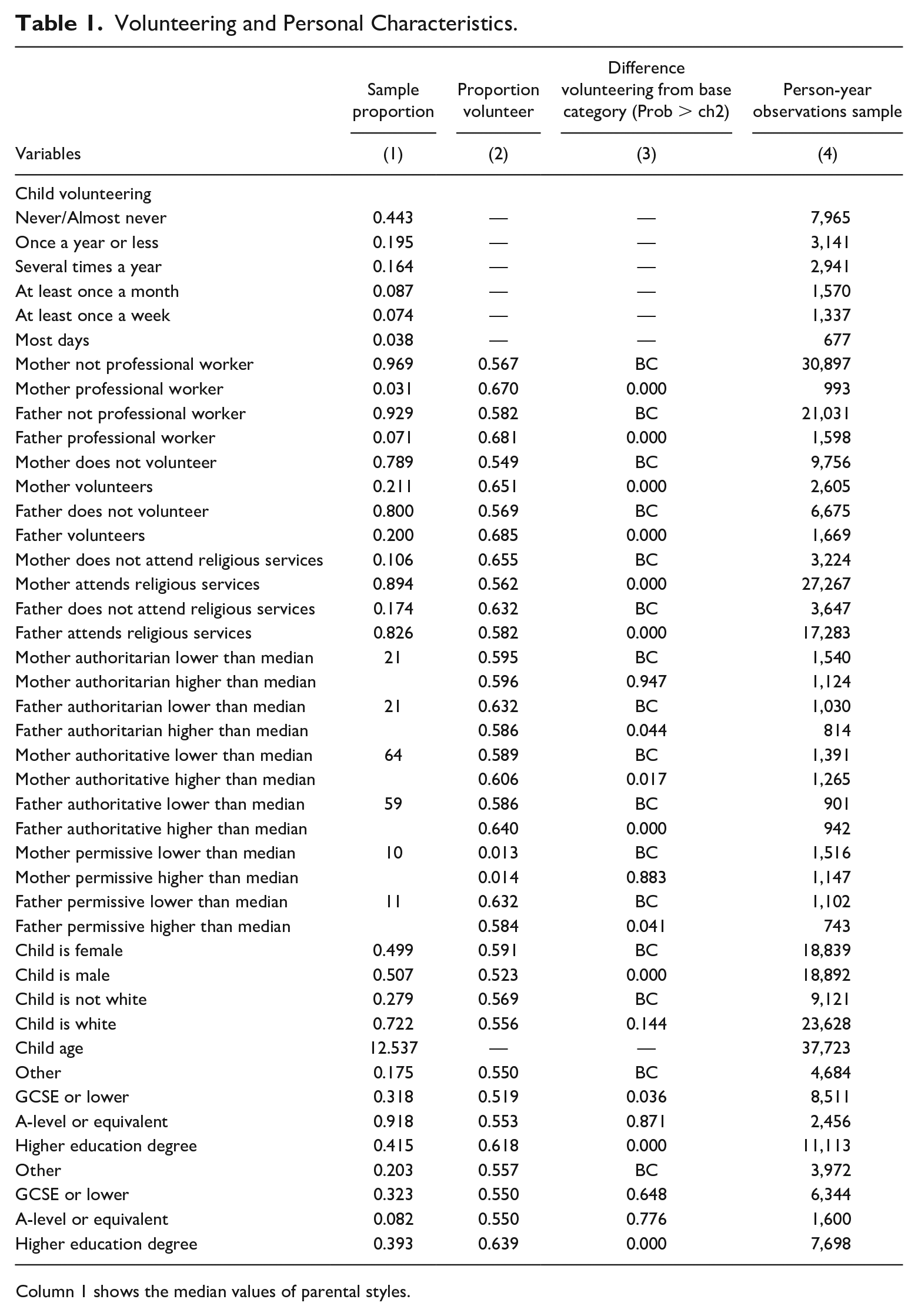
Column 1 shows the median values of parental styles.
Table 1 shows 55.7% of the early adolescents as having volunteered at some point in the past 12 months, but most of them infrequently. Among parents, 3.1% of mothers and 7.1% of fathers are professional, managerial, or technical workers. Column (2) shows that the offspring of higher occupational status workers volunteer significantly more than those from lower status homes, 10.3% more if the mother is a professional, managerial, or technical worker and 9.9% more if the father has a higher status job.
With regard to role modeling, 21.1% of mothers and 20.0% of fathers report volunteering in the past 12 months (at least sporadically or frequently). In both cases, children of parents who volunteer are significantly more likely to volunteer themselves, 10.2% more likely if the mother volunteers and 11.3% if the father volunteers. The same is true for children of parents who attend religious services, with most parents attending services at least once a year (excluding wedding, etc.), 89.4% for mothers and 82.6% for fathers. Surprisingly, children of parents who do not attend religious services are more likely to volunteer than the offspring of churchgoing parents. Girls volunteer on average more than boys, with a 6.8% difference between the two. Race does not affect whether a child volunteers. Children of highly educated parents are more likely to volunteer. Finally, parental styles influence child volunteering but only for fathers: Children have stronger probability of volunteering if the father scores higher on the authoritative scale and lower on the authoritarian and permissive scales, these differences are all statistically significant. This is not true for mothers; their parenting style is not correlated with their children’s volunteering.
Figure 1 shows the distribution of authoritarian parenting styles for mothers and fathers when children are volunteering and nonvolunteering. The distribution of authoritarian parenting is skewed to the left for both parents and both children volunteering status; however, it is far more skewed for parents of nonvolunteering children.
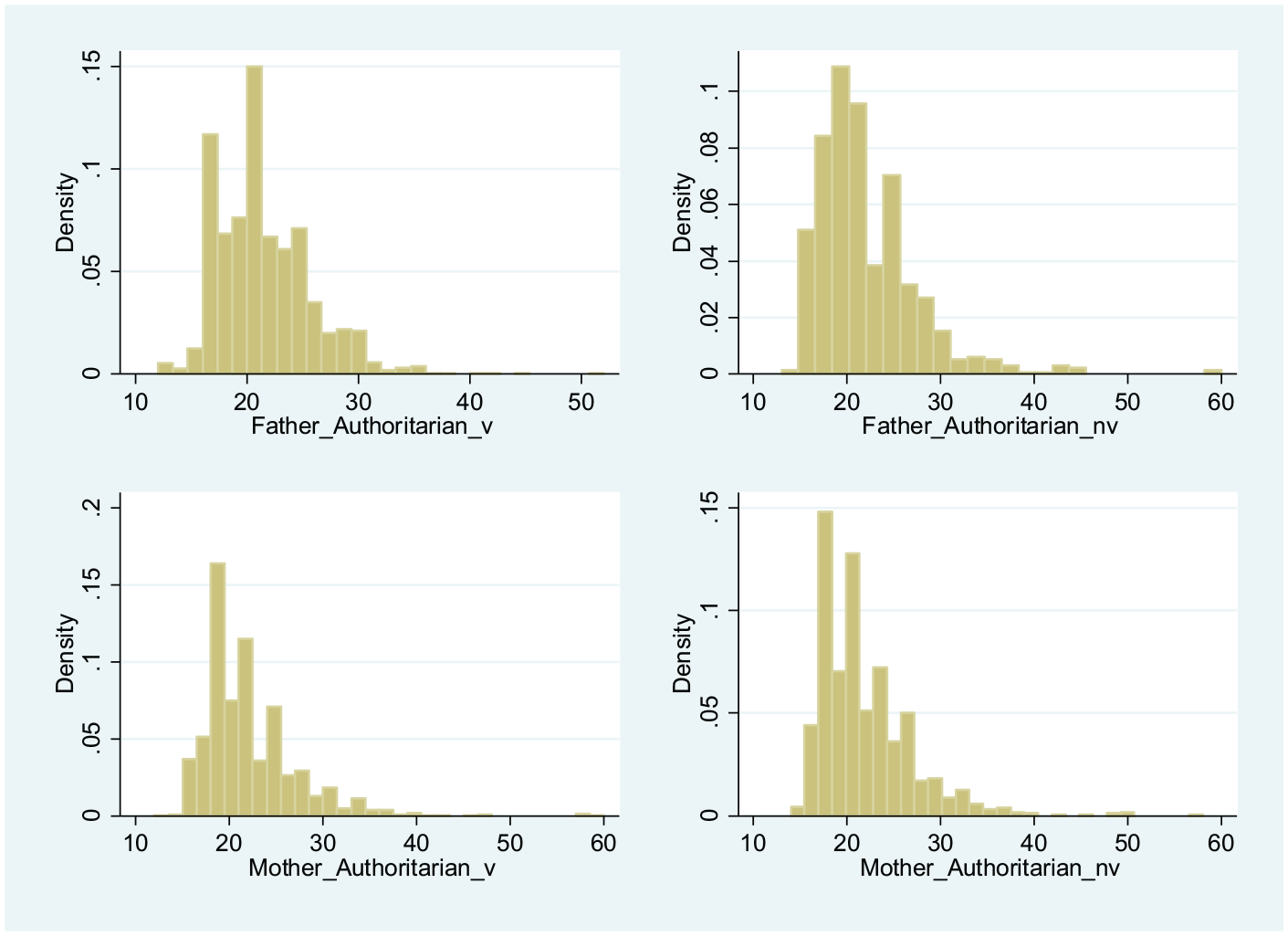
Parental Style—Authoritarian.
Figure 2 repeats the exercise for authoritative parents. Most parents score quite high on the authoritative scale. The distribution for both mothers and fathers of children who volunteer is skewed to the right, while it is more balanced for parents of children who do not volunteer.
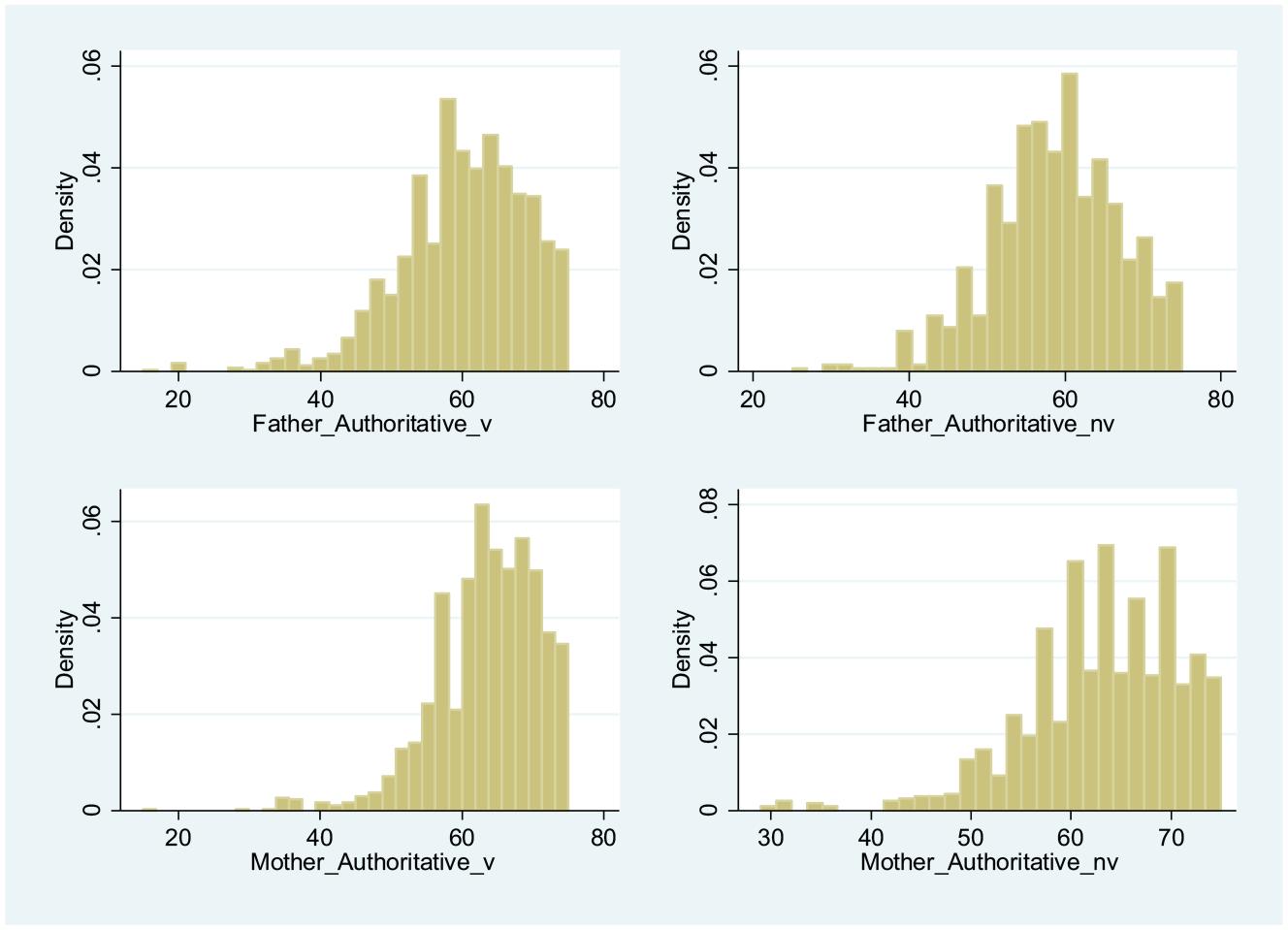
Parental Style—Authoritative.
Finally, Figure 3 shows the parental distribution for the permissive scale. All distributions are skewed to the left, and while there are some differences between parents of children who volunteer and those who do not, there is less evidence of a relationship than in the other two scales.
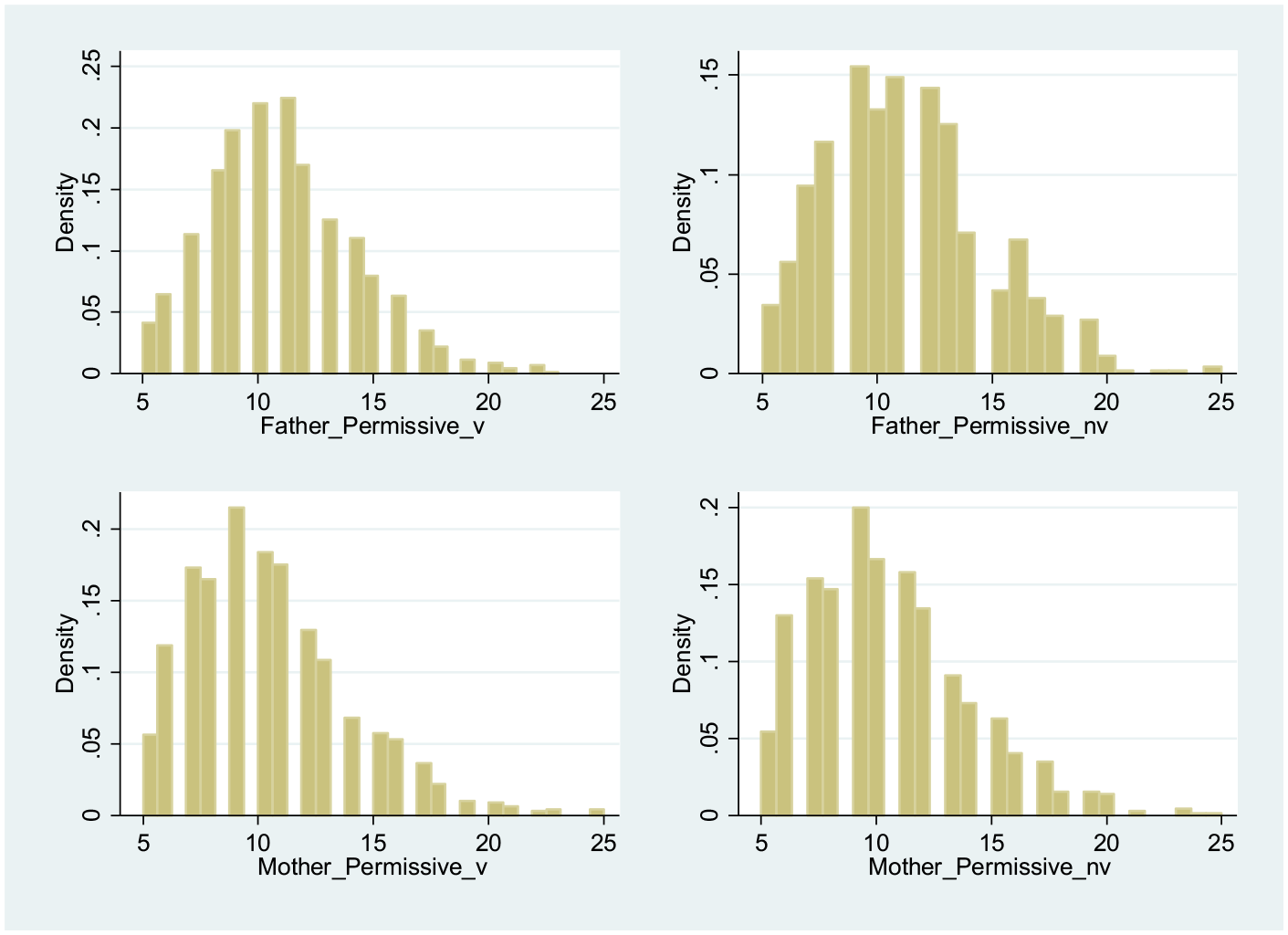
Parental Style—Permissive.
To analyze the association between parenting styles and early adolescent volunteering, we estimate a logit model in which the dependent variable is whether the child volunteers. The model is estimated for all two-parent households. 6 Results are presented in Table 2. Columns (1–5) show marginal effects of the logit regression model for the whole sample of children; Columns (6–7) show the results for boys; and Columns (8–9) show the results for girls. Regressions include year fixed effects, age of children, sex of children (Columns 1–5), dummy variables for mothers’ and fathers’ education and controls for parental religion, SC, and role modeling.
Logistic Regression.
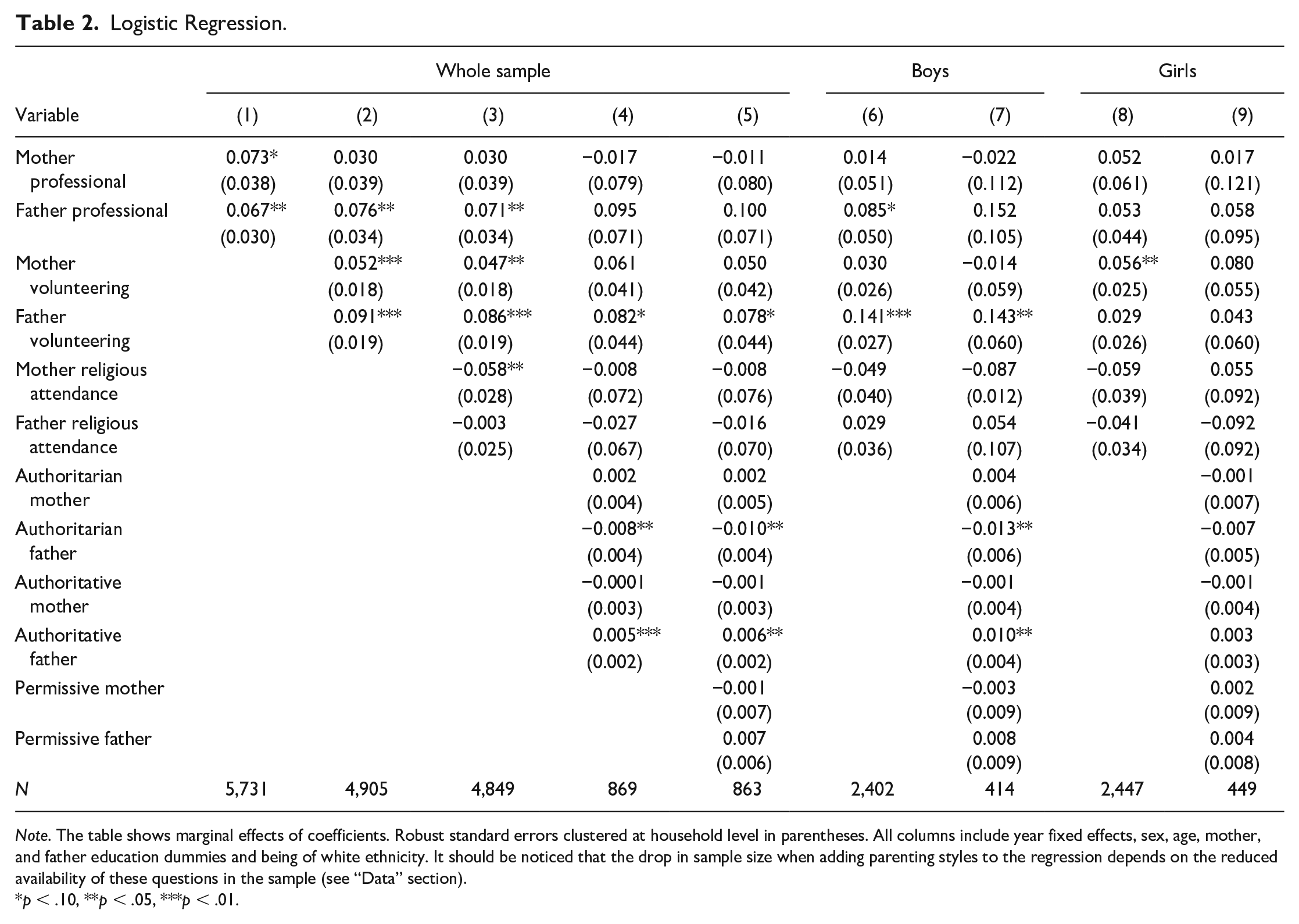
Note. The table shows marginal effects of coefficients. Robust standard errors clustered at household level in parentheses. All columns include year fixed effects, sex, age, mother, and father education dummies and being of white ethnicity. It should be noticed that the drop in sample size when adding parenting styles to the regression depends on the reduced availability of these questions in the sample (see “Data” section).
p < .10, **p < .05, ***p < .01.
Column (1) shows that mother and father being professional, managerial, or technical workers increase the probability of volunteering by their children by 7.3% and 6.6%, respectively, estimated at 10% and 5% levels. Column (2) introduces parental volunteering, showing statistically significance marginal effects of 5.2% (for mothers) and 9.1% (for fathers). The effect of mothers’ occupation is weaker. Column (3) adds parental church attendance, which has a negative significant effect on the child’s volunteering but for mothers only 8.6%. The effects of parents’ volunteering and father being a professional, managerial, or technical worker are similar to Column (2).
Column (4) adds parenting styles (authoritarian and authoritative). Coefficients and marginal effects are precisely estimated for fathers’ authoritarian scale (−0.8%) and authoritative scale (0.5%). In other words, a more authoritarian father decreases the probability of his child’s volunteering, while an authoritative father increases the probability. To put this into context, a change in the father’s authoritarian scale from the 25th to the 75th percentile would reduce the probability of his child volunteering by 4.8%, while the same change in the percentile in the authoritative scale would increase the probability of children volunteering by 6%. While these might be considered modest effects, it should be noted that parenting styles are correlated with other explanatory variables in the model, and the size of their marginal effects and significance is thus reduced.
Column (5) adds the parental permissive scale. It is not statistically significant. However, a joint F-test for fathers’ significance on the three scales shows a strong collinearity (p value of .005). Despite this collinearity, fathers’ volunteering, fathers’ authoritarian, and authoritative scales emerge as independent and significant predictors of the child’s volunteering. The marginal effect for the authoritative style is −0.01, and for authoritarian style, it is 0.005, equivalent to a 6% decrease for the first and a 6% increase for the second in the probability of volunteering moving from 25th to 75th percentile of the respective scales.
Columns (6 and 7) focus on boys. The reduction in sample size results in lower overall significance. However, the pattern is like that found in the whole sample. Father’s volunteering increases the chances of boys volunteering by 14.3%. His score on the authoritarian scale (−1.3%) indicates a decrease of 7.8% in the probability of boys volunteering when moving from 25th to 75th percentile, and his score on the authoritative scales (1.0%) indicates an increase of 12% in the probability of the boys volunteering when moving from 25th to 75th percentile. Again, there is collinearity between the three parenting styles for fathers, with a joint significance p value of .012.
On the contrary, girls seem to be less affected in their volunteering by parental behavior, except for mothers’ volunteering in Column (8). Even this effect disappears when parental style scales are added to the regressions.
In conclusion, it seems that fathers have a stronger effect on their children’s likelihood of volunteering than mothers, both in terms of their parenting styles and in terms of being role models, and that while these gendered effects are present in the whole sample, they are stronger for boys than girls. The effects shown in the study of the whole sample are mainly due to the father–son relation. However, there is collinearity between parents for both parenting styles and being role models, with fathers and mothers volunteering being jointly significant at least at 5% in all specifications (except for Column (9)). The same is true for the joint significance for parents reporting an authoritative style. This suggests that, although fathers have a stronger impact on children’ volunteering, and in particular on boys’ volunteering, mothers still have a non-negligible role in defining children’s volunteering behavior.
Discussion
This study contributes to the current literature on volunteering among early adolescents by focusing on their relationship with their parents. A better understanding of the factors that encourage volunteering in the early stages of life is valuable not only because of the positive effect of volunteering on youth development and maturation but also because youth volunteering is a strong predictor of adult volunteering. Our results are mostly in line with previous research, even though the literature has mostly focused on general prosocial behavior (see Wong et al., 2020), while we single out significant volunteering. The study finds that the influence of parenting styles is moderated by gender. Mothers’ parenting styles have no statistically significant influence on either daughters or sons. Fathers, however, do influence their son’s volunteering, partly through their role modeling and partly through their authoritarian (negative) and authoritative (positive) styles. This is somewhat in contrast with previous literature finding that mothers’ style matters more (Eisenberg, 2015), but this could be due to the specific versus general measure used in our study. On the contrary, Carlo et al. (2011) find that fathers’ authoritarian style is more strongly associated with a decrease in children’s prosocial behavior, compared with mothers. Although gender-restricted, the parenting style effects are in the expected direction: Authoritative parenting encourages altruistic behavior in boys, and authoritarian parenting discourages it (see Kuppens & Ceulemans, 2019; McGinley et al., 2010; Ottoni-Wilhelm et al., 2014).
Authoritative fathers foster perspective taking and empathy while authoritarian fathers cultivate a lack of concern for others. The insignificance of the permissive parenting is in line with previous research on this topic where the usefulness of the permissive scale had been often questioned, and later, research has divided the scale into two subscales (Crandall et al., 2016).
The pattern of gender moderation is interesting. The theory guiding the study is that same-sex parent–child dyads display more consistency than cross-sex dyads. In this case, boys will be more receptive to the styles of their fathers, girls to the styles of their mothers. The results generally support this theory. This is probably because boys identify with and are closer to their fathers than their mothers (Raley & Bianchi, 2006). But it could also have something to do with the fact that the prosocial behavior in question is volunteer work, an organized and more “public” form of being involved in the wider community. It is generally agreed that girls are expected to show more prosocial predispositions than boys, particularly when it comes to the more private, intimate kinds of helping rather than the more formal, organized, and public type that would include volunteering (Cano & Hofmeister, 2023; Carlo & Randall, 2002). The gender differences in the effect of parenting styles might, therefore, have something to do with the type of prosocial behavior in question, with girls being steered toward private and boys toward public helping. This by itself, however, would not explain why the gender of the parent is significant.
While it is striking that parenting style in the case of the father–son dyad is significant even with controls in the model, the effect is quite weak. It leaves much unexplained. Partly, this is attributable to the covariance of styles with the other parental characteristics, but it is also likely due to the fact that the prosocial behavior in question is public and formal. Often early adolescents will need a facilitator or sponsor to help them volunteer. In many cases, this will be the parent, but there are other adult facilitators, including church members, school teachers, and officials in youth clubs. There are also friends and acquaintances in peer groups. These groups can help “normalize” volunteer work for young people (Henney & Hackett, 2019, p. 67). Peer group pressure is in evidence when adolescents who volunteer are more likely to have friends who think it is important to be involved in community and volunteer work (Eisenberg et al., 2006, p. 680). A 2010 U.K. survey found that 67% of adolescents aged 11 to 16 would volunteer whether they could do it with their friends (Birdwell et al., 2013, p. 35). A 1995 survey of 12 to 17 in the United States found that half had been asked to volunteer and mostly by friends, followed by school teachers, and family members (Sundeen & Raskoff, 2000). About a third of 10th grade students in a study of U.S. schools were engaged in community service through their schools, and even more (57%) of the 12th graders were thus engaged (Cheng & Sikkink, 2020). All these factors might help account for the somewhat weak influence of parenting styles on volunteering among early adolescents.
Finally, it should be noted that a different approach could have been to analyze both genders adding interaction terms between explanatory variables and sex of the children. Rather than statistically significant differences, we find that there is a difference in significance. Moreover, we decided to distinguish the sample between the sexes because interacting the explanatory variables with sex has two disadvantages that make it unsuitable in this setting: First, it assumes that any noninteracted variable has the same effect on boys and girls, which might not be the case. Second, for a study like this, in which there is a multitude of explanatory variables, adding interacted variables saturates the model, thus making identification less clear.
Limitations
The UKHLS is a rare panel study in that it includes a recognized scale on parenting styles together with information on volunteering among early adolescents. However, it uses the older, abbreviated, three-style scales, and the permissive parenting scale is highly suspect. Second, although parenting style research emphasizes the importance of inductive forms of discipline (as measured in the authoritative scale), the UKHLS does not provide information on whether children learn vicariously from their parents’ role modeling much better if the parents explain what they are doing and why they are doing it. Third, the effect of styles might be conditional on the structure of the household. For example, authoritative parenting is more common in two-parent families (Chan & Koo, 2011). Fourth, parenting styles as conceptualized in this study are not the only way parents’ practices can affect child volunteering. There is a link between parental support and prosocial behavior. Supportive behaviors overlap with parenting styles, although the research on this topic presents “a somewhat complicated picture” (Padilla-Walker, 2014). In a Welsh survey of nearly 1,000 early adolescents aged 13 to 14, just over half of the volunteers (53.2%) said their parents had encouraged their involvement. The youth were asked how much they had in common with, admired, or had learned from their parents. Positive responses, especially in relation to the mother, were linked to volunteer status (Muddiman et al., 2019). Fifth, given the highly desirable nature of prosocial behavior, there is the question of social desirability bias in the self-reports of early adolescents inflating the rates of volunteering reported (Mallah, 2019). Sixth, the UKHLS does not contain an item on parental socialization of volunteering, and parental religion was used as a proxy measure. While this is backed by existing literature, future research should focus more on the interaction of parenting styles and the parents’ socialization skills. Seventh, the study is cross-sectional and cannot consider the possibility that the volunteer work of the child influences parenting styles. Eighth, while the UKHLS sample size does not allow for it, it would be important for future research to distinguish between different groups on the basis of ethnicities, religious affiliation, age of parents, single parents, same-sex couples, and a more granular grid of socio-economic groups. Ninth, as a measure of socialization, we are only able to use religious attendance of parents. While this is backed by existing literature, future research should focus more on the interaction of parenting styles and their socialization skills. Finally, given the age of the subjects of this study, it is impossible to determine exactly how “voluntary” their volunteer work is and how much it might resemble household chores enforced by parents. This is, of course, a problem with virtually all studies of volunteer work, which is often defined as being “non-obligatory” without taking into account norms of obligation such as those that impel members of voluntary organizations to “take their turn” at doing good.
Conclusion
Male children of authoritative fathers are more likely to volunteer, and male children of authoritarian fathers are less likely to volunteer. In addition, fathers model volunteering for their male children but results are not statistically significant for their female children. These patterns exist independent of the SC and religiosity of parents. The body of research on parenting styles and their effects on children’s prosocial behavior thus finds some support from the data gathered in a large, nationally representative panel study where both the parents and children are identified by gender. This should encourage more investigation of the role of parenting styles in promoting volunteering since early involvement in volunteer activities tends to have long-term effects. Special focus should be on how the various predictors of child volunteering interact with each other and what the mechanisms are that account for the effect of each predictor. How and why the effect of styles might vary by gender of parent and child should also be investigated and more information on the nature of the volunteer work both parents and children would desire, to device policies that can support parents and children into becoming active volunteers.
Footnotes
Appendix
Data used in this article are freely available upon registration from “Understanding Society—The U.K. Household Longitudinal Study” at https://www.understandingsociety.ac.uk/
Declaration of Conflicting Interests
The author(s) declared no potential conflicts of interest with respect to the research, authorship, and/or publication of this article.
Funding
The author(s) received no financial support for the research, authorship, and/or publication of this article.
