




Abstract
Nonprofits are increasingly involved in collaborative governance mechanisms, on the premise that their proximity to end users and better understanding of the local contexts can lead to better policy outcomes. Although government–nonprofit relations have been theorized and explored by several studies, few studies have examined specifically collaborative governance, instead focusing on other phases of policy development or service delivery. In this article, we present a realist evaluation of data gathered from in-depth semi-structured interviews (N = 41) and four focus groups with stakeholders involved in collaborative governance arrangements within “Strategic Public Social Partnerships” in Scotland. Our findings indicate that collaborative governance processes involving nonprofits can potentially lead to improved services through mechanisms such as the development of trust and the establishment of new learning dynamics, and when knowledgeable leadership and mutuality drive collaborations. However, this is only true if the long-term sustainability of these processes translates into the mainstreaming of both the resulting services and their underlying collaborative principles.
Introduction
Over the last 30 years or so, increasing attention has been paid to collaborative governance arrangements involving public services (Johnston & Brandsen, 2017), with a focus on the involvement of multiple stakeholders coming together to engage in consensus-oriented decision-making (Ansell & Gash, 2008). Collaborative governance is “a strategy used in planning, regulation, policy making, and public management to coordinate, adjudicate, and integrate the goals and interests of multiple stakeholders” (Ansell, 2012, p. 1). Nonprofits are often engaged within collaborative governance arrangements as they are assumed to represent the interests of citizens and ensure a plurality of voices (Andrews & Entwistle, 2010). However, we know relatively little about how the context and processes involved in collaborative governance arrangements influence outcomes (Cornforth et al., 2015; Gazley & Guo, 2015; Mosley & Park, 2022; Voorberg et al., 2015). While the literature has developed an understanding of how collaborative governance processes emerge, how they operate, and whether they are producing their intended effects (see, for example, Andrews & Entwistle, 2010), less is known about the involvement of nonprofits in these processes (Cheng, 2019; Cornforth et al., 2015) and what works, for whom, and in what circumstances (viz. Pawson & Tilley, 1997). There is thus a place for rigorous methodologies to be employed that could be helpful to evidence how and why the outcomes of collaborative governance involving nonprofits organizations are achieved (Cheng, 2019; Sørensen & Torfing, 2021) and thus what needs to be in place to successfully involve nonprofits in collaborative governance arrangements (Bianchi et al., 2021). The overarching question guiding our study is, therefore, “How do collaborative governance arrangements involving nonprofits work, for whom, and in what contexts?”
By employing a “realist evaluation” approach explicitly designed to relate context and processes to outcomes (Pawson & Tilley, 1997), we analyze the “Strategic Public Social Partnership” model in Scotland to explore whether and how the involvement of nonprofits in collaborative governance processes affects processes and outcomes. Underpinned by a realist ontology (Archer, 1995), realist evaluation conceptualizes programs as adding components to the complex array of relationships that make up the social world (Porter & O’Halloran, 2012). By connecting processes to outcomes via the appreciation of the context in which the processes take place, realist evaluation exploits empirical data to explain which components of a program can change the way the social world is patterned, how and why (Blackwood et al., 2010; Pawson & Manzano-Santaella, 2012). Realist evaluation is method-neutral because it appreciates that programs are examples of society at work and that they are complex, adaptive, and in need of context-coherent ways to be evaluated (Wong et al., 2016). The lessons learned through our research provide insights into how involving nonprofits in collaborative governance processes can potentially improve services. In particular, we found that several mechanisms such as the development of trust and the establishment of new learning dynamics, alongside leadership and mutuality, can lead to the development of better services. However, this is only true if the long-term sustainability of these processes translates into the mainstreaming of both the resulting services and their underlying collaborative principles.
Our article is structured as follows: First, we discuss the concept of collaborative governance concerning collaboration between public sectors and nonprofits in service design and commissioning. We explain why realist evaluation is an appropriate logic of enquiry to explore the dynamics behind collaborative governance processes and the specific methods employed. We then provide an overview of the policy context of the study. Next, we present our findings using the realist evaluation “Context-Mechanism-Outcome” (CMO) configurations. Combining these CMOs in model form allows us to better connect processes of collaborative governance to outcomes, and to better understand the circumstances under which involvement of nonprofits can potentially lead to better outcomes. We conclude by discussing the implications of our results for policy and practice.
Nonprofits and Collaborative Governance Arrangements
The notion of collaborative governance of public services involving nonprofit and public-sector actors has come to policy and academic attention over the last few decades (Ansell & Gash, 2008; Boyer et al., 2016; Cheng, 2019; Emerson et al., 2012; Maiolini et al., 2022; Mosley & Wong, 2021). It has emerged as a response to some of the failures of New Public Management, amid an increasing need for specialized knowledge to address the complex challenges we face in the 21st century (Cheng, 2019; Emerson & Nabatchi, 2015). Collaborative governance stresses the importance of including a wide-ranging network of stakeholders in public management and arrangements that facilitate and encourage partnership and co-operation between the public sector, businesses, and nonprofits to further public policy agendas (Osborne, 2006). The role of the nonprofit sector has then steadily shifted from being mainly a service provider to becoming a partner not only in service delivery (Brown et al., 2008) but also in policy formulation (Ansell & Gash, 2008; Bryson et al., 2006; Cornforth et al., 2015), developing a more collaborative and pluralistic welfare system (Buckingham, 2009). Although government–nonprofit relations have been theorized and explored by several studies (see, for example, Brinkerhoff, 2002; De Corte & Verschuere, 2014; McLaughlin & Osborne, 2003; Najam, 2000; Toepler et al., 2022; Young, 2000), scattered studies have examined the relation between government–nonprofit organizations specifically in the form of collaborative governance, instead focusing on other phases of policy development or service delivery (see, for example, Andrews & Entwistle, 2010; Gazley & Guo, 2015; Mazzei et al., 2020; Peng et al., 2020).
In studies that have focused specifically on collaborative governance processes, two broad theoretical justifications are highlighted in the literature for involving nonprofits. First of all, nonprofits are assumed to be closer to the end users of services (Mazzei et al., 2020). They are considered to have a deeper and more sensitive relationship with service users than other providers (Elstub & Poole, 2014). Hence, including nonprofits in governance potentially enhances, facilitates, and promotes greater citizen participation in how services are designed, managed, and delivered (Pestoff, 2012). This, in turn, is assumed to lead to more equitable outcomes for end users. For example, Andrews and Entwistle (2010) explain, For public sector organizations seeking to enhance the fairness of service delivery decisions, partnership with the nonprofit sector is therefore thought to lead toward more equitable public service outcomes . . . [they] do not just represent the views of their own organizations; they offer a way of connecting to, and learning from, different voices within civil society. (p. 684)
Second, pooling resources through mutual interdependence has been identified as useful for improving the quality of services and producing synergistic effects that each sector (whether nonprofit or public sector) would not achieve alone (Johnston & Brandsen, 2017). Nonprofits become involved in collaborative governance to address complex socioeconomic problems, which cannot be tackled by public-sector or nonprofit organizations acting independently (Sowa, 2009). A sharing of both hard (financial and material) and soft (managerial, technical, information, credibility) resources—many of which are intangible, such as the connection to service users, a granular understanding of the terrain in which the nonprofit operates and a greater capacity to avoid fragmented approaches—is at the base of collaborative governance between the public and nonprofit sectors (Sowa, 2009). Public organizations tend to have more stable financial resources, professional knowledge, and democratic public priority setting processes, whereas nonprofits can contribute with flexible expertise, service expertise, and community knowledge (Peng et al., 2020). The sharing of these resources potentially leads to service improvements (Gazley & Guo, 2015; Johnston & Brandsen, 2017; Sowa, 2009). At the core of this process, there is a “mutuality” dynamic that implies a degree of interdependence, integration, and equality in decision-making (Brinkerhoff, 2002).
While the first premise (that nonprofits are closer to the end users of services) has been explored empirically (see, for example, Andrews & Entwistle, 2010; Cheng et al., 2020; Mazzei et al., 2020) with often inconclusive results, the latter premise (that pooling resources across sectors leading to improved outcomes) remains mostly assumed. Thus, a more grounded understanding of how the involvement of nonprofits affects the processes and outcomes of collaborative governance is required (Fyall, 2017; Mosley, 2012; Mosley & Park, 2022; Mosley & Wong, 2021). Although several studies have focused on the advantages and risks of collaborative governance—especially on what favors or hinders the processes involved (see for example Choi & Robertson, 2014, 2019; Scott, 2015)—work that focuses on how contextual elements influence processes and outcomes is still relatively scarce (Bryson et al., 2015; Mosley & Park, 2022), and results are often unclear or ambiguous (Cheng et al., 2020; Gazley & Guo, 2015; Jakobsen, 2013; Voorberg et al., 2015). In most of the literature that focuses on collaborative governance processes from a public administration perspective, it is generally not possible to unpack and isolate the effects of involving nonprofits (Cheng, 2019) that are often included in a more general category of “private sector.” For example, Emerson et al. (2012) developed an integrative theoretical framework designed to unpack the drivers and mechanisms of collaborative governance processes, “aiming at exploring what factors lead to collaboration and how the components work together to produce desired state” (p. 2). Although they do not focus specifically on whether and how the collaboration works (differently) when nonprofits are involved, they concentrate upon drivers (such as leadership, consequential incentives, interdependence, and uncertainty), collaborative dynamics (principled engagement, capacity for joint action, and shared motivation), and their interaction when the private sector is involved.
Method
Collaborative governance processes can be understood as complex interventions that “impact on evolving networks of person-time-place interaction, changing relationships, displacing existing activities and redistributing and transforming resources” (Hawe et al., 2009, p. 267). Bryson et al. (2015) suggested that research should engage with understanding the effects of processes, structure, and contingencies on outcomes, thus seeking to uncover causal mechanisms in complex structures such as collaborative governance processes. Nonprofit organizations add new contextual ingredients (such as the aforementioned hard and soft resources) to the collaborative governance processes, which can ultimately affect the sustainability and quality of public services.
To unpack the role of nonprofits in collaborative governance processes and evidence what changes they bring and how these ultimately affect service outcomes, we grounded our study in a realist ontology (Archer, 1995). Realism represents a promising scientific paradigm to understand the complexity of social interventions (Fletcher et al., 2016). Emerging as a response to the perceived limitations of both positivism and interpretivism (Blackwood et al., 2010; Creswell & Clark, 2010), which are respectively concerned with describing linear relationships between variables and individualized experiences of reality, realism is interested in “deeper” explanations of social facts (Pawson, 2006). According to realism, reality is objective and independent from human knowledge but can be evidenced through observable patterns of events or outcomes that materialize only when social ingredients combine under the right contextual circumstances (Sayer, 2000). These circumstances are, in realist terms, responsible for the activation of the so-called generative mechanisms that explain why such outcome patterns occur (Archer, 2013; Bhaskar, 1975). In broad sociological terms, outcome patterns occur when the interplay between structure and agency experiences new social ingredients that can modify (or reproduce) the equilibrium between the two (Archer, 1995).
Realism remains, however, “a philosophy for and not about science” and, thus, it “does not engage with methodological matters much” (Alvesson & Sköldberg, 2017, p. 53). We, therefore, operationalized our ontological realism through realist evaluation (Pawson & Tilley, 1997). Realist evaluation is a relatively recent but widely accepted empirical approach to the investigation of interventions (Pawson, 2016; Porter & O’Halloran, 2012). In line with ontological realism, realist evaluation acknowledges that interventions are an example of social processes at work, and therefore they can be subject to an overabundance of explanatory possibilities because they are complex and behave as adaptive systems (Pawson, 2013). For realist evaluation, interventions will never behave the same way even when they have the same format or are part of the same family of interventions because their components will combine differently depending on the contextual circumstances under which they operate (Pawson, 2006).
The duty of realist evaluation is, therefore, to unravel the complex relationships between the “ingredients” of interventions and the social fabric in which they operate (Pawson & Manzano-Santaella, 2012). Empirically, this is done by exploiting theory-informed evidence to establish context, mechanism, and outcome configurations (CMOs) that account for what works in interventions (outcomes), why and how interventions work (mechanisms), and for whom and under what circumstances (context). Realist evaluation employs these configurations to advance a set of “program theories.” These are explanatory statements that are transportable from one context to another and can be subject to further conceptual refinement through new data collection and emerging theory (Van Belle & Mayhew, 2016).
In sum, realist evaluation allows an exploration of the “black box” approach that can characterize certain programs (Salter & Kothari, 2014), especially those that remain undertheorized about specific crucial ingredients and processes. Although realist evaluation has rarely been employed in public administration research (see Mele & Belardinelli, 2019), its use seems promising for the challenges that public management and nonprofit scholarship have recently discussed concerning the evaluation of collaborative governance arrangements as a complex form of intervention (Bryson et al., 2015; Sørensen & Torfing, 2021).
Data Collection
Over the last decade or so in Scotland, which is the setting for our empirical study, specific programs have been created to stimulate closer working between nonprofit organizations and public sector to develop the capacity within both sectors to qualitatively improve public services and redesign commissioning processes (Mazzei et al., 2020). Among several collaborative governance experiments, from 2006 onward 13 pilot projects were established as a “partnering arrangement which involves [nonprofits] earlier and more deeply in the design and commissioning of public services” (Scottish Government, 2011, p. 4). These were called Public Social Partnerships (PSPs) and were established based on “user-focused and sustainable service design” and using “nonprofits insight” to break down traditional service delivery silos and encourage service-user involvement in the strategic policy arena (Scottish Government, 2011, p. 5). Following these pilots, in 2012, the Scottish Government supported the development of six “Strategic” Public Social Partnerships (SPSPs) to strengthen public–nonprofit partnership work, service-user involvement, and innovation in public service delivery, in three key areas that the government considered to be especially important as demonstrator “testbeds” for the model: early years, criminal justice, and care for older people.
The Strategic PSPs (hereafter SPSPs) involved in the study are described in Table 1. Each commenced at different points in time and involved different governance arrangements, involving various nonprofits. While most of the partnerships have been led by a manager involved in the sector that initiated the process (mostly the public sector), SPSP 6 has been initiated by the public sector, but based upon the decision of the organizations involved in the partnership, a manager of one of the nonprofit organizations was appointed as leader of the process. Furthermore, a different rationale has been used as the basis for their development in each case: For example, some of them have been established to design new services, while others to rethink existing services and to increase the voice of service users in public services. In addition to that, at the time of the interviews, some of the partnerships had finished the formal part of their Strategic PSP project and they were exploring how to mainstream some of the services. However, there was no commitment, except in one of the SPSPs, to commission or mainstreamed the redesigned services in their current format. One of the partnerships was in the phase of testing pilot services to understand how to offer a better and integrated service.
Strategic Public Social Partnerships.
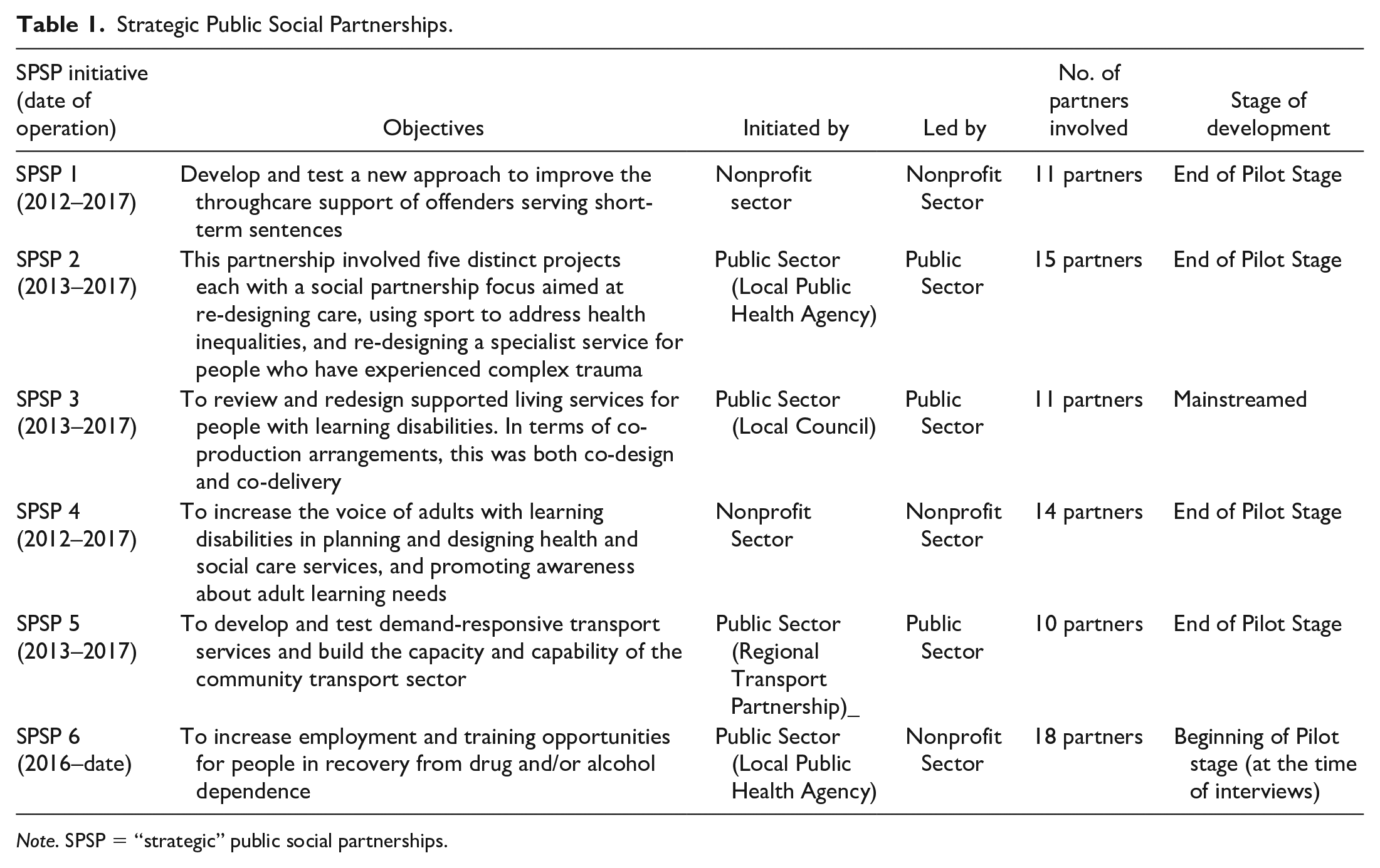
Note. SPSP = “strategic” public social partnerships.
Due to the novelty of applying realist evaluation to collaborative governance processes and the importance to understand the ingredients related to nonprofit sector inclusion, we decided to adopt a qualitative study based on focus groups and interviews. Across the SPSPs, we undertook 41 in-depth semi-structured interviews with public-sector representatives (n = 12), nonprofit sector representatives (n = 14), service users (n = 2), Scottish government officials (n = 4), consultants (n = 7), and grant funders (n = 2). In addition, we carried out four focus groups with key stakeholders and actors involved in the SPSPs (one focus group involving 20 public and nonprofit representatives, two focus groups involving eight nonprofit representatives each, and one focus group involving eight service users). The interview/focus group topic guide consisted of 15 questions and was divided into three main domains of inquiry:
the generative mechanisms (collaborative dynamics of the logic model) behind the co-production processes,
the individual and community contextual circumstances/variables (drivers of the logic models) affecting the outcomes, and
the outcome patterns.
We sampled our respondents following the recommendations for realist interviewing techniques (Manzano, 2016), adopting different recruitment strategies to engage with a broad range of stakeholders able to inform our CMO configurations from different perspectives and knowledge bases. A comprehensive approach to sampling based on stakeholder participation was undertaken. First, the lead partners of the collaborations were recruited through our contacts in the Scottish Government. Second, we contacted most of the stakeholders involved in the partnerships and we asked for their availability for interviews. Finally, we organized with the support of four of the leaders of the SPSPs, four focus groups that included several, if not all, organizations and/or beneficiaries involved. Approximately the same number of participants, representing different organizations, were interviewed for each SPSP. However, the eight service users of the focus group were all belonging to the same SPSP. The Scottish government officials, consultants, and grant funders provided information about all SPSPs involved. Data were collected in 2017–2018. The interviews ranged from 45 min to 1 hr and a half for an approximate total of 41 hr of recording. Focus groups lasted between 1 and 1½ hr, for a total of approximately 4 hr of recording.
Data Analysis
Interviews and focus groups were recorded and transcribed “intelligent verbatim” 1 . After ensuring that the transcripts were an accurate record of each interview, the data were imported into the computer-assisted qualitative data analysis software QSR NVivo to assist with two cycles of analysis. More precisely, interviews and focus groups were initially coded by the lead author separately in terms of statements related to contexts, mechanisms, and outcomes, following a typical thematic analysis process (Braun & Clarke, 2006; Saldaña, 2015) whereby different key themes or “groupings” of CMO configurations were identified. In the second round of coding, we employed “linked coding” (Jackson & Kolla, 2012) to establish how contexts triggered mechanisms which led to specific outcomes. Codes were initially developed collaboratively by Authors 1 and 5 and subsequently refined during discussions with the wider team. In line with the ethical approval obtained from our University’s Ethics Committee, all of the participants’ quotes have been anonymized. Our emerging findings were also discussed with all stakeholders interviewed in a knowledge exchange event, to support the validity of our results.
Findings
Our findings are presented in a series of six “CMO configurations,” in accordance with the guidelines for presenting realist evaluations (Wong et al., 2017). CMOs 1 to 5 explore the mechanisms developed during the collaborative governance processes, whereas CMO 6 identifies the long-term sustainability of the model and outcomes achieved.
Context: A dedicated and resourced person to drive the partnership was identified as a crucial feature of all the partnerships. This was exemplified by the experience of SPSP 6, in which a manager was appointed by the partnership (recently at the time of our research) to enable the process to progress at an operational level. The manager had the role of overviewing the different work streams of activities, including coordinating information sharing, aligning different projects, and reporting to their strategic committee. Strong and motivated leadership was identified as a key contextual characteristic for ensuring that the collaborative governance worked:
In SPSPs 3 and 5, the lead coordinators, both from public-sector organizations, had previous employment experience within the nonprofit sector before moving to public-sector appointments. The insight and experience gained by working in nonprofits in the past were recognized as a key factor in helping them to appreciate the challenges involved in making the collaboration work: I think it needed to be a person who understood nonprofits. . . I think if it had been someone that didn’t really know the background of community organizations it wouldn’t have worked out, even though they were a dedicated person. [Nonprofit Representative—SPSP 5]
Mechanism: The presence of a leader with knowledge of or involvement in nonprofits helped build trust among different partners and, thus, decrease the sense of competition that often characterizes the relationships among nonprofits and between nonprofit and public sector:
When you have the right people both at a management and leadership level, and also at delivery level, that just makes things work. It is actually people that make things work, not models or policies. It is people and their practice that make things work. [Consultant] The PSP does not just affect our relationship with providers, but the relationships that various providers have with each other. So they’ll now work together to do a piece of work in some cases, whereas before it was always like competing. If a piece of work came out before, you would have everybody putting a bid in for it. Now what you tend to get is providers will say “that’s not for us. [Public-Sector Representative—SPSP3]
Outcome: An increase in trust between partners enabled the development of mutuality, and this improved the dynamics between public-sector commissioners and nonprofit providers. This was discussed in a focus group with nonprofit representatives:
[Nonprofit Representative A]: I think there was a mindset change though with regard to the local authority because prior to the PSP when you came to the old providers’ meetings it was very much a – [Nonprofit Representative B]: Dictated. [Nonprofit Representative A]—dictated to by the council, this is what you will do and don’t rock the boat. Whereas with the PSP there seemed to be a change of mindset and it was more of a partnership, wouldn’t you agree? [Nonprofit Representative B]: Yeah, I’d absolutely agree that the word partnership, you know, is there in the title and I think it’s been played out in reality as well. [Nonprofit Representative—SPSP 3]
Changes in the ways of working among nonprofits were also noted, whereby a collaborative setting was established where the strengths and weaknesses of different providers were both accepted and shared. In SPSP 3, for example, increasing collaboration and synergies among nonprofits was identified, particularly for the preparation and submission of bids for funding.
Context: In instances where leadership was too centralized, particularly where leadership was exercised by civil servants within the public authority with a contract commissioning style, trust was difficult to establish. In SPSP 2, for example, where one specific person was the only one identified as being in charge of the partnership, the contribution of other organizations was inhibited, triggering unequal power arrangements within the partnership:
There was a feeling of one person being the boss and the other person . . . there was quite a few times when the project manager said, “Oh well, I’ll ask the PSP coordinator if that’s okay.” And we said, “Well, I don’t know, no I don’t think it is her/his decision, it’s the group’s decision.” [Nonprofit Representative—SPSP 2]
Mechanism: Overly centralized public authority–driven leadership generated feelings of unequal power distribution and weakened the sense of trust among partners, raising doubts about whether the partnership was, in fact, collaborative at all. In SPSP 6, there was evidence of this; the representative of the public authority involved in the SPSPs was perceived as acting as a commissioner of services (budget holder of the SPSPs), identifying the nonprofit involved as mainly potential delivery agents. Representatives of the public authority were perceived by other public-sector organizations as potentially not understanding the model as something different from a commissioning process:
Until we got our project team on board, we were obviously relying on being led by the public sector who potentially were the commissioners. And they did a fantastic job, but they may not have had a full and ready understanding of what the Scottish Government aspirations were—the PSP mythology. [Public-Sector Representative—SPSP 6]
Outcome: In several cases, the collaborative setting and mutuality were perceived as rhetoric. The cross-sectoral collaboration was seen as a struggle, and more nominal than factual or effective:
At the moment the public sector is paying all of the money and they commission [the services]. I think their role will be less so when actually the PSP gets [its act] together. At the moment they are always 100% in control. [Nonprofit Representative—SPSP 6]
Context: An external actor, able to draw upon expertise in both public-sector and nonprofit environments, was instrumental in supporting each cross-sector collaboration at every stage of their development. This organization, which did not have a stake in any of the partnerships, was tasked by the Scottish Government to undertake an independent brokerage and facilitator role. Their involvement was recognized as crucially important, with advice provided on such diverse areas as how best to proceed with a project plan, or providing support to enable the partnership to access further public or private funding opportunities:
[They] have been great in terms of, say from original set up, from pulling together the framing of it, from keeping us on task sometimes. To be honest with you, in terms of the last three years trying to get the funding to keep the thing going, if it hadn’t been for [them], I wouldn’t have been able to do it because I’m not as connected, particularly within the Nonprofit Sector. [Nonprofit Representative—SPSP 1]
Mechanism: The experience and knowledge of the external actor about partnership and procurement processes were recognized as being useful in addressing questions and assuaging doubts. They worked to provide information and reassurance, and this helped increasing the confidence of the partners, and—in all the SPSPs—the trust between the nonprofit-sector and public-sector partners:
I think having that kind of people with experience, people who could come in and speak with the nonprofit sector when they were asking difficult questions about procurement, that I have no idea about because I’ve never procured services in my life! That was really helpful. [Nonprofit Representative—SPSP 2]
Outcome: The external actor acted as a broker to reduce partnership tensions, ensuring that dialogue and a collaborative environment were maintained within each of the partnerships:
[Public-Sector Representative A]]: [They] guided us through each step, didn’t they? [Public-Sector Representative B]: It’s a minefield, so yes, absolutely. You couldn’t have done it without them. Even with the guidelines on the website, I don’t think you could have done it. It would have fallen apart. There were some tensions within the steering group in the early stages. Interviewer: So, they were negotiating the possible tensions? [Public-Sector Representative B]: Oh yes.
Context: Co-location in the same office, or having ample opportunity to visit other partner organizations, helped promote learning between different partners and allowed appreciation and understanding of different organizational cultures. Emblematic of this was SPSP 1, where all staff were based within the same building (within a prison) and shared the same office. This greatly influenced the culture of both the public-sector and nonprofit-sector officers:
Real gains were made in terms of locating nonprofits within the public sector that should be treasured. . . . The involvement of public sector officers in the delivery was really meaningful and changed how these officers thought about their roles as well. So, people spoke to me about that really positively. [Nonprofit Stakeholder]
Mechanism: A process of learning between public-sector officials and nonprofit practitioners was triggered and facilitated by a collaborative environment, which encouraged knowledge sharing between people from different environments:
We were also able to share the learning with all the people that were there. We had buy-in from all of the various providers. . . . There was a huge benefit for us which was about the learning that came out for everybody. You wouldn’t have got that, and we wouldn’t have done the things that we’ve done if we hadn’t used the [PSP] model. [Public-Sector Representative—SPSP 3]
In SPSP 1, the collaborative setting allowed a sharing of knowledge and different cultural perspectives, and an increase in experience and skill levels among all of the partners involved. This sharing was considered very valuable from the perspective of all the different partners.
Outcome: The experience that public-sector officials acquired in working in partnership with their nonprofit counterparts improved their professional skills, changing, for example, their approach to managing the needs of beneficiaries. Public-sector officers suggested that working in cross-sectoral collaboration helped them and their colleagues to better understand the difficulties faced by beneficiaries, leading to improvements in the quality of service provision:
That experience of having worked there and knowing what goes on outside in the community makes them, I believe, a better public sector officer, gives them something of a professional development edge. [Public-Sector Representative—SPSP 1]
Expertise within nonprofits was also enhanced. In SPSP 5, for example, the partnership acted as a conduit to build the capacity of the community transport network in the area and to raise quality standards to a level where providers can now deliver the transport services they helped design. Nonprofits also improved their ability to schedule services and, therefore, were increasingly recognized as credible providers by both public-sector and commercial providers. This collaboration enabled community transport organizations to develop and professionalize and to better connect. This learning process helped organizations build up their professional competence: Community organizations were not only able to increase the quality of the services provided, but they also acquired experience and confidence to participate in procurement and tendering exercises.
Context: Most of the SPSPs underwent a process of designing and testing pilots, which served as a flexible experimental testing ground for new ways of partnering and designing joint solutions to emerging problems:
So, the pilot we’ve been doing for the past 18 months, it’s meant we’ve had people sitting around a table and going “this isn’t working, how can we come in with solutions? how can we respond to that, or do we need to . . .?” So, there’s been lots of flex which I think has been really important. [Nonprofit Representative—SPSP 2]
Mechanism: Having the space to experiment, alongside the possibility of flexibly organizing the collaboration arrangements between partners, was identified as a key enabler of the process. This was the case even when the results proved ineffective:
In terms of the PSP and other forms of commissioning, how does it work? I think the massive thing is flexibility. So you don’t have a contract to work to. The lead agency and other partners are not expected to do anything, quite frankly. But that means we can change things, we can try things out. We’ve run a couple of pilots, pilots that sometimes haven’t worked very well. Okay, so they haven’t worked. But we can try something else. [Public-Sector Representative—SPSP 6]
The space to test and pilot jointly designed solutions encouraged the process of joint learning: We stick to the core principles of the model, but it gives us some . . . we’ve tested some things out and gone “no actually: what we need there is this,” and we’ve been keeping a learning log. [Nonprofit Representative—SPSP 2]
Outcome: Testing out ideas was crucial to the process of redesigning and developing more effective services. The model allowed the space for this development work, encouraging flexibility and enabling partners to have a voice in proposing new ideas to pilot. This was exemplified by SPSP 5, where the partners had the possibility to test and evaluate new services and decide how best to organize these:
We agreed what the overall structure was going to be and what the outcomes were maybe. But all the partners who were providing the training were allowed a bit of leeway to kind of organize a way that suited the participants the best. We tried two or three different ways before we settled on a definitive program of training. And being that given that chance to kind of say, “Okay, we’ll try it this way, we’ll try it another way,” eventually worked out the best way to do it for us. [Nonprofit Representative—SPSP 5]
Context: In some of the SPSPs, it was recognized that while the ultimate aim of the partnership was to embed the new service or culture within the mainstream provision, austerity-led budgetary constraints meant that this could not happen without significant government intervention. The re-designed service would never have gotten off the ground and would have encountered significant financial difficulties if not for the Strategic PSP funding support. This resulted in the partners not being able to see a way forward beyond the anticipated lifetime of the pilot:
All public bodies have to cut their expenditure. That creates a very difficult context in which to do this kind of partnership work in. It is quite difficult for people to be honest partners with one another and be transparent with one another. I think all of those things are quite hard. [Public-Sector Representative—SPSP 1]
Mechanism: It was felt that systemic change could occur only through early identification of a long-term path to sustaining the redesigned services:
If the Scottish Government’s objective, and we understand the objective to be, is to reduce the prison population, to use more-effective responses to people who commit criminal activity, then there has to be a long-term commissioning plan, a perspective about how they want to change that [which identifies] . . .the triggers that will change the trajectory of our use of prisons. [Public-Sector Representative—SPSP 1]
Addressing ongoing sustainability issues, however, also meant changing existing cultures within organizations, particularly encouraging changes in procurement and commissioning policies, and encouraging local authorities to think more creatively and more collaboratively when it comes to designing and commissioning public services. However, local authorities were also keen to see leadership taken at the central government level to give them the confidence to change.
Outcome: Although considerable appetite to change was apparent at the level of service commissioning, difficulties in implementing changes at a more local level were identified. Concerns about the sustainability of each of the cross-sectoral collaborations indicated that little structural change was occurring in the way services were being designed and commissioned:
The PSP promised something that it hasn’t really been able to deliver on. I think it was a good promise, in the sense it was a good vision for the future, but it wasn’t thought through in terms of future sustainability. That’s been the key problem, because now you’re ending up where we would have been anyway if [the services had just been commissioned from the outset]. But it was a new model to make people think, and I think it’s maybe challenged people to think differently. [Nonprofit Stakeholder]
Indeed, only in SPSP 3—a partnership focused on developing and delivering services for people with learning disabilities—did we encounter a service that had been fully redesigned, tendered, and commissioned. Even in that example, a long-term collaborative way of working had not yet been fully developed, at least not in any meaningful or systemic way.
Discussion
Our research question was to establish how collaborative governance arrangements involving nonprofits work, for whom, and in what contexts. The approach we have taken also allows us to contribute to conversations about how nonprofits in collaborative governance processes may be effectively involved. Our findings in the form of CMOs helped to account for what works (outcomes), why (mechanisms), for whom, and under what circumstances (context).
Our findings show that there is a range of mechanisms triggered by different contextual characteristics which allow (or constrain) outcomes to be reached. Involving nonprofits in these processes seems to improve services, but this happens under specific circumstances and for specific reasons. Each of these circumstances is described below, alongside a discussion on what each could mean in terms of policies and/or practices.
First (as seen in CMO1), we observed that the establishment of a motivated and nonprofit expert leadership is crucial for developing a sense of trust between nonprofits and public-sector partners, aligning with previous work affirming that leadership is critical for helping collaborations achieve their goals (see for example Ansell, 2012; Emerson & Nabatchi, 2015; Emerson et al., 2012; Mosley & Wong, 2021). However, our findings also show that simply having a formal or operational governmental actor leading does not necessarily ensure effectiveness in stewarding or mediating the collaboration (Ulibarri et al., 2020). In agreement with Wang and Ran (2021), the leadership role should be played by an actor that has unique professional and strategic resources that could build trust among stakeholders and effectively manage the partnership. Although most of the literature has identified public-sector actors as the leaders of collaborative governance processes, our research shows that managers involved in collaborative governance that involve nonprofits should not only be motivated in promoting new ways of collaborating, but they should also be selected for their in-depth knowledge and experience of the other partners. This could lead to the achievement of a greater process of integration, trust, and equality in decision-making (mutuality outcome), reducing the tensions among nonprofits and between nonprofits and the public sector that derives from a commissioning process (Mosley & Wong, 2021) that has often promoted competition among nonprofits (instead of collaboration) and unequal power relations.
The sense of trust between partners in collaborative governance can also be improved by the presence of an external, independent organization acting as a broker to reduce the tensions between partners. This indicates the importance an external player can have in driving and maintaining equal power relations in the governance processes (CMO 3). A sense of trust may be difficult to achieve, and collaborative environments may not be realistic, if the leadership resembles the “command and control” commissioning style, with related accountability and power relationship issues, as CMO 2 indicates. Hence, commissioning-oriented leadership can be detrimental to collaborative governance processes involving nonprofits as it undermines the feeling of mutuality (Mosley, 2021; Mosley & Park, 2022; Mosley & Wong, 2021) and sustains unequal power dynamics. Public-sector managers who would like to maintain positive relationships with nonprofit partners should promote social and relational mechanisms rather than formal control mechanisms (Mosley & Wong, 2021; Peng et al., 2020). This suggests that collaborative governance arrangements will function better where relations between government and nonprofits are based on relational mechanisms (Bauer et al., 2022) that make better use of the characteristics of nonprofits, such as their flexibility, innovation, and nonhierarchical structures (Wang et al., 2022). In addition to that, nonprofits leadership can be more involved in collaborative processes. Nonprofit leaders could use their experience to get other organizations to believe and commit to the process (Mosley, 2021) These findings support previous work highlighting that successful collaboration depends upon different kinds of leadership (e.g., Bryson et al., 2015). Our findings add to this literature by highlighting that collaborative governance processes involving nonprofits would particularly benefit when their leadership and external mediation incorporates knowledge and understanding of both public and nonprofit sectors. This is because when nonprofits enter collaborative governance processes, institutional tensions regularly arise (Vangen, 2017), and these tensions may undermine feelings of mutuality, deeply affecting the collaboration work.
Mechanisms that go beyond merely a commissioning or procurement mode between the public sector and nonprofits should also be promoted to establish trust (Mosley & Wong, 2021). It has been recognized for some time now that commissioning processes based on market approaches encourage competition among nonprofits, leading to an increased risk of mission drift (Eikenberry & Kluver, 2004) and reducing the opportunity to involve small grassroots organizations.
As we observed in CMO 4, if a mutual process is established, then a learning dynamic is achieved, and monetary and nonmonetary resources are shared between partners (CMO 4). If a mutual process is established, then organizations can temporarily suspend competition and work together to solve a particular problem and/or redesign a specific service. Collaborative governance processes could then act as a conduit to build the capacity of both nonprofit partners and public-sector partners, to improve their institutional legitimacy and sustainability (Johnston & Brandsen, 2017). In this context, we found that space to test and pilot new initiatives may also support the development of a learning process and the chances of improving services through experimentation (CMO 5). A bureaucratic and strict command and control process instead decreases the possibility of implementing a learning dynamic, not only incentivizing competition, as already discussed, but also establishing silos, replication, and fragmented services. However, the achievement of better services was jeopardized by difficulties in maintaining the long-term outcomes and mechanisms, as we observed in CMO 6. The lack of a long-term path to the sustainability of the services and processes, which could have instigated long-term changes in culture and the mainstreaming of such changes, was identified in all the cross-sectoral collaborations, undermining the potential for them to be a promising model for the future. All the partnerships experienced firsthand the difficulties posed when public-sector partners are tasked with changing their commissioning processes, budget management, and accountability systems. Our article thus confirms that the institutional environment is critical not only for legitimizing cross-sectoral collaborations (Bryson et al., 2015) but also for determining the long-term potentiality of collaborative governance arrangements when nonprofits are involved. Therefore, having formal agreements not only to govern collaborative relationships (see Peng et al., 2020) but also, crucially, to manage the long-term sustainability of the collaboration, rethinking at the beginning how to restructure the commissioning process, leads to reduced transaction costs and making the relationship (and new services) stable, predictable, and institutionalized. There was a general agreement among strategic PSP partners and stakeholders alike that the establishment of the various partnerships in different sectors had contributed to raising policy awareness about the model and increasing knowledge around collaborative and inclusive ways of working.
Our findings also partially support the theoretical understanding that involving nonprofits could lead to mutual interdependence and greater integration in decision-making (Brinkerhoff, 2002). We can see that mutual interdependence is not necessarily a mechanism that occurs in all cases in which nonprofits are involved, but depends upon specific contextual variables that trigger a sense of trust between partners. Thus, involving nonprofits in collaborative governance processes does not automatically imply mutuality and new approaches to service design. This is mediated by the different contextual variables explored above. Only through the establishment of trust among partners and equality in decision-making, mutuality, and consequently new approaches to service development, is then obtained. Involving nonprofits in collaborative governance processes can indeed lead to improved services (Cheng, 2019; Sowa, 2009), but our findings suggest that this occurs only if there is real discussion and commitment in terms of collaboration, particularly in terms of providing adequate resources and commissioning services properly.
Finally, our research also shows that the study of collaborative governance processes can benefit from an approach that offers ontological depth, and from the use of methods inspired by a realist ontology (Archer, 1995). Realism, we argue, could potentially offer an efficient operant ontology for exploring collaborative governance processes, in so far “as novel items (ideas, techniques, products, skills) are added to the cultural and social systems, so too the range of potential compatibilities between them increases” (Archer, 2013, p. 14). Through a realist evaluation approach (Pawson & Tilley, 1997), we showed that the role of nonprofits in collaborative governance processes and related outcomes is contingent on compatibilities between specific ingredients (actions, logics, resources and arrangements) and that these compatibilities are context-dependent (e.g., different governance arrangements; i.e., different SPSPs in our case). Realist evaluation could then provide researchers with a robust empirical framework to systematize evidence and conduct an iterative unpacking of the elements that explain collaborative governance of services. The unpacking of these elements could lead to advanced theoretical statements (as seen in our CMO configurations) that can be transferred to other contexts for refinement.
Conclusion
We have shown, at least in this case, that collaborative governance processes involving nonprofits can potentially lead to better and improved services through the establishment of mechanisms such as the development of trust and the establishment of learning dynamics and the presence of contextual characteristics such as knowledgeable leadership and mutuality. However, this was only true when there was a discussion of the long-term sustainability of these processes and a commitment to mainstreaming not only the resulting services but also the process itself. This finding has obvious implications for policymaking and public administration generally. If new forms of collaborative governance processes including nonprofits are the mainstay of future services design, then a clear path of sustainability of the processes should be identified at the outset of the collaboration through the establishment of formal agreements. In addition to that, expert leaders should be included in the processes as well as independent organizations to mediate and manage effectively potential tensions.
There are several limitations of our realist evaluation. Nonprofits and public-sector characteristics can vary widely in accordance with different contexts and settings. Thus, our results would benefit from being tested and refined in different contexts before our findings can be applied more generally. Our findings provide a possible platform for future studies that use a realist ontology. For example, testing the model through the involvement of beneficiaries of the services will enable the exploration of whether the services redesigned through the involvement of nonprofits in collaborative governance processes lead to better outcomes. Second, the model could also be tested in different policy contexts and arenas such as those that do not include collaboration at the core of their policies. This will be crucial to examine how different contextual circumstances and ingredients might affect the achievement of service outcomes. Finally, future studies could explore what happens in collaborative governance processes when different kinds of organization (such as social enterprises and/or for-profit enterprises) are included. This would be useful to understand which mechanisms and outcomes seen are specific to the involvement of nonprofits, and which are relevant to collaborative governance arrangements across different sectors. Through such future work, our program theories can be subjected to further conceptual refinement to contribute further to the nonprofit and collaborative governance literature.
Footnotes
Authors’ Note
The de-identified data and codes that produce the findings reported in this article can be requested by email to the corresponding author.
Declaration of Conflicting Interests
The author(s) declared no potential conflicts of interest with respect to the research, authorship, and/or publication of this article.
Funding
The author(s) disclosed receipt of the following financial support for the research, authorship, and/or publication of this article: This paper is based on an evaluation research project funded by the Scottish Government.
Ethical Statement
The manuscript complies with the NVSQ Code of ethics.
