




Abstract
To what extent do traditional environmental nongovernmental organizations (ENGOs) tackle climate change issues? What explains the variation among ENGOs regarding their attention to climate change issues? To answer these questions, we use an original dataset comprising 293 ENGOs that are affiliated with the International Union for Conservation of Nature and based in North, Central, or South America. We find that generalist ENGOs have a higher likelihood of tackling climate change issues and even of indicating them as a priority area of their work. However, we also find that the issue areas of the specialist ENGOs and whether these align with climate action explain variation across ENGOs based in different countries. Compared with wildlife-focused ENGOs, especially those working on nature protection and sustainability are more likely to tackle climate change issues. Interview data confirmed that ENGO leaders make informed decisions on their organization’s goals.
Keywords
Introduction
The number of environmental nongovernmental organizations (ENGOs) has grown sharply over the last four decades and particularly following the 1992 United Nations Conference on Environment and Development (Partelow et al., 2020). While the latter is widely associated with the notion of sustainable development and attention to environmental issues, one of its key achievements was the negotiation of the United Nations Framework Convention on Climate Change (UNFCCC), which in turn led to the Kyoto Protocol. Since the signing of this international treaty in 1997, climate change has become an increasingly salient topic in several countries and was so during the negotiation of the Paris Agreement in 2015 (for an overview, see Tuitjer et al., 2022).
The emergence of climate change as a salient topic entails the question of how traditional ENGOs have positioned themselves on this issue (see Boscarino, 2015). This is an important question for both theoretical and practical reasons. From a theoretical perspective, agenda-setting research has compellingly argued that there exist more issues than policy actors can attend to given their resource constraints (Baumgartner et al., 2006; Boscarino, 2015; Fraussen et al., 2021; Halpin et al., 2018). Consequently, they must be selective with the issues they address (E. W. Johnson, 2006), and the more we learn about the choices that different types of policy actors make, the more this will expand our cumulative knowledge on agenda-setting. Empirically, the question is equally important as the United Nations has identified environmental pollution and biodiversity loss, that is, the issues on which traditional ENGOs work, and climate change as three interlinked challenges that constitute the “triple planetary crisis” (UNFCCC Secretariat, 2022). Therefore, to ensure effective problem-solving, ENGOs need to attend to climate change while staying faithful to their original mission of tackling environmental pollution and biodiversity loss.
To what extent do traditional ENGOs tackle climate change issues? What explains the variation among ENGOs regarding their attention to climate change issues? These questions guide this empirical study.
Several studies have alluded to the importance of national context in explaining the strategic behavior of NGOs (e.g., Dupuy et al., 2015; E. Johnson & Prakash, 2007; Sell & Prakash, 2004). Therefore, we investigate ENGOs operating in a set of countries where the salience of climate change as well as the socioeconomic and political context varies. We expect this case selection to provide a robust answer to our research questions. Specifically, we investigate 293 ENGOs based in 22 countries in North, Central, and South America that all focus on traditional environmental issues, as indicated by their membership in the International Union for Conservation of Nature (IUCN).
Building on pertinent research on interest group behavior (Fraussen et al., 2021; Halpin et al., 2018) and organizational change (Hannan et al., 2003; Pólos et al., 2002), we postulate and show that generalist ENGOs have a higher likelihood of indicating climate change as a focus or priority area of their work. We also find that the issue areas of the specialist ENGOs explain variation across ENGOs.
The remainder of this article is structured as follows. The next two sections review the literature and put forth hypotheses. We then turn to the operationalization of the key variables and give clarifications on the research design. Subsequently, we present and discuss the findings of ordered logistic regressions and interviews carried out with one ENGO based in Costa Rica and one in Mexico. Finally, we offer some concluding remarks.
Literature Review
ENGOs represent a type of nonprofit organization whose activities comprise operational work (e.g., implementing reforestation projects) and policy advocacy. The latter includes not only political pressure in the narrow sense but also activities such as raising awareness and shaping the discourse on certain issues through discussion and debates (see Burksiene & Dvorak, 2022). Pertinent research suggests that development NGOs realize their potential impact on policy processes and therefore most of them increasingly prioritize policy advocacy work (e.g., Hudson, 2002). Consequently, for the purpose of the present study, we conceive of NGOs as advocacy organizations and take the corresponding literature—which predominantly studies interest groups—as the point of departure.
Existing research on NGOs has argued that they are strategic in their organizational decisions and pursue goals centered on securing organizational survival, such as maximizing funding (e.g., Dupuy et al., 2015; E. Johnson & Prakash, 2007; Sell & Prakash, 2004). If we conceive of NGOs as advocacy organizations, their main strategic goal is to maximize their policy influence through political agenda-setting (Baumgartner & Leech, 2001; Fraussen et al., 2021; Halpin et al., 2018; E. W. Johnson, 2006, 2008; Lowery et al., 2012). The bulk of research on political agenda-setting has focused on the interaction between different advocacy groups or between advocacy groups and policymakers (Baumgartner & Leech, 2001). The same goes for the more specific research on interest groups, which largely draws on population ecology theory and models the selection of policy issues as a function of the competitive situation among such groups (for a discussion, see Halpin & Binderkrantz, 2011).
Currently, there is minimal literature on the process of internal agenda-setting and the selection of issues to which advocacy groups dedicate their time and resources. An exception to this are the studies of Halpin et al. (2018) and Fraussen et al. (2021), as they offer a comprehensive conceptual model that identifies five internal and external drivers of issues which policy advocacy organizations prioritize. The alignment of the member and/or donor preferences with a given issue (internal responsiveness) and the resources and skills an organization has to advance an issue (policy capacity) are the two internal drivers. Whether an interest group is seeking its niche, what the political opportunity structures look like, and the issue’s salience are the three external drivers. The model can explain both issue prioritization at one point in time and changes in issue prioritization over time.
Empirical focus on interest groups or NGOs in one country is a stable pattern in the literature and comes with several advantages. First, it facilitates access to the field and enables researchers to rely on national inventories, such as the Encyclopedia of Associations for the United States, to construct a population of organizations, collect comparable data for them, and obtain contact information (see, for example, Bevan et al., 2013). Second, because of more data and/or higher data quality, it allows for the study of changes in the issue portfolios over time, which is more difficult to capture or reconstruct when investigating organizations based in different countries.
These advantages have produced a literature characterized by the existence of country-specific analyses, though most concentrate on organizations based in the United States. For example, E. W. Johnson’s studies (2006, 2008) on the issue portfolios of ENGOs provide valuable insights, but only for ones based in the United States. This holds even more true for the small body of research investigating how ENGOs position themselves on climate change (see, for example, Boscarino, 2015; Love-Nichols, 2020). An exception is the study by Partelow et al. (2020) which does provide regional comparative insights into different environmental discourses of ENGOs.
Given this state of research and the gaps therein, our foremost goal with this study is to assess whether we can find responses to our research questions that are robust across a large number of countries. Pursuing this goal comes at the expense of using less granular data than would be required for a rigorous testing of the model put forth by Halpin et al. (2018). It also means that tracing changes in the issue portfolios of ENGOs over time, in the manner of Boscarino (2015) or E. W. Johnson (2006), is not feasible. Our model does not offer the time dimension that is required by the model of Halpin et al. (2018) to test some of the potential explanations for issue prioritization. For example, issue salience is best captured over time, and the same goes for the degree to which organizational niches emerge or become crowded. This also partly holds true for political opportunity structures, which, inter alia, depend on the partisan composition of the government.
This leaves us with policy capacity and internal responsiveness as feasible candidates for developing our conceptual model. Of these two, policy capacity can explain issue prioritization in general terms, but it does not serve as a basis to formulate expectations regarding the likelihood of ENGOs to embrace climate change specifically. Consequently, in the next section, we present a theoretical model that uses the concept of internal responsiveness as the point of departure.
Theory and Hypotheses
This study is interested in the extent to which ENGOs tackle climate change issues, and why.
We consider issue portfolios to be the outcome of purposeful decisions made by authorized individuals within an ENGO. To explain the different values of the dependent variable, we use the conceptual work by Halpin et al. (2018) as the starting point. More precisely, we consider the authors’ notion of international responsiveness useful to provide an answer to the question why some ENGOs tackle climate change and others do not. However, for the purpose of this study, we interpret the dimension of internal responsiveness in terms of organizational science.
To this end, we follow Pólos et al. (2002), who stress the importance of an organization’s “socially coded identity,” which defines the limits within which an organization can change and still be considered legitimate by its internal and external audiences (see also Hannan et al., 2003, 2007). Because of the ENGOs’ respective organizational identities, those with a broad mission—that is, generalist ones—have more scope than specialist ones when defining their issue portfolios. Decision makers within ENGOs must trust that their audiences will accept their decisions regarding the composition of their issue portfolio. Consequently, we expect generalist ENGOs to be more willing to tackle climate change issues, which aligns with the theoretical reasoning put forth in existing research (Baumgartner & Leech, 2001; Halpin & Binderkrantz, 2011; Heaney, 2004; E. W. Johnson, 2006; Lowery et al., 2012).
Hypothesis 1 (H1). Generalist ENGOs engage with climate change issues to a higher degree than specialist ones.
Specialist ENGOs work on varying issues (Heaney, 2004; E. W. Johnson, 2006; Lowery et al., 2012), and we argue that some of the specialist ENGOs’ missions align better with climate change than others. This can be the case because their missions are broader (albeit not as comprehensive as those of generalist ENGOs) or because of functional or organizational interdependencies between their (specific) missions and climate action. Thus, still following the logic of socially coded organizational identities (Hannan et al., 2003; Pólos et al., 2002), and drawing on the argument that organizational identity matters for strategic decisions (Heaney, 2004), we expect the extent to which specialized ENGOs tackle climate change to vary across organizations. ENGOs whose legitimacy with internal and/or external audiences is not negatively affected by tackling climate change are more likely to address the corresponding issues (Olzak & Johnson, 2019). Specifically, we postulate that specialist ENGOs with an organizational mission that aligns with climate action are unlikely to lose legitimacy with their internal and/or external audience if they attend to this issue. This means they should be more likely to tackle climate change than their counterparts with other missions.
Hypothesis 2 (H2). Specialist ENGOs with missions that more closely align with climate change engage with it to a higher degree than specialist ENGOs with missions less closely related to climate change.
Data and Method
Data Source and Sample
The empirical scope of this study comprises ENGOs that work on conservation issues and are affiliated with the IUCN and based in North, Central, or South America. The composition of the country sample results from our deliberate choice to vary the country context as much as possible to include countries in which ENGOs have existed for a very long time and benefit from favorable political opportunity structures (e.g., Canada and the United States) alongside countries where ENGOs are more recent additions to the institutional landscape and must cope with comparatively less favorable political opportunity structures permanently or temporarily (e.g., several countries in Central and South America; see Partelow et al., 2020). Compared with ENGOs in Canada or the United States, ENGOs based in Central or South America also depend to a stronger degree on foreign funding (Hoogesteger, 2016, p. 170), which could make them more likely to tackle climate change issues simply because their donors or sponsors are in favor of climate action (see Dupuy et al., 2015). Thus, a comparative analysis of ENGOs based in the Americas and whether and to what extent they tackle climate change issues appears instructive.
The decision to concentrate on ENGOs affiliated with the IUCN resulted from several considerations that have already induced other studies to concentrate on this organization and its members (e.g., Bernauer et al., 2013). First and foremost, the IUCN claims to be the “world’s largest community of environmental experts” working “to conserve the integrity and diversity of nature and to ensure that any use of natural resources is equitable and ecologically sustainable” (IUCN, n.d., p. 2). From this follow several features which are relevant and desirable for this analysis. IUCN members are located all around the world, which facilitates a country-comparative analysis of a set of ENGOs that are still comparatively homogeneous in the sense that they are professional organizations and have enough resources to cover the membership fees. Another important feature is that through their membership in the IUCN, the ENGOs included in this analysis share an interest in shaping policy design at the national and international levels (IUCN, n.d., p. 4). Finally, the IUCN predominantly concentrates on issues related to conservation, biodiversity, and the management of natural resources. However, the organization has embraced climate change as an additional topic on which it works (Al Mubarak, 2021), which makes it likely to observe full variation in our dependent variable with IUCN-affiliated ENGOs.
When searching the IUCN website (https://www.iucn.org/about/members/iucn-members), we identified 326 organizations registered as NGO members of these countries. However, we had to omit some as they corresponded to other types of organizations, such as for-profits. We also deleted observations for those countries in which only one ENGO existed (i.e., the Bahamas, Cuba, Haiti, Jamaica, and Saint Lucia) as this would have caused difficulties in controlling for country-specific effects. These decisions left us with 293 ENGOs based in 22 countries (see Table A1 in the Appendix). The number of ENGOs that are IUCN members varies considerably across the countries: 105 of them are based in the United States, whereas there are only two IUCN-affiliated ENGOs in Venezuela, for example.
Following Boscarino (2015), who argues persuasively that websites represent the main channel for ENGOs to communicate with their members, with donors, and with potential allies for policy advocacy, we relied on the ENGOs’ websites to produce a dataset for testing the hypotheses formulated in the previous section. With the exception of six ENGOs, who used Facebook or LinkedIn to present their profiles (flagged in Table A1 in the Appendix), the websites were similarly resourceful despite the ENGOs being located in different countries. The information from the websites was coded by four researchers, who in the first coding round agreed on 82% of all data points, and in the second round on 91%. In the third round, one researcher inspected and coded the deviating cases to reconcile the differences.
Dependent Variable
We manually coded the ENGOs’ websites and generated a categorical variable, Climate Change, which differentiates between organizations who refer to climate change in their mission or vision statement (coded as 3), have a dedicated program line on climate change and work on it permanently (coded as 2), run individual projects on climate change and/or work on this issue temporarily (coded as 1), and organizations that do not mention climate change at all (coded as 0). As displayed in Table 1, more than three quarters of the ENGOs tackle climate change, albeit to differing degrees. Among these, around 40% stated on their websites that they have dedicated programs in place, followed by 22% that indicated project-based work on this issue. Only 15% of the organizations studied here identified climate change as a priority issue and referred to it in their mission or vision statements.
Descriptive Statistics.
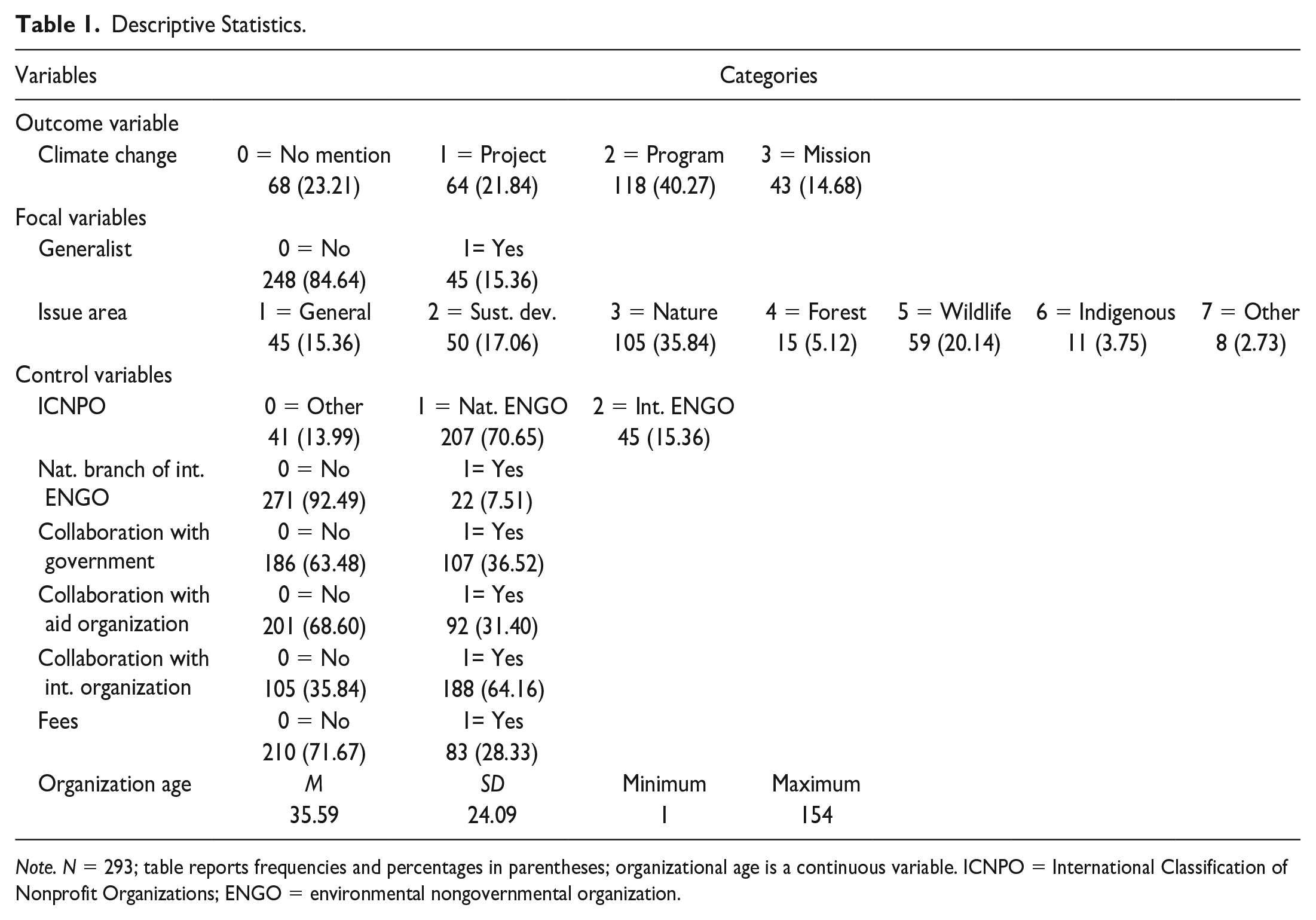
Note. N = 293; table reports frequencies and percentages in parentheses; organizational age is a continuous variable. ICNPO = International Classification of Nonprofit Organizations; ENGO = environmental nongovernmental organization.
Explanatory Variables
We rely on two sets of focal explanatory variables. The first variable is binary and differentiates generalist ENGOs from specialist ones (Generalist). We only coded an ENGO as generalist if it stated in its mission or vision statement that it works on environmental issues in the broadest sense, such as by stating “environmental protection” or listing more than three broad environmental issues. There were very few cases in which an ENGO listed only two environmental issues, and it was always clear which one was their focus, allowing us to code the ENGO accordingly. As a consequence of our coding approach, only 15% of the observations qualified as a generalist ENGO.
The second set of focal explanatory variables classifies the specialist ENGOs focusing on six different issue areas (Issue Area). We identified these issues by following the coding scheme presented by E. W. Johnson (2006), which we adapted to fit the aims of this study. We differentiate between specialist organizations working on sustainable development, natural resources, forests, wildlife, indigenous issues, and other issues. We deviate from Johnson’s coding scheme by adding the “indigenous” and “other” categories. Furthermore, we extracted “forests” from the broader category of “natural resources” as there exists a direct link between forests and climate change, which should be reflected in whether and how the respective ENGOs address climate change.
To test H2, we chose wildlife-focused ENGOs as the reference category. This choice was motivated by Boscarino’s (2015) study which showed that the U.S. National Wildlife Federation does not support climate action because its members and supporters are not generally interested in it. What is more, the leadership of the organization stated that it hesitates to create a connection with climate change because the wider public is considered to be skeptical of it, which could have an adverse effect on the organization’s environmentalist work (Boscarino, 2015, p. 106). Love-Nichols (2020) states that members of the wildlife community have recently started to pay attention to climate change, but also that they are a politically conservative group. Based on this, we expect that wildlife organizations are the least likely specialist ENGOs to tackle climate change. Relative to them the other specialist ENGOs should be more likely to tackle climate change issues. Considering that this expectation is informed by U.S.-based research, the country-comparative analysis will reveal particularly intriguing insights.
Turning to the control variables, we differentiate between organizations which are international ENGOs (where the organization in question represents the main office), national ENGOs, and ones that can be better characterized as any other type of nonprofit organization according to the criteria of the International Classification of Nonprofit Organizations (ICNPO), such as organizations working on culture and leisure or on education and research (see Litofcenko et al., 2020). As the variable on international ENGOs captures only those organizations that represent the main office, we created a second variable that gauges whether a national ENGO is part of an international ENGO but not the main office (National Branch of International ENGO), as this could drive its strategic decisions.
It is important to control for an ENGO’s capacity when explaining the characteristics of its issue portfolio. For example, E. W. Johnson (2006, p. 134) has argued that adding a new issue to an organization’s portfolio requires additional financial resources and personnel. From this, it follows that governments or international organizations can influence ENGOs’ issue portfolios by providing corresponding financial incentives (e.g., Brulle, 2014; Dupuy et al., 2015; Fraussen, 2014). While it would have been desirable to include information on the individual ENGOs’ membership, staff, and budget (see, for example, Partelow et al., 2020), this information was not available for the full set of ENGOs analyzed here. The IUCN does not disclose this information, at least not publicly, and only 50 out of the 293 ENGOs included in this analysis are registered with inventories such as the Yearbook of International Organizations.
At the same time, the absence of this information is not much of a limitation as all ENGOs included can be considered to have relatively high organizational capacities because of their membership in the IUCN. In fact, it is important to keep in mind these characteristics of ENGOs affiliated with the IUCN when interpreting our findings, for they entail a bias toward high-capacity organizations (see also Bernauer et al., 2013).
We can approximate the ENGOs’ capacities by inspecting their collaborative networks (for a discussion, see Gazley & Guo, 2020). We assume that those collaborating with government agencies, development organizations, and international organizations have access to additional funding. Consequently, we drew on the information on the ENGOs’ websites to generate three binary variables, which indicate whether an ENGO collaborates with government agencies, multilateral or bilateral aid organizations, or other international organizations such as the United Nations Program on the Environment (Collaboration with Government/Aid Organization/International Organization). This information was straightforward to code, as ENGOs with collaborative arrangements list their partners on their websites, often with their respective logos.
Furthermore, we included a variable that captures whether a given ENGO charges membership fees (Fees), which represents a stable internal revenue stream. Thus, ENGOs with membership fees should have a higher capacity than those without them (see, for example, Svensson et al., 2017) and be less constrained by governments in the work they undertake (Fraussen, 2014). At the same time, membership fees also ensure that the members have a greater say in the ENGOs’ goals and activities (Heylen et al., 2020), which resonates with our theoretical model.
Finally, we generated a variable capturing the ENGOs’ age (Organization Age), which represents the only continuous variable of the dataset. Table 1 gives an overview of the summary statistics for all variables.
Analytical Strategy
Because of the ordinal nature of the dependent variable, we ran ordered logistic regressions, which are sensitive to the assumption of parallel regressions. We ran Brant tests for the models, and neither the overall test statistic nor those of the individual covariates indicated a violation of the parallel regression assumption.
Given the limitation of our design, we decided to complement our quantitative analysis with two semi-structured interviews. The questions asked are provided in Figure A1 in the Appendix. The first interview was carried out in July 2021 with the Mexico-based Cooperative AMBIO, part of whose mission is climate change. We interviewed the Monteverde Conservation League based in Costa Rica in September 2021. We chose this ENGO for the second interview because its leadership has deliberately chosen to abstain from including climate change in its issue portfolio. The additional insights provided by the two interviews are integrated into the section where we discuss the empirical findings of the quantitative analyses.
Findings
Presentation of the Empirical Resultss
Table 2 presents the findings of eight ordered logistic models estimated with a binary focal explanatory variable that distinguishes between generalist and specialist ENGOs to test H1. Models 1a–4a are estimated with standard errors clustered by country to control for heterogeneity across the ENGOs based in different countries. Models 1b–4b are estimated with robust standard errors and country dummies to control for idiosyncratic factors, with the United States as the reference category. To improve the interpretability of the findings, we report the marginal effects for each of the four outcome categories of the dependent variable. Due to space constraints, the marginal effects of the country dummies are only reported in Table A2 in the Appendix.
Findings of Ordered Logistic Regressions Focusing on Generalist Versus Specialist ENGOs.
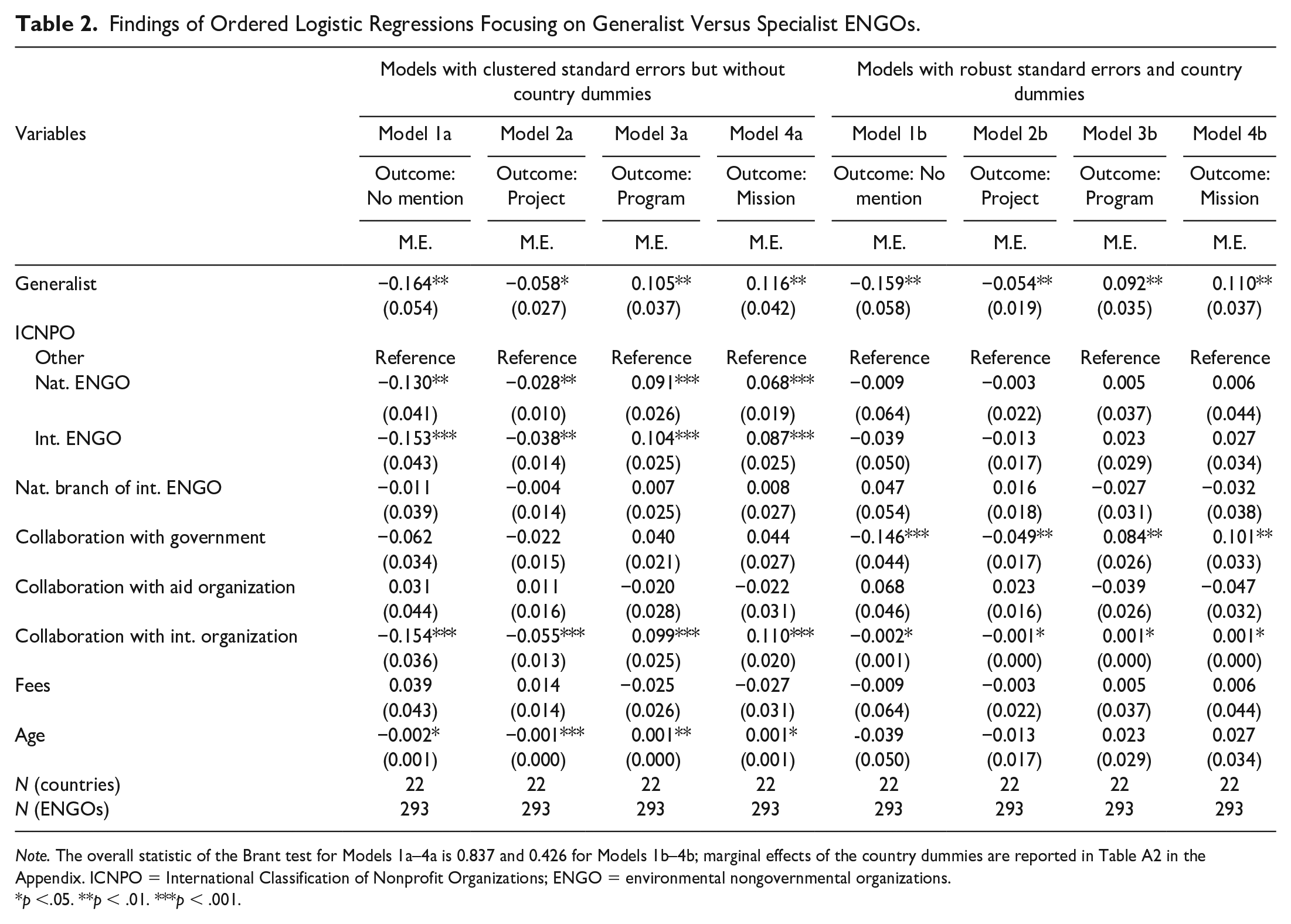
Note. The overall statistic of the Brant test for Models 1a–4a is 0.837 and 0.426 for Models 1b–4b; marginal effects of the country dummies are reported in Table A2 in the Appendix. ICNPO = International Classification of Nonprofit Organizations; ENGO = environmental nongovernmental organizations.
p <.05. **p < .01. ***p < .001.
The marginal effects tell us how probable it is that an IUCN member falls into one of the four categories of the dependent variable given the values of a covariate, and if all the other variables in the model are held constant. In models 1a to 4a, the marginal effects for the focal explanatory variable are significant. Being a generalist ENGO decreases the probability of falling into the “no mention” category by 16 percentage points, and the probability of falling into the “project” category by 6 percentage points. Conversely, compared with specialist ENGOs, generalists have a higher probability of 11 and 12 percentage points, respectively, to fall into the “program” and the “mission” categories of the dependent variable.
Turning to the control variables, the probabilities of falling into the “program” and the “mission” categories are higher for national or international ENGOs than they are for other types of IUCN members. Likewise, the probability of falling into the “no mention” or the “project” category is lower for national or international ENGOs in comparison with other organizations. The same pattern also materializes for IUCN members collaborating with international organizations and for older organizations.
When estimating the models with country dummies (see Models 1b–4b), the marginal effects for the focal explanatory variables change slightly in terms of their effect size and their significant levels, but overall, they confirm the findings obtained by Models 1a–4a. The marginal effects for collaboration with international organizations also remain similar to the ones presented previously. In marked contrast, the marginal effects for international and national ENGOs become insignificant. This change in the estimation findings is plausible given that almost 90% of the international ENGOs are based in the United States, and therefore the country dummies absorb the effect of the two covariates. The same holds true for the covariate gauging the age of an ENGO: The marginal effects become insignificant when country dummies are included. This is plausible given that U.S.-based ENGOs are among the oldest (see also Partelow et al., 2020). Interestingly, when controlling for the countries in which the ENGOs are based, we obtain significant marginal effects for collaboration with government agencies. Collaboration reduces the likelihood of falling into the “no mention” category by 15 percentage points (Model 1b), whereas it increases the likelihood of falling into the “mission” category by 11 percentage points (Model 4b).
Table 3 presents the findings of ordered logistic models estimated for the specialist IUCN members only, which is reflected in the reduction of the number of observations from 293 to 248. For a more straightforward interpretation of the findings, Figure A2 in the Appendix reports the percentage of different outcome categories for the specialist ENGOs. To test H2, the models differentiate between the issue areas on which the organizations work as well as compare how these influence the outcome variable when treating wildlife-focused ENGOs as the reference category.
Findings of Ordered Logistic Regressions Focusing on Specialist ENGOs.
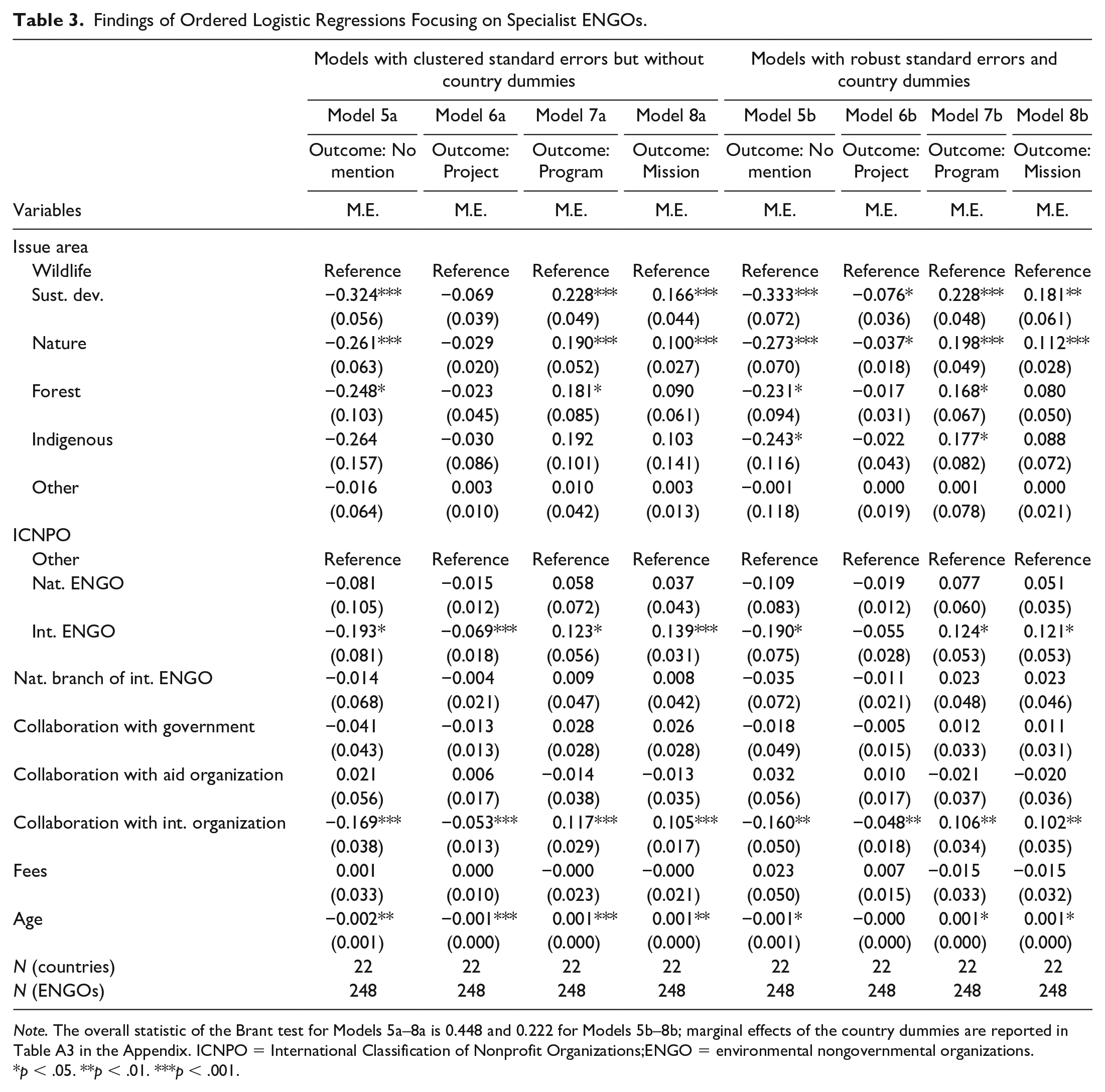
Note. The overall statistic of the Brant test for Models 5a–8a is 0.448 and 0.222 for Models 5b–8b; marginal effects of the country dummies are reported in Table A3 in the Appendix. ICNPO = International Classification of Nonprofit Organizations;ENGO = environmental nongovernmental organizations.
p < .05. **p < .01. ***p < .001.
With the exception of Models 6a and 6b, the marginal effects for the covariates gauging whether an organization works on sustainable development or natural resources are significant. Thus, compared with wildlife organizations, those working on sustainable development have a higher likelihood of falling into the “mission” category (Models 8a and 8b). The likelihood of falling into the same outcome category is 10 and 11 percentage points higher, respectively, for IUCN members working on natural resources as compared with those working on wildlife conservation. Forest ENGOs have a lower likelihood compared with wildlife ENGOs to fall into the “no mention” category but a higher likelihood to fall into the “program” category. The marginal effects for indigenous organizations are not statistically significant at conventional levels. Only when controlling for countries, indigenous organizations have a higher likelihood of 18 percentage points compared with wildlife organizations to fall into the “program” category (Model 7b).
Similar to the results of the first set of models, the marginal effects change when adding country dummies (see Table A3 in the Appendix for their marginal effects). However, in contrast to the models presented in Table 2, the ones in Table 3 remain robust for the impact of being the main office of an international ENGO, collaboration with international organizations, and the age of an IUCN member. The direction of the effects corresponds to those discussed above for the first analysis (see Table 2).
Discussion of the Empirical Results
The findings presented above support the reasoning of H1 in full and of H2 in part. The differences between IUCN members working on wildlife conservation and other issues did not turn out to be as robust as expected for the full range of specialist ENGOs. While we found robust support for the expected differences between wildlife-focused ENGOs and those working on sustainable development and natural resources, the findings were less robust for forest-focused and indigenous organizations. Nevertheless, the findings are noteworthy considering that wildlife organizations across the Americas seem to have a different approach to climate change issues as compared with other types of specialist ENGOs. In other words, we could show that the effect is not limited to the United States although it was inspired by U.S.-based research. Regarding the control variables, we obtained the most robust effects for collaboration with international organizations and the age of an IUCN member.
Despite the identification of these correlations, we are aware that our analyses are limited in terms of providing causal insights. Therefore, we turn to our interview data to make better sense of our findings and assess which other factors—those we could not include in our models—are relevant for explaining ENGOs’ decisions to tackle climate change issues.
The interview carried out with the Cooperative AMBIO helps us to better understand how internal factors as conceptualized by Halpin et al. (2018) determine an organization’s issue portfolio. The leadership of this Mexican ENGO decided to address climate change upon its foundation in 1998 as this offered it the strategic niche of becoming involved in the transaction of carbon credits under the UNFCCC mitigation program REDD+. The ENGO’s activities related to climate action have given it recognition and strengthened its reputation, resulting in funding from various national and international sources, including multinational companies. This example shows that the inclusion of climate change in an ENGO’s issue portfolio can pay off at different levels. It also illustrates that Cooperative AMBIO, as one of the first ENGOs to work on climate change, enjoyed a strategic advantage vis-à-vis other ENGOs by occupating this particular niche.
The Monteverde Conservation League started off as an organization working to raise funds to save the local forest. The organization has maintained its mission of striving to enhance the balance between humans and nature, education, conservation, and biodiversity. The local focus of the Costa Rican ENGO’s activities is, inter alia, a result of funding from the national government, which supports local projects. This exemplifies the supporting role governments play in shaping the issue portfolio of ENGOs (see, for example, Fraussen, 2014). Interestingly, the interviewee indicated that the organization’s leadership is aware that focusing on climate change can generate additional resources and suggested that the ENGO could expand its issue portfolio to include climate change in the future. However, the interview also revealed that given the organizational capacity, currently, the leadership prefers working on environmental issues only as they are considered to be more pressing than climate change.
Conclusion
The United Nations refer to climate change, environmental pollution, and biodiversity loss as the “triple planetary crisis,” of which each needs to be resolved to ensure a viable future on this planet (UNFCCC Secretariat, 2022). In this study, we showed that climate change has reached the working areas of IUCN-affiliated ENGOs based in the Americas. Inspired by the work of Halpin et al. (2018), we went beyond existing research by not only showing that ENGOs tackle climate change issues (see, for example, Partelow et al., 2020) but also to what degree and explaining why, which we regard as our first contribution to the literature.
Second, we reveal that among this group of ENGOs, generalists are more likely to tackle climate change issues than specialists, which supports existing findings in the literature (Baumgartner & Leech, 2001; Halpin & Binderkrantz, 2011; Heaney, 2004; E. W. Johnson, 2006; Lowery et al., 2012). However, our analysis also uncovered that the organizational goals of specialist ENGOs matter for explaining whether and to what extent they work on climate change. This aligns with the findings reported by Boscarino (2015) for the specific case of climate action and more broadly with E. W. Johnson’s (2006) on issue representation by ENGOs.
Drawing on Boscarino (2015), we chose wildlife-focused organizations as the reference category for assessing the likelihood of ENGOs to tackle climate change as we expected that this organization type would have to make the widest stretch to address climate change given its organizational goals and the interests of its members and supporters (see also Love-Nichols, 2020). While the author studied U.S.-based ENGOs only, our empirical findings confirmed that compared with wildlife organizations, specialist organizations working on sustainable development and natural resources as well as forest conservation have a higher likelihood of identifying climate change as a priority of their work, which represents our third contribution to the literature. Considering that we tested this relationship for a number of ENGOs based across the Americas, we regard this as a strong finding and one that demonstrates the value of country-comparative research on the issue agendas of nonprofit organizations.
Fourth, we show that the collaborative networks of ENGOs correlate with their issue portfolios, and we did so by taking into consideration collaboration with national (i.e., government agencies) and international organizations. This finding itself suggests that changing an ENGO’s issue portfolio to include climate change could necessitate changes in its collaborative networks (see, for example, Gazley & Guo, 2020).
Our fifth contribution to the literature stems from the interviews we conducted, as these demonstrated that ENGO leaders in transition countries do not simply embrace ideas that originate from the international level, as claimed in the literature (see Hoogesteger, 2016), but carefully weigh the potential costs and benefits of tackling climate change issues in addition to pursuing their original organizational mission. In fact, depending on their cost–benefit analysis, ENGOs may decide to concentrate on the issues that lie at the heart of their organizational mission.
Our study also yields at least one insight for practitioners, namely that individuals from outside an ENGO who are keen to promote climate action should not abstain from targeting specialized ENGOs, though they should make sure to approach the “right” ones. When such climate policy entrepreneurs have to select which type of specialized ENGO to approach, the best choice would be to address those working on sustainable development and nature conversation as well as on forests.
While we consider this study to have yielded some instructive insights, we are also aware that it suffers from several limitations, which represent the point of departure for future research. The most obvious limitation consists in the rather rough measurement of the key variables in the database by manually coding the information provided on the ENGOs’ websites. Similar to other literatures, research on nonprofit organizations has begun to use fully or semi-automated methods of text analysis (e.g., Litofcenko et al., 2020), which represents an avenue worth exploring. Second, the priority we gave to country-comparative measurements resulted in a data collection approach that did not produce data for established indicators in the pertinent literature, such as organizational resources and issue salience (see, for example, Halpin et al., 2018). Third, and along the same lines, we would have needed longitudinal data to test some of the factors discussed in the literature regarding issue prioritization, such as issue salience (see, for example, Boscarino, 2015). Information on these variables could have increased the overall explanatory power of our models.
Fourth, despite the inclusion of ENGOs based in Central and South America, all the ENGOs in our data sample represent organizations with relatively high organizational capacity and financial resources, as indicated by their IUCN membership (see Bernauer et al., 2013)—a potential bias also with other studies (see, for example, Partelow et al., 2020). Consequently, the findings reported here allow for generalization to this kind of ENGOs, and a promising next step would be to compare the Central and South American ENGOs analyzed here with a wider population of ENGOs in the region. Fifth, going back to the notion of the “triple planetary crisis,” future research could assess how climate-focused NGOs tackle issues related to environmental pollution and biodiversity loss. The present study could serve as a reference for future studies on this much-needed complementary research perspective.
Research Data
sj-docx-1-nvs-10.1177_08997640221146962 – for Adapted to Climate Change? Issue Portfolios of Environmental Nongovernmental Organizations in the Americas
sj-docx-1-nvs-10.1177_08997640221146962 for Adapted to Climate Change? Issue Portfolios of Environmental Nongovernmental Organizations in the Americas by Jale Tosun and Emiliano Levario Saad in Nonprofit and Voluntary Sector Quarterly
Footnotes
Appendix
Tosun, Jale and Emiliano Levario Saad (2023). Adapted to climate change? Issue portfolios of environmental non-governmental organizations in the Americas. Nonprofit and Voluntary Sector Quarterly. DOI: 10.1177/08997640221146962.
Acknowledgements
We thank Beth Gazley, Juniper Katz, and Aseem Prakash as well as three anonymous reviewers for helpful comments on earlier versions of this manuscript. Nora El-Awdan and Mina Trpkovic assisted in data collection. Laurence Crumbie deserves credit for language editing.
Declaration of Conflicting Interests
The author(s) declared no potential conflicts of interest with respect to the research, authorship, and/or publication of this article.
Funding
The author(s) disclosed receipt of the following financial support for the research, authorship, and/or publication of this article: The author(s) received financial support for the research of this article from the Heidelberg Center for the Environment (HCE).

Supplemental Material
Supplemental material for this article is available online.
Author Biographies
References
Supplementary Material
Please find the following supplemental material available below.
For Open Access articles published under a Creative Commons License, all supplemental material carries the same license as the article it is associated with.
For non-Open Access articles published, all supplemental material carries a non-exclusive license, and permission requests for re-use of supplemental material or any part of supplemental material shall be sent directly to the copyright owner as specified in the copyright notice associated with the article.
