




Abstract
Our contribution lies in exploring loci and reach of leadership diversity’s influence on proximal and distal performance outcomes to understand how and where these can be mobilized. Our moderated-mediation modeling decomposes the direct, indirect, and interaction effects of demographic diversity among three types of focal actors in governance—Boards (gender-, age-, and ethno-racial variety), Board Chairs (gender and ethno-racial demography), Chief Executives (gender and ethno-racial demography)—on five factors reflecting functional and social dimensions of Board Performance and two dimensions of Organizational Performance. We demonstrate that the Board composition affects proximal board performance outcomes, whereas CEO demography is more related to distal organizational performance outcomes. Board Chairs, a less-examined aspect of nonprofit governing, stand out as bridging both proximal and distal outcomes, both directly and through their interactions with Board diversity and CEO demography.
Keywords
The leading and governing of nonprofit organizations is highly interdependent work that often occurs far from the activities that constitute measurable organizational performance or change (Cornforth, 2012), and where assessments are made. Indeed, researchers have suggested that a litany of intervening variables obscure the ability to make a convincing case for the performance benefits of leadership diversity beyond a very narrow band of proximal outcomes (for a relatively exhaustive list, see Nishii et al., 2018). Proximal board performance outcomes, such as the ability to effectively provide fiduciary oversight or maintain strategic direction or engage stakeholders (Bradshaw et al., 1992; Brown, 2005; Herman & Renz, 2000), as well as more social ones, including building board culture and diversity-equity-inclusion competence (Brown, 2002; Buse et al., 2016), reflect some of the most important and frequently noted factors intermediating the effects that leadership composition have on more distal organizational performance outcomes. Indeed, there is little doubt that a Board demonstrating fiduciary or strategic competence would improve the financial standing of an organization, nor that a vibrant and dynamic governing team culture might generate a context for richer decision-making in strategic choice. There is, however, a question of the reach of influence; whether the effects of leadership and governing group diversity have the ability to affect distal organizational performance outcomes either through proximal factors or by more-directly intervening in them. There is also a question of loci, where the interdependence of leading and governing activities obscures our ability to discern the sources—CEO, Chair, or Board—of diversity’s influence, whether resultant from differences in gender, age, or ethno-racial composition. This second aspect omits the important but differentiated influences of key leadership and governing roles (Axelrod, 2005; O’Regan & Oster, 2005), where Chief Executives, Board Chairs, and Boards become entangled (Cornforth, 2012; Herman & Heimovics, 2010), leaving us little ability to determine which role affects which outcome and where or when this impact occurs. Together, the inability to identify the locus of diversity’s influence, combined with the difficulties discerning its reach, make associating possible loci with more proximal or more distal outcomes an important step in building a broader understanding of how and why leadership diversity might matter.
Focusing on diversity’s loci of influence and its reach, this research addresses two obstacles needed to better understand the impact of leadership and governance diversity, whether from gender, age, or ethno-racial identity. First, we work to disentangle the sources or loci of diversity’s influence in the highly interdependent context of nonprofit governance. Here, we take a comprehensive modeling approach that simultaneously examines the demographic diversity of Chief Executive, Board Chair, and Board to specify which is influencing outcomes, when, and how. Second, we examine the reach of this influence by testing whether compositional effects are limited to proximal (or localized) board performance outcomes, or whether the influence of leadership diversity extends to more distal outcomes such as organization performance, and if so, how. Our efforts produce new insight by decomposing, delineating, and clarifying the complex nature of demographic diversity as it relates to improving performance in the leading and governing of nonprofit organizations.
Theorizing the Decomposition of Diversity’s Impact
Building and retaining diverse leadership and governing groups is important, not just to demonstrate compliance with employment law and funder expectations (Bradshaw & Fredette, 2013; Miller-Millesen, 2003), or to improve ideation and decision-making (Forbes & Milliken, 1999), or to expand stakeholder relationships and community understanding (Brown, 2005; Herman & Renz, 1998), but also because leadership diversity signals moral and ethical commitment to equity by legitimizing the value of underrepresented communities (Guo & Musso, 2007), and promotes engagement with and participation in power-redistribution efforts (Ray, 2019). While our research largely examines the organizational implications of leadership diversity from a management perspective, the broader social context in which this study is embedded and the broader implications of ensuring equal opportunity in the leadership and governance of nonprofit organizations should not be lost, and the implications for people—both leaders and followers, service providers and recipients, employees, and volunteers—should not be overlooked, a point we return to in our conclusion.
With all the attention paid to board diversity (e.g., Bradshaw & Fredette, 2013; Gazley et al., 2010; Harris, 2014; Siciliano, 1996), why do we seldom see organizational performance benefits beyond those associated with changes in board performance? There is broad consensus that board performance (or effectiveness) shapes organizational outcomes by creating a task environment in which decisions about strategic direction, resourcing, policy compliance, and executive leadership are made and monitored (Bradshaw et al., 1992; Brown, 2005; Herman & Renz, 1998). And that these decisions, which inform and bound how organizational performance is to be pursued, shape executive and organizational activity, but are not deterministic of performance outcomes (Zald, 1969). Board diversity and board performance have been linked through a variety of mechanisms, including: representation and engagement of stakeholder communities in board resourcing (Cornforth, 2001); a wider array of decision-making perspectives and alternatives shaping board choice (Buse et al., 2016); and mission safeguarding and managerial oversight (Bradshaw et al., 1992; Bradshaw & Fredette, 2013). Given the importance of these mechanisms to governance quality and the belief that good governance will improve organizational performance, fiscally or otherwise, researchers rightly anticipate a composition-to-performance relationship, even though it is rarely obtained.
One explanation for why we often see proximal, but not distal effects, of compositional diversity, for example, the effect of board diversity improving board performance but not extending to gains in organizational performance outcomes, stems from assumptions about the interdependence among members of governing groups inclusive of Boards of Directors, Board Chairs, and Chief Executives. First, researchers tend to look at one source of influence at a time, either the CEO or Board—only rarely examining the role of the Chair (Harrison & Murray, 2012), to the exclusion of the others. This assumes that interdependence is limited to within Boards, or in the case of CEOs and Chairs, as an act of coordinating or entraining to a narrowly drawn exogenous source, such as a planning cycle or a reporting schedule (Ancona & Chong, 1996). Parsing governance interdependence by positions or roles, or by social systems or levels of analysis, imposes a constraint that is often not reflective of governance practice in which CEOs and Chairs are both nested within and distinguishable from their Boards (Cornforth, 2012; Van Puyvelde et al., 2018). We need to look at and model leadership and governance interdependence as we find them: the product of two distinct roles involving executive leadership and overseeing governors, each with their own responsibilities for policy formulation and implementation (Herman & Heimovics, 2010); composed of three unique positions—CEO, Chair, Board—with associated abilities and limitations (Axelrod, 2005; Zald, 1969); and with occupants of roles and positions arriving with existing societally recognized demographic differences informing their status and perspective (Zald, 1969).
A second reason we often see proximal, but not distal, effects of compositional diversity is that we assume equality in the influences of interdependent actors where it may not exist. Many of the functional benefits of working in groups and boards stem from interdependence assumptions (Langfred, 2005; Saavedra et al., 1993), for better (creativity, decision-making, ideation, legitimacy) and worse (conflict, tokenism, fault lines). These assumptions are often latent or left challenged in theorizing, meaning that we often assume away individual differences in personal influence and positional power, treating people engaged in board work as equally empowered. This not only ignores the implications of positional power such as the ability of the Chair to shape agendas, limit or extend debate, and rule on the legitimacy of actions to others (Harvey et al., 2017; Van Puyvelde et al., 2018), or the role of CEO in shaping board discussion through the provision, withholding, or selective filtering of information (Herman & Heimovics, 2010), but also excludes the aspects of individual demography that amplify or attenuate influence in politicking and coalitioning (Cyert & March, 1963) dynamics within boards by virtue of historic and present-day societal and organizational marginalization (Acker, 2006; Ray, 2019).
In this respect, the way we conceive of interdependence depends on how we draw boundaries around the actions involved in governing organizations. If we limit our view to the Boards of Directors, we might tend toward interdependence as mutually constituted action among equals (one person, one vote) in a team, omitting a behavioralist view of politicking, sub-group configurations, and coalitioning needed to overcome resistance (Cyert & March, 1963; Harvey et al., 2017). In contrast, if we consider interdependence through the eyes of a Chief Executive, we might reasonably focus on the entraining of individual action to the board mandate, which limits CEO autonomy of action in existing power structures (i.e., decision-making routines, role boundaries, needed permissions) and patterns of work (i.e., reporting, schedules, meetings). Unlike boards, executives retain individual authority to induce action, where boards do not (Herman & Heimovics, 2010). And for Chairs, who sit at the interface of governing and leading, overseeing both the board and the executive while coordinating board intent into executive action and at the same time exercising authority in both spheres (through consensus-building among board members and entraining management to governance directive), the boundaries and contingencies of interdependence are difficult to disentangle (Cornforth, 2012). These differences among perspectives are a result of role or position, and they provide a third rationale for emphasizing interdependence among CEO, Chair, and Boards in our study, rather than narrowing our examination to one group or compressing roles into a single source.
In our theorizing of the relationships among governing group diversity, board performance, and organizational performance, we assume and test the interplay among facets of societally relevant individual demography with organizational position or role (CEO, Chair, Board). Positionality matters, as do the varieties of perspectives and lived experiences that shape and inform assumptions about the world, which bring varieties of experience and expertise to leading and governing under uncertain, consequential, and complex decision-making conditions. Our contribution lies in exploring loci and reach of leadership diversity’s influence on proximal and distal performance outcomes to understand how and where these can be mobilized.
Figure 1 illustrates the conceptual model underlying our testing and the pattern of our hypothesized relationships. Our central thesis is that compositional diversity in the roles of CEO, Board Chair, and Board of Directors will improve organizational performance through the mediation of board performance and the moderation of interdependence among leadership and governance roles. Here we conceived of compositional diversity in terms of the categories of gender and ethno-racial demography for Chief Executives and Chairs, and in terms of the proportional variety of gender, ethno-racial, and age diversity of the Board, each of which reflect salient social categories (Cox, 1993). Board performance, we argue, is reflected in three functional (Strategic Oversight, Internal Awareness, External Engagement) and two social (Diversity and Inclusion Competence, Board Culture) factors, capturing a multidimensional assessment of the essential responsibilities and the requisite social dynamics of high performing boards (Fredette & Bernstein, 2019; Van Puyvelde et al., 2018), which mediate the relationship between composition and organizational performance. Organizational performance is oriented to social-purpose and financial-capacity concerns, balancing emphasis on mission centricity and financial survivability that are grounded in practice (Helmig et al., 2014; Sowa et al., 2004). The functional activities of governing, including the assertion of oversight, capital planning, or resource attraction and deployment, contribute to financial and fiscal viability, creating a context that support organizational continuance. Because we are interested in leadership and governance diversity as the predictor of board and organizational performance, we begin by hypothesizing the relationships among our focal actors:
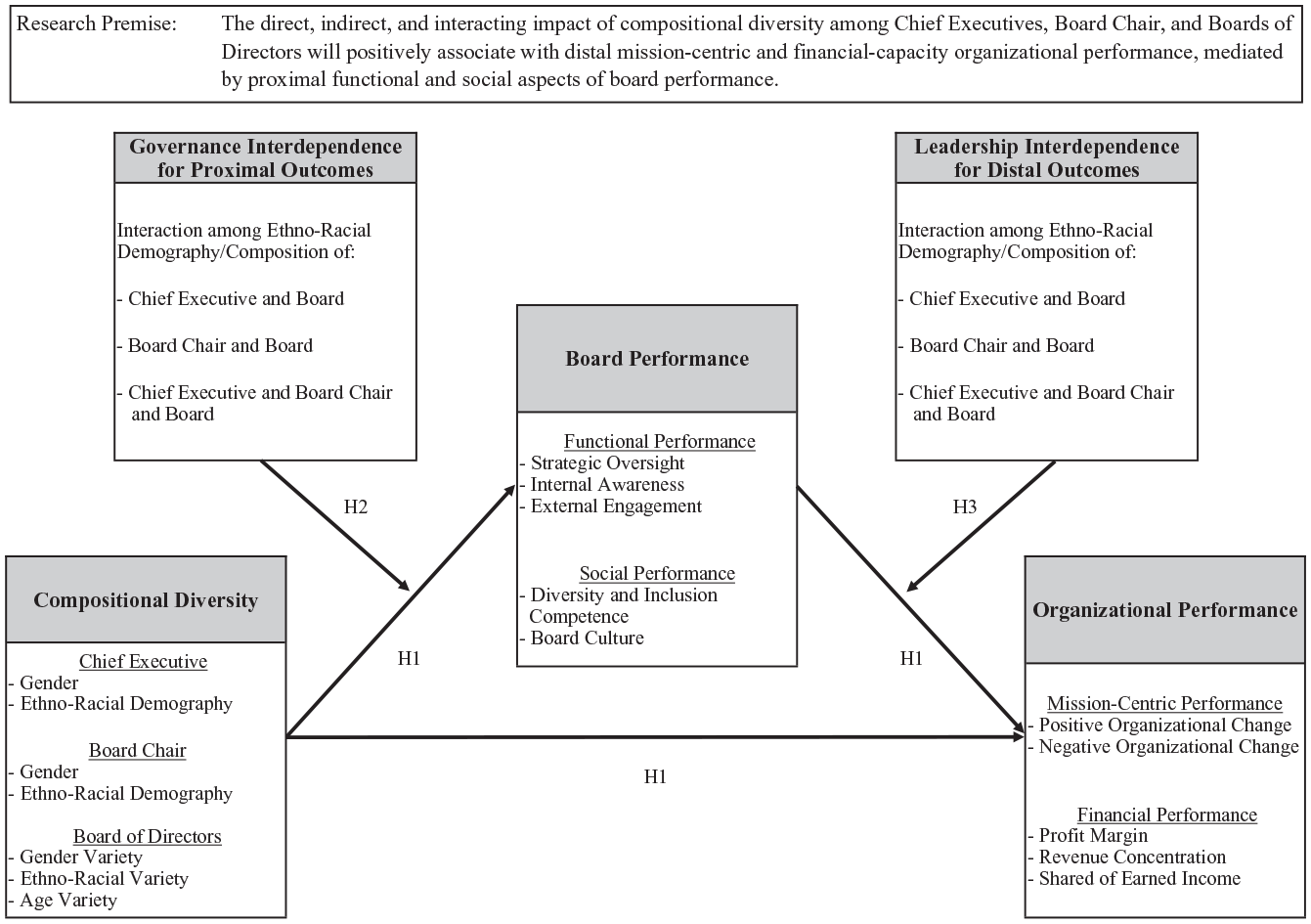
Conceptual Model of Relationships Among Compositional Diversity, Board Performance, and Organizational Performance.
Understanding the relationship among loci of influence and reach is a product of interdependencies among positions or roles in the leadership-governance system, the limits of, or boundaries in, the delegation of responsibilities for formulation and implementation of strategic action, and the opportunity for action or intervention resulting from the intersection of personal and positional influence.
Research has demonstrated differing performance effects associated with positional differences, typically emphasizing one source to the exclusion of others. Previous findings associated with Chief Executive roles are more demonstrative of diversity in gender or race and ethnicity relating to differences in financial and strategic performance outcomes that we conceive of as distal in our modeling. For example, researchers have found effects for corporate female CEOs that demonstrate improved financial results (Khan & Vieito, 2013), as well as reductions in financial leverage and earnings volatility associated with firm survival (Faccio et al., 2016). Similarly, examining the impact of gender and ethnic-minority CEOs in relation to board diversity, Borghesi et al. (2016) found that any value added via board diversity is nullified when a diverse board operates in the presence of a female or ethno-racially diverse CEO, suggesting an interaction among the diversity of interdependent actors.
In contrast to studies of CEO diversity, board diversity has been more broadly examined by for-profit and nonprofit researchers, with results more frequently, but not exclusively, demonstrating effects on proximal performance factors central to governance rather than to more distal organizational performance outcomes. For example, nonprofit researchers frequently find relationships associating board composition with board performance or governance effectiveness (Brown, 2002; Fredette & Bernstein, 2019; Fredette et al., 2016), whereas linking diversity to organizational performance or effectiveness has been more complex (Buse et al., 2016; Gazley et al., 2010; O’Regan & Oster, 2005; Siciliano, 1996). Similar in effect but in the opposing direction, corporate research conducted by Murray (1989) found a direct negative impact of ethno-racial diversity on board performance stemming from sub-group factions and a lack of cohesion, where Ali and colleagues’ (2014) examination of Australian board members found an inverted U-shaped curvilinear relationship between age diversity and return on assets. Mahadeo et al. (2012) found support for homogeneous rather than heterogeneous groups, subsequently finding the need for mediation by board processes, practices, and behaviors to positively affect the organizational performance. Examining the impact of women and ethnic minority directors in a sample of major U.S. corporations, Carter et al. (2010) found no relationship between the gender or ethnic diversity of the board, or important board committees, and financial performance. This contrasts with Miller and del Carmen Triana (2009), where support for both gender and racial diversity was positively associated with innovation, mediating board racial diversity and firm performance. Carter et al. (2010) found performance improvement when there were two or more minority board members. Taken together, prior results suggest that relationships among board composition, board performance, and organizational performance are tenuously inconsistent, with composition more frequently associating with proximal mediating outcomes such as board performance, rather than distal performance outcomes.
Comparatively less has been written about Board Chairs generally (Cornforth & Macmillan, 2016; Harrison & Murray, 2012), and virtually nothing has been written in either the nonprofit or for-profit literatures examining the impact of Chair gender or ethno-racial diversity. This is surprising, given descriptions afforded Board Chair positions as conveying power to shape agendas, coordinate activities, and alter parameters of discussion and debate (Harrison & Murray, 2012; Van Puyvelde et al., 2018); symbolically Chairs convey legitimacy and authority as well as value and worth, which are essential to leadership (Cornforth & Macmillan, 2016). Despite a paucity of study to date, emerging research seems to indicate that nonprofit board chairs sit at an impactful nexus of CEO, Board, and organizational influence (Harrison et al., 2013). From this, we infer that Chair demography, similar to CEO demography, will matter. First, demographic differences based on gender have demonstrated differences in tolerances for risk, approaches to leadership, and strategies for decision-making (Francoeur et al., 2008). Second, we anticipate interactions among focal actors, such as those between a male CEO and a female Chair or a racialized Chair and a largely majority White board, but we also anticipate intersectional implications (Acker, 2006), for instance in the form of a “double jeopardy” for a racialized female CEO or Chair.
As prior results suggest, differences in role or position demonstrate some differentiation in the projection of influence from compositional diversity to performance outcome. In some respects, this suggests a differentiation in the influence of leadership diversity in the case of CEO or Chair positions, from that of governing diversity in the case of Boards and board members. Building on our presumption that good governance generates good performance, we hypothesize the following associations with respect to the influence of interdependence among roles on proximal outcomes:
Alternatively, when we apply the same logic to organizational performance, an outcome that we argue results from, but is distal relative to Boards and the activities commonly associated with governance, we hypothesize the influence of interdependence among roles on distal outcomes in our model:
In summary, the literature suggests that diversity in the leading and governing of nonprofit organizations has the potential to affect both proximal and more distal organizational outcomes, but that these are rarely simultaneously considered, and the sources and dimensions of diversity are often studied in isolation. In addition, there has been little consideration of the interdependencies among roles and positions or the interplay among the loci of influence associated with leadership roles nor their reach to either proximal or distal aspects of performance.
Research Design and Methodology
We draw on data collected in the BoardSource (2016) Leading with Intent (LWI) survey integrated with 2017 IRS 990 data for this study, matching CEO responses with tax filing information. The LWI CEO survey sampled approximately 1,580 responding Chief Executives, of which we limited to U.S.-based charity organizations, allowing the integration of financial and organizational data. In addition, organizations were excluded if the CEO and Chair positions were held by the same individual because the CEO–Chair interplay was hypothesized in our modeling. This resulted in a total of 737 organizations included in our sample. Analysis of our moderated-mediation model was conducted using the Process v3.3 add-on to IBM’s SPSS statistical analysis software (Hayes, 2017).
Our sample consisted of organizations drawn from 26 subsectors of the nonprofit domain, with Human Services, Youth Development, and Arts, Culture, and Humanities reporting as the largest of these, representing approximately 21%, 11%, and 9% of responding organizations, respectively. Among Boards of Directors, respondents indicated that their boards tended to include more women (M = 7.68) than men (M = 7.17), with Whites composing approximately 82% of board seats, but with approximately 78% of boards reporting representation of at least two ethno-racial groups. Board Chairs were more often male (approximately 60%), approximately 89% of whom were reported as White, with African American or Black reported as the second largest ethno-racial group represented (5.0%) in the role of Chair. Nearly 91% of Chief Executives self-identified as White, with 4.1% self-identifying as African American or Black. Finally, CEO age averaged 53 years (SD = 9.926), the oldest of whom reported as 78 years old, and were more likely to identify as female (74%) than male (26%).
Missing Data Protocols
Addressing missing data in field survey research is not uncommon but warrants that we determine the scale and scope of omission or missingness and determine whether the missing data is random (Newman, 2014). Missing value analysis revealed that data derived from the IRS 990 form was missing in approximately 32% of cases, with all LWI data fields virtually complete. Estimating Little’s chi-square statistic (Χ2 = 67.039, df = 49, p = .044) to test randomness, we failed to meet the Missing Completely at Random (MCAR) standard. Newman (2014) directs the use of maximum likelihood (ML) data replacement in such cases, where more than 10% of the respondent pool is composed of partial respondents and the data meet Missing at Random (MAR) assumptions. Given our analytic approach to testing moderated-mediation hypotheses, a full information maximum likelihood approach was employed to minimize missing data estimation bias (Newman, 2014).
Dependent Variables
Organizational performance was operationalized using a LWI CEO-reported measure of strategic change collected in the second quarter of 2016 and IRS Form 990 data reflecting the 2017 calendar year used to calculate profit margin (Kim, 2017), revenue concentration (Chikoto & Neely, 2014), and the share of earned income (Ecer et al., 2017).
Positive and Negative Organizational Change
We took organizational change as a dependent variable to reflect mission-centric aspects of performance that are non-financial in nature (Bernstein et al., 2015). Responses to a multi-item question in which participants identified whether their organization had changed along a series of prescribed dimensions were coded “1” if the organization had experienced the change in the past 2 years and “0” otherwise. Respondents addressed 21 dimensions of possible change, from which we conducted a factor analysis allowing items to assign freely into principal components, and in the second step imposed a varimax rotation. The initial solution suggested two clearly-defined solutions and a third factor composed of items with weak loading scores.
Retaining the first two factors (Table 1), we reviewed the items associated with each and inferred from the items that one factor reflected organizational outcomes that were positive in nature, while the other reflected changes that would be considered organizationally-negative outcomes. Based on the outcome of the factor analysis, we labeled the positive dimension Positive Organizational Change and tested the properties of these items to determine their collective use in the form of a measurement scale. We first examined the items individually, reviewing properties of item means and standard deviations, then moving to address collective properties, first noting a mean of .57 (SD=.290) in the five-item scale and moderate reliability (Cronbach’s α = .602), secondarily noting that the elimination of any single item would not significantly improve the overall scale reliability.
Organizational Change Rotated Component Matrix.
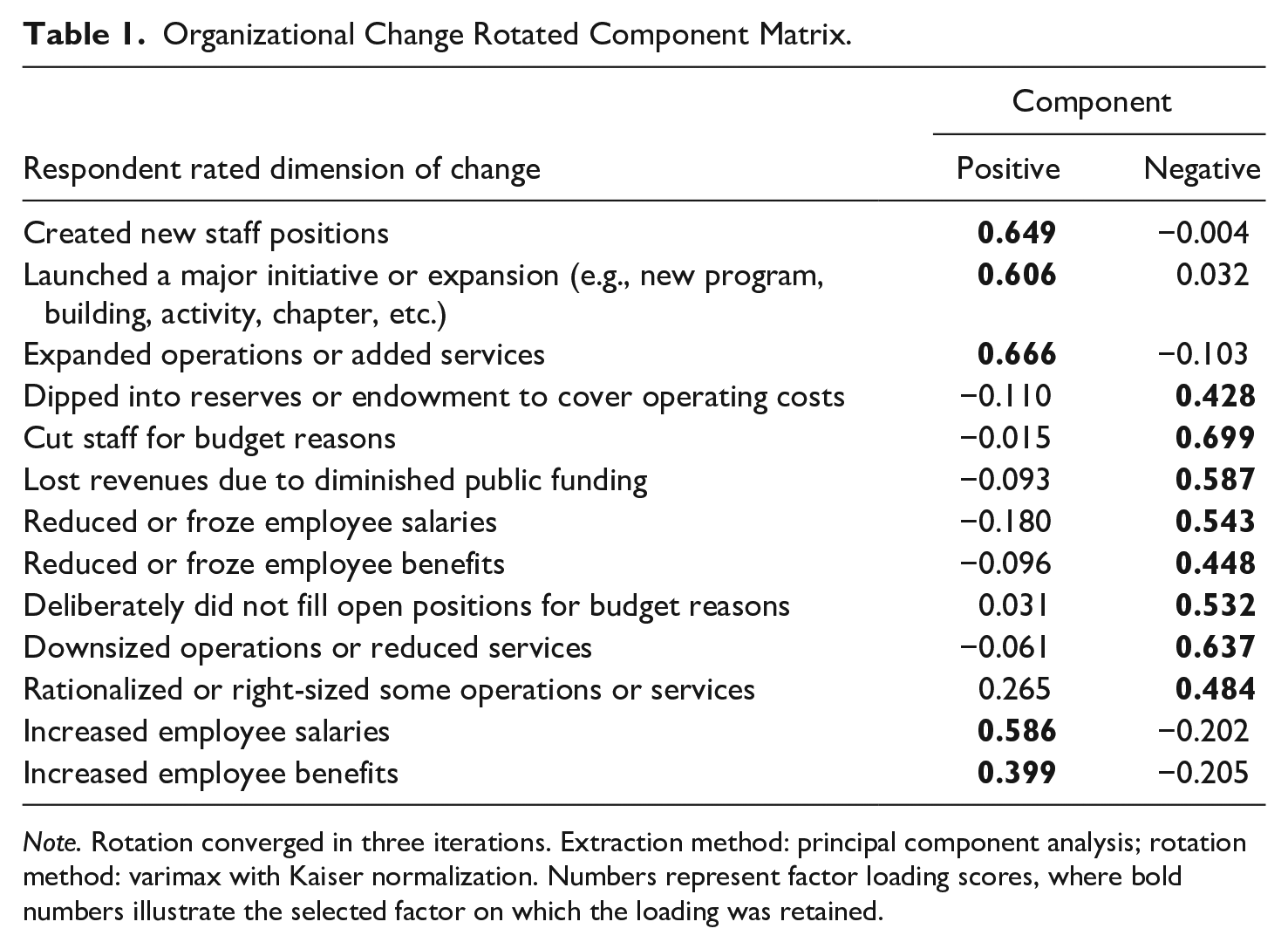
Note. Rotation converged in three iterations. Extraction method: principal component analysis; rotation method: varimax with Kaiser normalization. Numbers represent factor loading scores, where bold numbers illustrate the selected factor on which the loading was retained.
We repeated the process with the second dimension, which we chose to label Negative Organizational Change. This eight-item scale demonstrated a collective mean of .16 (SD = .204), indicating that fewer respondents identified experiencing negative outcomes in the prior two years than those having identified positive outcomes. Reliability (Cronbach’s α = .689) for our negative variable was adequate (Nunnally, 1967).
Financial Performance Measurement
Financial performance measures were derived from 2017 IRS Form 990 reporting data, which has demonstrated reliability when calculated from figures included in audited financial statements (Froelich et al., 2000). Profit Margin reflects a measure of financial stability (Kim, 2017), calculated as annual operating margins for the 2017 year, where operating margins are equal to net revenues as a share of total revenues. Revenue Concentration is measured using the Herfindahl-Hirschman Index in which changes in concentration of three categories of organizational revenue—total contributions, total program service revenue, total investment income—were examined (Carroll & Stater, 2009). Increasing revenue concentration suggests a growing dependence on a particular type or source of funding, whereas a decreasing concentration of revenue is suggestive of activities that attract broader funding composition.
Finally, Share of Earned Income (SEI) captures a measure of entrepreneurial revenue generation over time (Ecer et al., 2017), with SEI calculated as the total program service revenue divided by total revenue. As Ecer and colleagues note, program service revenues reflect the degree to which the organization earns revenues from activities, net of government grants.
Predictor Variables
Our interest in decomposing the effect of diversity and its locus of influence informed our measurement and testing strategies. We elected to operationalize and measure diversity of three focal actors, the CEO, the Chair of the Board of Directors, and the Board of Directors inclusive of the Chair and CEO (if the position entailed a seat on the board), providing a group-level variable. We measured diversity of the CEO in two ways: First, we examined ethno-racial demography (coding “1” if identifying as racialized, “0” if White); second, we coded for gender (coding “1” if identifying as female, “0” if male; though given the option, none of the respondents opted to identify as “other” and self-define alternatively). This coding procedure was repeated for the Board Chair, coding ethno-racial and gender demography. In addition, we created CEO and Chair diversity interaction terms to examine intersectional effects of gender and ethno-racial demography (Gender x Ethno-Racial Diversity, with “1” = racialized women, “0” for all other combinations).
Board diversity was operationalized using a series of Blau Index variables, reflecting representational variety in the gender, ethno-racial, and age composition of the group (D. A. Harrison & Klein, 2007). Board gender diversity was calculated by counting the number of board members in each of three survey-imposed gender groups (i.e., male, female, and “other”), following which we calculated the proportional index using Blau’s procedure (Blau, 1977). Board gender diversity produced an index with a potential range of 0 to 1, with 0 reflecting homogeneous gender composition and 1 reflecting complete heterogeneity. The mean for our measure was .431 with a standard deviation of .1010 (minimum = .000; maximum = .6563).
Board ethno-racial diversity was measured similarly, constructing an index variable incorporating seven categories (including an opportunity to self-define as “other” with a textbox) with an observed minimum of .000 and a maximum of .7755. Our measure demonstrated a mean value of .217 and a standard deviation of .1878. Board age diversity was comprised of five predefined age categories (under 30, 30–39 years, 40–49 years, 50–64 years, and 65 years or older), with more age-diverse boards scoring closer to 1 and more homogeneous groups scoring closer to 0. Our index had a mean of .598 (SD=.1371), and a minimum of .000 with a maximum of .7917.
Mediating Variables
Testing the mediation of Board Performance between compositional diversity and organization performance, we examined a 15-item question emphasizing functional contributions to governance that asked respondents, “How you would grade your board’s performance in the following areas?” (ranging from A to F, excluding E). Items differed in content, suggesting divergent underlying components, as such, we conducted a factor analysis creating principal components, and subsequently imposed a varimax rotation. We eliminated items with weak loading scores and sufficient ambiguity to make us question the utility of the item, displaying results in Table 2.
Governance Functions Rotated Component Matrix.
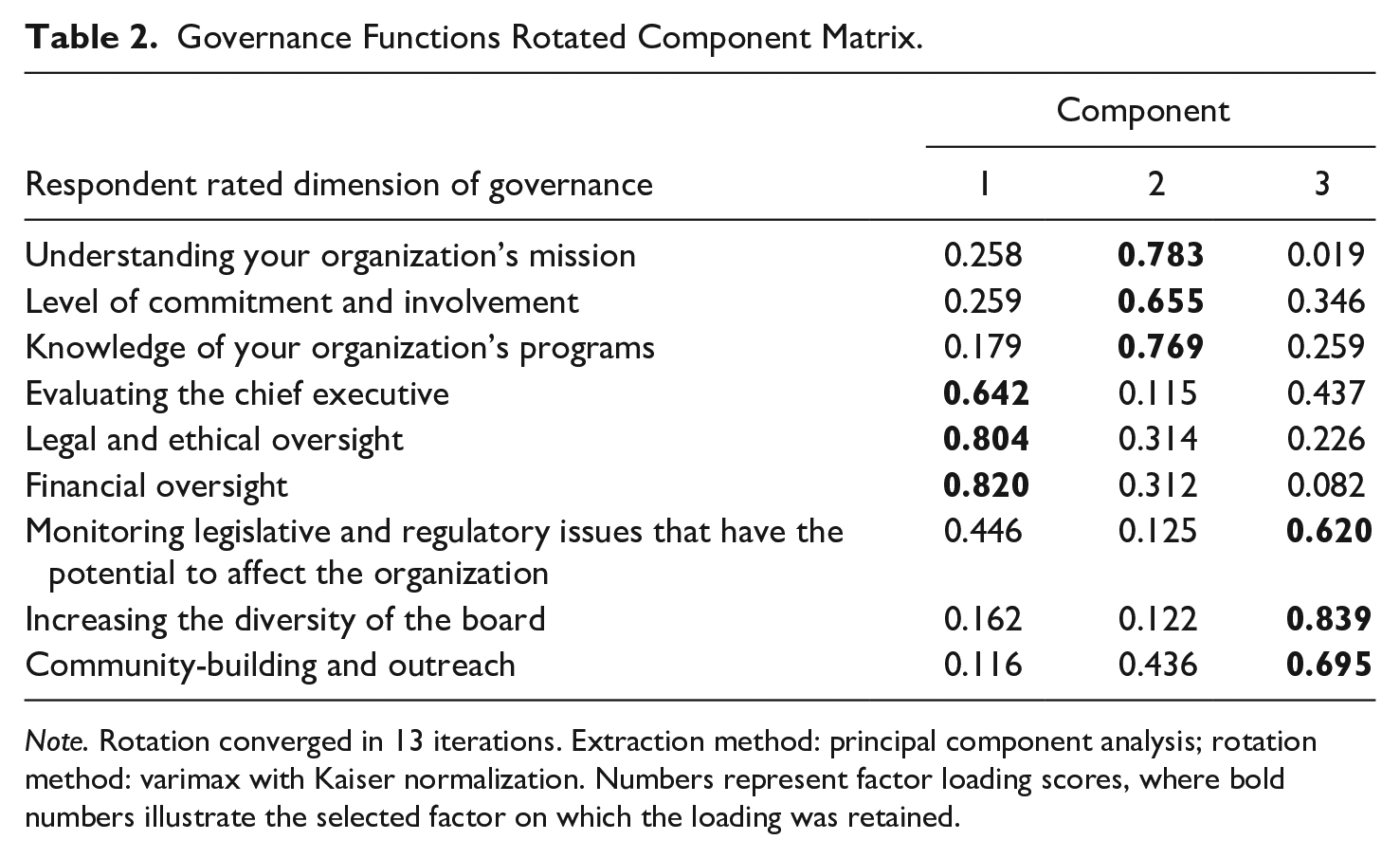
Note. Rotation converged in 13 iterations. Extraction method: principal component analysis; rotation method: varimax with Kaiser normalization. Numbers represent factor loading scores, where bold numbers illustrate the selected factor on which the loading was retained.
Factor analysis informed the construction of measurement scales, which were labeled “Strategic Oversight,” “Internal Awareness,” and “External Engagement” respectively. The first factor, Strategic Oversight included three items encompassing functions of fiduciary and strategic importance to the board, including evaluating the CEO, and monitoring financial, legal and ethical concerns. Strategic planning (Brown & Guo, 2010), financial oversight and planning, and CEO oversight have been deemed central to managing organizational performance in prior studies (Herman & Renz, 2000). Our measure presented a reliability of Cronbach’s alpha = .777 and a mean of 2.77 (SD=.8352).
Internal Awareness, the second factor, composed of three items, presented a mean of 2.94 (SD = .6869) with a reliability of Cronbach’s alpha = .734. Boards with clear understanding of, and commitment to, their organization’s programming, including its mission, have been associated with improved board performance (Bernstein et al., 2015). In the absence of attention to executive and board roles, leadership and governance responsibilities, and mission accountabilities, it is difficult to foresee how top leadership teams improve organizations, much less perform the governance function properly (Drucker, 1990).
Provan (1980) identified the need to emphasize the external role of the board when nonprofits face highly uncertain environments. External Engagement reflects the need for nonprofit boards to compete for resources, including donations, talented and diverse board members, and community recognition (Bernstein et al., 2015). In addition, attention to monitoring legislative and regulatory issues as well as those on whom they rely for funding and support require an external orientation (Provan et al., 1980). The three-item scale representing External Engagement demonstrated reliability (Cronbach’s α = .732), and a lower mean of 1.87 (SD = .8197).
As social and interpersonal dynamics have been shown to affect aspects of Board Performance (Van Puyvelde et al., 2018), we included two mediating variables addressing board social climate. The first is a nine-item measure of the perceived importance of Diversity and Inclusion Competence to the board that asked participants to rate “How important is diversity and inclusivity of your board for increasing your ability to advance on the following issues?” where examples of issues considered included “Understand the changing environment from a broader perspective,” “Monitor and strengthen programs and services,” and “Attract and retain top talent for the staff.” Responses were provided using Likert-style four category scales (not important at all = 1, only somewhat important = 2, important = 3, very important = 4). Reliability of the scale was good, with a Cronbach’s alpha = .906 among the nine items, with a collective mean of 3.21 and a standard deviation of .6305. The second measure reflects perceptions of Board Culture, based on a 15-item scale in which participants considered, “How strongly do you agree or disagree with the following statements related to your board’s culture?” Responses to items such as, “We have a clear vision that inspires me to work with enthusiasm and commitment” or “Board members listen attentively and respectfully to each other,” were provided using a five-category Likert-style scale (e.g., strongly disagree = 1, disagree = 2, neither agree nor disagree = 3, agree = 4, strongly agree = 5). The scale demonstrated a mean of 4.01 (SD=.7414) and a reliability of Cronbach’s alpha = .949.
Control Variables
Variables were introduced to address and control for confounding effects in the modeling of the predicted diversity-outcome relationships. Prior research has identified the value of controlling for differences in organization sector, scope of service area, and organization size to capture differences and ensure comparability within samples (Bradshaw & Fredette, 2013). Controlling for differences resulting from organization sector was accomplished with the inclusion of a single-item question, “Which part of the nonprofit sector most closely fits the work of your organization?” which included the 26 coded response categories. Respondents were asked to identify, “How would you describe the primary service area of your organization?” based on the following coded categories (ranging from “Local” = 1 up to “International” = 6), which was included to control for differences in scope of service area. Differences in organization size, particularly as they might relate to organizational performance variables (Brown, 2005) and the capacity to resource the recruitment of diverse or traditionally-marginalized leaders and governors, were included as control variables using a single-item measure asking, “What were your organization’s total revenues in your most recently completed fiscal year?” with seven categories (ranging from “less than US$1 million”=1 up to “US$100 million or more”=7).
Results
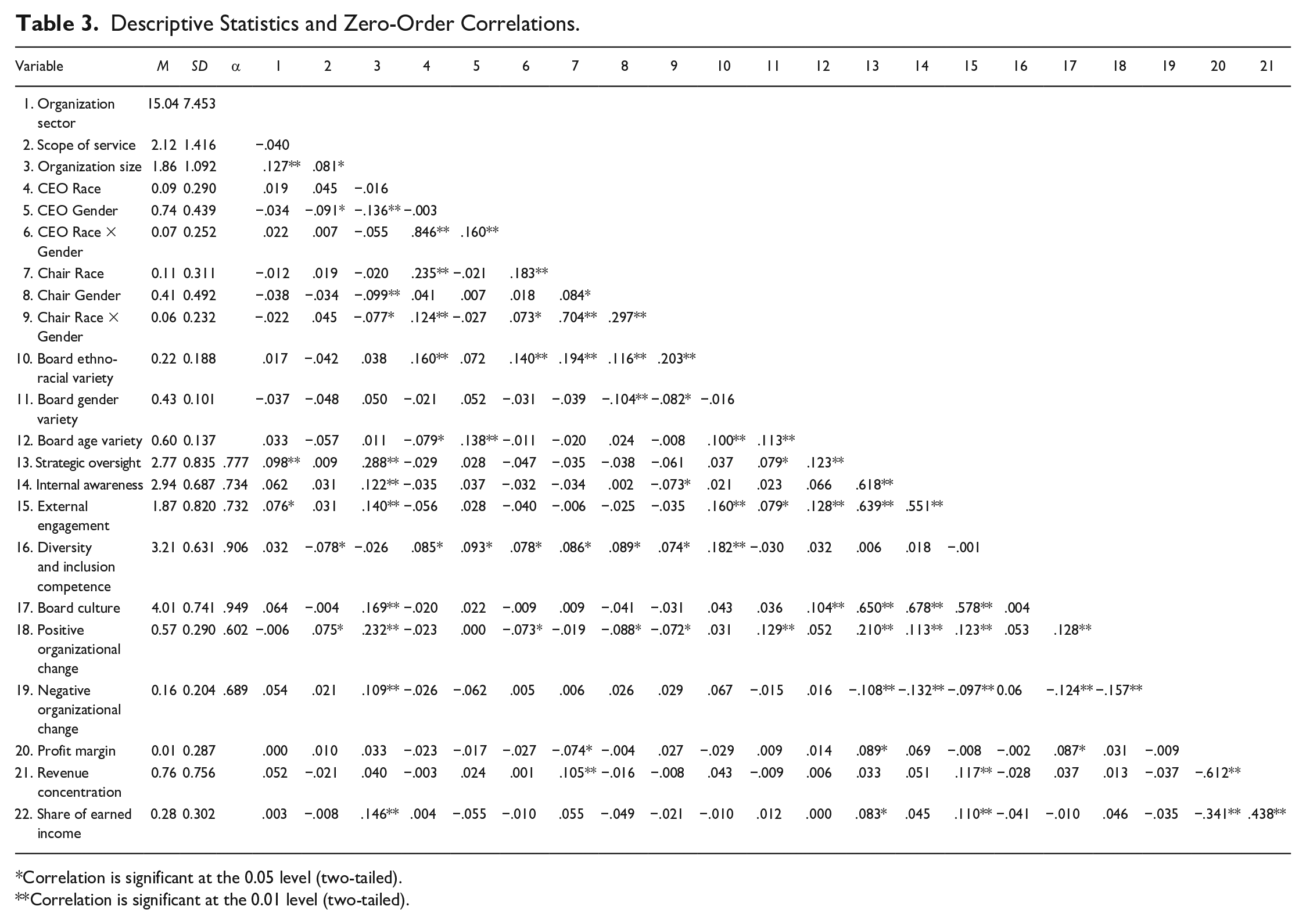
We used Process v3.3 for SPSS (Hayes, 2017) to test our moderated-mediation model. Summary statistics associated are included in Table 3, illustrating descriptive statistics, reliability statistics, and correlations.
Descriptive Statistics and Zero-Order Correlations.
Correlation is significant at the 0.05 level (two-tailed).
Correlation is significant at the 0.01 level (two-tailed).
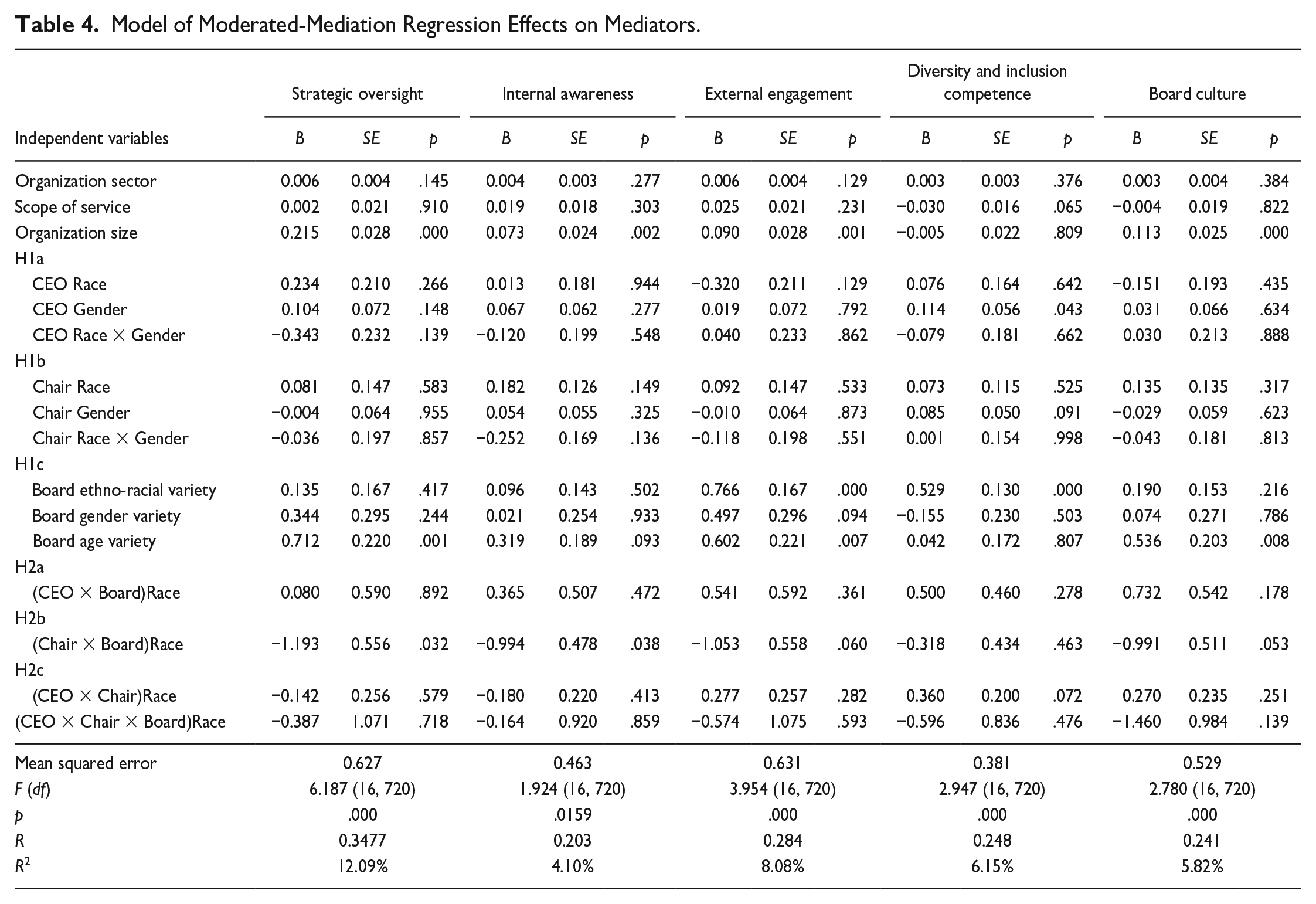
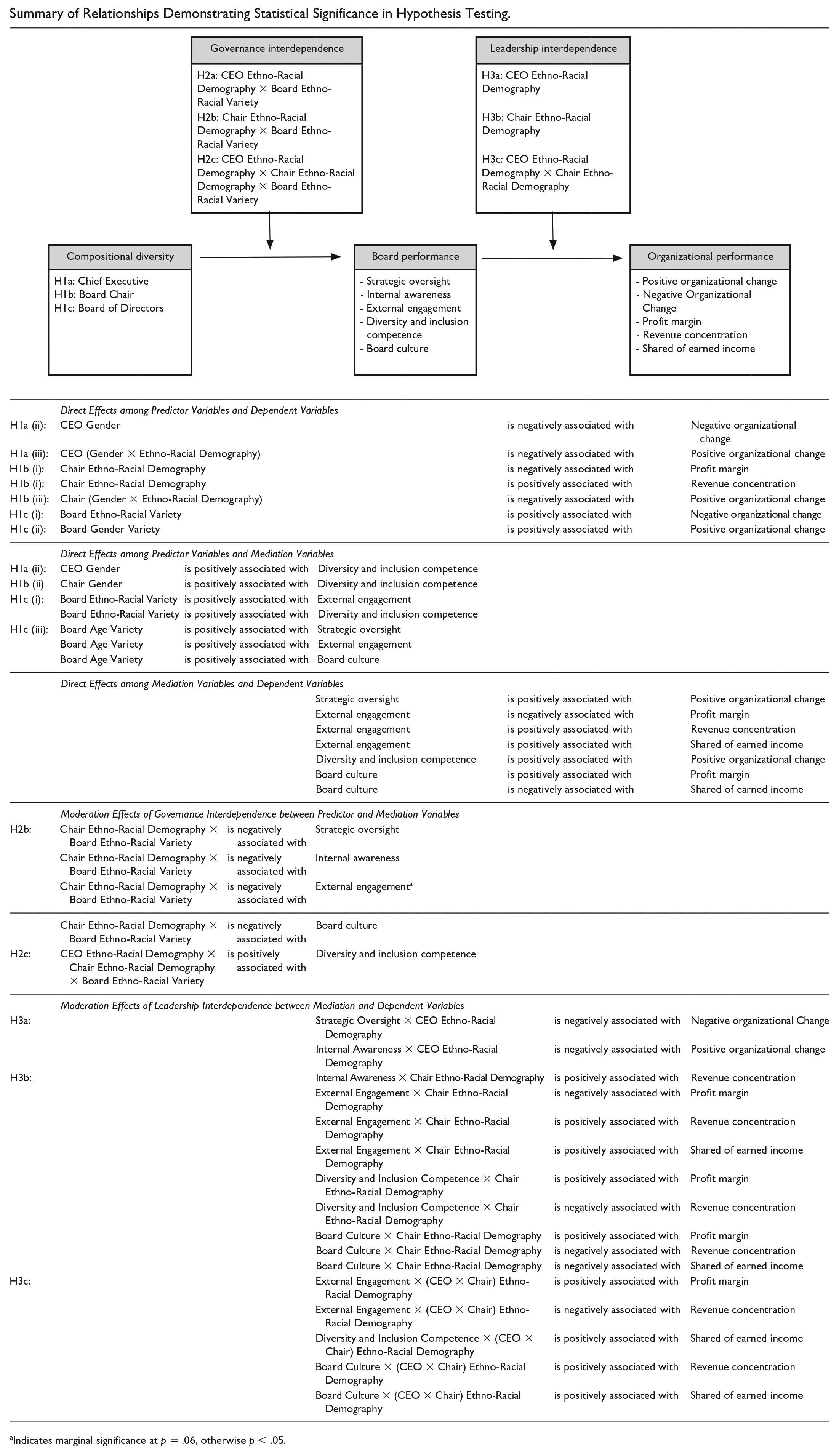
Testing moderated mediation is a multistep process that simultaneously models direct, mediating, and moderating effects for a dependent variable, requiring that we repeat the estimation process for each subsequent dependent variable. Details of each moderated-mediation regression analysis are included in Table 4, with the dependent variables displayed in Table 5 (the appendix illustrates the pattern of relationship discussed below).
Model of Moderated-Mediation Regression Effects on Mediators.
Model of Moderated-Mediation Regression Full Effects.
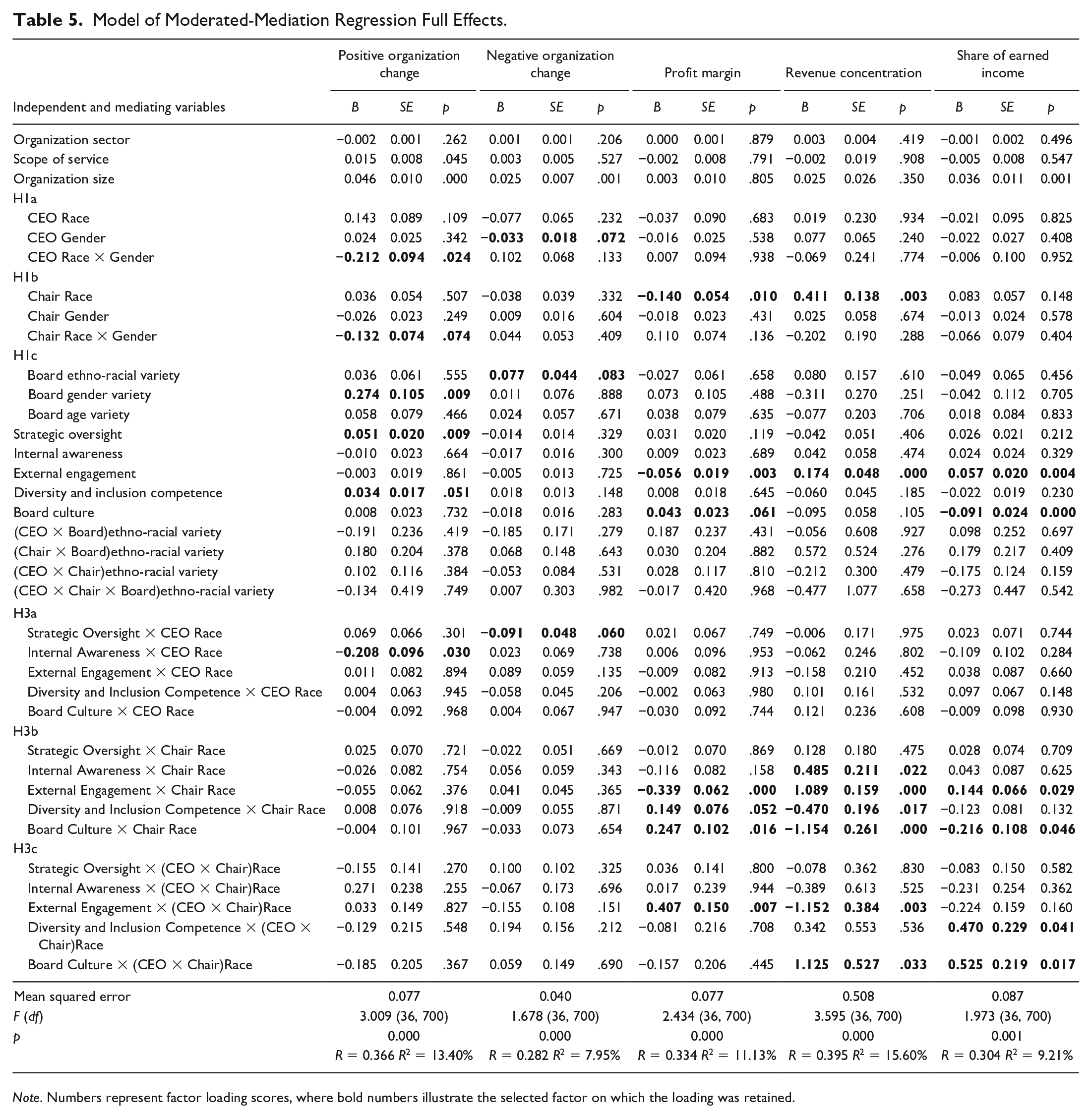
Note. Numbers represent factor loading scores, where bold numbers illustrate the selected factor on which the loading was retained.
Testing revealed significant direct and interaction effects of predictors on both the mediator and dependent variables, not always in the manner anticipated. First, hypotheses (H1a, H1b, H1c) anticipated Board Performance to mediate the Compositional Diversity and Organization Performance, it did not. Generally, significant relationships among aspects of Compositional Diversity, Board Performance, and Organizational Performance were found; however, all relationships among constructs were direct, with the exception of two conditional indirect effects. First, the mediation of External Engagement between Board ethno-racial variety and Revenue Concentration (effect = .0489, confidence interval [CI] = [.0190, .0862]), and second, the mediation in the relationship of Board ethno-racial variety and Share of Earned Income (effect=.0290, CI = [.0006, .0633]), occurring only when both CEO and Chair identified as White. That said, direct positive associations were found between facets of board diversity and each mediator (Table 4), with some association to positive and negative organizational change (Table 5). Variety in Board age, a frequently overlooked dimension of diversity, demonstrated positive association with two functional and one social dimension of Board Performance. Gender of CEOs and Chairs was positively associated with only one mediator, Diversity and Inclusion Competence, and only CEO gender was associated with reducing negative organizational change. Racialized female CEO and Chairs were negatively associated with positive organizational change only.
Second, hypotheses (H2a, H2b, H2c) testing moderation among CEO, Chair, and Board roles with respect to ethno-racial diversity for factors of board performance suggest the importance of Chairs. Predicted interactions between CEO ethno-racial demography and Board ethno-racial variety were unsupported (H2a). Negative interactions (Chair x Board) were found for all mediators except Diversity and Inclusion Competence (H2b), which was the only factor moderated by CEO–Chair interaction (H2c). These interactions highlight the presence of interdependencies among governance positions and roles associated with aspects of Board Performance (Table 4).
Third, support for hypotheses examining moderation between Board Performance and the board ethno-racial demography of the CEO (H3a), the Chairs (H3b), and the CEO–Chair interaction (H3c), for Organizational Performance were partial and inconsistent. CEO ethno-racial demography negatively moderated the relationship between Internal Awareness and Positive Organizational Change (H3a: B = −.208, p = .03), with a marginal negative moderation associated with Strategic Oversight and Negative Organizational Change (H3a: B = −.091, p = .06).
Results were more frequent for the moderation of Chair ethno-racial demography between Board Performance and each financial element of Organizational Performance (Table 5, H3b), with the exception of Strategic Oversight, which showed no direct, indirect, or interacting association with our financial measures. Testing the last hypothesis (H3c), three-way interactions between the ethno-racial demography of CEOs and Chairs, and Board Performance were found for Profit Margin (External Engagement: B = .407, p=.007), Revenue Concentration (External Engagement: B = −1.152, p = .003; Board Culture: B = 1.125, p = .033), and Share of Income Earned (Diversity and Inclusion Competence: B = .470, p = .041; Board Culture: B = .525, p = .017). Interactions highlight the presence of interdependencies among leadership positions associated with aspects of Organizational Performance (Table 5).
We observe the patterns of direct effects of diversity on our mediator and dependent variables, such that Boards are more associated with Board Performance than Organizational Performance. The opposite is observed for CEOs, with very little association with mediator variables, and a more direct and interacting association with dependent variables. Board Chairs demonstrate some direct association with dependent variables, but very frequently interact with CEO or Board diversity and aspects of Board Performance to inform financial measures of Organizational Performance. Mediation hypotheses (H1a, H1b, H1c) were not supported.
Discussion and Implications
While the data do not strictly support our hypotheses, they provide some evidence supporting the association of diversity and Organizational Performance, as well as diversity and Board Performance. We found that these effects were direct rather than mediated, with interdependence among positions and roles demonstrated in the interactions among CEO, Chair, and Board diversity across the range of measures (see the appendix). The intent of our effort was to decompose the impact of leadership diversity, by discerning loci of influence and their differential reach on proximal or distal outcomes, to better understand how and why diversity matters in the leading and governing of nonprofit organizations. To this end, we have isolated the influence associated with CEO and Chair positions from their roles as part of the Board and disentangled the influence of each source of influence, demonstrating that the Board composition (in terms of gender, age, and ethno-racial variety) largely affects proximal Board Performance outcomes, whereas CEO demography is more related to distal Organizational Performance outcomes. Board Chairs stand out as bridging both proximal and distal outcomes, both directly and through their interactions with Board diversity and CEO demography. This highlights that interdependencies among CEO, Chair, and Board roles are unique in their influence on different types of performance, suggesting that the influence of diversity will vary by role or position, and that diversity will matter differently as a result. For instance, our modeling of direct main effects is less telling than the interactions among the CEO and Chair, or Chair and Board, which frequently generated significant effects where none existed from main effects alone and altered effect direction in other cases. This offers a more granular perspective on the role of leadership and governance diversity in improving performance that begins to inform why linkages between compositional diversity and organizational performance have been elusive.
In addition, decomposing the reach of diversity’s influence advances the understanding of both how to build more effective and inclusive nonprofit governing groups and where to leverage diversity’s potential to improve equity among leaders and governors. One implication of this research is to question whether we should conceive of leadership diversity as different from, but related to, governance diversity while realizing the two are nested in most cases, because it seems that the nature and reach of influence reflect unique loci. This may be further complicated in contexts where a CEO–Chair duality exists. The ability to define how and why influence of diversity is mobilized should afford managers, leaders, and policymakers the opportunity to determine where the leverage points lie in organizations, and how we might attend to the most impactful loci needed to build healthy and sustainable organizations.
Finally, this research took a performance-oriented perspective of leadership diversity, which is by its nature instrumental in its treatment of people and extractive in its treatment of value, a view commonly embedded in organizational theory (Ray, 2019). The business case for diversity has been a useful tool for advancing theory, but perhaps the broader implications of ensuring equal opportunity in the leadership and governance of nonprofit organizations should not be lost, and the implications for people should not be overlooked. To this end, a shift away from instrumental thinking and toward a “justice case for leadership diversity,” where the logic of the business case might be an integral component, but the extraction of benefit is not the end goal, is past due.
Limitations and Future Considerations
The BoardSource “Leading with Intent” survey of Chief Executive Officers may have limitations that affect this study. First, we acknowledge the potential bias that is associated with self-reported data. However, it is unclear whether potential bias is more or less prevalent among our respondents than in the population at large. Second, respondents to this survey may be self-selecting based on an interest in governance practice, learning, and organization-level improvement. Despite these limitations and that we limited our data to U.S. charities with differentiated CEO and Chair roles, we are confident that this study represents a rigorous examination of the impact of leadership diversity on organizational performance, which could form the basis for future longitudinal analysis.
While aspects of the interplay among compositional diversity, board function, and organizational outcome are uncertain, our findings offer insight into the interdependence among dimensions of leadership and governance diversity, and how these relate to board and organizational performance. Here we were able to begin to decompose the complex relationships between differing loci of leadership diversity, and their reach in shaping proximal and distal performance outcomes. Many questions remain, however, among these are issues surrounding the duality of CEO–Chair governance structures as well as the determinants of board and organizational performance beyond those associated with compositional diversity. These and a number of other considerations illustrated in Table 3 hint at potential paths for further exploration, in which we hope others will join us in examining as the capacity for longitudinal study improves.
Footnotes
Appendix
Summary of Relationships Demonstrating Statistical Significance in Hypothesis Testing.
| Direct Effects among Predictor Variables and Dependent Variables | |||||
| H1a (ii): | CEO Gender | is negatively associated with | Negative organizational change | ||
| H1a (iii): | CEO (Gender × Ethno-Racial Demography) | is negatively associated with | Positive organizational change | ||
| H1b (i): | Chair Ethno-Racial Demography | is negatively associated with | Profit margin | ||
| H1b (i): | Chair Ethno-Racial Demography | is positively associated with | Revenue concentration | ||
| H1b (iii): | Chair (Gender × Ethno-Racial Demography) | is negatively associated with | Positive organizational change | ||
| H1c (i): | Board Ethno-Racial Variety | is positively associated with | Negative organizational change | ||
| H1c (ii): | Board Gender Variety | is positively associated with | Positive organizational change | ||
| Direct Effects among Predictor Variables and Mediation Variables | |||||
| H1a (ii): | CEO Gender | is positively associated with | Diversity and inclusion competence | ||
| H1b (ii) | Chair Gender | is positively associated with | Diversity and inclusion competence | ||
| H1c (i): | Board Ethno-Racial Variety | is positively associated with | External engagement | ||
| Board Ethno-Racial Variety | is positively associated with | Diversity and inclusion competence | |||
| H1c (iii): | Board Age Variety | is positively associated with | Strategic oversight | ||
| Board Age Variety | is positively associated with | External engagement | |||
| Board Age Variety | is positively associated with | Board culture | |||
| Direct Effects among Mediation Variables and Dependent Variables | |||||
| Strategic oversight | is positively associated with | Positive organizational change | |||
| External engagement | is negatively associated with | Profit margin | |||
| External engagement | is positively associated with | Revenue concentration | |||
| External engagement | is positively associated with | Shared of earned income | |||
| Diversity and inclusion competence | is positively associated with | Positive organizational change | |||
| Board culture | is positively associated with | Profit margin | |||
| Board culture | is negatively associated with | Shared of earned income | |||
| Moderation Effects of Governance Interdependence between Predictor and Mediation Variables | |||||
| H2b: | Chair Ethno-Racial Demography × Board Ethno-Racial Variety | is negatively associated with | Strategic oversight | ||
| Chair Ethno-Racial Demography × Board Ethno-Racial Variety | is negatively associated with | Internal awareness | |||
| Chair Ethno-Racial Demography × Board Ethno-Racial Variety | is negatively associated with | External engagement a | |||
| Chair Ethno-Racial Demography × Board Ethno-Racial Variety | is negatively associated with | Board culture | |||
| H2c: | CEO Ethno-Racial Demography × Chair Ethno-Racial Demography × Board Ethno-Racial Variety | is positively associated with | Diversity and inclusion competence | ||
| Moderation Effects of Leadership Interdependence between Mediation and Dependent Variables | |||||
| H3a: | Strategic Oversight × CEO Ethno-Racial Demography | is negatively associated with | Negative organizational Change | ||
| Internal Awareness × CEO Ethno-Racial Demography | is negatively associated with | Positive organizational change | |||
| H3b: | Internal Awareness × Chair Ethno-Racial Demography | is positively associated with | Revenue concentration | ||
| External Engagement × Chair Ethno-Racial Demography | is negatively associated with | Profit margin | |||
| External Engagement × Chair Ethno-Racial Demography | is positively associated with | Revenue concentration | |||
| External Engagement × Chair Ethno-Racial Demography | is positively associated with | Shared of earned income | |||
| Diversity and Inclusion Competence × Chair Ethno-Racial Demography | is positively associated with | Profit margin | |||
| Diversity and Inclusion Competence × Chair Ethno-Racial Demography | is negatively associated with | Revenue concentration | |||
| Board Culture × Chair Ethno-Racial Demography | is positively associated with | Profit margin | |||
| Board Culture × Chair Ethno-Racial Demography | is negatively associated with | Revenue concentration | |||
| Board Culture × Chair Ethno-Racial Demography | is negatively associated with | Shared of earned income | |||
| H3c: | External Engagement × (CEO × Chair) Ethno-Racial Demography | is positively associated with | Profit margin | ||
| External Engagement × (CEO × Chair) Ethno-Racial Demography | is negatively associated with | Revenue concentration | |||
| Diversity and Inclusion Competence × (CEO × Chair) Ethno-Racial Demography | is positively associated with | Shared of earned income | |||
| Board Culture × (CEO × Chair) Ethno-Racial Demography | is positively associated with | Revenue concentration | |||
| Board Culture × (CEO × Chair) Ethno-Racial Demography | is positively associated with | Shared of earned income | |||
Indicates marginal significance at p = .06, otherwise p < .05.
Acknowledgements
This research is a collaborative effort resulting from the equal contribution of both authors. We gratefully acknowledge the support of BoardSource and its leadership team. Thanks also to the participants of a thoughtful and formative session of the Governance section of the 2019 ARNOVA conference, to past and current editorial leadership, and NVSQ’s anonymous reviewers for skillfully guiding us to our best work. We recognize Julie Ann Israel for insightful comments and feedback throughout the development of this work.
Declaration of Conflicting Interests
The author(s) declared no potential conflicts of interest with respect to the research, authorship, and/or publication of this article.
Funding
The author(s) received no financial support for the research, authorship, and/or publication of this article.
