




Abstract
We study the charitable behavior of the wealthiest individuals in a very affluent and unequal society, that of the Dutch during their “Golden Age” (late 16th to the 17th centuries). Did these wealthy elites share their prosperity with those less fortunate? Using rare data from printed sources and wills located in archives, we study their inter vivos giving as well as their charitable bequests. Our study shows that the elites were surprisingly uncharitable: Only 15% made documented life-time gifts, and their bequests were valued around 1% of their wealth. Charity was embedded in the whole social fabric save the frugal top. Our results show that burghers made more documented life-time gifts than those belonging to the nobility and regent classes. In addition, those belonging to a religious minority as well as those without children gave more. We conclude our article with implications and limitations of elite philanthropy for society.
Introduction
Can society rely on wealthy elites being charitable to address societal needs? 1 Recently, philanthropy as a source for societal well-being has been subject to much scrutiny, especially where Ultra High Net Worth Individuals are involved (e.g., Maclean et al., 2021; Reich, 2018; Saunders-Hastings, 2022; Sievers, 2010). In this article, we examine Ultra High Net Worth philanthropy in a historical context (in a related vein as do Casson & Casson, 2019; Duquette, 2019, 2018; Harvey et al., 2011, 2019; Maclean et al., 2021). Our case study pertains to a wealthy but highly unequal society over a long period, albeit in a very different context and era: the Netherlands during the “Golden Age” (late 16th to the 17th centuries).2 At this time, the Dutch elites were among the wealthiest people in the world. Dutch cities prospered, and their elites flaunted their abundant wealth. The Netherlands at that time had an economy with modern traits and flourishing markets, which has been labeled “the first modern economy” (de Vries & van der Woude, 1997) and “pioneers of capitalism” (Prak & van Zanden, 2023), with many civil institutions such as guilds, waterboards, and universities. The prominence of the Dutch in global prosperity makes it especially interesting to study the charitable behavior of the wealthiest individuals in the Netherlands at that time, and to ask: How charitable were the elites of the Dutch Golden Age? And, if there were differences in their charitable behavior, how can we explain these differences?
We begin with a short sketch of the historical landscape, in particular, the philanthropic landscape in the Netherlands of the Golden Age. We continue with an interdisciplinary review of theories related to charitable behavior. Drawing on these theories, we formulate hypotheses predicting and explaining differences in charitable behavior among the wealthiest. We then present our data, describe and analyze the amounts given by wealthy elites, and explain who gave (and who did not) by testing our hypotheses.
Our key findings are that, although Dutch society was among the most charitable in the world during their heyday of global capitalism, the ultra-rich Dutch men and women did not give much either during their life or on their death. So there was not a substantial social redistribution through these gifts. And Dutch philanthropy was not very redistributive either over regions, as most gifts were to those in the same place as the donor; nor was it highly redistributive over faiths, as most was given to co-religionists. The ultra-rich were surprisingly frugal, and their philanthropic behavior was essentially ad hoc and thus unpredictable, although we do find evidence on the relevance of belonging to a religious minority. This frugality holds true in a social context that likely promoted empathy more than is the case today, as the rich lived closer to the poor and the degree of religious observance was higher. The fact that Dutch philanthropy in the Golden Age was supported not so much by large gifts from the ultra-rich but by gifts from almost every other layer of society suggests, incidentally, that elite influence on public policy was counterbalanced by a broader set of, local, interests, norms, and values than would otherwise have been the case.
Philanthropy in the Dutch Golden Age
In the Netherlands, as almost everywhere on the European continent, there was no national poor law stipulating who should take care of whom, and under what conditions. Charity was, thus, not organized by state regulation, but regulated locally, and very much reliant on private charitable giving (de Boer, 2020; Heerma van Voss & van Leeuwen, 2012; McCants, 1997; Parker, 1998; Prak, 2018; Spaans, 1997; Teeuwen, 2015). This charitable giving originated from the medieval charity organized by the Catholic Church to help the parish poor by means of funds collected from parishioners (de Boer, 2020). At the end of the Middle Ages this meant that, in the towns, there might be various Catholic charities, and sometimes also a municipal body to help those (such as recent migrants) not in receipt of support from Catholic charities. All these organizations, including the municipal ones, were financed through gifts from the community, either through inter vivos gifts or testamentary dispositions (van Leeuwen, 2012; van Nederveen Meerkerk & Teeuwen, 2013). Most gifts were small and anonymous, deposited in church collection boxes, but some could be lavish and public, such as the conspicuous charity involved in establishing an almshouse (Looijesteijn, 2012; Looijesteijn & van Leeuwen, 2014). As Dutch charities tended to be frugal, spending less than they received, many charities built up sizable endowments. By and large Dutch charities evolved from depending on gifts from the living to financing themselves from their endowed capital, although lifetime gifts remained important overall (van Leeuwen, 2012, 2013; van Nederveen Meerkerk & Teeuwen, 2013).
The Reformation and the Golden Age led to a remarkable growth in forms of charity. After the Reformation, the civic authorities in the Netherlands no longer overlapped with the religious ones. Unlike in most parts of Europe, all religions were tolerated. The Calvinist or Dutch Reformed Church was the most favored church as only their faithful could occupy political posts, but there were also places of worship for Catholics, Lutherans, Jews, and various small Protestant denominations (Heerma van Voss & van Leeuwen, 2012; McCants, 1997; Parker, 1998). All could worship but all were also expected to take care of their poor. Over time many religious groups and individuals set up, and financed, specialized institutions, such as those for Catholic orphan boys, or Lutheran orphan girls, or Jewish girls who needed a wedding outfit, or elderly Calvinist men living in a home for the elderly, or Calvinist middle-aged women sheltered in an almshouse. All of these institutions—some of which can still be admired in all their splendor—needed to be financed, and for this the wealth of the Golden Age proved useful.
Despite its voluntary organization, the level of charitable giving during the Dutch Golden Age was probably the most generous in Europe. Lindert’s (1998) estimates for charitable expenditure show that the Dutch Republic and England and Wales were well above the levels of other European countries at the end of the eighteenth century, suggesting that expenditure in the Dutch Republic was above that of Britain before then. Van Bavel and Rijpma (2016) estimate that total charity made up about 3% of Dutch GDP in 1760. Furthermore, charitable giving was continuous, weathering economic crises for centuries (Teeuwen, 2015; van Leeuwen, 2012, 2013; van Nederveen Meerkerk & Teeuwen, 2013).
Urban expansion was a factor in its own right in explaining the growth of charity. Not only did many of the ultra-rich live in cities, so too did the poor, in part flocking to towns, where they would have, at least initially, fewer friends, relatives, and acquaintances to help them in dire times. In these small Dutch towns, the poor lived within walking distance of the rich and the middle classes. In Amsterdam they might live just around the corner from the stately homes of the super “capitalists” on the magnificent canals (Lesger & van Leeuwen, 2011). Dutch elites came across the poor on the streets, in their churches, perhaps begging on their doorsteps, and serving in their houses. They had an appreciation of the lives of the poor, and what might be needed to help them; and what might happen if help were not forthcoming during bitter winters, when unemployment was high, or during times of high bread prices. Dutch elites were in close contact with their poorer fellow citizens (Prak, 1998).
To reduce motives for giving to just a handful does not do justice to the range of reasons that might inspire wealthy individuals to give, and perhaps portray them as slightly more rational and slightly less humanitarian than was the case. Nonetheless, there were rational reasons to give, and these were widely understood by the wealthy. These were discussed in meetings of the charities on whose boards they served, and duly noted in the minutes. As Maclean et al. (2021), phrase it in their study on elite philanthropy in the United States and the United Kingdom today: “Philanthropy at scale pays dividends to donors as much as it brings sustenance to beneficiaries” (Maclean et al., 2021, p. 330).
In relation to charity, elites had both shared goals and individual selective incentives to contribute (van Leeuwen, 1994). As to the common good (for the elites), they wanted to support workers who could not earn enough in slack times so they would be available when needed later. Apart from regulating the labor market, charity served to avoid social unrest and to install a sense of being taken care of among the poor. Apart from legitimizing the social order and other shared goals, the elites also had personal reasons to give to charity (Heerma van Voss & van Leeuwen, 2012; McCants, 1997; Parker, 1998; Prak, 2018; Spaans, 1997; Teeuwen, 2015; van Leeuwen, 2012).
It enhanced their social status, and in the small oligarchic circles that ruled Dutch towns it functioned as a litmus test of who could be entrusted with positions in city government. Serving on the board of a charity created an opportunity for informal talks with future colleagues and potential business partners, and thus furthered careers not unlike the membership of the upper class social networks in New York in the late 1980s described by Ostrower (1995) or the membership of an elite fraternity today (for other case studies see e.g., Casson and Casson [2019] and Harvey et al. [2011, 2019] and Maclean et al. [2021]). For the poor, however, accepting charity meant receiving monetary gifts, but also bibles, cloth, bread, and medical services from which the elites also profited: a pauper child not inoculated against smallpox might also infect their families.
Several authors have tested this simple portrayal of motives against the Dutch empirical record on philanthropy from the 16th to the 19th centuries. Research supports these motives for elite philanthropy in Amsterdam, although the middle classes also played an important role, for example as members of boards of certain charities and through their charitable donations (van Leeuwen, 2012). Other scholars have also stressed the importance of the middle classes, as recipients of particular forms of charity, notably as “genteel” or “shamefaced poor,” as inmates of almshouses, and as profiting from civic orphanages that would take in their children if they died prematurely, sparing those children the fate of ordinary orphans. The Amsterdam civic orphanages took care of middle-class orphans rather well, feeding them a monotonous but nutritious diet (McCants, 1997). The governors of the Amsterdam civic orphanage were members of Amsterdam’s ruling oligarchy. They regarded the prosperity of the Golden Age as being rooted in free transactions on the market by prudent and successful businessmen. However, this freedom also implied a civic duty to protect poorer members of society, almost as if they belonged to the same household (McCants, 1997, pp. 18 and 201–202).
Theory and Hypotheses
Based on interdisciplinary historic and philanthropic literature covering motives for charitable giving, we examine which wealthy elites in the Golden Age we expect to have been more charitable, and why. This endeavor serves two purposes. It has a heuristic value in drawing our attention to possible determinants of giving by the wealthy. Furthermore, by testing contemporary theories against the historical evidence, we can examine the validity of these theories more extensively.
First of all, the wealthier an individual was, the more they could donate to charitable causes and the more substantial any charitable bequest might be. One needs to have income or liquid assets to give it away. Current day empirical studies of giving by the wealthy provide amble support for the higher charitable giving by those with higher income and wealth, in absolute amounts donated (James, 2020; Osili et al., 2021; Wiepking & Bekkers, 2012). We want to examine whether this was similar for the wealthy in the Dutch Golden Age, and formulate Hypothesis 1:
In addition to having sufficient wealth to enable them to donate money, people also need to believe that they and their families will be financially secure, now and in the future, before making significant charitable donations (Breeze & Lloyd, 2013; Schervish, 2008; Wiepking & Breeze, 2012). Even those with substantial wealth might feel financially insecure, thus inhibiting their charitable giving. We formulate Hypothesis 2:
Some studies argue that the self-made—compared with those who inherited money—are more significant charitable donors, for reputational reasons. Both Odendahl (1990) and Ostrower (1995) show that charitable activities (making donations or fulfilling prestigious volunteer positions) can be used to acquire status or reputation. For example, donations to prestigious institutions such as museums, theaters, and schools facilitate access to society’s elites (Reich, 2018). Those with “new” money especially use this as a strategy to facilitate access to networks of elites (Odendahl, 1990; Ostrower, 1995). The nouveaux riches exchange part of their economic capital for social and symbolic capital (Bourdieu, 1977; for historical applications see e.g., Harvey et al., 2011, 2019; Maclean et al., 2021). They pay their dues as newcomers to become accepted by the establishment. In line with the social capital exchange argument for the nouveaux riches, we argue that those in the Golden Age who earned their own wealth were larger donors than those who inherited that wealth—as was the case in medieval England, where merchants were more philanthropic than other elites (Casson & Casson, 2019). We formulate Hypothesis 3:
Some might argue that those with substantial financial means have a duty to support others less fortunate (Breeze & Lloyd, 2013). In the literature, this is typically referred to as: “noblesse oblige, often said to be typical of the attitudes of the privileged toward the rest of society, stated as the felt responsibility of the privileged to return some of the share to those considered less fortunate” (Ostrander, 1980, p. 31). Noblesse oblige is cultivated through families, but also through educational institutions which wealthy children attend, not in the least because these thrive through the generous contributions made by these children later in life (Odendahl, 1989; Schmitz et al., 2021).
Noblesse oblige can also be viewed as an instrument to maintain social status and order. Using the obligation of charity, the wealthy promote their own worldview by supporting those charities aligned with that worldview: “The charitable wealthy see themselves as upholders of an American democracy where they are the natural leaders who set an example within their local communities and nationally” (Odendahl, 1989, p. 240). Many wealthy have ambivalent feelings toward their inherited wealth as it makes them feel uncomfortable (Breeze & Lloyd, 2013). At the same time, they wholeheartedly embrace their position using charitable activities to maintain it (Ostrower, 1995).
“Individual giving, foundations, and other charitable devices provide them [the wealthy] and their families with authority, power, and the self-approbation that generosity bestows. . . . philanthropy is essential to the maintenance and perpetuation of the upper class in the United States” (Odendahl, 1990, p. 4).
We argue that noblesse oblige as an instrument to maintain social status and order also existed in the Golden Age in the Netherlands. The merchant who paid the dockers who unloaded his ships a wage insufficient to live on might have seen charity as the counterweight that balanced the scales of his conscience. We formulate Hypothesis 4:
Religion is considered a key motive for charitable donations across countries in the 21st century. The literature distinguishes two motives for religious donations: conviction and community (Bekkers & Schuyt, 2008; Wuthnow, 1991). Conviction relates to religious values motivating people to do good and help those in need, through in-person support, volunteering, or charitable giving. Religious giving is highly stratified: most religious people tend to give to co-religionists. For example, in her study of New York’s elites in the late 20th century Ostrower (1995) shows that wealthy Protestants, Catholics, and Jews first and foremost donated to causes within their own congregation, and only then to organizations in the realm of culture and education. All religions in the Dutch Republic of the Golden Age stipulated that giving to local co-religionists had priority over giving to either those of another religion in the same place, or to those of the same religion elsewhere (Heerma van Voss & van Leeuwen, 2012; Parker, 1998; Spaans, 1997).
Community relates to the social context created through religious participation, which encourages people to donate. For example, when attending religious services people receive requests for donations, which they then act upon. In the Golden Age, just as today, churches were places where people were constantly reminded of the need to give: in a collection box for the poor, or in a small bag that, at the end of a long wooden pole, would be brought under the nose of the churchgoer. Collection boxes were even present in the streets, while several times a year orphan boys and church representatives would go knocking door to door to collect for the poor. All but the very poor were expected to give, and almost everyone did (Teeuwen, 2015). Conviction and community motives are intertwined. Both the conviction and community arguments lead us to expect that religious motives would have been a powerful factor in most charitable donations and bequests in the Golden Age. In addition, Wiepking et al. (2014) show that the religious composition of a society also influences individual charitable giving. When people belong to a religious minority in a community, they are more strongly motivated to act according to their religious convictions and to express this, inter alia, through donations to co-religionists. Hence, we expect religious motives for giving to have been stronger among religious minorities. We formulate Hypothesis 5:
The presence of close relatives in need of financial support is an important factor limiting charitable giving and charitable bequests (Whitaker, 2007). As argued earlier, people need to believe that they and their families will be financially secure, now and in the future, before they are willing to make significant charitable donations and bequests. Often, the largest charitable bequests are made by those without surviving close relatives, mostly elderly widows without children. We formulate Hypothesis 6:
Data
Inter Vivos Giving
Historical philanthropy data come in various forms such as tax records, wills, collection reports, or biographical dictionaries (see, for example, Duquette, 2019, 2018; Harvey et al., 2011, 2019; Maclean et al., 2021). We have collected unique data from a variety of sources on the charitable behavior of the 263 wealthiest individuals in the Netherlands during the Golden Age. 3 We started from wealth estimates by Zandvliet and Lesger (2006), supplementing these with information from biographical dictionaries, databases, and wills located in a number of archives in the Netherlands and, in some cases, abroad. Casson and Casson (2019) followed a similar procedure.
This consolidated dataset includes information on individual characteristics, including religion, gender, marital status, and often whether the wealthy had any relatives. We know about their wealth- and how it had been obtained (through family or self-created)-, their occupation, or, in the cases of married women, that of their husband, place of birth, noble title, religion and information on marriage partners and children.
We have information on charitable donations, including whether the individual donated during their lifetime and whether the individual made charitable bequests. In some cases, there is also information on what type of cause the wealthy donated to. We can be almost certain that not all the charitable activities of the wealthiest Dutch men and women have been captured by Zandvliet and Lesger and our additional archival resources. Nor is it likely ever to be completely captured by subsequent research. Still, significant inter vivos charitable activities such as founding an almshouse or making a substantial donation, serving on the board of a charity, or being a patron of the arts are unlikely to have escaped observation; these acts were very public, and well documented.
Charitable Bequests in Wills
Zandvliet and Lesger’s data do not contain much information on testamentary gifts to charities. We, therefore, tried to locate the wills of all 263 individuals on our list. To this end, we first consulted major collections of early modern Dutch biographies. 4 This gave us no leads. We then consulted two databases. The first relates to the elite families comprising the Vroedschap, which ran Amsterdam’s city government. Being a member of this institution was a sure sign of power and prestige, and one could become a member only through co-optation (Elias, 1963). 5 The second database was the Getty Provenance Index, with information on legal documents from Dutch and other households relating to paintings and other art objects. 6 Together with the information from the secondary literature, this gave us some ideas, of where to locate the wills we were seeking.
We consulted online archival material in all relevant cases and then checked archives, notably in the cities of Amsterdam, the mercantile capital, and The Hague, the political capital, as well as the provincial archives of Friesland, Gelderland, Groningen, Overijsel, Utrecht, and Zeeland. This round of research limited our scope somewhat, but the overwhelming majority of the 263 on our list resided, at least a fair part of their time, in either The Hague or Amsterdam, and would have gone to a notary there when making a will. The provincial archives contain archives of predominantly noble families. In The Hague, we consulted the archives of the Supreme Council of Nobility and the archives of the Dutch royal family. We also consulted the municipal archives of The Hague (which contains the notarial archives), and the National Archives (which contains several family archives). In Amsterdam, we consulted the municipal archive (which contains both notarial as well as family archives), and the private archive of the Six family. After a search that continued on and off for over 5 years, we found one or multiple wills for a total of 77 (almost 30%) of the 263 individuals. In the case of three individuals (#34, #57, and #176 in the Online Appendix) we could not determine whether these were valid, executed, wills. We, therefore, excluded these cases from our analyses.
Our dependence on wills should not overshadow that early modern people had different avenues to dispose of surplus capital and did not always bother to write it down if they gave money to charity. Many of the wealthiest Dutchmen were expected to support people in their family circle and circles of dependents (servants, people who offered them services, neighbors, co-religionists) and will have spent capital in doing so.
Measures
Dependent Variables
The first dependent variable in our analyses measures whether there is documented evidence of a significant charitable lifetime donation (inter vivos giving). The second set of dependent variables measure whether the wealthy individual or their partner made a charitable bequest to either individuals (not including relatives; bequests to servants and other personnel were very common and are included) or charitable institutions in their will, and the amount of both types of bequest.
Independent Variables
The level of wealth was documented by Zandvliet and Lesger (2006). The wealthiest individual, Hans Willem Bentinck, in our database is estimated to have had assets totaling 17.8 million guilders and the “poorest” assets of 208,000 guilders (amounts converted to guilders in 1900; a guilder in 1900 is worth 14,65 euro in 2021)—the latest year in the conversion database, consequently the worth of the wealthiest individual in our data is 261 million euros or 295 million US$. 7
We argue that if there was a low risk attached to building and retaining wealth, the wealthy would feel more financially secure; this we measured using the variable financial risk. For all wealthy individuals, we assessed the risk to building up and retaining their wealth. We defined being an international merchant as high risk (Spooner, 1983), as was being a self-made man acquiring enormous wealth within just one generation. The wealth of, for instance, the married couple Herman Wormskerck and Judith Steenhuysen (#108 on Zandvliet and Lesger’s list) was estimated to have been high risk because Wormskerck was an immigrant who made his fortune in the linen industry and was, therefore, at the mercy of cyclical fluctuations in the volatile economy. Other examples of high-risk wealthy individuals were Louis de Geer (#4), who traded internationally in arms and metals and was dependent on war in Europe and the ability of his royal customers to compensate him for his services. Indeed, de Geer built up a feudal empire in Sweden because its king paid him in royal domains rather than coin. De Geer had the good fortune to live in a time when Europe was riven by war; he earned a vast fortune exploiting the opportunities it created, which led to him being ennobled in Sweden.
To distinguish between the wealthy who created their own wealth and those who acquired wealth through family connections, either through inheritance or marriage, we created dichotomous variables for the former (N = 72; 27.9%) and the latter (N = 83; 32.2%). We also created a third variable, mixed wealth (N = 103; 39.9%), which indicates those who derived their wealth from a mix of both family and self-achievement.
To determine the social status of the wealthy, we looked at whether they belonged to the nobility (N = 50; 19.1%), the regent class (N = 95; 36.3%), or whether they were burghers (N = 117; 44.7%). The nobility included everyone regarded as being of hereditary noble status in the Dutch Republic, but also those ennobled by foreign monarchs. The regent class consisted of everyone who was an official within the government of a city or of the state, or married to one. As such, they belonged to the ruling classes of the Dutch Republic and enjoyed considerable prestige, almost as much as the nobility. The burghers were men and women without such offices and ties, whose prestige was based primarily on their wealth.
In terms of religious affiliation, the wealthy predominantly belonged to the Dutch Calvinist or Reformed Church (N = 218; 82.9%), or to its sister church, the Walloon Reformed Church (which held its services in French). Only those belonging to these churches were allowed to occupy public office, like Wormskerck and De Geer, who were both elders of the church. We regard the wealthy adhering to other religious denominations as belonging to a religious minority, including those belonging to the Roman Catholic Church (N = 29; 11.0%) and small Protestant denominations (N = 14; 5.3%), and those who were Jews (N = 2; 0.8%).
Of the wealthy in our data, 82.9% (N = 218) were male, 97.2% were married (N = 247), and 85.7% (N = 180; 53) had surviving children on their death.
Analytical Strategy
To present a historical account of the charitableness of the elites of the Dutch Golden Age, and examine possible differences in their charitable behavior, we start with a descriptive overview of our data. Next, we conduct simple statistical analyses to test our hypotheses, including unconditional means comparisons with t-tests for mean differences, correlational analyses, and logistic and ordinary least squares (OLS) analyses. More detailed information about our analytical strategy and full results of all analyses conducted as well as more information about the representativeness of the sample are available as an Online Appendix.
Results
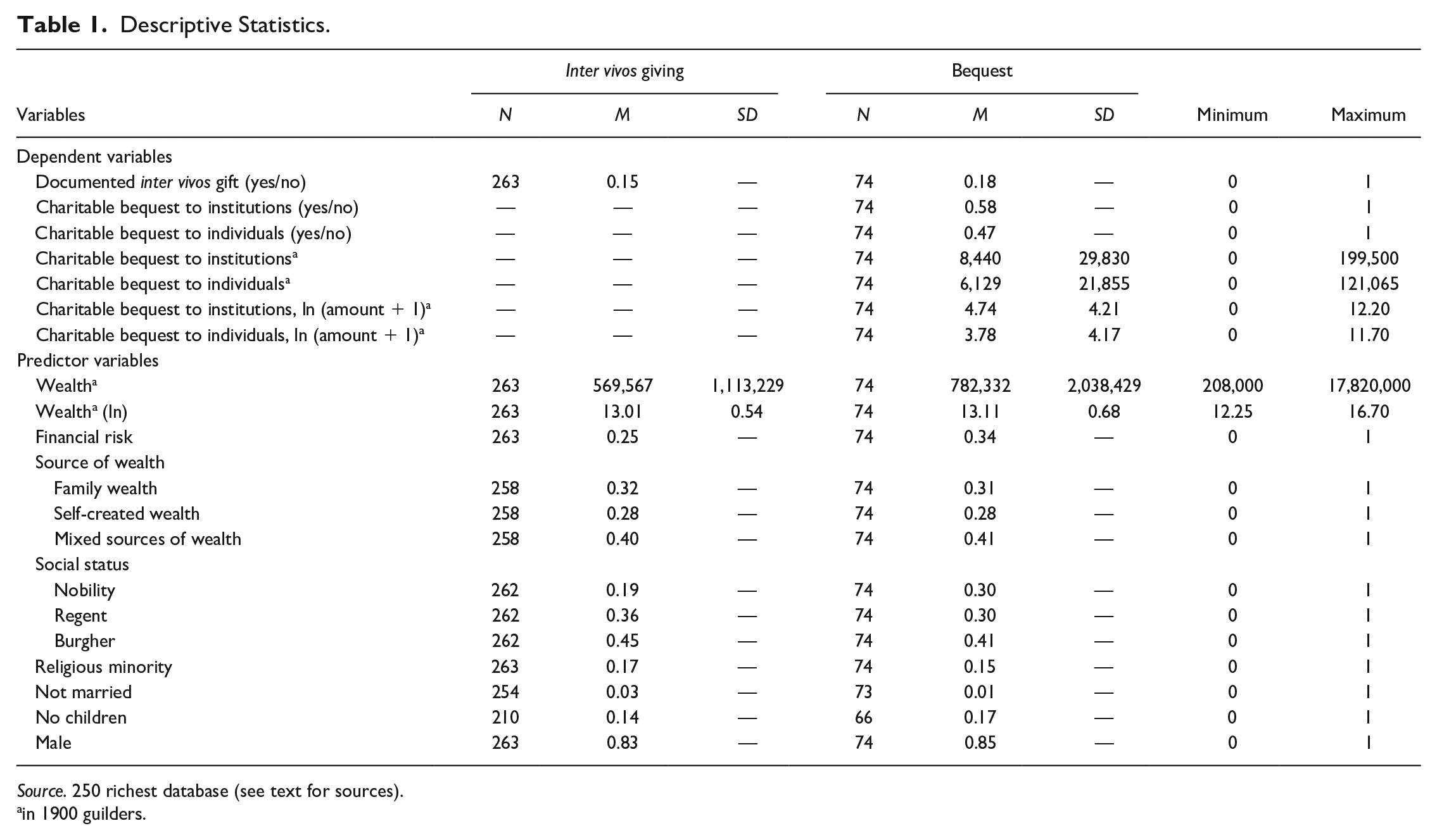
Table 1 shows the descriptive statistics for the variables included in the analyses of inter vivos giving and charitable bequests. How charitable were the wealthy elites in the Golden Age in the Netherlands?
Descriptive Statistics.
Source. 250 richest database (see text for sources).
in 1900 guilders.
Table 1 shows that few of the wealthy in our list made significant documented lifetime gifts: Only 14.8% (39 out of 263) did so. We find more evidence of generosity in their charitable bequests. Of the 74 individuals for whom we located valid wills, 35 (47.3%) made a charitable bequest to one or more individuals, and 43 (58.1%) made a charitable bequest to one or more institutions. The average charitable bequest to individuals was 6,129 guilders. The average charitable bequest to institutions was 8,440 guilders. Relative to average wealth (782,332 guilders among the 74 wealthy individuals making a valid bequest), these are rather modest sums, making up around 1% of wealth.
A typical “charitable” bequest involved leaving money to one’s servants. The sum usually depended on length of service, but was often considerable, enough, for example, to enable an elderly servant to secure a place in an almshouse, or a young servant to marry and establish a family (Looijesteijn, 2012). Quite often, these bequests took the form of the annual interest on a certain sum of money, to which the recipient was entitled for the rest of their life—in effect, a type of pension. Some domestic servants were allowed to remain living in the testator’s house in perpetuity, some received generous gifts enabling them to live out their lives in relative luxury. Zeger van Rechteren (#190), for example, left his servant 4,000 guilders (5,120 guilders in 1900) and the right to live in his house for life. He also founded an almshouse—such large gifts to one’s servants were rarely isolated. On the whole, however, these bequests were much more modest in size: 200 guilders was more frequent—still quite a generous sum for the servant concerned but small beer for the Dutch patrons, apart from the fact that it is a moot point if we are talking about charity.
It was fairly common to make a charitable bequest of a certain amount of money to institutions, usually to the deaconry of the Dutch Reformed Church or to the secular poor wardens of a particular place. Often, people would bequeath money to both, if a particular town or village had both religious and secular poor relief organizations. It was often the easiest way to donate money to a charitable institution, and on the whole was cheaper than founding one’s own poor relief agency. Most benefactors opted for this type of donation, with some bequeathing money to the poor relief agencies of a whole string of villages and places. These bequests were rarely very large, though sums of 500 and 1,000 guilders were quite common. Judith Steenhuysen and Herman Wormskerck (#108) for example left 1,500 guilders to the Dutch Reformed poor of Amsterdam, 500 guilders to those of Deventer, and 500 guilders to the poor travelers who applied to Amsterdam’s Dutch Reformed deaconry for help. 8 Next, we turn to examining and explaining potential differences in charitable behavior among the wealthy elites in the Golden Age.
In H1 we argued that those with higher levels of wealth would be more likely to make gifts. The results of an independent samples t-test, equal variances assumed; t(261) = 0.594; p = .277, one-sided test, show no relationship between documented higher levels of wealth and making significant lifetime donations. We found no significant differences in wealth for those who were found to be documented donors (M = 471,759, SD = 211,424) and those who were not (M = 586,595, SD = 1,202,677); those who made documented donations actually have slightly lower wealth on average. The results of an independent samples t-test also show no relationship between high levels of wealth and making a charitable bequest to either institutions, equal variances assumed; t(72) = −0.613; p = .271, one-sided test, or individuals, equal variances assumed; t(72) = −0.971; p = .167, one-sided test. When we consider the relationship between level of wealth and level of charitable bequests, we again find no relationship. There is no significant correlation between level of wealth and the natural log of the amount bequeathed 9 to institutions, r(74) = 0.079, p = .253, one-sided test, or individuals, r(74) = 0.133, p = .130, one-sided test. Hence, our results do not support the assumption that more wealth relates to higher giving, at least not for the wealthiest elites during this time period. Our results are in line with Van Nederveen Meerkerk (2010, 2012), who also found that the Dutch elites in Leiden, Utrecht, and Zwolle were just as likely to make charitable bequests as individuals from lower income groups.
We also expected that feeling financially secure, being confident that one’s family’s financial future is stable and secure, encourages people to make charitable donations and charitable bequests (H2). The descriptive results are in fact in contrast to our expectations. Those at high financial risk were slightly more likely to make lifetime gifts: 16.9% (N = 11) of them made documented gifts, while 14.1% (N = 28) of those at low financial risk were significant donors. However, the results of a chi-square test of independence, χ2(1, N = 263) = 0.300, p = .292, one-sided test, show that there were no significant differences in making donations between those at high or low financial risk, possibly because of the small numbers. 10
In relation to charitable bequests, the descriptive statistics show that those who faced low financial risk made bequests to institutions slightly more often: 61.2% (N = 30) of those at low financial risk and 52.0% (N = 13) of those at high financial risk were significant donors. However, the results of a chi-square test of independence, χ2(1, N = 74) = 0.579, p = .224, one-sided test, show that there are no significant differences in making bequests to institutions for those at high or low financial risk, possibly because of the small numbers. Those who faced low financial risk made bequests to individuals slightly more often too: 49.0% (N = 24) of those at low financial risk compared with 44.0% (N = 11) of those at high financial risk made significant bequests to individuals. Again, the results of a chi-square test of independence, χ2(1, N = 74) = 0.165, p = .343, one-sided test, show that there are no significant differences in making bequests to individuals for those at high or low financial risk.
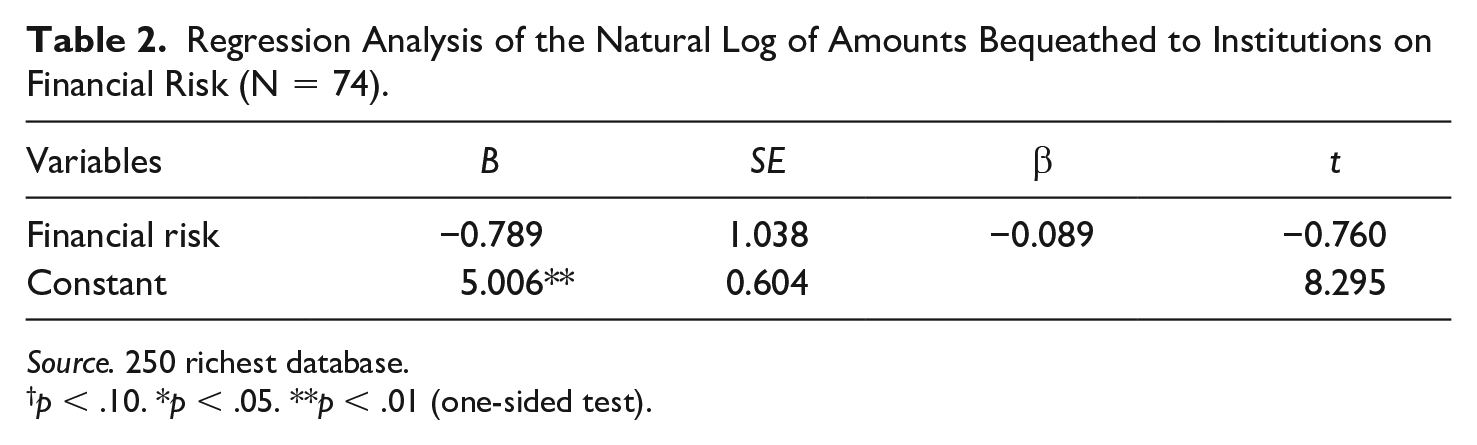
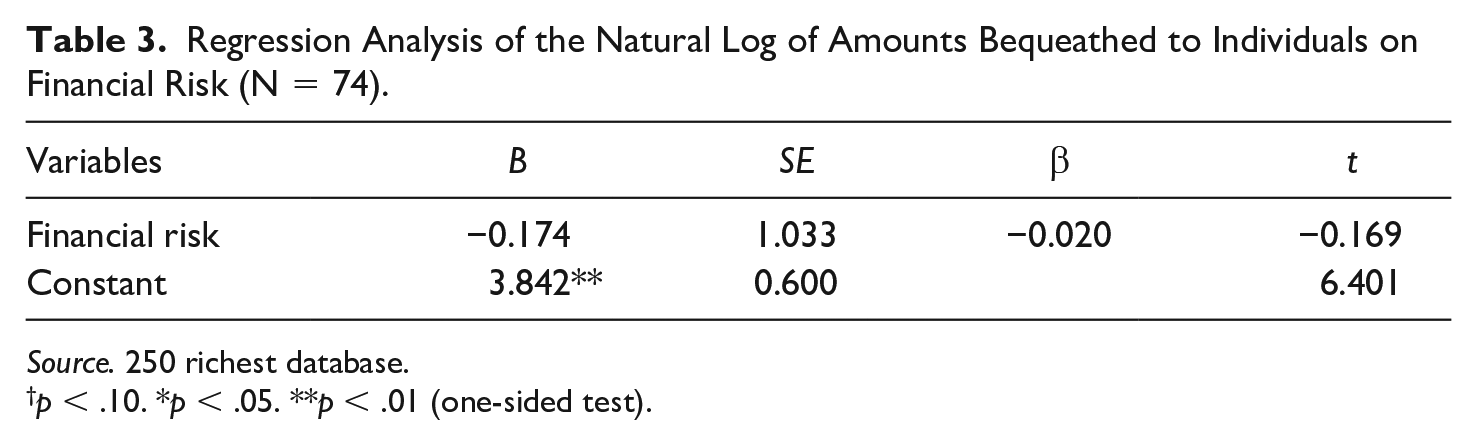
Tables 2 and 3 show the results of a regression analysis of the natural log of the amounts bequeathed to institutions and individuals respectively. The results show that level of risk associated with wealth is not significantly related to the level of either type of charitable bequest, although the relationship appears to be in the expected direction.
Regression Analysis of the Natural Log of Amounts Bequeathed to Institutions on Financial Risk (N = 74).
Source. 250 richest database.
p < .10. *p < .05. **p < .01 (one-sided test).
Regression Analysis of the Natural Log of Amounts Bequeathed to Individuals on Financial Risk (N = 74).
Source. 250 richest database.
p < .10. *p < .05. **p < .01 (one-sided test).
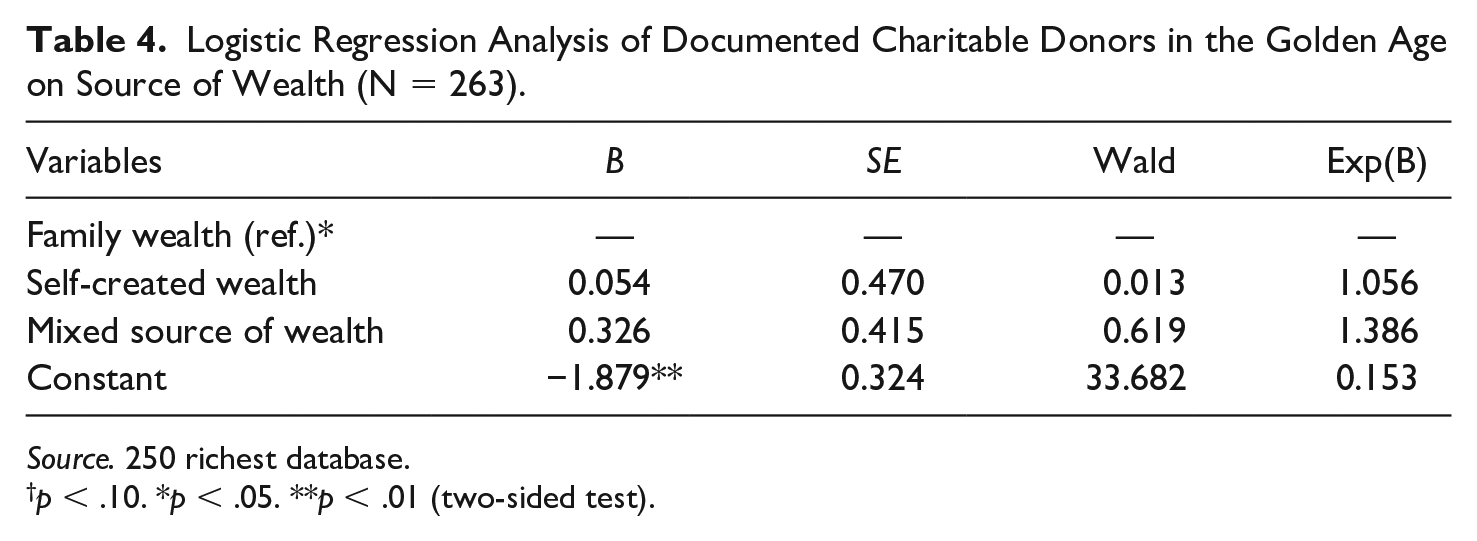
In H3, we argued that those who created their own wealth rather than inherited it would be expected to be more charitable. 13.9% (N = 10) of those who were self-made (N = 72) made a documented gift, compared with 13.3% (N = 11) of those who inherited their money (N = 83). Of those with a mixed source of wealth (N = 103), 17.5% (N = 18) made a documented charitable donation. Table 4 shows the results for the relationship between origins of wealth and likelihood of making a gift in a logistic regression model. The results show no support for a difference in wealth obtained by the wealthy themselves and through inheritance or by a mix of resources and the likelihood of making significant lifetime gifts.
Logistic Regression Analysis of Documented Charitable Donors in the Golden Age on Source of Wealth (N = 263).
Source. 250 richest database.
p < .10. *p < .05. **p < .01 (two-sided test).
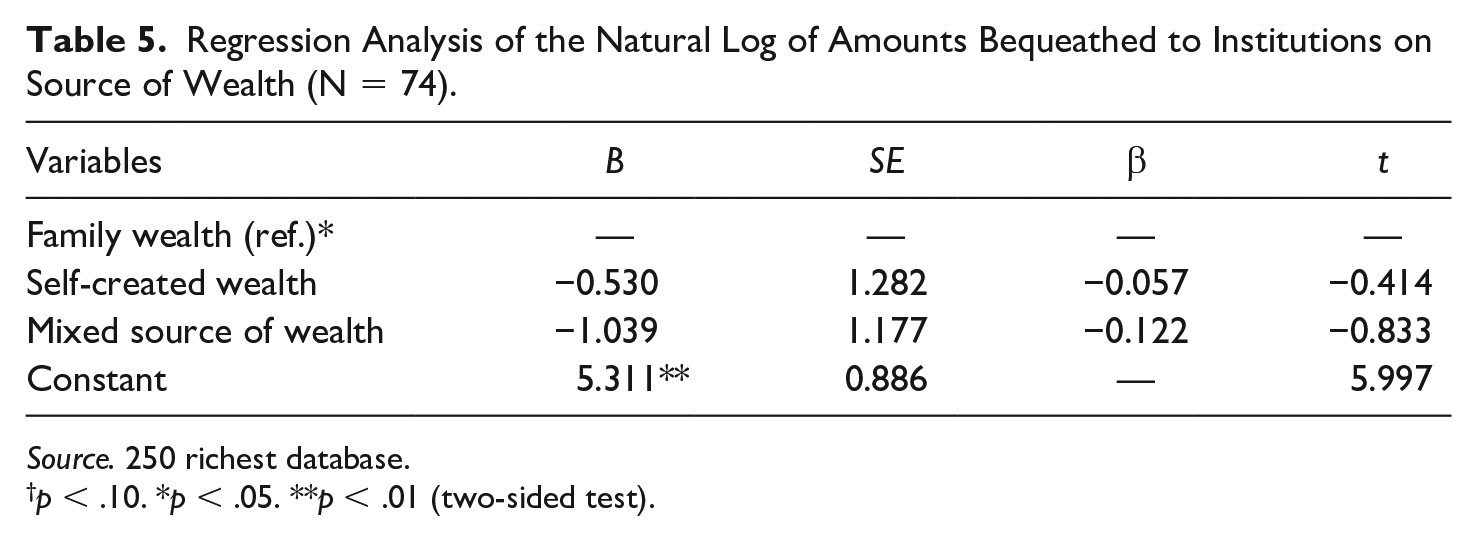
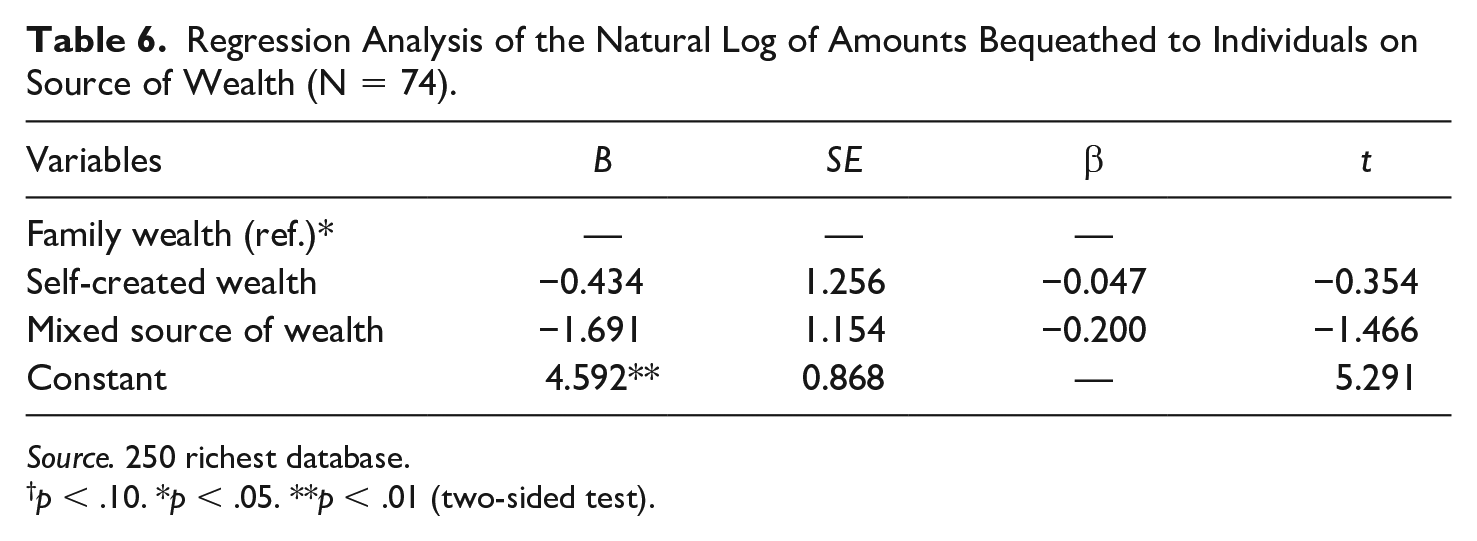
Our results further show that based on our data, there is no relationship between source of wealth and making charitable bequests to individuals and institutions (more detailed results are included in the Online Appendix). Tables 5 and 6, respectively, show the results of a regression analysis of the natural log of amounts bequeathed to institutions and individuals. These results indicate that both those who created their own wealth and those whose wealth originates from mixed sources made smaller charitable bequests to both institutions and individuals then those who inherited their wealth, but these differences are not statistically significant. As with inter vivos giving, we find no support for H3.
Regression Analysis of the Natural Log of Amounts Bequeathed to Institutions on Source of Wealth (N = 74).
Source. 250 richest database.
p < .10. *p < .05. **p < .01 (two-sided test).
Regression Analysis of the Natural Log of Amounts Bequeathed to Individuals on Source of Wealth (N = 74).
Source. 250 richest database.
p < .10. *p < .05. **p < .01 (two-sided test).
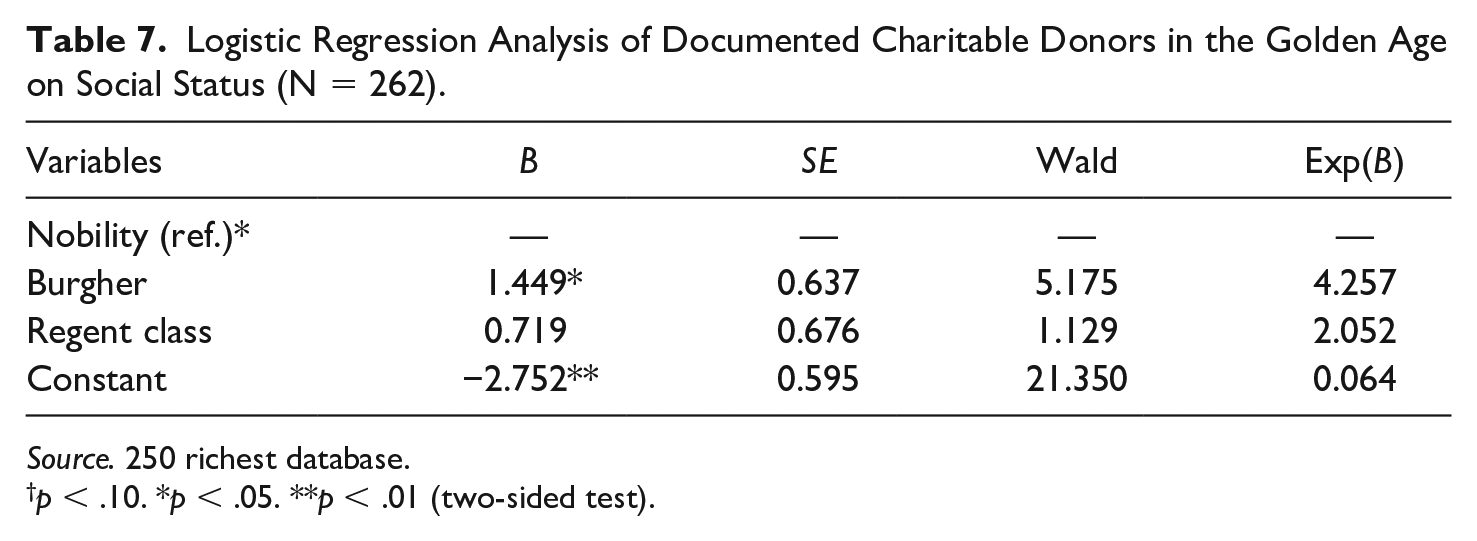
Examining the relationship between social status and charitable behavior among wealthy individuals in the Netherlands during the Golden Age, we find that social status mattered, but not in the way we expected in H4. No less than 21.4% of burghers (N = 117) made a documented lifetime gift, compared with only 6.0% of the nobility (N = 50) and 11.6% of regents (N = 95). The results from a logistic regression analysis show that burghers had a 4.3 higher predicted odds of making significant inter vivos donations than wealthy individuals belonging to the nobility class (see Table 7). Those belonging to the regent class also appear to be more likely to make inter vivos gifts than those belonging to the nobility class, but this result is not statistically significant.
Logistic Regression Analysis of Documented Charitable Donors in the Golden Age on Social Status (N = 262).
Source. 250 richest database.
p < .10. *p < .05. **p < .01 (two-sided test).
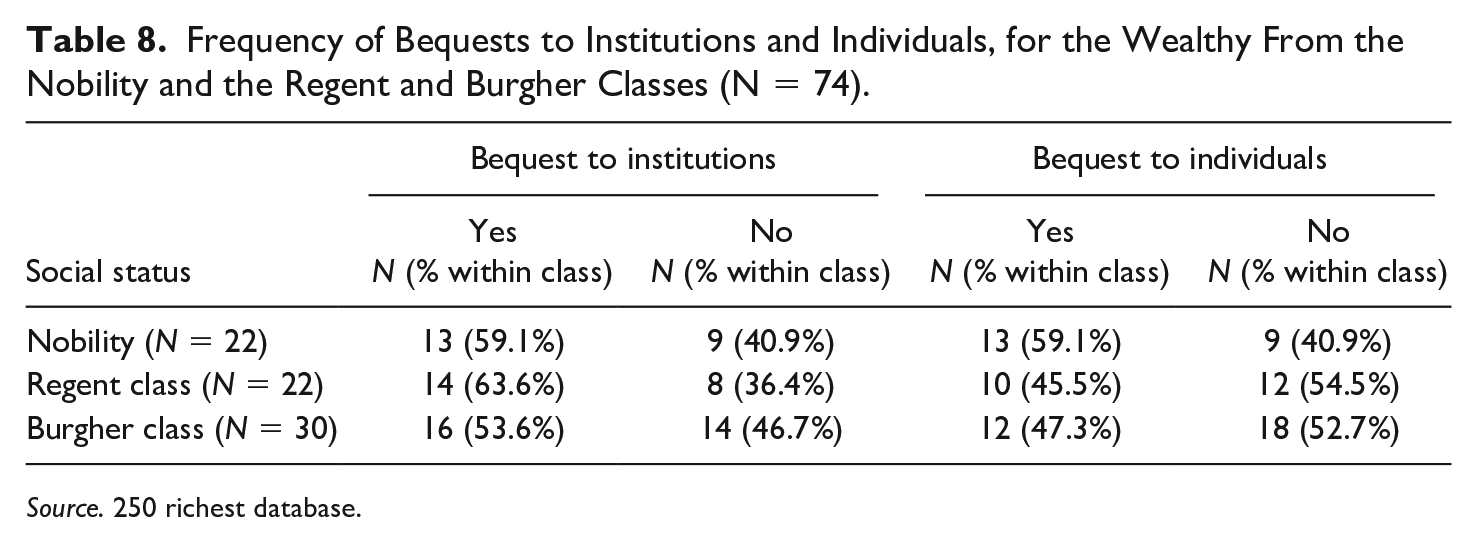
It is interesting to note that the frequency of making charitable bequests to either institutions or individuals is typically higher among the wealthy from the nobility and the regent class than among the wealthy from the burgher class (see Table 8).
Frequency of Bequests to Institutions and Individuals, for the Wealthy From the Nobility and the Regent and Burgher Classes (N = 74).
Source. 250 richest database.
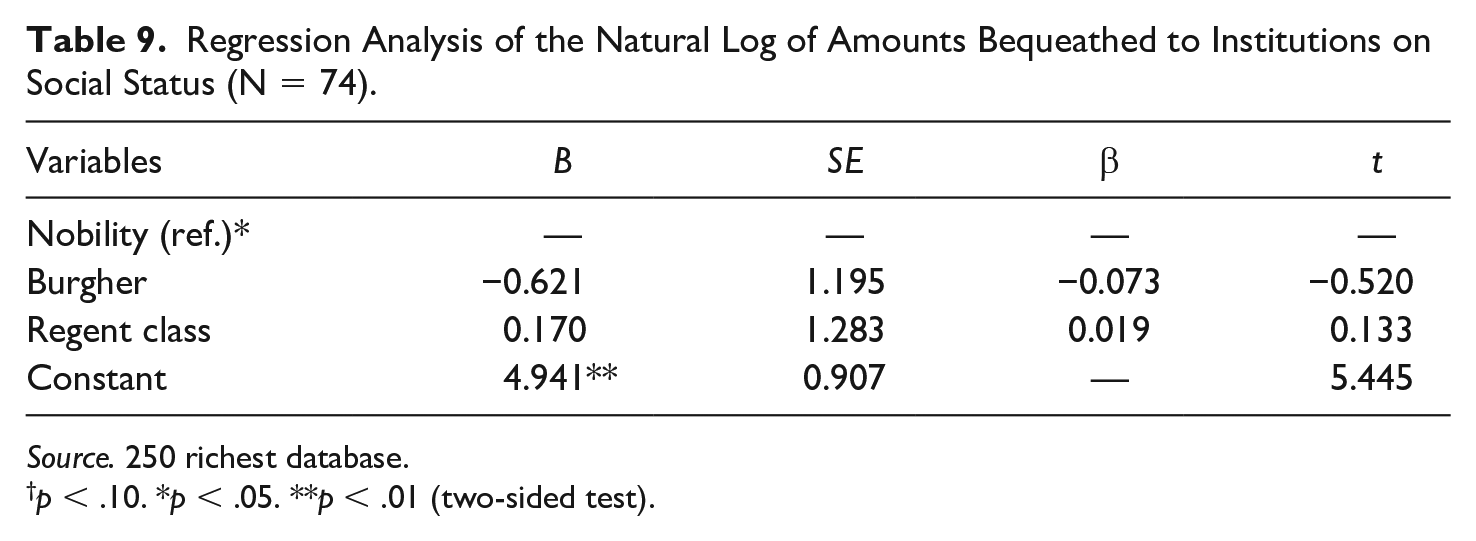
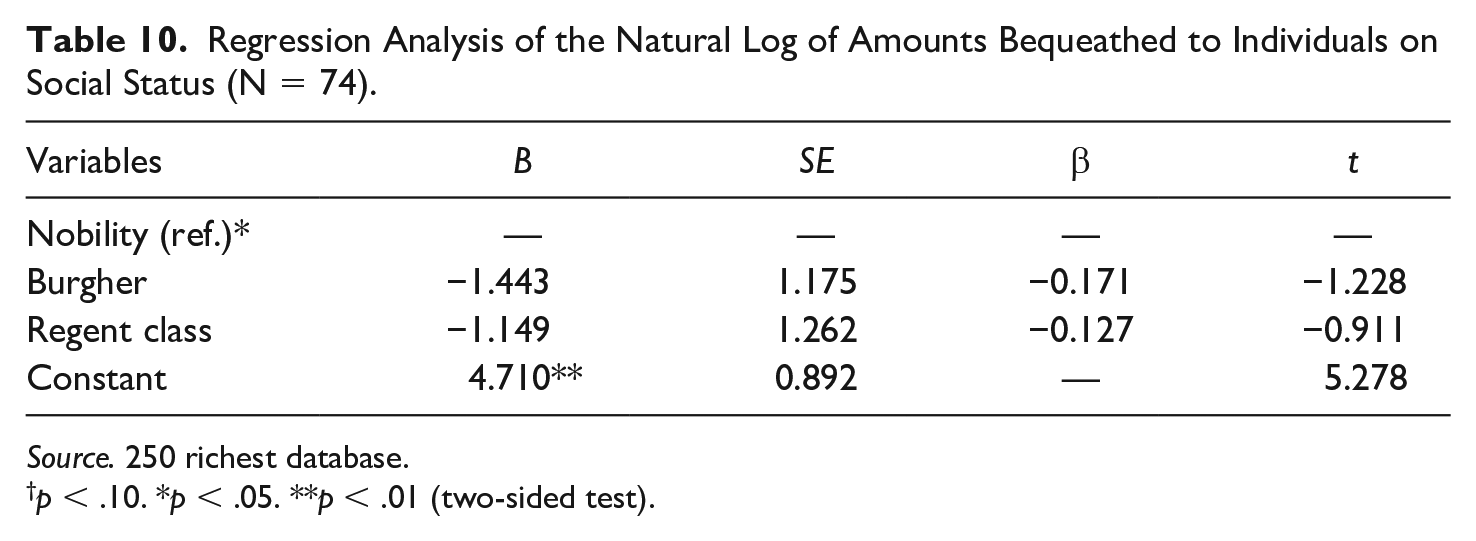
The results further show that there are no statistically significant differences among the wealthy from the nobility or regent and burgher classes in making charitable bequests to either individuals or institutions, or in the amount bequeathed. Interestingly, even though the results are not statistically significant, the results of the regression analyses indicate that burghers may have been giving lower amounts in bequests to both institutions and persons (see Tables 9 and 10).
Regression Analysis of the Natural Log of Amounts Bequeathed to Institutions on Social Status (N = 74).
Source. 250 richest database.
p < .10. *p < .05. **p < .01 (two-sided test).
Regression Analysis of the Natural Log of Amounts Bequeathed to Individuals on Social Status (N = 74).
Source. 250 richest database.
p < .10. *p < .05. **p < .01 (two-sided test).
In H5, we argued that the wealthy who belong to a religious minority are more likely to donate significant amounts to charitable causes during their lifetime.
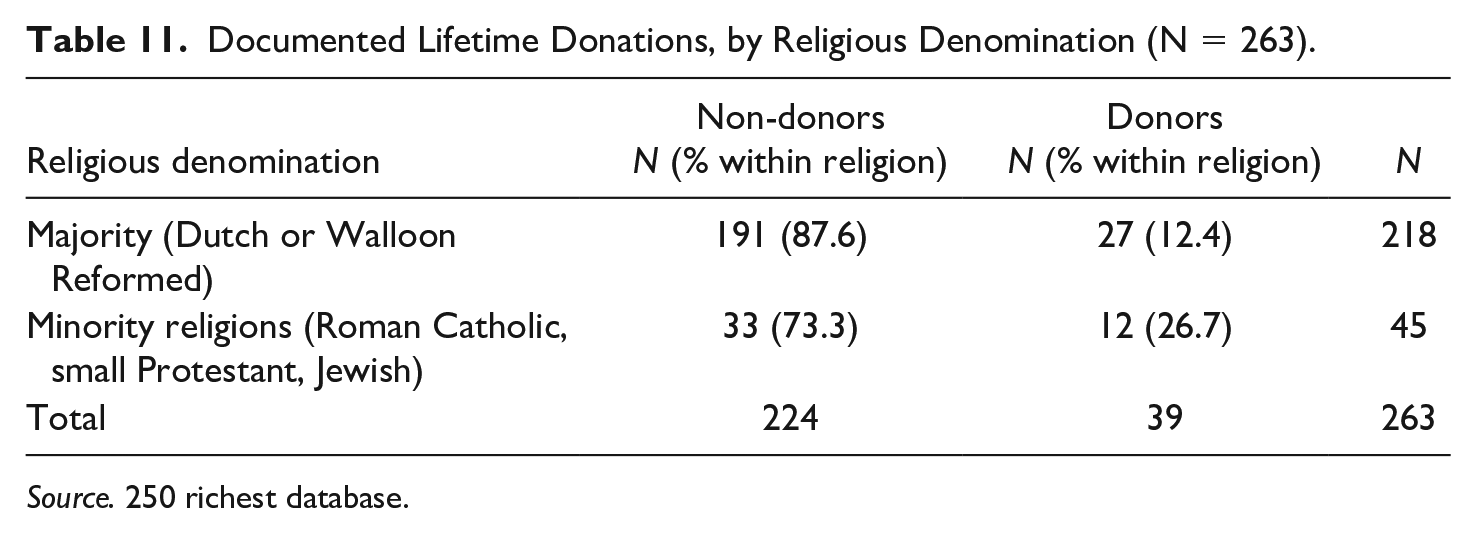
Table 11 shows that the wealthy of the Golden Age were predominantly Dutch or Walloon Reformed. There were few Roman Catholics, Mennonites, Lutherans, Remonstrants, or Jews among the wealthy. Among the general population, the distribution by religious denomination was a little different. According to data for the end of the eighteenth and beginning of the nineteenth century (Bergsma, 1995), over half the population were Calvinist or Dutch Reformed, a third were Roman Catholics, and 10% belonged to smaller Protestant denominations; some were Jewish. The main reason for the predominance of the Reformed Church among the wealthy was the requirement that administrative positions could be assumed only by those belonging to that church.
Documented Lifetime Donations, by Religious Denomination (N = 263).
Source. 250 richest database.
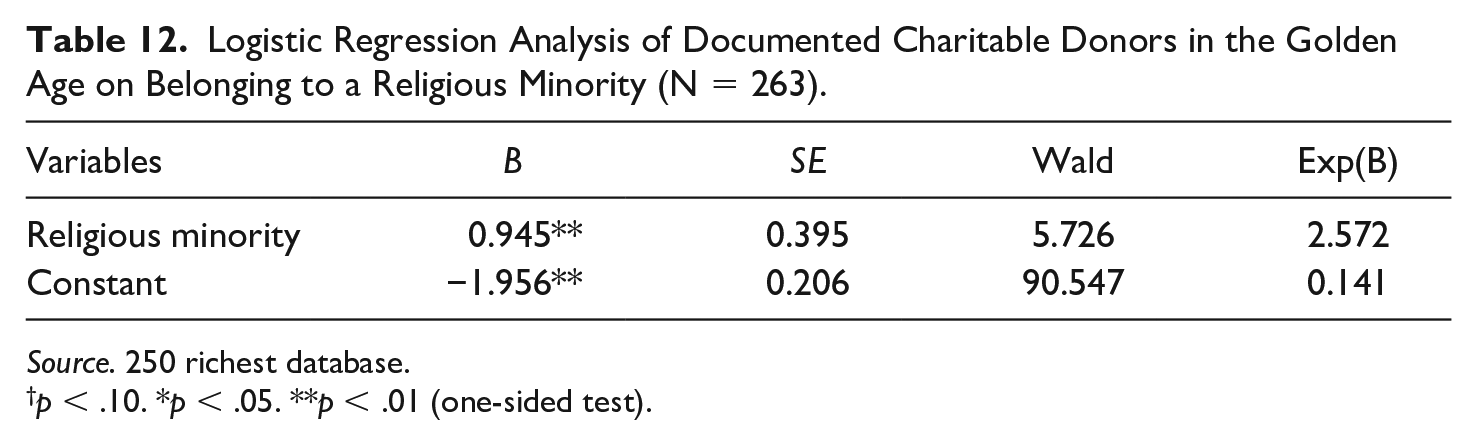
In line with our fifth hypothesis, the results of a logistic regression analysis show that those belonging to a religious minority had a 2.6 times higher predicted odds to have made documented inter vivos gifts than wealthy individuals belonging to the Dutch Reformed Church (see Table 12).
Logistic Regression Analysis of Documented Charitable Donors in the Golden Age on Belonging to a Religious Minority (N = 263).
Source. 250 richest database.
p < .10. *p < .05. **p < .01 (one-sided test).
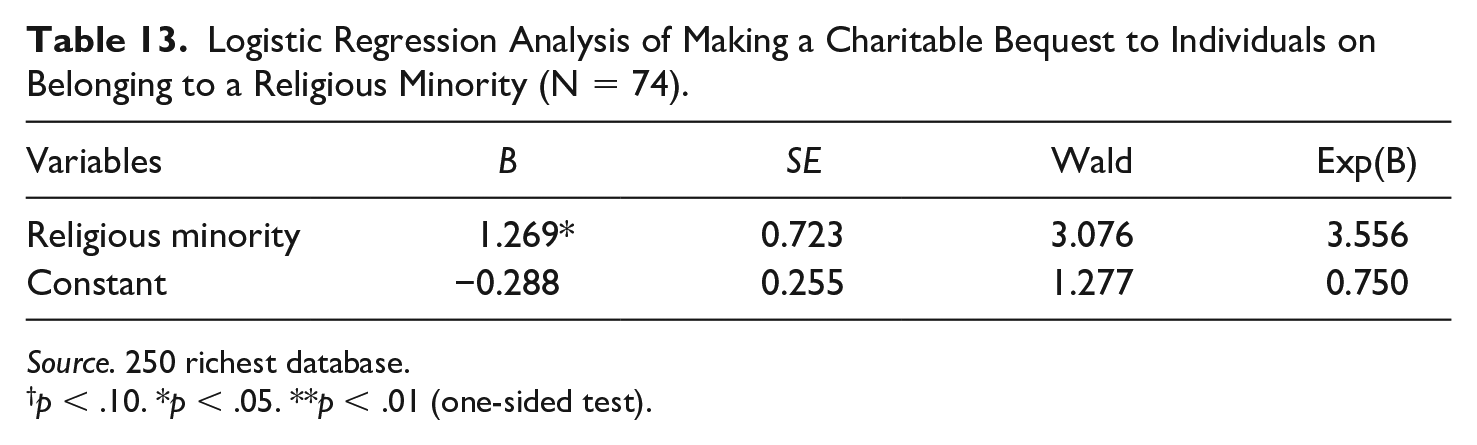
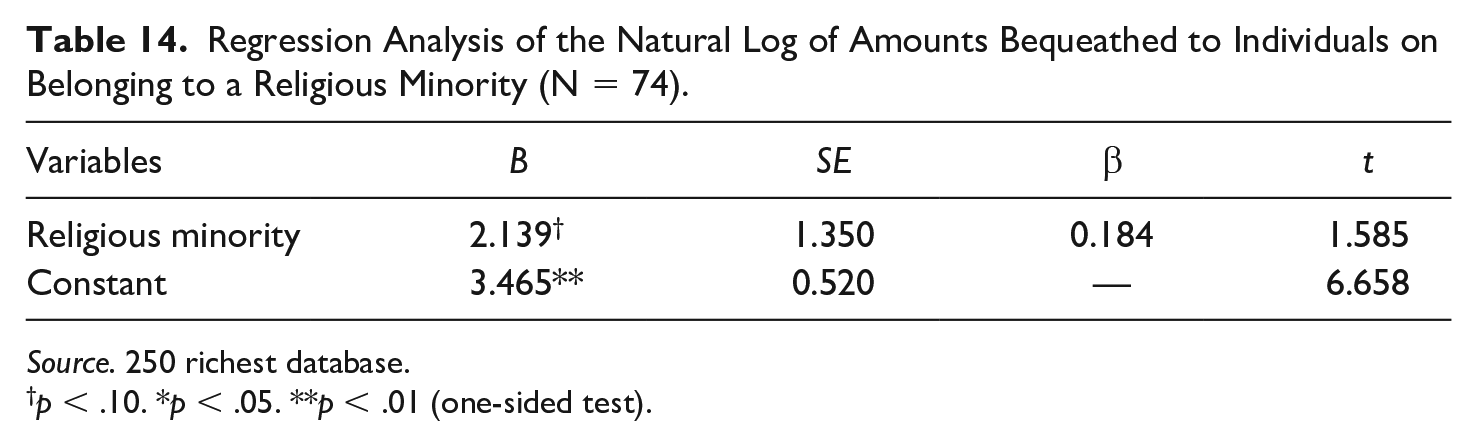
When considering the relationship between belonging to a religious minority and making charitable bequests, results from logistic regression appear to partly support H5, at least in relation to bequests to individuals (see Table 13). Those belonging to a minority religion appear to had a 3.6 higher predicted odds to have made charitable bequests to individuals than those belonging to the religious majority; further, those bequests appear to be larger, even though the results are only marginally statistically significant (see Table 14). In the case of bequests to institutions, there were no differences in terms of likelihood, χ2(1, N = 74) = 1.134, p = .287, one-sided test, nor in amount bequeathed (B = 1.587, SE = 1.373, p = .252, one-sided test) between those belonging to a religious minority and those belonging to the majority religion.
Logistic Regression Analysis of Making a Charitable Bequest to Individuals on Belonging to a Religious Minority (N = 74).
Source. 250 richest database.
p < .10. *p < .05. **p < .01 (one-sided test).
Regression Analysis of the Natural Log of Amounts Bequeathed to Individuals on Belonging to a Religious Minority (N = 74).
Source. 250 richest database.
p < .10. *p < .05. **p < .01 (one-sided test).
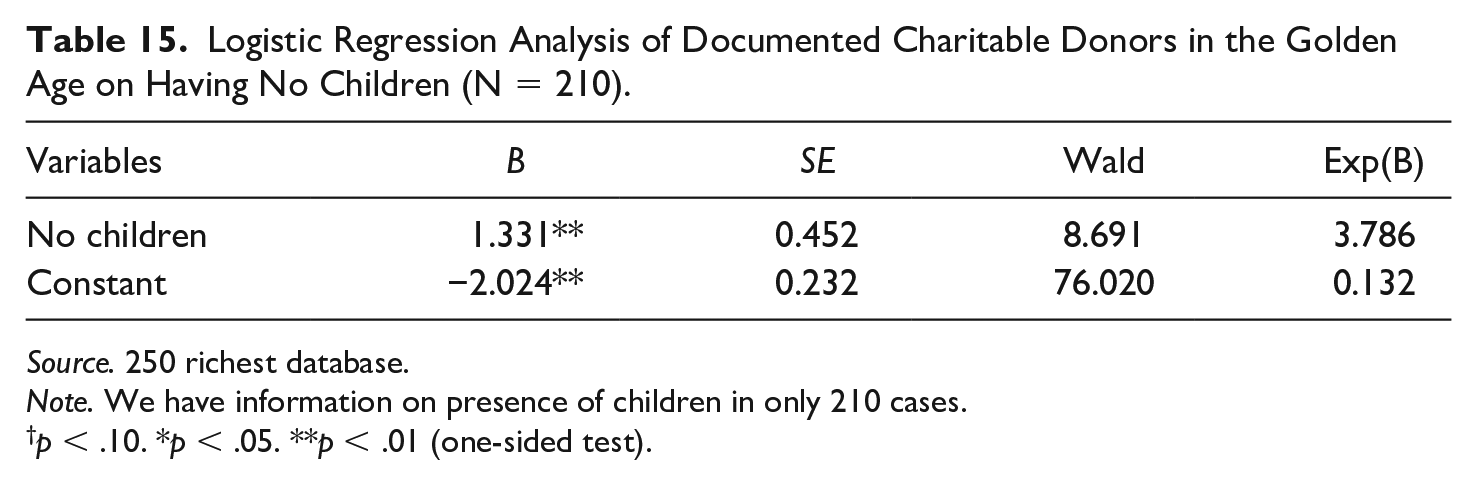
In the final hypothesis (H6), we argue that the wealthy with no close relatives (e.g., children and/or partner) will be more likely to donate significant sums to charitable causes. The results show no statistically significant difference in giving for those who were not married, because almost all (97.2%) of the wealthy were married. We find, as expected, that the presence of children significantly decreased the likelihood of making charitable donations. 11.7% (N = 21) of those who had children (N = 180) made a documented gift, compared with 33.3% (N = 10) of those who did not have children (N = 30). The results of a logistic regression analysis show that those without children had a 3.8 higher predicted odds to have made significant charitable donations than those who had children (see Table 15).
Logistic Regression Analysis of Documented Charitable Donors in the Golden Age on Having No Children (N = 210).
Source. 250 richest database.
Note. We have information on presence of children in only 210 cases.
p < .10. *p < .05. **p < .01 (one-sided test).
Furthermore, we find that those without children had a 4.3 higher predicted odds (B = 1.468, SE = 0.827, p = .038, one-sided test) to make a charitable bequest to institutions, and a 7.9 higher predicted odds (B = 2.064, SE = 0.830, p = .006, one-sided test) to make a charitable bequest to individuals. In addition, those without children bequeathed significantly higher amounts, both to institutions (B = 3.665, SE = 1.288, p = .003, one-sided test) and to individuals (B = 4.005, SE = 1.260, p = .001, one-sided test).
Conclusion and Discussion
We examined Ultra High Net Worth philanthropy in a wealthy but highly unequal society over a long period: the Netherlands during the “Golden Age” (late 16th to the 17th centuries), which has been dubbed the world’s “first civil society” (Sievers, 2010, p. xv). From the existing literature, we know that when the Netherlands became the world’s first modern economy and civil society—there was, by the standards of the time, abundant charity. Dutch elites engaged in acts of charity benefiting their poorer townsmen, through major gifts both during their life and after, to general or to specialized institutions such as almshouses, or to their servants. However, our analyses of inter vivos and bequest giving by the wealthiest 263 individuals of the Dutch Golden Age surprisingly show that most of these ultra-rich did not give substantially during their lifetime, with only 15 percent making documented inter vivos gifts. Bequests to individuals (47%) and institutions (58%) were more typical, but the amounts donated through these bequests on average only make up around 1% of the bequestors’ wealth. As a whole, our data suggest the country’s wealthiest individuals were surprisingly frugal, although a few very generous individuals did exist, even among the richest, but not sufficient to change the results. Instead, as also evidenced by other studies on charity in the Dutch Golden Age, philanthropy was financed by a very broad section of the population. Among the wealthy elites we studied, those with the lowest social status, the burghers, were most generous. Other studies found that even ordinary folk contributing a few cents during the offertory, as did the middling classes (Teeuwen, 2012; van Leeuwen, 2012; van Nederveen Meerkerk, 2012). Teeuwen (2012, 2015) also makes clear that it is unlikely that elites gave so much during collections, that is inter vivos, leading to them being so stingy in their last wills. In specific instances, Teeuwen was able to count the type of coins giving during collections. These overwhelmingly were small denominations, making it very unlikely that elites dispensed large sums during the collections as it would have involved bringing large bags of such small coins.
We are inclined to argue that we did not find a clear motive for charitable giving because the philanthropic behavior of the minority among the Dutch ultra-rich who did contribute was essentially ad hoc and thus unpredictable. We did find support for the idea that those wealthy without children—an unpredictable situation—sought to find alternative purposes for their wealth. Our results do highlight the relevance of religious minorities for charity, similarly important for philanthropy in current day and time (Wiepking et al., 2014). Belonging to a religious minority reinforced the need to support like-minded individuals who were disadvantaged in society, and wealthy individuals were often strongly encouraged to do so by their church. All in all, although Dutch society did provide a low level safety net for its inhabitants, this was financed but by gifts from all layers of society, and only meagerly by philanthropy from its ultra-rich.
Dutch charitable giving by the elites was not very redistributive over regions, as most gifts were to individuals and institutions in the same place as the donor. Nor was it highly redistributive over faiths, as most was given to co-religionists. In that respect, elites did not differ from other social groups. But how much of their individual wealth trickled down to the less fortunate?
The issue we face is that there was not much elite philanthropy to begin with. Although Dutch society was among the most charitable in the world according to the standards of the time, we have demonstrated that ultra-rich Dutch men and women did not give much either during their life or on their death, so a substantial social redistribution there was not.
We did not expect to find the `pioneers of capitalism’ in the cradle of civil society to have been so stingy. This finding opens up promising directions for future research. First, it would be good to extend our sample. First, some of our results support our hypotheses, but not significantly—perhaps owing to the small sample size, just 263 individuals. 11 Extending the data in time or in space will take many years, but it would mitigate this problem. Ideally it would be nice to have comparable data from Europe and elsewhere on the globe. It is interesting to note that in medieval England Casson and Casson (2019) hold that the entrepreneurial class is the main driver of philanthropy not the aristocratic or professional classes. By having many more contextualized case studies we can begin to notice what is general and what is specific to a particular time and place.
Second, what other status enhancing strategies competed with the philanthropic impulses? Elites in many places accumulate cultural, social and symbolic capital to top up their economic fortunes. As Harvey et al., write “Philanthropy at scale brings with it the right to call the shots” (Harvey et al., 2019, p. 444; see also Maclean et al., 2021). Although Dutch elites were probably not much different, their mix of strategies to do so apparently did not first and foremost include large scale philanthropy. Elite conspicuous consumption—via canal houses, summer homes outside the city, castles- or collecting noble titles given by foreign monarchs would have been among them, as were distributing favors systematically, with an eye on having the favor returned someday. Some very wealthy Dutch capitalists kept meticulous account of such often non-monetary transactions, such as burgomaster Joan Huydecoper (1625-1704), son-in-law of #30 Sophia Trip, but in general very little of such material has survived, see for example Kooijmans (1997) and Looijesteijn (2012). The maecenate also competed with philanthropy. Nobles, for example, were expected to be generous and magnanimous, with numerous dependents and indeed were often deep in debt as a consequence, see for example van Nierop (2009). Poets and artists often relied on the support of elite networks who sponsored their talent if need be and provided patronage in all sorts of ways, from money to contacts (Geerdink, 2012; Kok, 2016).
Third, we have studied the charitable behavior of individuals, but it has been said that the most powerful individuals in the Dutch Republic were organized as families and clans (Adams, 2005). We cannot rule out that, within such families, there was an explicit or tacit division of tasks, with one brother entering the mercantile profession and showing little interest in charity; another, poorer one, entering the church; a third, of modest means, joining the political elite and being active on the board of a charity, making inter vivos donations. And perhaps they had sisters actively supervising the day-to-day activities of an orphanage. As a result, studying the charitable activities of wealthy individuals might understate the role of the family as a whole. A study of the sum total of elite familial philanthropy would be very rare due to the availability of sources, but it would be a valuable venture.
Our results that Dutch philanthropy in the Golden Age was supported not so much by large gifts from the ultra-rich but by gifts from almost all of society suggests that elite influence on public policy was counterbalanced by a broader set of, local, interests, norms, and values than would otherwise have been the case. And this holds true in a social context that likely promoted empathy more than is the case today, as the rich lived closer to the poor and the degree of religious observance was higher. Dutch elites could certainly have given less. But they were not especially generous during the heyday of global capitalism.
Supplemental Material
sj-docx-1-nvs-10.1177_08997640221143764 – Supplemental material for How Charitable Were the Elites of the Dutch Golden Age?
Supplemental material, sj-docx-1-nvs-10.1177_08997640221143764 for How Charitable Were the Elites of the Dutch Golden Age? by Marco H. D. van Leeuwen, Pamala Wiepking and Henk Looijesteijn in Nonprofit and Voluntary Sector Quarterly
Supplemental Material
sj-docx-2-nvs-10.1177_08997640221143764 – Supplemental material for How Charitable Were the Elites of the Dutch Golden Age?
Supplemental material, sj-docx-2-nvs-10.1177_08997640221143764 for How Charitable Were the Elites of the Dutch Golden Age? by Marco H. D. van Leeuwen, Pamala Wiepking and Henk Looijesteijn in Nonprofit and Voluntary Sector Quarterly
Footnotes
Acknowledgements
The authors would like to thank Laurien van der Werff and Wouter van Dijk for assisting with the data collection, and the audiences at the 2016 ARNOVA Conference in Chicago, the European Social Science History Conference in Valencia in 2016, and the 2018 International Society for Third Sector Research Conference in Amsterdam for their helpful suggestions and remarks. They would also like to thank Lex Heerma van Voss, Elise van Nederveen Meerkerk, Daniëlle Teeuwen, Chris Einolf, and Arnout van de Rijt for their valuable comments on earlier drafts of this article.
Data Availability Statement
Declaration of Conflicting Interests
The author(s) declared no potential conflicts of interest with respect to the research, authorship, and/or publication of this article.
Funding
The author(s) disclosed receipt of the following financial support for the research, authorship, and/or publication of this article: Data collection and work by Marco H.D. van Leeuwen and Henk Looijesteijn were funded by the Dutch Research Council (NWO) grant “Giving in the Golden Age (GIGA).” For an introduction to this project, see  . Pamala Wiepking’s position as Stead Family Chair in International Philanthropy and Associate Professor of Philanthropic Studies at Indiana University is funded through a donation from the Stead family to the IU Lilly Family School of Philanthropy. Pamala Wiepking’s position as Professor of Societal Significance of Charitable Lotteries at VU Amsterdam is funded by the Dutch Postcode Lottery.
Supplemental Material
Supplemental material for this article is available online.
Notes
Author Biographies
References
Supplementary Material
Please find the following supplemental material available below.
For Open Access articles published under a Creative Commons License, all supplemental material carries the same license as the article it is associated with.
For non-Open Access articles published, all supplemental material carries a non-exclusive license, and permission requests for re-use of supplemental material or any part of supplemental material shall be sent directly to the copyright owner as specified in the copyright notice associated with the article.
