




Abstract
Among policy makers and governments in the Global North, the voluntary sector is considered a central arena for immigrant integration. The aim of this interpretive synthesis was to systematically review research to understand immigrants’ volunteering experiences and explore how volunteering may influence immigrants’ health. A systematic literature review was performed using six databases. Eleven studies met our inclusion criteria. Meta-ethnography was applied for the interpretive synthesis. Immigrants’ perceived volunteering contributed to improving self-conception, engaging in the community, developing skills and knowledge, and building social networks. Under certain conditions, volunteering could be an arena for developing meaningfulness and belongingness and capacity building in the new community for immigrants. Our study indicates that volunteering may have a health-promoting impact that may contribute to immigrants’ sense of belonging and positive well-being. However, this effect seems complex, and volunteering activities and contexts must be further explored.
Keywords
Introduction
The number of international migrants is increasing, leading to more social, ethnic, cultural, and religious diversity in many societies worldwide (Appave & David, 2017). In 2019, it was estimated that 272 million people lived in countries other than their countries of birth, representing an increase of 119 million people compared to 1990 (McAuliffe & Khadria, 2019). In the process of resettlement, acculturation, which, according to Berry (2005), is a dual process of cultural and psychological change resulting from contact between individuals from different cultural groups, occurs. Berry (2005) claimed that immigrants seek to acculturate in several ways. Preferences for acculturation strategies have been extensively studied, yielding various results, but integration is often argued to be the desired outcome (Berry et al., 2006). This outcome is central to government policies in the Global North but has been criticized for promoting specific imaginaries of culture, race, ethnicity, and belonging that cast immigrants inferior (Rytter, 2019). There are large differences among immigrants; immigrants are not a homogeneous group, but in this study, we included immigrants into one practical category (Brubaker, 2002) denoting that they for some reason left their countries of origin to settle in another country.
The Voluntary Sector
In the Global North, governments are placing an increasingly high value on volunteering and the voluntary sector as an arena for integration. It is suggested that recruiting and including immigrants in volunteering may help immigrants learn about their new society and language and facilitate easier entrance into the labor market (Christensen & Christensen, 2006; Meld. St. 10, 2018-2019; J. A. Smith et al., 2004). Volunteering has various definitions, but in this study, we define volunteering as freely contributing without an expectation of a reward or other compensation to benefit individuals or groups outside one’s household and social network in an organized context (Snyder & Omoto, 2008; Wollebæk et al., 2000).
Immigrants’ Volunteering and Health
Research related to volunteering among immigrants is primarily descriptive and mainly discusses participation compared to the majority population, volunteer hours, and motivation and barriers to participation (Eckstein et al., 2015; Gele & Harsløf, 2012; Lee et al., 2018; Wilson, 2012). Thus far, immigrants’ experiences with participation in voluntary work have been sparsely investigated (Torres & Serrat, 2019; Wilson, 2012). Given that studies show that acculturation may be a stressful experience that can result in negative health impacts (Gonzalez-Guarda et al., 2021; Yeh, 2003) and that social support and social networks have been found to be beneficial to mental health (Berkman et al., 2000; Dominguez-Fuentes & Hombrados-Mendieta, 2012; Kim et al., 2012; Seeman, 1996), volunteering may be an arena to build social networks and exchange social support (Lidèn, 2001; Putnam, 2000; Wilson, 2012).
The objective of this review is to explore and synthesize the existing qualitative research concerning immigrants’ experiences of being formal volunteers and how this may influence their health. Our research question is as follows: Which experiences related to participating in formal volunteering do immigrants have?
Method
We applied a meta-ethnographic approach following the seven steps developed by Noblit and Hare (1988). We chose this method to interpret the existing research concerning immigrants’ experiences of volunteering instead of conducting a narrative review aggregating findings based on a wide range of database searches. Meta-ethnography is a well-established form of interpretative review that synthesizes concepts to further develop conceptual meanings based on heterogeneous samples and contexts. The steps are as follows: getting started (step 1), deciding what is relevant to the initial interest (step 2), reading (and rereading) studies to discover the main concepts (step 3), determining how the studies are related (step 4), translating the studies into one another (step 5), synthesizing translations (step 6), and communicating the synthesis in text (step 7).
Search Strategy and Selection of Studies
Electronic searches were performed using six databases in June 2020 by the first author under the guidance of a research librarian. The following databases were included: MEDLINE, Embase, PsycINFO, CINAHL, Global Health, and Amed. We searched with subject headings and used all search terms as keywords in each database. Search 1, “minority group” and search 2, “volunteers” were combined with the Boolean operator AND (see the search strategy in the appendix). The search was limited to qualitative studies and obtained 3,642 hits. The first screening, which included duplicates and the inclusion and exclusion of studies based on the title and abstract, was performed by the first author. The third author screened a sample of the articles. The full texts of 50 articles were downloaded for further screening by the first and third authors. Thirteen articles were obtained from manual searches of the reference lists of the included articles, contact with experts and other singular searches. In total, 11 articles were included in this review. A flow diagram is presented in Figure 1.
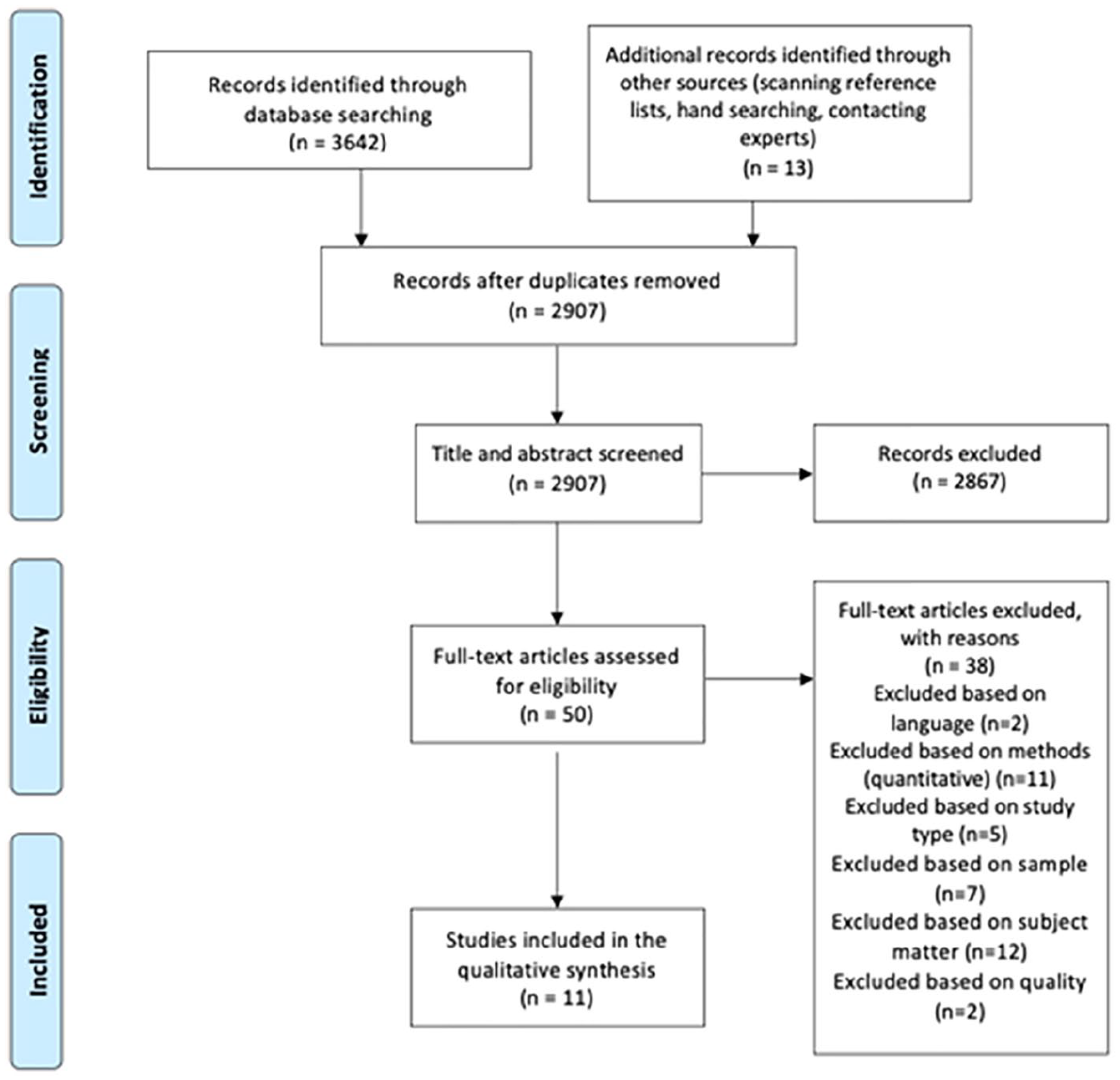
Flow diagram based on Moher et al. (2009).
Inclusion Criteria
The inclusion criteria were as follows: qualitative articles concerning volunteering among immigrants and ethnic minorities with a minority status in their country of residence on the basis of their place of birth, language, ethnicity, or cultural differences (18 years of age or above) and their experiences of being volunteers in organizations in high-income countries; full-text empirical studies published in peer-reviewed journals in English, Norwegian, Swedish, and Danish; and articles published from the inception of each database to June 2020.
Exclusion Criteria
Studies in which immigrants were only a part of the study samples or the qualitative results of the groups were not differentiated were excluded. Any study that did not report the data collection or strategy for analysis was also excluded.
Data Extraction and Quality Assessment
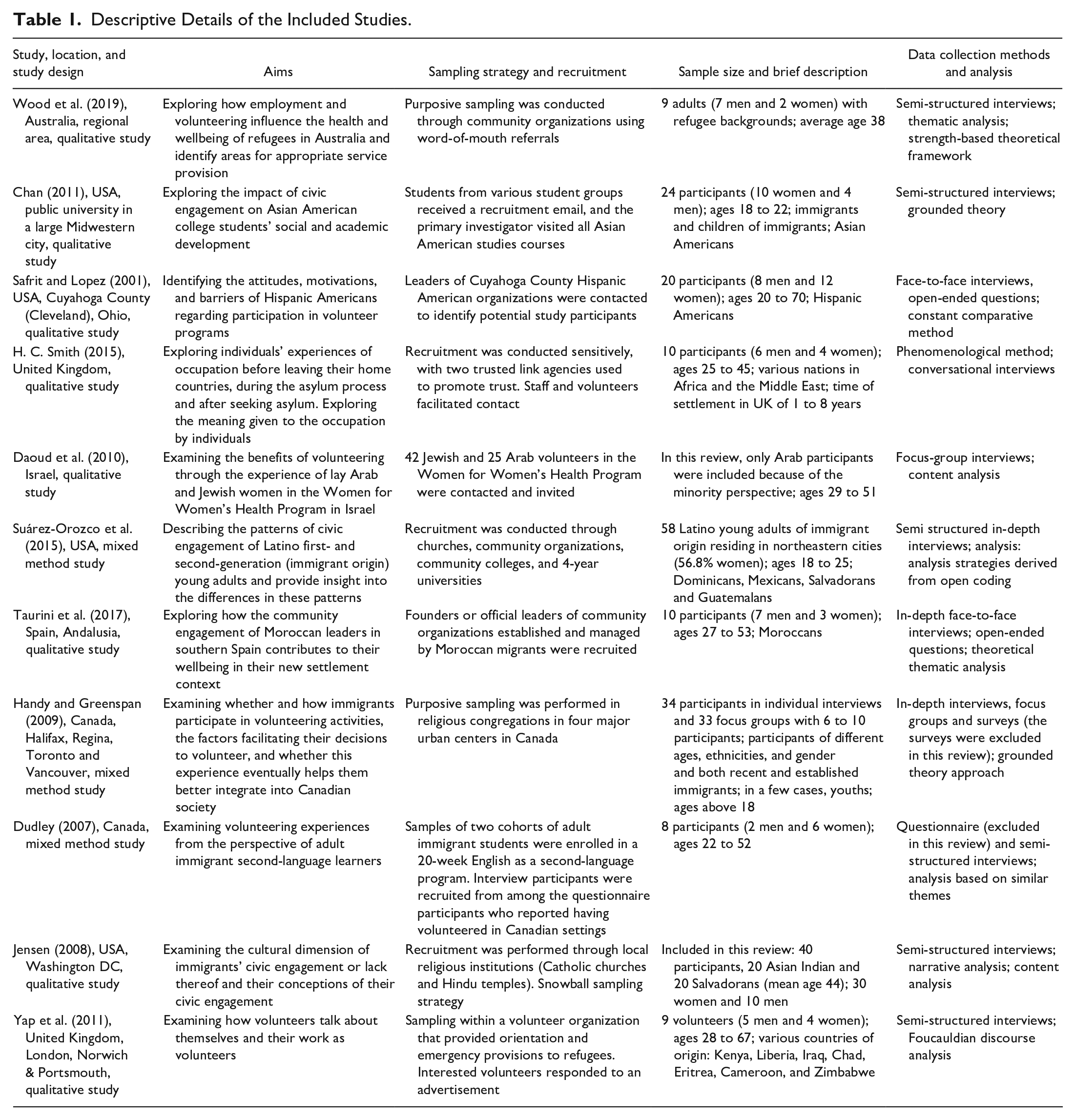
The data extraction was conducted independently by the first and third authors, and then, the extracted data were compiled and organized in a data extraction sheet. The two authors extracted information from the full primary studies and included both first- and second-order constructs. Descriptive information, such as the author, year, title, and publication, and information concerning the aim, methods, design, data collection, sampling, theoretical framework, analysis, findings, themes, and discussion were noted. The results concerning immigrants’ experience of volunteering were the main interest. Information concerning the participants, context and culture of voluntary work was also extracted. A short description of the included studies is presented in Table 1.
Descriptive Details of the Included Studies.
The evaluation of the quality of the studies was guided by a checklist covering aims, reflexivity (authors preconceptions and meta-positions), methods and design, data sampling and collection, theoretical framework, analysis, results, discussion, and conclusion (Malterud, 2001) and EPICURE (Stige et al., 2009). Any disagreements were noted and resolved by consensus among the authors.
Data Synthesis
The first and third authors read and reread the included studies to discover the main concepts (step 3). Common themes and concepts were identified (step 4). The common themes and concepts were compared and matched across the articles. The first author chose Wood et al. (2019) as an index study based on the quality and richness of the article. The studies were analyzed using the following categories from Wood et al.’s article: “sense of self and self-worth,” “belonging in a new community” and “work, health and illness.” The meanings of the themes and concepts identified were matched, compared, and organized in a table by the first author. All authors collaborated in the translations (step 5). The analysis included several steps. The first-order interpretations involved identifying and interpreting the meanings of the themes, concepts, and metaphors in each study, while the second-order interpretations included interpretations of how the identified concepts related to each other. The authors grouped the concepts from the articles and developed four themes that covered the concepts. Reciprocal interpretations, that is, meanings of themes and concepts that were similar, were synthesized. The reciprocal relationship in the studies made it possible to develop a line of argument. All authors collaborated to further synthesize the themes under the concepts of “meaningfulness,” “belongingness,” and “capacity building” (step 6). This article is an attempt to express the synthesis. All authors collaborated in the writing of this article (step 7).
Results
This review is a synthesis of qualitative literature concerning immigrants’ experiences of volunteering. This review includes studies with samples from a range of ethnic backgrounds in different countries and regions. The participants volunteered for different organizations, such as student organizations, church organizations, immigration-serving agencies, festivals, and community services. The volunteer activities included operating health resource centers; creating cultural meetings, such as book clubs; creating groups for physical activities; cooking and serving meals; providing counseling to young people and different activities for children; developing and leading organizations for social change; and assisting newly arrived immigrants.
Second-Order Analysis
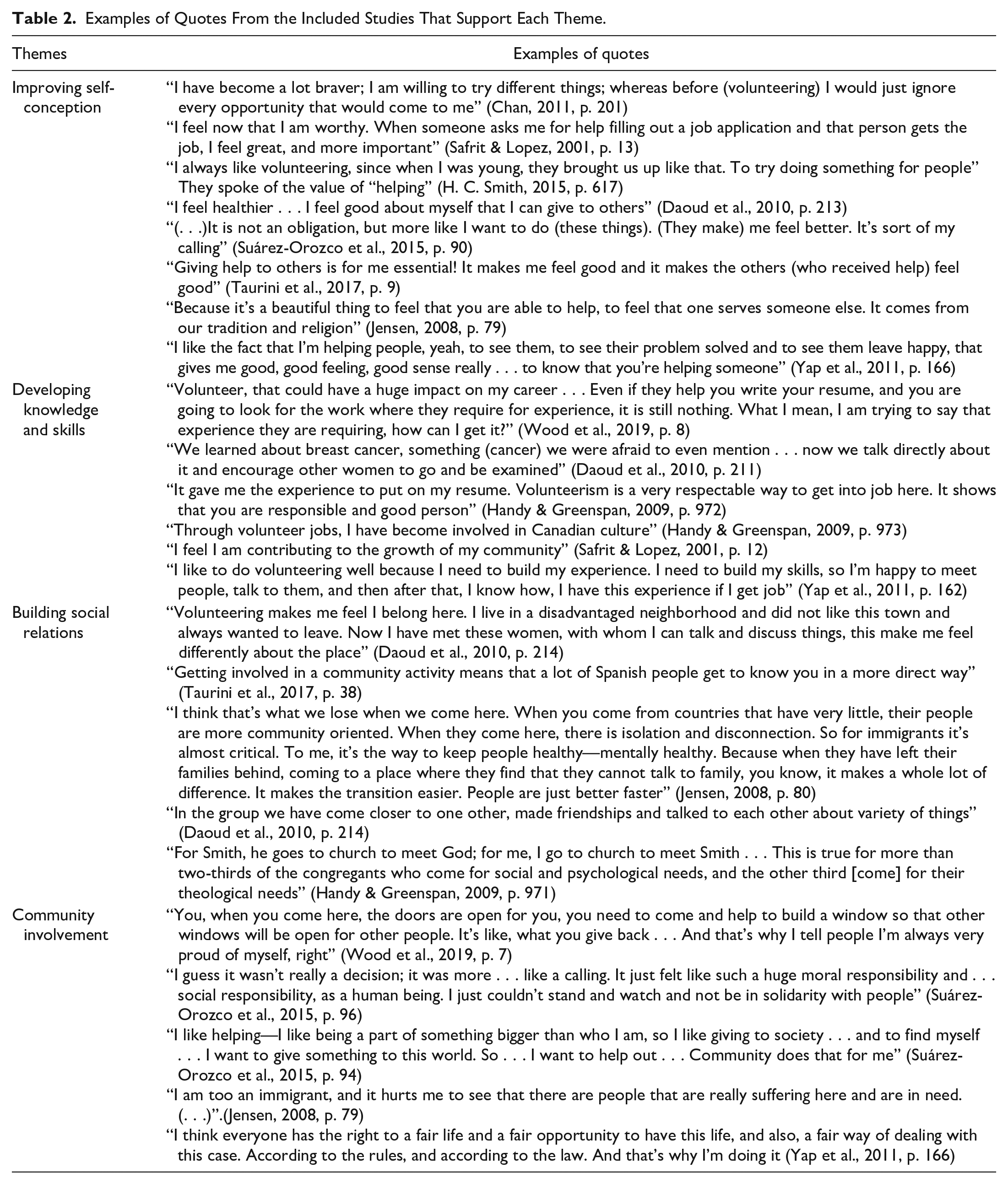
We first present our synthesis based on the second-order analysis with reciprocal translation of the main findings in the primary studies included. The following four main themes arose from our synthesis: (1) improving self-conception, (2) building social networks, (3) developing skills and knowledge, and (4) engaging in the community. Examples of the primary data that support each theme are presented in Table 2.
Examples of Quotes From the Included Studies That Support Each Theme.
Improving Self-Conception
The participants experienced personal growth and increased self-confidence through their volunteering (Chan, 2011). Some participants reporting becoming braver (Chan, 2011; Daoud et al., 2010), feeling more comfortable in social interaction with foreigners, and improving their interpersonal skills (Safrit & Lopez, 2001). Others reported that volunteering increased their sense of importance, usefulness, and self-worth (Chan, 2011; Daoud et al., 2010; Dudley, 2007; Safrit & Lopez, 2001; H. C. Smith, 2015; Wood et al., 2019; Yap et al., 2011). Some participants discussed philanthropic values, the ability to be a part of something larger than their own lives (Suárez-Orozco et al., 2015), and the opportunity to focus on others’ needs and not their own problems (H. C. Smith, 2015). Volunteering also created a sense of purpose for their lives (Handy & Greenspan, 2009; Taurini et al., 2017; Wood et al., 2019; Yap et al., 2011). Being busy and having some degree of daily structure were important for some participants (H. C. Smith, 2015). Seven studies reported that the participants who experienced volunteering had a better self-image and self-esteem and a more positive view of themselves (Chan, 2011; Daoud et al., 2010; Safrit & Lopez, 2001; H. C. Smith, 2015; Suárez-Orozco et al., 2015; Wood et al., 2019; Yap et al., 2011). The participants also reported improved connection with their original culture by establishing social relations with people from similar ethnic backgrounds. Some participants also found that they learned about and explored their own ethnic background. Some felt that this process helped them understand their development and contributed to a feeling of normality (Chan, 2011).
Building Social Networks
Some participants found that volunteering contributed to a sense of belonging in the new country and community (Chan, 2011; Dudley, 2007; Safrit & Lopez, 2001; Wood et al., 2019). In eight studies, the participants reported that volunteering could build strong social relations and friendships (Chan, 2011; Daoud et al., 2010; Dudley, 2007; Handy & Greenspan, 2009; Jensen, 2008; H. C. Smith, 2015; Taurini et al., 2017; Wood et al., 2019). Building a social network in the new society was important, and some participants emphasized the value of making new social relations since they left their families and felt socially isolated (Dudley, 2007; Jensen, 2008). Group interaction in volunteer activities could also promote a sense of mutual respect, trust, and fellowship within the volunteer organization, which helped the participants establish networks and social capital (Daoud et al., 2010). Some participants described their fellow volunteers as a part of an extended family (Handy & Greenspan, 2009). In addition to fulfilling social needs, social relations could provide an important link in the community (Dudley, 2007; Handy & Greenspan, 2009; Taurini et al., 2017) or implied that the participants had someone to ask for advice in a nonthreatening environment, which could reduce feelings of anxiety in their new country (Dudley, 2007). The participants also reported that they became friends with other cultural kin through volunteer activity (Chan, 2011; Handy & Greenspan, 2009; Jensen, 2008; Taurini et al., 2017; Wood et al., 2019).
Engaging in the Community
Many participants described volunteering as a way to engage with and contribute to society. The participants claimed that their engagement was a reciprocation of the support and help they received upon their arrival in the new community (Chan, 2011; Dudley, 2007; Handy & Greenspan, 2009; Jensen, 2008; Safrit & Lopez, 2001; Suárez-Orozco et al., 2015; Taurini et al., 2017; Wood et al., 2019).
Volunteering also represented an opportunity to contribute to social change and support other immigrants (Daoud et al., 2010; Dudley, 2007; Handy & Greenspan, 2009; Jensen, 2008; Safrit & Lopez, 2001; Suárez-Orozco et al., 2015; Taurini et al., 2017; Yap et al., 2011). In seven studies, the immigrants reported that their volunteering resulted in a form of acceptance from the majority population (Daoud et al., 2010; Jensen, 2008; Safrit & Lopez, 2001; Taurini et al., 2017; Wood et al., 2019; Yap et al., 2011). The contact established between the immigrants and the majority population was also considered important for reducing prejudice and racism (Daoud et al., 2010; Dudley, 2007; Taurini et al., 2017; Wood et al., 2019; Yap et al., 2011).
Developing Skills and Knowledge
Volunteering also represented an arena for acquiring knowledge regarding the majority’s culture, and the participants considered volunteering crucial for becoming a part of their new community (Daoud et al., 2010; Dudley, 2007; Handy & Greenspan, 2009; Jensen, 2008; H. C. Smith, 2015; Taurini et al., 2017; Wood et al., 2019). Some participants stated that volunteering increased their understanding and knowledge of the community needs (Safrit & Lopez, 2001), while others mentioned that they acquired general competences, such as organizing their day and respecting others’ time. Knowledge regarding health and illnesses, health care rights and health care services in the new country was also reported as a benefit of volunteering (Daoud et al., 2010).
For many participants, developing and practicing language skills in voluntary organizations were considered important for facilitating integration (Daoud et al., 2010; Dudley, 2007; Safrit & Lopez, 2001; H. C. Smith, 2015; Wood et al., 2019; Yap et al., 2011). The two-way integration process through which the participants encountered a mutual learning environment and could share knowledge with others was also a positive outcome of volunteering for some participants (Daoud et al., 2010; Safrit & Lopez, 2001; Taurini et al., 2017; Wood et al., 2019).
Volunteering was viewed by many immigrants as a way to obtain skills, knowledge, and work experience that could help them in their future careers (Chan, 2011; Daoud et al., 2010; Dudley, 2007; Handy & Greenspan, 2009; Safrit & Lopez, 2001; Suárez-Orozco et al., 2015; Taurini et al., 2017; Wood et al., 2019; Yap et al., 2011). This included knowledge regarding the employment sector that could help them adjust better to it (Wood et al., 2019). Some participants emphasized that volunteering improved communicative skills crucial for entering the labor market (Taurini et al., 2017; Yap et al., 2011). Volunteering could also be included in the immigrants’ resumés when applying for work, and the participants found volunteering a respectable way to obtain a paid job (Handy & Greenspan, 2009). Many participants clearly used volunteering as leverage into the employment force, which was their goal (Chan, 2011; Jensen, 2008; Safrit & Lopez, 2001; H. C. Smith, 2015; Suárez-Orozco et al., 2015; Wood et al., 2019).
Difficulties in Engaging in Volunteering
Although the participants reported many positive outcomes of volunteering in their new countries, some reported negative experiences. A few participants experienced difficulties practicing the new language while volunteering as some shared their mother tongue with other volunteers, making it natural to communicate in this language. Others found that people were too busy to talk to them or that people did not adjust the speed and clarity of speech to allow the immigrants to learn (Dudley, 2007). Some participants reported that knowing the language was crucial for being liked and accepted (Safrit & Lopez, 2001).
A few participants reported that they experienced prejudice and racism while volunteering (Daoud et al., 2010) and that it was difficult to be accepted and involved in the community (Jensen, 2008).
Summary of the Line of Argument
A line of argument synthesis was developed to explain and link the four themes to health. The voluntary sector may be a health-promoting arena for immigrants as it can provide meaningfulness through improved self-conception and an experience of being worthy and engaged in a meaningful activity. Capacity building may lead to empowerment, and the study showed that capacity building was obtained through the acquisition of knowledge and skills that could be a door-opener to the labor market. The immigrants also experienced a heightened sense of belonging through social relations and knowledge regarding the culture and community. Volunteering may represent both altruistic and instrumental dimensions that could lead to a positive impact on health.
Discussion
Belongingness
In our meta-ethnography, volunteering was considered a contribution to building social relations. The link between social relations and health is complex. Berkman et al.’s (2000) conceptual model of how social networks impact health shows that this relationship involves factors, such as social structural conditions (macro level), social networks (mezzo level) and psychosocial mechanisms (micro level). Depending on the context, the characteristics of the social relations and how social support is given and received, social relations may impact a person’s behavior, psychological processes and physiological functions (Berkman et al., 2000). The studies in our review indicate that social relations affect people in a positive way and may be a health promotive factor for immigrants. This finding is consistent with studies arguing that inclusion and social relations are particularly promotive of immigrants’ mental health (Guruge et al., 2015; Miller et al., 2020). However, social networks may also be stressful if they act as a source of conflict, social support is lacking (Guruge et al., 2015) or social networks are difficult to access according to a few studies included in this meta-ethnography.
Capacity Building
Governments promote the voluntary sector as a possible door-opener to language training, education and participation in the workforce for immigrants (Christensen & Christensen, 2006; Meld. St. 10, 2018-2019; J. A. Smith et al., 2004). In our meta-ethnography, volunteering is viewed as an arena for capacity building that may be a door-opener to practicing language and joining the labor market. Volunteering may be health promotive since employment is found to have a positive effect on mental health (Dalgard & Thapa, 2007; van der Noordt et al., 2014). It is increasingly accepted that volunteering can increase the chances for higher education and, consequently, a better job (Eimhjellen & Segaard, 2010; Paat, 2022; Wilson, 2012). However, it is not obvious that volunteering will lead to employment for immigrants as other structural factors might also have an impact. Immigrants may have difficulties accessing a volunteer activity to develop appropriate skills and networks (Allan, 2019), and even if they develop these skills and networks, some immigrants experience limited access to the labor market (Oreopoulos, 2011; Tomlinson, 2010).
However, this bold view of volunteering as an arena for building qualifications instead of a philanthropic activity based on altruism represents a shift in the role and understanding of volunteering.
Philanthropic Activity or a Qualifying Arena?
The motivation for volunteering may also impact the benefits of volunteering. In this study, the intrinsic reasons to volunteer may be connected to meaningfulness and helping others without obtaining anything in return, and the extrinsic reasons may be volunteering with the purpose of building capacity to more easily obtain access to the labor market. However, this issue is complex, and both intrinsic and extrinsic reasons may apply to many people. Volunteering for intrinsic reasons may be the most beneficial for volunteers (Degli Antoni, 2009; Konrath et al., 2012) and is stressed as important for sustained involvement in volunteering. However, extrinsically motivated volunteers may still have a considerable amount to offer communities and can be satisfied when their volunteer activity matches their motivation for volunteering (Stukas et al., 2016). Based on the government’s perspective of promoting the voluntary sector as a qualifying arena, development toward a more instrumental dimension of volunteering makes it important to consider how the voluntary sector might change. What will be the experiences of volunteers and beneficiaries of volunteering if the voluntary sector becomes a time-limited steppingstone for marginalized groups to enter the labor market? Should the voluntary sector change from a philanthropic activity to an arena for the qualification of labor resources or should the labor market be such a qualify arena? This may be a development feature linked to the growing individualism in many high-income countries and could perhaps make us question the nature and sustainability of the voluntary sector.
Strengths, Limitations, and Reflexivity
Meta-ethnography is criticized for not being standardized, and thus, the reporting of the analysis and synthesis lacks clarity and comprehensiveness (France et al., 2014). In this meta-ethnography, we followed Noblit and Hare’s (1988) methodology and expanded efforts to clearly report the procedures to ensure the quality of the review (France et al., 2019). A limitation of such synthesis is the difficulty in ensuring that no relevant studies were overlooked because of the search limitations or the focus of the review. We chose to include health databases, which may omit relevant studies that are not indexed in these databases. The search and some screenings of the search results were performed by one reviewer due to time and resource considerations. The validity is supported by our presentation of examples of the studies contributing to the themes, our search strategy and the description of the methods.
The 11 included articles constituted a small sample but provided overall diversity in the participants’ ethnic backgrounds, reasons for and time since migration, age, gender, and countries of resettlement. Some studies used terms that were broader than “volunteering” but included volunteering as an activity, such as “community engagement,” “civic participation,” and “occupation.” We screened the results to ensure that we only extracted results related to volunteering. The quality of the included studies varied. Some studies provided a limited quantity of results, and some studies were mainly descriptive. Eight studies did not remark on reflexivity, and five studies did not include theoretical frameworks. Five studies did not discuss the shortcomings, limitations, or strengths of the study. This issue may have limited the quality of the meta-ethnography.
Implications of the Review
The 11 studies included in this meta-ethnography largely support volunteering as an activity that has health-promotive impacts. However, it is important to stress that volunteering occurs in different contexts and that variations exist in how volunteer organizations recruit, facilitate and support volunteers, which again might yield various outcomes (Greenspan et al., 2018). Moreover, immigrants do not constitute a homogeneous group. Some immigrants do not have any wish to participate in the larger society (Berry, 2005). People with different cultural and ethnic backgrounds might also have different comprehensions of volunteerism and volunteer roles (Eimhjellen et al., 2020; Hobbs, 2001; Schwingel et al., 2017). To determine whether people benefit from volunteering, it is crucial to study the type of meaning volunteers attribute to volunteer activities, the quality of social interactions in volunteer activities, and the support and guidance volunteers receive from staff and other volunteers (Morrow-Howell, 2010). The experiences and outcomes of volunteering seem quite complex, and the activity and context must be scrutinized to determine whether and how volunteering can be health promoting.
Footnotes
Appendix
Author’s note
Laila Tingvold is now newly affilitated to Centre for Care Research East, Norwegian University of Science and Technology (NTNU), Gjøvik, Norway
Declaration of Conflicting Interests
The author(s) declared no potential conflicts of interest with respect to the research, authorship, and/or publication of this article.
Funding
This study was funded by the Norwegian University of Science and Technology and was part of a PhD research study.
