




Abstract
This article contributes to research on employee volunteering (EV) by focusing on the experiences of individuals to address the current overemphasis upon collective organizational outcomes. Drawing on qualitative research with employees and corporate social responsibility managers across seven companies, it demonstrates why employees’ experiences are central to understanding the complex mechanisms that link EV with organizational outcomes. The article reveals how both positive and negative organizational outcomes are influenced by the complex relationship between personal motivations and employees’ volunteering experiences—within their organization and within their community—combined with their broader reflexive interpretation of their employing organization and its values.
Keywords
Introduction
Corporate social responsibility (CSR) research examines the connections between CSR strategies and positive organizational outcomes. 1 In seeking to substantiate the business case, research has predominantly focused on macro- and meso-levels, concentrating upon institutional and organizational perspectives. More recently, research has adopted a micro-level perspective, examining CSR’s impact on individual behavior. This work has generated insights into how CSR shapes employee behavior and organizational engagement (Booth et al., 2009; Rhou & Singal, 2020). The majority of this work, however, centers on how CSR creates positive organizational outcomes, rather than focusing on employees’ experiences in and of themselves.
CSR encourages businesses to meet the expectations of stakeholders and needs of society (Freeman, 2010). Employee volunteering (EV) represents an important channel through which organizations demonstrate their commitment to society by enabling employees to engage in community programs (do Paço & Nave, 2013; Zhang et al., 2021). Despite this growing trend, understanding of how employees experience EV is limited. This article adopts a micro-CSR approach, examining how employees experience EV and what impact these experiences have in shaping organizational outcomes.
Utilizing insights from volunteer motivations literature to develop an employee-centered analysis, this qualitative study focuses upon employees’ perspectives on three core themes within EV literature: (a) motivations for volunteering, (b) volunteer experience, and (c) reflections on volunteering within a broader organizational context. In doing so, the article demonstrates the tendency of existing EV research to transplant approaches from broader volunteering literature onto the EV context. This is problematic on two counts: First, EV is distinct to traditional volunteering as it is shaped by the employer–employee relationship and not solely that of volunteer–voluntary organization. Matching volunteer motivations with the volunteer experience is thus mediated by the wider employment context. Second, this complexity interrupts the perceived linear relationship between EV and organizational outcomes, challenging some embedded assumptions in the EV literature around collective organizational outcomes and necessitating an examination of how employees experience and reflect on their EV both internally and externally.
Examining Existing EV Research
EV has been a significant focal point for micro-CSR analysis, identified as a “win/win” scenario, benefiting company, employee, and community. Organizational costs of EV are justified based upon the skills, employee commitment, and reputational benefits they bring (Caligiuri et al., 2013; Haski-Leventhal et al., 2019; Rodell et al., 2016). Existing EV research examines its effects on employee behavior but predominantly focuses upon the strategic benefits for the (employer) organization (Booth et al., 2009; Peloza & Hassay, 2006). Research has investigated how EV programs produce outcomes such as increased motivation/morale (Bhinekawati et al., 2020; do Paço & Nave, 2013), retention and attraction of employees (Sanchez-Hernandez & Gallardo-Vázquez, 2013), and increased employee pride/commitment (Jones, 2010; Peloza et al., 2009). Similarly, where research examines employee motivations, the focus is on how volunteering strengthens organizational commitment (Gómez & Fernández, 2017; Haski-Leventhal et al., 2019).
There is a wealth of literature examining EV through the lens of social exchange theory (SET) and social identity theory (SIT). SIT highlights how EV enhances organizational commitment by enabling employees to view their company as more prosocial, respected by external stakeholders, and thus deserving of their emotional attachment (Kim et al., 2010; Peloza et al., 2009). SET shows how employees feel compelled to reciprocate the benefits they receive from EV by giving back to their employing organization (Al Kerdawy, 2019; Booth et al., 2009). This emphasis on collective organizational outcomes has produced a focus on how employees “perceive and react” rather than “experience” EV, resulting in limited examination of its capacity to generate both positive and negative outcomes. Grant (2008) notes that organizational strategies do not always create intended outcomes, whereas Gatignon-Turnau and Mignonac (2015) found that employees possess the capacity to both reflect on and resist organizational motivations.
It is important to focus not simply on the collective organizational outcomes but also to consider how employees experience and reflect on their volunteering (Basil et al., 2009; Glavas, 2016). Weiss and Rupp (2011, p. 86) similarly call for a more “person-centred” work psychology which places people—not collective purpose—as the starting point for research problems. Furthermore, in identifying the predominance of “collective purpose” as problematic for micro-CSR development, Gond et al. (2017) seek greater analysis of The interpretative processes by which people form and organize their perceptions of CSR initiatives . . .; reflect cognitively on, appraise the worth, and attribute CSR initiatives to some causes . . .; make sense of meaning . . .; and experience emotions in appraising CSR. (pp. 226–227)
In adopting a micro-CSR approach, combined with insights from the broader volunteer literature regarding volunteer motivations and environment, this article examines (a) how employees actually experience EV programs, and (b) what impact these experiences have on organizational outcomes.
Insights Offered by Volunteering Research
EV research has drawn from volunteer motivations theory (Clary et al., 1998; Stukas et al., 2016) to examine the relationship between employee motivations, volunteer experience, and organizational outcomes (Brockner et al., 2014; Grant, 2012; Rodell, 2013). Clary et al.’s (1998) functional typology identifies six personal and social functions served by volunteering: values, understanding, enhancement, career, social, and protective. Importantly, this typology emphasizes the diversity and co-existence of multiple motivations, the blurring between prosocial and self-serving motivations and the significance of the “volunteer experience” in shaping individual and organizational outcomes. Attempts to understand the factors shaping the volunteer experience, for example, type of activity (Houle et al., 2005; Sekar & Dyaram, 2017), confirm the premise that individuals can have different motives for doing the same volunteering. However, EV research continues to utilize a binary interpretation of Clary et al.’s motivations (prosocial vs. self-serving), to examine a perceived linear relationship between employee motivations and organizational outcomes (Peloza & Hassay, 2006; Rodell et al., 2016).
Clary et al.’s typology also highlights how the volunteer experience is shaped by the bilateral relationship between the volunteer and the voluntary organization, arguing that the capacity of volunteerism to be sustained over time depends upon “matching the motivational concerns of individuals with situations that can satisfy those concerns” (Clary & Snyder, 1999, p. 156). This is extended in other volunteering research, highlighting how “a complete understanding of the volunteer experience also must consider characteristics of the organisation and the interaction of the individual with the organisation” (Finkelstien, 2009, p. 645; see also Butt et al., 2017). Understanding the complex interaction of volunteer motivations, experience, and the volunteering organization context has been key to understanding the variance in volunteering behavior and the organizational factors affecting volunteers (Bekkers et al., 2016; Hustinx et al., 2010; Studer & Von Schnurbein, 2013). Volunteer research has called for greater complexity through theorizing the “volunteer context,” examining the volunteer ecology (social, cultural, and structural environments) and its complex interactions with paid staff, other volunteers, organizational programs, and mission (Bekkers et al., 2016; Brudney et al., 2019; Hustinx et al., 2010). Further research on the volunteer–voluntary organization fit reveals how volunteers have to reconcile organization-level factors with their own personal values and motivations (Englert et al., 2020).
Whereas the traditional volunteering environment is largely shaped by the voluntary sector organization, the employee volunteer experience is entwined with, and mediated by, the wider employment context. This in turn will shape the organizational outcomes from EV, a fact well understood in volunteering research but underplayed in EV. Currently, when EV research examines the connections between employee motivations and (employing) organizational outcomes, it does so without considering how these are mediated by the wider employment organizational context (Brockner et al., 2014; Gatignon-Turnau & Mignonac, 2015; Rodell, 2013). The organizational outcomes from EV are only truly visible if research examines how employee volunteers experience, interpret, and reflect on their EV within the broader context of their working lives. This article examines how the volunteer experience interacts with the internal relationship between employee and employer to shape organizational outcomes from EV. It demonstrates how a more accurate analysis of the complex relationship between EV and organizational outcomes can be developed when research places the employee experience at its core. Consequently, it focuses upon how employees reflect on their motivations to volunteer, their experiences of volunteering (both internally within their organization and externally within the community), and how these experiences connect with their broader relationship with their employer organization and perception of its values.
Study Overview and Methodology
The data stem from a series of projects conducted by the authors, examining employees’ engagement with, and experiences of, EV schemes in the United Kingdom over the past 10 years. Projects included in-depth work with employees from seven case study firms, alongside subsequent policy-related analysis (UK Cabinet Office 2015–2017). 2 All projects centered around in-depth discussions with employees regarding their personal experiences of engaging in EV. While the data come from seven company cases across three research projects, the same core research questions were utilized in each. The research questions collate into four themes (applied in focus groups and interviews with employee volunteers) demonstrated in Table 1.
Research Themes and Questions.
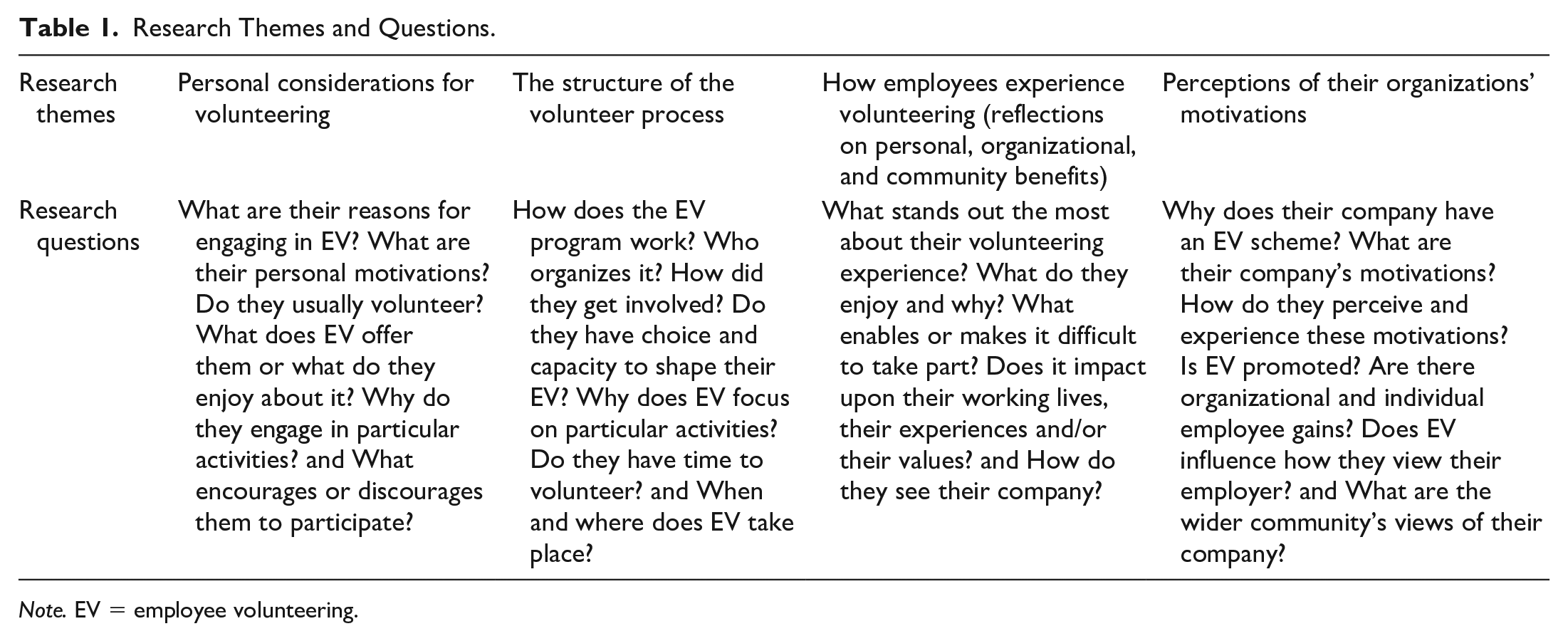
Note. EV = employee volunteering.
These questions were central to the studies but they also investigated additional questions, not germane to this article. This approach captured the challenges, drivers, motivations, and lived experiences of employee volunteers. The research created space for employees to share and compare experiences, to situate these within the context of their relationship with their employer, and to reflect on their personal values and ambitions. All interviews were transcribed verbatim. While each study was undertaken and analyzed in its own right, the application of a consistent research framework across all three projects provided the foundation for comparative analysis.
The case study businesses spanned banking, retail, legal, professional services, food production, media services, and telecommunications. Purposive nonrandom sampling techniques were used to recruit participants (Mason, 2002; Ritchie et al., 2003) and involved some snowballing. Employees volunteered on multiple occasions, across a variety of activities, including regular initiatives around skills-based volunteering (reading in schools, secondment to charities, etc.); supporting nominated charities raising funds in-house; and one-off “challenge days.” Typical of EV, the sampled employees participated in multiple volunteering activities with a range of host organizations selected by their employer. They were, therefore, reflecting on their overall personal experiences across activities rather than any single volunteering activity or voluntary organization. Consequently, the analysis focuses upon their overall experience of EV but cannot disaggregate between different EV activities (see Englert et al., 2020; Lough & Turner, 2017).
Different approaches to EV were captured, reflecting a mix of drivers ranging from reputation to community-embedded philanthropy. Across all projects, the research team utilized qualitative methods to conduct focus group and individual interviews with employees, business, and third-sector managers. All interviews and focus groups were designed to enable participants to talk freely about their personal experiences of volunteering. Table 2 summarizes the projects, data collected, and its utilization within this analysis. The data analysis here incorporates all of the employee data from the different projects, comprising 79 employee interviews, 13 employee focus groups (involving eight participants in each n = 104), with many of the individual interviewees being members of focus groups.
Summary of EV Research Projects From Which Data Are Derived With Details of What Data Sets Were Utilized for Current Analysis.
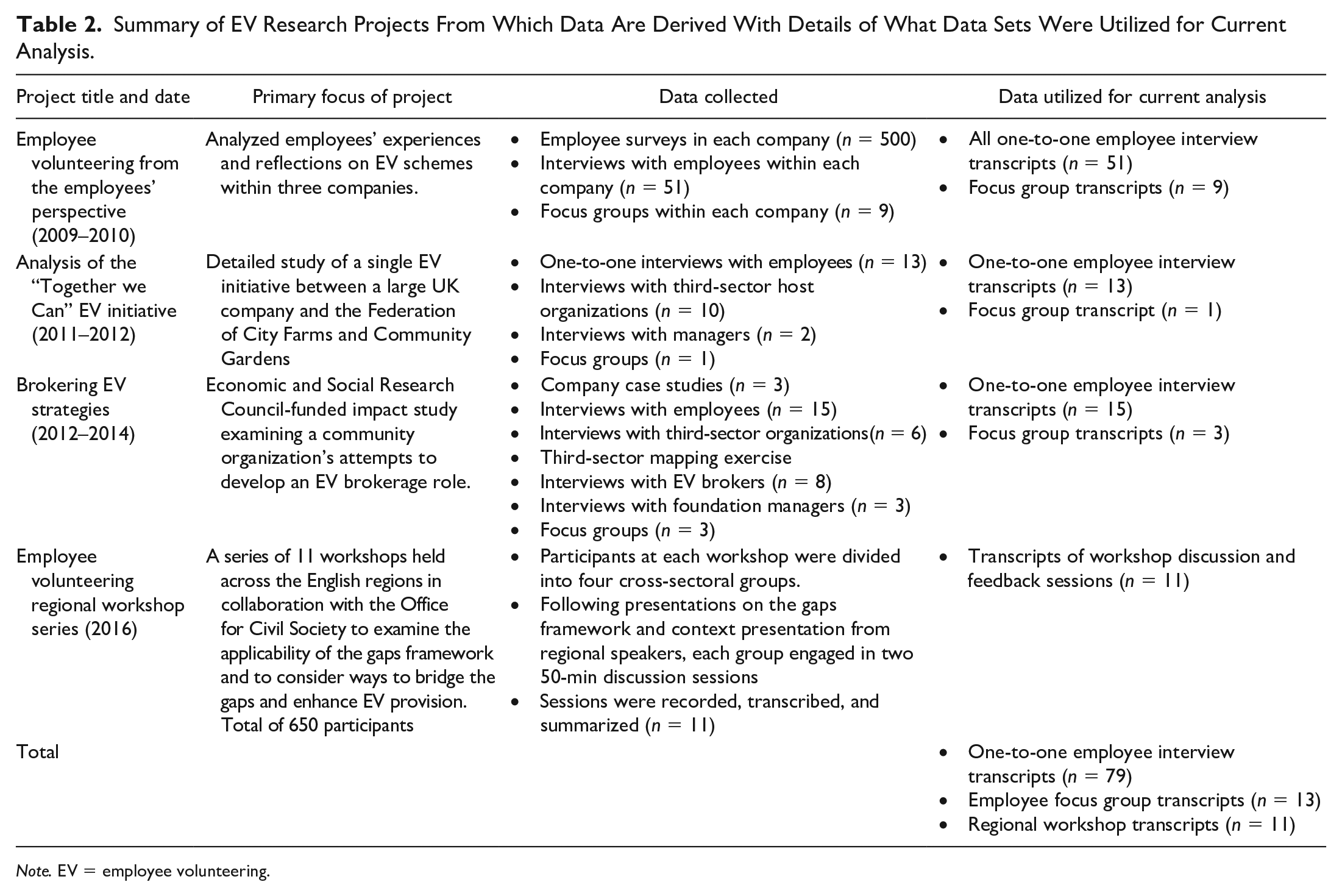
Note. EV = employee volunteering.
The methodology draws from a combination of Participatory Action Research approaches (Bergold & Thomas, 2012; Bradbury, 2015) and biographical and life story perspectives (Wengraf et al., 2002). The research was approved by the University Ethics Committee and participants gave informed consent.
Transcripts were coded using established methods of thematic coding of emerging themes (Mason, 2002; Spencer et al., 2013). Data analysis was undertaken via a combination of inductive data-driven and deductive theory/concept-driven coding (Fereday & Muir-Cochrane, 2006; Gibbs, 2018) utilizing the “framework” analysis stages outlined by Ritchie and Spencer (2002). This provides a systematic and flexible structure to manage and analyze data while enabling the development and maintenance of a transparent audit trail (Hackett & Strickland, 2018). An initial thematic framework was established based upon the core themes within the interview questions. The main themes identified were motivations for volunteering, the organizations’ impact on their volunteer experience, and reflections on their experience of volunteering. Interview data were indexed by applying textual codes to specific pieces of data. These were grouped into categories and charted against the headings from the thematic framework (see Table 3). All stages were scrutinized to ensure the clustered themes and categories were representative of the initial data analysis and assigned codes (Crabtree & Miller, 1999; Fereday & Muir-Cochrane, 2006). The interaction of text, codes, categories, and themes involved an iterative process of moving back and forth between the themes and the extant literature to identify patterns of meaning (Braun & Clarke, 2006; McShane & Cunningham, 2012).
Coding Table for Analysis of Employees’ Experiences of EV Schemes.
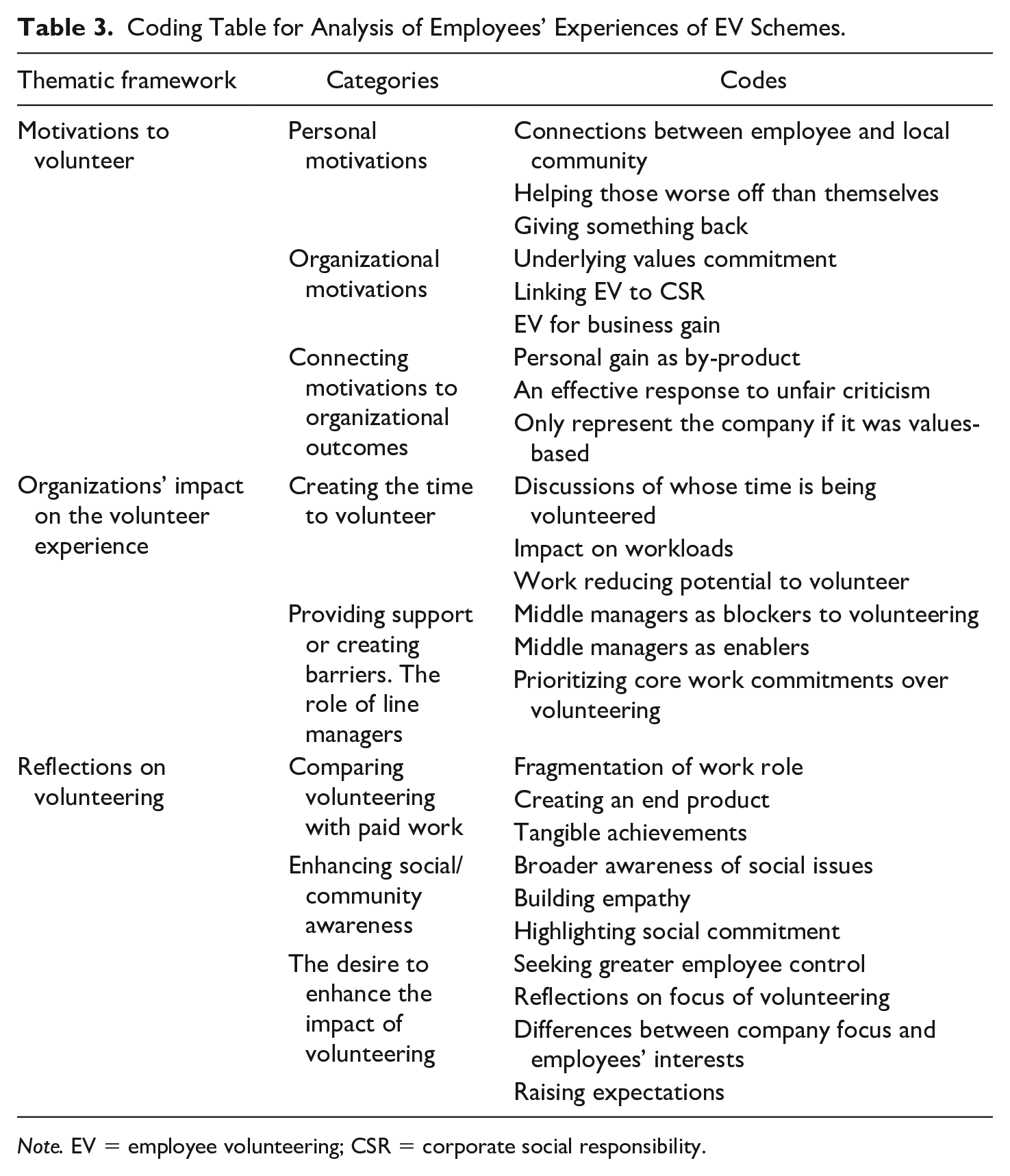
Note. EV = employee volunteering; CSR = corporate social responsibility.
Research Findings
The themes discussed were selected due to their predominance throughout the data and centrality to extant literature. Codes were included where issues were identified by a majority of participants. Where this is not the case, it is specified in the discussion. Findings focus upon the following themes: (a) employees’ discussions of their motivations for engaging in EV and their perception of its broader role within their organization, (b) how the employing organization impacts on the volunteer experience, and (c) employee reflections on EV.
Theme 1: Employee Motivations—Cause Over Company?
Central to existing EV research is the connection between employees’ participation and their levels of organizational commitment, identity, and citizenship behavior, in particular, the link between employee motivations to volunteer and the strategic organizational drivers for developing EV programs (do Paço & Nave, 2013; Peloza & Hassay, 2006). Across the case studies, employees devoted considerable time to discussing their own motivations and those of their organization. Three central strands emerged: connections between employee motivations and local community, connecting motivations to organizational outcomes, and disconnecting EV from organizational CSR.
Connections Between Employee Motivations and Local Community
When discussing volunteering, employees overwhelmingly identified some degree of altruistic or prosocial motivations (Clary & Snyder, 1999; Sheel & Vohra, 2016). However, their discussion was more specific than a broad-ranging desire to do good, focusing instead on two central issues. First, the connection between the employees and the local communities where the activities occurred. Second, the desire to help others worse-off than themselves. Location was key for most volunteers, with employees identifying personal connections with the causes and the locality: a lot of the areas for volunteering are local charities or stuff like that, so I mean they are known to me. I live locally, so it’s an opportunity to help. (Finance Interview 1) it’s helping people, because we all live locally, it does affect us because we are local people. (Telecoms Interview 3).
In line with other studies (Muthuri et al., 2009; Sekar & Dyaram, 2017), the research identified an emphasis among employees to “make a difference” and “give something back.” This was especially pertinent for projects that employees felt enhanced the well-being of their own community. Employees cited the personal feeling of giving directly rather than simply “standing on the sidelines”: I honestly feel a sense of responsibility . . . I work for a good company, on a good salary . . . not everybody has had the same opportunities . . . I just feel I have a responsibility to give back to the local community . . . (Telecoms Focus Group)
Two of Clary et al.’s (1998) motivational categories—values and protective—are central among employees’ articulations of why they engage. However, employees presented these motivations in a particularly personal and place-based manner.
Community-driven prosocial motivations took primacy over career, organizational benefits, or a sense of organizational commitment (Brockner et al., 2014; do Paço et al., 2013). Personal career benefits, organizational identity, and commitment were evident within employees’ discussions but predominantly as by-products, rather than primary motivations. The research identified a weak connection to personal career progression, highlighted by the negative attitudes many employees expressed toward connecting EV to appraisals: I wouldn’t ever want to put that sort of stuff into an appraisal, . . . you’re just setting yourself up for making volunteering a competition, . . . you’re forced to do it, to do well in your job basically rather than you’re doing it because you want to. (Food Focus Group)
While the data confirm that employees’ motivations are a key factor shaping engagement in EV, examining motivations through employees’ own interpretations reveals a more nuanced articulation absent from earlier studies. Importantly, it reveals a more complex picture, illuminating multiple motivations (Clary et al., 1998) and problematizing more linear EV approaches which demarcate between prosocial or self-serving.
Connecting Motivations to Outcomes
A sense of contributing to corporate citizenship was not absent in our data with employees highlighting “benefits to the brand” as a key business outcome. In several cases, employees recognized that their organization had embraced EV as a way of responding to local community criticisms. While rarely attributed as a primary motivation, employees identified this as an important outcome especially where criticisms were perceived to be unfair or inaccurate. This was particularly noticeable within the banking sector where all employees identified volunteering as a chance to redress the balance of negative publicity following the 2008–2009 financial crisis: tell someone you work in a bank you instantly get the “oh a million pounds worth of bonuses” comment . . ., so it’s quite nice just to go out and have someone say “oh wow [company name] is doing this, that’s really good.” (Finance Focus Group 1)
Similar sentiments were found in the telecoms company which had experienced negative press coverage: [company name] has had a lot of press with people saying “you do nothing for the community . . .” and I knew it to be untrue. I just wanted to make sure I was part of proving that it was untrue. (Telecom Interview 1)
While the above quotes illustrate how employees identified EV with improving organizational reputation, their willingness to allow their volunteering to be utilized in this way was connected to two central elements. First, the perception that the critique was either inaccurate or unfair, and second, that the organizational motives for engaging were a “genuine,” values-driven commitment to the community, and not for self-serving corporate gain: I wouldn’t want to be sort of a face of [organisation name] . . . if I didn’t respect the way that they carry on business. (Law Focus Group) part of the way round that is for the employees to fully and properly believe that the employer’s motives are pure in terms of what they’re trying to achieve and it’s not simply about using their workforce to generate good publicity. We don’t talk a great deal about what we do. (Food Interview 3)
The study found evidence of the link between organizational pride and EV, consistent with existing research (Bhinekawati et al., 2020; Booth et al., 2009). However, employees’ interpretations of these sentiments stretch beyond their volunteering experiences, to include reflections on their organization’s broader behavior. This suggests a more extensive evaluative process by employees stretching beyond Runte and Basil’s (2012) focus on the perceived “just distribution” of credit between the employer and employee. It also suggests that the role of EV in generating organizational commitment and citizenship behavior is more opaque. This partially supports the argument that employees reflect on their firms’ motivations in their decisions to engage (Gatignon-Turnau & Mignonac, 2015; Grant, 2012), but extends this beyond the organization’s perceived motivations for EV to include the influence of employees’ wider relationship with their organization.
Disconnecting EV From CSR
Many employees actively disconnected their motivations to volunteer from the broader organizational CSR strategy, perceiving volunteering to be a more “bottom up” activity: most members of staff are on board with the [charity name] and fundraising . . . they don’t see that as being CSR. (Finance Interview 2). I didn’t necessarily think of the company at all, that never crossed my mind. I’m not doing it for the company; I’m doing it for the kids. (Telecom Interview 5).
This disconnect between CSR strategy and volunteering relates to the sense of ownership employees expressed over volunteering. By demarcating volunteering from corporate CSR, employees felt able to retain their personal motivations of “giving” and ensure these did not get entangled with “legitimate” or “illegitimate” business gains. Consequently, employees maintained a personal commitment to “giving back” not motivated by career gain or undertaken for public relations purposes.
Research identifies increased levels of organizational identity and citizenship as a direct consequence of EV, achieved through the matching of employee motivations with EV strategy (Grant, 2012; Kim et al., 2010). The data above reinforce that employees justify their levels of organizational identity and commitment as grounded in their broader relationship with the organization and their perception of a “genuine” community commitment. This reflects the importance of “organisational fit” identified in broader volunteering literature (Englert et al., 2020).
Theme 2: Employer Organization’s Impact on the Volunteer Experience
Two key internal organizational issues, under-examined in existing research, were identified by employees as shaping their experiences: the time to volunteer and the role of line managers. Traditional volunteering research examines the “volunteer experience” as provided by the voluntary sector organization and focuses upon its capacity to satiate individual motivations (Englert et al., 2020; Stukas et al., 2016). While attention has been on the voluntary sector organization’s ability to support or discourage volunteering, this research found that employees’ experiences were also influenced by activities within the workplace, facilitating or hindering their volunteering.
Whose Time Is Being Volunteered?
Employees discussed whether employers were actually giving corporate time for EV. While volunteering fell officially within the “working day,” closer investigation revealed that most employees effectively gave up their own time. Rarely were workloads reduced, with employees expected to catch up on work missed: I’m going to be out all afternoon doing an event . . . so that’s . . . a full afternoon’s opportunity for charging time I’ll have lost that I’ll have to make back up again to make my target. (Law Focus Group 2)
The only exceptions were frontline employees who were unable to catch up because their duties involved “in-time” activities such as phone enquiries or serving customers. Consequently, the majority of volunteers were backroom employees. Where frontline employees participated, many volunteered on their days off or used leave. These issues reflect broader concerns that CSR schemes like EV represent “soft CSR”; outward facing but largely peripheral to core business activity and values (Fleming & Jones, 2012). Arguably, if EV represented a “true” commitment, the opportunities to engage should be equally available to all staff and reflected in workloads.
Time restraints have been identified in broader volunteering literature as a key barrier to volunteer participation and retention (Taylor et al., 2006). Employee volunteers similarly discussed how increased workload pressures reduced their volunteering time: I’ve had to say I can’t come for the rest of the term because my workload is just shocking and unfortunately that’s the first thing that’s gonna go. (Law Focus Group 2)
Several employees explained how they used to volunteer outside of work but increased workloads had reduced their ability to do this. Many spoke positively about their company providing them with a structured EV framework while simultaneously identifying work as the reason they couldn’t volunteer independently. Employees were conscious that they still had to complete the same amount of work, leaving them to intensify their work, work through lunch, or elongate their working day. For some, these issues were seen as indicative of whether their organization was truly supportive of EV.
The Hourglass of Volunteering
While identifying a connection between company values and EV, employees questioned the levels of internal support for volunteering. A core challenge across the organizations was the blocker or enabler role that middle managers can play. This was termed the squeezed middle, the “permafrost” of middle-management, or as one manager conceptualized it, “the hourglass of volunteering”: You have your leadership that are really keen at promoting it and you have people that are nearer to the communities that are really keen to get involved but the pinchpoint is the middle management who have to balance the targets and the day job and therefore don’t necessarily release their employees . . . So that “hourglass” is a real challenge that you have got to convince the “squeezed middle.” (EV Workshop, CSR Manager) They [middle managers] have the pressure coming down from the top to target, target, deliver, deliver, and then they’ve got the pressure from the bottom, what resources have I got to deliver, deliver. (CSR Managers Focus Group)
The enabling/blocking role of line managers was identified by all employees. Although rarely exhibited through direct refusals to let people volunteer, employees described being informally discouraged: There are certain partners who are subliminally putting pressure on associates not to go or to say to them “have you done so and so?” and “has this been done?” and you start off with 16 out of 30 will want to do it and by the time it comes down to the day I can guarantee that I’ll end up with 10. (Law Focus Group 1) It’s not overt pressure; it’s not saying “no you’re not going.” They start looking at holiday lists and they start looking at work files and then you go back to your desk and you think well I’ve asked and I’ll just wait until they come back and say I can go and then when nothing happens they just presume that they weren’t given permission to go. (Finance Focus Group 1)
These findings reveal an inconsistency between the organizational offer and its practical application, when contextualized alongside other business pressures. By contrast, where line managers embraced EV, employees spoke of being encouraged to volunteer. The overriding picture reflects inconsistency across organizations, with some employees feeling positively encouraged, whereas others felt pressured not to participate. Line managers were not required to facilitate volunteering and targets did not reflect or remove barriers. The concept of the “hourglass” or “squeezed middle” challenges the embeddedness of EV as core business practice and highlights a contradiction between organizational strategies to support EV and the pressures on middle managers to prioritize corporate economic targets. Interestingly, employees directed minimal criticism toward line managers, recognizing that their resistance was largely induced by workloads and targets—rather than antagonism toward EV.
Examining employees’ experiences as being shaped by the organization’s volunteering climate (Rodell et al., 2017) bring a much-neglected dimension of EV to the fore. Namely, that organizational and individual outcomes are shaped by the degree to which organizations remove barriers and create engagement opportunities (formal and informal) for employees. This reflects within an employer organization context Englert et al.’s conceptualization of perceived “fit” when volunteers “experience organizational support, in the form of access to service-relevant resources or infrastructure” (Englert et al., 2020: 345). This will impact on both the capacity of EV to satisfy employees’ motivations and on associated organizational benefits.
Theme 3: Employee Reflections on Volunteering
The research examined how employees reflect cognitively on their experiences and address potential contradictions, tensions, or paradoxes (Gond et al., 2017). While an emerging critique suggests EV produces both positive and negative organizational outcomes (Gatignon-Turnau & Mignonac, 2015), this is enhanced by examining how employees reflect on their experiences in relation to their broader working environment. These data are organized around the following subthemes: comparing volunteering with their paid work, enhancing social and community awareness, and the desire to enhance the impact of volunteering.
Comparing EV With Paid Work
A number of employees talked about the positive experiences of volunteering, identifying it as a route to overcoming alienation, mundanity, or narrowness within their work. Key themes included the repetitive nature of their jobs and never producing an “end product.” EV provided an opportunity to do something different and look beyond jobs and associated pressures: it definitely makes a difference. In here you’re just part of the process and you don’t see customers . . ., you might not even know about the rest of the process. Out there, if you’re building a cycle track, . . . you’re seeing it and it’s an end result . . . (Finance Focus Group 1) . . . most of us here, we don’t produce an identifiable thing in our daily work whereas the output of volunteering is a change that you can see that you have made . . . it’s a bit more tangible. (Food Focus Group)
This reflects research on Wanderlust (Grant, 2012; Rodell, 2013) and volunteer “fit” (Englert et al., 2020) and highlights how EV fills gaps in their jobs. This was not the case for all employees; the extent to which EV challenged employees’ perceptions varied. Some employees identified EV as enabling them to mitigate the limitations of their jobs: I’m a frustrated teacher or I was . . .Yeah, never mind. In my next life. (Telecoms Interview 2)
Once the recorder was turned off, a small number of interviewees spoke more explicitly of how they were utilizing volunteering to engage in activities that could eventually enable them to find alternative jobs.
Enhancing Social Awareness
Employees discussed how EV had altered their perception of both their own working lives and the lives of people around them: it broadens your knowledge of other people’s circumstances. You know you talk to some of the children and you find out about what their parents do or what they don’t do . . . the world’s made up of all those different people with varying opportunities. (Finance Interview 5) It does make you very humble . . . you know they’re gonna have a fight through the rest of their lives and if you can just make it a little bit easier for them. (Telecoms Interview 5)
EV may be producing more empathetic attitudes among employees as it broadens their understanding of social challenges. Employees perceived this positively, suggesting it enabled them to relate more to customers reflecting similar research findings (Afkhami et al., 2019; Haski-Leventhal et al., 2019). This could also have a negative organizational impact if, as employees develop a stronger sense of their own personal ethics, it leads them to question corporate practices and procedures.
Desire to Influence EV
The data identified a number of employees seeking to shape their organization’s EV. The extent to which organizations are prepared to let staff “have a say” again reflects their claims for embedding responsible values. While some employees felt there was space to suggest volunteering activities, others saw little opportunity. For example, in the finance organization, employees felt able to make suggestions for improvements: we talked to [name] a little while ago about . . . the [name of scheme] and about how from a learning perspective we might be able to assist in putting together some ideas . . . that might improve the process . . . and actually get more sort of evaluation of what value we’re actually adding. (Finance Interview 3)
Even within top-down organizational structures, employees expressed the desire to suggest changes. This confirms Rodell et al.’s (2017) suggestion that the volunteering climate can be driven by employees’ commitment to a cause as well as through organizational strategy. However, this research indicates that, as employees get more involved, they may also seek more control over activities and impacts, reflecting the broader volunteering literature’s findings on volunteer empowerment (Boezeman & Ellemers, 2009). This is inevitably balanced against broader business case objectives underpinning the EV strategy, setting the parameters of employee engagement. If employees’ EV experiences raise expectations, failure to match these could lead them to criticism of their organization’s commitment.
EV engagement has the potential to generate both positive and negative organizational outcomes. While existing research often connects these outcomes to the ability to match organizational EV strategy with employee motivations, this research indicates employees’ capacity to make more complex connections between their EV experiences and their broader working lives (Gond et al., 2017). These connections extend beyond the EV strategy itself. By reflecting upon their motivations for, and experiences of, volunteering, employees evaluate this against the values of their organization and the ability of their jobs to fulfill expectations/needs. This extends the notion of “volunteer fit” into the employment domain (Englert et al., 2020). This creates both positive and negative responses, upon which the specific framing of an EV strategy has limited impact, but for which the cognitive opportunity created by EV can be responsible.
Conclusion and Theoretical Implications
This article focused on the experiences of employees, to address the current overemphasis upon collective organizational outcomes (Glavas, 2016; Gond et al., 2017). While research identified connections between EV, organizational commitment, and motivations, this article has demonstrated how exploring EV from the employees’ perspective uncovers a more complex series of interactions and relationships shaping how they experience, reflect, and interpret EV. These processes in turn shape the extent to which EV can create positive or negative organizational outcomes for the employing organization (Figure 1).
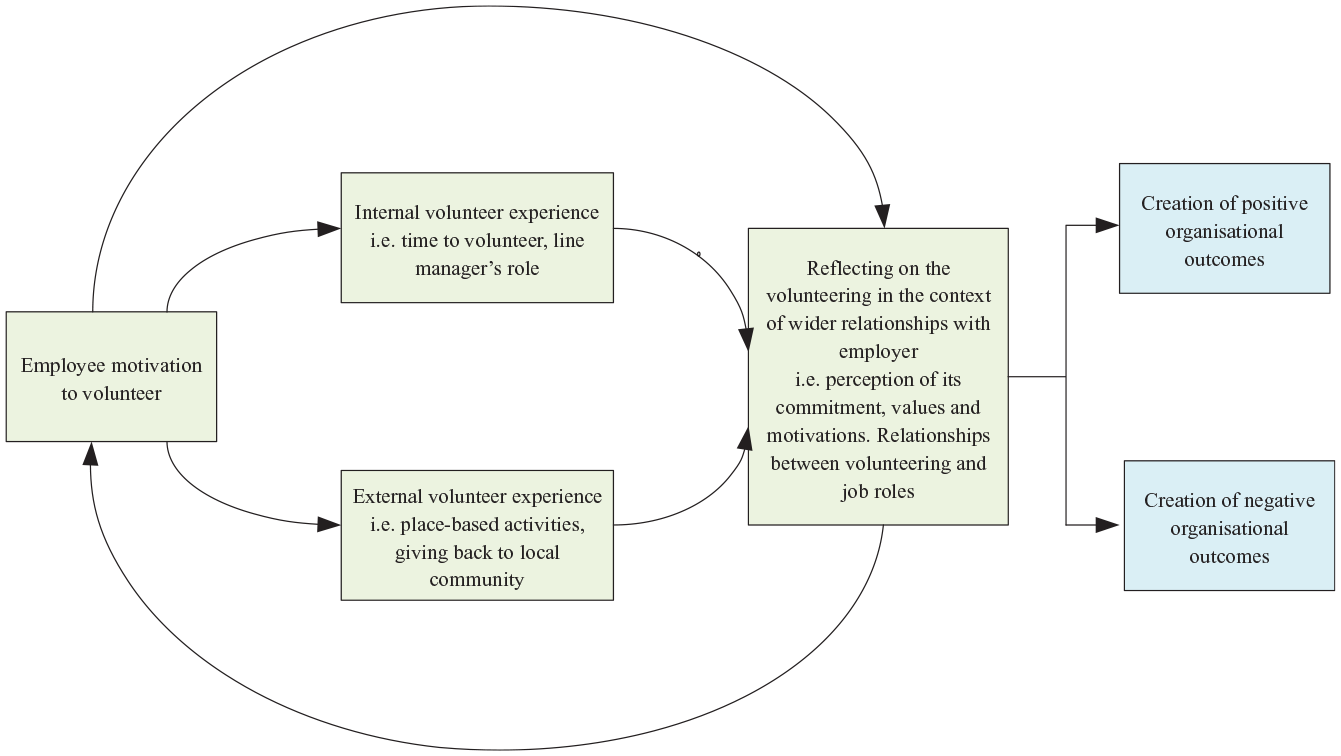
Linking employees’ motivations, experiences, and reflections to outcomes from EV for employing organizations.
The relationship between motivations, volunteer experience, and organizational outcomes is distinct with EV because it is not simply a two-way relationship between volunteer and voluntary sector organization—as in traditional volunteering. It is more complex because EV creates a three-way relationship between the volunteer-employee, the employing-organization, and the voluntary sector organization partner. Traditional volunteering literature provides extensive understanding of the relationships between volunteer and voluntary sector organization, which EV research has sought to transplant directly onto the EV context, neglecting the three-way nature of the relationship.
Like traditional volunteering, EV activities are not generically “prosocial” but are more place-based and personal, suggesting a strong connection between the volunteering activity and the individual. This has been a common finding in studies on episodic volunteering (Hendriks & Peelen, 2013; Snelgrove et al., 2013) and more recently in more general volunteering literature; Merrilees et al. (2020) found that the purpose/cause of the organization where volunteering takes place was the most important motive for volunteers to continue. Reflecting this, employees volunteered predominantly to meet their personal objectives of “giving something back” or “doing it for the kids.” To this end, many distanced their volunteering from their employing organization’s CSR, identifying volunteering activity as more community-focused, prioritizing community benefits with employer organizational gains being peripheral.
Conceptualizing EV as a three-way relationship challenges traditional connections to organizational outcomes. Injecting employees’ perspectives reveals that they reflect on their employer organization’s motivations for adopting EV schemes, and that their interpretation of “legitimate” organizational gain is shaped by their own motivations. This article identifies that employees’ evaluations of their employers values extend beyond the mere existence of an EV strategy or the perceived “just” distribution of credit for EV (Runte & Basil, 2012), to include broader reflections on the organization’s underlying values and practices.
EV also incorporates an additional dimension to the “volunteer experience.” While previous research examines employees’ experiences of volunteering within the community setting, this study highlights how these experiences are heavily influenced by resources and pressures within the workplace. Complementing research on the volunteer climate (Rodell et al., 2017; Studer & Von Schnurbein, 2013), this article highlights the potential for these internal dimensions to impact in complex ways on both the capacity of EV to satisfy employees’ motivations and upon the associated organizational benefits for employers.
This internal dimension to the employees’ volunteering experience is key to understanding why EV creates both positive and negative employing organizational outcomes. Employees’ perception of their organization, its values, motivations, and behavior, is shaped by their wider relationship with the organization as an employee, their internal and external volunteer experience, and their motivations to volunteer. While existing research considers how employees’ reflexive capacity can influence employing organizational outcomes, it is the combination of employee experience and reflexive capacity that can result in them being both positive and negative.
This article has deliberately focused upon the internal organizational factors shaping employees’ experiences and reflections on EV. We have explored elsewhere the implications of the relationships between business and voluntary sector organizations, highlighting how closer examination of this relationship questions the underlying “win–win” assumed in EV (Cook & Burchell, 2018). Future research is needed to examine the complex interaction of the three-way relationship between the employer–volunteer–voluntary sector organization and how these impact upon the organizational outcomes from EV. The initial threads of this approach are found in Haski-Leventhal et al.’s (2010) “third-party” model which identifies corporations, alongside governments and educational institutions, as macro-level actors who can impact upon established models and concepts in volunteering. More research is needed that examines the interaction of these three-way relationships, with volunteer motivations, experiences, and organizational outcomes.
In a 2019 NPVSQ special edition, Brudney et al. highlighted the propensity of volunteering studies to “appear to study the same phenomenon” and consequently create a perception that volunteering was a “unitary concept” (p. 65). In doing so they called for more explorations of the diversity of volunteering, including “the broader ecosystem in which the volunteering occurs.” This article contributes to this process by highlighting how EV incorporates multiple organizational environments within which the volunteer operates. Therefore, to understand the potential impacts and outcomes from EV, it is necessary to analyze the complex interaction of multiple organizational environments (corporate and voluntary sector).
Footnotes
Declaration of Conflicting Interests
The author(s) declared no potential conflicts of interest with respect to the research, authorship, and/or publication of this article.
Funding
The author(s) received no financial support for the research, authorship, and/or publication of this article.
