




Abstract
Studies explaining interest organizations’ influence typically focus on the role of groups’ structural characteristics, such as group type. However, we ask whether the boards of interest groups can also play a role in their organizations’ advocacy performance. Drawing from management scholarship, we investigate how the governance practices and characteristics of the boards of interest organizations are associated with those organizations’ advocacy performance. To study this, we surveyed the board members of Finnish elite interest organizations and found that board performance in strategy tasks (e.g., long-term planning and connecting with stakeholders) is strongly related to advocacy performance. Moreover, we found that the gender diversity of boards is negatively associated with success in advocacy, and the frequency of board meetings is curvilinearly associated. In contrast, board performance in control tasks (e.g., monitoring of management), board size, and inclusive practices are not associated with advocacy performance.
One of the most profound questions in political science is who has influence (Binderkrantz & Pedersen, 2019). In answering this question, the role of organized interests cannot be neglected; in fact, many scholars view interest groups as some of the most influential actors in politics (e.g., Baumgartner & Leech, 2001; Berry, 2000). Interest groups are organizations (e.g., associations) through which citizens and other actors (e.g., corporations) can channel their opinions and preferences to political decision-makers. Interest groups are important both in “pluralist” countries like the United States, where the logic of the political system favors interest groups (Berry, 2000), and in “corporatist” countries, like many European countries, where some groups have a strong, institutionalized position in policymaking (Öberg, 2002).
Numerous studies have sought to explain interest group influence and focused mainly on the role of factors such as groups’ financial resources (e.g., Baumgartner et al., 2009), group type (e.g., Dür et al., 2015), and advocacy strategies (Binderkrantz & Pedersen, 2019). Furthermore, scholars have analyzed the role of contextual factors, such as issue salience (Stevens & De Bruycker, 2020) and the degree of political conflict (Dür et al., 2015). However, the internal decision-making processes of interest organizations have remained understudied for a long time (Halpin & Fraussen, 2019), even though they have recently started to draw more attention (e.g., Albareda & Braun, 2019; Grömping & Halpin, 2019; Halpin, 2014; Halpin & Fraussen, 2019; Hollman, 2020). For example, Barakso (2018) has shown how voluntary associations’ internal structures affect their participation in the wider political arena.
This article aims to contribute to this emerging literature by focusing on the internal governance of interest organizations by analyzing its association with groups’ advocacy performance (Johansen & LeRoux, 2012)—that is, the success of their lobbying efforts. Furthermore, we begin from the observation that the internal governance of any organization can have a profound effect on, for example, its internal power structure (Jegers, 2009) and external success (Brown, 2005).
Specifically, we focus on the boards of directors, which are expected to play crucial roles in the internal governance of organizations 1 as important organizational resources (Coombes et al., 2011). Studies show that there is significant variation between boards in terms of their roles and practices in the nonprofit sector (Coombes et al., 2011). However, few studies have focused specifically on the role of boards in interest groups’ success.
To understand the role of boards in advocacy performance, we combine theories from management and interest group scholarship. Based primarily on management scholarship (e.g., the agency and resource-based theories), we hypothesize that three aspects of boards are especially relevant: (a) various board governance practices (i.e., what the board does; Buse et al., 2014; Hillman & Dalziel, 2003; Zattoni et al., 2015); (b) board characteristics (i.e., what the board is like; Mehrotra, 2016); and (c) boards’ inclusive practices (i.e., whom it listens to; Albareda & Braun, 2019; Brown, 2002). We combine these theoretical insights with the exchange theory, which interest group scholars commonly use to explain groups’ advocacy success. This theory posits that interest groups provide “policy goods,” such as information and political support, to decision-makers in exchange for policy influence (e.g., Beyers & Braun, 2014; Godwin et al., 2013). According to Bouwen (2002), organizational design affects the ability to deliver policy goods. We suggest that board practices and characteristics may affect interest organizations’ opportunities to produce and transfer policy goods to decision-makers and, hence, affect their performance in advocacy.
To test the hypotheses empirically, we draw from a unique survey of the board members of Finnish elite interest organizations. Finland has been categorized as a corporatist country (Siaroff, 1999), which means that labor unions and employers’ associations in particular have traditionally held a strong position in policy-making through their institutionalized access to government-appointed bodies (e.g., Helander, 1979). Although the inclusion of interest groups in these bodies seems to have decreased in recent decades, scholars have argued (Vehka & Vesa, 2020) that there is still a privileged elite of organizations—especially business groups, trade unions and institutional groups, and recently, citizen groups as well—that enjoy strong access to policy-making. Prominent groups include the peak-level organizations representing business (e.g., the Confederation of Finnish Industries) and employees (e.g., the Central Organization of Finnish Trade Unions). Another notable facet of a corporatist system is that groups are hierarchically organized, and there is relatively little competition between groups. Focus on a corporatist system such as Finland provides a conservative test for the role of boards in advocacy performance. If internal governance affects the success of interest organizations in a relatively noncompetitive and institutionalized corporatist system, it might be expected to influence it even more in pluralist systems such as that of the United States, even if there might be differences across systems in what kind of governance is effective.
In this article, we demonstrate how various factors related to interest group boards’ practices and characteristics as well as general organizational abilities can indeed be related to their organizations’ performance in advocacy. In particular, we found that a board’s performance in strategic tasks is strongly related to the entire organization’s advocacy success. These tasks include strategic long-term planning, providing support for the management, and contacts with organizations’ members and other stakeholders. In contrast, board performance in control tasks (e.g., monitoring of management) is not related to advocacy performance. Moreover, we found that gender diversity of boards is negatively associated with advocacy performance and the frequency of board meetings is curvilinearly associated with the same, while, for example, inclusive governance practices and the number of board members have no association with success in advocacy.
We contribute to management scholarship by extending governance research to interest organizations and interest group scholarship by opening the “black box” of the internal governance of these organizations.
Literature Review: Explaining Interest Groups’ Advocacy Performance
Interest groups are organizations that seek to influence public policy but also have other (intermediate) goals, such as influencing the media’s agenda and citizens’ opinions (Beyers, 2020). We use a broad definition of advocacy performance that includes success in these goals. Thus, this definition covers all three facets of power: decision-making, agenda-setting, and ideological (Bachrach & Baratz, 1963; Lukes, 1974; see Binderkrantz & Pedersen, 2019).
Effectiveness in advocacy is often a key feature of high-performing nonprofits (e.g., Crutchfield & Grant, 2008; Guo & Saxton, 2010), and in interest group scholarship, advocacy success is typically the primary measure of success (see Dür & De Bièvre, 2007). Performance, in general, is multidimensional and notoriously hard to measure (Johansen & LeRoux, 2012). We use the term “advocacy performance,” not “influence,” because we measure this phenomenon with constructs like those used by nonprofit scholarship to measure general organizational performance (Johansen & LeRoux, 2012).
Earlier studies of interest groups’ influence have largely focused on two group-level factors that affect their exchange relationship with decision-makers: groups’ financial resources and type. First, organizations with greater resources may make more effective exchanges than others (Godwin et al., 2013) because financial resources affect the quality of the information and other “policy goods” that they can offer to decision-makers (Beyers & Braun, 2014, p. 94). Second, a distinction is often made between economic (e.g., business groups) and citizen groups that represent noneconomic interests (e.g., cultural groups) or so-called diffuse interests (e.g., human rights groups; see, for example, Binderkrantz & Pedersen, 2019). Many studies suggest that economic groups often have advantages in policy processes, due to, for example, easier mobilizations caused by member incentives (because a smaller number of constituents makes mobilization easier) (Gilens & Page, 2014; Godwin et al., 2013; Mahoney, 2007; Olson, 1971). However, these theories have also been contested, and it has been argued that citizen groups can have great influence (Berry, 2000; Dür et al., 2015) and that money does not necessarily buy influence (Baumgartner et al., 2009).
Some scholars have also analyzed the internal organization of interest groups. For example, Albareda and Braun (2019) showed that the stronger the voice of interest group constituents in groups’ internal decision-making (according to their formal rules), the greater the access attained in political processes. This relationship exists because strong membership control signals to political decision-makers that the group is truly representative, and that their policy goods are thus more valuable. In a similar vein, Grömping and Halpin (2019) found that taking members into account can be beneficial for groups’ access to policymaking (see also, Halpin, 2014). Moreover, the impact of internal factors (e.g., culture) on nonprofit effectiveness has been thoroughly examined in the general nonprofit management literature (Langer & LeRoux, 2017). However, a thorough analysis of the role of boards that are supposed to lead the organization and represent members and other stakeholders is largely missing from the literature on interest organizations.
Hypotheses: Interest Groups’ Boards and Advocacy Performance
According to general management scholarship and the resource-based theory of the firm, different “resource endowments” explain organizational performance. “Strategic resources” that are valuable and rare are especially important (Coombes et al., 2011, p. 831). Crucially, boards of directors can also act as strategic resources in the nonprofit sector because of “their active and influential roles in guiding strategic and operational decisions” (see also Castanias & Helfat, 2001; Coombes et al., 2011, p. 831). Here, their role in oversight and providing connections to external resources as well as their counsel on how to use different resources may be important (Coombes et al., 2011).
It is somewhat surprising that interest groups’ boards and their relationship with advocacy success have remained significantly under-researched. A notable exception is Johansen and LeRoux’s (2012) study of a selection of general U.S. nonprofit organizations, which did not find an association between board performance (i.e., governance capacity) and advocacy performance. Our study extends this study in three ways. First, while Johansen and LeRoux (2012) used “governance capacity” and “board diversity” only as control variables, we focus systematically on various aspects of board practices, characteristics, and behaviors. Second, while they studied general nonprofits, our focus is on a wide selection of elite interest organizations (i.e., groups that have at least some level of access to policy-making, making advocacy performance a more important goal). Third, and most importantly, while Johansen and LeRoux (2012) used a single aggregate measure of “governance capacity,” we use a finer-grained distinction of board performance.
What does the board do? The effect of different governance practices
As Johansen and LeRoux (2012) hypothesized, nonprofit governance capacity could lead to increased advocacy effectiveness because strong boards generally tend to make organizations more effective (see Herman & Renz, 1998). Following this line of thinking, we rely on a common distinction in management literature and ask how board performance in (a) control tasks and (b) strategy tasks is associated with advocacy performance.
According to the agency theory, boards play an important role in protecting various stakeholders’ voices in the internal decision-making of organizations by monitoring management and staff behavior (Hillman & Dalziel, 2003; see Zattoni et al., 2015). The concept of control tasks refers to this monitoring function of boards. Boards are needed because the interests of different principals (e.g., shareholders or group members) and agents (e.g., managers and employees) do not always align (Tricker, 2015). Consequently, studies have also found a positive relationship between boards’ monitoring practices and organizational performance in nonprofit organizations (Brown, 2005). Within the framework of Buse et al. (2014), board actions like legal, ethical, and financial oversight, evaluating and guiding the CEO, and monitoring performance are examples of control tasks.
Previous interest group research has shown that the involvement of constituents in internal decision-making is positively associated with their advocacy success (Albareda & Braun, 2019; Guo & Saxton, 2010). Therefore, we hypothesize that the performance of interest groups’ boards (i.e., the guardians of members’ voices) in control tasks is also associated with higher advocacy performance because of the agency problem (because the interests of principals and agents do not always align). For example, in interest groups, some control might be needed to ensure, for example, that enough effort is put into advocacy activities, which are often difficult.
However, boards can also provide management with competencies, experience, resources, and direction (Zattoni et al., 2015) as well as legitimacy and, importantly, links to external actors (Hillman & Dalziel, 2003). The resource dependence theory often used to study the external dependencies of organizations emphasizes that boards perform such strategy tasks (Hillman & Dalziel, 2003; Pfeffer & Salancik, 1978). According to Buse et al. (2014), actions like strategic planning, supporting the CEO, fundraising, community relations, and outreach fall into this task category. Anecdotal evidence from a Finnish interest group also illustrates that board members may indeed play a strong role in supporting management (e.g., through regular discussions between the board chair and the director general), maintaining relationships with stakeholders, and providing direction (Häkämies, 2021).
Empirical studies on general nonprofits have also found that boards’ performance in strategy tasks may increase general organizational performance (Brown, 2005). Regarding advocacy performance, interest organizations’ boards could provide important contacts with policy actors, know-how on political processes, or effective lobbying strategies.
What is the board like? Board size, frequency of meetings, and (gender) diversity
In addition, certain board characteristics carry important governance and performance implications (Mehrotra, 2016) such as in the case of business firms. First, the number of directors on the board may matter because, as agency theory implies, “[m]ore directors are likely to be engaged in the review of management actions” (Mehrotra, 2016, p. 32). Moreover, as resource dependence theory implies, more directors can provide the firm with increased crucial resources. Studies have also found a positive correlation between board size and general nonprofit success in external activities (Langer & LeRoux, 2017). However, performance could be reduced if the number of board members is too large because reaching consensus could become more difficult (Mehrotra, 2016), and there are general problems with collective action (Olson, 1971). Therefore, we hypothesize that the relationship is curvilinear so that advocacy performance first increases with board size but decreases with very large boards.
Second, another factor related to resources is the frequency of board meetings, which are the main vehicle for decision-making and management monitoring (Mehrotra, 2016). Thus, in line with resource dependence theory (Pfeffer & Salancik, 1978), boards that meet more frequently may be more effective, which may affect the overall organizational performance. However, there is again the possibility that too much oversight and involvement may be less productive for the organization as, for example, it may be liable to promote reactive policy advocacy (Halpin & Fraussen, 2019). It could also be a signal that the board is ineffective or faces some internal challenges. We, therefore, hypothesize the following.
Third, the (gender) diversity on the board could account for improved performance in advocacy as well because it could provide the board and the organization with new information, perspectives, and insights (Mehrotra, 2016).
Whom does the board listen to? Inclusive governance practices
In management scholarship, the stakeholder theory recognizes that it is important for an organization to pay attention to the interests of external and internal stakeholders (Freeman, 1984). Therefore, inclusive practices—the extent to which boards consider various stakeholders’ perspectives in their decisions—may affect interest groups’ performance in advocacy (see Brown, 2002 for nonprofits; see Van Puyvelde et al., 2012 about multiple stakeholders).
Based on earlier studies which show that groups that listen to their constituencies achieve greater advocacy success (Albareda & Braun, 2019; Guo & Saxton, 2010), we should expect inclusive practices of boards to also have an effect on advocacy performance in the case of interest groups. Even though much has been written about the professionalization of political organizations and the resulting “diminished democracy” (Skocpol, 2003), some have suggested that member listening in particular may be a “beneficial inefficiency” because it can legitimate policy decisions and provide better quality access to goods (Grömping & Halpin, 2019). It may help to ensure, for example, that the policy statements that the group makes are really in line with member preferences and signal this to policymakers. However, based on the stakeholder theory, we examine the inclusion of many kinds of stakeholders, not only members.
Data and Research Design
Sampling Interest Groups and Their Board Members
To test the hypotheses, we used a survey of board members of elite Finnish interest organizations regarding the governance of their organizations. There is still no lobbying register in Finland, so constructing a random sample of all interest groups was not easy. However, since Finland has a corporatist interest group system, we can focus on a “top-down” sample (see Berkhout et al., 2018) of groups with institutionalized access to policymaking.
Target organizations were permanent, registered, nonstate associations (excluding parties) that participated in national-level political decision-making, either within policy preparation organs appointed by ministries or through parliamentary hearings. For the former, a dataset was used 2 on national-level committees and similar organs for 2018, in which about 100 associations were found. Of these, 71 either already had email addresses of board members available or provided them to us. For the latter, all interest groups that had given oral evidence to parliamentary committees regarding committee reports in 2018 were selected (around 400 organizations). Only a random sample (50%) of these associations was considered because the workload had to be limited. Using this method, 77 new organizations (i.e., not in the previous dataset) were found that had board member contact information available online. Only the associations that had the contact information of more than half of the board members available were included, to avoid overrepresenting chairpersons.
This overall strategy resulted in a sample of 148 associations with 1,552 board members. The survey was sent to the board members in 2020, and 513 board members from 141 different organizations responded to the survey. The response rates were 33.1% for board members and 95.3% for the organizations. This can be considered sufficient or even excellent in a case where many respondents are elite decision-makers. However, a few individual respondents were excluded from the analysis because of unreliable responses (straightlining). In the final analysis, 507 respondents were included (from 140 organizations).
The sample is not a random sample of all associations that aim to influence policymaking in Finland. In addition, slightly different sampling strategies were used for associations active in these two phases of the policy process (administrative and parliamentary). To account for this, the dataset where groups were included in the final sample was controlled in the analysis.
Aggregation of Data and Remedies for Common Method Bias
From the individual-level responses, organization-level data were aggregated. The research unit in this study is an organization, not a surveyed individual board member. The methods used in aggregation (means and modes) with each variable are described in the supplementary material alongside additional information about the aggregation of variables. Some of the variables in the aggregated data are categorical, but still used as continuous variables in the analysis.
By aggregating the responses to the organizational level, we aim to address common method bias (CMB)—the aggregation means that values were collected from many respondents. CMB was also considered when constructing the survey items (e.g., different variables were measured on different scales).
Dependent Variable: Advocacy Performance
One of the most common ways to measure effectiveness in organizations is by their reputation for effectiveness (Johansen & LeRoux, 2012). In this approach, stakeholders “use whatever criteria they consider to be most salient at the time, about the effectiveness of the organization” (see also Herman & Renz, 1998; Johansen & LeRoux, 2012, p. 357). Even if self-reported measures have their limitations, they are commonly used in organizational studies (Johansen & LeRoux, 2012). In the absence of good objective measures, they are a valuable source of information because effectiveness of any kind is at least partially socially constructed (Langer & LeRoux, 2017). Usually, only CEOs and other managers of organizations are surveyed. In our case, however, the respondents are board members, whom we consider to be even better judges of organizational effectiveness because they represent members and other stakeholders of the organizations, who are often the primary principals. Board members are also typically well informed about the practices of their organization.
Thus, we asked the respondents to evaluate the organizational and advocacy performance of their own organization, using questions adapted from Johansen and LeRoux (2012). Based on the literature on interest group influence (Binderkrantz & Pedersen, 2019), we also included additional measures of interest groups’ advocacy performance regarding agenda setting, decision-making, and ideological power. The composite variable advocacy performance was thus constructed as the mean of six items in the aggregated data, measuring the entire organization’s performance in influencing (a) citizens’ opinions, (b) media agendas, (c) political parties’ and politicians’ agendas, (d) civil servants’ and the national government’s agenda, (e) parliamentary decisions, and (f) governmental decisions (α = .872). Descriptive statistics and more information on this and other variables can be found in the supplementary material (Supplementary Table B), along with the correlation matrix of the individual items (Supplementary Table A). The correlation matrix shows that all items are quite strongly related, making the composite variable reliable. The supplementary material also includes an alternative analysis in which we split advocacy performance into “inside” and “outside” influence (see, for example, Binderkrantz, 2005)—that is, (a) on political agendas and decisions and (b) on public opinion and the media (Note A and Table C in the supplementary material).
Key Independent Variables
To measure the boards’ performances in various governance practices, we included a set of questions related to the control and strategy tasks of boards (based mostly on Buse et al., 2014). Performance in the former is a composite variable constructed as the mean of five items in the aggregated data (e.g., board performance in financial, legal, and ethical oversight or oversight and evaluation of an organization’s management activities; α = .872).
Performance in strategy tasks was calculated as the mean of various items (e.g., board performance in strategic, long-term planning, supporting management, fundraising for the organization, and contacts with members and various external stakeholders). The term “strategy” was not clarified to the respondents (except that it relates to long-term planning). However, in this context, strategizing refers to making choices or prioritizing (Dunn, 2021), which is essential in policy advocacy when resources are scarce.
Meanwhile, the original items used by Buse et al. (2014) only measured boards’ general connection to the community. Drawing from the resource dependence theory, we added measures of board members’ connections that could be significant to interest groups in particular (e.g., connections to organizations’ members, other interest groups, political decision-makers, and other external stakeholders). To our knowledge, this makes our measure of strategy task performance unique, since board involvement is usually not thoroughly measured in terms of external connections (α = .848; cf. Langer & LeRoux, 2017).
To test hypotheses about board characteristics, we included a measure of board size, which indicates the number of members as a five-point variable. In addition, we included a measure of the frequency of board meetings in a calendar year (five-point variable). Finally, we constructed a dummy variable for gender diversity from the variable measuring the percentage of men/women on the boards, so that 40–60 % means diversity.
Moreover, we measured inclusive governance practices with questions loosely based on the “political” dimension of the Board Self-Assessment Questionnaire (e.g., Brown, 2002; Jackson & Holland, 1998). The questions are related to the extent to which boards consider stakeholders’ perspectives in decision-making. We calculated a composite variable (α = .761) from the aggregated data, which is the mean of various items.
Control Variables
Interest group type is related to the type of constituents that they represent (e.g., business firms, workers, or citizens). Here, the coding scheme developed in the INTERARENA project was used (see, for example, Binderkrantz & Pedersen, 2019). In our study, we distinguish between economic groups (business groups, unions and professional associations, institutional groups) and various kinds of citizen groups (the reference category).
In interest group research, groups’ resources are usually measured in terms of their paid employees (Mahoney, 2007). Resources is an eight-point-variable that measures the number of paid staff members in a group, while the political employees variable measures how many of them are involved in actual political work using percentages (four-point variable; see, e.g., Binderkrantz, 2005). The extent to which groups allocate resources for advocacy is an important factor to be controlled for (Binderkrantz, 2005) because not all political organizations spend all their time in political activity; they may also have other missions, like service provision. The variable direct influence strategies (four-point variable) measures the proportion of time (%) that organizations use to try to gain influence through direct contact with decision-makers (Beyers et al., 2016), which is an important factor to be controlled for as well.
Management experience (four-point variable) measures whether groups’ highest management has experience mostly in advocacy or other activities (see also Johansen & LeRoux, 2012). In general, managerial experience (i.e., quality) should have a positive impact on organizational performance (Meier & O’Toole, 2002). Meanwhile, the ratio of paid managers/staff of respondents measures the proportion of respondent board members who are also paid managers or staff in the same organization. Paid employees might view their organizations’ performance differently.
Finally, we included a measure of political access in the models (and thus also controlled the dataset from which an organization was included in the sample). According to interest group scholarship, access to policymaking organs is an important prerequisite for influence. Therefore, we controlled whether the group was in the original policy preparation organ data, parliamentary data (reference category) or both.
After calculating the variables, we filtered out cases with missing values from the data. In the end, the analysis included 124 organizations.
Analysis Method
We used ordinary least squares regression. This method allows simple interpretation of model coefficients and, according to regression diagnostics, seems to describe the data well. Here, relationships were found to be sufficiently linear, residuals were quite normally distributed, and there was no clear sign of heteroscedasticity or influential outliers.
To evaluate the effect sizes, we focused on both normal coefficients and standardized beta-coefficients. A few variance inflation factor—values were a bit high (highest value about 6), but not high enough to jeopardize the validity of the model. We also considered the possibility that the research units may be interdependent because of interlocking directorates. However, only a few board members were members of multiple boards in the sample, so we do not consider this a problem.
Results
Table 1 shows the effects of the predictor variables on the advocacy performance of Finnish elite interest organizations. The model fit seems to be quite sufficient: The multiple R² is 0.5568, and the adjusted R² is 0.4905, which means that the independent variables can account for quite a lot of the variation in the outcome variable (49%).
The OLS Regression Predicting Finnish Interest Organizations’ Advocacy Performance.
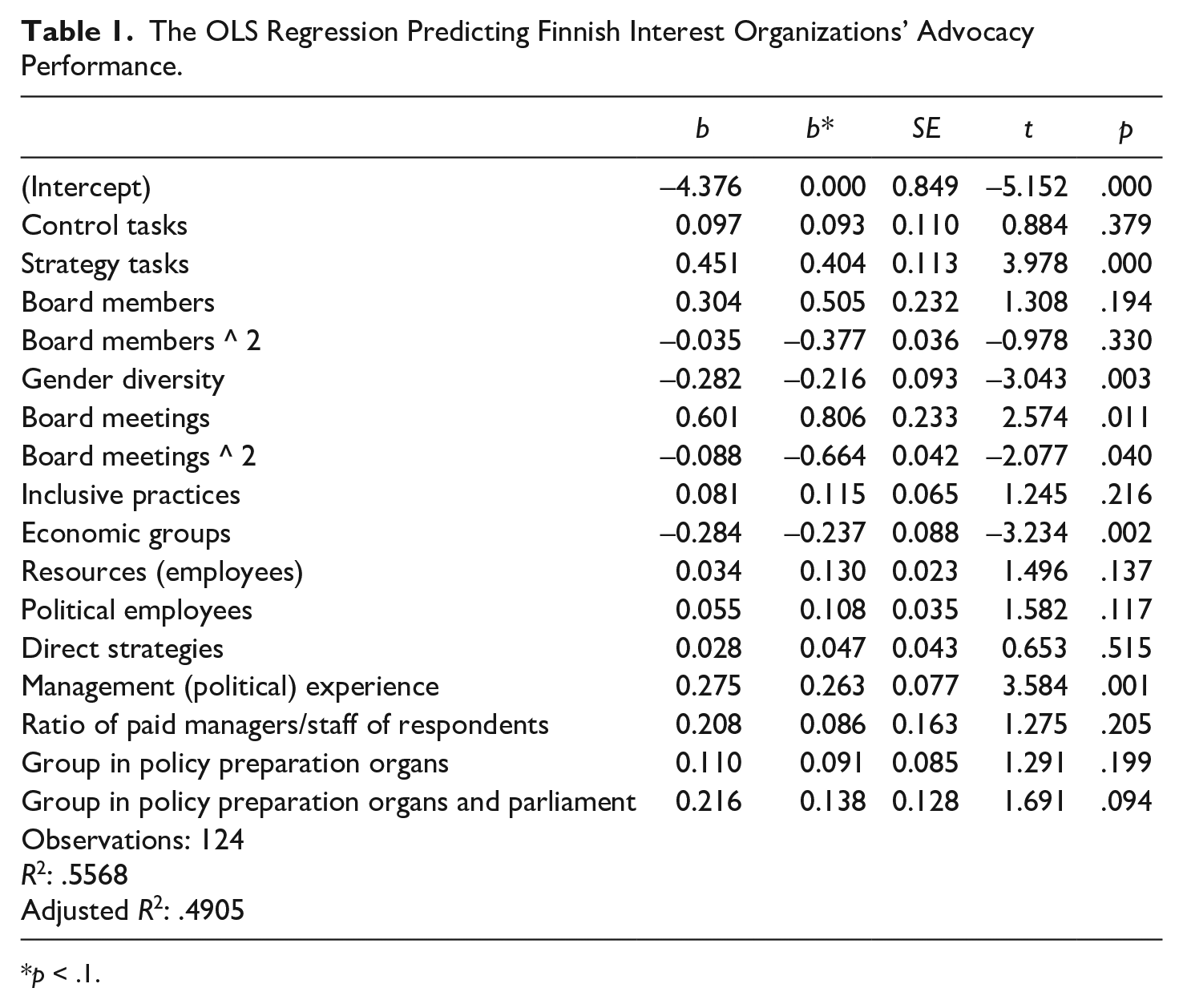
p < .1.
First, we consider performance in various governance practices (H1 and H2). The model indicates that board performance in control tasks is not related to advocacy performance; the positive coefficient is very small and statistically nonsignificant.
In contrast, the variable measuring performance in strategy tasks has a highly significant and positive association with the outcome variable (b = 0.451, b* = 0.404, t = 3.978, p = .000). This means that interest groups whose boards are efficient in strategy tasks tend to score higher on advocacy performance, as was hypothesized based on the resource dependence theory. The effect seems quite substantial, as a 1-point increase in the 7-point variable measuring strategy task performance increases advocacy performance (measured on a six-point scale) by about 0.45. Based on the standardized coefficients, the effect of strategy tasks seems to be among the strongest in the model. Thus, H1 is not supported, but H2 is supported.
With regard to board characteristics, the “board members” variable does not seem to have an association with the outcome variable; the coefficients for the main and squared variables are nonsignificant (even though the relationship is slightly positive; see Supplementary Material, Figure A). Thus, the number of board members is not related to advocacy performance, contrary to what was hypothesized (H3 is not supported.)
In contrast, the frequency of board meetings seems related to advocacy performance. The positive coefficient for “board meetings” (b = 0.601, b* = 0.806, t = 2.574, p = .011) and the negative coefficient for the squared term (b = -0.088, b* = −0.664, t = −2.077, p = .040) suggest that the relationship is curvilinear, as was hypothesized. The relationship is bell-shaped (see Supplementary Material, Figure A), so that 10-19 meetings seems to be an optimal frequency, all other things being equal.
In addition, gender diversity seems to be related to advocacy performance. According to this model, the effect of diversity is negative, however, not positive, as was hypothesized (b = −0.282, b* = −0.216, t = −3.043, p = .003). The effect seems quite moderate.
Finally, according to this analysis, H6 is not supported: Inclusive practices are not statistically significant predictors of advocacy performance, even though the coefficients are positive. With this sample and model, one cannot say that there is an effect.
Regarding control variables, another board- and management-related variable that has a statistically significant effect is the political experience of the groups’ highest management. The association is positive (b = 0.275, b* = 0.263, t = 3.584, p = .001), which means that political experience seems related to higher advocacy performance. According to the standardized coefficient, the effect seems to be moderate.
However, somewhat surprisingly, economic groups score lower on advocacy performance than citizen groups when other measures are controlled (b = −0.284, b* = −0.237, t = −3.234, p = .002). The effect is moderate. Finally, another control variable that is almost significantly related to the outcome is the one indicating that the interest group in question was in both policy preparation organs and parliamentary hearings (b = 0.216, b* = 0.138, t = 1.691, p = .094). The effect is positive (albeit small); thus, more access seems to be related to the group having a little bit more influence, which is consistent with the interest group literature.
The other variables in the model (except the intercept) are not related to advocacy performance according to the data; no generalizations can be made at this point because the effects are insignificant. According to our data, many variables used in traditional interest group research (e.g., general resources [employees]) have less support as explanatory factors for interest organizations’ advocacy performance.
Conclusion
This article attempted to shed new light on interest group scholarship by focusing on the internal governance of interest groups and, specifically, on the role of their boards in advocacy performance. Based on the general management theory (agency and resource-based theories) and interest group literature, we argued that boards are an important factor—somewhat neglected previously in the literature—that could contribute to organizations’ advocacy success.
Theoretically, we argued that many governance-related factors could contribute to interest groups’ performance in advocacy. Our empirical analysis suggests that many of these factors can indeed be good predictors of this performance. For example, the frequency of board meetings, board members’ (or managements’) political experience, and—perhaps most importantly—boards’ performance in strategy tasks seem related to organizations’ advocacy performance, as measured by board members’ perceptions. Our findings suggest that, by utilizing their boards as an important organizational resource, interest groups can improve their advocacy performance by: (a) increasing the frequency of meetings (a factor related to effort)—if meetings are not very frequent; (b) focusing more on strategic activities (e.g., strategic planning, guidance and support for the organization’s management, fundraising, and contacts with members, decision-makers, and other external stakeholders); (c) having politically experienced management. We believe that these findings suggest that the resource dependence theory (Pfeffer & Salancik, 1978) may be even more important than previously thought in interest group scholarship, although, for example, traditional employee-related resources were not significant predictors of advocacy performance.
However, our results somewhat differ from those of Johansen and LeRoux (2012), for example, who found that managerial networking with other nonprofits and stakeholders had no impact on advocacy effectiveness. According to our results, both political and other networking of board members can make a difference; this networking is not only about contact with politicians and civil servants, but also about bringing information into the organization from other important stakeholders. Thus, our results strengthen the assertion that “[t]oday, the environments that nonprofit organizations exist within are inextricably linked to internal systems” (Langer & LeRoux, 2017, p. 459). Our updated board-related performance measurement and its strong relationship with advocacy performance demonstrate that interest groups should be seen more as open systems rather than isolated or independent “atoms”; their performance depends, more than previously thought, on their links to the outside world. This is not to say that internal resources are unimportant; in this case, it is precisely those resources (i.e., the board-related capability) that make advocacy performance possible.
Some of the most interesting findings, however, are the factors not related to advocacy performance. First, our findings suggest that boards’ performance in control tasks does not influence success in advocacy, even though there are strong theoretical reasons to believe so. At first, this might imply that the traditional control function and supervision of management might not be as important for interest groups as for many other organizations (e.g., business firms or general nonprofits). This could be because successful advocacy also requires compromise and room for maneuvering for interest group management. However, we think that one should interpret this finding carefully because all the organizations in our sample scored quite high on control task performance (see the supplementary material).
Second, contrasting slightly with earlier studies, inclusive practices were not related to advocacy performance. The coefficient is positive but nonsignificant. Based on Albareda and Braun (2019) and Grömping and Halpin (2019), we would have expected a significant effect. However, this difference might be because we studied the inclusion of various stakeholders, while the earlier researchers studied only that of members. Thus, it may be that considering the voices of all the stakeholders is not effective in decision-making. Future interest group studies should more closely examine how the inclusion of different types of stakeholders affects advocacy performance.
In addition, according to our data, traditional employee-related resources (such as staff size) are also not a guarantee of influence. However, the nonsignificant effect may exist because we are dealing only with elite interest groups that generally have a lot of resources. The effect may be more likely to be found in larger samples that include a higher number of smaller organizations (e.g., Binderkrantz & Pedersen, 2019; Vehka & Vesa, 2020). It may also be somewhat surprising that, other things being equal, the data show that economic interest groups do not seem to have an advantage compared with others. On the contrary, they have less self-reported influence than citizen groups when other factors are held constant. This study may thus strengthen, for example, Berry’s (2000) observations that citizen groups have become strong players in politics (see also Dür et al., 2015; Grömping & Halpin, 2019).
Finally, surprisingly, gender diversity had a negative effect on advocacy performance, even though we expected a positive effect based on theory. This might be because speaking with one voice helps interest groups to attain influence and diversity can possibly make this harder. However, we would not advise interest group actors against diversity in their boards. Here, the real question is more the following: How can public policymakers be made to appreciate different viewpoints to a greater extent? Furthermore, diversity might also be positively related to other forms of organizational performance.
Our findings suggest that internal organization may be more important than previously believed in explaining advocacy performance. However, it is possible that we have overestimated the role of these factors by relying on board members’ assessments, even though we did not ask about their role in performance directly. However, if the internal governance of groups contributes to organizations’ advocacy success in a corporatist country (Finland), where access to decision-making is relatively highly institutionalized, it can possibly contribute even more in pluralist countries, where interest groups’ positions in decision-making are arguably influenced more by their own actions.
However, there are limitations in the research design. First, only board members were surveyed. Future research should also study the perceptions of different stakeholders or use more objective measures of advocacy performance. Second, we did not separate the views of ordinary board members from those of, for example, board chairs (chairs might view performance differently). Third, we were unable to rule out the possibility of reversed causality. It might be, for example, that advocacy performance has an effect on the effort put into governance and thus on the frequency of meetings or board performance, not vice versa. This possibility should be studied in the future with more advanced statistical methods. Finally, as the alternative analyses (see Note A and Table C in the supplementary material) suggest, in the future, scholars studying the effects of boards on advocacy performance may be advised to study advocacy performance regarding different arenas more closely.
However, if even part of the effects between our variables occurs the way we expected, some conclusions can be drawn. Thus, interest group scholars and practitioners should see the board as an important resource and actor that can improve advocacy performance in these organizations.
Supplemental Material
sj-docx-1-nvs-10.1177_08997640221091529 – Supplemental material for Internal Governance of Interest Organizations: The Role of Boards of Directors in Advocacy Performance
Supplemental material, sj-docx-1-nvs-10.1177_08997640221091529 for Internal Governance of Interest Organizations: The Role of Boards of Directors in Advocacy Performance by Mika Vehka and Juho Vesa in Nonprofit and Voluntary Sector Quarterly
Footnotes
Acknowledgements
We would like to thank Vehka’s supervisors, Turo Virtanen, Anne Holli, and Hanna Wass, the anonymous referees and Maria Valaste and everyone else who contributed to this article.
Declaration of Conflicting Interests
The author(s) declared no potential conflicts of interest with respect to the research, authorship, and/or publication of this article.
Funding
The author(s) received no financial support for the research, authorship, and/or publication of this article.

Supplemental Material
Supplemental material for this article is available online.
Notes
Author Biographies
References
Supplementary Material
Please find the following supplemental material available below.
For Open Access articles published under a Creative Commons License, all supplemental material carries the same license as the article it is associated with.
For non-Open Access articles published, all supplemental material carries a non-exclusive license, and permission requests for re-use of supplemental material or any part of supplemental material shall be sent directly to the copyright owner as specified in the copyright notice associated with the article.
