




Abstract
We develop the concept of the nonprofit data environment as all data collected and reported in a country resulting from law implemented into practice. We map data environments across 20 countries and propose explanations for differences between the information nongovernmental organizations report (collected) and what is made publicly available (reported). Domestic factors including regime type, civil society autonomy, and regulatory quality increase the amount of information collected and released publicly. Exposure to international political forces, including aid flows and globalization, increases the gap, which runs counter to expectations of greater openness with global engagement. Our findings point to the need for a better understanding of patterns in non-profit organizations (NPOs) data environments; while all governments collect information, countries with similar legal codes have widely varying data environments. This matters for NPOs as their ability to learn and improve depends on access to quality data and coincides with a feared global political backlash.
Existing work on nongovernmental organizations (NGOs) and the broader category of non-profit organizations (NPOs) have convincingly demonstrated the importance of national origins for how NPOs function (Bloodgood et al., 2014; Stroup, 2012). Even branches of the same international NGO (INGO) are constrained by different national government policies and domestic institutions and need to formulate localized responses to the same international developments (Bloodgood, 2009; Wong, 2012). Yet, there are growing international movements toward more transparent governance which, in turn, influence how national governments track civil society activities. These two dynamics shape the amount of data collected and released to the NPO sector in different countries.
In this article, we develop the concept of the data environment. The data environment describes the data that exists in a country and who has access to it as results from national policies and regulations on NPOs in a country when law is implemented into practice. Some countries make high demands of NPOs in terms of reporting requirements and release almost all of the data. In others, there is a gap between collecting and releasing data, and some countries collect very little data. The larger the gap between information collected and released, the more “closed” the data environment. Conversely, the smaller the gap between information collected and released, the more “open” the data environment. We focus on explaining and illustrating this variation in data environments because it has implications for the behavior and health of NPOs domestically as well as for a global civil society composed of networks of nationally based NPOs.
Beyond emphasizing the effect of the national on international politics, our research contributes to understanding two major global trends surrounding NPOs. First, governments’ concern over the international funding of national organizations has led to more stringent regulations on foreign NPO financing and operations (Dupuy et al., 2016; Toepler et al., 2020). This has been tied to concerns about international terrorist organizations’ financing (Bloodgood & Tremblay-Boire, 2011; Howell & Lind, 2009) and civil society protests against repressive regimes (Chaudhry & Heiss, 2022; Heiss & Kelley, 2017). Second, the open government movement has led governments to release more data in common formats, including tax records and grants data for their non-profit sectors (Attard et al., 2015; Saxena & Muhammad, 2018). Data-driven philanthropy has led to the creation of NPOs supporting better data collection and release—the International Aid Transparency Initiative, AidData, Powered By Data, 360Giving, GlobalGiving, Candid, and Publish What You Pay to name a few (Janssen, 2012).
These trends have created data environments in which the patterns of collection and release of data vary greatly across countries, and we argue these patterns are political. Governments choose how they collect and release NPO data based on a balance of two competing concerns: (a) the nature of government-NPO relationships (Bratton, 1989; Coston, 1997; Najam, 2000; Salamon & Toepler, 2015; Young, 2000) and (b) the diffusion of global norms and increasing similarities between the demands that grantmakers, including governments, place on NPOs (Cooley & Ron, 2002; Hammack & Heydemann, 2009; Quinn et al., 2013; Verbruggen et al., 2011).
Our new data set, the Global Register of Nonprofit Data Sources (GRNDS), reveals these patterns in national data environments. The results show support for both state–society relationships and international norms and actors playing a role in shaping the national data environment but at cross purposes. Domestic factors such as regime type, civil society autonomy, and regulatory quality increase the amount of information collected by governments and the amount of data that is released publicly. In some cases, this can lead to a decreased gap between what is collected and what is released. Exposure to international political forces, including aid flows and globalization, increases the gap, which runs counter to common expectations of greater openness with greater global engagement (DiMaggio & Powell, 1983; Quinn et al., 2013; Suarez, 2011). All governments at all levels of capacity in our data set demand substantial amounts of information from NPOs, but they do not always make what they receive public. The one exception is participation in the Open Government Partnership, which explicitly demands more data collection and release and means governments are committed to open data when they join. This is the puzzle: If governments have collected data on their NPO sector already, what drives the decision to create a closed or open data environment?
Our findings stress the need for a better understanding of patterns in NPO data environments. First, it is important to establish baseline knowledge about “global” civil society: At present, we simply do not know much about what government information is collected or released about NPOs, save for a few countries that have received heavy scholarly attention, such as the United States, United Kingdom, and Canada, where federal level data are easily available. We know much less about how these practices vary systematically across countries.
Second, our examination of national data environments adds to studies of information-based regulation of nonprofits (Breen et al., 2019; Keating & Frumkin, 2003; Sziper & Prakash, 2011; Verbruggen et al., 2011) by examining how regulation is implemented. We examine the forms that NPOs must fill and file. These forms provide more fine-grained insights into what governments know about their NPO sectors and what the sectors can know about themselves. Regulation requiring information reporting by NPOs specify broad categories for accountability and assign responsibility to the government or nongovernmental actors for implementation. The data environments that result from seemingly similar regulations can look very different in implementation.
Third, because we lack knowledge about the national-level variation in NPO data, we cannot generalize about how such actors work globally without many (perhaps incorrect) assumptions based on a few outliers. The countries for which we have the most data are those that make the vast majority of information collected on NPOs publicly available. This biases many of the findings we have. More importantly for us, the bias obscures the non-reciprocity of reporting back to civil society, especially in countries with more globally engaged civil societies. Both researchers and advocates have a stake in understanding data environments.
Finally, national NPO data environments matter for NPOs themselves. NPOs’ ability to learn and improve their impact depends on the existence of quality data and NPO access to sector information. This need coincides with a backdrop of a feared global political backlash against NPOs (Rutzen, 2015). More onerous data collection does not always correspond with more data release. “Most similar” countries, at least at first glance, have different NPO data environments, for example, the United Kingdom and Canada. Our data are therefore useful to not only academic researchers but also practitioners looking to expand the scope of their activities.
In this article, we first define the concept of “data environment” and use information from the 31 countries in GRNDS to describe the outlines of different nonprofit data environments. In the second section, we examine two explanations for the patterns observed in nonprofit data environments: national government incentives regarding the nonprofit sector and international pressures on states. Finally, we examine the implications of the finding that national factors continue to shape nonprofit data environments despite the rise of global institutions and suggest potential future impacts from global open government projects.
Defining Data Environment
We define the data environment as the amount of data collected and released in a given country. It results from government policies around what kinds of information to collect on an actor (in this case, NPOs) and importantly, what they release about those actors. The data environment is the result of government regulation in a country. While regulations outline appropriate behaviors for NPOs, information collected and released through the implementation of these policies allows for observation of their actual, not prescribed, behaviors.
It is well-established that government (and donor) reporting requirements have become more onerous over time (Moulton & Eckerd, 2012). Less frequently discussed is whether these requirements have resulted in more data availability. In short, we know more about data collection than data release. Governments can choose to make all categories of data available, a selection, or none at all, and they can also choose how to distribute that data, whether through a widely available data set, by specific requests made by the public, or only to certain categories of requesters (e.g., academics). While in some places there is no difference between what governments collect and release, more often governments collect more data than they distribute. A data environment is more open the smaller the gap between data collected and data made available. It is more closed the greater the difference between the data collected and released publicly. Government choices to collect and share data affect NPO capacity as reporting requirements increase and constrain their abilities to act strategically. Outside the sector, data environments determine what we know about NPOs in a country, and what policymakers and researchers do.
The NPO data environment is a specific case of broader informational structures that result from the government’s choices as a function of the regulation (Berliner, 2014, 2017; Mayer-Schönberger & Cukier, 2013; Scott 1998) The data environment is therefore intentionally created. Structural differences between regime types, for example, might be at play. Hollyer et al. (2018) explore the politics of transparency and data availability in shaping the stability of political regimes. They demonstrate how democracies and autocracies face different sets of incentives to effectively govern the population.
Existing research highlights government incentives for controlling information in the context of nonprofit regulations. Authoritarian governments may use information reporting against organizations (Dupuy et al., 2016; Scott, 1998), as organizations in some issue areas (human rights and education) are then forced to close (Bush, 2018; Heiss & Kelley, 2017). Recent research has shown that authoritarian regimes use foreign financing restrictions to crack down on their civil societies (Dupuy & Prakash, 2020) while increasing their support for local organizations (Pallas & Ngyuen, 2018). In democratic states, the collection of NPO data can be easily incorporated into the preexisting system of taxation and corporate registration due to generally high levels of state capacity to extract and manage data (Bäck & Hadenius 2008). In addition, information on accountability structures (e.g., governance mechanisms) as well as philanthropic activities would help to build popular trust in the sector and thus promote giving to NPOs (Cordery & Deguchi, 2018; McDonnell & Rutherford, 2019). By contrast, countries with low state capacity may not be able to extract as much information as they want from civil society. Instead, they may simply accept the role of NGOs as governance partners (Brass, 2016).
NPOs also have several incentives to demand data from the government. Existing research has extensively analyzed the effects of domestic regulations on NPO tactics and strategies (Bloodgood & Tremblay-Boire, 2016; Stroup, 2012). For example, stringent domestic regulations and demanding reporting requirements discourage NPOs from taking contentious actions against the government (Stroup & Murdie, 2012). Open data environments reduce uncertainty for NPOs, as they can learn about the activities of other organizations through publicly available data. Given the marketization of the nonprofit sector (Eikenberry & Kluver, 2004), data on sector concentration would also provide expectations about how difficult it is to survive as an NPO in that sector (Bush & Hadden, 2019). Moreover, the transparency of NPOs increases general public trust toward the nonprofit sector (Farwell et al., 2019), creating a positive feedback cycle where NPOs can receive greater revenues and volunteer turnout.
Third-party information providers, typically NPOs themselves, also have incentives to demand open data environments (Moulton & Eckerd, 2012; Phillips, 2013; Saxton & Gao, 2011; Sziper & Prakash 2011; Tremblay-Boire & Prakash, 2015). These third-party providers help donors make choices that shape the nonprofit sector. GuideStar (now Candid), Charity Navigator, and similar “charity watchdogs” (Sziper & Prakash, 2011) government data to which they add additional expert information and self-reported information from organizations and their websites. These organizations depend on available government data. They are currently constrained to countries with open data environments (the United States, Canada, England and Wales, South Africa, and India).
Data environment as a concept pulls together work on transparency with research on NPOs. Data environments affect NPOs and observers, and governments in their abilities to regulate, yet they are not readily observable from domestic regulations. Regulations that look similar in the text may result in very different implementation (in forms NPOs must submit). Moreover, regulations say nothing about what data types governments collect, and whether they will share any of the data. At a minimum, governments require the registration of an NPO with basic identifiers such as organizational identity and location. Most countries collect annual tax returns or audited accounts but they require information on the budget and activities of their NPOs differently. Another common requirement is for NPOs to report their funding sources and expenditures. Surprisingly, governments specifically collect information on nonprofit political activities very rarely, despite the common prohibition on nonprofit partisan activities and the perceived threat from these prohibitions.
Aside from reporting requirements, governments also differ in their taxonomy of different groups, with some countries distinguishing between “charities” and “nonprofit organizations,” with extra tax exemptions and activity limits given to charities. There may also be differences in how governments see locally focused organizations versus those working abroad, and nonprofits that originate domestically versus offshoots from international NGOs (Luxon & Wong, 2017).
Constructing the National Data Environment
The GRNDS data set 1 contains all of the official forms that nonprofits must complete as companies/corporations, charities, development organizations, civil society organizations, or public benefit organizations when they register, file taxes, or submit annual reports. Countries were chosen based on which ones made forms available or accessible online or by direct request from the relevant government agencies or ministries. The released data also had to be easily and freely accessed via a web portal, data download, or website/email request.
Each of the fields on these forms has been cataloged to determine what information is collected from nonprofits in a given country. Each field (e.g., the legal name of the organization) is described in terms of its location on a given form as well as its information properties, including the type of information requested (typed text, the click of a button, or a number), whether the organization has a choice of how to report the information (free text) or if they must use a given list of options, and if the field is mandatory. This gives a sense of how complicated the form is to complete, and thus possible error rates, as well as the comparability of this information to similar fields on forms in other countries (e.g., is the organization’s address listed as separate fields for street number, name, city, country, and postal code or as free form text for NPOs to complete as they want). An information subcategory is coded as collected (or released) for a country if at least one field containing this information exists, although in some countries the same information is collected several times in several ways across different forms and not all of these are released.
We repeat this process by completing an identical record for the data released by the government to the public, online or by request but without cost. We then compare how much of the data that NPOs report to the government is then released to the public. The fields have been grouped into subcategories and categories to compare across countries, as different numbers of fields can be used to collect roughly similar information, and not all of the collected fields for a given subfield may be released. For example, a country may collect names, addresses, and national ID numbers for staff members of NPOs in a given country and only release the names and not the more sensitive addresses and ID numbers. For our purposes, this would count as collected and released.
Overall, we code and analyze the amount of information that is collected and released for 31 countries by tracking 40 total possible elements of nonprofit information. These variables are sorted into eight categories—Organizational Identity, Establishment and Type, Activities, Budget, Giving Behavior, Membership, Governance, and Staff. We use the term subcategory to differentiate these categories from types of data that this information can take (e.g., Boolean yes/no answers, free form text, or established taxonomies). Table 1 provides the full list of possible subcategories that governments collect from nonprofit organizations.
Categories of Nonprofit Information.
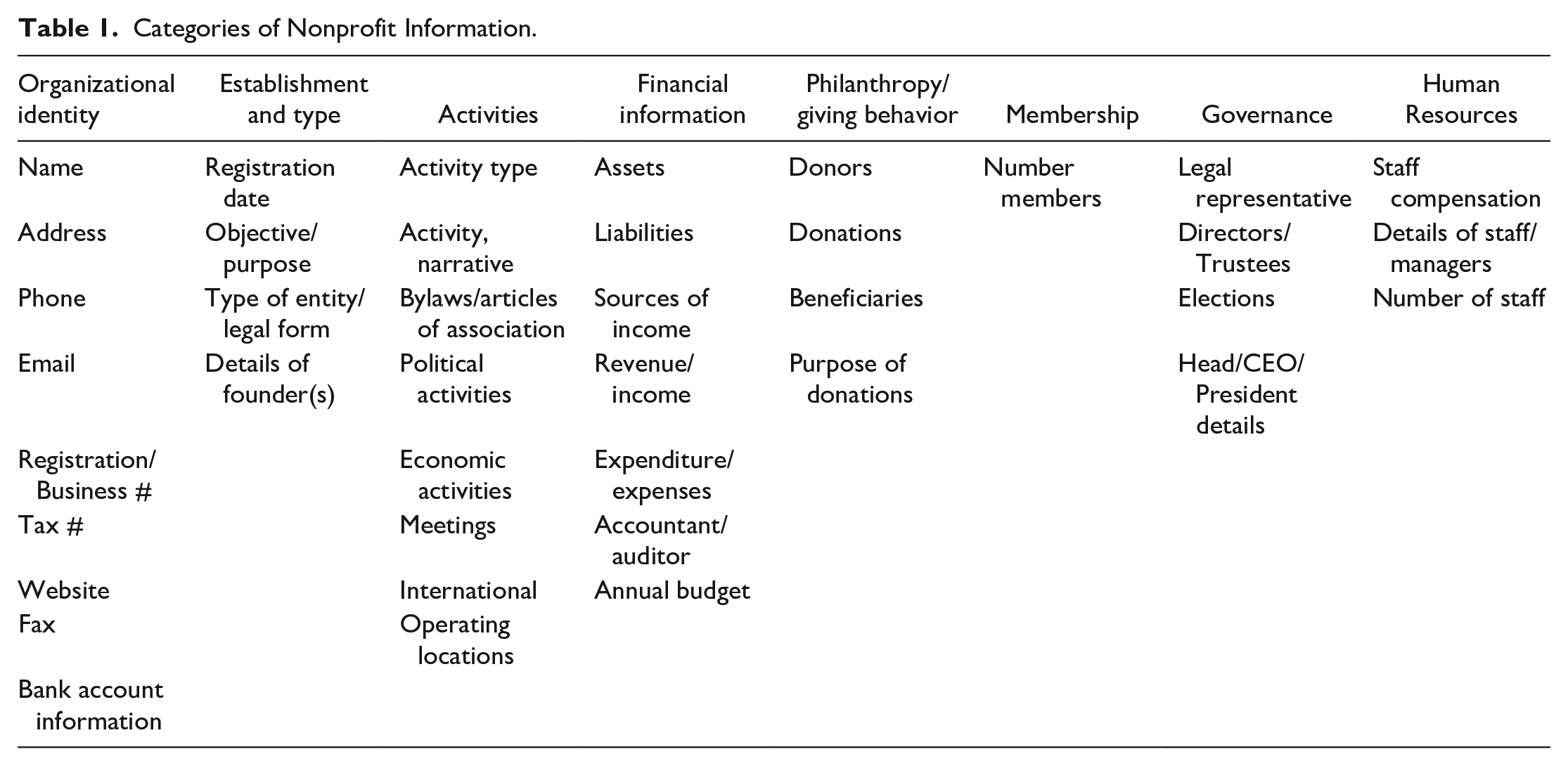
The countries in our data set represent all regions of the world, all levels of economic development, and a variety of legal regime types. Our data have a bias toward countries with more open data environments but nonetheless show a great deal of variation in the volume, types, and categories of data that are collected and released by the countries. Although democracies have the incentive to be more transparent (Hollyer et al., 2018), even among them, there is still a substantial difference in the data environments. The summary statistics by country, our primary concern in this piece, are presented in Table 2.
Collected and Released Information.
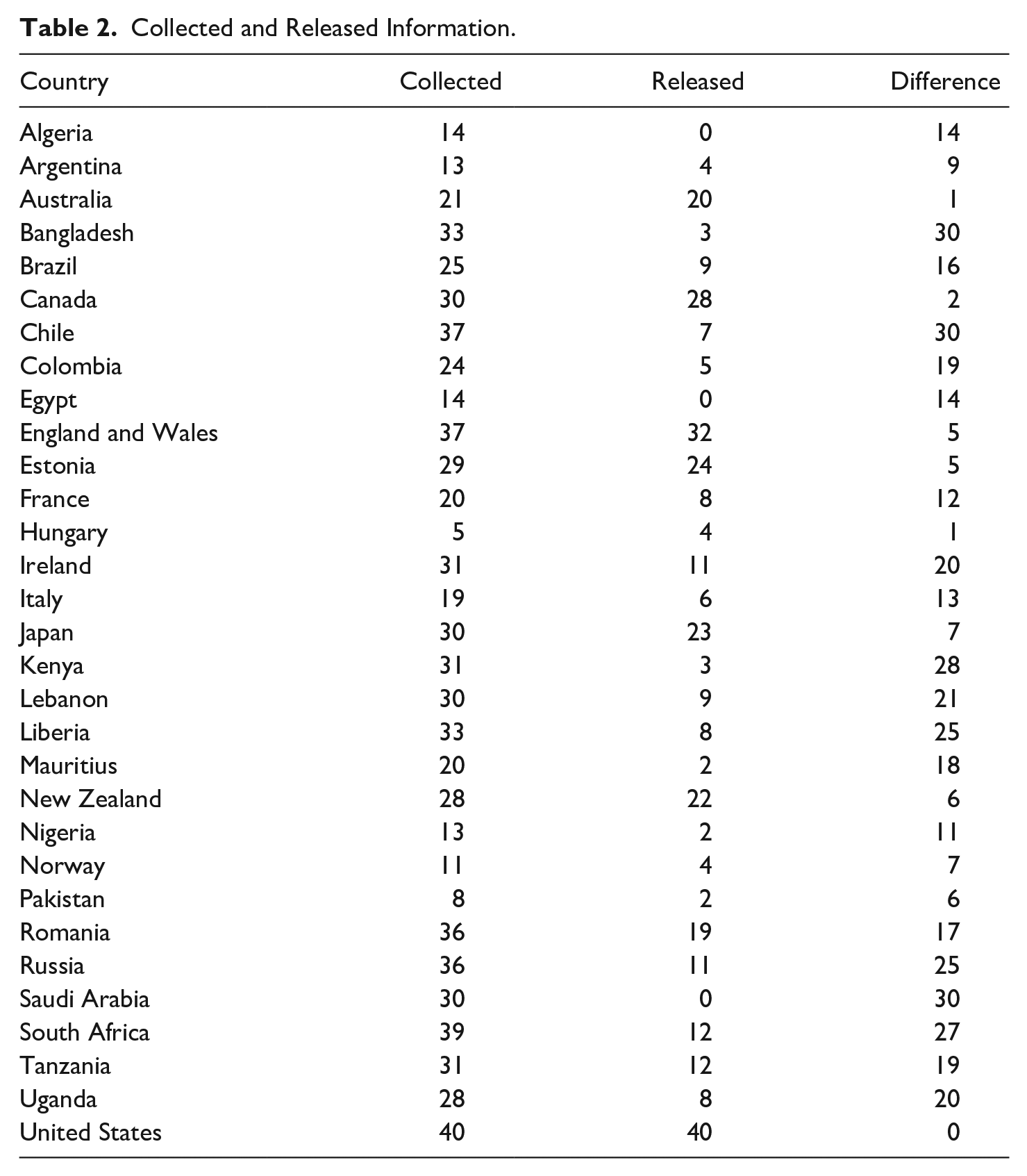
Of a possible 40 subcategories, countries like the United States and South Africa, followed by Chile, England and Wales, Bangladesh, and Liberia, collect the most data. Information collected includes organizational identity, the means of establishment and type of organization, activities, budget, giving behavior, membership, governance, and staff. All countries in our sample collect information on organizational identity, in particular the name of an organization. Most countries also collect information on the establishment and type (94% of countries) as well as the activities (97%), financial information (97%), and staff of NPOs (81%). Many fewer countries collect detailed information on giving behavior (74%) and membership (55%). By and large, most countries do not impose maximal reporting requirements on NPOs. Among the 31 countries examined, on average only 64% of the possible 40 subcategories of data are collected. Countries like Hungary, Pakistan, Norway, Nigeria, Algeria, and Egypt collect the least information on NPOs.
While the number and categories of information that can be released to the public depend specifically on which are collected, we still find substantial variation and a large gap between information collection and release in the aggregate, as can be seen in Figure 1. Most countries release only a portion of the information that they collect, with the United States as the exception reporting on all of the subcategories of information that it collects. Also at the high end of data environment openness are Australia (95% of what is collected is released), England and Wales (86%), Estonia (83%), and Canada (70%), and each collects at least 21 subcategories of information. At the low end, Algeria, Egypt, and Saudi Arabia are the most closed, reporting 0% of what is collected. Of the information which is collected, organizational identity (90% of countries), establishment information and type (65%), activities (59%), and governance information (35%) are the most commonly released categories of NPO data. Financial information (29%), giving behavior (29%), human resources (29%), and membership (10%) information are the least commonly released categories of collected data.
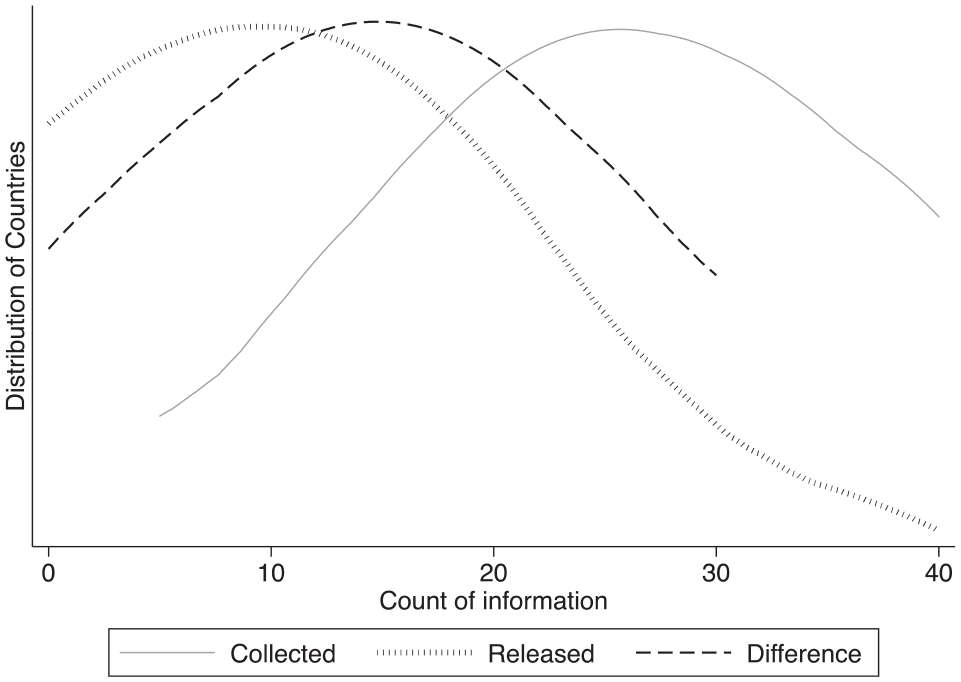
Informational collection and release.
The second half of this article examines two key explanations for these patterns in national NPO information collection and release: domestic state–society relations and international normative pressure. Using Poisson regression models, we find that both domestic and international explanations for national NPO data environments openness are statistically significant.
Domestic Explanation for Variations in Data Environments
Governments have substantial discretion in determining the openness of data environments. However, the data environment does not emerge in a vacuum; governments have prior relationships with civil society (Salamon & Anheier, 1998). As we discussed earlier, governments have incentives to regulate the nonprofit sector based on their intention to collaborate with or crackdown on civil society, while NPOs themselves have advocated for more open data environments to reduce uncertainty and increase public credibility. 2
The relationship between governments and national nonprofit sectors varies substantially between countries (Toepler et al., 2020). At one end of the spectrum, governments view NPOs as valued partners in social service provision (Coston, 1997; Najam, 2000; Salamon & Anheier, 1997). In countries in which the relationship between state and society is collaborative, it is in the interest of the government to establish an enabling context to support the nonprofit sector, including political protections on basic civil liberties such as freedom of association, speech, and press as well as access to financial resources such as government grants and tax deductions to encourage philanthropic giving (Brinkerhoff & Brinkerhoff, 2004). In these countries, nonprofit regulations and associated NPO reporting requirements are intended to deter and punish fraudulent behavior (Greenlee et al., 2007) and thus to maintain the accountability and capacity of the sector, including continued government financing (Gugerty & Prakash, 2010; Salamon & Toepler, 2015). At the other end of the spectrum, the government seeks to limit the potential of opposition groups that might challenge ruling institutions and individuals and thus protect the regime’s durability (Levitsky & Way, 2010). In these countries, a more contentious or conflictual relations exists between the government and the nonprofit sector (Coston, 1997; Toepler et al., 2020). Government regulation is seen as a tool to limit the autonomy and power of nonprofit organizations, depriving them of resources or political space, and thus reducing any threat they may pose (Dupuy et al., 2016; Heiss & Kelley, 2017; Hollyer et al., 2018).
From past work, countries have more enabling NGO regulations to support collaborative relationships between government agencies when NPOs are needed to fill gaps in service provision, democratic representation and participation, or information provision (Bloodgood et al., 2014; Brinkerhoff & Brinkerhoff, 2004). In these cases, we expect an open NPO data environment; where NPO data are collected on a broad variety of indicators to clearly identify organizations and follow their activities, financial and operational, as well as guarantee accountability via good governance. More importantly, in open data environments, the collected information should be widely shared with the public. We therefore expect that democratic governments have high and symmetric levels of NPO data collection and reporting. Other, more authoritarian governments fear the rise of independent organizations that might challenge their capacity to govern and thus seek to severely regulate NPOs (Christensen & Weinstein, 2013; Dupuy et al., 2016; Heiss & Kelley, 2017). In these countries, we expect more closed data environments where data collected is not released to protect the government’s information asymmetry. Information about the geographic scope of activities, sources of funding, and human resources would be particularly effective for controlling NPOs. Government capacity might be an important intervening factor limiting the amount of information that can be collected and released and so is included in our models subsequently.
International Explanation for Variations in Data Environments
International factors are also likely to shape national nonprofit data environments. First, governments may be pressured to collect and release data by financially more powerful actors. Financial dependence on external actors may produce information disclosure, explicitly or implicitly, so private grantmakers and governmental development agencies can monitor how their funding has been used (Verbruggen et al., 2011). Aid conditionality often requires transparency on the part of recipient countries (Burnell, 1994), with an increase in the number of donors increasing the amount of information demanded, even as governments made more vulnerable by aid dependency have incentives to withhold information (Dupuy et al., 2016).
Second, governments may change their behavior from adaptive learning. Under uncertainty, governments may not know how to solve a problem, so they rely on the expertise of external actors (Barnett & Finnemore, 2004; Finnemore, 1993; Haas, 1992). National governments might then learn from others, particularly when encouraged by an international organization, regarding best practices in data collection and release. The Open Government Partnership (OGP) provides an international venue for such learning, encouraging greater data collection and release for a range of government data, including NPOs’ registration and tax filings. Finally, governments may simply follow norms and conventions, which define what appropriate behavior is in a given context (DiMaggio & Powell, 1983; Nelson & Katzenstein, 2014). Patterns of data collection and release may thus spread across countries not so much as a learning exercise to adopt policy best fit for a given circumstance but as a more superficial adoption of a growing trend (Avant et al., 2010; Dolowitz & Marsh, 2000; Strang & Soule, 1989; Reimann, 2006). This is particularly likely to be the case if a country is strongly integrated globally via national participation in international NGOs and high levels of political and economic integration.
Explaining the Openness of Data Environments
To analyze the data, we use a Poisson regression model because the dependent variable is a count of the number of subcategories of information collected or released. Poisson regressions enable us to capture the count of the number of different subcategories of information that countries can collect or release when ordinary least square regression models return impossible values (negative numbers for collected or released information). We examine information collection and release in separate models as they are separate but related decisions. The difference between what is collected and released is very important for assessing the openness of the data environment as this determines whether there is an information asymmetry between the NPO sector and the government. The domestic legal and political environment are examined using regime type (how autocratic or democratic a country is according to Polity2), civil society environment (civil society index of ease of exit and entrance and government repression), press freedom, rule of law, and general government capacity (measured in terms of gross domestic product [GDP] per capita [PPP]) and regulatory quality (measured by expert perceptions of the ability to create and implement a solid policy for the private sector) (Marshall et al., 2017; Coppedge et al, 2020). Other measures of government capacity, including tax revenue and diversion of public funds, unfortunately, lacked sufficient observations for the country-years in our analysis.
The operationalization of international factors is more complicated, as different kinds of power operate in governments’ decisions. Although emulation is a much more nuanced exercise of power than donor countries demanding transparency, it still presupposes that governments understand whose data management practices should be emulated, which is a form of power (Barnett & Duvall, 2004). The exercise of such implicit power is difficult to observe. How do we rule out the possibility that the government is adopting a form of data management from others rather than innovating its own? International factors are thus examined with behavioral indicators to ensure that the exercise of power was at least attempted. More concretely, we use total official development assistance, both amounts in U.S. dollars and the number of donors (AidData, 2016), as these measure the amount of vulnerability or coercion governments face as well as from how many sources they may expect demands for information. We also examine the number of INGOs with national members, the number of reviewed commitments the country has made to the Open Government Partnership (OGP), and the KOF index of economic, political, and social globalization as sources of ideas and advocacy for more open data environments from governments, markets, and INGOs (Gygli et al., 2019). Appendix A gives the specific data source for each variable as well as summary statistics. Much of the data was aggregated by the Quality of Governance project (Teorell et al., 2018). To avoid concerns with endogeneity, indicators for the explanatory variables are averages from the period 2013 until 2017, while the information on NPO data collection and reporting are based on each country’s most recently revised forms as of 2018. As data environments are the results of the implementation of national regulations, we expect a relatively long period to occur between changes in the explanatory factors and the subcategories of information that are collected and released. A 5-year average is used to mitigate the effects of any exogenous global shocks as well as patterned events (such as the fact that OGP commitments are made every 2–3 years).
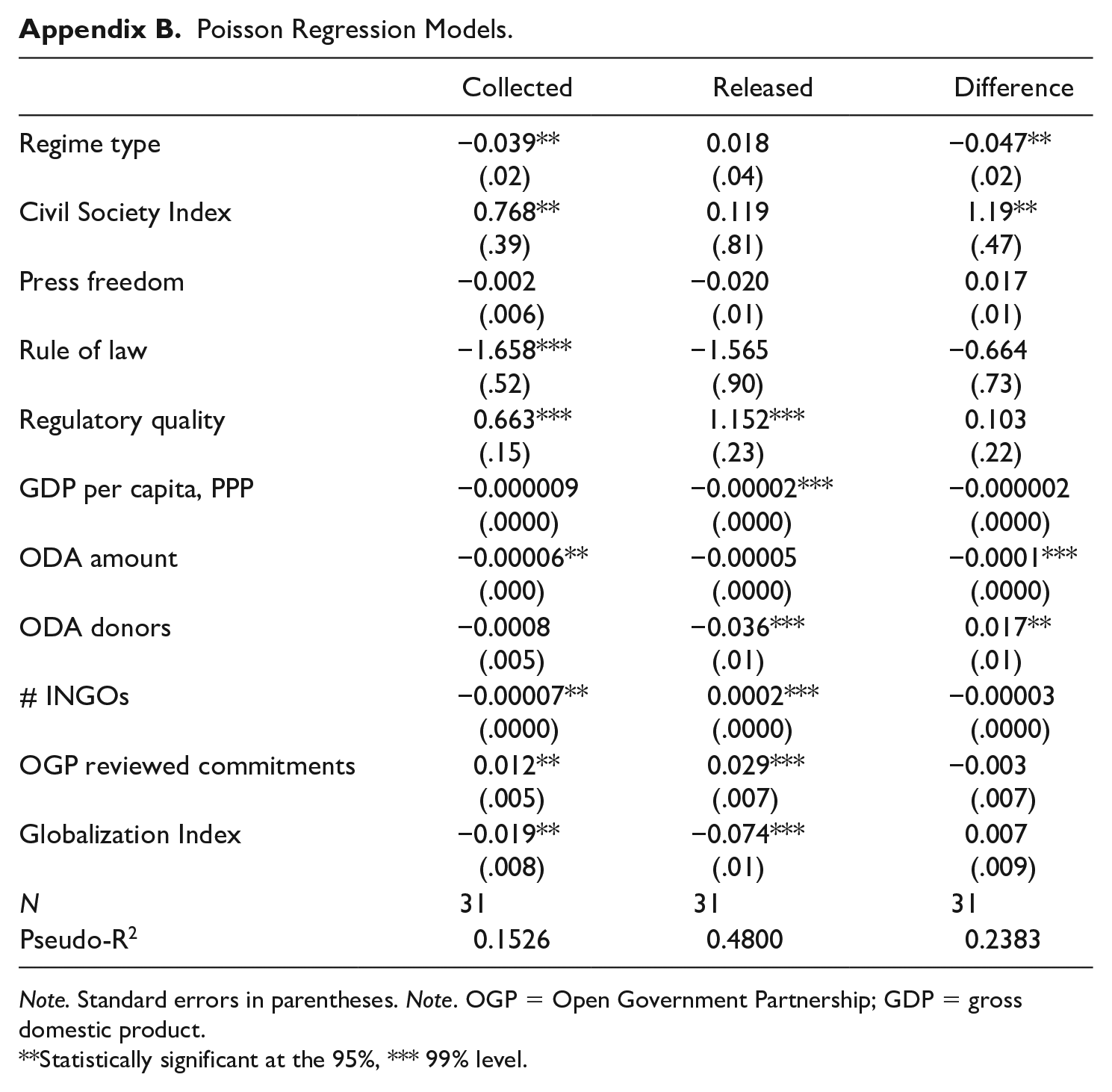
The results of the Poisson regression analysis for collected information, released information, and the difference between collected and released information are compared with our expectations in Table 3. Given the limited sample size of 31 countries, we avoid point estimates, instead of focusing on patterns in the relationship between domestic and international factors and data environments. Coefficients and standard errors are presented in Appendix B. Figures in Appendix C (online) show these results as marginal effects on counts of information subfields collected and released from different values of the statistically significant explanatory factors.
Theoretical Expectations and Empirical Findings Compared.
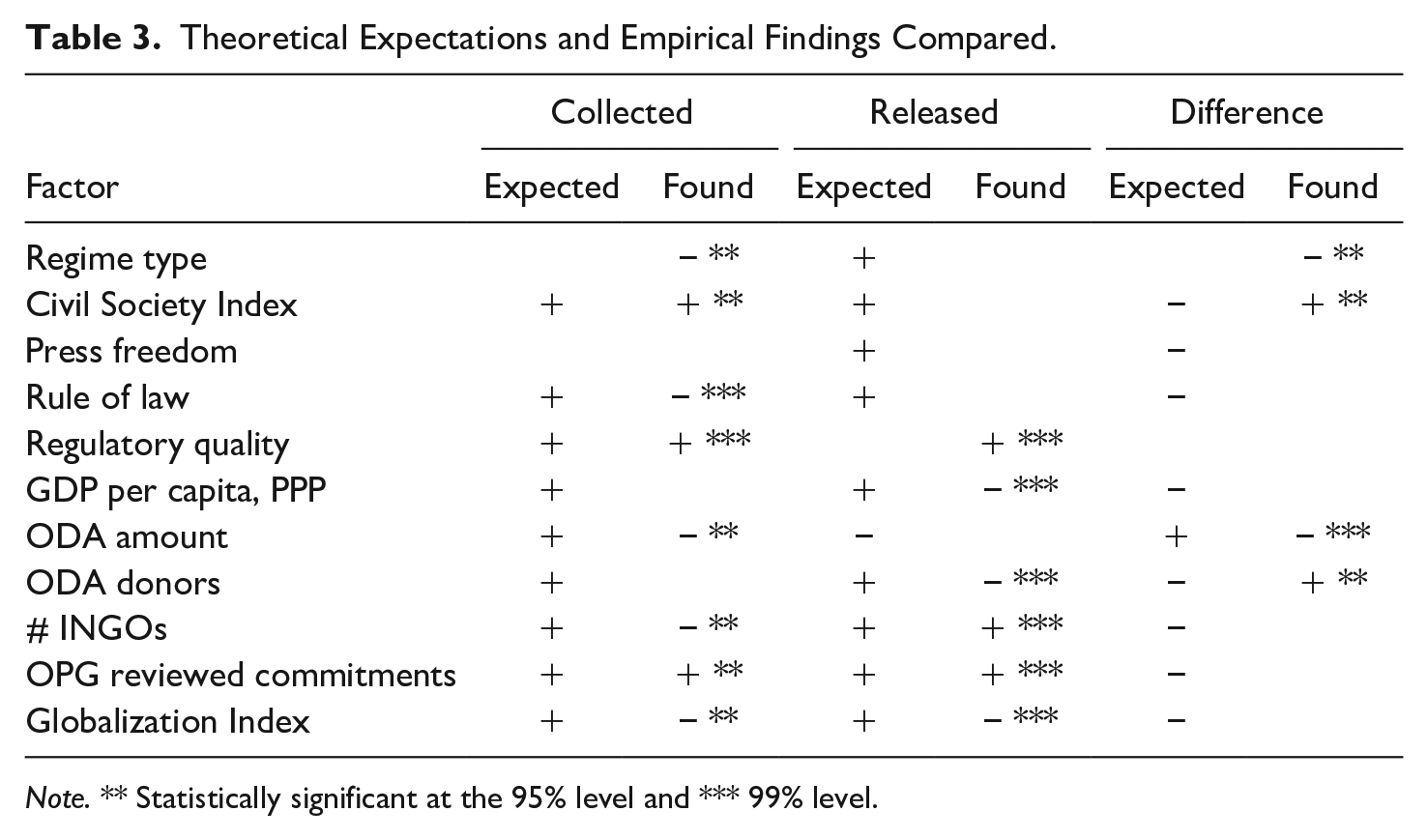
Note. ** Statistically significant at the 95% level and *** 99% level.
We find that both national and international factors have statistically significant effects on the collection of NPO data. Civil society autonomy and regulatory quality at the national level as well as OGP reviewed commitments have the expected effects—increases in each of these factors increase the amount of information collected. Surprisingly, being more democratic, having stronger rule of law, having more national connections to INGOs, receiving more ODA, and being more highly globalized all lead to decreased information collection. Increased democratic protections and freedoms as well as stronger rule of law and more national connections to INGOs may mean that there are fewer restrictions on NPOs and INGOs’ operations in that country. This disincentivizes the need to advocate for more information. The finding that less information is collected in countries with more INGOs may also mean that there are fewer restrictions on foreign financing and thus less reporting is required. Country capacity, measured as GDP per capita (PPP), has no systemic effect on governments’ collection of NPO data. This suggests that our argument that national data environments are politically driven, rather than a function of government capacity, is supported. This may be because information collection is less difficult for governments than expected or because if governments are motivated to collect more information, they will find a means to do so.
We find that increased regulatory quality (evaluated by experts’ perceptions of policy and implementation), more INGO ties, and more reviewed OGP commitments lead to increases in the amount of information on NPOs that is released by a government. More international factors have a significant effect on the openness of the data environment, by affecting information release, than national factors, although not always in the direction expected. This result suggests that the presence of a well-networked civil society can push the government to release more data, as open data environments reduce uncertainty for NPOs. In countries with a larger number of distinct donors and more globalized countries, less information is released. This might be because increased aid receipts from larger numbers of donors, as well as more global exposure (globalization index), suggest greater vulnerability for state sovereignty. The government wants to hold onto information as much as possible, no matter the type, to protect itself and domestic civil society from foreign influence. These results are robust when the level of economic development (GDP per capita) is controlled, and this is significantly negatively related to the amount of information released counter to expectations. This supports our argument that data environments are politically and not economically determined.
We expect that the data environment opens as the relationship between the government and NPOs improves, and thus each side benefits from access to information about the sector and is willing to share information to strengthen NPOs. More open data environments provide important information to both NPOs and governments that increases trust and credibility in the sector, improves access to new resources, and increases efficiency via collaboration. In addition, international norms in support of NPOs and open data should encourage more open data environments. Data environments open as governments become more democratic and receive more foreign aid (but not from more donors). This is consistent with our expectation that supportive state-society relations promote more open data environments. Interestingly, OGP participation and INGO ties do not affect the gap between collection and release even if they help open data environments by increasing either collection or release. Increases in the number of distinct foreign aid donors increase the gap between the amount of information collected and reported. This is counter to our expectations that increased international engagement will promote a more open data environment. Furthermore, to the extent that globalization increases exposure to international norms of openness, this has not had the expected effect on the openness of data environments. Globalization, at least as measured here, is associated with decreased collection and release of NPO information.
Conclusion and Implications
In this article, we construct the concept of data environment to show the data implications of how regulation is implemented. The data environment illuminates variations in how information in the NPO sector is collected and released at the national level. When governments enact information-based regulation, the data environment is the result of the implementation of this regulation and the results can vary widely even among democratic states. Our study builds on the growing literature on data politics and the importance of data. Deciding what to study and who gets to know information is a key form of power that government bureaucracies wield (Barnett & Finnemore, 2004). From a policy perspective, the availability of quality data is important for governments, donors, and NPOs seeking to understand the functions performed by NPOs, their distribution across countries and sectors of activity, and their funding composition and governance structures. All of these components impact the ability of NPOs to provide important services and information within a country, build trust through transparency, and collaborate effectively with one another and with government agencies to assess gaps in service provision and political representation. The data environment highlights that we cannot rely on the letter of the law alone; we must explore how the law is applied to those it seeks to govern.
In our study of the numbers of categories of information that governments demand from NPOs, we have found that national political factors and the relationship between state and society play the greatest role in determining data environment openness (the amount of data collected and the gap between collection and release). This is not a surprise, given the state and civil society have preexisting relationships that extend beyond regulation. The more enabling the domestic political, economic, and legal context for nonprofits, the larger the amount of information collected and the more open the data environment. Our findings suggest that countries with better relationships between government and the NPO sector, and those that are more internationally integrated, have more open data environments, while governments that see a real or perceived threat from civil society create closed data environments that collect NPO information without making that data available for public scrutiny. This finding is consistent with the logic regarding differences in transparency in autocracies versus democracies. In autocracies, there is a disincentive to be transparent (i.e., share information) because it empowers opponents, giving them the potential to destabilize the status quo.
International normative factors, by contrast, have more limited effects particularly targeted to information release. International normative factors, such as OGP reviewed commitments, can support open data environments at the national level by increasing both information collection and release. We surmise that peer pressure and adaptive learning explain the diffusion of open data practices. General exposure to international forces, that is, globalization, does not have the same effect, however, as increased globalization was associated with decreased information collection and release. Finally, we find that data environments are the result of political choices and not government capacity. Neither GDP per capita, as a measure of a country’s economic resources, nor foreign aid dependence limited the ability of governments to open their data environments. Countries with low GDPs have substantive amounts of information release and countries with higher amounts of foreign aid had smaller gaps between collection and release.
Interestingly, the number of INGOs in a country does not necessarily lead to a more open data environment, as might be expected. Countries with more participation in INGOs collect less information although release more of what is collected. This, however, may be a source of consolation for those concerned with the possible shrinking of civic space as governments impose increasing restrictions on INGO financing (Dupuy et al., 2016; Heiss & Kelley, 2017; Toepler et al., 2020). To monitor and enforce restrictions on foreign financing and operations, governments must impose reporting requirements and require bank account information. We find that the governments examined are less concerned with collecting detailed financial information than we had expected (only 26 of the 31 countries examined do so, and most of these are liberal democracies) and only 15 of 31 countries collect banking information.
Although there is great variation among countries in terms of the openness of data environments, there are countries that enable better NPO operations through the collection and sharing of data, allowing organizations to learn from others about potential funding opportunities and to collaborate with other NPOs and government agencies, avoiding competition or repetition of services. Most countries do not have onerous reporting requirements. Our findings on the effect of civil society-state relationships show that the data environment is shaped in part by contextual factors that do not have straightforward relationships. Importantly, open data environments are not determined by regime type or country capacity. The fact that international data standards such as OGP have an effect on data environments means that NPOs have allies in working with governments (Kasymova et al., 2016).
Research Data
sj-docx-1-nvs-10.1177_08997640221085731 – for Understanding National Nonprofit Data Environments
sj-docx-1-nvs-10.1177_08997640221085731 for Understanding National Nonprofit Data Environments by Elizabeth A. Bloodgood, Jesse Bourns, Michael Lenczner, Takumi Shibaike, Jenny Tabet, Amy Melvin and Wendy H. Wong in Nonprofit and Voluntary Sector Quarterly
Footnotes
Appendix
Poisson Regression Models.
| Collected | Released | Difference | |
|---|---|---|---|
| Regime type | −0.039**
(.02) |
0.018 (.04) |
−0.047**
(.02) |
| Civil Society Index | 0.768**
(.39) |
0.119 (.81) |
1.19**
(.47) |
| Press freedom | −0.002 (.006) |
−0.020 (.01) |
0.017 (.01) |
| Rule of law | −1.658***
(.52) |
−1.565 (.90) |
−0.664 (.73) |
| Regulatory quality | 0.663***
(.15) |
1.152***
(.23) |
0.103 (.22) |
| GDP per capita, PPP | −0.000009 (.0000) |
−0.00002***
(.0000) |
−0.000002 (.0000) |
| ODA amount | −0.00006**
(.000) |
−0.00005 (.0000) |
−0.0001***
(.0000) |
| ODA donors | −0.0008 (.005) |
−0.036***
(.01) |
0.017**
(.01) |
| # INGOs | −0.00007**
(.0000) |
0.0002***
(.0000) |
−0.00003 (.0000) |
| OGP reviewed commitments | 0.012**
(.005) |
0.029***
(.007) |
−0.003 (.007) |
| Globalization Index | −0.019**
(.008) |
−0.074***
(.01) |
0.007 (.009) |
| N | 31 | 31 | 31 |
| Pseudo-R2 | 0.1526 | 0.4800 | 0.2383 |
Note. Standard errors in parentheses. Note. OGP = Open Government Partnership; GDP = gross domestic product.
Statistically significant at the 95%, *** 99% level.
Correction April (2023):
Article updated online to add full reference details for McDonnell & Rutherford, 2019.
Declaration of Conflicting Interests
The author(s) declared no potential conflicts of interest with respect to the research, authorship, and/or publication of this article.
Funding
The author(s) disclosed receipt of the following financial support for the research, authorship, and/or publication of this article: The authors gratefully acknowledge the generous final support of the Social Science and Humanities Research Council for this research.

Supplemental Material
Supplemental material for this article is available online.
Notes
Author Biographies
References
Supplementary Material
Please find the following supplemental material available below.
For Open Access articles published under a Creative Commons License, all supplemental material carries the same license as the article it is associated with.
For non-Open Access articles published, all supplemental material carries a non-exclusive license, and permission requests for re-use of supplemental material or any part of supplemental material shall be sent directly to the copyright owner as specified in the copyright notice associated with the article.
