




Abstract
I present the findings of an exploratory qualitative enquiry into how employees in U.K.-based nonprofit organizations with clearly espoused organizational values experience values (in)congruences. Participants tended to adopt one of three positions—idealism, disillusionment, or cynicism—which they may transition between at different times. I use the theoretical lenses of the ideological psychological contract, organizational identification, and organizational cynicism to interpret these employees’ experiences. These data show how ideological psychological contract and organizational identification processes are entwined as employees fluidly navigate values (in)congruence in nonprofits. This analysis supports a critical reading of organizational cynicism, demonstrating how nonprofit values can be experienced as a form of managerial control, against which employees may wish to defend their selfhood. Several directions for future research are indicated.
Keywords
Organizational values are important in nonprofits, not because there are uniquely “nonprofit value sets” (Helmig et al., 2015) or because they operate differently in this organizational form as is sometimes assumed (Chen et al., 2013), but because values distinctively shape the psychology of the nonprofit employment relationship. Perceived fit between individuals’ work values and organizational values is higher in nonprofits than for-profit organizations, probably indicating that values are important in recruitment for both employers and employees (De Cooman et al., 2011; Devaro & Brookshire, 2007). In the case of staff commitment in charities, the perception of congruence between organizational and employees’ individual values seems to be more influential than actual values fit (Finegan, 2000; Stride & Higgs, 2014). Once employed, socialization processes can increase the perception of congruence between employees’ personal values and those of their organizations in for-profit organizations (Cooper-Thomas et al., 2004; Kim et al., 2005) and nonprofits (De Cooman et al., 2009). This leads to greater homogenization of the values of organizational members and the attrition of those who inadequately “fit” (De Cooman et al., 2009; Schneider, 1987). Perception of incongruences between the multiple value sets (e.g., Besharov, 2014) or values-fuelled identities (Glynn, 2000) that operate in nonprofits has also been linked to changes in employees’ organizational identification processes. Thus, how values affect the experiences of employees in nonprofits is a multifaceted issue of ongoing interest.
In this article, I explore an overarching research question of how employees in U.K. nonprofit organizations with clearly espoused values experience those values. I focus on how employees responded to perceived (in)congruences between different types of values, such as their organization’s espoused values and those they encountered in their daily working lives (see Fenton & Inglis, 2007, following Martin, 2002, for an interesting exploration of values incongruences in a nonprofit, and Bourne & Jenkins, 2013, for more recent theorization of different values types), as well as the (in)congruences employees perceived between their personal/work values and those of their organization as is usually operationalized in measures of person-organization fit (Kristof-Brown et al., 2005). I categorize employees’ responses to values (in)congruences into three main positions: idealism, disillusionment, and cynicism. I use three theoretical lenses to explain and distinguish these positions: the ideological psychological contract (IPC), organizational identification, and organizational cynicism, which I explore in greater detail below.
The Ideological Psychological Contract
The psychological contract is a widely used framework for understanding the employment relationship. Workplace psychological contracts are held to involve individual beliefs in reciprocal obligations between an employee and their organization (Blau, 1964; Rousseau, 1989). Psychological contracts have been characterized as comprising primarily economic or socio-emotional or, more recently, ideological “currency” (Thompson & Bunderson, 2003). The existence of a distinguishable ideological “third dimension” of psychological contracts been demonstrated using both qualitative (e.g., O’Donohue & Nelson, 2007; Vantilborgh et al., 2012) and quantitative (e.g., Bal & Vink, 2011; Scheel & Mohr, 2013) methodologies. While the literature affirms the general existence of reciprocity in IPCs (O’Donohue et al., 2007; Bal & Vink, 2011), some evidence for outcomes is emerging (Griep et al., 2018; Vantilborgh et al., 2014), and interesting new theory has been postulated (Jones & Griep, 2018), many unanswered questions remain about what kinds of “ideology” might form the basis of an IPC, what reciprocity dynamics might be involved, and with what outcomes.
If organizational values are indeed important in shaping the employer–employee relationship in nonprofits, psychological contracts may contain ideological “currency” that is important to both parties. When an employee perceives a discrepancy between promises and reality, their psychological contract may be breached. This may trigger negative affective reactions such as anger and distrust, known as “violation.” Unlike other forms of psychological contract, Thompson and Bunderson (2003) propose that an IPC can be breached by occurrences that do not actually involve the employee, many of which routinely occur in nonprofits. For example, the existence of tensions between competing value sets in nonprofits (Besharov, 2014; Golden-Biddle & Rao, 1997; Glynn, 2000) generates appropriate conditions for perceived goal displacement, and the functional entwinement of many nonprofits with funding bodies, service delivery partners, and other organizations is likely to create value interpenetration, both of which are postulated breach-triggers. The circumstances, experiences, or consequences of breach and violation of IPCs—or, conversely, of sustained fulfillment—is therefore of particular interest to nonprofits.
A few studies have examined IPCs between volunteers and nonprofit organizations (Scheel & Mohr, 2013; Vantilborgh et al., 2012)—notably including the counterintuitive finding that volunteers may increase work effort in response to IPC breach (Vantilborgh et al., 2014)—and the IPC literature has informed theorization on the changing role of volunteers in nonprofits (Vantilborgh et al., 2011). IPCs have also been studied among paid public sector employees in Australia, such as research scientists (O’Donohue et al., 2007) and registered nurses (O’Donohue & Nelson, 2007). Little evidence exists on how IPCs might operate among paid nonprofit employees, although there is some evidence that paid employees and volunteers have similar responses to general psychological contract violation (Griep et al., 2018).
Organizational Identification
Organizational identification occurs when individuals perceive their own identity to overlap with that of their organization. This leads employees to define themselves partially in terms of the organization and place a high value on membership (Ashforth & Mael, 1989). Identification tends to generate positive outcomes including low turnover intention, organizational citizenship behaviors, employee satisfaction, well-being, and performance (Ashforth et al., 2008; Riketta, 2006). If an employee defines themselves as not having attributes or principles that match those they perceive in the organization, a process of disidentification may occur (Kreiner & Ashforth, 2004).
Values-driven nonprofit environments shape the identity work of members (Chen et al., 2013; Kraus et al., 2017), and multiple organizational value sets in nonprofits can create contradictory implications for the actions and identities of employees which may be challenging to resolve, fuelling conflict and even disidentification (Golden-Biddle & Rao, 1997; Glynn, 2000), although disidentification may be averted through certain managerial practices (Besharov, 2014). Organizational identification is thus a key process in the nonprofit employment relationship.
Organizational Cynicism
Two contrasting views of cynicism in organizations exist in the neighboring fields of work/organizational psychology and critical management studies. The most commonly used psychological definition of organizational cynicism is as follows: a negative attitude toward one’s employing organization, comprising three dimensions: (1) a belief that the organization lacks integrity; (2) negative affect toward the organization; and (3) tendencies to disparaging and critical behaviours toward the organization that are consistent with these beliefs and affect. (Dean et al., 1998, p. 345)
Following this view, most psychological literature positions organizational cynicism as a negative individual attitude that is organizationally detrimental.
In contrast, much scholarship in critical management studies frames cynicism as a predictable outcome of the structures within which people work. In this view, cynicism constitutes a form of resistance against the exertion of managerial influence over norms, emotions, beliefs, and/or values, a management approach that may aim to “win the ‘hearts and minds’ of employees: to define their purposes by managing what they think and feel, and not just how they behave” (Willmott, 1993, p. 516). Building upon Foucauldian and other conceptualizations of power and subjectivity, critical management theorists suggest that the promotion of organizational values may encourage employees to create identities that are more amenable to managerial control. Cynics actively disbelieve these organizationally promoted messages, subjectively distancing themselves and constructing identities they consider more authentic (Collinson, 1992; Fleming & Spicer, 2003, 2010; Kunda, 1992). Cynicism thus constitutes a tactic of transgression (Fleming & Spicer, 2003) or a defence of selfhood (Casey, 1995) through which employees resist their organization’s ideology. Cynicism may act as a “safety valve,” allowing the release of pent-up “steam” that may result from existing in an environment of values-based control, although this may ultimately be self-defeating if it forestalls other acts of resistance that might change the circumstances that originally prompted the cynicism (Fleming & Spicer, 2007, p.39).
The great majority of research into organizational cynicism has been conducted in for-profit contexts, with a small amount in the public sector (e.g., Carey, 2014; Maben et al., 2007) and little in nonprofits. This study contributes to addressing this deficit, blending a psychological perspective with a critical view of the construct to interpret the experiences of employees in nonprofit contexts.
The Theoretical Lenses in Combination
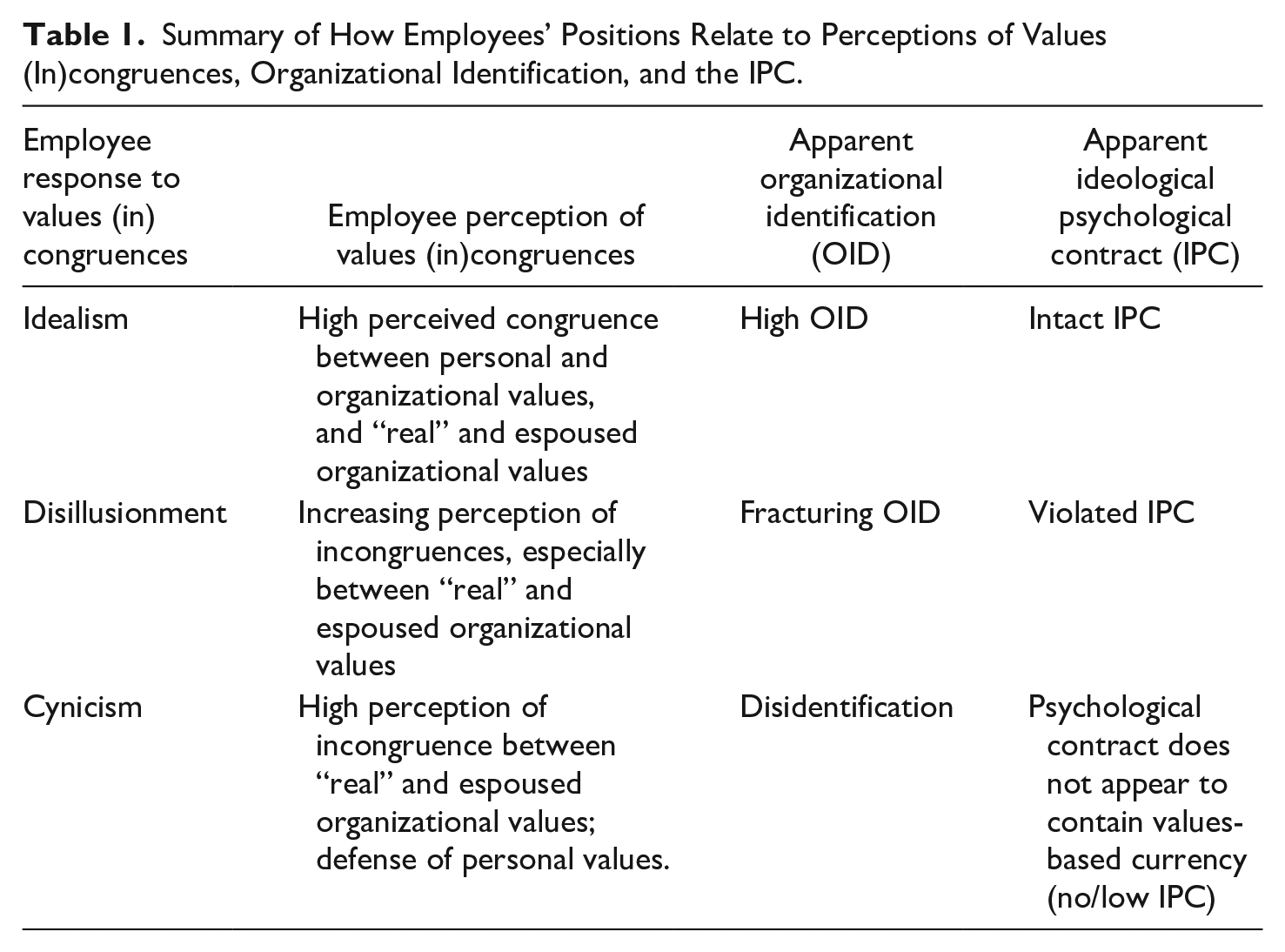
Combining these three theoretical lenses enables a better interpretation of participants’ psychological responses to values (in)congruences in nonprofit organizations than each lens would alone, yielding insights that are useful for nonprofit stakeholders and directions for future research (see the “Discussion” section). Psychological contract theory is underpinned by the social exchange perspective, which foregrounds the importance of the perceived quality and nature of the reciprocal exchange between employee and employer (Blau, 1964; Rousseau, 1989). Organizational identification theory draws on the social identity perspective, which emphasizes that group memberships affect self-definition (Ashforth & Mael, 1989). These perspectives have largely developed in isolation from each other (Knippenberg et al., 2007), although there is some evidence that relational content to psychological contracts may contribute to organizational identification (Lu et al., 2016) and breach may hinder it (Epitropaki, 2013; Zagenczyk et al., 2013). This study illustrates how values may be engaged in both social identity and social exchange processes, and also links organizational cynicism (in the critical management view) to disidentification and the absence of ideological content to the psychological contract (see the “Discussion” section). The ways in which these theoretical lenses elucidate the positions of idealism, disillusionment, and cynicism in this study is summarized in Table 1.
Summary of How Employees’ Positions Relate to Perceptions of Values (In)congruences, Organizational Identification, and the IPC.
Method
This study was designed as a small-scale qualitative enquiry into the experiences of employees in the complex real-world settings of nonprofit organizations. This kind of research is like an adventure (Willig, 2008): an unpredictable process of creating insights that are compelling, useful, and important. My enquiry was shaped by an overarching research question: how do employees in U.K.-based nonprofit organizations with clearly espoused values experience those values?
Recruitment Strategy
Recruitment criteria for individual participants were as broad as possible, with a few necessary restrictions. The volunteer–organization relationship may distinctively shape organizational identification (Watts, 2010), so I recruited only paid employees. Given the research topic, before committing to an interview with a potential participant, I established that they worked for a nonprofit organization that had clearly espoused values. Espoused values are only one type of organizational values (Bourne & Jenkins, 2013), but they are the most easily identifiable for research purposes. Given the contestability of the term (Knutsen, 2016), for this study, I defined “nonprofits” as organizations that exist for a socially or environmentally beneficial purpose, are constituted independently of the government (although many receive extensive public funding), and do not distribute profits for private gain unless this serves the organization’s primary purpose. I recruited individual participants via emails, posters, and presentation advertising, and through my personal and professional networks, first in one nonprofit and then more broadly. I offered the opportunity to enter a gift voucher draw as a gesture of thanks to participants. Recognizing that this was exploratory research, the question of sample size sufficiency involved considering the adequacy of the material to create initial insights into the research topic and indicate directions for future investigation, within practical constraints. I left the field when the dataset seemed to enable an interesting exploratory analysis.
Data Collection Approach
Participants were invited to discuss my overarching research question and offered the choice of talking in person or via Skype to aid accessibility and recruitment. The espoused values of participants’ organizations were identified before each interview from the organization’s website or directly from participants and used as a springboard into a discussion about organizational values and values (in)congruences, organizational identification, and meaningfulness at work. These semi-structured interviews are ideal for gathering rich, thick, and unexpected insights and allowing responses to be probed (Braun & Clarke, 2013). Interviews were audio-recorded, pseudonymized, and professionally transcribed. I have edited and punctuated data extracts to aid readability but pauses (denoted by “. . .”) and emphasis (denoted in italics) reflect the original transcripts. The research was approved by the appropriate Research Ethics Committee.
Description of Sample
The resulting sample included 15 employees from 11 organizations who gave interviews of 35 to 75 minutes, including one pilot interview that was discounted from the analysis. While this sample is relatively small, it is sufficient in an exploratory study to draw out a range of responses and indicate directions for future research (see the “Discussion” section), as demonstrated by other exploratory studies in the nonprofit literature (Cooney, 2010; Kearns et al., 2014; Lee & Bourne, 2017).
Demographic data were collected from all consenting participants. The sample broadly reflects the aggregated demographics of employees in U.K. voluntary organizations in gender and race: 10 were women, four men, and nearly all identified as white. However, the sample was skewed toward youth: roughly twice as many participants were aged 30 to 39 years than in the national voluntary sector workforce, and none were aged over 50, compared to 39% nationally. In line with the national average, nine participants worked full-time and five worked part-time (NCVO, 2017).
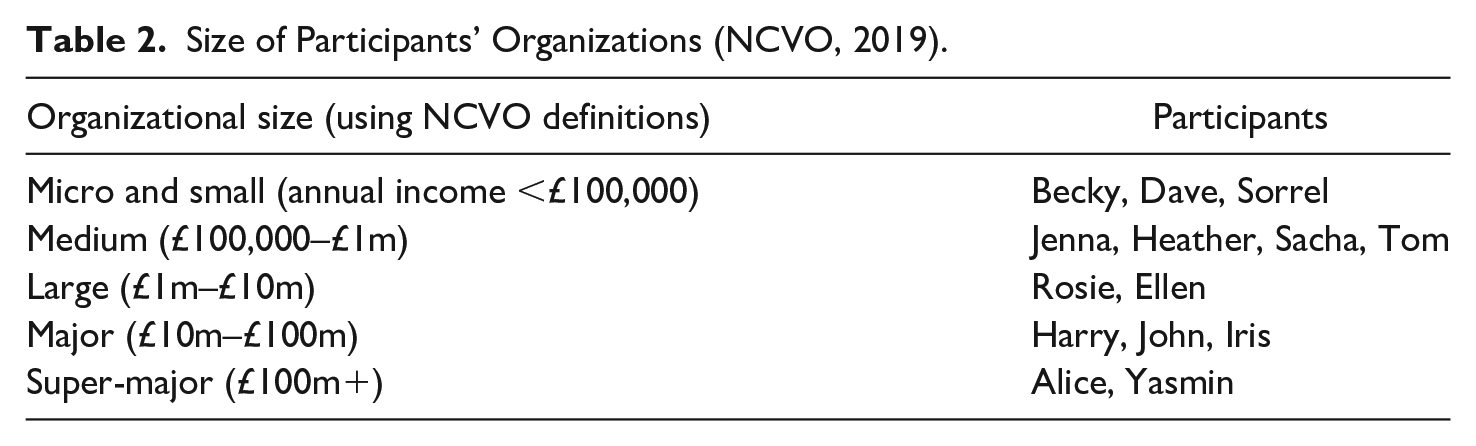
While the sampling strategy focussed on individuals, some details of participants’ organizations may contextualize the findings of the study. These organizations encompassed historically important forms of U.K. nonprofit activity (e.g., mutual societies and charities) alongside hybrid and liminal structures that are likely to become increasingly important in the future (e.g., NHS Foundation Trusts). Represented sectors included education (five participants), children and families (three), finance (two), religion (one), sports (one), refugees and asylum seekers (one), and international development (one). The size of organizations is indicated in Table 2 (excluding the pilot interview):
Size of Participants’ Organizations (NCVO, 2019).
Data Analysis
I adopted a free-form coding approach, generating codes organically at latent and surface levels of the data (recorded in NVivo). I tentatively grouped and divided codes into clusters that concerned different aspects of the data, such as participants’ sense of belonging or attitudes toward values (in)congruences. I iterated between reading the data closely and creating higher-level observations about the nature of the processes or phenomena at work in the code groups, exploring how they related to other code groups as I defined and refined my research focus and coding structure. Through this iterative process (and in discussion with colleagues), I constructed the positions of idealism, disillusionment, and cynicism, testing the fit of this framework against the data across all interview questions, code groups, and overarching research question, and began to explore the utility of the IPC framework for these data.
Reflexivity
My professional background as an employee and manager in U.K. nonprofit organizations positioned me partially as an insider in relation to participants, for example, in my familiarity with common nonprofit concepts and jargon. However, since most of my work in the nonprofit sector was not recent, in other ways I was an outsider. I thus occupied the space between insider and outsider in relation to the participants (Dwyer & Buckle, 2009): capable of empathizing with many of the experiences participants shared, but able to reflect on these commonalities across the distance of several years of hindsight.
Findings
Espoused, “Real,” and Personal Values
Several different kinds of values—and the (in)congruences between them—were relevant in this study. These included espoused organizational values, “real” organizational values, and participants’ personal or work values. The espoused values of each participant’s organization were used as a discussion-starter in their interview. These might have been created by a top-down process of managerial invention—“the boss came up with these four [values]” (Tom)—or emerged from a bottom-up process of “expressing what was obvious to us” (Sorrel) by collaboratively articulating shared values, or a combination of both. After these organizational values had been codified, they were often promoted using techniques such as awards, training, and formal systems to direct and assess employee behaviors, suggesting dynamics that might be expected to trigger organizational cynicism in the critical view. Espoused values were analytically distinguishable from “real” organizational values that described what participants experienced as the daily realities of working life. It was possible for inclusive, bottom-up processes of articulating organizational values to create temporary convergence between espoused and real values, because “the [espoused] values help people recognise what they did, almost” (John). However, when the espoused values appeared to diverge from day-to-day organizational life, as they usually did, participants constructed “real” organizational values as an oppositional category that drew attention to the ways in which these divergences were notable and/or problematic to them. In contrast to espoused and real organizational values, personal work values were foundational to participants’ self-identity. Rosie defined them as “actually what I believe in as a human rather than as a [professional] or anything else” and described what her colleagues believed “in their heart.”
Values (In)Congruences and Participant Positioning
Inevitably, espoused organizational values, real organizational values, and personal work values did not always overlap, and these incongruences were sometimes psychologically consequential. Participants adopted one of three positions in relation to the values (in)congruences they perceived: idealism (demonstrated by participants Ellen, Dave, Jenna, Alice, John, Sacha, and Sorrel), disillusionment (Rosie, Harry, and Becky), and cynicism (Iris, Tom, and Yasmin). One participant (Heather) was positive but broadly indifferent toward her organization’s espoused values, suggesting a psychological contract that was primarily predicated on a nonideological basis. Most participants occupied one position at the time of their interview, but some exhibited the typical characteristics of two positions, perhaps indicating a transitional phase. These positions are described below.
Position 1: Idealism
In the idealist position, participants perceived congruence between their personal work values and their organization’s values, linked to strong organizational identification: “I feel like [my organisation] is me and I’m it” (Sorrel) and “[my organisation’s espoused values] tap into who I am as a person already [. . .] I’ve found somewhere that I belong because of the values” (Jenna). As existing theory would predict (Albert et al., 2000; Ashforth & Mael, 1989), this stimulated group bonding and pro-social organizational citizenship behaviors: “it definitely gives it a group feeling . . . makes you fit in, but makes you want to fit in, and makes you want to do what you need to do to fit in” (Alice). John echoed: “there’s a sense that everybody’s in this together.”
One of the most interesting under-researched areas of IPC theory is how employees maintain their IPCs in environments that are rich in postulated breach-triggers (see the “Ideological Psychological Contract” section above). The idealists in this study enjoyed intact IPCs, believing that their organization’s attempts to fulfill its values-based promises were credible even when imperfectly delivered. This fuelled organizational identification: “as far as it is able, as often as it can, [the organization] does work by [its espoused values], live by them, do by them [. . .] I accidentally found a company that is the company version of me” (Alice). This is not a passive state: idealists were active in cognitively and behaviourally maintaining their idealism. They deliberately enacted their organization’s espoused values. For example, “enjoyment” was an espoused value in John’s workplace. He said: “there is an element of enjoyment to [the work], and people enjoy it where they can, and people try to put enjoyment into it.” More than this, participants routinely overlooked or minimized values incongruences which could threaten to breach their IPCs. For example, John comments: “sometimes there are parts of the work that aren’t enjoyable as well [. . .] so yeah absolutely there are times when [espoused and real values don’t] tie up but I would say they are not as often as we’re true to the values.”
Here, John indicates awareness of values incongruences, but disregards them, preserving his IPC and organizational identification. This is congruent with Thompson and Bunderson’s (2003) prediction that IPCs would prove resistant to breach when an organization falls slightly short of expectations, creating a “‘gray area’ of reasonable ideological claims” (p. 581).
Alice took direct action to maintain her idealism by changing her role to reduce the daily experience of problematic incongruences between real and espoused values. Her new role places her at “the middle point of the incongruence and congruence,” and she describes the effect on her organizational identification positively: “now I enjoy it [. . .] I find I talk about the organization differently so I’m much more you know . . . passionate you know rather than just being like ‘it’s a oh good place to work’ now I’m like . . . ‘I really like my job, I get to do this and this’ so it’s [made] a big difference” (Alice). Idealists regarded values congruence as a settled state: “I genuinely, genuinely believe that people still live [the espoused values] as much now as they did almost two years ago when I was starting, so I would say there’s certainly longevity in them” (John). The affective content of idealism was generally positive, satisfying, and stable, and participants showed no wish to change from it.
Position 2: Disillusionment
For reasons which do not seem to be well-explained by extant theory (Voronov & Yorks, 2015), some participants passed a tipping point at which they could no longer accommodate perceived values incongruences within an intact IPC and sense of organizational identification. Becky began to feel that “basically I’m working for [a large corporation] with a veneer of changing the world.” In this position of disillusionment, their IPCs were violated and their organizational identification was threatened, signified by feelings of betrayal, loss, frustration, and confusion. For example, Dave recalled growing awareness of values incongruences in a former employing organization: I found it a deeply frustrating and difficult experience. I think I was desperate to leave, desperate to get through the experience and get out the door as quickly as possible [. . .] because I don’t think [the organisation] agreed with the values that I had [. . .] that was a deeply difficult time, it involved [. . .] leaving meetings basically in tears, frustrated, hurt . . . it was incredibly painful. (Dave)
Disillusionment can have significant outcomes for individuals such as Sorrel, who attributes her departure from her former profession to psychologically unacceptable values incongruences: so I managed to survive . . . survive is a word I use very carefully . . . in [former profession] for nearly four years, but I felt like I was always fighting because of the values . . . [former profession] training is very much a values driven training programme, so you come out thinking you’re going to be able to live by those values in your profession, and then you find that actually you’ll have to choose your battles, and you’ll have to fight tooth and nail if you want those values to be real at all. (Sorrel)
Disillusionment also threatened participants’ social identity as part of the perceived organizational in-group, creating social vulnerability and dislocation. As values incongruences became increasing noticeable and salient, participants began to question how well they fitted in to their organization, identifying with it less strongly: In terms of values . . . I still believe strongly in what [my organisation] is trying to do but sometimes it doesn’t really . . . [laughter] when I go into the office in the morning I don’t really always go OK great I really want to be here [laughter] . . . should I be here? [laughter] . . . could I be doing my time somewhere else? or how could I cope with this? So, I don’t know, I’m considering [leaving]. (Becky)
The breakdown of the IPC and weakening of organizational identification that I characterize here as disillusionment was a cognitively and affectively draining liminal state that participants tried to escape, sometimes by transitioning to cynicism. Whether it is also possible to re-frame and re-form a new IPC to enable a transition back to idealism is a question that would warrant future research.
Position 3: Cynicism
As described above, critical management theorists understand cynicism as a means of resisting the encroachment of organizational ideology into employees’ subjectivities, as opposed to the psychological conception of cynicism as straightforwardly negative affect, belief, and behavior. The critical view was strongly supported by these data. Cynics had disidentified from their organizations, subjectively distancing themselves by constructing identities they judged to be more authentic (Costas & Fleming, 2009). They actively disbelieved values-based organizational rhetoric. Cynics fiercely protected the boundaries they had established around an inner space of “authentic” selfhood and freedom from organizational ideology.
The clearest example of the cynical position was Yasmin, who described the tension of working for an organization without investing herself as not being “absorbed by the great small monolith of the group [. . .] I might withhold myself from you.” In this quotation, Yasmin personifies her organization, angrily forbidding it from transgressing the boundary she has established between “performing” the “functions” of her daily work and her inner “life,” defying it to try to “co-opt” her: [organisational values are] all very performative and I just think “what nonsense!” I can’t be bothered to do any of those silly games . . . it’s like “you can’t co-opt my life, I will come and perform functions for you, but you will not” . . . like that’s where it ends, “you will not, I’m not building my career, I’m not building my brand with you,” all that crap [laughter], I’m so cynical. (Yasmin)
Yasmin’s psychological contract with her organization apparently did not contain ideological currency related specifically to organizational values, and she commented “personally I don’t care [laughter] whether there’s [espoused] values or not.” This was not the case in every place Yasmin had worked: she had been an idealist in a previous organization because “it more aligned with my values, [. . .] I felt [that organization] really really really mattered.” Like the other cynics, Yasmin had a strong sense of personal values that she protected from her organization, enacting organizational values only if they felt innately meaningful. This constituted a form of resistance to the values-based expectations that she perceived to reflect and enact organizational power: when you work for an organisation [. . .] there’s this weird dynamic which is “I am aligned with you and I am part of a group, but I am also an individual with my autonomy,” and there’s something about being told how to be that starts to, like, no no [laughter] [. . .] I’m going to be innovative because I choose to be innovative. (Yasmin)
Indeed, cynics expressed doubt about the usefulness and integrity of some espoused organizational values, regarding them as irrelevant at best, harmful at worst, and potentially performative forms of rhetoric: Maybe at my core I’m a little cynical at times about things and I think, actually, what are we playing at here? Are we trying to make people’s lives better [. . .] or are we trying to implicitly place our values [. . .] onto a situation, which might not actually be there? Clearly, I think equality is brilliant, but the awkward question is “Is my version of equality the right version of equality?” (Tom) I’m quite suspicious of the language of diversity and inclusion because I think it is often a way of trying to be nicer about things rather than really questioning the ways the [organisation] as an institution is part of white supremacy, capitalism, class, those sort of things. (Iris)
However, cynicism was not directed toward participants’ work or service users (e.g., students, clients, or patients). Iris felt that “there’s a kind of inherent meaning or value to some of the aspects of the work that I’m doing but it’s all very much caught up in a system that is that is about money and profit.” The subjective distancing of cynicism appeared to enable participants to continue engaging in meaningful work when they could no longer identify with their organizations or believe in its values.
These participants were not cognitively or affectively troubled by the values incongruences they frequently observed, perhaps because it did not undermine either their social identity (they had disidentified from their organizations) or their social exchange with their organization (because this ideology did not form a primary currency of their psychological contracts).
Transitioning Between Idealism, Disillusionment, and Cynicism
Personal or contextual changes sometimes caused participants to shift between idealism, disillusionment, and cynicism. This reflects the evolving nature of the IPC and its interplay with organizational identification. This is best illustrated by Harry’s experience of disillusionment.
Harry used to be an idealist. He felt his organization had a strong group identity, commenting that “sometimes people would jokingly refer to it as a bit of a cult.” He describes “a real sense of belief that what we were doing was important, and it wasn’t just a job, but it was exciting and new [. . .] and had a sort of buzz around it.” In his interview, he moved from using the first person singular (“I could see”) to the plural (“we’re still quite unique” “our organization”) as he recalled and inhabited the memory of being part of this ingroup, illustrating that the strength of his organizational identification caused him to overlook values incongruences that could breach his IPC: while I could see that it wasn’t like what I thought it was and that it was . . . a bit more rough around the edges or a bit more political or a bit more messy, it didn’t matter, I was willing to overlook it and still hold on to the fact that, oh well, nevertheless, we’re still quite unique in our organisation, and have these values, and spot [. . .] where they were manifesting themselves. (Harry)
Harry’s organization experienced significant change and he became disillusioned, causing him to frame his lost idealism retrospectively as a naïve position of “initial innocence” in which he wore “rose-tinted glasses” (see below). Justifying his inexperience, he explained that he had previously been “in an entry level role so . . . I was probably more . . . malleable at that stage or impressionable and found it quite easy to absorb the values of [the organization].” In contrast, now experience had made him more “realistic,” so he expected to notice values incongruences: “I don’t have perhaps the same expectations around what [espoused values] will do for the organisation.” Harry noticed that leaders were influential in this process, and when they made decisions that did not reflect his personal values “that gets eroded away, that initial innocence” (see also Price & Whiteley, 2014).
Harry had transitioned from having an intact IPC and strong sense of organizational identification to a growing awareness of values incongruences that undermined both. He experienced this as a gradual process: I was going into [the organisation after the change] with a more realistic view of the nature of the organisation . . . and so probably didn’t have any rose tinted glasses to start with [. . .] So it wasn’t that I was completely unaware, it wasn’t a stark change from being “oh yeah, I’m in this great organisation that has these great values and everyone lives them and it’s all rosy and perfect” [. . .] Suddenly to one where it’s much more realistic and actually they’re words on a page but what we do doesn’t always reflect that [. . .] it was more gradual, but the change of the organisation [. . .] was a chance to let go a bit of that kind of former belief or expectation.
The cognitive process of breach was accompanied by the powerful emotions of IPC violation and loss of identification. He commented: “I’m mourning the loss of the previous organisation, which I did feel very attached to, and enjoyed being part of, and had a strong affiliation with.” Harry did not expect to recover his position of “initial innocence” in the future, anticipating that he might become cynical: I imagine if I were to go on to a third [organisation] or a fourth then successively . . . the importance of that list of [espoused organisational values] words, I think you get a bit [. . .] sceptical of it, do they really matter that much as you get older or more familiar with different ways of working? Because, ultimately, they are just words on a page and what matters is your experience of the day to day . . . work at the organisation and the way that decisions are made [. . .] at a senior level, or on any level that will reflect those values
These extracts illustrate the entwining of IPC and organizational identification processes in Harry’s transitions between positions as he navigates the changing terrain of values in his organization.
Discussion
In this exploratory study, I describe employees’ responses to values (in)congruences in U.K. nonprofit organizations, postulating that they can be categorized into positions of idealism, disillusionment, and cynicism that participants can transition between. Similar positions have been identified among public sector employees in response to values incongruences experienced among newly qualified nurses (Maben et al., 2007) or structural change and rhetorical incongruences among social workers (Carey, 2014), but these have not previously been explored much in nonprofit contexts, in which values are likely to be particularly salient to the employment relationship (De Cooman et al., 2009, 2011). This study makes several contributions to nonprofit practice and the academic literature both on nonprofits and the constructs I use. It also indicates several ways in which a conversation about employee responses to organizational values in nonprofits could be extended.
Contributions
These data begin to show how IPC and organizational identification processes may be entwined in the psychology of employees as they fluidly navigate values (in)congruence in nonprofits. The ideological content of the psychological contracts in this study was values-based: the espoused values of organizations were perceived as promises that created the expectation of reciprocal values-based responses from employees. Organizational identification also had a values-based element for the participants in this study, so it seems that as individual personal/work values were engaged in responding to organizational values, participants’ social identities were drawn into the social exchange. In other words, values-based employer–employee exchanges involve the personal values on which identification with values-based organizations can also depend. Furthermore, disillusionment cannot be understood without reference to both the loss of organizational identification and IPC violation. This points to the value of conceptualizing psychological responses to values as a multifaceted process, both in the methodologies selected for further research and in organizational practice.
The IPC provides a useful framework for considering the dynamic nature of perceived values (in)congruence in nonprofits as reciprocal promises evolve through contract creation, maintenance, breach, and possible repair. While most of these areas of IPC theory remain well beyond the scope of this exploratory study, this study provides initial indications of how nonprofit workers maintain intact IPCs, how values incongruences may give rise to breach and violation, and what happens when workers opt-out of ideological content for their psychological contracts but continue to work in a values-led environment. These areas would repay further research.
These initial findings provide further empirical support for a critical view of organizational cynicism, indicating that cynicism can represent a defense of selfhood against values-based management (Fleming & Spicer, 2007; Willmott, 1993), and is thus an understandable position to adopt in nonprofits with clearly stated organizational values. Thus, cynicism may not necessarily be a negative phenomenon, as it is usually perceived in the psychological literature. For example, it may enable individuals to continue engaging in meaningful work when they have ceased to believe in espoused organizational values. In creating a psychological space of perceived autonomy, cynicism may enable the protection of privately cherished ideas and ideals that may fuel nonprofit work and create the potential for contestation of managerial ideological control. Since cynicism can be born of lost belief in espoused values-based promises and characterized by an ongoing lack of ideological content to an employee’s psychological contract, there appears to be interesting interplay between cynicism and employees’ IPCs.
This has implications for how cynics are regarded in nonprofits. Cynicism is not likely to be “solvable” by deliberate managerial interventions and certainly not by greater promotion of espoused organizational values, which is likely to backfire (although this approach might help disillusioned employees). If it is acceptable for some employees to forge IPCs, and some to choose not to do so, cynics may be better able to work in values-based nonprofits. This implies an approach to managing organizational ideology which does not primarily seek conformity, but allows space for diversity in levels and modes of ideological engagement. This might involve legitimizing verbalizing skepticism or dissent and valuing non- or differently ideological commitments such as to the meaningfulness of the work or client group.
Limitations
This study has some limitations. The study design precludes charting the unfolding and event-driven nature of IPCs and exploring many important elements of their operation such as reciprocity and mutual obligations. Participants were young in comparison with the demographics of the voluntary sector, and since age affects correlation with some measures of organizational identification (Riketta, 2006) and various aspects of psychological contracts (Bal, 2009), this may have affected the analysis. This sample comprised only U.K. participants and naturally there may be national variations which would be interesting to explore.
Further Research
Several areas of future research are indicated by this study. First, further exploring organizational cynicism from a critical psychological perspective would enable greater understanding of how employees navigate values-led nonprofit contexts. Second, if not every values incongruence is psychologically consequential for every employee at every time, what are the temporal, individual, and contextual factors that influence if and when an employee notices and psychologically problematizes values incongruences? Incongruences may appear natural to individuals, until the moment when they become alert to the gap between reality and aspiration (Voronov & Yorks, 2015). Understanding more about this process holds out the possibility of prediction, reduction, or amelioration of some IPC breaches. Avoiding under-fulfilling the ideological expectations of volunteers may be important to their long-term welfare and retention (Vantilborgh et al., 2014). This may apply also to employees, since they exhibit some similar responses to general psychological contract violation (Griep et al., 2018), but may be complicated by differing identification processes between paid employees and volunteers (Watts, 2010). Finally, further research into how, why, and when IPC breach escalates to violation in nonprofits (i.e., what contributes to the tipping point between idealism and disillusionment) is also indicated.
Footnotes
Acknowledgements
I gratefully acknowledge the support of Dr. Humphrey Bourne, Dr. Victoria Clarke, Gemma Pike, Dr. Paul Redford, and Prof. Irmgard Tischner in developing this paper. I thank the four anonymous reviewers and editors for their constructive comments on previous drafts.
Declaration of Conflicting Interests
The author(s) declared no potential conflicts of interest with respect to the research, authorship, and/or publication of this article.
Funding
The author(s) received no financial support for the research, authorship, and/or publication of this article.
