




Abstract
We examine the role of mediators in locally embedding the community foundation model of philanthropy to enable its global diffusion. We hold that mediators, as trusted agents within elite networks, promote and legitimate institutional innovation by tailoring the model to satisfy local requirements. They thereby limit resistance while creating future potentialities. Our novel addition to the community foundation literature stems from research on the transatlantic diffusion of the community foundation template from the United States to the United Kingdom focused on an in-depth case study of one of Europe’s largest community foundation, that serving Tyne & Wear and Northumberland in North East England. Our findings suggest that success in embedding the community foundation model depends on rendering it fit-for-context and fit-for-purpose. Mediators operating at both the macro and micro level matter because they have the cultural, social, and symbolic capital needed to win acceptance for initially alien philanthropic principles, practices, and structures.
Introduction
How do innovations in philanthropy diffuse and gain widespread acceptance? Answering this question is not simple because it begs a series of other questions relating to how institutional contexts shape philanthropic practices and how philanthropic innovations morph as they spread from one locale to another (Kasper et al., 2014). Following Daly (2008) and Wright (2001), our focus is on the process of translating the community foundation (CF) model of philanthropy, which originated in the United States, to other countries and localities around the world. The article presents findings from a study of the successful introduction and embedding of the community foundation model (CFM) in North East England where the Community Foundation for Tyne & Wear and Northumberland (CFTWN) has grown over the last three decades to become the largest CF in the United Kingdom. The CFTWN is not typical of UK CFs. It is an extreme case. Located in a region of socioeconomic disadvantage, it cannot draw support from large pools of super-rich individual donors or corporate sponsors. Yet, paradoxically, it has consistently financially outperformed CFs of similar vintage located in better-off parts of the United Kingdom. The argument we make here is that the CFTWN owes much of its success to the organization being created fit-for-context as well as fit-for-purpose. It never uncritically accepted the recommendations of US missionaries commissioned to promote the formation of CFs in the United Kingdom, but rather took the model and adapted it to suit local circumstances and sensitivities.
We are not the first researchers to emphasize the necessity of adaptation to long-term success (Feurt & Sacks, 2000). What we add that is novel is to theorize from our case study about the social processes underpinning the adaptation of the CFM. Specifically, we argue that mediators, as trusted actors within elite networks, promote and legitimate institutional innovation by tailoring the model to satisfy local requirements, thereby limiting resistance while creating future potentialities. We propose that initial conditions (Goldstone, 1998), consistent with the literature on organizational path dependence (Sydow et al., 2009), largely determine whether a new foundation realizes its full potential. In other words, rapid embedding and future growth stem in large measure from prior acceptance and sustained commitment of local elites (Maclean et al., 2010).
Adding to the existing body of CF-related constructs (Harrow et al., 2016), we define mediators as change agents possessing the cultural, social, and symbolic capital needed to win acceptance for initially alien philanthropic principles, practices, and structures (Harvey & Maclean, 2008). The mediator construct is opposite in meaning to that of intermediary, defined by Latour (2005, p. 39) as “a black box” that “simply diffuses a fixed set of ideas and practices, letting them pass without modification” (Whittle et al., 2010, p. 16). Our analysis is predicated on the assumption that the pre-existence of historically derived norms, standards, and practices makes it impossible simply to replicate successful models imported from another country (Czarniawska & Joerges, 1996). New models and associated practices constantly require recontextualizing to win acceptance locally—a process of mediation—which is a crucial but poorly understood process in the global diffusion of CFs. Our article therefore addresses Harrow et al.’s (2016) call for more rigorous research on the “implications and outcomes of what ‘context’ means for the shifting nature” of the CFM (p. 317).
Our article proceeds as follows. We first review the literature on CFs and the diffusion of the CFM. Our theoretical stance and research question are presented in the following section. Next, we provide details of sources and methods. In the following three sections we present our findings relating to CFs as an organizational field, the macro-processes of field formation, and the micro-processes of model diffusion. This is followed by a discussion and conclusion highlighting our contribution to the CF literature and translation theory.
Diffusion of the CFM
CFs have been described as “the most identifiable form of structured community philanthropy” (Sacks, 2014, p. 3). Operating in ways differentiated from either private or corporate foundations, a CF is “an independent, publicly accountable grant making body” controlled by community members and funded from multiple sources that include individuals, families, corporations, governments, and private foundations (Harrow et al., 2016, p. 208). The strength of the CFM lies in the professionalization of grant making; in channeling the philanthropic funds of multiple donors to approved charitable organizations with a high likelihood of meeting pressing community needs efficiently and effectively (Graddy & Morgan, 2006; Grønbjerg, 2006). By combining grant making with resource development, donor services, and community leadership, CFs aspire to be “a central, affirming element” of the communities they serve (Mazany & Perry, 2014, p. x).
The CF movement, which began in Cleveland in 1914, developed first in the United States and Canada before spreading in recent decades to other parts of the world. There are now 1,876 foundations located in 76 countries (Community Foundation Atlas, 2020). As the CFM has spread, there has been considerable debate about how foundations might best strike an appropriate balance between the priorities of donors and those of the communities they serve (Carson, 2003; Guo & Brown, 2006). Should donors call all the shots, or should other stakeholders have an equal say in allocating resources? Answers to this and other important questions differ within and between countries and have important implications for the management and governance of individual CFs. This is especially true at the point of creation of a new foundation when critical decisions are institutionalized, enshrined formally in founding charters, structures, and procedures, and informally in organizational values, practices, and processes. Thus, in the ongoing process of its global spread, the CFM has had to adapt to differing local contexts such that there are now multiple variant forms that differ in varying degrees “from the original invention” (Harrow et al., 2016, p. 317). Thus, while the operation of mimetic and normative forces help explain the global diffusion of CFs (DiMaggio & Powell, 1983), equally important are the adaptations necessary to establishing viability in local contexts (Grønbjerg, 2006; WINGS, 2012).
Despite the appellation “poor cousins” of private foundations (Hodgson & Knight, 2010, p. 3), CFs have emerged since the 1990s as a major force within the UK philanthropic field spurred by a revival of localism (Jung et al., 2013). Cities, towns, and villages increasingly are seen as foci for innovation and community renewal, often involving collaboration between local government, private sector, and charitable organizations (Williams et al., 2014). CFs, as philanthropic organizations identified with localism, are thus strategically positioned in “the search for a new balance between the state and civil society” (Walkenhorst, 2010, p. 1), providing opportunities for philanthropists to support the rejuvenation of communities to which they are attached (Maclean et al., 2013). This is especially true in places with an enduring sense of social cohesion and regional distinctiveness, but which have suffered from deindustrialization (Easterling, 2008; Van Slyke & Newman, 2006).
Yet, despite the international diffusion and strategic significance of CFs, they are perhaps “the least studied form of philanthropy” (Sacks, 2014, p. 3). The diffusion of CFs has been charted, but we know much less about what is involved in the successful translation, adaptation, and embedding of the CFM. In particular, we know little about how CFs unsettle existing institutions or how resistance to change is overcome (Daly, 2008; Wright, 2001). What is lacking is understanding of how the CFM is adapted and legitimated in widely differing socio-historical settings, enabling global diffusion. Focusing on the role of mediators in diffusing the CFM is important because their performances have material consequences for “how well . . . community foundations understand, respond to and represent in their own governance the diversity of their locales” (Harrow et al., 2016, p. 315). Thus, we ask, what is the role of mediators in diffusing the CFM of philanthropy?
Mediators and the Translation of Organizational Models
An important body of literature on translation theory (Czarniawska & Sevón, 2005; Pipan & Czarniawska, 2010) is helpful in understanding how the CFM is adapted as it journeys from one locality to another, instead of merely being diffused in a replicative process. Research on the diffusion of organizational models and practices has found that change agents such as senior managers and consultants shape models rather than simply copying them (Crucini & Kipping, 2001). Diffusion, it shows, depends not on remaining fixed and invariant but bearing “interpretive viability” (Benders & van Veen, 2001, p. 36), namely, “leaving room for interpretation in different contexts” (Mueller & Whittle, 2011, p. 188). Indeed, the literature rejects the idea that recipients espouse “the same thing for the same reason,” arguing instead that actors modify models to “fit their unique needs in time and space” (Abrahamson, 2006, p. 513). Czarniawska and Joerges (1996) hold that models do not spread simply because of the attraction of inherent attributes, but also because attributes are often “created, negotiated or imposed during the collective translation process” (p. 25). In other words, if a model is successfully to be diffused, it must be revised not simply recited (Sahlin-Andersson, 1996). This work is done, according to Latour (2005), by mediators who “transform, translate, distort, and modify” models to suit their own projects and purposes (p. 39). Therefore, the mediator is the vital change agent who “disturbs what comes in and what goes out,” enabling “the emergence of novelty together with the impossibility of ex-nihilo creation” (Latour, 1996, p. 237).
The arguments made by Latour and his followers are persuasive but theoretically incomplete. This is because translation theory remains silent on crucial matters like who mediators are, what gives them authority to act, their modus operandi, and the social context in which they operate (Elder-Vass, 2008; Sayes, 2017). It is useful to begin addressing this lacuna by recognizing that mediators, as people with the power to adopt and adapt organizational models, are by definition elite actors with the authority needed to initiate changes to policy and practice within organizational fields. Actors of this type are not only leaders within fields, they also operate within what Bourdieu calls the field of power (Bourdieu, 1993; Bourdieu, 1996), defined by Maclean et al. (2017) as the social sphere at the summit of society in which powerful actors with extensive social networks work together to promote changes in policy, practice, and societal resource flows. Elite actors who operate within the field of power possess high levels of cultural, social and symbolic capital and apply these in promoting causes to which they are committed (Harvey & Maclean, 2008). Some causes are pursued to secure organizational or even personal advantage, but others are motivated altruistically with the intention of benefiting society-at-large (Harvey et al., 2020).
An important extension to Bourdieu’s construct of the field of power is recognition that fields of power are nested hierarchically within nation states (Maclean et al., 2017). In the United Kingdom, for example, fields of power exist at the national, constituent country/region, and local levels, each aligned to its own governance arrangements, institutions, and traditions. The social networks and influence of the most powerful elite actors span all three levels within the master field of power. Most elites, however, operate predominantly within individual countries/regions and localities where they play leading roles in a variety of private, public, and third-sector organizations. It is from this social group that mediators are drawn. They are actors of high social standing who move fluently in elevated social circles whose authority derives from their centrality within extra-corporate elite networks, and whose modus operandi is to forge alliances in pursuit of economic and social goals (Hartmann, 2006).
Three main propositions emerge from our theorizing: (a) successful diffusion of the CFM is dependent on local adaptation, (b) mediators play a crucial role in adapting and locally embedding the CFM, and (c) mediators are high-status actors who garner support for the CFM within local/regional fields of power. In what follows, we appraise these propositions through an historical analysis of the diffusion of the CFM from the United States to the United Kingdom.
Method
The methodological underpinning our research is that of historical organization studies, namely, organizational research that draws primarily on historical data and methods to generate analyses and examination “whose validity derives from both historical veracity and conceptual rigor” to advance “understanding of historical, contemporary, and future-directed social realities” (Maclean et al., 2016, p. 609). Core to historical organization studies is the collection of primary data from documents and verbal testimonies that might shed fresh light on the power-laden processes crucial to change within institutions and organizations. In-depth historical case studies are particularly valued as a means of developing, improving and challenging theory (Eisenhardt & Graebner, 2007; Yin, 2009).
Sectoral Study
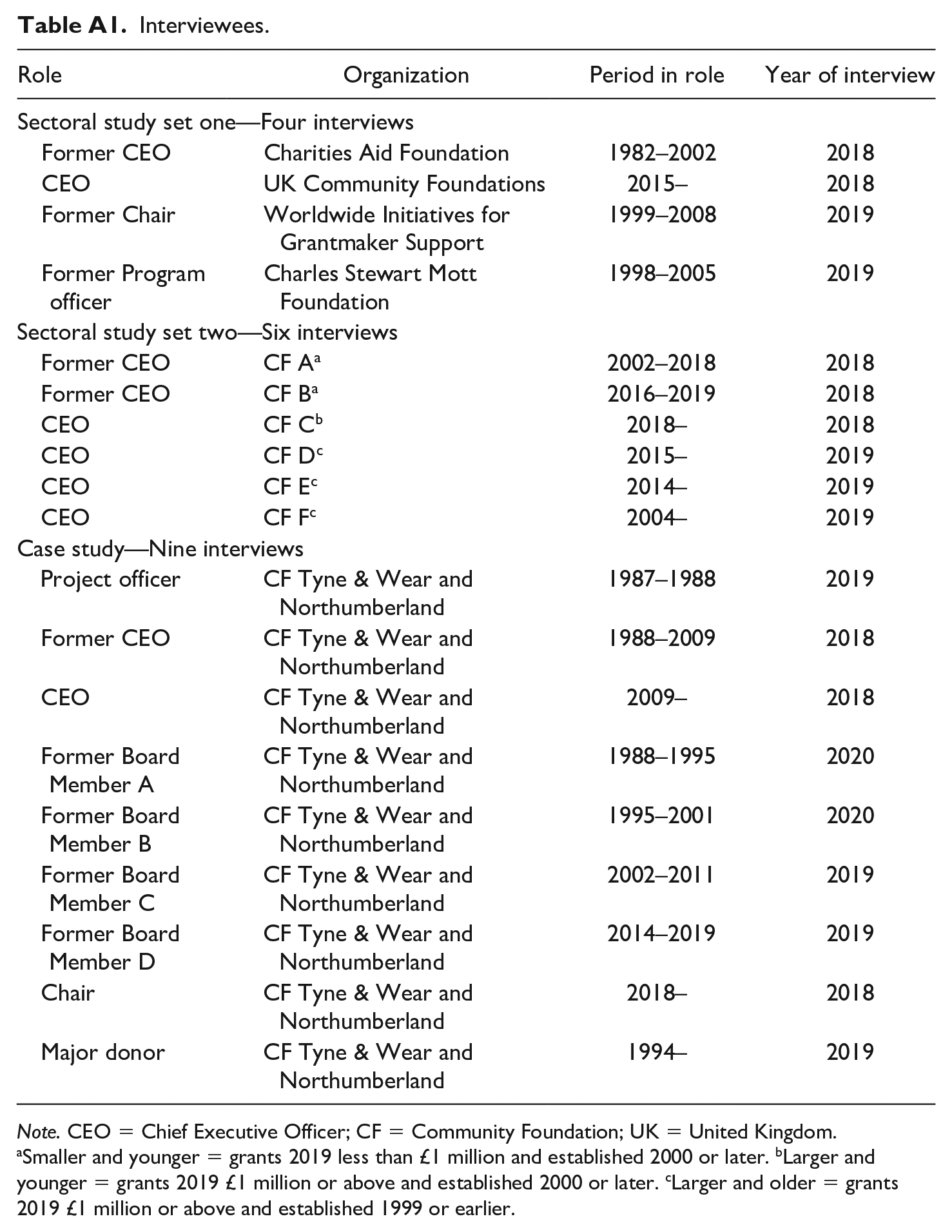
We began our research by studying the evolution and configuration of UK CFs as an organizational field. From existing literature, we learned about the challenges involved in establishing CFs (Leat, 2006), the necessity of local adaptation (Daly, 2008), and enduring differences in strategy and practices (Harrow & Jung, 2016). We next conducted a field-wide structural analysis that confirmed a high degree of variability within the population. To help explain these differences, we then conducted interviews with two sets of knowledgeable actors. The first with people involved in developing the sector: a former CEO of the Charities Aid Foundation (CAF), the CEO of UK Community Foundations (UKCF), a former Chair of Worldwide Initiatives for Grantmaker Support (WINGS), and a former program officer at the Charles Stewart Mott Foundation. The second with six CEOs of different types of CF: two, A and B, smaller and younger; one, C, larger and younger; three, D, E, and F, larger and older (see Appendix).
Case Study
The CFTWN is the largest CF in the United Kingdom, and indeed outside North America, if measured by size of endowment (CFTWN, 2018). It is viewed as a role model by UKCF and stands out as a “significant case” (Yin, 2009). Situated in North East England—“a profoundly deindustrialized region on the periphery of the European Union and on the margins of the global economy” (Hudson, 2005, p. 581)—its stated mission is to engender “a ‘virtuous circle’ of giving where engaged people and businesses support effective charitable organizations to make a difference in communities” (CFTWN, 2011, p. 5). The endowed funds of the CFTWN grew enormously from £20,000 in 1990 to more than £80 million in 2019. In 2018 to 2019 it awarded 1,515 grants valued at £7.8 million in total from 239 donor funds (CFTWN, 2019).
We secured privileged access to various types of documents held by the CFTWN, including memoranda and articles of association, annual reports and accounts, written personal recollections, and an unpublished foundation history written by one of the founding board members. These sources, official and personal, provided valuable information about the CFTWN’s establishment, its strategic orientation and change, and a timeline of translations, proffering “traces” through which “we can know the past” (Scott, 1990, p.10). These sources were complemented by nine interviews conducted with the original project officer, a former CEO, the current CEO and Chair, four former board members, and a major donor. Interviewees were selected as historically knowledgeable people directly connected to those who established and embedded the foundation.
Analysis and Interpretation
We first coded our interviews thematically to identify the macro-processes of field formation and the micro-processes of CFM diffusion. In a first pass, we open coded the near 60,000 words captured in 19 interviews (Corbin & Strauss, 2015), yielding 67 text segments classified by 12 first-order macro terms, and 58 text segments classified by 11 first-order terms. Coding was carried out by two researchers and differences reconciled. Next, following the Gioia method (Gioia et al., 2012), the first-order terms were distilled further to identify six macro and six micro second-order concepts, which were then aggregated into three macro-processes of field formation and three micro-processes of CFM diffusion.
The operation of each of the six processes was then interpreted historically with reference to existing literature and original documents. This involved sequencing, whereby we established a timeline and chain of translation; contextualizing, linking field formation to contemporary developments and events; exploring, whereby we actively sought to make causal links between actors, events, and outcomes; and interpreting, deriving wider meaning and points of theoretical interest from close examination of our case. In doing so, we created a contextualized narrative of events and actions with the aim of moving beyond description to explain the processes of translation and mediation and reveal the operation of transformative social processes (Harvey et al., 2019; Pentland, 1999).
CFs in the United Kingdom
CFs constitute a distinctive organizational subfield situated within the much broader field of third-sector charitable organizations. The results of our field-level analysis, summarized in Table 1, show that field formation significantly took place in two decades between 1985 and 2006 during which 41 of the 46 UKCF members in existence in 2019 were established. Two early movers—Swindon (1975) and Northern Ireland (1979)—initiated the movement, but little progress was made before the mid-1980s. Among three latecomers established since 2010, the London Community Foundation has grown most rapidly, principally as a conduit grant maker funded largely by companies, private foundations, and government. By 2019, the CF movement in entirety held assets of almost £800 million, including endowed funds of near £700 million, and in 2018 to 2019 awarded grants of approximately £100 million. What stands out from Table 1, however, is the high degree of variability between CFs in total assets, endowed funds, and grant-making capacity. In part, this is because the 24 CFs established since 2000 are playing catch-up, but even among the 22 longer established foundations, large disparities in financial capacity can be observed.
Descriptive Statistics for UK Community Foundations.
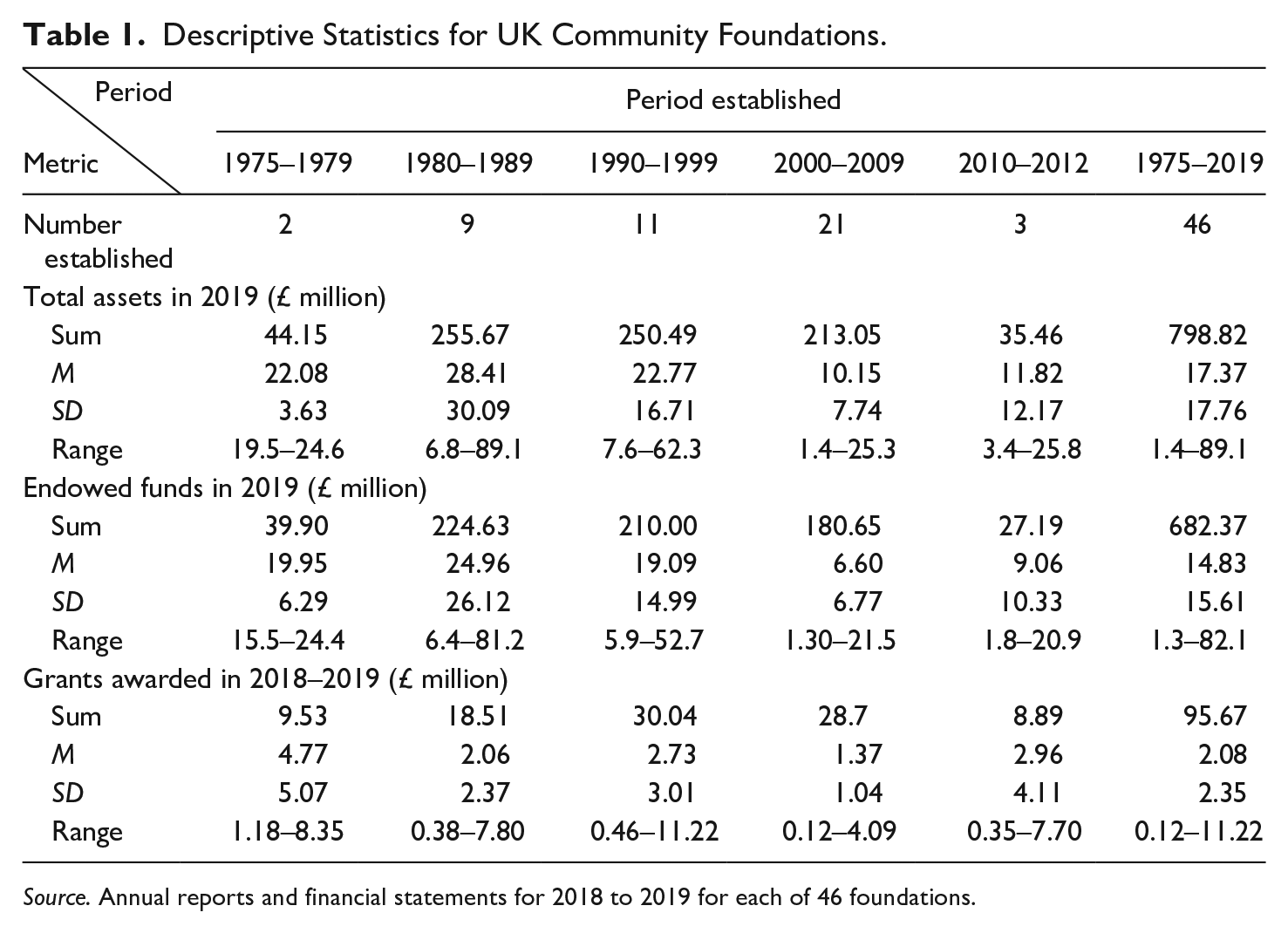
Source. Annual reports and financial statements for 2018 to 2019 for each of 46 foundations.
We argue in what follows that such disparities stem not from exogenous macro-processes of field formation, but from endogenous micro-processes of model diffusion. This is because the societal forces shaping the establishment and growth of CFs have impacted evenly across the field, whereas the micro-processes of model diffusion depend crucially on local organizational capabilities, thus explaining variability.
Macro-Processes of Field Formation
The term macro-process is used here to delineate the societal forces bearing on field formation. Thematic analysis of interview and document data led to the identification of three macro-processes of field formation, illustrated by the quotations presented in Table 2.
Macro-Processes of Field Formation.
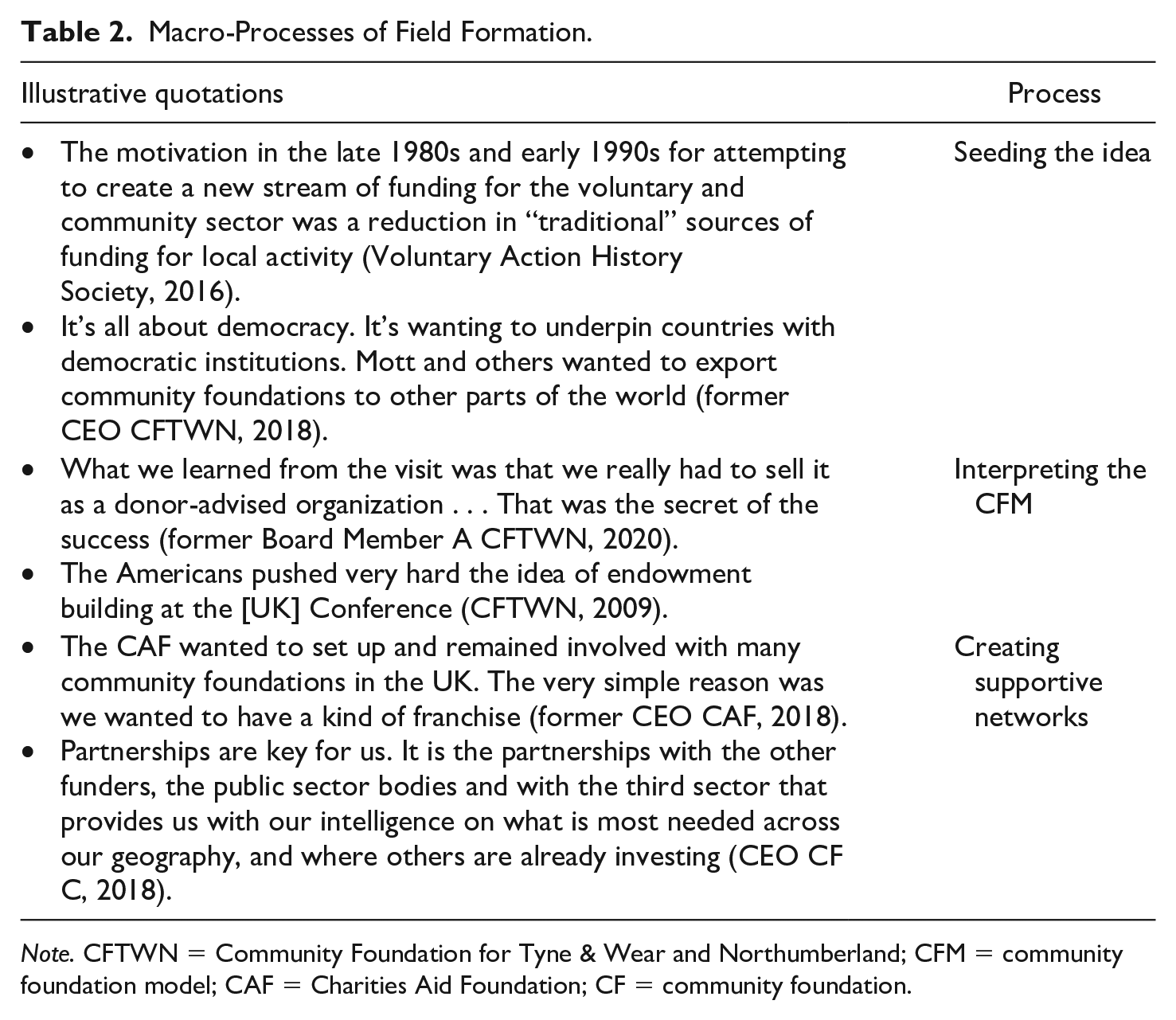
Note. CFTWN = Community Foundation for Tyne & Wear and Northumberland; CFM = community foundation model; CAF = Charities Aid Foundation; CF = community foundation.
Seeding the Idea
Our data suggest that CF field formation in the United Kingdom was inspired by social and economic disruption and the promotion of entrepreneurial freedoms “within an institutional framework characterized by global markets and free trade” (Harvey, 2005, p. 2). The movement gained momentum in the 1980s when the Thatcher government began actively “rolling back the state so that people had more money in their pocket” (former CEO CFTWN, 2018). Cuts to local government budgets directly led to withdrawal of financial support to philanthropic organizations (Voluntary Action History Society, 2016). In place of grants, charities increasingly competed for contracts to deliver specified services on behalf of government, reducing the capacity of the third sector to identify community needs and address local issues. The feeling grew that wealthy beneficiaries of tax cuts should emulate their US counterparts in donating more to charity. As the former CAF CEO recalled, We saw that in the US the level of giving was much higher . . . Therefore, it was the obvious place to go to see what we could import . . . [I thought] it would be a good idea to get American help to set up . . . community foundations in the UK. (2018)
Through conversations between powerful actors in government and third-sector circles, the idea of establishing US-style CFs in the United Kingdom progressively gained traction. Advised by the CAF, the Home Office established the Community Trust Development Unit (CTDU) in 1986 to advise on making grants to cover the initial costs of would-be CFs (Leat, 2006). In this way, the CTDU played an important role in seeding the idea of community philanthropy.
Interpreting the CFM
Interpretation is the process of conveying the assumptions and ideas underpinning an ideal type or model from originators to recipients. It is a role often played by management consultants who routinely promote the diffusion of new models and practices (Wright et al., 2012). The role of interpreter in diffusing the CFM to the United Kingdom was played by the Mott Foundation of Flint, Michigan, and the experts recruited by Mott to instruct fledgling foundations in the United Kingdom on best practice in community philanthropy (Mott Foundation, 2000). The “expert assistance program” of 1988, co-sponsored by the CAF, was conceived when the CEO of the CAF visited the Mott Foundation in 1987. The program involved numerous events and meetings in cities across the United Kingdom. It is remembered by the former program officer of the Mott Foundation as a mission led by zealous believers: The first thing they did was send over several American community foundation experts, the leaders in the field, to talk to key officials in individual towns, to mayors, to accountants . . . The Americans came over with the attitude of we will show you how to do it.
Attendees at one event recalled being drilled in the need to concentrate on raising vast sums from wealthy individuals, families, and companies and the need to accumulate a sizable endowment to achieve permanence and independence (CFTWN, 2009). These lessons caused UK CFs to reject mass solicitation of funds and pursue instead large donations and the accumulation of endowed funds. One of the US experts, Doug Jansson, then CEO of the Rhode Island Foundation, later claimed the mission had “a multiplier effect that few grant programs anywhere can match” (Mott Foundation, 2016, p. 29).
Creating Supportive Networks
Professional associations and networks are known to play an important role in the transformation of institutionalized fields (Greenwood et al., 2002). In the case of UK CFs, supportive networks formed early and have since played an important role in field formation. Figure 1 reveals the network centrality of the Mott Foundation and the CAF. As funders, Mott and the CAF joined forces in 1990 to launch an endowment building initiative under which a £2 million fund was created to make grants of varying sizes to three recently formed CFs on condition they raise £2 per £1 of grant (Voluntary Action History Society, 2016). In this way, the largest beneficiary, CFTWN, created an initial endowed fund of £3 million; its £1 million grant leveraging a further £2 million from local philanthropic sources. A subsequent initiative by the Esmée Fairbairn Foundation emulated this approach.
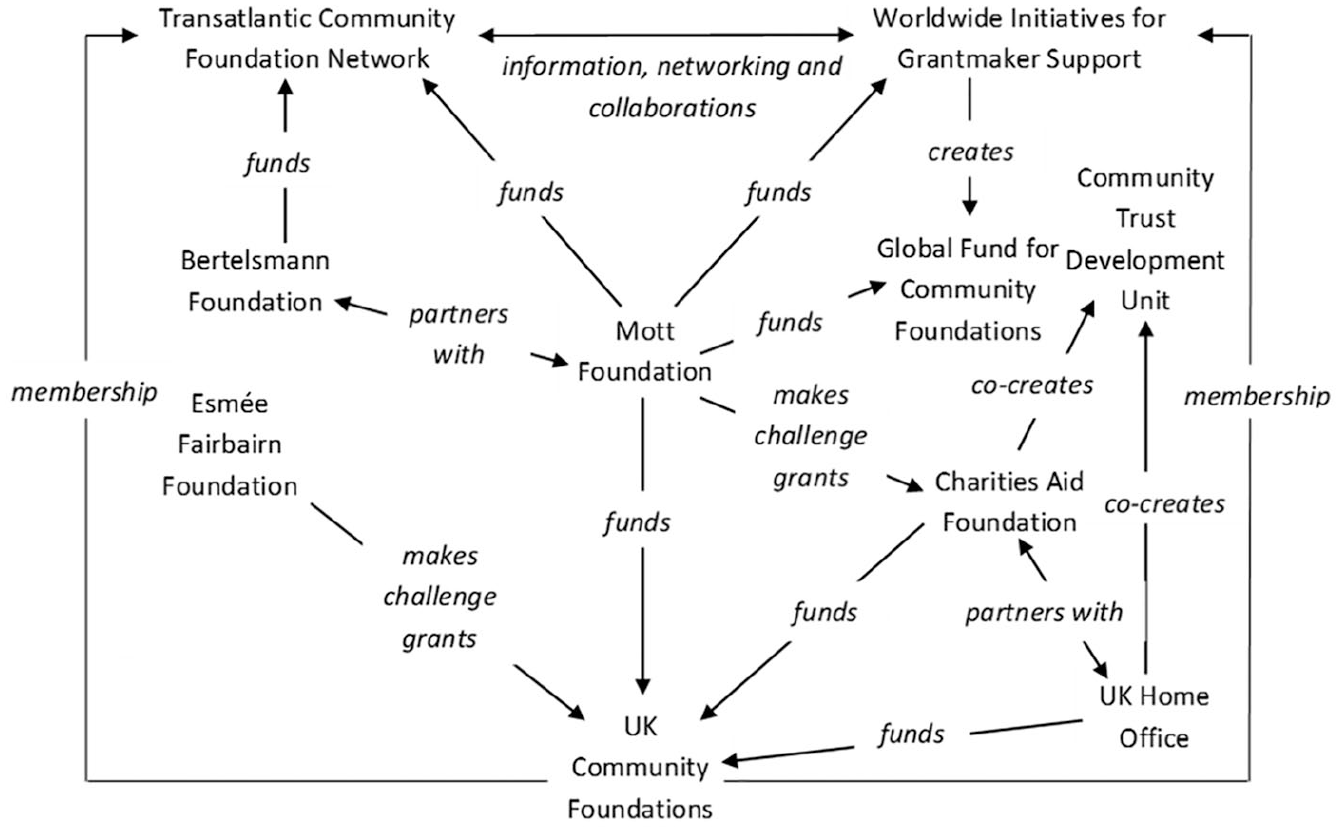
Actor-network model of community foundation transatlantic diffusion.
Mott and the CAF were also influential in founding network organizations that have since supported the development of the CF field. In 1991, the CAF led in creating the Association of Community Trusts and Foundations (ACTAF), renamed the Community Foundation Network in 2001 and UKCF in 2013. The organization has accelerated field formation by advising new foundations, setting standards, disseminating knowledge, and leading on national initiatives. As the former Chair of WINGS observed, Mott funded UK community foundation network [across the field. It has played an important role in] skills transfer, knowledge transfer [and the development of community foundations in the UK].
The Mott Foundation has played an especially important role in strengthening the institutional infrastructure of the CF movement by funding the creation in 1999 of WINGS, and, jointly with the Bertelsmann Foundation, the Transatlantic Community Foundation Network (TCFN).
Micro-Processes of Model Diffusion
The term micro-process is used here to delineate the actions taken by mediators to garner support for the CFM and embed it locally. Thematic analysis of interview data led to the identification of three micro-processes of CFM diffusion, illustrated by the quotations presented in Table 3.
Micro-Processes of Model Diffusion.
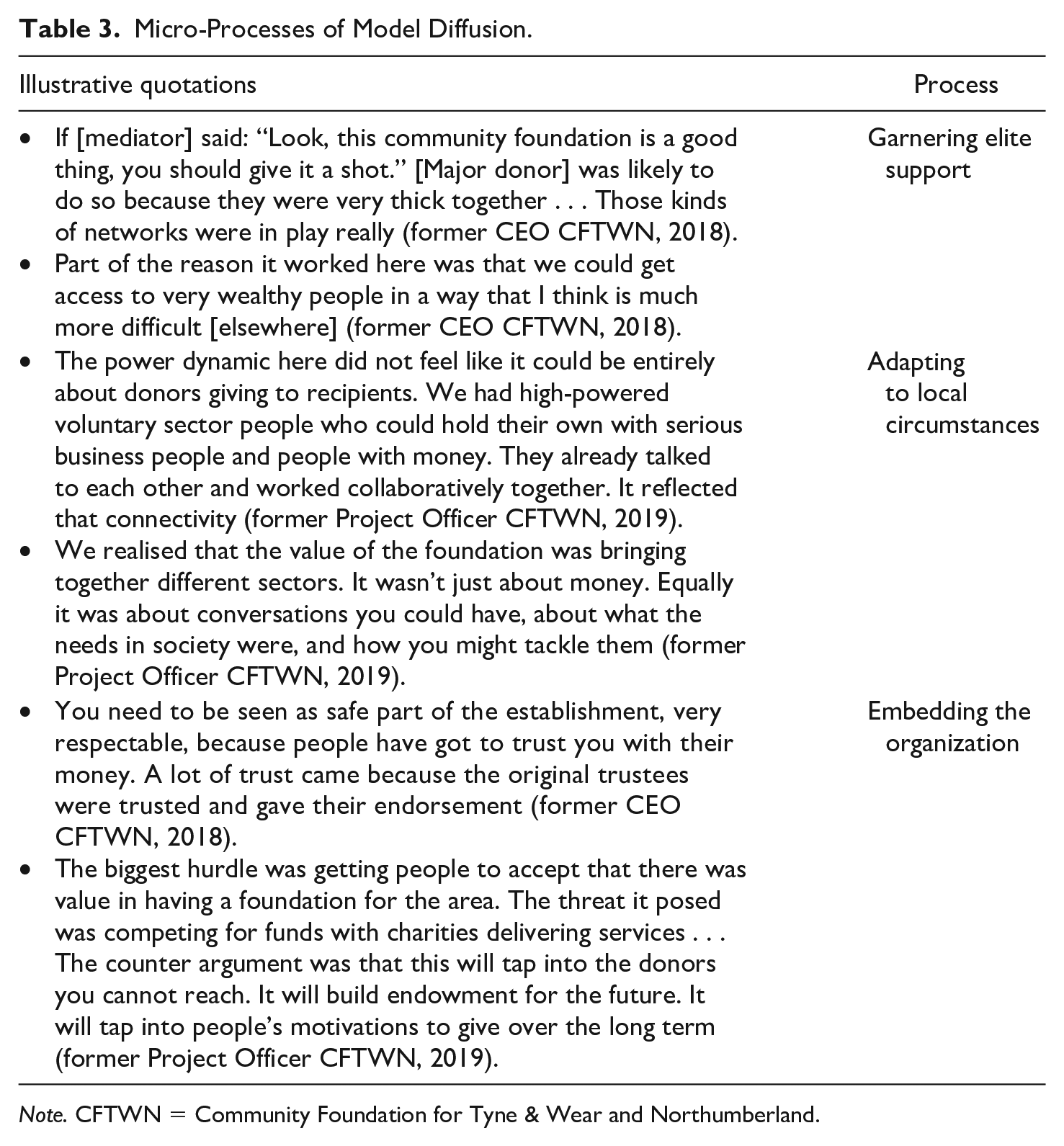
Note. CFTWN = Community Foundation for Tyne & Wear and Northumberland.
Garnering Elite Support
The introduction of the CFM to North East England occurred immediately following the decline and collapse of its staple industries, including shipbuilding, coal mining, heavy engineering, and iron and steel, in the 1970s and early 1980s (Pike, 1999). Elite networks remained, but within them old alliances dissolved, and new ones formed. Business leaders and elite professionals now joined forces with local politicians, government officials, and third-sector leaders to confront the challenges of deindustrialization, strengthening the region’s already distinctive identity (Jackson, 2019). The CFTWN, launched in October 1988, was conceived as a means of supporting struggling communities (CFTWN, 1987, 2008).
The founding Chair, Grigor McClelland, whose networks spanned academia, business, and the third sector, was the prime mover in establishing and embedding the foundation (Philanthropy North East, 2019). He was a former Dean of Manchester Business School, Chair of the Joseph Rowntree Trust, and CEO of a chain of regional supermarkets, which, when sold, made him independently wealthy. He was also rich in cultural, social, and symbolic capital and a pivotal actor within the regional field of power. His high standing within the region had led already to his appointment as Chair of the Washington New Town Development Corporation and to playing a leading role in successful negotiations with Nissan to locate its European headquarters and production facilities in Sunderland (McClelland, 1988).
Having an extensive social network meant that the Chair was ideally placed to garner elite support for the CFTWN. He gathered around him a coterie of influential people from business, the professions, academia, and the third sector who shared his belief that the foundation might serve as an engine for social renewal. The necessary funds, it was agreed, “should mainly come from those who had a great deal of it—the wealthy, businesses, and other charitable trusts—not from those who have relatively little” (CFTWN, 2010, p. 23). As he later recalled, I learnt that we should target our fundraising at a very small market sector—the top. We developed our standing partly by appointing honorary officers—the Lord Lieutenant of the County as President, two established local philanthropists, William Leech and Catherine Cookson, as Patrons, and a dozen well-known figures connected with the region, as Vice-Presidents. (CFTWN, 2008)
These people, in trusted positions with abundant symbolic capital, in turn attracted other wealthy donors to support CFTWN, inspired in part by the Chair’s belief, shared by many in the region, that “London does not help, we have got to pull our socks up, we have got to look after our own” (former CEO CFTWN, 2018). The relative ease with which CFTWN raised £2 million from 40 donors to meet the conditions of the Mott-CAF challenge grant to create an initial endowed fund of £3 million bears testimony to the wisdom of this approach.
Adapting to Local Circumstances
The organization, originally known as the Tyne & Wear Foundation, became the CFTWN in 1992 when it extended its area of benefit to Northumberland. It was McClelland who assumed the role of mediator-in-chief, taking the lead in translating the CFM and rendering it fit-for-context. As reported by the CFTWN CEO (2018): When we were being set up back in the late 1980s, the consultants from the US said that boards should be made up of donors. It was felt that this was wrong for this place, and that the donor interest had to be balanced with other perspectives, that’s why our membership arrangements and board structure were put in place.
Rather than creating a donor-led organization, it was agreed that fee paying members should be grouped into four constituencies—companies, local authorities, charitable organizations, and donors—and three board members elected to represent each constituency, with opportunity to appoint others with special expertise (CFTWN, 1988). The intention, simply stated, was to make CFTWN a stakeholder-based foundation with policymaking delegated to stakeholder representatives (former Board Member D CFTWN, 2019). McClelland’s experience had taught him that socioeconomic renewal could only be accomplished if different elements within the elite worked together. According to one close observer, he put his reputation and name behind an untested model and developed a collegial citizen board, which was an invention at the time “not found elsewhere, at home or abroad” (former Project Officer CFTWN, 2019).
Adapting the CFM had significant consequences. Most importantly, the foundation’s practices and culture became loaded with an ethos of collaboration and expertise sharing. It was accepted that the organization required not just money, also influence in other quarters (former Board Member C CFTWN, 2019). Engaging proactively with third-sector organizations and local authorities supported effective grant making, providing reassurance to corporate and individual donors that their money was being well spent. It also caused other local and national trusts and foundations to channel money through the organization, increasing its grant making capacity. Mediators, in adapting the CFM to local circumstances, thus created the initial conditions necessary for future growth.
Embedding the Organization
Embedding is the process of securing a sustainable long-term position within an organizational ecosystem. For the CFTWN, this meant delivering services valued by philanthropists and charitable organizations. With no track record and an alien business model, the foundation initially suffered from what organization theorists call the liability of newness (Singh et al., 1986), as its first CEO, George Hepburn, explained, People would support the foundation because lots of people famous in the region were already involved. They could see it was well run, that it was an effective means of handling philanthropy . . . But in the early days it was a new thing, it wasn’t proven, nobody famous was involved, so you needed a very compelling proposition to get people to support you. (Former CEO CFTWN, 2018)
Crucial in overcoming this challenge was the active deployment of social and symbolic capital to develop funding streams and enable grant making. Prestigious supporters hosted dinners for potential donors, and two benefactors, housebuilder William Leech and novelist Catherine Cookson, became patrons. This created an aura of success around the foundation, engendering belief in its future. Several prestigious organizations began channeling grants through the foundation, and in time the agency function grew large when several national foundations appointed the CFTWN as their North East agent. Winning the Mott-CAF challenge grant and the creation of an initial £3 million endowment capped these efforts and consolidated the foundation’s position in the region.
Building on this success, Hepburn next set about learning how successful US CFs had grown their endowed funds and grant-making capacity. An important strategic decision was taken in 1995, following the advice of a US consultant, to see the world from the donor perspective, especially with regard to motivation and the satisfactions and rewards deriving from philanthropy (CFTWN, 2009). He and senior colleagues now focused on the “philanthropic journey” and how they might serve would-be philanthropists as “guide” (Maclean et al., 2015). As one major donor recalled, We had started giving but weren’t being strategic about it and didn’t really know what to do or how to think about it. Then, through a mutual friend we met George [Hepburn] and from that developed a conversation that opened our eyes and really helped us, and of course his own organization. (Major Donor CFTWN, 2019)
Similar exercises in raising professional standards followed in building referral networks with solicitors and accountants, in grant-making procedures, community leadership, event management and public relations (CFTWN, 2010).
Discussion and Conclusion
The evidence presented in this article strongly supports the propositions put forward in our third section concerning the role of mediators in diffusing the CFM of philanthropy. First, in the case of CFTWN, the successful establishment and embedding of the model depended on local adaptation, particularly in adopting its representative stakeholder model of governance, which created the initial conditions necessary for future success. Second, we have demonstrated how mediators blessed with abundant cultural, social, and symbolic capital played a crucial role in adapting and locally embedding the CFM in North East England. Third, we have shown how mediators garnered support for what initially was an unfamiliar organizational model by mobilizing the support of local elites. By interacting, negotiating, and alliancing with diverse actors who operate within the field of power, mediators enabled the establishment of a foundation structurally and culturally attuned to local needs and circumstances. What, then, are the implications for (a) research on CFs, and (b) translation theory?
Contributions to Research on CFs
Our article makes two main contributions to research on CFs. The first is identification of the macro- and micro-processes at play in the diffusing the CFM. At the macro-level, our research suggests that the rising popularity of CFs may be accounted for by the structural conditions arising from social and economic change as rising inequalities in income and wealth have increased both the supply and demand for philanthropic funds (Harvey et al., 2020). Viewed in this light, CFs provide opportunity for rich but not necessarily super-rich individuals, families, and firms to engage in a distinctive form of elite philanthropy that is more socially and symbolically rewarding than simply “writing cheques.” On this reading, private foundations like Mott, in serving as interpreters of the CFM in countries outside the United States, have helped diffuse an ideology, not just an organizational innovation (Harrow et al., 2016). The same might be said of supportive network organizations such as UKCF, WINGS, and TCFN whose efforts have encouraged field formation by sharpening its identity and ensuring common purpose.
In terms of micro-processes, our research highlights the important role played by mediators in rendering the CFM fit-for-context. Adaptation, we find, is about more than organizational design. Each of the three processes identified—garnering elite support, adapting to local circumstances, and embedding the organization—play out in a preexisting institutional context infused with preexisting power relations (Greenwood et al., 2002). Mediators encounter resistances and in overcoming them mobilize the resources needed to shape policy and practice at the local level (Ball & Junemann, 2012). Our research suggests that effective translation of the CFM depends on mediators having ample social capital, networks connecting different groups within the field of power, and well-developed social skills. As Fligstein (2001) observes, “skilled social actors must understand how the sets of actors in their group view their multiple conceptions of interest and identity . . . to provide an interpretation of the situation and frame courses of action that appeal to existing interests and identities” (p. 112). This explains the adoption by the CFTWN of representative governance as the best means of reconciling different interest groups, legitimizing the new organization with multiple stakeholders, and reconciling it with “existing structures, norms, and beliefs” in the recipient culture (Wright, 2001, p. 415).
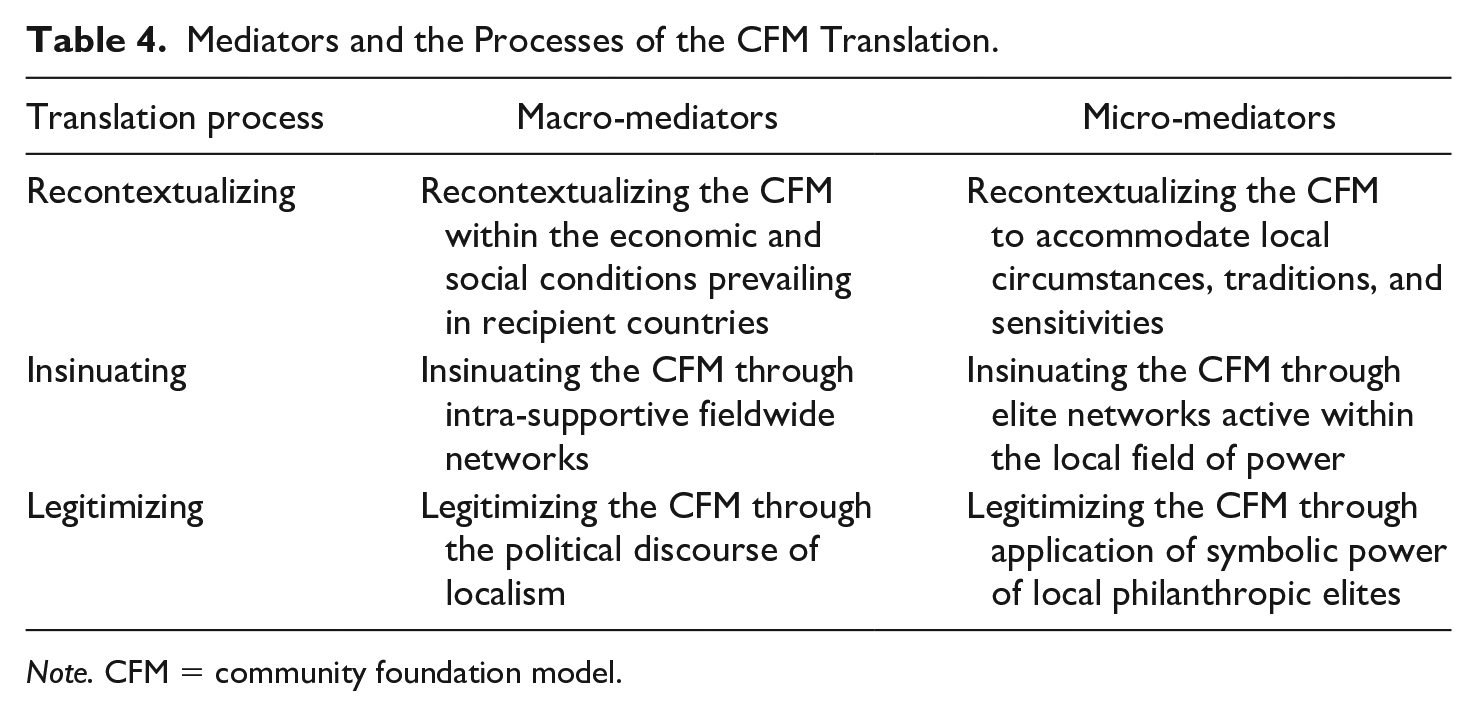
While existing literature has shown that a strength of the CFM is its adaptability to local circumstances and sensitivities (e.g., Daly, 2008; Harrow et al., 2016), we go further in identifying the macro- and micro-mediators and processes involved in cross-national diffusion. We have shown how both macro- and micro-mediators engage in different ways in processes of recontextualizing, insinuating, and legitimizing to facilitate the translation of the CFM, as summarized in Table 4. Macro mediators, operating fieldwide, recontextualize the CFM within the general economic and social conditions and patterns of wealth prevailing in recipient countries, particularly with respect to the obligation of elites to foster social inclusion. They insinuate the CFM through intra-supportive fieldwide networks and legitimize it through the political discourse of localism. Micro-mediators, operating locally, recontextualize the CFM to accommodate local circumstances, traditions, and sensitivities. As high-status agents, they insinuate the CFM through elite networks active within the local field of power and legitimize it through application of the symbolic power of local philanthropic elites, embedding the model in the local recipient institutional context. Conceptualizing the complementary roles of macro- and micro-mediators in this way suggests that the diffusion of the CFM is best understood as an agential movement involving different types of elite actors operating at different levels in society—locally, nationally, and internationally. In thus theorizing from our distinctive case, we offer a conceptual framework with potential for application in different locales and circumstances.
Mediators and the Processes of the CFM Translation.
Note. CFM = community foundation model.
Our insights into recontextualization and fitness-for-context give pause for thought, pointing to the significance of the local and regional context for many philanthropists. Hartmann (2018) writes that, contrary to expectations, so-called “international” elites are something of a fiction, because the need for elites to share analogous class-based experiences, reflecting commonly held assumptions and values, is fundamental (Harvey & Maclean, 2010; Maclean et al., 2006). While his comments may be provocative, they contain an important truth, borne out by our research: namely, that philanthropic endeavors and impacts are geographically embedded, such that giving back to a community with which philanthropists identify often takes center stage (Maclean et al., 2015; Marshall et al., 2018). Our study of the CFTWN, anchored in a local field of power, shines a light on this salient truth.
Our second main contribution to research on CFs is to identify the importance of initial conditions and fitness-for-context as explanatory variables with respect to enduring variations in financial performance. The sectoral analysis presented in Table 1 confirms that the UK CF field is highly variegated, populated by large and small foundations whose differing financial performance can only partially be explained by variables such as age, income per capita, and size of population served. This finding is consistent with established literature demonstrating the importance of local structures and cultures in inducing variety in substance and performance within the nonprofit sector (Grønbjerg & Paarlberg, 2001; Paarlberg & Meinhold, 2012). What we add that is novel, is the idea that future performance depends in large part on the degree of success achieved by mediators in establishing favorable conditions for future growth, that is, in embedding the CFM such that is fit-for-context. When, as at CFTWN, mediators get it right, the greater the likelihood a CF will flourish.
Contribution to Translation Theory
The idea that models and templates are translated—modified, adapted, and recast—through interactions between actors as they travel through space and time is anchored in actor-network theory (Latour, 2005). Ultimately, however, the analytical value of translation theory is limited by its incapacity to identify how causal mechanisms operate within differing social structures, systems, and contexts (Elder-Vass, 2008). This deficiency, according to Sayes (2017), results in the “lack of a category that is able to provide a practical mechanism for sufficiently incorporating mediation” (p. 308). In other words, translation theory as presently constituted tells us little about how mediators actually accomplish change within given social settings and the resources they need to do so. The proposition put forward here is that mediators translate ideas and models by mobilizing resources and support within what Bourdieu (1993, 1996) calls the field of power. This extension to translation theory lends mediators form and substance as actors within power-laden networks with the authority needed to enact translations accommodating the interests of the elites whose interests they serve.
Limitations and Future Research
The limitations of our study stem from our research design. In concentrating on a single extreme case, albeit within the context of CF field formation in the United Kingdom, we sacrificed breadth for depth, restricting the generalizability of our empirical findings. We did so to exploit the opportunity, in the evaluating mode of historical organization studies (Maclean et al., 2016), to test, refine, and develop relevant theory. Building on the ideas put forward here, we believe there is immediate opportunity to formalize and test hypotheses relating to variability in the financial performance of CFs within national fields. Longer term, the scope exists to undertake comparative case-based research, within and across national fields, which might further develop our understanding of the international appeal and spread of the CFM.
Conclusion
Our research has exposed some of the complex realities behind the translation of the CFM, providing insights into how CFs might position themselves to take full advantage of potentialities within local communities (Carman, 2001). Translating the CFM does not necessarily mean that it becomes distorted or depleted. Indeed, it may be enriched and developed by rendering it fit-for-context, “philanthropy-led and community-responsive” (Harrow et al., 2016, p. 309). What our extended insights on CFs help us to better understand are the processes through which CFs may be successfully embedded in the communities they serve.
Footnotes
Appendix
Interviewees.
| Role | Organization | Period in role | Year of interview |
|---|---|---|---|
| Sectoral study set one—Four interviews | |||
| Former CEO | Charities Aid Foundation | 1982–2002 | 2018 |
| CEO | UK Community Foundations | 2015– | 2018 |
| Former Chair | Worldwide Initiatives for Grantmaker Support | 1999–2008 | 2019 |
| Former Program officer | Charles Stewart Mott Foundation | 1998–2005 | 2019 |
| Sectoral study set two—Six interviews | |||
| Former CEO | CF A a | 2002–2018 | 2018 |
| Former CEO | CF B a | 2016–2019 | 2018 |
| CEO | CF C b | 2018– | 2018 |
| CEO | CF D c | 2015– | 2019 |
| CEO | CF E c | 2014– | 2019 |
| CEO | CF F c | 2004– | 2019 |
| Case study—Nine interviews | |||
| Project officer | CF Tyne & Wear and Northumberland | 1987–1988 | 2019 |
| Former CEO | CF Tyne & Wear and Northumberland | 1988–2009 | 2018 |
| CEO | CF Tyne & Wear and Northumberland | 2009– | 2018 |
| Former Board Member A | CF Tyne & Wear and Northumberland | 1988–1995 | 2020 |
| Former Board Member B | CF Tyne & Wear and Northumberland | 1995–2001 | 2020 |
| Former Board Member C | CF Tyne & Wear and Northumberland | 2002–2011 | 2019 |
| Former Board Member D | CF Tyne & Wear and Northumberland | 2014–2019 | 2019 |
| Chair | CF Tyne & Wear and Northumberland | 2018– | 2018 |
| Major donor | CF Tyne & Wear and Northumberland | 1994– | 2019 |
Note. CEO = Chief Executive Officer; CF = Community Foundation; UK = United Kingdom.
Smaller and younger = grants 2019 less than £1 million and established 2000 or later. bLarger and younger = grants 2019 £1 million or above and established 2000 or later. cLarger and older = grants 2019 £1 million or above and established 1999 or earlier.
Acknowledgements
The authors wish to thank Co-Editor-in-Chief Susan Phillips and three reviewers for their many valuable suggestions that have greatly improved our paper. We also would like to thank George Hepburn and Rob Williamson, former and present CEOs, respectively, of the Community Foundation Tyne & Wear and Northumberland, for sharing with us with numerous historical insights and for granting access to the documents underpinning our study.
Declaration of Conflicting Interests
The author(s) declared no potential conflicts of interest with respect to the research, authorship, and/or publication of this article.
Funding
The author(s) received no financial support for the research, authorship, and/or publication of this article.
