




Abstract
Social care services are increasingly provisioned in quasi-markets in which for-profit, public, and third sector providers compete for contracts. Existing research has investigated the implications of this development by analyzing ownership variation in latent outcomes such as quality, but little is known about whether ownership predicts variation in more concrete outcomes, such as violation types. To address this research gap, we coded publicly available inspection reports of social care providers regulated by the Care Inspectorate in Scotland and created a novel data set enabling analysis of ownership variation in violations of (a) regulations, and (b) national care standards over an entire inspection year (n = 4,178). Using negative binomial and logistic regression models, we find that for-profit providers are more likely to violate non-enforceable outcomes (national care standards) relative to other ownership types. We did not identify a statistically significant difference between for-profit and third sector providers with regard to enforceable outcomes (regulations).
Introduction
To meet the growing demand for social and health care services, in part due to the aging population, such services are increasingly delivered in quasi-markets (Blomqvist, 2004; Dilnot, 2017; Hjelmar et al., 2018; Le Grand, 1991). Quasi-markets are commonly understood as competitive markets of subsidized services commissioned by the state (e.g., social care services) in which for-profit organizations (FPOs), public sector organizations (PSOs), and third sector (nonprofit) organizations (TSOs) compete for service contracts. As a result of this open competition, the number of for-profit social care providers has been growing rapidly over the past 30 years and is currently the most common type of care provider in the United Kingdom (Bach-Mortensen & Montgomery, 2019; Barron & West, 2017). Although it remains unclear whether this development has successfully improved health and social care services, it rests on the rationale that open bidding and competition among service providers improves service quality and cost-effectiveness. Yet this rationale has been criticized for relying on a flawed new public management (NPM) line of thinking, which prioritizes aspects related to costs over service quality (Atkinson et al., 2018; Cunningham & James, 2009; Hardill & Dwyer, 2011).
To investigate the effect of the quasi-market for social care, a sizable body of research has analyzed ownership variation in performance- and quality-related outcomes across different types of social and health care services, including nursing homes (Amirkhanyan et al., 2018; Barron & West, 2017; Comondore et al., 2009; Harrington et al., 2017; Hjelmar et al., 2018; Stolt et al., 2011), mixed social care providers (Bach-Mortensen & Montgomery, 2019), hospitals (Tynkkynen & Vrangbæk, 2018), and other health services (Herrera et al., 2014). Most research on this topic shows a consistent direction of effect, often favoring public and third sector providers. However, different quality indicators are used to investigate different service types. For example, research on hospitals often use indicators such as mortality (Pedraza et al., 2015), and readmission rates (Holom & Hagen, 2017), whereas most research on social care services rely on the quality metrics designed by inspection agencies. Importantly, although such metrics are helpful to understand broad directions in “quality” and “performance,” these constructs do not, in isolation, allow for a very detailed understanding of the behavior of different types of providers.
To improve the understanding of the role of ownership in quasi-markets, it is important to supplement analysis of latent constructs, such as “quality,” with concrete outcomes that allow for more nuanced hypothesis testing. By creating a novel data set of publicly available inspection reports over a full inspection year, we analyzed two types of violations across Scottish social care providers: (a) enforceable regulation violations, and (b) non-enforceable violations of national care standards (described in detail below). This allowed us to test whether ownership predicts specific types of violation outcomes, and whether the observed behavior corresponds to theoretical expectations. To the best of our knowledge, this is the first study to investigate ownership variation across these outcomes.
Conceptual Framework
The term “quasi-market” is used to describe markets in which the state operates as the purchaser (rather than the implementer) of services that are contracted to competing providers (Forder et al., 1996; Le Grand, 1991). This market type is thought to outperform state monopolies following the idea that competition will improve “allocative efficiency” and give clients “[. . .] alternative sources of supply” (Le Grand, 1991, p. 1262). However, to understand and theorize how competition in such markets can be thought to operate, it is important to clarify “ownership,” as this is not consistently categorized in the literature, with some research classifying “private” providers as those in the for-profit and third sector, whereas other researchers refer to “non-profits” as both third and public sector providers (Comondore et al., 2009; Moore, 2000). The focus of this article is on providers operating in the social care sector, and we therefore define for-profits as private profit pursuing providers of social care, TSOs as registered not-for-profit providers of social care, and PSOs as care providers run by local authorities.
Existing theories on the mixed provision of social care predict that contracting services in markets with information asymmetry creates different incentives and, as a result, different behavior across ownership (Arrow, 1963; Weisbrod, 1989). Information asymmetry occurs when providers and clients do not share equal access to the true value of key service features, such as service quality. In the quasi-market provision of social care services, information asymmetry persists in that “quality” and “performance” are challenging to observe and monitor directly, which makes it hard to allocate contracts based on the ability of providers to deliver on those outcomes. This asymmetry creates an agent–principal problem, which may compel opportunistic providers to favor observable outcomes (e.g., costs) above hard-to-measure aspects (e.g., quality of care and client needs).
To respond to information asymmetry, contract failure theory (Hansmann, 1980) suggests that services which involve outcomes that are difficult to monitor should be implemented by the provider type with the smallest incentive to underdeliver on important unobservable features (Amirkhanyan et al., 2018; Ben-Ner et al., 2012). Yet there are multiple ways in which to theorize how information asymmetry can be thought to influence the behavior of different providers.
It is conventionally argued that PSOs and TSOs are more reliable providers of social care services as these organizations are generally thought to be driven by social mission and the motivation to “do good” (Moore, 2000). More importantly, by not allocating profits to shareholders (i.e., the “non-distribution constraint”), public and third sector providers are considered less likely to engage in profit-motivated opportunistic behavior (Schlesinger et al., 2003) and it is often thought that such providers distribute their excess income toward improving facilities and services (Ronald et al., 2016). In contrast, for-profit providers are frequently accused of “gaming” the commissioning system by, for example, cherry-picking easily treated clients and thus expecting more difficult patients to be “parked” in public and third sector institutions (Bos et al., 2020). In consequence, it is often assumed that the service quality of for-profit social care providers will be compromised if the contracting framework allows for opportunistic behavior.
However, there are some additional aspects relating to ownership that are important to consider in the quasi-market context. First, although TSOs should be less susceptible to profit-motivated opportunism, they are not immune to opportunistic and suboptimal behavior. For example, research has demonstrated that TSOs prioritize and pursue their own survival, even if that means putting other nonprofit providers out of business (Scharf, 2014). To survive in a quasi-market, providers must become competitive, which demands attention to efficiency, costs, and income. Competing for service contracts may thus create pitfalls for TSOs, in which the pursuit of market expansion and competitiveness conflicts with their original social objectives, thus introducing the risk of becoming “for-profits in disguise” (Chetkovich & Frumkin, 2003; Tuckman, 1998). Second, it is generally accepted that the absence of the nondistribution constraint enables FPOs to be more flexible in their management and offer more attractive staffing conditions. Moreover, the ability to distribute profits to shareholders is likely to facilitate easier access to capital and investment, which, in turn, may enable for-profit providers to offer innovative services at lower costs than other provider types.
Focus of This Study
The main argument against for-profit providers delivering social care services can be summarized by the idea that “[. . .] the more complex and ambiguous the proposed [quality] measures, the stronger is the social efficiency case for the nonprofit alternative” (Weisbrod, 1989, p. 545). In other words, public and third sector providers are conventionally assumed to have an intrinsic motivation to prioritize quality of care, even if the incentives in place to maximize such outcome are flawed. For-profit providers, on contrary, are thought to be more willing to adopt higher risk management strategies and prioritize costs, which may increase their likelihood to violate regulations and NCS. However, there are two aspects that may undermine the conventional argument that public and third sector providers differ from for-profit providers.
First, it is unclear whether social care providers can be meaningfully understood according to traditional ownership archetypes, given that these providers have had to adapt to similar market constraints (Bromley & Meyer, 2017). Thus, many years of open bidding and competition may have changed the norms of surviving providers, such that “[. . .] standards of service and conduct set by the proprietary firms eventually may be taken as an acceptable minimum even among the nonprofits” (Hansmann, 1980, p. 876). Second, social care services are often carefully regulated and violating regulations can be costly, in that violations typically require immediate action by the violating provider, which, in turn, should operate as a strong disincentive for all providers, regardless of ownership, to deliver services below violation threshold.
To test the consequences (if any) of ownership in social care markets, we use a novel data set to analyze variation in violation outcomes. There is an important distinction between the outcomes investigated in this analysis: violating regulations requires immediate and potentially costly amendment, whereas violating NCS lead to a “recommendation,” which does not, in isolation, involve direct enforcement. Following the idea that all care providers are incentivized to avoid fines and regulatory enforcement, it follows that ownership should not matter greatly to “costly” outcomes (regulations). However, in terms of non-enforceable outcomes, it is unclear what differences should be expected across ownership, as there is no obvious incentive (from a rational contract-oriented perspective) to comply with these. Thus, by analyzing variation in these outcomes, we test the extent to which the quasi-market has created similar behavior across ownership types and whether the conventional expectation that third and public sector providers will prioritize care-related outcomes that are not directly incentivized can be empirically validated. These hypotheses can be summarized as follows:
Institutional Context
The Care Inspectorate is the independent regulator of more than 13,000 social care providers in Scotland with the most common service types being care homes, children’s day care services, housing support services, and support services. Similar to the Care Quality Commission (CQC) in England and Wales, the Care Inspectorate follows a standardized rating procedure to inspect and rate social care providers. The main role of the Care Inspectorate is to ensure client safety by undertaking unannounced inspections of all services that deliver social care–related activities. These inspections entail evaluating whether a “requirement” or a “recommendation” should be posed to the provider based on adherence to regulations and NCS.
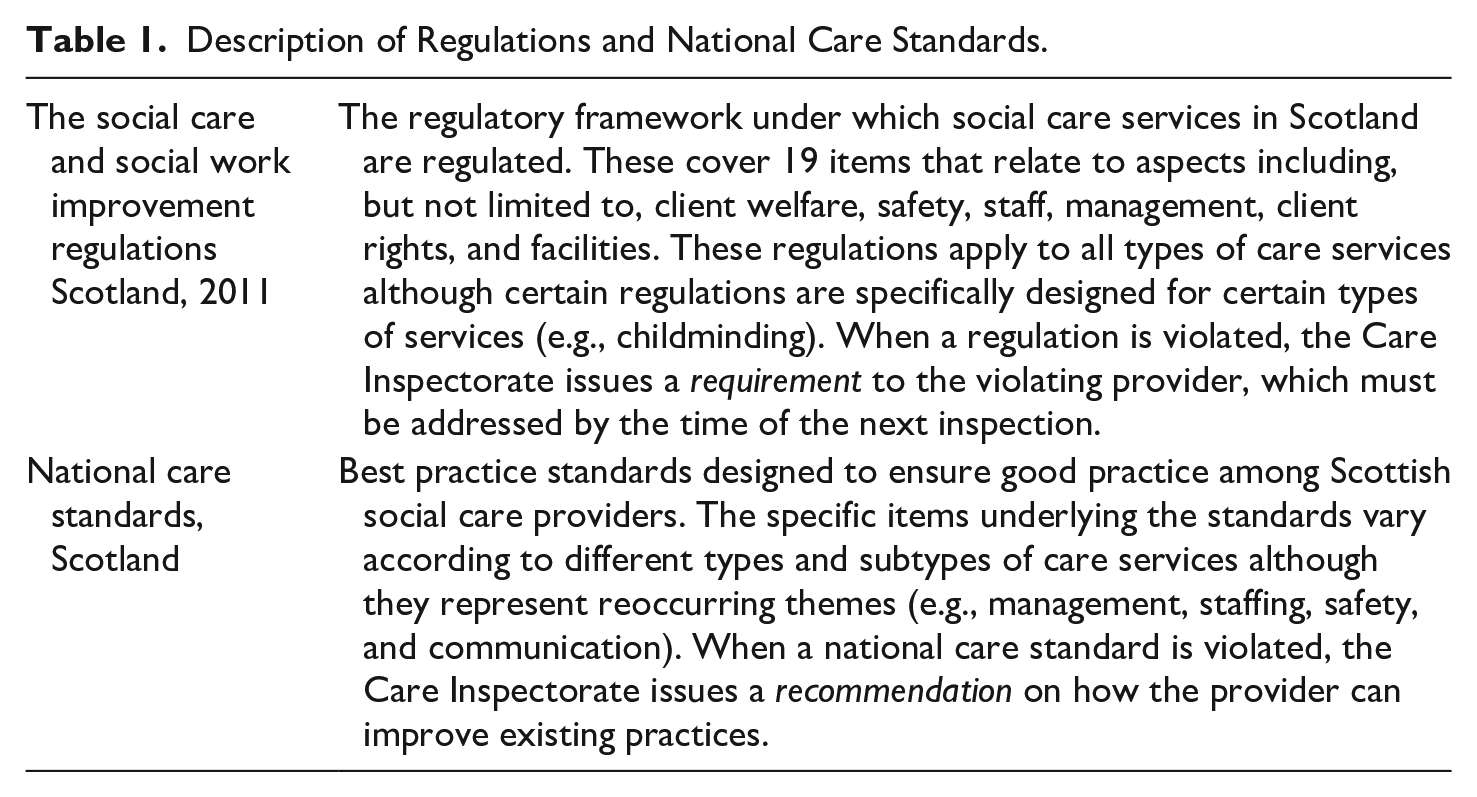
The central difference between these violation outcomes is that violating a regulation leads to a “requirement,” which involves direct enforcement if not corrected, whereas violating an NCS results in a “recommendation” on how to improve practices on an issue, which may not necessarily lead to an enforcement if not adhered to (see Table 1 for further details).
Description of Regulations and National Care Standards.
Data
We use publicly available data from the Care Inspectorate in Scotland to analyze the types of regulations and NCS violated by social care providers in 2017-2018. All violations of NCS and regulations are publicly available on the Care Inspectorate website in the inspection reports (Care Inspectorate, 2018). We manually coded inspection entries from the 2017-2018 inspection year (n = 4,178). Considering our interest in ownership, we only include service types with ownership variation, which include the following services: care home services, day care of children, support services, and housing support services. See Online Figure A1 for details on these service types.
Coding of Inspection Reports
To enable statistical analysis of the inspection reports, all inspection outcomes for the 2017-2018 inspection were manually coded by the authors. Recommendations were coded as the specific NCS violations (see the online supplementary material for a full list of these) cited in the inspection report. Requirements were coded as “The Social Care and Social Work Improvement Scotland (Requirements for Care Services) Regulations 2011” (“www.legislation.gov.uk/sdsi/2011/9780111012321/contents,” 2011) violated by the inspected provider.
To ensure that the coding was done consistently between the two reviewers, an initial subsample was coded jointly. During the subsequent coding process, all ambiguous observations were noted and reviewed and resolved in consensus. The overall coding process required no individual interpretation by the coders as the specific regulations and NCS were always cited explicitly in the report. However, to confirm the robustness of the coding results, the authors reviewed a 20% sample of each other’s coded observations.
Analysis
As the main outcomes involve counts (number of violations), and due to overdispersion, we modeled our data using negative binomial regression. Yet, although the number of violations may be indicative of regulation severity, it is a not a guaranteed marker of that. For example, a requirement citing five violated regulations relating to staff is not necessarily more severe than a report citing one serious violation of client welfare. Based on these considerations, we dichotomized the violation values (violation/no violation) across all individual regulations and NCS, and analyzed these using logistic regression. All models were calculated with robust standard errors. To ensure that the results are intuitively interpretable, we display the marginal effect of all main outcomes (Norton & Dowd, 2018). All analyses were conducted in Stata 13.
Explanatory Variables
Our primary explanatory variable is ownership, which is coded as a dummy variable (for-profit, public, and third sector ownership). To reduce the likelihood of the relationship between ownership and violations being confounded by other factors, we control for a number of organizational and client characteristics. Specifically, we control for years of registration, number of registered client places, number of facilities owned by the same provider, client group (e.g., children, adults, and older clients), number of staff, and service type (e.g., care homes, children’s day care services, housing support service, and support services). To capture any nonlinear effect of age, we also included a squared term for years of registration.
Dependent Variables
Our main dependent variables are the violated regulations and NCS cited in the inspection reports. The regulations apply to all social care services and are thus numbered consistently in all inspection reports. There is some variation in how NCS are numbered and worded in the inspection reports as different NCS apply to different service types. To enable comparison, we therefore recoded all the NCS into overall themes as the items generally revolve around similar issues. The merged categories can be found in the online supplementary material, which specifies the specific NCS included in each category.
Results
Descriptive Results
Table 2 displays some summary statistics of the included sample. FPOs represent 40.31% of the sample, followed by TSOs (33.39%) and PSOs (26.30%). FPOs received the largest proportion of requirements and recommendations (58.10% and 59.09%, respectively), followed by TSOs (27.51% and 26.51%, respectively) and PSOs (14.39% and 14.41%, respectively).
Summary Statistics.
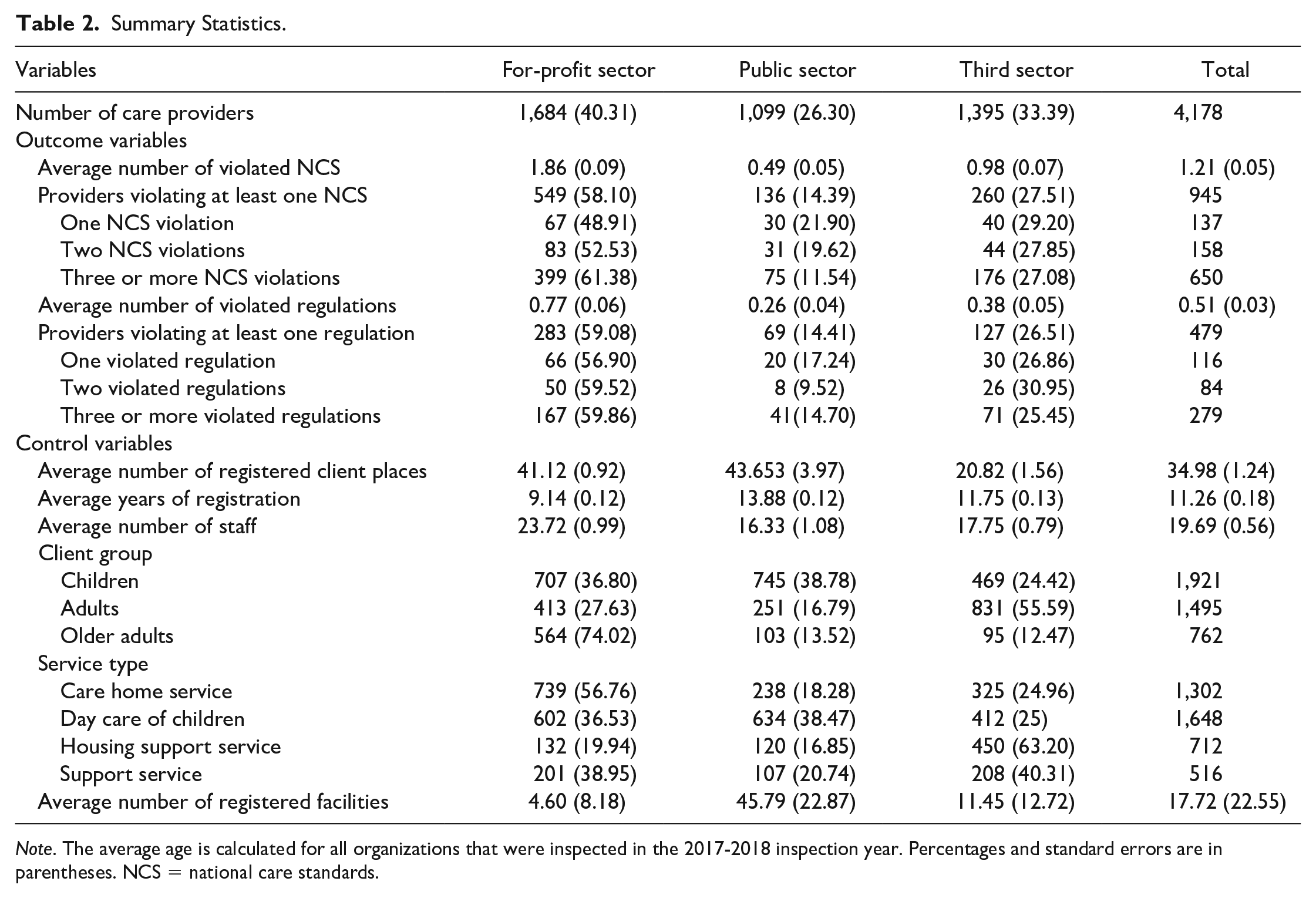
Note. The average age is calculated for all organizations that were inspected in the 2017-2018 inspection year. Percentages and standard errors are in parentheses. NCS = national care standards.
On average, FPOs have been registered for fewer years than TSOs and PSOs, with PSOs having been registered, on average, the longest. FPOs tend to have more paid staff, as measured by whole-time equivalent (WTE), compared with PSOs and TSOs. For-profit providers have the smallest average number of facilities, with public providers having the most, mainly due to local authority clusters. FPOs serve a large proportion of older clients (74.02%) relative to their overall market share (40.31%), which is also illustrated by for-profit providers delivering a large proportion of care home services (56.76%). Third sector providers represent the majority of “housing support services” (63.20%) and adult clients (55.59%), whereas the largest relative client group for PSOs is children (38.78%) and their biggest service type “day care of children” (38.47%).
The Online Table A2 shows the raw distribution of the outcome variables and how these are distributed across ownership. The most commonly violated regulation across the full sample is Regulation 4 (“Welfare of Users”), which was violated in 9.24% of all inspections, followed by Regulations 15 (“Staffing”) and 5 (“Personal Plans”), which were violated in 4.50% and 3.66% of all observations, respectively. The most frequently violated NCS category is “Management and staff,” with 18.02% of all reports citing issues related to this category. Other frequently cited national care issues include standards related to “Environment,” “Keeping well,” and “Support.” Across most NCS categories, FPOs received the highest proportion of violations and PSOs the fewest.
Regression Results
Tables 3 and 4 display the negative binomial and logistic regression results. The coefficients in the first two columns refer to the number of violated variables (number of violated regulations and NCS), which are obtained from negative binomial regression models, whereas the rest of the columns display the exponentiated logistic regression coefficients of the dichotomized variables (violation/no violation). Due to missing data on the number of staff, 248 observations were dropped from the full regression models. The characteristics of the dropped observations can be found in Online Table A3 and the substantive results remain similar when running the models without adjusting for number of staff.
Regulation Outcomes.
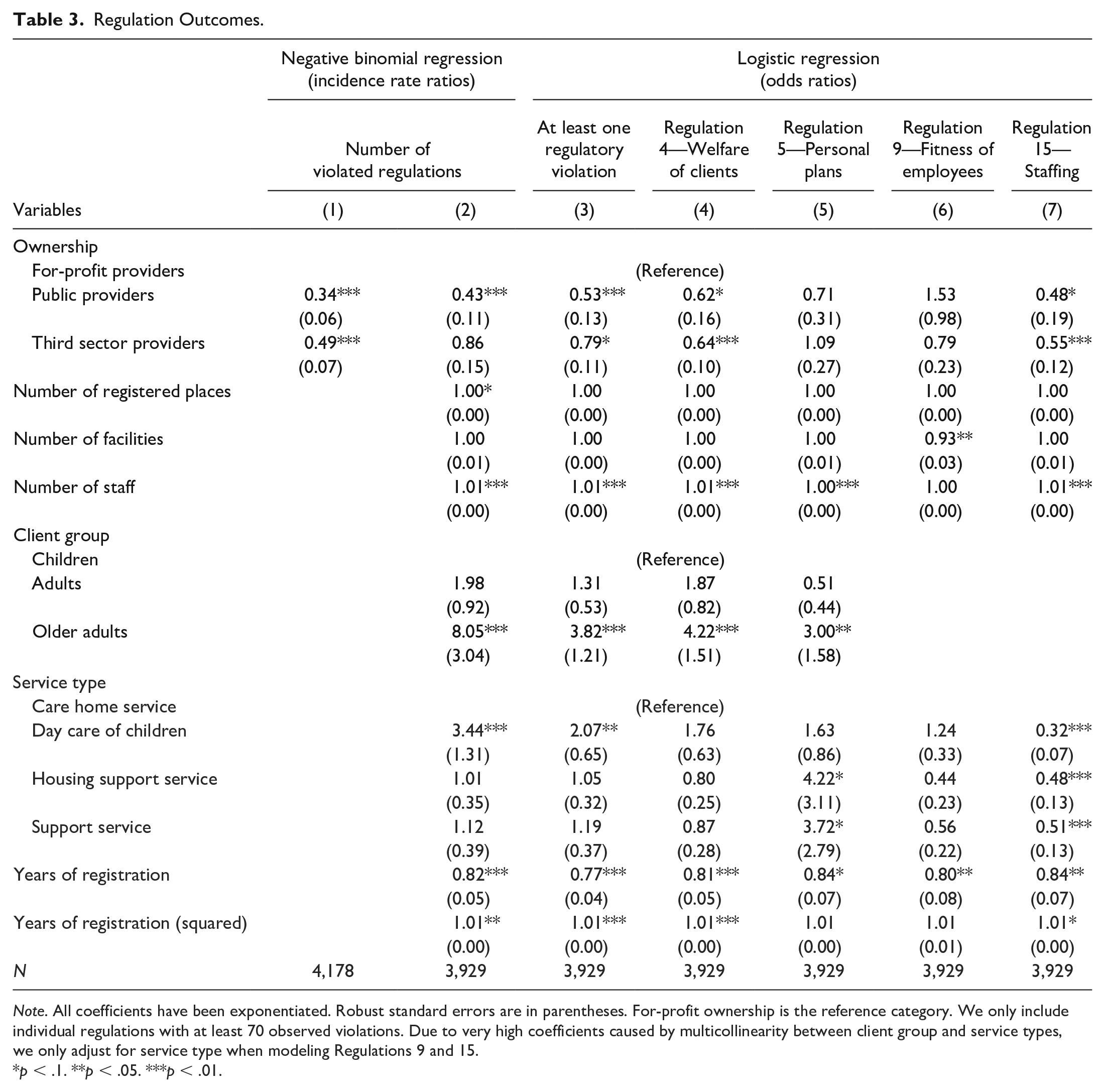
Note. All coefficients have been exponentiated. Robust standard errors are in parentheses. For-profit ownership is the reference category. We only include individual regulations with at least 70 observed violations. Due to very high coefficients caused by multicollinearity between client group and service types, we only adjust for service type when modeling Regulations 9 and 15.
p < .1. **p < .05. ***p < .01.
National Care Standards (NCS) Outcomes.
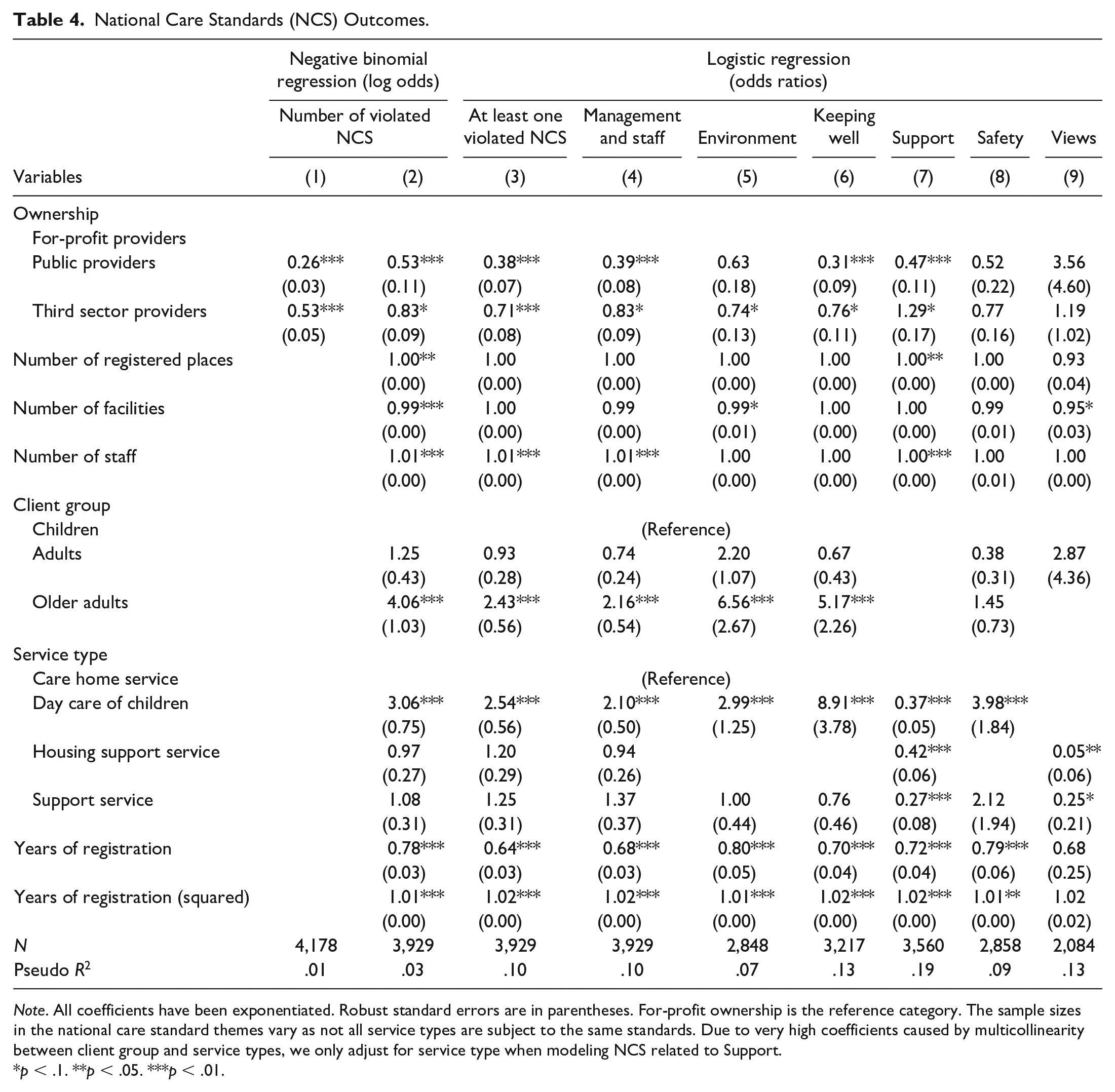
Note. All coefficients have been exponentiated. Robust standard errors are in parentheses. For-profit ownership is the reference category. The sample sizes in the national care standard themes vary as not all service types are subject to the same standards. Due to very high coefficients caused by multicollinearity between client group and service types, we only adjust for service type when modeling NCS related to Support.
p < .1. **p < .05. ***p < .01.
Table 3 displays the full regression results on the regulation outcomes. The table shows that public and third sector providers are generally associated with fewer violations, compared with for-profit providers although this difference was only statistically significant between for-profit and public providers. This direction of effect was also observed in the logistic regression results, with public providers being less likely to receive any type of requirement, compared with for-profit providers. The difference between third and for-profit providers was statistically significant (p < .05) for Regulations 4 (“Welfare of clients”) and 15 (“Staffing”).
Table 4 displays the full negative binomial and logistic regression results across the NCS outcomes. The table displays a similar pattern to the regulation outcomes although the coefficients are larger compared with the regulation outcomes and the difference between TSOs and FPOs is statistically significant in more outcomes. Specifically, FPOs were significantly more likely to violate at least one NCS compared with TSOs, but were not associated with a higher number of NCS violations (p < .10). The difference between for-profit and public providers was statistically significant in all NCS outcomes, except for the standards relating to environment, safety, and client views.
Across both tables, we observe that “years of registration” was negatively associated with the probability to violate both regulations and NCS, suggesting that providers with more years of experience were less likely to receive a violation. “Number of staff” was positively associated with increased violation probability, indicating that providers with more staff were more prone to violations. Compared with services working with children, providers that worked with older clients were more likely to violate either a regulation or an NCS. However, these coefficients should be interpreted with a high degree of caution, in that service and client type will inevitably be influenced by multicollinearity (e.g., day care of children services only include children). The results remain similar when excluding observations with high leverage values and with more than 10 violations (see Online Table A4).
Figure 1 displays the marginal effects of the adjusted negative binomial and logistic regression models. Overall, the figure displays a pattern in which FPOs have a higher predicted value on all displayed outcomes (violating at least one NCS/regulation and number of NCS/regulation violations), compared with both PSOs and TSOs. Specifically, around 12% of FPOs violated at least one regulation, followed by TSOs (10%) and PSOs (7%). This difference was substantially bigger in NCS outcomes in which the predicted probability for FPOs to violate a given NCS was 27%, 21% for TSOs, and 12% for PSOs. The predicted number of violations for FPOs was 1.14 and 0.46 for NCS and regulations, respectively, whereas it was 0.94 and 0.4 for TSOs and 0.60 and 0.20 for PSOs. The difference between FPOs and PSOs was statistically significant across all outcomes, whereas TSOs only differed with statistical significance to FPOs by being less likely to violate at least one NCS.
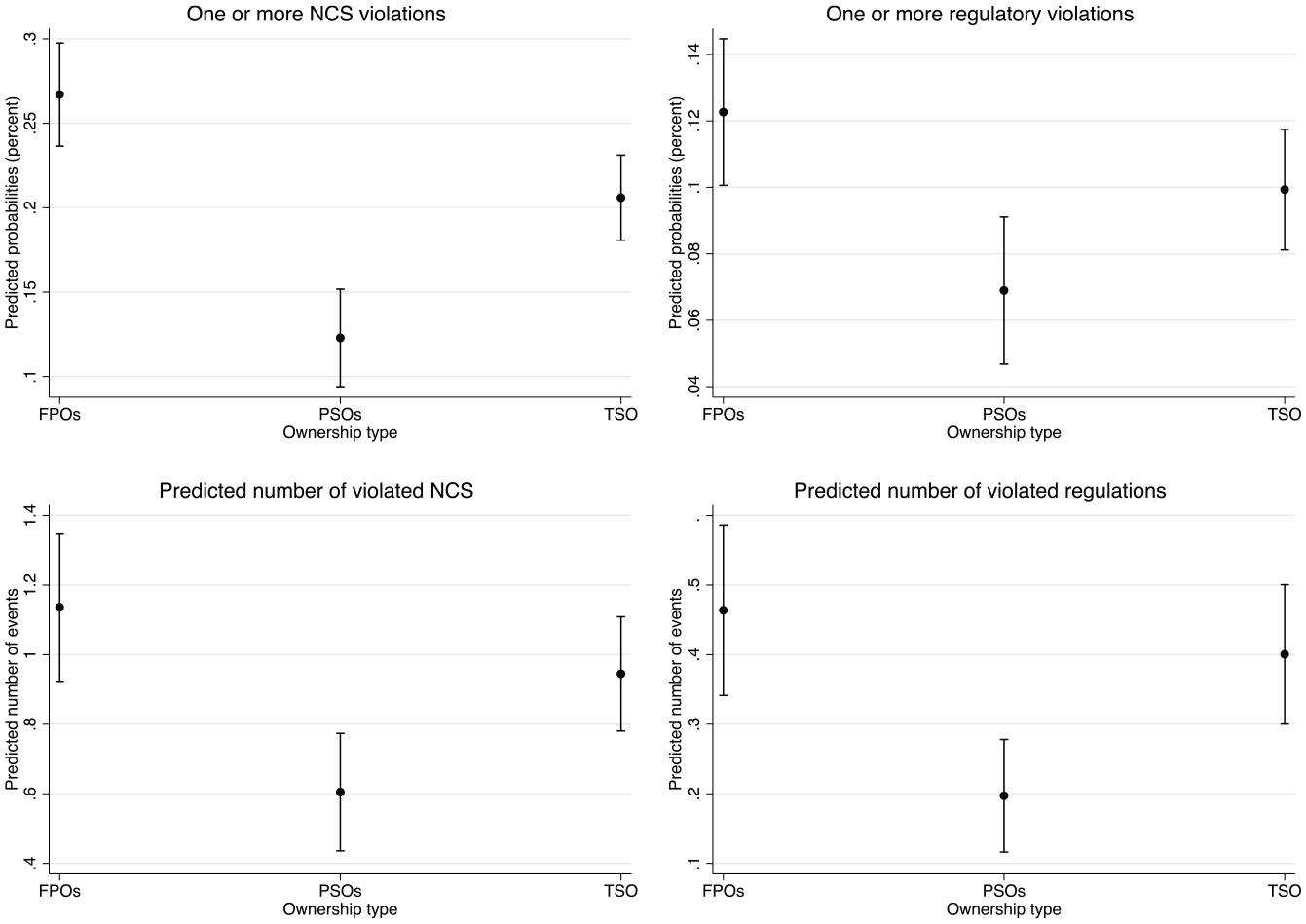
Predicted values for the main violation outcomes.
Interaction Results
The results displayed above represent the average effect from a mixed sample of service types. Although all models adjust for service and client types, it is possible that the effect of ownership on violation probability varies according to different service types. Thus, to supplement our results, we ran the models with service types as interactions to ownership. The predicted probabilities are illustrated in Figure 2 and the full regression results can be found in Online Table A5.
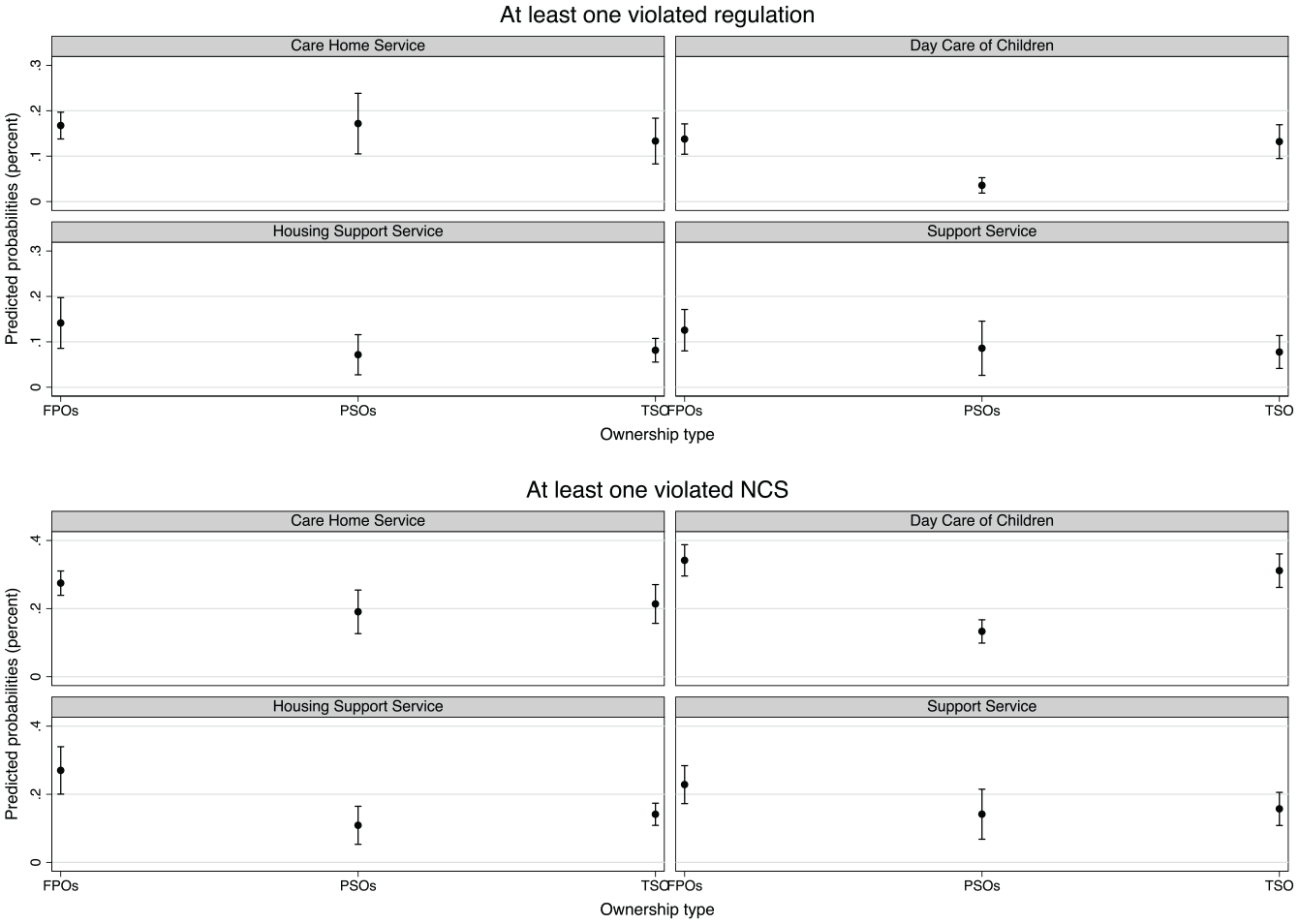
Marginal effects of the effect of the interaction models displayed in online Table A5.
The interaction results display a similar direction of effect as presented in the primary results. Concretely, there were no statistically significant differences across ownership by service types in regulation outcomes, with the exception of “day care of children” services, in which public providers were less likely to violate a given regulation compared with both for-profit and third sector providers. For-profit providers were statistically significantly more likely to violate NCS across all service types compared with PSOs, except for “Support Services,” which displayed marginal statistical significance (p < .08). Similarly, TSOs were less likely to violate NCS compared with FPOs for care homes and housing support services, marginally significant for support services (p < .06), but not statistically significant for children’s day care services. Public and third sector providers did not differ in violation propensity across service types except for children’s day care services.
Discussion
Summary of Findings
In this article, we have analyzed whether ownership accounts for variation in two currently unexplored aspects: enforceable and non-enforceable violations. Our results demonstrate partial support for Hypothesis 1 (no ownership difference for costly violations), in that there was no statistically significant difference in the propensity to violate regulations between public and third sector providers, nor between third sector and for-profit providers. However, public providers were statistically significantly less likely to violate regulations compared with for-profit providers. We generally find support for Hypothesis 2 (that public and third sector providers perform better on non-enforceable outcomes), in that for-profit providers were, on average, more likely to violate NCS compared with both public and third sector providers. Moreover, the magnitude of the ownership differences in adherence to non-enforceable outcomes was substantially larger compared with variation in enforceable violations. Our results consistently indicate public providers to be more compliant to the regulation and NCS outcomes compared with both FPOs and TSOs.
Importantly, our results represent aggregated providers within multiple service types, which may entail inherent differences. However, our interaction analyses generally support both hypotheses, in that there were modest ownership differences in the regulatory violations, but quite clear differences in the adherence to NCS across most service types. Yet the results suggest that public providers of children’s day care services are particularly adherent to regulations and NCS relative to for-profit and third sector providers of similar services.
Discussion of Findings
Broadly, the success of a quasi-market provision of social care relies on the ability of the state purchaser to either (a) reliably monitor relevant outcomes, or (b) “trust” the commissioned providers not to behave opportunistically. Ensuring meaningful monitoring of care is, however, a difficult endeavor to achieve in practice. For example, a recent article demonstrated that the majority of the quality requirements specified in social care contracts in Swedish nursing homes were assessed by the authors to be either non-monitorable or only partly monitorable (Isaksson et al., 2018), thus questioning the relevance and meaningfulness of such indicators. Second, traditional theories on the altruistic features of TSOs and the public sector motivation of PSOs suggest that these providers are less willing to risk client welfare compared with FPOs. However, the nonprofit exemption is often achieved by reporting on financial aspects (Bach-Mortensen & Montgomery, 2018), which has been critiqued on the grounds that this information “[. . .] will not assist the public to address accountability issues or to evaluate how best to blend nonprofit and for-profit endeavors” (Tuckman, 1998, p. 190).
In other words, these conditions are difficult to meet in practice, which may explain previous research findings that for-profit providers perform better on outcomes that are observable to clients compared with unobservable factors (Ben-Ner et al., 2012), thus implying that FPOs utilize the asymmetric information between client and provider to their advantage. Similarly, our results support the intuition that FPOs organize their services according to the incentive framework under which they operate by focusing on enforceable outcomes. Furthermore, although FPOs were generally more likely to violate NCS, violations relating to “client views,” “environment,” and “safety” (arguably relating to observable and client-relevant domains) were not statistically different across ownership.
Moreover, our results indicate that for-profit providers are not more likely to violate regulations compared with TSOs, which can be interpreted to mean that the behavior of private providers (FPOs and TSOs) does not differ with statistical significance across enforceable outcomes. This supports the intuition that FPOs perform similarly to their nonprofit counterparts on “important” outcomes. However, the probability for third sector providers to violate both enforceable and non-enforceable outcomes was generally lower than the predicted probability values of FPOs, but higher compared with PSOs. This may be understood in terms of the dual pressure experienced by TSOs, who, on one hand, are expected to serve their mission, but, on the other hand, have to compete for government contracts (Chetkovich & Frumkin, 2003). This conflict is often thought to create tension among nonprofit providers with the risk of creating “[. . .] mission vagueness and an unclear charitable purpose” (Froelich, 1999, p. 262). Contrary to the idea that third sector providers are gradually becoming indistinguishable from for-profit providers, our results demonstrate that TSOs are less likely than FPOs to receive a non-enforceable violation and are also more adherent to Regulations 4 (client welfare) and 15 (staffing). In line with conventional assumptions about the third sector provision of social care (Billis & Glennester, 1998), this suggests that TSOs are more likely to address issues not directly incentivized through contracts and are also are more attentive to client welfare and staffing conditions than their for-profit counterparts.
However, the interaction models demonstrated similar results for for-profit and third sector providers across certain service types. Specifically, both for-profit and third sector children’s day care providers were significantly more likely to violate at least one NCS and regulation compared with public providers. This clear difference in favor of public providers may thus reflect private sector abuse of information asymmetry as the ability of caregivers (who presumably choose the children’s care provider) to observe the quality of such services will inevitably be limited. If private ownership differences are exacerbated in services with reduced transparency and client agency, it presents important implications for the quasi-market provision of children’s care. For example, it is known that the majority of U.K. children’s homes and fostering services are operated by for-profit providers (Narey, 2016), which is a potentially alarming development, in that there is very limited client choice among children’s home and fostering service users, meaning that quality control and safeguarding is imperative for these services. However, our results only represent day care of children’s services, in which the interest and safety of a child is protected by a caregiver. We are not aware of any research that directly tests differences in ownership variation across services with different levels of transparency and client choice, which will be important to investigate going forward. In our sample, TSOs performed better than FPOs across most service types and public providers often performed better than both FPOs and TSOs.
Going Forward
The future demand for social care is thought to increase due to the demographic changes caused by the aging population (Dilnot, 2017) and it is therefore important to be open to innovations. As noted by Weisbrod (1989, p. 545), “The optimal choice among institutional forms is a mixture, not a single form; neither government, private enterprise, nor the non-profit form is best under all conditions.” However, for competition to improve social care services, it is central that the commissioning system under which these are contracted consider potential flaws in the incentive structure. It is known that social care budgets in the United Kingdom are decreasing (Glasby et al., 2020; Wraw et al., 2020) and quasi-markets have been accused of outsourcing austerity and reduced social care budgets to nongovernmental providers (Hudson, 2016). If contracts are primarily awarded according to outcomes such as costs, it follows that these will then be the focus of providers in a competitive environment, which may have harmful effects in the long run. Specifically, such a system might introduce serious equity issues by incentivizing competing providers to focus on the most easily treated clients and thereby overlook severe and difficult to treat patients. To ensure that social care suppliers are incentivized to deliver on relevant outcomes, it is critical to avoid contract failure by making meaningful efforts to define and incentivize quality and client safety as part of the commissioning process. Importantly, an incentive framework focusing on superficial outcomes is risky in an open market setting as it may facilitate a “race to the bottom” in which providers of all types are pressured to design their services around costs and easy-to-serve clients to win contracts.
Strengths and Limitations
The findings of this article should be interpreted in light of the following limitations. First, during the initial coding, both authors identified some inconsistencies in the data, such as missing entries or out-of-date information. To address this issue, all suspicious data entries were marked and manually reviewed by the first author, who updated the information directly from the full inspection reports. Second, similar to the existing research (Barron & West, 2017; Hjelmar et al., 2018), this analysis was based on administrative observational data, making it difficult to assess the extent to which the effect of ownership can be considered causal. Third, the generalizability of the findings should be interpreted considering the sample, that is, Scottish social care providers, subject to an inspection in the 2017-2018 inspection year.
However, several strengths should also be noted about the analysis. First, by manually coding publicly available data, we created a novel data set, enabling direct testing of ownership difference across inspection outcomes. Second, the analysis contributes to the existing body of research investigating service deliveries across ownership by adding further insights into specific violation issues experienced across different social care providers. Finally, the findings were robust to a series of adjustments and the results were largely consistent across all included service types.
Conclusion and Future Research
With the growing share of for-profit social care providers, it is central to understand whether and how the ownership status of providers influences the operation of services, so that practitioners and policy makers can address problematic ownership-specific differences through regulation (Dickinson & Miller, 2011; Krachler & Greer, 2015). To the best of our knowledge, this is the first study to investigate ownership variation in violations among social care providers. Overall, we find that for-profit providers are more likely to violate non-enforceable outcomes compared with public and third sector providers, but that there is modest ownership variation in enforceable outcomes. Going forward, it is central to undertake research in the following areas.
First, most research on this topic seems to focus on service performance or quality, with limited attention to which ownership-specific characteristics or constraints lead to the observed variation. Therefore, a more detailed understanding of the mechanisms driving the observed differences across ownership is strongly warranted. Second, although our interaction results displayed a direction of effect that was consistent with the main results, it was not the focus of this article to compare ownership differences between different service types. Given the development toward an increasingly for-profit provision of children’s services, it is critical that future research explicitly explore the role of ownership across different services and clients. Finally, most research on quasi-markets is conducted in individual national contexts and on a limited range of service providers, thus making it difficult to understand how the wider policy and political contexts may influence ownership variation. For example, research in the United Kingdom and United States (Barron & West, 2017; Karen et al., 2009) tend to demonstrate quite clear differences in performance across ownership, whereas studies conducted within Scandinavia demonstrate more modest ownership variation (Stolt et al., 2011). To understand how different policy contexts may be related to certain types of outcomes, comparative research is needed to determine whether and, if not, why, different kinds of variations can be observed across different regulation contexts.
Supplemental Material
sj-pdf-1-nvs-10.1177_08997640211001448 – Supplemental material for Ownership Variation in Violated Regulations and National Care Standards: Evidence From Social Care Providers
Supplemental material, sj-pdf-1-nvs-10.1177_08997640211001448 for Ownership Variation in Violated Regulations and National Care Standards: Evidence From Social Care Providers by Anders M. Bach-Mortensen and Ani Movsisyan in Nonprofit and Voluntary Sector Quarterly
Footnotes
Acknowledgements
We are very grateful to Caspar Kaiser and Ertugrul Polat for their helpful comments on earlier drafts of the article. We also gratefully acknowledge the feedback provided by the editor and anonymous peer-reviewers, which greatly improved this work.
Declaration of Conflicting Interests
The author(s) declared no potential conflicts of interest with respect to the research, authorship, and/or publication of this article.
Funding
The author(s) disclosed receipt of the following financial support for the research, authorship, and/or publication of this article: A.M.B.-M. is supported by a research fellowship from the Carlsberg Foundation. The funder was not involved in the research process.

Supplemental Material
Supplemental material for this article is available online.
Author Biographies
References
Supplementary Material
Please find the following supplemental material available below.
For Open Access articles published under a Creative Commons License, all supplemental material carries the same license as the article it is associated with.
For non-Open Access articles published, all supplemental material carries a non-exclusive license, and permission requests for re-use of supplemental material or any part of supplemental material shall be sent directly to the copyright owner as specified in the copyright notice associated with the article.
