




Abstract
National Day of Service (NDS) volunteering events have become common, yet little is known about how the design of such events affects volunteer satisfaction. This relationship is important because volunteer satisfaction ensures a strong volunteer base for special events and promotes sustained volunteerism. We explore how the design of NDS projects promotes volunteer job satisfaction. Our approach to the research question is informed by work design theory. Based on interview, participant observation, and focus group data from an NDS in the Netherlands, the findings suggest that nonprofit organizations can elicit volunteer job satisfaction by designing NDS projects that create a sense of added value, support productivity, and make volunteers feel comfortable. Designing NDS projects that incorporate task significance, symbolic social support, feedback from others, beneficiary contact, task identity, project preparation, physically demanding work, social support, and limited autonomy help to achieve these goals.
Keywords
Introduction
National Day of Service (NDS) events are nationwide volunteering events in which individuals and groups support nonprofit organizations by contributing their time to 1-day service projects. These events mobilize large numbers of people to engage in one-off volunteer service. For example, in the Netherlands, NLdoet (Netherlands Does) mobilizes 300,000 people to donate their time to 8,000 projects (NLdoet, n.d.). In the United States, millions volunteer on 9/11 Day (9/11 Day, 2019). Other examples include Make a Difference Day and Martin Luther King Jr. Day in the United States, Sewa Day in 25 countries around the world, and Mandela Day in South Africa.
In addition to mobilizing enormous amounts of donated labor to help communities, NDS events are intended to enhance the profile of volunteering (Center for Volunteer and Nonprofit Leadership, n.d.), stimulate additional volunteering (Energize, n.d.), create an ethic of volunteering (Christensen et al., 2005), and build civil society (Handy & Brudney, 2007). Nonprofits plan, organize, and stage NDS events to increase numbers of volunteers and to introduce new people to volunteering (Cnaan & Handy, 2005). Wicker (2017) argued that a volunteer legacy depends on the quality of volunteer experiences, shaped by volunteer management. The key variable in explaining intentions to continue volunteering is volunteer satisfaction, especially among new volunteers (Vecina et al., 2009). Volunteer satisfaction in NDS events is thus an important way to secure a volunteer legacy and strengthen the volunteer base. We explore how to design NDS projects that promote volunteer satisfaction.
Given the short, time-limited nature of NDS projects, they afford little opportunity to nonprofits to apply general volunteer management practices based on long-term volunteer interaction. Nevertheless, nonprofits can plan, structure, and organize NDS projects far in advance to enhance participant satisfaction. Work design theory (Hackman & Oldham, 1975, 1980) provides a rich framework for this purpose, positing that factors reflecting how individuals accomplish and experience their work, including job satisfaction, are affected by the content and organization of work tasks, activities, relationships, and responsibilities (Hackman & Oldham, 1980; van den Broeck & Parker, 2017). We therefore apply work design theory to analyze the design of volunteer jobs in NDS events.
Our study addresses the design of NDS projects to generate satisfying volunteer experiences. By applying work design theory to NDS projects, we respond to repeated calls in the literature. First, by enhancing knowledge concerning job satisfaction for volunteers participating in NDS, we respond to Hyde et al.’s (2016) call for studies examining the determinants of volunteer satisfaction in episodic and short-term volunteering. Second, we advance the field of volunteer administration, as studies that focus explicitly on management models for episodic volunteering are scarce (Dunn et al., 2020). Specifically, we respond to Cnaan et al.’s (2017) call for research to develop management practices for episodic volunteers. Third, we examine organizational factors influencing volunteer behavior and attitudes, as suggested by Studer and von Schnurbein (2013). Our findings could help nonprofits design more fulfilling NDS projects and similar one-off events for participants. This focus merits attention as nonprofits face significant challenges in developing efficacious management approaches to attain desired levels of volunteer involvement (Dunn et al., 2020).
We begin by situating NDS events within the broader literature of volunteering, relating NDS events to episodic volunteering and volunteer management practices. We then introduce volunteer job satisfaction, followed by work design theory and its application to volunteers. Our analysis focuses on NLdoet, a large-scale annual NDS in the Netherlands. We base our study on qualitative data from multiple sources: interviews with representatives of nonprofits that have hosted volunteer projects for NLdoet, interviews with volunteer center officials who have advised host nonprofits regarding these projects, field notes provided by trained participant observers at NLdoet, and focus groups with NLdoet volunteers. We conclude by discussing the implications of our findings for research and practice.
Volunteering in NDS Events
Despite strong international interest in NDS events, research on these events is scarce (Christensen et al., 2005). Most studies on short-term volunteering focus on “high-intensity” events requiring large numbers of volunteers for short duration, such as religious (Cnaan et al., 2017), large-scale sports (Harris, 2012), or cultural events (Handy et al., 2006). High-intensity events, however, require mass short-term volunteering at a single event, whereas NDS events allocate volunteer efforts across numerous (small) unrelated projects hosted by different nonprofits. Although researchers have examined “the causal effect between motivations and volunteer satisfaction” in high-intensity events; they have neglected other sources of volunteer satisfaction, particularly volunteer management practices (Wang & Yu, 2015, p. 339). Despite the importance of volunteer satisfaction for sustained volunteering, little is known about how to design and manage NDS projects to promote volunteer satisfaction. Our inquiry is informed by literature on episodic volunteering, volunteer (job) satisfaction, and work design theory.
Volunteering in NDS events is similar to, yet different from, volunteering in other contexts. With regard to the type of volunteering involved and the need for appropriate volunteer administration, NDS events are quite distinct from traditional, ongoing, “regular” volunteering. Volunteering in NDS events more closely resembles sporadic, short-term, and temporary volunteer engagements, generally known as “episodic volunteering” (Cnaan & Handy, 2005; Handy et al., 2006; Macduff, 2005). Episodic volunteers contribute their time sporadically, only during special times of the year, or at one-off events (Weber, 2002) in intervals “ranging from activities every couple of months to one-time events” (Hustinx et al., 2008, p. 52). Studies suggest that a decline in the median hours donated by volunteers coupled with an increase in demand for short-term, flexible volunteer assignments may signal a rise in episodic volunteering (Cnaan & Handy, 2005; Dunn et al., 2020; Handy et al., 2006).
Episodic volunteering takes three forms: interim, occasional, and temporary (Macduff, 2005). Interim volunteering occurs at regular intervals for short periods for up to 6 months. Occasional volunteering applies to a single activity, event, or project at recurring intervals. Temporary episodic volunteering involves a short period of service (e.g., a few hours, one day, or a weekend) by individuals who typically do not engage in volunteer work for the host nonprofit. Volunteering in NDS events is a form of temporary episodic volunteering.
Mounting evidence suggests that different styles of volunteering require different management strategies (Brudney et al., 2019; Brudney & Meijs, 2014; Studer & von Schnurbein, 2013). A comprehensive review of the volunteer administration literature demonstrates that successful volunteer management entails aligning organizational settings to volunteers’ needs (Studer & von Schnurbein, 2013). Since the motivations of short-term volunteers differ from those of long-term volunteers (Handy et al., 2006; Hustinx et al., 2008; Wang & Yu, 2015), nonprofits hosting NDS events might benefit from implementing models to meet short-term volunteers’ needs. Research suggests that nonprofits tailor management practices to the types of volunteering they host. For instance, Hager and Brudney (2004) reported that volunteer management practices of organizations that rely on regular, ongoing volunteers differ from those of organizations that rely on episodic volunteers.
In regular volunteering contexts nonprofits can establish relationships and manage their engagement with volunteers over time, making adjustments to improve the “fit” for both parties (e.g., by altering work assignments) (Brudney & Meijs, 2009). Similar to paid work, aspects of human resource management principles can be applied, such as interviewing, screening, orientation, supervision, evaluation, and recognition (Studer & von Schnurbein, 2013). By contrast, NDS events offer one-off, time-limited volunteer projects that may not resemble ongoing volunteering opportunities. Nonprofits must use other techniques to create satisfying NDS experiences to inspire an ethic of volunteering and support ongoing volunteerism.
Few scholars have attempted to develop management practices for short-term volunteering (e.g., Brudney & Meijs, 2014; Cnaan & Handy, 2005; Dunn et al., 2020). Scholars agree that recognition is an important element in episodic volunteer management (Cho et al., 2020; Dunn et al., 2020). Researchers advise nonprofits to provide quick, honest recognition tailored to the activity (Hager & Brudney, 2004; Rehnborg, 2009), whereas failing to recognize volunteers’ work leaves a negative impression (Harris, 2012). More specifically, Cnaan et al. (2017) found that episodic volunteers are more likely to value expressions of gratitude from supervisors, rather than small gifts of appreciation.
These authors also found that the overall quality of supervision, including availability and appreciation for volunteers, are related to episodic volunteer satisfaction. Similarly, in a study of sporting events Bang and Ross (2009) indicated that meaningful experiences, a sense of responsibility for outcomes, and positive feedback promote volunteer satisfaction. Cho et al. (2020) showed that volunteer orientation and training, social interaction, empowerment (i.e., leadership opportunities), and schedule flexibility relate to episodic volunteer satisfaction. Finally, Rehnborg (2009) advised that episodic volunteering events should be well-organized, with materials and instructions readily available.
Although Hager and Brudney (2004) found that nonprofits relying on episodic volunteers “tend to apply more recognition activities, collect more information on volunteer numbers and hours, and measure volunteer impacts more frequently” (p. 8), episodic volunteer administration does not always follow the aforementioned scholarly suggestions. Exploring episodic volunteer management in the health and welfare sector in North America and the Asia Pacific, Dunn et al. (2020) concluded that nonprofits do not provide episodic volunteers support through volunteer management: episodic volunteers oftentimes do not receive screening, training, or mentoring; are not matched to specific roles; and are not accorded recognition. Analyzing the London Olympic Games, Harris (2012) likewise documented the poor management of short-term volunteers. Although adhering to accepted principles of event volunteer management (e.g., appropriate training, on-site supervision, and small incentives), management often failed in situations where volunteers worked alongside paid staff, lacked immediate public recognition, or were managed by other volunteers. Hager and Brudney (2004) observed that nonprofits relying more on episodic volunteers focus less on volunteer training and supervision, perhaps due to a lack of paid staff with sufficient time to train or supervise episodic volunteers, as found by Dunn et al. (2020). Thus, despite insights offered in the literature, advice is not always heeded; moreover, the applicability and connection of these insights to volunteer satisfaction in NDS events has not been examined empirically.
Volunteer Satisfaction and Work Design Theory
Scholars have examined the determinants and the outcomes of volunteer satisfaction (e.g., Vecina et al., 2009). For regular volunteers, satisfaction is related to important outcomes such as time spent volunteering (Penner & Finkelstein, 1998), volunteer longevity (Omoto & Snyder, 1995; Penner & Finkelstein, 1998), service duration (Chacón et al., 2007), and intentions to continue volunteering (Fallon & Rice, 2015; Vecina et al., 2012). Studies on the relationship between volunteer satisfaction and these important outcomes have yielded mixed results. Jiménez and colleagues (2010) noted that volunteer satisfaction is necessary, but not sufficient, to explain sustained volunteering. In contrast, Fallon and Rice (2015) found that “satisfaction exerts a strong influence on intention to stay” (p. 65), and Vecina and colleagues (2009) argued that volunteer satisfaction is the key variable explaining intentions to continue volunteering. The latter ascribe inconclusive results “to the wide range of ways in which the concept [volunteer satisfaction] is understood and measured” (p. 112).
Cnaan et al. (2017) argued that the same factors that drive retention of regular volunteers affect an individual’s willingness to repeat episodic volunteering, finding that episodic volunteer satisfaction relates to future episodic volunteering. In fact, for episodic volunteers, positive experiences result in legacies of volunteerism (Doherty, 2009; Wang & Yu, 2015), as they increase support for participation in similar and other volunteer events (Cnaan et al., 2017), as well as volunteer work in general (Downward & Ralston, 2006).
In particular, short-term volunteer satisfaction plays a key role in maintaining a healthy volunteer base for special events and volunteering in general. Kim and colleagues (2019) argued that dissatisfaction of event volunteers significantly hinders event organizers in volunteer recruitment, and that volunteer satisfaction relates to intentions to participate in similar events and to recommend event volunteering to others. Farrell and colleagues (1998) similarly concluded that short-term “volunteer satisfaction is integral to the success of the initial event and to the success of future events in a community” (p. 289).
Analyzing the internal structure of volunteer satisfaction, Vecina et al. (2009) identified three dimensions: satisfaction with organizational management, job satisfaction, and motivational satisfaction. Wang and Yu (2015) found that a complex set of psychological, contextual, or organizational factors and relationships can drive volunteer satisfaction. Thus, volunteer satisfaction partly emerges from organizational attributes and management practices (Farrell et al., 1998; Penner, 2002), including the characteristics of volunteer activities (Milette & Gagné, 2008; Vecina et al., 2009). Cho et al. (2020) found a positive relationship between volunteer management (volunteer working conditions) and episodic volunteers’ intentions to continue volunteering, with a full mediating effect of job satisfaction.
Extensive research in both paid work and volunteer contexts shows that the design of work has a “foundational impact” on individuals’ experience of activities, projects, and tasks (Grant, 2012, p. 591). Work or job design, “the content and organization of one’s work tasks, activities, relationships and responsibilities” (Parker, 2014, p. 662), offers a useful framework for relating organizational factors (characteristics of an activity) to volunteer job satisfaction within NDS projects.
Parker and colleagues (2001) and van den Broeck and Parker (2017) reviewed the work design literature. Work design theory posits that the opportunities and constraints structured into tasks and job responsibilities affect how individuals accomplish and experience work (Hackman & Oldham, 1975, 1980). The dominant motivational approach to job design research (Parker et al., 2001), the Job Characteristics Model (JCM) of Hackman and Oldham (1975), finds that five characteristics — task variety, task identity, task significance, autonomy, and job-based feedback — contribute to three psychological states: experienced meaningfulness; responsibility for work outcomes; and knowledge of results. These states, in turn, influence important work outcomes, including job satisfaction, defined as “an overall measure of the degree to which the employee is satisfied and happy with the job” (Hackman and Oldham, 1975, p. 162).
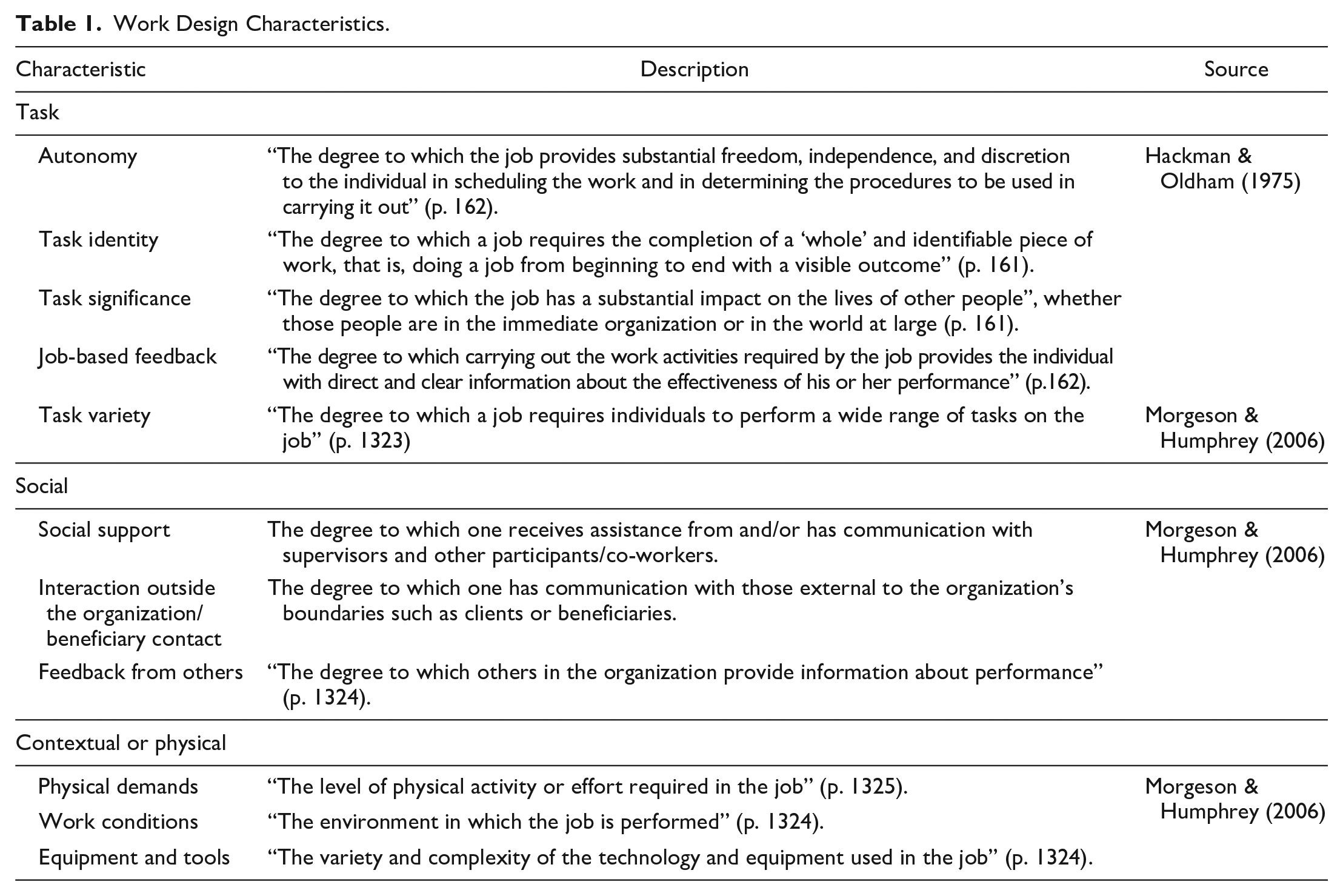
Because work design is known to influence individuals’ experiences and job satisfaction, it is likely that characteristics (job design) of NDS projects have important implications for volunteer job satisfaction. Our study is based on the JCM (Hackman & Oldham, 1975), with elaborations from more recent literature (Humphrey et al., 2007; Morgeson & Humphrey, 2006; see Table 1).
Work Design Characteristics.
Although volunteer work differs from paid work, and volunteers differ from paid staff in motivation and job attitudes (Pearce, 1993), extensive research has reinforced the relevance of work design theory to volunteering. Many scholars have applied work design theory, including the JCM, to explore volunteers’ motivation, satisfaction, performance, and engagement (e.g., Milette & Gagné, 2008). Studies have confirmed the validity and applicability of the JCM to regular (Milette & Gagné, 2008) and corporate (Grant, 2012; Pajo & Lee, 2011) volunteering. Especially task significance, meaningfulness, relational elements (interaction with beneficiaries and others), and autonomy seem to play a crucial role in creating satisfying volunteering experiences (Grant, 2012; Pajo & Lee, 2011).
Findings in the literature confirm the applicability of work design theory to long-term volunteering and corporate volunteering. We extend this literature to another volunteering context by examining how the theory can be applied to enrich NDS projects to yield satisfying volunteer experiences.
Data and Methodology
Our research setting was NLdoet, an NDS held annually in the Netherlands. NLdoet features intensive one- or two-day volunteering projects. People volunteer as individuals or in groups, self-selecting projects from many options posted by host nonprofits on the NLdoet website. Host nonprofits recruit volunteers for the event through the NLdoet website and their own communication channels.
Data Collection
To explore the design of volunteer projects and volunteer satisfaction in NDS events, we collected a variety of qualitative data: in-depth, semi-structured interviews with officials involved in NLdoet from nonprofits and volunteer centers; field notes of trained participant observers; and focus group discussions with NLdoet volunteers. These different types of data capture the perspectives of both NDS organizers and volunteers. We conducted semi-structured interviews with 19 respondents, representing 13 nonprofits and six volunteer centers. We were careful to select respondents who had substantial experience with NLdoet. Nonprofit respondents were responsible for organizing and managing NLdoet projects and had participated in NLdoet 5 to 10 times. At least half of these respondents were also responsible for similar one-off events (e.g., corporate volunteering projects, other NDS events). Most nonprofit respondents held paid positions such as activity or volunteer coordinator and worked in the health care sector. All volunteer center respondents held paid positions such as advisor, project leader, activity or volunteer coordinator, and had provided host nonprofits with support and advice in organizing and implementing NLdoet and other one-off events for 6 to 13 years. Interviews were conducted face-to-face and audio-recorded with interviewees’ consent (length 35–90 minutes). We used an open-ended interview strategy to encourage respondents to describe their experiences and reflections (Patton, 1990). Key questions included: What makes for a positive (or negative) volunteer experience during NLdoet? What are important aspects or decisions when organizing volunteer projects for NLdoet? What makes NLdoet projects successful for volunteers?
We also obtained data from participant observations of 12 NLdoet volunteer projects by seven trained student-observers drawn from a graduate-level nonprofit management course. Five observers participated in two projects at NLdoet, and the other two participated in one project. On average, the projects lasted 7 hours; collectively, the participant observers volunteered for 83 hours. To make their volunteer experiences more authentic, the student-observers self-selected projects that interested them, just like NLdoet volunteers. The projects involved interacting with beneficiaries (e.g., gardening with former addicts) and performing hands-on activities (e.g., refurbishing a playground). We provided training to prepare the participant observers to provide a chronological account of the NLdoet project, information on group composition, and how the design and organization of the volunteer projects influenced their own behavior and attitudes, as well as those of the other NLdoet volunteers.
To enrich the volunteer perspective in our study, we conducted two focus groups, each with five NLdoet volunteers. Participants were recruited though an open invitation distributed online by a volunteer center that solicited volunteers with NLdoet experience. On average, respondents had participated in NLdoet twice. The focus groups lasted 60 and 75 minutes, were conducted face-to-face, and audio-recorded with respondents’ consent. Discussion topics included volunteer (dis)satisfaction with the design and organization of NLdoet projects.
All interviews and focus groups were conducted in Dutch. The field notes from two observations were written in Dutch, and the other 10 sets of notes were in English. The analysis was performed in Dutch, reflecting the language of most of the data. Quotations (presented below) were first translated from Dutch to English by the first author and consequently translated back to Dutch by an independent scholar. Translation differences were resolved by consensus.
Data Analysis
Transcripts of the interviews and focus groups plus the observation field notes yielded 506 pages of raw data, which were subjected to a theoretical thematic analysis (Braun & Clarke, 2006) guided by our theoretical and analytical interest in job design characteristics in NDS projects (see Table 1). As we explored the experiences of volunteers, we adopted a realist/essentialist paradigm to report respondents’ experiences, meanings, and realities (Braun & Clarke, 2006). We used a semantic approach to ensure that “the themes are identified within the explicit or surface meaning of the data and the analyst is not looking for anything beyond what a participant has said [or written]” (Braun & Clarke, 2006, p. 13).
We began by applying open coding to the raw data to identify recurring themes. Sample saturation was determined when the analysis generated no new codes. Subsequently, we gradually funneled codes with similar attributes, repetitive patterns, and consistencies into broader subthemes articulated by theory (job characteristics). Using our research question as a lens, we engaged in “constant comparison” (Corbin & Strauss, 2008), iterating between theory and data throughout coding and analysis, and considering relationships among categories to develop a conceptual understanding. Finally, we considered relationships among the subthemes and integrated them as appropriate to derive common themes to enhance our conceptual understanding of the dynamics at play (Saldaña, 2009).
Findings
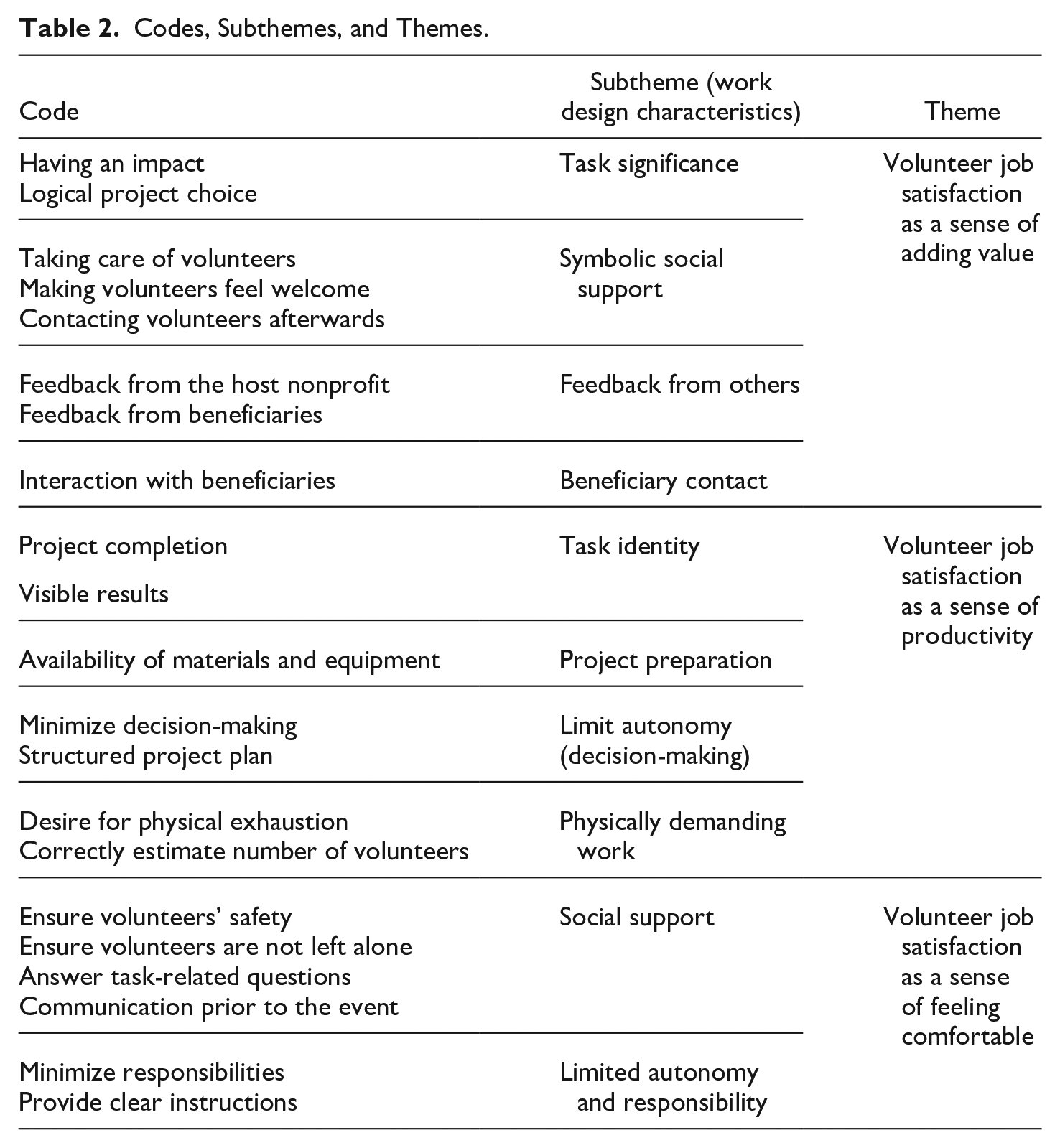
Our findings suggest that volunteer job satisfaction in NLdoet results from three key elements: a sense of added value, a sense of productivity, and a sense of feeling comfortable. Our findings are organized around three key elements and are substantiated by quotations from nonprofit (NPO) and volunteer center (VC) representatives, participant observations (PO) and volunteers (VOL). Table 2 summarizes the findings, and Table 3 presents illustrative quotations highlighting how various job characteristics elicit volunteer job satisfaction in NLdoet.
Codes, Subthemes, and Themes.
Subthemes With Example Quotations.
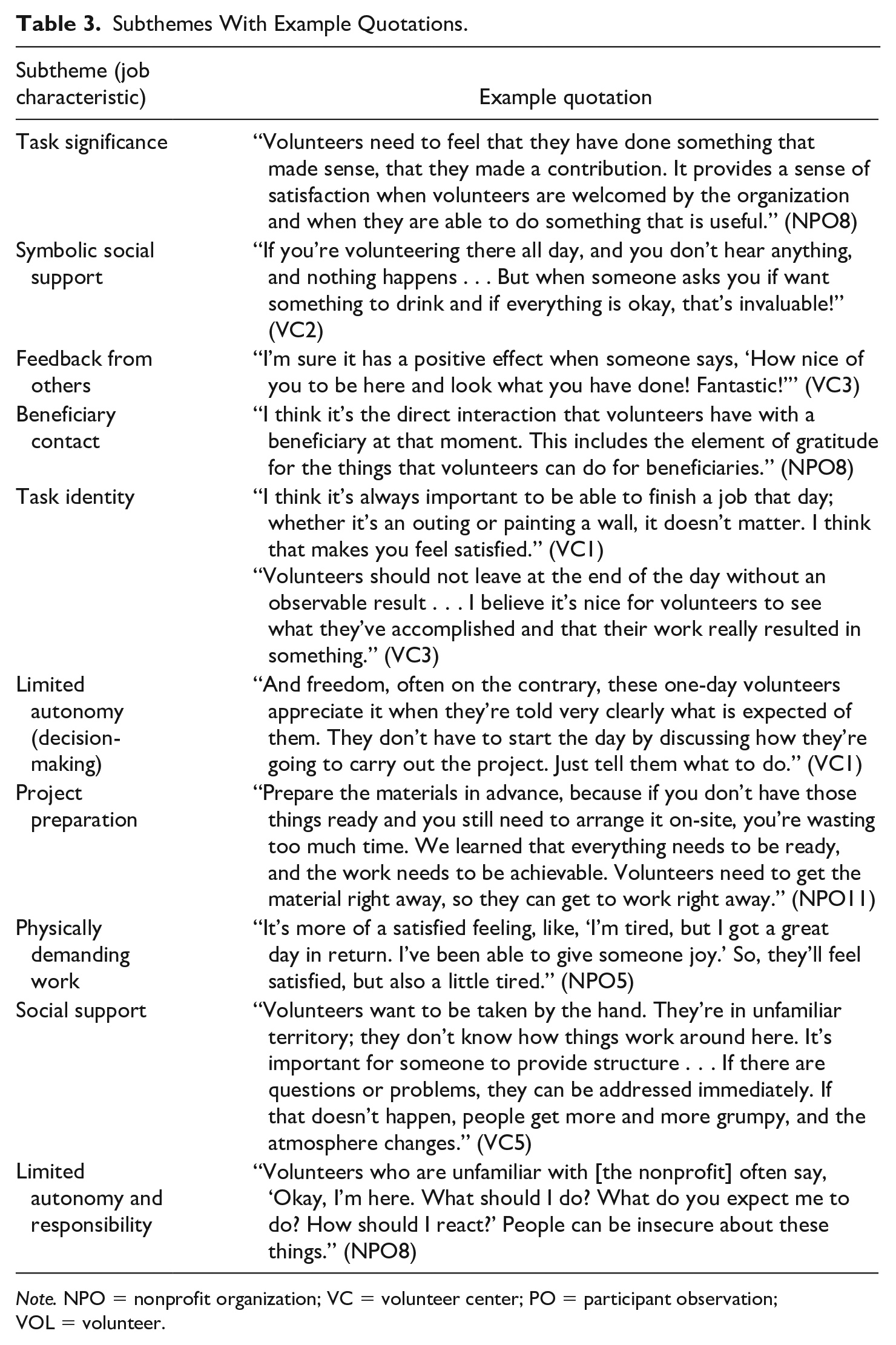
Note. NPO = nonprofit organization; VC = volunteer center; PO = participant observation; VOL = volunteer.
Volunteer Job Satisfaction as a Sense of Adding Value
Our data suggest that NLdoet projects promote volunteer job satisfaction when volunteers feel that they add value and have meaningful experiences. According to one volunteer, “When you give your time knowing that you’re helping someone else . . . it provides satisfaction” (VOL2). Projects that provide task significance, symbolic social support, feedback from others, and beneficiary contact are likely to create meaningful experiences.
Nearly all respondents emphasized the importance of task significance. Our data suggest that volunteers experience task significance when they have a strong sense that their work is meaningful and affects others. “Volunteers need to be aware that they have value . . . that they add something” (NPO5). Respondents indicated that when volunteers feel their work is meaningful and has impact, they are likely to have positive experiences, especially because doing something meaningful is a primary reason for participating in NLdoet (VC1; VC5; VOL2; and NPO10). To be perceived as meaningful, respondents indicate that the volunteer activity should be a suitable and logical choice as a NDS project: It [the project] must respond to a certain demand in which it makes sense to ask people to volunteer in NLdoet. Why should anyone volunteer in NLdoet to mow the grass at a soccer association where the grass will be mowed anyway? (NPO5)
A frustrated participant observer elaborated: It was more of a regular day for the nonprofit, where they had additional assistance, instead of achieving something they would not have achieved without NLdoet. I know that other volunteers felt the same, and this was not really motivating. (PO3)
Providing symbolic social support by creating a welcoming atmosphere also communicates that volunteers are appreciated and add value. According to various respondents, sufficient symbolic social support during NLdoet (e.g., introductory meetings, coffee breaks, and lunch) made volunteers feel welcome (NPO1; VOL6; and VOL10). A participant observer affirmed: “During the day, the nonprofit would offer us drinks and snacks . . . They were really spoiling us, and that made all the volunteers feel really good and special!” (PO10). A volunteer center respondent agreed: “It’s just a bit of personal attention and appreciation for the volunteers. It shows that you take care of the volunteers” (VC5). A proper introduction matters, given the negative experiences of respondents with organizations that seemed unprepared or disorganized (VC3; VC6; NPO7; PO5; and VOL10). As one nonprofit respondent admitted: “I don’t think it’s positive if people are not welcomed or the organization isn’t prepared for their arrival” (NPO8). Such oversights suggest that volunteering for the NDS project is unimportant (PO8), thus diminishing the volunteers’ sense of adding value.
The findings further indicate that communicating with volunteers after the event promotes volunteer satisfaction by reiterating that their work added value and was appreciated by the host organization (NPO2). Conversely, a lack of follow-up may lead to feelings of exploitation, resulting in negative attitudes (VC2). Several nonprofit respondents noted that they sent photos to NLdoet volunteers afterwards to show their gratitude (e.g., NPO10), which volunteers appreciated (PO9 and VOL1).
Similarly, the data show that feedback from others during the event enhanced experienced meaningfulness. Recognizing the efforts of volunteers and appreciating their work and commitment created fulfilling experiences (NPO11). A lack of feedback limits volunteer satisfaction by suggesting that their work was unappreciated or unimportant. “It was a little dissatisfying not to see any enthusiasm about what we’d been doing” (PO6). Respondents suggested that volunteers appreciate immediate and relevant feedback from supervisors or others involved in the project (PO10). A nonprofit respondent confirmed: “It’s very important to receive a pat on the back every now and then” (NPO3). Volunteers reported appreciating recognition (e.g., thank-you and small tokens) in real time, indicating that their work was valued (PO10; VC6; VOL1; and VOL10). “The organizational members thanked us in the end . . . It was nice to see how grateful they were for our help” (PO4). Failing to express gratitude engendered mixed feelings: “I didn’t mind helping, but thanking someone would have been nice and would have given me a better feeling afterwards” (PO8).
Volunteers especially appreciate feedback from beneficiaries (VC3; VOL6; and VOL10). Experienced meaningfulness and a sense of adding value are enhanced when beneficiaries show their appreciation (e.g., smiles and thank-you; VC6; VOL1; VOL5; and VOL10). If beneficiaries are incapable of providing verbal feedback, paid staff or regular volunteers can translate beneficiaries’ appreciation to NDS volunteers (NPO1 and NPO4). Respondents noted that NLdoet volunteers can become overwhelmed with emotion when interacting with beneficiaries (NPO5; NPO7; and VOL6). A nonprofit respondent explained: “It’s the direct interaction between the beneficiary and the volunteer that matters. When the beneficiary says, ‘I’m so happy that you are here, and I enjoy this so much,’ volunteers find that amazing!” (NPO8). In sum, beneficiary contact elicits volunteer job satisfaction in NDS projects.
Volunteer Job Satisfaction as a Sense of Productivity
The second key element that promotes job satisfaction among NDS volunteers is ensuring a sense of productivity. “It needs to be a productive day. They [volunteers] must feel as if they have done something” (NPO1). Our findings suggest that to make volunteers feel productive, NLdoet projects must be completed and have a clear beginning and end with visible results (task identity). Moreover, projects should be well-planned, physically demanding, and limit NDS volunteers’ autonomy (decision-making).
Respondents highlighted the importance of task identity in promoting a sense of productivity. They emphasized that organizing “delimited” NLdoet projects with a “clear beginning and end” (VC2) that can be completed during the event helps volunteers feel productive (VOL1). An unfinished project is “not fulfilling, not for the volunteer, not for the organization, and not for the beneficiaries” (NPO6), and results in an “unsatisfied feeling” (VOL10). A participant observer similarly reported: “Leaving the site, particularly unfinished, would cause certain feelings of incompleteness” (PO3). As a precaution against unfinished projects, respondents suggested that nonprofits carefully estimate the project scope and develop backup plans to downsize projects if necessary, to ensure a sense of completion during the event (NPO2 and VOL10).
Respondents regarded achieving visible results as important to provide a sense of productivity (NPO3). A volunteer center representative stressed the importance of “making sure volunteers see results” (VC3). “NLdoet should include work that is visible and that makes a difference . . . then you get a sense of satisfaction” (NPO10). Conversely, the absence of visible results yields a lack of fulfillment: “It shouldn’t be the case that you’ve been working there all day and you still can’t see what you’ve done. Then you’ll feel like you haven’t done anything” (VC5). For volunteers, achieving tangible results and being able to see what they have accomplished promote job satisfaction (VOL1 and VOL2).
Job satisfaction stemming from a sense of productivity also requires proper project preparation. Respondents identified the importance of project planning and preparation (NPO3) and noted that a lack of preparation can result in volunteer dissatisfaction by limiting accomplishments (NPO7). To that end, respondents emphasized that necessary equipment and tools should be available and working properly (VC4; VC5; NPO4; and VOL10), as problems may prevent volunteers from completing projects, thus impairing task identity and their sense of productivity. “Then there were missing tools, which meant we couldn’t complete the job . . . This was somewhat unsatisfying, because we should have easily been able to finish the entire job in a day” (PO12). Given the highly limited time available during an NDS, it is detrimental when such issues prevent volunteers from being productive (NPO5 and NPO11).
Somewhat surprisingly, substantial autonomy or decision-making power in an NDS project can hamper work productivity, resulting in unfulfilling volunteer experiences.
Many aspects weren’t well thought through, so [another volunteer] and I had quite a few opportunities to come up with strategies and plans. The indecisiveness of [the organizer] was sometimes frustrating to both of us . . . I expected the organization to have a plan, but it wasn’t really structured, which was confusing. I was asked to decide all sorts of things at once. (PO12)
When host nonprofits make project decisions in advance, they ensure that NDS volunteers can focus solely on carrying out the work (PO1). To limit decision-making autonomy, respondents advise nonprofits to come up with a structured project plan (NPO2).
Physically demanding work is another factor that promotes a sense of productivity among NDS volunteers. Volunteers seek a productive day’s effort and expect to feel fatigued after an NDS (NPO2) and appear to derive satisfaction from it (NPO5). A volunteer noted: “For me, it matters when I come home, and I’m tired and exhausted. That satisfies me” (VOL6). To ensure an appropriate workload, respondents recommend that nonprofits estimate accurately the number of volunteers needed for each NDS project and have additional tasks for volunteers, if necessary (VC4 and VOL10). If too many volunteers are recruited, they are likely to get in each other’s way (VOL8) or have too little work, resulting in feelings of boredom, uselessness, and redundancy (NPO3), ultimately diminishing perceptions of task significance. Such experiences are particularly frustrating to volunteers who wish to be productive (VOL4).
Since we couldn’t do anything else at the time, we went inside and had a long coffee break. The lack of work made me feel useless, and it felt like I was wasting my time and could have spent it more productively. (PO1)
Volunteer Job Satisfaction as a Sense of Feeling Comfortable
A third key element that promotes volunteer job satisfaction in NLdoet is making volunteers feel comfortable with their surroundings by providing sufficient social support and limiting volunteers’ autonomy and responsibility over the NDS project and beneficiaries.
Social support from regular volunteers or paid staff reduces social anxiety and insecurity by making NDS volunteers feel safe (NPO8 and NPO9) and comfortable (NPO1). NDS volunteers typically are not engaged with, and are largely uninformed, about the host nonprofit. When NDS volunteers are left to work alone or without support, they can feel lost (VC4) and become frustrated or even frightened (VC4; VOL6; and VOL10). “It’s frustrating for volunteers to be left alone and unaware of what they should do” (NPO9). Another nonprofit respondent elaborated, “Volunteers should never be left alone during NLdoet . . . It’s important to make volunteers feel welcome, to be hospitable, and to make them feel safe” (NPO8). Regular volunteers or paid staff can help make NDS volunteers feel welcome and address any questions (NPO5). A volunteer center respondent explained: “Especially when you go to a place where you haven’t been before . . . it’s nice when someone takes you by the hand and shows you the way” (VC5).
Findings suggest that communication prior to the NDS event helped volunteers feel comfortable. Immediately after volunteers had subscribed to NDS projects via the NLdoet website, host nonprofits confirmed by email, and sent a reminder a few days before the event (NPO5 and NPO8). This communication reaffirmed volunteer participation and informed volunteers about the nonprofit and the project (NPO5 and VOL10). A participant observer who had received early communication reported: “This actually gave me a good feeling, knowing that they [host nonprofit] would take care of us” (PO7).
Limited autonomy and responsibility also help NDS volunteers feel comfortable with their surroundings and promote satisfaction. Whereas regular volunteers typically are familiar with the nonprofit and its beneficiaries and may welcome autonomy and responsibility, NDS volunteers are usually new to the context and may find too much responsibility over the project or beneficiaries overwhelming (NPO2). “People actually find it very pleasant when you clearly tell them what is expected from them” (VC1). Clear, detailed instructions regarding how to carry out the work or how to interact with beneficiaries help unaccustomed NDS volunteers feel less insecure (NPO8).
Discussion
Although NDS events and similar one-off volunteer opportunities have become common, few empirical investigations have addressed NDS events or, more generally, episodic volunteering (Handy et al., 2006; Hyde et al., 2016). Accordingly, we have examined how NDS projects can be enriched to promote volunteer job satisfaction. Our results indicate that volunteer satisfaction emerges when NDS projects provide a sense of adding value, a sense of productivity, and a sense of feeling comfortable. These elements are generated by several work design characteristics. A sense of adding value emanates from NDS projects that incorporate task significance, symbolic social support, feedback from others, and beneficiary contact. A sense of productivity arises from NDS projects that incorporate task identity, project preparation, physically demanding work, and limited autonomy (decision-making). Finally, a sense of feeling comfortable arises when host nonprofits provide social support and limit volunteers’ autonomy and responsibilities.
These key elements of volunteer job satisfaction in NDS projects align with the literature on job design, specifically with the three psychological states that influence satisfaction: experienced meaningfulness, knowledge of results, and responsibility (Hackman & Oldham, 1975). Within NDS projects, the need to add value corresponds to the need for experienced meaningfulness; the need to feel productive corresponds to knowledge of results. Our third element, helping volunteers feel comfortable with their surroundings, can be seen as the opposite of the need for responsibility. As we have observed, NDS volunteers feel comfortable when they have proper social support and limited autonomy and responsibility.
Our findings add important nuance to previous studies on the role of autonomy on job satisfaction (Hackman & Oldham, 1975; Milette & Gagné, 2008). Previous studies demonstrated that both regular volunteers (Hustinx, 2010) and corporate volunteers (Pajo & Lee, 2011) value autonomy and that too little responsibility can make volunteers feel as if they are wasting their time. Unlike regular volunteers, who are familiar with the context and who may feel comfortable with greater autonomy and responsibility, our findings suggest that NDS volunteers feel uncomfortable when given substantial autonomy and responsibility. NDS volunteers tend to experience responsibility and the need to make many decisions as a burden. Understandably, given the one-off, time-limited nature of the projects, NDS volunteers do not have the same need as regular volunteers, and prefer to be directed and supported by others to make the most of their time.
Other findings extend previous literature on regular and episodic volunteer management, job design, and volunteer satisfaction to the NDS context. The need for NDS volunteers to add value affirms previous findings concerning the importance of “symbolic support” (e.g., recognition, appreciation, and value) in regular volunteering (Farmer & Fedor, 1999). The need for relatedness, social interaction, and valuable work have been identified as important elements in satisfaction of regular volunteers (Boezeman & Ellemers, 2009; Pearce, 1993), and scholars have highlighted the need for supervisor support and recognition to promote volunteer satisfaction (Fallon & Rice, 2015). Our study suggests that these earlier findings apply to NDS events. We confirm the importance of social interaction and recognition from supervisors and beneficiaries in episodic volunteering (Cho et al., 2020; Cnaan et al., 2017). Whereas Cnaan et al. (2017) speculated about what role supervision may play in episodic volunteering; our findings suggest that social support from the host organization reduces anxiety and insecurity by answering volunteers’ questions and providing direction.
Our results concerning NDS volunteers’ need to feel productive confirm Rehnborg’s (2009) admonition that episodic volunteering events should be well organized. Our findings reinforce that episodic volunteers wish to be productive (Cnaan et al., 2017) and that the number of volunteers should be matched to the task at hand (Hustinx, 2010; Koutrou et al., 2016).
Although our findings are consistent with some findings for regular and episodic volunteering, NDS projects seem to differ from other volunteering contexts in at least two respects. First, the importance of volunteer management practices to promote satisfaction are intensified, given the limited timeframe of NDS projects and the inability to make on-site adjustments. Our findings suggest that NDS volunteers expect greater immediacy (e.g., social support, feedback from others, beneficiary contact, project completion and visible, physically demanding work), even though nonprofits’ ability to manage NDS volunteers is greatly constrained during these events. Thus, NDS volunteers must be managed primarily through the careful design of projects in advance, as elaborated in our findings. Second, NDS volunteers value detailed instructions, physically demanding tasks, project completion, and visible results at the end of the day. These insights do not characterize of volunteering in other contexts. Moreover, as opposed to regular and corporate volunteers, NDS volunteers prefer to have limited autonomy and responsibility.
Overall, our results provide valuable guidance for designing NDS projects. We have examined organizational factors (job design) that influence job satisfaction of NDS volunteers and proposed a model for designing and enriching NDS projects and managing NDS volunteers. Our findings suggest that job satisfaction of NDS volunteers can be attributed to three key elements: a sense of adding value, a sense of productivity, and a sense of feeling comfortable.
Implications for Practice
Our findings point to several suggestions for host nonprofits to create satisfying volunteer experiences in NDS events. First, NDS volunteers aspire to add value. NDS projects incorporating direct contact with and impact on beneficiaries enhance task significance. Moreover, by carefully explaining how the project supports the nonprofit’s mission, task significance is enhanced. Symbolic social support and feedback from others are strengthened by ensuring that staff and/or regular volunteers are on-site during NDS events to make volunteers feel welcome and by recognizing volunteers during and after the event.
Second, volunteer satisfaction is enhanced when NDS volunteers feel productive. Designing NDS projects that can be completed within a limited timeframe and that have clear, visible results reinforces task identity. Preparation is critical to ensure materials and equipment are available and to develop structured project plans that minimize NDS volunteers’ time spent on decision-making on-site. Finally, because volunteers feel productive when NDS projects are physically demanding, it is important to estimate accurately the number of volunteers needed to ensure that all are fully used.
Third, regular volunteers and paid staff can play an important role in making NDS volunteers feel comfortable with their surroundings. Assisting volunteers during the event and initiating communication prior to the event can reduce social anxiety and insecurity. Limiting NDS volunteers’ autonomy and responsibility also help them feel comfortable.
Generalizability and Future Research
Our findings should be generalized with caution. First, our conclusions are based on a relatively small, albeit diverse, sample of 19 organizational interviewees, field notes from 12 observed NLdoet volunteer projects, and 10 NLdoet volunteers in two focus groups. All data pertain to a single country and volunteering culture (Meijs et al., 2003). Second, our results may be subject to sample bias because several nonprofit respondents were affiliated with the health care sector. As this sector typically has identifiable clients, our findings could potentially exaggerate the importance of direct beneficiary contact, although the literature routinely highlights the significance of such contact for volunteers (e.g., Pajo & Lee, 2011). Third, we restricted our inquiry to job design; other factors may promote (or limit) volunteer satisfaction in NDS (e.g., Nencini et al., 2016). Our study relies on only a portion of work design theory: the JCM and related elaborations. Finally, the qualitative nature of our study limits our ability to assess the strength of proposed relationships between job characteristics and NDS volunteers’ job satisfaction.
Future research might examine whether job characteristics that promote NDS volunteer job satisfaction differ based on the volunteering history of participants. For example, different job characteristics may be required to promote a satisfying experience for frequent NDS volunteers or those who regularly volunteer elsewhere than for those who participate infrequently. Conversely, a dissatisfying NDS experience might negatively affect the volunteering habits of infrequent volunteers much more than those of more frequent volunteers. Researchers could also test our assumption that fulfilling NDS experiences promote sustained volunteering, for instance, through quantitative studies examining the relationships among volunteer management practices, volunteer satisfaction, and sustained volunteering, or focusing on the degree to which regular volunteers had participated in NDS events in the past.
As implied by our findings, NDS projects require extensive organizational time and effort (e.g., adequate planning, preparation, and guidance) to promote volunteer satisfaction. Dunn et al. (2020) found that nonprofits often lack paid staff to train and supervise episodic volunteers, and funds to support administration, coordination, and management of episodic volunteers. Researchers could explore ways to manage NDS volunteers efficiently, as well as the circumstances under which it might make sense for nonprofits to participate in NDS events, that is, expend their scarce resources on these volunteers. Although the skills and efforts of episodic volunteers can be highly useful to nonprofits (Brudney & Meijs, 2014; Dunn et al., 2020), NDS events also help to “build ‘civil society’” (Handy & Brudney, 2007, p. 96) by expanding the volunteer base. It is worth exploring whether organizations that profess an interest in building civil society are more likely to bear these costs and risk investing resources to strengthen the general volunteer base.
Our findings yield insights into the underlying mechanisms of job design and volunteer satisfaction in an NDS context: providing a sense of adding value, a sense of productivity, and a sense of feeling comfortable. It is unclear whether these three elements inform job design and volunteer management in other volunteer contexts. Researchers might examine the possible relevance of these three psychological needs in other contexts and explore whether a hierarchy exists among the needs.
To address a lacuna in the literature, we have sought to provide a foundation for investigations of NDS events and similar episodic and one-off events, with a focus on volunteer job design and satisfaction. Our findings demonstrate that nonprofits can promote job satisfaction among NDS volunteers by designing NDS projects appropriately. Importantly, our results reveal the mechanisms underlying NDS volunteer satisfaction, a potential driver of sustained volunteer engagement.
Footnotes
Acknowledgements
The authors would like to thank NVSQ Editor Susan Philips for her guidance and the anonymous reviewers for their constructive feedback and comments throughout the review process. The authors also wish to express gratitude toward Samer Abdelnour, Ram Cnaan, and Derck Koolen for their assistance.
Declaration of Conflicting Interests
The author(s) declared no potential conflicts of interest with respect to the research, authorship, and/or publication of this article.
Funding
The author(s) received no financial support for the research, authorship, and/or publication of this article.
