




Abstract
Nudging techniques can help charities to increase donations. In this article, we first provide a systematic overview of prototypical nudges that promote charitable giving. Second, we argue that plenty of the ethical objections raised against nudges, such as the exploitation of power they involve and the arguably intrusive and deceptive nature, are not specific to nudging itself. Carefully designing nudges can help to avoid these worries. Third, given that most concerns boil down to the worry that nudges infringe on people’s autonomy, we analyze when this could nevertheless be justified. We differentiate between perfect duties, imperfect duties, and supererogatory acts and argue that nudges are (a) morally permissible (even when they violate autonomy) when it comes to perfect duties and can (b) provide the best available strategy when it comes to imperfect duties. That said, we also analyze the conditions under which nudging charitable giving is impermissible.
Fundraising and Behavioral Insights
As there is fierce competition between charities and scarce donor resources (Thornton, 2006), nonprofit organizations often need to rely on fundraising to ensure the ongoing support for the good causes they are fighting for. Charities such as Oxfam, Doctors Without Borders, Children International, and others try to meet this challenge by using behavioral insights to increase their revenue. Many of those techniques are so-called “nudges” (Thaler & Sunstein, 2008), which influence people’s decision-making processes without incentivizing, coercing or rationally persuading them. Instead, nudges rely on cognitive heuristics at play when people make decisions. Hence, research from psychology and behavioral economics helps charities to develop new fundraising tools or make existing ones more effective (Chapman et al., 2019; Goering et al., 2011; Goswami & Urminsky, 2016; Jacob et al., 2012; Lee et al., 2017; Richardson, 2012). Besides monetary giving, nudges can also bolster the donation of other valuable goods, such as time or cord blood (Grieco et al., 2018).
While it is evident why charities would want to enhance their fundraising through nudging, it has also raised ethical worries. Luc Bovens (2018) warns that charitable nudging can amount to “trickery” (p. 169), undermine autonomous agency, and entail an “abuse of power and violations of privacy” (p. 171). Other authors restrict the use of charitable nudges to life-threatening causes, such as disaster recovery (Hobbs, 2017; Krishnamurthy, 2015; Moles, 2015). We later label these cases as involving a perfect duty. In contrast, donating to improve the educational opportunities of a child is only an imperfect duty. Although one should adopt “education for all” as a general end, one is not morally obliged to contribute to a particular child’s education at a particular time. Furthermore, donating to other causes, such as community building, culture, arts, and heritage protection, can be praiseworthy without involving a perfect or an imperfect duty. While such instances of supererogation have been dismissed as insufficiently important to allow nudging, we will argue otherwise.
In this article, we offer a systematic analysis of the most common nudging techniques used by charities (section “Nudge Strategies for Charitable Giving”). We carefully disentangle the main ethical worries raised in the literature and relate them to supposed infringements of (potential) donors’ autonomy (section “Ethical Considerations Concerning Nudging Charitable Giving”). Next, as the ethical evaluation of charitable nudging is still controversial, we develop a framework for when it is morally permissible to nudge people toward donating to charity, depending on the moral worth of the cause they are supporting (section “Perfect and Imperfect Duties and Supererogation”). Finally, we draw out the implications for the nudging techniques discussed (section “Implications for Nudge Strategies”) and conclude (section “Conclusion”).
Nudge Strategies for Charitable Giving
Traditionally, nudging has been defined as deliberately changing [. . .] any aspect of the choice architecture that alters people’s behavior in a predictable way without forbidding any options or significantly changing their economic incentives. To count as a mere nudge, the intervention must be easy and cheap to avoid. (Thaler & Sunstein, 2008, p. 6)
We focus exclusively on nudges that tap into, trigger or rely on “shallow” cognitive processes, heuristics, and responses that are typically faster and less deliberate, conscious and effortful than the “deeper,” slower and more deliberate, conscious, and effortful processes involved in interpreting information, weighing off reasons and reflectively making up one’s mind (Kahneman, 2011). Dual-processing theories distinguish between Systems 1 and 2 here, but given the contentious status of these theories we will use a broader terminology here.
In what follows, we discuss four paradigmatic nudge strategies that are widely applied by nonprofit organizations. The categories, however, are not analytically distinct. The online nudge strategies we discuss can also be used offline, and vice versa, for example.
Street Fundraising
Perhaps the best-known strategy used by charities is to have volunteers and paid fundraisers approach people on the street or at their front door. The most persistent of them are known as “chuggers” or charity muggers (Bovens, 2018, p. 173). They typically have a bag full of tricks, which include nudging techniques, such as asking simple, hard-to-ignore questions—“do you care about children?”—to lure people into the conversation. Once hooked with a leading question, chances increase that individuals actually donate, for example, due to cognitive dissonance reduction. Fundraisers can also invoke social norms by pointing out how much other people (allegedly) give to charity. Even “guessing the norm increases charitable giving” (Bartke et al., 2017, p. 73). While one can always choose to ignore street fundraisers, the way they frame their questions and present their case is obviously meant to induce people to donate. One can also develop novel techniques on the basis of recent psychological insights, such as the finding “that moral nudges increase charity donations by about 44%, on average” (Capraro et al., 2019, p. 7), where a moral nudge is simply to ask people “what they think is the morally right thing to do when they see a stranger in need,” right before inviting them to donate.
Designing Giving Schemes
Charities also design all kinds of giving schemes: They can, for example, team up with companies whose employees have to opt out of some payroll-giving scheme (instead of opting in). Such defaults constitute a well-known and forceful nudging technique (Kahneman et al., 1991). Various mechanisms can be at play here, such as laziness, the status quo bias, or the belief that the default is recommended. In a company with 50,000 employees, the number of new employees agreeing to yearly inflationary adjustment of donations increased from 10% (opt-in) to 49% (opt-out) (Behavioral Insights Team, 2013, p. 18).
Another technique is personalization. When their CEO invited employees to donate, Deutsche Bank found that personalizing the e-mail (“dear David” instead of “dear colleague”) raised the numbers of donors from 5% to 12% (and to 17% among employees who additionally received sweets on the same day) (Behavioural Insights Team, 2013, p. 20f). Furthermore, Breman (2011) found that future commitments could make giving schemes more effective due a tendency of individuals to discount the future. The “mean increases in donations are significantly higher when donors are asked to commit to future increases in donations as compared to when they are asked to increase donations immediately” (Breman, 2011, p. 1357).
Not only employees but also customers can be targeted. Dutch airline company KLM announced that they would send customers a Whatsapp reminder to offset their CO2 emissions, predicting that this would increase numbers from 0.25% to around 40% (Sawbridge, 2019). And asking customers in supermarkets to “roundup” their bill and give the change to charity is significantly more effective than flat donation requests (Kelting et al., 2019).
Independent form corporate giving schemes, frequent reminders are considered an effective tool in nudging (Sonntag & Zizzo, 2015). However, if used too often, they can lead to “unsubscriptions from the mailing list” (Damgaard & Gravert, 2018, p. 15).
Designing Campaigns
Charities also deliberately design their campaigns—both online (on websites, social media, and advertisement banners) and offline (on pamphlets, advertisements, and letters to donors)—with salient, vivid, and simple information about the specific benefits that donations bring about. Next to simplification and making the message as salience as possible, research found that mail requests that were easily readable and that appealed to the charity’s credibility produce the highest donations (Goering et al., 2011). Oxfam uses donation gifts to achieve a similar effect: donors receive a certificate of their contribution to sanitation, farm crops, or emergency relief for people in need (Figure 1).

Oxfam (2020) charity gifts.
Simplifying and emphasizing the relation between an act of giving and the results serve this purpose. Small et al. (2007, p. 149) found that donations more than doubled when presenting people with an identifiable beneficiary (compared to giving only statistical information). It is more touching to know that one’s donation helps little orphan Joshua to attend school than to know that some organization helped out 133,8 million children in 2018 (Save the Children Deutschland e.V., 2018).
Campaigns are deliberately designed to trigger on prosocial emotions and the warm glow donors feel when helping another person (Andreoni, 1990; Erlandsson et al., 2018). Pictures of young children are especially effective, as their facial features, known as “baby schema,” trigger caretaking behavior (Glocker et al., 2009).
This can be further reinforced by tactically employing loss instead of gain frames: opportunities to “prevent death” create greater motivational force to donate than opportunities “save lives” (Chou & Murnighan, 2013; Cao, 2016). When designing campaigns, charities can of course also play into people’s tendency to empathize more easily with and be more generous toward those similar to themselves, which results in “home bias” (proximity matters) and “gender bias” (Moleskis et al., 2019).
Designing Online Donation Tools
Online donation tools, such as fundraising widgets, are a permanent feature on any charity website. Aiming to facilitate the donation process, they can be enhanced with nudge strategies.
Tversky and Kahneman (1974) already showed people’s tendency to align their guesses or estimations to numbers they have previously encountered, a process called anchoring. Charities can use this by displaying a high amount when inviting donations (Fraser et al., 1988). Even when website visitors remain free to enter their own amount, the anchor will likely influence their decision (Figure 2). An anchor can also be social, for example, when publicizing past donations from other people, thus setting and signaling a group norm.
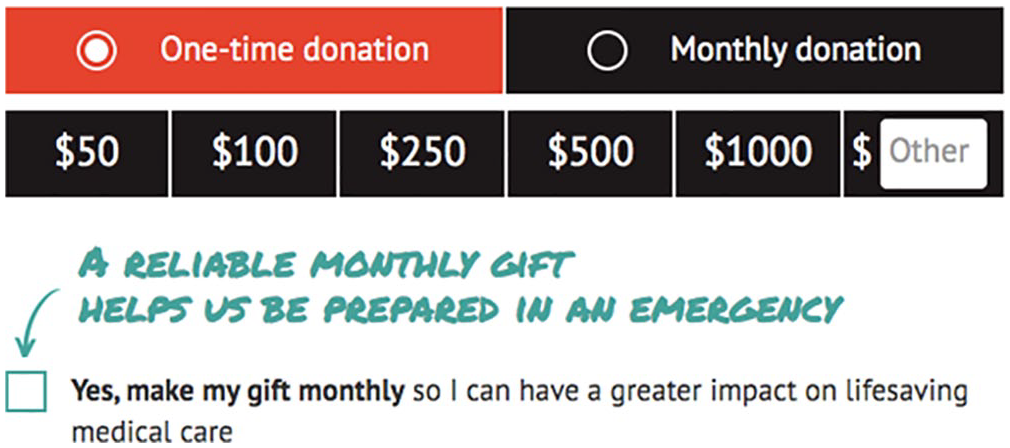
Anchoring in the online donation tool of Doctors Without Borders (2020).
Decoying relies on people’s tendency to choose the middle of three options or the option that is obviously superior to another (Ariely, 2008, pp. 1–6). According to Bovens (2018, p. 169), this “Goldilocks effect (. . .) encourages donors to choose the middle amount by taking advantage of our inclination to avoid extremes.”
We have already discussed the power of defaults in the previous section. Donation widgets can, for example, preselect the option to give monthly instead of only once, which maximizes donation sums over time and provides charities with more stable revenue (note that the Doctors Without Borders donation tool above does the opposite).
Online donation tools can also be designed to give the impression that the donor is urgently needed to provide the funds for completing a project. Bovens (2018, p. 172) refers to Kiva, a nonprofit organization that relies on crowdfunding to offering microloans to people in developing countries (see also: Moleskis et al., 2019). Highlighting the loans close to their targets and suggesting that loans are provided only when that target is reached, Kiva’s website design taps into people’s “task completion bias”: the tendency to prioritize tasks that can easily be completed (KC et al., 2017).
Ethical Considerations Concerning Nudging Charitable Giving
Before dealing with the ethical concerns, we argue that nudging charitable giving cannot and should not be dismissed off-hand. First, charities typically bring a lot of good into the world. Donations help people get access to clean water, proper health care, and a decent education, and there are plenty of other good causes worth supporting. Instead of judging which goals are worthwhile and which charities are effective in reaching those, we assume here that charities succeed in doing good and ask what means they can legitimately employ in this respect. Without arguing that the end justifies the means, nudging seems a sensible way of generating the revenue charities need if they want to change the world for the better. Second, corporations nudge their (potential) customers, for example, when advertising, without much reservation (Ruehle, 2018). Similarly, charities can be understood as organizations with a reasonable self-interest in generating revenue. Third, nudging has been shown to work. Given that donations should be voluntary and not coerced and that rational persuasion is often not particularly effective, nudging may be the best fundraising technique available.
While these arguments are in favor of nudging, let us focus on the objections voiced against charity nudges: they arguably involve power abuse, privacy violations or intrusiveness, and deception. Discussing each of these objections, we follow the same argumentative strategy and argue (a) that the raised objection is not inherent or unique to nudging per se and (b) that the objection relates to worries about nudges being manipulative and infringing on people’s autonomy.
Power Abuse
Bovens (2018, p. 171) criticizes (default) enrolment in workplace giving schemes and personalized CEO e-mails because they exploit the power relations between the different stakeholders. We agree that this is a serious issue but provide two arguments why it is only partially nudge related.
First, Bovens (2018) presumes that CEOs or managers know who gives what to charity. If such knowledge were shared, it would indeed give additional power to bosses. But such privacy violations and power abuse are in no way inherent to these nudging techniques themselves: there can be workplace charitable nudges that avoid such worries. A company can still default new employees into donating, while guaranteeing that information about donations is not shared with anyone thus ensuring that employees will not suffer when opting out.
Second, worries about power abuse only apply to specific nudges, namely those where nudgers and nudgees are in a hierarchical relationship. This is usually not the case with street fundraising, charity campaigns, and online donation tools. As such, the concerns relate primarily to the nudger, not to the nudge itself (Ruehle, 2018). In contrast to companies, charities cannot be charged with abusing power simply because they have none, in the workplace, on the street or on their websites.
Privacy Violations and Intrusiveness
Even when avoiding power abuse, nudging techniques employed by charities can be perceived to be overly intrusive. Take street (or door-to-door) fundraising, which can easily devolve into chugging. This seems to be a paradigmatic case of outright manipulation, which is a recurring worry about nudging in general (Hausman & Welch, 2010; Nys & Engelen, 2017; Wilkinson, 2013). The way in which chuggers lure people into the conversation and emotionally extort them is worrisome to say the least.
The reason why chugging is worrisome, we agree, is its intrusive and invasive character. Quite often, people want and have the right to be left alone. Yet, their lives are interrupted as they are confronted with leading questions (“Do you like children?”) and have to start justifying why they are not saving the world (“Then why do you not support Unicef?”). The same goes for guilt-inducing flyers and other campaign material. Note that the intrusive character of these fundraising techniques does not necessarily imply that charities are entering into people’s “private” spheres. It may occur in public places, as in street fundraising or public campaign ads.
We offer three arguments to counter the intrusiveness objection. First, some intrusive techniques are not nudging. Nudges, after all, are ever so gentle pushes that are by definition “easy and cheap” (Thaler & Sunstein, 2008, p. 6) to resist and avoid. According to Yashar Saghai (2013), nudges are “easily resistible,” means that (a) one should be able to see them coming (which is not a problem with chuggers) and (b) one can inhibit whatever psychological propensity they trigger. The latter condition is violated in the case of public harassment and shaming. Of course, one can always try to ignore chuggers or deny that one likes children, but their techniques are so intrusive that they rather qualify as shoves than as nudges.
Second, not all nudges are intrusive. Someone politely using salient information in a request to donate money hardly prevents one from leading one’s own life. There is a gradual difference between a simple request, a slight manipulation, a guilt trip, straightforward hassling, and outright coercion. While chuggers are on the far end, that does not imply all nudges are equally worrisome in this respect.
Third, there is an obvious distinction to where nudges take place. Door-to-door fundraising is more intrusive than online fundraising. After all, website visitors can be assumed to visit websites voluntarily, thus being aware of being influenced by what they find there.
Deception
A third objection against nudges by charities is that they are deceptive (Bovens, 2018, p. 172). When telling salient stories about identifiable beneficiaries, charities may deceptively suggest that it is this specific person that you can help. Take Kiva: Instead of channeling your money directly to the beneficiary, Kiva gives the money to her local partner organization. While this is disclosed on their website (Kiva, 2020), Kiva’s whole setup creates the illusion that you are making a real difference to this one person’s life: “The website is just a bit of make-believe to create the illusion that there is a direct connection between a donation and the benefit to a particular farmer” (Bovens, 2018, p. 172).
Again, we argue that the moral worry here lies in the deception, not in the nudge and that nudging is possible without deception. Children International (2020) actually does connect the donor directly with the beneficiary, in which case there is no deception and the objection vanishes. The moral problem can be isolated and is neither inherent nor unique to nudging. Truthful nudges exist just as deceptive incentives and laws.
The question arises whether deception must be understood broadly here, in the sense of a bypassing of reasoning capacities. If so, nudges are arguably inherently deceptive. If Sunstein (2015, p. 437) is right in claiming that “autonomy requires informed choices,” then charities deceiving potential donors inhibit the latter from making autonomous donation decisions. We believe this objection is better formulated in terms of manipulation, given that is about how factors that clearly should not matter from a rational point of view still influence people’s decisions. We analyze this objection more fully in the following section.
Autonomy Violations
While many of the ethical worries raised against charity nudges can be avoided if nudges are designed with care, a general concern for the autonomy of the nudgee remains. We take a broad understanding of autonomy as relating to freedom of choice (“the availability of options and the environment in which individuals have to make choices”), agency (“an individual’s capacity to deliberate and determine what to choose”), and self-constitution (“someone’s identity and self-chosen goals”) (Vugts et al., 2020, p. 7).
The idea that nudges violate autonomy can be substantiated in (at least) three ways. First, nudges may not be as easily resistible as they seem and thus violate freedom of choice. Second, they may manipulatively bypass or pervert people’s reflective capacities and shape people’s preferences “behind their backs” or “in the dark” and thus violate agency. Third, they may inhibit the extent to which people achieve their own goals and be the author of their lives and thus thwart self-constitution. These are all widely shared worries about nudges in general (Bovens, 2009; Hansen & Jespersen, 2013; Hausman & Welch, 2010; Vugts et al., 2020) and they obviously relate to the objections of power abuse, intrusiveness, and deception.
Take a charity that teams up with companies to default employees into monthly donations. The worry here is that the resulting donation decisions are not as autonomous as they should be, as this nudge is too manipulative and too hard to resist. It potentially undermines people’s autonomy in the sense of both their agency and freedom of choice. Another autonomy-related worry, more related to self-constitution, could be that companies should simply not interfere with matters unrelated to work. Or consider the objections about nudges violating privacy and being too intrusive. The value at stake here is, again, autonomy: people leading their own lives, according to their own conception of the good. Overly intrusive chuggers (and perhaps also some campaigns) arguably diminish freedom of choice by removing the option to go about one’s day. Their use of leading questions and social norms boils down to manipulation. The same goes for deceptive nudges: bypassing the nudgee’s reasoning capacities and concealing important information arguably inhibits deliberate and autonomous decision making.
All this leads us to three questions. First, are all charity nudges autonomy infringing? Second, if at least some of them are, when are such infringements justified? Third, does it matter here that we are talking about charitable giving, which is not neutral but desirable, morally speaking? While we cover the last two questions in section “Perfect and Imperfect Duties and Supererogation,” let us first argue here that not all nudges violate people’s autonomy.
In fact, some charity nudges can actually promote people’s autonomy (Engelen & Nys, 2020; Sunstein, 2015). They can enhance—instead of bypass or subvert—people’s more reflective decision-making capacities. Given that people will pay more attention to and more easily digest information presented in personalized, accessible, salient, and emotionally laden ways, their resulting decisions will be more informed and autonomous. Furthermore, nudges can be transparent and nudgees can become aware of and even welcome them. One might actually want to donate more to charities and welcome people in shopping streets who facilitate this. Krishnamurthy (2015, p. 256) calls such a person a “weak-willed philanthropist,” who aims to give to charity but lacks the motivation to do so when not presented with a charity nudge. For these people, charitable nudges are means paternalist and thus facilitate people achieving their own goals. If it was not for nudges stimulating charitable giving, they would fail to achieve their goals, with their laziness, akrasia, and/or status quo bias undermining their autonomy. Charity nudges counter this, helping these people to do what they actually consider having reason to do. As such, when designed and targeted carefully, some nudges can promote ones’ autonomy.
Unfortunately, the same nudge can increase someone’s autonomy but reduce that of someone else (Engelen & Nys, 2020; Krishnamurthy, 2015). This leads us to the second and the third question: if nudges do infringe on autonomy, when is this justified? And is there anything specific about nudging charitable giving that changes the way it should be assessed?
Perfect and Imperfect Duties and Supererogation
Having considered several ethical worries concerning (charity) nudging, we now want to focus more specifically on the moral worth of donating to charities. As this article assumes that charities are doing good and that these nudges thus help achieve something of moral value, charitable giving is a morally desirable and praiseworthy thing to do.
This special moral worth of charitable giving is lacking in most of the nudged behavior discussed in the literature (such as eating healthily, peeing without splattering, or saving for retirement). While the discussion on the ethics of nudging originally initially focused mostly on paternalistic nudges promoting the well-being of nudgees (Thaler & Sunstein, 2008), the scope widened so as to include not only “proself” but also “prosocial” nudges (see e.g., Barton & Grüne-Yanoff, 2015) and even “moral nudges” (Capraro et al., 2019). Still, what is lacking in the literature so far is whether the particular moral worth of the nudged behavior (in our case, charitable giving) matters to the ethical evaluation. In what follows, we will distinguish between nudging people to adopt and perform perfect duties, imperfect duties, and supererogatory actions. This distinction, we argue, is crucial in assessing the (im)permissibility of charity nudges.
Krishnamurthy argues that nudging people to donate to charity runs the risk of infringing upon their autonomy. There are, Krishnamurthy (2015, p. 256) argues, four potential targets of such a nudge. First, there are philanthropists, who would have been motivated to donate even if they had not been nudged (Krishnamurthy focuses on being presented a persuasive pamphlet). Next are weak-willed philanthropists, who already aim to give to charity but who would have lacked the motivation to do so if they had not been nudged. The third group are misanthropists, who would have aimed not to help the poor if they had not been nudged. Finally, neutralists, who would neither have aimed to help or not to help the poor in the absence of being nudged.
Who can legitimately complain that being nudged has violated their autonomy? According to Krishnamurthy (2015, p. 255), someone acts autonomously, “if she (1) has aims and commitments and (2) acts in ways that are motivated by those aims or commitments.” As such, Krishnamurthy (2015, pp. 257–560) claims that one has not to worry for the philanthropist because the nudge facilitates her achieving her genuine aim. As we have seen, the weak-willed philanthropist even sees her autonomy promoted by the nudge because it induces her to realize her aims and put her commitments in practice. As for the neutralist, she has no aims to help or not to help the poor, so according to Krishnamurthy, the nudge does not violate her autonomy. The problem lies with the misanthropist who aims not to help the poor. Nudges that interfere with her aim violate her autonomy and are at least prima facie wrong, that is, wrong unless a sufficient justification can be provided for this interference with her autonomy.
One possible justification is that the nudged action is a perfect duty rather than an imperfect duty. Krishnamurthy (2015, p. 260) explains this Kantian distinction as follows: Perfect duties must be fulfilled without exception and at all times. They specify a particular action. Imperfect duties are supererogatory. Fulfilling them is good, but is not strictly required. These duties also allow significant latitude in deciding when and how to comply with them.
Moreover, perfect duties are “enforceable” even when the enforcement involves violating someone’s autonomy, while imperfect duties are not (Krishnamurthy, 2015, p. 261). Interference with someone’s autonomy, the argument goes, is justified to ensure that they act in line with their perfect duties but not to ensure that they perform an imperfect duty. So, according to Krishnamurthy, to ethically evaluate nudging misanthropists into charitable giving, we need to know whether it promotes performing a perfect duty (then nudging is permissible) or an imperfect duty (then nudging is impermissible).
Note how much this argument concedes to those who wish to nudge charitable giving. The autonomy objection only comes into play then when (a) nudgees are misanthropists and (b) with no perfect duty to donate. Some philosophers, like Pogge (2008), have argued that citizens of rich countries have a perfect duty to donate their disposable income to aid those in absolute poverty, for example, in which case nudging—and even chugging and tricking—people into donating to poverty-reducing charities would always be justified.
Despite this concession, Krishnamurthy (2015, pp. 262–263) puts it more restrictively and claims that charities need to know (a) that they are nudging people into performing a perfect duty or (b) that they are not nudging misanthropists. As charities cannot know the aims and commitments of all their potential nudgees, they should only nudge when confident they are stimulating people to perform a perfect duty. This is a hollow victory for charities who wish to nudge charitable giving. After all, many charities (involved in, for example, artistic expression or community building) do not support perfect duties. In addition, it is often impossible to know the different attitudes that prevail in the audience they are targeting. However, we believe that nudging charitable giving is permissible in a wider range of cases than Krishnamurthy allows and provide three reasons for this.
First, Krishnamurthy’s distinction between perfect and imperfect duties is flawed. While she claims that imperfect duties are supererogatory (good to perform but not morally required), supererogatory acts lie beyond the call of duty and so outside the scope of moral requirements. However, Krishnamurthy’s analysis does not fit with the Kantian understanding of imperfect duty. According to Kant (1797/1996, pp. 6, 390), one is not blameworthy for failing to perform an imperfect duty, “unless the subject should make it his principle not to comply with such duties.” As Marcia Baron (2016, p. 350) explains, Kant views imperfect duties as duties to adopt a certain maxim as an end. Take the duty to promote others’ happiness, which does not require that I perform any particular action to promote a particular person’s happiness at a particular time. However, it does require that I commit myself to promoting other people’s happiness. If I never promote this, I would be violating this imperfect duty. If, as Krishnamurthy argues, it is permissible to violate people’s autonomy by nudging them to perform acts that are enforceable (perfect duties), then it should also be permissible to violate their autonomy by nudging them into adopting an end that they are blameworthy for failing to adopt. So, if I have an imperfect duty to promote others’ happiness then it would be permissible for charities to nudge me into adopting this as a goal.
One way to do so would be to create advertising campaigns that make especially salient the many obstacles to happiness faced by those living in sickness or in need. They might do so by using particularly striking and easy-to-process examples of these challenges, such as the distance people need to travel to get to school or access clean water. Presenting these kinds of salient depictions of other people’s struggles and hardships can help at least some of the targeted nudgees acknowledge that these people deserve to be happy as well and thus that helping out others in this respect is a valuable end to adopt. This in turn can lead to those nudgees reshuffling their personal priorities. However, it would not be permissible for a charity to nudge me into making a particular donation, to that particular charity, at that particular time. Nudge-enhanced donation relying on anchoring or decoying would thus be inappropriate here.
While it would be permissible to enforce that people adopt a certain end, related to an imperfect duty, there is an important complication. As Kant (1797/1996, pp. 6, 381) points out, a logical contradiction lies in coercing someone into adopting a particular end. One only adopts an end if one chooses to adopt that end. While we can coerce people to act in certain ways, we cannot coerce them to adopt an end. As Michael Cholbi (2016, p. 61) puts it, the law may require people to give to charity but no law can require that people “act charitably for the sake of the end of charity.”
Here, nudging comes to the rescue because it does not coerce or enforce. Nudge strategies are not only able to facilitate and encourage people to perform duties that are not enforceable (Moles, 2015), they can also encourage people to adopt ends related to (imperfect) duties. When rational persuasion is unable to motivate people to adopt ends related to their imperfect duties (for example, the end to promote others’ well-being) and when people acting in line with such duties generates important benefits, we have good reason to encourage this. 1 And since enforcement is not an option here, nudging people to adopt such ends circumvents the complication because it is not coercive and leaves open their choice whether or not to adopt that end. Think of nudge-enhanced social advertising, which aims not to increase giving to one particular charity but to increase charitable giving more generally.
The second reason to think nudging charitable giving is permissible in a wider range of cases than Krishnamurthy allows, has to do with supererogation. In our view, many nudge strategies can permissibly be used to encourage people to perform supererogatory acts. These are acts that are, roughly, morally good but not morally required (and thus lie beyond the scope of duty). Given that alternative uses of money lack this kind of moral worth, donating to charities is often considered to be a prototypical example of supererogation.
Often, praiseworthiness is claimed to be a necessary condition of supererogation (McNamara, 2011) and even those who deny this accept that supererogatory acts are typically praiseworthy (Archer, 2016). Given this, it is perfectly appropriate to encourage others to perform these acts with praise. Conversely, it would be inappropriate to blame those who do not perform supererogatory acts, as not going beyond the call of duty is not blameworthy.
This implies that praise-like nudge strategies are justified when it comes to stimulating people to donate to charities with supererogatory purposes, while nudge strategies akin to blame are not. In this respect, feel-good campaigns with salient, vivid, and positive messages about identifiable beneficiaries like Joshua are perfectly fine when it comes to increasing donations. Focusing on the good that donations can buy works like praise and can inspire people to donate more. In contrast, guilt tripping potential donors by focusing on how their inaction contributes to all the bad in the world is like inappropriately blaming nudgees. While praise and praise-like nudges are perfectly acceptable ways to encourage people to go beyond the call of duty, blame and blame-like nudges should be avoided.
A third reason why we are more generous toward nudging charitable giving than Krishnamurthy is, refers to the (slightly modified) “inevitability argument” (Sunstein, 2015, p. 420), which states that one often cannot avoid some kind of choice architecture. Campaigns and websites have to be designed somehow. In addition, any way of framing and wording the charity’s message will influence people’s decisions. The unimaginative use of statistical evidence about a charity’s impact or an extremely user-unfriendly donation tool will also nudge people, but now to donate less. As such, demanding that charities avoid nudging altogether is a nonstarter in such cases.
This does not mean that any nudge is permissible. The above argument does not imply that anything goes but that one should always compare nudges with possible alternatives. Quite often, it is wishful thinking to assume that removing the nudge also avoids any kind of influence on people’s decision making. A letter with purely statistical information that refuses to tell Joshua’s story could, for example, imply that potential donors rely on another heuristic, such as the availability bias (remembering what they last donated). As there will always be some heuristic at play when making donation decisions, the aim is not to do away with heuristics but to assess which can be appropriately invoked in this context.
In general, the moral worth of the nudged behavior matters. If a nudge ensures that nudgees fulfill a perfect duty (for example, donations for disaster relief, medical care, clean drinking water, and to prevent hunger), then autonomy infringements may be justified. So, whenever charities are promoting perfect duties, they have most leeway to engage in nudge-enhanced donation requests. Even power-abusing, intrusive, deceptive, and autonomy-infringing nudges could be justified in extreme situations. In the case of imperfect duties (such as promoting others’ happiness in an essential way by donating for the education of a child, micro lending to improve another person’s economic situation, or volunteering for environmental conservation), the distinction between adopting a general end and performing a specific action (giving to this charity here and now) is relevant. While it is permissible to nudge potential donors to adopt morally desirable ends, it is not allowed to nudge them into donating here and now. If nudges promote supererogatory acts (for example, donations for arts, the conservation of buildings or other heritage, and funding events that are not essential yet nice to have, for example, to foster community building), even fewer nudging techniques are permissible. Nevertheless, there is still quite some leeway for charities to create nudge-enhanced campaigns and websites, especially when they are akin to praising and not blaming.
In summary, we analyzed how the moral worth of charitable giving affects the permissibility of nudging it. According to Krishnamurthy, such nudges are permissible only if the target has a perfect duty to donate and not if the duty is an imperfect one. We argued, in contrast, that there is good reason to think that at least some nudge strategies can be permissibly employed even in the latter case and in the case of supererogation. In the following section, we explore the practical implications of this conclusion.
Implications for Nudge Strategies
To analyze the implications for charity nudges, we return to our key examples from section “Nudge Strategies for Charitable Giving”. Let us start with the most innocuous of all nudge stories, such as the use of salient, simplified, and personalized stories, both online and offline, which highlight the benefits to identifiable beneficiaries. As long as these are truthful, we frankly see no reason why this would constitute an illegitimate use of nudging (regardless of the exact moral worth of the nudged behavior). Concrete examples are scout organizations using salient stories of the good their volunteers do and Children International’s focus on benefiting individual kids. These techniques do not abuse power, are not overly intrusive or deceptive and do not gravely violate (potential) donors’ autonomy. As long as the charities are sufficiently transparent about where donations go, their campaign material, giving schemes and websites can legitimately frame the good they bring about. 2 Vividly visualizing a charity’s positive impact is permissible and even morally desirable. It helps those who already committed to donating—Krishnamurthy’s “weak-willed philanthropists”—to follow through and those who were previously undecided—the “neutralists”—to adopt the relevant end (which may relate to imperfect duties or supererogation).
Other nudges, when designed carefully, are also permissible because none of the objections discussed apply. Take KLM’s payment reminders for carbon offsetting. The only way in which to oppose those would be to argue that (a) compensating for environmental damage is supererogatory and (b) the payment reminder is a guilt trip and/or the nudge therefore infringes on autonomy. We believe both claims can be dismissed. First, as environmental damage has a negative effect on fellow human beings, animals, and future generations, it is plausibly more than just supererogatory to avoid it. Second, the accusation of guilt tripping is overstated, as long as the reminder is easy to ignore and does not use strong emotional language to induce flight shame (which is not in KLM’s interest anyway). Nudgees still have plenty of ways to fulfill their imperfect duty or perform some supererogatory act, for example, by donating to other charities and cycling to work.
What about the framing, anchoring, and decoying techniques employed in online donation tools? Our analysis holds that their legitimacy depends on a number of factors. How major is the resulting autonomy violation when nudgees cannot recognize how their reasoning capacities are interfered with? To what extent does the nudge leave intact the nudgees’ freedom, agency, and self-constitution? What are the available alternatives, that is, how avoidable is framing? Does the nudge contain relevant and true information (for example, average donation amounts) or not at all (for example, arbitrary or ridiculously high anchors)? While the evaluation will vary from case to case, nudging techniques stimulating people to adopt a desirable end and committing to a worthy cause are preferable over techniques that merely aim to extract as much money as possible on the spot.
Which nudging techniques are problematic on our analysis? The power abuse involved in some of the opt-out workplace inhibits people from adopting the right end or doing what is right for the right reasons. The same goes for the deception that characterizes (avoidable) anchoring and decoying in donation tools. Charities also should not chug or emotionally blackmail people into donating there and then, as this constitutes an infringement on their autonomy. Take the use of emotionally disturbing pictures or other ways of guilt tripping. While this can be legitimately induced to have people perform their perfect duty or adopt an end related to their imperfect duty, it should not be used to induce people to perform a specific action—donate their money on the spot—when the charitable act is not of exceptional importance and urgency. Take a charity that has trouble sustaining a valuable artistic project. Even if it could increase revenue by telling potential donors that they are the only ones who can prevent this, thus inducing blame and guilt, it should rather stick to praise-like nudges, as people cannot legitimately be blamed for not engaging in such supererogatory actions.
Conclusion
In sum, charities wanting to legitimately nudge (potential) donors have two strategies available. First, they can argue that they are inducing people to perform a perfect duty. Second, they can argue that their purpose relates to an imperfect duty or to something beyond the call of duty, in which cases some but not all nudges are legitimate.
While clearly not everything goes, we want to conclude by drawing four positive conclusions from our analysis. First, nudging is more likely to be legitimate, ceteris paribus, the greater the nudged behavior’s moral worth. Second, the less severely nudges infringe on autonomy, the more likely they are permissible. Third, when implemented carefully, they can provide the perfect tool to stimulate people to adopt ends that relate to their imperfect duties because they have obvious advantages over coercion (which simply cannot induce people to adopt an end) and rational persuasion (which might not provide sufficient motivation once people have adopted an end). Fourth, charities cannot avoid thinking about how to frame their message, solicit donations, and design their campaigns and websites. Trying to avoid nudges altogether might turn out futile. When the influence of frames and designs is inevitable, charities should be allowed to use corresponding nudge strategies to increase donations rather than being forced to undermine their work.
The question which nudging techniques toward charitable giving are morally permissible deserves a nuanced answer that does justice to the moral importance of the kind of fundraising needed to make the world a better place.
Footnotes
Authors’ Note
Rebecca C. Ruehle received a Visiting Fellowship at Tilburg University.
Declaration of Conflicting Interests
The author(s) declared no potential conflicts of interest with respect to the research, authorship, and/or publication of this article.
Funding
The author(s) received no financial support for the research, authorship, and/or publication of this article.
