




Abstract
This article reviews the main developments in social welfare provision in East Central Europe (ECE), the emergence of nonprofit organizations as welfare providers, and changing nonprofit–government relations in social welfare provision since the early 1990s. In assessing the strengths and weaknesses of nonprofit organization (NPO)–government relations in social welfare provision in ECE, the article suggests that after establishing a firm basis by the mid-2000s, to varying degrees in different countries, nonprofits have not been able to maintain a secure independent role in the face of fluctuating government attitudes to their role and growing competition from private sector and church organizations.
Introduction
The problems faced by East Central Europe (ECE) since the end of communist rule, both in terms of reforming welfare systems and of developing a new relationship between state and society, have been somewhat similar to those of Russia. In significant ways, however, the experience of the ECE countries has also diverged (Cook, 2015, pp. 2332–2333). The aim of this article is to review the experiences of some ECE countries to welfare reform and relations between government and civil society in the provision of social welfare.
In ECE, in parallel with the withdrawal of the state from its pervasive position in all areas of political and economic life under communist rule, various kinds of civil society organizations (CSOs) also emerged, representing the interests and outlooks of different groups or sections of society. Although the majority of these have been concerned with helping to organize the cultural and social life of their members or advocating on behalf of their constituents or disadvantaged groups in society, others have sought to provide welfare support on a not-for-profit basis to wider sections of society.
A recent review of the role of nonprofit organizations (NPOs) in the former communist area has suggested that “the non-profit sector is viewed as a supplement, and in some cases, as a subordinate to the state and powerful economic interests,” and NPOs in the region “appear highly dependent upon their external environment, with limited ability to address the environmental pressures and . . . to sustain themselves” (Smith et al., 2018, p. 297). However, within this general picture there is much variation between different countries. The focus of this article is on these service-providing NPOs in four ECE countries whose postcommunist political and economic transformation stands in sharp contrast with that of Russia and countries to the east. These are the four European Union (EU) member countries of the Visegrád group: the Czech Republic, Hungary, Poland, and Slovakia. In terms of their civil society development, these four countries can be distinguished from the other countries of ECE as a distinct group characterized by their relatively less restrictive policies toward civil society under communist rule, their relatively prompt introduction of economic restructuring and the establishment of legal and administrative frameworks for civil society in the early postcommunist period, their early accession to the EU in 2004, and their generally higher levels of economic performance than their neighbors (Meyer et al., 2017, pp. 16–18). They were also distinctive in providing more substantial levels of government support to NPOs, and as such, they, therefore, form a distinct group for comparison with Russia.
The article discusses the interrelations between state and NPOs in the provision of social welfare in the four Visegrád countries as changes took place both in social policy and in state–civil society relations. Such an exploration raises a number of critical questions about the relationship, especially about the nature of the relationship between governments and NPOs, and also the consequences of state–NPO cooperation for the relations between NPOs and their constituents, the groups within society that they seek to represent and from which they draw their members. The next section briefly explores what these critical questions are, before turning, in subsequent sections to outlining the main developments in social welfare provision in ECE, the changing NPO–government relations regarding social welfare provision since the early 1990s, the current situation of NPOs as providers of welfare services in each country, and in conclusion, the relative strengths and weaknesses of NPO–government relations in social welfare provision in ECE.
Government–Nonprofit Cooperation: The Issues
Government–NPO cooperation has been the subject of a wide debate in which writers of different persuasions have presented the relationship either as mostly conflictual or more supportive. Among the more negative assessments, it has been suggested that the use of the language of cooperation or partnership to describe the contractual relations between the state and NPOs conceals the more “hierarchical” character of these relationships (Evans et al., 2005, p. 78). Furthermore, concerning the effect of government–NPO cooperation on the relationship between the organization and its constituents, it has been argued that this relationship takes organizations away from the “informal participative and/or democratic types of decision-making towards more bureaucratic forms of organization and, by implication, erodes one of their most distinguishing features” (Bode & Bransen, 2014, p. 1060).
In contrast, it has been argued that such assessments have diverted attention from the potential benefits to both sides of the relationship, and “have obscured recognition of key features of the [non-profit] sector that make cooperation with the state a natural and necessary path to effectiveness” (Salamon & Toepler, 2015, p. 2155). In this view, a more fruitful framework for the discussion would be to examine government–NPO relations in terms of problems or dangers and possible ways of resolving or overcoming them. Three such potential dangers for NPOs regarding service provision in their relations with governments are the following: ‘(a) the potential loss of autonomy or independence that some fear can result from heavy dependence on government support, (b) “vendorism” or the distortion of agency missions in pursuit of available government funding, and (c) bureaucratization, or over-professionalization resulting from government program and accounting requirements (Salamon & Toepler, 2015, p. 2169). These are problems that must be recognized, but which may be overcome by governments and NPOs. First, they may adopt arrangements that accommodate the organizational needs of NPOs to avoid over-cumbersome administrative arrangements and performance requirements. Second, they may ensure effective management of the partnership, for example, by including both partners in the design of the program, avoiding government interference in non-service provision functions of the NPO, and encouraging other sources of income for the NPO outside the contract, such as private giving. Third, such arrangements should pay attention to the “particular tools through which partnerships are effectuated,” especially by offering means of payment through grants and contracts from governments rather than through vouchers and tax allowances that put resources in the hands of consumers who can then “shop around,” potentially to the disadvantage of the NPOs (Salamon & Toepler, 2015, pp. 2171–2173).
In considering such means for ensuring supportive partnerships for NPOs, key questions would include how far economic circumstances, political pressures on governments, and political ideologies of different governments would provide appropriate contexts for the adoption of such terms of agreements.
The Main Developments in Social Welfare Provision in ECE
After the fall of the communist regimes, new social policies were introduced in ECE to take account of the social consequences of the introduction of market economies. Although economic restructuring led to a reduction in employment and cuts in expenditures on social services, governments were afraid to cut too deeply for fear of creating social unrest. Initially, most countries in the region sought to mitigate the social consequences of the market reforms by introducing income-related unemployment benefits. However, governments soon found these measures difficult to sustain as unemployment rose, and both the level and duration of benefits were cut back (Kramer, 1997, p. 94). Governments also sought a reduction in the size of the workforce, for example, by encouraging women to stay at home or encouraging people to retire early. Pension policy was used as a surrogate form of unemployment benefit as workers were offered early retirement, whereas others received disability pensions (Kramer, 1997, p. 82; World Bank, 2000, p. 29). However, this was unsustainable in the longer term as it further increased the costs of welfare provision to the state, on top of the growing cost of unemployment benefits (Cox, 2007).
Consequently, in the 1990s, ECE governments sought to restructure their welfare systems toward a greater reliance on social insurance for people in employment or with a stable employment history, and on means-tested social assistance for other, more vulnerable groups in society. Although central governments retained responsibility for social insurance, the delivery of the new forms of social assistance was increasingly devolved to local governments. In Poland, for example, this occurred in two stages in 1990 and 1999 (Struyk, 2002, p. 430), and in Hungary in 1993 and 1997 (Scharle & Szikra, 2015, p. 295; Tausz, 2002). In each case, the new provisions set out a range of different grounds on which people might be eligible for support, expanded the numbers of local offices to administer the system, and in general gave local welfare workers quite large discretion in deciding whether applicants qualified for assistance. However, such measures did not remove the pressure to cut the costs of social welfare provision, and in this context, local governments increasingly made arrangements for service delivery with private companies, not-for-profit organizations, and churches in the expectation that such organizations could provide welfare more cheaply (Struyk, 2002, p. 430).
By the early 2000s, social policy in the Visegrád countries had come increasingly under the influence of the standards and policy guidelines of the EU’s European Social Model, as all four countries went through the accession process and then became EU members in 2004. Drawing on a range of different EU treaties and other documents, “the European Social Model can be defined around six main pillars, including universal sustainable social protection systems, public services, and social inclusion and cohesion” (Vaughan-Whitehead, 2015, pp. 3–10). However, in the area of social policy, the EU did not lay down very detailed requirements, but rather a set of general characteristics for member countries to aim for, leading to a wide range of variations in detail (Romano, 2014, p. 171).
By the late 2000s, somewhat similar social welfare arrangements had emerged across the ECE countries. Although, as Kati Kuitto (2016, pp. 175–176) has noted, “No uniform and single East European welfare model has emerged,” nevertheless they all shared some elements of what Kuitto identified as a marginal role for social services in the financial commitment of governments and the transposition of social services to a greater extent either to “market-based solutions or back to the responsibility of families.” Moreover, under the pressure of the financial crisis of 2008, and following the introduction of austerity packages to reduce debt, many ECE countries further increased their reliance on the private sector and NPOs, as central and local governments sought cheaper providers of basic welfare services. At the same time, there has been a greater stress on the idea of deservedness as a way of delivering welfare more selectively (Romano, 2014, p. 178). This has manifested itself to varying degrees across the ECE countries, in the adoption of the ideas of workfare—making the receipt of benefits conditional on participation in job-seeking or new occupational training—or, in the case of Hungary after the election of the FIDESZ government in 2010, participation in community work programs as a condition for receiving social assistance (Romano, 2014, pp. 187–188, 190–197; Scharle & Szikra, 2015).
These policy trends have created a challenging environment in which NPOs have sought to take on a role as welfare providers. In a situation of scarce financial resources for social assistance since the 1990s, exacerbated by austerity measures in the 2000s, local governments have seen NPOs as one source of cheaper welfare provision. Agreements with NPOs have therefore had low budgets. Furthermore, as ideas of selectivity and deservedness have become more pervasive in welfare discourses, NPOs as agents of governments have been required to implement such approaches, and where, as a result of stricter selectivity, claimants have fallen through welfare safety nets, often the only source of support may be low-budget services provided by NPOs on a voluntary basis.
The Development of the NPO Sector in ECE and its Role in Welfare Provision
The 1990s and 2000s in ECE witnessed significant developments in the establishment of CSOs. Various legislative changes after 1989 led to the creation of a legal and regulative framework defining the status and activities of CSOs, and of NPOs in particular. These changes were further supported by the accession process into the EU in the years leading up to membership in 2004. However, development of the NPO sector has been uneven as a result of fluctuations in the political context as different parties have alternated in government and have shown different degrees of support for, or suspicion of, cooperation with NPOs. The years after 1989 also witnessed some decentralization and devolution of relations with NPOs to regional and local government, especially regarding the commissioning of NPOs to deliver welfare services, more gradually in Slovakia than in the other three countries (but since 2010, this trend has been reversed in Hungary, and a similar process seems to be under way in Poland as well). To varying degrees, public funding has been the most important source of finance—it has been comparatively high in the Czech Republic and Poland, and in Hungary until 2010, but consistently lower in Slovakia. NPOs have been involved in providing social welfare services in each country but to a lesser extent than their involvement with sports and leisure, culture, and education (Meyer et al., 2017, pp. 19, 23).
NPOs as welfare providers emerged earlier in ECE than elsewhere in Eastern Europe—especially in Poland, Hungary, and the Czech Republic—partly reflecting their different starting positions in the late 1980s (Rikmann & Keedus, 2013, pp. 153–54). Initially, there was some tension with the new political elites that saw CSOs in general as competitors to their claim to represent the people in the new democratic political systems. As a result, NPOs had access to very little funding from government bodies, while individual and corporate philanthropy hardly existed (Stulik, 2007, p. 35). In the early 1990s, most funding for NGOs came from foreign donors, mainly from North America and Western Europe, and most of the funding was aimed at projects to develop the infrastructure of the NGO sector and ideas and practices supporting it.
Development continued to be uneven through the 1990s as different parties or coalitions came to power with more favorable or more skeptical attitudes to civil society. However, the situation started to change gradually as governments began to see the need to recognize and regulate the new CSOs that were emerging, to identify different legal categories, and to establish mechanisms for funding NPOs as service providers. New legislation was passed in each country, usually as a series of separate measures, governing such issues as regulatory frameworks, taxation, procurement, and social service delivery (Rutzen et al., 2009, p. 1). Gradually, there emerged a higher “proportion of organizations more closely related to public institutions and with a formally stated public mission” (Rikmann & Keedus, 2013, p. 155). With regard to the provision of social welfare, of particular significance was the legal recognition of public benefit organizations (PBOs) that were seen as serving more effectively the needs of local communities and society as a whole. Hungary adopted a public benefit law in 1997 and Poland enacted a Law on Public Benefit Activities and Volunteerism in 2003, in part, at least, reflecting EU prompting. The Hungarian law introduced two tiers of public benefit status: basic and prominent. The advantages for PBOs of obtaining prominent status was that they were eligible to provide services on behalf of national or local governments, usually by having a contract with a government body, and they also had a right to a higher threshold exemption from taxes on income from paid-for services they provided. The Polish law made recognized PBOs eligible to bid for providing social services on an equal footing with government agencies, and they were also given an exemption from corporate income tax on all income they then used to provide officially approved public benefit services (Moore et al., 2008, p. 2). In focusing on such social needs, NPOs were seen increasingly as complementary to the role of the state in providing services and often responding to social needs more quickly and efficiently than government organizations were able to do (Moore et al., 2008, p. 1).
Alongside the establishment of the legal basis and forms of regulation of NPOs, governments at the national and local levels more gradually recognized they had a role in financing NPOs. The main contribution of governments at the national level, at least in Hungary, Poland, and Slovakia, was the introduction of the so-called 1% rule—a mechanism by which taxpayers were allowed to designate 1% of their income tax payments to government-approved charities. Meanwhile, regional and local governments, gradually becoming more interested in using NPOs to help deliver services, began to provide increasing funding to NPO service providers and took measures to streamline the application process for funding. By 2007, some estimates suggested that public funding now averaged between 50% and 60% of all funding for NPOs (Stulik, 2007, pp. 36–37, 41). However, such figures also reflected the growing dependence of NPOs on funding from subnational levels of government. After their support in the early 1990s, foreign donors began withdrawing, and there was still very little domestic charitable or philanthropic funding available. During the period leading up to EU accession, some EU funding was important in underwriting government support to NPOs, but after 2004, NPOs soon “discovered that the new EU funds were not as ‘user-friendly’ as the pre-accession . . . funding had been.” Post-accession Structural Funds did not provide direct support to NPOs, but instead enabled a bidding process in which NPOs had “to compete with other service providers, including private sector and public sector organizations” (Stulik, 2007, p. 39).
By the mid-2000s, the Visegrád countries had all established structures and procedures for government–NPO relations (Hadzi-Miceva, 2008, p. 1). Hungary established clear legal categories and a largely supportive regulatory framework for NPOs and supported a trend toward the democratization and decentralization of funding allocation, developing partnerships with NPOs and increasing state support for them (Kuti, 2017, p. 62). A special fund, the National Civil Fund, was set up to administer the distribution of funds derived from the government and from taxpayers through the 1% rule. Decisions on allocations to NPOs were decided by boards that were elected mainly by CSOs. However, the allocation of other funds, including those deriving from the EU, was less transparent. As a result, there were several thousand small NPOs providing welfare services, mainly on a contract basis covering their expenses per capita.
The main social problems for which NPOs were providing services also became clearer. According to annual reports of United States Agency for International Development (USAID) panels of civil society experts in each country, the main focus was on social assistance in Slovakia and Poland (United States Agency for International Development [USAID], 2000, p. 94; USAID, 2002, pp. 124–125); support for people with disabilities in the Czech Republic, Hungary, and Poland (USAID, 2000, p. 53; USAID, 2001, pp. 69–70; USAID, 2002, p. 133); support for homeless people in the Czech Republic, Poland, and Slovakia (USAID, 2001, pp. 69–70; USAID, 2002, p. 63; USAID, 2014, pp. 196–197); and care for older people in the Czech Republic, Hungary, and Slovakia (USAID, 2001, pp. 69–70; USAID, 2002, p. 79; USAID, 2009, p. 197). In Hungary, the two most important target groups for NPO-provided services were the poor and the disabled (Kuti, 2017, p. 67). In Poland in 2002, the recipients of NPO services are most frequently children and youth and disabled people (USAID, 2003, p. 133).
As shown in Table 1, by 2014 while the NPO share of gross domestic product (GDP) and total employment was small in each Visegrád country and varied within a narrow range, there were wider differences between them in the density of NPO membership, which was distinctly higher in the Czech Republic and Slovakia than in Hungary and Poland, whereas public funding for NPOs was higher in the Czech Republic and Poland than in Hungary and Slovakia. The NPO activity specifically in welfare provision in terms of numbers and the proportion of all NPOs was highest in Poland, but the highest percentage of NPO employees in social welfare provision was still in Hungary.
Key Features of the NPO Sector in the Visegrád Countries in 2014.
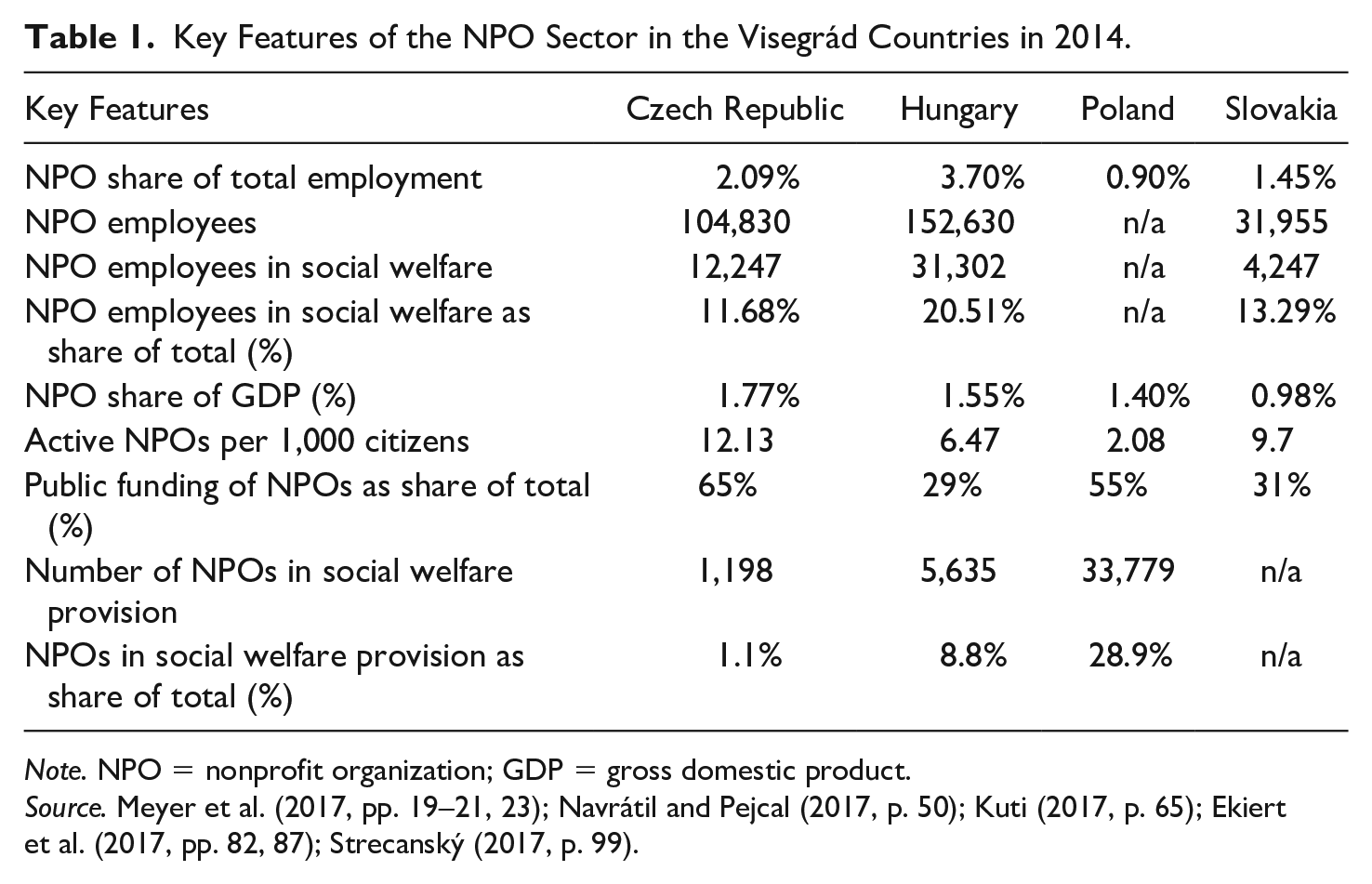
Note. NPO = nonprofit organization; GDP = gross domestic product.
Source. Meyer et al. (2017, pp. 19–21, 23); Navrátil and Pejcal (2017, p. 50); Kuti (2017, p. 65); Ekiert et al. (2017, pp. 82, 87); Strecanský (2017, p. 99).
Thus, in the years after 1989, the ECE states “had elaborated legal and institutional frameworks and built systems for government–nonprofit cooperation and awarding of government contracts for social service provision” Cook (2015, p. 2342). However, in view of the increasingly challenging economic and political environment of NPOs, especially since the 2008 financial crisis, it seems doubtful that the current state of the government–NPO relationship in ECE has been able to develop much beyond this basis. After the financial crisis of 2008 there was a turn to greater austerity and more nationalist economic policy agendas in the region, and further problems emerged or grew more serious for NPOs—governments decreased the range of services; financing agreements were confined to more short-term and niche projects; and NPOs faced stronger competition from local authorities, business providers, and church organizations (USAID, 2013, pp. 185, 192; USAID, 2014, pp. 196–197; USAID, 2015, p. 217; USAID, 2016, pp. 240–241). Poland was a partial exception to the trend, experiencing only slight declines in NGO service provision (USAID, 2014, pp. 163–164), but facing some budget cuts and increasing competition from for-profit enterprise service providers (USAID, 2015, pp. 174–175; USAID, 2016, pp. 187–188).
However, a more radical departure from the general pattern of development in ECE took place in Hungary after the election of the FIDESZ government in 2010. NPOs were replaced as favored service providers by church organizations (USAID, 2010, pp. 94–95; USAID, 2012, p. 92; USAID, 2014, p. 99), leading many NPOs to cease service provision and others to transfer to church organizations to avoid closing down. Health and social services were increasingly brought under central state control with no role for NPOs. Social welfare budgets were severely cut as the government decided to rely only on public work schemes to combat unemployment and poverty, and the low remuneration of public works basically replaced all other social benefits previously available to the poor (USAID, 2015, p. 99; USAID, 2016, pp. 116–117). Although less restricted funding is still available from taxpayers opting to give 1% of their income tax to support NPOs, the CSO sector has “lost some of its independence and become more directly influenced by political interests and the prevailing power relations” (Szalai & Svensson, 2018, pp. 113–14). In effect, “previous democratization and decentralization processes have been reversed” (Kuti, 2017, p. 61), the scope and authority of local governments have been reduced, and there has been a narrowing of “the space for local civil actions and contribution in different service provisions” (Kover, 2015, p. 194). Furthermore, the definition of public benefit status and the range of services that could be offered by NPOs have been significantly narrowed, and the board responsible for distributing public funding has been replaced by the National Cooperation Fund, which distributes fewer funds than its predecessor and is appointed centrally by the government. The government has also introduced severe restrictions on the scope for NPOs to receive funding from foreign organizations, including new legislation in 2017 requiring NPOs receiving funding from abroad to register as “foreign-funded” and to announce this on their websites and publications (USAID, 2018, p. 4). Under current arrangements, the criteria for allocating grants or contracts to NPOs entail a greater stress on national and traditional values. Central government has taken a more active role in directly allocating funding to selected NPOs whose names highlight traditional and family oriented values, many of which had been recently founded under the FIDESZ government, while many others were church-based organizations.
As of the time of writing, developments in Hungary have stood in contrast to those of the other ECE countries. However, serious concerns have emerged in the NPO sector in Poland about the establishment of a new National Center for Civic Society Development under the Deputy Prime Minister, to distribute funds to NPOs and establish priorities for their activities according to government criteria and to deny funding to organizations it disagrees with (USAID, 2018, pp. 160, 166). This threatens to impose severe restrictions on the independent NPO sector, similar to those already in place in Hungary.
Evaluating the Current Situation
In the absence of any large-scale systematic empirical research on the question, this article draws on two main available kinds of sources for assessing the relationship between governments and NPO service providers: the judgments of expert observers in the literature, and the views of representatives of the NGO sector in ECE who have direct experience as service providers, in the form of the annual reports compiled by USAID based on data and assessments gathered for their NGO Sustainability Index (later renamed the CSO Sustainability Index) which uses a standardized set of questions and methods to assess the development of civil society in Eastern Europe and Eurasia. The reports are based on assessments by representatives of the CSO sector in each country of relations between government and CSOs. In view of their narrative character, the reports are used here as background rather than as data per se. They are not based on statistically significant samples, and probably reflect the values of the USAID program, but may be useful in reflecting views within the sector in each country. These two kinds of sources are used to provide a tentative assessment of two of the three dangers discussed by Salamon and Toepler confronting NPOs in their relations with governments: loss of autonomy and distortion of agency missions. (The available sources are more limited still on questions of bureaucratization or over-professionalization.)
Questions of loss of autonomy and distortion of mission are seen as interrelated and are discussed in two aspects: (a) restrictions imposed by governments in return for agreeing to NPOs having a role in service provision, and (b) limitations on the ability of NPOs to adopt their own aims. According to Evenson (2009), although there has been a steady increase in service provision by NPOs in the region, “their ability to set agendas and influence societal and governmental efforts has not grown proportionately and, in some countries, may have become diluted” (p. 20). Their capacity to act independently from their governments and gain financial stability is undermined, she suggests, by the legal and funding environments in which they operate. This is illustrated in relation to Slovakia where, according to Strecanský (2017), social care NPOs are restricted in their delivery of services by the institutional framework and regulatory requirements imposed by central and local governments, and the government–NPO partnership is “more formal than real” as NPOs experience “persistent underfunding or poor-quality funding” (pp. 102, 104).
With regard to problems of lack of autonomy, government bodies not only decide which problem areas they want to devolve to NPOs, but they also set priorities and conditions for the NPOs. This lack of autonomy is closely related, for many NPOs, to an inability to pursue their own aims. For example, in the Czech Republic, Hungary, and Poland, many NPO representatives felt working with local governments was taking them away from their own views concerning the needs of their constituent groups (USAID, 2005, pp. 111–112, 201–202; USAID, 2007, pp. 115, 176–177), and these views were echoed in USAID reports on the Czech Republic in 2005 and again in 2008 (USAID, 2006, p. 85; USAID, 2009, pp. 97–98). In Poland, governments were described as having a paternalistic attitude to NPOs and often using them to provide nonspecialist basic services (USAID, 2006, p. 104). A recurrent theme among Polish panel members was that they were “stuck in a vicious cycle” (USAID, 2002, pp. 124–125): NGOs did not win contracts for services because of their poor standards, but they were unable to improve their standards until they began contracting services (USAID, 2007, pp. 176–177).
The system of application for funding from state and EU funds has also created problems for the independent identity of NPOs as they have had to focus on meeting conditions to receive funding rather than designing service provision themselves. Also, policies regulating service provision have not always facilitated the development of stable or predictable relations between government and NPOs. As noted by Struyk (2002, p. 434), there are three ways in which local governments may support NPOs as providers of social services. First, they can provide “in-kind assistance,” such as free or cheap office space and office services, or discounted registration fees. Second, they could provide grants or pay fees to NPOs for the delivery of services. By the turn of the century, grants had become quite common in Hungary and Poland and had been adopted to a lesser extent in other countries of the region. Third, state bodies can enter into contracts with NPOs on a more regular basis for the provision of services, and some contracts were agreed, especially in Hungary and Poland, but these were exceptional. Although contracts are seen as the most supportive arrangement for NPOs because they offer more assured and predictable payment structures, for a variety of reasons—including NPOs being unready to provide the services required; a lack of robust systems to ensure agreements were honored; political disagreements by some local authorities about devolving services; local governments not wanting competition from other providers; and local governments not being ready—grants are the preferred arrangement by local authorities throughout the region (Struyk, 2002, p. 436). Generally, by the 2000s, the type of funding NPOs received was not in the form of contracts that many NPO representatives said they preferred, but in the form of short-term grants for a specific service or period, causing more insecurity for NPOs (USAID, 2000, p. 53; USAID, 2002, pp. 79, 145–146; USAID, 2003, pp. 84, 159; USAID, 2004, pp. 180, 186; USAID, 2005, pp. 11–12, 92; USAID, 2006, p. 85; USAID, 2007, pp. 94–95, 191; USAID, 2008, p. 96).
A further problem for NPOs has been a lack of commitment by local governments to treat NPOs as preferred, or at least equal, partners in service provision. According to Moore et al. (2008, p. 10), local governments had not looked beyond the regulation of NPOs and had not clearly defined the contribution to society they could make. This rather weak relationship has continued in recent years as NPO representatives in the Czech Republic and Slovakia have reported their concerns that local governments prefer to fund state organizations or private for-profit companies to provide social services rather than NPOs (USAID, 2016, p. 231; USAID, 2017, pp. 86, 226). Until recently, NPO representatives in Poland were reporting a more favorable situation, but in 2016, they too were reporting that publicly owned service providers were receiving preferential treatment (USAID, 2017, p. 185).
For most NPOs that want to retain their independence in setting goals and defining the services they can provide, the consequences have been a chronic shortage of funds and associated restrictions in the scope of services they can offer, or a change of focus in favor either of services for which they can charge fees, or of services that can be provided at low cost by volunteers. According to Evenson (2009), “NGO analysts express a concern that dependence on public funds, whether from local, national or EU sources, has had a negative impact on NGO-constituent relations” (p. 26). In the years since 2008, local or regional government funding has continued to be the main financial source for NPO social service providers in the Czech Republic, Poland, and Slovakia, while the amount of funding has declined especially in the Czech Republic and Slovakia (USAID, 2013, pp. 70, 155, 185; USAID, 2015, p. 209).
Insufficient funding is related to budget cuts, which were affecting government–NPO relations even before the financial crisis of 2008. With the exception of Poland (USAID, 2001, pp. 129–130; USAID, 2002, pp. 124–124; USAID, 2004, p. 151), where a slow improvement continued through the 2000s, further development of NPO–government relations was limited as a result of budget cuts. Local governments were willing to use NPO providers if they could provide their services more cheaply than state-owned organizations, but this in turn created problems for the quality of NPO services, and there were often delays in NPOs receiving payments, leading to increasing indebtedness. A further problem was that the funding provided by local government bodies often fell short of the full costs to the NPOs for providing the services (USAID, 2001, pp. 69–70; USAID, 2004, pp. 136–137, 186). In the Czech Republic, for example, state funds only covered 70% of total project costs and the remaining 30% had to be found from other foreign or domestic charitable donors. These adverse conditions led some NPOs to close down (USAID, 2005, pp. 232; USAID, 2006, p. 185; USAID, 2007, pp. 115, 206–207; USAID, 2008, pp. 118–119, 209–210). After the financial crisis, NPOs continued to rely mainly on local government funding in the Czech Republic, Poland, and Slovakia, but the range and quality of their service provision was limited by further budget cuts, especially in the Czech Republic and Slovakia (USAID, 2013, p. 70; USAID, 2015, p. 75).
Although many NPOs had high hopes that, upon their countries becoming EU member states EU structural funds would be a source of more reliable and higher funding, in practice they found the procedures and regulations governing applications for such funding very difficult (USAID, 2008, pp. 118–119; USAID, 2011, p. 73; USAID, 2016, p. 89). The main problem reported by Polish NPOs was that they were having to focus on applications for these funds to the detriment of focusing on their own missions, and in 2008, it was noted that by focusing on delivering contracted services to local governments, NPOs were becoming more detached from their constituencies (USAID, 2009, pp. 183–184).
A major problem for NPOs is competition from state-owned organizations, church-based organizations, and private for-profit companies in the provision of social services, and what many NPO representatives see as a preference by local governments for these competitor organizations (USAID, 2013, p. 92; USAID, 2015, p. 175; USAID, 2016, p. 23; USAID, 2017, pp. 86, 226). In Poland, according to Ekiert et al. (2017, p. 87), some of the largest and most active NPOs have been set up by, or are closely related to, the Catholic Church, with Caritas Poland being the largest. Under pressure from competition with larger for-profit and church-based organizations, in many cases NPOs have to reduce the quantity and quality of the services they provide and rely more on a limited range of activities that can be carried out on a voluntary basis. This has been happening especially in Hungary as independent NPOs have been starved of any funding (USAID, 2017, p. 114).
However, such competition may also push some NPOs in the direction of institutional isomorphism, assuming the characteristics of organizations with which they interact or are in competition. As early as 2002, NPO representatives in Hungary were voicing concerns that they were coming to resemble state institutions due to the bureaucratic requirements of state bodies (USAID, 2003, p. 84). For Evenson (2008, p. 34), the main trend may be toward local governments establishing a particular type of NGO under their own control, known as GONGOs (government organized nongovernment organizations). Although such organizations are more common in Russia and Eurasia, she suggests, “Even in countries with diverse civil societies financial sustainability remains a significant challenge for NGOs . . . and there is a perception at least of government favouritism towards government-friendly or government-sponsored institutions.”
These trends may be seen in the context of the wider political and cultural legacies of ECE countries. In the Czech Republic, according to Navrátil and Pejcal (2017, pp. 52, 54–55), a mainly path-dependent process had taken place, drawing on the corporatist heritage of Czech society. Governments tended to see NPOs as supplementary to their own policies and exercised control through setting standards and providing grants for areas of welfare provision. In Hungary until 2010, according to Kover (2015, p. 196), the “system of civil-state cooperation in policy development and consulting can be depicted as a mixture of pluralistic and corporatist elements.” Although most NPOs operated in a mainly pluralistic and competitive field, a number of larger, umbrella-type organizations were already part of a more hierarchical, noncompetitive, corporatist structure in terms of their relations with the state—a trend which has been reinforced since 2010.
In the accounts of the academic and activist commentators on which this discussion draws, it is difficult to separate the issues of loss of autonomy and distortion of agency missions: As noted above, they are seen as closely connected and closely related in turn to financial difficulties. For most NPOs, given their small size and scarce resources, lack of expertise and professionalism seem to be bigger problems than over-professionalization. However, for NPOs that are unable to retain the integrity or coherence of their aims and goals, the choice seems to be either to accept a weak and less effective role as service providers or to lose autonomy, become subordinate to public bodies, and become increasingly influenced by the bureaucratic and professionalized approaches of such bodies.
Conclusion
The evidence reviewed above from the existing literature on government–NPO relations in social welfare is somewhat impressionistic, and there is an urgent need for more detailed research, especially survey and interview-based studies at the level of individual NPOs that would provide information on particular examples of government–NPO cooperation, what terms were negotiated, what results were achieved, and how participants on both sides of the relationship and service recipients assessed the outcomes. In that way, it would be possible to arrive at more informed conclusions about key questions such as those posed by Bode and Bransen (2014) or Salamon and Toepler (2015) on the precise nature of the relationship in specific instances, the degree to which the relationships approximate any definitions of partnership, and how the relationships with government compare to those with private donors or the fee-for-service market. A further line of enquiry would be to examine the relations between NPOs set up under the auspices of government bodies and churches to discover whether local-level officials or activists in such NPOs are able to provide any input of their own into welfare policies and procedures of the larger umbrella organizations that they operate within. This could provide interesting comparisons with the situation in Russia where social NPOs increasingly work closely with regional and local governments. Unfortunately, since such research is lacking, only the more tentative assessments above are possible from evidence that is more indirect on such questions and was collected to address slightly different questions.
As it stands, the evidence seems to support a rather negative interpretation of the state of NPO–government relations in social welfare provision in ECE. The approach adopted by governments at national and local levels in allowing NPOs a role in service provision has limited the ability of NPOs either to pursue their own aims or to preserve their autonomy, which are closely related in turn to financial difficulties as governments have regarded NPOs as a source of cheap welfare services. Thus, it is far from clear that NPOs’ relations with the state at the central or local levels approximates the ideal of a mutually beneficial partnership between independent actors, or that ECE governments have consistently put in place the kinds of arrangements proposed by Salamon and Toepler (2015) to enable such partnerships—such as by avoiding over-cumbersome administrative arrangements and performance requirements, including NPO partners in the design of programs, or by offering stable and predictable means of payment. Suspicion of NPOs by local governments has been reinforced by austerity policies adopted at the national level, as well as by the political legacies and ideologies of different governments that have formed the broader contexts for the development of a more positive government–NPO relationship.
On the other hand, for all its limitations and shortcomings, since the early 1990s the government–nonprofit relationship in the Visegrád countries (with serious reversals in Hungary since 2010, and probably Poland more recently) has proceeded farther down the road toward meaningful partnership than its counterparts in other parts of the former Soviet sphere (Smith et al., 2018, pp. 295–298). In all four countries, a supporting legal and institutional framework was established and some limited arrangements for funding were made. The more precarious economic situation since 2008 and the recent less favorable shifts in political culture and policy orientations have not completely eroded those advances. The experience of the Visegrád countries may thus offer lessons from which other countries, and other NPO sectors, in this sphere might usefully benefit.
Footnotes
Author Note
This work/article is an output of a research project implemented as part of the Basic Research Program at the National Research University Higher School of Economics (HSE).
Declaration of Conflicting Interests
The author(s) declared no potential conflicts of interest with respect to the research, authorship, and/or publication of this article.
Funding
The author(s) received no financial support for the research, authorship, and/or publication of this article.
